DESIGN FORMULATION AND EVALUATION OF FLOATING
MICROSPHERES OF TIMOLOL
Ch. Taraka Ramarao*1 and T. Yugandhar2
Department of Pharmaceutical Technology, Sri Venkateswara College of Pharmacy, Etcherla, Srikakulam, Andhra Pradesh, India-532410.
ABSTRACT
The goal of present investigation attempt was made to prepare microspheres of timolol employing by using various polymers like HPMC K15M, Eudragit S100 and ethyl cellulose to achieve an oral controlled release of the timolol. In the present study nine formulations were formulated by using HPMC K15M, Eudragit S100 and EC in various proportions (1:1, 1:2, 1:3). All the formulations were subjected to (%) Percentage yield, drug content, buoyancy time and entrapment efficiency, in vitro dissolution and release kinetics shown satisfactory results. Entrapment efficiency was increased with increased polymer concentration. On the basis of release data and graphical analysis formulation F6 shown good controlled release profile with maximum entrapment efficiency because of high polymer concentration. The co-efficient of determination indicated that the release data was best fitted with zero order kinetics. Higuchi equation explains the diffusion controlled release mechanism. The diffusion exponent ‘n’ values of Korsemeyer- Peppas model was found to be in the range of more than 1 for the Timolol floating microspheres prepared with drug and Eudragit indicating super case II transport diffusion mechanism of drug through timolol floating microspheres. The floating microsphere is possible to formulate promising controlled release timolol. The results it can be concluded that the drug release from the floating microspheres diffusion controlled. The formulations showed best appropriate balance between buoyancy and in vitro drug release. The floating microspheres are stable during shelf life.
Volume 6, Issue 16, 430-443. Research Article ISSN 2277– 7105
Article Received on 14 October 2017,
Revised on 05 Nov. 2017, Accepted on 25 Nov. 2017
DOI: 10.20959/wjpr201716-9838
*Corresponding Author
Ch. Taraka Ramarao
Department of
Pharmaceutical Technology,
Sri Venkateswara College of
Pharmacy, Etcherla,
Srikakulam, Andhra
KEYWORDS: Micro spheres; HPMC K 15M; Buoyancy; Entrapment efficiency; Percentage yield.
INTRODUCTION
Gastro retentive systems can remain in the gastric region for several hours and hence significantly prolong the GRT of drugs. Prolonged gastric retention improves bioavailability, reduces drug waste and improves solubility for drugs that are less soluble in a high pH environment. It has applications also for local drug delivery to the stomach and proximal small intestine. Gastro retention helps to provide better availability of new products with new therapeutic possibilities and substantial benefits for patients.[1,27] Timolol is a beta1 and beta2 (non-selective) adrenergic receptor blocking agent that does not have significant intrinsic sympathomimetic, direct myocardial depressant, or local anesthetic (membrane-stabilizing) activity. Timolol has a half life of (3-4 hrs) and it reaches a peak plasma concentration after 1hr. To formulate Timolol floating microspheres using polymers like HPMC K15 M, EUDRAGIT S 100 and EC for controlled delivery of anti-hypertensive drug Timolol.
MATERIALS AND METHODS
MATERIALS
Timolol, A Gift sample from Glenmark Pharmaceuticals LTD
Hydroxy propyl methyl cellulose K 15M, A Gift sample from Spectrum pharmalabs Hyderabad
Ethyl cellulose, A Gift sample from Spectrum pharmalabs Hyderabad Eudragit S100, A Gift sample from Shreeji chemicals, Mumbai NAHCO3 S D, A Gift sample from fine chemical Ltd, Mumbai
Dichloromethane, A Gift sample from S D fine chemical Ltd, Mumbai
Potassium dihydrogen phosphate, A Gift sample from S D fine chemical Ltd, Mumbai Ethanol, A Gift sample from Central drug house (p) Ltd, Bombay
Sodium hydroxide pellets, A Gift sample from S D Fine chemical Ltd, Mumbai
METHODS
Preparation of Timolol Floating Microspheres
Method used: Emulsification – solvent evaporation method
containing 0.01% tween 80 maintained at 30-400C subsequently stirred at ranging agitation speed for 30 min to allow the volatile liquid to evaporate. The microspheres formed were filtered, washed with water and dried in vacuum. The microspheres were then stored in a desiccator over fused calcium chloride.
Evaluation of Timolol Floating Microspheres
Percentage yield
Percentage practical yield of Timolol floating microspheres is calculated to know about percentage yield or efficiency of any method, thus it helps in selection of appropriate method of production. Practical yield was calculated as the weight of Timolol f l o a t i n g microspheres recovered from each batch in relation to the sum of starting material. The percentage yield of prepared Timolol f l o a t i n g microspheres was determined by using the formula.
Buoyancy percentage
Fifty milligrams of the floating microspheres were placed in 0.1N hydrochloric acid, 100 ml containing 0.02 w/v% Tween 20. The mixture was stirred at 100 rpm in a magnetic stirrer. After 12 hrs, the layer of buoyant microspheres was pipette and separated by filtration. Particles in the sinking particulate layer were separated by filtration. Particles of both types were dried in a desiccator until constant weight. Both the fractions of microspheres were weighed and buoyancy was determined by the weight ratio of floating particles to the sum of floating and sinking particles.
Where Wf and Ws are the weights of the floating and settled microspheres, respectively.
Percentage Drug Entrapment (PDE)
Theoretical Drug Content
Theoretical drug content was determined by calculation assuming that the entire Timolol present in the polymer solution used gets entrapped in Timolol floating microspheres and no loss occurs at any stage of preparation of Timolol floating microspheres.
Practical Drug Content
Practical drug content was analyzed by using the following procedure, weighed amount of Timolol floating microspheres equivalent to eight mg of Timolol floating microspheres was dissolved in 100 ml of 6.8 phosphate buffer. This solution was kept overnight for the complete dissolution of the Timolol f l o a t i n g microsphere in 6.8 phosphate buffer. This solution was filtered and further diluted to make a conc of 10 µg/ml solution. The absorbance of the solutions was measured at 294nm using double beam UV-Visible spectrophotometer against 6.8 phosphate buffer solution as blank and calculated for the percentage of drug present in the sample.
In vitro dissolution studies
The release rate of Timolol floating microspheres was determined by employing USP XXIII apparatus by rotating basket method. The dissolution test was performed using 900 ml 6.8 phosphate buffer in 37 ± 0.5°C at 50 rpm. Timolol floating microspheres equivalent to 8 mg were placed in a basket to avoid floating of microspheres. A sample (5 ml) of the solution was withdrawn from the dissolution apparatus hourly for 12 hrs and the samples were replaced with fresh dissolution medium. The samples were passed through whatman filter paper and the absorbance of these solutions was measured at 294nm Using UV Spectrophotometric method.
Drug Kinetics
To examine the drug release kinetics and mechanism, the cumulative release data were fitted to models representing zero order (Q v/s t), first order [Log(Q0-Q) v/s t], Higuchi’s square root of time (Q v/s t1/2) and Korsemeyer Peppas double log plot (log Q v/s log t) respectively, where Q is the cumulative percentage of drug released at time t and (Q0-Q) is the cumulative percentage of drug remaining after time t. In short, the results obtained from
release Vs. √T (Higuchi’s classical diffusion equation), Log of cumulative percentage drug release Vs. log Time (Peppas exponential equation).
Stability Studies
The stability studies were carried out as per ICH guidelines at 25ºC/60%RH, 30ºC/65% RH and 40ºC/75% RH for 90 days.
RESULTS AND DISCUSSIONS
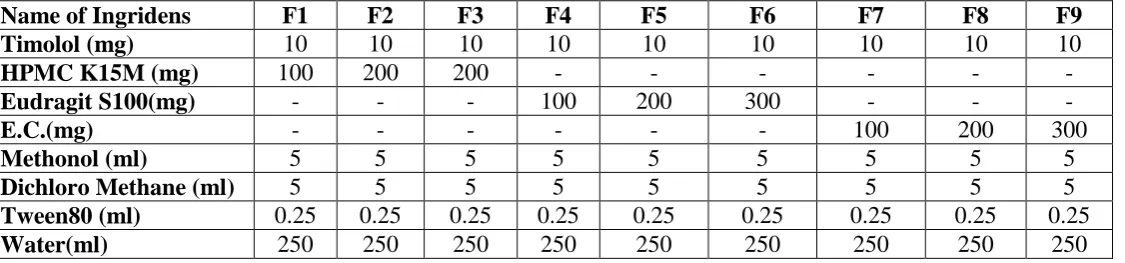
The present investigation to formulate and characterize the floating microspheres of Timolol by solvent evaporation technique with HPMC K15M, EC, Eudragit S100 as polymers in different concentration of polymer. Total nine formulations were prepared and the detailed composition is shown in Table.1. The prepared Timolol floating microspheres were then subjected to (%)Percentage yield, drug content, entrapment efficiency, in vitro dissolution, and scanning electron microscopy shown in Table.2, Table.3, Table.4, Table.5 and Fig.1 and Fig.2.
Buyounancy percentage
The microspheres floated for prolonged time over the surface of the dissolution medium without any apparent gelation. As the polymer concentration increases the buoyancy time increases. Percentage buoyancy of the microspheres was in the range 47.63% to 92.98% after 12 hrs shown in Table.2.
Percentage yield
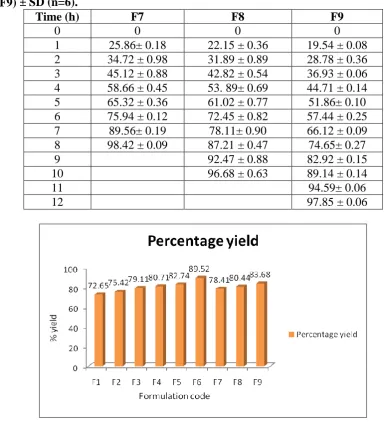
The percentage yield for Timolol floating microspheres were in the range of 72.65 to 89.52%.
Percentage drug entrapment efficiency
In vitro dissolution studies
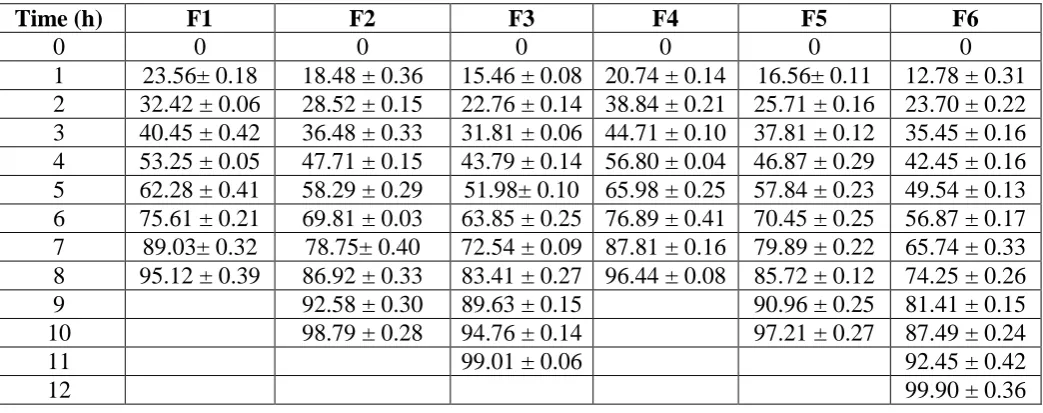
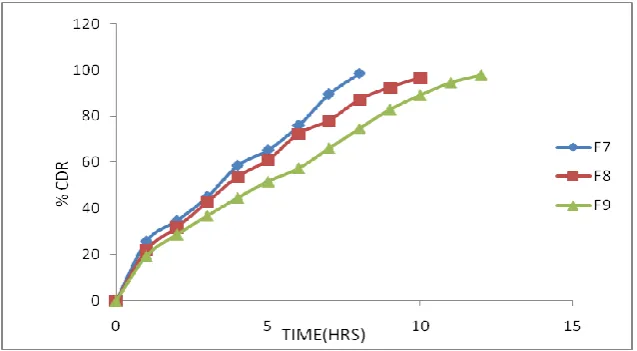
The in vitro performance of timolol floating microspheres shown in Table.4, Table.5 and Fig.3, Fig.4 and Fig.5. The formulations F1 s h o w s d r u g r e l e a s e o f 95.12%, formulations F2 s h o w s d r u g r e l e a s e o f 98.79%, formulations F3 s h o w s d r u g r e l e a s e o f 99.01%, formulations F4 s h o w s d r u g r e l e a s e o f 96.44%, formulations F5 s h o w s d r u g r e l e a s e o f 97.21%, formulations F6 s h o w s d r u g r e l e a s e o f 99.90%, formulations F7 s h o w s d r u g r e l e a s e o f 98.42%, formulations F8 s h o w s d r u g r e l e a s e o f 9 6 .68% and finally formulations F9 s h o w s d r u g r e l e a s e o f 9 7 . 85% at the end of 12 hours by comparing all the formulations, formulation (F6) containing drug and Eudragit (1:3) ratio shows best drug release of 99.90% is selected as optimized formulation.
Release kinetics of Timolol Floating Microspheres
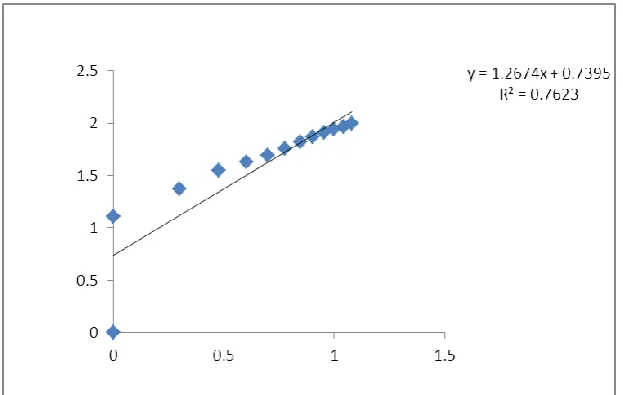
The plots of cumulative percentage drug release V/s. time, cumulative percent drug retained V/s. root time, log cumulative percent drug retained V/s. time and log cumulative percent drug release V/s. log time were graphically drawn. The slopes and the co-efficient of determinations (r2) were listed in Table.6. The co- efficient of determination indicated that the release data was best fitted with zero order kinetics. Higuchi equation explains the diffusion controlled release mechanism. The diffusion exponent ‘n’ values of Korsemeyer-Peppas model was found to be in the range more than 1 for the Timolol floating microspheres prepared with drug and Eudragit indicating super case II transport diffusion mechanism of drug through Timolol floating microspheres. Stability studies were conducted for optimized formulation (F6) which indicates there are no physical changes observed indicating it passes stability test results shown in Table.7.
Table 1: Formulation Design for Timolol Floating Microspheres using Different ratios
of Drug and Polymers.
Name of Ingridens F1 F2 F3 F4 F5 F6 F7 F8 F9
Timolol (mg) 10 10 10 10 10 10 10 10 10
HPMC K15M (mg) 100 200 200 - - - -
Eudragit S100(mg) - - - 100 200 300 - - -
E.C.(mg) - - - 100 200 300
Methonol (ml) 5 5 5 5 5 5 5 5 5
Dichloro Methane (ml) 5 5 5 5 5 5 5 5 5
Tween80 (ml) 0.25 0.25 0.25 0.25 0.25 0.25 0.25 0.25 0.25
[image:6.595.22.585.617.748.2]Table 2: Buyounacy Percentage of Timolol Floating Microsphere.
Formulation % Buoyancy time
F1 47.63±0.36 F2 56.65 ±0.20 F3 69.24 ±0.78 F4 71.15±0.98 F5 80.32 ±0.75 F6 92.98 ±0.11 F7 52.45±0.23 F8 61.14 ±0.78 F9 77.28 ±0.55
Table 3: Percentage Entrapment Efficiency, Drug content and Percentage Yield of
Prepared Formulations (F1 to F9).
Formulation Percentage yield Drug content (%) Entrapment efficiency (%)
F1 72.65 91.10 89.11
F2 75.42 92.63 90.24
F3 79.11 94.31 93.74
F4 80.71 97.11 94.89
F5 82.74 98.70 96.28
F6 89.52 99.55 99.25
F7 78.41 94.96 93.82
F8 80.44 97.85 95.89
F9 83.68 98.23 97.63
Table 4: In vitro release data of Timolol floating microspheres of different Formulations
(F1-F6) ± SD (n=6).
Time (h) F1 F2 F3 F4 F5 F6
0 0 0 0 0 0 0
1 23.56± 0.18 18.48 ± 0.36 15.46 ± 0.08 20.74 ± 0.14 16.56± 0.11 12.78 ± 0.31 2 32.42 ± 0.06 28.52 ± 0.15 22.76 ± 0.14 38.84 ± 0.21 25.71 ± 0.16 23.70 ± 0.22 3 40.45 ± 0.42 36.48 ± 0.33 31.81 ± 0.06 44.71 ± 0.10 37.81 ± 0.12 35.45 ± 0.16 4 53.25 ± 0.05 47.71 ± 0.15 43.79 ± 0.14 56.80 ± 0.04 46.87 ± 0.29 42.45 ± 0.16 5 62.28 ± 0.41 58.29 ± 0.29 51.98± 0.10 65.98 ± 0.25 57.84 ± 0.23 49.54 ± 0.13 6 75.61 ± 0.21 69.81 ± 0.03 63.85 ± 0.25 76.89 ± 0.41 70.45 ± 0.25 56.87 ± 0.17 7 89.03± 0.32 78.75± 0.40 72.54 ± 0.09 87.81 ± 0.16 79.89 ± 0.22 65.74 ± 0.33 8 95.12 ± 0.39 86.92 ± 0.33 83.41 ± 0.27 96.44 ± 0.08 85.72 ± 0.12 74.25 ± 0.26 9 92.58 ± 0.30 89.63 ± 0.15 90.96 ± 0.25 81.41 ± 0.15 10 98.79 ± 0.28 94.76 ± 0.14 97.21 ± 0.27 87.49 ± 0.24
11 99.01 ± 0.06 92.45 ± 0.42
Table 5: In vitro release data of Timolol floating microspheres of different Formulations (F7-F9) ± SD (n=6).
Time (h) F7 F8 F9
0 0 0 0
1 25.86± 0.18 22.15 ± 0.36 19.54 ± 0.08 2 34.72 ± 0.98 31.89 ± 0.89 28.78 ± 0.36 3 45.12 ± 0.88 42.82 ± 0.54 36.93 ± 0.06 4 58.66 ± 0.45 53. 89± 0.69 44.71 ± 0.14 5 65.32 ± 0.36 61.02 ± 0.77 51.86± 0.10 6 75.94 ± 0.12 72.45 ± 0.82 57.44 ± 0.25 7 89.56± 0.19 78.11± 0.90 66.12 ± 0.09 8 98.42 ± 0.09 87.21 ± 0.47 74.65± 0.27 9 92.47 ± 0.88 82.92 ± 0.15 10 96.68 ± 0.63 89.14 ± 0.14
11 94.59± 0.06
[image:8.595.141.460.554.741.2]12 97.85 ± 0.06
Fig 1: Percentage yield of Timolol floating microspheres.
Fig 3: Cumulative Percentage Drug release (%CDR) profile of Timolol Floating
microspheres Formulations (F1-F3).
Fig 4: Cumulative Percentage Drug release (%CDR) profile of Timolol Floating
microspheres Formulations (F4-F6).
Fig 5: Cumulative Percentage Drug release (%CDR) profile of Timolol Floating
[image:9.595.139.457.67.249.2] [image:9.595.137.462.311.488.2] [image:9.595.139.458.550.725.2]Fig 6: First order Drug Release Profile of Timolol Optimized Formulation (F6).
Fig 7: Higuchi Model Drug Release kinetics profile of Timolol Optimized Formulation
(F6).
Fig 8: Peppas Model Drug release kinetics profile of Timolol Optimized formulation
[image:10.595.143.455.527.724.2]Table 6: Correlation co-efficient (r2) values Timolol floating microspheres Optimized
Formulation(F6).
Formulation Zero order First order Higuchi Matrix Peppas plot
R2 value ‘n’ value
F6 0.989 0.938 0.963 0.762 1.267
Table 7: Stability studies of Optimized Formulation (F6) Before storage and After
storage.
Time(days) % Drug content
25 0C/60%RH 300C/65% RH 400C/75% RH
0 99.55 99.55 99.55
15 99.48 99.50 99.47
45 99.53 99.51 99.49
90 99.51 99.53 99.52
CONCLUSION
1. The goal of present work is to provide a therapeutic amount of (Timolol) to the proper site in the body and also to achieve and maintain the desired Timolol concentration. 2. An attempt was made to prepare microspheres of Timolol floating o/w emulsion solvent
evaporation techniques by using polymers like HPMC K15M, Eudragit S100 and EC achieve an oral controlled release of the Timolol.
3. In the present study nine formulations were formulated by using HPMC K15M, Eudragit S100 and EC in various proportions (1:1, 1:2, 1:3).
4. In pre formulation study, estimation of Timolol was carried out by Shimadzu UV spectrophotometer at λ max 294 using 6.8 buffer as buffer, which had a good reproducibility and this method was used in entire study.
5. All the formulations were subjected to (%) Percentage yield, drug content, buoyancy time and entrapment efficiency, in vitro dissolution and release kinetics shown satisfactory results.
6. Entrapment efficiency was increased with increased polymer concentration. From the results it can be inferred that there was a proper distribution of Timolol in the microspheres and the deviation was within the acceptable limits.
7. On the basis of release data and graphical analysis formulation F6 shown good controlled release profile with maximum entrapment efficiency because of high polymer concentration.
[image:11.595.76.526.111.159.2]mechanism. The diffusion exponent ‘n’ values of Korsemeyer- Peppas model was found to be in the range of more than 1 for the Timolol floating microspheres prepared with drug and Eudragit indicating super case 2 transport diffusion mechanism of drug through Timolol floating microspheres.
9. The above obtained data it can be summarized that it is possible to formulate promising controlled release floating microspheres of timolol by solvent evaporation technique using polymers like HPMC K 15 M, Eudragit and EC.
REFERENCES
1. Patel MG, Patel RH, Patel M, Patel KJ. Floating drug delivery system: An innovative approach to prolong gastric retention. Available at www.pharmainfo.net.aug.2010.
2. Garg R, Gupta GD. Progress in controlled gatroretentive delivery systems. Tropical J Pharm Res., 2008; 7(3): 1055- 66.
3. Ashford M. The gastrointestinal physiology and drug absorption. In: Pharmaceutics the science of dosage form design. Aulton ME, editor. Pharmaceutics the science of dosage form design. 2nd ed. Edinburgh: Churchill living stone. 2004; 220.
4. Wilson KR, Waugh A. Anatomy and physiology in health and illness, 9th ed. London: Churchill Livingstone, 1996.
5. Wilson CG, Washington N. The stomach: its role in oral drug delivery. Physiological Pharmaceutical: Biological Barriers to Drug Absorption. Chichester, UK: Ellis Horwood, 1989: 47-70.
6. Wong DSL. Prolonged release active agent dosage form adapted for gastric retention. US Patent, 2000; 15th Sept: 120-803.
7. Yuveraj Singh T, Naruk PS, Ojha GR. Development and evaluation of floating microspheres of Verpamil Hydrochloride. Braz J pharma sci., 2007; 43(4): 529-34.
8. Gattani YS, Kawtikwar PS, Sakarka DM. Formulation and evaluation of gastro retentive multiparticulate drug delivery system of Aceclofenac. Int J Chem Tech Res., 2009; 1(1): 1-10.
9. Yeole PG, Khan S, Patel VF. Floating drug delivery systems: Need and development. Indian J pharma Sci., 2005; 67(3): 265-72.
11.Garima, Chawla, Piyush. Gupta, Vishal. Koradia, Bansal KA. Gastro retention: A Means to address regional variability in intestinal drug absorption. Pharm tech, 2003; 27(2): 50-68.
12.R.Talukder and R.Fissihi. Gatroretentive Delivery Systems: A Mini review. Drug Dev Ind Pharmacy, 2004; 30(10): 1019-28.
13.Xu.WL, Tu.XD, Lu.ZD. Development of Gentamycin sulfate sustained-release tablets remaining-floating in stomach. Yao Hsueh Pao, 1991; 26(7): 541-45.
14.Srivastava AK, Narayanarao D. Floating microspheres of Cimetidine: formulation, characterization and in- vitro evaluation. Acta Pharm, 2005; 55: 277-85.
15.Fursule RA, Patra CN, patil GB, Kosalge SB, patil PO, Deshmukh PK. Study of multiparticulate floating drug delivery system prepared by emulsion gelation technique. Int J Chem Tech Res., 2009; 1(2): 162-7.
16.Kumaresh SS, Tejraj MA, Sunil AA, Nadagouda NM, Padmakar VK. Effect of coexcipient on drug release and floating property of Nifedipine hollow microspheres: a novel gastro retentive drug delivery system. J Appl Polym Sci., 2006; 100: 486-94.
17.Jain AK, Jain CP, Tanwar YS, Naruka, PS. Formulation characterization and in vitro evaluation of floating microspheres of Famotidine as a gastro retentive dosage form. Asian J Pharm, 2009; 3(3): 222-6.
18.Gronia R, Heun G. Oral dosage forms with controlled gastrointestinal transit. Drug Dev Ind Pharm, 1984; 10: 527-39.
19.Atyabi F, Sharma HL, Mohammad H, Fell JT. In vivo evaluation of a novel gatroretentive formulation based on ion exchange resins. J Cont Rel., 1996; 42: 105- 13.
20.Klausner A, Lavy E, Friedman M, Hoffman A. Expandable gatroretentive dosage form. J Cont Rel., 2003; 90: 143-62.
21.Singh BN, Kim HK. Floating drug delivery systems: An approach to oral controlled drug delivery via gastric retention. J Cont Rel., 2000; 63: 235-7.
22.Whitehead L, Collett JH, Fell JT. Amoxycillin release from a floating dosage form based on alginates. Int J Pharm, 2000; 210: 45-9.
23.Arora S, Ali J, Ahuja A, Khar RK, Baboota S. Floating drug delivery systems: A review. AAPS Pharm Sci Tech, 2005; 6: 372-90.
24.Mayavanshi AV, Gajjar SS. Floating drug delivery systems to increase gastric retention of drugs: A Review. Res J Pharm Tech, 2008; 1(4): 345-48.
26.Oth M, Franz M, Timmermans J, Moes A: The bilayer floating capsule: a stomach directed floating drug delivery system for Misprostal. Pharma Res., 1992; 9: 298- 302. 27.Menon A, Ritschel WA, Sakar A. Development and evaluation of a monolithic floating