Space-Time Trellis and Space-Time Block Coding
Versus Adaptive Modulation and Coding Aided
OFDM for Wideband Channels
Tong-Hooi Liew and Lajos Hanzo,
Fellow, IEEE
Abstract—The achievable performance of channel coded space-time trellis (STT) codes and space-space-time block (STB) codes trans-mitted over wideband channels is studied in the context of schemes having an effective throughput of 2 bits/symbol (BPS) and 3 BPS. At high implementational complexities, the best performance was typically provided by Alamouti’s unity-rateG2 code in both the 2-BPS and 3-BPS scenarios. However, if a low complexity imple-mentation is sought, the 3-BPS 8PSK space-time trellis code out-perfoms theG2code. TheG2space-time block code is also com-bined with symbol-by-symbol adaptive orthogonal frequency divi-sion multiplex (AOFDM) modems and turbo convolutional channel codecs for enhancing the system’s performance. It was concluded that upon exploiting the diversity effect of theG2space-time block code, the channel-induced fading effects are mitigated, and there-fore, the benefits of adaptive modulation erode. In other words, once the time- and frequency-domain fades of the wideband chan-nel have been counteracted by the diversity-aidedG2 code, the benefits of adaptive modulation erode, and hence, it is sufficient to employ fixed-mode modems. Therefore, the low-complexity ap-proach of mitigating the effects of fading can be viewed as employ-ing a semploy-ingle-transmitter, semploy-ingle-receiver-based AOFDM modem. By contrast, it is sufficient to employ fixed-mode OFDM modems when the added complexity of a two-transmitterG2scheme is afford-able.
Index Terms—Adaptive modulation and coding, HSDPA, OTDM, STBC, STTC.
I. INTRODUCTION
S
PACE-TIME block (STB) codes were proposed in the seminal contributions of Alamouti [1], as well as Tarokhet al.[2], [3], while their achievable performance was investi-gated over perfectly interleaved, nondispersive Rayleigh fading channels, for example, in [4] and [5]. Furthermore, space-time trellis (STT) codes [6]–[11] were proposed by Tarokh et al.
which incorporate jointly designed channel coding, modula-tion, transmit diversity, and optional receiver diversity. The per-formance criteria for designing space-time trellis codes were outlined in [6], under the assumption that the channel is fad-ing slowly and that the fadfad-ing is frequency nonselective. It was shown in [6] that the system’s performance is determined by ma-trices constructed from pairs of distinct code sequences. Both the diversity gain and coding gain of the codes are determined
Manuscript received December 23, 2003; revised March 6, 2005. The review of this paper was coordinated by Prof. J. Shea.
The authors are with the Department of Electronics and Computer Sci-ence, University of Southampton, Southampton, SO17 1BJ U.K. (e-mail: [email protected]).
Digital Object Identifier 10.1109/TVT.2005.861174
by the minimum rank and the minimum determinant [6], [12] of the matrices, respectively. The results were then also extended to fast fading channels. The STT codes proposed in [6] provide the best tradeoff between data rate, diversity advantage, and trellis complexity.
The performance of both STT and STB codes over narrow-band Rayleigh fading channels was investigated by numerous re-searchers [1], [3], [6], [10], [13]. The investigation of space-time codes was then also extended to the class of practical wideband fading channels. The effect of multiple propagation paths on the performance of STT codes was studied in [11] for transmission over slowly varying Rayleigh fading channels. It was shown in [11] that the presence of multiple paths does not decrease the di-versity order guaranteed by the design criteria used to construct the STT codes. The evidence provided in [11] was then also ex-tended to rapidly fading dispersive and nondispersive channels. As a further performance improvement, turbo equalization was employed in [14] in order to mitigate the effects dispersive chan-nels. However space-time coded turbo equalization involved high complexity. In addressing the complexity issues, Bauch
et al.[15] derived finite length multiple-input multiple-output (MIMO) channel filters and used them as prefilters for turbo equalizers. These prefilters significantly reduce the number of turbo equalizer states and, hence, mitigate the decoding com-plexity. As an alternative solution, the effect of intersymbol interference (ISI) could be eliminated by employing orthogo-nal frequency division multiplexing (OFDM) [16], [17]. Em-ploying a system using STT-coded OFDM is attractive, since the decoding complexity reduced, as demonstrated by the re-cent surge in research interest [13], [18]–[20]. In [13], [18] and [20], nonbinary Reed–Solomon (RS) codes were em-ployed in the STT-coded OFDM systems to improve their performance.
Similarly, the performance of STB codes was also in-vestigated over frequency-selective Rayleigh fading channels. In [21], a MIMO equalizer was utilized for equalizing the dispersive multipath channels. Furthermore, the advantages of OFDM were also exploited in STB-coded systems [13], [22], [23].
In this contribution, we assume that the readers are famil-iar with the encoding and decoding processes of both STB and STT codes [5]–[11]. This paper does not design new STT codes, block codes, error correction codes, or adaptive modu-lation schemes. The contribution of this treatise is rather that of providing system designers with a performance versus im-plementational complexity-type technology road-map, the best
design choices at a given system complexity and throughput in various propagation scenarios.
The structure of the paper is as follows. In Section II, our system model is introduced, which enables the comparison of STT and STB codes transmitted over wideband fading chan-nels. Our simulation results are then provided in Section III. We continue our investigations by employing space-time coded adaptive modulation-based OFDM in Section IV. Finally, we conclude our discourse in Section V.
II. SPACE-TIMECODEDTRANSMISSIONOVER
WIDEBANDCHANNELS
We now investigate the performance of space-time codes over dispersive wideband fading channels. As mentioned in Section I, Bauch’s approach [14], [15] of using turbo equalization for mitigating the ISI exhibits considerable complexity. Hence, we argued that using space-time-coded OFDM constitutes an at-tractive approach of communicating over dispersive wireless channels, since the associated decoding complexity is signifi-cantly lower. Therefore, in this contribution, OFDM is employed for mitigating the effects of dispersive channels.
It is widely recognized that STT codes [6] perform well at a cost of high complexity. However, Alamouti’sG2STB code [1]
could be invoked instead of STT codes. The space-time block codeG2is appealing in terms of its simplicity, although there
is a slight loss in performance. Recall that it is vital for theG2
code that the channel’s attenuation and phase rotation remains the same for its two consecutive time slots [6]. However, in order to facilitate transmissions over dispersive or wideband channels, in this contribution, we invoked OFDM, and instead of mapping the signalsx1, x2to two consecutive time slots, we
mapped them to two adjacent OFDM subcarriers.
Furthermore, we concatenated the space-time block codeG2
with turbo convolutional (TC) codes in order to improve the performance of the system. The family of TC codes was fa-vored, because it was shown in [5] that in a space-time coded context, TC codes achieve an attractive coding gain at a mod-erate complexity when compared to convolutional codes, turbo BCH codes, trellis-coded modulation, and turbo trellis-coded modulation. The performance of concatenated STB codes and TC codes will then be compared to that of STT codes. Conven-tionally, Reed–Solomon [5] (RS) codes have been employed in conjunction with the STT codes [13], [18], [20] for improving the performance of the system. In our forthcoming discussion, we will concentrate on comparing the performance of STB and STT codes in conjunction with various channel coders.
A. System Overview
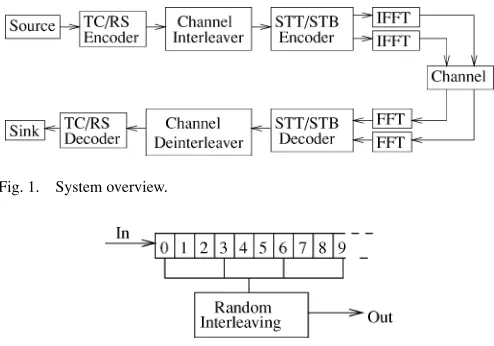
[image:2.594.306.553.65.238.2]Fig. 1 shows the schematic of the system employed in our performance study. At the transmitter, the information source generates random information data bits. The information bits are then encoded by TC codes, RS codes, or left uncoded. The coded or uncoded bits are then channel interleaved, as shown in Fig. 1. The output bits of the channel interleaver are then passed to the STT or STB encoder. We will investigate a number of STT codes proposed by Tarokhet al.[6], where the associated trellis
Fig. 1. System overview.
Fig. 2. Random separation-based interleaving.
state transition diagrams are shown, for example, in [5, Fig. 11.6–11.12]. The modulation schemes employed are 4PSK as well as 8PSK. On the other hand, from the family of STB codes, only Alamouti’sG2 code is employed in the system, since it
was shown in [5] and [24] that the best performance is achieved by concatenating the unity-rate STB codeG2 with TC codes
rather than its lower rate counterparts using a higher number of antennas. Furthermore, although turbo BCH codes, trellis coded modulation (TCM) and convolution codes were also used in the investigations of [5], [24]; again, the best performer was the TC code at a given implementational complexity. For convenience, the transmission matrix of the space-time block code G2 is
reproduced here as
G2=
x1 x2 −x¯2 x¯1
(1)
where, again,¯x2,x¯1indicate the conjugate complex versions of x2, x1. Different modulation schemes may be employed [25],
such as binary phase shift keying (BPSK), quadrature phase shift keying (QPSK), 16-level quadrature amplitude tion (16QAM), and 64-level quadrature amplitude modula-tion (64QAM). Gray mapping of the bits to symbols was applied, and this resulted in different protection classes in higher order modulation schemes [16], [17]. The mapping of the data bits and parity bits of the TC encoder was chosen such that it yielded the best achievable performance along with the application of the random separation-based channel interleaver [26].
TABLE I
PARAMETERS OF THESPACE-TIMETRELLISCODESUSED
The output of the space-time encoder was then OFDM [16], [17] modulated and transmitted by the corresponding antenna. Again, instead of mapping the signalsx1, x2to two
consecu-tive time slots having identical channel attenuation and phase rotation as in [6], we mapped them to two adjacent OFDM subcarriers. The number of transmit antennas was fixed to two, while the number of receive antennas constituted an ad-justable design parameter. Dispersive wideband channels were used, and the associated channels’ profiles will be discussed later.
At the receiver, the signal of each receive antenna is OFDM demodulated. The demodulated signals of the receiver antennas are then fed to the STT or STB decoder. The space-time decoders apply the MAP [27] or Log-MAP [28], [29] decoding algorithms for providing soft outputs for the channel decoders. If no channel codecs are employed in the system, the space-time decoders apply the Viterbi algorithm (VA) [5], [6], [30], which gives similar performance to the MAP decoder [5] (VA) at a lower complexity. The decoded bits are finally passed to the sink for the calculation of the bit error rate (BER) or frame error rate (FER).
B. Space-Time and Channel Codec Parameters
In Fig. 1, we have given an overview of the system studied. In this section, we present the parameters of the space-time codes and the channel codecs employed in the system, which are summarized in Table I. On the other hand, from the family of STB codes, only Alamouti’s G2 code is employed, since
we have shown in [24] that the best performance in the set of investigated schemes was obtained by concatenating the STB codeG2with TC codes. The transmission matrix of the code is
shown in (1), while the number of transmitters used by the STB codeG2is two, which is identical to the number of transmitters
in the STT codes shown in Table I.
We now consider the TC channel codes used. We will concen-trate on using the simple half-rateTC(2,1,3)code. Its associ-ated parameters are shown in Table II. As seen in Table III, dif-ferent modulation schemes are employed in conjunction with the concatenated STB codeG2and theTC(2,1,3)code. Since the
half-rateTC(2,1,3)code is employed, higher order modulation schemes such as 16QAM and 64QAM were chosen so that the throughput of the system remained the same as that of the system
TABLE II
ASSOCIATEDPARAMETERS OF THETC(2,1,3)CODE
TABLE III
SIMULATIONPARAMETERSASSOCIATEDWITH THETC(2,1,3)CODE
employing the STT codes without channel coding. It is widely recognized that the performance of TC codes improves upon increasing the turbo interleaver size, and near-optimum perfor-mance can be achieved using large interleaver sizes exceeding 10 000 bits. However, this performance gain is achieved at a cost of high latency, which is impractical for a delay-sensitive real-time system. On the other hand, STT codes offer impressive coding gains [6] at low latency. The decoding of the STT codes is carried out on a transmission burst-by-burst basis. In order to make a fair comparison between the systems investigated, the turbo interleaver size was chosen such that all the coded bits were hosted by one transmission burst. This enables burst-by-burst turbo decoding at the receiver. Since we employ an OFDM modem, latency may also be imposed by a high number of subcarriers in an OFDM symbol. Therefore, the turbo inter-leaver size was increased as the number of subcarriers increased in our investigations. In Table III, we summarized the modula-tion schemes and interleaver sizes used for different numbers of OFDM subcarriers in the system. The random separation based channel interleaver of [5] and [26] was used. The mapping of the data bits and parity bits into different protection classes of the higher order modulation scheme was carried out such that the best possible performance was attained. Again, this issue was addressed in [5] and [26].
RS codes [5] were employed in conjunction with the STT codes. Hard decision decoding was utilized, and the coding pa-rameters of the RS codes employed are summarized in Table IV. We note, however, that the achievable performance of RS codes may be further improved in conjunction with errors-and-erasures decoding, since the decoder is typically capable of correcting twice as many erasures as errors [31].1
TABLE IV
CODINGPARAMETERS OF THEREED-SOLOMONCODESEMPLOYED
C. Complexity Issues
In this section, we will address the implementational com-plexity issues of the systems studied. We will, however, focus mainly on the relative complexity of the systems, rather than attempting to quantify their exact complexity. In order to sim-plify our comparative study, several assumptions are stipulated. In our simplified approach, the estimated complexity of the sys-tem is deemed to depend only on that of the STT decoder and turbo decoder. In other words, the complexity associated with the modulator, demodulator, STT encoder, and decoder, as well as that of the STT encoder and turbo encoder, are assumed to be insignificant compared to the complexity of STT decoder and turbo decoder.
In [5] and [24], we have detailed our complexity estimates, where the estimated complexity of the TC decoder is assumed to depend purely on the number of trellis transitions per infor-mation data bit. This simple estimated complexity measure was also used in as the basis of our comparisons.
In [5, Fig. 11.6–11.12], we have shown the state diagrams of the 4PSK and 8PSK STT codes used here. From these state di-agrams, we can see that the number of trellis transitions leaving each state is equivalent to2BPS, where BPS denotes the number
of transmitted bits per modulation symbol. Since the number of information bits is equal to BPS, we can approximate the complexity of the STT decoder as
comp{STT}= 2
BPS×No. of States
BPS
= 2BPS-1×No. of States. (2)
Applying (2) and assuming that the Viterbi decoding algorithm was employed, we tabulated the approximated complexities of the STT decoder in Table V.
III. SIMULATIONRESULTS
In this section, we will present our simulation results char-acterizing the OFDM-based system investigated. As mentioned previously, we will investigate the system’s performance over dispersive wideband Rayleigh fading channels. We will com-mence our investigations using a simple two-ray channel im-pulse response (CIR) having equal tap weights, followed by a more realistic wireless asynchronous transfer mode (WATM) channel [16], [17]. In the CIR of the two-ray model, the re-flected path has the same amplitude as the line of sight (LOS) path, although arriving 5µs later. However, in our later simu-lations, we also present performance results for transmissions over two-ray channels separated by various delay spreads,
rang-TABLE V
ESTIMATEDCOMPLEXITY OF THESTT DECODERS
Fig. 3. Baseband representation of the simple twin transmitter STB codeG2
of (1) using one receiver over varying fading conditions.
ing up to 40µs. Jakes’ model [32] was adapted for modeling the fading channels. Initially, a 128-subcarrier OFDM symbol was employed, having a guard period of 40µs. The guard pe-riod of 40µs corresponded to a cyclic extension of 32 samples, which was sufficiently long for overcoming the inter-OFDM symbol interference imposed by the dispersive channel’s mem-ory. We assumed furthermore that the average signal power received from each transmitter antenna was the same, that all multipath components undergo independent Rayleigh fading, and that the receiver has a perfect knowledge of the CIR. We note that the above assumptions are aften unrealistic, yielding the best-case performance, nonetheless facilitating the perfor-mance comparison of the various techniques under identical circumstances.
A. Space-Time Coding Comparison—Throughput of 2 BPS and 3 BPS
In Fig. 4, we show our FER performance comparison be-tween 4PSK STT codes and the STB codeG2concatenated with
Fig. 4. FER performance comparison between various 4PSK STT codes and the STB codeG2concatenated with the TC(2,1,3)code using one receiver and
the 128-subcarrier OFDM modem over a channel having a CIR characterized by two equal-power rays separated by a delay spread of 5µs. The maximum Doppler frequency was 200 Hz. The effective throughput was 2 BPS, and the coding parameters are shown in Tables I–III.
OFDM modem. The CIR had two equal power rays separated by a delay spread of 5µs, and the maximum Doppler frequency was 200 Hz. The TC(2,1,3)code is a half-rate code, and hence, 16QAM was employed in order to support the same 2 BPS throughput as the 4PSK space-time trellis codes using no chan-nel codes. We can clearly see that at FER= 10−3, the perfor-mance of the concatenated scheme is at least 7 dB better than that of then STT codes.
The performance of the STB codeG2 without TC(2,1,3)
channel coding is also shown in Fig. 4. It can be seen in the fig-ure that without channel coding, the STB codeG2does not
per-form well, exhibiting a residual BER, which is a consequence of the channel-induced intersubcarrier interference of the OFDM modem, rendering the channel transfer factors of theG2code’s x1 andx2 components different. This issue will be addressed
in more depth during our subsequent discourse. Moreover, at highEb/N0values, the performance of the single-transmitter,
single-receiver system is better than that of the STB codeG2.
This is because the assumption that the fading is constant over the two consecutive transmission instants is no longer valid in this situation. Here, the two consecutive transmission instants are associated with two adjacent subcarriers in the OFDM sym-bol, and the fading variation is relatively fast in the frequency domain. Therefore, the orthogonality of the space-time code has been destroyed by the frequency-domain variation of the fading envelope. At the receiver, the combiner can no longer separate the two different transmitted signals x1 andx2. Specifically,
the signals interfere with each other. The increase in SNR does not improve the performance of the STB codeG2, since this
also increases the power of the interfering signal. We will ad-dress this issue more explicitly in Section III-B. By contrast, the TC(2,1,3)channel codec succeeds in overcoming this problem. However, we will show in Section III-B that the concatenated
Fig. 5. BER performance comparison between various 4PSK STT codes and the STB codeG2concatenated with the TC(2,1,3)code using one receiver and
the 128-subcarrier OFDM modem over a channel having a CIR characterized by two equal-power rays separated by a delay spread of 5µs. The maximum Doppler frequency was 200 Hz. The effective throughput was 2 BPS, and the coding parameters are shown in Tables I–III.
channel-coded scheme exhibits the same residual BER problem if the channel’s variation becomes more rapid.
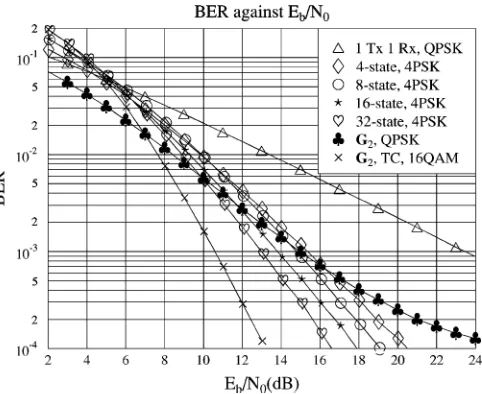
In Fig. 5, we provide the corresponding BER performance comparison between the 4PSK STT codes and the STB codeG2
concatenated with the TC(2,1,3)code using one receiver and the 128-subcarrier OFDM modem over a channel characterized by two equal power rays separated by a delay spread of 5µs and having a maximum Doppler frequency of 200 Hz. Again, we show in the figure that the 2 BPS throughput concatenated G2/TC(2,1,3)scheme outperforms the 2 BPS STT codes using
no channel coding. At a BER of10−4, the concatenated channel
coded scheme is at least 2-dB superior in SNR terms to the STT codes using no channel codes. At highEb/N0values, the
STB codeG2again exhibits a residual BER. On the other hand,
at low Eb/N0 values, the latter outperforms the concatenated
G2/TC(2,1,3)channel-coded scheme as well as the STT codes
using no channel coding.
In [5] and [24] and in Section II-C, we have derived the complexity estimates of the TC decoders and STT decoders, respectively. By employing (2) and the equations in [24], we compare the performance of the schemes studied while considering their approximate complexity. Our performance comparison of the various schemes was carried out on the basis of the coding gain defined as the Eb/N0 difference,
expressed in decibels, at FER= 10−3 between the schemes
studied and the uncoded single-transmitter, single-receiver system having the same throughput of 2 BPS. In Fig. 6, we show our coding gain versus estimated complexity comparison for the various 4PSK STT codes and the STB codeG2 concatenated
[image:5.594.41.288.67.264.2]Fig. 6. Coding gain versus estimated complexity for the various 4PSK STT codes and the STB codeG2concatenated with the TC(2,1,3)code using one
as well as two receivers and the 128-subcarrier OFDM modem over a channel having a CIR characterized by two equal-power rays separated by a delay spread of 5µs. The maximum Doppler frequency was 200 Hz. The effective throughput was 2 BPS, and the coding parameters are shown in Tables I–III.
the number of trellis states. By constrast, the estimated com-plexity of the TC(2,1,3)code was increased by increasing the number of turbo iterations. The coding gain of the concatenated G2/TC(2,1,3)scheme using one, two, four, and eight iterations
is shown in Fig. 6. It can be seen that the concatenated scheme outperforms the space-time trellis codes using no channel cod-ing, even though the number of turbo iterations was only one. Moreover, the improvement in coding gain was obtained at an estimated complexity comparable to that of the 32-state 4PSK space-time trellis code using no channel coding. From the figure, we can also see that the performance gain of the concatenated G2/TC(2,1,3)channel-coded scheme over the STT codes
be-comes lower when the number of receivers is increased to two. Due to space limitations, the FER and BER curves of the corresponding 8PSK-based 3-BPS transceivers are not included here. However, similarly to the 2-BPS schemes of Fig. 6, we compare the performance of the 3-BPS throughput schemes by considering their approximate decoding complexity. The deriva-tion of the estimated complexity has been detailed in [5] and [24] and Section II-C. As mentioned previously, the performance comparison of the various schemes was made on the basis of the coding gain defined as theEb/N0difference, expressed in
deci-bels, at a FER= 10−3 between the schemes investigated and
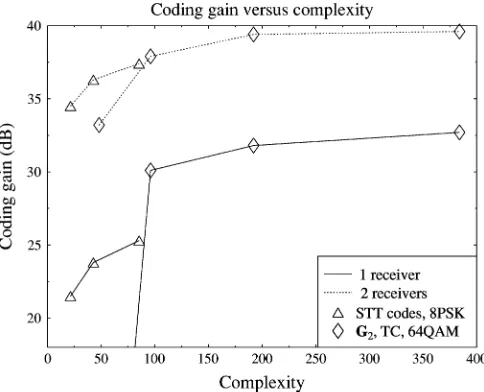
the uncoded single-transmitter, single-receiver system having a throughput of 3 BPS. In Fig. 7, we show the associated coding gain versus estimated complexity curves for the 8PSK space-time trellis codes using no channel coding and the STB code G2concatenated with the TC(2,1,3)code using one and two
receivers and the 128-subcarrier OFDM modem. For the sake of consistency, the CIR again exhibited two equal power rays separated by a delay spread of 5µs and a maximum Doppler fre-quency of 200 Hz. Again, the estimated complexity of the STT codes was increased by increasing the number of states. On the other hand, the estimated complexity of the TC(2,1,3)code
Fig. 7. Coding gain versus estimated complexity for the various 8PSK STT codes and the STB codeG2concatenated with the TC(2,1,3)code using one
and two receivers and the 128-subcarrier OFDM modem over a channel having a CIR characterized by two equal-power rays separated by a delay spread of 5µs. The maximum Doppler frequency was 200 Hz. The effective throughput was 3 BPS, and the coding parameters are shown in Tables I–III.
was increased by increasing the number of iterations. The coding gain of the concatenated channel-coded scheme invoking one, two, four, and eight iterations is shown in Fig. 7. Previously, in Fig. 6, we have shown that the concatenated TC(2,1,3)-coded scheme using one iteration outperformed the STT codes using no channel coding. However, in Fig. 7, the concatenated scheme does not exhibit the same performance trend. For the case of one receiver, the concatenated scheme using one iteration has a neg-ative coding gain and exhibits a saturation effect. This is again due to the employment of the high-order 64QAM scheme, which has a preponderance to exceed the channel’s capacity. Again, we can also see that the performance gain of the concatenated G2/TC(2,1,3)-coded scheme over the STT codes using no
channel coding becomes smaller when the number of receivers is increased to two. Having studied the performance of the var-ious schemes over the channel characterized by the two-path, 5-µdispersion CIR at a fixed Doppler frequency of 200 Hz, we next study the effects of varying the Doppler frequency.
B. Effect of Delay Spreads
In this section, we will study how the variation of the delay spread between the two paths of the channel affects system performance. By varying the delay spread, the channel’s frequency-domain response varies as well. In Fig. 8, we show the fading amplitude variation of the 128 subcarriers in an OFDM symbol for a delay spread of (a) 5, (b) 10, (c) 20, and (d) 40µs. It can be seen from the figure that the fading amplitudes vary more rapidly when the delay spread is increased. For the code STB G2, the fading envelopes of the two consecutive
[image:6.594.44.291.67.263.2]Fig. 8. Frequency-domain fading magnitudes of the 128 subcarriers in an OFDM symbol for an equal tap gain two-path channel having a tap separation of (a) 5, (b) 10, (d) 20, and (c) 40µs.
frequency-domain fading envelope will eventually destroy the orthogonality of the STB codeG2.
When communicating over dispersive channels, the two trans-mission instants of theG2code may no longer be assumed to
be associated with the same complex frequency-domain channel transfer function values. The figure shows the baseband repre-sentation of the simple twin-transmitter space-time block code G2of (1) using one receiver. At the receiver, we have
y1=h1,1x1+h2,1x2+n1 (3)
y2=−h1,2x¯2+h2,2x¯1+n2 (4)
wherey1is the first received signal, andy2is the second. Both
signals y1 andy2 are passed to the combiner in order to
ex-tract the signals x1 andx2. Aided by the channel estimator,
which in this example provides perfect estimation of the diver-sity channel’s frequency-domain transfer functions, the com-biner performs simple signal processing in order to separate the signalsx1andx2. Specifically, in order to extract the signalx1,
it combines signalsy1andy2as follows:
˜
x1= ¯h1,1y1+h2,2y¯2
= ¯h1,1h1,1x1+ ¯h1,1h2,1x2+ ¯h1,1n1−h2,2¯h1,2x2
+h2,2h¯2,2x1+h2,2¯n2
= (|h1,1|2+|h2,2|2)x1+ (¯h1,1h2,1−h2,2¯h1,2)x2
+ ¯h1,1n1+h2,2n¯2. (5)
A similarly simple symmetric expression may be generated for
x2. In contrast to the prefect cancellation scenario of [1], we can
see from (5) that the signalsx1andx2now interfere with each
other since the second round-bracketed term becomes nonzero. Hence, we can no longer cancel the cross-coupling of signalsx2
andx1in (5) unless the fading envelopes satisfy the condition
ofh1,1=h1,2andh2,1=h2,2.
At high SNRs, the noise power is insignificant compared to the transmitted power of the signalsx1 andx2. Therefore, we
can ignore the noise termsnin (5) However, the interference signal’s power increases as we increase the transmission power. Assuming that both the signals x1 andx2 have an equivalent
signal power, we can then express the signal-to-interference ratio (SIR) for signalx1as
SIR= |h1,1|
2
+|h2,2|2
¯
h1,1h2,1−h2,2¯h1,2
(6)
and again, a similarly simple symmetric expression may be generated for the SIR ofx2.
In Fig. 9, we show the FER performance of the STB code G2concatenated with the TC(2,1,3)code using one receiver
and the 128-subcarrier 16QAM OFDM modem as a function of the delay spread. The CIR has two equal power rays sep-arated by various delay spreads and a maximum Doppler fre-quency of 200 Hz. As we can see in (6), we have SIR→ ∞if
h1,1=h1,2andh2,1=h2,2. On the other hand, we encounter
SIR→1ifh1,1=δ1h1,2 andh2,1=δ2h2,2, whereδ1→ ∞,
andδ2→ ∞. Since the SIR decreases, when the delay spread
increases due to the rapidly fluctuating frequency-domain fading envelopes, as shown in Fig. 8, we can see in Fig. 9 that the per-formance of the concatenated scheme degrades when increasing the delay spread. When the delay spread is more than 15µs, we can see from the figure that the concatenated scheme exhibits the previously observed BER-curve flattening effect. Furthermore, the error floor of the concatenated scheme becomes higher as the delay spread is increased.
In Fig. 10, we quantify theEb/N0value required for
main-taining FER= 10−3 versus the delay spread for the 32-state
Fig. 9. FER performance of the STB code G2 concatenated with the
[image:8.594.45.290.67.268.2]TC(2,1,3)code using one receiver, the 128-subcarrier OFDM modem, and 16QAM. The CIR exhibits two equal-power rays separated by various delay spreads and a maximum Doppler frequency of 200 Hz. The coding parameters are shown in Tables I–III.
Fig. 10. Eb/N0values required for maintaining FER= 10−3versus delay spreads for the 32-state 4PSK space-time trellis code and for the space-time block code G2 concatenated with the TC(2,1,3)code using one receiver
and the 128-subcarrier OFDM modem. The CIR exhibited two equal power rays separated by various delay spreads and a maximum Doppler frequency of 200 Hz. The effective throughput was 2 BPS, and the coding parameters are shown in Tables I–III. The SIR of various delay spreads are shown as well.
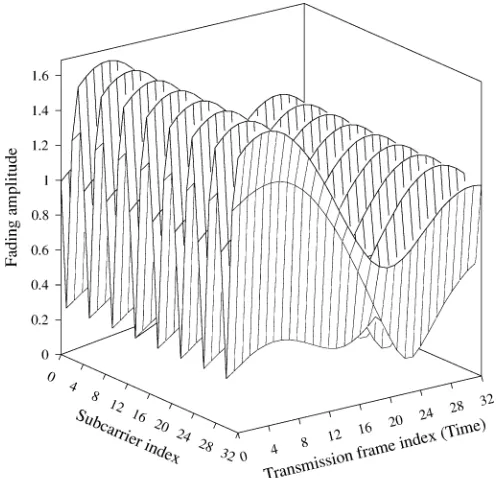
[image:8.594.46.288.330.505.2]the TC(2,1,3)code using one receiver and the 128-subcarrier OFDM modem. The CIR exhibited two equal power rays sep-arated by various delay spreads. The maximum Doppler fre-quency was 200 Hz. We can see in the figure that the per-formance of the 32-state 4PSK space-time trellis code does not vary significantly with the delay spread. However, the con-catenated TC(2,1,3)-coded scheme suffers severe performance degradation upon increasing the delay spread, as evidenced by the associated error floors shown in Fig. 9. The SIR associated with the various delay spreads was obtained using computer simulations, and the associated SIR values are also shown in Fig. 10, denoted by the hearts. As expected, the calculated SIR decreases with the delay spread. We can see in the figure that
Fig. 11. Fading amplitude versus time and frequency for various 128-subcarrier OFDM symbols over the two-path channel exhibiting two equal power rays separated by a delay spread of 40µs and maximum Doppler fre-quency of 100 Hz.
the performance of the concatenated G2/TC(2,1,3) scheme
suffers severe degradation when the delay spread is in excess of 15µs, as indicated by the near-vertical curve marked by trian-gles. If we relate this curve to the SIR curve marked by the hearts, we can see from the figure that the SIR is approximately 10 dB. Hence, the SIR of the concatenatedG2/TC(2,1,3)scheme has
to be more than 10 dB for it to outperform the STT codes using no channel coding.
C. High-Delay System
Previously, we have provided simulation results for a low-delay OFDM symbol-by-symbol decoded system. More explic-itly, the received OFDM symbol had to be demodulated and de-coded on an OFDM symbol-by-symbol basis in order to provide decoded bits for example for a low-delay interactive speech [33] or video [34] source decoder. Therefore, the two transmission in-stants of the STB codeG2had to be in the same OFDM symbol.
Fig. 12. FER performance comparison between adjacent subcarriers and ad-jacent OFDM symbols allocation for the STB codeG2concatenated with the
TC(2,1,3)code using one receiver, the 128-subcarrier OFDM modem, and 16QAM over a channel having a CIR characterized by two equal-power rays separated by a delay spread of 40µs. The maximum Doppler frequency was 100 Hz. The coding parameters are shown in Tables I–III.
implies that the SIR attained would be higher if we were to al-locate the two transmission instants of the STB codeG2to the
same subcarrier of consecutive OFDM symbols. This increase in SIR is achieved by doubling the delay of the system, since in this scenario, two consecutive OFDM symbols have to be decoded before all the received data becomes available.
In Fig. 12, we show our FER performance comparison for the preceding two scenarios, namely, using two adjacent subcarri-ers and the same subcarrier in two consecutive OFDM symbols for the STB codeG2 concatenated with the TC(2,1,3)code
using one 128-subcarrier 16QAM OFDM receiver. As before, the CIR exhibited two equal power rays separated by a delay spread of 40µs and a maximum Doppler frequency of 100 Hz. It can be seen from the figure that there is a severe perfor-mance degradation if the two transmission instants of the STB G2are allocated to two adjacent subcarriers. This is evidenced
by the near-horizontal curve marked by diamonds across the figure. On the other hand, upon assuming that having a delay of two OFDM-symbol durations does not pose any problems in terms of real-time interactive communications, we can allo-cate the two transmission instants of the space-time block code G2to the same subcarrier of two consecutive OFDM symbols.
From Fig. 12, we can observe a dramatic improvement over the previous allocation method. Furthermore, the figure also indi-cates that by tolerating a two OFDM-symbol delay, the concate-nated G2/TC(2,1,3) scheme outperforms the 32-state 4PSK
space-time trellis code by approximately 2 dB in terms of the requiredEb/N0value at a FER of10−3.
Since the two transmission instants of the STB codeG2are
allocated to the same subcarrier of two consecutive OFDM sym-bols, it is the maximum Doppler frequency that would affect the performance of the concatenated scheme more gravely, rather than the delay spread. Hence, we extended our studies to
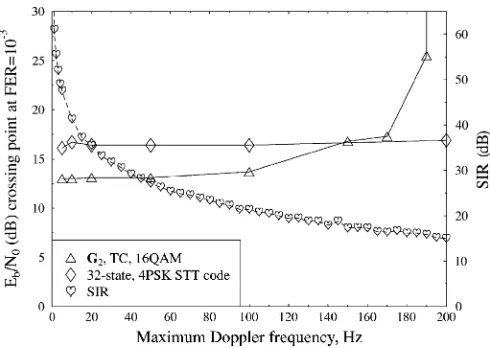
con-Fig. 13. Eb/N0value required for maintaining FER= 10−3versus the max-imum Doppler frequency for the 32-state 4PSK STT code and for the ad-jacent OFDM symbols allocation of the STB code G2 concatenated with
the TC(2,1,3)code using one receiver and the 128-subcarrier OFDM mo-dem. The CIR exhibited two equal power rays separated by a delay spread of 40µs. The effective throughput was 2 BPS, and the coding parameters are shown in Tables I–III. The SIR of various maximum Doppler frequencies are shown as well.
sider the effects of the maximum Doppler frequency on the per-formance of the concatenatedG2/TC(2,1,3)scheme.
Specif-ically, Fig. 13 shows theEb/N0 values required for
maintain-ingFER = 10−3versus the Doppler frequency for the 32-state
4PSK STT code and for the STB codeG2concatenated with the
TC(2,1,3)code using one 128-subcarrier 16QAM OFDM re-ceiver when mapping the two transmission instants to the same subcarrier of two consecutive OFDM symbols. The channel ex-hibited two equal power rays separated by a delay spread of 40µs and various maximum Doppler frequencies. The SIR achiev-able at various maximum Doppler frequencies is also shown in Fig. 13. Again, we can see that the performance of the concate-natedG2/TC(2,1,3)scheme suffers severely if the maximum
Doppler frequency is above 160 Hz. More precisely, we can surmise that in order for the concatenated scheme to outperform the 32-state 4PSK space-time trellis code, the SIR should be at least 15 dB, which is about the same as the required SIR in Fig. 10. From Figs. 10 and 13, we can conclude that the con-catenatedG2/TC(2,1,3)scheme performs better if the SIR is
in excess of about 10–15 dB.
IV. SPACE-TIMECODEDADAPTIVEMODULATION FOROFDM
A. Adaptive Modulation
[image:9.594.42.285.69.268.2]employment in the third-generation wireless system’s [46], [47] high-speed data packet access mode.
Recently adaptive modulation was also invoked in the con-text of OFDM, which was termed adaptive OFDM (AOFDM) [16], [17], [41], [42], [48]. AOFDM exploits the variation of the signal quality, both in the time domain as well as in the fre-quency domain. In what is known as subband adaptive OFDM transmission, all subcarriers in an AOFDM symbol are split into blocks of adjacent subcarriers referred to as subbands. The same modulation scheme is employed for all subcarriers of the same subband. This substantially simplifies the task of signaling the modulation modes, since there are typically four modes and, for example, 32 subbands, requiring a total of 64 AOFDM mode signaling bits.
B. Turbo-Coded and Space-Time-Coded Adaptive OFDM
In this section, the adaptive OFDM philosophy portrayed, for example, in [16], [17], [41], [42], and [49] is extended in order to exploit the advantages of multiple transmit and receive an-tennas. Additionally, turbo coding is employed for improving the performance of the system. The system schematic of the turbo-coded and space-time-coded adaptive OFDM system is identical to that in Fig. 1, except that, additionally, the AOFDM modes have to be signaled from the receiver estimating the channel quality to the remote transmitter using this information for activating the required AOFDM mode. Similarly to Fig. 1, random data bits are generated and encoded by the TC(2,1,3) encoder using an octal generator polynomial of (7, 5). Various coding rates were used in conjunction with the different mod-ulation mode, which were generated by appropriately punctur-ing [5] the TC(2,1,3)codec. The encoded bits were channel interleaved and passed to the modulator. The choice of the mod-ulation scheme to be used by the transmitter for its next OFDM symbol is determined by the channel quality estimate of the receiver based on the current OFDM symbol. In this study, we assumed perfect channel quality estimation and perfect signal-ing of the required modem mode of each subband based on the channel quality estimate acquired during the current OFDM symbol. Aided by the perfect channel quality estimator, the re-ceiver determines the highest throughput modulation mode to be employed by the transmiter for its next transmission while maintaining the system’s target BER. Five possible transmis-sion modes were employed in our investigations, which are no transmission (NoTx), BPSK, QPSK, 16QAM, and 64QAM. In order to simplify the task of signaling the required modulation modes, we employed the subband adaptive OFDM transmission scheme detailed, for example, in [16], [17], [41], [42], and [49]. The modulated signals were then passed to the encoder of the STB code G2. The space-time encoded signals were OFDM
modulated and transmitted by the corresponding antennas. The number of receivers invoked constitutes a design pa-rameter. The received signals were OFDM demodulated and passed to the space-time decoders. Log-MAP [29] decoding of the received space-time signals was performed in order to pro-vide soft-outputs for the TC(2,1,3)decoder. Assuming that the demodulator of the receiver has perfect knowledge of the
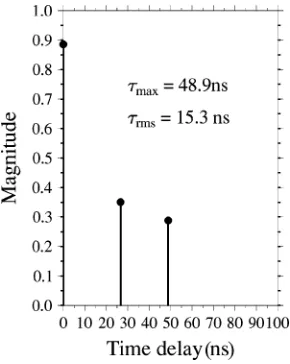
instan-Fig. 14. Short WATM channel impulse response.
taneous channel quality, this information is passed to the trans-mitter in order to determine its next AOFDM modulation mode allocation. The received bits were then channel deinterleaved and passed to the TC decoder, which employs the Log-MAP decoding algorithm [28]. The decoded bits were finally passed to the sink for calculation of the BER.
C. Simulation Results
1) Shortened WATM Channel: The shortened WATM chan-nel was used, and its CIR profile is portrayed in Fig. 14. The system used 512 subcarriers, and each OFDM symbol was ex-tended with a cyclic prefix of length 64. The sampling rate was 225 Msamples/s, and the carrier frequency was 60 GHz. In [16] and [17] two WATM CIRs were used, namely, a five-path and a three-path model, where the latter was referred to as the short-ened WATM CIR. This CIR was used also in our investigations here, which is depicted in Fig. 14, where the longest delay path arrived at a delay of 48.9 ns, which corresponds to 11 sample periods at the 225 Msamples/s sampling rate.
2) Space-Time Coded Adaptive OFDM: In this section, we employ the fixed threshold-based modem mode selection algorithm, which was also used in [16] and [17], adapting the techniques of [39], [50], and [51] for serial modems. It was as-sumed that the channel quality was constant for all the symbols in a transmission burst, i.e., that the channel’s fading enve-lope varied slowly across the transmission burst. Under these conditions, all the transmitted symbols are modulated using the same modulation mode, chosen according to the predicted SNR. Torrance optimized the modem mode switching thresh-olds [39], [50], [51] for the target BERs of 10−2 and 10−4,
[image:10.594.358.503.66.248.2]TABLE VI
OPTIMIZEDSWITCHINGLEVELSQUOTEDFROM[39]FORADAPTIVE MODULATIONOVERRAYLEIGHFADINGCHANNELS FOR THESPEECH AND DATASYSTEMS, SHOWN ININSTANTANEOUSCHANNELSNR (INDECIBELS)
Fig. 15. BER and BPS performance of 16-subband AOFDM employing the STB codeG2 using multiple receivers for a target BER of10−4 over the
shortened WATM channel shown in Fig. 14. The switching thresholds are shown in Table VI.
problem, since state-of-the-art wireless systems, such as, for example, IMT-2000 [25], have a high-rate, low-delay signal-ing channel. This modem mode signalsignal-ing feedback information is utilized by the transmitter for selecting the next modulation mode. Specifically, a given modulation mode is selected if the instantaneous channel SNR perceived by the receiver exceeds the corresponding switching levels shown in Fig. 15, depending on the target BER.
As mentioned previously, the adaptation algorithm of [39], [50] and [51] assumes constant instantaneous channel SNR over the whole transmission burst. However, in the case of an OFDM system transmitting over frequency-selective chan-nels, the channels’ quality varies across the different subcarri-ers. In [16], [17], and [49], the lowest quality subcarrier of the subband is employed for controlling the adaptation algorithm, which is based on the switching thresholds given in Table VI. Again, this approach significantly simplifies the signaling, and therefore, it was also adopted in our investigations.
In Fig. 15, we show the BER and BPS performance of the 16-subband AOFDM scheme employing the STB codeG2in
con-junction with multiple receivers and a target BER of10−4over
the shortened WATM channel shown in Fig. 14. The switching thresholds are shown in Table VI. The performance of the con-ventional AOFDM scheme using no diversity [16], [17] is also shown in the figure. From Fig. 15, we can see that the BPS per-formance of the space-time coded AOFDM scheme using one receiver is better than that of the conventional AOFDM scheme.
The associated performance gain improves as the throughput in-creases. At a throughput of 6 BPS, the space-time coded scheme outperforms the conventional scheme by at least 10 dB inEb/N0
terms. However, we notice in Fig. 15 that as a secondary effect, the BER performance of the space-time coded AOFDM scheme using one receiver degrades as we increase the average channel SNR. Again, this problem is due to the interference of signalsx1
andx2caused by the rapidly varying frequency-domain fading
envelope across the subcarriers. We note that it is possible to take into account this interference source in the calculation of the effective signal to interference plus noise ratio (SINR).
At high SNRs, predominantly 64QAM was employed. Since the constellation points in 64QAM are densely packed, this mod-ulation mode is more sensitive to the “cross-talk” of the signals
x1andx2. This limited the BER performance to10−3even at
high SNRs. However, at SNRs lower than 30 dB, typically more robust modulation modes were employed, and hence, the target BER of10−4was readily met. We will show in the next section
that this problem can be overcome by employing turbo channel coding in the system.
In Fig. 15, we also observe that the BER and BPS perfor-mance improves as we increase the number of AOFDM re-ceivers, since the dispersion-induced interference between the signalsx1andx2is eliminated. With six AOFDM receivers, the
BER of the system drops below10−8when the average channel
SNR exceeds 25 dB, and in the SNR-range investigated, there was no sign of a residual BER. It is also interesting to note the undulating nature of the BER curve, which is due to the fact that fixed AOFDM mode switching thresholds were used, and when activating switching to a higher throughput AOFDM mode, the BER inevitably increased first, before decreasing upon further increasing of the SNR. It is also worth mentioning that the AOFDM switching thresholds were optimized follow-ing the AOFDM design procedures of [16] and [17]. However, more recent research augmented the fact the optimum switching thresholds are slightly SNR-dependent [17], [37], and hence, the thresholds employed here were somewhat suboptimum.
In Fig. 16, we show the instantaneous channel SNR experienced by the 512-subcarrier OFDM symbols for a single-transmitter, single-receiver scheme and for the STB code G2 using two receivers over the shortened WATM channel.
The average channel SNR is 10 dB. We can see in Fig. 16 that the variation of the instantaneous channel SNR for a single transmitter and single receiver is fast and severe. The instan-taneous channel SNR may become as low as 4 dB due to deep fades of the channel. On the other hand, we can see that for the STB code G2 using two receivers, the variation in the
Fig. 16. Instantaneous channel SNR of 512-subcarrier OFDM symbols for single-transmitter single-receiver and for the space-time block codeG2using two
receivers over the shortened WATM channel shown in Fig. 14. The average channel SNR is 10 dB.
of the channel magnitude and phase becomes lower. Effectively, by employing higher order diversity, the fading channels have been converted to near-constant magnitude AWGN-like chan-nels, as evidenced by the STB codeG2using two receivers. In
conclusion, since adaptive modulation only offers advantages over fading channels, we argue that using adaptive modulation might become unnecessary as the diversity order is increased.
To elaborate further, we surmise from Fig. 16 that fixed mod-ulation schemes might become more attractive when the diver-sity order increases, which is achieved in this case by employ-ing more receivers. This is because for a certain average channel SNR, the probability of a particular modulation mode increases. In other words, the fading channel has become an AWGN-like channel, as the diversity order is increased. In Fig. 17, we show our throughput performance comparison between AOFDM and fixed modulation-based OFDM in conjunction with the STB codeG2employing 1) one receiver and 2) two receivers over
the shortened WATM channel. The throughput of fixed OFDM was 1, 2, 4, and 6 BPS, and the corresponding Eb/N0 values
were extracted from the associated BER versusEb/N0curves
of the individual fixed-mode OFDM schemes. It can be seen from Fig. 17(a) that the throughput performance of the adap-tive and fixed OFDM schemes is similar for a10−2target BER
system. However, for a10−4target BER system, there is an
im-provement of 5–10 dB inEb/N0terms at various throughputs
for the adaptive OFDM scheme over the fixed OFDM scheme. At high average channel SNRs, the throughput performance of both schemes converged, since 64QAM became the dominant modulation mode for AOFDM.
On the other hand, if the number of receivers is increased to two, we can see in Fig. 17(b) that the throughput performance of both adaptive and fixed OFDM is similar for both the10−4and
10−2 target BER systems. We would expect similar trends as
the number of receivers is increased, since the fading channels become AWGN-like channels. From Fig. 17, we conclude that AOFDM is only beneficial for the space-time block code G2
using one receiver in the context of the10−2target BER system.
3) Turbo and Space-Time Coded Adaptive OFDM: In the previous section, we have discussed the performance of space-time coded adaptive OFDM. Here, we extend our study by concatenating turbo coding with the space-time coded AOFDM scheme in order to improve both the BER and BPS performance of the system. As previously seem, the turbo convolutional code TC(2,1,3)having a constraint length of three and octal gener-ator polynomial of(7,5)was employed. Since the system was designed for high-integrity, low-BER data transmission, it was delay nonsensitive. Hence, a random turbo interleaver size of approximately 10 000 bits was employed. The random separa-tion channel interleaver [26] was utilized in order to disperse the bursty channel errors. The Log-MAP [28] decoding algorithm was employed, using eight iterations.
We proposed two TC coded schemes for the space-time coded AOFDM system. The first scheme is a fixed half-rate turbo and space-time coded adaptive OFDM system. It achieves a high BER performance but at the cost of a maximum throughput limited to 3 BPS due to half-rate channel coding. The second one is a variable-rate turbo and space-time coded adaptive OFDM system. This scheme sacrifices the BER performance in exchange for an increased system throughput. Different puncturing patterns are employed for the various code rates
Fig. 17. BPS throughput performance comparison between adaptive OFDM and fixed modulation-based OFDM using the STB codeG2employing (a) one
receiver and (b) two receivers over the shortened WATM channel shown in Fig. 14.
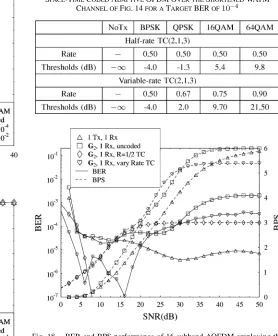
In Fig. 18, we show the BER and BPS performance of the 16-subband AOFDM employing the STB code G2
concate-nated with both half-rate and variable-rate TC(2,1,3) coding at a target BER of 10−4 over the shortened WATM channel of Fig. 14. We can see in the figure that by concatenating fixed half-rate turbo coding with the space-time coded adap-tive OFDM scheme, the BER performance of the system im-proves tremendously, indicated by a steep dip of the associated BER curve marked by the solid line and diamonds. There is an improvement in the BPS performance as well, exhibiting anEb/N0 gain of approximately 5 and 10 dB at an effective
[image:13.594.42.292.70.483.2]throughput of 1 BPS, compared to space-time coded AOFDM and conventional AOFDM, respectively. However, again, the maximum throughput of the system is limited to 3 BPS, since half-rate channel coding was employed. In Fig. 18, we can see that at an Eb/N0 value of about 30 dB, the maximum
TABLE VII
CODINGRATES ANDSWITCHINGLEVELS(INDECIBELS)FORTC(2,1,3)AND SPACE-TIMECODEDADAPTIVEOFDM OVER THESHORTENEDWATM
[image:13.594.269.547.89.425.2]CHANNEL OFFIG. 14FOR ATARGETBEROF10−4
Fig. 18. BER and BPS performance of 16-subband AOFDM employing the STB codeG2concatenated with both half-rate and variable-rate TC(2,1,3)at
a target BER of10−4over the shortened WATM channel shown in Fig. 14. The switching thresholds and coding rates are shown in Table VI.
throughput of the turbo coded and space-time adaptive OFDM system is increased from 3.0 to 5.4 BPS by employing the variable-rate TC(2,1,3) code. Furthermore, the BPS perfor-mance of the variable-rate turbo coded scheme is similar to that of the half-rate turbo coded scheme at an average channel SNR below 15 dB. The BER curve marked by the solid line and clubs drops as the average channel SNR is increased from 0 to 15 dB. Due to the increased probability of the 64QAM transmission mode, the variable-rate turbo coded scheme was overloaded by the plethora of channel errors introduced by the 64QAM mode. Therefore, we can see in Fig. 18 that the BER increases and stabilizes at10−4. Again, the interference of the signalsx1and x2in the context of the STB codeG2prohibits further
improve-ments in the BER performance as the average channel SNR is increased. However, employing the variable-rate turbo codec has lowered the BER floor, as demonstrated by the curve marked by the solid line and squares.
V. CONCLUSION
of each trellis transition were derived in order to facilitate their maximum likelihood (ML) decoding.
In Section II, we proposed to employ an OFDM modem for mitigating the effects of dispersive multipath channels due to its simplicity compared to other approaches [14], [15]. Turbo codes and RS codes were invoked in Section II-A for concatenation with the STB codeG2and the various STT codes, respectively.
The estimated complexity of the various STT codes was derived in Section II-C.
We presented our simulation results for the proposed schemes in Section III. The first scheme studied was the TC(2,1,3)coded STB codeG2, whereas the second one was based on the family
of STT codes. It was found that the FER and BER performance of the TC(2,1,3) coded STBG2 was better than that of the
investigated STT codes at a throughput of 2 and 3 BPS over the channel exhibiting two equal power rays separated by a delay spread of 5µs and having a maximum Doppler frequency of 200 Hz. Our comparison between the two schemes was performed by also considering the estimated complexity of both schemes. It was found that the concatenatedG2/TC(2,1,3)scheme still
outperformed the STT codes using no channel coding, even though both schemes exhibited a similar complexity.
Although the corresponding results are not shown here due to space limitations, it was found that the maximum Doppler fre-quency had no significant impact on the performance of the STB and STT-coded OFDM schemes when mapping the two trans-mission instants of the STB-coded scheme onto two adjacent OFDM subcarriers. In contrast, in Section III-B, we investi-gated the effect of the delay spread on the system. Initially, the delay-spread dependent SIRof the STB code G2 was
quan-tified. It was found that the performance of the concatenated TC(2,1,3)-G2scheme degrades as the delay spread increases
due to the decrease in the associatedSIR. However, varying the delay spread had no significant effect on the STT codes. We proposed in Section III-C an alternative mapping of the two transmission instants of the STB codeG2to the same
subcar-rier of two consecutive OFDM symbols: a solution which was applicable to a delay nonsensitive system. By employing this approach, the performance of the concatenated scheme was no longer limited by the delay spread but by the maximum Doppler frequency. We concluded that a certain minimum SIR has to be maintained for attaining the best possible performance of the concatenated scheme.
The shortened WATM channel was introduced in Section IV-C1. In this section, STT codes were concatenated with RS codes in order to improve the performance of the system. Once again, both channel-coded STB and STT codes were compared at a throughput of 1 and 2 BPS. It was also found that the TC(2,1,3) coded STB codeG2outperforms the RS-coded STT codes.
Space-time block-coded AOFDM was studied in Section IV. It was shown in Section IV-C2 that only the STB code G2,
using one AOFDM receiver, was capable of outperforming the conventional single-transmitter, single-receiver AOFDM sys-tem designed for a data transmission target BER of 10−4
over the shortened WATM channel. We also confirmed that upon increasing the diversity order, the fading channels be-come AWGN-like channels. This explains why the benefits
of AOFDM erode when the diversity order is increased. In Section IV-C3, we continued our investigations into AOFDM by concatenating turbo coding with the system. Two schemes were proposed: half-rate turbo and space-time-coded AOFDM, as well as variable-rate turbo and space-time-coded AOFDM. Despite the impressive BER performance of the half-rate turbo and space-time-coded scheme, the maximum through-put of the system was limited to 3 BPS. However, by employing the variable-rate turbo and space-time coded scheme, the BPS performance improved, achieving a maximum throughput of 5.4 BPS. This BPS performance improvement was achieved at the cost of a poorer BER performance. In conclusion, this is a burgeoning research area, which is expected to achieve further advances in the field of turbo space-time coding [5].
REFERENCES
[1] S. Alamouti, “A simple transmit diversity technique for wireless commu-nications,”IEEE J. Sel. Areas Commun., vol. 16, no. 8, pp. 1451–1458, Oct. 1998.
[2] V. Tarokh, H. Jafarkhani, and A. Calderbank, “Space-time block codes from orthogonal designs,” IEEE Trans. Inf. Theory, vol. 45, no. 5, pp. 1456–1467, Jul. 1999.
[3] V. Tarokh, H. Jafarkhani, and A. Calderbank, “Space-time block coding for wireless communications: performance results,”IEEE J. Sel. Areas Commun., vol. 17, no. 3, pp. 451–460, Mar. 1999.
[4] T. Liew and L. Hanzo, “Space-time block codes and concatenated channel codes for wireless communications,”Proc. IEEE, vol. 90, no. 2, pp. 183– 219, Feb. 2002.
[5] L. Hanzo, T. Liew, and B. Yeap,Turbo Coding, Turbo Equalisation, and Space-Time Coding. Piscataway, NJ: Wiley, IEEE Press, 2002. [6] V. Tarokh, N. Seshadri, and A. Calderbank, “Space-time codes for high
data rate wireless communication: performance criterion and code con-struction,”IEEE Trans. Inf. Theory, vol. 44, no. 2, pp. 744–765, Mar. 1998.
[7] N. Seshadri, V. Tarokh, and A. Calderbank, “Space-time codes for high data rate wireless communications: code construction,” inProc. IEEE Vehicular Technology Conf.’97, Phoenix, AZ, 1997, pp. 637–641. [8] V. Tarokh, N. Seshadri, and A. Calderbank, “Space-time codes for high
data rate wireless communications: performance criterion and code con-struction,” inProc. IEEE Int. Conf. Communications’97, Montreal, QC, Canada, 1997, pp. 299–303.
[9] V. Tarokh, A. Naguib, N. Seshadri, and A. Calderbank, “Space-time codes for high data rate wireless communications: mismatch analysis,” inProc. IEEE Inter. Conf. Communications’97, Montreal, QC, Canada, 1997, pp. 309–313.
[10] A. Naguib, V. Tarokh, N. Seshadri, and A. Calderbank, “A space-time coding modem for high-data-rate wireless communications,”IEEE J. Sel. Areas Commun., vol. 16, no. 8, pp. 1459–1478, Oct. 1998.
[11] V. Tarokh, A. Naguib, N. Seshadri, and A. Calderbank, “Space-time codes for high data rate wireless communication: performance criteria in the presence of channel estimation errors, mobility, and multiple paths,”IEEE Trans. Commun., vol. 47, no. 2, pp. 199–207, Feb. 1999.
[12] R. Horn and C. Johnson,Matrix Analysis. Cambridge, U.K.: Cambridge Univ. Press, 1988.
[13] A. Naguib, N. Seshadri, and A. Calderbank, “Increasing data rate over wireless channels,”IEEE Signal Process. Mag., vol. 17, no. 5, pp. 76–92, May 2000.
[14] G. Bauch, A. Naguib, and N. Seshadri, “MAP equalization of space-time coded signals over frequency selective channels,” inProc. Wireless Communications and Networking Conf., New Orleans, LA, Sep. 1999. [15] G. Bauch and N. Al-Dhahir, “Reduced-complexity turbo equalization with
multiple transmit and receive antennas over multipath fading channels,” inProc. Information Sciences and Systems, Princeton, NJ, Mar. 2000, pp. WP3 13–18.
[16] L. Hanzo, W. Webb, and T. Keller, Eds., Single- and Multi-Carrier Quadrature Amplitude Modulation, 3rd ed.. New York: Wiley, 2000. [17] L. Hanzo, M. M¨unster, B.-J. Choi, and T. Keller,OFDM and MC-CDMA
[18] D. Agrawal, V. Tarokh, A. Naguib, and N. Seshadri, “Space-time coded OFDM for high data-rate wireless communication over wideband chan-nels,” inProc. IEEE Vehicular Technology Conf., Ottawa, ON, Canada, May 1998, pp. 2232–2236.
[19] Y. Li, N. Seshadri, and S. Ariyavisitakul, “Channel estimation for OFDM systems with transmitter diversity in mobile wireless channels,”IEEE J. Sel. Areas Commun., vol. 17, no. 3, pp. 461–471, Mar. 1999.
[20] Y. Li, J. Chuang, and N. Sollenberger, “Transmitter diversity for OFDM systems and its impact on high-rate data wireless networks,”IEEE J. Sel. Areas Commun., vol. 17, no. 7, pp. 1233–1243, Jul. 1999.
[21] W.-J. Choi and J. Cioffi, “Space-time block codes over frequency selective fading channels,” inProc. Vehicular Technology Conf., Amsterdam, The Netherlands, Fall 1999, pp. 2541–2545.
[22] Z. Liu, G. Giannakis, A. Scaglione, and S. Barbarossa, “Block precoding and transmit-antenna diversity for decoding and equalization of unknown multipath channels,” inProc. 33rd Asilomar Conf. Signals, Systems and Computers, Pacific Grove, CA, Nov. 1999, pp. 1557–1561.
[23] Z. Liu and G. Giannakis, “Space-time coding with transmit antennas for multiple access regardless of frequency-selective multipath,” inProc 1st Sensor Array and Multichannel SP Workshop, Boston, MA, Mar. 2000. [24] T. Liew, J. Pliquett, B. Yeap, L.-L. Yang, and L. Hanzo, “Concatenated
space time block codes and TCM, turbo TCM, convolutional as well as turbo codes,” inProc. GLOBECOM 2000, San Francisco, CA. [25] R. Steele and L. Hanzo,Mobile Radio Communications. New York:
Wiley, 1999.
[26] T. Liew, J. Pliquett, B. Yeap, L.-L. Yang, and L. Hanzo, “Comparative study of space time block codes and various concatenated turbo coding schemes,” inProc. PIMRC 2000, London, U.K., Sep. 2000, pp. 741–745. [27] L. Bahl, J. Cocke, F. Jelinek, and J. Raviv, “Optimal decoding of linear codes for minimizing symbol error rate,”IEEE Trans. Inf. Theory, vol. IT-20, no. 2, pp. 284–287, Mar. 1974.
[28] P. Robertson, E. Villebrun, and P. Hoeher, “A comparison of optimal and sub-optimal MAP decoding algorithms operating in the log domain,” in
Proc. Int. Conf. Communications, Jun. 1995, pp. 1009–1013.
[29] G. Bauch, “Concatenation of space-time block codes and turbo-TCM,” inProc. IEEE Int. Conf. Communications, Vancouver, BC, Canada, Jun. 1999, pp. 1202–1206.
[30] G. Forney, “The Viterbi algorithm,”Proc. IEEE, vol. 61, pp. 268–277, Mar. 1973.
[31] L.-L. Yang and L. Hanzo, “Performance analysis ofm-ary orthogonal signaling using errors-and-erasures decoding over frequency-selective Rayleigh fading channels,”IEEE J. Sel. Areas Commun., vol. 19, no. 2, pp. 211–221, Feb. 2001.
[32] W. Jakes,Microwave Mobile Communications. Piscataway, NJ: IEEE Press, 1993.
[33] L. Hanzo, F. Somerville, and J. Woodard,Voice Compression and Commu-nications: Principles and Applications for Fixed and Wireless Channels. Piscataway, NJ: IEEE Press, Wiley, 2001.
[34] L. Hanzo, P. Cherriman, and J. Streit,Wireless Video Communications: From Second to Third Generation Systems, WLANs and Beyond. Pis-cataway, NJ: IEEE Press, Wiley, 2001.
[35] R. Steele and W. Webb, “Variable rate QAM for data transmission over Rayleigh fading channels,” inProc. Wireless’91, Calgary, AB, Canada, 1991, pp. 1–14.
[36] W. Webb and R. Steele, “Variable rate QAM for mobile radio,”IEEE Trans. Commun., vol. 43, no. 7, pp. 2223–2230, Jul. 1995.
[37] L. Hanzo, C. Wong, and M. Yee,Adaptive Wireless Transceivers. Pis-cataway, NJ: IEEE Press, Wiley, 2002.
[38] J. Torrance and L. Hanzo, “Latency and networking aspects of adaptive modems over slow indoors Rayleigh fading channels,”IEEE Trans. Veh. Technol., vol. 48, no. 4, pp. 1237–1251, Jul. 1999.
[39] J. Torrance and L. Hanzo, “Performance upper bound of adaptive QAM in slow Rayleigh fading environments,” inProc. ISPACS’96, Singapore, 1996, pp. 1653–1657.
[40] J. Torrance and L. Hanzo, “Interference aspects of adaptive modems over slow Rayleigh fading channels,”IEEE Trans. Veh. Technol., vol. 48, no. 5, pp. 1527–1545, Sep. 1999.
[41] T. Keller and L. Hanzo, “Adaptive orthogonal frequency division mul-tiplexing schemes,” inProc. ACTS Mobile Communications Summit’98, Rhodos, Greece, Jun. 1998, pp. 794–799.
[42] T. Keller and L. Hanzo, “Blind-detection assisted sub-band adaptive turbo-coded OFDM schemes,” inProc. Vehicular Technology Conf. VTC’99, Houston, TX, 1999, pp. 127–130.
[43] H. Matsuako, S. Sampei, N. Morinaga, and Y. Kamio, “Adaptive modula-tion systems with variable coding rate concatenated code for high quality multi-media communication systems,” inProc. IEEE Vehicular Technol-ogy Conf., Atlanta, GA, 1996, pp. 487–491.
[44] S.-G. Chua and A. Goldsmith, “Variable-rate variable-power mQAM for fading channels,” inProc. IEEE Vehicular Technology Conf.’96, Atlanta, MA, 1996, pp. 815–819.
[45] V. Lau and M. Macleod, “Variable rate trellis coded QAM for high band-width efficiency applications in Rayleigh fading channels,” inProc. IEEE Vehicular Technology Conf.’98, Ottawa, ON, Canada, 1998, pp. 348–352. [46] J. Blogh and L. Hanzo,3G Systems and Intelligent Networking.
Piscat-away, NJ: IEEE Press, Wiley, 2002.
[47] L. Hanzo, L. L. Yang, E. L. Kuan, and K. Yen,Single- and Multi-Carrier CDMA. Piscataway, NJ: IEEE Press, Wiley, 2003.
[48] I. Kalet, “The multitone channel,”IEEE Trans. Commun., vol. 37, no. 2, pp. 119–124, Feb. 1989.
[49] T. Keller and L. Hanzo, “Adaptive multicarrier modulation: A convenient framework for time-frequency processing in wireless communications,”
Proc. IEEE, vol. 88, no. 5, pp. 611–642, May 2000.
[50] J. Torrance and L. Hanzo, “Optimization of switching levels for adaptive modulation in a slow Rayleigh fading channel,”Electron. Lett., vol. 32, no. 13, pp. 1167–1169, Jun. 1996.
[51] J. Torrance and L. Hanzo, “On the upper bound performance of adaptive QAM in a slow Rayleigh fading,”Electron. Lett., pp. 169–171, Apr. 1996. [52] O. Acikel and W. Ryan, “Punctured turbo-codes for BPSK/QPSK chan-nels,”IEEE Trans. Commun., vol. 47, no. 9, pp. 1315–1323, Sep. 1999.
Tong-Hooi Liewreceived the B.Eng. degree in electronics engineering and the Ph.D. degree from the University of Southampton, Southampton, U.K., in 2001. He is currently continuing his research as a Postdoctoral Research Fellow at the University of Southampton.
His current research interests are associated with coding and modulation for wireless channels, space-time coding, and adaptive transceivers. He has published his research results widely, including coauthoring a Wiley-IEEE Press monograph.
Lajos Hanzo(F’02) received the M.S. degree in electronics in 1976, the Ph.D. degree in 1983, and the D.Sc. degree from the University of Southampton, Southampton, U.K., in 2004.
During his 28-year career in telecommunications, he has held various re-search and academic posts in Hungary, Germany, and the U.K. Since 1986, he has been with the Department of Electronics and Computer Science, University of Southampton, U.K., where he holds the Chair in telecommunications. He has co-authored 11 Wiley/IEEE Press books totaling about 9000 pages on mobile ra-dio communications, published in excess of 500 research papers, organized and chaired conference sessions, presented overview lectures, and has been awarded numerous distinctions. Currently, he is managing an academic research team and working on a range of research projects in the field of wireless multimedia communications sponsored by industry, the Engineering and Physical Sciences Research Council (EPSRC) U.K., and the European IST Programme, and the Mobile Virtual Centre of Excellence (VCE), U.K. He is an enthusiastic sup-porter of industrial and academic liaison, and he offers a range of industrial courses.