differences in explicit and implicit visuomotor learning and working memory capacity.
Scientific Reports. 36633. ISSN 2045-2322
https://doi.org/10.1038/srep36633
[email protected]
https://eprints.whiterose.ac.uk/
Reuse
This article is distributed under the terms of the Creative Commons Attribution (CC BY) licence. This licence
allows you to distribute, remix, tweak, and build upon the work, even commercially, as long as you credit the
authors for the original work. More information and the full terms of the licence here:
https://creativecommons.org/licenses/
Takedown
If you consider content in White Rose Research Online to be in breach of UK law, please notify us by
Individual di erences in explicit and
implicit visuomotor learning and
working memory capacity
Antonios I Christou
,R Chris
Miall
Fiona McNab
, ,*Joseph M Galea
,*The theoretical basis for the association between high working memory capacity WMC and enhanced visuomotor adaptation is unknown Visuomotor adaptation involves interplay between explicit and implicit systems We examined whether the positive association between adaptation and WMC is speci c to the explicit component of adaptation Experiment replicated the positive correlation between WMC and adaptation but revealed this was speci c to the explicit component of adaptation and apparently driven by a sub group of participants who did not show any explicit adaptation in the correct direction A negative correlation was observed between WMC and implicit learning Experiments
and showed that when the task restricted the development of an explicit strategy high WMC was no longer associated with enhanced adaptation This work reveals that the bene t of high WMC is speci cally linked to an individual s capacity to use an explicit strategy It also reveals an important contribution of individual di erences in determining how adaptation is performed
he ability to retain information for a short period of time, working memory (WM), is known to support many cognitive functions1,2. Interestingly, an association is also seen with motor function. For example, WM capacity
(WMC) predicts learning rate during the early stage of a visuomotor adaptation task, with signiicant overlap in the pattern of neural activation associated with spatial WM and early adaptation3,4. Although this work suggests
that early, but not late, visuomotor adaptation engages WM processes, it fails to explain this diference.
he literature emphasises the role of implicit learning in visuomotor adaptation tasks. For instance, when an explicit aiming strategy is given to participants; it is quickly overridden by implicit learning5. In addition,
stud-ies of amnesic patients emphasised that motor learning does not rely on declarative memory6,7. However, more
recent studies have suggested an important interplay between explicit and implicit learning. his was indirectly supported by modelling8 and inferring implicit versus explicit learning by the ater efect and catch trials,
respec-tively9. Direct evidence was provided by Taylor, Krakauer & Ivry10 who introduced a novel reaching paradigm
in which the contribution of explicit learning was estimated from participant’s report of their aiming direction, while the contribution of implicit learning was estimated by the diference between the intended aiming angle and their movement angle. It was shown that explicit learning, driven by the error from the target, involved initially large explorations of aiming direction biased towards the correct solution, whereas implicit learning, driven by sensory-prediction error, was slow and monotonic10.
Although the cerebellum plays a key role in visuomotor learning11, activation of the prefrontal cortex (PFC)
and speciically the dorsolateral PFC (DLPFC) has been consistently observed during adaptation3,12. It has been
suggested that the PFC is directly associated with the employment of strategic processes13. Given the relationship
between WM and PFC14, this raises the possibility that the link between WM and adaptation is speciic to the
engagement of an explicit strategic component. However, we have previously shown that even when participants are unaware of the perturbation, so that implicit adaptation must dominate, a cognitively demanding secondary task can still disrupt adaptation15. his suggests that implicit adaptation requires cognitive resources and
sup-ports an alternative hypothesis in which the positive association with WM extends to implicit adaptation. A third possibility is that those with low WMC show only a small contribution of explicit adaptation, but compensate with enhanced implicit adaptation. For example, within an individual, the systems may operate in parallel or in a “push-pull” manner10. Our individual diferences approach enabled us to investigate the way in which WMC
predicts the contribution of implicit and explicit adaptation systems between individuals.
School of Psychology, University of Birmingham, UK. School of Applied Social Sciences, De Montfort University, UK. Department of Psychology, University of York, UK. *These authors contributed equally to this work.
Correspondence and requests for materials should be addressed to F M email ona mcnab york ac uk
Received August Accepted October Published November
Adopting the paradigm introduced by Taylor et al.10, we obtained measures of explicit and implicit learning
during visuomotor adaptation, as well as WM capacity for each participant. We hypothesized that WMC would predict the contribution of explicit adaptation, and their association would be positive. We predicted that a pos-itive correlation would not be seen between WMC and implicit adaptation. Furthermore, we predicted that in a paradigm in which explicit learning was minimised, we would eliminate any positive association with WMC. his would indicate that despite being challenged with the same task, individuals may difer in the way they adapt, with explicit strategy making a greater contribution for those with high WMC.
Results
For each participant, a computer-based visual-spatial WM task was used to obtain a measure of WMC16.
Participants were asked to remember the positions of three, four, ive or six red circles (targets) presented simulta-neously for 1 second in a circular array (Fig. 1). Participants were asked to make a button press to indicate whether a probed location corresponded to a target position. WMC was estimated with the K-value, estimating how much information can be stored in WM17.
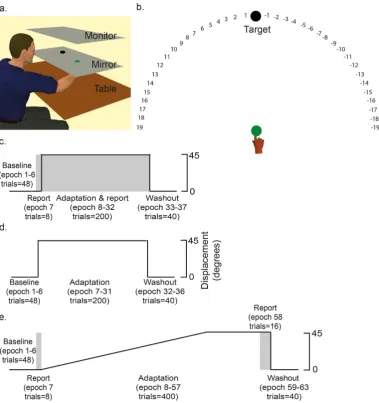
For each participant, the WMC task was followed by a visuomotor adaptation task. hree diferent visuomotor tasks were employed (Experiments 1–3), with each person participating in only one experiment. For all partic-ipants, their right index inger was attached to a Polhemus motion tracking system underneath a horizontally suspended mirror. he mirror prevented direct vision of the hand and arm, but showed a relection of a computer monitor mounted above that appeared to be in the same plane as the hand (Fig. 2a). For all experiments, a target was displayed in one of eight positions arrayed radially 45° apart at 7 cm from a central starting box and a cursor represented the position of the participant’s index inger18.
For each trial, participants were required to make a fast, “shooting” movement through the target, from the starting position. Angular hand direction (°) was calculated as the diference between the angular hand position and angular target position at the point when the cursor intersected an invisible circle with a radius of 7 cm which was centred on the starting position. Positive values indicated CW error whereas negative values indicated CCW error. During veridical feedback, the goal was for reach direction error to be 0°. However with a visuomotor trans-formation, hand direction had to compensate; that is, for a − 45° (CCW) visuomotor rotation, a hand direction of + 45° (CW) was required for the cursor to hit the target. When the visuomotor transformation was removed (washout), we did not give any instruction to stop aiming.
In order to test the association between WMC to adaptation success, we used absolute values of the diference in angle from 45°. his disregards the direction of movement relative to the target, and considers only the extent to which the angle difers from the target angle. For illustration we show the angle that resulted from subtracting the angle of movement from the target angle, but for the statistical analyses we use absolute values as we were interested in adaptation success, and not whether a participant moved or aimed to the right or the let of the tar-get. Using the raw values did not afect the results; the same correlations were statistically signiicant, irrespective of the measure of adaptation.
For analysis, epochs were created by binning 8 consecutive movements (including 1 movement towards each target). We calculated performance averages across the last 2/3 of epochs within each block for each of the 3 experiments. In addition, reaction time (RT: diference between target appearing and participant moving out of the start box) and movement time (MT: diference between reaction time and movement end) were calculated for each trial.
Experiment explicit and implicit visuomotor adaptation
Experiment 1 employed a task that was adapted from Taylor et al.10 and enabled the dissociation of explicit and implicit processes during visuomotoradaptation (Fig. 2b). Participants completed 4 blocks with terminal feedback (Fig. 2c).
During Block 1 (baseline), which involved veridical vision, all participants (n = 30) showed similar accurate reaching behaviour, with there being no signiicant correlation between WMC and hand direction (r = − 0.19, p > 0.25, r2= 0.03), RT (r = − 0.17, p > 0.25, r2= 0.03), or MT (r = − 0.30, p = 0.10, r2= 0.04) (Table 1). Block 2
[image:3.595.100.556.48.160.2](baseline report) involved veridical vision and prior to commencing each trial participants were required to
Figure 2. Visuomotor adaptation task. (a) Experimental set up. Participants made reaching movements towards targets displayed on a screen. (b) Verbal report task (Taylor et al.10). he target was placed at 0 with
numbers being placed either side of the target at 5° intervals. Participants were asked to report which number they were planning to move their inger towards. his was used as a direct measure of participant’s trial-by-trial cognitive strategy. (c) Experiment 1: participants adapted to an abrupt 45° visuomotor rotation with terminal feedback whilst performing the verbal report task (grey) prior to each movement. (d) Experiment 2: participants adapted to an abrupt 45° visuomotor rotation with terminal feedback. (e) Experiment 3: participants adapted to a gradual 45° visuomotor rotation with online feedback. he verbal report task (grey) was performed at the start and end of the adaptation block. Amount of trials and epoch number are provided in brackets. Between baseline, adaptation and washout there were short rest periods.
Experiment 1 (N = 30) Experiment 2 (N = 34) Experiment 3 (N = 20)
[image:4.595.158.538.45.449.2]WMC 1.99 ± 0.21 2.54 ± 0.21 1.84 ± 0.25 HD-base − 0.68 ± 0.33 − 0.82 ± 0.21 − 0.61 ± 0.25 HD-wash 2.88 ± 0.52 3.98 ± 0.44 24.44 ± 0.96 RT-base 0.44 ± 0.01 0.48 ± 0.02 0.39 ± 0.01 RT-adapt 1.46 ± 0.10 0.67 ± 0.04 0.55 ± 0.02 MT-base 0.37 ± 0.05 0.42 ± 0.06 0.33 ± 0.02 MT-adapt 0.62 ± 0.07 0.33 ± 0.03 0.30 ± 0.02
verbally report the direction in which they were aiming to move their inger (explicit aiming strategy). In these trials, the target was presented at the centre of a semi-circular arc of numbers (Fig. 2b). Participants were asked to report which number they were planning to move their inger towards10,19,20. Once they had provided this verbal
response, the numbers disappeared and the participants performed the reaching movement. his reporting block was used simply to introduce the participants to the reporting procedure.
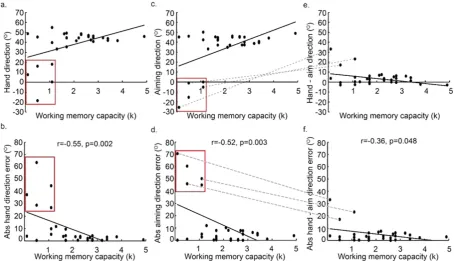
In Block 3 (adaptation and report), a 45° CCW visuomotor rotation of the cursor, relative to the hand, was imposed. he participants were required to verbally report their explicit aiming strategy (angle) prior to each movement. When exposed to the 45° rotation, there was a negative correlation between WMC and absolute hand direction error (r = − 0.55, p = 0.002, r2= 0.30, Fig. 3a,b), showing that those with greater WMC were
more successful at the adaptation task. As well as testing the linear association between WMC and absolute hand error (HE = β *WMC + α , where α is the intercept, β is the regression coeicient and HE is absolute hand direction error), we also tested an exponential association between WMC and absolute hand direction error (HE = expβ(WMC)+ α ). Each model explained a signiicant amount of variance, with the linear model giving a
slightly better it (linear model: α = 23.89, β = − 7.30, p = 0.002, r2= 0.30; exponential model: α = 13.00, β = − 0.70,
p = 0.002, r2= 0.29). he fact that the exponential model did not explain more variance than the linear model is
likely to be due to the fact that the association is driven by ive participants who show poor adaptation, so that the participants appear to fall into two groups. his was explored further with additional analyses (see below). RT (r = 0.20, p > 0.25, r2= 0.04; Table 1) and MT (r = − 0.32, p = 0.09, r2= 0.1; Table 1) were not signiicantly
associated with WMC.
On each trial, participants were required to report the direction to which they were aiming, before moving (explicit aiming strategy). here was a signiicant negative correlation between WMC and absolute aiming direc-tion error (r = − 0.52, p = 0.003, r2= 0.27; Fig. 3c,d). As shown by Fig. 3c/d, ive participants either failed to show
[image:5.595.99.554.46.307.2]WMC and absolute values of implicit adaptation (r = − 0.36, p = 0.048, r2= 0.13; Fig. 3e,f). As shown by Fig. 3e/f,
there were large values for implicit adaptation in the correct direction (ie. compensating for the 45° rotation) by participants with low WMC.
Block 4 (washout) involved veridical vision, and no report was required. here was only a small ‘ater-efect’, which did not signiicantly correlate with WMC (r = 0.17, p = 0.37).
Participants showing no explicit adaptation in the correct direction
From Fig. 3, it is clear that the observed correlations between adaptation (in Block 3) and WMC seem to be driven by ive participants (the data-points within the red squares in Fig. 3) who showed either no explicit adaptation, or explicit adaptation in the wrong direction. When data from these ive participants were removed from the analysis, none of the corre-lations were statistically signiicant (the correlation between absolute hand direction error and WMC: r = − 0.39, p = 0.06, r2= 0.15; the correlation between absolute aiming direction error and WMC: r = 0.09, p > 0.25,r2= 0.007; the correlation between absolute hand - aim direction error and WMC: r = 0.09, p > 0.25, r2= 0.007). It
is not clear whether these ive participants did not have the cognitive resources to successfully employ an explicit strategy, or were not suiciently motivated to do so. As shown by Fig. 3, there were two participants with a WMC of less than 2 who did show explicit adaptation in the correct direction.
Although further work is needed to understand the basis for a failure to show successful explicit adapta-tion, our data do suggest that WMC does not predict adaptation success throughout the range of WMC scores obtained. Our group was better characterised as those who did and those who did not show successful explicit adaptation. his result highlights the need for caution when associating WMC with adaptation and suggests that it is particularly important to include a report task, so that participants who do not explicitly aim in the correct direction can be identiied.
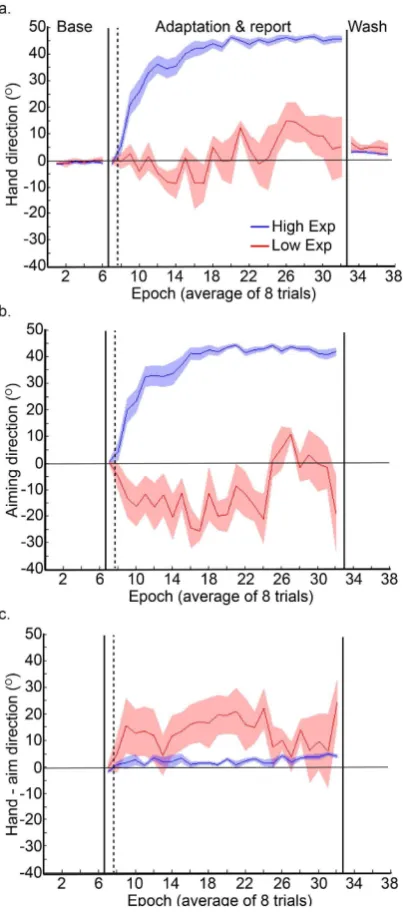
Interestingly, as indicated by the grey dashed lines in Fig. 3, three of the ive participants who did not show any explicit adaptation in the correct direction, had the highest values for implicit adaptation, suggesting that explicit and implicit adaptation may be operating in a push-pull manner between individuals. Figure 4 reveals that the ive participants who did not show any explicit adaptation (red curves, the low explicit adaptation group) showed greater implicit adaptation in the direction of the target, throughout the adaptation period, relative to the other participants (blue curve, high explicit adaptation group).
Experiments and
With Experiment 1 we observed a positive association between WMC and explicit adaptation using a task in which participants reported their direction of aim. In contrast there was no positive correlation between WMC and implicit adaptation; in fact we observed a negative correlation. his suggests that the beneit of high WMC for adaptation3,4,21 is speciic to the explicit component. With Experiments 2 and 3we sought to verify this conclusion with a paradigm that did not involve the participants reporting their aim-ing direction duraim-ing adaptation. We predicted that there should not be a positive association between WMC and adaptation in situations where the task does not promote an explicit strategy. Experiment 2 used a simple visuomotor rotation task in which participants adapted to an abrupt 45° displacement with terminal visual feed-back (Fig. 2d). An abrupt rotation with terminal feedfeed-back should promote an explicit strategy10,20. In contrast,
Experiment 3 involved adaptation to a gradual 45° rotation with online visual feedback (Fig. 2e), and thus did not encourage the use of an explicit strategy.
Experiment abrupt visuomotor adaptation
For Experiment 2, during baseline with veridical vision, all participants (n = 34) showed similar accurate reaching behaviour, with there being no signiicant correlation between WMC and hand direction (r = − 0.05, p > 0.25, r2= 0.003), RT (r = 0.03, p > 0.25, r2= 0.001) or MT(r = − 0.08, p > 0.25, r2= 0.007) (Table 1). However following exposure to a sudden 45° rotation (Block 2), a
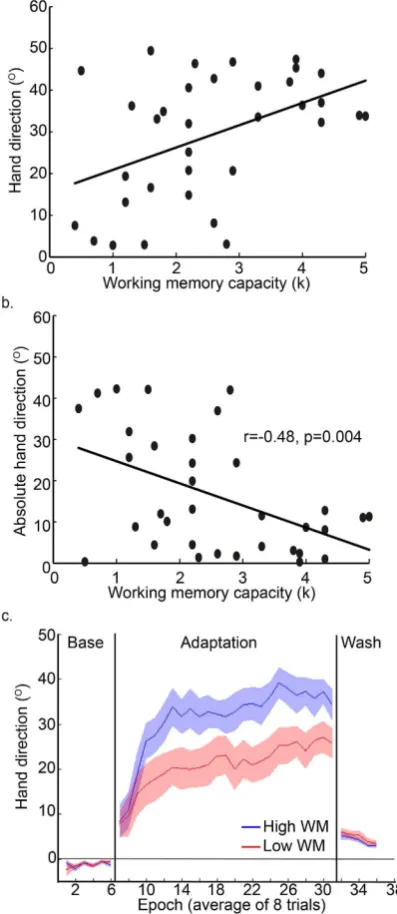
signiicant correlation was observed between absolute hand direction error and WMC (r = − 0.48, p = 0.004, r2= 0.23, Fig. 5a,b), whereby those with high WMC displayed a greater level of adaptation. When we restricted
our analysis to ‘early’ adaptation (the irst 96 trials, a number similar to Anguera et al.3), the correlation between
WMC and absolute hand direction error was very close to reaching signiicance (r = − 0.34, p = 0.051, r2= 0.11).
RT (r = 0.15, p > 0.25, r2= 0.02) and MT (r = − 0.29, p = 0.10, r2= 0.08) (Table 1) did not show a signiicant
correlation with WMC during adaptation. When the visual rotation was removed (washout), all participants showed a small ‘ater-efect’ whereby their hand direction did not instantly return back to baseline levels (Fig. 5c). Surprisingly, despite the large diferences in adaptation, there was no signiicant association between WMC and hand direction during washout (r = − 0.08, p > 0.25, r2= 005). his indicates that high WMC was associated with
successful adaptation when the task design (abrupt with terminal feedback) promoted an explicit strategy. For illustrative purposes, we performed a median split to separate the participants into high and low WMC groups. Figure 5c clearly shows that the high WMC group showed a greater amount of adaptation relative to the low WMC group.
Experiment gradual visuomotor adaptation
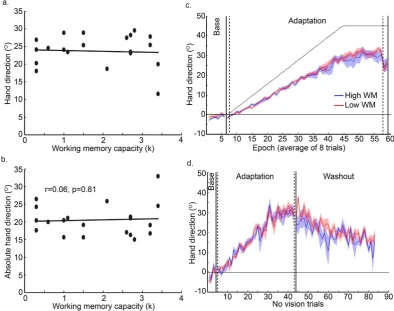
Experiment 3 involved adaptation to a gradual 45° rotation with online visual feedback, to reduce the likelihood of the participant using an explicit strategy. During baseline, all participants (n = 20) showed similar accurate reaching behaviour, with there being no signiicant correlation between WMC and hand direction (r = 0.31, p = 0.18, r2= 0.10), between WMC and RT (r = 0.40,p = 0.08, r2= 0.16) or between WMC and MT (r = − 0.03, p > 0.25, r2= 0.001) (Table 1). Participants were then
gradually exposed to a 45° rotation over the next 300 trials, with it then remaining constant for a further 116 tri-als. Although it is clear that participants did not fully adapt to the gradual visual rotation, there was no signiicant correlation between absolute hand direction error and WMC (r = 0.06, p > 0.25, r2= 0.003; Fig. 6a–c).
Experiment 2: 0.23), we estimated (G*Power; http://www.gpower.hhu.de/en.html) that power of 0.93 and 0.87 was achieved in Experiment 1 and 2, respectively. For Experiment 3 (r2= 0.003), a total sample size of 3168 would
be required to achieve similar power of 0.87. his indicates that the efect size was negligible and adding an addi-tional 14 participants, making the sample size similar to Experiment 2, would have made little diference.
To ensure the participants were indeed unaware of the perturbation, participants were asked to report their aiming direction at the beginning and end of the adaptation block10. For each time point, only two participants
reported a non-zero aiming angle, and these were < 5°. his suggests that by the end of the adaptation block, participants had not developed an explicit strategy. To examine behaviour further we had included no vision trials throughout baseline, adaptation and washout. We surmised that no vision trials during washout would give a better indication of the level of implicit adaptation achieved. Similarly to the vision trials, we observed no signiicant association between WMC and hand direction (r = 0.14, p > 0.25, r2= 0.02). During washout, there
[image:7.595.157.359.45.502.2]was a slow drit back to baseline performance (Fig. 6d). Although not signiicant, there is a suggestion that par-ticipants with low WM showed a greater ‘ater-efect’ than parpar-ticipants with a high WM (r = − 0.40, p = 0.08,
r2= 0.16). Once again for illustrative purposes, we median split the participants into high and low WMC groups.
Figure 6c,d clearly shows that the high and low WMC groups displayed a similar amount of adaptation. Although the igure suggests that the low WM group showed a greater ater-efect, this did not reach statistical signiicance (t (18) = 1.60, p = 0.13).
[image:8.595.156.355.55.513.2]Comparison between Experiments and
There was a significant difference in the correlation between WMC and absolute direction hand error during adaptation for Experiments 2 and 3 (Fisher’s Z = − 1.93, p = 0.03, Cohen’s q = 0.46, one tailed-test). As predicted, there was an association between WMC and absolute hand direction error only when the rotation was applied abruptly (Experiment 2), and not when it was introduced gradually, restricting the involvement of explicit processes (Experiment 3).Discussion
Summary
his study examined whether the link between WMC and visuomotor adaptation is speciic to the use of an explicit strategy, or extends to implicit adaptation. First, we replicated previous indings linking high WMC with more successful adaptation, during a standard visuomotor rotation task. By obtaining separate measures of explicit and implicit adaptation, we found that this association was driven by ive participants who failed to show any explicit adaptation in the correct direction. Interestingly, a majority of these ive participants also displayed a high level of implicit adaptation, which reduced their hand error. We also showed that when adaptation was dominated by implicit learning, high WMC was no longer associated with enhanced adaptation.Explicit and Implicit adaptation and the association with WMC
Experiments 1 and 2 replicated previous work showing a correlation between spatial WMC and adaptation3, although in their study this wasspeciic to “early” adaptation. We extended the approach to separately consider two components of adaptation: a cerebellar-dependent implicit process, that involves a sensory-prediction error signal used to update a forward model, and a non-cerebellar explicit process in which participants implement a strategy.
DLPFC activity, which may be associated with WM, has been observed during adaptation tasks3,12, and may be
speciically associated with the employment of strategic processes13. Furthermore, a speciic impairment shown
by older adults during ‘early’ adaptation to an abrupt perturbation, but not to a gradual perturbation22,23, appears
to be due to an inability to engage DLPFC-dependent spatial WM13,22,24. his work raises the possibility that the
link between WMC and adaptation is speciic to the implementation of a cognitive strategy.
An alternative account would be that both explicit and implicit adaptation show a positive association with WMC. We have previously shown that even when participants are unaware of the perturbation, so that implicit adaptation must dominate, a cognitively demanding secondary task can still disrupt adaptation15. his suggests
[image:9.595.155.550.47.358.2]that implicit adaptation requires cognitive resources and that the association with WMC extends to implicit adaptation. A third alternative is that explicit adaptation shows a positive association with WMC, but that implicit adaptation shows a negative association with WMC, in line with implicit and explicit systems operating in a push-pull manner.
By employing the paradigm of Taylor, Krakauer & Ivry10, and separately measuring explicit and implicit
adap-tation, we observed, for the irst time, a positive association between WMC and explicit adaptation, but a negative
association between WMC and implicit adaptation, supporting the third account. We were also able to identify ive participants who failed to show any explicit adaptation in the correct direction. When excluding data from these participants, we no longer observed a signiicant association between WMC and adaptation. his suggests that the involvement of WMC in explicit adaptation could be “all or none”, whereby a minimum WMC is needed for strategy development, but extra capacity gives no additional beneit. Alternatively, the ive participants who failed to show any explicit adaptation in the correct direction may have not been suiciently motivated to perform the experiment correctly. Irrespective of the cause, these results suggest that previously reported correlations between adaptation and WMC3, which did not distinguish between explicit and implicit adaptation, may have
been misleading. Enhanced implicit adaptation in those with low WMC and little explicit adaptation, could give the impression of a linear association between WMC and adaptation, rather than showing a diference between two groups of participants.
WMC is not crucial when implicit learning dominates
Explicit and implicit processes have oten been compared using adaptation to an abrupt and gradual perturbation15,25,26. he limited movement errorsresult-ing from gradual perturbation are thought to be corrected implicitly. Our previous work has suggested that despite minimal awareness, implicit adaptation can be disrupted by a cognitively demanding secondary task15.
At the beginning and end of the gradual adaptation period of Experiment 3 we found no evidence of any partic-ipants using a strategy. Critically, there was no signiicant association between adaptation and WMC, unlike in Experiment 2 where explicit adaptation was encouraged by an abrupt rotation. his supports our inding from Experiment 1 that the positive association between WMC and adaptation is directly linked to the ability to use an explicit strategy.
We are not suggesting there is a categorical diference between abrupt and gradual adaptation. We believe, along with others, that there is a continuum for the contribution of implicit and explicit learning processes, which can be afected by task parameters, including the size of the perturbation, the number of trials, target position, visual feedback conditions etc15,20,25,27. In our study, we pragmatically chose two extremes to highlight the
speci-icity of the association with WMC.
WMC and explicit adaptation
Our study is the irst to directly link WMC with the adoption of an explicit strategy during visuomotor adaptation. Our results show that even when task parameters remain the same, indi-vidual diferences between participants, such as WMC, predict the manner in which they adapt. hese indings may inform rehabilitation. While focussing on implicit processes may be more efective for motor rehabilita-tion following stroke, for tasks where an explicit strategy is beneicial, WM training28 could provide an efectiveadjunct treatment.
he nature of the association we see between WMC and strategic visuomotor adaptation remains to be clar-iied. Most obviously, a higher WMC, or a greater ability to control attention, may better equip an individual to maintain diferent hypotheses and action-response associations during the execution of a cognitive strategy. A related possibility is that participants who more readily use an efective strategy beneit from this approach dur-ing both adaptation and WM tasks29. However, it has been argued that strategies that can be used for WM tasks
tend to be task-speciic and simple, and that individual diferences in strategic behaviour cannot explain the link between WMC and, for example, reasoning ability30. Another possibility is that a lack of motivation to perform
the task correctly afects measures of WMC and explicit adaptation, but not implicit adaptation. Our inding of high implicit adaptation in participants who failed to show explicit adaptation in the correct direction provides some support for this account.
The association between explicit and implicit adaptation
Our inding of a signiicant positive cor-relation between WMC and explicit adaptation, but a signiicant negative correlation between WMC and implicit adaptation suggests that implicit and explicit systems operate in a “push-pull” manner, between individuals. For other types of motor learning, such as sequence learning31–33, restricting the contribution of explicit learning,enhances implicit learning. As far as we are aware, our study is the irst to suggest a “push-pull” association between explicit and implicit learning between individuals, rather than between experimental conditions. It sug-gests that for visuomotor adaptation enhanced implicit adaptation may compensate in individuals who show less explicit adaptation. his indicates that implicit adaptation processes may not be monotonic, as previously suggested13. An alternative account would be that those with high implicit adaptation, who tend to have a low
WMC, have smaller aiming angles (or aim in the wrong direction) as they are relying on implicit adaptation. However, our signiicant correlation between WMC and overall adaptation indicates that those with low WMC do not employ suicient explicit adaptation to bring them up to the same level of overall adaptation as those with higher WMC.
methods were used to predetermine the sample size for each experiment with funding/time restraints being the principal rule for stopping collection. Although this led to variable participant numbers across the 3 experiments, posthoc power analysis was used in the results section to show that this did not afect our conclusions. All partic-ipants reported that they were not taking any medication and had a normal amount of sleep the previous night. Participants were recruited through online advertising and posters, and received money (£6) or study credits as compensation upon completion of the study.
Experimental tasks
Each participant completed a WMC task, followed by a visuomotor adaptation task. hree diferent visuomotor tasks were employed (Experiments 1–3), with each person participating in only one experiment.Working Memory Capacity (WMC) task. A computer-based visual-spatial WM task was used to obtain a meas-ure of WMC16. Participants were asked to remember the positions of three, four, ive or six red circles (targets)
presented simultaneously for 1 second in a circular array (Fig. 1). Following a 3 second delay a question mark (probe) appeared in one of the target cells or an adjacent cell in the array. Participants were asked to make a button press with the index or middle inger of their right hand, to indicate whether the probed location corresponded to a target position. here were 10 trials of each array size, half of which required a “yes” response.
Visuomotor task. he three experiments shared most details of their design; diferences will be described below. In all three, participants were seated with their forehead supported on a headrest in front of a visual workstation. heir semipronated right index inger was attached to a Polhemus motion tracking system (Colchester, VT, USA) underneath a horizontally suspended mirror. he mirror prevented direct vision of the hand and arm, but showed a relection of a computer monitor (30-inch; 1280 × 1024 pixel resolution) mounted above that appeared to be in the same plane as the hand (Fig. 2a). he visual display consisted of a 1 cm-diameter starting box, a green cursor (0.25 cm diameter) representing the position of their index inger, and a circular white target (0.33 cm diameter). For all experiments, a target was displayed in one of eight positions arrayed radially 45° apart at 7 cm from the central starting box18. At the beginning of each trial, participants were asked to move their index inger to the start
position, which was located at the centre of the screen, and a target then appeared. Participants were required to make a fast, “shooting” movement through the target, such that online corrections were efectively prevented. At the moment the cursor passed through the invisible boundary circle (an invisible circle centred on the starting position with a 7 cm radius), the cursor was hidden and the intersection point was marked with a yellow square to denote the terminal (endpoint) error. In addition, a small square icon at the top of the screen (15 cm above the start position) changed colour based on movement speed. If the movement was completed within 100–500 msec, then it remained white. If the movement was slower than 500 msec, then the box turned red (too slow). Note, no feedback was given regarding reaction time. Ater each trial, subjects moved back to the start. he cursor indicat-ing their hand position only reappeared when they were within 2 cm of the central position. For all experiments, the targets were presented pseudo-randomly so that every set of eight consecutive trials included all eight target positions (1 epoch).
Experimental protocol
Experiment 1: explicit and implicit visuomotor adaptation. Experiment 1 repli-cated the task developed by Taylor et al.10 to directly assess the contribution of explicit and implicit learning tovisuomotor adaptation. Participants completed 4 blocks with terminal feedback. Block 1 (baseline) involved 48 trials with veridical vision. Block 2 (baseline report) involved 8 trials with veridical vision: prior to commencing each trial participants were required to verbally report the direction in which they were aiming to move their inger (explicit aiming strategy). In these trials, the target was presented at the centre of a semi-circular arc of numbers displayed at 5° intervals (Fig. 2b). Clockwise (CW) of the target were negative numbers from 1–19, and Counter-CW (CCW) of the target were positive numbers from 1–19. Participants were asked to report which number they were planning to move their inger towards10,19,20. Once they had provided this verbal response, the
numbers disappeared and the participants performed the reaching movement. his reporting block was used to introduce the participants to the reporting procedure. Block 3 (adaptation and report) involved 200 trials where a 45° CCW visuomotor rotation of the cursor, relative to the hand, was imposed. he participants were required to verbally report their explicit aiming strategy (angle) prior to each movement. Block 4 (washout) involved 40 trials with veridical vision, and no report was required. his experiment is described by Fig. 2c.
involved 200 trials where a 45° counter clockwise (CCW) visuomotor rotation of the cursor was imposed relative to the hand (epoch 7–31). Block 3 (washout) involved 40 trials with veridical vision (epoch 32–36).
Experiment 3: gradual visuomotor adaptation. Experiment 3 was designed to present a visuomotor task where the implementation of an explicit strategy would be minimised (Fig. 2e). Participants completed 3 blocks with both online vision of their movement and terminal feedback. Online feedback of the inger position was provided by the cursor during the movement as this is thought to optimise error-based/implicit learning15,27. However,
for every 10th movement we removed both online and terminal feedback so that participants made reaching
movements without vision; they saw a target but received no feedback as to their movement accuracy (no vision trials). Block 1 (baseline) involved 44 trials with veridical vision and 4 no vision trials. Block 2 (baseline report) involved 8 trials with veridical vision; the participants were required to verbally report their explicit (planned) aiming direction prior to each movement. Block 3 (adaptation) involved 416 trials in which a 45° CCW visuomo-tor rotation was gradually applied; 39 of these were no vision trials. he rotation began at 0.15° on the irst trial of the block and increased by 0.15° on each subsequent trial until it reached a maximum of 45° (trial 300). he 45° rotation was then maintained for the remaining 116 trials. For the last 16 trials of this block, participants were required to verbally report their planned aiming direction prior to each movement. his provided a measure of each participant’s explicit aiming strategy at the end of adaptation. Finally block 4 (washout) involved 40 trials with no vision. Note, this is diferent to Experiments 1 and 2 where participants had vision during washout. No vision trials were used during this experiment to determine whether WMC inluenced the retention of a visuo-motor rotation learnt primarily through implicit processes.
Data analysis
Working memory. WMC was estimated with the K-value, estimating how much information can be stored in WM, using a standard formula: K= S (H− F), where S is the array size, H is the observed hit rate and F is the false alarm rate17. his formula uses the false alarm rate to correct for guessing and assumes that if Kitems can be held in WM, from an array of S items, the probed item would have been one of those held in memory on K/S of trials, so that performance will be correct on K/S of the trials. For each participant, the mean K of array sizes 5 and 6 was used as our measure of WMC. For inclusion in the study, participants were required to have a K value greater than 0.
Visuomotor tasks. Index inger (hand) position (x,y) was collected at 60 Hz using Matlab (he MathWorks, Natick, USA) and the Psychophysics toolbox (http://www.psychtoolbox.org). For each trial, angular hand direc-tion (°) was calculated as the diference between the angular hand posidirec-tion and angular target posidirec-tion at the point when the cursor intersected the 7-cm invisible circle centred on the starting position relative to the central starting point. Positive values indicated CW error whereas negative values indicated CCW error. During verid-ical feedback, the goal was for reach direction error to be 0°. However with a visuomotor transformation, hand direction had to compensate; that is, for a − 45° (CCW) visuomotor rotation, a hand direction of + 45° (CW) was required for the cursor to hit the target. In addition, reaction time (RT: diference between target appearing and participant moving out of the start box) and movement time (MT: diference between reaction time and movement end) were calculated for each trial. For all experiments, we removed any trial in which reach direction exceeded 60°34. Across experiments, this accounted for less than 4% of trials.
For analysis, epochs were created by binning 8 consecutive movements (including 1 movement towards each target). We calculated performance averages across the last 2/3 of epochs within each block for each of the 3 experiments. It was thought that this provided a good representation of inal baseline, inal adaptation and inal washout (retention) values where performance had plateaued. Speciically for Experiment 1, explicit learning (aiming direction) was deined as the participant’s verbal report of the numbered landmark they were aiming to, multiplied by the spacing of the numbered landmarks (5°). Implicit learning (hand - aim direction) was computed by subtracting the aiming angle from the angular hand direction for each trial10,19,20. For hand direction, averages
were calculated for baseline, adaptation and washout blocks. For explicit and implicit learning, an average was calculated for the adaptation block. For Experiment 2, we calculated averages for epochs 3–6 (baseline; 32 trials), 16–32 (adaptation; 136 trials) and 35–37 (washout; 24 trials). For Experiment 3, we irst separated the no vision trials (every 10th trial), which were analysed separately: there were 83 no vision trials: 4 in baseline (block 1), 39
in adaptation (block 3; note we did not include no vision trials at the very end of adaptation or during the explicit aiming trials) and 40 in washout (block 4). We calculated averages for baseline (no vision trials 2–4), adaptation (no vision trials 16–43) and washout (no vision trials 57–83). We also calculated averages for the online vision trials; baseline trials (epochs 3–6, 32 trials) and adaptation trials (epochs 24–59, 280 trials).
5. Mazzoni, P. & Krakauer, J. W. An implicit plan overrides an explicit strategy during visuomotor adaptation. J Neurosci 26, 3642–3645 (2006).
6. Corkin, S. Acquisition of motor skill ater bilateral medial temporal-lobe excision Neuropsychologia 6, 255–265 (1968).
7. Shadmehr, R., Brandt, J. & Corkin, S. Time-dependent motor memory processes in amnesic subjects. J Neurophysiol 80, 1590–1597 (1998).
8. Taylor, J. A., Wojaczynski, G. J. & Ivry, R. B. Trial-by-trial analysis of intermanual transfer during visuomotor adaptation. J Neurophysiol 106, 3157–3172, doi: 10.1152/jn.01008.2010 (2011).
9. Benson, B. L., Anguera, J. A. & Seidler, R. D. A spatial explicit strategy reduces error but interferes with sensorimotor adaptation. J Neurophysiol 105, 2843–2851, doi: 10.1152/jn.00002.2011 (2011).
10. Taylor, J. A., Krakauer, J. W. & Ivry, R. B. Explicit and implicit contributions to learning in a sensorimotor adaptation task. J Neurosci 34, 3023–3032, doi: 10.1523/JNEUROSCI.3619-13.2014 (2014).
11. Martin, T. A., Keating, J. G., Goodkin, H. P., Bastian, A. J. & Thach, W. T. Throwing while looking through prisms. I. Focal olivocerebellar lesions impair adaptation. Brain 119 (Pt 4), 1183–1198 (1996).
12. Anguera, J. A., Russell, C. A., Noll, D. C. & Seidler, R. D. Neural correlates associated with intermanual transfer of sensorimotor adaptation. Brain Res 1185, 136–151, doi: 10.1016/j.brainres.2007.09.088 (2007).
13. Taylor, J. A. & Ivry, R. B. Cerebellar and prefrontal cortex contributions to adaptation, strategies, and reinforcement learning. Prog Brain Res 210, 217–253, doi: 10.1016/B978-0-444-63356-9.00009-1 (2014).
14. Courtney, S. M., Petit, L., Maisog, J. M., Ungerleider, L. G. & Haxby, J. V. An area specialized for spatial working memory in human frontal cortex. Science 279, 1347–1351 (1998).
15. Galea, J. M., Sami, S. A., Albert, N. B. & Miall, R. C. Secondary tasks impair adaptation to step- and gradual-visual displacements. Exp Brain Res 202, 473–484, doi: 10.1007/s00221-010-2158-x (2010).
16. McNab, F. & Klingberg, T. Prefrontal cortex and basal ganglia control access to working memory. Nature Neuroscience 11, 103–107, doi: 10.1038/nn2024 (2008).
17. Vogel, E. K., McCollough, A. W. & Machizawa, M. G. Neural measures reveal individual diferences in controlling access to working memory. Nature 438, 500–503, doi: 10.1038/nature04171 (2005).
18. Galea, J. M., Mallia, E., Rothwell, J. & Diedrichsen, J. he dissociable efects of punishment and reward on motor learning. Nat Neurosci 18, 597–602, doi: 10.1038/nn.3956 (2015).
19. McDougle, S. D., Bond, K. M. & Taylor, J. A. Explicit and Implicit Processes Constitute the Fast and Slow Processes of Sensorimotor Learning. J Neurosci 35, 9568–9579, doi: 10.1523/JNEUROSCI.5061-14.2015 (2015).
20. Bond, K. M. & Taylor, J. A. Flexible explicit but rigid implicit learning in a visuomotor adaptation task. J Neurophysiol 113, 3836–3849, doi: 10.1152/jn.00009.2015 (2015).
21. Seidler, R. D., Bo, J. & Anguera, J. A. Neurocognitive contributions to motor skill learning: the role of working memory. J Mot Behav 44, 445–453, doi: 10.1080/00222895.2012.672348 (2012).
22. Anguera, J. A., Reuter-Lorenz, P. A., Willingham, D. T. & Seidler, R. D. Failure to engage spatial working memory contributes to age-related declines in visuomotor learning. J Cogn Neurosci 23, 11–25, doi: 10.1162/jocn.2010.21451 (2011).
23. Buch, E. R., Young, S. & Contreras-Vidal, J. L. Visuomotor adaptation in normal aging. Learning & memory 10, 55–63, doi: 10.1101/ lm.50303 (2003).
24. Heuer, H. & Hegele, M. Adaptation to direction-dependent visuo-motor rotations and its decay in younger and older adults. Acta Psychol (Amst) 127, 369–381, doi: 10.1016/j.actpsy.2007.07.006 (2008).
25. Hwang, E. J., Smith, M. A. & Shadmehr, R. Dissociable efects of the implicit and explicit memory systems on learning control of reaching. Exp Brain Res 173, 425–437, doi: 10.1007/s00221-006-0391-0 (2006).
26. Ingram, H. A. et al. he role of proprioception and attention in a visuomotor adaptation task. Exp Brain Res 132, 114–126 (2000). 27. Hinder, M. R., Tresilian, J. R., Riek, S. & Carson, R. G. he contribution of visual feedback to visuomotor adaptation: how much and
when? Brain Res 1197, 123–134, doi: 10.1016/j.brainres.2007.12.067 (2008).
28. Klingberg, T. et al. Computerized training of working memory in children with ADHD–a randomized, controlled trial. Journal of the American Academy of Child and Adolescent Psychiatry 44, 177–186, doi: 10.1097/00004583-200502000-00010 (2005). 29. McNamara, D. S. & Scott, J. L. Working memory capacity and strategy use. Memory & cognition 29, 10–17 (2001).
30. Gonthier, C. & homassin, N. Strategy use fully mediates the relationship between working memory capacity and performance on Raven’s matrices. Journal of experimental psychology. General 144, 916–924, doi: 10.1037/xge0000101 (2015).
31. Galea, J. M., Albert, N. B., Ditye, T. & Miall, R. C. Disruption of the dorsolateral prefrontal cortex facilitates the consolidation of procedural skills. J Cogn Neurosci 22, 1158–1164, doi: 10.1162/jocn.2009.21259 (2010).
32. Brown, R. M. & Robertson, E. M. Of-line processing: reciprocal interactions between declarative and procedural memories. J Neurosci 27, 10468–10475, doi: 10.1523/JNEUROSCI.2799-07.2007 (2007).
33. Brown, R. M. & Robertson, E. M. Inducing motor skill improvements with a declarative task. Nat Neurosci 10, 148–149, doi: 10.1038/nn1836 (2007).
34. Morehead, J. R., Qasim, S. E., Crossley, M. J. & Ivry, R. Savings upon Re-Aiming in Visuomotor Adaptation. J Neurosci 35, 14386–14396, doi: 10.1523/JNEUROSCI.1046-15.2015 (2015).
Acknowledgements
We thank Nichola Burns, Emily Collins, Jessica Blumsom and Lauren Whittle for help with data collection. JMG was supported by an ERC starting grant (MotMotLearn: 637488). FM holds a Wellcome Trust research career development fellowship (091826/Z/10/Z). RCM was supported by a Wellcome Trust grant (WT087554).
Author Contributions
Additional Information
Competing inancial interests: he authors declare no competing inancial interests.
How to cite this article: Christou, A. I. et al. Individual diferences in explicit and implicit visuomotor learning and working memory capacity. Sci. Rep.6, 36633; doi: 10.1038/srep36633 (2016).
Publisher's note: Springer Nature remains neutral with regard to jurisdictional claims in published maps and institutional ailiations.
his work is licensed under a Creative Commons Attribution 4.0 International License. he images or other third party material in this article are included in the article’s Creative Commons license, unless indicated otherwise in the credit line; if the material is not included under the Creative Commons license, users will need to obtain permission from the license holder to reproduce the material. To view a copy of this license, visit http://creativecommons.org/licenses/by/4.0/