comm
en
t
re
v
ie
w
s
re
ports
de
p
o
si
te
d r
e
sea
rch
refer
e
e
d
re
sear
ch
interacti
o
ns
inf
ormation
Caste- and development-associated gene expression in a lower
termite
Michael E Scharf, Dancia Wu-Scharf, Barry R Pittendrigh and
Gary W Bennett
Address: Department of Entomology, Purdue University, 901 W State Street, West Lafayette, IN 47907-2089, USA.
Correspondence: Michael E Scharf. E-mail: [email protected]
© 2003 Scharf et al.; licensee BioMed Central Ltd. This is an Open Access article: verbatim copying and redistribution of this article are permitted in all media for any purpose, provided this notice is preserved along with the article's original URL.
Caste- and development-associated gene expression in a lower termite
Social insects such as termites express dramatic polyphenism (the occurrence of multiple forms in a species on the basis of differential gene expression) both in association with caste differentiation and between castes after differentiation. We have used cDNA macroarrays to com-pare gene expression between polyphenic castes and intermediary developmental stages of the termite Reticulitermes flavipes.
Abstract
Background: Social insects such as termites express dramatic polyphenism (the occurrence of multiple forms in a species on the basis of differential gene expression) both in association with caste differentiation and between castes after differentiation. We have used cDNA macroarrays to compare gene expression between polyphenic castes and intermediary developmental stages of the termite Reticulitermes flavipes.
Results: We identified differentially expressed genes from nine ontogenic categories. Quantitative PCR was used to quantify precise differences in gene expression between castes and between intermediary developmental stages. We found worker and nymph-biased expression of transcripts encoding termite and endosymbiont cellulases; presoldier-biased expression of transcripts encoding the storage/hormone-binding protein vitellogenin; and soldier-biased expression of gene transcripts encoding two transcription/translation factors, two signal transduction factors and four cytoskeletal/muscle proteins. The two transcription/translation factors showed significant homology to the bicaudal and bric-a-brac developmental genes of Drosophila.
Conclusions: Our results show differential expression of regulatory, structural and enzyme-coding genes in association with termite castes and their developmental precursor stages. They also provide the first glimpse into how insect endosymbiont cellulase gene expression can vary in association with the caste of a host. These findings shed light on molecular processes associated with termite biology, polyphenism, caste differentiation and development and highlight potentially interesting variations in developmental themes between termites, other insects, and higher animals.
Background
The lower termites possess one of the most ancient forms of insect eusociality, and a social organization that has arisen independently from that of the eusocial Hymenoptera [1,2]. Lower termites of the genus Reticulitermes have a worldwide distribution, are the most common termites in the United States and Europe, and are extremely important from both an
economic and an ecological perspective [3]. Lower termites, including Reticulitermes, undergo incomplete (hemimetabo-lous) metamorphosis and a caste-differentiation process that is unparalleled among the social insects (Figure 1) [4-6].
Caste differentiation and development in Reticulitermes ter-mites can follow imaginal (winged) and apterous (wingless) Published: 26 September 2003
Genome Biology 2003, 4:R62
Received: 18 June 2003 Revised: 16 July 2003 Accepted: 26 August 2003 The electronic version of this article is the complete one and can be
routes (Figure 1). All forms except alates and the three repro-ductive forms are considered immature in lower termites. The initial developmental branch point occurs in the last lar-val instar, where either workers or nymphs differentiate. Nymphs have three developmental potentials: regressive molts into worker-like pseudergates (false-workers) which retain the capacity to redifferentiate into nymphs; differenti-ation into fully winged and eyed adult alates that disperse, mate, and become primary reproductives which head colo-nies; or differentiation into rudimentary-winged and eyed, non-dispersive second-form reproductives that serve to sup-plement the reproductive capacity within colonies. Workers have three developmental potentials: status quo molts in which they remain as workers; differentiation into the single-instar presoldier stage (followed immediately by molting into the soldier stage); or differentiation into apterous and eyeless third-form reproductives that assume identical functions as second-form reproductives.
Caste differentiation and development in termites has been studied extensively at the organismal level, yet many basic questions remain unanswered [6]. Furthermore, virtually nothing is known about the molecular mechanisms that underlie termite differentiation and development. As with
honey-bees and other social insects [7-9], it is logical to assume that termite polyphenism and associated develop-mental processes occur via differential gene expression [10,11]. Our objective was to use an array-based genomic approach to gain a better understanding of molecular proc-esses associated with termite biology and development through the identification of differentially expressed genes. Here, we report the results of our efforts to identify and char-acterize levels of gene expression between castes and develop-mental stages of the most common termite in the United States, R. flavipes. Our results provide novel insights into previously uncharacterized aspects of termite polyphenism and caste-associated biology. More generally, these results also demonstrate the applicability of array-based genomic investigations for the study of processes related to develop-mental polyphenism, as well as relationships between organ-isms and their endosymbiotic fauna.
Results
Array screens
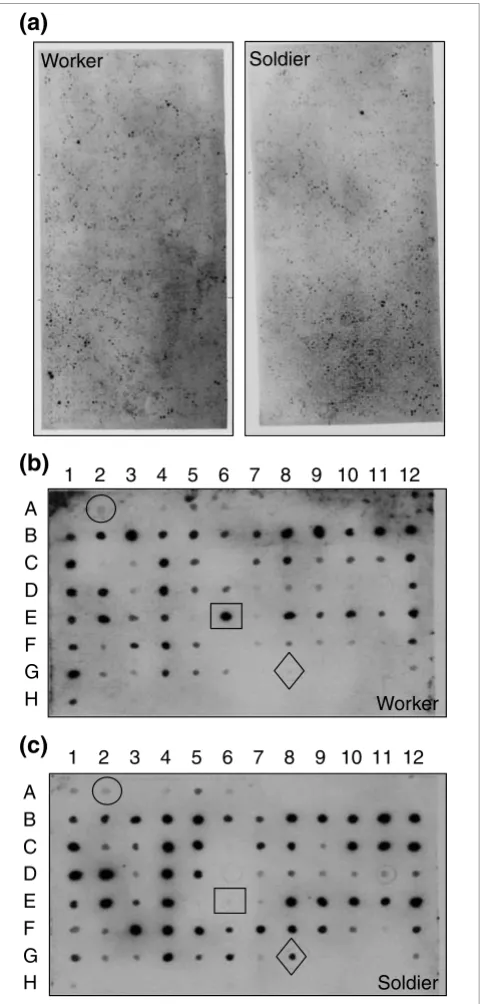
Macroarrays were probed separately with digoxigenin (DIG)-labeled mRNAs from worker or soldier R. flavipes (Figure 2a). Initially, 153 cDNAs with either clear or marginal Experimental design and diagram of caste differentiation and development in Reticulitermes termites
Figure 1
Experimental design and diagram of caste differentiation and development in Reticulitermes termites. Castes enclosed in blue boxes (soldier, worker) were compared initially by using cDNA macroarrays prepared from all stages shown except adult reproductives. Next, quantitative PCR was used to compare expression levels of specific gene transcripts between castes enclosed in blue boxes (soldier, worker) versus intermediary developmental stages enclosed in red boxes (nymph, presoldier).
Third-form reproductive
Second-form reproductive
Primary reproductive
Egg
Nymph
Alate
Larvae Worker
Pre-Soldier Soldier
Imaginal Apterous
comm
en
t
re
v
ie
w
s
re
ports
refer
e
e
d
re
sear
ch
de
p
o
si
te
d r
e
sea
rch
interacti
o
ns
inf
ormation
differential expression between soldiers and workers were identified in the array screens. These clones were the basis of further analysis. Clones corresponding to each of the 153 pos-itive array positions were sampled from frozen cultures in 384-well plates and grown as liquid cultures. Plasmid DNA was obtained from each culture and spotted on duplicate membranes in equal quantities. The resulting dot blots were probed with aliquots of the same DIG-labeled worker or sol-dier mRNA pools that were used to originally probe the array membranes. The secondary dot blots verified elevated tran-script abundance in around 50% of instances (Figures 2b,c). In the dot blots shown in Figure 2, examples of worker- and soldier-specific cDNAs are in positions noted by squares and diamonds, respectively.
Dot blots were also used to determine the expression of two potential genes with similar expression levels between castes: these encoded NADH dehydrogenase and actin-related pro-tein 66B (ARP 66B). These two transcripts were identified previously from expressed sequencing tag (EST)-sequencing studies [12] and were used as candidate control genes for expression. Similar expression levels of the two control genes can be seen in the upper left corners of the dot blots, with ARP 66B being circled (Figure 2b,c). In subsequent experiments it was determined that expression levels of these two genes were not robust enough to serve as controls in quantitative PCR. As a result, β-actin was used as the control in all subse-quent experiments (see below).
EST sequencing and bioinformatic summaries
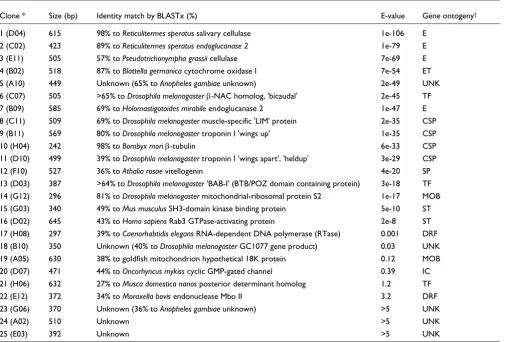
Following verification on dot blots, 68 clones were confirmed with clear differences in expression between workers and sol-diers. High-quality ESTs were obtained for each of these clones (Additional data file 1). Because the cDNA library was created with 5'-3'-oriented cDNAs, EST sequencing was only performed in one pass from the 5' ends of clones. EST sequencing results are summarized in Table 1 in order of BLASTx E-value significance scores. Lengths of high-quality, vector-trimmed sequence ranged from 66 to 632 nucleotides. On the basis of BLASTx database similarity searches, eight cDNAs occurred more than once in the array screen (Additional data file 1). These multiply-occurring cDNAs, shown in order of their identity-significance scores, corre-spond to genes encoding: termite salivary cellulases (3 total), termite endoglucanase (10), endosymbiont endoglucanase (3), endosymbiont cellulase (2), mitochondrial cytochrome oxidase I (24), muscle-specific LIM protein (2), mitochon-drial 18K protein (2), and unknown #24 (3). For simplicity, only single clones representing the longest sequence are reported in Table 1. Clones 1-16 possess significant E-values of less than 1 × 10⁻⁸ and therefore their identities are consid-ered valid (Tables 1, 2). Because clones 17-25 have larger E-values, the identities of these clones, when available, are only considered putative.
[image:3.612.56.296.86.588.2]Representative macroarray and dot blot results Figure 2
Representative macroarray and dot blot results. (a) Duplicate
macroarrays were probed separately with mRNAs that were labeled with digoxigenin (DIG) after isolation from worker or soldier R. flavipes. Shown are representative autoradiograms from arrays probed with worker (left) or soldier (right) mRNAs. (b-c) Plasmid DNA was obtained from array-positive cultures and spotted on duplicate membranes in equal quantities. The resulting dot blots were probed with aliquots of the same DIG-labeled worker or soldier mRNA pools that were used to probe the array membranes originally. The secondary dot blots verified elevated transcript abundance in approximately 50% of instances. Examples of worker- and soldier-associated cDNAs are in positions noted by squares and diamonds, respectively, while a control gene with similar expression (actin-related protein 66B) is circled.
A B C D E F G
H Worker
A B C D E F G
H Soldier
Worker Soldier
1 2 3 4 5 6 7 8 9 10 11 12 1 2 3 4 5 6 7 8 9 10 11 12
(a)
(b)
Because the six ESTs noted above corresponded to multiple positive array positions, the total number of distinct/unique sequences present in the array-positive EST pool was 25. These 25 cDNAs can be categorized into 10 gene ontogeny categories following the summary presented by Adams et al. [13]. These are: enzyme, cytoskeletal/structural, electron transport, transcription factor, mitochondrial organization and biogenesis, signal transduction, storage, DNA replica-tion, ion channel, and five unknown (Table 1).
Relative gene expression
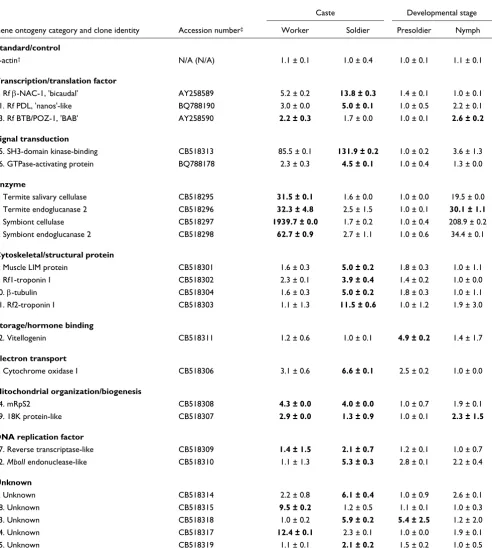
Relative expression patterns for 24 discrete gene transcripts, determined by quantitative PCR, are shown in Table 2. Raw data from quantitative PCR analyses are provided in Addi-tional data file 2. There was only one gene transcript that could not be amplified and evaluated by quantitative PCR. This sequence encodes a putative cyclic GMP-gated ion chan-nel (clone 20) with highly repetitive nucleotide sequences and
high CG content [14]. Because of these properties, no PCR primer pairs could be designed that would provide the high-fidelity PCR necessary for quantitative PCR analysis.
Transcripts having highest worker-associated expression were those encoding cellulase and endoglucanase enzymes involved in cellulose digestion. Cellulases and endogluca-nases can have origins in either termites or their microorgan-ismal endosymbionts. Cellulases and endoglucanases of apparent endosymbiont origin had substantially higher expression relative to those of apparent termite origin. Other transcripts with elevated expression in workers were either related to mitochondrial organization and biogenesis (mRpS2 and 18K protein-like; also elevated in soldiers), or had unknown identity (clones 18 and 24).
[image:4.612.58.564.116.457.2]More than half of the transcripts evaluated had exclusive sol-dier-biased expression (13 of 24). These included two Table 1
EST sequence summary of 25 positive R. flavipes clones identified from array screens
Clone * Size (bp) Identity match by BLASTx (%) E-value Gene ontogeny†
1 (D04) 615 98% to Reticulitermes speratus salivary cellulase 1e-106 E 2 (C02) 423 89% to Reticulitermes speratus endoglucanase 2 1e-79 E
3 (E11) 505 57% to Pseudotrichonympha grassii cellulase 7e-69 E
4 (B02) 518 87% to Blattella germanica cytochrome oxidase I 7e-54 ET
5 (A10) 449 Unknown (65% to Anopheles gambiae unknown) 2e-49 UNK
6 (C07) 505 >65% to Drosophila melanogaster β-NAC homolog, 'bicaudal' 2e-45 TF 7 (B09) 585 69% to Holomastigotoides mirabile endoglucanase 2 1e-47 E 8 (C11) 509 69% to Drosophila melanogaster muscle-specific 'LIM' protein 2e-35 CSP 9 (B11) 569 80% to Drosophila melanogaster troponin I 'wings up' 1e-35 CSP
10 (H04) 242 98% to Bombyx mori β-tubulin 6e-33 CSP
11 (D10) 499 39% to Drosophila melanogaster troponin I 'wings apart', 'heldup' 3e-29 CSP
12 (F10) 527 36% to Athalia rosae vitellogenin 4e-20 SP
13 (D03) 387 >64% to Drosophila melanogaster 'BAB-I' (BTB/POZ domain containing protein) 3e-18 TF 14 (G12) 296 81% to Drosophila melanogaster mitochondrial-ribosomal protein S2 1e-17 MOB 15 (G03) 340 49% to Mus musculus SH3-domain kinase binding protein 5e-10 ST 16 (D02) 645 43% to Homo sapiens Rab3 GTPase-activating protein 2e-8 ST 17 (H08) 297 39% to Caenorhabtidis elegans RNA-dependent DNA polymerase (RTase) 0.001 DRF 18 (B10) 350 Unknown (40% to Drosophila melanogaster GC1077 gene product) 0.03 UNK 19 (A05) 630 38% to goldfish mitochondrion hypothetical 18K protein 0.12 MOB 20 (D07) 471 44% to Oncorhyncus mykiss cyclic GMP-gated channel 0.39 IC 21 (H06) 632 27% to Musca domestica nanos posterior determinant homolog 1.2 TF
22 (E12) 372 34% to Moraxella bovis endonuclease Mbo II 3.2 DRF
23 (G06) 370 Unknown (36% to Anopheles gambiae unknown) >5 UNK
24 (A02) 510 Unknown >5 UNK
25 (E03) 392 Unknown >5 UNK
Clones are listed according to the significance of their identify-based BLASTx score E-values. * Clone number, with sequence identifier position shown in parentheses. See Additional data file 1 for sequence details. †Gene ontogeny classification based on Adams et al. [13]: E (enzyme), CSP
comm
en
t
re
v
ie
w
s
re
ports
refer
e
e
d
re
sear
ch
de
p
o
si
te
d r
e
se
a
rch
interacti
o
ns
inf
o
[image:5.612.60.552.119.669.2]rmation
Table 2
Relative expression levels of R. flavipes gene transcripts
Caste Developmental stage
Gene ontogeny category and clone identity Accession number‡ Worker Soldier Presoldier Nymph
Standard/control
β-actin† N/A (N/A) 1.1 ± 0.1 1.0 ± 0.4 1.0 ± 0.1 1.1 ± 0.1
Transcription/translation factor
6. Rf β-NAC-1, 'bicaudal' AY258589 5.2 ± 0.2 13.8 ± 0.3 1.4 ± 0.1 1.0 ± 0.1
21. Rf PDL, 'nanos'-like BQ788190 3.0 ± 0.0 5.0 ± 0.1 1.0 ± 0.5 2.2 ± 0.1
13. Rf BTB/POZ-1, 'BAB' AY258590 2.2 ± 0.3 1.7 ± 0.0 1.0 ± 0.1 2.6 ± 0.2
Signal transduction
15. SH3-domain kinase-binding CB518313 85.5 ± 0.1 131.9 ± 0.2 1.0 ± 0.2 3.6 ± 1.3
16. GTPase-activating protein BQ788178 2.3 ± 0.3 4.5 ± 0.1 1.0 ± 0.4 1.3 ± 0.0
Enzyme
1. Termite salivary cellulase CB518295 31.5 ± 0.1 1.6 ± 0.0 1.0 ± 0.0 19.5 ± 0.0
2. Termite endoglucanase 2 CB518296 32.3 ± 4.8 2.5 ± 1.5 1.0 ± 0.1 30.1 ± 1.1
3. Symbiont cellulase CB518297 1939.7 ± 0.0 1.7 ± 0.2 1.0 ± 0.4 208.9 ± 0.2
7. Symbiont endoglucanase 2 CB518298 62.7 ± 0.9 2.7 ± 1.1 1.0 ± 0.6 34.4 ± 0.1
Cytoskeletal/structural protein
8. Muscle LIM protein CB518301 1.6 ± 0.3 5.0 ± 0.2 1.8 ± 0.3 1.0 ± 1.1
9. Rf1-troponin I CB518302 2.3 ± 0.1 3.9 ± 0.4 1.4 ± 0.2 1.0 ± 0.0
10. β-tubulin CB518304 1.6 ± 0.3 5.0 ± 0.2 1.8 ± 0.3 1.0 ± 1.1
11. Rf2-troponin I CB518303 1.1 ± 1.3 11.5 ± 0.6 1.0 ± 1.2 1.9 ± 3.0
Storage/hormone binding
12. Vitellogenin CB518311 1.2 ± 0.6 1.0 ± 0.1 4.9 ± 0.2 1.4 ± 1.7
Electron transport
4. Cytochrome oxidase I CB518306 3.1 ± 0.6 6.6 ± 0.1 2.5 ± 0.2 1.0 ± 0.0
Mitochondrial organization/biogenesis
14. mRpS2 CB518308 4.3 ± 0.0 4.0 ± 0.0 1.0 ± 0.7 1.9 ± 0.1
19. 18K protein-like CB518307 2.9 ± 0.0 1.3 ± 0.9 1.0 ± 0.1 2.3 ± 1.5
DNA replication factor
17. Reverse transcriptase-like CB518309 1.4 ± 1.5 2.1 ± 0.7 1.2 ± 0.1 1.0 ± 0.7
22. MboII endonuclease-like CB518310 1.1 ± 1.3 5.3 ± 0.3 2.8 ± 0.1 2.2 ± 0.4
Unknown
5. Unknown CB518314 2.2 ± 0.8 6.1 ± 0.4 1.0 ± 0.9 2.6 ± 0.1
18. Unknown CB518315 9.5 ± 0.2 1.2 ± 0.5 1.1 ± 0.1 1.0 ± 0.3
23. Unknown CB518318 1.0 ± 0.2 5.9 ± 0.2 5.4 ± 2.5 1.2 ± 2.0
24. Unknown CB518317 12.4 ± 0.1 2.3 ± 0.1 1.0 ± 0.0 1.9 ± 0.1
25. Unknown CB518319 1.1 ± 0.1 2.1 ± 0.2 1.5 ± 0.2 1.0 ± 0.5
Relative expression levels of R. flavipes gene transcripts (average ± standard error), identified using cDNA macroarrays and quantified by quantitative PCR. Data shown in bold-face type represent the highest relative expression for a given gene (LSD t-test; P ≤ 0.05). Relative expression calculated using the method described by Pfaffl et al. [44] (n = 3). See Additional data file 2 for raw data. †All results are normalized to the control gene β-actin.
Primers designed from mouse and rat sequences (Accession nos. X03672 and V01207), as described by Giulietti et al. [43]. ‡Clone numbers
transcription factors, two signal transduction factors, four cytoskeletal/musculature proteins, one transcript associated with mitochondrial electron transport, one putative DNA rep-lication factor, and three transcripts of unknown identity. Three additional transcripts had similar expression levels between workers and soldiers, yet had higher expression than the presoldier and/or nymphal intermediary developmental stages (mRpS2,18 K protein-like, and reverse transcriptase-like).
Two soldier-biased troponin I-encoding transcripts had both differential expression and sequence variation (Additional data file 3). The first of these (Rf1-troponin I) aligns with a portion of the 3' region of the Drosophila troponin I cDNA whereas the second (Rf2-troponin I) aligns with the 5' region, and includes the ATG start signal. The two troponin ESTs have a 60-nucleotide overlap, but share only 65% amino-acid identity in the overlap region. These termite troponin forms have significantly elevated expression levels in soldiers, which are 1.7- and 10.5-fold elevated for the Rf1 and Rf2 forms, respectively, relative to workers.
Transcripts were also observed with high expression levels in the intermediary presoldier and nymph developmental stages. In all cases, transcripts that were identified with ele-vated nymphal expression were also eleele-vated in workers (as with cellulases/endoglucanases and Rf BTB/POZ-1) or both workers and soldiers (as with mitochondrial 18 K protein-like). Finally, a transcript encoding the storage/hormone-binding protein vitellogenin had highest expression in presol-diers, a stage incapable of feeding itself, and that is also hypothesized to serve as a sink for juvenile hormone [15].
Putative caste-regulatory genes
Two putative regulatory genes with significant homology to Drosophila and honey-bee (Apis mellifera) developmental genes were identified. Both these genes are transcriptional/ translational regulators. One is Rfβ-NAC-1, which is related to the bicaudal locus of Drosophila, and the second is Rf BTB/POZ-1, which is related to the bric-a-brac (BAB) locus of Drosophila. Alignments of the respective translated amino-acid sequences are shown in Additional data files 4 and 5. A third related gene, Rf-PDL, has putative identity as a nanos-homologous posterior-determinant gene on the basis of weak homology to database sequences; however, hydropathy pro-files for the translated amino-acid sequence bear striking similarities to Drosophila nanos protein and its homologs from other species (Additional data file 6).
Rfβ-NAC-1 is a Reticulitermes homolog of the ribosomal translation factor β-NAC. A partial open reading frame (ORF) of 420 nucleotides (140 amino acids) was included in our cDNA clone. Database searches using the Rfβ-NAC-1 trans-lated amino-acid sequence revealed numerous proteins with significant homology, all of which are associated with ribos-omal translational processes. Alignments of Rfβ-NAC-1
revealed 73 invariant amino-acid residues (Additional data file 4). Also observed was significant pairwise homology to β -NAC homologs from Drosophila (61.5%), A. mellifera (71.5%), and Caenorhabditis elegans (60.9%). These findings clearly establish identity of the Reticulitermes sequence as a β-NAC homolog.
Complete sequencing of the Rf BTB/POZ-1 cDNA clone eluci-dated a complete ORF of 1,320 nucleotides (439 amino acids). Database searches with the translated amino-acid sequence of the entire ORF did not reveal homologs with high degrees of similarity across their entire lengths; however, sig-nificant similarity to BTB/POZ domains of many BTB/POZ proteins was identified (Additional data file 5). The presence of the highly conserved BTB/POZ domain indicates that the sequence encodes a zinc-finger protein involved in transcrip-tional regulation. Alignments of the amino-terminal regions of several BTB/POZ domain-containing proteins revealed an insertion of 60-65 amino acids in the amino-terminal region of Rf BTB/POZ-1 that is not present in any of the homologous sequences, and the presence of three invariant sequence motifs in all BTB/POZ proteins shown (single-letter amino-acid code: LRWN, DVTL, LSACS). Overall identity between the BTB/POZ domains of termite Rf BTB/POZ-1 and Dro-sophila BRcore, DroDro-sophila fruitless, A. mellifera pipsqueak, and Drosophila pipsqueak are 44.5, 43.1, 41.8, and 35.8%, respectively.
A third EST termed Rf-PDL (posterior determinant-like) shares modest similarity with nanos-homologous posterior determinant genes of Musca domestica (AAA87461) and Xenopus laevis (X72340) (part a in Additional data file 6). Striking similarities in hydropathy profiles exist, however, for sequenced portions of the termite cDNA versus nanos homologs from Drosophila, Musca, and Xenopus (part b in Additional data file 6). The nanos gene in Drosophila is a transcription factor that controls anterior-posterior polarity and is under direct control of β-NAC. Quantitative PCR results for Rf-PDL follow a similar caste and development-associated expression pattern to Rf β-NAC-1, implying a link between these two genes.
comm
en
t
re
v
ie
w
s
re
ports
refer
e
e
d
re
sear
ch
de
p
o
si
te
d r
e
sea
rch
interacti
o
ns
inf
ormation
Discussion
Intuitive agreements between caste-associated physiology and gene expression
Cellulases
Termites and their close relatives the Cryptocerca cock-roaches comprise most of the invertebrate taxa that have the ability to feed on, digest, and receive nutrition from cellulose. We identified four transcripts encoding enzymes apparently involved in R. flavipes cellulose digestion, two each of puta-tive termite and endosymbiont origin, respecputa-tively. The assigned identity of these ESTs as either termite or endosym-biont is based on their significant levels of identity to data-base sequences obtained from endosymbiont-free termite salivary glands [16] or endosymbionts themselves (GenBank accession numbers BAB69425, BAB64564). Abundance of cellulase transcripts was highest in workers and nymphs, which is consistent with cellulose-feeding adaptations in these forms; and is also likely to be attributable to differences in symbiont communities between workers and nymphs ver-sus presoldiers and soldiers. The ability of termites to digest cellulose was long thought to be conferred exclusively by endosymbiotic bacteria and protozoa. However, after cellu-lase-encoding genes were discovered in the termite genome [16], the main role of protozoan and bacterial gut symbionts was concluded to relate more to anaerobic respiration and nitrogen fixation, than to cellulose digestion [17]. Interest-ingly, we observed that both endosymbiont- and termite-homologous cellulases were abundant, supporting the con-tention that cellulases of both endosymbiont and termite ori-gin are important to cellulose digestion [18].
Cytoskeletal, muscular and electron-transport proteins
Differentiation of the soldier caste is associated with a tre-mendous increase in body mass and musculature; particu-larly in the head, where a large muscle mass is required to drive the enlarged mandibles. We identified four cytoskeletal/muscular protein-coding transcripts with high expression in soldiers (two troponin I forms, a muscle LIM protein, and β-tubulin), and another encoding mitochondrial cytochrome oxidase I. The elevated expression of cytochrome oxidase I in soldiers would appear to be a result of elevated energy demands associated with their large muscle mass. Similarly, elevated cytochrome oxidase expression levels were observed previously in larval queen honey-bees [19,20], suggesting parallels in caste-associated respiratory require-ments between the eusocial Hymenoptera and Isoptera.
Troponin I is a Ca2+-binding protein involved in the interac-tion of thin (actin) and thick (myosin) muscle filaments, and is therefore central to muscle function [21]. heldup mutations arise from aberrations and point mutations in the Drosophila troponin I reading frame, resulting in pronounced flight-muscle degeneration [22]. Soldier termites are flightless, unlike their highly developed counterparts, the winged pri-mary reproductives, or alates (Figure 1). Because of the apter-ous nature of soldiers, the fact that both apterapter-ous and
imaginal forms differentiate from last instar larvae, and the existence of apparent aberrations (relative to the Drosophila sequence) in the two termite troponin I ESTs, it is possible that Rf1 and/or Rf2-troponin I may be involved in flight-mus-cle degeneration.
We also identified a termite muscle LIM protein with similar-ity to muscle LIM protein 60A of Drosophila. Muscle LIM proteins are cysteine-rich proteins with zinc-binding motifs that provide cytoarchitectural support and regulate cell growth and differentiation during development [23,24]. Two LIM muscle proteins occur in Drosophila (Mlp60A, Mlp84B) [23]. Drosophila LIM 60A is expressed throughout muscle fibers, both late in embryogenesis and during pupal meta-morphosis [23]. Because soldier termites constitute a devel-opmental end-point, and also because the main role of LIM proteins in Drosophila relates to muscle cytoarchitecture [24], we hypothesize that the termite LIM has a primary role in cytoarchitecture. This conclusion excludes any develop-mental roles for the termite LIM.
Finally, the termite β-tubulin we identified is most similar to constitutively expressed β-tubulins from Drosophila and Bombyx mori [25]. Tubulins are assembled from α- and β -tubulin dimers, and are involved in cytoskeletal support and mRNA trafficking in cells during development. From the soldier-specific expression of termite β-tubulin, it also appears to have a role in maintaining cytoarchitecture, rather than in caste development-affiliated processes.
Genes with putative caste-regulatory and/or developmental functions
Transcription and translation factors
Three putative regulatory genes were identified with clear caste-associated expression. Two of these, Rf β-NAC-1 and Rf BTB/POZ-1, possess significant sequence homology to highly conserved developmental genes from Drosophila that occur at the bicaudal [26] and bric-a-brac [27,28] loci, respec-tively. A third gene transcript, Rf-PDL, has weak homology but conserved hydropathy profiles with a developmental gene occurring at the nanos locus of Drosophila [29,30] and its homologs. In Drosophila, both bicaudal and nanos function in embryonic pattern formation; thus, expression of their putative homologs in late and terminal termite developmen-tal stages is highly intriguing. Expression profiles and func-tions of the termite bicaudal and nanos (that is, Rf β-NAC-1 and Rf BTB/POZ-1) are presently undefined; therefore, it is not known if their elevated expression in a developmental end-point such as the soldier caste is related to a caste-spe-cific function, or whether it is residual from the presoldier-to-soldier developmental transition.
with mirror-image duplications of abdominal segments. Markesich and co-workers [26] mapped the bicaudal locus to a region encoding β-NAC, a component of the ribosomal translational machinery and the nascent polypeptide-associ-ated complex. bicaudal and a relpolypeptide-associ-ated mutation, enhancer of bicaudal, are caused by insertions into the β-NAC transcribed region. Both bicaudal mutations have been rescued by wild type copies of β-NAC, which regulates expression of the pos-terior determinant gene nanos (that is, bicaudal mutations lead to ectopic expression of nanos [26]). The observed high expression of Rf β-NAC-1 in soldiers, and the unique shape of the termite soldier head in relation to the rest of the body, suggest that Rf β-NAC-1 may influence the generalized soldier body plan and possibly direct ectopic expression of the poste-rior determinant nanos (see below).
In insects, nanos is an evolutionarily conserved organizer of anterior-posterior polarity, which acts as a translational repressor by directing expression of the hunchback gene [30,32]. The mechanism by which nanos acts is conserved in insects, and nanos sequence divergence among dipterans correlates with evolutionary relationships and natural his-tory. As a result, nanos should be more highly diverged in R. flavipes. In a study by Curtis et al. [30], nanos homologs with only 28-63% amino-acid identity from evolutionarily distant dipteran species successfully rescued nanos activity in null mutants of Drosophila. Although the function encoded by the Rf-PDL transcript is unknown, its similar expression patterns to Rf β-NAC-1, and its similar hydropa-thy profiles to known nanos homologs, provide support that it may potentially encode nanos-homologous functions. Regardless of its true identity, the Rf-PDL transcript pos-sesses caste-associated expression that suggests a develop-mental role.
BTB/POZ domains are conserved amino-acid motifs in the amino terminus of zinc-finger proteins, some of which function as transcriptional regulators. A total of 40 BTB/POZ domain-containing proteins are encoded in the Drosophila genome, and therefore these proteins appear to be responsi-ble for a vast number of functions [27,28]. Several lines of evi-dence establish clear developmental roles for BTB/POZ-domain-containing proteins, however. Godt and co-workers [27] reported that the BTB/POZ protein bric-a-brac (Bab-I), which is most similar to our termite sequence, is involved in pattern formation along the proximal-distal axis of the leg and antenna of Drosophila, and that mutants possess legs and antennae with segmentation defects. bric-a-bac is also known to be involved in Drosophila ovary morphogenesis on the basis of the disrupted ovariole formation and female ste-rility in bric-a-brac mutants [33]. BTB/POZ protein domains can dimerize with themselves [34], possibly leading to self-inactivation. This suggests that the expression of termite Rf BTB/POZ-1 may repress gene expression in workers and nymphs, which have higher BTB/POZ expression than presoldiers and soldiers. Alternatively, elevated BTB/POZ
expression in workers and nymphs may relate to their gona-dotropic/reproductive potential.
Signal transduction factors
We also identified two gene transcripts with significant hom-ology to the signal transduction factors SH3-domain kinase and GAP. SH3-domain proteins are adaptor proteins involved in the regulation of signal transduction [35]. The SH3 domains of these proteins can interact with other kinases involved in apoptotic cell death and membrane trafficking. Expression of mouse SH3-Ruk proteins in cells appears to be involved in the regulation of their survival and other intracel-lular processes [35]. Extremely high levels of expression occurred for the SH3-domain protein in termite soldiers (139-fold relative to presoldiers), but expression was also high in workers (85.5-fold relative to presoldiers), suggesting that dose-dependent factors may be implicated in SH3-domain cascade-dependent processes.
GAPs are involved in regulating the transfer of phosphate groups by GTPases, and are particularly relevant to signal transduction processes. One related protein in Drosophila, named Ras1, mediates the modulation of homeotic gene func-tion in cell and segment identity [36] and eye development [37]. Ras1-mediated cell signaling modifies nuclear activity of transcription factors, most notably those encoded by the homeobox genes proboscopedia and ultrabithorax. Ras1 is active when coupled with GTP but inactive in the presence of GDP, thus implicating GTPases as regulators of Ras1 (and homeobox) action. Ras1 impacts on homeobox gene expres-sion are dose-dependent [36], which may explain high and intermediate (not absent) GAP expression in soldiers and workers, respectively. Together, our signal transduction-related findings suggest interesting possibilities for signal transduction-mediated transcriptional regulation, cascade-dependent processes, and possibly regulation of cellular death in termite caste-differentiation processes.
Conclusions
comm
en
t
re
v
ie
w
s
re
ports
refer
e
e
d
re
sear
ch
de
p
o
si
te
d r
e
se
a
rch
interacti
o
ns
inf
o
rmation
to key developmental processes in Drosophila and honey-bees) appear to be important in the development and differ-entiation of the soldier caste. Third, genes associated with musculature and cytoskeletal architecture (including two tro-ponin I forms) were identified in association with the apter-ous and highly muscular soldier caste. Fourth, expression of a gene encoding the storage/hormone-binding protein vitello-genin is associated with a stage incapable of feeding and thought to serve as a juvenile hormone sink (the presoldier stage). Finally, several genes with unknown and/or putative identity, but with significant caste and development-associ-ated expression were also identified as having differential expression between castes.
Because the two stages compared in our cDNA arrays repre-sent a developmental end-point (soldiers) and a non-differ-entiated caste (workers), many important developmental genes were surely not identified. Future sociogenomic-based studies on intermediary developmental stages (nymphs and presoldiers) is likely to yield exciting new information. We observed strong similarities between termite genes and a number of well-characterized Drosophila mutants and genes, as well as honey-bee developmental genes. It is unclear if the differences we identified in developmental gene expression between Drosophila, honey-bees and termites relates to the holometabolous and hemimetabolous nature (respectively) of these insect groups. Nonetheless, the information on novel termite genes reported here sheds new light on completely uncharacterized aspects of basic termite molecular biology and physiology.
Materials and methods
The authors will provide specific protocols on request.
Termites, cDNA library, array preparation and array screening
Termites of multiple castes and developmental stages were obtained, and a polyphenic cDNA library synthesized as described previously [12]. Total RNA was isolated from groups of whole termites using the RNaqueous total RNA iso-lation kit (Ambion, Austin, TX), and its integrity and quantity verified by formaldehyde-agarose electrophoresis [38]. Poly(A) RNA was purified from the total RNA (Ambion), cDNA was synthesized using an oligo-dT12 adaptor primer, and the library constructed (see [12]). From the cDNA library, the Purdue University Genomics Core Facility prepared mul-tiple identical 'macro' arrays, which are gridded bacterial col-ony filters. Each 22 × 22 cm filter was printed from 18,432 glycerol stocks contained in forty-eight 384-well plates. Duplicate filters were printed by using a Biorobotics robot (Total Array System, Woburn, MA) to spot samples from plates onto charged nylon membranes overlaid with LB agar containing 100 µg/ml ampicillin. The filters were grown over-night at 37°C, peeled away from the agar, placed on chroma-tography paper saturated with 5% SDS and 2x SSC for 2 min,
heated in a microwave for 2.5 min, then UV-cross linked in a Stratalinker (Stratagene, La Jolla, CA).
Primary gene-expression comparisons between the soldier and worker castes were made as follows, using soldiers and workers isolated from laboratory colonies. mRNA was obtained separately from whole, pooled worker or soldier ter-mites (Figure 1) using a commercially available protocol (Ambion), then digoxigenin (DIG)-labeled using a separate commercially available protocol (DIG Chem-link Labeling and Detection; Roche, Indianapolis, IN). Individual array membranes were probed with DIG-labeled mRNAs from either workers or soldiers (10 ml of 100 ng/ml). Autoradio-grams of the membranes, showing the positions of specific clones, were produced using a commercially available protocol (Roche). Expression levels were compared between soldier and worker array autoradiograms by manual alignment.
For secondary verification, dot blots were performed using plasmid DNA affixed to nitrocellulose membranes (Millipore, Marlboro, MA). Liquid cultures were produced from array-positive cell lines, from which plasmid DNA was obtained using a commercially available protocol (Qiagen, Valencia, CA). Pure plasmid DNA (100-200 ng) was manually spotted onto duplicate membranes [38]. Membranes were probed with labeled aliquots of the same worker- and soldier-derived mRNAs noted above, using an identical procedure, then were manually superimposed to compare relative expression levels between castes.
Sequencing and bioinformatics analyses
Array and dot blot-positive clones were sequenced from their 5' ends (T3 promoter) using a high-throughput EST sequenc-ing procedure. For the putative regulatory genes Rfβ-NAC-1 and Rf BTB/POZ-1, longer sequences shown in alignments (Additional data files 4 and 5) were obtained by sequencing from both the 5' and 3' ends, and by designing internal sequencing primers in the case of BTB/POZ (forward = GCAACGGATGACTACATGGA, reverse = TGGTTGAAGCCTGATTCACA). All sequencing-related pro-cedures were performed by the Purdue University Genomics Core Facility. After contaminating vector sequences were trimmed, the ESTs were used as query sequences to search the GenBank nucleotide and translated databases by BLASTx [39]. Database searches were performed under default set-tings, with E-values for significance of identity being 1 × 10⁻¹⁰ and smaller [40]. Sequence alignments were performed using clustal analysis in DNAstar-Megalign software (Madison, WI).
Quantitative real-time PCR
nymph termites. Total RNA isolation and DNase treatment were performed using commercially available protocols (Qia-gen and Ambion, respectively). The quantity and quality of RNA was assessed before and after DNase treatment by spec-trophotometry and formaldehyde-agarose electrophoresis [38]. cDNA was synthesized from 5 µg total RNA using an oligo-dT15 primer and 50 U Superscript II reverse tran-scriptase (Invitrogen, Carlsbad, CA) at 42°C for 50 min.
Primers for use in quantitative PCR were designed from EST sequence data by the MIT Primer 3 program [41]. Primer sequences are provided in Additional data file 9. Quantitative PCR primers were designed to provide products of 100-200 base-pairs (bp) within putative ORFs; and had 45-55% GC content, Tm = 57-62°C, non-complementarity between for-ward and reverse primers, and pyrimidine nucleotides on their 5' and 3' ends [42].
Quantitative PCR was performed using an iCycler iQ real-time PCR detection system (Bio-Rad, Hercules, CA) with SYBR Green I product tagging. To verify the amplification efficiency for both target and control genes, quantitative PCR conditions were optimized for cDNA template dilution (1:5, 1:10, 1:25, 1:50, and so on) and annealing temperature (Tm ± 5°C). Before experiments, the production of single product bands and absence of 'primer-dimers' was confirmed by view-ing products followview-ing agarose electrophoresis and ethidium-bromide staining. Simultaneous determination of relative expression levels for specific genes in workers, soldiers, presoldiers and nymphs was determined from quantitative PCR results in relation to the standard gene β-actin [43], using REST software [44] (see Additional data file 2).
Data deposition
Sequences have been deposited in GenBank under accession numbers AY258589, AY258590, BQ788178, BQ788190 and CB518295 through CB518319.
Additional data files
The following additional data are included with the online version of this article: Figures showing a summary of clones and clone sequences (Additional data file 1), the quantitative real-time PCR raw data (Additional data file 2), the troponin alignments (Additional data file 3), the β-NAC alignments (Additional data file 4), the BTB/POZ alignments (Additional data file 5), the nanos alignments and hydropathy profiles (Additional data file 6), the SH3-domain kinase alignments (Additional data file 7), the GAP alignments (Additional data file 8), and the real-time PCR primer sequences (Additional data file 9).
Additional data file 1
A figure showing a summary of clones and clone sequences A figure showing a summary of clones and clone sequences Click here for additional data file
Additional data file 2
A figure showing the quantitative real-time PCR raw data A figure showing the quantitative real-time PCR raw data Click here for additional data file
Additional data file 3
A figure showing the troponin alignments A figure showing the troponin alignments Click here for additional data file Additional data file 4
A figure showing the β-NAC alignments A figure showing the β-NAC alignments Click here for additional data file Additional data file 5
A figure showing the BTB/POZ alignments A figure showing the BTB/POZ alignments Click here for additional data file
Additional data file 6
A figure showing the nanos alignments and hydropathy profiles A figure showing the nanos alignments and hydropathy profiles Click here for additional data file
Additional data file 7
A figure showing the SH3-domain kinase alignments A figure showing the SH3-domain kinase alignments Click here for additional data file
Additional data file 8
A figure showing the GAP alignments A figure showing the GAP alignments Click here for additional data file Additional data file 9
A figure showing the real-time PCR primer sequences A figure showing the real-time PCR primer sequences Click here for additional data file
Acknowledgements
We thank Phillip San Miguel and Paul Parker of the Purdue University Genomics Core Facility for their expert assistance, Catina Ratliff, Jody Aleong and Jesse Hoteling for technical assistance with termites, and Bill
Pak and anonymous reviewers for helpful comments on manuscript drafts. This is journal article No. 17100 of the Agricultural Research Program of Purdue University, West Lafayette, Indiana.
References
1. Wilson EO: Caste: Termites. In The Insect Societies Cambridge, MA: Belknap Press; 1971:183-210.
2. Thorne BL: Evolution of eusociality in termites.Ann Rev Ecol Syst 1997, 28:27-54.
3. Nutting WL: Insecta: Isoptera. In Soil Biology Guide Edited by: Dindal DL. New York: Wiley and Sons; 1990:997-1032.
4. Buchli H: L'origine des castes et les potentialitiés ontogé-niques des termites européens du genre Reticulitermes.Annls Sci Nat Zool Biol Anim 1958, 20:261-429.
5. Thorne BL: Termite terminology.Sociobiology 1996, 28:253-261. 6. Roisin Y: Diversity and evolution of caste patterns. In Termites:
Evolution, Sociality, Symbioses, Ecology Edited by: Abe T, Bignell DE, Higashi M. Dordrecht: Kluwer; 2000:95-119.
7. Evans JD, Wheeler DE: Gene expression and the evolution of insect polyphenisms.BioEssays 2001, 23:62-68.
8. Evans JD, Wheeler DE: Differential gene expression between developing queens and workers in the honey bee, Apis mellifera.Proc Natl Acad Sci USA 1999, 96:5575-5580.
9. Abouheif E, Wray GA: Evolution of the gene network underly-ing wunderly-ing polyphenism in ants.Science 2002, 297:249-252. 10. Miura T, Kamikouchi A, Sawata M, Takeuchi H, Natori S, Kubo T,
Matsumoto T: Soldier caste-specific gene expression in the mandibular glands of Hodotermopsis japonica.Proc Natl Acad Sci USA 1999, 96:13874-13879.
11. Miura T: Morphogenesis and gene expression in the soldier-caste differentiation of termites.Insectes Soc 2001, 48:216-223. 12. Wu-Scharf D, Scharf ME, Pittendrigh BR, Bennett GW: Expressed
sequence tags from a polyphenic Reticulitermes flavipes cDNA library.Sociobiology 2003, 41:479-490.
13. Adams MD, Celniker SE, Holt RA, Evans CA, Gocayne JD, Amanati-des PG, Scherer SE, Li PW, Hoskins RA, Galle RF, et al.: The genome sequence of Drosophila melanogaster. Science 2000, 287:2185-2195.
14. Vervoort R, Lennon A, Bird AC, Tulloch B, Axton R, Miano M, Meindl A, Meltinger T, Ciccodicola A, Wright AJ: Mutational hot spot within a new PRGR exon in X-linked retinitis pigmentosa. Nat Genet 2000, 25:462-466.
15. Henderson G: Primer pheromones and possible soldier caste influence on the evolution of sociality in lower termites. In Pheromone Communication in Social Insects Edited by: Vander Meer RK, Breed MD, Espelie KE, Winston ML. Boulder, CO: Westview Press; 1998:314-329.
16. Watanabe H, Noda H, Tokuda G, Lo N: A cellulase gene of ter-mite origin.Nature 1998, 394:330-331.
17. Bignell DE: Introduction to symbiosis. In Termites: Evolution, Social-ity, Symbioses, Ecology Edited by: Abe T, Bignell DE, Higashi M. Dor-drecht: Kluwer; 2000:189-209.
18. Nakashima K, Watanabe H, Saitoh H, Tokuda G, Azuma JI: Dual cel-lulose-digesting system of the wood-feeding termite Coptot-ermes formosanus.Insect Biochem Mol Biol 2002, 32:777-784. 19. Evans JD, Wheeler DE: Expression profiles during honeybee
caste determination.Genome Biol 2000, 2:research0001.1-0001.6. 20. Corona M, Estrada E, Zurita M: Differential expression of mito-chondrial genes between queens and workers during caste determination in the honeybee Apis mellifera.J Exp Biol 1999, 202:929-938.
21. Squire JM: Architecture and function in the muscle sarcomere.Curr Opin Struct Biol 1997, 7:247-257.
22. Beall CJ, Fryberg E: Muscle abnormalities in Drosophila mela-nogaster heldup mutants are caused by missing or aberrant troponin-I isoforms.J Cell Biol 1991, 114:941-951.
23. Stronach BE, Siegrist SE, Beckerle MC: Two muscle-specific LIM proteins in Drosophila.J Cell Biol 1996, 134:1179-1195.
24. Stronach BE, Renfranz PJ, Lilly B, Beckerle MC: Muscle LIM pro-teins are associated with muscle sarcomeres and require dMEF2 for their expression during Drosophila myogenesis. Mol Biol Cell 1999, 10:2329-2342.
comm
en
t
re
v
ie
w
s
re
ports
refer
e
e
d
re
sear
ch
de
p
o
si
te
d r
e
se
a
rch
interacti
o
ns
inf
o
rmation
26. Markesich DC, Gajewski KM, Nazimiec ME, Beckingham K: bicaudal encodes the Drosophila beta NAC homolog, a component of the ribosomal translational machinery. Development 2000, 127:559-572.
27. Godt D, Couderc JL, Cramton SE, Laski FA: Pattern formation in the limbs of Drosophila : bric-a-brac is expressed in both a gradient and wave-like pattern and is required for specifica-tion and proper segmentaspecifica-tion of the tarsus.Development 1993, 119:799-812.
28. Lehmann M, Siegmund T, Linterman KG, Korge G: The pipsqueak protein of Drosophila melanogaster binds to GAGA sequences through a novel DNA-binding domain.J Biol Chem 1998, 273:28504-28509.
29. Wang C, Lehmann R: Nanos is the localized posterior determi-nant in Drosophila.Cell 1991, 66:637-647.
30. Curtis D, Apfeld J, Lehmann R: nanos is an evolutionarily con-served organizer of anterior-posterior polarity.Development 1995, 121:1899-1910.
31. Bull A: bicaudal, a genetic factor which affects the polarity of the embryo in Drosophila melanogaster. J Exp Zool 1966, 161:221-242.
32. Lall S, Ludwig MZ, Patel NH: Nanos plays a conserved role in axial patterning outside of the Diptera.Curr Biol 2003, 13: 224-229.
33. Godt D, Laski FA: Mechanisms of cell rearrangement and cell recruitment in Drosophila ovary morphogenesis and the requirement for bric-a-brac.Development 1995, 121:173-187. 34. Chen W, Zollman S, Couderc JL, Laski FA: The BTB domain of
bric-a-brac mediates dimerization in vitro.Mol Cell Biol 1995, 15:3424-3429.
35. Buchman VL, Luke C, Borthwick EB, Gout I, Ninkina N: Organiza-tion of the Ruk locus and expression of isoforms in mouse tissue.Gene 2002, 295:13-17.
36. Boube M, Benassayag C, Seroude L, Cribbs DL: Ras1-mediated modulation of Drosophila homeotic function in cell and seg-ment identity.Genetics 1997, 146:619-628.
37. Gaul U, Mardon G, Rubin GM: A putative Ras GTPase activating protein acts as a negative regulator of signaling by the Seven-less receptor tyrosine kinase.Cell 1992, 68:1007-1019. 38. Sambrook J, Fritsch EF, Maniatis T: Molecular Cloning: A Laboratory
Manual 2nd edition. Cold Spring Harbor, NY: Cold Spring Harbor Laboratory Press; 1989.
39. NCBI BLAST search 1989 [http://www.ncbi.nlm.nih.gov/BLAST]. 40. Altschul SF, Gish W, Miller W, Myers EW, Lipman DJ: Basic local
alignment search tool.J Mol Biol 1990, 215:403-410. 41. Primer3 software distribution 1990
[http://www-genome.wi.mit.edu/genome_software/other/ primer3.html].
42. Boeckman F, Brisson M, Tan L: Real-time PCR: General Considerations. Hercules: Bio-Rad; 2001.
43. Giulietti A, Overbergh L, Valckx D, Decallonne B, Bouillon R, Mathieu C: An overview of real-time quantitative PCR: applications to quantify cytokine expression.Methods 2001, 25:386-401. 44. Pfaffl MW, Horgan GW, Dempfle L: Relative expression software