COMMISSION OF THE EUROPEAN COMMUNITIES
Proposal for a COUNCIL DECISION
COMC89) 567 final
Brussels, 8 December 1989
proposing the adoption of a Community action programme for the development of continuing vocational training
ll
OOUUUNITY ACTION PROGRAMME FOR THE DEVELOPMENT OF CONTINUING VOCATIONAL TRAINING·
COMU ISS I ON OOUUUN I CAT I ON PARAGRAPHS
I. INTRODUCTION 1-5
I I. ROLE OF CONTINUING VOCATIONAL TRAINING 6-9
II I. ACTION PROGRAMME
A. STRATEGY 10
B. OBJECTIVES 11-12
C. TRANSNATIONAL MEASURES 13-17
D. IMPLEMENTING AND BUDGET PROCEDURES 18
IV. CONCLUSIONS 19
PROPOSAL FOR A COUNCIL DECISION
- 1
-COMMUNITY ACTION PROGRAMME FOR THE DEVELOPMENT OF CONTINUING VOCATIONAL TRAINING
COMMISSION COMMUNICATION TO THE COUNCIL
I. INTRODUCTION
1. Continuing vocational training and Its development are already central to the strategies adopted by firms and the pol lcles pursued by and In the Member States to harness the acceleration In economic and social change, prepare for the achievement of the 1992 objective and, thanks to a new qual ltatlve and quantitative effort, meet a set of challenges of fundamental Importance for the future of the Community: level of competitiveness, technological Innovation, demographic change, developments In employment, transfer of work and reinforcing of economic and social cohesion. 2. Continuing vocational training Is also becoming an Increasingly
Important subject at all levels In the social dialogue. This Is explained both by the desire of both sides of Industry to achieve greater convergence of training and employment objectives and to develop a work organIzation focused to a greater extent on the man/woman at work, thanks to new approaches I Ink I ng the forward planning of job content, the systematic adaptation of training and decentral lzatlon of organizational methods.
3. Among those responsible for political and socio-economic aspects, whether In the Council, the European Parliament, the Economic and Social Committee or on both sides of Industry, a consensus has already emerged on the following polnts1:
-Continuing vocational training plays an Important role In the strategy for achieving the completion of the Internal market by 1992 as a determining factor In economic and social pol Icy.
Investment In the Community's human resources Is an essent lai pre-condition for the successful achievement of this objective. -The strategy of upgrading human resources lmpl les that alI
workers should, In the light of requl rements, have access to continuing vocational training and benefit from lt.
4. The development of continuing vocational training also continues to add a new ,Qua II tat I ve dImensIon to the po II c I es of freedom of movement and equal opportunities:
- Freedom of movement for workers wIthIn a sIng I e economIc and social area creates new requirements for continuing vocational training. This applies In particular to support for transnational cooperation between firms, temporary mobility for skilled manpower and the opening-up of the European technological area. Here, the contribution made by continuing vocational training to completion of the Internal market wl I I operate In tandem with the development of Community action on the comparability and transparency of qual lflcatlons and the recognition of diplomas. -The promotion of equal opportunities by means of greater
participation by women In continuing vocational training schemes and the diversification of career choices towards the sectors and occupations of the future, Is closely I Inked both to the development of the range of training on offer and significantly
Improved access to lt.
5. Thus, the Implementation of a common continuing vocational training policy appears to be the key step to be taken to arr lve at a convergence of the var lous protagonists' object lves and efforts (public authorities, the two sides of Industry, entreprlses, training bodies and Individuals), to achieve coherence In the new Initiatives developed by and In the Member States, motivate the parties concerned to make a greater Investment In continuing vocational training and promote dynamism In bul ldlng both the economic and social aspects of the Community.
II. ROLE OF CONTINUING VOCATIONAL TRAINING
6. Continuing vocational training performs three functions Inside and outside firms, depending on the case, which complement one another: that of ensuring permanent adaptation to the changing nature and content of occupations and hence the Improvement of skills and qual lflcatlons which Is so Imperative for strengthening the competitiveness of European firms and their staff;
that of promotIng soc I a I condItIons to enable workers to overcome a lack of prospects for qual lflcatlons and to Improve their situation;
3
-I
7. The current state of affairs as regards continuing vocational training may, all In alI, be summed up as follows:
(I) highly diverse legislation and Industrial relations policies which, together with the scant or complete lack of Information tools or statistics aval lable, makes any comparison risky. Similarly, the terminology used Is Inconsistent, which does not facl I I tate reciprocal comprehension.
(II) It Is noticeable that there Is a certain shift between the Identification of ski II requirements and the development of short cont lnu lng vocat lona 1 traInIng courses whIch do not lead to the award of any certificate. There Is a risk that continuing vocational training may be managed more as an ad hoc adjustment to new tasks, than as a systematic pol Icy on skills.
(I I I) however, an Increasing number of firms are seeing continuing vocational training as an Investment. In the context of the human resources management pol lcles which form part of their overall strategy. This trend seems to be gaining strength In the run-up to 1992. Continuing vocational training thus becomes a means for mob I. I I zing human resources In support of such alms as the flexlbl I lty of production processes, wll I lngness to Introduce new forms of organization and new working conditions, the need to exploit the results of research and development and the demands of qual lty In manufacturing.
(lv) the role of the sectors Is becoming IncreasinglY Important both In carrying out experiments In the field of continuing vocational training and In drawing up forecasts of skill requirements. The negotiation of agreements In conjunction with the allocation of certain productivity gains or the reduction of Individual working time Is a key Issue In many
Industries In some Member States.
(vi) In most Member States partnership has been reinforced In respect of continuing vocational training at national, regional and local level. These moves have sometimes led to arrangements for joint Investment by the different parties concerned: training organized partly In working t lme and partly In free time, publ lc authorities participating In the financing.
(vi I) finally, continuing ·vocational training for wage and salary earners Is an Important topic In the dialogue, consultations and concertatlon between the two sides of Industry. It Is also a key factor In motivating workers faced with technological change. As far as wage and salary earners are concerned, It Is essent I a I to the maIntenance of theIr jobs and plays a part In occupational. mobility both within the firm and on the labour market, a feature which Is all the more Imperative In the context of the completion of a European occupational mobil lty area.
8. The common guidelines to promote the development of cont lnulng vocational training and the Investment In human resources result from wide-ranging discussions on the functions of continuing vocational training and the measures to be promoted by the Member States and the Community, from Intensive consultations carr led out on the bas Is of the CommIssIon CommunI cat lon2 datIng from 1986 among the European Parllament3, the Councll4; Member States, the Economic and Social CommitteeS and both sides of lndustry6 (taking Into account the unanimous opinion delivered In June 1987 by the AdvIsory CommIttee on Vocat lona I TraInIng) and also from the findings of a Community survey of the current situation as regards continuing vocational training In each Member State.
9. In accordance with the principle of subsidiarity, the Council Reso I utI on IdentIfIes fIrst I y a number of common measures whIch should be taken or encouraged by the Member States (relating to development of the range of training, the extension of access to the latter and the promotion of new Initiatives to raise awareness and stimulate motivation), and secondly guidelines for Comunlty measures which should bring added value to the activities developed by and In the Member States: Identification and assessment of national provisions, support for transnational measures to raise-awareness and
2 COM(86)780 final.
3 OJ C 96, 17.4.1989, p. 61. 4 OJ C 148, 15.6.1989, p.1. 5 OJ C 180, 8.7.1987, p.8.
6 Joint Opinion on Training and Motivation of 6 March 1987.
I
I
5
-stimulate motivation, observation of qualifications. development of transnational partnerships· by the exchange of experience and support for the.reallzatlon of Innovatory projects. the ~erfectlng
of appropriate technical aid to help regions which do not yet have sufficient Infrastructure and experience. the spread of Innovations concerning teaching materials and methods and the communication of InformatIon on access to cont I nu lng vocat lona I traInIng and the benefit to be derived from it. "Complementary to this Resolution reference should be made among Community measures of the training of scientific staff, partlrularly researchers. as provided for under the RTD framework programme 1990-94 (OJ C 243, 23.9.89).•
Ill. THE ACTION PROGRAMME
Ill .A. STRATEGY
10. The strategy proposed to achieve the ambitious objectives which the Community has set Itself Is based on a dynamic process along the
following three complementary lines:
-the solemn proclamation of the right to vocational training under the Community Charter of Fundamental Social Rights;
- the adoption of a new joint opinion on education and training In the context of the Social Dialogue at Community level;
'
The draft second joint opInIon on educaton and traInIng as It emerged after discussions within the working party, goes Into greater detail and Identifies a number of Important themes which already appear In the first joint opinion of 6 March 1987, In particular basic training and the preparation of young people for working I lfe and training throughout working I lfe. The,dlscusslons on this subject between UNICE, the CEEP and the ETUC on this subject demonstrate the fact that, whl le the question of the right to training, as a guarantee affecting third parties, Is still a very controversial one, that of access. to training Is on the other hand one on which there Is a great deal of convergence, on the grounds of a basic distinction between training decided on by the firm, on the one hand, and leave linked to training corresponding to a need for personal development, on the other. Another strong point In this debate Is that the participants recognize the Importance of drawing up training plans as part ·of overal I ·Industrial strategy.
In the light of the results of the Social Dialogue, the Commission reserves the possibility of presenting a Community Instrument on access to vocational training.
In view of the need to present an action pro.gramme which swiftly makes the request of the other Community bodies, the Advisory Committee and both sides of Industry, and one which Is one a sufficient scale to have an Impact on the Community, It Is advisable to base It primarily on the objective which Is unanimously shared of Improving ·significantly access to continuing vocational training.
By emphasizing this objective, the programme can be better organized to support joint measures and Initiatives by the social partners,. thus offering a posslbl I lty for the Social Dialogue to be pursued on other levels, for example In sectoral concertatlon or re'glonal planning with regard to training.
lJI
7
-Secondly, In accordance with the guidelines set out In the Council Resolution,. the Interaction between the European Social Fund and the programme will make It possible to pursue two specific alms: firstly, to establish a network of Innovatory projects of part I cuI ar Interest for the topIc of access and whIch ensure an effective transfer of experience; secondly, to support Innovatory partnerships In regional planning, especially In backward regions where the need to Increase the numbers undergoing training and access to the latter are greatest, and In whlch the transfer of knowhow across the Community may have considerable added value. Lastly, thanks to the support of joint transnational and cross ·frontier projects between firms specifically related to the consequences of the completion of the Internal market, the programme can a I so he I p to Improve the supply of traInIng by developing high qua·t lty common standards throughout the Community.
III.B.OBJECTIVES
11. The action programme comprises the following:
- a common framework of general principles, which the pub! lc authorities of the Member States undertake to promote; It Is aimed at significantly Improving access-to continuing vocational training for all workers, reinforcing the existing provisions, ensuring access for the least skilled workers and guaranteeing equal treatment as regards access; It Is Intended to promote the convergence of the Member States' activities In this field;
- a number of transnational measures, to be Implemented at Community level, with a view to promoting Innovatory partnernshlps to encourage Investment In training, to sustain Innovation In continuing voc~tlonal training and Its transfer by means of projects and exchanges and ensure the monItorIng ·and analysis of the development of training mechanisms and the evolution of qual lflcatlons; these are Intended .to provide support for and supplement the measures taken by and In the Member States.
12. It Is so devised as to Involve all the parties concerned (firms, training bodies, the two sides of Industry and pub! lc authorities) and to make their efforts on the following objectives converge: - every European CommunIty worker must have access to vocat lona I
training and be able to benefit from It throughout his working I lfe. The conditions of access to such training may not Include discrimination on grounds of national lty.
The publ lc authorities, firms or the two sides of Industry, each within their own sphere of competence, must set up continuing and
training systems enabling every Individual to undergo retraining, more especially through leave for training purposes, Improve his ski lis or acquire new skills, particularly In the I lght of technical developments.
The programme Is designed to mobilize all the parties Involved In the development of contInuIng vocat lona I traInIng and to support the policies and activities developed by and In the Member States aimed at the following:
-encouraging greater Investment In continuing vocational training and Improved results, In particular by developing Innovatory partnerships designed to raise the awareness among public authorities (especially In the regions), firms (In particular smal I and medium-sized enterprises), the two sides of Industry or Individual workers of the benefits resulting from Investing In training;
-providing support for Innovation In the training management, methods and equipment, particularly with a view to developing training schemes for categories of workers, economic sectors or regions of the Community which are currently lagging behind In terms of participation levels and Investment In training In the Community;
-promoting the planning and devising of strategies for training schemes whIch exp I I cIt I y take account of the consequences of completing the Internal market, In particular by supporting joint transnational and cross frontier training projects and exchanges of Information and experience;
-contributing to greater effectiveness of training mechanisms and theIr capacIty to respond to changes on the CommunIty I abour market, by reinforcing measures at all levels to monitor and analyse the development of continuing vocational training, seek: better forecasting of needs In terms of qual lficatlons and occupations and ensure a general and effective dissemination of
Information on these trends.
The programme wl I I also be able to promote the spread of Innovatory agreements and good practices aimed at or having the effect of bringing about a significant Improvement In access to continuing vocational training. The methods are to be defined In concertatlon with the two sides of Industry, each side fully respecting their own responsibilities with regard to the extensions to be made to
9
-III.C TRANSNATIONAL MEASURES
13. In order to provide a significant Community Impetus to the Member States' efforts to promote the development of continuing vocat lona I traInIng and ensure that CommunIty ass \stance makes a valuable contribution to operations Implemented by and In the Member States, the Commission will put the following transnational measures Into effect:
A. Support for Innovatory partnerships promoting Investment In continuing vocational training.
B. Support for Innovation In continuing vocational training.
C. Analysis, monitoring and assessment of the development of continuing vocational training and Improving access to It; forecasting trends In qualifications and occupations.
D. Supplementary support measures.
Section A will receive financial assistance from the European Social Fund In accordance with the rules governing the tasks and Intervention of the structural Funds. Sections B, C and D wl I I be financed under a new budget heading (6343). The Council Decision, a proposal for which Is attached In the Annex, Is based on Article 128 of the EEC Treaty and wl I 1 concern only Sections B,
C and D.
Transnational measures wl I I be organized In such a way that there will be a genuine Interaction with the tasks and Intervention of the European Social Fund as defined In Council Regulations (EEC) No 2052/88 and No 4255/88 with the EUROTECHNET and COMETT10 programmes, the IRIS network on vocational training for women In preparat \on for 199211 and exper I menta I schemes for sma II buslnesses.12 In this context, given the Importance of using new technologies In training and retraining, close cooperation wl 1 I be establ \shed with the Cornett, Eurotecnet and Delta programmees, with a view to promoting open and distance training systems.
14. SECTION A - INNOVATORY PARTNERSHIPS
In the context of the Community support frameworks the Member States and the Commission will present operations to be co-financed by the European Social Fund which wl 11 form part of the Community action programme
7 OJ L 185, 15.7.1988, p. 9. 8 OJ L 374, 31.12.1988, p. 21.
9 Councl I Resolution of 2 June 1983, OJ C 186, 25.6.1983, p. 1; COM(89)355 final.
10 Council Decision 89/27/EEC, OJ L 13, 17.1.1989, p. 28. 11 OJ L 342, 4.12.1987, p. 35.
for the development of continuing vocational training. The operations concerning the programme wl II be presented by the competent authorities In the Member States and the Commission who wl II be responsible for- the actual financing mechanisms In accordance with the rules governing the structural Funds and the development of a Community common pol Icy In the field of continuing vocational training.
Two types of operations may be supported: technical assistance for the development of regional consortia and the Implementation of transnational continuing vocational training operations.
Technical assistance for the development of regional consortia
The partnership at regional level (consortium between public authorities and the two sides of Industry. between firms and training bodies) Is an essential Instrument for developing the Investment of human resources and regional planning In continuing vocational training based on an overall analysis of the position and training requirements of the region or the employment area which Includes the components reI at I ng to the economIc. soc I a I. traInIng and demogr.aph I c structure. the constraInts of the I abour market In the area and of the environment. Through the European Social Fund the Community could support: technical assistance for regional consortia for feaslbl I lty studies. management and organization of work. assessment of regional planning In the field of continuing vocational training and the exchange of experiences that have a multiplying effect. Special attention wl I I be given to the activities of regional consortia aiming to facilitate the adaptation of the agricultural sector to the new economic context and contribute to rural development.
Completion of transnational continuing training operations
Through the· European Social Fund the Community could support a feasibility study of continuing vocational training schemes. diagnosis of needs. design of training plans and completion of transnational operations presented by training bodies belonging to two or more Member States. or recognIzed at Coinmun I ty I eve I; the I attar cou I d be based on fIrms or groups of fIrms Interested In sharIng theIr experIence and know-how In the fIe I d of dIagnosIs. design and assessment. and bodies special lzed In assistance for smal I businesses.
Priority will be given to transnational vocational operations concerning: .
- 11
---schemes designed to Improve significantly access to continuing vocatronal.tralnlng for the most disadvantaged and least ski I led groups;
-the schemes of the regional consortia (preparation of content and training procedures and transferable assessment methods) with particular reference to schemes concerning frontier workers and those In European development areas;
- schemes designed for the staff of smal I businesses when they are developing a strategy of partnerships with larger firms or transnational. transreglonal or cross-frontier alI lances;
- projects designed to assist persons under threat of unemployment whose ski I Is need to be adjusted or Improved In regions or sectors which could be negatively affected by the completion of the Internal market; this concerns (1) frontier areas directly
affected by the closure of economic activities directly related to frontier crossings, (2) Industrial sectors currently benefIttIng from protectIve measures due to be removed by 1993 (Article 115 of the EEC Treaty) and (3) competition following the removal of restrictions on funding.
15. SECTION B - SUPPORT FOR INNOVATION IN CONTINUING VOCATIONAL TRAINING
Achieving synergy of Innovation
The Community could support Community-wide activities and a network of European transnational operations with a view to stimulating alI possible forms of partnership between the parties concerned. Improving the design, organization and assessment of continuing vocational training operations with special reference to the general alms of the programme and to promote the transfer of knowledge and know-how within the Community.
(I)' an exchange programme to promote the rapid dissemination of Innovations In continuing vocational training while promoting the European dimension of certain training operations aimed at bringing about a significant Improvement In access to continuing vocational training; the Community could provide support In the form of grants for training courses In firms or training bodies In another Member State, for full-time Instructors, staff In human resources departments, staff representatives In firms and training special lsts In regional consortia;
(II) preparatory work on the design and development of transnational or cross-frontier continuing vocational training pilot schemes, In close liaison with firms and groups of firms In various Member States with a view to promoting the transfer of knowledge and know-how In the Community, while giving priority to the needs of small businesses and expl lcltly taking Into account the conseQuences of completion of the Internal market, In particular:
-workers' geographical mobil lty;
-promotion of eQual opportunities for men and women; -forecasting trends In occupations and Qual lflcatlons;
development of training at Community level (either In the countries concerned and on the basis of previously establ lshed Community criteria, or In a given country with the possibility of aiming at a transnational or cross-frontier publ lc).
Based on this preparatory work, It wl I I be up to the Member States to present within the Community support frameworks continuing vocational training operations to be co-financed by the European Social Fund.
European sectoral surveys of training plans
Based on a choice of sectors (e.g. steel, the motor vehicle Industry, distribution, transport, telecommunications and financial services) and In close liaison with joint committees and existing
joint groups, the Community could support sectoral surveys on training plans which would examine the following topics:
-methods of drawing up training plans at Information, consultation, negotiations, assessment);
- 13
-- firm level ,agreements and practices;
- technIques used to deve I op traInIng and Improve the access of workers who have low skills, are working part-time or on an
Insecure basis.
16. SECT I ON C - ANALYSIS , UON I TOR I NG, ASSESSMENT AND FORECASTING
Analysis and monitoring mechanisms for the Implementation of the common framework of general principles
Within two years of the adoption of this decision on the programme and after that annually, the Member States will transmit to the Commission a report on activities Initiated to Implement the common framework of genera I pr Inc I pIes, Inc I ud I ng a I I usefu I I nformat Jon on existing arrangements to promote continuing vocational training, their levels and financing methods. These reports and their summary wll I be assessed with the national authorities In consultation with the two sides of Industry. To support this work and fll I In gaps as regards comparative Information, through Eurostat the Community, while Improving existing statistical Instruments and data collection will launch a surv.ey on training and continuing vocational training. This survey wl II provide Inter alia basic Information on the number of beneficiaries of training, length of courses, level of qual lflcatlons, cost of traIn lng and methods of f I nanc lng. The CommunIty a I so pI ans to disseminate comparative Information that will be regularly updated In a table showing the position with regard to continuing vocational training.
Analyses of contractual policy on continuing vocational training Given the Increasing Importance of contractual pol Icy In developing continuing vocational training, the Community plans to support the establ lshment of a comprehensive table showing the practices, contractual arrangements and collective agreements on continuing vocat tonal training at all levels of contractual policy In the Member States. These analyses to be carried out In each Member State In close· cooperation with the two sides of Industry will be put forward for examination In the context of the .social dialogue at Community level. Innovatory col lectlve agreements aimed at or having the effect of significantly Improving access to continuing vocational training which are Identified during this review will be disseminated, by means of publ.lcatlons and seminars and wl II be subsequently collected In a European compendium.
Forecasting trends In qual lflcatlons and occupations
Based on work developed by CEDEFOP In this field and with Its assistance, a network of highly specialized experts In the analysis and forecasting of trends In qualifications and occupations could be made responsible for work aimed at promoting the comparability and convergence of methodologies relating to the analysis of training needs and changes on regional labour markets.
17. SECTION D- SUPPLEMENTARY SUPPORT MEASURES
The support measures wl I I concern monitoring the Implementation of the programme, technical assistance, assessment and completing the genera I objectIves of the programme, and concertat I on wIth those responsible for training In the public authorities, the two sides of Industry and firms.
III.D. IMPLEMENTING AND BUDGET PROCEDURES
18. The Commission plans to manage the Implementation of the programme with the assistance of a liaison group consisting of 24 members (twelve appointed as national coordinators by the Member States, six appointed by UNICE and CEEP and six by the ETUC).
The Commission will ensure assistance from CEDEFOP on the conditions laid down In Councl I Regulation (EEC) No 337/75 of 10 February 1975 setting up a European centre for the development of vocational. tralnlng.13
The programme wl I I be Implemented for a period running from 1 July 1990 to 31 December 1993. Needs estimated to 1992 established In the light of the present financial prospects for 1988-92 are an estimated ECU 88 million, of which approximately ECU 61 m I Ilion wIll be made ava II ab I e through the European Soc 1 a 1
Fund by 1992. Budget heading B - 6343 covers the measures provided for In Sections B, C and D of the programme. Financing of operations under Section A are the responsibility of the Member States, but additional resources could be obtained from the European Social Fund In the context of the Community support framework.
IV. CONCLUSIONS
19. ThIs Counc I I CommunI cat I on Is accompanIed by a p roposa 1 for a Council Decision and a technical annex relating to the proposed measures In the context of the programme and a financial record containing the corresponding financial estimates.
\41
- 1
-Proposal for a
COUNC·IL DECISION
proposing the adoption of a Community action programme
for the development of continuing vocational training
THE COUNCIL OF THE EUROPEAN COUUUNITIES.
Having regard to the Treaty establishing the European Economic Community, and In particular Article 128 thereof,
Having regard to the Commission proposal ,1
Having regard to the opinion of the European Pari lament,2
Having regard to the opinion of the Economic and Social Commlttee,3
Whereas the fundamental objectives of a common vocational training pol Icy set forth In· the second principle of Decision 63/266/EEc4 refer In part I cuI ar to the need to promote bas I c and advanced vocatIon a I traInIng and, where appropriate, retraining, suitable for the various stages of working life; whereas the tenth principle of Decision 63/266/EEC states that special measures may be taken In respect of special problems concerning special sectors of activity or specific categories of person;
1
2
3
4 OJ C 63, 29.4.1963, p. 1338.
Whereas the European Council affirmed that completion of the Internal market must go hand In hand with Improved access to vocational training
(Hanover, 27-28 June 1988); whereas It stressed that Community action should help to develop available human resources and the preparation of future changes and technical adjustment; whereas the reform of training systems, Including continuing vocational training, will play a vital role In achieving these objectives (Rhodes, 2-3 December 1988); whereas It noted the agreement reache.d by the Council on continuing vocational training (Madrid, 26-27 June 1989);
Whereas on 15 March 1989 the European Par II amant adopted a reso lut Jon on the social dimension of the Internal market,5 In which It emphasized Investment In training and making the most of human resources; whereas, In particular, It considered that vocational training and the management of human resources are decisive factors In the adaptation of undertakings and their capacity to respond to change, and that consequently It Is essential to encourage them to Invest In these areas;
Whereas In Its resolution of 5 June 1989 on continuing vocational trainingS the Council stressed that continuing vocational training plays an Important role In the strategy for achieving, by 1992, both the Internal market, Including Its social dimension, and economic and social cohesion, as a determining factor In economic and social policy; whereas It considered that all workers should, In the light of requirements, have access to continuing vocational training, and benefit therefrom; whereas It requested the Member States. wl th due regard for
'
the powers under national law of the parties concerned, to take or promote a number of measures; whereas It requested the Commission to lay before It as soon a~ possible an action programme on continuing vocational training;
3
-Whereas the acceleratIon of techn lea I, economic and IndustrIa I change against a background of Increased competition and the advent of the completion of the Internal market demand at this juncture reinforcement of the ant lclpatory and adaptat lonal role played by cent lnulng vocat lonal training and the reinforcement of existing measures;
Whereas equality as regards access to continuing vocational training Is essential to promote equal treatment for men and women;
Whereas the monitoring of changes In qualifications Is an essential factor In developing Initial and continuing vocational training operations adapted to the requirements of the labour market;
Whereas cooperation between Member States Is likely to enable them to reinforce continuing vocational training arrangements open to all workers, to contribute to developing human resources through training and Investment In human resources, to make a significant contribution to access to continuing vocational training for all workers, and to promote the European dimension so as to give vitality to the functions of anticipation, adaptation and the promotion of social advancement through continuing vocational training• whereas such cooperation should be based on existing measures In force In the Member States, whl le respecting the diversity of national legal systems and national practices, and the powers under
Internal law of the parties concerned and contractual autonomy;
In the Member States In the area of continuing vocational training;
whereas this action programme should be organized In such a way that It
Interacts with the tasks and actions of the European Social Fund7, the
Eurotecnet8 and Comett9 programmes, the IRIS network10 on vocational
training for women with a view to 1992, and experimental schemes promoted
by the SMEs11;
Whereas this programme should be designed to mobilize all the parties
concerned In the development of continuing vocational training and promote
the coherence of new measures Introduced by and In the Member States;
whereas It should therefore Include two complementary parts, a common
framework of general principles and a number of transnational measures;
whereas the common framework of general measures Is designed to promote the
coherence of measures adopted by the public authorities In the
Member States, especially with a view to bringing about a significant
Improvement In access to continuing vocational training; whereas the
transnational measures are Intended to give a significant Community Impetus
to the Member States' efforts to promote the development of continuing
vocational training and make sure that the Community makes a significant
contribution to the activities developed by and In the Member States In
this field;
Whereas on 6 March 1987 the two sides of Industry at Community level
(UNICE, CEEP, ETUC) adopted a joint opinion on training and motivation;
whereas they are presently working on a new joint opinion setting out their
pol Icy as regards continuing vocational training, and whereas accordingly
It Is appropriate to associate them closely with the Implementation of the
action programme with a view to establishing synergy with work on the
social dialogue,
HAS DECIDED AS FOLLOWS:
7 OJ L 185, 1 5 • 1 2 • 1988 ' p. 9; OJ L 374, 31 • 1 2 . 1988 ' p. 21.
8 OJ
c
186, 25.6.1983, p. 19 OJ L 13, 17. 1 . 1989' p. 28.
10 OJ L 342, 4.12.1987' p. 35.
11 OJ
c
287, 14 • 11 • 1986 ' p. 1 .5
-Article 1
An action programme for the development of continuing vocational training
1 n the CommunIty Is hereby adopted for the per lod from 1 Ju I y 1990 to 31 December 1993. Its aim Is to support and complement the policies and activities developed by and In the Member States In the area of continuing vocatIon a I traIn 1 ng. It Is so desIgned as to I nvo I ve a I I the partIes concerned (undertakings, training bodies, the two sides of Industry and public authorities) and to make their efforts converge on the following objectives converge:
Every European Community worker must have access to vocational training and be able to benefit from It throughout his working I lfe. The conditions of access to such training may not Include discrimination on grounds of nationality.
The public authorities, undertakings or the two sides of Industry, each within their own sphere of competence, must set up continuing and permanent training systems enabl lng every Individual t~ undergo retraining, more especially through leave for training purposes. to Improve his ski I Is or to acquire new skills, particularly In the light of technical developments.
Article 2 The objectives of the programme are:
(b) to support Innovations In training management, training methods and training facilities, particularly with a view to developing training
I
schemes for those categories of workers, economic sectors or regions of the Community which are currently lagging behind In terms of participation and training Investment;
(c) to promote the strategIc pI ann I ng and desIgn of schemes whIch take account expl lcltly of the consequences of the completion of the Internal market, In particular by supporting transnational and transfront ler partnershIps and the exchange of lnformat I on and experience;
(d) to contribute to greater effectiveness of training mechanisms and their capacity to respond to changes In the Community labour market, by reinforcing measures at alI levels to monitor and analyse the development of continuing vocational training. Identifying better ways of forecasting requirements In terms of qual lflcatlons and occupations and ensuring a general and effective dissemination of Information on these trends.
Article 3
The programme Includes two complementary parts which respect the principle of subsidiarity:
(a) a common framework of_ general principles designed to support and complement the policies and measures adopted b.y the Member States, bearing In mind the responsibilities of the parties concerned under national law. with a view to promoting the development of continuing vocational training, as set forth In Article 5;
7
-Article 4 For the purposes of this decision:
the phrase "continuing vocational training" Is used In a general sense to denote any vocat lonal training engaged In by a worker In the European Community throughout his working life. The training operations are Intended to perform one of three functions, within an undertaking or outside It, as appropriate:
to ensure permanent adaptation to the changing nature and content of occupatIons, and hence the Improvement of sic Ills and qual lflcatlons Imperative for strengthening the competitiveness of European undertakings •nd their staff;
to promote social conditions to enable large numbers of workers to overcome their lack of qualifications and thereby to Improve their situation;
to anticipate the consequences of the completion of the Internal market and to overcome the difficulties arising In sectors or undertakings undergoing economic or technological restructuring;
the word "undertaking" Is used to denote all types of economic actIvIty, Inc I ud I ng I arge and sma II busInesses, regard I ess of theIr
legal status or the economic sector In which they operate;
the word "worker" Is used to denote any person obtaining an Income from their employment, Including the self-employed.
Article 5
1. The common framework of general principles and the transnational measures provided for In Article 6 contribute to .promoting the convergence of measures, provisions and new Initiatives adopted by the Member States, In accordance with their national legal systems and practices, bearing In mind the responslbll ltles of the parties concerned under national law, while respecting contractual bargaining systems. which seek:
(a) to promote the European dimension of schemes to give Impetus to the functions of anticipation, adaptation and social advancement assured by continuing vocational training;
(b) to ensure, In concertatlon with labour and management, that the least qualified workers, whatever their status, benefit from continuing vocational training measures, enabl lng them to obtain a basic qual lflcatlon;
(c) to promote real equality of opportunity for men and women as regards access to continuing vocational training;
(d) to strengthen Incentives for undertakings, particularly smal I businesses, to Invest In continuing vocational training;
9
-(f) to Improve, by procedures adapted. to national conditions and customs, and, If necessary, In stages, the · supp I y of contInuIng vocational training and to reinforce existing arrangements for continuing vocational tialnlng, In order to meet the specific needs of smal I and medium-sized businesses and the demands of labour and management at all levels In relation to the development of new
forms of partnership;
(g) to ensure that all workers who are nationals of Member States are afforded equal treatment as regards access to continuing vocational training;
(h) to promote the Individual right to continuing vocational training according to conditions to be laid down by each Member State.
2. Within two years of the date of this Decision and subsequently on an annual basis, the Member States shal I send to the Commission a report on the steps taken to Implement thIs common framework of genera I pr Inc lp I es, Inc I ud lng In format I on
continuing vocational training, financing methods. These reports
on current arrangements to promote the levels. of wuch training and and summaries thereof wl II be assessed with the national authorities In consultation with labour and management.
.
'
Article 6
In order to give a significant Community Impetus to the efforts of the Member States to develop continuing vocational training and to ensure a genuine Community contribution to the activities developed by and In the Member States, the Commission shal I Implement the following transnational measures:
monItor lng
11. Analysis, continuing forecasting occupations.
and evaluation vocational training
of changes w I t h
I I I. Supplementary back-up measures.
and regard
of the development Improved access to
to Qua I I f I cat Ions
Detailed provisions regarding these measures are set out In the Annex.
Article 7
of It; and
From 1 January 1991, the annual appropriations needed to cover the Community contribution to the schemes provided for In the programme will be set out In the annual budgetary procedure. These appropriations are Intended for the financing of various schemes set out In detail In the Annex, Including the appropriate measures taken to ensure technical assistance at Community level, continuous monitoring and evaluation of the programme.
The appropriations considered necessary to cover the first two years of the programme wl I I form part of future budgets In accordance with the financial perspectives for 1988-1992 (decided In June 1988 by the three Institutions
jointly) and their adjustments.
Article 8
1. The Commission shal I secure the cooperation of the European Centre for the ·Development of Vocational Training (CEDEFOP), on the terms set out
In Councl I Regulation EEC/337/751.
11
-2. Before 30 June 1992 the Commission ·shall present to the Council, the
European Pari lament, the Economic and Social Committee and the Advisory
Committee on Vocational Training an Interim report on the launch phase and, before 30 June 1994, a final report on the Implementation of the
programme.
Article 9
The Commission shal I Implement the programme In accordance with the
provisions set out In the Annex.
Article 10
This Decision Is addressed to the Member States.
Done at Brussels, For the Counc I I ,
The President
COMMUNITY ACTION PROGRAMME FOR THE DEVELOPMENT OF CONTINUING VOCATIONAL TRAINING
ANNEX
The following measures are to be Implemented:
ACTION I - SUPPORT FOR INNOVATION IN CONTINUING VOCATIONAL TRAINING
(a) Achieving synergy In Innovation
The CommunIty cou I d support actIvItIes at CommunIty I eve I and the operation of a European network of transnational operations with a view to stimulating all possible forms of partnership between the parties concerned, to Improve the design, organization and assessment of continuing vocational training operations with particular reference to the general objectives of the programme and to encourage the transfer of knowledge and know-how In the Community. It Is up to the Member States to ensure the establ lshment and financing of the transnational operations as such and to present In the Community Support Frameworks measures to be f lnanced jointly by the European Social Fund. The aim of assistance from the programme Is to develop and Improve I Inks between operations at Community level through animation and colaboratlon activities and dissemination of Information and experience. Under the heading of organization, Community assistance could be granted for:
(I) an exchange scheme to promote the rapid dissemination of Innovations In continuing vocational training while promoting the European dimension of certain training operations aimed at brIngIng about a sIgnIfIcant Improvement In access to continuing vocational training; the Community could provide support In the form of grants for training courses In firms or training bodies In another Member State, for full-t lme Instructors, staff In human resources departments, staff representatives In firms and training specialists In regional consortia;
- 13
-(I I) preparatory work on the design and development of transnational or cross-frontier continuing vocational training pi lot schemes, In c I ose I I a I son wIth f I rms and groups of fIrms In var I ous Member States . with a view to promoting the transfer of Information and know-how In the Community, whl le giving priority to the needs of smal I businesses, and expl lcltly taking Into account the consequences.of completing the Internal market, In particular: workers' geographical mobility;· promotion of equal opportunities for men and women; forecasting of trends In occupations and qual lflcatlons and development of
training at Community level.
(b) European sectoral surveys of training plans
The CommunIty cou I d support Sector a I Surveys of traInIng plans wh lch would examine the following topics: methods of drawing up training plans at firm level; cost-effectiveness evaluation of training at firm level; firm-level agreements and practices; techniques used to develop training and Improve the access of workers who have few qual lflcatlons, are work1ng part-time and on an Insecure basis.
(c) Community financial contribution
/
The Community could cover the design, costs of sectoral surveys, up to a
throughout their duration.
Implementation and assessment eel 1 lng of ECU 0.5 mill lon,
ACTION II- ANALYSIS. MONITORING. ASSESSMENT AND FORECASTING
(a) Analysis and monitoring mechanism on the Implementation of the common framework of general principles
In support of reports presented by the Member States on the Implementation of the common framework of general principles, through Eurostat the Community, whl le Improving existing statistical Instruments and data collection plans to launch a survey on training and continuing vocational training. This survey should provide Inter alIa basic Information on the number of beneficiaries of training, length of courses, level of qual lflcatlons, costs of training and methods of financing.
(b) Analysis of contractual pol Icy on continuing vocational training
The Community plans to support the preparation of a coherent table for the analysis of practices, contractual arrangements, collective agreements on continuing training agreed at all levels concerned In collective bargaining In the Member States. It will be used to
Identify and disseminate Innovatory contractual agreements.
15
-(c) Forecasting trends In Qual lflcatlons and occupations
Drawing on work developed by CEDEFOP In this field and with Its assistance, a network of highly specialized experts In the analysis and forecasting of trends In Qualifications and occupations could be made responsible for work aimed at promoting the comparability and convergence of methodologies relating to the analysis of training needs and changes on the labour market, and the development of a common analysis table.
(d) Community financial contribution
ThIs will be lim I ted to the dIrect costs entered Into under (a), (b) and (c); The Community could cover the cost of the Eurostat survey analysis tables on contractual agreements and forecasting trends In qual lflcatlons and occupations. With respect to grants for exchanges, the CommunIty f Inane I a I
costs of mobil lty and
contribution will be limited to the direct must not exceed ECU 7 500 per grant per benef.lclary, for exchanges of up to 3 months.
ACTION Ill- SUPPLEMENTARY ACCOMPANYING MEASURES
The accompanying measures wl II concern monitoring the Implementation of the programme, techn I ca I ass I stance and assessment of the achIevement of the general objectives of the programme and concertatlon with those responsible for training within the public authorities, the two sides of Industry and firms.
1. Budget heading and title of action
B-6343 and European Social Fund (B-6343 established from 1991)
new Item to be
Community action programme for the development of continuing vocational training (FORCE programme).
2. Legal basis
Council Resolution of 5 June 1989 concerning continuing vocational training (OJ C 148, 15.6.1989, p. 1).
Council Decision 89/ ... ./EEC of ... adopting the Community action programme for the development of continuing vocational training.
Article 128 of the EEC Treaty 3. Proposed classification
Non-compulsory expenditure.
Non-differentiated appropriations (Article 634). 4. Description
The aim of the action programme Is to support and complete pol lcles and activities developed by and In the Member States to promote the development of continuing vocational training. It Is designed to associate alI the parties concerned (undertakings, training bodies, the two sides of Industry, public authorities) and ensure that their efforts converge towards the following objectives:
Every European CommunIty worker must have access to vocat lona I training and be able to benefit .from It throughout his working life. The conditions of access to such training may not Include discrimination on grounds of national lty.
The public authorities, firms or the two sides of Industry, each within their own sphere of competence, must set up continuing and permanent training systems enabling every Individual to undergo retraining, especially through leave for training purposes, lmproye his skills or acquire new skills, particularly In the light of technical developments.
2
-The alms of the programme are as follows:
(a) to encourage greater Investment In cont lnulng vocat lonal training and Improved results, In particular by developing
Innovatory partnerships designed to encourage greater awareness among the pub! lc authorities (especially In the regions), firms (In particular SMEs), the two sides of Industry and Individual workers of the benefits accruing from Investment In training; (b) to support Innovations In the training management methods and
the equipment, particularly with a view to developing training schemes for those categor les of workers,. economic sectors or regions of the Community which are currently lagging behind In terms of participation and training Investment;
(c) to promote the planning and the devising· of strategies for schemes whIch take account exp II cIt I y of the consequences of the completion of the Internal market, In particular by supporting transnational and transfrontler partnerships and exchanges of Information and experience;
(d) to contribute to greater effectiveness of training mechanisms and their capacity to respond to changes In the Community labour market, by reinforcing measures at alI levels to monitor and analyse the development of continuing vocational training, Identifying better ways of forecasting requirements In terms of qual lflcatlons and occupations and ensuring a general and effective dissemination of Information on these trends.
The action programme Includes: a ·common framework of general principles which the publ lc authorities and the Member States undertake to promote and which Is Intended to lead to the convergence of their activities In the field; a number of transnational measures to be Implemented at Community level designed to support and complement measures adopted by and In the Member States. These measures are as follows:
A. Supper t for Innovatory partnershIps des lgned to promote Investment In continuing vocational training.
B. Support for Innovations In continuing vocational training. C. Analy~ls, monitoring and assessment of the development of
continuing vocational training and the Improvement of access to It; forecast of trends In qual lflcatlons and occupations.
5. Justification
Continuing vocational training and Its development are at the heart of the strategies of firms. and policies conducted by and In the Member States to respond to accelerated economic and social change, to prepare for achIevIng the object I ve of 1992 and to respond, through a fresh qualitative and quantitative effort, to a comblnat lon of vital challenges for the future of the Community: economic, technological and demographic challenges, employment and cohesion. Implementation of a joint continuing vocational training policy would seem to be the decisive step needed to ensure that convergence Is achieved between the objectives and efforts of the various parties (public authorities, the two sides of Industry, firms, training bodies and Individuals) to establish on an organized basis the new Initiatives developed by and In the Member States, to motivate those concerned to Invest more widely In continuing vocational training and promote the dynamic construction of the Community In Its economic as well as Its social sphere. 6. Financial lmpl lcatlons of the programme on operating appropriations
-Nature of expenditure and method of calculation
6.1 The necessary appropriations wll I be Included In future budgets In the context of the financial prospects for 1988-92 and their development. Estimated requirements until 1992 established In the context of the financial prospects for 1988-92 amount to ECU 24 million under the budget heading 8 6343 with an additional amount estimated at approximately ECU 61 ml II lon to be financed by the European Social Fund within the Community support frameworks concerned.
6.2 Section A: Innovatory partnerships
The Member States and the Commission wll I present under the Community support frameworks operations to be financed jointly by the European Social Fund which are part of the action programme. These operations concerning the programme wl I I be presented by the Member States' competent authorities to the Commission which will be responsible for the actual financing mechanisms In accordance with the rules governing the structural Funds and the development of the Community common policy with respect to continuing vocational training. The Fund could support: technical assistance for the development of regional consortia, Implementation of transnat lona I contInuIng vocat I ona I traInIng schemes and preparatory costs for setting up a European network of operations. 6.3 Sections 8, C and D
4
-6.4 Section B training
Support for Innovations In continuing vocational 6.4.1 Achieving synergy of Innovation
Cooperative activities: organization of high level conferences In the Member States or at CommunIty I eve I to promote the transfer of knowledge and expertise relating to four priority topics (regional Investment In training, access, small businesses, persons under threat of unemployment); Interactive workshops on the design, organization and assessment of training operations focused on the same priority topic.
Organizational activities: grants for training courses -the Community contribution will be limited to -the direct costs of mobility and cannot exceed an amount of ECU 7 500 per grant per beneficiary for training periods of up to three months. Preparatory work on the design and development of transnat lonal or cross-front ler cont lnulng vocational training pilot schemes takes account speclflcal ly of the consequences of completing the Internal market: the Community contribution will be limited to 50% of committed el lglble expenditure up to a cell lng of ECU 100 000 per year per scheme, for transnational or cross-frontier schemes covering a period of up to two years which wl II be financed In two successive annual phases. Dissemination activities: publications and video recordings on the results of schemes.
The breakdown of estimated expenditure Is as follows:
1991 1992 TOTAL
B-6343 (MECUs) 2.6 7.3 9.9
Including cooperation and
dissemination 0.6 1.8 2.4
grants for training courses 1 2 3
setting up schemes 1 3.5 4.5
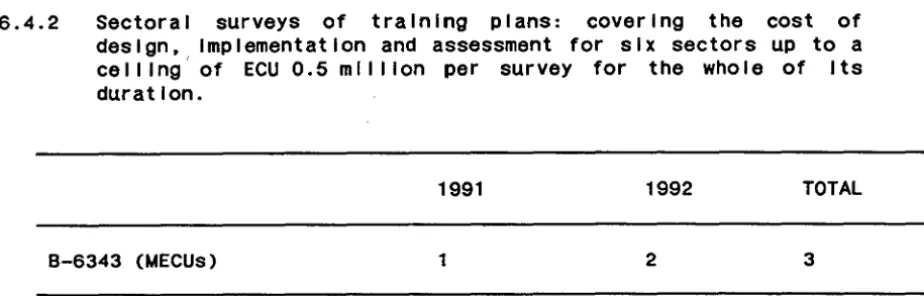
6.4.2 Sectoral surveys of training plans: covering the cost of design,. Implementation and assessment for six sectors up to a ceiling of ECU 0.5 million per survey for the whole of Its duration.
1991 1992 TOTAL
B-6343 (MECUs) 1 2 3
6.5 Section C- Analysis, monitoring, assessment and forecasting
6.5.1 Analysis and monitoring of the Implementation of the common framework of general principles: covering the cost of the Eurostat survey: preparation of software, printing the questionnaire, etc.) ECU 1.2 million; data collection ECU 1.5 million; processing and management of the findings of surveys ECU 0.8 ml I I ion.
1991 1992 TOTAL
B-6343 (MECUs) 1.5 2 3.5
6.5.2 Analysis table of contractual agreements: covering the cost of national analysis, the comparative table, assessment and dissemination of findings. Exchange grants for persons concerned with Industrial relations the Community contribution will be limited to the direct costs of mobility and must not exceed an amount of ECU 7 500 per grant and per beneficiary for exchanges for a maximum of 3 months.
1991 1992 TOTAL
[image:36.596.72.534.71.219.2]6
-6.5.3. Forecasting trends In qualifications and occupations: coverage of the costs of drawing up a comparative methodology, of national analyses, the comparative table, assessment and dissemination.
1991 1992 TOTAL
B-6343 (MECUs) / 1 2 3
6.6 Section D - Supplementary accompanying measures
The breakdown of estimated expenditure on technical assistance for Implementing the programme Including logistical support for the preparation of transnational schemes, scientific cooperation ~lth
those responsible for the schemes as regards the transfer of know-how and techn I ca I supper t for preparatIon of assessment of schemes Is as follows:
1991 1992 TOTAL
B-6343 (MECUs) 0.6 1.2 1 .8
6.7 Budgetary lmpl lcatlons
The breakdown of expendIture fInanced under headIng B-6343 Is as follows:
B-6343 1991 1992 Total
6.4 .1. 2.6 7.3 9.9
6.4.2. 1 2 3
6.5.1. 1.5 2 3.5
6.5.2. 1.3 1 .5 2.8
6.5.3. 1 2 3
6.6. 0.6 1.2 1 .8
Total MECUs 8 16 24
6.8 Summary table for guidance
The estimated appropriations are shown below
1990 Section A
Sections B.
c.
D7. F I sea I Imp II cat Ions None.
8. Type of monitoring
1991
4
3
1992
18
8
Total 39
.16
61 27
a) Financial monitoring Is provided by the competent departments of the Commission with respect to the conformity of expenditure and execution of the budget.
b) Technical supervision Is provided by the competent departments of the CommIssIon. espec I a I I y the Task Force for human resources. education, training and youth, with, If necessary, assistance from an advisory committee.
9. Financial lmpl lcatlons for staff appropriations and operation (Part A of the general budget)
Staff needed from 1991:
2 A7/4: organization and monitoring of the network and European sectoral surveys; organlzat lon and monitor lng of surveys; comparative analyses and preparatory work.
2 B: technical support at meetings, documentation and Information; supervision and monitoring of contracts and budgetary operations
3 C: secretaries
ExpendIture on the above staff requIrements are covered by the Community (part A of the Commission budget) and amount to ECU 369
ooo
for one ful I year.8
-The national authorities may second staff under· the conditions established ,for other Community programmes.
The necessary posts will be provided by lnte~nal redeployment or In the framewor~ of the 1991 budgetary procedures.
10. Technical assistance
Coherent Implementation of the programme In all the Member States cal Is for the assistance of experts In continuing vocational training. In part lcular they will be called on to perform the following tas~s:
technical coordination of the establishment of a European
networ~ of transnational operations, the organization of
courses and exchanges, and activities of the European networ~:
loglst lc support for sett lng up transnat lonal schemes, technical cooperation between persons responsible for these schemes with respect to the transfer of ~now-how and the dissemination of ~nowledge;
. preparation of lnformat Jon on the programme and part lclpat I on In Information activities In all the Member States, Including the translation required for operations In the nine Community
languages;
logistic follow-up of the programme and related activities developed In the Member States; technical support for regular consultation with those responsible for training within the pub! lc authorities, the two sides of Industry and firms; technical support for the preparation of regular assessment of the programme;
techn I ca I ass I stance on preparatory wor~ for conferences, seminars and wor~shops organized at
level by the Commission.