Miniaturised Liquid Chromatography
By Yan Li
A dissertation submitted in fulfilment of the requirements for the Doctor of Philosophy
(Chemical Sciences)
School of Natural Sciences
University of Tasmania
Declaration of Originality
I hereby declare that this thesis contains no material which has been accepted for a degree or diploma by the University or any other institution. To the best of my knowledge and belief, this thesis contains no material previously published or written by another person, except where due reference is made in the text of the thesis.
Yan Li 10th Oct 2018
Authority of Access
This thesis may be made available for loan and limited copying and communication in accordance with the Copyright Act 1968.
Yan Li 10th Oct 2018
Statement regarding published work contained in thesis
The publishers of the papers comprising Chapters 1 to 6 hold the copyright for that content, and access to the material should be sought from the respective journals. The remaining unpublished content of the thesis may be made available for loan and limited copying and communication in accordance with the Copyright Act 1968.
Acknowledgement
This thesis could not be realised without the support and help from many individuals. I would like to express my sincerest appreciation and respect to my primary supervisor, Professor Mirek Macka, for his guidance and mentorship during this PhD. Thank you for believing in my abilities, providing me with enormous flexibility and independence in my research, and encouraging me to express and pursue my own ideas. Mirek was not just my supervisor, but also a friend. I enjoyed numerous after-work discussions of various topics and was always impressed by his wisdom and knowledge. Sincere thanks to my secondary supervisors Professor Pavel Nesterenko, Professor Brett Paull and Professor Roger Stanley for expert advice, untiring support and guidance throughout this project. Professor Pavel Nesterenko and Professor Brett Paull also supervised my earlier Master of Science work. Under their supervision, I have developed good research practices that will follow me through the rest of my life.
opportunity to visit his laboratory for 3 weeks, which to extend my skills in 3D printing technologies. I would also acknowledge the cooperation and help of LabSmith with instrumental and software support, namely, Kirsten Pace.
I would also like to acknowledge the people who were always there for me. Professor Michael Breadmore guided me when I struggled to see the direction in my PhD, treated me as a member of his research group and looked out for me during numerous international conferences. I also would like to thank Father Michael Tate and Father Brian Nichols from Sandy Bay Parish, Tasmania, they both provided countless help during my life in Tasmania. The friendships with Mrs Brenda Mooney, Dr Min Zhang, Dr Hong Heng See, Dr Feng Li, Dr Yabin Wen and Mr Shing Chung Lam, grew from fun times in and after work, and will last forever.
I want to say XieXie (thank you) to my parents, Zhongli Li and Wen Yan, for having me, standing with me in all moments of life and supporting all my endeavours. Though my parents desperately wish me to stay in China with them, I am grateful for unconditionally supporting my decision to pursue life in Australia. Last but not least, I would like to thank my wife Mónica Alves for her understanding, patience and love.
Statement of Co-authorship
The following people and institutions contributed to the publication of work undertaken as part of this thesis:
In Chapter 2, Paper 1: Li, Y.; Pace, K.; Nesterenko, P. N.; Paull, B.; Stanley, R.; Macka, M., Miniaturised electrically actuated high pressure injection valve for portable capillary liquid chromatography. Talanta 2018,180, 32-35.
Yan Li was the primary author and conducted all the experiments, analysed data and wrote the manuscript. Kirsten Pace, Mirek Macka, Pavel Nesterenko, Brett Paull and Roger Stanley contributed to the idea, its formalisation and development. All co-authors assisted with refinement and presentation.
In Chapter 3, Paper 2: Li, Y.; Nesterenko, P. N.; Paull, B.; Stanley, R.; Macka, M., Comparison of cation-exchange capillary columns used for ion chromatographic separation of biogenic amines. Journal of Chromatography A 2018,1571,193-200.
In Chapter 4, Paper 3: Li, Y.; Dvořák, M.; Nesterenko, P. N.; Nuchtavorn, N.; Macka, M., High power deep UV-LEDs for analytical optical instrumentation. Sensors and Actuators B: Chemical 2018,255, 1238-1243.
Yan Li was the primary author and conducted all the experiments, analysed data and wrote the manuscript. Mirek Macka and Pavel Nesterenko contributed to the idea, its formalisation and development. Miloš Dvořák and Nantana Nuchtavorn offered experimental assistance. All co-authors assisted with refinement and presentation.
In Chapter 4, Paper 4: Li, Y.; Nesterenko, P. N.; Paull, B.; Stanley, R.; Macka, M., Performance of a new 235 nm UV-LED-based on-capillary photometric detector. Analytical Chemistry 2016,88 (24), 12116-12121.
Yan Li was the primary author and conducted all the experiments, analysed data and wrote the manuscript. Mirek Macka, Pavel Nesterenko, Brett Paull and Roger Stanley contributed to the idea, its formalisation and development. All co-authors assisted with refinement and presentation.
In Chapter 4, Paper 5: Li, Y.; Nesterenko, P. N.; Paull, B.; Stanley, R.; Macka, M., High sensitivity deep-UV LED-based z-cell photometric detector for capillary liquid chromatography. Analytica Chimica Acta 2018,1032, 197-202.
In Chapter 5,Paper 6: Li, Y.; Dvořák, M.; Nesterenko, P. N.; Stanley, R.; Nuchtavorn, N.; Krčmová, L. K.; Aufartová, J.; Macka, M., Miniaturised medium pressure capillary liquid chromatography system with flexible open platform design using off-the-shelf microfluidic components. Analytica Chimica Acta 2015,896, 166-176.
We the undersigned agree with the above stated "proportion of work undertaken" for each of the above published peer-reviewed manuscripts contributing to this thesis:
Signed:
Prof. Mirek Macka
Supervisor
School of Natural Sciences
University of Tasmania
Date: 10 Oct 2018
Prof. Mark Hunt
Head of School
School of Natural Sciences
List of Publications
Journal articles
1. Li, Y.; Pace, K.; Nesterenko, P. N.; Paull, B.; Stanley, R.; Macka, M., Miniaturised electrically actuated high pressure injection valve for portable capillary liquid chromatography. Talanta 2018,180, 32-35.
2. Li, Y.; Nesterenko, P. N.; Paull, B.; Stanley, R.; Macka, M., Comparison of cation-exchange capillary columns used for ion chromatographic separation of biogenic amines. Journal of Chromatography A 2018,1571,193-200.
3. Li, Y.; Dvořák, M.; Nesterenko, P. N.; Nuchtavorn, N.; Macka, M., High power deep UV-LEDs for analytical optical instrumentation. Sensors and Actuators B: Chemical 2018,255, 1238-1243.
4. Li, Y.; Nesterenko, P. N.; Paull, B.; Stanley, R.; Macka, M., Performance of a new 235 nm UV-LED-based on-capillary photometric detector. Analytical Chemistry 2016,88 (24), 12116-12121. (Front cover featured article)
5. Li, Y.; Nesterenko, P. N.; Stanley, R.; Paull, B.; Macka, M., High sensitivity deep-UV LED-based z-cell photometric detector for capillary liquid chromatography. Analytica Chimica Acta 2018,1032, 197-202.
Conference oral presentations
1. Li, Y.; Nesterenko, P. N.; Stanley, R.; Paull, B.; Macka, M., Microfluidic breadboard approach to capillary liquid chromatography. In AMN/ISMM/APBCM/ANZNMF, Hobart, Australia, 2017.
2. Li, Y.; Nesterenko, P. N.; Stanley, R.; Paull, B.; Macka, M., The potential of under 250 nm deep UV-LEDs in chemical analysis. In 24th Annual RACI Analytical and Environmental Division R&D Topics Conference, Sydney, Australia, 2016.
3. Li, Y.; Müller, M. N.; Paull, B.; Nesterenko, P. N., Precise and fast determination of inorganic magnesium in coccolithophore calcite. In ACROSS International Symposium on Advances in Separation Science (ASASS2), Hobart, Australia, 2016.
4. Li, Y.; Nesterenko, P. N.; Paull, B.; Stanley, R.; Macka, M., Miniaturised modular capillary LC: Sensitive detection with UV-LED z-cell. In 16th Asia-Pacific International Symposium on Microscale Separations and Analysis (APCE2016), Johor Bahru, Malaysia, 2016.
6. Li, Y.; Dvořák, M.; Nuchtavorn, N.; Nesterenko, P. N.; Stanley, R.; Macka, M., Portable LC Platforms: Concepts, Technical Issues, Applicability. In The International Chemical Congress of Pacific Basin Societies 2015, Honolulu, USA, 2015.
7. Li, Y.; Dvořák, M.; Nesterenko, P. N.; Stanley, R.; Aufartová, J.; Krčmová, L.; Macka, M., Portable capillary LC: A modular medium pressure system based on a microfluidic platform and designed with off-the-shelf components. In 20th International Symposium on Separation Sciences (ISSS), Prague, Czech Republic, 2014.
8. Li, Y.; Dvořák, M.; Krčmová, L.; Aufartová, J.; Nuchtavorn, N.; Nesterenko, P. N.; Stanley, R.; Macka, M., Portable moderate pressure capillary liquid chromatography based on a modular microfluidic system using off-the-shelf components. In 22nd Annual RACI Analytical and Environmental Division R&D Topics Conference, Adelaide, Australia, 2014.
9. Li, Y.; Dvořák, M.; Krčmová, L.; Aufartová, J.; Nuchtavorn, N.; Nesterenko, P. N.; Stanley, R.; Macka, M., Portable capillary LC: A modular medium pressure system designed with off-the-shelf components. In The 38th International Symposium on Capillary chromatography (ISCC), Riva del Garda, Italy, 2014.
Conference poster presentations
1. Li, Y.; Nesterenko, P. N.; Stanley, R.; Paull, B.; Macka, M., Microfluidic breadboard approach to miniaturised capillary liquid chromatography. In 17th Asia-Pacific International Symposium on Microscale Separation and Analysis, Shanghai, China, 2017.
2. Li, Y.; Nesterenko, P. N.; Stanley, R.; Paull, B.; Macka, M., High power deep UV-LEDs for analytical optical instrumentation. In 46th International Symposium on High Performance Liquid Phase Separations and Related Techniques, Jeju, Korea, 2017.
3. Li, Y.; Nesterenko, P. N.; Stanley, R.; Paull, B.; Macka, M., The potential of deep UV-LEDs below 250 nm in chemical analysis: 235 nm UV-LED photometric detection in capillary liquid chromatography, Pittcon, Chicago, USA, 2017.
4. Li, Y.; Nesterenko, P. N.; Stanley, R.; Paull, B.; Macka, M., Miniaturised HPLC injection valve with potential for portable capillary LC, Pittcon, Chicago, USA, 2017.
5. Li, Y.; Nesterenko, P. N.; Stanley, R.; Paull, B.; Macka, M., Miniaturised capillary LC: Sensitive UV-LED Z cell detection In ACROSS International Symposium on Advances in Separation Science (ASASS2), Hobart, Australia, 2016.
exhibiting ion-exchange and hydrophobic properties using biogenic neutral and charged solutes. In The 40th International Symposium on Capillary chromatography (ISCC), Riva del Garda, Italy, 2016.
7. Li, Y.; Nesterenko, P. N.; Stanley, R.; Paull, B.; Macka, M., 255 nm and 280 nm UV-LED based photometric detection integrated with z cell for capillary LC. In The 40th International Symposium on Capillary chromatography (ISCC), Riva del Garda, Italy, 2016.
8. Li, Y.; Dvořák, M.; Nuchtavorn, N.; Nesterenko, P. N.; Stanley, R.; Macka, M., Portable capillary LC as a flexible design modular system based on a microfluidic platform and designed with off-the-shelf components. In 42th International Symposium on High Performance Liquid Phase Separations and Related Techniques (HPLC), Geneva, Switzerland, 2015.
9. Li, Y.; Dvořák, M.; Krčmová, L.; Aufartová, J.; Nuchtavorn, N.; Nesterenko, P. N.; Stanley, R.; Macka, M., Portable medium pressure capillary liquid chromatography based on a modular microfluidic system using off-the-shelf components. In Pittcon, New Orleans, USA, 2015.
Abstract
Table of Contents
Acknowledgement i
Statement of Co-authorship iii
List of Publications vii
Abstract xii
Table of Contents xv
List of Abbreviations xvii
Chapter 1. Introduction 1
1.1 Overview 1
1.2 Design of portable and miniaturised LC instruments 3 1.2.1 Current commercial LC instruments 3
1.2.2 Miniaturised LC instrument design: definition and expectations 4 1.2.3 Commercialisation towards miniaturised LCs 5
1.2.4 Research-based miniaturised and portable LCs 7 1.3 Functional components of miniaturised LC systems 9
1.3.1 Columns 9
1.3.2 Injection system 13
1.3.3 Solvent delivery system 16 1.3.4 Detection technology 19 1.4 Concluding remarks 24 1.5 Aims of the project 26 References 28
Chapter 2. Fluidic system 36
2.1 Miniaturised electrically actuated high pressure injection valve for portable capillary LC 36
2.2 Performance of a miniaturised syringe-based solvent delivery system for portable capillary LC 52
2.2.1 Introduction 52 2.2.2 Experimental 53
2.2.3 Results and Discussions 55 References 61
Chapter 3. Comparison of cation-exchange capillary columns used for ion
chromatographic separation of biogenic amines 63
4.3 High sensitivity deep-UV LED-based z-cell photometric detector for capillary LC 94
Chapter 5. Miniaturised medium pressure capillary liquid chromatography system with flexible open platform design using off-the-shelf microfluidic
components 104
Chapter 6. Conclusions 127
6.1 Fluid delivery system 128 6.2 Sample introduction system 128 6.3 Columns 129
List of Abbreviations
AmpD Amperometric detection
CE Capillary electrophoresis
ECD Electrochemical detection
FIA Flow injection analysis
HPLC High performance liquid chromatography
IEC Ion exchange chromatography
k Retention factor
LC liquid chromatography
LED Light emitting diode
LOD Limit of detection
MPLC Medium pressure liquid chromatography
RSD Relative standard deviation
tR Retention time
UHPLC Ultra high pressure liquid chromatography
UV Ultraviolet
α Separation factor
Chapter 1. Introduction
1.1 Overview
In modern world, miniaturisation is of significant importance in many fields of science, including engineering1, medical science2 and chemistry3, in order to achieve better portability, less material, power and space consumption, and shorter analysis time. On one hand, the development of material science, information technology and mechanical engineering supports scientific instrumentation to be more portable and affordable. On the other hand, the advances in inexpensive mobile computers and smart phones provided the possibilities of using portable data acquisition systems for portable instrumentation. In the 1990s, the concepts of lab-on-a chip and micro-total analysis systems (μTAS) were introduced, leading an evolutionary trend of miniaturisation in analytical chemistry4. The progress of lab-on-a-chip and μTAS, together with other miniaturised classical technologies, provide a great opportunity to advance miniaturized chemistry devices that will enable the reduction of sample and reagent volume, rapid analysis and low operational cost.
Along with these requirements, many portable devices have been developed and commercialised, including mobile pH meters, electrochemical detectors and spectrometers. For flow based portable separation and analysis devices, various techniques have been developed, for example, using CE6-7 and gas chromatography (GC)8-9. The general trend in miniaturization in chemistry has been towards miniaturized LC utilizing microfluidic chips for portable development. However, there are some inherent advantages of non-chip miniaturised fluidic systems, using capillary-based LC especially in terms of simplicity, robustness, affordability, and flexibility of design. Column-based LC has simple geometry and the technology of polyimide coated fused-silica capillary proven by decades of usage.
LC is one of the most commonly used analytical techniques and is applied in many areas of chemistry and biological science. Researchers have continued to make advances in its theory, practice, applications and instrumentation, especially throughout the last half century10. However, even though LC is widely used in laboratories, compared to other separation-based analytical instrumental techniques, LC has suffered a lack of development and application for in-field analysis where its flexibility for multiple analyses and high resolution power can be used in situations requiring more immediate answers such as for labile samples or for real time process control.
scaled down (miniaturised) systems compared to precision laboratory-based (benchtop) LC; and (4) Designs for miniaturised LC systems that rely strongly on in-house fabricated components not widely available, thus causing a lack of accessibility to other users. These issues have resulted in difficulties accessing appropriate components thus inhibiting the design and fabrication of effective miniaturised LC systems. Additionally, the smaller market, in comparison with other portable devices, creates higher manufacturing costs for limited production series. Therefore, in this Chapter, we focus on each of the functional parts of a miniaturised LC system, in order to provide a clear overview of the developments and off-the-shelf availability of each of the components, which will help future researchers in their efforts designing miniaturised LC systems.
In contrast to on-chip LC, which has been many times reviewed in recent years11-18, there have been only a few reviews targeting portable ‘non-chip’ LC instrumentation5, 19-20. This Chapter highlights recent status, factors in the design of miniaturised LC systems, and expected future developments. Special attention has been given to the miniaturized functional elements of miniaturised LC, which in the future would be applied for miniaturizing of portable-field LC system.
1.2 Design of portable and miniaturised LC instruments
1.2.1 Current commercial LC instruments
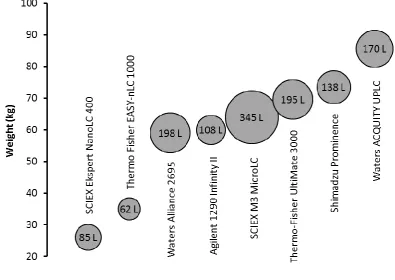
Fig. 1.1 Comparison of volume and weight of commercially available LC instruments. Space is calculated as effectively occupied by a box in which the instrument would fit. Information was sourced from vendor’s specifications.
1.2.2 Miniaturised LC instrument design: definition and
expectations
battery will be here termed “miniaturised”. In addition, in comparison with the current sophisticated bench-top instruments, operation of a portable instrument should be simplified to allow use by a non-expert or an operator with little experience.
1.2.3 Commercialisation towards miniaturised LCs
Since HPLC was introduced in the mid-1960s, no portable or miniaturised LC system was manufactured until the first system was released in 1983 by Baram et al.21. This so-called OB’-4 or MiLiChrom micro-column LC was actually a lab-station portable system, as the weight was 42 kg and a regular line power supply was needed. This system executed the idea of using miniaturised micro-columns in a portable LC to minimise the solvent and sample consumption. Although, this device will not satisfy today’s terminology of portability regarding the dimension and weight, it still should be noted that this portable LC system was then commercially available on market for more than 10 years. Over 5000 machines have been sold (records till 1996)22, which evidences that the market demand for portable LC instrumentation was already significant two decades ago.
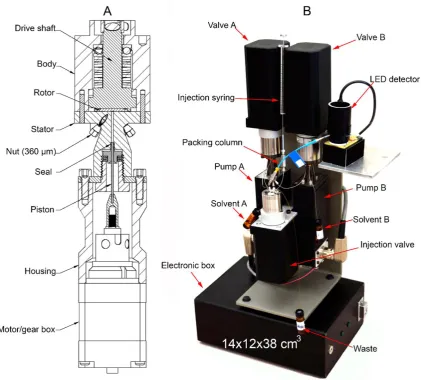
Fig. 1.2 A. Schematic drawing of a single nanoflow pump; B. Photograph of the portable nanoflow ultra high pressure liquid chromatography (UHPLC) with LED detector. The system weighed 5.9 kg or 4.5 kg without a controller and could hold up to 110 MPa (16000 psi) of pressure32. Reprinted with permission from American Chemical Society.
1.2.4 Research-based miniaturised and portable LCs
[image:26.595.120.542.68.448.2]possible reason for this was that the system pressure requirement for IEC is lower than that for RPLC, and therefore less challenged for the development of a suitable pumping system. A USB power-driven portable IEC was introduced by Kiplagat et al.37, which with a weight under 1 kg is currently the smallest column-based portable LC in the world (Fig. 1.3). The pumping system is a miniaturised air pressure cylinder, providing only 15 MPa (100 psi) maximum pressure. With laptop USB power, this portable LC can be operated for more than 8 hours. A solar panel powered “portable” IEC was reported by Elkin38. Despite its heavy weight (27.5 kg), this IEC was the first in-field LC system with a photovoltaic power supply. This was also a fully automatic, sophisticated LC system, comprising an eluent reuse system, autosampler, sample preconcentration system and suppressor. The system provided sample analysis for a continuous 27 days, with a limit of detection (LOD) for phosphate of 10 µg L-1 (10 ppb).
Fig. 1.3. A. Photograph of pressure based portable IEC instrument with integrated miniaturised C4D. APC: air pressure cylinder, CC: capillary column, E: eluent reservoir, I: injection valve, PR: pressure regulator valve, SV: stop valve. B. chromatogram of a separation of alkali, alkaline earth and transition metal cations by the USB driven portable LC with integrated non-suppressed C4D37. Reprinted with permission from Elsevier.
1.3 Functional components of miniaturised LC systems
1.3.1 Columns
The format and size of the LC column will determine to a large degree the design and portability of the whole LC system. Compared to other components of an LC system,
A
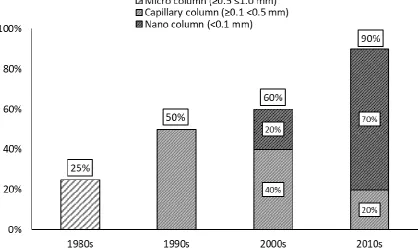
[image:28.595.190.447.64.489.2]the physical dimension of an analytical LC column body is relatively small. Therefore, the focus of LC column miniaturisation, unlike other LC system components that aim to reduce the physical demission and weight, is to decrease the inner diameter (i.d.). According to the i.d. and operation flow rate range, miniaturised LC columns can be categorised into micro-columns (≥0.5 ≤1.0 mm i.d.), capillary columns (≥0.1 <0.5 mm i.d.) and nano-columns (<0.1 mm i.d.)42. A smaller column i.d. results in a reduction in mobile phase and sample volume consumption by up to three orders of magnitude (due to inverse proportionate dependence of flow linear velocity on column cross-section or square of i.d.). Lower flow rates also have an advantage regarding coupling to detection using mass spectrometry (MS). Additionally, miniaturised LC columns of smaller i.d. can lead to increase in column efficiency due to lower dispersion and flow resistance to mass transfer43-44.
instrumentation, and therefore miniaturised LC column stationary phase development, which is a relatively independent area, is not included. Instead, the synergy of miniaturised LC columns and miniaturised LC systems and the trend of incorporating miniaturised LC columns in miniaturised LC systems will be discussed.
Fig. 1.4 The percentage of newly reported miniaturised LC systems (including those with non-portable detector) that support miniaturised columns during each decade. For the systems that support a wide range of column, the most miniaturised column format was selected. (The % numbers are calculated from the numbers of miniaturised LC systems reported in scientific papers or commercialised).
miniaturised with a satisfactory performance29. Therefore, the medium pressure miniaturised LC columns (e.g. Chromolith from EMD Millipore) will continue to be desirable for miniaturised LC systems before miniaturised UHPLC pumps achieve a technology breakthrough.
1.3.2 Injection system
Early HPLC systems that only operated under low-pressures widely used septum-type injectors. However, these types of injectors lack reliability and user-friendliness53, and are also not suited for automation54. Stop-flow injection was introduced by Waters in their U6K in 197555. As the injection technique name suggests, the pump flow must be stopped while sample injection is made. In comparison to septum-type injectors, stop-flow injection allows easy and steady injection into a relative high-pressure system. A Stop-flow injection system was integrated into the portable nano HPLC solvent delivery systems recently reported by Lee’s group30-31. Six-port continuous-flow injectors, introduced in 1976, provided uninterrupted high pressure continuous-flow injection, and eventually became the industry standard53. The continuous-flow injectors are normally an individual component that can be modular, therefore they have been used widely in miniaturised LC systems23, 28-29, 41, 56.
Therefore, for capillary LC systems, where the required injection volume is more than 100 nL, a continuous-flow injector using an external sample loop is the best option19.
The general opinion is that the size and weight of standard HPLC injectors are small enough so that there are no principal changes needed for miniaturised LC injectors5. Indeed, a 1 kg standard stainless steel based injector does not have as strong impact on the overall LC system or on early stage miniaturised LC systems, in comparison to relatively bulky solvent delivery and detection systems. Based on this view, there is lack of significant efforts towards miniaturisation of HPLC injection valves49.
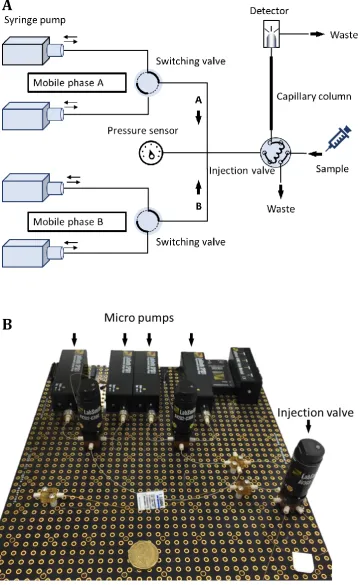
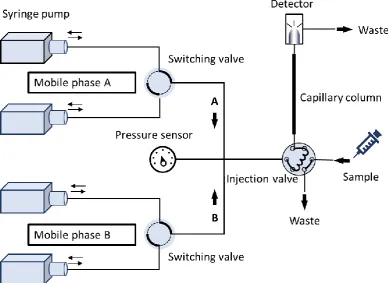
Fig. 1.5 The schematic (A) and photograph (B) of the miniaturised injection valve and miniaturised LC system57.Reprinted with permission from Elsevier.
A
1.3.3 Solvent delivery system
The solvent delivery system is one of the most crucial parts for an HPLC system, as it determines the maximum pressure of operation, the precision and accuracy of the fluid flow and the flow rate scale. Since the column particle size (i.d.) decreased dramatically over the past decades to achieve higher column efficiency, the desirable maximum operating pressure for HPLC pumps has increased significantly up to 140 MPa (20000 psi) for modern UHPLC systems10, 53. However, regardless of the increased pressure of operation, the basic requirements for HPLC pump remained the same. The high pressure pump options for HPLC include reciprocating pump54, syringe pumps54 and electro-osmotic pumps58-60. For miniaturised LC systems, some low pressure pumps were also used, such as direct piston pumps23 and peristaltic pumps36. Due to the applicability of and trends in HPLC development, in this Section we will only focus on high pressure HPLC pumps.
In modern HPLC, the Waters M-6000 reciprocating pump53 become the “gold standard”, which led to the reciprocating type pump dominating most, if not all, of the commercial standard HPLC systems.
Since the 1980s, the prospects of HPLC moving from conventional bench top scale into the portable capillary domain has gained considerable attention50. However, the reciprocating pump systems capable of offering nL - µL min-1 flow rates were rare on the market during that time (1980s-1990s) as well as expensive66, and the pulsations at low flow rates were significant5. The bulky dimensions of reciprocating pumps also make them, in principle, impractical to be applied in miniaturised LC systems. Although some miniaturised LC systems still utilised reciprocating pumps during the 1990s28 and early 2000s29, 39, these systems were usually relatively large for miniaturised LC28, 39, or they only supported conventional columns28. These miniaturised LC systems were all discontinued, and there was no newer version further released.
pumps and syringe pumps have become the choice of pumping systems of some miniaturised and portable LC systems21-22, 30-31, 34, 41. Among these systems, two of the recent miniaturised LC pumping systems can be highlighted. The first one is used in a hand portable LC system reported by Lee’s group (Fig. 1.2)30-32. This pump can provide up to 110.3 MPa (16,000 psi) pressure with accuracy > 99.9% at flow rates 0.3-6 µL min-1, which makes it an UHPLC pump. The second pumping system reported by our group, uses multiple miniaturised micro-syringe pumps assembled on a microfluidic breadboard in a LEGO-like fashion (Fig. 1.5)41, 57. Two pairs of micro-pumps were used for each mobile phase to enable continuous pumping, as well as gradient elution capability, while additional micro-syringe pumps could be used for other functions such as sampling and delivering post-column reagent. The maximum pressure of these micro-syringe pumps was up to 11.5 MPa (1523 psi), so they could not be classified as an HPLC system, but the maximum pressure was enough for use with low pressure, especially monolithic, columns.
sophisticated, the use of EOPs in HPLC is thus limited to a few research groups. There has been only one miniaturised LC reported using EOP56 until now. However, this system is a low-pressure LC, and the EOP could only deliver eluent under maximal 1 MPa pressure. Undoubtedly, more investigations should be conducted to evaluate the applicability of high pressure EOP for miniaturised LC.
1.3.4 Detection technology
of suppressors70 will enable ECD to be used under gradient elution, which will dramatically increase the applicability of ECD.
UV absorption detection is almost universal in most LC separations53. UV detection is considered a robust, easy to use and low-cost technique, although its sensitivity and selectivity is lower than for ECD. A standard UV detector consists of a light source, wavelength selector, flow cell and detector to measure light passing through the flow cell. For early miniaturised LCs, due to overall dimension of the LC and the available technology, the detection system was not the key element for the whole LC system miniaturisation. The first portable LC used a standard UV detection system, where a deuterium lamp and diffraction grating mirror were used21-22. Fixed wavelength UV detection was then introduced to portable LC28. The fixed length detector had improved compactivity and sensitivity, while changeable lamps for different wavelengths offered a broad applicability of the LC system. The LOD of the portable LC was 200 µg L-1 (ppb) and 15 µg L-1 (ppb) for phenol and anthracene, respectively.
Fig. 1.6. A. photograph showing the sizes of the new detector and the PCBs for LED driver (left) and photo diode (right). B. 3D ray tracing model of the new detector78. Reprinted with permission from Elsevier.
The effective path length of on-capillary/column absorption detector is limited by the capillary/column i.d., normally around 100 µm. To further improve the detection sensitivity, a deep UV-LED detector with a z-shaped nano flow cell was recently developed, with a 100 times increased path length, resulting in the detection sensitivity increasing 50 times79. The performance of this miniaturised LED detector was shown to be comparable and superior to the conventional benchtop UV detectors. High-power
deep UV LED’s with a higher monochromaticity (lower parasitic emission in the visible spectral range) are already commercially available80. In addition, UV-LED technology is still advancing rapidly, so commercial deep UV LEDs will become available at lower wavelengths, with stronger optical intensity and longer life times. All these factors will provide deep UV-LEDs with a greater applicability in absorption detection.
1.4 Concluding remarks
Miniaturization influences all areas of science and technology, impacting positively on the size and the potential portability of existing LC instrumentation. In the field of analytical and separation sciences, and specifically for LC, a substantial source of progress in miniaturization will be from general progress in technology (i.e. reduced component sizes including those of separation columns, dimensions of detection cells and operating electronics). This will also have positive influence on the development of miniaturised/portable instrumentation.
Miniaturization of LC pumps, as the central parts of LC design, is a key to successful miniaturised/portable LC development. High pressure reciprocating pumps are the most commonly used pumps for benchtop LC, but other eluent delivery techniques, in particular high pressure syringe pumps and EOP hold promise for future developments in miniaturised/portable LC.
As the most commonly used high pressure reciprocating pumps still have not been miniaturised with a satisfactory performance, medium pressure miniaturised LC columns (e.g. Chromolith from EMD Millipore) are still be desirable for miniaturised LC systems until miniaturised UHPLC pumps achieve a technical breakthrough and become widely available.
From the point of view of suitable detection for miniaturised/portable LC, ECD has the advantage of compatibility with miniaturization and portable instrumentation. Miniaturized, low-cost light sources (e.g., high-power LEDs and LDs) are very efficient, inexpensive alternatives to traditional light sources (e.g., laser modules for LIF) so LEDs and LDs are also likely to find their way into miniaturised/portable LC.
materials science, electronic semi-conductor, power sources and other components, and miniature electromagnetic actuators). Developments in these areas drive and enable future developments in miniaturization of components and integrated systems. The enabling technologies are continually being developed and therefore available for further improvements in the miniaturised/portable LC devices.
1.5 Aims of the project
The overall objective of this project has been to understand and integrate some of the available technologies, as well as develop new technologies, in order to develop a miniaturised capillary LC system.
The specific aims of the project were to:
1. Develop the design and explore the advantages of a novel miniaturised LC platform based on off-the-shelf components. The basis of the system was a modular microfluidic platform with the components assembled on a breadboard. The investigation within this project focused on the performance of each miniaturised functional components, including sample injection and solvent delivery system.
References
1. Madou, M. J., Fundamentals of microfabrication: the science of miniaturization. CRC press: 2002.
2. Figeys, D.; Pinto, D., Lab-on-a-chip: a revolution in biological and medical sciences.
Anal. Chem. 2000,72 (9), 330 A-335 A.
3. McMahon, G., Analytical instrumentation: a guide to laboratory, portable and miniaturized instruments. John Wiley & Sons: 2008.
4. Mark, D.; Haeberle, S.; Roth, G.; von Stetten, F.; Zengerle, R., Microfluidic
lab-on-a-chip platforms: requirements, characteristics and applications. Chem. Soc. Rev. 2010,39 (3), 1153-1182.
5. Sharma, S.; Tolley, L. T.; Tolley, H. D.; Plistil, A.; Stearns, S. D.; Lee, M. L.,
Hand-portable liquid chromatographic instrumentation. J. Chromatogr., A 2015,1421, 38-47. 6. Kubán, P.; Nguyen, H. T. A.; Macka, M.; Haddad, P. R.; Hauser, P. C., New fully
portable instrument for the versatile determination of cations and anions by capillary
electrophoresis with contactless conductivity detection. Electroanalysis 2007,19 (19-20), 2059-2065.
7. Koenka, I. J.; Sáiz, J.; Rempel, P.; Hauser, P. C., Microfluidic Breadboard Approach
to Capillary Electrophoresis. Anal. Chem. 2016,88 (7), 3761-3767.
8. Smith, P. A., Person-portable gas chromatography: Rapid temperature program
operation through resistive heating of columns with inherently low thermal mass properties.
J. Chromatogr., A 2012,1261, 37-45.
9. Lee, J.; Zhou, M.; Zhu, H.; Nidetz, R.; Kurabayashi, K.; Fan, X., Fully Automated
Portable Comprehensive 2-Dimensional Gas Chromatography Device. Anal. Chem. 2016,88 (20), 10266-10274.
10. Chester, T. L., Recent Developments in High-Performance Liquid Chromatography
11. Faure, K., Liquid chromatography on chip. Electrophoresis 2010,31 (15), 2499-2511.
12. Lavrik, N. V.; Taylor, L. T.; Sepaniak, M. J., Nanotechnology and chip level
systems for pressure driven liquid chromatography and emerging analytical separation
techniques: A review. Anal. Chim. Acta 2011,694 (1-2), 6-20.
13. Lin, S. L.; Bai, H. Y.; Lin, T. Y.; Fuh, M. R., Microfluidic chip-based liquid
chromatography coupled to mass spectrometry for determination of small molecules in
bioanalytical applications. Electrophoresis 2012,33 (4), 635-643.
14. Ohla, S.; Belder, D., Chip-based separation devices coupled to mass spectrometry.
Curr. Opin. Chem. Biol. 2012,16 (3), 453-459.
15. Kutter, J. P., Liquid phase chromatography on microchips. J. Chromatogr., A 2012, 1221, 72-82.
16. Mensack, M. M.; Holcomb, R. E.; Henry, C. S., Potential of Microfluidics and
Single Cell Analysis in Metabolomics (Micrometabolomics). In Metabolomics in Practice, Wiley-VCH Verlag GmbH & Co. KGaA: 2013; pp 239-259.
17. Lin, S.-L.; Lin, T.-Y.; Fuh, M.-R., Recent developments in microfluidic chip-based
separation devices coupled to MS for bioanalysis. Bioanalysis 2013,5 (20), 2567-2580. 18. Grinias, J. P.; Kennedy, R. T., Advances in and prospects of microchip liquid
chromatography. TrAC Trends in Analytical Chemistry 2016,81, 110-117.
19. Nazario, C. E.; Silva, M. R.; Franco, M. S.; Lanças, F. M., Evolution in miniaturized
column liquid chromatography instrumentation and applications: An overview. J. Chromatogr., A 2015,1421, 18-37.
20. Lynch, K. B.; Chen, A.; Liu, S., Miniaturized high-performance liquid
chromatography instrumentation. Talanta 2018,177, 94-103.
21. Baram, G. I.; Grachev, M. A.; Komarova, N. I.; Perelroyzen, M. P.; Bolvanov, Y.
A.; Kuzmin, S. V.; Kargaltsev, V. V.; Kuper, E. A.; V, E. S. P. B.; Division, S.,
Micro-column liquid chromatography with multi-wave-length photometric detection. I. The OB-4
22. Baram, G. I., Portable liquid chromatograph for mobile laboratories: I. Aims. J. Chromatogr., A 1996,728 (1-2), 387-399.
23. Otagawa, T.; Stetter, J. R.; Zaromb, S., Portable liquid chromatograph for analysis of
primary aromatic amines in coal-derived materials. J. Chromatogr. 1986,360 (1), 252-259. 24. Zaromb, S.; Otagawa, T.; Stetter, J. R.; Quandt, K., Preconcentration of Airborne
Primary Aromatic-Amines for Analysis by a Portable Liquid Chromatograph. Abstr. Pap. Am. Chem. Soc. 1986,192, 6-ENVR.
25. Tsitouridou, R.; Puxbaum, H., Application of a Portable Ion Chromatograph for
Field Site Measurements of the Ionic Composition of Fog Water and Atmospheric Aerosols.
Int. J. Environ. Anal. Chem. 1987,31 (1), 11-22.
26. Baldwin, D. R.; Berg, J. D.; Buckley, B. M.; Mackay, A. D., Rapid Theophylline
Analysis at the Chest Clinic Using a Portable High-Performance Chromatograph (Hplc).
Thorax 1988,43 (10), P845-P845.
27. Sushchik, N. N.; Gladyshev, M. I.; Kalachova, G. S.; Guseynova, V. E., Rapid
Assay of Fatty-Acid Composition Using a Portable High-Performance Liquid
Chromatograph for Monitoring Aquatic Ecosystems. J. Chromatogr., A 1995,695 (2), 223-228.
28. Tulchinsky, V. M.; Technologies, S.; Park, A. B., A Practical Portable HPLC
System — MINICHROM , a New Generation for Field HPLC. Field Analytical Chemistry & Technology 1998,2 (5), 281-285.
29. http://www.iconsci.com/worldssmallesthplc.html (accessed 13/03/2018).
30. Sharma, S.; Plistil, A.; Simpson, R. S.; Liu, K.; Farnsworth, P. B.; Stearns, S. D.;
Lee, M. L., Instrumentation for hand-portable liquid chromatography. J. Chromatogr., A 2014,1327, 80-9.
31. Sharma, S.; Plistil, A.; Barnett, H. E.; Tolley, H. D.; Farnsworth, P. B.; Stearns, S.
D.; Lee, M. L., Hand-Portable Gradient Capillary Liquid Chromatography Pumping System.
32. Zhao, X.; Xie, X.; Sharma, S.; Tolley, L. T.; Plistil, A.; Barnett, H. E.; Brisbin, M.
P.; Swensen, A. C.; Price, J. C.; Farnsworth, P. B.; Tolley, H. D.; Stearns, S. D.; Lee, M. L.,
Compact Ultrahigh-Pressure Nanoflow Capillary Liquid Chromatograph. Anal. Chem. 2017, 89 (1), 807-812.
33. Sharma, S.; Tolley, H. D.; Farnsworth, P. B.; Lee, M. L., LED-based UV absorption
detector with low detection limits for capillary liquid chromatography. Anal. Chem. 2015,87 (2), 1381-6.
34. Boring, C. B.; Dasgupta, P. K.; Sjögren, A., Compact, field-portable capillary ion
chromatograph. J. Chromatogr., A 1998,804 (1), 45-54.
35. Kalyakina, O. P.; Dolgonosov, A. M., Ion-chromatographic determination of
fluoride ions in atmospheric precipitates and natural waters. J. Anal. Chem. 2003,58 (10), 951-953.
36. Victory, D.; Nesterenko, P.; Paull, B., Low-pressure gradient micro-ion
chromatography with ultra-short monolithic anion exchange column. Analyst 2004,129 (8), 700-701.
37. Kiplagat, I. K.; Kubán, P.; Pelcová, P.; Kubán, V., Portable, lightweight, low power,
ion chromatographic system with open tubular capillary columns. J. Chromatogr., A 2010, 1217 (31), 5116-23.
38. Elkin, K. R., Portable, fully autonomous, ion chromatography system for on-site
analyses. J. Chromatogr., A 2014,1352, 38-45.
39. Nelson, M. A.; Gates, A.; Dodlinger, M.; Hage, D. S., Development of a portable
immunoextraction-reversed-phase liquid chromatography system for field studies of
herbicide residues. Anal. Chem. 2004,76 (3), 805-813.
40. Peoples, M. C.; Phillips, T. M.; Karnes, H. T., A capillary-based microfluidic
instrument suitable for immunoaffinity chromatography. J. Chromatogr., B: Anal. Technol. Biomed. Life Sci. 2007,848 (2), 200-207.
41. Li, Y.; Dvorak, M.; Nesterenko, P. N.; Stanley, R.; Nuchtavorn, N.; Krcmova, L. K.;
system with flexible open platform design using off-the-shelf microfluidic components.
Anal. Chim. Acta 2015,896, 166-176.
42. Vissers, J. P.; Claessens, H. A.; Cramers, C. A., Microcolumn liquid
chromatography: instrumentation, detection and applications. J. Chromatogr., A 1997,779 (1-2), 1-28.
43. Karlsson, K. E.; Novotny, M., Separation efficiency of slurry-packed liquid
chromatography microcolumns with very small inner diameters. Anal. Chem. 1988,60 (17), 1662-1665.
44. Kennedy, R. T.; Jorgenson, J. W., Preparation and evaluation of packed capillary
liquid chromatography columns with inner diameters from 20 to 50 micrometers. Anal. Chem. 1989,61 (10), 1128-1135.
45. Knox, J. H., Theoretical aspects of LC with packed and open small-bore columns. J. Chromatogr. Sci. 1980,18 (9), 453-461.
46. Novotny, M., Microcolumns in liquid chromatography. Anal. Chem. 1981,53 (12), 1294A-1308A.
47. Ishii, D.; Takeuchi, T.; West, T., Micro High-Performance Liquid Chromatography.
Rev. Anal. Chem. 1982,6 (2), 87-112.
48. Desmet, G.; Eeltink, S., Fundamentals for LC miniaturization. Anal. Chem. 2012,85 (2), 543-556.
49. Saito, Y.; Jinno, K.; Greibrokk, T., Capillary columns in liquid chromatography:
between conventional columns and microchips. J. Sep. Sci. 2004,27 (17‐18), 1379-1390. 50. Fanali, C.; Dugo, L.; Dugo, P.; Mondello, L., Capillary-liquid chromatography
(CLC) and nano-LC in food analysis. TrAC Trends in Analytical Chemistry 2013,52, 226-238.
51. Blue, L. E.; Franklin, E. G.; Godinho, J. M.; Grinias, J. P.; Grinias, K. M.; Lunn, D.
B.; Moore, S. M., Recent Advances in Capillary Ultrahigh Pressure Liquid Chromatography.
52. Sestak, J.; Dusa, F.; Moravcova, D.; Kahle, V., Simple automated liquid
chromatographic system for splitless nano column gradient separations. J. Chromatogr., A 2013,1276, 26-32.
53. Fanali, S.; Haddad, P. R.; Poole, C.; Riekkola, M.-L., Liquid chromatography: fundamentals and instrumentation. Elsevier: 2017.
54. Huber, J. F., Instrumentation for high performance liquid chromatography. Elsevier: 2011; Vol. 13.
55. Louis, A.; Hutchins Jr Burleigh, M. Novel injector mechanism. 1975.
56. Ishida, A.; Fujii, M.; Fujimoto, T.; Sasaki, S.; Yanagisawa, I.; Tani, H.; Tokeshi, M.,
A Portable Liquid Chromatograph with a Battery-operated Compact Electroosmotic Pump
and a Microfluidic Chip Device with a Reversed Phase Packed Column. Anal. Sci. 2015,31 (11), 1163-1169.
57. Li, Y.; Pace, K.; Nesterenko, P. N.; Paull, B.; Stanley, R.; Macka, M., Miniaturised
electrically actuated high pressure injection valve for portable capillary liquid
chromatography. Talanta 2018,180, 32-35.
58. Gu, C.; Jia, Z.; Zhu, Z.; He, C.; Wang, W.; Morgan, A.; Lu, J. J.; Liu, S.,
Miniaturized electroosmotic pump capable of generating pressures of more than 1200 bar.
Anal. Chem. 2012,84 (21), 9609-9614.
59. Chen, A.; Lynch, K. B.; Wang, X.; Lu, J. J.; Gu, C.; Liu, S., Incorporating
high-pressure electroosmotic pump and a nano-flow gradient generator into a miniaturized liquid
chromatographic system for peptide analysis. Anal. Chim. Acta 2014,844, 90-98.
60. Zhou, L.; Lu, J. J.; Gu, C.; Liu, S., Binary electroosmotic-pump nanoflow gradient
generator for miniaturized high-performance liquid chromatography. Anal. Chem. 2014,86 (24), 12214-12219.
62. Martin, M.; Blu, G.; Eon, C.; Guiochon, G., The use of syringe-type pumps in liquid
chromatography in order to achieve a constant flow-rate. J. Chromatogr., A 1975,112, 399-414.
63. Achener, P.; Abbott, S. R.; Stevenson, R. L., An experimental evaluation of
compressibility effects in syringe pumps for liquid chromatography. J. Chromatogr., A 1977, 130, 29-40.
64. Abbott, S. R.; Berg, J. R.; Achener, P.; Stevenson, R. L., Chromatographic
reproducibility in high-performance liquid chromatographic gradient elution. J. Chromatogr., A 1976,126, 421-437.
65. Martin, M.; Guiochon, G., Theoretical study of the gradient elution profiles obtained
with syringe-type pumps in liquid chromatography. J. Chromatogr., A 1978,151 (3), 267-289.
66. Kephart, T. S.; Dasgupta, P. K.; Alexander, J. N., An affordable high-performance
pumping system for gradient capillary liquid chromatography. Journal of Microcolumn Separations 1999,11 (4), 299-304.
67. Coutinho, M.; Figueira, L.; Nazario, D.; Eduardo, C.; Monteiro, A. M.; Lanças, F.
M., Novel devices for solvent delivery and temperature programming designed for capillary
liquid chromatography. J. Sep. Sci. 2014,37 (15), 1903-1910.
68. Wang, W.; Gu, C.; Lynch, K. B.; Lu, J. J.; Zhang, Z.; Pu, Q.; Liu, S., High-pressure
open-channel on-chip electroosmotic pump for nanoflow high performance liquid
chromatography. Anal. Chem. 2014,86 (4), 1958.
69. Ryvolová, M.; Macka, M.; Ryvolová, M.; Preisler, J.; Macka, M., Portable
capillary-based (non-chip) capillary electrophoresis. TrAC Trends in Analytical Chemistry 2010,29 (4), 339-353.
70. Yang, B.; Zhang, M.; Kanyanee, T.; Stamos, B. N.; Dasgupta, P. K., An open
tubular ion chromatograph. Anal. Chem. 2014,86 (23), 11554-11561.
71. Macka, M.; Piasecki, T.; Dasgupta, P. K., Light-emitting diodes for analytical
72. Schmid, S.; Macka, M.; Hauser, P. C., UV-absorbance detector for HPLC based on a
light-emitting diode. Analyst 2008,133 (4), 465-469.
73. Krcmova, L.; Stjernlof, A.; Mehlen, S.; Hauser, P. C.; Abele, S.; Paull, B.; Macka,
M., Deep-UV-LEDs in photometric detection: A 255 nm LED on-capillary detector in
capillary electrophoresis. Analyst 2009,134 (12), 2394-2396.
74. Bomastyk, B.; Petrovic, I.; Hauser, P. C., Absorbance detector for high-performance
liquid chromatography based on light-emitting diodes for the deep-ultraviolet range. J. Chromatogr., A 2011,1218 (24), 3750-3756.
75. Bui, D. A.; Bomastyk, B.; Hauser, P. C., Absorbance detector based on a deep UV
light emitting diode for narrow-column HPLC. J. Sep. Sci. 2013,36 (19), 3152-3157. 76. Kraiczek, K. G.; Bonjour, R.; Salvadé, Y.; Zengerle, R., Highly Flexible UV–Vis
Radiation Sources and Novel Detection Schemes for Spectrophotometric HPLC Detection.
Anal. Chem. 2014,86 (2), 1146-1152.
77. Li, Y.; Nesterenko, P. N.; Paull, B.; Stanley, R.; Macka, M., Performance of a new
235 nm UV-LED based on-capillary photometric detector. Anal. Chem. 2016,88 (24), 12116-12121.
78. Xie, X.; Tolley, L. T.; Truong, T. X.; Tolley, H. D.; Farnsworth, P. B.; Lee, M. L.,
Dual-wavelength LED-based UV Absorption Detector for Nano-flow Capillary Liquid
Chromatography. J. Chromatogr., A 2017, 1523, 242-247.
79. Li, Y.; Nesterenko, P. N.; Stanley, R.; Paull, B.; Macka, M., High sensitivity
deep-UV LED-based z-cell photometric detector for capillary liquid chromatography. Analytica Chimica Acta 2018,1032, 197-202.
80. Li, Y.; Dvořák, M.; Nesterenko, P. N.; Nuchtavorn, N.; Macka, M., High power
*All of this research contained in this chapter has been published as Li, Y.; Pace, K.;
Chapter 2. Fluidic system
2.1 Miniaturised electrically actuated high pressure
injection valve for portable capillary LC
This article has been
Supplementary Information (SI)
Miniaturised electrically actuated high pressure injection valve for portable
capillary liquid chromatography
Yan Li1, Kirsten Pace2, Pavel N. Nesterenko1, Brett Paull1, Roger Stanley3, Mirek Macka1*
1) School of Physical Sciences and Australian Centre for Research on Separation Science
(ACROSS), University of Tasmania, Hobart 7001, Australia
2) LabSmith, 6111 Southfront Rd, Suite E, Livermore CA 94551, USA
3) Centre for Food Innovation, University of Tasmania, Locked Bag 1370, Launceston 7250,
Australia
*Corresponding author
Professor Mirek Macka, Private Bag 75, School of Physical Sciences and Australian Centre for
Research on Separation Science, University of Tasmania, Hobart 7001, Australia
E-mail: [email protected]
1. Experimental
1.1 Chemicals and reagents
Analytical or higher purity grade reagents and deionised water (Millipore, Bedford, MA, USA) were
used for preparing all solutions. Methanesulfonic (MSA) acid was generated by an ICS-3000 Eluent
Generator (Thermo Scientific Dionex, Sunnyvale, CA, USA). Uracil, sodium chloride, lithium chloride,
ammonium chloride, potassium chloride, L-DOPA, phenylephrine, norfenefrine, 5
hydroxytryptophan, dimethylamine and trimethylamine were purchased from Sigma-Aldrich (St.
Louis, MO, USA).
1.2 Methods and procedures
The internal volume measurement was through the injection of uracil solution (1 mg L-1 in deionised
water) using different volume of external sample loop. The uracil was then detected using a UV
detector (254 nm). The linear dependence between the peak area and the volume of external
sample loop was then obtained. Injection carry-over was studied by first injecting a concentrated
uracil solution (500 mg L-1 in deionised water). The injection valve was then thoroughly cleaned by
purging with deionised water and a blank injection (deionised water) was made with carry over
detected using a UV detector (254 nm). These experiments were repeated five times.
Injection performance under different backpressures was studied with sample injection of sodium
chloride (10 mg L-1). The sample was detected using a C4D detector (voltage -12 dB, gain 50%) at
the shortest possible distance from the injection valve (55 mm i.d. 100 µm capillary). The solvent
used was deionised water. Temperature: 20 °C. Flow rate 10 µL min-1. Two restrictors made by
polyimide coated fused silica capillary were used: medium pressure restrictor (10 µm x 33 mm) and
low pressure restrictor (25 µm x 90 mm). The detailed experimental setup is illustrated in SI, Fig. S4
For the maximum operating pressure study, a high pressure restrictor made by polyimide coated
fused silica capillary was used (10 µm x 44 mm) and all experiments were performed at 20 °C. The
maximum operating pressure was determined with the injection valve first switched to the loading
position (SI, Fig. S2 C). After each new flow rate was set, the value of pressure was recorded, while
observing that the pressure was steady and no leakage occurred. The injection valve was then
switched to the injecting position (SI, Fig. S2 D) for 20 minutes before being switched back to
loading position. The injection valve was finally tested under 32MPa (4640 psi) for 24 hours, which
is the maximum operating pressure of the Dionex ICS-5000 system used in this experiment. The
2. The schematic of the miniaturised LC system
1
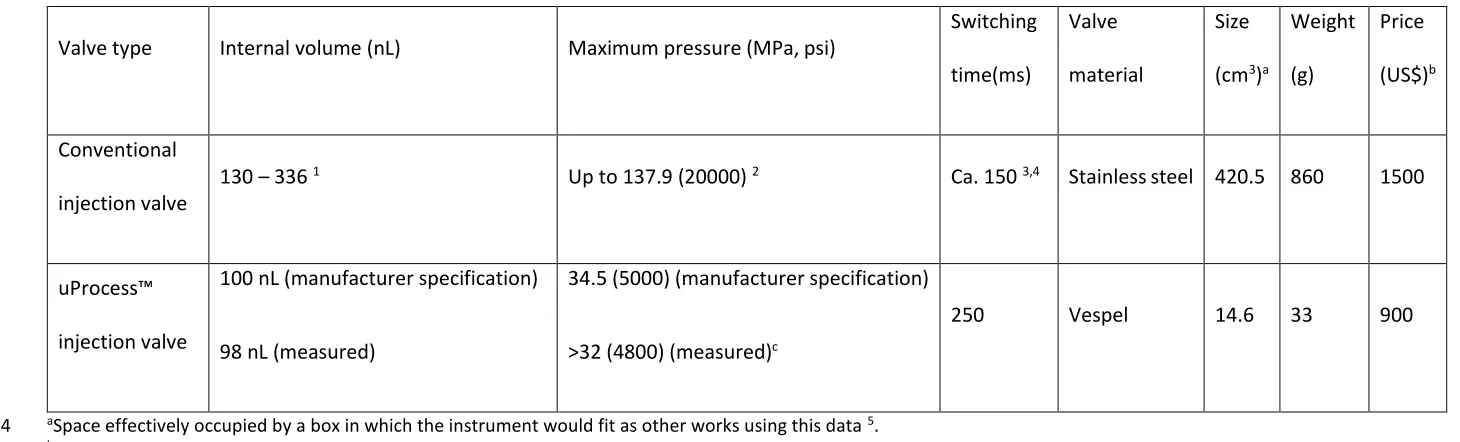
3. Summary of specifications for conventional injection valve and the miniaturised injection valve.
[image:60.842.48.778.190.411.2]2
Table S1. Summary of specifications for conventional injection valve and uProcess™ miniaturised injection valve.
3
Valve type Internal volume (nL) Maximum pressure (MPa, psi)
Switching
time(ms)
Valve
material
Size
(cm3)a
Weight (g) Price (US$)b Conventional injection valve
130 – 336 1 Up to 137.9 (20000) 2 Ca. 150 3,4 Stainless steel 420.5 860 1500
uProcess™
injection valve
100 nL (manufacturer specification)
98 nL (measured)
34.5 (5000) (manufacturer specification)
>32 (4800) (measured)c
250 Vespel 14.6 33 900
aSpace effectively occupied by a box in which the instrument would fit as other works using this data 5. 4
bThe costs are indicative price range for each instrument type judged across a variety of manufacturers active in each area. 5
cIt is the highest investigated backpressure. The injection valve has the potential to operate under a pressure higher than 32 MPa (4641 psi).
6
4. The schematic of the miniaturised capillary injection valve (Rotor and
8
rotor holder)
9
10
[image:61.595.48.530.116.735.2]11
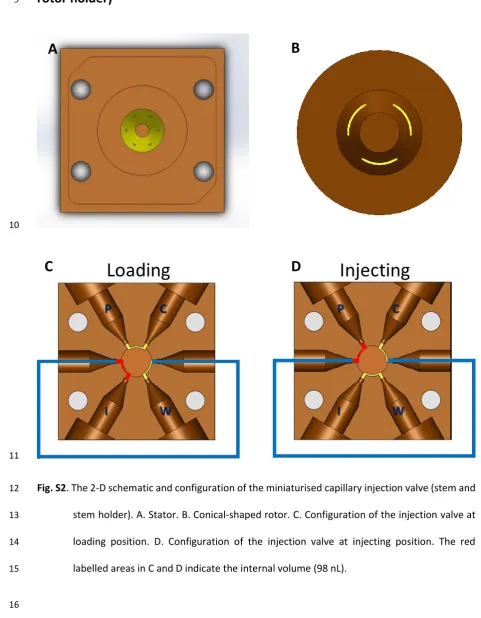
Fig. S2. The 2-D schematic and configuration of the miniaturised capillary injection valve (stem and 12
stem holder). A. Stator. B. Conical-shaped rotor. C. Configuration of the injection valve at 13
loading position. D. Configuration of the injection valve at injecting position. The red 14
labelled areas in C and D indicate the internal volume (98 nL). 15
16
17
A
B
5. Schematic of the miniaturised capillary injection valve
18
[image:62.595.59.479.126.452.2]19
Fig. S3. The 2-D schematic and configuration of the miniaturised capillary injection valve. 20
6. The experimental setup for the study of injection performance under
22
different backpressures
23
24
Fig. S4. The experimental setup for the study of injection performance under different 25
backpressures (A, B and C) at the same flow rate (10 µL min-1) and maximum pressure study
26
(D) at different flow rates (1-14 µL min-1). Three pressure restrictors were used: high
27
pressure restrictor (10 µm x 44 mm), medium pressure restrictor (10 µm x 33 mm) and low 28
pressure restrictor (25 µm x 90 mm). The solvent used was deionised water. Temperature: 29
25 °C. For A, B and C, the pump always operated against the same backpressure to provide 30
a similar performance. The C4D on-column detector was connected at the shortest possible 31
distance from the injection valve. 32
33
[image:63.595.89.522.147.358.2]7. Internal volume
35
[image:64.595.67.520.104.468.2]36
Fig. S5. The calibration curve of peak area (uracil, 1 mg L-1) vs the volume of external sample loop.
37
Flow rate 1 µL min-1.The internal volume (98 nL) was determined by extrapolating the
38
calibration curve to peak area at zero (calibration curve intercept across x-axis). For details 39
of conditions see Experimental in SI. 40
41
8. Maximum operating pressure
43
[image:65.595.71.537.120.444.2]44
Fig. S6. The measurement of maximum pressure of the miniaturised injection valve. The injection 45
valve can be stably operated at 32 MPa (4640 psi) without any leakage being observed. 46
Details of conditions see Experimental. 47
48
References
49
(1) Aggarwal, P.; Liu, K.; Sharma, S.; Lawson, J. S.; Tolley, H. D.; Lee, M. L. J. Chromatogr., A 2015, 50
1380, 38-44. 51
(2) http://www.vici.com/cval/c72m.pdf, 20/04/2017 52
(3) http://www.vici.com/act/mic.php, 20/04/2017 53
(4) http://www.knauer.net/en/products/valves/, 20/04/2017 54
(5) Ryvolová, M.; Macka, M.; Ryvolová, M.; Preisler, J.; Macka, M. Trends Anal. Chem. 2010, 29, 339-55
353. 56
2.2 Performance of a miniaturised syringe-based solvent
delivery system for portable capillary LC
2.2.1 Introduction
Solvent delivery system is one of the most crucial components for flow analysis instruments, such as LC and flow injection analysis (FIA), as it determines the fluidic performance and applicability of an instrument. The important parameters of a solvent delivery system include maximum pressure of operation, the precision and accuracy of the fluid flow and the flow rate scale. Modern reciprocating pumps for UHPLC have achieved maximum operating pressures of 140 MPa (20000 psi) while producing pulse-less flow at accurate flow rates1-2. Over the last decades, trends towards miniaturised and portable analytical instrumentation put notable attention onto miniaturised eluent delivery systems with increasing market interest. However, the bulky dimensions of benchtop reciprocating pumps make them impractical for miniaturised devices.
An early study found that with the presence of an air bubble in the syringe, the flow rate fluctuation can be eliminated11. However, while this method provides a simple solution for low-pressure syringe pumps, is not practical for high pressure flow systems, as the air bubble will be gradually absorbed in the eluent liquid and so lose the damping function. For a fluidic flow system operated under pressure used in our previous study on miniaturised capillary LC, we showed that the flow rate fluctuations decreased dramatically by over an order of magnitude with relatively small backpressure of only 0.35 MPa (43.5 psi), applied through a backpressure restrictor, while a chromatographic column achieved the same effect9.
In this study, the impact of back pressure on syringe pump flow rate fluctuation was investigated. The syringe pump studied here was a miniaturised microsyringe pump for microfluidic platforms, which we further developed to work within a medium pressure LC system. It has a highly compact design making it currently one of the smallest and lightest commercially available high pressure microsyringe pumps. This study focused on the cause of the flow rate fluctuation observed at very low backpressure and the effect of back pressure damping. Finally, methods of reducing the syringe pump fluctuation are presented and discussed.
2.2.2 Experimental
2.2.2.1 Chemicals and reagents
2.2.2.2 Instrumentation
12 programmable microsyringe pumps with one 5 µL syringe (SPS01, LabSmith, Livermore CA, USA) were used in this study. The pumps were plugged in LabSmith uProcess™ microfluidic system ("Microfluidic Fluid Control & Connectors"12, LabSmith, Livermore CA, USA) and tested one by one. This microfluidic platform also consists an AV201 automated 3-port microfluidic switching valves (LabSmith, Livermore CA, USA). More detailed descriptions can be found from the manufacturer specifications13. For monitoring the flow rate, a nano-flowmeter (Upchurch) was used. The restrictors for testing the injection valve operation at different backpressures and maximum operating pressure were made of polyimide coated fused silica capillary (variable length; 25 µm i.d., Polymicro Tech; Phoenix, AZ, USA).
Software from uProcessTM (LabSmith) was used for driving the LabSmith components. The software from Upchurch “USI Nano Flow” was used to view and monitor the flow rate on the computer. All the data were recorded at 20 Hz.
2.2.2.3 Methods and procedures
2.2.3 Results and Discussions
2.2.3.1 Flow rate pulsation investigation
The result showed that even with the same glass syringe and piston set, different motor units gave different flow rate profiles. The flow rate pulsations (as %RSD) varied from 16% to 121% for 12 motor units. This suggested that the motor units contributed to the flow rate pulsation significantly, and different motor units had their unique “fingerprint”. This was believed due to the movement of piston driven by the mechanical motor force. Therefore, to damp the syringe pump flow, it is necessary to resolve the uneven mechanical movement issue.
2.2.3.2 The pressure damping investigation
pulsations (as %RSD) was reduced from 37% to 5.5% (Fig. 2.3), while for the pressure damping, the flow pulsation for the same motor unit was further reduced to 4.4%.
In the chromatographic system, the column itself can be acted as the pressure restrictor, therefore, here the syringe pumps proved to be suitable pump option for the LC eluent delivery system. The flow pulsation was found highly due to the motor mechanical movement pulsation and can be smoothened by force. For the low pressure fluidic device (e.g. FIA), a resist component can be applied on the syringe pump motor unit to provide a force to smooth the motor movement.
2.2.4. Conclusions
References
1. Chester, T. L., Recent Developments in High-Performance Liquid Chromatography Stationary Phases. Anal. Chem. 2013,85 (2), 579-589.
2. Fanali, S.; Haddad, P. R.; Poole, C.; Riekkola, M.-L., Liquid chromatography: fundamentals and instrumentation. Elsevier: 2017.
3. Kephart, T. S.; Dasgupta, P. K.; Alexander, J. N., An affordable high-performance pumping system for gradient capillary liquid chromatography. Journal of Microcolumn Separations 1999,11 (4), 299-304.
4. Coutinho, M.; Figueira, L.; Nazario, D.; Eduardo, C.; Monteiro, A. M.; Lanças, F. M., Novel devices for solvent delivery and temperature programming designed for capillary liquid chromatography. J. Sep. Sci. 2014,37 (15), 1903-1910.
5. Baram, G. I.; Grachev, M. A.; Komarova, N. I.; Perelroyzen, M. P.; Bolvanov, Y. A.; Kuzmin, S. V.; Kargaltsev, V. V.; Kuper, E. A.; V, E. S. P. B.; Division, S., Micro-column liquid chromatography with multi-wave-length photometric detection. I. The OB-4 micro-column liquid chromatograph. J. Chromatogr., A 1983,264 (C), 69-90.
6. Baram, G. I., Portable liquid chromatograph for mobile laboratories: I. Aims. J. Chromatogr., A 1996,728 (1-2), 387-399.
7. Boring, C. B.; Dasgupta, P. K.; Sjögren, A., Compact, field-portable capillary ion chromatograph. J. Chromatogr., A 1998,804 (1), 45-54.
8. Sharma, S.; Plistil, A.; Simpson, R. S.; Liu, K.; Farnsworth, P. B.; Stearns, S. D.; Lee, M. L., Instrumentation for hand-portable liquid chromatography. J. Chromatogr., A 2014,1327, 80-9.
system with flexible open platform design using off-the-shelf microfluidic components.
Anal. Chim. Acta 2015,896, 166-176.
10. Sharma, S.; Plistil, A.; Barnett, H. E.; Tolley, H. D.; Farnsworth, P. B.; Stearns, S. D.; Lee, M. L., Hand-Portable Gradient Capillary Liquid Chromatography Pumping System. Anal. Chem. 2015,87 (20), 10457-10461.
11. Pravda, M.; Marvin, C. A.; Sarre, S.; Michotte, Y.; Kauffmann, J. M., A damping system for syringe pumps used for microdialysis with on line electrochemical detection.
Anal. Chem. 1996,68 (14), 2447-2450.
12. http://products.labsmith.com/fluid-control-and-connectors/#.WFt52xt95v1. (accessed 20/04/2017).