R E S E A R C H A R T I C L E
Open Access
Using Hypervideo to support
undergraduate students
’
reflection on work
practices: a qualitative study
Marco Perini
1*, Alberto A. P. Cattaneo
2and Giuseppe Tacconi
1* Correspondence:marco.perini@ univr.it
1Department of Human Sciences,
University of Verona, Verona, Italy Full list of author information is available at the end of the article
Abstract
According to several exploratory studies, the HyperVideo seems to be particularly useful in highlighting the existing connections between the school-based and the work-based contexts, between authentic work situations and theoretical
underpinnings. This tool and its features, in particular, the video annotation, seems to constitute an instrument which facilitates the students’reflection on work-practices. Even though several researchers have already studied the efficacy of HyperVideo, studies concerning the qualitative differences between a reflection process activated with or without its use are still missing. Therefore, the present contribution is focused on the reflective processes activated by two groups of students engaged in a higher education course while they carry out a reflective activity on work practices using the HyperVideo or not. The aim is to investigate wether the HyperVideo can be useful for students to foster the connection between theoretical concepts and work practices. Through multi-step qualitative analysis which combined Thematic Qualitative Text Analysis and Grounded Theory, a sample of reflective reports drafted by a group of students who employed HiperVideo to make a video-interview on a work-practice and to reflect on it (Group A) was compared with a sample of reflective reports drafted by a group who did not use it to complete the same task (Group B).
The results emerging from the comparison of the coding frequencies between the two groups show that HyperVideo can support the reflective processes of students, better connecting theory and professional practice.
Keywords:Hypervideo, Video annotation, Reflective activities, Crossing boundaries, Educational technologies
Introduction
Since the turn of the century, the world economy has constantly been in flux because of globalization and the rapid evolution of technology. In order to meet emerging chal-lenges, policymakers have consistently tried to innovate their respective educational systems in order to effectively face and keep up with the demands of the labor market
(Paplova,2009). For example, the European Union (EU) introduced the Lifelong
Learn-ing program in 2006, establishLearn-ing a common framework of key competencies that member States had to aspire to in order to try and close the gap between educational
and work contexts (European Council, 2006). Despite the educational reforms led by
this intervention, the issue is still open. Indeed, the EU recently proposed a renewal ef-fort to address this gap through a new set of recommendations on key competencies
for Lifelong Learning (European Commission, 2018). The need to connect educational
and work contexts is not new in the field of educational research. A long tradition ex-ists to study how such contexts can interact each other (e.g. Ludvigsen, Lund, Rasmus-sen, & Säljö, 2011; Stenström & Tynjälä, 2009; Tuomi-Gröhn & Engeström, 2003). Several pedagogical models similarly emphasize the need of a stronger articulation
among learning locations and propose ways to realize it: we cite here the expansive
learning model (Fuller & Unwin,2003), theconnective model(Griffiths & Guile, 2003; Guile & Griffiths, 2001), theintegrative pedadogics model (Tynjälä, 2005, 2008, 2009),
and thehybrid curriculum model(Zitter, Hoeve, & de Bruijn,2016). The same
perspec-tive is also assumed when studying the knowledge inherent in teachers’ work
experi-ence in order to make it available for in-training teachers (Tacconi, 2011; Tacconi &
Gomez,2010; Tacconi & Hunde,2017; Mortari,2010).
Advocated across these methods, two theoretical concepts that have a central role in describing potential ways for closing the gap between different learning contexts are
boundary crossing, and boundary objects. The concept of “boundary crossing”,
intro-duced by Suchman (1994) and refined by Engeström, Engeström, and Kärkkäinen
(1995), denotes how an expert worker or a practitioner may need to combine and
nego-tiate elements belonging to different contexts (e.g. routinely workplace, past learning situations, etc.) when s/he needs to challenge new and/or unfamiliar hybrid situations. An unfamiliar hybrid situation occurs when the characteristic conditions of different
contexts occur at the same time with novel combinations. The concept of boundary
crossingbases on that of boundary objects (Star & Griesemer,1989).“Boundary objects […] both inhabit[these]intersecting social worlds […] and satisfy the informational re-quirements of each of them […] maintainin[ing] a common identity across the sites” (p.
393). The results of a literature review drafted by Akkerman & Bakker, 2011, through
which they examined 181 papers to better understand the learning potential of bound-aries, reveals reflection to be one of the four potential dialogical learning mechanisms taking place at the boundaries, together with identification, coordination and trans-formation. In particular, reflection “is about expanding one’s perspectives on the prac-tices”(Akkerman & Bakker,2011, p. 150).
Reflection, technologies and the Efrahrraum model
The relevance of reflection for better articulating the distances between different learn-ing contexts has been enhanced also by more recent studies, which are not included in
the review cited above (e.g. Perini, 2017; Bronkhorst & Akkerman, 2016;
Schwendi-mann et al., 2015). According to the conclusion of an ethnographic study conducted
into the Vocational Education and Training (VET) healthcare context, the “reflective
processes take place within a range of settings, contacts and through activities, many of
which are initiated and enacted by the [participants] themselves” (Wegener, 2013, p.
well as the knowledge on which they are based; b) the four-stage experiential learning
model by Kolb (1984), provides for a reflective observation phase, between the concrete
experience and the abstract conceptualization phases; c) according to Schön’s (1987)
view on the nature of the reflective practices, reflection allows practitioners to learn from unexpected outcomes and from events that come out of the routinely actions, ac-tivating the attention and creating a prerequisite for self-learning which takes place through reflection. These and many other theoretical frameworks (e.g., Boud, Keogh, &
Walker, 1985; Engeström,1987; Jarvis, 2009; Moon,1999) define the role of reflection
in learning processes, but, just taking a look at the encyclopedic definition attributed to reflection it is possible to understand its role in the learning processes related to work and to the skills development:
“Reflection plays an important role in experiential learning, both cognitively and metacognitively. It has been widely discussed in the literature as an important approach for promoting learning and higher order thinking skills, developing professional practices, and facilitating and structuring learning through experiences” (Looi & Wu,2015, p. 610)
Technology is often identified in the literature as a means to support reflection and
then able to foster the“bridging function”between the working and school context,
be-cause technologies“can serve many roles to support work-based learning”(Margaryan,
2008, p. 17). In this framework, the “Efrahrraum” is a pedagogical model
(Schwendi-mann et al., 2015), consisting “of technology-enhanced spaces that facilitate
conversa-tions between work and school […] context in iterative loops” (p. 373). In the Erfahrraum, the boundary-crossing between the contexts is allowed by a scaffolded space for reflection on experiences. In fact, the name of the model is the result of the
combination of the German terms ‘Erfahrung’ (experience) and ‘Raum’ (space).
Con-ceived to be compliant with dual vocational education, and then to favor learning across contexts, the model is grounded on experiential learning; it gives technologies a special role to create a specific “space” sustaining a reflective process that allows real
experiences to become knowledge (Schwendimann et al., 2015). This model confirms
then the role of technologies as boundary objects, given that they“could serve as
brid-ges between the school and the workplace as well as between the actors of these different locations”(Schwendimann et al.,2015, p. 371). Furthermore, it highlights reflection as a technology-scaffolded activity able to turn experiences into knowledge, without restric-tions about the types of technology used for implementation. As anticipated, this model, like many of the studies concerning its bridging activity, has been developed in and for the VET context. Vocational education is a privileged location for studying this topic, especially within states that provide a dual-system (e.g. Germany, Switzerland, Austria, Denmark etc.) which allows students (apprentices) to carry out the curricular activities alternating in its different learning contexts: in the VET school (in the
class-room) and in the workplace (working for a company) (Cattaneo & Aprea,2018).
The Hypervideo and video annotation
highlighting connections between classroom and work context, between authentic
work situations and theoretical subjects (Cattaneo, Nguyen, Sauli, & Aprea, 2015;
Cattaneo & Nguyen, 2016; Cattaneo & Sauli, 2017; Cattaneo, van der Meij, Aprea,
Sauli, & Zahn, 2018; Sauli, Cattaneo, & van der Meij, 2018). Moreover, as claimed
by Cattaneo & Aprea (2018a) and Schwendimann et al. (2015), it seems particularly
suitable for implementing the Efrahrraum model. In 2018 Sauli and colleagues published a literature review which aimed at highlighting the concept and use of
HV. The authors drawn the characteristics which distinguish the “classic” video
and the HV, splitting them into two groups: 1) the fundamental features allow a non-linear video navigation (e.g. through segmentation or visual tables of con-tent), advanced control features and the possibility to link or include additional material to it (e.g. documents, other videos, descriptions etc.); 2) the optional features allow to insert individual or collaborative video annotation and/or
gener-ate manual or automgener-ated feedback (Sauli et al., 2018). The second features’group
in particular “allow reflection about the contents and deeper understanding, which
is an important aspect of learning with videos” (Sauli et al., 2018, p. 126). Above
all, according to several studies summarized by Cattaneo and Boldrini (2016),
“Video annotation facilitates individual reflection on practices, thereby supporting ex-post monitoring and evaluating processes, as well as anticipatory ones
(Cattaneo, Nguyen, Sauli, & Aprea, 2015, p. 41)”. As reported above, the efficacy
of video annotation has already been studied by several researchers (e.g. Colasante,
Kimpton, & Hallam, 2014; Rich & Hannafin, 2009). However, to the best of our
knowledge, studies about the qualitative differences between a reflection process activated with and without the use of video annotation still require investigation. Furthermore, the use of HV should also be examined out of the VET context, in order to foster the connection between different learning location, workplace and school in particular.
Research aims and questions
It is thought that having more information about the qualitative features of the re-flective process activated by the video annotation could support teachers and trainers - especially those in VET - in teaching design, because, in order to obtain an effective learning process support, technologies need to be adapted and
contex-tualized depending on the learning context, as remarked by Hattie’s metanalysis
(Hattie, 2009). Therefore, the present study is focused on the reflective processes
research project aimed at discovering the potential of video-related technologies in VET-teacher education.
Methods
In order to answer the proposed question, given its descriptive nature, a
The-matic Qualitative Text Analysis (TQTA) was conducted, because “thematic
ana-lysis is primarily a descriptive strategy that facilitates the search for patterns of
experience within a qualitative data set” (Ayres, 2008, p. 867). Specifically, the
analysis procedure for TQTA proposed by Kuckartz (2014) was employed. The
choice fell upon Kuckartz’s proposal because, unlike the classic version of TQTA
(Ayres, 2008), it lends itself to a data-driven approach. The analysis was carried
out in two macro-steps: in the first step a codebook was drafted on the basis of the category system that emerged by analyzing a random sample of reflective re-ports in accordance with the Grounded Theory (GT) approach (Glaser, Strauss, &
Strutzel, 1968); in the second step a larger sample of texts was codified through
the coding scheme laid out in the codebook. After the analysis process, the cod-ing frequency (in terms of number of words) of the texts belongcod-ing to the stu-dents who used the annotation tool was compared with those of the stustu-dents who did not receive any indications regarding video annotation tools for carrying out the assignment. To this end, descriptive statistics, correlational analysis and T-test were employed. The next sections report detail on the data collection and data analysis processes.
Context and participants of the study
The context in which the present study took place is the bachelor course “Educational
Sciences in Organizations”held at the University of Verona, during the academic years
2015/2016 and 2016/2017. Specifically, the study-setting is the module titled“Training
didactics” which is scheduled for the first year of the course outlined above. The
pri-mary reason for this choice was that this course eventually gave to the students the op-portunity to operate in the VET sector. Furthermore, the main objective of the
module is to improve the course participants’ knowledge and competencies by
re-ducing the gap between the students and professional practices, in order to make them capable of conceptualizing and designing appropriate instructional activities in accordance with the specific learning situations offered by the relevant work practices and the training courses linked to work contexts. Therefore, the training activities foreseen in the module have been chosen and designed in order to
de-velop the students’ skills in work-practice analysis, i.e., to achieve a deep
under-standing of the practices’ crucial characteristics through a reflective approach,
which in turn directs them in putting into words the new acquired knowledge
(Tacconi, 2015). Both in the academic years 2015/2016 and 2016/2017, the final
the end of the semester out of the course timetable. One option asked students a
reflective report on a free-choice’ book. The other option, which is the subject of
the present research, asked the students to a) make a video-interview on a work practice (a professional activity) and, b) draft a reflective report on the content of this video and the thought process put in place during the video making. The students could choose the interviewee (whatever kind of professional), the work practice and, where to shoot the video (usually at the workplace of the inter-viewee). They also had to get the video equipment autonomously. The assignment described above had different rules of implementation in the two academic years:
the students of in the academic year 2015/2016 (Group A) had to make the
video-interview and write the reflective report without receiving restrictions or
suggestions; the students in the academic year 2016/2017 (Group B) had to
complete the same tasks using the “iVideo” (iVideo, 2018) software, an HV
sys-tem also integrating video annotation functions. Specifically, the second group had to make the video-interview in the form of an HV and to draft the reflective report by inserting video annotations through the dedicated iVideo feature. The same Group B also participated in a 4-h long training session on the HV and were assisted by a tutor in order to solve any technical problems that could arise with respect to the creation of the HV. On the contrary, as previously mentioned,
the students of Group A didn’t receive any dedicated training or support as they
did not use the HV software. All the students involved (Group A and Group B) could choose the working method for video production, that is to say, teamwork or individual work. The students who chose to produce the video together with other peers also had to
write a part of the reflective report individually. The students of Group Aand Group B
who chose to make the video-interview and draft the reflective report (the option explained above) to carry out the third part of the exam were involved in the research. All the interviewees signed a standard consent form which explicitly allows for the use of the
gathered video-material for research purposes. The department’ ethics committee
approved the standard consent form.
Data collection
In academic year 2015/2016 the 74% of students choose to make the video-interview, while in academic year 2016/2017 the 69% chose this option. All the videos produced and the reflective reports drafted by the students of Group A and
Table 1Overview of the collected data
Academic Year
Technology used
Sub-group
Students’ Working Method
Amount of collected videos
Amount of collected reflective reports
Amount of selected videos
2015/2016 Gr. A (unspecified)
At Team work 38 84 14
2015/2016 Gr. A (unspecified)
Ai Individual work 29 29 14
2016/2017 Gr. B (iVideo)
Bt Team work 30 69 14
2016/2017 Gr. B (iVideo)
Group B were collected and catalogued. The materials of the students who did not comply with both the requests or who did not receive an evaluation on the same were not taken into consideration for the purposes of the study. All of the formats of the text files were checked and, if necessary, converted to ensure compatibility
with Nvivo 11 software (Nvivo Pro.11, 2015). The materials gathered with respect
to each group have been divided into as many sub-groups, depending on the work-ing methods employed by the students (teamwork or individual work). The
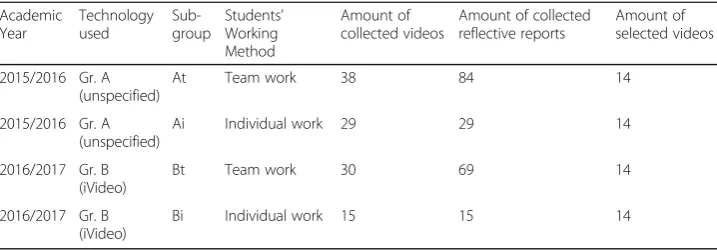
follow-ing Table 1 shows the numbers pertaining to the materials collected for each
group. One hundred ninety-seven reflective reports and 112 videos were collected altogether.
In addition to the materials submitted by the students, the grades attributed by the teacher to the students were also collected. Only the marks related to the third part of the exam described above were taken into account for the analysis because the other two parts concerned different contents and learning materials.
In order to define the corpus of data relevant for the analysis, the reflective reports of each sub-group were ordered from the lowest mark to the highest mark. After that, in every sub-group, 7 reflective reports with the highest grade and the 7 reflective reports with the lowest grade were selected for the analysis, for a total of 56 texts. The length of both the reflective texts (measured in words) and the corresponding videos (measured in seconds) was collected and added to the data set.
Step 1–the codebook’drafting
As mentioned above, in order to outlying a codebook based on the students’
re-flective reports, a sample of rere-flective texts was randomly taken out of the entire
corpus of data. In accordance with the Corbin and Strauss’ GT approach for data
analysis (Corbin & Strauss, 2008), the selected reports were analyzed by following
the open coding and axial coding procedures, which provide for the establishment of a category system based on data. The analysis was conducted pursuant to the following research questions: What are the characteristics of the reflective reports? What are the main topics discussed by the students in their reflective texts? The coding was carried out separately by two coders who generated two different sets of categories and coding. The two coders and a third member of the research team compared the sets of categories in order to obtain a unique and shared coding
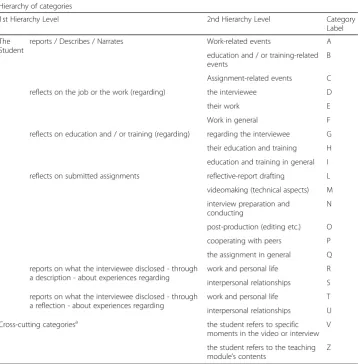
sys-tem through a dialogic process. The obtained coding syssys-tem –reported in Table 2
– is composed by a hierarchy of categories and sub-categories inductively based on
data with 21 coding possibilities.
On the basis of the hierarchy reported in Table 2, a guideline document for
coders - a codebook - was drafted. The codebook contains the following ele-ments: the coding procedure; the minimum size of the coding units; the category system; the description and explanation of categories and subcategories; examples of pieces of text coded using the procedure.
Nvivo 11 software (Nvivo Pro.11, 2015): several tests were made to ensure that they understood the meaning of the categories and how to attribute them to the parts of the text.
Step 2–the sample’coding
The 56 reflective reports selected for the analysis were distributed to the two coders and were analyzed separately using the Nvivo 11 software (Nvivo Pro.11,
2015) and following the codebook guidelines. Three texts were analyzed by both
the coders to check the intercoder agreement. Given the high number of coding options (21), the coefficient of interclass correlation through test F was calculated
on the three texts’ encodings using SPSS software (IBM SPSS Statistics, 2011).
The intercoder agreement was confirmed as the coefficients resulted > 0.6 in all three cases and their mean was 0,801 (SD = 0.1583). After that, thanks to the
matrix coding feature of Nvivo 11 software (Nvivo Pro.11, 2015), the coding frequencies of all categories, in terms of word number, have been obtained. The
Table 2The coding system and its categories
Hierarchy of categories
1st Hierarchy Level 2nd Hierarchy Level Category
Label
The Student
reports / Describes / Narrates Work-related events A
education and / or training-related events
B
Assignment-related events C
reflects on the job or the work (regarding) the interviewee D
their work E
Work in general F
reflects on education and / or training (regarding) regarding the interviewee G
their education and training H
education and training in general I
reflects on submitted assignments reflective-report drafting L
videomaking (technical aspects) M
interview preparation and conducting
N
post-production (editing etc.) O
cooperating with peers P
the assignment in general Q
reports on what the interviewee disclosed - through a description - about experiences regarding
work and personal life R
interpersonal relationships S
reports on what the interviewee disclosed - through a reflection - about experiences regarding
work and personal life T
interpersonal relationships U
Cross-cutting categoriesa the student refers to specific moments in the video or interview
V
the student refers to the teaching module’s contents
Z
a
word number was chosen as the unit of measurement because it could well ex-press the space dedicated by the students in the reflective reports to the topics identified through the categories. All the emerged data were organized into a data
set which was then analyzed using SPSS software (IBM SPSS Statistics, 2011).
The use of quantitative analysis methods reported below does not have the ambition to generalize the results of this explorative study, but to provide a precise and detailed answer to the research question and to highlight also unexpected outcomes, which are not inherent to the research question, but still interesting for the research topic.
Results
Reflective reports and corresponding video characteristics
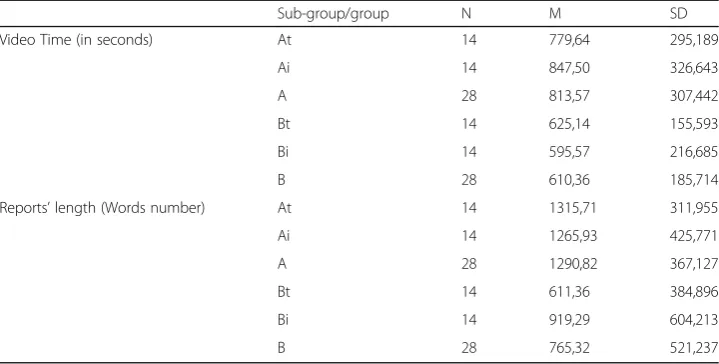
Descriptive statistics (means (M) and standard deviations (SD)) about the charac-teristics of reflective reports and corresponding videos split into groups A and B
are reported in Table 3.
Looking at the differences between the group means, the Group B condition (using HV and video annotation) seems to affect the video duration and reflective report length. The Pearson coefficients confirmed the presence of a correlation
both between video length and study group conditions (r(56) =−.377, p< .005)
and between the latter and report length (r(56)-.510, p< .001). On the contrary,
the correlation between video and report length is not significant (r(56).112,
p= .372). The independent-sample T-test and the effect-size coefficient confirmed
the trend:
there was a significant difference in the video length for Group A and Group B conditions; t(54) = 2.994, p< 0.01,d= 0.800
there was a significant difference in the report length for group A and Group B conditions;t(54) = 4.362,p< 0.001,d= 1.166
Table 3Report and video characteristics split into Group (A and B) and subgroups (At, Bt, Ai, Bi)
Sub-group/group N M SD
Video Time (in seconds) At 14 779,64 295,189
Ai 14 847,50 326,643
A 28 813,57 307,442
Bt 14 625,14 155,593
Bi 14 595,57 216,685
B 28 610,36 185,714
Reports’length (Words number) At 14 1315,71 311,955
Ai 14 1265,93 425,771
A 28 1290,82 367,127
Bt 14 611,36 384,896
Bi 14 919,29 604,213
Significant correlations between working methods employed by the students (team-work or individual (team-work) and the video-time or the report length were not found.
Frequencies of the coding categories
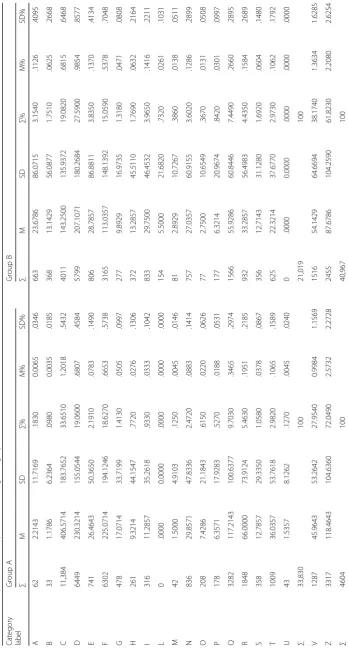
Due to the significant difference between the report length of group A and B, the frequen-cies of the coding words in each group needed to be uniform in order to allow the compari-son to take place. To this end, the percentage of coded words in each category has been calculated based on the number of coded words for each group individually. Given the pe-culiarities of the cross-cutting categories V and Z, the percentages referring to the same have been calculated separately. Table4reports the descriptive statistics about the categor-ies’coding frequencies split into group A and group B: the sum, the mean, and the standard deviation of coded words (∑, M, SD), and the respective standardized values for the purpose
of a comparison (∑%, M%, SD%). Looking at the combination of M% of group A and B, that
is highlighted in Fig.1, several differences between group A and B can be observed.
Statistics were employed to underline the main differences in this instance as well. In particular, a correlation matrix has been employed to highlight the princi-pal correlations between variables, and a T-test was used to confirm the differences
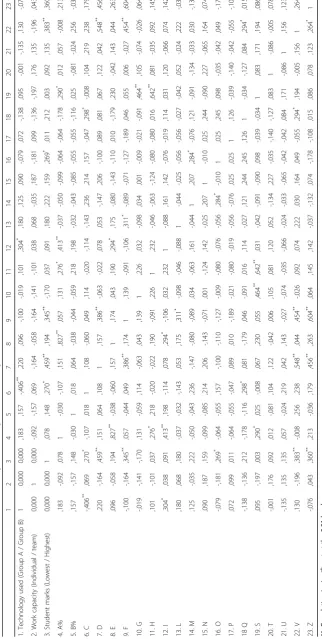
between the Groups. According to the results of the correlation matrix (see
Ap-pendix), the categories “C” (r(56) =−.406, p< .005) and “I” (r(56) =−.304, p< .005) have a significant correlation with the use of video annotation. Even the correlation
with category “D” (r(56) =−.220, p= 0.103) was taken into account because its p
-value is closer to 0.05 than the other categories. The independent sample T-test was applied to the categories highlighted above to verify the hypothesis: Group
A≠Group B. As shown in Table 5, this hypothesis is thus confirmed for categories
C and I. This means that there is a significant variation in the number of coded
words between the groups both for category C (p= .002) and for category I
(p= .023). The hypothesis is not formally confirmed for category D (p= .103), but,
given that the p-value is marginally significant with α= .10, that the value of
Cohen’s d suggests a slight effect (d =−.443), the difference between Group A and
Group B for this category were taken into account too.
Descriptive statistics also show that the means of cross-cutting categories (V and
Z) are greater for Group B than for group A, but the correlation coefficient didn’t
result significant for any of the two.
Discussion
By cross-referencing all the results concerning the reflective reports and the corre-sponding video characteristics, we could deduce that the students who completed the task employing HV and video annotation (Group B) produced videos and reports that were shorter than the students who completed the tasks employing unspecified video tools (Group A). This suggests that the students in Group B followed the guidelines proposed during the training on HV, which suggested an average duration of 3 to 5 min
for each HV (Cattaneo & Sauli, 2017), but also that the HV editing features (e.g. the
With regard to the frequencies of the coding categories, according to the emerged evidence, the use of HV technology led students to edit videos and to draft reflective reports differently. It seems that the students who used HV focused on describing
assignment-related events significantly less than the students who didn’t use this
spe-cific educational technology (category C). On the contrary, the students who used HV focused their reflective activity on the topic of education and training significantly more than the other group of students (category I). Furthermore, even if the T-test results
are only marginally significant with α= .10, the use of HV seems to facilitate students
also in reflecting on the interviewees’work activities (category D). On this basis, it can be deduced that on one hand the group of students who used video annotation allowed more room and paid more attention to reflection activities than the other group; on
the other and, the group that didn’t use the video annotation kept more attention to
descriptions. This outcome could be due to the fact that using video annotation forces the users to write the reflective reports in correspondence with video specific segments while they are watching the video. In this way, the students may pay more attention to the reflective thinking as they did not need to remember nor to textually reproduce the
content of the video. In other words, the “description” is not so needed any more as it
is immediately available and directly connected with the written reflection. This
out-come would also confirm that the cognitive load theory (e.g. Sweller, 1988, 2011)
has implication in HV and instructional design, as highlighted by several authors
(Cattaneo, van der Meij, Aprea, Sauli, & Zahn, 2018; Bonaiuti, 2012; Bonaiuti,
Calvani, Menichetti, & Vivanet, 2017; Sauli et al., 2018). All considered, these
re-sults suggest that the HV had the potential to really become a boundary object, able to support students in articulating and connecting what they learnt at the university in theory and what they could see and document through their inter-viewees in the world of professional practice. By means of its facilities, and above all by the annotation tool, the HV provided a way to support reflection, i.e. one
Fig. 1Uniformed means comparison
Table 5Independent samples T-Test for equality of means
T df p Cohen’s d
C 3.260 54 .002 .871
I −2.345 54 .023 −.627
of the main learning mechanisms connected to boundary crossing (Akkerman &
Bakker, 2011). Although in the experience reported here the use of the HV was
framed within a specific assessment task, this observation has interesting implica-tions on curricula design: HV and video annotation could in fact become an in-teresting means to support boundary crossing and reflective activities across different (formal, informal, non-formal) learning contexts.
Limitations
Given its explorative nature, this study presents some limitations. Firstly, not all the collected data were deeply analyzed, forcing the researcher to restrict the cor-pus of the analysis, which could be extended at a later stage; secondly, the
stu-dents’ grades concerning the whole exam were not taken into account: controlling
for this variable could provide additional evidence on the process the students went through. Furthermore, all the participants carried out the assignment on a voluntary basis, as the realization of the video was not mandatory. This choice automatically excluded all the students who were not motivated for - or frightened by - the use of technology. Finally, another limitation of the present study is due to the fact that only the video annotation feature of iVideo was considered. So, the data analysis did not take into account possible reflexive processes which could be
occurred during the production of an HV through others iVideo’ features (e.g.,
active points, attachments, subtitles, etc.)
Conclusions
As shown in the section before, the results of the statistical analysis highlighted two sets of information. The first set answers the research question about the use of HV and video annotation, while the second provides new elements con-cerning the use of reflective activities and video technologies regardless of their specific characteristics - to better articulate the gap between education and work context. Furthermore, the category system emerged from the first macro-step is composed of a hierarchy of categories and sub-categories inductively based on data with 21 coding possibilities. This coding system could be considered one of the study outcomes because it could be employed in different contexts (in re-search or teaching filed) to analyze the content of work practices reflexive-reports. In summary, the use of HV and video annotation seems to allow stu-dents to better center their focus on reflection rather than on description; to this extent, the efficacy of the use of video as educational technology, already outlined
by the Hattie (2009) meta-analysis results, has been confirmed. Furthermore, in
line with the Efrahrraum model (Schwendimann et al., 2015), the effectiveness of
Abbreviations
GT:Grounded Theory; HV: Hypervideo, interactive video; TQTA: Thematic Qualitative Text Analysis; VET: Vocational Education and Training
Acknowledgements
We thank the trainee-students involved in the research for their helpful support in gathering and organizing data.
Authors’contributions
MP conducted the study and wrote the manuscript; AC made substantial contributions to research design, manuscript drafting, and revision; GT was involved in study conception, research design, and data collection. All authors read and approved the final manuscript.
Funding
This study did not receive specific funding.
Availability of data and materials
The datasets used and/or analyzed during the current study are available from the corresponding author on reasonable request.
Competing interests
The authors declare that they have no competing interests.
Author details
1Department of Human Sciences, University of Verona, Verona, Italy.2Swiss Federal Institute for Vocational Education
and Training, Lugano, Switzerland.
Received: 24 January 2019 Accepted: 4 June 2019
References
Akkerman, S. F., & Bakker, A. (2011). Boundary crossing and boundary objects.Review of Educational Research,81(2), 132–169. https://doi.org/10.3102/0034654311404435.
Ayres, L. (2008). Thematic coding and analysis. In The SAGE encyclopedia of qualitative research methods, (pp. 868–869). Thousand Oaks: Sage Publications, Inc..
Bonaiuti, G. (2012). La video annotazione per osservare e riflettere.Form@ Re-Open Journal per La Formazione in Rete,12(79),
71–83http://www.fupress.net/index.php/formare/article/view/12603%0A.
Bonaiuti, G., Calvani, A., Menichetti, L., & Vivanet, G. (2017).Le tecnologie educative, (1st ed., ). Roma: Carocci editore. Boud, D., Keogh, M., & Walker, D. (1985).Reflection: Turning experience into learning. London: Kogan Page.
Bronkhorst, L. H., & Akkerman, S. F. (2016). At the boundary of school: Continuity and discontinuity in learning across contexts.Educational Research Review,19, 18–35.https://doi.org/10.1016/j.edurev.2016.04.001.
Cattaneo, A., & Boldrini, E. (2016). You Learn by your Mistakes. Effective Training Strategies Based on the Analysis of Video-Recorded Worked-out Examples.Vocations and Learning, 1–26. https://doi.org/10.1007/s12186-016-9157-4.
Cattaneo, A., & Nguyen, A. (2016). Teaching and Learning with Hypervideo in Vocational Education and Training.Journal of Educational Multimedia and Hypermedia,25(1), 5–35https://www.learntechlib.org/p/151120.
Cattaneo, A., Nguyen, A. T., Sauli, F., & Aprea, C. (2015). Scuolavisione: Teaching and learning with hypervideos in the Swiss vocational system.Journal of ELearning and Knowledge Society,11(2), 27–47.
Cattaneo, A., & Sauli, F. (2017).Integrating Interactive Video in a Learning Scenario - Guidelines From Iv4Vet Project. Cattaneo, A. A. P., & Aprea, C. (2018). Visual technologies to bridge the gap between school and workplace in vocational
education. In D. Ifenthaler (Ed.),Digital Workplace Learning, (pp. 251–270). Cham: Springer International Publishing. https://doi.org/10.1007/978-3-319-46215-8.
Cattaneo, A. A. P., van der Meij, H., Aprea, C., Sauli, F., & Zahn, C. (2018). A model for designing hypervideo-based instructional scenarios.Interactive Learning Environments, 1–22.https://doi.org/10.1080/10494820.2018.1486860.
Colasante, M., Kimpton, A., & Hallam, J. (2014). A curriculum model to promote (chiropractic) clinical thinking with video-case annotation. In M. Gosper, & D. Ifenthaler (Eds.),Curriculum models for the 21st century: Using learning technologies in higher education, (pp. 181–210). New York: Springer Science + Business Media.
Corbin, J., & Strauss, A. (2008).Basics of qualitative research. Techniques and procedures for developing grounded theory, (3rd ed., ). Thousand Oaks: Sage Publications, Inc.
Dewey, J. (1933).How we think, a restatement of the relation of reflective thinking to the educative process. Boston: D.C. Heath and Co.
Engeström, Y. (1987).Learning by expanding: An activity-theoretical approach to developmental research. Helsinki: Orienta-Konsultit.
Engeström, Y., Engeström, R., & Kärkkäinen, M. (1995). Polycontextuality and boundary crossing in expert cognition: Learning and problem solving in complex work activities.Learning and Instruction,5(4), 319–336. https://doi.org/10.1016/0959-4752(95)00021-6.
European Commission (2018).Proposal for a council recommendation on key competences for lifelong learning. 2018/0008 (NLE), (vol. 170008)http://eur-lex.europa.eu/resource.html?uri=cellar:395443f6-fb6d-11e7-b8f5-01aa75ed71a1.0001.02/DOC_ 1&format=PDF. Accessed 12 Oct 2018.
Fuller, A., & Unwin, L. (2003). Learning as apprentices in the contemporary UK workplace: Creating and managing expansive and restrictive participation.Journal of Education and Work,16(4), 407–426.
Glaser, B., Strauss, A., & Strutzel, E. (1968). The discovery of grounded theory; strategies for qualitative research.Nursing Research,17(4), 364.
Griffiths, T., & Guile, D. (2003). A connective model of learning: The implications for work process knowledge.European Educational Research Journal,2(1), 56–73.
Guile, D., & Griffiths, T. (2001). Learning through work experience.Journal of Education and Work,14(1), 113–131. Hattie, J. A. (2009).Visible learning: A synthesis of 800+ meta-analyses on achievement. Abingdon: Routledge. IBM SPSS Statistics. (2011).
iVideo. (2018).http://ivideo.education/ivideo/login.jsp
Jarvis, P. (2009).Learning to be a person in society. Oxon: Routledge.
Kolb, D. A. (1984).Experiential learning: Experience as the source of learning and development. Englewood Cliffs: Prentice Hall. Kuckartz, U. (2014).Qualitative text analysis: A guide to methods, practice & using software. London: SAGE Publications, Inc.
https://doi.org/10.4135/9781446288719.
Looi, C.-K., & Wu, L. (2015). Reflection and preflection prompts and scaffolding. In S. J. Michael (Ed.),The SAGE encyclopedia of educational technology, (pp. 610–613). Thousand Oaks: SAGE Publications, Inc.https://doi.org/10.4135/
9781483346397.n253.
Ludvigsen, S., Lund, A., Rasmussen, I., & Säljö, R. (Eds.) (2011).Learning across sites. New tools, infrastructures and practices. New York: Routledge.
Margaryan, A. (2008).Work-based learning: A blend of pedagogy and technology. Saarbrücken: Verlag Dr Müller. Moon, J. (1999).Reflection in learning and professional development. London: Kogan Page.
Mortari, L. (2010).Dire la pratica. Milano-Torino: Bruno mondadori. Nvivo Pro.11 (2015).Https://www.qsrinternational.com/nvivo/nvivo-products
Paplova, M. (2009).Technology and vocational education for sustainable development, (vol. 10). Unesco Unevoc, Springer. https://doi.org/10.1007/978-1-4020-5279-8.
Perini, M. (2017). Crossing boundaries between classroom and work learning processes through ICT: a systematic review. In Crossing boundaries in VET, (pp. 264–267). Rostock: University of Rostock.
Rich, P., & Hannafin, M. (2009). Video annotation tools: Technologies to scaffold, structure, and transform teacher reflection. Journal of Teacher Education,60(1), 52–67.
Sauli, F., Cattaneo, A., & van der Meij, H. (2018). Hypervideo for educational purposes: A literature review on a multifaceted technological tool.Technology, Pedagogy and Education,27(1), 115–134.https://doi.org/10.1080/1475939X.2017.1407357. Schön, D. (1987).Educating the reflective practitioner. San Francisco: Jossey-Bass.
Schwendimann, B. A., Cattaneo, A. A. P., Dehler Zufferey, J., Gurtner, J.-L., Bétrancourt, M., & Dillenbourg, P. (2015). The‘Erfahrraum’: A pedagogical model for designing educational technologies in dual vocational systems. Journal of Vocational Education & Training,67(3), 367–396.https://doi.org/10.1080/13636820.2015.1061041. Star, S. L., & Griesemer, J. R. (1989). Institutional ecology, translations’and boundary objects: Amateurs and professionals in
Berkeley’s museum of vertebrate zoology, 1907-39 Author(s): Susan Leigh Star and James R. Griesemer source: Social studies of science, Vol. 19, no. 3.Social Studies of Science,19(3), 387–420.https://doi.org/10.2307/285080.
Stenström, M.-L., & Tynjälä, P. (Eds.) (2009).Towards integration of work and learning. Strategies for connectivity and transformation. Dordrecht: Springer.
Suchman, L. (1994). Working relations of technology production and use.Computer Supported Cooperative Work,2(1–2), 21–
39.https://doi.org/10.1007/BF00749282.
Sweller, J. (1988). Cognitive load during problem solving: Effects on learning.Cognitive Science,12, 257–285. Sweller, J. (2011). Cognitive load theory. In The psychology of learning and motivation, (pp. 37–76). San Diego: Elsevier
Academic Press.https://doi.org/10.1016/B978-0-12-387691-1.00002-8.
Tacconi, G. (2011).La didattica al lavoro. Analisi delle pratiche educative nell’istruzione e formazione professionale. Milano: Franco Angeli.
Tacconi, G. (2015). Didattica Della Formazione Syllabus a.a. 2015-2016.http://www.dfpp.univr.it/documenti/OccorrenzaIns/ matdid/matdid879619.pdf. Accessessed 31 July 2018.
Tacconi, G., & Hunde, A. B. (2017). Participatory research on teaching practice as basis for teacher education and networking between universities and VET schools. In F. Eicker, H. Gesine, & B. Lennartz (Eds.),Vocational Education and Training in Sub-Saharan Africa. Current Situation and Development. Bielefeld: W. Bertelsmann Verlag.https://doi.org/10.3278/ 6004570w134.
Tacconi, G., & Gomez, G. M. (2010).Raccontare la formazione. Analisi delle pratiche nei centri di Formazione Professionale dell’associazione CIOFS/FPPuglia. Taranto: Print Me.
Tuomi-Gröhn, T., & Engeström, Y. (Eds.) (2003).Between school and work. New perspectives on transfer and boundary-crossing. Oxford: Pergamon - Elsevier Science.
Tynjälä, P. (2005). Integrative pedagogics—learning in real life situations. In Keynote address in Paper presented at the enhancing physiotherapy competencies in innovative learning environments. Helsinki: European Network of Physiotherapy in Higher Education. Tynjälä, P. (2008). Perspectives into learning at the workplace.Educational Research Review,3(2), 130–154.
Tynjälä, P. (2009). Connectivity and transformation in work-related learning–Theoretical foundations. In M.-L. Stenström, & P. Tynjälä (Eds.),Towards integration of work and learning. Strategies for connectivity and transformation, (pp. 11–37). Dordrecht: Springer. Wegener, C. (2013). A situated approach to VET students’reflection processes across boundaries.Journal of Education and
Work,27(4), 454–473.https://doi.org/10.1080/13639080.2012.758358.
Zitter, I., Hoeve, A., & de Bruijn, E. (2016). A design perspective on the school-work boundary: A hybrid curriculum model. Vocations and Learning,9(1), 111–131.https://doi.org/10.1007/s12186-016-9150-y.
Publisher’s Note