Accepted by Editor Krassie Petrova │Received: April 14, 2016│ Revised: June 26, July 27, August 19, Septe m-ber 28, November 29, 2016; February 20, April 3, 2017│ Accepted: April 4, 2017.
Cite as: Fluck, A., Adebayo, O.S., & Abdulhamid, S. M. (2017). Secure e-examination systems compared: Case studies from two countries. Journal of Information Technology Education: Innovations in Practice, 16,107-125. Retrieved from http://www.informingscience.org/Publications/3705
(CC BY-NC 4.0) This article is licensed to you under a Creative Commons Attribution-NonCommercial 4.0 International License. When you copy and redistribute this paper in full or in part, you need to provide proper attribution to it to ensure
S
ECURE
E-E
XAMINATION
S
YSTEMS
C
OMPARED
:
C
ASE
S
TUDIES FROM
T
WO
C
OUNTRIES
Andrew Fluck * University of Tasmania, Launce
s-ton, Tasmania, Australia, [email protected] Olawale S. Adebayo Federal Universityof Technology,
Minna, Nigeria [email protected]
Shafi’i M. Abdulhamid Federal University of Technology,
Minna, Nigeria [email protected]
* Corresponding author
A
BSTRACTAim/Purpose Electronic examinations have some inherent problems. Students have expressed negative opinions about electronic examinations (e-examinations) due to a fear of, or unfamiliarity with, the technology of assessment, and a lack of
knowledge about the methods of e-examinations.
Background Electronic examinations are now a viable alternative method of assessing stu-dent learning. They provide freedom of choice, in terms of the location of the examination, and can provide immediate feedback; students and institutions can be assured of the integrity of knowledge testing. This in turn motivates stu-dents to strive for deeper learning and better results, in a higher quality and more rigorous educational process.
Methodology This paper compares an e-examination system at FUT Minna Nigeria with one in Australia, at the University of Tasmania, using case study analysis. The fun c-tions supported, or inhibited, by each of the two e-examination systems, with different approaches to question types, cohort size, technology used,and secur i-ty features, are compared.
Findings The comparison of the two institutions in Nigeria and Australia shows e -examinations have been implemented for the purpose of selecting students for university courses, and for their assessment once enrolled. In Nigeria, there is widespread systemic adoption for university entrance merit selection. In Au s-tralia this has been limited to one subject in one state, rather than being adopted nationally. Within undergraduate courses, the Nigerian scenario is quite exten-sive; in Australia this adoption has been slower, but has penetrated a wide vari e-ty of disciplines.
Recommendations
for Practitioners Assessment integrity and equipment reliabilitytwo case studies, although the delivery of e-examinations is different in each were common issues across the country. As with any procedural process, a particular solution is only as good as its weakest attribute. Technical differences highlight the link between e
-examination system approaches and pedagogical implications. It is clear that social, cultural,and environmental factors affect the success of e-examinations. For example, an interrupted electrical power supply and limited technical know -how are two of the challenges affecting the conduct of e-examinations in Nig e-ria. In Tasmania, the challenge with the “bring your own device” (BYOD) is to make the system operate on an increasing variety of user equipment, including tablets.
Recommendation
for Researchers The comparisons between the two universities indicate there will be a produtive convergence of the approaches in future. One key proposal, which arose c-from the analysis of the existing e-examination systems in Nigeria and Australia, is to design a form of “live” operating system that is deployable over the Inte r-net. This method would use public key cryptography for lecturers to encrypt their questions online.
Impact on Society If institutions are to transition to e-examinations, one way of facilitating this move is by using computers to imitate other assessment techniques. However, higher order thinking is usually demonstrated through open-ended or creative tasks. In this respect the Australian system shows promise by providing the same full operating system and software application suite to all candidates, thereby supporting assessment of such creative higher order thinking. The two cases illustrate the potential tension between “online” or networked reticulation of questions and answers, as opposed to “offline” methods.
Future Research A future design proposition is a web-based strategy for a virtual machine, which is launched into candidates’ computers at the start of each e-examination. The new system is a form of BYOD externally booted e-examination (as in Austral-ia) that is deployable over the Internet with encryption and decryption features using public key cryptography (Nigeria). This will allow lecturers to encrypt their questions and post them online while the questions are decrypted by the administrator or students are given the key. The system will support both obje c-tive and open-ended questions (possibly essays and creative design tasks). The authors believe this can re-define e-examinations as the “gold standard” of a s-sessment.
Keywords e-examination, e-Learning, public-private relationships, open-source software, accreditation authorities, post-paper assessment
I
NTRODUCTIONin turn motivates students to strive for learning and better results in a higher quality and more rigo r-ous educational process.
E-examinations still have some inherent problems: students may have negative opinions about e -examinations due to a fear of or unfamiliarity with the technologyand a lack of knowledge about the methods of e-examinations. In this research, the authors compared e-examinations in Nigeria with those of Australia, with the aim of identifying the challenges and to propose strategies for improv e-ment.
Examinationis a perennial focusof debate (Baird, Cresswell,& Newton, 2000). Qualifications au-thorities balance examinationswith coursework assessment(Elwood, 1999). In this paper,the au-thors do not question the value or validity of examination-style assessment, which debate is the pro v-ince of qualifications authorities and often reflects the particular syllabus or subject content. Rather, the authors examine e-examinations in the light of information technology developments and e x-plain the anticipated clash between fully online and live operating system styles of e-examination. The authors’interest in e-examinations stems from theirrole in spearheading computer-based as-sessment at their respective institutions. Theviewpoints are complementary,yet also offer an unusual and more holistic perspective.
“E-examinations”refers tothe use of computers by candidates in a high-stakes supervised (pro c-tored) assessment,generally simultaneously ina fixed time period. Adebayo and Abdulhamid’s survey (2010) shows this definition has been widely accepted in private and public institutions of higher learning as well as in high schoolsby identifying common practices. Adebayo and Abdulhamid’s su r-vey indicates several examination bodies in Nigeria preferred e-examinations to manual examinations (in whichstudents use “pen on paper”). Staff and students preferred e-examinationsbecauseof their flexibility, security, integrity,and ease of use.
As with manual examinations, e-examinationsrequire stakeholder co-operation and reliable equi p-ment for success. The lecturers, invigilators, candidates, computer instructors,and server operators are the stakeholders in the conduct of e-examinations. However, unlike manual examinations,where the stakeholders can (with opportunity)influence the integrity of the results, the integrityof e-examinations’results depends on the security apparatus and technology appropriateness. For exa m-ple, closed circuit televisioncan beused to monitor candidates during the conduct of e-examinations rather thanthe use of invigilators alone in manual examinations. The results of e-examinations are submitted directly to the central server for onward processing and delivery. This compares with ma n-ual examination results,which can be modified by the tutor.
There are many examplesof computersbeing employed in learning and many other types of asses s-mentmethods. The problems of teaching large classes (Kumar, 2011)are being overcome by the use of learning content management systems for delivering materials over the Internetand educating geographically dispersedstudents. These students are becomingaccustomed to using a computer for all learning activities. Assessing thislearning by using penon paper examinationscan therefore ap-pear incongruous to these students; butit is frequently employed. This discord is one of the key rea-sons the authors have championed e-examinations,and which has stimulated our interest in their d e-velopment beyond our own countries.
L
ITERATURER
EVIEWTo establish the context of e-examinations, literature related to the growth of e-Learning and e -assessment was investigated. We located literature related to the followingthemes: e-Learning, e -assessment,and e-examinations.
There has been a surge of interest over the past five years in online assessment associated with n a-tional testing programs. For example, Australia’s naa-tional testing program in schools will transition to an online format by 2019 (Australian Curriculum, Assessment andReporting Authority [ACARA], 2017).
TheUS Department of Educationissued a request for information about Assessment Technology Standardsfornational online testing on December 20, 2010(Twing, 2010). This request defined the range of technical issues(such as compatibility standards)required for widespread adoption of any new high-stakes assessment technology. Potential suppliersidentified concerns aboutnetwork access of any kind and the anticipatedreliability of the computer equipment.
In 2014, theAustralian stateof Victoria’sDepartment of Education and Early Childhood Develo p-ment(DEECD)released a similar information requestand tender for a reporting and analytics co m-ponent of the online integrated assessment platform known as the Insight Platform. The advantages of putting such monitoring and diagnostic testing online include scalability, easy revision, centralised control over access,and swift marking of many items. The disadvantages are the need for constantly reliable equipment (including communication links), the restrictions of posing questions within a web browser, and the cost of creating question items.
Offline assessment methods are growing more slowly in comparison. The main thrusts have been to capitalise on BYOD (“bring your own device”) strategies by using “live”operating systems. A “live” operating system can be put onto a removable storage device,such as a CD-ROM or USB drive. The BYOD computer boots from this device and whilethe computer remains activated, it is totally under the control of this operating system. Thus,assessors can devise highly complex activities (with the option of involving the use of additional software applications) beyond the scope of a web pagein a secure environment,which is identical for every candidate. Finland stands out in publishing a co m-mitment to move all high-stakes school examinations to such a system in its Digabi project (Matricu-lation Examination Board of Finland [MEB], 2013).The project commenced operation in 2016 with the computerisation of university entrance examinations in three subjects and will convert all such examinations to computers by 2019.
Importantly, BYOD strategies provide institutions with access to individual student computing equipment without incurring prohibitive costs. Plan Ceibal in Uruguay is an example of a national “one laptop per child”program,which was funded by the central government. Thiswas partially re p-licated in Australia by the Digital Education Revolution (Crook & Sharma, 2013). Ricci (2015) ident i-fies the2013 closure of theprevious federal government's Digital Education Revolution(DER), which had provided laptop computers to students from Year 9 level onward, as thecritical catalyst for a new strategy. For many Australian schools, BYOD has become that alternative strategy.A n a-tional survey(conducted by educational software provider Softlink)of 1267 schools across Australia in 2014 revealed that BYOD programs grew by 30 per cent in that yearalone. Numerous primary schools have also embarked on BYOD schemes with the introduction of iPads:“despite lingering concerns about network capability, affordability and e-safety, some describe the BYOD global trend as the next stage in the evolution of schooling: one that will provide students with the skillsthey will require for life in the technological age”(Ricci, 2015).
o-priate. Predictably, Dawson (2016) identifies the potential to cheat in BYOD exams: “the cons e-quences of these hacks are significant, ranging from removal of the exam paper from the venue through to receiving live assistance from an outside expert”.
In BYOD in Education: A report for Australia and New Zealand,Sweeney(2012) details the observations and findings from in-depth interviews and executive roundtable focus groups conducted by Intell i-gent Business Research Services. Sweeneynotesthat“... it became evident that the more significant issue was not the ‘device’ per se but the delivery of software and services that impact educational activities” (p. 5), and concludes:
Everyone is looking for the ‘One Approach’ that alleviates all of the headaches of providing digital education (changing policies, duty of care, maintenance, etc.) while consuming as little of the scarce ICT budget as possi-ble. In truth, there is not one approach that fits all educational institutions – or even a single approach that can be used across a single school (p. 27).
A recent pilot study of an e-examinationsystem at Central Queensland University (Wibowo, Gran-dhi, Chugh,& Sawir, 2016) found that students and staff,
… expressed a variety of feedback and concerns ... [and] the ineffectiveness of the existing system and other issues associated with the system could be improved. Future selection of e-exams system should consider features missing in current e-exams system. The implementation of e-exams is still in its infancy at CQUniversity, more work need [sic] to be done which requires collaboration among students, teaching, professional and tech-nical staff, and decision makers at the institution (p. 29).
Although ourstudy specifically investigates and compares e-examinations in Australia and Africa, it is of value to understand a more global approach to this method of assessment and learning. There have been many commercial education options (outside the accredited tertiary sector), which have been operating in thefield for nearly twenty years. For example, one companypromotes itself as,
… a leading developer of online platforms for high-stakes assessment. Utilising the latest cloud-hosting technol-ogies, [and specialising] in providing innovative, highly scalable and secure applications built to meet the as-sessment requirements of our clients now and for the future. Our team consists of highly experienced profes-sionals who have been building online assessment systems together for a number of years and have delivered on a range of highly successful assessments in Australia, Europe, the US and Asia (Janison, 2016).
In this case, it is worthy to consider the application of cloud-hosting technologies and how they will come into play, in terms of security,in the next five to ten years of e-examinations.Other intern a-tional research investigates e-examination security and encryption (Sabbah, Saroit & Kotb, 2011), Moodle and e-Learning systems (Kumar, Gankotiya & Dutta, 2011),and connections between au-thoring tools, learningmanagement, e-Learning and e-examinations (Impedovo, Lucchese & Pirlo, 2006). E-examinations have been deployed widelyin Austria (Frankl, Schartner & Zebedin, 2012). An open source secure exam browser from Switzerlandhas been popularin a large number of institu-tions (Halbherr, Reuter, Schneider, Schlienger,& Piendl, 2014).
In 2012 students at Impington Village Collegein Englandwere provided with iPads and Kindles loaded with the test papers bythe University of Cambridge International Examinations boardfor a mock IGCSE biology exam, although studentsstill handwrote their answers. The majority favoured the use of technology, but 33%of the students preferred penon paper (McPherson, 2012;Ward, 2012). This was an early trial of one-to-one personal computer assessment technologies in secondary schools.
i-dates have a free choice of writing tool whenanswering an examination(Hochlehnert, Brass, Moel t-ner, & Juenger, 2011). Studies from Edinburgh suggestcomputer-using candidates have a slight a d-vantage, with more complex language and higherword-counts observed (Mogey & Fluck, 2015; M o-gey & Paterson, 2012).
In terms of e-Learning, for example, MOOCs (Massive Online Open Courses - courses made avail a-ble over the Internet, freeof charge, to a very large number of people) have become globally popular (Kay, Reimann, Diebold,& Kummerfeld, 2013). Haynie (2014) notes MOOCs are “praised for providing a free education to people across the world. … But they have a murky record in terms of their overall effectiveness, particularly in light of their low student completion rates”. Further, Fiona Hollands, who recently led a study onMOOCs for Columbia University's Teachers’ College,
acknowledgesthat“there is little data about whether MOOCs are moreeffective than other learning models. Almost no one is doing that work… It's rare and I don’t really understand why people are avoiding it” (Haynie, 2014).
Tensions have emerged betweenthe desire to improve the authenticity of assessment, yet retain the integrityof testing individuals for award purposes (Hillier & Fluck, 2015). These tensions extend to the various technologies becoming available for e-examinations. Wholly online methods contend with secured word-processing applications for legal and medical assessments (Alfredsson, Sejersen, Stathakarou,& Zary, 2015; Chatzigavriil & Fernando, 2015; Poutre, Hedlund, & Nau, 2015). These studies have reported differences in candidate acceptance and perceptions of assessment validity. However, at the institutional level, there is no clear roadmap for e-examination adoption without reputational risk.
The use of computers for examinations has been considered at the highest level by the authors’ un i-versities. The Federal University of Technology, Minna in Nigeria (FUT Minna) approved the use of online computers in examinations in February2010. The University of Tasmania (UTAS) Academic Senate approved the use of offline e-examinations(in all disciplines) on 4March 2011. Each unive r-sity considered equity, technical reliability and implementation processes.The authors located only a few previous studies,whichhave compared e-examinationsbetween geographical locations(Bukie, 2014; Spanaka&Kameas,2013).
R
ESEARCHM
ETHODOLOGY ANDM
ETHODYin (1984) defines case study research method as an empirical inquiry that investigates a contemp o-rary phenomenon within its real-life context and in which multiple sources of evidence are used (p. 23). A qualitative case study is “an approach to research that facilitates exploration of a phenomenon within its context using a variety of data sources” (Baxter & Jack, 2008, p. 544) and this ensures the issue is “not explored through one lens, but rather a variety of lenses which allows for multiple facets of the phenomenon to be revealed and understood” (Baxter & Jack, 2008, p. 545). This is based on the constructivist paradigm that truth is relative and is dependent on one’s perspective; it acknowl-edges the importance of the subjective human creation of meaningbut does not reject notions of objectivity.
According to Yin (2003),a case study design should be considered when the focus of the study is to answer “how”and “why”questions or when the researcher cannot (or should not) manipulate the behaviour of those involved in thestudy. A case study is an in-depth study of a particular situation. In this study the research was conducted at the institutional level in order to make cross-institutional comparisons. Our data were collected independently from the individual sites, and then organised into high-level categories for presentation and subsequent analysis. The researchers did not know the personal details of the individual e-examination candidates, when data werecollected.
Therefore,selection bias is considered minimal as the cases exemplify such distinct differences. Par-ticipants were chosen through opportunisticsampling; that is,the cohorts observed were randomly selected according to their availability to the researchers. In drawing participants from diverse con-texts, the results are expected to show if,and how, e-examinationscan play a part in selecting stu-dents for university courses, and for their assessment once they are enrolled in a degree program. Furthermore, through comparative analysis of the two institutional cases, inspiration will be drawn for improved technologies and processes for e-examinations.
This research was undertaken subsequent to a visit to FUT Minna by one of the authors. It uses a qualitative comparative case study design and was conducted at the institutional level. Sample sele c-tion was by opportunity, since one author had become aware of the work at FUT Minna on the basis of searches using the “e-examination”term and arranged to visit thecampus. It is not intended that these case studies should have similarities; in fact, the intentions and technologies at the two sites are very diverse, and therefore give a greater perspective on the subsequent issues than a closer match might have revealed.The two case studies are provided in the following section to preserve them as holistic descriptions. The case from FUT Minna is presented first, followed by the case from the University of Tasmania.
Using the constant comparative analysis method (Fram, 2013), each case study is arranged in four parts, with a general introduction that defines the technological approach and educational context. Glaser and Strauss (1967), the key proponents of grounded theory, describe the constant comparative analysis method as identifying a phenomenon, object, event or setting of interest; identifying a few local con-cepts, principles, structural or process features of the experience or phenomenon of interest; making decisions regarding initial collection of data based on one’s initial understanding of the phenomenon (in that further data collection cannot be planned in advance of analysis and the emergence of the o-ry); and engaging in theoretical sampling(pp. 28-52).
The goal of this approach (as a form of grounded theory) is to generate theories that explain how some, clearly identified, aspect of the social world “works.” The key rationale for selecting compar i-son groups in the first phaseis their theoretical relevance for fostering the development of emergent categories. Accordingly, in the second phase, computer use in university entrance selection processes is described. Third, the use of computer-based assessment in university courses, and finally, future directions are explored. After the cases are presented, the comparative analysis is described, and the o-ries are proposed.
C
ASES
TUDYO
NE:
FUT
M
INNA(N
IGERIA)
B
ACKGROUNDANDT
ECHNOLOGYe-Learning and e-examination innovations in African countries are generally still at a low level, and this has led to limited utilisationof information technology facilities to enhance the conduct and d e-velopment of examination systems. Further,thefew countries in the forefront of the awareness and usage of e-examinations are facing challenges that range from poor electricity supply to facility maintenance. A report by Michigan State University, which focuses on e-Learning in Secondary School Education in Tanzania(Olsenet al., 2011)states:
Improving secondary education in Africa and other developing countries had until recently been overshadowed by programs focusing on national economic and infrastructure development. … Many new policies and projects have begun to introduce information and communications technologies and related teaching approaches, known collectively as electronic or e-learning, into schools ... e-Learning programs in Africa and in other developing countries are still often small, experiential pilot projects with little documented history of their successes and im-pacts. Nevertheless, a body of literature is emerging that analyzes e-learning programs (p. iii).
otherwise called online examinations, for high-stakes assessments, career evaluation,and aptitude tests (Osang, 2012). Theparastatal organisationsusing pre-employment online assessments include the National Information Technology Development Agency and the Petroleum Technology Devel-opment Fund.
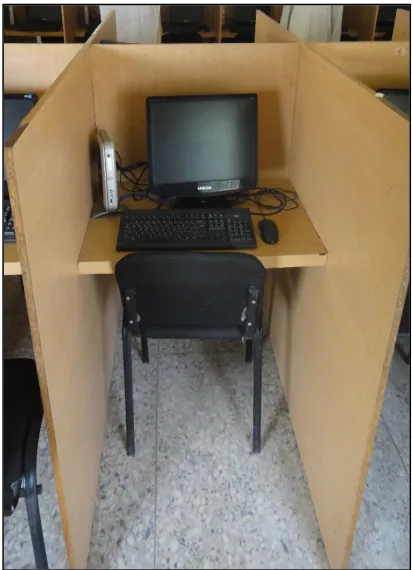
[image:8.612.199.405.324.609.2]FUT Minnahas been administering e-examinations since 2010. The University was one of the very first in Nigeria to adopt the electronic-based test and has overcome some major challenges,such as the security of the questions and also the integrity of the results produced using the electronic test. Thisled to early researchers proposinga more secure system (Adebayo & Abdulhamid, 2010). The current e-examination process in FUT Minnais administered by the electronic Testing Company (eTC). The e-examination venue is a purposely-constructed building containing a campus server and an independent backup electricity supply linked to 120 thin client (“dumb”) terminals,which issue multiple choice questions over an internal wired network. The student terminals do no processing, but transfer keystrokes to the server and display the server response on the screen. Questions from individual course lecturers are encrypted using his or her public RSA key (Rivest, Shamir,& Adleman, 1978) and sent directly to the eTC database poolfrom where they are uploaded onto the thin client terminals for candidates to answer. This e-examination security strengthens the reliability and efficiency of the system. Collusion and cheating is preventedwithin the dedicated building by the use of partitioned carrels and a video-surveillance system covering all candidates (Figure 1). Stu-dent iStu-dentity is authenticated conventionally upon entry by using photo ID cards.
Figure 1: Candidate Workstation at FUT Minna.
U
NIVERSITYA
DMISSIONS
ECTOR–
N
IGERIA(PUTME). Candidates from the surrounding area come to the eTC building forthree to sixdays each year to sit the test. Afterwards, the PUTME candidates receive a scratch-off identity ticket. This pr o-vides each candidate with a unique number,which they can use to access the result system from an Internet café just two hours later to receive their marks.
E-
EXAMINATIONS INN
IGERIANU
NIVERSITYC
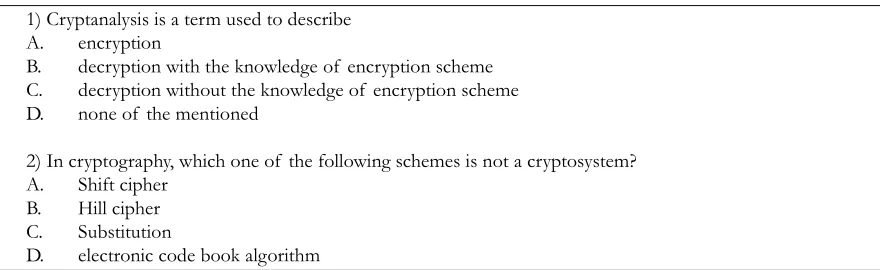
OURSESThe eTC e-examination system is very efficient and effective for the various examinations usually conducted by FUT Minna. These range from internal course-work tests to examinations for most first year undergraduate students. This represents very wide adoption of the eTC e-examination sy s-tem. Two of the sample e-examination multiple-choicequestions are provided in Figure 2.
1) Cryptanalysis is a term used to describe A. encryption
B. decryption with the knowledge of encryption scheme C. decryption without the knowledge of encryption scheme D. none of the mentioned
2) In cryptography, which one of the following schemes is not a cryptosystem? A. Shift cipher
B. Hill cipher C. Substitution
[image:9.612.105.545.203.338.2]D. electronic code book algorithm
Figure 2: Examples of multiple-choice questions from FUT Minna.
T
HEF
UTURE OFO
NLINEE
XAMINATIONS INN
IGERIAThe future trajectory is for e-examinations to be deployed on a BYODbasis administered at a di s-tance and at a convenient time for each candidate. This will be highly welcomed by distance learning students who can rarely attend lectures. Itwill bring many advantages to the conduct of examin a-tions,as students will spend less time and money on transportationandavoid the risk of accidents and the likelihood of missing examinations in a country where distances are great and reliable transport is difficultto find.
Moreover, as JAMB has started conducting online e-examinations, many other examination bodies are expected to shortly follow this lead. The authors also expect to see many university examination administrating bodiesconducting examinations online. This will assist inreducingprocessing time, reducingalteration cases (where test results are contested),and increasingstudent confidence in the assessment process. The authors also identified security from examination office staff as an i m-portant factor that must be given adequate priority to ensure the integrity of results.
C
ASES
TUDYT
WO:
U
NIVERSITY OFT
ASMANIA(UTAS,
A
USTRALIA)
B
ACKGROUNDANDT
ECHNOLOGYiden-tical application software suite and operating system to ensureequality of opportunity. This use of a “live”operating systemovercomes the limitations of e-examinationsdelivered within a webpage, such as those linking to a learning content management quiz system. Webpage based e-examinations generally restrict students to choosing between answer optionsand inhibitthe use of sophisticated software to demonstrate higher order thinking. The “live”operating system allows every student to run application software and could potentially permit the use of powerful speech recognition sy s-tems (Audhkhasi, 2009).
By 2013 over 1000 candidates had successfully used the system in high-stakes assessments. In 2014, Version 5 was developed from Ubuntu 12.04 at the University of Queensland. Thiscould bootboth Windows PC and Macintosh computers from the same USB data stick
(www.transformingexams.com). This version also includes a copy of the Moodlelearning content management system for handling multiple-choice and similar question types. Three key security measures were incorporated toprevent cheating (Kumar, 2012)and to provide a fair assessment con-text by:
• disabling communications to prevent Internet access or collusion; • preventing access to local hard drives or other USB storage devices; and
• providing a unique visual image (for example,a pet animal) on all candidate screens at startup, for non-technical invigilators (exam supervisors without computer skills) to check technical compliance.
E-examinationcandidates can access a sample USB stick at least threeweeks prior to their asses s-ment to become familiar with the start-up process and operational characteristics. When commen c-ing an e-examination, the candidate enters the assessment centrewith their own computer and finds a USB stick on their designated desk with launching instructions. After startingtheir computer, each candidate’s desktop security image is checked by supervisors before they are permitted to open the question paper and start writing answers. Periodically throughout,and at the end of the
e-examination,their answers are saved on the USB stick, which is left on the desk after the assessment for collection, collation,and forwarding to assessors for marking.
U
NIVERSITYA
DMISSIONS
ECTOR INT
ASMANIAThe eExam System software was trialed by the Tasmanian Qualifications Authority (TQA) in2011. TQA is responsible for the calculation of a national ranking for all students aspiring to enter unive r-sity and the administration of subject-specific pre-tertiary examinations. A report on the 2011 trial states:
The e-exam in Information Technology & Systems was taken by 93 students at 10 exam centres. Each school had used e-exam [sic] for their mid-year examinations and was familiar with the system. There were no issues with major equipment failure (TasmanianQualifications Authority [TQA], 2012). In 2012 a “post-paper”question was trialed by the TQA,whereby noInternetconnection was al-lowed or available.The question directs candidates to a small website provided on the USB drive containing rich features such as color images and animations (Figure 3). These could not have been easily provided on paper, hence the term “post-paper question”.
The ‘Up and Comers’ Tennis Club is a medium-size tennis club with about 150 members. During the consul-tation process two particular problems were identified:
(i) The tennis club’s website is somewhat limited. (ii) The tennis club’s membership records are a mix of: • some details written on membership forms
• some e-mails received and sent
• some records in a spreadsheet — mainly of those who had paid.
At the time, this was some of the tennis club’s web site (click to see it). Specifically referring to this club’s website, discuss three aspects of it you would change and why.
Type your answer below this line:
---
Figure 3: Example of a post-paper question from a university admission e-examination.
E-
EXAMINATIONS INU
NIVERSITY OFT
ASMANIAC
OURSESSeveral UTASdisciplines trainedfaculty staff and either offered this mode to students as an option, or made it compulsoryfor assessment. An e-examination is generally conducted in the same venue as penonpaper exams and alongsidethem. Collusion is prevented by the layout of the desks, making it virtually impossible for a student sitting the examinationto see the screen of any other candidate. Further,the e-examinationtechnology prevents access to internal/external data storage devices and to all communication channels. Candidates’ identities are validated using photo ID cards,as is stan d-ard operational procedure for university examinations. History, law, education,and medicine students have used the eExam Systemsoftwareat all year levels, thereby illustrating the diversity of subjects in which it can be applied. Lecturers in law, for example, commented the answer-scripts were much ea s-ier to read and mark.
These e-examinations can be dividedinto paper-replacement and post-paper assessments. In the case of paper-replacement e-examinations, candidates can choose to create textwith a pen or with a ke y-board. They are offered a choice of text creation methods, and all candidates answer the same que s-tions. In this context, equity is assured by permitting each candidate to select his or herpreferred writing implement (pen or keyboard). An example of a paper-replacement question used in the Fa c-ulty of Law is provided in Figure 4.
In 2011, Alpha Corp was fined $5,000,000by the Federal Housing Court for collusive pricing under the House Prices Act, 2009(Cth). It did not appeal the decision to the High Court….
Provide arguments for the Commonwealth government, including arguments that the High Court should be invited to reconsider the basis of constitutional review.
Please type your answer below this line
---
Figure 4: Example of a paper-replacement question from the Bachelor of Laws e-examination.
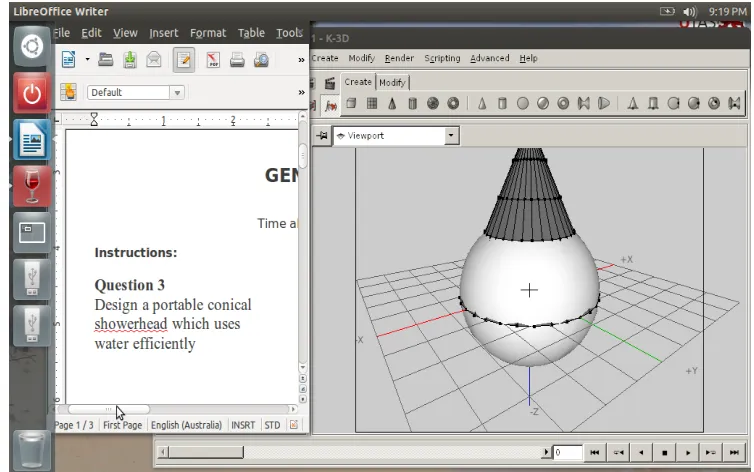
Figure 5: Example post-paper question (requires software use during e-examination).
F
UTURET
RAJECTORY INA
USTRALIAOver the next five to ten years, e-examinations willbe developed to the point that examination ca n-didates will require minimal technical expertise. Some of the challenges now include the move to new start-up computer architectures (from Basic Input-Output System to Unified Extensible Firmware Interface),as Windows 8and 10 are deployed. Greater numbers of ARM processors (replacing the Intel models)may need to be accommodated by e-examination systems. The popularity of tablets is under consideration, as these devices do not provide ways of booting from an alternative operating system source. They are also arguably poor devices upon which to input text at high speed, which is typical of e-examinationconditions. By providing a rich e-examination environment supporting post -paper assessment, curricula can be transformed, taking advantage of the sophisticated software tools, which can also be usedin exams. This will better match professional practice where such software tools are commonplace.
C
OMPARATIVEA
NALYSISComparative analysis was conducted by considering two different datadimensions. The first data dimension forcomparison lookedat the four parts of each institutional case study. The second data dimension forcomparison considered the deeper technicalfeatures of the two e-examination sy s-tems used.These two dimensionsof comparison elicited several key points for the discussion that follows.
c-cess to the same full operating system.TheTasmanian examination environment is variably scalable in that extant (non-specialist)venuesare employed.
Both institutions have used their technologies in the University admissions sector. The Nigerian case is particularly functional,in that it provides aspiring university students access to their results within hours.The Tasmanian case illustrates the use of post-paper assessment e-examinations in both the university admissions sector and in university courses. In FUT Minna degree courses the e
-examination system is proving more suitable for first year course assessmentswhere knowledge recall is a basic requirement. The UTAS example demonstrates application across year levels and disc i-plines,with a transition pathway from paper-replacement e-examinations to post-paper assessment. The future in FUT Minna is a move towards BYOD equipment and external assessment facilitated by enhanced security measures, using biometrics, for example. The challenges in Tasmania are to support a wider range of user devices and to promote curriculum change.
Overall, this first data dimension comparison showed the two institutions had different strategic o b-jectives and had chosen e-examination systems to suit their respective purposes. Each system had strengths and weaknesses. Some of these strengths and weaknesses are likely to affect future devel-opment.The second dimension of comparison looked at the technical elements of each e
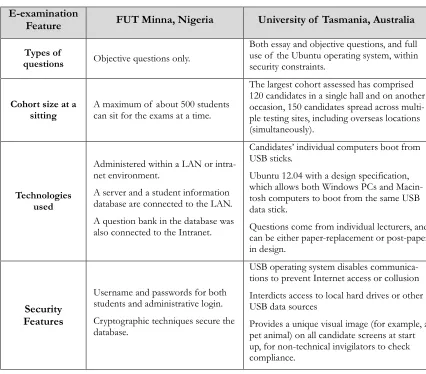
[image:13.612.107.533.312.686.2]-examination system in greater detail. Table 1summarises the four main features of the two systems.
Table 1. E-examination features of the two Case Studies E-examination
Feature FUT Minna, Nigeria University of Tasmania, Australia
Types of
questions Objective questions only.
Both essay and objective questions, and full use of the Ubuntu operating system,within security constraints.
Cohort size at a
sitting A maximum of about 500can sit for the exams at a time.students
The largest cohort assessed has comprised 120 candidates in a single hallandon another occasion, 150 candidates spread across mult i-ple testing sites, including overseas locations (simultaneously).
Technologies used
Administered within a LAN or intr a-net environment.
A server and a student information database are connected to the LAN. A question bank in the database was also connected to the Intranet.
Candidates’ individual computers boot from USB sticks.
Ubuntu 12.04 with a design specification, which allows both Windows PCs and Macin-tosh computers to boot from the same USB data stick.
Questions come from individual lecturers, and can be either paper-replacement or post-paper in design.
Security Features
Username and passwords for both students and administrative login. Cryptographic techniques secure the database.
USB operating system disables communic a-tions to prevent Internet access or collusion Interdicts access to local hard drives or other USB data sources
The differences in features and underlying technologies between the two cases provide a means of determiningwhat might be desirable in any successive system and in anticipation of likely technolog-ical and educational developments. It would clearly be advantageous for any new system to deal eff i-ciently with objective questions,as well as more subjective open-ended questions. The capacity to deal with ever growingcohort sizesand with a greater geographic distribution would also be benef i-cial to remote students. The setting of e-examinations can be enhanced by theuse of question banks; however,faculty staff would require additionaltraining for the specialisationof writing post-paper items. For e-examinations to have academic integrity, security will need to be absolutely ensured. In combination, these attributes provide starting points to develop and improve e-examination systems and processes forthe future.
D
ISCUSSIONThis paper demonstrateshow e-examinationscan play an active and usefulrole in selecting students for university courses and for their assessment once enrolled. The comparisonof two institutions in Nigeria and Australia shows e-examinations have been implemented for these purposes. In Nigeria, there is widespread systemic adoption for university entrance merit selection; but inAustralia this has been limited to one subject in one state, rather than being adopted nationally. Within undergraduate courses, the Nigerian scenario appears to be quite extensive in one university (all first year courses), while in Australia this adoption has been slower but has penetrated a wide variety of disciplines. A reading of the cross-case comparison, allowsfive observations to be made.
First, the integrity of the assessment and equipment reliability were commonissues across the two case studies,although the delivery of e-examinations is different ineachcountry. The Nigerian e x-ample uses an internal network to link institutional workstations in a dedicated building, while the Tasmanian approach is to boot student’s own computers in the context of a mainstream convention-al examination hconvention-all.Other technical solutions are available with a variety of commercial (for example, learn.examsoft.com; www.exam4.com) and open-source (for example,MEB, 2013) offerings. These e-examination solutionshave different strengths and weaknesses. As with any procedural pr o-cess, any particular solution is only as good as its weakest attribute. If any element of the examin a-tion preparaa-tion, delivery,and answerscript collection process breaks down, there is thechance of candidates not receiving the mark to which they are entitled. Inevitably comparisons are made with conventional paper examinations where failures are limited to oneor twoin a thousand.Any tech-nical failure in an e-examination system becomes a threat to the integrity of the assessment.
Second, technical differences highlight the linkbetween e-examination system approaches and ped a-gogical implications. In the Nigerian case, candidates mustselect from a list of prepared answers to each question. This allows automatic marking and provides an extremely fast turn-around time for assessment resultsbut is largely limited to knowledge recall questions unless assessors are highly trained. The Australian technology supports essays (conventionally and tediously marked by human assessors) and sophisticated software use within a simultaneously identical operating system env i-ronment for all candidates. These more advanced pedagogical possibilities come from a system that is more difficult toimplement because it works on students own computers instead of in a controlled institutional laboratory.
Third, social, cultural,and environmental factors affect thesuccess of e-examinations. An interrup t-ed electrical power supply, limited technical know-how, and negative personal perceptions are some of the challenges affecting the conduct of e-examinationsin FUT Minna Nigeria.In Tasmania the BYOD challenge is to make the system operate on anincreasing variety of user equipment, including tablets.
marked by human assessors). However, higher order thinking is usually demonstrated through open -ended or creative tasks, and in this respect the Australiansystem shows promise, byprovidingthe same full operating systemand software application suite to all candidates, thereby facilitating a s-sessment of such creative higher order thinking.Students’responses can include data files created with sophisticated software tools, illustrating the capacity for assessing creativity in this e-examination system.
Finally, the two cases illustrate the potential tension between “online”or networked reticulation of questions and answers, as opposed to “offline”methods. The former can be implemented using “thin”clients or with BYOD equipment “locked down”by proprietary software. This provides a re-stricted assessment environment for candidates, but faster startup and collectionof student respon s-es. The offline methods require computer startup or booting processeswhich are unfamiliar,but thereafter do not dependon technology outside the control of the candidate; therefore the offline methods are more technically resilient.
The researchers’ intention inpresenting e-examinationsin two different countries is to assist stak e-holders (including lecturers, invigilators, candidates, computer instructors,and server operators) in identifyingways to improve the process. One proposal, which arosefrom the analysis of the existing e-examination systems in Nigeria and Australia, is to designa form of “live”operating system that is deployable over the Internet. Itwould usepublic key cryptography forlecturers to encrypt their questions online. These questions wouldthen decrypted by the administrator or students when given the keyat the start of the e-examination session. Such a system would cater for both subjective essay-style questions and objective questions. This could provide a solution for courses delivered as MOOCs to candidates using BYOD computers; however, at this stage authentication still requires a trusted individual to assure candidate identity and an assurancethe assessment was doneunder exam-ination conditions.
This study was conducted at the institutional level, so the design proposals for any future system are broad-brushonly.Due to this limitation, further details about the user interface, question design, end-to-end e-examinationmanagement,or interface with the local student management computer system, are beyond the scope of this paper. Each of these aspects would be more properly dealt with at the local levelof the individual institution or organisation.
C
ONCLUSIONThe prospect for more extensive use of e-examinationsis highly appropriatefor a wide range of di s-ciplines, and probably inevitable. This is not to say they will be applicable in all disciplines; some su b-jects will clearly bemore suited to the technique than others. This may also be affected in the future by changes in the ways subjects are taught. For example, studio- and laboratory-based courses may well be taught entirely by live link-ups, and other traditionally face-to-face teaching methods could be replaced by virtual realitytechnologies.
The comparisonsbetweenthe two universities suggestthere will be a productiveconvergence of the approaches in future. Dedicated buildings and equipment put considerable strain on resources; these specialised uses may not be sustainable without public-private partnerships. However, the ease of deployment using a web-based strategy is one that overcomes the difficulties associated with prepa r-ing and distributr-ing USB sticks. The administration of questions overthe Internet should be a major concernand is one way in whicha cryptographic e-examinationsolution could avoid hackers hijack-ing the questions online and thereby imperillhijack-ingfair testing. The methods of cheating identified, for example, by Dawson (2016)can be addressed by more sophisticated strategies; e-examinations can identify and respond quickly and uniformly to such constantly developing attacks.
software tools. It would also move e-examinations beyond knowledge-recall to the assessment of higher-levelthinking and creative professional design skillsusing sophisticated software tools. At the same time,security needs will be paramount, and therefore the system wouldpossibly require and incorporate biometric (and less personal supervision)to ensure fairness(as will other global security formats).
The unique contribution of this research has come from unitingthe user-experience and otherfa c-tors affecting the conduct of e-examinationsin Nigeria and Australia. The comparisonof the e-examinations systems assisted the authors to devise a new system that contains the best features from both countries. The new system is a form of BYOD externally booted e-examination(as inAustralia) that is deployable over the Internet with encryption and decryption features using public key cry p-tography (Nigeria). This will allow lecturers to encrypt their questions and post them online while the questions are decrypted by the administrator,or students are given the key. The system will support both objective and open-ended questions (possibly essays and creative design tasks). The authors believe this can re-define e-examinations as the “gold standard”of assessment.
A
CKNOWLEDGMENTAndrew Fluck visited FUT Minna whilst on paid long service leave from the University of Tasmania. We wish to acknowledge the supportof the eTC Manager at FUT Minna for escortingus around the facilities for verification and analysis.
R
EFERENCESAdebayo, O.,& Abdulhamid, S.M. (2010). E-Exam for Nigerian universities with emphasis on security and result integrity. International Journal of the Computer, the Internet and Management 18(SP1), 47-59.Retrieved from www.elearningap.com/eLAP2010/Abstract/Olawale%20Adebayo.doc
Alfredsson, J., Sejersen, R., Stathakarou, N.,&Zary, N. (2015). The e-examination ecosystemin healthcare edu-cation: Information and process models. In Proceedings of the 2nd International Conference on Medical Education Informatics.Retrieved from https://peerj.com/preprints/1145.pdf
Audhkhasi, K. (2009). Automatic evaluation of fluency in spoken language. IETE Technical Review 26(2), 108 -114.
Australian Curriculum, Assessment and Reporting Authority [ACARA]. (2017). NAPLAN Online. Retrieved from https://www.nap.edu.au/online-assessment
Baird, J., Cresswell, M.,& Newton, P. (2000). Would the real gold standard please step forward? Research Papers in Education 15(2), 213-229. doi: 10.1080/026715200402506
Baxter, P., & Jack, S. (2008). Qualitative case study methodology: Study design and implementation for novice researchers. The Qualitative Report, 13(4), 544-559. Retrieved from
http://nsuworks.nova.edu/tqr/vol13/iss4/2
Bjørklund, P. G. (2010). Securing the ICT-based examination. Master’s Thesis: Gjøvik University College.Retrieved from
https://brage.bibsys.no/xmlui//bitstream/handle/11250/143946/1/master_thesis_petter_bjorklund_201 0.pdf
Bukie, O. (2014). Understanding technologies for e-assessment: A systematic review approach. Journal of Emerg-ing Trends in ComputEmerg-ing and Information Sciences, 5(12), 936-947.Retrieved from
http://www.cisjournal.org/journalofcomputing/archive/vol5no12/vol5no12_8.pdf
Chatzigavriil, A.,& Fernando, T. (2015). Law e-assessment pilot study. The London School of Economics and P o-litical Science.Retrieved from http://eprints.lse.ac.uk/64339/1/Law-e-assessment-Pilot-study.pdf Crook, S. J.,& Sharma, M. D. (2013). Bloom-ing heck! The activities of Australian science teachers and
Dawson, P. (2016). Five ways to hack and cheat with bring-your-own-device electronic examinations. British Journal of Educational Technology, 47(4), 592–600.
Department of Education and Early Childhood Development. (2014). Tender 1314-051: Assessment reporting and analytics - insight online assessment management platform. Melbourne, VIC.
Dion, D. (2005). Evidence and inference in the comparative case study. InSica, A. (Ed.),Comparative methods in the social sciences. Thousand Oaks, CA: Sage Publications.
Elwood, J. (1999). Gender, achievement and the ‘Gold Standard’: Differential performance in the GCE A level examination. The Curriculum Journal 10(2), 189-208. doi: 10.1080/0958517990100203
Fluck, A. (2010). eExaminations development and acceptance. InN. Reynolds &M. Turcsanyi-Szabo(Eds.), IFIP TC 3 International Conference proceedings, KCKS 2010, held as part of WCC 2010, Brisbane, Australia, September 20-23, 2010126-135. doi: 10.1007/978-3-642-15378-5_12
Fram, S. M. (2013). The constant comparative analysis method outside of Grounded Theory. The Qualitative Report, 18(1), 1-25.Retrieved from http://www.nova.edu/ssss/QR/QR18/fram1.pdf
Frankl, G., Schartner, P.,&Zebedin, G. (2012). Secure online exams using students’ devices. In Proceedings of the Global Engineering Education Conference (EDUCON).DOI: 10.1109/EDUCON.2012.6201111
Glaser, B. G.,&Strauss, A. L. (1967). The discovery of grounded theory: Strategies for qualitative research. Chicago: A l-dine Publishing Company.
Halbherr, T., Reuter, K., Schneider, D., Schlienger, C.,&Piendl, T. (2014). Making examinations more valid, mean-ingful and motivating: The online exams service at ETH Zurich. EUNIS 2014, Umeå, Sweden June 11 – 13.R e-trieved from http://www.eunis.org/download/2014/papers/eunis2014_submission_69.pdf
Haynie, D. (2014). Experts debate the impact of MOOCs on education. US News: Higher Education. Retrieved from https://www.usnews.com/education/online-education/articles/2014/06/06/experts-debate-the-impact-of-moocs-on-education
Hillier, M.,&Fluck, A, (2015). A pedagogical end game for exams: Alook 10 years into the future of high stakes assessment.In Proceedings of Globally connected, digitally enabled: ASCILITE 2015in Perth, 29 Nove m-ber - 2December, Perth, Western Australia, pp. 465-470.
Hochlehnert, A., Brass, K., Moeltner, A.,& Juenger, J. (2011). Does medical students’preference of test format (computer-based vs. paper-based) have an influence on performance? BMC Medical Education, 11, 89.R e-trieved from http://www.biomedcentral.com/1472-6920/11/89
Impedovo,S.,Lucchese,M.G.,& Pirlo,G.(2006). Examinations: An advanced methodology for student's tests on eLearninguniversity courses. WSEAS Transactions on Advances in Engineering Education, 3(5),361-366. Janison. (2016). High stakes online exams. Retrieved fromhttp://janison.com/assessment
Kay,J.,Reimann,P.,Diebold, E.,& Kummerfeld, B. (2013). MOOCs: So many learners, so much potential ... IEEE Intelligent systems,28(3), 70-77.
Kumar, M.J. (2011). Reflections on teaching a large class. IETE Technical Review, 28(4), 275-278.
Kumar, M.J. (2012). Honestly speaking about academic dishonesty. IETE Technical Review, 29(5), 357-359. Kumar, S., Gankotiya, A. K., & Dutta, K. (2011). A comparative study of Moodle with other e-learning sy
s-tems. In Proceedings of the 3rd International Conference on Electronics Computer Technology (ICECT)(Vol. 5, pp. 414-418).doi:10.1109/ICECTECH.2011.5942032
McPherson, G. (2012). Pupils given a taste of tablets in exams. Cambridge News.Retrieved from
http://www.cambridge-news.co.uk/Education/Education-news/Pupils-given-a-taste-of-tablets-in-exams-28052012.htm
Matriculation Examination Board of Finland[MEB]. (2013). Digabi project.Retrievedfrom http://digabi.fi/doku.php?id=start_en
Mogey, N.,& Paterson, J. (2012). Stylistic differences between typed and handwritten essay examinations. InD. Whitelock, W. Warburton, G. Wills,&L. Gilbert (Eds.),CAA 2012 International Conference. University of Southampton.Retrieved from
http://caaconference.co.uk/pastConferences/2012/caa2012_submission_4b.pdf
Olsen, J., Codde, J., deMaagd, K., Tarkleson, E., Sinclair, J., Yook, S.,and Egidio, R. (2011). An analysis of e-learning impacts & best practices in developing countries: With reference to secondary school education in Tanzania. East Lansing, MI: Michigan State University.Retrieved from http://tism.msu.edu/ict4d
Osang, F. (2012). Electronic examination in Nigeria, academic staff perspective—Case study: National Open University of Nigeria (NOUN). International Journal of Information and Education Technology, 2(4), 304-307.R e-trieved from http://www.ijiet.org/papers/137-T019.pdf
Poutre, B., Hedlund, D., &Nau, W. (2015). Combining testing software, online proctoring and lockdown browsers to assure a secure assessment environment for students in hybrid or online programs. Assessment Symposium, Creighton Office of Academic Excellence and Assessment. Retrieved from
https://dspace2.creighton.edu/xmlui/bitstream/handle/10504/74446/13_Combining%20Testing%20Sof
tware-Online%20Proctoring-Lockdown%20Borwers%20to%20Assues%20A%20Secure%20Environment.pdf
Ricci, C. (2015, Feb 9). BYOD brings its own challenges for schools and students. The Age(newspaper). R e-trieved from http://www.theage.com.au/national/education/byod-brings-its-own-challenges-for-schools -and-students-20150204-135p08.html
Rivest, R., Shamir, A.,&Adleman, L. (1978). A method for obtaining digital signatures and public-key cry p-tosystems. Communications of the ACM, 21(2), 120–126. doi:10.1145/359340.359342
Sabbah, Y., Saroit, I.,& Kotb, A. (2011). An interactive and secure e-examination unit (ISEEU).Roedunet Intern a-tional Conference (RoEduNet)23-25 June 2011. doi: 10.1109/RoEduNet.2011.5993713
Spanaka, A.,&Kameas, A. (2013) CRITON - Prediction of e-learners’ progress and timely assessment of the achievement of learning outcomes in Lifelong Learning: D2.1 Study of Assessment practice in e-learning environments. Lifelong Learning Programme.Retrieved from
http://hermes.westgate.gr/criton/wp- includes/document/CRITON_D2.1_Study%20of%20Assessment%20practice%20in%20e-learning%20environments.pdf
Sweeney, J. (2012). BYOD in education: A report for Australia and New Zealand – Nine conversations for successful BYOD decision making.Intelligent Business Research Services Ltd. Retrieved from
http://1to1sustainmentdeecd.global2.vic.edu.au/files/2013/07/BYOD_DELL-2dtch9k.pdf
Tasmanian Qualifications Authority [TQA]. (2012). Tasmanian Qualifications Authority meeting summary Item 3.1 External assessment 2011. Retrieved from http://www.tqa.tas.gov.au/9981
Twing, J. V. (2010). Pearson’s response to FR Doc. 2010-31881: Assessment technology standards RFI.Retrieved from http://www2.ed.gov/programs/racetothetop-assessment/rfi-response/pearson.pdf
Ward, V. (2012). School trials iPad exam. Daily Telegraph(25 May 2012).Retrieved from http://www.telegraph.co.uk/education/9291172/School-trials-iPad-exam.html
B
IOGRAPHIESAndrew Fluckhas taught high school mathematics, science,and information technology in Nigeria, England,and Australia. He has been a teacher educator at the University of Tasmania since 1995. He gained his PhD in 2003 on the transform a-tional potential of computers in education. He has provided advice on the emerging national curriculum in Australia. He developed the eExam System for students to use their own computers in high-stakes asses s-ment, and is thechair of Working Group 3.3 (research into educational applications of information technologies) for IFIP/UNESCO. He has published widely on information technology in education,and is a r e-viewer for Australian Educational Computing, Australasian Journal of Educational Technology, Education and Information Technologies, Jou r-nal for Computer Assisted Learning,and British Journal of Educational Technology. See more at http://andrew.fluck.id.au
Olawale Surajudeen Adebayois a Lecturer in the Department of Cyber Security Science, Federal University of Technology Minna, Niger State, Nigeria. He earned a Bachelor of Technology in Mathematics and Co m-puter Science from the Federal University of Technology, Minna, Nigeria in 2004 and anMSc in Computer Science fromthe University of Ilorin, Kwara State, Nigeria in 2009. He is presently a PhD candidate in the D e-partment of Computer Science, International Islamic University Malaysia. His current research themes include malware detection, information secu-rity, cryptology, and data mining security. He has published many acade m-ic papers in these research areas. He is a member of Computer Profe s-sional Registration Council of Nigeria (CPN), Nigeria Computer Society (NCS), IEEE, Global Development Network, and International Associ a-tion of Engineers (IAENG) among others. He is a reviewer of many local and international journals such as Computers & Security, Information Sciences,and Security and Communications Networks. See more at https://www.researchgate.net/profile/Olawale_Adebayo2
Shafi’i Muhammad Abdulhamid was awarded his PhD in Computer Science from the Universiti Teknologi,Malaysia in 2016. He received hisMSc in Computer Science from Bayero University Kano, Nigeria in 2011 and also received a Bach e-lor of Technology in Mathematics/Computer Science from the Federal University of Technology Minna, Nigeria in 2004. His current research themes are grid computing, cloud computing, cyber security and big data. He is a member of the Computer Professional Registration Council of Nigeria (CPN), IEEE Computer Society and Nigerian Computer Society (NCS). Presently, he lectures at the department of Cyber Security Science, Federal University of Technology, Minna, Nigeria. See more at