Proceedings of Research in Engineering Education Symposium 2011 Madrid, 4th - 7th October 2011
Topic: PBL – Chair: Milo Koretsky
Evaluating tutor training for online PBL teamwork courses in first year engineering
Hannah Jolly [email protected]
University of Southern Queensland, Toowoomba Australia
Lyn Brodie [email protected]
University of Southern Queensland, Toowoomba Australia
Lesley Jolly [email protected] Strategic Partnerships, Brisbane
Australia
Abstract: The use of Problem-based Learning and other collaborative pedagogies in undergraduate engineering courses is recommended by a plethora of learning theory and research on educational best-practice, particularly for Applied Sciences such as Medicine and Engineering. One barrier to implementing and sustaining these curricular and pedagogical approaches lies in the development of the appropriate knowledge and skills and a consistent and appropriate approach in the teaching team. A significant change from the traditional pedagogies employed by tutors and the training of tutors is required, if PBL and similar methods are to be effective in delivering their numerous affordances, especially in asynchronous online environments for distance learning. This paper describes the development of a strategy to train engineering tutors in online PBL facilitation, and the evaluation framework used to assess the effectiveness of this training. Results of the evaluation of training and subsequent behavioural changes of the tutors are given. The evaluation revealed a variance between the message of the training and subsequent practice. Recommendations are made about the need for ongoing tutor development and support, and the necessity of evaluation in the implementation of PBL pedagogies
Introduction
Although the theoretical bases of PBL and other collaborative and student centred pedagogies are well established in educational literature (Litzinger et al. 2011) the evaluation of their implementation within universities should be understood as a separate concern and subject of study for tertiary educators. Implementation involves a number of specific considerations which can be understood by examining case sites such as our institution. The Engineering Problem Solving Strand is a core strand of four courses
offered in all of the Engineering and Surveying Faculty‟s undergraduate programs
Proceedings of Research in Engineering Education Symposium 2011 Madrid, 4th - 7th October 2011
all majors). The courses use a Problem Based Learning paradigm, in which students work in teams to meet a wide range of course objectives. These are primarily concerned with the skills involved in several key graduate attributes, such as teamwork, communication, and problem solving. Many students access these courses externally, and therefore engage in their learning in an online environment. This adds another dimension to the skills required of PBL teachers and the requirements for PBL training programs.
Whilst tutor development resources and workshops in PBL have been in place for some time at [our institution], until recently they have been run on an ad hoc basis. They included no formal mechanism to monitor ongoing tutor requirements, or to evaluate either the workshops or the courses themselves to ensure that the implementation of PBL methods has been successful and appropriate. There was also no opportunity to capture valuable information about how the PBL approach was being played out within the constraints of the online environment and the issues that this might raise. PBL courses, whether online or proximal, require high levels of maintenance if they are to deliver their promised benefits year after year. In developing tutor training and resources it became clear that some of the pressure of this maintenance could be relieved by instituting ongoing monitoring and evaluation structures. These structures also have the capacity to optimise the use of PBL pedagogy by providing information to feedback into an ongoing process of calibration of the PBL approach.
The role of the tutor in PBL
PBL requires that tutors take a particular approach: to facilitate the learning. This requirement derives from the nature of PBL: a form of learning in which students collaboratively construct and elaborate on an integrated understanding of the subject matter, based on their prior skills and knowledge and the exploration of a relevant and rich problem-based context (Savery & Duffy 1995). Problems presented in the PBL context are ill-structured, with no single solution or solution path; they are designed to simulate real world contexts through their richness and complexity. Thus, students are provided with the opportunity to develop authentic and transferable skills in problem solving, critical thinking and self-directed learning (Das et al. 2002; Hmelo-Silver & Barrows 2006; Sobral 1997). Learning in PBL should be driven by deductive processes such as hypothesising, research, investigation and discussion. This deduction is directed by the students themselves as learning and ideas are elaborated, tested, and ultimately deepened by group discussions among students (Dahlgren, Castensson & Dahlgren 1998). The role of the teacher is to guide and support the learning so that the necessary deductive processes are enabled (Collins, Brown & Newman 1989). As such, tutors in PBL should not simply disseminate information and answers to students, but encourage students to negotiate meaning. Tutors provide feedback, and seek to stimulate student interest in learning (Dolmans et al. 2002). They do this by asking timely questions, by drawing
students‟ attention to matters of relevance and importance, and by encouraging students to summarise and reflect on what they know. The tutor‟s role is that of a facilitator.
The effectiveness with which tutors fulfil their role is influenced by the preconceptions that they bring to the learning environment about the nature of effective teaching and
learning (De Grave et al. 1999). Rando and Menges, (1991) propose that individuals‟
Proceedings of Research in Engineering Education Symposium 2011 Madrid, 4th - 7th October 2011
pedagogical approaches may be broadly categorised into two main models: „learning
facilitation‟ and „knowledge transmission‟ (De Grave et al. 1999). Lecturers who see their
role as transmitting knowledge are more focused on the content of the learning than on the processes that are required for it to take place (Dolmans et al. 2002). This represents a significant challenge for PBL tutor training. Many participants in the workshops continually expressed concerns about how best to get information across to students, thus revealing their implicit acceptance of the transmission model. Other tutors more
accurately saw their role as „facilitating‟: focussing on the processes they wish their
students to engage in, in order to develop and demonstrate the requisite skills and knowledge surrounding the subject matter being learned. These different approaches to teaching provide a hypothetical explanation for differing levels of effectiveness among PBL tutors (Dahlgren, Castensson & Dahlgren 1998; De Grave et al. 1999). This difference, along with other concerns, was the focus of the evaluation of tutor training for the PBL courses.
The tutor training program
The difference between the role of the PBL tutor and traditional beliefs about teaching creates a significant potential barrier to the successful implementation of authentic PBL pedagogies. The PBL tutor training program undertaken at [our institution] was targeted at addressing this. The training program is discussed in detail in Brodie and Jolly (2010). However, the key point of the training was that it was run using a PBL approach. Whilst operating as learners in a PBL environment, the participating tutors explicitly examined both the theoretical foundation and pedagogical practice of PBL. This provided an opportunity to address the fundamental beliefs which underpinned their teaching approaches.
The clear message of the training program was the need to redefine the tutor‟s role from
instruction/transmission to facilitation. It was hoped that this day of training challenged tutors to view their practice as skills-based, with a need for continual development and self-reflection on performance. Although a participant survey of the training was carried out at the end of the program, providing data on how well the facilitation message was understood and accepted, the true outcomes of the training could only be empirically demonstrated by examining the consequent facilitation practices of participating tutors. Monitoring and evaluation
Following the lead of major development organisations such as the World Bank and government departments, in a program logic approach was taken to the monitoring and evaluation of this program of tutor training (University of Wisconsin 2010). The approach identifies all relevant inputs, outputs, outcomes and impacts so as to set out clearly what it is that needs to be monitored and evaluated (Brodie & Jolly 2010; Markiewicz 2010; Perla & Carigio 2009). Brodie and Jolly (2010) discuss in detail the matrix was that used in planning monitoring activities, and how it set out what the program was designed to achieve and how it was to achieve it. It centred on evaluation questions such as the following:
Proceedings of Research in Engineering Education Symposium 2011 Madrid, 4th - 7th October 2011
• Were the models provided suitable for the job? • Was the facilitation message well understood? • Was the training effective in demonstrating PBL?
• How often during semester did tutors draw on the training? • Is the training adaptable to experienced tutors?
Data Collection and Analysis
One of the goals of the project was to evaluate how effective the training initiative had been for promoting positive PBL facilitation techniques among tutors, and to adjust the training and tutor support, if necessary. Deciding whether the training had worked was primarily concerned with determining if the facilitation versus transmission had been
understood, accepted and if it was translating to tutors‟ practice. The Program Logic
[image:4.595.86.513.335.477.2]analysis that was undertaken (University of Wisconsin 2010) resulted in the following data collection strategy (Table 1) but this paper focuses on the analysis of online discussion lists.
Table 1: Data Collection activities
On completing the workshop, participants were asked to fill out an evaluation form using a simple Likert scale to answer a number of questions. This was used to determine if the tutors considered the training effective and useful.
Following the training workshop, a number of tutors were interviewed to gain deeper insight into the central evaluation questions. With little variation, the data from these interviews also indicated that the key message of the training had been communicated, understood and accepted. The interviewed tutors could clearly articulate the nature and importance of the PBL facilitation techniques that were communicated in the workshop.
In order to examine how the message of the training translated to the facilitation techniques of participating tutors, further analysis of was undertaken. This was conducted by means of a content analysis of each tutor‟s interaction with students on the online
discussion forums for the course. Discussion forums constituted the main means by which tutors were interacting with their student teams and intervening in their learning. Each tutor was responsible for 4-6 student workgroups.
Proceedings of Research in Engineering Education Symposium 2011 Madrid, 4th - 7th October 2011
unless there was insufficient data from other threads for a given workgroup. In analyzing
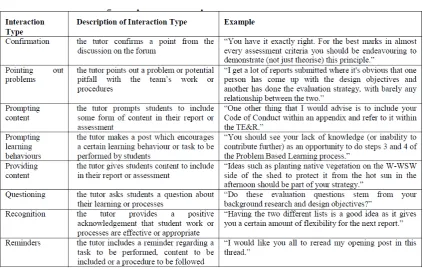
the data, tutors‟ interactions with students were coded according to seven observed nodes of interaction type. These types along with corresponding examples are listed in Table 2.
Results
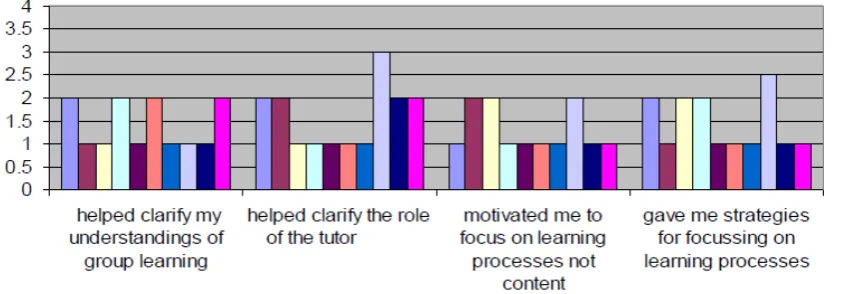
The evaluation questionnaire results are shown in Figure 1. A number of questions asked them to rate the workshop on a scale of one to four, one being to a considerable extent, and four being not at all. Ratings were provided by participants for each of the following about the workshop. The workshop:
• helped clarify my understandings of group learning • helped clarify the role of the tutor
• motivated me to focus on learning processes not content • gave me strategies for focusing on learning processes
The results in Figure 1 suggest that the training was understood and considered effective by the participants in achieving each of these objectives.
[image:5.595.93.516.557.704.2]Table 2 describes the range of facilitation techniques that were observed in the forum data. According to the theory of PBL, questioning and prompting learning behaviours are the most appropriate and effective of these tutor behaviours (Hmelo-Silver & Barrows, 2006). Confirmation, pointing out problems, questioning, recognition and reminders are also appropriate, as they do not contradict the tenets of PBL and they support effective learning processes, especially when used in combination with questioning and prompting learning behaviours (Hmelo-Silver & Barrows, 2006). Prompting and providing content, on the other hand are less appropriate, as they do not actively encourage student self-directed learning. To give an idea of how each of these types of facilitation appeared in practice, Table 2 outlines a description and some examples of each (taken from a variety of tutors).
Figure 2 summarises the overall results for facilitation technique for each tutor for whom data was available.
Proceedings of Research in Engineering Education Symposium 2011 Madrid, 4th - 7th October 2011
Figure 2: Results of Facilitation Technique
Table 2: Interaction coding descriptions and examples
Tutor A provided the best exemplar for PBL facilitation, by frequently displaying the desired facilitation techniques of prompting learning behaviours, questioning, pointing out
problems and recognition. This tutor‟s discussion forums yielded a high number of
instances of facilitation compared to other tutors, suggesting that this tutor was
frequently, consistently and effectively involved in their groups‟ learning processes,
[image:6.595.86.510.322.590.2]Proceedings of Research in Engineering Education Symposium 2011 Madrid, 4th - 7th October 2011
example, Tutor G was not seen to have any interaction with the students and their learning at all, and, as such, the training message in this instance was unsuccessful.
In comparing this data with the results from in-depth interviews with selected tutors, and broad exit data obtained following the workshops, it was found that although the facilitation versus transmission message of PBL was effectively communicated, accepted and understood by participating tutors, key facilitation behaviours did not consistently transfer to instances of actual practice in the online environment. As such, the evaluation
process uncovered a significant disparity between tutors‟ understanding and acceptance
of the training program, and their ability to apply it during facilitation.
Conclusions
Despite the theoretical basis for the design of the PBL tutor training program, these results suggest that one-off training sessions alone are not sufficient to ensure that the implementation of PBL pedagogies is optimised. Whilst the training provided did promote the required pedagogies, this was not enough to ensure that the message that was communicated could be consistently put into practice by participating tutors. Training programs may need to be combined with a number of ongoing, Faculty-level supporting strategies in order to be optimally effective. For example, although the training attempted to address the fundamental beliefs and approaches of the participating tutor (the primary barrier to successful implementation), the approach that the training promoted was, in some instances, highly divergent from participating tutors‟ habits and preconceptions about teaching and learning. For each tutor‟s response to the message of the training to be
enduring, the tutor development program needs to be embedded and ongoing.
Admittedly, the above evaluation was not exhaustive, and is limited in what it can empirically demonstrate about the effect of the training. More sophisticated measures would need to be implemented for a deeper insight into the question “what works for whom under what circumstances?” when it comes to promoting optimal PBL facilitation and pedagogy. For example, this evaluation does not take into account the effect of aspects such as course design and student attributes and behaviours on facilitation techniques. However, this evaluation does demonstrate that tutor training sessions cannot stand alone. It is the difference between the exit data and the evaluation results that indicate the need for ongoing support and periodic evaluation. As important in the process of PBL implementation is the monitoring, evaluation and, if necessary, revision of PBL practices. A systematic approach to the evaluation of PBL implementation, such as the program logic approach described above, is necessary if insights such as the ones discussed above are to be available to the Faculties attempting to implement PBL pedagogies. It is through these methods that the Faculty can learn how to support their tutors in fulfilling their role. Without the information and feedback from these processes, along with continuous support and opportunity for skill development, PBL and other cooperative pedagogies are likely to be unsustainable, and may lead to reduced learning outcomes in collaborative learning environments.
Proceedings of Research in Engineering Education Symposium 2011 Madrid, 4th - 7th October 2011
Brodie, L & Jolly, L 2010, 'Providing Ongoing Just in Time Professional Development in Engineering Education', in A Gardner & L Jolly (eds), 21st Annual Conference for the Australasian Association for Engineering Education, Sydney, Australia, pp. 680-6.
Collins, A, Brown, JS & Newman, SE 1989, 'Cognitive apprenticeship: Teaching the crafts of reading, writing, and mathematics', in LB Resnick (ed.), Knowing, learning, and instruction: Essays in honor of Robert Glaser, Lawrence Erlbaum Associates, Hillsdale, NJ, pp. 453-94.
Dahlgren, MA, Castensson, R & Dahlgren, LO 1998, 'PBL from the Teachers' Perspective: Conceptions of the Tutor's Role within Problem Based Learning', Higher Education, vol. 36, no. 4, pp. 437-47.
Das, M, Mpofu, DJS, Hasan, MY & Stewart, TS 2002, 'Student perceptions of tutor skills in problem-based learning tutorials', Medical Education, vol. 36, no. 3, pp. 272-8.
De Grave, WS, Dolmans, DHJM, van der Vleuten, CPM & de Grave, W 1999, 'Profiles of effective tutors in problem-based learning: scaffolding student learning', Medical Education, vol. 33, no. 12, pp. 901-6.
Dolmans, DHJM, Gijselaers, WH, Moust, JHC, de Grave, WS, Wolfhagen, IHAP & van der Vleuten, CPM 2002, 'Trends in research on the tutor in problem-based learning: conclusions and implications for educational practice and research', Medical Teacher, vol. 24, no. 2, pp. 173-80.
Hmelo-Silver, CE & Barrows, HS 2006, 'Goals and Strategies of a Problem-Based Learning Facilitator', The Interdisciplinary Journal of Problem-based learning, vol. 1, no. 1, pp. 21-39. Litzinger, T, Hadgraft, R, Lattuca, L & Newstetter, W 2011, 'Engineering education and the development of expertise.', Journal of Engineering Education, vol. 100, no. 1, pp. 123–50.
Markiewicz, A 2010, 'Monitoring and Evaluation Core Concepts', Materials produced for Australasian Evaluation Society workshops.
Perla, RJ & Carigio, J 2009, 'Towards a General and Unified View of Educational Research and Educational Evaluation', Journal of Multidisciplinary Evaluation, vol. 6, no. 11, pp. 38-55.
Rando, WC & Menges, RJ 1991, 'College Teaching: from theory to practice', in RJ Menges & D Svinicky (eds), New Directions for Teaching and Learning, Jossey-Bass, San Fransisco, vol. 45, pp. 7-14.
Savery, JR & Duffy, TM 1995, 'Problem Based Learning: an instructional model and its constructivist framework', Educational Technology, vol. 35, no. 5, pp. 31-8.
Sobral, DT 1997, 'Improving Learning Skills: A Self-Help Group Approach', Higher Education, vol. 33, no. 1, pp. 39-50.
Proceedings of Research in Engineering Education Symposium 2011 Madrid, 4th - 7th October 2011