Flexible Delivery
A model for analysis and implementationof flexible programme delivery
Preface
The approach to quality and standards in Scotland is enhancement-led and learner-centred. It was developed through a partnership of the Scottish Funding Council (SFC), Universities Scotland, the National Union of Students in Scotland (NUS Scotland) and the Quality Assurance Agency for Higher Education (QAA) Scotland. The Higher Education Academy has also joined that partnership. The Enhancement Themes are a key element of a five-part framework which has been designed to provide an integrated approach to quality assurance and enhancement, supporting learners and staff at all levels in enhancing higher education in Scotland drawing on developing, innovative practice within the UK and internationally.
The five elements of the framework are:
z a comprehensive programme of subject-level reviews undertaken by the higher education institutions themselves; guidance on internal reviews is published by SFC (www.sfc.ac.uk) z enhancement-led institutional review (ELIR) run by QAA Scotland (www.qaa.ac.uk/reviews/ELIR) z improved forms of public information about quality; guidance on the information to be
published by higher education institutions is provided by SFC (www.sfc.ac.uk) z a greater voice for students in institutional quality systems, supported by a national
development service - student participation in quality scotland (sparqs) (www.sparqs.org.uk) z a national programme of Enhancement Themes aimed at developing and sharing good practice
to enhance the student learning experience, which are facilitated by QAA Scotland (www.enhancementthemes.ac.uk).
The topics for the Themes are identified through consultation with the sector and implemented by steering committees whose members are drawn from the sector and the student body. The steering committees have the task of developing a programme of development activities, which draw upon national and international good practice. Publications emerging from each Theme are intended to provide important reference points for higher education institutions in the ongoing strategic enhancement of their teaching and learning provision. Full details of each Theme, its steering committee, the range of research and development activities, and the outcomes are published on the Enhancement Themes website (www.enhancementthemes.ac.uk).
To further support the implementation and embedding of a quality enhancement culture within the sector, including taking forward the outcomes of the various Enhancement Themes, a new
overarching committee has been established, chaired by Professor Kenneth Miller (Vice-Principal, University of Strathclyde). It has the important dual role of supporting the overall approach of the enhancement themes, including the five-year rolling plan, and of supporting institutional
The Flexible Delivery Enhancement Theme 2 A model for analysis and implementation of flexible programme delivery 2
Other publications from this Enhancement Theme 3
Project team 3
A model for analysis and implementation of flexible programme delivery 4
Introduction 4
Flexible programme delivery at three levels 4
Defining flexible programme delivery 5
Flexible programme delivery with a focus on learning and teaching 5
Flexible programme delivery 7
Implementation of flexible programme delivery 9
A model for flexible programme delivery 9
The model as an analytical and implementation tool 13
Four case studies of flexible delivery programmes 13
Summary 22
References 23
Appendix 1: 19 dimensions of flexibility (adapted from Collis and Moonen, 2004) 25
Appendix 2: Case study outline pro forma 27
Appendix 3: Questionnaire 33
The Flexible Delivery Enhancement Theme
The Enhancement Theme Steering Committee for Flexible Delivery (established in January 2004) has implemented a programme of work to address the growing challenge faced by higher education (HE) institutions to develop and adapt their provision to allow greater flexibility for today's large and diverse student body, as part of the wider implementation of a learner-centred approach. To this end, the Steering Committee adopted the broadest possible interpretation of flexible delivery, to encompass not only modes of study but also methods of delivery, together with underpinning support and infrastructure. Accordingly, its programme of work has sought to encapsulate a vision of a learner-centred model of pedagogy and learner support, appropriate to the needs of the individual learner, within a high-quality learning environment and supported by efficient, effective business and administrative processes. This work has been informed by exemplars of good practice from HE institutions worldwide, reflecting changing practice in learning and teaching to promote flexibility. It has also been informed by the outcomes from a series of
workshops involving a number of international experts, together with UK and Scottish practitioners. As a practical means of ensuring that the breadth of the Enhancement Theme was reflected in the scope of its development projects, the Steering Committee formulated a typology of flexible delivery, comprising the following key operational areas:
z flexible admissions
z credit, recognition of prior learning (RPL) and accreditation of prior experiential learning z flexible programmes
z student support, advice and guidance z continuing professional development z collaborative partnerships.
This typology provided a framework to support the planning and implementation of a number of projects addressing different practical applications of flexible delivery; the outputs from these projects would provide a suite of tools to inform and support institutions, practitioners and learners in terms of both strategic issues and practical implementation.
A model for analysis and implementation of flexible programme delivery
This is one of a series of publications from the Flexible Delivery Enhancement Theme. It represents the outcomes from one of six development projects supported by the Steering Committee.
and administrative processes. It aims to transform the way in which HE institutions consider flexible delivery and to provide a practical tool that will help them to achieve change. The reference model for technology-supported blended learning described in this publication has practical applicability across the sector.
The model, together with the associated A practical guide to providing flexible learning in further and higher education (Casey and Wilson, 2006), should allow programme teams to audit existing
provision. It will also guide them in choosing the appropriate approaches and tools to best meet the needs of their particular groups of students.
Other publications from this Enhancement Theme
Other publications from this Enhancement Theme will address different dimensions of flexible delivery. This includes flexible entry and flexible programmes, with a focus on RPL and credit transfer in the context of the Scottish Credit and Qualifications Framework (SCQF) and curriculum design for achieving learning outcomes by a variety of routes and modes of assessment. In addition, there will be a survey of virtual learning environment (VLE) usage in the Scottish HE sector. The compilation of an on-line resource to facilitate access to information, tools and materials from JISC (Joint Information Systems Committee) development programmes and the work of the Higher Education Academy will further assist institutions in enhancing flexible delivery within the context of their individual missions.
Project team
University of the Highlands and Islands Millennium Institute (UHI)
Dr Paddy Maher, Dean of Science and Technology, Moray College, UHI; Project Director John Casey, Learning Materials Manager, Learning Information Services, Perth College, UHI Pam Wilson, Education Development Manager, Perth College, UHI
Wolfgang Greller, Head of Learning Environments, Learning Information Services, Lewes Castle College, UHI (to September 2005)
Elaine Sutherland, Administration Assistant, Moray College, UHI
University of Dundee
Professor Allison Littlejohn, Chair of Learning Technology and Director of the International Centre for Research on Learning; Project Co-Director
Introduction
This study has been funded by the Quality Assurance Agency for Higher Education (QAA) Scotland to develop a model to support further education (FE) and HE institutions in planning the
implementation of flexible programme delivery (FPD). Included in this resulting publication is a literature review which explores the concept of FPD within FE and HE institutions. The aim is to highlight the key features of FPD, including explicit and implicit assumptions about why flexibility is needed and the perceived barriers and solutions to implementing it.
The model developed is for use by institutions as an auditing and analytical implementation tool for developing flexibility within teaching and learning. This model can be viewed as a 'planning tool' or 'framework' that supports exploration of explicit and implicit rationales for introducing FPD.
The model was developed through a review of the literature alongside an examination of programme team case studies exploring areas of flexibility. The rationale, impetus and drivers behind the introduction of flexibility were identified. From this, a model was developed to enable effective implementation of flexible delivery within a Scottish FE and HE context. A unique aspect of this study is that it has addressed issues in flexible programme delivery at three levels within institutions:
z institutional management (IM) z operational management (OM)
z teaching-learning management (TLM).
Flexible programme delivery at three levels
At the IM level, decisions are made with strategic objectives in mind. It is often 'big picture' thinking, with little structure provided as to how the strategic objectives might be realised. The personnel involved at this level are principals, deputy/assistant principals or deans. At the OM level, the operational managers are staff working at the middle level. They have
responsibility for implementing strategic objectives coming from the top in a way that is consonant with their operational objectives. Personnel at this level are heads of faculty/school and programme directors/leaders. A key feature of this level is that is where budgetary control is usually located; this is significant in curriculum delivery - flexible or not - and resource management.
At the TLM level, lecturers carry out the strategic and operational objectives with explicit and implicit awareness. This level is primarily made up of lecturers who engage directly with learners. The effect of having these three management levels and the issues for them of flexible delivery -becomes apparent in the following three sections, which look at how flexible delivery is defined and conceptualised.
Defining flexible programme delivery
There is no single definition for FPD within the literature (Nunan, 1996). In fact, the term is used broadly to incorporate flexible learning and flexible teaching, and is used synonymously with other approaches, including 'open learning', 'distance learning' and 'e-learning'. This is not surprising, as within any flexible programme of study there may be elements of all these pedagogical approaches and modes of delivery. Perhaps the reason why there is no single definition of flexible delivery is that it has different meanings for different people.
In responding to this problem, an exploration of the context underpinning flexibility may reveal a particular perspective, which may in turn influence the decisions made and characterise the shape and nature of the concept(s). The purpose or function of flexibility within programmes is
determined by many factors, both explicit and implicit, and these serve to shape its form. Collis and Moonen (2004) caution that vagueness about definition and usage of terminology may be 'counter-productive' to the aim of flexible learning because it may foster a narrow view and not reflect the possibilities and dimensions of flexibility (p8). The following section explores the meaning and usage of the terms 'flexible learning' and 'flexible teaching' within the literature.
Flexible programme delivery with a focus on learning and teaching
Institutions may have many reasons for choosing to introduce flexibility within their curricula. These include:
z improving the quality of the teaching and learning experience and process (Yetton, 1997) z the shift from short-term, subject-focused learning to 'lifelong' learning (Rigmore and Luke,
1995; Bates, 2005)
z the need to tap into a global market (Nicol et al, 2004) z widening access and embracing diversity (Yetton, 1997)
z the social inclusion and employability agendas (Rigmore and Luke, 1995) z the 'new' knowledge society (Laurillard, 2002; Collis and Moonen, 2005)
z competition from other universities (Yetton, 1997) and the private sector (Nunan, 1996; Twigg, 2002).
These drivers are complex and may not be readily known to the academic practitioner, the learner and the wider social community, who may perceive flexibility within the curriculum as related to their individual needs and desires. However, they reflect the strategic objectives of the institution and are usually driven by government policy initiatives.
and according to this model, learner choice must be regarded as a central component of flexible learning. Collis and Moonen (2004) focus on key 'dimensions' of flexible learning that shift the emphasis from teacher-led to learner-led educational processes and choices (Appendix 1). For them, an important question is 'for whom is this learning flexible?'. From their perspective, learners should have control over their own learning. Many lecturers in FE and HE - ie at the TLM level - subscribe to this philosophy. At this level within institutions, flexible teaching and learning is driven by
pedagogical considerations. Less clear, though, is how such flexible teaching and learning fits within an OM or IM concept of FPD.
Much of the literature considers FPD that focuses on learningand learners. However, the literature also points to dimensions of flexibility that concentrate on teaching, arising from individual
innovative teachers (Littlejohn and Peacock, 2003; Collis and Moonen, 2004; Bates, 2005). This represents a 'bottom-up' approach wherein individual initiatives promote structural change at the micro level.
The most innovative examples of flexible teaching derive from the work of individual lecturers as they strive to find solutions to perennial and new problems. Widening participation, equality legislation, employers' demands and lifelong learning have all impacted on lecturers and
necessitated new, often groundbreaking methodologies (McNaught, 2002). Lecturers' searches to identify ways of teaching in a flexible manner have led to a range of developments in programme design, delivery, assessment and use of new technology (Nicol et al, 2004). Surprisingly, this aspect of changing practice is not widely discussed in the literature, because teaching has largely been subsumed within the discourse on learning. There has, however, been a recent re-emphasis on the centrality of teaching within learning (Ramsden, 2005). The current prominence of 'professionalism' within HE and FE teaching adds weight to this argument (Furlong, 2000).
The danger of perceiving teaching as 'invisible' is that it is not assessed and evaluated in the same way as flexible learning and, to a lesser extent, FPD. One reason for this could be cultural,
particularly within HE institutions, where lecturers are usually seen as having autonomy over their own teaching (Nicol and Coen, 2003). Another danger is that this micro level can be ignored by strategic and operational managers - not necessarily intentionally, but often through its 'invisibility'. If practitioners can find solutions at a local level, then they can continue to work innovatively and flexibly, discretely.
Several studies highlight this tension between the competing views of lecturers and senior
The 'top-down, bottom-up' approach can lead to tensions in implementing e-learning. According to Gleeson and Shain (2003, p233), perceived 'polarised identities of senior management and lecturers' have led to 'a crisis of professional identity' within FE lecturers. In other words, there is a perception of disparity between the competing cultures of 'managerialism' and 'pedagogy' within institutions (Gleeson and Shain, 2003; Hellawell and Hancock, 2003). Lecturers may perceive a discord with what they view as 'management values', and may interpret these values as having a primary focus around financial and marketplace drivers rather than pedagogical considerations. Consequently, they may not share a common vision and may have a focus on different factors (Gleeson and Shain, 2003; Hellawell and Hancock, 2003; Normand, 2004, unpublished).
Gleeson and Shain (2003) report that these competing values (ie at the TLM and IM levels) may be mediated at the middle (OM) level. Successful integration may require 'strategic compliance', in which an 'operational manager' is able to engage in dialogue meaningful to staff at the other levels (Gleeson and Shain, 2003, p240). The operational manager should be able to articulate IM vision and values, while at the same time understanding the views of lecturers. To do this requires consideration of teaching and learning issues, while balancing these factors against cost. This is a major challenge for middle managers within FE and HE, and may compete with their personal values. Such conflict is experienced most acutely at the OM level because it is located between the two competing value systems at the TLM and IM levels.
Flexible programme delivery
The concept of FPD is used mainly in FE and refers to flexible learning, flexible teaching and flexible modes of delivery (ie distance learning and also blended learning). The means by which the
teaching is delivered is regarded as critical by lecturer, learner, employer and institution, but they have different specific concerns.
When considering FPD, the lecturer asks questions such as: 'What will be the balance between facilitation and instruction?'; 'Will the materials be paper-based or electronic?'; 'What aspect of the programme will be flexible and what part static?' However, such reflection may not be known to the wider institution: it remains located at the TLM, operational level.
At the OM level, FPD is concerned with issues such as the mechanism of delivery as an 'output' or product. This perspective reflects an operational concern, but also has the potential to meet
strategic objectives. Both TLM and OM perspectives are vital to successful implementation, and are inextricably bound up with successful teaching and learning.
Yetton, 1997). The contrary position to this - pedagogical needs and desires - may be considered invisible within this perspective, though Twigg (2002) refers to the use of e-technology as way of increasing quality in pedagogy.
Perhaps it is because so many of the concerns at all levels of management remain either implicit or invisible that there is little literature in this area. It may also reflect the more recent shift from 'flexible', meaning variations on face-to-face learning and delivery, to e-technology, ie electronically mediated learning and delivery (Nunan, 1996).
The development of e-learning and the virtual campus has resulted in significant costs for institutions, yet rarely is 'return on investment' considered (Collis and Moonen, 2004, p111).
This is thought, at least in part, to be because of the difficulty in measuring the complex and diverse information sources. Most costing systems focus on a single aspect, for example, network costs or staffing costs. Moonen (1997) argues that the difficulties in costing arise from there being no consensus on inclusive frameworks. Bates (2005) states that institutions need to develop a cost structure that recognises the local context and cultural conditions, as these influence outcomes and analysis. Current workload models often do not take into account full staff costs, since they do not take into consideration the time required for on-line learning and teaching (Bates, 2005). This is attributed to institutions rarely creating the infrastructure to support the use of new technologies in learning. According to Bates (2005), technology tends to be an add-on to traditional classroom or paper-based distance-learning models rather than a planned, strategic choice (Nicol et al, 2004). Perhaps even more importantly, these workload models do not take staff development costs into consideration, particularly the extra time required for staff to learn how to teach in a new way (Bates, 2005). Nor do they have clear, measurable evaluation processes to assess real cost benefits (Nicol and Coen, 2003; Bates, 2005). As a result, teaching staff are often working under extreme pressure, compromising both the quality and long-term viability of flexible learning. Resistance to 'new working practices' has been identified as a major risk facing all institutions. In consequence, operational readiness for transformational change is deemed to be necessary at every level (Nicol et al, 2004, p8). The development of costing models which take a holistic view would appear to be essential for successful FPD.
Nicol and Coen (2003, p48) identify three distinct types of costs: infrastructure, value added and support. Infrastructure refers to the total cost of 'information and communications technology (ICT) assets'; value added refers to activities relating to teaching and learning ('the institution's primary objective'); and support refers to the administrative and academic support, including ICT (Nicol and Coen, 2003, pp48-9). From this position the authors have developed the INSIGHT model, which identifies costs and benefits through the appraisal of 'competing options', for example 'staff satisfaction' with 'student satisfaction'. The benefits of this model are that it takes in a whole
Implementation of flexible programme delivery
The implementation of FPD requires institutions to identify and focus on key elements of flexibility that they aim to put into operation. Collis et al (1997) identify 19 dimensions of flexibility that cut across the levels of management. These include flexibility related to:
z time- time for starting and finishing a course, assessment and pace of study z content - topics, choices related to sequence, and learning resources
z entry requirements- recognition of prior knowledge, experience and qualifications z pedagogy- pedagogical approach, social interaction, language and resource generation
z delivery logistics - time and place for interactions, technology supporting collaboration, learner support mechanisms and communication channels.
Research at the Open University of the Netherlands is exploring a further dimension: the flexibility to study different parts of a course across a variety of institutions (Koper, 2005).
The literature contains little hard, empirical evidence concerning programmes that increase learners' choice and improve learning through the introduction of flexible learning (Nicol et al, 2004). However, a notable exception is the 'Pew Learning and Technology Program' (Twigg, 2002), which demonstrated that through course (re)design and the incorporation of information technology (IT) within programmes, learners, academics and institutions could benefit from an improved learning experience. One strategy employed in the Pew Program was to individualise the learning
programme, starting with an audit of the learner's knowledge and an assessment of needs;
thereafter a specific learning plan was created to facilitate the individual's identified learning needs and requirements (Twigg, 2002, p17). The Pew Program was a large-scale project in which 30 American institutions participated, in three Rounds. The results of Round I stated that five of the 10 projects reported 'improved learning'. The Round II projects stated preliminary findings, which reported six of the 10 projects to have 'improved learning outcomes'. More significantly, Round III projects, though still in the pilot stage, reported 'increased learning by students' in eight of the 10 projects (Twigg, 2002, p20). As previously noted, surprisingly few studies report cost reduction as an explicit reason for introducing flexibility. This highlights a tension between explicit and implicit reasons for FPD.
A model for flexible programme delivery
The MIT90 framework, shown in Figure 1, was originally developed to analyse the effects of IT on business processes. More recently it has been used to examine technology implementation in HE (Yetton, 1997). The MIT90 framework focuses on five components: strategy, structure, roles and skills, management processes, and technology, which forms a central component.
[image:15.595.75.537.394.680.2]We considered these components to be pertinent as they aligned with those of Collis and Moonen, yet introduced the notion of institutional structures and strategy. In our model we initially grouped 'strategy' and 'structure' as 'contextual' factors, and 'roles and skills' and 'management processes' as 'process'. Later, we began to explore the centrality of strategy (or strategic thinking) and structure (or structural layers within an institution) as being pivotal to successful FPD. These components sit alongside 'technology'. The result is a model with three main components: context, process and technology, as outlined by Collis and Moonen and illustrated in Figure 2. Our model builds on the Collis and Moonen model of technology (2005, p6) as a learning workbench, or set of tailorable tools to manage learning. It incorporates these components into a three-dimensional plane, which enables multiple discourses within and between hierarchical layers.
Figure 1: MIT90, Scott Morton (1991), taken from Nicol et al (2004)
Organisational border
Structure
Individuals and roles Strategy
Culture
External Environment
Figure 2: Collis and Moonen model (2005)
The interlinking of these three perspectives (context, process and technology) is important to flexible learning and delivery in that it can be used to put the learner in control through the use of technology tools that can support learning processes within particular contexts (Figure 2).
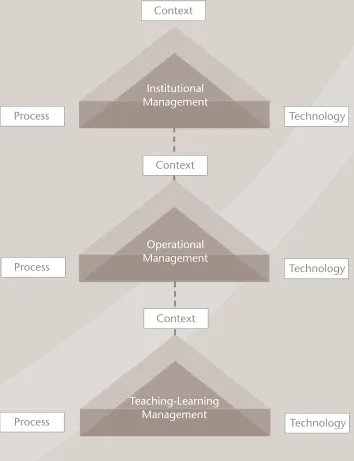
The significance of each of these perspectives - context, process and technology - is likely to vary across the different levels of any institution (ie IM, OM or TLM). Therefore we propose a model that analyses the three perspectives of FPD at each of these three institutional levels (Figure 3). This model provides a lens that enables stakeholders at each of these levels to identify key issues in flexible learning and delivery across each of the three perspectives. It can be used to identify a 'best fit' in process, context and technology across each of the levels.
Technology Context
Figure 3: Model for analysis and implementation of FPD
Technology
Technology
Technology Context
Process
Process
Process
Context
Context
Institutional Management
Operational Management
The model as an analytical and implementation tool
Within this study we were not able to fully test the model as an analytical tool for implementing FPD because we were working with programmes that were already established. However, we believe that it would be effective in the planning and analysis leading to the implementation of FPD in new programmes. Casey et al (2006) have adapted our model and developed a grid matrix that can be used in conjunction with it to explore meaning and shared understandings between the different institutional levels during the planning for implementation stage. Their work on the TrustDR project can be accessed through the website:
http://www.uhi.ac.uk/lis/projects/trustdr/work_in_progress.html
In our study, the model was tested as an analytical tool through the examination of programme team case studies from UHI and the University of Dundee. Completed questionnaires were received for all three levels for four case studies (see below). These case studies revealed areas of flexibility and perceptions about flexibility within each of the programmes and at each level.
Four case studies of flexible delivery programmes
For each of the case studies, responses were requested from individuals at each of the three levels: IM, OM and TLM (Appendix 2). Perspectives were investigated through the use of structured
questionnaires that revealed understanding and perceptions of enabling and inhibiting factors across flexible learning programmes (Appendix 3). These questionnaires revealed areas of shared
understanding about flexibility, and illustrated alignment/non-alignment between each management level. Case-study and questionnaire raw data can be accessed via the QAA Enhancement Themes website (http://www.enhancementthemes.ac.uk/).
Case study A
SCQF level 10University of Dundee
Originated by a small team at OM and TLM levels. The programme is in its second year of operation.
Programme overview: The programme aims to provide initial teacher education at secondary school level. It focuses on subject areas that are in short supply: English, mathematics, physics, chemistry and modern languages. The aim of the programme is to give students the opportunity to study to become secondary school teachers. This is the second year of the programme; year one had 27 students, year two has 63.
Delivery mechanism:The programme is predominantly a distance-learning one, supported by block face-to-face weeks, a VLE, email, telephone and work placements in local schools. This model of delivery has attracted students from the length and breadth of Scotland, as it meets the needs of participants living remotely to study flexibly in a way that reduces or removes the barriers of time and distance.
Main flexible features:location, content, time, pace. A blended learning model is used, with 11 weeks of on-line study, seven weeks of face-to-face study on campus, and 18 weeks in work
placement (secondary school). The VLE can be used flexibly as a repository, a discussion forum, for peer and tutor support, for administrative support, for social interaction and for formative and summative assessment.
Case-study analysis:This case study illustrates a good fit between personnel at adjacent
management levels, that is, between the IM and OM levels and between the OM and TLM levels, but not between IM and TLM. This is consonant with the literature on the competing values and considerations of the IM and TLM levels and the mediating function of the OM level.
Context:In response to questions about the enablersto flexible learning within the case study in terms of context, IM and OM agreed on improved access for students as a result of the 'any time, any place' dimension of flexibility. They also agreed on the linking of face to face contact with virtual 'contact' as another enabler. Both agreed that e-technology is a context enabler, as study can be done in the workplace or at home.
OM and TLM agreed that isolation is a barrier for students after the initial two-week block face to face period.
Process: There was less fit between IM and OM in relation to process. However, there were more similarities when focusing on themes. Both agreed that staff are enablers when implementing flexible learning, but that this factor can also be a barrier.
OM cited staff time, which cannot be easily monitored, as a barrier. As student numbers increase (the numbers have more than doubled in the second year), the workload for staff increases. Yet this aspect is hard to quantify and, therefore, resource. This was echoed by TLM, who reported that as student numbers rise so does the difficulty in maintaining relationships with the students. This is consistent with Bates (2005), as discussed earlier. For IM, the concerns regarding staff were that they may not be suitably skilled and would require development/training to enable greater flexibility. IM posed the question of incentive and said that there were too few incentives for staff to prioritise flexible learning innovation, but praised the 'ingenuity and sheer hard work of staff' in delivering a quality learning environment.
Technology: There was good agreement in relation to the benefits of technology. All three levels identified the communicative aspects of technology and its ability to connect distance learners as an enabler.
It was agreed that barriers focused around the poor linking of university support services, such as the registry and VLE maintenance, as a major problem.
Discussion:This case study illustrates a difference in emphasis across each of the three levels. The IM perspective is clearly 'broad brush' - eg 'resources and funding are (predictably) the main inhibiting factor'. Even with issues related to the case study, these transcend the particular to encompass the general (eg 'Degree provision without the learning technology to deliver it flexibly…is now unthinkable').
TLM focuses strongly on detail and practice rather than on broad objectives and strategy. The focus is on concerns around pedagogical issues at the micro teaching level. These include problems surrounding 'repetition of topics during the course' and 'navigating Blackboard'.
Although OM concerns are divided between the micro and the macro levels, the primary concern for OM remains at the micro level, for example: 'on site accommodation not suitable for the increased student numbers,' and 'small staff resource for teaching, with staff time not fully factored in'. This demonstrates in-depth knowledge and strong identification with the programme's
Case study B
SCQF level 9University of Dundee
Originated by one person at OM level.
The programme has been running for several years and was revalidated in 2002.
Programme overview:The programme is designed as distance learning to enable a wide range of early childhood professionals to continue working while studying for a higher qualification. The students are professionals working in a range of early years settings, including playgroups, nurseries, child and family centres, international schools, and as development officers. The focus of the course is the exploration of key issues pertinent to the early years' sector.
Delivery mechanism: paper-based distance learning with face-to-face delivery if the numbers and geographical proximity allow. Tutor support is offered predominantly by email and telephone.
Main flexible features:time, content, pace, location. Students can choose from a range of modules, based on their interests and needs. Extended time for completion can be negotiated. Module materials are represented in a booklet that can be used flexibly. The programme is on a roll-on roll-off basis. Students can study in the workplace or at home, and can generate their own pace.
Case-study analysis:This case study reflects poor alignment between the three management levels. Interestingly, there was greater concordance between IM and TLM, challenging the thesis that adjacent levels would be more concordant.
Context: This concordance could be attributed to several of the responses being 'broad brush'. For example, with reference to context, IM and TLM agreed that students being able to study in their 'own time' is an enabler, which is a feature of this programme and any other distance-learning programme. IM and TLM also agreed that isolation is a barrierin relation to context. This is another specific-generic factor, ie specific to this programme, but also a feature of many distance-learning programmes.
There was some agreement between OM and TLM in relation to context, as both said that the 'level of student/study' is a barrier.
Process: There was no concordance in relation to processes for either enablers or barriers.
IM and TLM agreed that access to technology is a barrier.
Discussion:This case study highlights disagreements about the effectiveness of technology. OM views included: 'We have used technology, but this did not work for us,' and 'we are…still exploring whether and how to use more technology'. This contrasts with IM views on 'very limited' use of technology in the current programme, with some 'limited use of email' as an enabler. IM also cited 'no VLE' as a barrier. This concurs with TLM, who stated that 'communication is quicker via email, and tutor feedback can be more effective'.
Case study C
SCQF level 10 UHIOriginated by a small team at OM and TLM levels. The programme is in its fourth year of operation.
Programme overview: The degree celebrates the diverse childhood experiences of those in the Highlands and Islands. It prepares students for a career in child and youth work and develops the skills needed to take further professional qualifications. It enables access by use of technology to fully support the learning experience, which appeals to those living remotely. The primary market is women who are home-based and/or working full or part-time.
Delivery mechanism: The programme is delivered on-line through learning materials and support on the VLE. Each student is assigned a local student adviser who provides ongoing pastoral and academic support for the duration of the programme. Tutor, peer and monitoring processes are structured for the on-line environment.
Main flexible features:on-line delivery, pace of study, time for study, digitised texts for reading programme material, place of study, on-line assessment, cyber café for social 'chat'.
Case-study analysis: Overall, there is greater concordance between adjacent levels, with some examples of agreement between IM and TLM. All levels are very focused on the specifics of the programme rather than general objectives - strategic or not.
Context: OM and TLM agreed that a major enabler related to context is that students living in geographically remote areas can access the programme. OM and IM considered the student adviser support to be an enabler.
There was no concordance with reference to the barriers.
Process: OM and IM cited 'teamwork of staff' and 'support' as enablingfactors related to process. This time, IM and TLM agreed that the student advisers are enablers.
All three levels agreed that organisational, business and administrative processes are a barrier. Problems with recording and tracking students were reported. OM reported that 'we need better links between academic staff and student registry systems at all delivery sites'. IM stated
organisational problems 'associated with logging students onto modules from many sites'. This problem would have significant consequences for the institution, so it is not surprising to find IM highlighting it. Funding is related to student activity once a student is registered. The advisers, who are seen as an enabling factor within the programme, are only allocated to registered students. The control and coordination of several sites is an IM and OM responsibility, but the focus is strategic rather than operational.
Technology: TLM and OM agreed that the programme could not run without technology; this is the mode of delivery, which both saw as an enabler. TLM and IM agreed that the VLE (WebCT) is user-friendly. Of course, this is agreement about a generic factor rather than a programme-specific one.
There was no concordance as to the barriers related to technology.
Discussion:This programme has been running for four years, is fairly well established and is due for review. Personnel at all three levels have a clear view of strengths and weaknesses within the
programme, but the issues and perspectives emphasised depend on the level. For example, IM cited student advisers as an enablingfactor, yet recognised that this resource is very costly to the
institution. This is traded with the realisation that the student adviser service enables students to 'keep on track'. It is not clear from the case study what, if any, return on investment is known. But the belief is there.
There is an overwhelming sense of making the programme work, which appears to come from strategic objectives within UHI to deliver 'highly relevant and up-to-date programme[s] that are available to all learners within UHI - no barriers to access' (IM). These objectives, though certainly subscribed to, are not paramount at the TLM level. Here, there is an acknowledgment that for staff there is 'poor supporting infrastructure for on-line delivery' (which is also consistent with the findings of Bates, 2005), and that 'under-funding and under-resourcing' exists for both students and staff.
Case study D
SCQF level 11 UHIOriginated by one individual at TLM level.
The programme is in its fifth year of delivery. It was revalidated in 2004 with minor changes to the assessments.
Programme overview:This on-line programme is directed at those whose employment may be wholly or partially dependent on specialist infection-control knowledge, and who require a holistic, scientifically based knowledge of all aspects of the discipline. It aims to enhance the professional practice and competence of practitioners and contribute to the development of professions in the area of infection control both within and outside the Highlands and Islands.
Delivery mechanisms: The programme is part-time with an emphasis on on-line distance learning. The only face-to-face meeting is at an annual induction weekend, though attendance is optional. Self-directed learning is encouraged and facilitated through the VLE. At registration, students are assigned a student adviser who mentors them and provides support for learning. Communication is student-tutor, student-student and within a tutor group of students. Group discussions are usually asynchronous.
Main flexible features:exit points (certificate, diploma, master's), time, content, pace, location, on-line, pedagogy.
Case-study analysis:This case study is consonant with the discourse that adjacent levels will be more concordant. The OM and TLM levels focus more on the programme specifics than IM, who discusses both micro and macro levels. There is a strong sense permeating the responses that this is a very good, perhaps even model programme.
Context:TLM and OM agreed that employing 'expert tutors' from the professional field is an
enablingfactor. The expert tutors are located throughout the country and are selected on their professional knowledge and expertise in this field. The distance model is an ideal vehicle for using remote staff. OM and IM agreed that the programme is in a 'highly topical subject'. All three levels agreed that the flexibility for students to study at their own time is an enablingfactor.
TLM and OM agreed that 'lack of study time from employers' is a major barrier for programme participants in relation to context. They were also critical of the nature of computer access. All three levels stated that the reliance on expert tutors can be a barrier, as they have little control over them. They reported that this can create difficulties, as the expert tutors may have 'different
Process: OM and TLM cited the enablingaspect of 'administrative support' to the programme. OM and TLM cited lack of face-to-face contact as a barrier. They also stated that there is a 'lack of human resources to meet OUVS [Open University Validation Services] requirements'.
Technology:OM and TLM stated that an enableris that the course is available throughout the UK. This aspect was referred to again, when citing another enabling factor: that of the expert tutors being located throughout the UK.
IM and OM agreed that the 'downtime of computers' is a barrierfor this programme. OM and TLM said that 'students not engaging in discussion' (because of the medium) is a barrier, as is 'access problems for students'.
Our three-level model for FPD can be used to capture a range of different perspectives across each of the levels. This is substantiated in the previous section, where each of the case studies reveals distinct viewpoints at each level. The IM responses all reveal a 'broad brush' standpoint, while the TLM perspectives focus on specific issues arising, for example, relating to pedagogy, support and the
integration of e-learning with face-to-face communication. The OM level in three of the four case studies reflects aspects of both top-down and bottom-up perspectives. This is clearly illustrated in case study A. All of these case studies illustrate bottom-up initiatives, with the OM adopting a 'teaching-learning' discourse rather than a 'managerialist' discourse. Three of the four case studies reveal a good fit between adjacent levels (ie IM and OM; OM and TLM). This is concordant with the view that the operational manager acts as a mediator, drawing together bottom-up imperatives and top-down strategic objectives. In part this is because OM personnel need to form an appreciation of strategic issues. At the same time, OM personnel have usually worked at the teaching-learning level and may have a strong identification with the 'pedagogical' perspective. The OM role can be seen to
purposefully bridge the gaps between the two competing discourses.
This mismatch of views of the IM and TLM levels may also illustrate discord across two types of flexibility: 'institutionalised' and 'instructor-offered' flexibility (de Boer, 2004). Institutional flexibility focuses on cross-programme implementation and includes issues of entry requirements, access codes, number of intakes and assessments. This type of flexibility is usually recognised at all three levels. Instructor-offered flexibility is more personalised and individualised, and includes flexibility among group members on assessment submission dates or attendance at face-to-face sessions. This type of flexibility is not usually recognised at the IM level, as it is viewed as an operational issue specific to the programme. De Boer (2004, p60) argues that as universities adopt a more diverse student population, there will be a greater need for both types of flexibility.
The authors would like to note that since all the completed case studies are examples of bottom-up programmes, they tend to reflect instructor-offered flexibility, with some aspects of institutionalised flexibility evident. Further investigation is required into top-down led initiatives and the effects of institutionalised flexibility (eg compulsory use of VLEs, the 24/7 campus).
The case studies illustrate ways in which the three-level framework can be used as a basis for discussion on alignment issues in established programmes. The case-study questionnaires helped to identify specific areas of match or mismatch across each of the levels. The authors intend to use this approach as a basis for round-table discussions involving IM, OM and TLM personnel to improve alignment where
necessary, and to develop implementation strategies that reflect perspectives from all three levels. We see the round-table approach as most appropriate, as we wish to move away from a view of strategic management as being located at the institutional level or layer. Casey et al (2006) are trialling this
Bates A (2005) Technology, E-Learning and Distance Education, 2nd edition, Oxon: RoutledgeFarmer Casey J and Wilson P (2006) A practical guide to providing flexible learning in further and higher education, Gloucester: QAA
Casey J, Proven J and Dripps D (2006) Modeling Organisational Frameworks for Integrated E-learning: the experience of the TrustDR project, paper presented at the IEEE ICALT 2006 conference
(http://www.uhi.ac.uk/lis/projects/trustdr/work_in_progress.html)
Collis B and Moonen J (2004)Flexible Learning in a Digital World, 2nd edition, Oxon: RoutledgeFalmer
Collis B and Moonen J (2005) An on-going journey: Technology as a learning workbench, Enschede, Netherlands: Faculty of Behavioural sciences, University of Twente
(http://bettycollisjefmoonen.nl/rb.htm)
Collis B, Vingerhoets J and Moonen J (1997) 'Flexibility as a key construct in European training: experiences from the TeleScopia Project', British Journal of Educational Technology, 28, 3, 199-218 de Boer W (2004) Flexibility Support for a Changing University, Enschede, Netherlands: Prinpartners Ipskamp
Furlong J (2000) Higher Education and the New Professionalism for Teachers: Realising the Potential of Partnership, Cardiff: School of Social Sciences, Cardiff University
Gleeson D and Shain F (2003) 'Managing ambiguity in further education', in Bennett N, Crawford M and Cartwright M (eds) Effective Educational Leadership, London: Paul Chapman
Hellawell D and Hancock N (2003) 'Between hierarchical control and collegiality: the academic middle manager in higher education', in Bennett N, Crawford M and Cartwright M (eds) Effective Educational Leadership, London: Paul Chapman
Koper R (2005) 'Increasing learner retention in a simulated learning network using indirect social interaction', Journal of Artificial Societies and Social Simulation8, 2
Laurillard D (2002) 'Rethinking Teaching for the Knowledge Society', Educause Review, Jan/Feb (http://www.educause.edu/ir/library/pdf/erm0201.pdf)
Littlejohn A and Peacock S (2003) 'From Pioneers to Partners: the changing voices of staff
developers', in Seale J (ed) Learning Technology in Transition: from individual enthusiasm to institutional implementation, Lisse, Netherlands: Swets and Zeitlinger
Moonen J (1997) 'The Efficiency of Telelearning',Journal of Asynchronous Learning Networks, 1, 2 (http://www.aln.org/publications/jaln/v1n2/v1n2_moonen.asp)
Nicol C and Coen M (2003) 'A model for evaluating the institutional costs and benefits of ICT initiatives in teaching and learning in higher education',Association of Learning Technology Journal (ALT-J), 11, 2, 46-60
Nicol D, Coen M, Breslin C and Howell D (2004) The Risks Associated with E-learning Investments in Further Education and Higher Education, JISC-funded project, University of Strathclyde and Kilmarnock College (http://www.insight.strath.ac.uk/predict/ and scroll down to 'Risk')
Normand C (2004) 'A reflective report on the leadership of the 'team' in the development of the operational plan', unpublished
Nunan T (1996) Flexible delivery - what is it and why is it a part of current educational debate?, HERDSA (http://www.herdsa.org.au/confs/1996/nunan.html)
Ramsden P (2005) 'Using research on student learning to enhance educational quality', DeLiberations (http://www.londonmet.ac.uk/deliberations/ocsld-publications/isltp-ramsden.cfm)
Rigmore G and Luke R (1995) 'The Critical Place of Information Literacy in the Trend Towards
Flexible Delivery in Higher Education Contexts' (paper delivered at the 'Learning for Life' conference, Adelaide), DeLiberations
(http://www.city.londonmet.ac.uk/deliberations/flex.learning/rigmor_fr.html)
Schon D (1987) 'Educating the Reflective Practitioner', presentation to the American Educational Research Association Conference(http://educ.queensu.ca/~ar/schon87.htm)
Scott Morton M (1991) The Corporation of the 1990s: Information Technology and Organisational Transformation, New York: Oxford University Press
Talbot C (2003) Studying at a Distance, Maidenhead: Open University Press
Twigg C (2002)Improving Quality and Reducing Costs, The Observatory on Borderless Higher Education (http://www.obhe.ac.uk/products/reports/pdf/September2002.pdf)
Areas of flexibility implemented Do you think your programme offers flexibility in the case study to students in terms of one or more of the
factors listed below? Place an 'x' at any of the relevant choices.
Flexibility related to time:
Fixed time Flexible 1 Times (for starting and finishing course) 2 Times (for submitting assignments
and interacting within the course) 3 Tempo/pace of studying
4 Moments of assessment
Flexibility related to content:
Fixed content Flexible 5 Topics of the course
6 Sequence of different parts of the course 7 Orientation of the course (theoretical, practical) 8 Key learning materials of the course
9 Assessment standards and completion requirements
Flexibility related to entry requirements:
Fixed requirements Flexible 10 Conditions for participation
Flexibility related to instructional approach and resources:
Fixed pedagogy
11 Social organisation of learning (face to face, group, individual)
12 Language to be used during the course 13 Learning resources: modality, origin
(instructor, learners, library, WWW) 14 Instructional organisation of learning
(assignments, monitoring)
Flexibility related to delivery and logistics:
Fixed place and procedures Flexible 15 Time and place where contact with instructor
and other students occur
16 Methods, technology for obtaining support and making contact
17 Types of help, communication available, technology required
18 Location, technology for participating in various aspects of the course
Programme name
SCQF exit level/SCOTCAT points
(Scottish Credit and Accumulation Transfer Scheme)
Faculty
Institution
Programme originator/developer
Contact name
Contact email
Delivery mechanism Campus based, distance paper based, web based, student support arrangements
Main flexible features and rationale Flexible in terms of time, pace, structure, location, entry, exit, course content? Rationale for
Learning and teaching approaches How are learning and teaching strategies structured? Who supports the students? Are core materials provided centrally, shared or
individually developed? Who supports you and the programme team?
Evaluation to date and main changes How long has the programme run in its present format? How is it evaluated? Are criteria different for flexible delivery? What have been the main changes and why?
Areas of flexibility implemented in the case study Do you think your programme offers flexibility to students in terms of one or more of the factors listed below? Place an 'x' at any of the relevant choices.
Flexibility related to time:
Fixed time Flexible
1 Times (for starting and finishing course) 2 Times (for submitting assignments and
interacting within the course) 3 Tempo/pace of studying 4 Moments of assessment
Flexibility related to content:
5 Topics of the course
6 Sequence of different parts of the course 7 Orientation of the course
(theoretical, practical)
8 Key learning materials of the course 9 Assessment standards and completion
requirements
Flexibility related to entry requirements:
Fixed requirements Flexible 10 Conditions for participation
Flexibility related to instructional approach and resources:
Fixed pedagogy
and resources Flexible 11 Social organisation of learning (face to face,
group, individual)
12 Language to be used during the course 13 Learning resources: modality, origin
(instructor, learners, library, WWW) 14 Instructional organisation of learning
(assignments, monitoring)
Flexibility related to delivery and logistics:
Fixed place and procedures Flexible 15 Time and place where contact with
instructor and other students occur 16 Methods, technology for obtaining
17 Types of help, communication available, technology required
18 Location, technology for participating in various aspects of the course
19 Delivery channels for course information, content, communication
1a What do youthink are the three main enabling factors within your flexible learning programme in terms of context? (By contextwe mean the learning environment, the level of study, the subject discipline, the organisation of the programme and any other issues related to context).
1b Please list the three main inhibiting factors within your flexible learning programme in terms of context.
2a What do you think are the three main enabling factors within your flexible learning programme in terms of process? (By process we mean the learning processes, social interactions, course design processes and/or administrative processes).
2b Please list the three main inhibiting factors within your flexible learning programme in terms of process.
3a Outline any of the ways in which technologyhas contributed to the success of your programme. (By this we mean ways in which technology has supported learning or administrative processes as well as social communications).
3b Please list any inhibiting factors associated with the use of technology. We are particularly interested in situations where technology was not useful in supporting learning, administration or social activities.