Social Research Number: 8/2018
Publication Date: 05/02/2018
Seren Network Evaluation
Final Report
Mae’r ddogfen yma hefyd ar gael yn Gymraeg. This document is also available in Welsh.
Seren Network Evaluation
Author: Nia Bryer, OB3 Research with contributions from Rhys
Davies and Suh
a
er Yunus, ADRC-Wales, Cardiff University
Views expressed in this report are those of the researcher and not necessarily
those of the Welsh Government
For further information please contact:
Heledd Jenkins
Knowledge and Analytical Services
Social Research and Information Division
Welsh Government
Cathays Park
Cardiff
Email: [email protected]
ISBN: 978-1-78903-461-5
3
Contents
List of tables ... 6
List of Figures ... 6
Glossary ... 7
1. Introduction ... 7
Structure of this report ... 9
2. Evaluation Methodology ... 10
Method ... 10
Methodological considerations ... 12
Profile of survey respondents ... 12
3. Introduction to the Seren Network ... 16
Policy context ... 16
The HEI context ... 19
The Oxbridge Ambassador Research ... 20
Seren Network’s aims and objectives ... 20
Structure and delivery model ... 24
4. Published Data... 27
Top A Level attainment ... 27
Oxbridge applications, offers and enrolments... 28
Other top university applications, offers and enrolments ... 31
Welsh domiciled students at UK HEIs ... 32
UCAS Applicant Data ... 33
Conclusions ... 34
5. Design, Rationale and Evidence of Need ... 35
Aims and Objectives ... 35
Design and Rationale ... 37
Complementarity of provision ... 39
6. Delivery model and management ... 43
Hub Boundaries ... 43
Collaboration between hubs ... 44
Seren Funding ... 45
4
Governance ... 48
Role of the Welsh Government ... 48
Seren Network Co-ordinators meeting ... 49
Data collection and reporting ... 50
Brilliant Club ... 52
Promotion and Communications ... 53
7. Awareness, recruitment and engagement ... 55
Reasons for engagement ... 55
Selection criteria ... 56
Attendance ... 60
Awareness and understanding ... 62
Communication ... 65
8. Programme of provision and how local hubs are working ... 67
Nature of Provision ... 67
Quality of Provision ... 69
Areas for improvement ... 71
Timings of Provision ... 72
Location and accessibility ... 73
Frequency of provision ... 74
Views on hub management ... 75
Usefulness of provision ... 76
Welsh language ... 78
National Conference ... 80
9. Engagement with HEIs ... 82
Nature of engagement ... 82
Feedback from HEIs ... 83
Feedback from non-engaged HEIs ... 85
The way forward to engaging HEIs ... 86
10. Difference Made ... 88
Positive effects ... 88
Unintended effects ... 93
11. Final impact Evaluation ... 94
5
Sources of Data to Support the Evaluation of Seren ... 96
Identifying Seren Participants within Administrative Data... 101
Assessing the Impact of the Seren Scheme ... 106
Conclusion ... 111
12. Conclusions and Recommendations ... 113
Annex A Survey Questionnaires ... 123
Annex BData sources ... 148
6
List of tables
Table 3.1: Number of Participants by Seren hub ... 26
Table 4.1: A level results by grade ... 27
Table 4.2: Welsh domiciled offer and acceptance rates at University of Oxford compared with other UK regions ... 29
Table 4.3: Welsh domiciled applicants and acceptances at University of Oxford ... 29
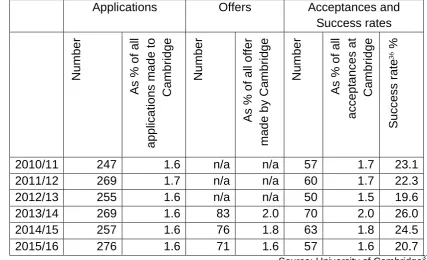
Table 4.4: Welsh domiciled applicants, offers and acceptances to University of Cambridge ... 31
Table 4.5: Welsh domiciled student applicants for 2018/19 courses with October 2017 deadline ... 33
Table 4.6: Welsh domiciled student applicants for 2018/19 medicine courses with October 2017 deadline ... 34
Table 7.1: Surveyed participants and parents’ university ambitions ... 55
Table 11.1 Overview of data source and cohort details... 102
List of Figures Figure 3.1: Location of the 11 Seren hubs ... 23
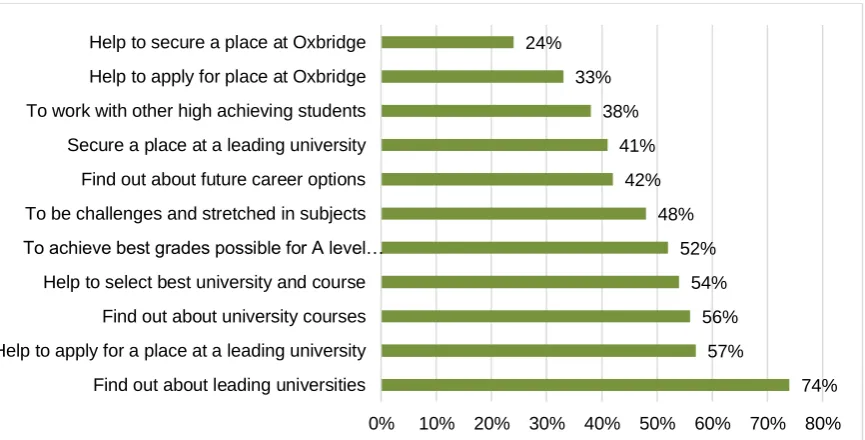
Figure 7.1: Expectations of the Seren Network ... 56
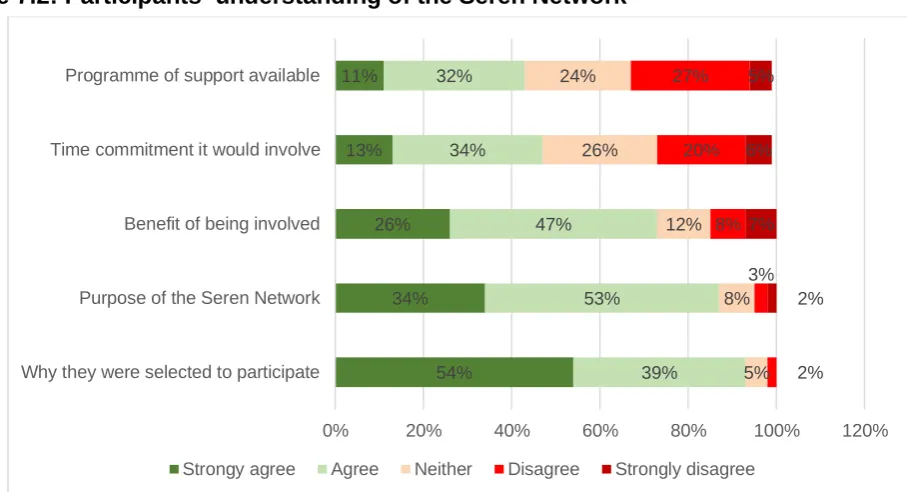
Figure 7.2: Participants’ understanding of the Seren Network ... 64
Figure 8.1: Involvement with Seren activities ... 69
Figure 8.2: Surveyed participants view of various aspects of Seren provision ... 70
Figure 8.3: Quality of Seren provision ... 71
Figure 8.4: Frequency of attendance at local Seren events ... 75
Figure 8.5: Usefulness of Seren provision ... 77
Figure 10.1: Difference made from participation within Seren Network ... 91
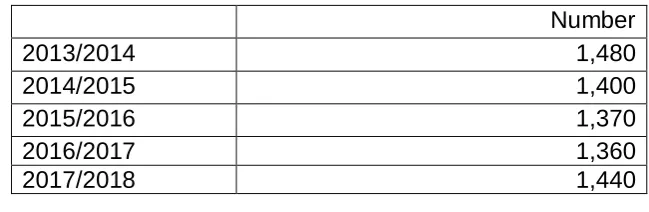
Figure 10.2: Views on how participation will help participants ... 92
7
Glossary
1.
I
ntr
od
uct
ion
1.1 I
n July 201 7, the Wel sh Go ver nm ent app oint ed OB 3 Res ear ch, in con jun Acronym/Key word Definition
BMAT BioMedical Admissions Test
CL Community Learning
CIA Counterfactual Impact Analysis
EAS Education Achievement Service
FSM Free School Meals
FE Further Education
FEI Further Education Institution
GDPR General Data Protection Regulation
HEAT Higher Education Access Tracker
HEFCE Higher Education Funding Council for England
HEIs or HEPs Higher Education Institution or Provider
HESA Higher Education Statistics Agency
LLWR Lifelong Learning Wales Record
LNAT National Admissions Test for Law
NPD National Pupil Database
PSM Propensity Score Matching
PLASC Pupil Level Annual School Census
SHELL Skills, Higher Education and Lifelong Learning
SEN Special Educational Needs
STEMM Science, Technology, Engineering, Mathematics and
Medicine
TEF Teaching Excellence Framework
UCAS University and Colleges Admissions Service
WISERD Wales Institute of Social and Economic Research,
Data and Methods
WED Welsh Examinations Database
8
ction with the Wales Institute of Social and Economic Research, Data and
Methods (WISERD) of Cardiff University, to undertake an evaluation of the
Seren Network.
1.2 The aim of the evaluation is to undertake a formative and process evaluation of the Seren Network to inform decisions about the criteria for young people’s
participation and the design and delivery of the programme at national and
local levels. The evaluation consists of three key elements:
a formative evaluation,
a process evaluation,
preparation for the final impact evaluation.
1.3 The overall objectives of the evaluation are to:
Assess how each Seren hub is operating to include consideration of engagement criteria, programme costs, participation levels and
programme of provision
Identify the barriers and enablers to delivery for Seren hubs and
participants
Assess the extent to which hub activities contribute to the Seren Network objectives
Design a methodology and make recommendations for undertaking a final impact evaluation of the programme.
1.4 The methodology adopted included interviews with Welsh Government
officials and representatives from Higher Education Institutions (HEIs) as well
as a package of fieldwork with a range of contributors at each of the 11 Seren
hubs. It also involved surveying participants, parents and representatives from
9
Structure of this report
1.5 This report is presented in 12 chapters as follows:
chapter one: this introduction to the report
chapter two: an outline of the evaluation methodology and the profile of those surveyed
chapter three: an introduction to the Seren Network including the policy and strategic context in place, the programme’s aims and the delivery
model
chapter four: a review of published data setting out current trends in terms of A level attainment and top university applications and
enrolments
chapter five: findings from the fieldwork in relation to the design and underlying rationale for the Seren Network and the evidence of need in
place for intervention
chapter six: findings from the fieldwork in terms of the delivery models and management arrangements in place
chapter seven: findings from the fieldwork regarding levels of
awareness, hub recruitment and engagement with participants, parents
and educational settings
chapter eight: findings in relation to the characteristics of each hub’s programme provision and views on how local hubs are working
chapter nine: findings from the fieldwork in terms of how the Seren
Network has engaged with HEIs
chapter ten: difference made by participating within the Seren Network to participants and educational settings
chapter eleven: consideration for possible approaches to adopt when undertaking a final impact evaluation of the Seren network
chapter twelve: our conclusions and recommendations for this
10
2.
Evaluation Methodology
2.1 This chapter sets out the method deployed for undertaking the evaluation
and offers a view about the strength and limitations of the approach adopted.
The chapter also provides a profile of surveyed participants, parents and
school/FEI representatives who responded to the three web surveys.
Method
2.2 The evaluation, which was undertaken between July and November 2017,
encompassed the following elements of work:
an inception stage to include attendance at an inception meeting with the study Steering Group, attending a Seren hub co-ordinators meeting in July
2017, accessing relevant information and documentation in relation to the
Seren hubs and preparing an evaluation inception document
desk based research to include a detailed literature review of Welsh
Government policy and strategy documents and programme operational
documentation
a review of published sources of data covering current trends in terms of A level attainment, top university applications, enrolments and first year
retention of Welsh students
preparing research instruments to include semi-structured discussion
guides for use with a range of contributors and three web based surveys to
be deployed with Seren participants, their parents and representatives
from schools and FEIs involved with the initiative. The surveys for
participants and parents were designed to accommodate feedback from
those currently and previously engaged with Seren, although were
primarily promoted to those who were currently engaged with the
programme
conducting face to face interviews with ten policy and strategic stakeholders (seven Welsh Government representatives and three
representatives from across the two contracted delivery agents, the
11 conducting telephone interviews with a total of 15 representatives from 13
HEIs. Of these four representatives were based within Welsh HEIs and 12
were from Russell Group/Sutton Trust institutions1. Representatives
primarily held recruitment, outreach or admission responsibilities
undertaking a package of qualitative fieldwork across the 11 hubs. The fieldwork included:
o Interviews with 11 hub co-ordinators (and any support staff where
appropriate)
o Interviews with seven senior representatives from the host
organisation or the hub network. These included Chairs of the Seren hub Strategy Group and/or the co-ordinator’s line manager
o Interviewing a total of 77 participants. Of these 14 were Year 12
students, 60 were Year 13 students and three were former
participants
o Interviewing 34 representatives from schools and FEIs engaged
with the Seren hub which included a facilitated focus group with
representatives of one Seren hub Management Group
o Observing delivery at five events.
deploying three bilingual web based surveys which were approved by the
Welsh Government and piloted with a small number of respondents before they were fully launched. A link to each survey was distributed via Seren’s
Twitter page and by hub co-ordinators to schools and colleges, who were
also asked to distribute the surveys to participants and parents.
Responses were received from 168 participants, 35 parents and 23
FEI/school representatives.
interviewing five parents either during our visits to the hubs or via a follow
up discussion (parents were asked if they were prepared to contribute
further as part of the web based survey)
1 One representative fell into both groups in that they were from a Welsh HEI and a Russell Group/Sutton Trust
12 considering possible approaches for undertaking a final impact evaluation
of the Seren network, to include possible Counterfactual Impact Analysis
approaches, and setting out recommendations on a possible methodology
to adopt.
Methodological considerations
2.3 It was not possible for the research team to distribute the three web surveys
directly to participants, parents or school and FEI representatives as the
appropriate contact data could not be made available due to the fact that
Seren hubs do not consistently collect contact data (and gain the necessary
permission to share such data) for participants and their parents. The
evaluation was therefore reliant upon hub co-ordinators to distribute the web
links to schools and FEIs as well as via social media methods. An
acceptable level of response was secured to the participant survey whilst the
response to the other two surveys was lower than desired. As a result, the
school/FEI and parental survey data should to be interpreted with some
caution. Despite this, qualitative feedback was secured from representatives
from schools and FEIs during the hub visits so as to provide a robust sample
for the evaluation findings. Care must be taken when interpreting the views
of parents gathered as part of this evaluation, given the low sample who
contributed.
2.4 This report is not intended to offer an assessment of the impact achieved by
the Seren Network in terms of the difference made to the number of
applications, offers and enrolments made by Welsh domiciled students at
leading universities but rather to offer evidence for how the Seren hubs are
operating from the perspective of the co-ordinators, schools and FEIs,
participants and their parents. Any impact assessment of the initiative would
require an analysis of robust counterfactual data and this has not been
included within the scope of this evaluation.
Profile of survey respondents
2.5 Three web surveys were deployed between 18 September 2017 and 15
13 168 participants. Of these the majority were studying A levels in Year
13 at a school (110 or 66 per cent) whilst 18 (11 per cent) were
studying A levels at an FE college or sixth form school and 31 (19 per
cent) were studying A levels in Year 12 at a school
35 parents. Of these, the majority had a child studying A levels in Year 13 (23) or Year 12 (nine) at a school whilst three had a child at
university
23 school and FEI representatives. Of these, all but one were based
at a school setting.
2.6 Surveyed participants and parents had been involved with all 11 Seren hubs
although the number of responses for the hubs covering Lliw-Tawe, Neath
Port Talbot/Powys/Bridgend and the five counties2 serviced by the Education
Achievement Service (EAS) was very low – no more than six responses for
each area. Surveyed school/FEI representatives covered nine of the 11
Seren hubs (not Neath Port Talbot/Powys/Bridgend or EAS) although in
three hub areas only one response was received in each case.
2.7 The majority of surveyed participants (139 or 83 per cent), surveyed parents
(28) and surveyed representatives from schools and FEIs (16) completed the
survey in English. A third (59 or 35 per cent) of surveyed participants
considered themselves to be fluent in Welsh whilst a further 16 per cent (26
respondents) could speak a fair amount of Welsh.
2.8 Two-thirds (108 or 64 per cent) of surveyed participants were female and a
third (54 or 32 per cent) were male. A handful preferred either not to say or
identified themselves in another way.
2.9 The majority of surveyed parents reported that they were the child’s mother (31) and four reported that they were the child’s father.
2.10 The majority (101 or 60 per cent) of surveyed participants stated that they
had a parent or guardian who had a degree or higher qualification whilst 26
surveyed parents stated that they had this level of qualification. The majority
of these surveyed parents (17 of the 26) had studied at a Welsh HEI whilst
14
eight had studied at an institution outside of Wales3. Only one of these had
studied at an Oxbridge institution.
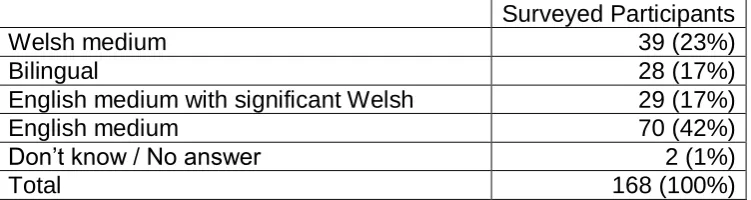
2.11 Table 2.1 presents the type of school which surveyed participants had
attended and shows that responses were secured from a cross-section of
[image:14.595.104.480.216.316.2]schools.
Table 2.1: Type of school attended
Surveyed Participants
Welsh medium 39 (23%)
Bilingual 28 (17%)
English medium with significant Welsh 29 (17%)
English medium 70 (42%)
Don’t know / No answer 2 (1%)
Total 168 (100%)
Source: OB3 web survey (Base=168 participants)
2.12 The majority (66 per cent or 110) of surveyed participants were studying A
levels in Year 13 at a school and the same proportion (23) of surveyed
parents reported that their child was studying A levels in Year 13 at a school.
A smaller proportion of surveyed participants were studying A levels in Year
12 at a school (31 or 19 per cent) or at an FE college or sixth form school
(18 or 11 per cent). A small number (eight or 5 per cent) of surveyed
participants were already studying at a university as was also the case for
surveyed parents (three had a child studying at a university). Of these eight
participants already at university three were studying at a Wales based
university and five were studying outside of Wales.
2.13 The most commonly cited A level subjects studied by surveyed participants
were Mathematics (97 or 58 per cent), Chemistry (77 or 46 per cent),
Biological Sciences (68 or 41 per cent), History (52 or 31 per cent), Physics
(50 or 30 per cent) and English (38 or 23 per cent).
2.14 In terms of previous qualifications, the survey asked participants to note the
number of A* and A grades achieved at GCSE. Of the 167 surveyed
participants who provided data:
15 69 per cent (116 participants) had secured at least 10 A* or A grades
at GCSE
90 per cent (150 participants had secured at least 8 A* or A grades at GCSE
10 per cent (17 participants) had achieved 7 A* or A grades or less at GCSE, with three of these having achieved fewer than 5 A grades.
On average, each surveyed participant had achieved just over 6 A* and just under 4 A grades at GCSE
2.15 In terms of the profile of those surveyed from school and FEI settings (23 in
all), all but one were based within a school. Ten were working within an
English medium school and four were based in Welsh medium schools. The
majority (15) were Head of sixth forms whilst other survey respondents held
positions of Deputy/assistant heads or a More Able and Talented (MAT)
co-ordinator. The size of their respective institution varied from 500 to 2,000
pupils (excluding the college) and the number of Year 13 Seren participants
16
3.
Introduction to the Seren Network
3.1 This chapter sets out an introduction to the Seren Network. It considers:
The policy and strategic context in place when the programme was developed
The HEI context within which it operates
The programme’s aims and objectives
The programme’s structure and delivery model
Its key deliverables to date.
Policy context
3.2 The Seren Network has been designed and is being delivered within the
context of a Welsh Government policy which focuses on raising the global
profile of Higher Education in Wales4, improving the proportion of graduates
who stay in Wales5 and widening access to and participation in higher
education more generally.
3.3 One of the fundamental objectives set out in the Welsh Government’s ‘Learning Country: Vision into Action’ is to ‘tackle poverty of educational opportunity and raise standards in schools’6. Of relevance to the Seren
Network are the Welsh Government’s plans for raising the level of attainment
at GCSE and to narrow the gap in performance across schools. The action plan also sets out the Welsh Government’s commitment to supporting the ‘needs of Welsh students and enable them to participate in higher
education’7. It acknowledges that Higher Education participation rates
amongst young people from disadvantaged communities is too low and that
4 Welsh Assembly Government (2008) The Learning County: Vision into Action. Cardiff: Welsh
Assembly Government
5 Welsh Government (2013) Policy Statement on Higher Education. Cardiff: Welsh Government
6 Welsh Assembly Government (2008) The Learning County: Vision into Action. Cardiff: Welsh Assembly
Government p.10
17
action should be taken to ‘improve the percentage of students who after graduation stay in Wales to work’8.
3.4 In its Policy Statement on Higher Education (2013) the Welsh Government
sets out its vision and future priorities for the sector. One of the key
objectives relates to widening access to Higher Education so that ‘all those
with the potential to benefit regardless of age, gender, model and level of study, country of origin and background’9 are able to participate. The policy
statement also states that ‘universities in Wales should aspire to become the
designation of first choice for students from Wales, the UK and across the
works’10.
3.5 We take the view that Seren Network has the potential to make a
contribution towards Welsh Government policies of widening access to and
participation in Higher Education. However the initiative, which has been
designed to select and support the most academically able students in order
to provide them with additional enrichment activities to improve their chances
of going to prestigious universities, could be considered to be taking Welsh
Government policy in a slightly different direction to existing policies which
are primarily focused on widening access to Higher Education amongst
disadvantaged students and supporting Higher Education institutions in
Wales to become the first choice for students from Wales and beyond. It is
also noteworthy that no direct reference is made to the Seren Network within
any mainstream Welsh Government educational or Higher Education
policies reviewed as part of this evaluation.
More able and talented (MAT) policy
3.6 In 2008, the Welsh Government set out guidance and advice11 for schools
and local authorities in Wales on meeting the educational needs of MAT learners. The guidance circular reinforces the Welsh Government’s
commitment to fostering high levels of achievement for all students
8 Ibid., p.27
9 Welsh Government (2013) Policy Statement on Higher Education. Cardiff: Welsh Government p. 15
10 Ibid., p.15
18
3.7 In 2010 further advice was provided to schools and local authorities via the Welsh Government’s ‘A curriculum for all learners’12. This guidance circular
sets out materials for teachers of learners with a range of additional learning
needs.
Student finance and higher education funding
3.8 The Seren Network is being delivered within the context of a changing student support climate which could have a bearing upon young people’s
decisions to progress into Higher Education and possibly their university
selection.
3.9 The Welsh Government commissioned Professor Sir Ian Diamond to lead an
independent review of higher education funding and student finance
arrangements in Wales. The findings of the review were published in
September 201613. The review recommended that the student support
package be re-worked so that ‘a simple system that recognises the holistic costs of higher education study to students’ be adopted. The Welsh
Government accepted this recommendation and agreed that ‘the focus of
undergraduate support should move towards improved maintenance support for full-time and part-time students’14.
3.10 The Welsh Government also accepted the review’s recommendation that
Welsh-domiciled students who would begin their HE courses from the start
of the 2018/19 academic year would be eligible for subsidised loans to meet
the full costs of university fees regardless of where they decided to study in
the UK. In its response the Welsh Government reported that:
‘The Welsh Government agrees that it has a responsibility to
Welsh-domiciled students, wherever they choose to study, and we accept the
12 A curriculum for all learners; Guidance to support teachers of learners with additional learning needs (Welsh
Government, March 2010)
13
http://gov.wales/topics/educationandskills/highereducation/reviews/review-of-he-funding-and-student-finance-arrangements/?lang=en
14 Welsh Government response to the recommendations from the Review of Student Support and Higher
Education Funding in Wales p.3
19
recommendation that student support should be portable and available to Welsh-domiciled students who choose to study anywhere in the UK’15.
3.11 This statement has important implications for the Seren Network in that
participants will continue to be able to select their preferred university without
being financially restricted by student finance arrangements.
The HEI context
3.12 Leading UK universities have traditionally been defined as those included
within the Russell Group or the Sutton Trust 30. The Russell Group
represents 24 self-selected member universities16 who are considered
leading research universities across the UK. One university member is
based within Wales. The Sutton Trust is a charitable foundation established
in 1997 to improve access for young people from low and moderate income
backgrounds to top universities. In 2011, the Sutton Trust identified the 30
most highly selective UK universities for the purposes of supporting students
to access. Of the 24 Russell Group universities, 22 are also included within the Sutton Trust 30 and only Queen Mary University of London and Queen’s
University Belfast are not. Eight universities appear within the Sutton Trust
30 but are not Russell Group member universities17.
3.13 Various university league tables also play a part in defining leading UK universities – with each one adopting different methodologies for generating
university rankings. They include the Complete University Guide compiled by
Mayfield University Consultants, the Times Higher Education World
University Rankings, the Quacquarelli Symonds (QS) university rankings and the Guardian’s league table.
3.14 In addition, the recently introduced Teaching Excellence Framework (TEF)
which assesses the quality of undergraduate teaching across HEIs offers
15 Ibid., p.10
16 University of Birmingham, University of Bristol, University of Cambridge, Cardiff University, Durham
University, University of Edinburgh, University of Exeter, University of Glasgow, Imperial College London, King’s College London, University of Leeds, University of Liverpool, London School of Economics and Political Science, University of Manchester, Newcastle University, University of Nottingham, University of Oxford, Queen Mary University of London, Queen’s University Belfast, University of Sheffield, University of Southampton, University College London, University of Warwick and the University of York
17 University of Bath, University of Lancaster, University of Leicester, University of Reading, Royal Holloway,
20
another mechanism for defining leading universities. Each HEI who
participated in the assessment was awarded a gold, silver, bronze or
provisional award18. Having been piloted in 2016 it is likely that more
universities will participate in the TEF award scheme in future years.
The Oxbridge Ambassador Research
3.15 The Seren Network was established in direct response to the need to halt
the decline in the number of successful applications being made by students
in Wales to attend Oxford and Cambridge Universities. During 2013, Paul
Murphy MP, the former Secretary of State for Wales, was appointed the Welsh Government’s Oxbridge Ambassador and was tasked with
undertaking research to understand the factors which accounted for the
decline and to put forward a series of recommendations to address the
issues. The review found that Wales did not benefit from having a small
number of schools which supplied a large number of applicants to Oxford
and Cambridge as was the case in other UK regions. To address these
fundamental issues, in his final report19 the Oxbridge Ambassador recommended that ‘a national network of partnership hubs should be
established to ensure that schools and colleges can learn from each other,
and share resources to support their most academically able students’20. This recommendation effectively laid the foundations for the establishment of the
Seren Network.
Seren Network’s aims and objectives
3.16 The Seren Network is focused on supporting the academically brightest A
level students to achieve higher grades and attainment and progress to the UK’s leading universities, frequently referred to as those in the Russell Group/Sutton Trust 30. The initiative’s aims were initially defined by the
Welsh Government as:
18http://www.hefce.ac.uk/lt/tef/data/
19 Welsh Government (June 2014) Final Report of the Oxbridge Ambassador for Wales
21
‘The Seren network aims to raise aspirations and provide support to students
and teachers to ensure more able and talented young people achieve their potential and progress to the UK’s top universities’21.
3.17 The programme seeks to achieve a number of objectives, including:
Challenging students to extend their knowledge beyond the A level
curriculum by attending subject specific workshops
Offering practical support and advice regarding UCAS applications, university interviews and assessments
Linking students with leading UK universities, providing information on
courses, summer schools and workshops
Supporting schools and teachers in providing information, advice and
activities for high achieving students22.
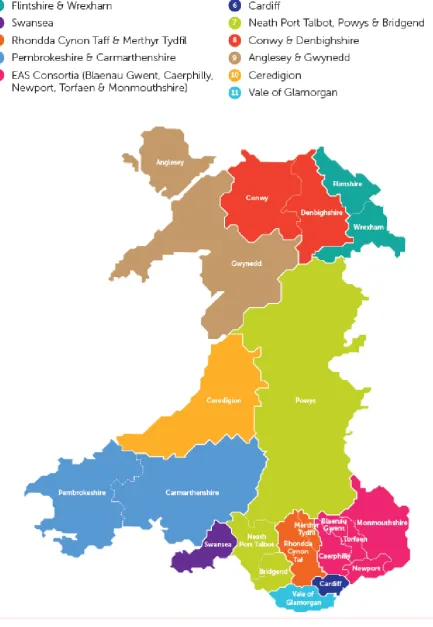
3.18 As shown in Figure 2.1, the Seren Network consists of 11 geographically
bound hubs covering Wales. Three pilot hubs were launched by the Minister
for Education and Skills in January 201523 for the areas of Flintshire/
Wrexham, Swansea and Rhondda Cynon Taf/Merthyr Tydfil. These areas
were selected as pilot areas on the basis that they already demonstrated
good practice in terms of supporting students to apply for Oxford and
Cambridge Universities. In the case of the Swansea hub for instance, the
network built upon an existing HE+ initiative24.
3.19 The remaining nine hubs were established over the course of 2015/16, with
the last to be established in November 2016. Most hubs were fully
operational for the 2016/17 academic year and it was reported that more
21 National Assembly for Wales Research Service ‘Reach for the stars: The Seren network and Welsh Oxbridge
applications’ p.4
22 Ibid. p.4
23
http://gov.wales/topics/educationandskills/learningproviders/Seren/oxbridge-project/news-and-events/Seren-supporting-wales-brightest/?lang=en
24 The HE+ initiative is a collaborative project between the University of Cambridge and its Colleges, working
22
than 2,000 students had engaged with Seren during 2016/1725. A full
academic programme of provision will be delivered by all 11 hubs for the first
time during the 2017/18 academic year.
3.20 The geographical boundaries of the hubs vary. Of the 11 hubs, four are
focused on a single local authority area, five cover two local authority areas
and one covers five local authority areas. The host organisations for each
Seren hub constitute nine local authorities, one regional educational
consortium and an FE college.
3.21 As emphasised within the Minister for Education and Skills’ speech during the launch event, one of the intentions of Seren was to establish a ‘long term, sustainable answer to a complex and difficult challenge’. The Minister also announced that ‘the hubs will create a system where all our schools and
colleges learn from each other and share resources to support their most academically able students’26.
25 National Assembly for Wales Research Service (2017), ‘Reach for the stars: The Seren network and Welsh
Oxbridge applications’ p.2
https://seneddresearch.blog/2017/07/06/reach-for-the-stars-the-seren-network-and-welsh-oxbridge-applications/
23
24
Structure and delivery model
3.22 Each Seren hub comprises a partnership of schools and Further Education
colleges who draw upon the inputs of leading universities. Each hub receives
an equal amount of funding from the Welsh Government and have been
awarded a total of £50k each for the initial two-year delivery period (i.e. £25k
per annum).
3.23 The Welsh Government issued guidance to each hub as they set out to establish their structures and provision, in the form of a ‘Memorandum of Understanding’. This guidance covered aspects such as governance,
funding responsibilities, communication and participant selection. It did not
however set out to guide hubs on the content of provision.
3.24 The guidance suggested that each hub could consider adopting three levels
of governance arrangements, although warranted flexibility to each hub to
organise this as appropriate:
Management level – a project board consisting of senior managers from
a representative selection of institutions which would meet twice a year
to provide high level steer and oversight
Steering level – a steering group comprising of a small number of practitioners who would develop plans for hub activities
Partner level – where all practitioner partners would meet regularly, possibly termly, to keep up to date with progress from the steering
group, to be consulted on proposal and suggest areas of work for the
steering group.
3.25 The Welsh Government guidance also requested that each hub establish its
own funding authorisation policies and defined some of the communication
requirements it ought to adopt in terms of communicating with students,
parents and schools/colleges. The guidance also stated that hubs were
expected to make their own arrangements for identifying and selecting
students to participate and could set their own thresholds in terms of eligible
academic achievements. Furthermore, the guidance suggested that hubs
25
so as to ensure students would be making active choices about further
participation.
3.26 The Welsh Government has commissioned additional resources to support
the delivery of the Seren Network over its lifetime. Golley Slater was
contracted from the outset to provide communication and PR services to the
initiative and their role has included providing support with hub launch
events, preparing promotional material and case studies as well as
delivering a media and social media communications campaign. In addition,
the Brilliant Club was contracted to provide additional support services and
their work has included developing two National Conference programmes
(March 2017 and December 201727) and supporting the work of hubs (e.g.
sourcing guest speakers from HEIs).
Participant engagement
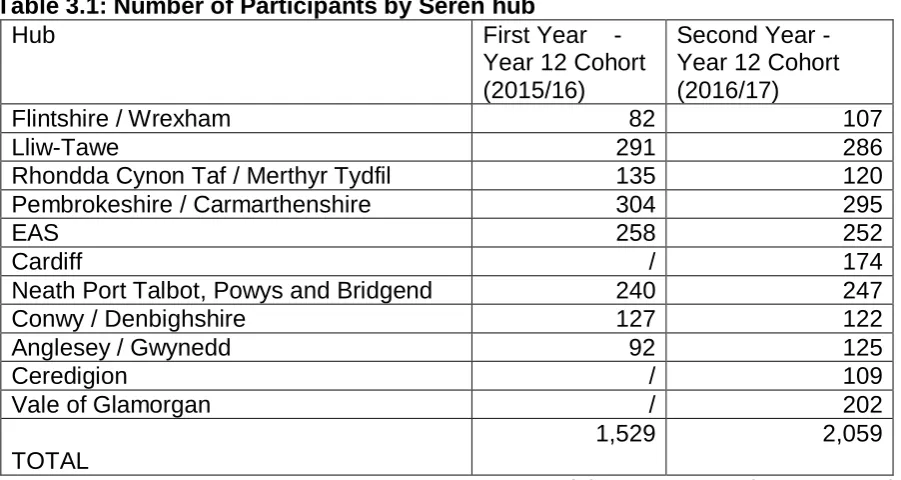
3.27 The number of participants engaged with the Seren hubs increased from
1,529 during 2015/16 to 2,059 during 2016/17. As shown in Table 3.1, the
number of participants engaged at the hub level varies from around 100 to
nearly 300 students.
26
Table 3.1: Number of Participants by Seren hub
Hub First Year -
Year 12 Cohort (2015/16)
Second Year - Year 12 Cohort (2016/17)
Flintshire / Wrexham 82 107
Lliw-Tawe 291 286
Rhondda Cynon Taf / Merthyr Tydfil 135 120
Pembrokeshire / Carmarthenshire 304 295
EAS 258 252
Cardiff / 174
Neath Port Talbot, Powys and Bridgend 240 247
Conwy / Denbighshire 127 122
Anglesey / Gwynedd 92 125
Ceredigion / 109
Vale of Glamorgan / 202
TOTAL
1,529 2,059
27
4.
Published Data
4.1 This chapter provides an overview of the trends in terms of top A-level
attainment, top university applications and offers, top university enrolments
and first year retention for pupils from Wales over the past few years. It is
intended to set out and explore the evidence available for the underlying
rationale for intervention and to present the context within which the Seren
Network operates. This chapter offers an overview of recent historical trends
in terms of top university applications, offers and enrolments made by Welsh
domiciled students. None of the changes or observations discussed within
this chapter can be attributed to the work of the Seren Network due to the
fact that the initiative has only become fully operational during the 2017/18
academic year.
Top A Level attainment
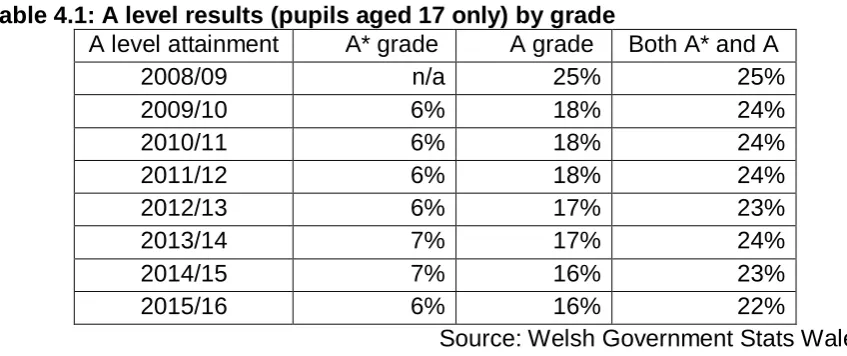
4.2 Over one fifth of 17 year old students studying at a maintained school in
Wales achieve a top A level grade although there has been a gradual fall in
the proportion of students achieving an A or A* grade at A level since
peaking at 25 per cent in 2009 to a low of 22 per cent in 2016, as shown in
[image:27.595.80.504.470.648.2]Table 4.1.
Table 4.1: A level results (pupils aged 17 only) by grade
A level attainment A* grade A grade Both A* and A
2008/09 n/a 25% 25%
2009/10 6% 18% 24%
2010/11 6% 18% 24%
2011/12 6% 18% 24%
2012/13 6% 17% 23%
2013/14 7% 17% 24%
2014/15 7% 16% 23%
2015/16 6% 16% 22%
Source: Welsh Government Stats Wales28
28
28
4.3 Published data show that the proportion of Welsh students achieving top A
level attainment is lower than England (at 26 per cent29) and this gap has
increased over time.
Oxbridge applications, offers and enrolments
4.4 During the 2015/16 academic year, a total of 426 applications were made by
Welsh domiciled applicants to study at the University of Oxford30 for courses
starting in October 2016. This accounted for 3.5 per cent of all applications
made to the institution during that year31. In all, 101 offers were made (an
offer rate of 23.7 per cent) and 86 final acceptances were recorded32 (an
overall acceptance rate against applications made of 20.2 per cent). The
institution calculates that the potential applicant pool for 2015/16 from Wales
was 1,32033 thus the proportion of ‘eligible’ students applying to the university stood at 32.3 per cent whilst the proportion of ‘eligible students’
receiving an offer was 7.7 per cent.
4.5 Compared to other regions of the UK, the offer rate for Welsh domiciled
applicants at the University of Oxford during 2015/16 was lower than six of
the nine English regions and the acceptance rate was lower than five of the
nine English regions as shown in Table 4.2.
29https://www.gov.uk/government/news/guide-to-as-and-a-level-results-for-england-2017 accessed 2
February 2018
30
https://public.tableau.com/views/UoO_UG_Admissions/UKRegion?%3Aembed=y&%3Adisplay_count=yes&%3 AshowTabs=y&%3AshowVizHome=no
31 12,193 applications were made in all from UK domiciled students
32 An offer refers to applicants who received an offer to study from the university and would include applicants
who subsequently declined the offer, went to a different institution, failed to meet their offer conditions when they received their examination results and were rejected, declined a changed offer, or who withdrew from the admissions process after receiving an offer
29
Table 4.2: Welsh domiciled offer and acceptance rates during 2015/16 at University of Oxford compared with other UK regions
Offer Rate (%) Acceptance Rate (%)
Eastern 27.3% 24.9%
South East 26.1% 26.6%
South West 25.6% 22.3%
Greater London 24.4% 20.9%
Yorkshire and the Humber 24.1% 20.5%
North East 23.8% 20.1%
Wales 23.7% 20.2%
North West 23.5% 20.6%
East Midlands 21.9% 19.6%
West Midlands 21.4% 18.7%
Northern Ireland 18.9% 16.8%
Scotland 18.6% 17.8%
Source: University of Oxford (2017)34
4.6 Between 2006/07 and 2012/13, the number of applications made by Welsh
domiciled applicants to study at the University of Oxford dropped but has
since increased, as shown in Table 4.3. A similar pattern can be observed
for the number of Welsh domiciled applicants receiving an offer over this
time period. Since 2012/13, the number of applications, offers and final
acceptances made to Welsh domiciled students at the institution has varied.
Table 4.3: Welsh domiciled applicants and acceptances at University of Oxford Applications Offers Offer Rate
(%)
Final Acceptances
Acceptance Rate (%)
2006/07 446 91 20.4% 83 18.6%
2007/08 401 92 22.9% 84 20.9%
2008/09 486 85 17.6% 78 16.0%
2009/10 436 79 18.1% 74 17.0%
2010/11 476 83 17.4% 74 15.5%
2011/12 425 80 18.8% 75 17.6%
2012/13 384 59 15.4% 55 14.3%
2013/14 411 86 20.9% 80 19.5%
2014/15 394 90 22.8% 77 19.5%
2015/16 426 101 23.7% 86 20.2%
Source: University of Oxford (2017)35
34https://public.tableau.com/views/UoO_UG_Admissions/UKRegion?%3Aembed=y&%3Adisplay_count=yes&%
[image:29.595.73.522.481.691.2]30
4.7 During the 2015/16 academic year, 276 applications were made by Welsh
domiciled students to study at the University of Cambridge for courses
starting in October 2016 or by deferred entry to courses starting in October
2017. These accounted for 1.6 per cent of all applications made to the
institution. In all, 71 offers were made (an offer rate of 25.7 per cent and
representing 1.6 per cent of all offers made by the institution). A total of 57
students accepted a place to study at the institution (an acceptance rate of 20.7 per cent) which was in line the institution’s average of 20.6 per cent for
the UK (including Scotland and Northern Ireland) but lower than all English
regions acceptance rates. This proportion is also much lower than the
average of 22.6 per cent over the 2008 -2012 period covered by the Murphy
report.
4.8 When exploring the data over time between the academic years or 2010/11
and 205/16 no obvious pattern emerges in terms of number of applications,
other than it peaking during 2015/16. The success rate has similarly varied
over the six year period shown in Table 4.4, having peaked during 2013/14
at 26 per cent and dropped to 20.7 per cent by 2015/16.
35https://public.tableau.com/views/UoO_UG_Admissions/UKRegion?%3Aembed=y&%3Adisplay_count=yes&%
31
Table 4.4: Welsh domiciled applicants, offers and acceptances to University of Cambridge
Applications Offers Acceptances and
Success rates N u m b e r A s % o f a ll a p p lica tio n s m a d e t o Cam b ridg e N u m b e r A s % o f a ll o ff e r m a d e b y Ca m b rid g e N u m b e r A s % o f a ll a cce p ta n ce s a t Cam b ridg e S u cce ss r a te
36 %
2010/11 247 1.6 n/a n/a 57 1.7 23.1
2011/12 269 1.7 n/a n/a 60 1.7 22.3
2012/13 255 1.6 n/a n/a 50 1.5 19.6
2013/14 269 1.6 83 2.0 70 2.0 26.0
2014/15 257 1.6 76 1.8 63 1.8 24.5
2015/16 276 1.6 71 1.6 57 1.6 20.7
Source: University of Cambridge37
Other top university applications, offers and enrolments
4.9 Using University and Colleges Admissions Service (UCAS) data the evidence gathered as part of the Oxbridge Ambassador for Wales’ study38
showed that some 78.8 per cent of top achieving Welsh students (i.e. those
achieving AAA or above at A level) between 2008 and 2013 went on to
attend a Russell Group university. Overall 23.2 per cent of these high
achievers went to Cardiff University, 55.6 per cent went to a non-Wales
based Russell Group university, 6.2 per cent went to another university in
Wales and 15 per cent went to another UK university.
4.10 Recent media coverage39 suggests that there has been a drop in the number
of Welsh domiciled students who study at a Russell Group university over
the last three years. In all, 6,900 first year students enrolled at a Russell
Group university during 2012/13 but this had dropped to 6,260 first year
36 Welsh domiciled acceptances as a proportion of all applications made by Welsh domiciled applicants
37http://www.undergraduate.study.cam.ac.uk/apply/statistics [accessed 20 November 2017]
38 Oxbridge Ambassador for Wales ‘Analysis of Higher Education destinations of Welsh high achievers between
2008-13’ S Gallagher (June 2014) p.4
32
students during 2015/16 – a drop of 640 students or 10 per cent40. However,
this decline should be considered within the context of a similar drop of 10
per cent in the number of Welsh domiciled students who enrolled on Higher
Education courses more generally during this time. Furthermore, the drop
should also be considered within the context of declining Russell Group university performance across national league tables – of those Russell
Group universities, excluding Oxbridge, in England that are geographically
proximate to Wales, very few now regularly appear within the top cohort of
universities in national league tables41.
Welsh domiciled students at UK HEIs
4.11 In 2015/16 there were 35,525 Welsh domiciled students enrolled on Higher
Education undergraduate courses across UK HEIs. Of these, 18,800 were
studying full-time first degrees. Whilst there has been a gradual drop in the
number of Welsh domiciled students enrolled on HE undergraduate courses
since 2008/09 (from 42,245) the number of Welsh domiciled students
enrolled on full-time first degrees has remained comparable (17,570 in
2008/09)42.
4.12 In terms of where they chose to study, WISERD reported that there had
been a decline in the number and proportion of Welsh-domiciled
undergraduate entrants studying in Wales: 75 per cent of all
Wales-domiciled undergraduate entrants in 2007/08 (31,320) to 69 per cent in
2012/13 (27,589) 43. For the 2015/16 academic year, the Welsh Government
reported that two fifths of Welsh domiciled undergraduates studied in
England44.
40 HESA Student Record data
41 E.g. https://www.thecompleteuniversityguide.co.uk/league-tables/rankings;
https://www.theguardian.com/education/ng-interactive/2016/may/23/university-league-tables-2017
42
https://statswales.gov.wales/Catalogue/Education-and-Skills/Post-16-Education-and-Training/Higher- Education/Students/Welsh-Domicile-Enrolments-at-UK-HEIs/firstyearenrolmentsduringtheyearatukheis-by-level-modeofstudy-yearofstudy accessed 31 October 2017
43 WISERD (2015) Access to Higher Education in Wales, Report to HEFCW, Cardiff: WISERD p.10
44http://gov.wales/statistics-and-research/students-higher-education-institutions/?lang=en accessed 31
33
4.13 Data available for Welsh domiciled students45 who enrolled at a UK HEI over
the three-year period between 2014/15 and 2016/17 show that 34,740 students enrolled at one of Wales’s HEI’s (with University of South Wales
(8,185), Cardiff (5,855) and Swansea (5,430) Universities attracting the
highest number of students during this period). For HEIs outside of Wales,
the universities of Chester (1,395), Liverpool John Moores (1,330), Liverpool
(855), Manchester Metropolitan (765), Manchester (695), Exeter (700),
Bristol (695), Birmingham (590), Plymouth (570) and Bath (540) attracted the
largest number of Welsh domiciled students.
UCAS Applicant Data
4.14 Published data by UCAS46 on the number of applications made during the
2017/18 academic year for courses with an October 2017 deadline and
starting in autumn 2018 (i.e. most Medicine/Dentistry/Veterinary courses and
courses at Oxford and Cambridge universities) show a gradual decline
between 2013/14 and 2016/17 in the number of Welsh domiciled student
applicants, as shown in Table 4.5. An increase in the number of Welsh
domiciled student applicants was reported for these courses for 2017/2018,
compared with the previous year, and this annual increase of six per cent
was in line with a similar increase at the UK level47.
4.15 The vast majority (99 per cent) of the 2017/18 Welsh domiciled applicants
applied to at least one provider in England (1,420) whilst 32 per cent (460)
applied to at least one provider in Wales and 8 per cent (110) applied to at
[image:33.595.97.422.597.703.2]least one provider in Scotland.
Table 4.5: Welsh domiciled student applicants during 2017/18 courses with October 2017 deadline
Number
2013/2014 1,480
2014/2015 1,400
2015/2016 1,370
2016/2017 1,360
2017/2018 1,440
45 HESA data accessed by the Coleg Cymraeg Cenedlaethol and shared with the research team
46https://www.ucas.com/file/130736/download?token=EDhCX9xV accessed 20 November 2017.
47 At the UK level an increase of 6 per cent from 39,440 during 2016/17 to 41,970 during 2017/18 was
34 Source: UCAS48
4.16 When considering the data for Medicine courses only, a similar downward
trend in applicant numbers was observed between 2013/14 and 2016/17,
with a very small increase of 2 per cent between 2016/17 and 2017/18
compared with an 8 per cent increase across the UK overall49, as illustrated
in Table 4.6.
Table 4.6: Welsh domiciled student applicants during 2017/18 for medicine courses with October 2017 deadline
Number
2013/14 710
2014/15 660
2015/16 570
2016/17 570
2017/18 580
Source: UCAS50
Conclusions
4.17 The evidence suggests that there is a clear rationale for intervention targeted
at increasing the number of Welsh domiciled students applying to, and securing, a study place at an Oxbridge institution given Wales’ under
performance compared to other UK regions. In terms of the baseline position
during 2015/16, 702 students applied to study at Oxbridge and 143 students
accepted a place. Over the three-year period between 2013/14 and 2015/16,
435 students accepted a place to study at Oxbridge.
4.18 The evidence for intervention is less conclusive for supporting students into
other top universities, given that three-quarters of top achieving students
already enrol at a Russell Group university although the downward trend in
the number of Welsh domiciled applicants studying for Medicine would
suggest that there may be a need for targeted intervention to support
students applying for specific, competitive university degree places.
48https://www.ucas.com/file/130736/download?token=EDhCX9xV accessed 20 November 2017.
49 At the UK level an increase of 8 per cent from 14,450 during 2016/17 to 15,620 during 2017/18 was
reported.
35
5.
Design, Rationale and Evidence of Need
5.1 This chapter considers:
The aims and objectives of the Seren Network, their appropriateness and how these have changed over time
Contributors’ views on the design and rationale of the initiative
The extent to which the programme has complemented existing interventions.
Aims and Objectives
5.2 Most contributors to this evaluation (particularly Welsh Government officials,
Hub co-ordinators and school/FEI representatives) commonly observed that one of Seren’s fundamental aims was to encourage participants to aim
higher, raise their aspirations and equip them with the confidence to feel ‘good enough’ to apply to study at prestigious universities. It was also commonly suggested that Seren was about ‘expanding the horizons’ of
young people, which in some cases involved getting them to consider
applying to a wider range and more competitive institutions than would otherwise have been the case. For some hubs this meant ‘opening students’ eyes’ to other institutions than those located locally to them.
5.3 It was commonly accepted by all types of contributors to the evaluation
including participants and parents that Seren was focused on supporting high
academic achievers, as assessed by their GCSE grades. However, a small
number of HEI representatives did not necessarily accept this objective, suggesting that Seren set out to support those from ‘disadvantaged
backgrounds’ to study in higher education. Most Welsh Government officials,
Hub Co-ordinators and school/FEI representatives were in agreement that
the target audience for Seren was appropriate although a small number did
question whether the initiative ought to adopt criteria to only selected those
from socio-economically disadvantaged backgrounds. Furthermore, several
contributors (particularly schools and participants) thought that Seren
provision would be equally as helpful to other A level students who, in their
36
participants. Indeed, several school, FEI and participants argued that many
students who had achieved GCSE results just below the threshold set locally
for their hub were considering applying for Russell Group or Sutton Trust
universities and could benefit from the support available.
5.4 The fieldwork revealed a lack of consensus amongst those consulted from
across Welsh Government, HEIs, hub co-ordinators and their line managers, schools and FEI representatives and some ambiguity around the initiative’s aims and objectives in terms of the ‘end game’ for participants. To some
extent it was suggested that greater clarity was being established over time
but some Welsh Government officials, HEIs and school/FEI representatives
still had concerns and doubts over the target universities which Seren was
focused upon.
5.5 All types of contributors (including participants, parents, hub co-ordinators,
schools and FEI representatives) also commonly stressed that an underlying
objective for Seren was to provide super-curricular experiences to
participants which would stand them in a stronger position to apply for and study Higher Education, thereby addressing some of the fundamental ‘gaps’
which were perceived to exist within the current educational curriculum. In
this respect it was widely acknowledged across school and FEI
representatives that Seren would be focussed on adding value to the existing
provision which was already available for More Able and Talented (MAT)
students.
5.6 Welsh Government officials, schools and FEI representatives as well as
those involved in the delivery of local hubs also recognised that a critical
aspect of Seren was about developing the capacity and knowledge of
educational practitioners to be able to better support pupils within their own
institutions.
5.7 A more mixed opinion was expressed by all contributors as to whether Seren
could be expected to make a difference to the A level attainment of
participants, with many co-ordinators, schools and FEI representatives taking
the view that this was an unrealistic objective for the initiative whilst others
37
Design and Rationale
5.8 Feedback from stakeholders suggested that Seren was established in
response to a political drive as opposed to being an initiative which stemmed
from Welsh Government policy. In this respect it was noted that Seren
represented a somewhat interesting and different policy direction to that
outlined via published Welsh Government education and widening access
policies at the time of its inception.
5.9 Since its establishment, responsibility for Seren has moved from the
Education Department to the Skills, Higher Education and Lifelong Learning
(SHELL) Department within the Welsh Government and some stakeholders
questioned whether this had been appropriate. A few stakeholders suggested that the initiative was still a ‘floating policy area’ and not
adequately embedded within current Welsh Government policies. Some
stakeholders regarded this a strength in that it had offered the initiative significant flexibility to ‘find its feet’ during the establishment period but it was
generally accepted that Seren could be better reflected within mainstream
Welsh Government policies going forward and its linkages with MAT policies
clarified.
5.10 In terms of its underlying rationale, most contributors from Welsh
Government, schools, FEIs and those involved in the delivery of the Seren
hub referred to the fact that the need for Seren had largely been based upon
Oxbridge data and the drop in the number of Welsh students applying to
study at these institutions in recent years, as demonstrated in the Murphy
report. At a more local level, the fieldwork did suggest that the need for
Seren varied geographically and by school/FEI provider characteristics. For
instance, co-ordinators and school/FEI representatives across the valleys
based hubs were more likely than others to stress that participants had lower
aspirations for Higher Education whilst the same type of contributors from
south west based hubs were more likely to point out that students were less
likely to be prepared to travel far to attend HE, preferring instead to opt for
HEIs along the M4 corridor.
5.11 It was commonly noted that Seren had evolved quickly during its design and
38
increasing the number of students enrolling at Oxbridge institutions, not least
because a programme of delivery focused only on Oxbridge was considered
too elitist and too specialist. Indeed, it was suggested by several
stakeholders that the agenda had been broadened prior to publishing the Murphy report and that the initiative’s delivery focus had always included
Russell Group and Sutton Trust HEIs.
5.12 The fieldwork with those involved with local hubs suggested that whilst the
original Seren concept may have been upon Russell Group/Sutton Trust institutions the delivery focus had always been about ‘getting participants into the best course for them’. The fieldwork also found that there was a common consensus that Seren was about ‘directing students towards higher end universities’ although it was accepted that defining a ‘high tariff, or ‘selective’ or ‘leading’ institution and courses was much more subjective. More recently
it was observed that the target HEIs had also come to include high tariff
institutions outside of the UK e.g. Ivy League institutions51.
5.13 Feedback from contributors involved in delivering Seren hubs reinforced this
mixed picture. A fundamental priority for Seren was considered to be about
getting more students to study at Oxbridge institutions but that supporting
pupils to other high tariff universities or courses was equally a prominent objective for those involved in delivering hub’s activities.
5.14 The growing acceptance amongst Welsh Government officials and those
involved in the delivery of Seren hubs that Seren was about supporting the
brightest academic pupils to secure a place at leading institutions and/or
high-tariff courses was thought to have major implications in terms of the
approach that could be adopted to evaluate the true impact of Seren given
that defining these outcomes will be challenging. Indeed, it was frequently
argued that as defining leading institutions was highly subjective the original
criteria adopted to select Russell Group and Sutton Trust universities was by now ‘possibly outdated’. It was suggested that other methods, such as the
Teaching Excellence Framework (the TEF52) introduced recently by the
51 Eight Higher Education institutions from the Northeastern United Sates.
39
Higher Education Funding Council for England (HEFCE), should also be
considered for the future as the framework becomes better acknowledged
and utilised.
5.15 Most contributors from Welsh Government, schools/FEIs and those involved
in the management and delivery of Seren hub provision discussed whether
Welsh HEIs53 ought to be involved with Seren and considered the possible
conflicting tension which arose as a result of their inclusion. Indeed, it was
observed that their participation could potentially dilute the success of Seren, if the initiative’s success were to be measured against the number of Welsh
students studying at Russell Group or Sutton Trust universities.
5.16 The fieldwork found that Seren hubs are very dependent upon Welsh HEIs to
support their provision at a local level and feedback suggests that their
involvement supports, rather than hinders, the Seren Network to achieve its
objectives. Whilst interviewed Welsh HEIs were not particularly comfortable with Seren’s design of being focused on Russell Group/Sutton Trust
universities their concerns had reduced over time by being able to engage with local hubs. A few contributors argued that it had ‘probably been right’
that Welsh HEIs had been able to engage with Seren, despite them not necessarily reflecting the initiative’s objectives or identified as intended
beneficiaries of intervention.
5.17 Another area of tension in relation to Seren’s design which was raised during the fieldwork related to the appropriateness of the initiative’s objective of
encouraging Welsh students to study outside Wales. This concept did not
rest comfortably with some school, FEI and HEI interviewees and has
created challenges for some local hubs whose partner organisations are torn
between the need to raise student aspirations on one hand and trying to
retain students to study and work locally on the other.
Complementarity of provision
5.18 The fieldwork revealed that in the main, Seren hub provision was thought to
complement and add value to existing intervention which was already
available across schools and colleges, although it was observed that a
40
minority of schools and colleges were already offering similar experiences to
their students.
5.19 Contributors involved in the delivery of provision across hubs argued that
Seren has been instrumental in adding value to existing provision, with the
greatest level of added value being in place for schools which did not have a
particularly strong record or offer in place for supporting students to apply to
Oxbridge institutions. This was perhaps at its most evident in the Vale of
Glamorgan where a few schools were considered to have very strong
previous connections with Oxbridge and Russell Group institutions and the main value added was thought to be for those schools who didn’t. It was
suggested by those involved with the local network, including school
representatives, as well as HEIs which had been involved with the hub, that Seren had created a ‘level playing field’ between schools and colleges in this
respect.
5.20 School and FEI representatives suggested that some elements of Seren’s
provision (such as academic masterclasses and access to HEI
representatives) added the greatest value to their schools and colleges, as they provided very little of this themselves. It was thought that Seren’s
approach of bringing pupils from different schools together also added value,
particularly in terms of the way in which this could offer opportunities for more ‘isolated’ pupils to network and help overcome what was perceived to
be inconsistent expertise and capacity across the school and college support
network. Furthermore, it was emphasised that Seren had brought about a
clear and consistent structure for provision, for instance:
‘there wasn’t anything concrete before. We did some work at our school, but Seren has reinforced it, widening the scope and expanded it’.
5.21 The main area of duplication was thought to be in relation to advice on
applying to HEIs, including advice on completing personal statements, given
that some schools and colleges who contributed to the evaluation observed
that they were already providing this type of support to all pupils who were
interested in progressing to Higher Education. It was also observed that
41
provisions already available such as the regional UCAS Higher Education
exhibitions. In a couple of cases, hub partner organisations had taken a
decision not to focus on student finance issues as this was considered to be
adequately covered already by schools and colleges.
5.22 Most school and college representatives who contributed to this evaluation
welcomed the additional offer that their pupils were able to tap into given that
the requirements upon them, usually as Head of Sixth Forms, to support
pupils was onerous and time consuming. They also recognised that they as
teachers did not always have the appropriate knowledge or expertise to
advise pupils, particularly if very few or none of their students had previously
applied to Oxbridge institutions. Overall, only a couple of school
representatives interviewed thought that Seren offered very little added value to what they already provided – these tended to be cases where schools
considered that they already had a healthy number of students progressing
into good universities or schools with no students considering applying to
Oxbridge.
5.23 The school/FEI representative survey findings echo these views:
Nineteen respondents agreed that the Seren provision made available via
their local hub complemented and added value to what their school or
college made available
Seven respondents thought that Seren had replaced provision which was available previously. It was suggested that in these cases schools would
have previously provided the provision in house themselves
Seven respondents thought that Seren duplicated provision already
available to pupils at their school or college. In this respect it was
suggested that Seren provision offered ‘additional opportunities’ for pupils who already accessed support with ‘interview practice and personal statement support’ at the school.
5.24 Across the three hub areas where there had been some previous similar
provision it was argued that the introduction of Seren had enabled partners
42
them to strengthen and expand their links with a broader number of HEIs, not
43
6.
Delivery model and management
6.1 This chapter considers the delivery model adopted across the Seren hubs
including their boundaries, use of funding, governance arrangements and