0022-538X/05/$08.00⫹0 doi:10.1128/JVI.79.13.8602–8613.2005
Copyright © 2005, American Society for Microbiology. All Rights Reserved.
Attenuation of Recombinant Yellow Fever 17D Viruses Expressing
Foreign Protein Epitopes at the Surface
Myrna C. Bonaldo,
1Richard C. Garratt,
2Renato S. Marchevsky,
3Evandro S. F. Coutinho,
4Alfredo V. Jabor,
1Luı´s F. C. Almeida,
3Anna M. Y. Yamamura,
3Adriana S. Duarte,
1Prisciliana J. Oliveira,
1Jackeline O. P. Lizeu,
1Luiz A. B. Camacho,
4Marcos S. Freire,
3and Ricardo Galler
1*
Fundac¸a˜o Oswaldo Cruz, Instituto Oswaldo Cruz, Departamento de Bioquimica e Biologia Molecular,1Fundac¸a˜o
Oswaldo Cruz, Instituto de Tecnologia em Imunobiolo´gicos, Departamento de Controle de Qualidade,3
and Escola Nacional de Sau´de Pu´blica,4Rio de Janeiro, and Universidade de Sa˜o Paulo,
Instituto de Fı´sica de Sa˜o Carlos, Sa˜o Carlos,2Brazil
Received 26 November 2004/Accepted 13 March 2005
The yellow fever (YF) 17D vaccine is a live attenuated virus. Three-dimensional (3D) homology modeling of the E protein structure from YF 17D virus and its comparison with that from tick-borne encephalitis virus revealed that it is possible to accommodate inserts of different sizes and amino acid compositions in the flavivirus E proteinfgloop. This is consistent with the 3D structures of both the dimeric and trimeric forms in which thefgloop lies exposed to solvents. We demonstrate here that YF 17D viruses bearing foreign humoral (17D/8) and T-cell (17D/13) epitopes, which vary in sequence and length, displayed growth restriction. It is hypothesized that interference with the dimer-trimer transition and with the formation of a ring of such trimers in order to allow fusion compromises the capability of the E protein to induce fusion of viral and endosomal membranes, and a slower rate of fusion may delay the extent of virus production. This would ac-count for the lower levels of replication in cultured cells and of viremia in monkeys, as well as for the more attenuated phenotype of the recombinant viruses in monkeys. Testing of both recombinant viruses (17D/8 and 17D/13) for monkey neurovirulence also suggests that insertion at the 17D E proteinfgloop does not com-promise the attenuated phenotype of YF 17D virus, further confirming the potential use of this site for the development of new live attenuated 17D virus-based vaccines.
The yellow fever (YF) 17D virus is attenuated and used for human vaccination. Some of the outstanding properties of this vaccine include limited viral replication in the host but with significant expansion and dissemination of the viral mass, yield-ing a robust and long-lived neutralizyield-ing antibody response. The vaccine is cheap and applied as a single dose, and there are well-established production methodology and quality control procedures, which include the monkey neurovirulence test (MNVT). Altogether, the 17D virus has become very attractive as an expression vector for the development of new live atten-uated vaccines.
The development of infectious-clone technology has allowed the genetic manipulation of the YF 17D virus genome toward the expression of foreign genes. Different technical approaches to constructing recombinant viruses based on the YF 17D virus are possible and will differ according to the antigen to be ex-pressed. One major approach has been the creation of chime-ric viruses through the exchange of structural prM/M/E genes (reviewed in reference 10). An alternative approach used in the development of YF 17D virus as a vector for heterologous antigens is the expression of particular epitopes in the E pro-tein. In the mature virus, the E protein forms a symmetrical network of 90 dimers. These dimers are anchored into the viral envelope and lie flat on its surface. Each monomer is
com-posed of three domains. The central and dimerization domains (I and II, respectively) are formed of several noncontiguous stretches of the polypeptide chain, while the C-terminal do-main III is a continuous immunoglobulin-like module that leads into the stem section and subsequently the transmem-brane helices (22). Domain III is implicated in mediating cell receptor recognition and cell penetration (17, 21, 22).
We have previously described the viability of heterologous insertions in thefgloop of the YF 17D virus E protein (1). This loop is located in domain II, distant from the receptor binding domain III. Hence, insertions in the former should not alter attenuation for humans and monkeys, which is a major char-acteristic of YF 17D virus. We have formerly used thisfgloop site for the insertion of a model humoral epitope from the circumsporozoite (CS) surface protein from the protozoan parasite Plasmodium falciparum, consisting of three NANP repeats. Modeling of the insertion in the milieu of the YF 17D virus E protein suggested that it could adopt several confor-mations without significantly interfering with the overall E protein structure (1). A recombinant virus (YF 17D/8) express-ing this insertion flanked by two glycine residues at each end is specifically neutralized by a monoclonal antibody to the model epitope. Furthermore, mouse antibodies raised against the re-combinant virus recognize the parasite protein in an enzyme-linked immunosorbent assay (ELISA). Serial passage analysis confirmed the genetic stability of the insertion in the viral genome.
The attenuation of YF 17D virus for humans must be veri-* Corresponding author. Mailing address: Departamento de
Bio-quimica e Biologia Molecular, Fundac¸a˜o Oswaldo Cruz., Avenida Bra-sil 4365, Manguinhos, Rio de Janeiro, RJ, Brazil, 21040-900. Phone: 55 21 3865 8112. Fax: 55 21 2590 3495. E-mail: [email protected].
8602
on November 8, 2019 by guest
http://jvi.asm.org/
fied by a highly standardized neurovirulence test in nonhuman primates (12, 30) This test has been used to study the attenu-ation of several recombinant and nonrecombinant YF 17D viruses (5, 7, 8, 12, 15, 16). Here, we have used the interna-tionally accepted MNVT to show that the insertion of two pro-tein epitopes, of different amino acid sequences and lengths, into the E protein at thefgloop did not alter the attenuation of the respective recombinant YF 17D viruses.
MATERIALS AND METHODS
Modeling of the YF 17D virus E protein.We have previously described a sequence alignment of several different flavivirus E proteins and its application in the construction of homology models for the YF virus envelope protein and in the identification of insertion sites therein for the expression of heterologous peptide epitopes (1). Based on this alignment, 10 models were built for a dimer of the YF virus E protein carrying the nonapeptide CD8⫹epitope SYVPSAEQI, derived from the CS protein of the rodent parasitePlasmodium yoelii. Mod-els were built by the satisfaction of spatial restraints as implemented in the MODELLER program (25), based on the known crystal structure of the neu-tral-pH (dimeric) form of the E protein from tick-borne encephalitis (TBE) virus (22). For each model, a default coordinate randomization in Cartesian space of 4 Å was employed, prior to model optimization using the variable target function method followed by simulated annealing. The nine-residue insert was modeled into thefgloop between residues E199 and T200 of the YF virus E protein sequence. Deliberate misalignment of the first and final residues of each inser-tion/deletion in the sequence alignment was used in order to relax the homology constraints and facilitate achieving acceptable stereochemistry in the region. A similar approach was taken to the modeling of the YF 17D virus E protein car-rying no heterologous peptide.
Ten models carrying the insert GG(NANP)3GG in the same site were gener-ated as described previously (1). In this case the threefold NANP repeat, derived from the human parasitePlasmodium falciparumCS protein, was flanked by two glycine spacers on either side in order to better accommodate the insert in thefg
loop and to render it more accessible.
The resulting models were evaluated initially via their pseudo-energies [⫺ln(P), where P is the MODELLER molecular probability function including both ho-mology-derived and stereochemical terms] and subsequently by using the PRO-CHECK (11), VERIFY_3D (13), and WHATIF (29) programs for the analysis of model stereochemistry, residue environments, and atomic contacts, respec-tively. During this process particular attention was paid to the inserted residues and their vicinity. Analysis of the best models concentrated on both structural and functional aspects of the molecule and included comparisons with the re-cently described low-pH (trimeric) form of the E proteins from TBE and dengue viruses (2, 18).
Cell cultures.Vero cells, originally obtained from the American Type Culture Collection, were grown in 199 medium supplemented with 5% fetal bovine serum.
Construction of infectious cDNA clones.The regeneration of YF 17D virus from cDNA was first described by Rice et al. (23). Here, two plasmids containing different portions of the YF virus genome were joined to assemble the complete genome from which infectious RNA can be transcribed. For the insertions at the
fgloop, an EcoRV site was created at nucleotide 1568 of the viral genome in plasmid pYF5⬘3⬘IV (1, 23). The resulting plasmid was called pYFE200. By cutting pYFE200 and pT3/27 (a derivative of pYFM5.2) with NsiI/SalI, specific restriction fragments were generated which, upon ligation, reconstituted the complete YF virus genome in the cDNA form. Linearization of this cDNA with XhoI allows its use for in vitro synthesis of viral RNA. The construction of full-length clones with the insertion of the humoral epitope (NANP)3was de-scribed by Bonaldo et al. (1), and the virus regenerated from this plasmid was named YF 17D/8. For the regeneration of a virus expressing theP. yoeliiCS protein CD8⫹epitope (SYVPSAEQI), the corresponding oligonucleotides, with the codon usage of the YF genome, were inserted into the EcoRV site of plasmid pYFE200. This plasmid was used for template preparation and in vitro tran-scription as described elsewhere (1, 23).
Recovery of virus from cloned cDNA: transcription and transfection.The in vitro-ligated template resulting from pYFE200 containing the SYVPSAEQI epitope with the pT3/27 plasmid system and full-length pYF17D/MAL8 were transcribed by SP6 RNA polymerase (AmpliScribe SP6; Epicentre Technolo-gies), and the RNAs were transfected with Lipofectamine (GIBCO BRL), as
previously described (3). The recovered viruses were named YF 17D/13 and YF 17D/8, respectively.
Viral stocks, viral growth, and plaque size characterization.Following trans-fection, viruses were harvested after the onset of the cytopathic effect, and titers were determined by plaque assay on Vero cells. Viral stocks were prepared by infecting Vero cell monolayers with posttransfection supernatants at a multiplic-ity of infection (MOI) of 0.1. These second-passage stocks were titered and were used in all steps of virus characterization. Viral growth curves were determined by infecting monolayers of Vero cells at an MOI of 0.02. Cells were plated at a density of 62,500/cm2and infected 24 h later. Samples of cell culture superna-tants were collected at 24-h intervals postinfection. Viral yields were estimated by plaque titration on Vero cells at a density of 50,000/cm2with 3.5% carboxy-methylcellulose as an overlay. Determination of the plaque size was made by growing viruses in Vero cells plated at 62,500/cm2
in six-well plates with a 3-ml overlay of 0.5% low-melting-point agarose in 199 medium supplemented with 5% fetal bovine serum. Following 4 days of incubation at 37°C, 2.0 ml of medium supplemented with 0.1% neutral red was added, and the plates were incubated for 1 day prior to fixation in 10% formaldehyde and subsequently stained with 0.01% crystal violet.
Reverse transcription-PCR (RT-PCR) and sequencing.Recombinant 17D/8 and 17D13 virus stocks corresponding to the third passage in Vero cell mono-layers were used to initiate the additional 10 serial passages in all animal exper-iments and for complete-genome sequencing. Viral suspensions were used for RNA extraction with Trizol LS (Invitrogen, Life Technologies), and RNA was precipitated with isopropanol in the presence of glycogen (Invitrogen, Life Tech-nologies). The RNA was used as a template for cDNA synthesis with a negative-strand YF virus-specific synthetic, followed by PCR amplification with the GeneAmp 9600 instrument (Applied Biosystems) and the GeneAmp RNA PCR Core kit (Applied Biosystems). The analysis of insert genetic stability was based on the sequencing of a limited genomic region (nucleotides 1131 to 1781) en-compassing thefgloop area in the E protein gene. This was done using RNA extracted from the YF 17D/8 and 17D/13 viruses at their fifth and tenth serial passages in Vero cells and also for viruses corresponding to the transfection supernatant and its first passage in Vero cells.
For complete genomic sequence determination carried out on viral stocks used in animal experimentation (third passage), amplification of viral genomic regions was performed essentially as described elsewhere (5). A total of 11 RT-PCR fragments were designed comprising nucleotides 1 to 1066, 940 to 1799, 1641 to 2639, 2361 to 3387, 3004 to 4286, 4181 to 5071, 4980 to 6325, 6102 to 7272, 7162 to 8420, 8302 to 9586, and 9425 to 10862; within these fragments, internal prim-ers were positioned on both cDNA strands for the overlapping sequencing reactions. Nucleotides were numbered, and primers were designed, according to the YF 17D vaccine strain sequence (GenBank accession number X03700). Amplification products were further purified from excess primers with silica-based purification kits (QIAGEN). The purified products were sequenced directly without molecular cloning. Nucleotide sequencing reactions were per-formed with the BigDye terminator mix, version 2.0 (Applied Biosystems), ac-cording to the manufacturer’s recommendations. Electrophoresis of fluorescent products was performed in an ABI PRISM 3100 instrument (Applied Biosys-tems). Nucleotide sequences were analyzed using Chromas software, version 1.45 (Technelysium), and a consensus sequence for each viral genome was derived from contiguous sequences using SeqMan II software from the Lasergene pack-age, version 4.05 (DNAStar).
Genetic stability assay.Recombinant viruses were serially passaged in Vero cells at an MOI of 0.02. For the supernatants of the fifth and tenth passages, viral suspensions were extracted with Trizol LS, and cDNA was synthesized and sequenced as described above.
Experimental inoculation of rhesus monkeys.Studies were carried out using a protocol reviewed and approved by the Institutional Committee for Experimen-tation and Care of Research Animals (CEUA-Fiocruz, P0112/02).
Four groups of 10 captive-bred healthy rhesus monkeys (Macaca mulatta; 26 males and 14 females, weighing 2,980 g to 5,920 g) were obtained from the Primatology Department (CECAL/Fiocruz, Rio de Janeiro, Brazil). Each animal was kept in a separate cage under controlled environmental conditions (temper-ature, 20 to 22°C; relative humidity, about 60%; 12 h of artificial light and 12 h of darkness). Animals were fed twice daily with monkey chow supplemented with fresh fruits and were allowed water ad libitum. All monkeys were shown to be free of YF virus neutralizing antibodies by a plaque reduction neutralization assay. Virus inoculation, viremia, clinical observation, necropsy, and histological examination have been described previously (5, 15).
The viral inocula were back titrated by a plaque assay on Vero cells. Doses of the YF secondary seed lot virus (YFV 17DD 13Z) were 26,303 mouse 50% lethal doses (LD50) in experiment I and 33,884 mouse LD50in experiment II. The
on November 8, 2019 by guest
http://jvi.asm.org/
intracerebral (i.c.) dose of the YF 17D/8 virus was 26,303 mouse LD50, whereas that of the YF 17D/13 virus was 10,471 mouse LD50.
Seroconversion to YF was determined by the plaque reduction neutralization test at a 50% end point (15, 26). Results were expressed in thousandths of international units per milliliter (mIU/ml), using an international reference se-rum preparation for yellow fever containing 14,300 mIU/ml (World Health Organization [WHO], International Biological Standard, held by Statens Serum Institut, Copenhagen, Denmark; International Reference Preparation of Anti-Yellow-Fever Serum, 14.3 IU/vial, lot identification YF XIII-125 1000 6 62). Although this unit system is not frequently used in the literature to express YF virus neutralizing antibody titers, we provide the data in this format so that our results can readily be compared with those from other laboratories using a standardized unit system. The reciprocal of the dilution at the 50% plaque reduction end point of the reference preparation corresponds to 14,300 mIU/ml. This reference preparation was used to calibrate an in-house standard monkey serum by using both in parallel neutralization assays. The amount of mIU/ml for the in-house standard was calculated by the formula (reciprocal of the dilution at 50% for the in-house serum⫻14,300)/(reciprocal of the dilution at 50% for the reference preparation). The in-house standard was included in all neutralization assays performed to obtain the data shown in Table 1 by using the formula (re-ciprocal of the dilution at 50% for the test serum)⫻(in-house titer in mIU/ml)/ (reciprocal of the dilution at 50% for the in-house standard). Antibodies to the NANP repeat epitope were detected by ELISA as described elsewhere (1) but using microtiter plates (Costar, Cambridge, MA) coated with 50 ng/well of the resin multiple antigen peptide (MAP) containing the three-repeat B-cell epitope of the CS protein ofP. falciparum[MAP-(NANP)3].
Statistical analysis.Means and standard deviations were calculated for clinical and combined histological scores. The Studentttest was used for comparing means. When there was a suggestion that the data were asymmetrical or that variances were not homogeneous, the Kruskal-Wallis nonparametric test was performed. Differences were considered statistically significant if thePvalue was 0.05 or less. Statistical analyses were done using Stata 7.0 software (Stata Corp., College Station, Tex., 2002).
RESULTS
Comparative analysis of the three-dimensional (3D) struc-tures of the E proteins from the YF 17D/8 and 17D/13 viruses.
We have previously shown that a repetitive humoral epitope of the parasitePlasmodium falciparumwas stably cloned and expressed at thefgloop of the 17D virus E protein (1). We wanted to validate the usefulness of this site for the expression of a variety of epitopes with other immunological specificities. For this purpose we selected a second Plasmodiumepitope that has been shown to be involved in the protection of mice against challenge with thePlasmodium yoeliiCD8⫹T-cell epi-tope SYVPSAEQI (28).
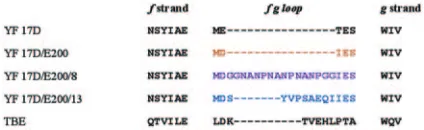
Thefgloop chosen as the insertion site is variable in length between flaviviruses; it is six residues longer in TBE virus than in YF virus (Fig. 1). Upon introduction of the nine-residue SYVPSAEQI epitope into this loop, the resulting structure is therefore only three residues longer than that observed in TBE virus. Furthermore, there is a reasonable degree of sequence
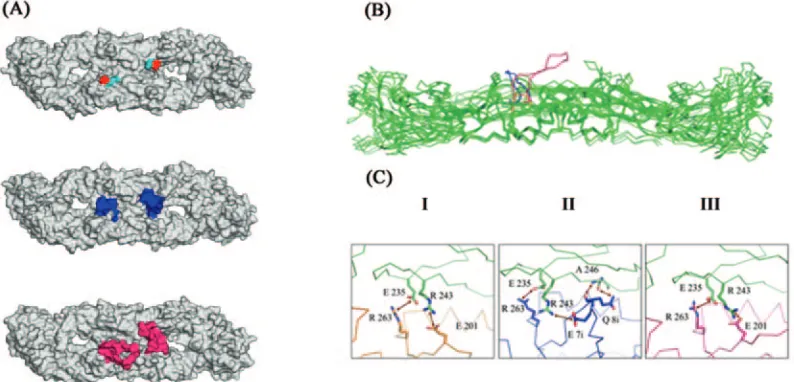
similarity between the C terminus of the original TBE virus loop (sequence EHL) and that of the insert (EQI). Taken to-gether, these observations suggested that this insert might be tolerated within thefgloop without further alterations. This speculation is borne out by quality analysis of the best overall model, which presented a PROCHECK G-factor of 0.07 (equivalent to a crystal structure at ⬍1.0 Å resolution) with 92% of the residues in the most favorable regions of the Ramachandran plot and no stereochemical distortions in the region of the insertion sites in the two monomers. Furthermore, the overall WHATIF atomic contact quality for this model was ⫺1.0 and the VERIFY_3D score was 350 (compared to an expected value of 369 for a protein of the same length), both indicating the model to be reliable in terms of overall packing. More importantly, one of the inserts of the dimer had a local average VERIFY_3D environment score for the fg loop of 0.34/residue. This is above that observed for the crystal struc-ture of the E protein from TBE virus, on the basis of which the model was built (0.28/residue). Overall the modeling results therefore suggest that it is possible to accommodate the insert in thefgloop of the dimer while preserving reasonable chem-ical environments for the additional residues (Fig. 2).
We have described previously the models for the GG(NANP)3GG sequence inserted into the YF 17D virus E protein and the rationale behind the inclusion of the glycine spacers in this case (1). Principally, this was based on the ex-pected need to leave this B-cell epitope exposed on the viral surface while minimizing the size of the spacers. A second rea-son was that, in contrast to the T-cell epitope described above, there was a complete lack of any sequence similarity between the (NANP)3epitope and the original sequence for thefgloop in TBE virus.
Models of the 17D/8 insert show that the effect of the glycine spacers is to lift the (NANP)3epitope above the surface of the virus, making it more solvent exposed (1) (Fig. 2A and B). Although there is a great diversity of conformations for the insert among the models, some common features are still dis-cernible. Analysis of the 20 loops corresponding to the 10 di-meric models shows that they rarely contribute significantly to the dimer interface and that they present an average increase in the intermonomer contact surface of only 57 Å2, compared with the 217 Å2observed for the 17D/13 virus. Furthermore, in many of the models, the two salt bridges seen in many of the 17D virus E protein structures are also conserved (Fig. 2C). Overall, there is little indication that this loop would signifi-cantly alter dimer stability.
It is of interest to examine the potential impact of the in-serted epitopes on functional aspects of the structure of the E protein, including the potential occlusion of residues believed to participate in the receptor binding surface of domain III, the stabilization or destabilization of the dimer interface, and the compatibility of the insert with the trimeric form of the struc-ture, which is a prerequisite for host cell invasion.
[image:3.585.57.269.67.132.2]In the case of the 17D/13 nonapeptide insert, the majority of the models show thefgloop rising from a hollow in the mol-ecule and projecting only slightly from its external surface (Fig. 2A and B). Because this loop is only slightly larger than the original TBE virus loop of six residues, it occupies a similar volume of space and cannot reach either the fusion peptide or the receptor binding surface of domain III on either of the two FIG. 1. Amino acid sequences of thefgloops of different
flavivi-ruses. The amino acid sequences at the regions comprising parts of the fandgstrands and at thefgloops of the different YF viruses (17D-204 strain sequence, GenBank accession number X15062), and the homol-ogous regions of TBE virus E protein (Neudoerfl strain, GenBank accession number U27495), were aligned using Clustal W.
on November 8, 2019 by guest
http://jvi.asm.org/
monomers. This observation is also valid for the 17D/8 insert, despite its additional size.
An increase in monomer-monomer contact is observed in all cases compared with models for the YF 17D virus E molecule. This leads to a total mean solvent-inaccessible contact area of 1,460 Å2for the models, which is comparable to the 1,503 Å2 observed for TBE virus and 217 Å2greater than that observed for models of the YF 17D virus E protein. Overall, this in-crease in contact area across the dimer interface, part of which is due to specific hydrogen bond interactions, would be ex-pected to increase the stability of the dimer.
At least two salt bridges can potentially form across the dimer interface of YF 17D/13 virus E protein (Fig. 2C). These were also observed in models for the YF 17D virus E protein, although in some cases a glutamate from the insert itself (E7i) performed the role played by E201 in the original sequence (Fig. 2C). Furthermore, many of the models show the forma-tion of a hydrogen bond between the penultimate glutamine residue of the insert (Q8) and the main chain of the neighbor-ing monomer (in the model shown in Fig. 2, this is via A246). The details of these interactions vary from one model to an-other and are the consequence of the inherent uncertainties in homology modeling of loop insertions.
The interdomain interfaces of the E protein appear to be critical for protein functionality, as reorientation of the do-mains is the principal conformational change to occur during the dimer-to-trimer transition. Particularly relevant in the
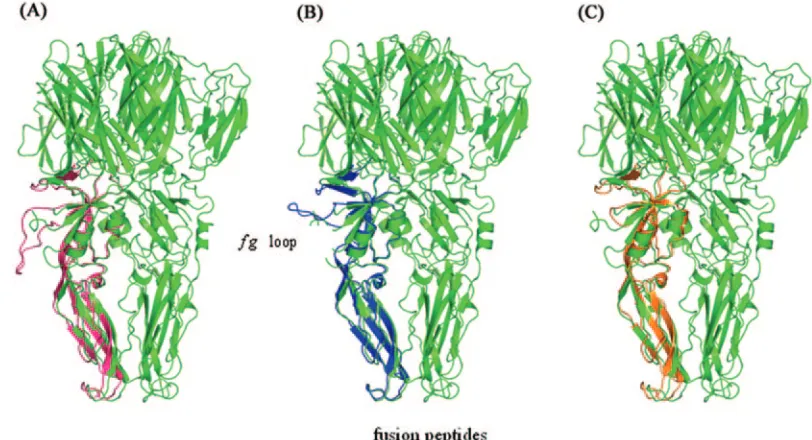
present context is the observed flexibility of theklloop, which lies adjacent to thefgloop at the interface between domains I and II (2, 17, 18). In the 10 models for the 17D/13 insert, there is an observed correlation between the conformations of the two loops, indicating that the insert has potential structural and functional consequences for the region. For the 17D/8 virus no such correlation is observed, most probably due to the presence of the glycine spacers which flank the epitope itself. In the final postfusion trimer, the fg loop is located about halfway up the lateral surface of the elongated molecule in a manner similar to that seen in the dimer on which it was built (Fig. 3). Thus, although the trimeric structure was unknown at the time when the inserts were designed, the use of thefgloop appears to be compatible, at least in structural terms, with both oligomeric forms.
Construction and characterization of a recombinant YF 17D virus expressing a P. yoelii CS T-cell epitope. As predicted from the 3D structure analysis, there was expected to be no need to add the glycine spacers for the insertion of the CD8⫹ T-cell epitope SYVPSAEQI into the YF 17D virus E protein
fgloop, as was done previously for the cloning of the humoral epitope.
[image:4.585.94.491.70.261.2]The resulting virus, YF 17D/13 virus, after two passages in Vero cells, led to viral stocks that had titers of 6.62 log10 PFU/ml. The presence of the insert in the viral genome was confirmed by sequencing of the cDNAs made from the viruses FIG. 2. 3D models of the YF 17D vaccine virus and recombinant E proteins. (A) Surface representations of typical models for the YF 17D (I), 17D/13 (II), and 17D/8 (III) viruses. In model I, the N and C termini of the insert site are indicated in light blue and red, respectively. In models II and III, the molecular surface of the insert is highlighted in dark blue (17D/13) or pink (17D/8). (B) Superposed C␣trace for the three models highlighting the insertion site by following the same color scheme (wild type in orange). The remainder of the molecule, together with the original TBE crystal structure, is shown in green. In the YF 17D virus, thefgloop is buried in a hollow on the molecular surface from which the inserts project. (C) Potential salt bridges and hydrogen bonds across the dimer interface. In all cases, the upper subunit is shown in green and the lower subunit is shown according to the color scheme used in subsequent figures. Models for (I) the YF 17D virus (orange) showing two potential salt bridges, (II) the 17D/13 virus (blue), in which hydrogen bonds involving a glutamine residue within the insert are observed in addition to the two salt bridges, and (III) the 17D/8 virus (pink), which is essentially identical to the wild type. Numbering is shown according to the YF 17D sequence, and residues within the insert are indicated by a lowercase “i.” Interactions shown by yellow arrows summarize typical results for the 10 models, but due to considerable variation between them, they are not necessarily observed in all structures.
on November 8, 2019 by guest
http://jvi.asm.org/
present in the cell culture supernatants derived from both stocks, after transfection and a second passage in Vero cells.
Based on single-step growth curves in Vero cells, differences were observed between the insertion-bearing viruses and con-trol viruses (Fig. 4). Both recombinant viruses produced peak titers at 96 h postinfection, like the control 17D/E200 virus but in contrast to the 17DD virus, which exhibited a peak titer at 72 h postinfection. However, the 17D/8 virus peak titer was nearly six- and twofold lower than those of the 17DD and 17D/ E200 control viruses, respectively. The 17D/13 virus showed a reduction in peak titer of almost twofold compared to that of the 17DD control virus but no significant difference from that of 17D/E200.
In Vero cells, both recombinant viruses produced tiny plaques, 1.10⫾0.26 mm for 17D/8 virus and 1.51⫾0.28 mm for 17D/13, compared to the 17DD virus (5.3⫾1.4 mm) and the small-plaque 17D/E200 virus (3.2⫾0.9 mm).
Recombinant virus attenuation for rhesus monkeys. The definition of the attenuation of YF viruses must come from an internationally accepted MNVT, as recommended by WHO for the characterization of new YF seed and vaccine viruses (30). Here, quantitative histopathological examination of brain and spinal cord tissue provides a sensitive method for distin-guishing strains of the same virus with subtle differences in neurovirulence (12, 15, 16).
We examined the attenuation of the YF 17D/13 and 17D/8 viruses by the current monkey neurovirulence test (30) in order to address specific preclinical safety concerns. For this purpose we performed two separate tests to check the phenotypes of the two different recombinant viruses. In each test, a group of 10 monkeys was inoculated with the known vaccine control as recommended (30)—in our case, the 17DD virus–and another 10 animals received the experimental virus.
Viremia.Table 1 displays the data on viremia recorded for monkeys inoculated with each virus. Mean peak viremia was calculated based on the peak value for each monkey in a given group. Monkeys for whom viremia was undetectable by plaqu-ing on Vero cells at a low dilution (dilution, 1:3; titer,⬍0.6 log10 PFU/ml) were given a titer of zero in the calculation. Because the serum samples from monkeys in group IV were negative by plaquing, cultivation, and RT-PCR, determination of the absence of virus in sera from animals belonging to other groups was based only on plaquing. However, attempts to detect viral RNA by RT-PCR in sera from other MNVTs with 17DD virus failed to reveal any positives not detected by plaquing. Therefore, assuming the zero for the calculation of mean titers was a reasonable alternative to include all mon-keys.
[image:5.585.86.492.69.289.2]FIG. 3. Superposition of domain II from each model onto the same region from one of the monomers of the low-pH trimeric form of the TBE virus E protein (green). (A) The 17D virus (orange) has a smallerfgloop than that seen in TBE virus, which is variably disordered in the crystal structure. (B) The 17D/13 virus (blue), showing anfgloop comparable in size to that of TBE virus. (C) The 17D/8 virus (pink), showing how the largefginsert projects from the trimer surface and would potentially interfere with the association of trimers during membrane fusion. For clarity, thefgloop and the clustering of the fusion peptides at the bottom tip of the molecule are indicated only in the central image.
FIG. 4. YF 17D virus growth in Vero cells. Monolayers of Vero cells were infected either with control virus 17DD (black squares) or 17D/E200T3 (open triangles) or with a recombinant virus (17D/13 [gray circles] or 17D/8 [gray squares]) at an MOI of 0.02. Values at each time point represent the average titer obtained from three sep-arate experiments with the respective standard deviations.
on November 8, 2019 by guest
http://jvi.asm.org/
In the experimental infection of rhesus monkeys by the i.c. route with the 17DD and 17D/13 viruses (groups I and II, respectively), monkey serum viremia differed between the two groups: only 5 animals were viremic at any given day (day 2, 4, or 6) after inoculation with the 17D/13 virus, while 17DD induced viremia in 8 out of 10 animals. Viremia was most prevalent in both groups at the fourth day postinfection, when 5 out of 10 monkeys showed measurable circulating virus. Monkeys that received the 17D/13 virus had detectable viremia in 5 out 30 measured points (10 monkey sera tested on each of days 2, 4, and 6), whereas the 17DD group had viremia in 10 out of 30. The mean peak viremia for the 17D/13 virus was 0.44 log10 PFU/ml (range, 0 to 1.44), whereas for 17DD it was significantly higher (1.09 log10PFU/ml; range, 0 to 2.42) (P⫽ 0.04 by thettest).
Groups III and IV, which received the 17DD and 17D/8 viruses, respectively, also showed limited viremia. The 17DD virus induced viremia in all animals of group III for a total of 14 days and at a mean peak titer of 0.99 log10PFU/ml (range, 0 to 1.55), whereas no viremia at all was detected for the YF 17D/8 virus (P⬍0.001 by thettest). Viremia was not signif-icantly different between the two groups that received the control 17DD virus in terms of mean peak titer (P⫽0.71 by thettest) or duration (P⫽0.15 by thettest). Animals inoc-ulated with the 17D/13 virus (group II) showed a significantly higher mean peak titer of viremia as well as a significantly greater duration than monkeys in group IV (P⫽0.01 andP⫽
0.04, respectively, by thettest).
[image:6.585.44.539.80.505.2]Serum samples from all 10 animals that received the 17D/8 virus were also inoculated into flasks of Vero cell cultures and TABLE 1. Viremia in rhesus monkeys inoculated by the intracerebral route with YF 17D viruses
Virus Monkey
Viremiaa
Total days of viremiab
Day 2 Day 4 Day 6 Mean peak titer (SD) Range
17DD (group I) 114 ⬍0.6 1.83 ⬍0.6 1.09 (0.77) 0–2.42 10
116 0.6 ⬍0.6 ⬍0.6
159 ⬍0.6 ⬍0.6 1.08
162 1.20 1.20 ⬍0.6
240 1.68 ⬍0.6 ⬍0.6
303 ⬍0.6 ⬍0.6 ⬍0.6
810 0.9 2.42 ⬍0.6
934 ⬍0.6 ⬍0.6 ⬍0.6
4U ⬍0.6 1.20 ⬍0.6
O31 ⬍0.6 0.9 ⬍0.6
17D/13c(group II) 178 ⬍0.6
0.6 ⬍0.6 0.44 (0.52) 0–1.44 5
253 ⬍0.6 1.44 ⬍0.6
423 ⬍0.6 0.6 ⬍0.6
520 ⬍0.6 0.9 ⬍0.6
540 ⬍0.6 ⬍0.6 ⬍0.6
558 ⬍0.6 0.90 ⬍0.6
4A ⬍0.6 ⬍0.6 ⬍0.6
6U ⬍0.6 ⬍0.6 ⬍0.6
46 ⬍0.6 ⬍0.6 ⬍0.6
T73 ⬍0.6 ⬍0.6 ⬍0.6
17DD (group III) T21 1.08 ⬍0.6 ⬍0.6 0.99 (0.33) 0–1.55 14
T23 0.6 ⬍0.6 ⬍0.6
T25 ⬍0.6 ⬍0.6 0.6
T45 0.9 0.9 ⬍0.6
T57 0.6 ⬍0.6 ⬍0.6
T77 ⬍0.6 1.2 1.3
T81 ⬍0.6 0.9 ⬍0.6
U11 1.3 ⬍0.6 ⬍0.6
U41 0.9 1.55 ⬍0.6
U71 0.9 1.08 ⬍0.6
17D/8c(group IV) T17 ⬍0.6 ⬍0.6 ⬍0.6 0 0 0
T19 ⬍0.6 ⬍0.6 ⬍0.6
T43 ⬍0.6 ⬍0.6 ⬍0.6
T49 ⬍0.6 ⬍0.6 ⬍0.6
T51 ⬍0.6 ⬍0.6 ⬍0.6
T63 ⬍0.6 ⬍0.6 ⬍0.6
T65 ⬍0.6 ⬍0.6 ⬍0.6
T69 ⬍0.6 ⬍0.6 ⬍0.6
U5 ⬍0.6 ⬍0.6 ⬍0.6
U49 ⬍0.6 ⬍0.6 ⬍0.6
aExpressed as log
10PFU per milliliter. Values for detectable viremia are boldfaced.Pvalues for differences in mean peak titer between groups were as follows: for group I versus II,P⫽0.04; for group I versus III,P⫽0.71; for group II versus IV,P⫽0.01; and for group III versus IV,P⬍0.001.
bPvalues for differences in duration of viremia between groups were as follows: for group I versus II,P⫽0.08; for group I versus III,P⫽0.15; for group II versus IV,P⫽0.008; for group III versus IV,P⬍0.001.
cViral stocks were used at the third passage level.
on November 8, 2019 by guest
http://jvi.asm.org/
incubated for 1 week, with no evidence of cytopathic effect. These cultures were then split and incubated for another week without evidence of viral growth. RT-PCR analysis performed directly on monkey sera also failed to reveal the presence of the viral genome. Because we followed the recommended WHO protocol, samples were not taken after the sixth day, and therefore it remains unknown whether the 17D/8 virus crosses the blood-brain barrier to reach the peripheral blood after this period.
The onset of fever in animals inoculated with the 17D/8 virus occurred at 10.5 days (standard deviation [SD], 1.8), compared to 8 days (SD, 0.81) for animals that received the 17DD virus. This late onset may reflect virus circulation after the sixth day postinfection. It has been shown (15) for the YF 17DD virus that fever is preceded by viremia, and there was no detectable
17D/8 viremia until the sixth day. Since the onset of fever for the 17D/8 virus occurred later than that observed for 17DD, there might have been virus circulation after the sixth day post-inoculation.
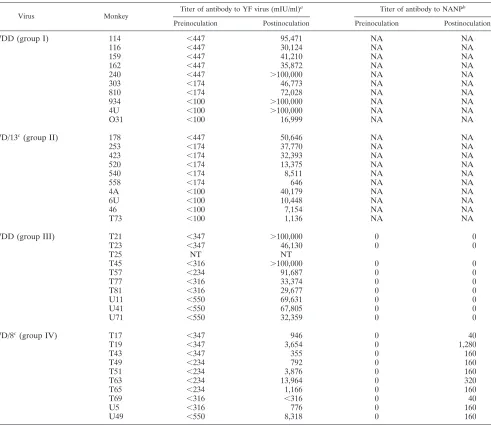
Seroconversion.All animals developed neutralizing antibod-ies 30 days after YF virus inoculation, as indicated by plaque reduction neutralization tests, with the exception of monkey T69, inoculated with the YF 17D/8 virus (Table 2). However, this monkey had detectable antibody to the foreign epitope at a 1:40 dilution, whereas all nine other animals that received the same virus had titers ranging from 1:40 to 1:1,280 (reciprocal of the dilution).
[image:7.585.50.541.79.505.2]Neutralizing antibody titers to YF virus ranged from 355 to more than 100,000 mIU/ml. It must be pointed out that a total of five neutralization titers went off scale (⬎100,000; monkeys TABLE 2. Antibody response to YF virus inoculation
Virus Monkey
Titer of antibody to YF virus (mIU/ml)a Titer of antibody to NANPb Preinoculation Postinoculation Preinoculation Postinoculation
17DD (group I) 114 ⬍447 95,471 NA NA
116 ⬍447 30,124 NA NA
159 ⬍447 41,210 NA NA
162 ⬍447 35,872 NA NA
240 ⬍447 ⬎100,000 NA NA
303 ⬍174 46,773 NA NA
810 ⬍174 72,028 NA NA
934 ⬍100 ⬎100,000 NA NA
4U ⬍100 ⬎100,000 NA NA
O31 ⬍100 16,999 NA NA
17D/13c(group II) 178 ⬍447 50,646 NA NA
253 ⬍174 37,770 NA NA
423 ⬍174 32,393 NA NA
520 ⬍174 13,375 NA NA
540 ⬍174 8,511 NA NA
558 ⬍174 646 NA NA
4A ⬍100 40,179 NA NA
6U ⬍100 10,448 NA NA
46 ⬍100 7,154 NA NA
T73 ⬍100 1,136 NA NA
17DD (group III) T21 ⬍347 ⬎100,000 0 0
T23 ⬍347 46,130 0 0
T25 NT NT
T45 ⬍316 ⬎100,000 0 0
T57 ⬍234 91,687 0 0
T77 ⬍316 33,374 0 0
T81 ⬍316 29,677 0 0
U11 ⬍550 69,631 0 0
U41 ⬍550 67,805 0 0
U71 ⬍550 32,359 0 0
17D/8c(group IV) T17 ⬍347 946 0 40
T19 ⬍347 3,654 0 1,280
T43 ⬍347 355 0 160
T49 ⬍234 792 0 160
T51 ⬍234 3,876 0 160
T63 ⬍234 13,964 0 320
T65 ⬍234 1,166 0 160
T69 ⬍316 ⬍316 0 40
U5 ⬍316 776 0 160
U49 ⬍550 8,318 0 160
aDetermined by the plaque reduction neutralization test at a 50% end point. NT, not tested. bDetermined by an ELISA for (NANP)
3. Each serum sample was serially diluted from 1:20 to 1:2,560; each titer is expressed as the reciprocal of the highest serum dilution that presented anA492of⬎0.1. NA, not applicable.
cViral stocks at third passage level.
on November 8, 2019 by guest
http://jvi.asm.org/
240, 934, and 4U in group I, and monkeys T21 and T45 in group III [Table 2]). Therefore, the means could not be cal-culated. In order to compare the test groups, we used their medians, since this measure, in our case, was not affected by the extreme values, including those off scale. To compare the medians, we employed a nonparametric test that uses ranks, the Kruskal-Wallis test. The YF 17DD virus was significantly more immunogenic by the intracerebral route than the YF 17D/13 virus (P⫽0.0051) or the 17D/8 virus (P⫽0.0002). No statistical significance was observed for the difference in anti-body titer between the two groups of animals inoculated with the 17DD virus, whereas 17D/13 was significantly more immu-nogenic than 17D/8 (P⫽0.02).
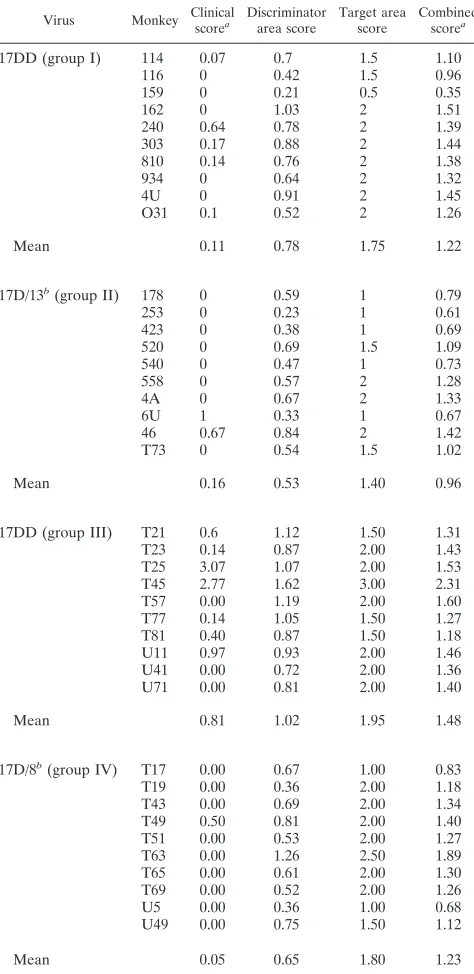
Clinical score.Table 3 displays the individual clinical scores after the 30-day observation period for both neurovirulence tests. This score is the average of the values given at each day during this period for each monkey. For the first experiment, comparing our 17DD vaccine virus and the 17D/13 recombi-nant, the results show (Table 3) that only two monkeys (mon-keys 6U and 46) inoculated with the 17D/13 virus displayed any clinical signs, compared to five monkeys inoculated with the 17DD virus (monkeys 114, 240, 303, 810, and O31). The fact that several animals displayed viremia and all specifically se-roconverted to YF confirms that the animals were indeed in-fected by the inoculated viruses. Monkeys 114, 240, and 810, inoculated with the 17DD virus, had the highest viremias but minimal clinical scores (0.07, 0.14, and 0.64, respectively). For 17D/13, monkey 253 showed no clinical signs and had the highest viremia in the group (Tables 1 and 3). The overall clinical score for each group is given in Table 3 along with the histological scores. The mean clinical score for the YF 17DD vaccine virus was 0.11, whereas that for 17D/13 was 0.16. Since the values do not show a homogeneous distribution, we used a nonparametric statistical test to analyze the significance of the difference between the two means. According to the Kruskal-Wallis test, this difference was not significant (P⫽0.37).
A somewhat higher score for the 17D/13 virus was due to a single outlier monkey (6U) that presented signs of encephalitis such as slow and incomplete movements, as well as tremors, that lasted for 10 days. This particular monkey showed no viremia, did seroconvert to YF, and did not present histolog-ical alterations in the central nervous system (CNS) compatible with the clinical picture (Table 3). It showed a low target area score (1.0); the nucleus caudatus and putamen were given scores of 0.5 and 0.75, respectively; and the nuclei thalami had values of 0.25. The spinal cord showed no lesions at the cervical level, and at the lumbar, only minor damage (grade 1) could be observed in one hemisection out of the six areas analyzed (score, 0.08). Monkeys 178, 253, 423, 540, T73, 4A, and 46 had higher histological scores for the same areas and yet showed no clinical signs.
In the second experiment, comparing the YF 17DD vaccine virus to the YF 17D/8 recombinant virus, we observed that in the group inoculated with the latter, only 1 monkey (T49) displayed minor clinical signs, compared to 7 out of 10 animals inoculated with 17DD.
Among these seven animals, two (T25 and T45) showed signs of encephalitis starting at days 7 and 8, respectively, after inoculation. Monkey T25 died on day 8 with low-grade fever, whereas monkey T45 showed only 1 day of fever (day 8
[image:8.585.302.539.82.569.2]posti-noculation). Monkey T45 continued with encephalitic signs until day 17, when it died. As a consequence, both animals showed the highest clinical scores in this group (Table 3). Both animals were within the average weight gain for the group when they died and showed minimal viremia (Table 1). Two other animals showed signs of encephalitis after inoculation with the 17DD virus (T81 and U11) that lasted for 2 and 3 TABLE 3. Neurovirulence of YF 17D viruses for rhesus monkeys
Virus Monkey Clinical scorea
Discriminator area score
Target area score
Combined scorea
17DD (group I) 114 0.07 0.7 1.5 1.10 116 0 0.42 1.5 0.96 159 0 0.21 0.5 0.35 162 0 1.03 2 1.51 240 0.64 0.78 2 1.39 303 0.17 0.88 2 1.44 810 0.14 0.76 2 1.38 934 0 0.64 2 1.32
4U 0 0.91 2 1.45
O31 0.1 0.52 2 1.26
Mean 0.11 0.78 1.75 1.22
17D/13b(group II) 178 0 0.59 1 0.79
253 0 0.23 1 0.61 423 0 0.38 1 0.69 520 0 0.69 1.5 1.09 540 0 0.47 1 0.73 558 0 0.57 2 1.28
4A 0 0.67 2 1.33
6U 1 0.33 1 0.67
46 0.67 0.84 2 1.42 T73 0 0.54 1.5 1.02
Mean 0.16 0.53 1.40 0.96
17DD (group III) T21 0.6 1.12 1.50 1.31 T23 0.14 0.87 2.00 1.43 T25 3.07 1.07 2.00 1.53 T45 2.77 1.62 3.00 2.31 T57 0.00 1.19 2.00 1.60 T77 0.14 1.05 1.50 1.27 T81 0.40 0.87 1.50 1.18 U11 0.97 0.93 2.00 1.46 U41 0.00 0.72 2.00 1.36 U71 0.00 0.81 2.00 1.40
Mean 0.81 1.02 1.95 1.48
17D/8b
(group IV) T17 0.00 0.67 1.00 0.83 T19 0.00 0.36 2.00 1.18 T43 0.00 0.69 2.00 1.34 T49 0.50 0.81 2.00 1.40 T51 0.00 0.53 2.00 1.27 T63 0.00 1.26 2.50 1.89 T65 0.00 0.61 2.00 1.30 T69 0.00 0.52 2.00 1.26 U5 0.00 0.36 1.00 0.68 U49 0.00 0.75 1.50 1.12
Mean 0.05 0.65 1.80 1.23
aPvalues for differences in clinical scores between groups were as follows: for group I versus group II,P⫽0.37; for group III versus IV,P⫽0.009; for group I versus III,P⫽0.11.Pvalues for differences in combined histological scores between groups were as follows: for group I versus group II,P⫽0.05; for group III versus IV,P⫽0.03; for group I versus III,P⫽0.15.Pvalues below 0.05 are considered statistically significant.
bViral stocks at third passage level.
on November 8, 2019 by guest
http://jvi.asm.org/
days, respectively, but there was full recovery at the end of the observation period, although with slight weight loss. Both an-imals showed only 1 day of viremia with minimal titers (Table 1 and 2). The mean clinical score for the 17DD vaccine virus was 0.81, whereas that for 17D/8 was 0.05 (Table 3). As indi-cated above for the comparison of the clinical scores for the 17DD and 17D/13 viruses, we used a nonparametric statistical test to analyze the significance of the difference between the two means. According to the Kruskal-Wallis test, this differ-ence was found to be significant (P⫽0.009), and therefore the 17D/8 virus is more attenuated than our YF 17DD vaccine.
The difference in clinical scores between the two groups that received the 17DD virus is noteworthy (Table 3), though not statistically significant (P⫽0.11 by the Kruskal-Wallis test; if the two outlier monkeys, T25 and T45, are excluded,P⫽0.33). Marchevsky et al. (15) have shown that for 49 rhesus monkeys inoculated i.c. with the 17DD virus in six different experiments, the mean clinical scores ranged from 0 to 0.57, with heavier animals showing fewer clinical signs. However, the mean weights of the two groups are not disparate (about 700 g), and therefore the observed difference is more likely to be related to test-to-test variation. Moreover, the combined histologi-cal scores for the two groups are not significantly different (Table 3;P⫽0.15 by the Kruskal-Wallis test).
Histological score.For all animals, there were no abnormal-ities in any extraneural organs that could suggest damage or impaired function. None of the animals in either experiment developed any histological lesions of the liver, kidney, adre-nals, heart, spleen, or lungs. All 40 rhesus monkeys inoculated i.c with the 17DD, 17D/13, or 17D/8 virus developed histolog-ical lesions in the central nervous system (Table 3). As pro-posed by Levenbook et al. (12), the target area in the rhesus monkey CNS for several vaccine viruses is the substantia nigra. In this study, the substantia nigra presented with the highest histological scores for the monkeys inoculated i.c. for all vi-ruses. Based on the individual values shown in Table 3, mon-keys inoculated with the 17DD virus had average scores in this area of 1.75 (experiment I) and 1.95 (experiment II), compared to 1.40 for 17D/13 and 1.80 for 17D/8, respectively. Monkey T45 presented grade-3 lesions in the target area and suc-cumbed to infection. In five MNVTs for the 17DD 102/84 seed lot virus, from which our control 17DD virus was produced, all animals showing that much neuronal involvement in the target area had died before the experimental period was over. The average target area score in these tests was 1.49 (15).
Among the discriminator areas in the CNS, the putamen, globus pallidus, and nucleus caudatus were the areas most affected, but the lesion scores were never above 2 with any of the viruses in experiment I. However, in experiment II, several animals showed grade-3 lesions in at least one (but not simul-taneously in all) hemisection of the above areas and the nuclei thalami. These included monkeys T21, T25, T45, T57, T81, and U11, inoculated with the YF 17DD virus, as well as monkey T63, inoculated with 17D/8. Monkey T45 presented grade-3 lesions in the target area, the globus pallidus, and the lumbar enlargement of the spinal cord. Monkey 6U, inoculated with 17D/13, presented the highest clinical score (1.00) among the 20 animals in experiment I and showed the third-lowest score in the discriminatory areas (0.33 [Table 3]). The average dis-criminator area score for the 17DD virus was 0.78, compared
with 0.53 for 17D/13. In experiment II, monkey T45 had the highest discriminator area score (1.62), well above the mean of 1.02 for the 17DD group. Monkey T63, inoculated with 17D/8, had the highest scores for both target and discriminator areas for the group inoculated with this virus, yet no clinical signs were noted.
Assessment of the histological basis of the neurotropism of a given virus is based on the average of the combined target and discriminator area scores of all monkeys. For the 17DD virus, this combined score was 1.21, whereas for 17D/13 it was 0.96. Given the normal distribution presented by the individual values in this test, we used thettest to analyze the significance of the difference between the two means. The mean for the 17D/13 virus is at the borderline level of significance (P ⫽
0.05), suggesting a more attenuated phenotype for this virus than for 17DD. In experiment II, the combined scores for the monkeys inoculated with 17D/8 are lower than those for the group that received the control 17DD virus (1.23 versus 1.48 [Table 3]), suggesting a higher degree of attenuation for the former. Both parametric (t) and nonparametric (Kruskal-Wal-lis) tests indicated a statistically significant difference between the means (P⫽0.03).
Recombinant virus genetic stability.As previously reported, the insertion GG(NANP)3GG of the YF 17D/8 virus was sta-ble after serial passages in Vero cells but not in chicken em-bryo fibroblasts (1). We performed two independent serial passages of the YF 17D/13 virus at passage 3 in Vero cells, with an MOI of 0.02. After sequencing the respective genomic area at the fifth and tenth passages, we observed that the insertion (SYVPSAEQI) was intact.
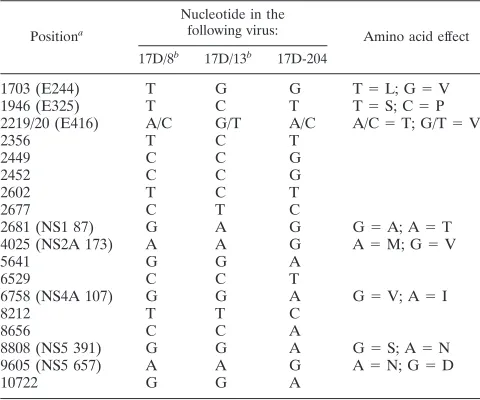
[image:9.585.301.541.81.281.2]A total of 19 positions were found to differ between the YF 17D-204 virus and the 17D/8 and 17D/13 viruses, leading to eight amino acid substitutions (Table 4). The YF 17D/8 virus and 17D/13 differed at eight nucleotide positions and four amino acid residues, three of which were in the E protein at amino acids E244, E325, and E416. The remaining substitution was in the NS1 gene (NS1 87). With the exception of the
TABLE 4. Nucleotide sequence comparison of YF 17D viruses
Positiona
Nucleotide in the
following virus: Amino acid effect 17D/8b 17D/13b 17D-204
1703 (E244) T G G T⫽L; G⫽V 1946 (E325) T C T T⫽S; C⫽P 2219/20 (E416) A/C G/T A/C A/C⫽T; G/T⫽V
2356 T C T
2449 C C G
2452 C C G
2602 T C T
2677 C T C
2681 (NS1 87) G A G G⫽A; A⫽T 4025 (NS2A 173) A A G A⫽M; G⫽V
5641 G G A
6529 C C T
6758 (NS4A 107) G G A G⫽V; A⫽I
8212 T T C
8656 C C A
8808 (NS5 391) G G A G⫽S; A⫽N 9605 (NS5 657) A A G A⫽N; G⫽D
10722 G G A
aNumbering according to GenBank accession number X03700. bViral stocks at third passage level.
on November 8, 2019 by guest
http://jvi.asm.org/
change at E244, which is due to mutation during the viral passages, all reflect the use of a different plasmid DNA back-ground for virus regeneration. Mutations at positions 4025 (NS2A 173), 6758 (NS4A 107), 8808 (NS5 391), and 9605 (NS5 657) are common to the two recombinant viruses and differ from 17D-204. The former two mutations reflect clonal differ-ences between the cDNA used for the sequencing (24), Gen-Bank accession number X00730, and that used for the cloning and virus regeneration described here. The two changes at NS5 were introduced by mutagenesis of the original infectious cDNA (23) and were present in the plasmids used to regener-ate both the 17D/8 and 17D/13 viruses but were absent from the original sequence.
DISCUSSION
The YF 17D virus has several characteristics which are de-sirable for new live attenuated vaccines. We have approached its development as a vector for heterologous antigens by study-ing the expression of a humoral epitope at the surface of the E protein based on the results of modeling of its three-dimen-sional structure. A recombinant virus expressing a B-cell epi-tope from the malarial parasite Plasmodium falciparum was characterized with regard to surface expression of the epitope, viral growth, attenuation for mice, and immunogenicity (1). Here we describe the construction and characterization of a second 17D recombinant virus expressing a CD8⫹T-cell de-terminant. This epitope is present in the major circumsporo-zoite surface protein ofPlasmodium yoeliiand has been shown to confer protection on mice challenged with live sporozoites (28). The insertions were made in thefgloop, located in do-main II of the 3D structure proposed for the E protein, a domain not known to be involved in cell tropism and possibly virulence. Here we demonstrate experimentally that insertions at this site do not compromise viral attenuation.
One of the hallmarks of the YF 17D vaccine is its extremely low incidence of adverse events. A total of 21 cases of neuro-logical disease have been reported (19), and encephalitic re-actions in vaccinees were also observed in the early develop-ment of the YF 17D virus (4). Since neurotropism is a concern with YF 17D vaccines, a standardized neurovirulence test with monkeys was established to ensure the attenuation of any YF 17D virus (12, 30). The attenuation of the recombinant 17D/8 and 17D/13 viruses was rigorously studied in tests for neuro-tropism and visceroneuro-tropism in rhesus monkeys, as recom-mended for YF 17D vaccine viruses (30). Since the YF 17DD virus has a long history of safe use in humans, we used it as a reference against which to compare the recombinant viruses in the MNVT.
Vaccine-related clinical signs were observed in 12 out of 20 monkeys that received the YF 17DD virus beginning at day 8 postinoculation and included encephalitis in some animals. In contrast, clinical signs were observed for only 1 monkey out of 10 that received the 17D/8 virus and were minor. Virus-related clinical signs were observed for only 2 out of 10 animals that received the 17D/13 virus. Accordingly, the clinical score for the group of monkeys that received the 17D/8 virus was sig-nificantly lower than that for the group inoculated with the 17DD vaccine. The group that received the 17D/13 virus did not show a significantly different clinical score from the group
receiving 17DD. Likewise, the histological lesions in both tar-get and discriminatory areas of monkeys inoculated with the recombinant 17D viruses were less frequent and of lower inten-sity, involving fewer neuronal changes and yielding combined histological scores significantly lower than those observed for the control YF 17DD vaccine virus. Although the YF 17DD virus was recently found to be slightly more neurovirulent for rhesus monkeys than 17D-204, the histological scores for the recombinant viruses were similar to those observed for YF-VAX, a commercial 17D-204-based vaccine (20).
Viscerotropism was assessed by measuring viremia after i.c. inoculation and analyzing slides of the liver, spleen, heart, kidney, and adrenal glands from all monkeys by light micros-copy. The amount of 17D virus in the extraneural circulation must be below 500 mouse LD50/0.03 ml for all (10 out of 10) sera andⱖ100 LD50/0.03 ml in 1 out of 10 monkey sera at a 1:10 dilution. In this regard, the highest viremia observed was 2.42 log10 PFU/ml for monkey 810, inoculated with 17DD. That corresponds to 1.64 LD50/0.03 ml, well below the estab-lished limits. In addition, the range of titers observed here is similar to that observed for rhesus monkeys inoculated with the attenuated 17D/JE SA-14-14-2 virus or with the chimeric 17D-den or 17D-204 virus (7, 8, 20). In addition, no evidence for hepatic, renal, or myocardial dysfunction or pathology was found, suggesting the absence of any unexpected tissue tropism or altered pathogenesis.
The observations of limited viremia, minimal clinical signs of infection, no extraneural organ alterations, and CNS histolog-ical scores within the expected range all suggest an attenuated phenotype for the YF 17D/8 and 17D/13 recombinant viruses. If thefgloop is to be employed in a predictable fashion for the production of recombinant viruses carrying other heterologous epitopes, the destabilization of the E protein 3D structure, interference with the threshold for the dimer-to-trimer transi-tion, and alteration of the fusion activation itself should be considered as potentially involved in viral overattenuation and reduced immunogenicity.
Thefgloop is located in domain II of the 3D structure of the E protein of flaviviruses (22). This domain is highly cross-linked by disulfide bonds and undergoes a low-pH transition, which is related to exposing a strictly conserved and hydropho-bic stretch of amino acids involved in the fusion of the viral envelope to the endosomal membrane. This transition involves a rearrangement of the E protein dimers into trimers, together with a simultaneous conformational change within each mono-mer, which leads to a novel spatial distribution of the three domains (2, 18). In order for this to occur, the molecule pos-sesses inherent flexibility at the interface between domains I and II, particularly due to thekl loop. In the models for the 17D/13 virus, the conformation of this loop appears to be perturbed by that of the insert itself, which lies spatially close by. The overall increase in the hidden surface area (217 Å2) and the potential for a greater number of hydrogen bonds across the dimer interface as a result of the insert may inhibit the transition from dimer to trimer necessary for infection. Alterations to specific interactions at the dimer interface have been put forward recently by Guirakhoo et al. (8) as an expla-nation for the attenuation conferred by a single point mutation within thefgloop of a chimeric YF 17D-dengue 1 virus. How-ever, in the case of 17D/8, the hypothesis of an altered
on November 8, 2019 by guest
http://jvi.asm.org/
tion threshold is less appealing, because the insert, despite its size, is predicted to interfere only minimally with the dimer interface and thekl loop, due to the presence of the glycine spacers, which lift the (NANP)3epitope above the surface of the virus (1). The most likely explanation would, therefore, appear to be related to the fusion activity itself.
Upon superposition of domain II of the models onto the same region of one of the monomers within the postfusion trimer (2) the fg loop continues to be solvent exposed and therefore is not expected to interfere with trimer formation. However, it has been postulated that, for fusion to occur, a ring of such trimers must form so that the fusion peptides at their tip are brought into close proximity (2, 18), in a manner similar to that observed for alphaviruses such as Semliki Forest virus (6). This requires that the lateral surfaces of the trimers must approach one another. As can be seen from Fig. 3, a large insert in thefgloop (such as is present in 17D/8) would steri-cally impede this approach, compromising the capability of the E protein to induce fusion of viral and endosomal membranes. It is conceivable that a lower rate of fusion may delay the ex-tent of virus production and thereby lead to a milder infection of the host, accounting for the lower extent of replication in cultured cells and the more attenuated phenotype of the re-combinant virus in both the mouse and monkey models. Al-though the protrusion of the 17D/13 loop is less marked and presumably more readily tolerated, it may contribute to atten-uation in this case also.
It is of interest that the 17D/13 and 17D/8 viruses differ at specific amino acid positions in the genome. Three of these positions are located in the E protein, two (at positions 244 and 325) within the soluble domain. 17D/13 bears a proline at po-sition 325 compared with a serine in 17D/8. This is not ex-pected to contribute significantly to their different phenotypes, as this difference is also observed between the 17D-204 and 17DD vaccine strains. However, the possibility cannot be to-tally ruled out, as this position maps to the predicted receptor binding site on domain III. From the 3D structure, the differ-ence at position 244 (leucine in 17D/8 and valine in 17D/13) seems unlikely to contribute to the phenotypic differences ob-served here, due to both its conservative nature and the addi-tional space afforded to the hydrophobic cavity at this amino acid position by the presence of an alanine at 117 (compared with valine in TBE), which would aid in accommodating either the larger leucine at 244 or the valine more commonly seen in flavivirus sequences. There are five other amino acid changes (Table 4), the role of which in viral attenuation remains un-clear. It is noteworthy that the substitution at NS5 657 is close to the GDD motif of viral RNA polymerases and may have some effect on viral RNA replication.
The fact that all monkeys mounted a neutralizing antibody response against the YF 17D/13 virus and that 9 out of 10 mounted such a response against 17D/8 suggests that the re-combinant viruses have maintained their immunogenicity, de-spite the epitope insertions in the envelope protein. However, the mean neutralizing antibody titers for both recombinant viruses were significantly lower than those elicited by the 17DD vaccine virus. The fact that both viruses are neutralized effi-ciently by YF-immune monkey and mouse sera suggests that the projection of the longerfgloop from the external surface of the dimer would cause minimal steric hindrance to antibody
binding at the external surface of the E protein domain II, where important flavivirus B-cell epitopes are located (9, 14). The most plausible explanation for the reduced immunogenic-ity is the limited viral replication. We are currently examining the capability of the 17D/8 virus to elicit a humoral immune response after subcutaneous inoculation of rhesus monkeys.
The results shown here suggest that inserts of different sizes and amino acid compositions are tolerated at the YF 17D virus E proteinfgloop. This is consistent with the 3D structures of both the dimeric and trimeric forms, in which thefgloop lies exposed to solvents (Fig. 3 and 4). The insert design was orig-inally based on the crystal structure of the dimer, and the site was chosen so as to minimally interfere with its lateral surface, as this would be expected to perturb the assembly of the 90 dimers into the complete envelope. The recent determination of the postfusion, low-pH form of the E protein from TBE and dengue viruses indicates that the external surface of domain II in the dimer, wherefgresides, has become the lateral surface in the trimer (Fig. 4). As described above, this may impose steric restraints on trimer approximation during envelope fu-sion. Although thefgloop may therefore represent a tolerant generic insertion site in structural terms, there may be limi-tations to its use which may restrict the size of the peptide that can be accommodated without causing a significant loss in functionality.
The testing of both recombinant viruses (17D/8 and 13) for monkey neurovirulence also suggests that insertion at the 17D E proteinfgloop does not compromise the attenuated pheno-type of the YF 17D virus further, confirming the potential use of this site for the insertion of foreign epitopes and the devel-opment of new live attenuated 17D virus-based vaccines.
Malaria remains one of the most important vector-borne human diseases. The concept that vaccination may be a useful tool to control the disease is based mainly on the fact that individuals continually exposed to infection by the parasitic protozoan eventually develop immunity to the disease. It is noteworthy that immunization of humans with a single dose of YF 17D virus suffices to induce detectable levels of neutraliz-ing antibodies to YF virus even 40 years after the primary immunization (19), a fact that lends further support to the use of the 17D virus to express the relevant malarial epitopes toward the development of a new line of viral vaccines capable of protecting against both diseases, possibly on a lifelong basis. In this regard the immunization of mice with the 17D/13 virus carrying the CD8 epitope induced significant T-cell priming, which contributed to a high degree of protection against a sporozoite challenge (R. S. Nussenzweig; M. C. Bonaldo, and R. Galler, unpublished results). The attenuation of YF 17D/8 virus shown here warrants the use of this virus in the formu-lation of a multicomponent vaccine, including viruses express-ing T-cell epitopes from human plasmodia toward the induc-tion of antiparasite immunity.
While it is true that single epitopes might not counter an infection by a malaria parasite, which is made up of different proteins during the various stages of its life cycle, over the last decades different groups have described several epitopes re-lated to all arms of the immune response. There have also been efforts to develop strings of epitopes as new candidate vac-cines. For YF 17D virus, thefgloop will probably accommo-date only single epitopes, with structural restrictions on size