Abstract This study on the sublimation diffusion of disperse dye from paste into PET film was performed by using a film roll method. The Laplace transform was applied to finding the solution of the diffusion equation for the diffusion in a semi-infinite medium. The process to calculate the diffusion coefficient using the iterated complementary error function was proposed. For the sublimation diffusion of disperse dye to PET by treating at 190°Cfor 3 hours, the mean dye concentration for each layer was determined colorimetrically and the diffusion coefficient was calculated by obtaining the variable value of the iterated complementary error function derived from the ratio of the mean dye concentrations between adjacent layers. The mean diffusion coefficient for all the layers was unsuitable because ofits large standard deviation, while that for below the 5th layer was estimated to be appropriate.The surface concentration calculated by the equation of the iterated complementary error function for the third layer was suitable.
Keywords: Iterated complementary error function, Diffusion coefficient, Disperse dye, Laplace transform, PET, Sublimation
I. INTRODUCTION
In the dyeing and printing process of PET textiles with disperse dyes, it is imperative that as much of the vaporized disperse dye as possible can be absorbed by the polyester fibres. The diffusion coefficient of commercial disperse dyes are essential for the design of the sublimation processes such as vapor-phase dyeing[1], conventional printing[2,3], and sublimation transfer printing.[4,5] Sekido and Matsui[6] applied a film roll method to study the kinetic behaviour of vat dyes in cellulose substrate. Sicardi et al.[7,8] applied a film roll method to measure the diffusion coefficients of dyes to PET film in supercritical carbon dioxide. They proposed a method of determining surface concentration by means of allowing a flap of film to protrude from the outer layer of the roll and reaching this flap to dye saturation at the polymer-bath interface.
General solutions of the diffusion equation can be obtained for a variety of initial and boundary conditions provided the diffusion coefficient is constant. A solution of the diffusion equation usually has one of two standard forms, one of which is a series of error functions and the other is a trigonometricalseries[9]. Laplace transformation is a mathematical device which is useful for the solution of various problems in mathematical physics. Application of the Laplace transform to the diffusion equation removes the Revised Manuscript Received on May 22, 2019.
Geon-Yong Park, Department of Chemical Engineering, Chungwoon University, Incheon, 22100, Korea
time variable and reduces the partial differential equation to the ordinary differential equation. The solution of thediffusion equation yields the transform of the concentration as a function of distance, satisfying the initial and boundary conditions[10].
In this study, first of all, the Laplace transform was applied to finding the solution of the diffusion equation for the diffusion in a semi-infinite medium. Thesolving process of obtaining the equation of the iterated complementary error function for the calculation of the diffusion coefficient was explained and proposed[9]. When disperse dye in paste was treated at 190°Cfor 3 hours using a film roll method, the mean dye concentration was determined colorimetrically. The diffusion coefficient was calculated by obtaining the variable value of the iterated complementary error function from the ratio of the mean dye concentrations between adjacent layers. The surface concentrations were also calculated by the equation of the iterated complementary error function.
II. MATERIALSANDMETHODS 2.1.Materials
C. I. Disperse Violet 26(Sumicaron Bordeaux SE-BL) was used without further purification. Biaxially oriented polyethyleneterephthalate (PET) film (40 μm in thickness) was supplied by SKC. Sodium alginate was the first grade.
2.2.Preparation of film roll
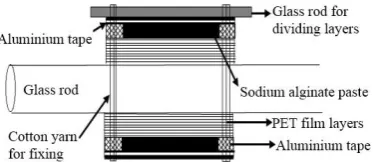
The PET film of 40 μm in thickness, of which width is 4 cm and length is 50 cm, was wrapped tightly around a glass rod of 1 cm in diameter. Both sides of film roll were wrapped by aluminium tape of which thickness is 180 μm. Sodium alginate paste was composed of C. I. Disperse Violet 26 of 300 g and 5% (w/w) sodium alginate stock paste of 700 g. Sodium alginate paste containing disperse dye was coated on the film roll between both barriers of aluminium tape and dried sufficiently at 100°C in dryer. The top of roll was fixed firmly by a thin aluminium tape and cotton yarn with glass rod for dividing layers[11,12].Figure 1 shows the schematic image of film roll method.
Diffusion Coefficient for Sublimation Diffusion
Of Disperse Dye using Error Function
Figure 1.Image of film roll coated by paste containing dye 2.3.Heat treatment
The film roll coated with paste containing disperse dye was treated in laboratory curing chamber at 170-190°C for 3-4 hours for the sublimation of disperse dye. After heat treatment was finished, the film was unrolled, washed with water, and cut into the section pieces representing the successive layers.
2.4. Determination of dye concentration
These films of each layer were dipped in test tubes including chlorobenzene for the extraction of dye. The concentration of dye extracted from the section pieces was determined using spectrophotometer (Agilent Cary 8454).
III. RESULTSANDDISCUSSION 3.1.Application of Laplace transform
A film roll method was used to study the diffusion behaviour of disperse dye into PET film. The Laplace transform and a series of error funcions can be applied to the diffusion equation to determine the diffusion coefficient and the surface concentration. If diffusion is one-dimensional and the diffusion coefficient ( ) is a constant, the diffusion equation Eq. (1) is obtained by Fick's second law[13,14].
is the concentration (mg·cm-3) at position at time . is distance (cm) from surface of film roll. is time (minute).
The dimension of is cm2·min-1.
Assuming that the PET film roll may be considered a semi-infinite medium in the direction of the center of the film roll, the surface concentration ( ) at position in one dimension of the -axis is maintained at constant through the whole period of diffusing under the infinite dye-bath condition, and the initial concentration is zero throughout the medium, then the solution of diffusion equation satisfies the initial condition Eq. (2) and the boundary conditions Eq. (3) and Eq. (4).
Initial condition:
Boundary conditions:
To seek solutions of Eq (1), let . Then a special solution of Eq. (1) is a function of one variablepas the form of Eq. (5).
Multiplying both sides of Eq. (1) by for the application of the Laplace transform and integrating with respect to from to yield Eq. (6).
The Laplace transform of is defined as Eq.
(7)[15].
Assuming that the orders of differentiation and integration can be interchanged, and integrating by parts, the left hand of Eq. (6) becomes Eq. (8). Since the term in the square bracket vanishes at by virtue of the initial condition Eq. (2) and at through the exponential factor.
Also the right hand of Eq. (6) becomes the function of the Laplace transform , i.e.Eq. (9).
Thus Eq. (1) is reduced to Eq. (10) by combining Eq. (8) with Eq. (9).
By treating the boundary condition Eq. (3), Eq. (11) is obtained[16].
The Laplace transform reduces the partial differential equation to the ordinary differential equation (ODE) Eq. (12).
If a solution of ODE Eq. (12) is , a characteristic equation is Eq. (13).
solution of ODE Eq. (12) is Eq. (14), where and are constants.
Because the solution of Eq. (12) must remain finite as approaches infinity and satisfy Eq. (11), thus and . Thus the final solution of Eq. (12) is Eq. (15).
3.2.Application of complementary error function
The error function is Eq. (16). The complementary error function is Eq. (17).
When , the Laplace transform of is defined by Eq. (18).
When , the Laplace transform of Eq. (18) is given by Eq. (19).
By changing the order of integration and noting that and , Eq. (20) is obtained.
For solving the integral in Eq. (20), the derivatives of complementary error function, Eq. (21) and Eq. (22), are used.
The integral in Eq. (20) can be converted into Eq. (23), of which the each integral term can be represented as Eq. (24) and Eq. (25) using Eq. (21) and Eq. (22). Thus Eq. (26) is obtained.
When , the Laplace transform of is defined by Eq. (28)[17].
If the exponent in Eq. (28) is equal to the exponent in Eq. (15), then . Thus the Laplace transform of Eq. (15) is rewritten in the form of Eq. (29) according to Eq. (28).
Finally Eq. (30) can be obtained from Eq. (29).
3.3.Iterated complementary error function
If is an antiderivative of for the integration of with respect to from to , then Eq. (31) is obtained.
The repeated integrals of the complementary error function, i.e. , are defined by Eq. (32)[18].
The repeated integral of the complementary error function for , i.e. called the iterated complementary error function, is Eq. (35) which can be obtained from Eq. (33) and Eq. (34).
Substituting for in Eq. (31) as Eq. (36) and combining Eq. (32) with Eq. (31) yield Eq. (38) through Eq. (37).
Let the mean concentration in -th layer from the outside be and the thickness of each layer be Then since the total concentration in -th layer is equal to the integration of with respect to from to , Eq. (39) is obtained
where .
In the same way the mean concentration in -th layer devided by can be written in the form of Eq. (41).
Thus of eq. (42) can be obtained from deviding Eq. (41) by Eq. (40).
3.4. Diffusion coefficient
The diffusion coefficients were calculated by obtaining the values of from eq. (42). The value of was calculated by obtaining the ratio of to .The mean dye concentration was determined using spectrophotometer.
Figure 2.Profile of mean dye concentration ( ) and distance according to the layer number for the sublimation diffusion by treating at 190°C for 3 hours
Figure 2 shows the mean dye concentrations in terms of the diffusion distance according to the layer number for the sublimation diffusion of disperse dye to PET by treating at 190°C for 3 hours.
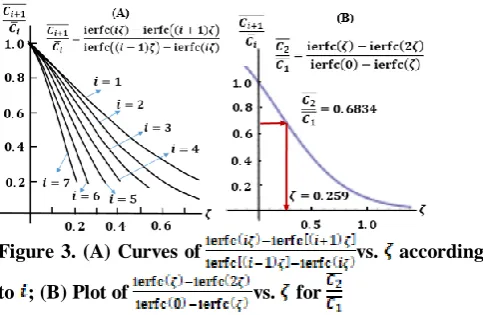
Figure 3. (A) Curves of vs. according to ; (B) Plot of vs. for
Figure 3 (A) shows the curves of Eq. (42) according to the layer number . The value for each layer number can be determined by the concentration ratio between adjacent layers from the curve for each layer. Figure 3 (B) shows the process of determining the value of for the layer number
.
Table 1:Values of according to and
0.259
0 0.56149
0.156
4 0.14665
1 0.34262 5 0.09645
2 0.19115 6 0.06121
0.252
1 0.34764
0.188
5 0.06047
2 0.19773 6 0.03324
3 0.10311 7 0.01738
0.216
2 0.23432
0.162
6 0.05482
3 0.13781 7 0.03258
4 0.07585 8 0.01858
0.210
3 0.14440
4 0.08132
5 0.04289
Table 1 presents the values of ierfc(i ) according to the values of and the layer number[19]. When the value of was 0.259, the value of Eq. (42) was closest to / . The validity of =0.259for / was verified by calculating Eq. (42). The diffusion coefficient between adjacent layers can be calculated by . The diffusion coefficient between the first layer and the second layer calculated by putting
=0.259 into Eq. (43) was 3.313×10⁻⁷cm2·min-1.
Figure 4.(A) Plot of vs. for ; (B) Plot of vs. for
Figure 4 (A) shows the process of determining the value of for the layer number =2, and Figure 5 (B) also shows the process of determining the value of for the layer number =3. When the value of was 0.252, the value of Eq. (42) was closest to / , and
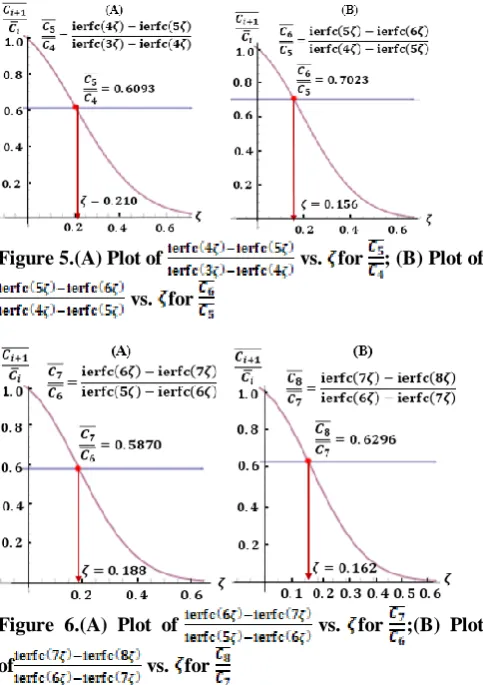
[image:5.595.304.550.204.392.2] [image:5.595.48.260.286.427.2] [image:5.595.305.547.487.676.2] [image:5.595.48.290.538.695.2]Figure 5.(A) Plot of vs. for ; (B) Plot of vs. for
Figure 6.(A) Plot of vs. for ;(B) Plot
[image:6.595.48.290.51.394.2]of vs. for
Table 2: Diffusion coefficient between adjacent layers
(cm2·min-1)
1 0.6834 0.259 0.6836 3.313×10⁻⁷
2 0.6309 0.252 0.6312 3.499×10⁻⁷
3 0.6418 0.216 0.6420 4.763×10⁻⁷
4 0.6093 0.210 0.6092 5.039×10⁻⁷
5 0.7023 0.156 0.7020 9.131×10⁻⁷
6 0.5870 0.188 0.5861 6.287×10⁻⁷
7 0.6296 0.162 0.6295 8.468×10⁻⁷
Figure 5 (A) shows the process of determining the value of for i=4, and (B) shows the process of determining the value of for i=5. The value obtained from the plot and / ,was 0.210, and that for / was 0.156. Figure 6 (A) and (B) also show the process of determining the values of for i=6and i=7. The value for / was 0.188 and that for / was 0.162. The validity of values derived from the ratio of to and the diffusion coefficients calculated by
were presented in Table 2.
Figure 7.Diffusion coefficients between adjacent layers and the mean diffusion coefficient for the sublimation diffusion of disperse dye by treating at 190°C for 3 hours
Figure 7shows the distribution of the diffusion coefficients between adjacent layers and the mean diffusion coefficient for the sublimation diffusion of disperse dye by treating at 190°C for 3 hours. The diffusion coefficients for above the 5-th layer were relatively large compared with those for the layers from to . The mean diffusion coefficient for all the layers ( ) was 5.786×10⁻⁷cm2·min-1and its standard deviation was very large. While the mean diffusion
coefficient for the layers from to ( ) was
4.154×10⁻⁷ cm2·min-1 and its standard deviation was small, which was estimated to be appropriate.
3.5.Surface concentration
The surface concentration can be calculated by the values in Table 1 obtained by putting the determined value into the
terms of and in Eq. (40).The value
of must be derived from the
[image:6.595.309.512.52.181.2]value and the curves to obtain the ratio of to . Then is calculated by the known .
Table 3: obtained from using Eq. (40)
(mg·cm-3)
1 77.7 0.259 0.8555 90.8
2 53.1 0.259 0.5848 90.8
3 33.5 0.252 0.3755 89.2
4 21.5 0.216 0.2869 74.9
5 13.1 0.210 0.1830 71.6
6 9.2 0.156 0.2259 40.7
7 5.4 0.188 0.0849 63.6
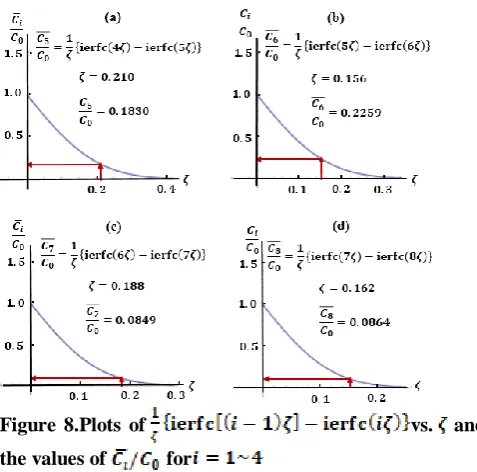
[image:6.595.49.288.421.587.2] [image:6.595.311.543.477.615.2]Figure 8.Plots of vs. and the values of for
Figure 8 shows the process of determining the ratio of to by the value for the layer number , where (a) is for , (b) is for , (c) is for , and (d) is for .
The ratio of to by the value for are
determined in the same process.The surface concentrations derived by the ratios of to and the values for each layer were presented inTable 3. The surface concentrations derived from the layers above were unsuitable because they were below the mean dye concentration of the first layer. But the surface concentration derived from the layer of was suitable.
IV. CONCLUSION
The Laplace transform were applied to finding the solution of the diffusion equation for the diffusion in a semi-infinite medium. The process to calculate the diffusion coefficient using the iterated complementary error function was proposed. For the sublimation diffusion of disperse dye to PET by treating at 190°Cfor 3 hours using a film roll method, the mean dye concentration in i-th layer was determined using spectrophotometer, and the diffusion coefficient was calculated by obtaining the variable value of the iterated complementary error function from the ratio of the mean dye concentrations between adjacent layers. The mean diffusion coefficient and its standard deviation were also discussed. The surface concentration was calculated by putting the value into the equation of theiterated complementary error function and discussed.
REFERENCES
1. Shimizu T, TabataI, Kawamura Y, Hori T.Heats of sorption of anthraquinone model disperse dyes on PET film from the vapor phase.Sen-i Gakkaishi.1986 Feb; 42(2), 61-8.
2. HawkyardCJ.The release of disperse dyes from thickener films during thermal processes.Journal of the Society of Dyers and Colourists. 1981 May;97(5): 213-9.
3. BiedermannW,IschiA. Factors affecting dye transfer in conventional printing with disperse dyes.Journal of the Society of Dyers and Colourists. 1983Dec; 99(12): 363-74.
4. GuoL, Zhang M, GuoX, Zhu Q.Research on the color models of the heat transfer printing paper.Advanced Materials Research. 2011 May;236-238:1332-5.
5. Chavanand RB, Jain AK. The importance of film thickener structure, dye vapour pressure and solubility parameter in sublimation transfer printing.Journal of the Society of Dyers and Colourists.1989 Feb; 105(2): 73-8.
6. Sekido M, Matsui M. Study on vat dyeing.Sen-i Gakkaishi.1964 Dec; 20(12): 778-83.
7. Sicardi S, Manna L, Banchero M. Diffusion of disperse dyes in PET films during impregnation with a supercritical fluid.The Journal of Supercritical Fluids. 2000 Apr; 17(2):187-94.
8. Sicardi S, Manna L,Banchero M. Comparison of dye diffusion in poly(ethylene terephthalate) films in the presence of a supercritical or aqueous solvent.Industrial& Engineering Chemistry Research. 2000 Dec; 39(12): 4707–13.
9. Crank J. The mathematics of diffusion: 2nd ed.Oxford:Oxford University Press; 1975. p. 11.
10. Crank J. The mathematics of diffusion: 2nd ed. Oxford:Oxford University Press; 1975. p. 19.
11. Park GY. Factors affecting the absorption and diffusion of disperse dye in print paste for polyester film.Journal of the Korean Society of Dyers and Finishers. 2007 Dec; 19(6):21-7.
12. Park GY. Diffusion behaviors of disperse dye to PET film from print paste using film-roll Method.Textile Science and Engineering. 2017 Apr;54(2): 125-30.
13. Cain JW, ReynoldsAM. Ordinary and partial differential equations. Virginia: Virginia Commonwealth University Press; 2010.p. 251-72. 14. Wikipedia[Internet].Fick’s laws of diffusion. https://
en.wikipedia.org/wiki/Fick’s laws of diffusion/.
15. Hildebrand FB. Advanced Calculus for Applications. New Jersey: Prentice Hall Press;1976. p. 55-8.
16. Crank J. The mathematics of diffusion: 2nd ed. Oxford:Oxford University Press; 1975. p. 20.
17. Spiegel MR. Laplace Transform. New York: McGraw-Hill; 1965.p. 96-8. 18. Wikipedia[Internet].Error function. https://en. wikipedia. org/wiki/Error
function/.
[image:7.595.47.286.47.283.2]