Parallel Multidimensional Scaling Performance on Multicore Systems
Seung-Hee Bae
[email protected]
Community Grids Laboratory
Indiana University, Bloomington
Abstract
Multidimensional scaling constructs a configuration points into the target low-dimensional space, while the interpoint distances are approximated to corresponding known dissimilarity value as much as possible. SMA-COF algorithm is an elegant gradient descent approach to solve Multidimensional scaling problem. We design paral-lel SMACOF program using paralparal-lel matrix multiplication to run on a multicore machine. Also, we propose a block de-composition algorithm based on the number of threads for the purpose of keeping good load balance. The proposed block decomposition algorithm works very well if the num-ber of row blocks is at least a half of the numnum-ber of threads. In this paper, we investigate performance results of the im-plemented parallel SMACOF in terms of the block size, data size, and the number of threads. The speedup factor is al-most7.7with 2048 points data over 8 running threads. In addition, performance comparison between jagged array and two-dimensional array in C# language is carried out. The jagged array data structure performs at least40% bet-ter than the two-dimensional array structure.
1. Introduction
Since multicore architectures were invented, multicore architectures have been getting important in software devel-opment and effecting on client, server and supercomputing systems [2, 8, 10, 22]. As [22] mentioned, the parallelism has become a critical issue to develop softwares for the pur-pose of getting maximum performance gains of multicore machines. Intel proposed that the Recoginition, Mining, and Synthesis (RMS) [10] approach as a killer application for the next data explosion era. Machine learning and data mining algorithms are suggested as important algorithms for the data deluge era by [10]. Those algorithms are, how-ever, usually highly compute-intensive algorithms, so the running time increases in quadratic or even more as the data size increases. As [10] described, the amount of data is huge
in every domain, due to digitization of not only scientific data but personal documents, photos, and videos. From the above statements, the necessary computation will be enor-mous for data mining algorithms in the future, so that imple-menting in scalable parallelism of those algorithms will be one of the most important procedures for the coming many-core and data explosion era.
As the amount of the scientific data is increasing, data vi-sualization would be another interesting area since it is hard to imagine data distribution of the most high-dimensional scientific data. Dimension reduction algorithms are used to reduce dimensionality of high dimensional data into Eu-clidean low dimensional space, so that dimension reduction algorithms are used as visualization tools. Some dimension reduction approaches, such as generative topographic map-ping (GTM) [23] and Self-Organizing Map (SOM) [16], seek to preserve topological properties of given data rather than proximity information, and other methods, i.e. mul-tidimensional scaling (MDS) [18, 3], work on maintaining proximity information, similarity or dissimilarity informa-tion, between mapping points as much as possible. The MDS uses several matrices which are full andn×n ma-trices for the ngiven points. Thus, the matrices could be very large for large problems (ncould be as big as million even today). For large problems, we will initially cluster the given data and use the cluster centers to reduce the problem size. In this paper, the author uses parallel matrix multi-plication to parallelize an elegant algorithm for computing MDS solution, named SMACOF (Scaling by MAjorizing a COmplicated Function) [6, 7, 14], in C# language and presents performance analysis of parallel implementation of SMACOF on multicore machines.
2. Multidimensional Scaling (MDS)
Multidimensional scaling (MDS) [18, 3] is a general term for a collection of techniques to configure data points with proximity information, typically dissimilarity (inter-point distance), into a target space which is normally Eu-clidean low-dimensional space. Formally, the n×n dis-similarity matrix ∆ = (δij)should be satisfied symmet-ric (δij = δji), nonnegative (δij ≥ 0), and zero diagonal elements(δii = 0) conditions. From the given dissimilar-ity matrix∆, a configuration of points is constructed by the MDS algorithm in a Euclidean target space with dimension p. The output of MDS algorithm can be ann×p config-uration matrix X, whose rows represent each data points xi in Euclideanp-dimensional space. From configuration matrix X, it is easy to compute the Euclidean interpoint distancedij(X) = kxi−xjk amongnconfigured points in the target space and to build then×nEuclidean inter-point distance matrixD(X) = (dij(X)). The purpose of MDS algorithm is to construct a configuration points into the target p-dimensional space, while the interpoint dis-tancedij(X)is approximated toδij as much as possible. Two different measurements were suggested as an objec-tive function of MDS algorithms. First, Kruskal proposed STRESS (σ or σ(X)) criterion (Eq. (1)) which is based on weighted squared error between distance of configured points and corresponding dissimilarity [17]. The SSTRESS (σ2orσ2(X)) criterion (Eq. (2)) is an weighted squared er-ror between squared distance of configured points and cor-responding squared dissimilarity [24].
σ(X) = X i<j≤n
wij(dij(X)−δij)2 (1)
σ2(X) = X i<j≤n
wij[(dij(X))2−(δij)2]2 (2)
wherewijis a weight value, sowij ≥0.
Therefore, the MDS can be thought of as an optimiza-tion problem, which is minimizaoptimiza-tion of the STRESS or SSTRESS criteria during constructing a configuration of points in thep-dimension target space.
2.1. Scaling by MAjorizing a COmplicated
Function (SMACOF)
Scaling by MAjorizing a COmplicated Function (SMA-COF) [6, 7, 14] is an iterative majorization algorithm in or-der to minimize STRESS criterion. SMACOF is a variant of gradient descent approach so likely to find local minima. Though it is trapped in local minima, it is powerful since it guarantees monotone decreasing the STRESS (σ) criterion. We will not explain the mathematical details of SMACOF
in this paper (for detail, refer to [3]), but introduce the es-sential equation, called Guttman transform
X =V†B(Z)Z (3)
where V† is the Moore-Penrose inverse (or Pseudo in-verse). The Guttman transform is generated from the sta-tionary equation ∇σ(X) = 0 which can be written as V X =B(Z)Z.
V = (vij) (4)
vij =
−wij ifi6=j
P
i6=jwij ifi=j
(5)
B(Z) = (bij) (6)
bij =
−wijδij/dij(Z) ifi6=j
0 ifdij(Z) = 0, i6=j −P
i6=jbij ifi=j
(7)
If the weights are equal for all distances (wij = 1), then
V = n
I−ee t
n
(8)
V† = 1 n
I−ee t
n
(9)
wheree = (1, . . . ,1)tis unit vector whose length isp. In this paper, we use Eq. (9) forV†.
The iteration is processed by substitutionX[k−1]intoZ in Eq. (3) like following Eq. (10)
X[k] =V†B(X[k−1])X[k−1] (10) whereX[k]is the configuration matrix afterkiteration, and X[0] is random initial configuration or a prior initial con-figuration matrix. Finally, SMACOF algorithm stops when ∆σ(X[k]) = σ[k−1] −σ[k] < ε, where ε is a relatively small threshold constant. The Algorithm 1 illustrates the SMACOF algorithm for MDS solution.
Algorithm 1SMACOF algorithm Z ⇐X[0];
k⇐0;
ε⇐small positive number; Computeσ[0]=σ(X[0]);
whilek = 0or (∆σ(X[k])> εandk≤max iterations)
do
k⇐k+ 1;
Compute the Guttman transformX[k]by Eq. (10) Computeσ[k]=σ(X[k])
Z ⇐X[k];
points 128 256 512 1024 2048
time (sec) 1.4 16.2 176.1 1801.2 17632.5
Table 1. The running times of SMACOF pro-gram in naive way for different data on Intel8b machine.
2.2. Time Complexity of SMACOF
As discussed in Section 2.1, SMACOF algorithm con-sists of iterative matrix multiplication as in Eq. (10), where V andB(X[k−1])aren×nmatrices, andX[k−1]isn×p matrix. Since the inside of the iteration steps are the most time-consuming steps of the SMACOF approach, the order of SMACOF algorithm must be O(k·(n3+p·n2)), wherek is the iteration number andpis the target dimension. Since the target dimensionpis typically two or three, the author may have the assumption thatp n, without loss of gen-erality. Thus, the order of SMACOF method might be con-sidered as O(k·n3), and we may think ofkas a constant in-teger, which is not too small constant for some large enough data set. Since the running time of SMACOF method is pro-portional ton3, the running time is highly dependent on the number of points (n).
Table 1 shows the average of the 5 running times of a naive (non-parallel, non-block based) SMACOF program in C# on Intel8bmachine (refer to Table 2 for the detail information of the machine) for four-dimensional Gaussian distribution data set to map in 3D space. In Table 1, the average running time is increased about 10 (>23) times as the data size is increased in twice. It takes more than 30 minutes for the 1024 points Gaussian distribution data and more than 4 hour 50 minutes for the 2048 points Gaussian distribution data. The number of points, however, could be more than millions in real scientific data which we are in-terested in, so it would take more than0.5×1010hours to run the ordinary SMACOF algorithm with those large sci-entific data. You should note that even thoughIntel8b ma-chine has two 4-core processors which has actually 8 cores, the naive SMACOF implementation uses only one of the 8 cores. As in multicore era, parallel approach is essential to software implementation not only for high performance but for hardware utilization. These are the reasons why paral-lel implementation of SMACOF, or any application which takes huge amount of time, is interesting now.
3. Parallel Implementation of SMACOF
Since the dominant time consuming part of SMACOF program is the iterative matrix multiplication, which is O(k·n3), building parallel matrix multiplication is the most
[image:3.612.313.542.244.332.2]natural thought to implement parallel SMACOF in efficient way. Parallel matrix multiplication [4, 1, 9, 25, 12] makes two benefits in terms of performance issue. First, High hardware utilization and computation speed-up is achieved as implied in parallelism on multicore machines. In addi-tion, the performance gain of cache memory usage is also achieved, since parallel matrix multiplication is composed of a number of small block matrix multiplications, which would be fitter into cache line than the whole matrix multi-plication. Fitting into cache line reduces unnecessary cache interferences, such as false sharing and cache I/O overhead. The cache memory issue is significant in performance, as you see in Section 5.1.
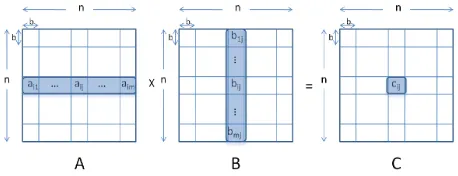
Figure 1. Parallel Matrix multiplication.
Parallel matrix multiplication is composed of a block de-composition and block multiplications of the decomposed blocks. Figure 1 illustrates how to operate matrix multipli-cation (A·B =C) using block decomposition. In Figure 1,n×nsquare matrices are used as an example, but square property of matrix is not necessary for the block version of matrix multiplication. Also, decomposed blocks can be rectangular if row of block in matrixAis equal to column of block in matrixB, though the Figure 1 useb×bsquare block. In order to compute blockcijin Figure 1, we should multiplyith block-row of matrixAwithjth block-column of matrixB, correspondingly, as in Eq. (11):
cij= m
X
k=1
aik·bkj (11)
wherecij,aik, andbkjareb×bblocks, andmis the number of blocks in block-row of matrixAand in block-column of matrixB. Thus, if we assume that the matricesA,B, andC are decomposedm×mblocks byb×bblock, without loss of generality, the matrix multiplication (A·B=C) can be finished with m2 block matrix multiplications. Note that computation of cij blocks (1 ≤ i, j ≤ m, cij ⊂ C) is independent each other.
num-Algorithm 2First mapping block index of each thread /* starting block index of each thread is (0,id) */ row⇐0;
col⇐id;/* 0≤id≤T H−1*/
/* whereidis the thread ID, andT H is the number of threads */
Algorithm 3Mapping blocks to a thread
whilecol≥the number of the block columnsdo
row⇐row+ 1;
ifrow≥the number of the block rowsthen returnf alse
end if
col⇐(row+id+row·(T H−1)/2)%T H;
end while
returntrue
ber of decomposed blocks assigned to each thread should be as equal as possible, which means eitherdm2/T Heor dm2/T He −1blocks assigned to all threads. Algorithm 3 is used for block assignment to each thread in consider-ation of load balance in our implementconsider-ation, and it works very well if the number of row blocks is at least a half of the number of running threads. As in Algorithm 2, (0,id) block is the starting position of each thread. If (0,id) block ex-ists, then threadidstarts computing (0,id). Otherwise, the Algorithm 3 will find an appropriate block to compute for the thread, and then the thread computes the found block. After block multiplication is done, the thread will execute Algorithm 3 again with assigningcol value tocol+T H. Each thread keeps those iteration, to do matrix multiplica-tion and find the next working block by Algorithm 3, until the thread getsf alsefrom calling Algorithm 3. Finally, ev-ery assigned blocks to each thread is finished for the full matrix multiplication.
After finishing assigned computation, each thread sends a signal to the main thread which is waiting on the Ren-dezvous (actually ‘waitingAll’ method is called). Finally, the main thread will wrap up the matrix multiplication af-ter getting all signals from the participated threads. For the purpose of synchronization and other thread issues, a novel messaging runtime library CCR (Concurrency and Coordi-nation Runtime) [5, 19] is used for this application.
[image:4.612.51.291.71.285.2]Afterkthiteration is completed, the parallel SMACOF application calculates STRESS value (σ[k]) of the current solution (X[k]), and measures∆σ[k](= σ[k−1]−σ[k]). If ∆σ[k] < ε, whereεis a threshold value for the stop condi-tion, the application returns the current solution as the final answer. Otherwise, the application will iterate the above procedure again to findX[k+1]usingX[k]as in Eq. (10).
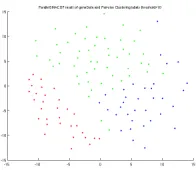
[image:4.612.379.477.73.158.2]Figure 2 is an example of MDS results by SMACOF
Figure 2. MDS result by SMACOF algorithm of 117 ALU sequence data with labeled by DA Pairwise Clustering.
algorithm of 117 ALU sequence data. The sequences are clustered in three clusters by deterministic annealing pair-wise clustering method [15]. Three clusters are represented in red, blue, and green in the Figure 2. Though we use only 117 ALU sequence data for the gene visualization problem now, we need to apply MDS to very large system (e.g. one million ALU sequences) so we should consider parallelism for the large systems.
4. Experimental Settings
4.1
Experimental Platforms
For the performance experiments on multicore machines of the parallel SMACOF, two multicore machines depicted in Table 2 are used. Both intel8a and intel8b have two quad-core CPU chips, and a total of 8 cores. Both of them use Microsoft Windows OS system, since the program is written in C# programming language and CCR [5, 19].
ID Intel8a Intel8b
CPU Intel Xeon E5320 Intel Xeon x5355
CPU Clock 1.86 GHz 2.66 GHz
Core 4-core×2 4-core×2
L2 Cache 2×4 MB 2×4 MB
Memory 8GB 4GB
OS XP pro 64 bit Vista Ultimate 64 bit
Table 2. Multicore machine specification
4.2
Experimental Data
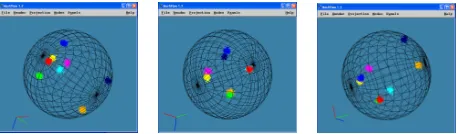
[image:4.612.307.551.484.576.2]Figure 3. The example of SMACOF results with 8-centered Gaussian distribution data with 2000 points shown with Meshview in 3D.
(0,0,0,0), (2,0,0,0), (0,2,0,1), (2,2,0,1), (0,0,1,0), (2,2,1,0), (2,0,4,1), and (0,2,4,1). Note that the fourth dimension val-ues are only 0 and 1. Thus, for those data, it would be natu-ral to be mapping into three-dimensional space near by cen-ter positions of the first three dimensions.
In fact, the real scientific data would be much more com-plex than those simple Gaussian distribution data in this pa-per. However, nobody can verify that the mapping results of those high dimensional data is correct or not, since it is hard to imagine original high dimensional space. Figure 3 shows three different screen captures of the parallel SMACOF re-sults of the given 2000 points data in a 3D image viewer, called Meshview [13]. Combining three images in Figure 3 shows that the expected mapping is achieved by the parallel SMACOF program.
4.3
Experimental Designs
Several different aspects of performance issues are in-vestigated by the following experimental designs:
• Different number of block sizes: This experiment demonstrates the performance of parallel SMACOF program with respect to block size. Three different data set of 4-dimensional Gaussian distribution are used for this test. As Section 5.1 describes, different block affects on the cache memory performance, since computers fetch data into cache by a cache line amount of data, whenever it needs to fetch data, without regard to the actual necessary data size. Note that whenever the author mentions the block size, saysb, it means a b×bblock, so that the actual block size is notbbutb2. • Different number of threads and data points:As the number of threads increases, the number of used core will be increased unless the number of threads is big-ger than the number of cores in the system. However, when we use more threads than the number of cores, thread performance overhead, like context switching and thread scheduling overhead, will increase. We ex-periment the number of thread from one to sixteen.
This experiment setup will investigate the thread per-formance overhead and how many threads would be used to run the parallel SMACOF on the test machines. The bigger data uses more computation time. The au-thor examines how speedup and overhead change as the data size differs. The tested number of data points are from 128 to 2048 as increased by factor of 2.
• Two-dimensional array vs. jagged array: It is known as jagged array (array of arrays) shows bet-ter performance than two-dimensional array in C# [21][26]. This knowledge is investigated by compar-ing performance results of the two different versions of parallel SMACOF program, which are based on jagged array and two-dimensional array.
Due to gradient descent attribute of SMACOF algorithm, the final solution highly depends on the initial mapping. Thus, it is appropriate to use random initial mapping for the SMACOF algorithm unless specific prior initial mapping exists, and to run several times to increase the probability to get optimal solution. If the initial mapping is different, how-ever, the computation amount can be varied whenever the application runs, so that we could not measure any perfor-mance comparison between two experimental setups, since it could be inconsistent. Therefore, though the application is originally implemented with random initial mapping for real solutions, the random seed is fixed for the performance measures of this paper to generate the same answer and the same necessary computation for the same problem. The stop condition threshold value (ε) is also fixed for each data.
5. Experimental Results and Performance
Analysis
5.1.
Performance
Analysis
of
Different
Block Sizes (Cache Effects)
As mentioned the previous section, the author tested per-formance of parallel SMACOF program with respect to block sizes. We used three different data set of 1024, 2000, and 2048 points data and experimented with 8 threads on
Figure 4. Parallel SMACOF running time with respect to block sizes with 8 threads.
running time of 2000 points data is longer than that of 2048 points data on both test platforms, even though the number of points are less. The reason is that the iteration number of 2000 data is 80, but that of 2048 data is only 53 for the performance tests.
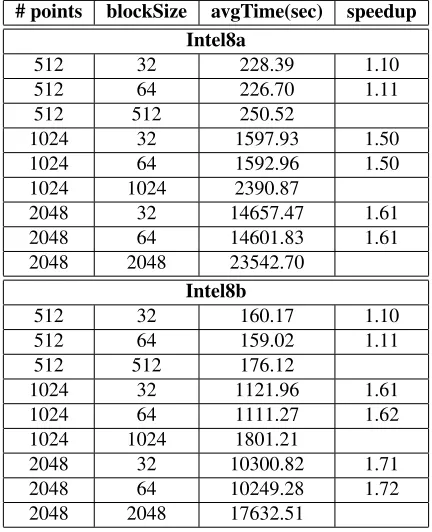
Running results with only one thread will be more help-ful to investigate the cache effect, since there is no other performance criteria but the block size. Table 3 describes the running time with only one thread with 512, 1024, and 2048 points data. Based on the 8-thread results, we chose block sizesb= 32,64to test cache effect and measure the speedup of selected block sizes based on the result of using one big wholen×nmatrix. The result shows that there are more than1.6speedup for the 1024 and 2048 points data, and around1.1speedup for the even small 512 points data onIntel8band a little smaller speedup onIntel8a. Also, performance ofb = 64is better than b = 32in all cases. Note that there is some additional tasks (a kind of over-heads) for the block matrix multiplication, such as block decomposition, finding correct starting positions of the cur-rent block, and the iteration of submatrix multiplication.
5.2. Performance Analysis of the Number
of Threads and Data Sizes
We also investigated the relation between the perfor-mance gains and the data sizes. Based on the result of the previous section, block sizeb= 32,64cases are only exam-ined and we compute the speedup of 8 threads running on the two 8-core test machines over 1 thread running with the same block size with respect to five different Gaussian dis-tribution data, such as 128, 256, . . . , and 2048 points data. For the 128 points data set we measure onlyb = 32case,
# points blockSize avgTime(sec) speedup Intel8a
512 32 228.39 1.10
512 64 226.70 1.11
512 512 250.52
1024 32 1597.93 1.50
1024 64 1592.96 1.50
1024 1024 2390.87
2048 32 14657.47 1.61
2048 64 14601.83 1.61
2048 2048 23542.70
Intel8b
512 32 160.17 1.10
512 64 159.02 1.11
512 512 176.12
1024 32 1121.96 1.61
1024 64 1111.27 1.62
1024 1024 1801.21
2048 32 10300.82 1.71
2048 64 10249.28 1.72
[image:6.612.319.535.72.338.2]2048 2048 17632.51
Table 3. Running results with only one thread with different block sizes for 512, 1024, and 2048 points data onIntel8aandIntel8b.
since the number of blocks is only 4 if b = 64so only 4 threads does actual submatrix multiplication. Figure 5 il-lustrates the speedup of the Parallel SMACOF with respect to different data sizes. As Figure 5 depicted, the speedup ratio increases as the data size increases. Following equa-tions are the definition of overhead (f), efficiency (e), and speedup(S(N)):
f = N T(N)−T(1)
T(1) (12)
e = 1
1 +f = S(N)
N (13)
Figure 5. Speedup by 8 threads on 8 core ma-chines with respect to different Data sizes
significant speedup but negligible overhead.
In addition to the experiments on data size, the perfor-mance gain with respect to the number of threads (T H) is also experimented with 1024 points data. Figure 6 illus-trates the speedup of the Parallel SMACOF with respect to T HonIntel8aandIntel8bmachines. As we expected, the speedup increases almost linearly duringT H ≤ 8, which is the number of cores. Then, whenT H = 9, the speedup factor suddenly decreases on both machines. That might be dependent on context switch and thread scheduling algo-rithms of the operating system. When the number of threads is above 9, the performance gain increases again, but it is al-ways less than when the number of threads is equal to the number of cores on the machine. Note that the speedup curves in the Figure 6 are different for more than 9 threads on the machinesIntel8aandIntel8b. That must be affected by thread management algorithm of the operating systems on those machines (refer to Table 2).
5.3. Performance of two-dimensional Array
vs. Jagged Array (C# Language
Spe-cific Issue)
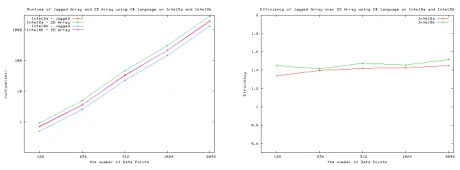
[image:7.612.311.545.75.251.2]It is known that jagged array (array of arrays) performs better than two-dimensional (multidimensional) array in C# language [21, 26]. The author also wants to measure perfor-mance efficiency of jagged array over two-dimensional ar-ray on the proposed parallel SMACOF algorithm. The Fig-ure 7 describes the runtime and the efficiency value with re-spect to different size of data set. The left figure of Figure 7 is the runtime plottings of both jagged and two-dimensional array on both test machines with block size b = 64 and the right figure demonstrates the efficiency of jagged array
Figure 6. Speedup on 8 core machines with respect to the number of threads with 1024 points data
Figure 7. Performance comparison of Jagged and 2-Dimensional array in C# language on Intel8aandIntel8bwithb= 64, T H= 8.
over two-dimensional array on both Intel8a andIntel8b. As shown in the right figure of Figure 7, the efficiency is about1.5onIntel8band1.4onIntel8afor all the test data set, 128, 256, 512, . . . , 2048 points data. In other words, jagged array data structure is more than 40% faster than two-dimensional array structure in C# language.
6. Conclusions & Future Works
[image:7.612.313.543.319.404.2]Furthermore, several different performance analyses have been done. The experimental results show that quite high efficiency and speed up is achieved by the proposed parallel SMACOF, about 0.95% efficiency and 7.5 speedup over 8 cores, for larger test data set with 8 threads running, and the efficiency is increased as the data size increased. Also, we tested the cache effect of the performance with the different block sizes, and the block sizeb = 64is the fittest on both tested 8-core machines for the proposed par-allel SMACOF application. In addition, the performance comparison between jagged array and two-dimensional ar-ray in C# is carried out. Jagged arar-ray shows at least1.4 times faster than two-dimensional array in our experiments. Our group have already tested deterministic annealing clustering [20] algorithm using MPI and CCR under 8 node dual-core Windows cluster and it shows scaled speedup [11], and we will improve the proposed parallel SMACOF to run on cluster of multicore. Based on high efficiency of the proposed parallel SMACOF on a single multicore ma-chine, it would be highly intertesting to develop reasonably high efficient multicore cluster level parallel SMACOF.
References
[1] R. C. Agarwal, F. G. Gustavson, and M. Zubair. A high performance matrix multiplication algorithm on a distributed-memory parallel computer, using overlapped communication. IBM Journal of Research and Develop-ment, 38(6):673–681, 1994.
[2] K. Asanovic, R. Bodik, B. C. Catanzaro, J. J. Gebis, P. Hus-bands, K. Keutzer, D. A. Patterson, W. L. Plishker, J. Shalf, S. W. Williams, and K. A. Yelick. The landscape of par-allel computing research: A view from berkeley. Techni-cal Report UCB/EECS-2006-183, EECS Department, Uni-versity of California, Berkeley, Berkeley, California, Dec 2006. http://www.eecs.berkeley.edu/Pubs/ TechRpts/2006/EECS-2006-183.html.
[3] I. Borg and P. J. Groenen. Modern Multidimensional Scal-ing: Theory and Applications. Springer, New York, NY, U.S.A., 2005.
[4] J. Choi, D. W. Walker, and J. J. Dongarra. Pumma:parallel universal matrix multiplication algorithms on distributed memory concurrent computers. Concurrency:Practice and Experience, 6(7):543–570, Oct. 1994.
[5] G. Chrysanthakopoulos and S. Singh. An asynchronous messaging library for c#. InProceedings of Workshop on Synchronization and Concurrency in Object-Oriented Lan-guage (SCOOL), OOPSLA, San Diego, CA, U.S.A., 2005. [6] J. de Leeuw. Applications of convex analysis to
multidi-mensional scaling.Recent Developments in Statistics, pages 133–145, 1977.
[7] J. de Leeuw. Convergence of the majorization method for multidimensional scaling. Journal of Classification, 5(2):163–180, 1988.
[8] J. Dongarra, D. Gannon, G. Fox, and K. Kennedy. The impact of multicore on computational science
software. CTWatch Quarterly, 3(1), Feb 2007.
http://www.ctwatch.org/quarterly/ archives/february-2007.
[9] J. J. Dongarra and D. W. Walker. Software libraries for lin-ear algebra computations on high performance computers.
SIAM Review, 37(2):151–180, Jun. 1995.
[10] P. Dubey. Recognition, mining and synthesis moves com-puters to the era of tera.Technology@Intel Magazine, 2005. [11] G. C. Fox. Parallel data mining from multicore to cloudy grids. In International Advanced Research Workshop on High Performance Computing and Grids, HPC2008, Ce-traro, Italy, Jul. 2008.
[12] J. Gunnels, C. Lin, G. Morrow, and R. Geijn. A flexible class of parallel matrix multiplication algorithms. InProceedings of First Merged International Parallel Processing Sympo-sium and SympoSympo-sium on Parallel and Distributed Processing (1998 IPPS/SPDP ’98), pages 110–116, 1998.
[13] A. J. Hanson, K. I. Ishkov, and J. H. Ma. Meshview: Vi-sualizing the fourth dimension, 1999. http://www.cs. indiana.edu/˜hanson/papers/meshview.pdf. [14] W. J. Heiser and J. de Leeuw. Smacof-1. Technical Report
UG-86-02, Department of Data Theory, University of Lei-den, LeiLei-den, The Nethelands, 1986.
[15] T. Hofmann and J. M. Buhmann. Pairwise data clustering by deterministic annealing. IEEE Transactions on Pattern Analysis and Machine Intelligence, 19(1):1–14, 1997. [16] T. Kohonen.Self-Organizing Maps. Springer-Verlag, Berlin,
Germany, 2001.
[17] J. B. Kruskal. Multidimensional scaling by optimizing goodness of fit to a nonmetric hypothesis. Psychometrika, 29(1):1–27, 1964.
[18] J. B. Kruskal and M. Wish.Multidimensional Scaling. Sage Publications Inc., Beverly Hills, CA, U.S.A., 1978. [19] J. Richter. Concurrent affairs: Concurrency and
coordination runtime. MSDN Magazine, Sep. 2006. http://msdn.microsoft.com/en-us/ magazine/cc163556.aspx.
[20] K. Rose. Deterministic annealing for clustering, com-pression, classification, regression, and related optimization problems. Proceedings of the IEEE, 86(11):2210–2239, 1998.
[21] D. Solis.Illustrated C# 2005. Apress, Berkely, CA, 2006. [22] H. Sutter. The free lunch is over: A fundamental turn toward
concurrency in software.Dr. Dobb’s Journal, 30(3), 2005. [23] M. Svens´en. GTM: The Generative Topographic Mapping.
PhD thesis, Neural Computing Research Group, Aston Uni-versity, Birmingham, U.K., 1998.
[24] Y. Takane, F. W. Young, and J. de Leeuw. Nonmetric in-dividual differences multidimensional scaling: an alternat-ing least squares method with optimal scalalternat-ing features. Psy-chometrika, 42(1):7–67, 1977.
[25] R. A. van de Geijn and J. Watts. Summa: Scalable universal matrix multiplication algorithm.Concurrency:Practice and Experience, 9(4):255–274, Apr. 1997.