Abstract: Designing and automation of a robust controller and pre-filter for multi-variable processes are a very challenging task. In this study, an automated and simple conception of multi- variable QFT (QFT: Quantitative Feedback Theory) is proposed using fractional order controllers design. Contrary to the traditional manual QFT design, our methodology consists of obtaining all required performances in QFT without going to the QFT loop shaping process.A non-integer order proportional derivative controller PDµ is conceived for a robust control of MIMO (Multi Input Multi Out- put) systems through multi-objective optimization based genetic algorithm . In the designed approach an implicit fractional order pre-filter FBLFD (FBLFD : Frequency Band Limited Fractional Differentiator) is adopted and its parameters are optimized. A diagonal version of this fractional order pre-filter and a non diagonal one are proposed. The problem of loop interactions is eliminated by the non diagonal designed pre-filter. Consequently, the procedure of fractional controller and pre-filter parameters optimization is illustrated. A comparative study and the efficiency of the developed methodologies are considered through SCARA robot.
Keywords : FBLFD pre-filter, Fractional order Controller, Multivariable systems, Motion control.
I. INTRODUCTION
The large majority of practical systems are multivariable [1]. The MIMO systems (Multi Input Multi Output) are more frequent as compared to SISO (Single Input Single Output) ones. In fact, controlling SISO system consists of a synthesis of a controller that provides stability and specified performances in the face of uncertainties and disturbances. More than the above required performances; a MIMO controller is called to minimize control loops interactions.
Revised Manuscript Received on December 05, 2019.
Najah YOUSFI : Industrial Engineering Program, College of Engineering, Taif University, Taif, Saudi Arabia.
b
: Laboratory of Control & Energy Management CEM, University of Sfax, Sfax, Tunisia.
Nabil DERBELb, Laboratory of Control & Energy Management CEM, University of Sfax, Sfax, Tunisia..
Pierre MELCHIORc, IMS, LAPS Department, 351 cours de la linération, Bat, A4, Bordeaux, France.
Hamed ALMALKIa : Industrial Engineering Program, College of Engineering, Taif University, Taif, Saudi Arabia.
In MIMO control, the QFT [2] is a very used process based on Nichol’s chart. This called QFT methodology is one of ro-
bust methods to generate acceptable MIMO system responses while respecting disturbances rejection and uncertainties [3]. In the MIMO QFT methodology, the initial MIMO process with uncertainty is distributed into uncertain subsystems. The QFT approach is used to control MIMO systems by designing, for each subsystem, a local suitable controller and pre-filter to keep responses under pre-specified bounds.One of the challenging tasks in a system motion control is how to keep the performance of a process in face of plant uncertainties and external disturbances. In recent years, researchers have become increasingly interested in the issue of systems with uncertainties [2]-[19]. The idea of this paper is to announce a robust path tracking approach for robotic applications by the fractional PID controller and fractional pre-filter techniques. The impulse for this technique is the smart features that the fractional approaches exhibit. This design methodology based on automated design of combined non- integer PID control process and fractional pre-filter in QFT provides besides stability, rejection of disturbance and noise insensitivity.The fractional Calculus (FC) has been gaining importance in recent years. This topic of mathematics used integrals or derivatives of real or complex order of a function [4]-[7]. Yet, the FC is not well known like integer order (IO) calculus due to foreign fractional order (FO) derivative and the limited number of physical and control engineering applications which incorporate this notion. Quite recently, considerable attention has been paid to FC and to related application to FO controllers.
Much research based on FO controllers has been done. It proves the robustness and the high quality of this type of controllers than the IO ones. The FO controllers are utilized in different areas like sciences, physics and engineers domain. This type of controller proves its ability to resolve problems of robustness and performances [7]-[12]. A non-integer order PID controller which is a generalization of the integer order one is proposed to resolve some limitations (rapidity, stability...) given by the classical ones [13], [14]. This fractional order (FO) PID controllers with its extra degrees in the integral and derivative terms allows flexibility
Robust Motion Control Using Combined
Centralized Non-Integer Pre-Filter of Type
FBLFD and Fractional Order Pdµ Controller
in the control process. The FO controllers are used to improve the system robustness [15], [16]. For controlling MIMO systems, several non-integer order approaches are studied in literature. An extended version of CRONE control (CRONE : Commande Robuste d’Ordre Non Entier) algorithm is elaborated by Gruel et al. [17]. Also, a control method based sliding mode is developed [18] in which a sliding variable with a special fractional order are selected. Moreover, a robust synthesis based on combining MIMO QFT and H∞ [31] and CRONE control [30] is studied to treat the case of multivariable systems. Both decentralized and decoupled fractional order PID controller are treated by Muresan et al. [12] for non-minimum phase processes.
II. PRELIMINARIES A. Fractional calculus
Since 17th century, leibniz and Euler [34]-[36] has initiated the topic of differentiation with fractional (non-integer) order. This theory, in 19th century, is well dealt with Lacroix, Laplace, Liouville, Riemann, Abel, ect [37]-[41]. The object of fractional calculus topic is evaluating the non integer differentiation of such function. The fractional calculus is to evaluate a fractional differentiation of an
equation
n n
d y
dt
where n can be integer, fractional orcomplex.
The generalized fundamental definition including fractional integration and differentiation of order α is given as:
, ( )
0
1, ( )
0
, ( )
0
t t a
d
R
dt
R
a
d
R
D
(1)
With
R
( )
, a and t are respectively the real part of α and the two bounds of operation. Several description of non-integer order derivative systems are discussed. The most known and used are GL (Grunwald-Letnikov) and RL (Riemann- Liouville) definitions.The following expression gives the GL presentation of the fractional differential with order α of the function
f t
( )
,( )
a
D f t
t :
0
0
( )
lim
1
t h
j a t
h
j
D f t
h
f t
jh
j
(2)In which t
h
is the integer portion of t
h and,
j
1
1
j
1
j
(3)with Γ , h are respectively the function gamma and the step time. The definition of RL of the non-integer derivative of f is specified by:
10
1
( )
n t
n
f
d
d
d
f
D f t
dt
n
dt
t
(4)
Where n = [α] + 1, ([α]: the integer part of α). For several real uses in physics/mechanics domains and engineering, the equivalence between these two definitions given by GL and RL are demonstrated by many researchers.There are several methods of approximation of the fractional order functions. These approximations [5],[34]-[41] are available in both domains (discrete or continuous). Depending on the context and several characteristics, one of them is used in order to respect frequency behavior, response time or other factors like these.
B. MIMO QFT overview
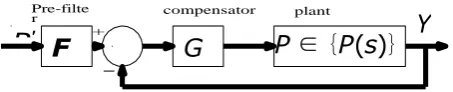
The MIMO QFT robust frequency design methodology is founded on considering 2 degrees of freedom (pre-filter F and Compensator G) in order to satisfy some robust specifications like robustness with respect to uncertainty. The pre-filter F is designed after the controller G in the aim to guarantee desired frequency response with uncertain systems.
Considering the MIMO-QFT control loop in figure 1:
Fig. 1. MIMO control loop structure
P is the matrix of transfer, minimum-phase and time invariant with uncertainties to be controlled. The closed-loop matrix T is as:
1T
I
PG
PGF
Let P −1 = [p∗ ] = Λ + B, with Λ and B are the diagonal and anti-diagonal parts of the inverse of matrix P , called P −1.
The matrix T can be reformulated into:
1
¨
T
G
GF
BT
(5)So, elements of matrix T will have be formulated
considering
G
diag g
(
ii)
andF
G
P
∈ {
P
(
s
)
}
Pre-filte r
R
′compensator plant
+
Y
[image:2.595.312.539.472.518.2]*
1
det( )
(
)
ij
ij ij
P
q
p
adj P
as:
11 12 21 22
11 21 11 22
11 11 11 12
1 11 11 12 1 11 11 12
22 11 22 12
22 21 22 22
1 22 22 21 1 22 22 21
11 11 11 11 12 12
22 21 21 22 22 22
t t
T t t
q t q t
g f g f
q g q q g q
q t q t
g f g f
q g q q g q
d d
d d
(6)
With:
1
ii ii
ii ii
q
g q
(7)ij
g f
ii ij
(8)And
,
1, 2,...,
m kj ij
h i ik
t
d
k
m
q
(9)dij is considered as “disturbance” [43], so the MISO
system is assimilated to a SISO form.
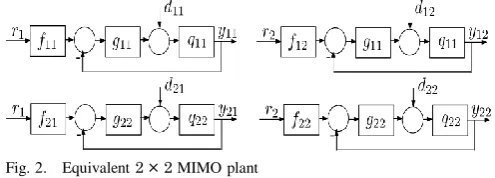
For a MIMO process with square order, for example a 2 × 2 process, the MIMO closed loop function presented in figure 1 is similar to a 4 MISO subsystems [2], [3], [42]( figure 2)
Fig. 2. Equivalent 2 × 2 MIMO plant
In QFT technique, the general aim of designers is achieving the following requirements:
Robustness of stability margin: G(s) is conceived such the following mathematical statement is endorsed:
( )
,
0,
1
P j
P s
P
P j
G j
Performance of tracking: To allow tracking, both con- troller G(s) and prefilter F (s) are
designed to confirm the next mathematical inequality. The goal is to establish a closed loop response located included in min and max bounds Tmin and Tmax:
min max
1
( )
,
0,
F j
P j
G j
T
T
P j
G j
P s
P
Performance of disturbance attenuation: The requirement here is to verify the following equation. The disturbance rejection is ensured by the fact that the sensitivity function is under TD:
1
( )
,
0,
1
P j
G j
T
D
P s
P
where
P
,
, Tmin, Tmax and TD are respectivelya possible uncertain plants, stability margin, lower and upper bounds of tracking performance and the bound of disturbance attenuation.
III. NON-INTEGERORDERCONTROLLER A. Problem statement
Next the use of MIMO QFT procedure and obtaining the MISO forms, a non-integer order PD controller is applied to control the obtained MISO forms. A fractional PDµ
controller
G(s) is described as follow:
( )
p dG s
k
k s
(10) where kp, kd, and µ are proportional, differentiator gains,non integer or fractional order of differentiation respectively. The fractional PDµ controller derives its
importance from its flexibility with regard to the integer one through fractional parameter µ. The fractional PDµ
controller have infinite possibilities. So as to apply the non-integer order controller, several researchers proposed many approximation methods in a fixed range of frequencies. In order to be physically acceptable, the P Dµ
controller need to be modified because with this expression (10) the control sensitivity function can have an infinite value so,
( )
1
d p
f
k s
G s
k
s
(11)G(s), the controller, is bi-proper or strictly proper if γ ≥ µ
[image:3.595.44.292.521.610.2]B. Controller specifications
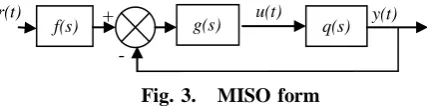
[image:4.595.56.270.113.166.2]Let the equivalent MISO simple closed loop presented asfollow:
Fig. 3. MISO form
The fractional controller, fractional pre-filter and the plant are accordingly g(s), f (s) and q(s).Phase margins and gain
have at all times served as imperative dealings of robustness. It is identified from traditional control that the phase-margin is associated to the system damping and consequently can also provide as a performance measurement. So, gain-crossover frequency (ωgc) and the phase-margin (ϕm)
specifications have been considered to provide the robustness of the system. Hence, the following conditions must be satisfied to obtain the parameters of fractional PDµ
controller. They are extracted with the respect of the next statements:
Unity in
gc (gain crossover):
gc
gc
0
dB
g j
q j
(12) Phase-margin value
m specification:
arg
g j
gcq j
gc
m(13)
Robustness warranty:
arg
0
gc
d
g j
q j
d
(14)
Noise mitigation at high frequencies:
1
dB
g j
q j
T j
A
g j
q j
(15)With A is the noise reduction value.
Disturbance rejection:
1
1
dB
S j
B
g j
q j
(16)C. Genetic algorithm multi-objective optimization Many researches are based on multi-objective optimization algorithms [20]-[23]. Many algorithms like Particle Swarm optimization, Multi-objective Bat Algorithm, Genetic algo-
rithms and Genetic algorithms II based non dominated sorting are used to obtain the optimized controller parameters. The multi-objective method of optimization utilizing evolutionary algorithms is employed in this study thanks to its simple and efficient use. Via the frequency characteristics (phase- margin ϕm and gain-crossover ωgc) and by fixing a frequency range, the non-integer controller expressions are tuned via the minimization of next criteria [23]:
1
r gc gc dB
C
g j
q j
(17)
2 min
max
m m
Cr
g j
q j
g j
q j
(18)where ϕ (g(jω)q(jω))min and ϕ (g(jω)q(jω))max are upper and lower values of phase margin in the
pre-specified frequency range
min,
max
. Thenon-integer order controller is determined based on the reduction of criteria Cr1 and Cr2 subject to
,
0, 0
2,
0
p d f
k k
and
.IV. FBLFDPRE-FILTERDESIGN A. Principle and definition
The most important constraints of FBLFD pre-filter synthesis are possessing:
No overshoots in the process output,
The shortest settling time, maximum bandwidth energy and
Maximal control law at initial time.
The final constraint is the important characteristic of FBLFD pre-filter FFBLFD. Its analytic expression is given as:
2
1
1
1
FBLFD
s
F
s
(19) With
,
1,
2
2and
1
2 .B. Synthesis of diagonal pre-filter elements
From the expression (eq.19), there are only 3 parameters which characterize the fractional pre-filter expression (τ1, τ2, η). In the aim of having best tracking
characteristics, it is desired that
( )
1
1
( ) ( )
S s
g s q s
, the sensitivity transfer function is small for low values of frequencies to attenuate the disturbances. Also, the
complementary sensitivity transfer function
( ) ( )
( )
1
( ) ( )
g s q s
T s
g s q s
must be small for highfrequencies and equivalent to unit for low values of frequencies in order to track
the reference asymptotically. y(t)
f(s) + g(s) q(s)
-
The reference sensitivity Sref function (see fig 3)
must respect the following constraint in the aim to mitigate overshoots:
maxmax
0,
refT j
u
S
j
f
j
q j
e
(20)
With umax and emax are maximum static measure of
input of the pre-filter.
From (20), the frequency constraint that allows maximal control signals, is:
max2 1 max
1
0,
1
1
g
u
j
j
g
q
e
(21)By initial value theorem, we can deduce
2by the nextexpression:
max 12 1
max
1
( )
lim
( )
s
g s q s
u
g s
e
(22)So we are requested to obtain only two parameters (η, τ1), because τ2 is function of these two parameters.
The closed-loop transfer
function /'
( )
( )
( )
1
( )
( )
ii
ii ii ii
y r
ii ii
g s q s
T
j
f s
g s q s
must beunder two bounds described below:
'
min / max
0,
0,
ii
y r
T
j
T
j
T
j
(23)
With
21
1
1
i i ii is
f
s
s
.Expression (23) becomes:
'
min /
0,
0,
0
ii
y r
T
j
T
j
(24)
' max
/ii max
0
y r
T
j
T
j
(25)With / '
min
ii
y r
T
j
and / '
max
ii
y r
T
j
are minimal and maximal closed loop transfer function values under uncertainties.Under frequency constraints (21, 22, 24, 25), the non-integer order pre-filter of various MISO forms of the
global MIMO transfer function matrix (fii)i=1...n are obtained
via the minimization of the criteria Ie, given by:
1 11 21 2 12 22
...
1 2e n n n
I
(26)
After getting the diagonal parts of the multivariable pre-filter fii we must find now the non-diagonal elements fij.
C. Synthesis of non diagonal pre-filter elements
Considering the closed loop system given by figure 1, the system output y is:
1 ' 1 1 1 * * ' 1 1 1 * * * /1 1 1
1 1 * * ' * 1 * * ' / d d d d
d d d
d d b b b y r
d d d d d d
d b b b b y r d b
y
I
PG
PGFr
I
P
G
P
G Fr
I
P
G
P
G
P
G T
Fr
I
P
G
P
G F r
I
P
G
P
G F
G
P
G T
F
F
r
(27) WithP
d*,G
d andF
d respectively the diagonal parts of inverse of the plant matrixP
*
P
1, the controller matrix G and the pre-filter matrix F. The anti diagonal parts of inverse of the plant, controller and pre-filter matrix are correspondinglyP
b*,G
bandF
b.The system output y can be divided into two diagonal
'
/ii
y r
T
and anti-diagonal / ' ijy r
T
parts:' '
/ii /ij
y r y r
y
T
T
(28) Where:
' 1 1 1 * * '/ii d d d d d
y r
T
I
P
G
P
G F r
(29)
' 1 1 1 * * / * ' / 1 1 1 * * 'ij d d d
y r
d b b b b y r d b
d d d
T
I
P
G
P
G F
G
P
G T
F
F
r
I
P
G
P
Cr
(30)With C is the coupling matrix given by:
, 1.. 1 * 1 11
1
1
nij i j n ii ij ij ik kj ik k
n n
ik ik ik kl lk l k
C
c
g f
g f
p
g
t f
(31)With
ij and
ikrepresent the kronecker functions.Considering some hypothesis which is subject of another paper [32], the non diagonal
obtained by according zero to the coupling effects C.
*
*
jj jj
ij ij ij ij
jj jj ii
g
f
f
p
g
g
p
g
g
(32)V. DESIGNGUIDELINES
In order to control MIMO plant systems by our methodology, we recommend following these steps:
Step 1: Applying the RGA (Relative Gain Array) method is essential to get the pairing rules between inputs and outputs.
1
TRGA
P
P
Based on the obtained RGA matrix, the result of pairing rules can be extracted.
Step 2: Fixing the performance specifications (equations (12), (13), (14), (15) and (16)) and based on the multi- objective optimization (minimizing Cr1 and Cr2), the fractional PDµ
controller for each MISO structure(plant qii) is
designed (see paragraph B and C in section III).
Step 3: Synthesis of diagonal elements of the fractional pre-filter of type FBLFD fii respecting all frequency constraints (from equation (20) to (25)) and by the minimization of the integral gap criteria given by the inequality (26) (paragraph B in section IV).
Step 4: Determination of non diagonal terms of fractional pre-filter matrix fij by elimination of
the coupling matrix. After obtaining the adequate diagonal elements of controller G(s) and pre-filter
F (s) of each plant, the non diagonal element fij of
the pre-filter matrix F (s) can be deduced from expression (32) (paragraph C in section IV).
Step 5: Checking of the design performances by applying the proposed methodology an uncertain system (SCARA). It is time to verify if all plant cases are into the desired fixed ranges and if the interactions between loops are decreased by the new designed non diagonal pre-filter matrix (section VI).
VI. RESULTS A. Process model
The suggested methodology is tested on the model of a SCARA robot [44]. Our aim is the control of the joint angles
δ1 and δ2 (see fig.4).
A linearized SCARA robot process is given by the transfer function matrix P with u1,2 are value of the control signals
to be applied the robot motors.
1 1 11 12 1
2 2 21 21 2
( )
( )
( )
( )
( )
u
p
s
p
s
u
P s
u
p
s
p
s
u
(33)With:
2 3
2 2
2 3 1 3 1
1 1
( ) ( )
( )
2
1 1
( ) ( )
h s
s s k s k
P s
h h s
s k s s k
(34) Where
2
2 1 0
( )
s
s
s
(35)αi,i=1,2,3 and ηj,j=0,1,2 are as follow:
With:
k Power amplifier gain
Coefficients of viscous friction Moment of inertia
Mass ith link Length of link 1 h Cosine value of
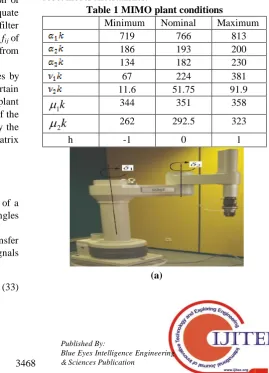
2 [image:6.595.47.280.53.131.2] [image:6.595.272.542.462.835.2]The robustness issue can be highlighted as follows. Supposing that P, the plant transfer function, belongs to a set of {P}. By considering some specifications of the closed loop system, a controller is qualified by robustness through respect to this specification, if it maintains this specification for all plants in {P}. Table 1 present the robot model uncertainties.
Table 1 MIMO plant conditions
Minimum Nominal Maximum
719 766 813
186 193 200
134 182 230
67 224 381
11.6 51.75 91.9
1
k
344 351 3582
k
262 292.5 323h -1 0 1
Fig.4. (a), (b): SCARA robot and its angles
The diagonal closed-loop transfer function / ' ii
y r
T
mustrespect the following inequalities:
'
min / max
0,
0,
T
T
y r dT
(36)For 2 × 2 MIMO system:
min 2
2.25
( )
4.5
2.25
/ 10 1
T
s
s
s
s
(37)
max 2
12.25
/ 30 1
( )
5.25
12.25
s
T
s
s
s
(38)And the robust stability margin is described by:
( )
1.2,
1, 2,
1
ii ii ii
ii ii
q g
T s
for i
q g
(39)B. Controller design
The MIMO QFT methodology is used to obtain MISO subsystems (see figure 2). Each MISO systems must respect following characteristics:
a) Closed-loop 1:
Unity-gain frequency ωcg = 1;
Phase-margin ϕm = 70◦;
Frequency lower interval value ωmin = 1;
Frequency upper interval value ωmax =
10ωcg
b) Closed-loop 2:
Unity-gain frequency ωcg = 1;
Phase- margin ϕm = 70◦;
Frequency lower interval value ωmin = 1;
Frequency upper interval value ωmax = 10ωcg
The above presented specifications for control loop 1 and 2 are required in the fitness function development which is based on the two criteria given by (17) and (18).
The fractional PDµ controller is as follow:
11 22
0
0
g
G
g
(40) Where:
1
ii di ii pi
fi
k s
g
k
s
(41)4 parameters in the case of PDµ controller will be optimized. Each chromosome structure is presented as
chromi = [kpi kdi µi τfi]. The simulation is based on the real
representation of each chromosome.So, in order to obtain responses with no overshoots, the fractional derivative order is chosen as µi∈ [0, 1] and γi is equal to = 1 (µi < γi in order
to have a strictly proper controller). Based on several trials (trial and error method), the area of the rest of the fractional controller elements are selected as: kpi∈ [0, 10000], kdi∈ [0,
10000], and τfi ∈ [0, 1].After minimization of the two
criteria Cr1 and Cr2 ( eq 17 and 18), the multi-objective optimization by genetic algorithms gives:
0.92
11
2137.64
1023.998
1 0.026
s
g
s
(42)0.998
22
1731.534
1024.701
1 0.046
s
g
s
(43)The CRONE toolbox [45] is used in this paper to give the integer order approximation of the obtained controllers (eq.42,43) :
11
3.912 05
1.859
0.
1024(
)(
)(
)
(
2532
0.6
918
)
(
38.
4
6
)(
6
918)
g
s
e
s
s
s
s
s
(44)
22
1024.7
3.706 05
1.032
0.5582
0.9908
(
)(
)(
)
(
)
(
21.74
)
(
9
9 8)
0
s
e
s
s
s
s
s
g
(45)
C. Pre-filter design
The pre-filter expression is a matrix of order 2:
11 22
0
0
f
F
f
(46)Minimizing the criterion (eq 26) with consideration of all frequency constraints and performance specifications (eq.21, 22, 24, 25, 37, 38, and 39) the optimized diagonal elements (f11 and f22) parameters of the non diagonal pre-filter matrix F are:
link 2
δ
2
link 1
δ
1
21 11
11 1.382
1
1
1 0.049
1 0.908
s
f
s
s
s
(47)
2
22 22
12 1.497
1
1
1 0.001
1 0.806
s
f
s
s
s
(48)
Based on Oustaloup approximation [5], we can get the integer expression of diagonal elements of fractional pre-filter F:
11
0.017449
22.89
11.91
237.9
29.
(
)(
)
(
)(
)
(
72
)
(
)
7.58
0.8848
s
s
s
s
s
f
s
(49)22
4.5934
05
83.5
10.29
237.9
29.72
2 1562
6.1
(
0
)(
)
(
)(
)
(
)
(
)(
)
1 05
3.518
0.9672
e
s
s
s
s
s
s
e
s
s
f
(50)
A reduced model of the non-diagonal parts f12 and f21 of
the pre-filter F are obtained using eq (32):
2
12 2
0.029959
(
148.9
2.939
)
(
)
04
1208
(
3.507
8.926
)
s s
s
e
s
s
s
f
(51)
21
0.00017144
853.4
616.1
160.3
59.83
9.824
76
(
)(
)(
)
(
)(
)
(
9.4
)
(
91.
93
)(
31.3
3.872
0.9885
)
(
)(
)
s
s
s
s
s
s
s
s
s
s
f
(52)
D. Simulation
For all following figures (5,6 and 7), the figure (a) represent the control loop 1 corresponding to the first robot link and the figure (b) is for the control loop 2 of the second robot link.
a) Diagonal pre-filter approach
Using the diagonal pre-filter matrix 11 22
0
0
f
F
f
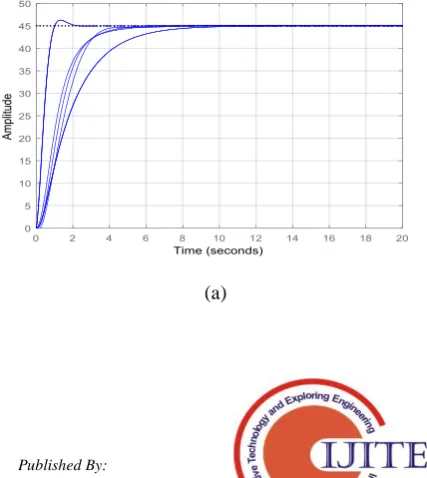
(see(49)-(52)) and the PDµ controller (see (40), (42) and (43)), the closed loop 1 and 2 step (of amplitude 45◦) responses of the MIMO system under uncertainties are given by figure 5.
(a)
(b)
Fig. 5. (a), (b):Closed loop tracking using diagonal fractional pre-filter and P Dµ fractional controller
(tracking references : discontinued line, closed loop responses: continued line )
b) non diagonal pre-filter approach
Figure 6 gives the closed loop step (of amplitude 45◦) responses of the system using the non diagonal pre-filter
matrix
11 12
21 22
f
f
F
f
f
(see (49)-(52)) and and the PDµ fractional controller (see (40),(42) and (43)).
The data obtained in figure 5 and 6 are broadly consistent with the major trends. All step responses of first and second loops under uncertainties are into the desired tracking lower and upper bounds which confirm the robustness of developed fractional PDµ controller. Also, the ability of both diagonal
and non diagonal fractional pre-filters of type FBLFD to shift the steps responses under desired tracking specifications is confirmed.
[image:8.595.321.528.66.314.2] [image:8.595.324.538.573.812.2](b)
Fig. 6. (a), (b):Closed-loops 1 & 2 tracking utilizing non-diagonal non- integer pre-filter and P Dµ
non-integer controller (tracking ref.: broken line, closed-loops 1 & 2: unbroken line)
a) coupling effects:
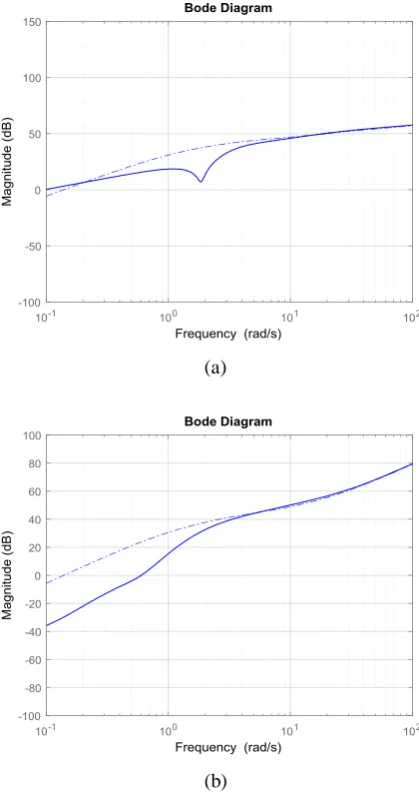
Now, the coupling effects which are described by eq (31) are represented by the figure 7 in frequency domain.
Observing figure 7, the finding was quite respectable and shows the benefits of using the non diagonal version of the fractional pre-filter of type FBLFD in the reduction on interactions between loops.This paper proposes a new approach combining the QFT technique with a non-integer order controller and non-integerorder pre-filter designs. To our knowledge, this the first studyto deal with multi-objective optimization of a non-integer order controllers utilized with an implicit non integer FBLFD pre- filter to find solutions of multi-variable systems and especially the problem of loop interactions. The fractional proposed controllers are selected after a multi-objective optimization based on genetic algorithms. After using a random initial chromosome and selecting the search domain of each parameters in this chromosome, the minimization of the specified criteria are done and an optimized fractional order controller of type PDµ is obtained. This obtained
controller is used in another algorithm of optimization to extract the diagonal terms of the fractional FBLFD pre-filter matrix. The integral gap criterion (see eq.(26)) is used here to obtain the pre-filter optimized parameters. After this step, we are called to obtain the non diagonal parts of fractional order pre-filter matrix that reduces the interaction effects between control loops. The designed fractional controller (PDµ and diagonal and non diagonal fractional pre-filter of
type FBLFD are tested via the application of step signal in the input of MISO equivalent sub-systems. Observing figures 5 and 6, it is clearly that the step responses of the closed-loop with uncertainties are under upper and lower tracking specifications. Figure 7 indicates the frequency responses of the interaction effects given by the expression (31). It is shown that using non diagonal fractional FBLFD pre-filter gives a small interaction compared to the used diagonal pre-filter.
(a)
(b)
Fig. 7. (a), (b):Coupling effects of loop 1 and 2(Using diagonal pre- filters: discontinued line, Using non
diagonal pre-filters: continued line ) VII. CONCLUSION
This work presents new control strategies for MIMO systems. It is required to transform the original MIMO systems in MISO structures. A non-integer PD controller is applied to command equivalent subsystems and after that a non- integer order FBLFD pre-filter is used here so as to shift the closed loop transfer function in the specified region under all uncertainties. A structure of fractional controller is considered in this article: the non-integer derivative controller PDµ . A multi-objective optimization based on
genetic algorithms is proposed to obtain controller parameters. The fractional pre- filter of type FBLFD is used in two different forms, the first one is a multi-variable diagonal matrix and the second is in non-diagonal form. Diagonal elements of pre-filter matrix are designed while respecting the frequency specifications and the non diagonal parts of the pre-filter matrix is developed to eliminate the subsystems interaction. The effectiveness of our proposed methods are assessed on robot model of type SCARA. A Comparison with other control design using the same model of this robot is presented in this
[image:9.595.76.283.61.251.2] [image:9.595.319.529.62.460.2]of the results. Future works will interest to develop a complex order controller and to generalize this method with time delayed MIMO systems.
ACKNOWLEDGMENT
I express my deep gratitude to Mr. Fathi Mnasri, a senior teachers in English language and a former lecturer at Oman HCT and VTCs.
REFERENCES
1. S.Skogested , I.Postlethwaite, Multivariable feedback control: analysis and design. Wiley, Chichester, 2005.
2. I.Horowitz, “Some ideas for QFT research”, International Journal of Robust and Nonlinear Control, Vol.13, 2003, pp.599-605.
3. I.Horowitz, Application of quantitative feedback theory (QFT) to flight control problems, In. 29th IEEE Conference on Decision and Control, honolulu, hawaii, December 1990.
4. K.-B. Oldham, J. Spanier, Fractional calculus: theory and applications of differentiation and integration to arbitrary order. Academic Press, Inc., New York, London, 1974.
5. Oustaloup, O. Cois, L. LeLay, Representation et identification par modele non entier, Hermes-Lavoisier, 2005.
6. A.-A. Kilbas , H.-M. Srivastava , J.-J. Trujillo, Theory and applications of fractional differential equations. Elsevier, Neatherlands, 2006. 7. S. Kempfle, I. Schafer, H. Beyer, ”Fractional calculus via functional
calculus, theory and applications”, Nonlinear dynamics, vol.29, 2002, pp. 99-127.
8. S. Sutha , P. Lakshmi ,S. Sankaranarayanan, “Fractional-Order Sliding Mode Controller Design for a Modified Quadruple Tank Process via Multi-Level Switching”, Computers & Electrical Engineering, Vol. 45, 2015, pp.10-21.
9. J. Wang, Ch. Shao, Y.-Q. Chen, “Fractional order sliding mode control via disturbance observer for a class of fractional order systems with mismatched disturbance”, Mechatronics, Vol. 53, 2018, pp. 8-19 10. Jun-Yi , L. Jin , C. Bing-Gang, Optimization of fractional order
controllers based on genetic algorithms. In: Proceedings of the Fourth International Conference on Machine Learning and Cybernetics, Guangzhou, 2005, pp. 5686-5689
11. L. Ying , Ch. Yang Quan, Fractional-order [Proportional Derivative] controller for robust motion control: tuning procedure and validaion. In: American control conference, St Louis, MO, USA, 2009, pp. 1412-1417 12. I.-M. Cristina , H.-D. Eva , C. Cosmin, De-K. Robin, I. Clara, “Design and analysis of a multivariable fractional order controller for a non- minimum phase system”, Journal of Vibration and Control, Vol.22(9), 2015, pp. 2187-2195.
13. Podlubny, “Fractional-order systems and PI-lambda-D-mu con- trollers”, IEEE Transactions on Automatic Control, Vol.44(1), 1999, pp. 208-214. 14. Xue , C. Zhao, Y. Chen, Fractional order pid control of a dc-motor with clastic shaft: a case study. In: Proceedings of American control conference, 2006, pp.3182-3187.
15. J. Cervera , A. Banos Automatic loop shaping in QFT by by fractional structures. In: Proceedings of the 2nd IFAC workshop on fractional differentiation and its application. Porto, Portugal, 2006.
16. J. Cervera , A. Banos, Tuning of Fractional PID Controllers by Using QFT. In: Proceedings of IECON 32nd Annual Conference of IEEE Industrial Electronics Society, Paris, France, 2006.
17. D.-N. Gruel , P. Lanusse, A. Oustaloup, ”Robust control design for multivariable plants with time-delays”, Chemical Engineering Journal, Vol. 146(3), 2009, pp. 414-427.
18. Pisano , M.-R. Rapaic , Z.-D. Jelicic , E. Usai , et al., “Sliding mode control approaches to the robust regulation of linear multivariable fractional-order dynamics”. International Journal of robust and nonlinear control, Vol. 20, 2010, pp. 2045-2056.
19. J. Sabatier, P. Lanusse , P. Melchior, A. Oustaloup, ,Fractional Order Differentiation and Robust Control Design. Springer, 2015.
20. Y. Jianmin , W. Qiang , Zh. Zhimin , L. Xubin, ”Multi-objective opti- mizations of multidirectional forming mold based on fractional factorial design”. International Journal of Advanced Manufucturing Technology, 2017, DOI 10.1007/s00170-016-8844-5
21. A.-C. Escamilla, F.-J.Torres , F.-G. Aguilar , G.-F. Escobar-Jime´nez, V. Guerrero-Ram´ırez, “On the trajectory tracking control for an SCARA robot manipulator in a fractional model driven by induction motors with PSO tuning”. Multibody System Dynamics, 2017, DOI 10.1007/s11044- 017-9586-3
22. S.-K.Verma , S. Yadav, S.-K. Nagar, “Optimization of Fractional Order PID Controller Using Grey Wolf Optimizer”. Journal of Control, Automa- tion and Electrical Systems, Vol. 28: 314, 2017, DOI:10.1007/s40313-017-0305-3
23. B. Saidi , M. Amairi , S. Najar, M. Aoun, Fractional PI design for time delay systems based on min-max optimization. In: Proceeding of ICFDA’14 International Conference on Fractional Differentiation and its applications, Italy, 2014.
24. Krokhin, P. Jeavons, P. Jonsson, “Constraint satisfaction problems on intervals and lengths”. SIAM Journal on Discrete Mathematics, Vol.17(3), 2004, pp. 453-477
25. Jun-yi , C. Bing-gang, Design of Fractional Order Controllers Based on Particle Swarm Optimization. In: Proceeding of the 1st IEEE Con- ference on Industrial Electronics and Applications, Singapore, Singapore, 2006. 26. P.-S.V. Nataraj , S. Tharewal, “An interval analysis algorithm for
automated controller synthesis in QFT designs”, Journal of dynamic systems, measurement, and control , Vol. 129(3), 2007, pp 311-321. 27. Z. Majid , K.-Gh. Masoud , S. Nasser , P. Mostafa, “Design of a
fractional order PID controller for an AVR using particle swarm optimization”. Control Engineering Practice, 17(12), 2009, pp. 1380-1387.
28. N. Nasirpour, S. Balochian, “Optimal design of fractional-order PID con- trollers for multi-input multi output (variable air volume) air-conditioning system using particle swarm optimization”. Intelligent Buildings interna- tional, Vol.9(2), 2016, pp. 107-119.
29. D.-M. Patil ,P.-S.V. Nataraj , V.-A. Vyawahare , “Design of robust fractional-order controllers and prefilters for multivariable system using interval constraint satisfaction technique”. International Journal of Dy- namics and Control, 2015, DOI: 10.1007/s40435 − 015 − 0187 − 9 30. N. Yousfi, P. Melchior, Ch. Rekik , N. Derbel, A. Oustaloup, “Path
tracking design based on Davidson-Cole prefilter using a centralized CRONE controller applied to multivariable systems”, Nonlinear Dynam- ics, Vol.70(4), 2013, pp.701-712.
31. N. Yousfi, P. Melchior, C. Rekik, N. Derbel, A. Oustaloup, “Path tracking design by fractional pre-filter using a combined QFT/H∞ design for TDOF uncertain feedback systems”, Journal of Applied Nonlinear Dynamics, Vol.1(3), 2012, pp.239-261.
32. N. Yousfi , N. Derbel, P. Melchior, “Non-diagonal multivariable frac- tional prefilter in motion control”, International Journal of Modelling, Identification and Control, Vol. 28(3), 2017, pp.271-283
33. N. Yousfi, R. Jallouli Khlif , P. Melchior, Lanusse P., Derbel N. , A. Oustaloup, Path Tracking Design by Frequency band Limited
Fractional Differentiator Prefilter: Square MIMO Systems. In: International Confer- ence on Fractional Differentiation and its Applications, Catania, Italy, 2014.L. Euler, Institutiones Calculi Differentialis. Saint Petersburg, 1755.L. Euler, Foundations of Differential Calculus. New York, Springer, 2000.
34. T.-J. Osler, “The integral analog of the Leibniz rule”, Mathematics of Computation ,Vol. 26, 1972, pp.903-915.
35. Letnikov, ”Theory of differentiation of fractional order”, Matematich- eskii Sbornik, Vol.3, 1868, pp.1-68.
36. J. Liouville, Me´moire sur le calcul des différentielles à indices quel- conques”, Journal de l’Ecole Polytechnique, Vol.13, 1832, pp. 71-162. 37. F. Mainardi, ”Fractional relaxation in anelastic solids”, Journal of Alloys
and Compounds, Vol.211/212, 1994, pp. 534-538.
38. B. Ross, Fractional calculus and its applications. In: Proceedings of the International Conference, New Haven. New York, Springer-Verlag, 1974.
39. R. Metzler, J. Klafter, ”The random walk’s guide to anomalous diffusion: a fractional dynamics approach”, Physics Reports, Vol. 339, 2000, pp.1-77
40. Horowitz, “Improved design technique for uncertain multiple input- output feedback systems”. International Journal of Control, Vol. 36, 1982, pp. 977-988.
41. P. Melchior, C. Inarn, A. Oustaloup, Path tracking design by fractional prefilter extension to square MIMO systems. In: Proceedings of the ASME 2009 International Design Engineering Technical Conferences and Computers and Information in Engineering Conference, California, USA, 2009.
42. M. Garcia-Sanz,et al., Robust Control Engineering: Practical QFT Solutions, CRC press, 2017.
AUTHORSPROFILE
Najah YOUSFI was born in Tunisia in 1984.She is graduated from the Sfax university in Automatic Control and Industrial Computing in 2008, she obtained her PhD in Automatic Control Theory in 2012 and the Accreditation to Supervise Research in 2019. She is currently an Assistant Professor in Control Theory at the Taif engineering School and a researcher in the Automatic Control between the Taif Engineering School and Control & Energy Management (CEM) Laboratory of Sfax University. Her research interests are in the area of fractional systems, control theory and robotics (fractional motion planning).
Nabil DERBEL received his Engineering Diploma from the National school of engineers of Sfax in 1986, Diplome d’Etudes Approfondies in Automatic Control from the National Institute of applied sciences of Toulouse in 1986, University Doctorate from the Laboratory of Automatic and System Analysis of Toulouse in 1989, and State Doctoral from the National School of Engineers of Tunis. He joined the Tunisian University since 1989, where he held different position involved in research and education. Currently, he is a Full Professor of Automatic Control at the National School of Engineers of Sfax. His current interests include: optimal control, complex systems, fuzzy logic, neural networks, and genetic algorithms. He is the author and the co-author of more than 40 journal papers and of more than 250 conference papers.
Pierre MELCHIOR graduated from the Bordeaux 1 University in Electrical Engineering in 1984 and he obtained his PhD in Control Theory from Paul Sabatier University in 1989. He is currently an Associate Professor in Control Theory at the IPB/ENSEIRB-TIATMECA Engineering School and a Researcher in the Automatic Control LAPS Department (Control Engineering, Production Systems and Signal Processing) of the IMS Laboratory of Bordeaux 1 University-IPB/ENSEIRB TIAT MECA. He is a Co-manager of the LAPS CRONE team. His research interests are in the area of fractional systems, system identification, control theory and robotics (fractional path planning, fractional motion planning).