491
Published By:
Blue Eyes Intelligence Engineering & Sciences Publication
Retrieval Number: F10990486S319/19©BEIESP
Abstract: Use of active and passive control techniques are reported in the literature for regulation of the base pressure in order to reduce the base drag in aerodynamic vehicles. In this work, air flow from a nozzle expanded suddenly into a duct of larger area than the nozzle exit area is studied in detail using active control. Using four micro jets each of 1 mm diameter placed on the periphery of the nozzle exit, the base pressure is actively controlled. The flow Mach number operated is 1.7, 2.3, and 2.7 whereas the length to diameter (L/D) ratio of the enlarged duct is reduced from 10 to 2. The nozzle pressure ratio (NPR) chosen is 1 to 10 for each value of Mach number and L/D ratio with and without control. The area ratio is fixed at 7.56. A detailed comparative base pressure variation analysis is performed using a controlled and uncontrolled flow. The results show that the at higher L/D ratio the base pressure variation using control is negligible whereas, at lower L/D ratio and Mach 1.7, the base pressure variation is significant for both the cases of control and without control.
Keywords: Base flow; active control; base pressure; micro jets; area ratio; base drag.
I. INTRODUCTION
In aerodynamic vehicles like as rockets, missiles, projectiles etc. the flow separation causes the recirculation region to be formed, which is of low pressure. Generally, the pressure in this recirculation region is considerably of reduced strength than the pressure of free stream atmosphere. The low pressure at the base results in pressure difference causing base drag which can be up to 1/3rd of the
total drag during their supersonic speed [1]–[3]. This base drag is around 10 percent of the drag caused by skin friction during the sub-sonic flow. Various techniques exist to reduce this base drag such as base burning, boattail, and base bleed. Many researchers attempted to the study in detail about the suddenly expanded flows due to their broad applicability in aerodynamic vehicles. Passive control techniques were used to control the base pressure. However, use of active control to reduce the base drag are generally less [4]–[11].
Several studies have been reported in literature related to the sudden expansion of flows and techniques adopted in the reduction of base drag in those flows. Rathakrishnan et al. [3] analyzed the suddenly expanded subsonic flow field using the cavities as a passive control mechanism. From their study, it was concluded that the cavities effect on the primary flow field is well noticeable for bigger ducts and the aspect ratio of cavity also has a profound effect on the enlarged duct flow field and base pressure. With a change in aspect ratio from 2 to 3, it was seen that the decrease in base
Revised Manuscript Received on April 12, 2019.
Fharukh Ahmed G M, Department of Mechanical Engineering, Bearys Institute of Technology, Mangalore, Karnataka, India
Sher Afghan Khan, Department of Mechanical Engineering, Bearys Institute of Technology, Mangalore, Karnataka, India.
pressure was obtained whereas with a change in aspect ratio from 3 to 4, caused increase in base pressure. Asadullah et al. [12] analyzed wall pressure distribution for low supersonic Mach number, i.e., at 1.3. The results showed that the expansion and compression waves reduced drastically at L/D =3 due to variation in back pressure. NPR of 2.77 and 4.16 was used in another experimental investigation for base pressure reduction analysis using active control for an area ratio of 2.56. The L/D=8 and 10 revealed a completely different base pressure variation compared to L/D ratios of higher values. Negligible increase in wall pressure for under expanded flows was obtained, and for the case of with and without control, the effectiveness remained same [13].
For Mach numbers of 1.87, 2.2 and 2.58 and area ratio 4.84 with NPR variation from 3 to 11, the study by Baig et al. [14] concluded that 45% increase in base pressure is obtained. Another similar study using area ratio of 6.25 with NPR from 3 to 11 and L/D ratio of 1 to 10 gave an increase of about 55% of base pressure using active control. A thorough analysis is also reported related to wall pressure distribution for an area ratio of 2.56 for the same L/D ratio and NPR. The results revealed that the wall pressure distribution does not have any adverse effect on the enlarged duct. One more study was carried out by the same authors to improvise the base pressure without hurting wall pressure distribution [15]. Khan et al. [16] operated control for Mach numbers 0.2, 0.4, 0.6, 0.8, and 0.9 and with area ratios of 2.56, 3.24, 4.84, and 6.25. Length to diameter (L/D) ratio was varied from 1 to 10 during the experimentation. Reduction in base pressure using microjets and no adverse effect on wall pressure was obtained. Baig et al. [17] carried similar study for an area ratio of 3.24 for NPR from 3 to 11 and obtained a 70% increase in base pressure.
In yet another study of Baig et al. [18] performed another single study at Mach 1.87 while the area ratios were varied accordingly as 2.56, 3.24, 4.84, and 6.25. Under expansion study was performed choosing and length to diameter ratio was varied from 1 to 10. 80% increase in base pressure was obtained, an area ratio of 6.25 and 4.84 is found suitable for length to diameter ratio of 2, and for area ratios 2.56 and 3.24 the length to diameter ratio of 2 is found suitable. Ashfaq et al. [5] carried out a series of experiment considering sonic Mach numbers to control the base pressure by providing four microjets. Area ratios of 2.56, 3.24, 4.84, and 6.25, and L/D ratio of 1 to 10 was operated for the experimental analysis. The area ratio of 6.25 and NPR of 1.5, 2.0, and 3.0 was applied which lead to effective
Active Control of Base Pressure using Micro
492
Published By:
Blue Eyes Intelligence Engineering & Sciences Publication
Retrieval Number: F10990486S319/19©BEIESP
control of base pressure [19]. Another study is reported by them for under expanded flow for subsonic and sonic flows with nearly the same configuration [20].
Baig et al. [21] carried experimental investigation using the control to reduce base pressure in sudden expansion flows with the axi-symmetric passage. Microjets at four different locations were used to control the base pressure. Mach numbers of 1.87, 2.2 and 2.58 were employed for the experimental investigation. The area ratio was fixed at 2.5, and the length to diameter ratio was varied from 1 to 10. Nozzle pressure ratio (NPR) of the operating nozzles were changed from 3 to 11. As high as a 65% increase in base pressure was obtained during their analysis, and it was found that the flow field was not disturbed in the enlarged duct using the microjets. Quadros et al. [22] used the L9 orthogonal array for the planning of experiments and found that the lower area ratios are useful in control than the higher area ratios. Analysis of variance and multiple linear regression analysis were performed for the obtained experimental results. Fifteen random test results were used for the prediction of accuracy to test two linear regression models. Their analysis revealed that the linear regression model is enough to predict the base pressure accurately with and without control. Computational fluid dynamics analysis were performed for further in-depth analysis and validation was performed with the experimental results. For Mach number 1.25 and nozzle diameter ratio of 1.6 experiments were performed for under-expanded and correctly expanded cases by Khan et al. [23]. Surprisingly, the flow filed became oscillatory for a particular combination of NPR and L/D ratio. The oscillatory nature of the flow in the duct was observed in the case of both controls and without control. Several other relevant research works carried out using active control include [24]–[33].
From this literature review of recent articles shows that many studies are conducted to reduce base pressure in sonic, transonic and supersonic flow using passive and active controls. However, for Mach number of 1.7, 2.3, and 2.7, area ratio of 7.56 the combination of NPR and L/D ratios the base pressure analysis is not reported. In this article use of active control technique to reduce base pressure with the aid of microjets is reported in detail.
II. EXPERIMENTAL PROCEDURE
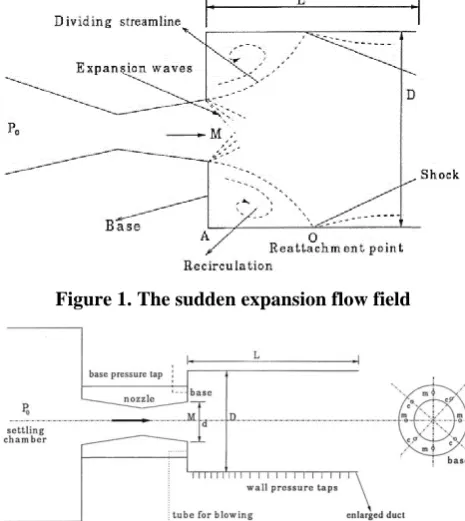
Figure 1 shows the essential features of sudden expansion flow filed is illustrated showing the reattachment point, expansion waves, and recirculation zone. The same concept is used to perform the experimental investigation with the application of four micro jets at the base as shown in Figure 2. The experimental facility available at High-Speed Aerodynamics Laboratory (HSAL), IIT, Kanpur, is employed for the analysis. The experimental setup is schematically shown in Figure 2. The side view shown at the right side of Figure 2 shows the presence of eight holes along the circular position outer to the nozzle exit. The holes marked with ‘c’ are the microjets placed suitably for blowing and holes ‘m’ marked in the Figure are to measure the base pressure (Pb). By blowing air, active control is accomplished through the holes ‘c’ consuming the pressure from a tube connected through the blowing chamber as shown in Figure 2. The blowing chamber uses the same
[image:2.595.310.543.310.571.2]pressure from the settling chamber. To measure the wall pressure and the flow field nature in the duct (enlarged one), pressure taps were used on the wall. At a distance of 8 mm each, holes are made which are nine in number, and the remaining holes are prepared at a distance of 10 mm. The Length to diameter ratio (L/D) used in this study is varied from 10 to 1, and the readings for each ratio is conducted. The experiment is repeated for Mach numbers like 1.7, 2.3, and 2.7. In literature usually, L/D ratio employed is 3 to 5 for without control. With control, this ratio can be varied from 10 to 1. For each value of each number, L/D ratio, with and without control the NPR is varied from 1 to 10 in a step of 1 each, and the readings are noted every single time. PSI System 2000 is used as a pressure transducer to record the change in base pressure variation. The pressure range is 0-300 psi of the transducer employed, and it has 16 channels. The sampling rate of the pressure transducer is 250 samples per second, and then the reading is displayed on the monitor and recorded. The wall pressure were recorded using mercury manometer.
Figure 1. The sudden expansion flow field
Figure 2. Experimental setup for active control
III. RESULTS AND DISCUSSIONS
493
Published By:
Blue Eyes Intelligence Engineering & Sciences Publication
Retrieval Number: F10990486S319/19©BEIESP
[image:3.595.302.547.75.607.2]shown in Figure 2. The Mach numbers for the analysis chosen are 1.7, 2.3, and 2.7. The L/D ratios selected for the base pressure variations are 10, 6, 4, and 2. The base pressure and wall pressure are non-dimensionalized using back pressure (Pa). Detailed comparative analysis of base pressure with no control (NOC) and with control (WC) is provided in this section. The area ratio in the pressure investigation is fixed at 7.56 throughout.
Figure 3. Variation of base pressure at L/D=10
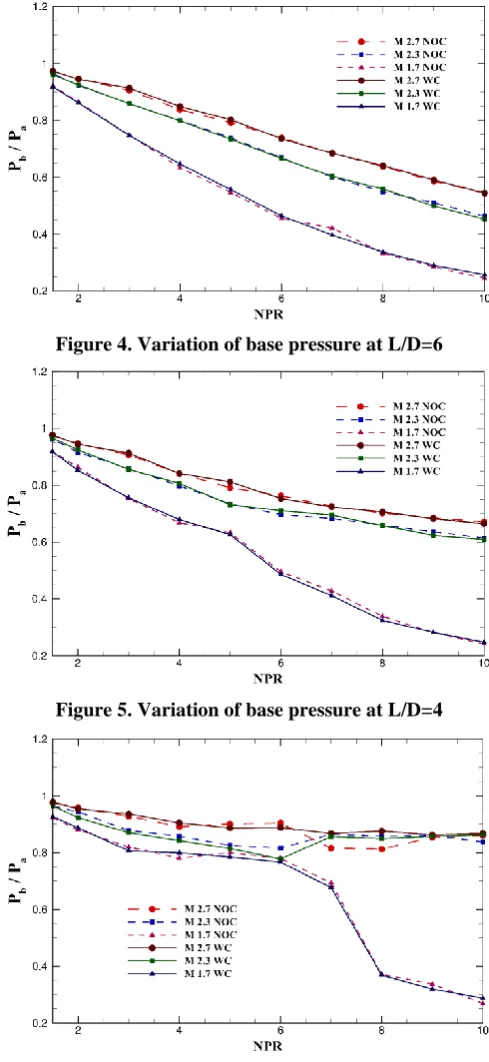
In Figure 3, the variation of base pressure with NPR varying from 1 to 10 at Mach numbers 1.7, 2.3, and 2.7 for a flow having active control and no control is shown. The L/D ratio for this analysis is kept at 10. It is evident enough that, the functional dependence of base pressure with an increase in NPR remains unaltered with active control. Slight effectiveness of control can be seen at all NPR in modifying the base pressure. It is seen from the results that in the supersonic regime the Mach number has got a powerful influence on the base pressure. The decrease in base pressure with NPR can be attributed to shock at the nozzle exit turning the flow away from the base. The increased area ratio also affects the base pressure mostly as the NPR at a particular Mach number dictates the level of expansion. When the L/D=6 is adopted, the base pressure results obtained are shown in Figure 4 for different Mach numbers. The nature of base pressure variation with control and with no control for different NPR's is similar to the case of L/D=10. The control is not useful at all NPR and for different Mach numbers chosen. However, in both the cases, the base pressure remains decreasing due to the shifting of reattachment length along the length of the duct wall. The effect of L/D=4 for change in base pressure is depicted in Figure 5. Comparison between Figure 4 and 5 reveals that the L/D ratio of 6 and 4 have the same effect on base pressure variation with NPR. The marginal effect of control and without control is obtained at this L/D ratio as clearly can be seen from Figure 5.
The base pressure variations shown in Figure 6 belong to the L/D ratio of 2. The trends obtained are different from those obtained from higher L/D ratios. Till NPR 6 the base pressure at all Mach number remains higher with or without control as the flow is not attached to the wall of the duct. Whereas for Mach 2.7 it acquired the very high value of base pressure and control results in a decrease of base pressure. The interpretations of these results also indicate
that further reduction in L/D ratio will result in no attachment of flow to the duct wall.
Figure 4. Variation of base pressure at L/D=6
Figure 5. Variation of base pressure at L/D=4
Figure 6. Variation of base pressure at L/D=2
[image:3.595.47.291.159.324.2]494
Published By:
Blue Eyes Intelligence Engineering & Sciences Publication
Retrieval Number: F10990486S319/19©BEIESP (a) Mach 1.7
(b) Mach 2.3
[image:4.595.46.294.45.553.2](b) Mach 2.7
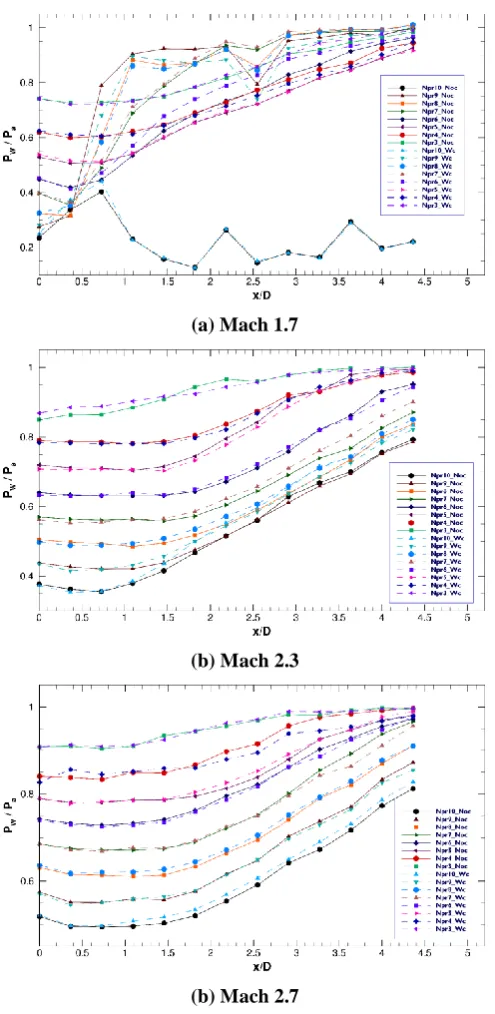
Figure 7. Distribution of wall pressure for L/D=10
IV. CONCLUSION
Experimental research work is carried in this article to analyze the effect of active control on base pressure variation. Investigations are performed at Mach number of 1.7, 2.3, and 2.7, NPR 1 to 10, and L/D ratio from 10 to 2. It is concluded from the results that in the supersonic regime the Mach number has got a powerful influence on the base pressure. The L/D ratio of 6 and 4 have the same effect on base pressure variation with NPR but, the marginal effect of control and without control is obtained. At L/D ratio of 2, the results obtained are different from those obtained from higher L/D ratios. Till NPR=-6 the base pressure at all Mach number remains higher with or without control as the flow is not attached to the wall of the duct. Whereas for Mach 2.7 control results in a decrease of base pressure.
REFERENCES
1. A. K. Rathakrishnan, E, Sreekanth, “Flows in pipes with sudden enlargement,” in 14th International Symposium
on Space Technology and Science, 1984, pp. 491–496.
2. P. R. Viswanath, “Passive Devices for Axisymmetric Base Drag Reduction at Transonic Speeds,” J. Aircr., vol. 25, no. 3, pp. 258–262, 1988.
3. E. Rathakrishnan, O. V Ramana Raju, and K.
Padmanabhan, “Influence of Cavities on Suddenly Expanded Flow Field,” Mech. Res. Commun., vol. 16, no. 3, pp. 139–146, 1989.
4. S. A. Khan and E. Rathakrishnan, “Active Control of
Suddenly Expanded Flows from Overexpanded
Nozzles,” J. Aeronaut. Sci., vol. 19, pp. 119–126, 2002. 5. S. A. Khan and E. Rathakrishnan, “Control of Suddenly
Expanded Flows with Micro-Jets,” Int. J. Turbo Jet
Engines, vol. 20, pp. 63–81, 2003.
6. S. A. Khan and E. Rathakrishnan, “Control of Suddenly Expanded Flows from Correctly Expanded Nozzles,” Int.
J. Turbo Jet Engines, vol. 21, pp. 255–278, 2004.
7. S. A. Khan and E. Rathakrishnan, “Active Control of Suddenly Expanded Flows from Underexpanded Nozzles,” Int. J. Turbo Jet Engines, vol. 21, pp. 233– 254, 2004.
8. S. A. Khan and E. Rathakrishnan, “Active Control of Suddenly Expanded Flows from Underexpanded Nozzles - Part II,” Int. J. Turbo Jet Engines, vol. 22, pp. 163–183, 2005.
9. S. A. Khan and E. Rathakrishnan, “Nozzle Expansion Level Effect on Suddenly Expanded Flow,” Int. J. Turbo
Jet Engines, vol. 23, pp. 233–257, 2006.
10. S. A. Khan and E. Rathakrishnan, “Active Control of Base Pressure in Supersonic Regime,” J. Inst. Eng.
Aerosp. Eng. Journal, vol. 87, pp. 1–10, 2006.
11. S. A. Khan and E. Rathakrishnan, “Control of suddenly expanded flow,” Aircr. Eng. Aerosp. Technol. An Int. J., vol. 78, no. 4, pp. 293–309, 2006.
12. M. Asadullah, M. Bashir, A. Janvekar, and S. A. Khan, “Active Control of Wall Pressure Flow Field at Low Supersonic Mach Numbers,” IOSR J. Mech. Civ. Eng., pp. 90–98, 2016.
13. F. A. G. M, M. A. A. Baig, M. Bashir, and S. A. Khan, “Control of Ideally Expanded and under Expanded Nozzle Flows with Micro Jets,” IOSR J. Mech. Civ. Eng., pp. 83–89, 2016.
14. A. Ahmed, Maughal Baig, S. A. Khan, and E.
Rathakrishnan, “Active Control of Base Pressure in Suddenly Expanded Flow for Area Ratio 4.84,” Int. J.
Eng. Sci. Technol., vol. 4, no. 05, pp. 1892–1902, 2012.
15. M. A. A. Baig, S. A. Khan, and E. Rathakrishnan, “Effect of Mach number In a Suddenly Expanded Flow for Area Ratio 4.84,” Int. J. Eng. Res. Appl., vol. 2, no. 4, pp. 593–599, 2012.
16. S. A. Khan, M. A. A. Baig, and E. Rathakrishnan, “Subsonic Jet Control with Micro Jets,” Int. J. Emerg.
trends Eng. Dev., vol. 5, no. 2, pp. 269–275, 2012.
17. A. Ahmed, Maughal Baig, S. A. Khan, and E.
Rathakrishnan, “Effect on Base Pressure in Suddenly Expanded Flows with Variable Location of Microjets,”
Int. J. Curr. Res. Rev., vol. 04, no. 16, pp. 2–9, 2012.
18. M. A. A. Baig, S. A. Khan, and M. Y. Khan, “Effect of Area Ratio on Base Pressure in a Suddenly Expanded Duct for Under Expanded Flow with Mach 1.87,” Int. J.
495
Published By:
Blue Eyes Intelligence Engineering & Sciences Publication
Retrieval Number: F10990486S319/19©BEIESP
19. S. Ashfaq and S. A. Khan, “Studies on Flow From Converging Nozzle and the Effect of Nozzle Pressure Ratio for Area Ratio of 6.25,” Int. J. Eng. Sci. Adv.
Technol., vol. 4, no. 1, pp. 49–60, 2014.
20. S. Ashfaq and S. A. Khan, “Combined Effect of Relief and Level of Expansion in a Suddenly Expanded Flow,”
IOSR J. Mech. Civ. Eng., vol. 12, no. 5, pp. 52–59, 2015.
21. A. Ahmed, Maughal Baig, F. Al-mufadi, S. A. Khan, and E. Rathakrishnan, “Control of Base Flows with Micro Jets,” Int. J. Turbo Jet Engines, vol. 28, pp. 59–69, 2011. 22. J. D. Quadros, S. A. Khan, and A. J. Antony, “Effect of Flow Parameters on Base Pressure in a Suddenly Expanded Duct at Supersonic Mach number Regimes using CFD and Design of Experiments,” J. Appl. Fluid
Mech., vol. 11, no. 2, pp. 483–496, 2016.
23. S. A. Khan, M. Bashir, F. A. G. M, and M. A. Ullah, “An investigation of base flow control by wall pressure analysis in a suddenly expansion nozzle,” J. Sci. Res. Dev., vol. 3, no. 5, pp. 1–6, 2016.
24. F. A. G. M, M. A. Ullah, and S. A. Khan,
“EXPERIMENTAL STUDY OF SUDDENLY
EXPANDED FLOW FROM,” ARPN J. Eng. Appl. Sci., vol. 11, no. 16, pp. 10041–10047, 2016.
25. S. A. Khan and J. Quadros, “Modelling of Suddenly Expanded Flow Process in Supersonic Mach Regime using Design of Experiments and Response Surface Methodology Study of Effect of Flow Parameters on Base Pressure in a Suddenly Expanded Duct at Supersonic Mach Number Regimes using CFD,” no. January, 2018.
26. S. A. Khan, M. Asadullah, F. A. G. M, A. Jalaluddeen, and A. Ahmed, Maughal Baig, “Passive Control of Base Drag in Compressible Subsonic Flow Using Multiple Cavity,” Int. J. Mech. Prod., vol. 8, no. 4, pp. 39–44, 2018.
27. S. A. Khan, Z. I. Chaudhary, and V. B. Shinde, “Base Pressure Control by Supersonic Micro Jets in a Suddenly Expanded Nozzle,” Int. J. Mech. Mechatronics Eng., vol. 18, no. 4, pp. 101–113, 2018.
28. F. Ahmed and S. A. Khan, “Investigation of efficacy of low length-to-diameter ratio and nozzle pressure ratio on base pressure in an abruptly expanded flow,” in MATEC
Web of Conferences, 2018, vol. 01004, pp. 1–6.
29. S. A. Khan, M. Asadullah, and J. Sadhiq, “Passive Control of Base Drag Employing Dimple in Subsonic Suddenly Expanded Flow,” no. 03, pp. 69–74, 2018. 30. M. Asadullah, S. A. Khan, W. Asrar, and E. Sulaeman,
“Passive control of base pressure with static cylinder at supersonic flow,” Int. Conf. Aerosp. Mech. Eng., vol. 370, p. 012050, 2018.
31. M. Asadullah, S. A. Khan, W. Asrar, and E. Sulaeman, “Low-Cost Base Drag Reduction Technique,” Int. J.
Mech. Eng. Robot. Res., vol. 7, no. 4, pp. 428–432, 2018.
32. A. A. Alrobaian, S. A. Khan, M. Asadullah, F. A. G. M, and Imtiyaz A, “A new approach to low-cost open-typed subsonic compressible flow wind tunnel for academic purpose,” Int. J. Mech. Prod., vol. 8, no. 6, pp. 383–394, 2018.