EVALUATION OF THE WOUND HEALING EFFECT OF A
POLYHERBAL FORMULATION
Pradeep YN*, Raju BK*, Reema R**
*Department of Pharmacology, Visveswarapura Institute of Pharmaceutical Sciences, BSK 2nd stage, Bangalore-560070
**Department of Pharmacology, Al-Ameen College of Pharmacy, Hosur Road,Wilson Garden,Near Lalbagh Main Gate Willson Garden, Bangalore, 560027
Summary
In excision woundmodel Vedic Heal produced a significant decrease (P<0.001) in period of epithelization when compared to control. Treatment with Framycetin Skin Cream also produced significant (P<0.001) reduction in the period of epithelization. The treatment also showed significant decrease in wound contraction (50%) as compared to control. In the incision wound model, both Vedic Heal and Framycetin Skin Cream produced a significant increase (P<0.001) in the breaking strength of the wound when compared with the control group. Histopathology of granuloma tissue obtained from the Vedic Heal and
Framycetin Skin Cream treated group showed a significant increase in collagen
deposition with few macrophages and more fibroblasts.
Keywords: Vedic Heal; Framycetin Skin Cream; incision wound; excision wound;
histological studies.
Address for correspondence Pradeep YN
Department of Pharmacology,
Visveswarapura Institute of Pharmaceutical Sciences, BSK 2nd stage,
Bangalore-560070 Phone 09845385588
E mail: [email protected]
Introduction
Management of wound healing, is a complicated and expensive programme. Research on wound healing drugs is a developing area in modern biomedical sciences. Several drugs from plant are known to have wound healing properties. Some of these plants have been screened scientifically for evaluation of their wound healing activity in different pharmacological models and patients, but the potential of most remains unexplored. There is a need for safe, economic and effective pro-healing agents for the wound management programme, which can enhance healing as well as controling infection. Several drugs from plant, mineral, and animal origin are described in the Ayurveda for their wound healing properties. Some such medicinal plants, are Aloe vera, Ficus bengalensis, Cynodon dactylon, Symplocos racemosa, Rubia cordifolia, Pterocarpus santalinus, Ficus racemosa, Glycyrrhiza glabra, Berberis aristata, Curcuma longa, Centella asiatica, Euphorbia nerifolia found to be effective in experimental models.1 Reports about medicinal plants affecting various phases of the wound healing process, such as coagulation, inflammation, collagenation, epithelization and wound contraction are seen in scientific literature.2, 3
The present work deals with the screening of Vedic Heal a product of Vedic Bio Labs Pvt Ltd. Bangalore, for its wound healing activity in rats.
Materials and Methods Experimental animals
Albino Wister rats of either sex weighing between 200-250gms were used in the present study. The experimental protocol was approved by Institutional Animal Ethics Committee and animals were maintained under standard conditions in an animal house approved by Committee for the Purpose of Control and Supervision on Experiments on Animals (CPCSEA).
Formulation of Vedic Heal.
The formulation was prepared as follows
10gms each of aqueous extract of dried leaves of Ficus lacor, Rubia cordifolia, Pterocarpus marsupium, Jasminum grandiflora, Symplocus racemosa, Ficus bengalensis, Ficus glomerat, Albizzia lebbeck and dried roots of 12.5gms of Curcuma longa was mixed 60ml Sesamum indicum oil, 10 ml Azadirachta indica oil, 20ml Cocus nucifera oil and 10ml Pongamia pinnata oil.
Effect on excision wound4, 5
Effect on incision wound 6
Para vertebral straight incision of 6 cm length was made through the entire thickness in the skin, on either side of the vertebral column with the help of a sharp scalpel in pentobarbitone (30 mg/kg s.c) anesthetized rats. After complete haemostasis, wound was closed by means of interrupted sutures placed at equidistance points about 1 cm apart. Animals were treated daily with drugs, as mentioned above under excision wound model from 0 day to 9th post-wounding day. The wound breaking strength was estimated on 10th day by continuous, constant water flow technique.
Histopathology of Granuloma Tissues:
The granulation tissues formed on the grass piths were removed on 10th post wounding day and fixed with 10% formalin solution. The tissues were dehydrated with 90% ethanol, embedded in paraffin, cut into 7 mm thin sliced sections, stained with haemotoxyline-eosin dye and observed under light microscope for healing markers like, epithelization, collagenation, fibrosis and neovascularisation on the 15-day healed regenerated tissue.
Statistical Analysis
Results are expressed as mean ± S.D. The differences between experimental groups were compared by one-way Analysis of Variance (ANOVA) followed by Dunnetts test. The results were considered statistically significant when P<0.05.
Results
Effect on excision and incision wound
Vedic Heal produced a significant decrease (P<0.001) in period of epithelization when compared to control. Treatment with Framycetin Skin Cream also produced significant (P<0.001) reduction in the period of epithelization. The treatment also showed significant decrease in wound contraction (50%) as compared to control. In the incision wound model, both Vedic Heal and Framycetin Skin Cream produced a significant increase (P<0.001) in the breaking strength of the wound when compared with the control group (Table 1)
Effect onHistological studies
Table 1: Effect of Vedic Heal and Framycetin Skin Cream on period of epithelization and wound contraction in excision wound model and breaking strength in incision wound model.
Excision wound Incision wound
Group
Epithelization period (days)
Wound contraction
-50% (days) Breaking strength
Control
21.50 + 0.3416 9 + 0.365 337 ± 4.295
Standard (Framycetin Skin
Cream)
15.833 + 0.166*** 6.83+ 0.0373** 631 + 3.159**
Test( Vedic Heal
) 16.33 + 0.4216*** 7.5 + 0.428** 585 + 5.323** All values are mean + SD, n=6, **P<0.01, ***P<0.001 when compared with control.
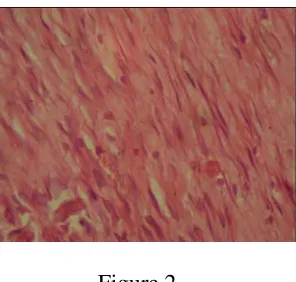
Figure 1
Granulation Tissue of group 1 animal (control) showing with less collagen and more macropages after scarifying on the last day of experiment (H&E 45X)
Figure 2
Figure 3
Granulation Tissue of group 3 animal (Test) showing moderate deposition collagen after scarifying on the last day of experiment ( H&E 45X) .
Discussion
The present study was undertaken to evaluate whether Vedic Heal could promote wound healing in experimentally induced wounds in rats. The results of the present study substantiate the use of Vedic Heal in folklore medicine for the treatment of wounds.
Vedic Heal applied topically promoted the wound breaking strength, wound contraction and period of epithelization in different models of experimental wounds.
Collagenation, wound contraction and epithelization are crucial phases of wound healing. The phase inflammation, macrophasia, fibroplasias and collagenation are intimately interlinked. Thus an intervention into any one of these phases by drugs could eventually lead to either promotion or depression of the collagenation phase of healing. Growth hormone is known to promote the healing process by enhancing epithelial cell proliferation and cell collagen formation. Collagen is the family of protein, which provide structural support and it is the main component of tissue such as fibrous tissue and cartilage. Collage is synthesized by a complex biochemical mechanism of ribosome. The collagen synthesis is stimulated by various growth factors.7 Growth hormone is also known to promote the proliferation of fibroblasts8and fibroblast proliferation form the granulation tissue. In the dead space wound model Vedic Heal treatment increased granuloma tissue weight and breaking strength. Hence it is assumed the pro-healing activity of Vedic Heal could be due to the direct or indirect influence on growth hormone release.
References
1. Biswas TK, Mukherjee B. Plant medicines of Indian origin for wound healing activity: a review. Int J low Extrem Wounds 2003; 2 (1): 25-39.
3. Choi SW, Lee SK, Son YS, Son BW. The wound healing effect of a glycoprotein fraction isolated from Aloe vera, British Journal of Dermatology 2001; 145: 535-545.
4. Kamath JV, Rana AC, Chowdhury AR Pro-healing effect of Cinnamomum zeylanicum bark. Phytother Res 2003; 17: 970-972.
5. Morton JJ, Malone MH.Evaluation of vulnerary activity by open wound procedure in rats. Arch Int Pharmacodyn Ther.1972; 196: 117-126.
6. Lee KH. Studies on the mechanism action of salicylates II, effect of vitamin A on wound healing retardation action of aspirin. J Pharmacol Sci 1968; 57: 1238-1240.
7. Corton SR, Kumar V, Collins T. Robbins Pathologic Basis of Disease, Harcourt Limited, New Delhi (India), 6th ed. 2003; 96-111.
8. Williams TC, Frohman LA. Potential therapeutic indication for growth hormone releasing hormone in the condition other than growth retardation. Pharmacotherapy 1986; 6: 311-318.