Multicultural Issues of Product Development Education in
Virtual Teams*
VANJA Cˇ OK1, NUSˇA FAIN2, NIKOLA VUKASˇINOVIC´1and ROMAN ZˇAVBI1 1University of Ljubljana, Faculty of Mechanical Engineering, Laboratory for Engineering Design—LECAD 2University of Strathclyde, Strathclyde Business School, Department of Marketing,
E-mail: [email protected], [email protected], [email protected], [email protected]
Project oriented courses became a global trend among best engineering universities around the world in the past decade. They teach students not only core academic knowledge, but face students with real problem solving situations, where they need to express and develop their other virtues and skills, e.g. working in multidisciplinary teams, time and task management, problem solving, different presentation and communication skills, etc.
In this paper we investigate (multi-) cultural background of virtual team members from two different aspects: how it influences the team’s creativity and how various cultural backgrounds of creative team members could lead into different perceptions of particular design features. Multi-cultural background of NPD teams is a complex challenge, which—if not addressed properly—could cause multi-level problems. The results of our first described research clearly indicate how these differences could affect the forming of virtual NPD creative teams and suggest guidelines how to build effective NPD teams. The second research shows that the same design features can trigger different responses in different cultural background. The designers, who design a product for a particular market, should be aware of these differences, which must be addressed with a special care if we want the product to be properly accepted at the desired target of a global market.
Keywords: interdisciplinary virtual teams; creativity; shape perception; multicultural influences
1. Introduction
The development of innovative and competitive products and mastery of information and commu-nication technologies (ICT) are crucial for any company’s long-term success in the global informa-tion society and the global market. It is vital to understand that winning in a competitive environ-ment is based on the combination of low-cost, innovative, high-quality products and responsive-ness to market demand [1, 2]. It also needs to be emphasized that in a world that can only survive through global collaboration, international coop-eration is indispensable [3].
These facts force companies into forming of cross-functional teams that lead to functional merging of geographically, organizationally and culturally dispersed human resources, including product developers. In view of many companies, developing global products necessitated drawing on the local expertise of individuals, who reside in the countries for whom new products were being developed [4]. New product development (NPD) is a demanding and complex activity as it is, and the ever-changing business environment additionally increases its level of difficulty, primarily by func-tional association of geographically dispersed human resources [5].
The Gartner group e.g., predicted that by 2015, 75% of the knowledge-based project work (includ-ing new product development) in the Global 2000
Company will be completed by virtual teams [6]. These teams are supposed to provide many advan-tages over traditional teams, including the ability to bridge time and space (e.g. ‘‘follow-the-sun’’ pro-duct development), better utilization of distributed human resources without physical relocation of employees, ability to hire the best people regardless of their location, and organizational flexibility [7–9], that ultimately leads to higher levels of creativity [10, 11].
Furthermore, understanding of users and their emotional responses in relation to a product or service is often at the forefront when developing new products for the global market. For example, use of specific shape in the new product develop-ment process can trigger unexpected or even una-ware response of a potential customer or user, which could be either positive or negative. A good product designer and developer—who is often an engineer— must therefore be aware that each decision he/she does can have crucial impact on customer’s decision for the product purchase. User experience does not end only with designing a visually appealing pro-duct. Designer must develop a capacity to holisti-cally consider all user senses during product development process. Hence, if this iterative step is skipped the consequences will be revealed at the end of process, when user-product interaction comes to the forefront.
These trends lead to a (re)development of the sets of skills that an effective designer or product
oper needs, and thus also needs to be addressed in education. The development of innovative and competitive products namely requires appropri-ately trained product developers, who possess a broad spectrum of technical and professional com-petencies. The importance of professional compe-tencies (sometimes called soft skills or transferable skills) is recognized by many studies/authors, e.g. [1–3, 12]. Working in (virtual) teams is one of the important competencies that have to be acquired during educational process [13].
Focusing on competencies has been an on-going process; the importance of technical and profes-sional competencies was analysed by Passow in 2008 using meta-analyses of various research work. She found that the most important compe-tencies (with few exceptions) are problem solving, communication, decision-making and data analy-sis, followed by teamwork, commitment to achiev-ing goals, ability to integrate theory and practice effectively in professional work settings, leadership skills and project management, design, life-long learning, engineering tools and math, science and engineering knowledge. The least important ones (relatively) are contemporary issues, experiments (without data analysis) and impact of engineering work [14, 15]. Educational programs in NPD there-fore need to focus on structuring educational pro-grams in such a way that the above aspects are considered. Most of the trends can be addressed through project-based learning, and a lot of educa-tional institutions have been revamping their pro-grams to include it in the curriculum. A question however arises, if the skills outlined in educational programs are actually transferred to students. It is also paramount to assess, if there are differences between perceptions of different students in differ-ent cultures with regard to these trends.
This paper addresses these questions through two case studies that have been performed among stu-dents of 7 countries that according to Hofstede (2010) differ in culture [16]. We tested their percep-tion of above concepts in relapercep-tion to new products: Study 1 will address multicultural influences on creativity within virtual student teams [10]; while Study 2 will address the influence of different cultural backgrounds of students on emotional values of products [e.g. 17, 18].
The intersection of both studies will provide guide-lines towards improvement of new product devel-opment education. The paper is structured into three sections. First, we outline why culture is an important aspect that needs to be addressed in NPD and design and engineering education. That is followed by the outline of the two case studies. The methodologies and results are discussed for
the two cases separately and then conclusions are drawn on the basis of the commonalities and differ-ences between studies.
2. Contextual background
2.1 How is culture relevant?Culture is the collective programming of the mind, which distinguishes the members of one group or category of people from another [19]. It is a collec-tive phenomenon, because it is at least partly shared with people who live or have lived within the same social environment. As almost everyone belongs to a number of different groups and categories of people at the same time, people unavoidably carry several layers of mental programming within them-selves, corresponding to different levels of culture, i.e. according to one’s country or social class level. In order to be able to measure different aspects of culture, Hofstede [19] has conducted empirical research within the field and was able to determine four dimensions of national culture: power distance, uncertainty avoidance, collectivism vs. individual-ism and masculinity vs. femininity. These dimen-sions define a specific culture and consequently affect the performance level of people in dispersed/ virtual teams. Especially power distance and uncer-tainty avoidance affect people’s thinking about organizations and working within them. Who has the power to decide what is influenced by cultural norms of power distance, whereby cultural norms about uncertainty avoidance influence the rules and define the procedures that will be followed to attain desired ends [16]. The remaining two dimensions, individualism and masculinity affect our thinking about people in organizations rather than about organizations themselves. The way to solve organi-zational problems within different national cultures should therefore be influenced by the levels of uncertainty avoidance and power distance of a specific culture [16].
within these two dimensions. The national cultures studied within our two case studies fall into three of these clusters: ‘‘village market’’, ‘‘family’’ and ‘‘pyr-amid of the people’’. These three clusters differ according to the studied dimensions, i.e. ‘‘pyramid of people’’ types of national cultures are strongly oriented towards collectivism and have high power distance and uncertainty avoidance levels within their culture [19]. These characteristics put them opposite to the ‘‘village market’’ type of national culture where the orientation is individualist and the levels of power distance and uncertainty avoidance are low. The cultures that fall into the ‘‘family’’ cluster are characterised by low levels of uncertainty avoidance and high levels of power distance. Where on the continuum the national cultures represented within our two case studies can be found is shown in Fig. 1.
Within this paper, we define cultural diversity as heterogeneity of national cultures of team members. Studies that have been done in the past on effects of cultural diversity within face-to-face teams have found mixed effects, however the ones done on heterogeneous teams concluded that diversity increased effectiveness due to the wider range of perspectives, more and better ideas and less ‘‘group-think’’ [20]. We will test how the perception of effectiveness and shapes, creativity, working in virtual teams and their interrelationships vary
within different national cultures. Due to the pre-sented cultural differences, we therefore presume:
H0: There will be differences between different clusters of culture in relation to perceived effectiveness, shape, creativity and working in virtual teams.
To test this hypothesis two case studies will be presented below. For both studies, we follow Hof-stede’s [19] example and separate the data gathered with the studies into three clusters with regard to the University origin—‘‘village market’’ (Great Britain, Switzerland and the Netherlands), ‘‘pyramid of people’’ (Hungary, Slovenia and Croatia) and ‘‘family’’ (India).
2.2 Creativity and design process in virtual teams
Virtual teams are defined as groups of individuals collaborating in the execution of a specific project while geographically dispersed, possibly beyond the boundaries of their parent organization [21–23]. These teams are deemed to have the capability to solve the most complex problems due to the diver-sity in skills and competences of their members [24]. Such teams can work faster, smarter, more crea-tively and more flexibly [25]. Since creativity requires loose settings, free spirits and a lack of strict boundaries [26], such teams should foster creativity. Furthermore, organizations involved in
NPD have to adopt flexible, dispersed methods of working to meet the numerous and varied demands of the global marketplace. Thus, virtual teams come together to perform a specific NPD task. Their NPD project meetings are carefully structured and planned in order to ensure highest effectiveness possible in this time.
The design process that such teams perform is defined as an innovative process, whereby the inputs into the process are creative ideas and the final result is a definition of the final product. Each phase of the design process requires specific knowledge and skills to assure a successful transition to the next phase, whereby creativity is essential to start it. It provides a critical point for a firm’s performance in a complex and changing environment [27]. The recognition and definition of the problem is an activity guided by an individual or group within a firm intending to identify a new business opportunity. The key activ-ity in this process is idea generation, in which creativity plays a crucial role.
Nemiro [10, 21] argues that virtual teams follow a path of four stages in the quest toward the produc-tion of creative results: idea generaproduc-tion, develop-ment, finalization and closure, and evaluation. It is crucial to realize that these stages may not be mutually exclusive and the activities can overlap and recur in another stage. However, the establish-ment of procedures and forums for team members to clarify their goals, get feedback from one another and ensure accountability has an important role in final NPD success [10].
2.3 Cross-cultural influence on shape meaning
Perception of shape characteristics could be affected by user’s cultural background. There is a difference between cultures in their use of context and infor-mation to create meaning [28]. It is however difficult for designers to grasp multicultural emotional dimensions toward product characteristics, since the same shape could elicit totally diverse associa-tion between groups of individuals. Contrary, Desmet and Hekkert [29], demonstrated that car models that vary in appearance could elicit drama-tically different emotions. Thus, the product visual appearance must create a desired tangible positive feeling even before a tactile interaction is per-formed. Forslund et al. mentioned that when adapt-ing a proposed design to manufacture, decisions need to be made on what geometrical deviations can be accepted on a final product [30]. Above all, understanding the shape elements in a cultural context can aid designers in better relating to different consumer emotional needs, since consu-mers are expected to prefer products that commu-nicate a meaning that is desirable in a particular culture or subculture [31]. Many researchers rely on
Hofstede’s cultural dimensions when researching cultural difference in shape perception [32, 33]. Zhang et al. explored the cultural distinction between individuals by creating a theory that indi-viduals who differed on the individualism/collecti-vism scale also differed in their attractiveness perceptions of angular vs. rounded shapes [32]. He discovered that individuals with an independent self-construal should perceive angular shapes as more attractive, whereas individuals with an inter-dependent self-construal should find rounded shapes more attractive. Similarly, Reinecke et al. proved that their culturally adaptive system MOCCA, which provides users with personalized interfaces, is significantly easier to use because it is adapted to users cultural differences [33].
However, some basic facts referring to shapes, Gestalt psychology and later studies should be considered regardless to user’s culture dimensions. Gordon noted [34] that curves are generally con-sidered more beautiful than straight lines. Conse-quently, Leider and Carbon discovered that curved and less innovative designs were seen as being particularly attractive, when most participants saw the relatively unusual straight design as being inno-vative [35]. They found that the effects of individual differences were much smaller than expected. Inter-estingly, they discover that differences between straight and curved designs (in respect to attractive-ness) were more pronounced for participants with higher interest in art, and these participants took more time to look at the less attractive high-inno-vative designs. Bar and Neta found that curved angled contours elicit positive emotions, and sug-gest that dislike of sharp-angled neutral objects in their experiment stemmed from a similar feeling of threat, and that this feeling was triggered by the sharpness of the angles per se [36].
3. Case studies
3.1 Multicultural influences on creativity
3.1.1 Conceptual framework
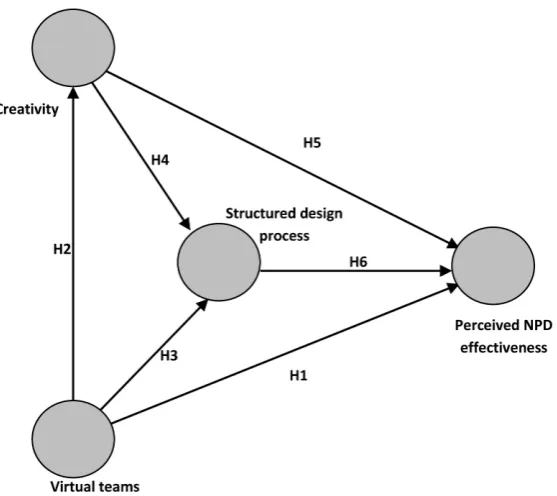
As indicated in the contextual background, litera-ture suggests that working in virtual teams requires a structured design process that aids the final out-come. Furthermore, it is indicated that virtual teams would aid creativity due to the diversity in their structure. Creativity can thus have a positive influ-ence on both, the design process and the final effectiveness of the NPD process.
structured design process on the final result of the design process [37]. To assess if students perception of the relevant concepts matches—what has been discovered in practice—the outlined framework was tested on a student sample. The hypotheses relevant to the framework (Fig. 2) have resulted from in-depth literature review and the contextual background and are as follows:
H1: Working in virtual teams has a direct positive effect on NPD effectiveness.
H2: Working in virtual teams has a positive effect on creativity in NPD.
H3: Working in virtual teams has a positive effect on the design process.
H4: Creativity has a positive effect on the design process within the virtual environment. H5: Creativity within virtual environments has a
positive effect on NPD effectiveness level. H6: A structured design process in virtual
envir-onments has a positive effect on NPD effec-tiveness level.
To test our hypotheses we collected data from students from Dutch, Swiss, Croatian, British, Hungarian and Slovenian students, involved in engineering education. 81 participants out of 156 responded to the questionnaire, giving the effective response rate of 51.9 %. Our sample had no Indian students included, thus the presented study will only assess the discrepancies between the two clusters ‘‘village market’’ and ‘‘pyramid of people’’.
3.1.2 Questionnaire design and measures
The questionnaire that was given to students online consists of items that assess the design phases, creativity in the virtual teams and the overall NPD effectiveness (for details see [11] ). All the items are taken from well-established and validated scales [10]. The questionnaire has been modified according to findings of [37]. A shorter questionnaire has also proven to be more user-friendly and has produced a higher response rate. All the items were measured on 7-point Likert type of scales. Each mechanism was given a composite score created by averaging the scores of the items. To be able to test the hypotheses among different cultural groups, the students were also asked to state their origin University. With regard to the cultural indexes [19] of the country of origin, two clusters of national culture types were formed for the analysis (Fig. 1)—‘‘village market’’ (The Netherlands, United Kingdom and Switzer-land) and ‘‘pyramid of people’’ (Slovenia, Croatia and Hungary).
3.1.3 Results
[image:5.595.161.440.77.325.2]To validate our hypotheses we utilized the structural equation modelling (SEM) for data analysis. We used the partial least squares (PLS) technique of SEM that utilizes a variance-based approach for estimation. We used SmartPLS 2.0 for performing the analysis. Two assessments are supported by PLS: (1) the measurement model assessment, where item reliability, convergent and discriminant validities of the measurement scales are examined
and (2) the structural model assessment, where information related to item loadings and the strength of the paths in models is presented. The path significance levels using t-values are estimated by the bootstrap method.
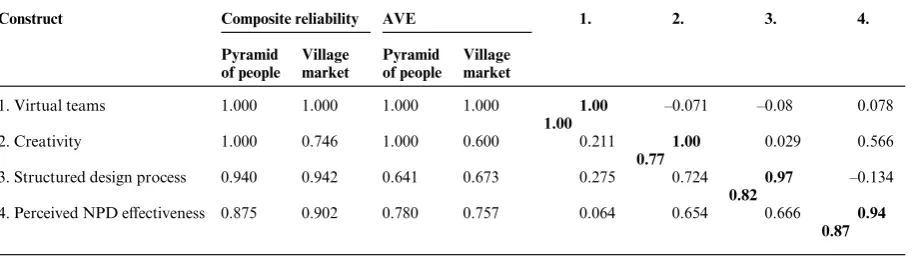
We have conducted two separate PLS analyses for both studied types of national cultures. The differences between the gained results will confirm/ reject the postulated hypotheses. As outlined above, a two-step approach was taken in the analysis. First, reliability and consistency were evaluated. Internal consistency is demonstrated when the reliability of each measure in a scale is above 0.7. As shown in Table 1 we assessed internal consistency by measur-ing composite reliability. All of the measured con-structs have the composite reliability exceeding the recommended 0.7 indicating adequate internal con-sistency. The composite reliability of the construct virtual teams is 1.0 as this construct was measured by only 1 item. For ‘‘pyramid of people’’ type of national culture the composite reliability for crea-tivity is also 1.0 as some items measuring creacrea-tivity were taken out of the analysis, as the factor analysis showed they had loadings that did not exceed 0.6.
For adequate discriminant validity it has been recommended that the following three conditions be met: (1) the square root of AVE of all constructs should be larger than all other cross-correlations; (2) all AVE should have values above 0.5; and (3) the principal component factor analysis should have item loadings greater than 0.6 on their respective constructs, and no item should load highly on any other construct [38].
Convergent validity is adequate if each of the constructs in the model has an average variance expected (AVE) of at least 0.5 [38]. AVE measures the percentage of the overall variance for indicators represented in a latent construct through the ratio of the sum of the captured variance and the measure-ment error [38].
The results in Table 1 indicate that all correlations between constructs were lower than the squared
root of AVE (the principal diagonal element) and all AVEs were above the 0.5 threshold. The SmartPLS confirmatory analysis also showed that all items included in the analysis loaded on the construct for which they were designed to measure. Thus, the discriminant validity of the scales used for this study is adequate.
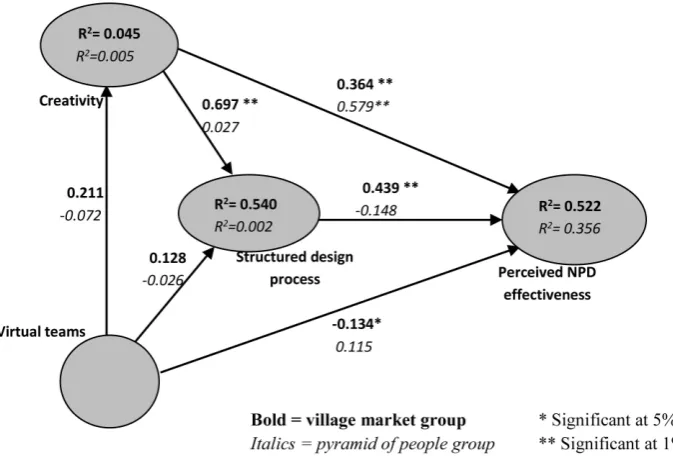
In the next step, SmartPLS 2.0 provided the squared multiple correlations (R2) for each con-struct in the model and path coefficients () with other constructs also given. The R2 indicates the percentage of a construct’s variance in the model, while path coefficients indicate the strength of relationships between constructs [20]. The results of the PLS analysis are shown in Fig. 3 for both ‘‘village market’’ (bold) and ‘‘pyramid of people’’ (italics).
When comparing the results for ‘‘village market’’ with the original framework [10, 21, 22], it can be seen, that most of the original hypotheses were supported. Contrary to the testing of hypotheses for ‘‘village market’’ type of national culture, the results for ‘‘pyramid of people’’ type of national culture have not supported the original model. Only the fifth hypothesis (H5) was supported, as creativ-ity has proven to have a direct positive effect on the perceived NPD effectiveness (= 0.579; t = 6.049). Testing the framework within different types of national cultures has proven to give very different results, thus giving support to our H0—the percep-tion of effects of working in virtual teams on NPD effectiveness differs between national cultures.
3.2 Multicultural aspects of product perception
According to previous discoveries we assume:
[image:6.595.72.530.89.218.2]H1: Participants from collectivistic countries (Croatia, India and Slovenia) will tended to have higher mean responses (one or more mean differences) at both bipolar adjectives related to curved-edged shapes in comparison to individualistic country (Hungary).
Table 1.Measure validation of the two national culture types
Construct Composite reliability AVE 1. 2. 3. 4.
Pyramid of people
Village market
Pyramid of people
Village market
1. Virtual teams 1.000 1.000 1.000 1.000 1.00
1.00
–0.071 –0.08 0.078
2. Creativity 1.000 0.746 1.000 0.600 0.211 1.00
0.77
0.029 0.566 3. Structured design process 0.940 0.942 0.641 0.673 0.275 0.724 0.97
0.82
–0.134 4. Perceived NPD effectiveness 0.875 0.902 0.780 0.757 0.064 0.654 0.666 0.94
0.87
3.2.1 Method
Theoretical assumptions about shape preferences allowed a limited number of samples and research questions. We did systematically define shape cate-gories in order to measure preferences with a cultural influence. Despite that a study was con-ducted using 2 types of shapes (straight edged = a, b, c; curved edged = d, e, f), Table 2. We used a semantic differential technique for evaluation of the Shape samples, as proposed by Nagamachi and Lokman [39] and Dahlgaard et al. [40]. This type of arrangement allows the respondent to intui-tively relate adjective with a geometrical shape. The subjects used a 5-point scale to rate the shape’s aesthetic attribute (1 = very ugly, 5 = very beautiful) and functional attribute (1 = very unreliable, 5 = very reliable). Bipolar adjectives were chosen regarding to the theory of Tracinsky et al. [41] by which beautiful object is also treated as usable. Thus, we decided to investigate if perception of straight and curve angled shapes will differ in a context of aesthetic (ugly-beautiful) and func-tional-usable (unreliable-reliable) point of view.
3.2.2 Participants
Participants represented 4 different nationalities. The subjects of this research included 137 (25–30 years old) voluntary engineering students from Hungary n = 28 (25% female, 75% male), Croatia n = 28 (13.8% female, 82.8% male), Slovenia n = 28 (21.4% female, 78.6% male) and India n = 53 (32.1% female, 67.9% male). They were undergraduate, master and Ph.D. students. Their educational
back-grounds were: mechanical engineering, industrial design engineering and product design.
3.2.3 Procedure
Participants received printed questionnaires and instructions about the procedure. The surveys were conducted in the classroom in the daylight. The first part of the questionnaire contained demo-graphic questions. In the second part, the students evaluated different geometric shape properties based on the bipolar adjectives. There was no need notice to translate questionnaire questions.
3.2.4 Results
First, a one-way multivariate analysis of variance (MANOVA) using SPSS software was conducted to test the hypothesis that there would be one or more mean differences between participants (Croatia, Slovenia, Hungary and India) and shapes prefer-ence scores. Levene’s F-tests, the homogeneity of variance assumption was considered satisfied, since none of test was statistically significant (p> 0.05).
Participants’ responses statistically significant differ at shape D aesthetic perception with F(3,127) = 3.496, p < 0.018 and atshape Eaesthetic perception with F(3,127) = 4.359, p < 0.006. Despite this, they statistically differently valuate shape A
[image:7.595.127.464.79.307.2]with functional attribute (unreliable-reliable),
Fig. 3.Summary of the two types of national cultures path model analysis.
resulted in F(3,127) = 2.816, p < 0.042 (see appen-dix).
Second, a series of post-hoc analyses (Fisher’s LSD) were performed to examine individual mean difference comparisons across all four levels of countries and all 6 shapes with bipolar adjectives (unreliable-reliable, ugly-beautiful). The results revealed that three post-hoc mean comparisons were statistically significant (p < 0.05)—Table 3. According to results we can confirm our hypothesis that there is more than one mean difference, what explain deviations in responses between observed participants.
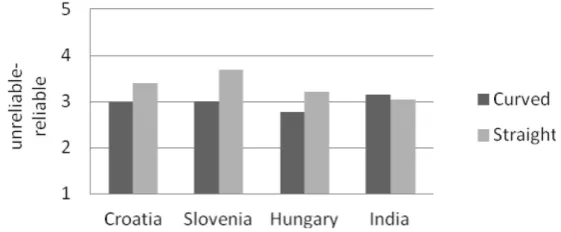
Croatia (M = 3.93, SD = 1.02) in comparison to Slovenia (M = 3.00, SD = 1.22) or Hungary (M = 3.29, SD = 1.12) perceivesshape D(curved edges)— with a higher mean—as more beautiful. Also India (M = 3.53, SD = 1.12) perceivesshape Dto be more beautiful in comparison to Slovenia or Hungary (Fig. 4). Again, Croatians (M= 3.82, SD=1.19) and
Indians (M = 4.11, SD = 0.96) perceive shape E (curved e.) as more beautiful than Slovenians (M = 3.21, SD = 1.26) Hungarians (M = 3.46, SD = 1.14) do. Croatia (M = 3.64, SD = 1.25) and Slovenia (M = 3.79, SD = 1.23 perceiveshape A(straight edges) as more reliable in comparison to India (M = 3.02, SD = 1.42), Fig. 5. So far our study indicated 3 shapes upon which participants responses deviate. Hereby it should be noted that a lot of shapes weren’t indicating to provide differences in percep-tion among culturally diverse group of participants.
4. Discussion
Case study 1(Multicultural influences on
creativity)
[image:8.595.163.431.471.586.2]Testing the framework within different types of national cultures has proven to give very different results, thus giving support to our H0—the percep-tion of effects of working in virtual teams on NPD
Table 3.Mean difference in response power between Countries
C.Europe C.Europe vs India
Cro. vs. Slo.
Cro. vs. Hun. SE
Ind. vs. Slo.
Ind. vs. Hun.
Cro. vs. Ind.
Slo. vs.
Ind. SE Mean d
Ugly-beautiful (d) 0.93 0.64 0.299 0.53 / / / 0.267 0.7
Ugly-beautiful (e) 0.61 / 0.298 0.89 0.64 / / 0.266 0.71
Unreliable-reliable (a) / / / 0.62 0.76 0.312 0.69
Note: Slo. = Slovenia; Cro. = Croatia; Hun. = Hungary; Ind. = India. Post-hoc comparison was statistically significant (p < 0.05) based on Fisher’s test. The error term is Mean square (Error) = 1.788. ‘Mean d’ = Mean difference.
Fig. 4.Overall mean of shapes with curved and straight angles (bipolar adjectives: ugly-beautiful).
[image:8.595.157.438.623.739.2]effectiveness differs between national cultures. Regarding on outcome, the influencing factors should be considered when creating a virtual team of cultural diverse members. Since creativity is an abstract concept and subject of continuous debate we developed criteria upon which the individual belonging to a specific cultural context was carefully defined [10, 11].
The results show that two distinct perceptions about NPD effectiveness have formed within the two national culture types. We find the explanation for this within the cultural characteristics of the studied national culture types. The students coming from the ‘‘pyramid of people’’ national culture have been raised within the environment where strict rules need to be followed, and proce-dures, such as the design process, are strictly for-malized and structured, whereby the students from ‘‘village market’’ national culture type were not faced with such strict rules and procedures. The students from the ‘‘pyramid of people’’ national culture type therefore do not perceive the structure of the process and organization of the team as relevant for NPD effectiveness, as these are part of their culture and they attribute all influence to creativity. On the other hand, the students from the ‘‘village market’’ national culture type perceive all, the softer aspects of NPD, such as creativity as important as following a certain structure.
The two national culture types therefore differ in their perception of what are the relevant factors for NPD effectiveness.
These results show that special care needs to be placed on the cultural aspects of team forming, as different perceptions of team members can have a relevant effect on the outcome of the NPD process.
4.1 Case study 2(Multicultural aspects of product
perception)
The results have shown that collectivistic groups of students—especially Croatian and Indian—tend to perceive rounded shapes as more beautiful in com-parison to individualistic (Hungary) group of students, Fig. 4. However, the differences in prefer-ences between countries exist, but are not as drasti-cally as we assumed. Surprisingly, Slovenia, which is categorized as collectivistic society hasn’t indicated special preference toward curved angled shapes. Generally, participants from all countries show lower preferences to straight angled shapes in vali-dation of aesthetic (ugly-beautiful) attribute. Actu-ally, they experience straight angled shapes as ugly. Contrary, straight angled shapes were perceived to be more reliable in comparison to curved angled shapes while those were perceived to be beautiful by all participants. These results confirm also similar findings of Leder and Carbon [35] and Norman [42].
It is interesting that Croatia and Slovenia perceive straight-edged shapes as more reliable in compar-ison to India and even Hungary, Fig. 5. Overall means give a holistic overview about shape prefer-ences between countries in general. It appears that same shapes may be evaluated more or less posi-tively by divergent groups of participants. Some-how, users from certain cultural environment can identify themselves with shape characteristic, which reflect familiar every-day items they interact with [42]. We believe that there are some general percep-tions or stereotypes that remain similar regardless of different cultural backgrounds, and despite of dif-ferences in the intensity of perceptions. This could be explained with discoveries of Norman [42] who claims that ‘‘pattern matching’’ situations and objects that, throughout evolutionary history, offer food, warmth or protection give rise to positive affect. He defined rounded and smooth objects as a condition of positive affect but sharp objects as conditions of negative effect. That confirms our results, which indicate that both groups of partici-pants tended to find curved angled shapes more beautiful as straight angled. We cannot avoid the fact that some naturally based preferences to rounded shapes are almost default. Still, the groups of participants tended to differentiate in intensity of overall emotional responses toward specific shape category.
Anyway, cultural differences in shape perception are not negligible and could cause conflict into multicultural teams when decision-making process comes to forefront. Thus, students involved to culturally diverse teams should be aware to make compromises at that point. This fact is important for both, team members who act in multicultural environment, and at the same time for designers who develop products for multicultural users. Therefore, designers need to sensitively implement cultural patterns into product design appropriately and at the right moment of product development procedure.
5. Conclusion and future research
analysed and appropriately offered within a pro-gram. However, we believe that education curricu-lum utilizing virtual teams addresses many issues of authenticity of NPD project based learning, includ-ing cultural ones.
Since our research was performed on a limited student population from 7 countries, we should expand the population sample at more regions and consequently expect more differences to emerge. We propose or encourage future researchers to build decision-making strategy regarding on these per-spectives. Due to complexity of gathering multi-cultural emotional responses toward product visual appearance, aspect of educational background could be also an interesting topic worth of special attention in a future research. Furthermore, future studies should involve investigation whether and how the shape contours are perceived in comparison with simplified 3D shapes or observing other affec-tive product features.
References
1. Z. Prusak, Challenges to Future Engineering Professionals— How to Prepare Students to Face Them,Proceedings ASEE Annual Conference, Session 1347, 1998, pp. 1–10.
2. M. Allan and C. U. Chisholm, The Development of Compe-tencies for Engineers within a Global Context,Proceedings Conference on Innovation, Good Practice and Research in Engineering Education, 2008, retrieved on 26 February 2014 from http://www.heacademy.ac.uk/assets/documents/ subjects/engineering/EE2008/p001-allan.pdf
3. D. E. Jansen, Intercultural competence: a requirement of future professional engineers.Proceedings 3rd Global Con-gress on Engineering Education, 2002, pp. 111–114. 4. E. F. McDonough, K. B. Kahn and G. Barczak, An
investigation of the use of global, virtual, and colocated new product development teams, The Journal of Product Innovation Management,18(2), 2001, pp. 110–120. 5. R. Zˇavbi and J. Tavcar, Preparing undergraduate students
for work in virtual product development teams,Computers & Education,44(4), 2005, pp. 357–376.
6. Gartner, Inc. (2011). PPM market universe: Techniques and tools for project collaboration, Available from: http:// www.gartner.com/id=1714619 [Accessed 26 February 2014]. 7. M. Biggs, Assessing risks today will leave corporate leaders well-prepared for the future of work, InfoWorld, 22(39), 2002, pp. 100–101.
8. J. Lipnack and J. Stamps, Virtual teams: People working across boundaries with technology (2nd ed.), Wiley, New York, 2000.
9. S. Paul, P. Seetharaman, I. Samarah and P. P. Mykytyna, Impact of heterogeneity and collaborative conflict manage-ment style on the performance of synchronous global virtual teams,Information and Management,41(3), 2004, pp. 303– 321.
10. J. E. Nemiro,Creativity in Virtual Teams: Key Components for Success. San Francisco, Pfeiffer, 2004.
11. N. Fain, M. Kline and J. Duhovnik, Is new product devel-opment culturally bound?,Proceedings of the International conference on engineering and product design education, 2011, pp. 715-720.
12. C. L. Dym, A. M. Agogino, O. Eris, D. D. Frey and L. J. Leifer, Engineering Design Thinking, Teaching, and Learn-ing,Journal of Engineering Education,94(1),2005, pp. 103– 120.
13. T. U. Daim, A. Ha, S. Reutiman, B. Hughes, U. Pathak, W. Bynum and A. Bhatla, Exploring the communication
break-down in global virtual teams,International Journal of Project Management,30(2), 2012, pp. 199–212.
14. H. J. Passow, What competencies should engineering pro-grams emphasize? A meta-analysis of practitioners’ opinions informs curricular design,Proceedings of the 3rd Interna-tional CDIO Conference, 2007, pp. 1–36.
15. H. J. Passow, What competencies should engineering pro-grams emphasize? A Dilemma of Curricular Design that Practitioners’ Opinions Can Inform, Doctoral Dissertation, The University of Michigan, 2008.
16. G. Hofstede, G. J. Hofstede and M. Minkov,Cultures and Organizations: Software of the Mind. 3rd Edition, McGraw-Hill USA, 2010.
17. P. M. A. Desmet and P. Hekkert, Framework of product experience, International Journal of Design, 1(1), 2007, pp. 57–66.
18. K. A. Hsiao and L. L. Chen, Fundamental dimensions of affective responses to product shapes,International Journal of Industrial Ergonomics,36(6), 2006, pp. 553–564. 19. G. Hofstede, Culture’s Consequences: Comparing Values,
Behaviors, Institutions, and Organisations across Nations. 2nd Edition, Sage Publications, Thousand Oaks, London, 2001.
20. P. Shachaf, Bridging cultural diversity through e-mail,
Journal of Global Information Technology Management,
8(2), 2005, pp. 46–60
21. J. E. Nemiro, The Creative Process in Virtual Teams,
Creativity Research journal,14(1), 2002, pp. 69–83. 22. N. Fain, M. Kline and J. Duhovnik, Creativity of virtual
teams in innovation processes: The case of European Global Product Realization, In:Proceedings of R&D Management Conference, June 17–20, 2008, Ottawa, Canada.
23. R. T. A. J. Leenders, J. M. L. Van Engelen and J. Kratzer, Virtuality, communication, and new product team creativity: a social network perspective, Journal of Engineering and Technology Management,20, 2003, pp. 69–92.
24. K. Prasad in K. Akhilesh, Global virtual teams: what impacts their design and performance,Team Performance Manage-ment8, 2002, pp. 102–112.
25. A. Majchrzak, A. Malhotra, J. Stamps and J. Lipnack, Can absence make a team grow stronger? Harvard Business Review82(5), 2004, pp. 131–137
26. R. Westwood and D. R. Low, The Multicultural Muse: Culture, Creativity and Innovation,International Journal of Cross-cultural Management,3(2), 2003, pp. 235–259. 27. M. Basadur and P. A. Hausdorf, Measuring Divergent
Thinking Attitudes Related to Creative Problem Solving and Innovation Management,Creativity Research Journal
9(1), 1996, pp. 21–32.
28. E. T. Hall,Beyond Culture, Anchor Books/Dubleday, New York, 1976.
29. P. M. A. Desmet and P. Hekkert, Emotional Reactions Elicited by Car Design: A Measurement Tool for Designers, In:Proceedings of the 31st ISATA conference, Dusseldorf, Germany, 1997, pp. 237–244.
30. K. Forslund, M. Karlsson and R. So¨derberg, Impacts of geometrical manufacturing quality on the visual product experience,International Journal of Design,7(1), 2013, 69–84. 31. P. H. Bloch, Seeking the Ideal form: Product Design and Consumer Response, Journal of Marketing, 59(3), 1995, pp. 16–29.
32. Y. Zhang, L. Feick and L. J. Prince, The Impact of Self-Construal on Aesthetic Preference for Angular Versus Rounded Shapes,Society for Personality and Social Psychol-ogy, PSPB,32(6), June 2006, pp. 794–805.
33. K. Reinecke and A. Bernstein, Improving performance, perceived usability, and aesthetics with culturally adaptive user interfaces,ACM Trans. Computer-Human Interaction,
18(2), June 2011.
34. K. Gordon,Esthetics, 1909, pp. 166–168.
35. H. Leder and C. C. Carbon, Dimensions in Appreciation of Car Interior Design,Applied Cognitive Psychology,19,2005, pp. 603–618
36. M. Bar and M. Neta, Humans prefer curved visual objects,
Psychological Science,17(8), 2006, pp. 645–648.
teams in virtual environments, International Journal of Technology and Design Education,23(2), 2013, pp. 273–288. 38. C. Fornell and D. F. Larcker, Evaluating Structural Equa-tion Models with Unobservable Variables and Measurement Error,Journal of marketing,18, 1981, pp. 39–50.
39. M. Nagamachi and A. M. Lokman,Innovations of Kansei engineering, Taylor & Francis, 2010.
40. J. J. Dahlgaard, S. Schu¨tte and E. Ayas, Kansei/affective
engineering design: A methodology for profound affection and attractive quality creation,The TQM Journal, 20(4), 2004, pp. 299–311.
41. N. Tracinsky, A. Shoval-Katz and D. Ikar, What is beautiful is usable.Interacting with Computers13(2), 2000, pp. 127– 145.
42. D. A. Norman,Emotional Design: Why We Love (or Hate) Everyday Things, Basic Books, New York, 2004.
Appendix
Manova with Shapes subscales as dependent variable and Countries as independent Variable
Levene’s MANOVAs Croatia Slovenia Hungary India
F(3,127) p F(3,127) p 2 M SD M SD M SD M SD
ugly-beautiful(a) 0.366 0.778 0.702 0.552 0.016 2.61 0.994 2.89 1.10 2.61 0.956 2.85 1.02 ugly-beautiful (b) 1.229 0.302 0.256 0.857 0.006 2.57 1.10 2.43 1.23 2.68 1.12 3.53 0.95 ugly-beautiful (c) 1.528 0.210 0.757 0.520 0.018 3.21 1.13 3.14 1.33 3.32 1.02 2.94 1.11 ugly-beautiful (d) 1.271 0.287 3.496 <0.018d 0.076 3.93 1.02 3.00 1.22 3.29 1.12 3.53 1.12
ugly-beautiful (e) 2.106 0.103 4.359 <0.006e 0.093 3.82 1.19 3.21 1.26 3.46 1.14 4.11 0.96 ugly-beautiful (f) 2.100 0.104 1.281 0.284 0.029 3.64 1.37 3.75 1.21 4.14 1.01 4.04 1.04 Unreliable-reliable (a) 1.258 0.292 2.816 <0.042g 0.062 3.64 1.25 3.79 1.23 3.11 1.23 3.02 1.42 Unreliable-reliable (b) 0.686 0.562 2.187 0.093 0.049 2.93 1.02 3.54 1.00 3.07 1.12 2.94 1.09 Unreliable-reliable (c) 0.866 0.461 1.638 0.184 0.037 3.61 0.99 3.71 0.90 3.43 1.10 3.21 1.10 Unreliable-reliable (d) 0.645 0.588 0.861 0.464 0.020 2.71 1.01 2.64 1.06 2.61 1.23 2.98 1.19 Unreliable-reliable (e) 0.238 0.870 1.269 0.288 0.029 3.36 1.42 3.32 1.47 2.75 1.30 3.32 1.40 Unreliable-reliable (f) 0.579 0.630 0.332 0.803 0.008 2.86 1.15 3.04 1.35 3.00 1.39 3.17 1.40
Note. N=137,2= Partial eta squared.,d. R Squared = 0.076 (Adjusted R Squared = 0.054) e. R Squared = 0.093 (Adjusted R Squared =
0.072), g. R Squared = 0.062 (Adjusted R Squared = 0.040).
Vanja Cˇ okis a PhD candidate at Faculty of Mechanical engineering in Ljubljana, Slovenia. She earned her B.S. degree in Industrial Design at Academy of Fine Arts and Design in Ljubljana in 2010. Her B.S. degree project »Active Lounge Chair 1« was awarded with Trimo research award in 2010. Currently, her research interests include Kansei engineering, Emotions and Design, Ergonomic Design, User-centred Design, Cross-cultural aspects of user perception and New Product Development.
Nusˇa Fain, PhD is a Lecturer in marketing at University of Strathclyde, Glasgow, UK. She has extensive scientific knowledge and practical experience in market research and analysis, statistical data analysis, development of marketing campaigns and strategies as well as interdisciplinary integration of functions within a company. Her current work includes cooperation with industrial partners in developing new business models for successful new product development (KTP project) and teaching and supervision of Honours and Masters students in marketing. She has presented several of her findings in journal papers and at conferences.
Nikola Vukasˇinovic´, PhD is mechanical engineer, graduated in Mechanical Design at University of Ljubljana, Faculty of Mechanical Engineering in 2004. Since 2004 he has been working at the University of Ljubljana, Faculty of Mechanical Engineering, Laboratory for Computer aided design. During that time he has been engaged in research of laser triangulation geometry and shape measurements. He has conducted various research projects and engineering design education courses that are related primarily to construction and development of new products.
![Fig. 1. Cultural map for Uncertainty avoidance and Power distance for the studied countries (adapted from [19]).](https://thumb-us.123doks.com/thumbv2/123dok_us/1622286.115340/3.595.146.451.441.739/cultural-uncertainty-avoidance-power-distance-studied-countries-adapted.webp)