Copyright© 1967 AmericanSocietyforMicrobiology PrintedinU.S.A.
Structure
and
Function of
Bacteriophage R17
Replicative
Intermediate Ribonucleic Acid
II.
Properties
of
the Parental
Labeled Molecule
R. L. ERIKSON ANDE. ERIKSON
Department of Pathology, University of Colorado Medical School, Denver, Colorado 80220
Receivedforpublication2 February 1967
Replicative intermediate ribonucleic acid (RNA), designated RI, which
con-tained parental RNA labeled with 32p was separatedby filtration through agarose
from the nucleic acids prepared from 32P-labeled RNA phage-infected Escherichia coli. A larger amount of ribonuclease-sensitive parental label was found in the rapidly sedimenting forms ofRI than in the slower sedimenting forms, indicating
that parental RNA is displacedtoformasingle-strandedtail. This resultindicates that somephage RNA is generated by asymmetric semiconservative replication of
RI, but it does notmean that a portion of the RI duplexes cannot be conserved
duringgeneration ofphageRNA.ParentalRNAwasalso found indouble-stranded RNA withno apparenttails which sedimented withan S valueof 13. This RNA wassolublein2MNaCl,anditssedimentationratewasunaffectedbyribonuclease;
nevertheless, single-strand scissions were produced by ribonuclease and were
de-tected after the duplexwasconvertedtoitscomponentsinglestrands.
In cells infected with small ribonucleic acid
(RNA)-containing viruses,avirus-specific double-stranded RNAmolecule termed replicative form (RF) has been found (17, 19, 20).This molecule
has been isolated by virtue of its
solubility
insolutions of high ionic strength (1,
2)
and hasbeen shown
by
Ammann,
Delius,
andHofschneider (1) tocontaina
biologically
active strand of viral RNA. Replicative form RNA ishighly resistant to ribonuclease. By the use of
very shortpulses of 3H-uridine, a second,rapidly labeled, virus-specific RNA component which is
only partially
resistant to ribonuclease has beenidentified in infected cells (13), and it has been termed replicative intermediate RNA (RI). RI, in contrast to RF, is precipitated by 1 M NaCl (3,7, 14) andappears tohavenascent strandsof viral RNA attached to a
double-stranded
RNA core. Sinceafter short pulses ofRNA precursorsRI is labeled morerapidlythan isviral RNA or RF (3, 7, 13), it may be the precursor to viral RNA.
Without resort to enzymatic treatment, the RI of R17bacteriophagecanbeseparatedfrom viral
andcellularRNAin anundegradedform(12, 14).
Purified RI was found to contain RNA strands identicalto those isolated from intactphage, and native RI wasalsofoundtobebiologicallyactive
(8). This strengthens the claim that RI does
indeed serveasan intermediate inbacteriophage
RNAbiosynthesis.
Inthis communication, we describe some of the properties of RI in which the parental RNA is
labeled with 32p. The results support those recently reported by Lodish and Zinder (18) on the mechanism of replication of f2 RNA and support the earlier suggestions that at least a
portion of bacteriophage RNA is synthesized in anasymmetricsemiconservative manner (13,21).
A preliminary account of the present report has appeared (R. L. Erikson, Abstr. Ann. Meeting
Biophys.
Soc., 11th,1967).
MATERIALS AND METHODS
The media and strains ofbacteriaand phage and
the methods ofinfectionof bacteria and spheroplasts
have beendescribedpreviously(8).Thisearlier
com-munication also listed thetechniquesof
ultracentrif-ugation andradioactivityassay aswell as those
con-cerning the purification of RI. The preparation of
32p_
labeled R17 bacteriophage was carried out asdescribedpreviously (9).
RESULTS AND DISCUSSION
Experimental rationale. Ourcurrent conceptof the relationship between the sedimentation
behavior of RI and two of itspossible structures may be illustrated as in Fig. 1
(8,
11, 13). In model a, the plus (phage-like) and minus(com-523
on November 11, 2019 by guest
http://jvi.asm.org/
SEDIMENTATION BEHAVIOR
"Fast"
+ +
-Slow"
_+
+
FiG. 1. Two of the possible mechanisms for the
generation of phage RNA (+) stranids from comple-mentary (-)strands. Sedimentationbehavior refersto
thefactthatRlapparentlymoves morerapidly through
asucrosegradient when it consistsofagreateramouint
ofsingle-strandedRNA.
plementary) strands in the duplexareconserved,
and a newplus strand is generated ina manner
that is presumably analogous to that of deoxy-ribonucleic' acid (DNA)-dependent RNA
syn-thesis. In contrast, operation ofmodel b results inthedisplacement of the plus strand during the synthesis of another plus strand. One method of specifically tagging only a plus strand and no
other RNA consists of the infection of bacteria withbacteriophage inwhich the RNAis labeled with 32p.Then, ata suitable time afterinfection,
the RI formed in these infected cells is purified. When such RI isfractionated on thebasis of its
sedimentation behavior and when the parental strand is examined for ribonuclease sensitivity,
we wouldexpectthat, if themechanism depicted
by modelawereoperative, bothfastandslowRI
would contain parental label equally resistantto
ribonuclease.Accordingtomodelb, however,the
parental-labeled RNA in fast RI shouldbemore
sensitivetoribonucleasethan itwouldbeinslow
RI, because the plus strand with the longest region exposed to ribonuclease action would be
theone containing parental label.
All of these considerations also hold if the
minus strandwere in a ring form as proposed by Brown and Martin (4). Although the electron micrographs published by Granboulan and Franklin (15) do not show any circular molecules, they do demonstrate the presence of noncircular
branched molecules.
Replicative intermediate in which the parental strand is labeled with32p. A few minutes after the
infectionofEscherichia coli with 32P-labeled bac-teriophage, the parental RNA can be detected in RI (9, 17, 21). Pure parental-labeled RI cannot
be
obtained
from these cells without additional fractionation of the nucleic acids, because, asshown by the above investigations, the conversion
of parental RNAto RI is never complete, and, therefore, intact single-stranded labeled parental RNA is detectable throughout infection. A
furthercomplication of these studies ariseswhen,
apparentlyowing tonucleaseaction or to changes in RNA structure, single-strandedparental RNA
is
detected
asslower sedimenting forms in sucrosegradients (10, 16).
Nucleicacids were preparedbyphenol-sodium
lauryl sulfate extraction of infected cells.
Ribo-somal RNA, phage RNA, and RI were
precipi-tated with 2 M NaCl, whereas DNA, 4S
host-soluble RNA, and RF (double-stranded RNA) remained in the2 MNaClsupernatantfluid.The nucleic acids precipitated by 2 M NaCl are then passed through columns of 4% agarose granules (Mann Research Laboratories, Inc., New York, N.Y.); in STE buffer [0.15 M NaCl; 0.05 M
tris-(hydroxymethyl)aminomethane (Tris), pH 7.2;
103 M ethylenediaminetetraacetic acid
(EDTA)].
TheRIisexcluded by 4% agarose, andelutesin
the void volume, whereas the single-stranded
RNA isretarded. Inthisway,after threepassages
through such a column, the RI is freed of all
single-stranded
cellularandphageRNA.Fig. 2a illustrates the distribution of purified
RIaftersedimentation throughasucrose
gradient
with
purified
27SR17 RNAadded fora sedimen-tation rate marker. When a similar mixture in103 M EDTA plus 10-2 M Tris (pH 7.2) was
heated to 95 C for 3 min, quickly chilled, and
then
centrifuged,
the32P-labeledRNAsedimentedwith the optical density (OD) marker of R17 RNA (Fig. 2b). Before heat denaturation, the
labeled RI had abroad distribution of S values (from 15 to 35) and was
partially
resistant toribonuclease (Pancreatic ribonuclease
A;
Worthington Biochemical Corp.,
Freehold, N.J.),
whereasafterdenaturation the labelbehaved likephageRNAinbothrespects. No32Plabeled R17 RNA was detected in RI when it was
simply
added to an infected cell
lysate
prior
tophenol
treatment.
Excluding
theunlikely
possibility
of breakdown andresynthesis,
this sedimentationbehavior ofthe 32P-labeled RNA indicates that
on November 11, 2019 by guest
http://jvi.asm.org/
[image:2.461.79.218.68.338.2]0.4
0 (0
C)
d
0.2
Fraction no.
FIG. 2. Sedimentationt analysis ofRIin which theparental RNAstranldis32P-labeled. Asfor therestofthe figures, the sedimentation wasthrougha4.4-ml7to 20%osucrose gradienit (w/v)
containin7g
0.1 MNaCI (45,000 rev/min),at10C,byuseofaBeckmaniL2ultracentrifuge. (a)NativeRI(3P)aiid27SR17RNA(OD).
(b)
Sameas(a),butdenaturedfor3miiiat95 Cin 10-3IfEDTA
plhis
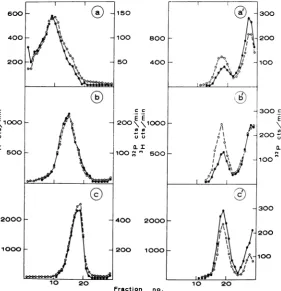
10-2ifTris.Centtrifugationtimewas150 mitt.Symbols: 0,OD260; *, 2Pradioactivity.Fraction no.
FIG.3.
Sedimentationt
analysis(see Fig. 2legenid)
oftreatedanduntreatedRIpreparations. Ribonuclease treat-ment:0.1,ugof ribonucleaseperml,10miii
at37 Cin0.15 r NaCl, 0.05 if Tris (pH 7.2), and 10-3 M EDTA.Immediatelyafter treatment,thepreparations were chilled, layered
oni
sucrosegradients, anidcentrifuged. (a), (b),and(c) Untreatedpreparations,centrifuged 150 min; (a'), (b'), awid (c') treated preparations,
centrifuiged
180 min. Symbols: *, 32P radioactivity (parental RNA); 0, 3Hradioactivity (newlysynthesizedRNA).on November 11, 2019 by guest
http://jvi.asm.org/
[image:3.461.83.368.68.257.2] [image:3.461.85.367.319.611.2]the parental strand is still intact. The RI de-scribedinFig. 2and 3wasobtained 30minafter
infection, a time when phage RNA synthesis was
proceeding rapidly, from cells which had been
infected atamultiplicity of 10. However, similar results were obtained with RI prepared 10 or20 minafterinfection from cells infected at a
multi-plicity of1.
Other infectionswereperformedinthe presence of uridine-5-3H to label uniformly all RNA
synthesizedafter infection.Therefore, thepurified
RI was doubly labeled; the parental strand was
labeled with 32P, and the rest of the molecule and all other RI molecules not containing parental
RNA, with 3H. This RI preparation was
sepa-rated,on the basis of sedimentationrate, into the
three arbitrarily selected fractions shown in Fig.
3a, b, andc. The S values of these preparations
asdetermined bythepositions of thepeakswere
32, 24,and 17.Whenasamplefrom eachof these
preparations
was treated with 0.1 ,ug ofribonu-TABLE 1. Riboniuclease digestioniof
parental-labeled RI
Resistance(%)a Avg Spriortodigestion
3H 32P
32 43 28
24 52 42
17 73 68
aDetermined as the percentage of radioactive RNAwhich sediments withan Svalueof 13after
ribonuclease treatment, as described in legend
to Fig. 3.
U)
{1000 o
Cl
cleasepermlfor10 min at 37 C andrecentrifuged,
the results (Fig 3a', b', andc') demonstrate that
each preparation yielded a ribonuclease-resistant fraction (S = 13) and nonsedimentable frag-ments. The values for the fraction of
ribonuclease-resistant RNA in this experiment are given in
Table 1. These results indicate that some of the RI has the structure illustrated by model b in Fig. 1, butthey do not rule out that RI also exists
intheformshown bymodel a.
Thevalues fortheresistance of the3H label in RI aresimilarto those described previously (8),
but in themselves they yield no information on structure other than the fact that strands of
ribonuclease-sensitive RNA are a part of the RI structure. Asymmetric semiconservative
replica-tionofaportion ofphage RNA is implied by the
resistance of the parental label in RI and by the
experiments of Lodish and Zinder (18) which
demonstrate that all phage f2 parental RNA is
chased outofa
double-stranded
form during the synthesis ofsingle-stranded RNAin the absenceof synthesis of double-stranded RNA. These authors also point out that the time required to
chase parental RNA out of a double-stranded form may mean both mechanisms operate (Fig.
1);that is, thereisapossibilityatthe initiation of each new strand that the duplex is conserved. Previous experiments (5, 6) have established that parental phageRNAis nottransferredto progeny phage.Therefore, some mechanism must exist to ensurethatparentalRNA isrecycled intoRIand not into phage. However, no explanation as to
thenature of this mechanism is available at this time.
Replicative form in which theparentalstrand is
C E
U,
2000
_ _I\A 1000
Fraction no.
FIG. 4. Sedimentation analysis, as inlegend toFig. 2,ofreplicative.form RNA, treated and untreated with
ribonuclease. (a) Untreated;(b)treatedasdescribedinthelegendtoFig.3.Centrifugationtime,180 min.Symbols:
0,
UPradioactivity (parental RNA); 0,'Hradioactivity(newlysynthesized RNA).on November 11, 2019 by guest
http://jvi.asm.org/
[image:4.461.48.235.297.398.2] [image:4.461.100.406.450.620.2]labeled with 32p. As mentioned in the previous section, RF,
the molecule
which isapparently
completely double-stranded, issoluble in 2 M
NaCl. According to the reasoning in the experi-mental rationale discussed above, the parental
strand in this molecule should be completely resistant to the action of ribonuclease. The
nucleicacidssolublein 2 MNaCIwerecentrifuged through a sucrose gradient, RNA from
appro-priate fractions was collected, and purified RF wasobtained from thisRNAby filtration through
agarose. RF
displayed
the same sedimentation characteristics before orafter ribonucleasetreat-ment (Fig. 4a and b), andwasgreaterthan 95% resistant by this test to ribonuclease. This be-havior isinmarkedcontrast to evenslowly sedi-menting forms of RI, the sedimentation charac-teristics of which are altered by treatment with
ribonuclease. This result satisfies the expectation
that the parental RNA molecule hydrogen-bonded to the complementary (minus) strand overitsentire
length
isnotdegraded by
pancreatic ribonuclease, with thequalificationspresented
inthefollowing section.
Effect ofribonuclease on double-strandedRNA. RF is notaffected by ribonuclease treatment as
measured bysedimentationbehaviororbyrelease of nonsedimentable
fragments.
However, thisresult doesnotexclude the
possibility
thatphos-phatediester bonds arehydrolyzed, because this hydrolysis may go undetected in the double-stranded molecule. To test for this possibility,
RF(about10lg/ml) inwhichtheparental strand
was labeled with 32P was treated with 1 ,ug of ribonuclease per ml for 10 min at 37 C,
chilled,
and extracted three times with cold
phenol
to remove the ribonuclease. This preparation wasthenmixedwith 27SR17 RNA in 10-3MEDTA
plUS
10-2MTris(pH7.2)
andwasheat-denatured (3 min,at95 C).The RF which had been ribonuclease-treated prior to denaturation
yielded
almost no 27S 32P labeled RNA (Fig. 5c), whereas the denatured control(Fig.
5b) yieldeda significant fraction ofRNAwithsedimentation behavior similarto that
ofR17 RNA. Prior to
denaturation,
both prep-arations sedimented exactly as shown by theundenatured control (Fig. 5a). Such a result establishes that pancreatic ribonuclease
hydro-lyzes bonds in the component single strands of the double-stranded RNA molecule without affecting the sedimentation properties of the native double-stranded molecule. In addition, unpublished results ofR. L. Erikson and R. M. Franklin show thattreatment of RF with higher
ribonuclease concentration does reduce its S value without the release of
nonsedimentable
fragments, indicating that enough single-strand
0
(0
c'J
6
300
200
100
IL
100C
50
100
50
10 20
Fraction no.
FIG. 5. Effect of ribonuclease oni
double-stranided
RNA. (a) Replicativeform RNA plusR17 RNA; (b)
same as(a), butdenaturedat95 Cfor3mi in 10-O X
EDTA plus JO-2 M Tris; (c) replicative form RNA,
ribonuclease-treated anidphenol-extracted prior to the
additioniofRi7RNA a,tddenaturation. Symbols: 0,
OD260; 0, 32p radioactivity. Centrifugation time, 150
nmilm.
breaks can be obtained to result in scission of the
double-stranded molecule. It should be noted that, since the R17 RNA exhibited the same profile in all three instances,the heat denaturation did not cause significant breakdown and that an 527
on November 11, 2019 by guest
http://jvi.asm.org/
[image:5.461.233.420.68.509.2]appreciable amount of ribonuclease which could have hydrolyzed the RNA after heat denatu-ration was not carried through.
An unexplained result of these experiments is
theappearance ofasecond, slower-moving peak
of single-stranded RNA in Fig. 5b. The result expected, as inFig. 2b, wasthatallparental label would appear at 27S after denaturation.
How-ever, six preparations of RF each yielded a
second, slower moving peak (about 19S), as
shown in Fig. 5b, whereas an equal number of denatured RI preparations yielded inadditionto
phage-like RNA only an ill-defined trail of slowly sedimenting material. This result may indicate
areal differencebetween RI andRFmolecules.
ACKNOWLEDGMENTS
Thisinvestigation was supported by Public Health
Service grant Al 06844 from the National Institute of
Allergy and Infectious Diseases and by grant E-389
from theAmerican CancerSociety.
LITERATURE CITED
1. AMMANN, J., H. DELIUS,ANDP.H.HOFSCHNEIDER.
1964. Isolation and properties of an intact
phage-specific replicative form ofRNA phage
M12. J.Mol.Biol. 10:557-561.
2. BALTIMORE, D. 1966. Purification and properties
ofpoliovirus double-stranded ribonucleic acid.
J. Mol. Biol.18:421-428.
3. BALTIMORE, D., AND M. GIRARD. 1966. An
intermediate in the synthesis of poliovirus
RNA. Proc. Natl. Acad. Sci. U.S. 56:741-748.
4. BROWN, F.,ANDS.J.MARTIN. 1965.A newmodel
for virus ribonucleic acid replication. Nature
208:861-863.
5. DAVIS, J. E., AND R. L. SINSHEIMER. 1963. The
replication ofbacteriophage MS2. 1. Transfer of parental nucleic acid to progeny phage. J.
Mol. Biol. 6:203-207.
6. Doi, R. H.,AND S. SPIEGELMAN. 1963.
Conserva-tion ofaviral RNA genomeduring replication
andtranslation.Proc.Natl. Acad. Sci. U.S. 49: 353-360.
7. ERIKSON, R. L. 1966. Fractionation of
viral-specific ribonucleic acid by cesium sulfate
equilibrium density-gradient centrifugation. J.
Mol. Biol. 18:372-381.
8. ERIKSON, R. L., E. ERIKSON,AND J. A. GORDON.
1966. Structure and function of bacteriophage
R17 replicative intermediate RNA. I. Studies
onsedimentation and infectivity. J. Mol. Biol.
22:257-268.
9. ERIKSON, R. L., M. L. FENWICK, AND R. M.
FRANKLIN. 1964. Replication of bacteriophage
RNA:Studies on the fate of parental RNA. J.
Mol. Biol. 10:519-529.
10. ERIKSON, R. L., M. L. FENWICK, AND R. M.
FRANKLIN. 1965. Replication of bacteriophage RNA: Some properties of the parental-labeled replicative intermediate. J. Mol. Biol. 13:399-406.
11. ERIKSON, R. L., AND R. M. FRANKLIN. 1966.
Symposiumonreplication of viral nucleic acids.
I. Formation and properties of a replicative intermediate in the biosynthesis of viral
ribo-nucleicacid. Bacteriol. Rev. 30:267-278.
12. ERIKSON, R. L.,ANDJ. A. GORDON. 1966.
Repiica-tion of bacteriophage RNA: PurificaRepiica-tion of the
replicative intermediate by agarose coiumn
chromatography. Biochem. Biophys. Res.
Commun. 23:422-428.
13. FENWICK, M. L., R. L. ERIKSON, AND R. M.
FRANKLIN. 1964. Replication of the RNA of
bacteriophage R 17. Science 146:527-530. 14. FRANKLIN, R. M. 1966. Purification and
prop-erties of the replicative intermediate of the
RNA bacteriophage R17. Proc. Natl. Acad.
Sci. U.S. 55:1504-1511.
15. GRANBOULAN, N., AND R. M. FRANKLIN. 1966.
Electron microscopy of viral RNA, replicative
torm and replicative intermediate of the
bac-teriophage R17. J. Mol. Biol. 22:173-177. 16. KELLY, R. B., J. L.GOULD,ANDR. L.SINSHEIMER.
1965. The replication of bacteriophage MS2.
IV. RNA components specifically associated
with infection.J. Mol. Biol. 11:562-575.
17. KELLY, R. B.,ANDR.L. SINSHEIMER. 1964.A new
componentinMS2-infectedcells. J. Mol. Biol.
8:602-605.
18. LODISH, H. F., AND N. D. ZINDER. 1966.
Semi-conservative replication of bacteriophage f2
RNA.J.Mol. Biol. 21:207-209.
19. MONTAGNIER, L., AND F. K. SANDERS. 1963.
Replicative form of encephalomyocarditis
virus nucleic acid. Nature 199:664-667.
20. WEISSMANN, C., AND P. BORST. 1963.
Double-strandedribonucleic acid formationin vitroby
MS2 phage-induced RNA synthetase. Science
142:1188-1191.
21. WEISSMANN,C., P. BORST, R. H.BURDON, M. A.
BILLETER, AND S.OCHOA. 1964. Replication of
viral RNA. IV. Properties of RNA synthetase
andenzymatic synthesisof MS2 phage RNA.
Proc. Natl. Acad.Sci. U.S. 51:890-897.