Optimization-Based Islanding of Power Networks
Using Piecewise Linear AC Power Flow
Paul A. Trodden
, Member, IEEE
, Waqquas Ahmed Bukhsh
, Student Member, IEEE
, Andreas Grothey, and
Ken I. M. McKinnon
Abstract—In this paper, a flexible optimization-based frame-work for intentional islanding is presented. The decision is made of which transmission lines to switch in order to split the network while minimizing disruption, the amount of load shed, or grouping coherent generators. The approach uses a piecewise linear model of AC powerflow, which allows the voltage and reactive power to be considered directly when designing the islands. Demonstrations on standard test networks show that solution of the problem provides islands that are balanced in real and reactive power, satisfy AC powerflow laws, and have a healthy voltage profile.
Index Terms—Controlled islanding, integer programming, piecewise linear approximation, power system modeling.
NOMENCLATURE
Sets
Buses. Lines. Generators. Loads.
Buses connected by line . Lines connected to bus . Generators located at bus . Loads located at bus . Buses assigned to section 0. Buses assigned to section 1. Set of uncertain lines. Set of generator buses.
Parameters
Shunt conductance, susceptance at bus .
Manuscript received April 15, 2013; revised July 17, 2013, October 01, 2013, and November 15, 2013; accepted November 15, 2013. Date of publication December 18, 2013; date of current version April 16, 2014. This work was supported by the UK Engineering and Physical Sciences Research Council (EPSRC) under grant EP/G060169/1. Paper no. TPWRS-00453-2013.
P. A. Trodden is with the Department of Automatic Control & Sys-tems Engineering, University of Sheffield, Sheffield S1 3JD, U.K. (e-mail: [email protected]).
W. A. Bukhsh, A. Grothey, and K. I. M. McKinnon are with the School of Mathematics, University of Edinburgh, Edinburgh EH9 3JZ, U.K. (e-mail: w.a. [email protected]; [email protected]; [email protected]).
Color versions of one or more of thefigures in this paper are available online at http://ieeexplore.ieee.org.
Digital Object Identifier 10.1109/TPWRS.2013.2291660
Conductance, susceptance, shunt susceptance of line .
Off-nominal tap ratio of line (if transformer). Min., max. voltage magnitude at bus . Min., max. real power outputs of generator . Min., max. reactive power outputs of generator
.
Real, reactive power demands of load . Real power loss limit of line .
Max. angle across if connected, disconnected.
Generation cost function for generator . Loss penalty for load .
Variables
Voltage magnitude and phase at bus . , voltage phase difference between bus
and . Note .
. Note .
. Note .
Voltage magnitudes at either end of line (which connects buses and ).
Voltage phase difference across a line . Note .
. Note .
Real, reactive power injection at bus into line (which connects buses and ).
Real, reactive power outputs of generator . Real, reactive power supplied to load .
Proportion of load supplied.
Binary. Section (0 or 1) assignment of bus . Binary. Connection status of generator . Binary. Connection status of line .
I. INTRODUCTION
T
HE last decade has seen a number of notable cases of wide-area blackouts as a consequence of severe distur-bances and cascading failures [1]–[3]. Although preventive andcorrective systems exist to ameliorate the effects of severe dis-turbances, the operation of networks closer to limits, together with increased uncertainty in load and distributed generation, means that cascading failures may be harder to prevent, or stop once instigated [4]. Thus, intentional islanding is attracting at-tention as a corrective measure for limiting the effects of severe disturbances and preventing wide-area blackout.
Intentional islanding aims to split a network, by discon-necting lines, into electrically-isolated islands. The challenge is that, if an island is to be feasible, it must satisfy both static constraints—load/generation balance, network constraints, system limits—and dynamic constraints,i.e.,for frequency and voltage stability. Furthermore, the act of islanding must not cause a loss of synchronism or voltage collapse.
The majority of approaches to islanding aim tofind, as a pri-mary objective, electromechanically stable islands. A popular approachfirst uses slow coherency analysis to determine group-ings of machines with coherent oscillatory modes, and then aims to split the network along the boundaries of groups [5], [6]. De-termining the required cutset of lines involves considerations of load/generation balance, powerflows, and other constraints: algorithms include pre-specification of boundaries [7], exhaus-tive search [5], [6], minimal-flow minimal-cutset determination using a combination of breadth- and depth-first search [8], graph simplification and partitioning [9], spectral clustering [10], and meta-heuristics [11], [12]. A key attraction of the slow-coher-ence-based approach is that generator groupings are dependent on machine properties and largely independent of fault location and, to a lesser extent, operating point [6]. If the network can be split along the boundaries of these groups, while not causing excessive load/generation imbalance or disruption, the system is less likely to lose stability. Moreover, groupings and line cut-sets can be determined offline. Consequently, the online action of islanding is fast, and the approach has been demonstrated ef-fectively by simulations of real scenarios [13], [14].
Another approach uses ordered binary decision diagrams (OBDDs) to determine balanced islands [15]. Subsequently, power flow and transient stability analyses can be used to iterate until feasible, stable islands are found [16]. In [17], a framework is proposed that iteratively identifies the controlling group of machines and the contingencies that most severely impact system stability. A heuristic method is used to search for a splitting strategy that maintains a desired stability margin. Wanget al.[18] employed a power flow tracing algorithm to first determine the domain of each generator, i.e., the set of load buses that “belong” to each. Subsequently, the network is coarsely split along domain intersections before refinement of boundaries to minimize imbalances.
While it is known that the sensitivity of coherent machine groupings to fault location is low, it is true that splitting the network along the boundaries ofa-prioridetermined coherent groups is not, in general, the only islanding solution that main-tains stability. Moreover, such islands may be undesirable in terms of other criteria, such as the amount of load shed, the voltage profile or the possibility that the impacted region may be contained within a larger than necessary island. For example, in [10], the slow-coherence-based islanding of the 39-bus New England system isolates the network’s largest generator in an island with no load. In [19], an optimization-based approach
to islanding and load shedding was proposed. A key feature is that, unlike many other methods, it can take into account a part of the network that is desired to be isolated—a troublesome area—when determining islands, and isolate this while mini-mizing the expected amount of load shed or lost. The problem is formulated as a single mixed integer linear programming (MILP) problem, meaning that power balances, flows, and operating limits may be handled explicitly when designing islands, and satisfied in each island in a feasible solution.
The islanding MILP problem has similarities with the trans-mission switchingproblem [20], in that the decision variables include which lines to disconnect, while power flow con-straints must be satisfied following any disconnection. Both approaches—islanding and transmission switching—may be seen as network topology optimization problems with added powerflow constraints. In both cases, inclusion of AC power flow laws in the constraints results in a mixed integer nonlinear program (MINLP), which is difficult to solve. Hence, linear DC power flow has been used to date, resulting in a more computationally favorable MILP or MIQP problem.
A disadvantage of the DC powerflow model is that the ef-fect of line disconnections on network voltages is not consid-ered. This is not exclusive to MILP-based islanding and trans-mission switching; a number of islanding approaches consider real power only, and assume that reactive power may be com-pensated locally after splitting. In [19], however, cases were re-ported where a solution could not be found to satisfy AC power flow and voltage constraints when the islands were designed considering DC powerflow,even when sufficient reactive power generation capacity was present in each island. Investigation found that local shortages or surpluses of reactive power led to abnormal voltages in certain areas of the network.
This paper presents a new method for controlled islanding that respects voltage and reactive power constraints. A piece-wise linear approximation to AC powerflow is developed and then used in a MILP-based approach to islanding: decisions are which lines to disconnect, which loads to shed and how to ad-just generators. Results on test networks show this eliminates the AC-infeasibilities reported in [19]. The method isflexible and able to deal with different reasons for islanding. For ex-ample, to minimize the load shed while splitting the network so that coherent synchronous machines remain in the same island. Or, to split the network in two so as to ensure that the most of it is left in a known safe state, isolated from a troubled region that has been identified as a possible trigger for cascading failures. The objective would be to minimize the load that is planned to be shed, plus the expected extra load that might be lost due to failures in the small island surrounding the troubled region. There can be many reasons for suspecting trouble from a re-gion—e.g.,incomplete or inconsistent measurements, estimates of system stress such as closeness to instability or equipment operating limits, indications of component failures, or other be-haviour patterns that simulations have shown to be correlated with cascading failure [21]—but the precise definition of what evidence would lead to islanding being initiated is complex and is beyond the scope of this paper.
and its use is demonstrated in an optimal power flow (OPF) problem. In Section III, the islanding formulation is described. Section IV presents computational results for test networks. Conclusions are made in Section V.
II. PIECEWISELINEARAC POWERFLOW
A. Linear-Plus-Cosine Model of AC Power Flow
The linear “DC” model is a widely accepted approximation to AC powerflow, whose benefits (linearity, simplicity) often outweigh its shortcomings. Recently, however, there has been renewed research interest in the DC model itself [22] and more accurate alternative linearizations [23]. Recent work [19] by the authors found that a DC-based approach to controlled islanding sometimes led to infeasible islands being created, mainly owing to out-of-bound voltages and local shortages or surpluses of re-active power. Motivated by this, this section presents a piece-wise linear approximation to AC powerflow, in which voltage and reactive power are modeled.
The AC powerflow equations are described as follows. Real and reactive power balances at each bus give
A line connects bus to bus . The
powerflows from to are
with a similar expression from to , where
The convention is for a transformer to be located at thefromend (bus ) of a branch.
The standard “DC” approximation to AC power flow lin-earizes these equations by using the approximations
, , , and yielding .
The reactive power variables and equations are dropped. In the model in this paper, voltage and reactive power are retained. Ex-panding the lineflows about , and (hence
):
In a standard linearization, the small-angle
approxima-tions would then be used: and
.Table I gives the maximum absolute errors for each of the constituent terms in the linearizedflows, over a typical range of operating voltages and angles, i.e.,
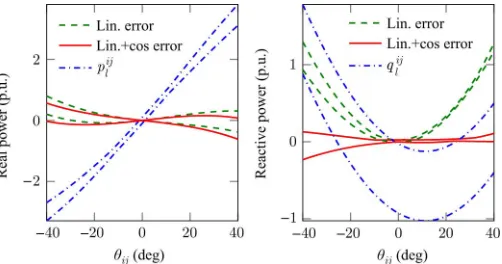
at each end of the line, and . The cosine approximation incurs the largest error. Fig. 1 shows maximum and minimum powerflows and errors over this range
of voltages and angles for a line with .
[image:3.592.305.556.61.193.2]Approximation errors are obtained for when the
Fig. 1. Maxima and minima of powerflows, and of approximation errors, as a function of phase angle difference.
TABLE I
APPROXIMATIONERRORS INLINEFLOWTERMS(VOLTAGES INP.U.)
term is approximated as 1 (a linear model) and modeled exactly (linear plus cosine). In both cases, is used. Although little reduction in errors is apparent in the realflows, the importance of modeling the cosine term is clear for reactive flows.
A similar analysis shows that including the sine term (instead of its linearization) in addition to the cosine term reduces the error in the realflows slightly, but makes no significant differ-ence to the reactive power. Since the infeasibilities that occur using the DC approach to islanding are mainly owing to the re-active power and voltage limits [19], the appropriate approxi-mation to use is the linear-plus-cosine one. And although co-sine terms cannot be used directly in an MILP model, they can be modeled to arbitrary levels of accuracy by piecewise linear functions. The next section demonstrates the use of the model in an OPF formulation.
B. Piecewise Linear AC OPF
The piecewise linear (PWL) AC OPF problem is defined as
subject to, , the linearized power balances:
(1a)
(1b)
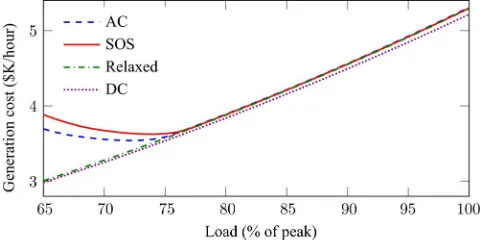
Fig. 2. Generation costs as a function of load for the 9-bus network.
The -piece PWL approximation to . For all :
(2) where and are chosen so that the approximation
coincides with at breakpoints . System
limits are applied:
(3)
Note that lineflow limits are limits on real power loss. If an MVA limit is given, this may be converted by assuming
nominal voltage,i.e., .
The implementation (2) of the PWL model of requires either binary variables or special ordered sets of type 2 (SOS-2) [24]. The overall problem is then, depending on , a mixed in-teger linear or quadratic program (MILP or MIQP). If (2) is re-placed by its relaxation , then the problem becomes a convex optimization problem and no binary variables or SOS sets are needed. Since real and reactive line losses de-crease as increases, it is tempting to assume that equality will hold for one of the PWL sections, and this relaxation will yield a tight result. However, as Fig. 2 shows, situations exist where the SOS formulation is necessary. This shows optimal generation costs against load level, as obtained by OPFs using AC, PWL with SOS, relaxed PWL, and DC powerflow models. The network is the WSCC 9-bus network modified to set voltage limits to and the lower reactive power limit for each gen-erator is raised from to Mvar. This means that at low load levels the generatorsfind it increasingly difficult to bal-ance the reactive power, as more lines become sources rather than sinks of reactive power, and the generation cost rises with falling load. While the SOS PWL is able to capture this ef-fect, the relaxed PWL and DC-based models are not; the former “cheats” by having some lines continue to store reactive power irrespective of their end voltages and angles—allowed because is permitted—and this allows more of the real power to be generated by the cheaper generators.
III. FORMULATION FORSYSTEMISLANDINGUSING
PIECEWISELINEARAC POWERFLOW
In [19], the problem of determining how to split a transmis-sion network into islands is considered. The aim is to limit the effects of possible cascading failures and prevent the onset of wide-area blackouts by re-configuring the network—via line switching—so that problem areas are isolated. The MILP-based method defines twosectionsof the network. All of the buses that must be isolated are pre-assigned to section 0, and the optimiza-tion determines which other buses and lines to place in secoptimiza-tion 0. All the remaining components are in section 1. This creates at least two islands. The optimization will also determine the best strategy to adjust generation and shed load so as to establish a load-generation balance in each island while respecting all net-work equations and operating constraints after the split.
A. Motivation: Effect of Topology Changes on Voltage Profile
Solution of the MILP islanding problem provides a set of lines to switch, loads to shed and generators to adjust. However, if only the DC powerflow equations are included in the con-straints, the effects of changing the network topology on volt-ages and reactive powerflows is not considered. Thus, in [19], an AC optimal load shedding (OLS) problem is solvedafterthe MILP islanding problem, using the islanded network topology. If a solution to this can be found, the islanded network is fea-sible with respect to AC powerflow and operating constraints. The solution provides the correct generator output and load ad-justments to make, now having considered voltage and reactive power.
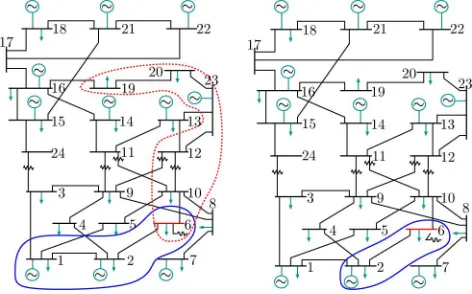
However, a number of the islanding solutions in [19] were AC infeasible, primarily due to violation of voltage bounds; solu-tions could be recovered by relaxing the normal limits. One such example, for the 24-bus IEEE Reliability Test System (RTS) [25], is described as follows. Given the problem of isolating bus 6 while minimizing the expected load shed or lost, the op-timal solution islands buses 1, 2 and 6, as indicated in Fig. 3. There remains sufficient real power capacity in both islands to meet demand, and no load is shed. Moreover, but not by de-sign, there is sufficient reactive power capacity in each island to meet the total reactive power demand. Despite this, a feasible solution to the AC-OLS cannot be found. Softening the voltage bounds recovers a solution, but with an abnormally low voltage of 0.6443 p.u. at bus 6 and an over-limit flow on line (2,6). Further inspection reveals that this situation has arisen because of the disconnection of line (6,10), a cable with high shunt ca-pacitance. The passive shunt reactor at bus 6 would, in normal circumstances, balance locally the excess reactive power and maintain a satisfactory voltage profile. This problem could be avoided by linking together the disconnection of line (6,10) and the shunt reactor at 6. The optimal solution when these actions are linked is shown in the right-hand diagram of Fig. 3, and it yields a better feasible solution than when the reactor is not dis-connected. Rules like this are easy to incorporate in the model; however, it is difficult a-priorito define all possible rules. A better approach is to allow the model to decide the combination of equipment to disconnect, and when this is done the optimal solution disconnects both line (6,10) and the reactor at bus 6, giving the right-hand Fig. 3 solution. The models and result for this example are given in Sections III-B4 and IV-A1.
Fig. 3. IEEE 24-bus RTS with bus 6 isolated. On the left, DC method (solid) and PWL method without shunt switching (dashed). On the right, PWL method with shunt switching.
constraints are included—is unsatisfactory. It also shows that even if reactive power balance is achieved within each island, local shortages or surpluses can lead to an abnormal voltage profile. Many test networks are prone to this problem [19]. Moreover, it is not just system islanding that is susceptible; DC-based transmission switching also does not consider the consequences on voltage of disconnecting lines. Thus, there is a need for network topology optimization methods that can determine AC-feasible solutions, but without having to resort to solving the full MINLP problem. The focus of this paper is topology optimization for the purpose of islanding, and in the next section, a formulation is presented that uses the PWL model of AC powerflow.
B. Formulation of Constraints for Islanding
The problem is to decide which lines to switch in order to iso-late a part of the network. Separation of sections is enforced by sectioning constraints. The islanded network must satisfy power balance andflow equations and operating limits, and so these are included as constraints in the problem.
1) Sectioning Constraints: Define and , where , as the subsets of buses that are desired to be sepa-rated. For now, the motivation for this separation is left open, but it may be that these buses in, say, represent a failing area of the network, or are associated with a coherent group of synchronous machines that will be separated from other groups. The proposed approach will split the network into twosections: section 0 will contain all buses in and section 1 all buses in . For a bus , denotes the section (0 or 1) to which that bus is assigned. That is, if is to be placed in section 0, then . Separation between sections is achieved by switching lines: denotes the connection status of a line , and the con-vention followed is for when is disconnected. The exact boundaries of each section will depend on the objective, defined later, and the optimization will determine how to assign to sec-tions those buses not in or , in order achieve balance and optimize the objective. However, the following constraints en-force the separation of section 0 and 1, without predefining their boundaries:
(4a) (4b)
2) Power Flow: The remainder of the constraints are con-cerned with achieving a balanced steady state for the islanded network. It is assumed that generators are permitted to make only small-scale changes to output or be switched off, and loads may be fully or partly shed in order to maintain a balance. As a consequence of these changes and the topological changes, bus voltages, angles and lineflows will change, and so must be mod-eled to ensure satisfaction of network constraints and operating limits.
First, the power balances, (1a) and (1b), are included without modification. Next, the lineflow equations are modified so that when a line is disconnected, powerflows across it are zero ir-respective of its end bus voltages and angles. To assist this, we introducelinevariables— and as end voltages and as the angle difference—that are distinct frombusvariables , and . The following constraints control the relationship be-tween line variables and bus variables. For a line with end buses and
(5a) (5b)
(5c) (5d)
(5e)
where is a “big- ” constant. Of these, (5a) and(5b) force equality of and for a connected line, but set for a disconnected line while allowing thebus
angles and to vary independently. Likewise, if
then, by (5c), and . However, if then
the line voltages are set to minimum values— and —independent of the bus voltages and .
This switching between line and bus variables is made use of in modified lineflow equations. For a line
(6a)
(6b)
and is given by (2), using . Note that since if , then for a disconnected line. Hence, if
then , irrespective of , and . If ,
the normal powerflow equations are recovered.
for generator , around the pre-islanded value. The limits will depend on the ramp and output limits of the generator, and the amount of immediate or short-term reserve capacity available to the generator. For the test scenarios in Section IV, a time limit of 2 min is assumed for ramping, but the formulation permits any choice. This choice should be informed by existing post-contin-gency response protocols. For reactive power, it is assumed that a new output can be set in some range to . The set of possible real and reactive power outputs of a generator is usu-ally convex. For the test scenarios in Section IV, the bounds on the real and reactive power are independent. In the more general case, since the range of values for the real power output is small, the feasible region for the problem is a narrow slice through a convex set, and—except when the real power output is close to its upper limit—it is a good approximation to treat the real and reactive power bounds as independent. If this is not the case, it is straightforward to add constraints that couple and .
The operating regime is modeled by the constraints
(7a) (7b) (7c)
Here, is a binary variable and denotes the on/off setting of the real power output, and is a subset of generators which are required to remain on.
For loads, because of the limits on generator outputs and net-work constraints, it may not be possible after islanding to fully supply all loads. It is therefore assumed that some shedding of loads is permissible. Note that this isintentionalshedding, not automatic shedding as a result of low voltages or frequency. To implement this in the real network there has to be central control over equipment. For all
(8a) (8b)
where .
Finally, line limits are applied via constraint (3).
4) Rules for Other Component Switching: As motivated by Section III-A, sometimes it is necessary to have rules for switching components or adjusting controls in different situ-ations. Such rules can easily be included in the formulation using standard techniques for deriving constraints from logical rules [26]. For example, the switching of a shunt component at a bus can be modeled by introducing binary and continuous variables, and respectively, constraints
and replacing the , terms in (1a) and
(1b) with and , respectively. In Section IV-A1 this is explored further for the 24-bus example.
C. Objective Functions for Islanding
The general aim is to split the network, separating the two sections 0 and 1, yet leaving it in a feasible state of operation. The specific motivations and objectives for islanding are dis-cussed in this section. Clearly, if a network can be partitioned with minimal disruption to load, and with minimal disturbances
to generators, then its chances of viable operation until future restoration are increased.
1) Isolating Uncertain Regions and Maximizing Expected Load Supply: We assume that there is an identifiable localized area of the network that is believed could be a trigger for cas-cading failure. Similar to the approach in [19], the goal is to in-clude this area of potential trouble in an island, leaving the rest of the network in a known, secure steady state. The sets and consist of all buses and lines in the troubled area and, addi-tionally, any buses and lines whose status is uncertain. To ensure section 1 contains no uncertain components, all lines re-maining in this section are disconnected by replacing (4a) by
(9)
Because section 0 may contain failing components or be in an uncertain state, it is assumed there is a risk of not being able to supply any load placed in that section. Accordingly, a load loss penalty is defined for a load , which may be interpreted as the probability of being able to supply a load if placed in section 0. Suppose a reward is obtained per unit supply of load . If is placed in section 1 a reward is realized per unit supply; however, if is placed in section 0, a lower reward of is realized.
The objective is then to maximize the expected total value of load supplied:
(10)
where , and .
Here a new variable is introduced for the load delivered in section . If (and so the load at bus is in
sec-tion 0), then , , and the reward is .
Conversely, if then and , giving a
larger reward . Thus, maximizing (10) gives a prefer-ence for and a smaller section 0, so that the impacted area is limited.
2) Promoting Generator Coherency: Another aim is to en-sure the synchronicity of generators within islands. Large dis-turbances in the network cause electro-mechanical oscillations, which can lead to a loss of synchronism. A popular approach is to split the system along boundaries of near-coherent generator groups, as determined by slow-coherency analysis [27]. Thus, weak connections between machines—which give rise to slow, lightly-damped oscillations—are cut, leaving separate networks of tightly-coupled, coherent machines.
Consider those buses in the network with generators attached, the set of which is defined as , and define as the set of all pairs of such buses. For what follows, it may be assumed that multiple units at a bus are tightly coupled and are aggregated to a single unit. The dynamic coupling, , between a pair of machines at buses may be determined from slow-coherency analysis. For example, assuming as in [10] the undamped second order swing equation
at and . To favour, in the objective, separating loosely-cou-pled generators, introduce a new variable for all
. Then the constraint
(11)
sets to 1 if generator buses and are in different sections of the network (and hence electrically isolated), but otherwise may be zero. Minimizing the function
(12)
gives a preference for machines in different sections having small ,i.e.,being weakly coupled, and those within the same section have stronger coupling. This may be used in conjunction
with (10),i.e., , with weighting , so
that section 0 is the “unhealthy” section, and the expected load supply is maximized while keeping together strongly-coupled machines.
Minimizing (12) alone will favour keeping all machines in the same section, and to force the machines apart additional con-straints may be needed. Alternatively, the following implemen-tation splits the network directly into coherent groups, making different use of the sets and .
3) Splitting Into Coherent Groups: Suppose that coherent groups of generators have been determined, and that assigned to and are those buses in corresponding to machines in different groups. For example, may contain the critical co-herent group of machines, and all others. The sectioning con-straints will ensure that the machines are separated, but which other buses are assigned to each section is determined by the optimization. The solution that minimizes the amount of load shed can be found by maximizing the function
(13)
Alternatively, to seek a solution that changes the generator out-puts minimally from their initial values , minimize
(14)
where , , and .
The sectioning constraints ensure that the machines are split into two sections. If further separation is required, the optimization can be re-run on each island of the network.
4) Penalties: Often there may be multiple feasible solutions with objective values close to the optimum. Including additional penalty terms in the objective—small enough to not signifi -cantly affect the primary objective—improves computation by encouraging binary variables to take integral values in the relax-ations, and also guides the solution process towards particular solutions. For example, consider the penalty terms (for a mini-mization problem)
(15)
where , , are weights to be chosen appropriately. The first term penalizes line losses, and reduces the need for SOS branching. The second penalizes cutting lines. We found
these substantially reduced the number of lines that are cut be-yond those needed to create the island, and this significantly im-proved solution times. Also, if is set to a small multiple of the pre-islanding powerflow through the line, disconnecting high-flow lines is penalized most heavily; in [19] it was shown that this leads more often to solutions that retain dynamic sta-bility. The third term penalizes the switching-off of generators. If then units are given uniform weighting. If, say, , then the disconnection of large units is discouraged.
D. Overall Formulation
The overall problem is to optimize the chosen islanding ob-jective [e.g.,(10), (12), (13), or (14)], subject to
• sectioning constraints (4); • line switching constraints (5);
• power balance [(1a) and (1b)] andflow (6) constraints; • the PWL approximation (2);
• generation limits (7); • lineflow limits (3);
• load shedding constraints (8).
IV. COMPUTATIONALRESULTS
A. Islanding to Minimize Expected Load Loss
A set of scenarios was built based on the 9-, 14-, 24-, 30-, 39-, 57-, 118-, and 300-bus test systems from MATPOWER[28].
For a network with buses, scenarios were generated by assigning in turn each single bus to . No buses were included in and no lines in . For each scenario, the islanding so-lution was obtained by solving the previously described MILP problem. The feasibility of an islanding solution was checked by solving an AC optimal load shedding (OLS) problem on the islanded network, which includes all AC power balance, flow and operating constraints, but permits load shedding as per (8a) and (8b).
Data for the islanding problems are described as follows. In the objective function, , a value of 0.75 is used for the load loss penalty . The generator coherency objective, , was not included initially. The penalties are ,
and , so that the line-cut
penalty is scaled by the total load in the system. Our investiga-tions show that these penalties have a negligible effect on the quality of the solutions, but reduce computation time by an order of magnitude. For the PWL approximation for a line ,first the angle difference prior to islanding, , is determined from the base-case AC OPF solution, and then 12 pieces are
used over .
TABLE II
24-BUSSYSTEM: COMPARISON OFSOLUTIONS
1) AC-Feasible Islanding of 24-Bus Network: Returning to the example of Section III-A, the PWL AC islanding approach is applied to the problem of islanding bus 6. The islanding problem was solved both with and without the option (as part of the optimization) of switching the shunt reactor at bus 6. The optimal solutions are shown in Fig. 3. Without shunt switching (PWL-AC-1), the cable (6,10) is left intact and the final network topology is significantly different from before. With shunt switching permitted (PWL-AC-2), the cable is again switched, but fewer buses are islanded than for the DC solution. The feasibility of each solution was checked by solving the AC OLS problem on the islanded network, and both PWL AC solutions satisfied all AC constraints.Table II compares the DC, PWL-AC-1 and PWL-AC-2 solutions, using values obtained from both the MILP solutions and the post-islanding AC solutions. The PWL AC islanding solutions are close to thefinal AC OLS solutions. Note that the PWL AC solutions achieve AC feasibility at the cost of a lower expected load supply (hence higher expected load shed).
2) Computation Time: The speed with which islanding deci-sions have to be made depends on whether the decision is being made before a fault has occurred, as part of contingency plan-ning within secure OPF, or after, in which case the time scale de-pends on the cause of the contingency. Finding solutions that are optimal, or to within a pre-specified percentage of optimality, can take an unpredictable amount of time. Hence, especially in the latter case of reacting after a fault has occurred, it is impor-tant to be able to produce good feasible solutions within short time periods even if these are not necessarily optimal. To il-lustrate how the quality of the solution depends on the solution time, tests were run for a set offixed times of between 5 and 45 s, returning the best found integer feasible solution.Table III sum-marizes these results for the 57-, 118-, and 300-bus scenarios, quoting the average relative MIP gap of returned solutions. All the test cases with 39 or fewer buses solved to negligible gaps within 5 s, and are not shown.Table III also shows the av-erage gaps between the returned and best-known AC solutions for each scenario, where an AC solution was obtained from a re-turned PWL islanding solution by solving the AC-OLS on the islanded network. The mean error between the objectives of the returned PWL-AC and AC solutions was less than 0.02%. For each network and scenario, the best-known AC solution was the best from those found from the different termination times, plus longer 1000-s runs. In the second and third sections of Table III, the mean values are over all cases that were feasible within the time limit. The platform was a 64-bit Dual Intel Xeon processor and 128 GiB RAM with up to 12 threads and using CPLEX 12.5 as the MILP solver.
TABLE III
SOLUTIONS TOISLANDINGPROBLEMS FORDIFFERENTTIMELIMITS
TABLE IV
COHERENCY-BASEDISLANDING OF39-BUSNETWORK
The results show that good islanding solutions were found within 30 s —and usually sooner—for all networks. Moreover, the islanding topology usually changes little, or not at all, be-tween the solutions returned at 5 s and 45 s.
3) AC Feasibility: Using the DC model 20% of cases led to AC-infeasible islands [19], whereas none of the islands found using the PWL AC model were infeasible.
4) Promoting Generator Coherency: The generator co-herency objective, , may be included for the 24-bus network example by taking second-order dynamic data taken from [25]. For example, when , maximizing just leads to an optimal solution that places bus 1 in section 0 along with bus 3, and an expected load supply of 2699 MW. In doing this, the line between buses 1 and 2 is switched, separating the large generator sets at these buses (which would incur a cost of ). However, when maximizing the joint objective with , the optimal solution does not include bus 1 in section 0, opting instead to leave the line (1,2) intact and placing just buses 3 and 9 in section 0. With , the expected load supply is slightly smaller (2670 MW), but the strongly-coupled generators at buses 1 and 2 remain connected
.
B. Coherency-Based Islanding
The coherency-based splitting approach was applied to the 10-machine, 39-bus New England test network. Slow coherency analysis, assuming second-order dynamics, shows that the ma-chines may be divided into two groups: those at buses 30, 31 and 39 in one group, and then all others.
With and , the optimal
solu-tion splits the system as shown in Table IV. Note that although buses 1–3 and 5–9 are included in the same section as 30, 31, and 39, no generators are present at these buses. The objective was to minimize the movement of generator real power outputs,
exists that splits these two groups but requires less total change in generator outputs.
V. CONCLUSIONS ANDFUTUREWORK
An optimization-based framework for the intentional or con-trolled islanding of power networks has been presented. The ap-proach isflexible with respect to the aims and objectives of is-landing, andfinds islands that are balanced and satisfy real and reactive powerflow and operating constraints. It has been shown that the inclusion of a piecewise linear model of AC power flow allows AC-feasible islands to be found, where previously a DC-based approach led to islands with out-of-bound volt-ages. The use of objectives that promote generator coherency has been demonstrated.
Future work will investigate the wider practical aspects of the approach by performing detailed simulations on representa-tive networks and blackout scenarios, considering transient and dynamic performance. Current work is exploring the use of de-composition and aggregation methods to improve the computa-tional efficiency for larger networks.
REFERENCES
[1] Final Report of the Investigation Committee on the 28 September 2003 Blackout in Italy, Union for the Coordination of the Transmission of Electricity (UCTE), Final Report, 2004.
[2] U.S.-Canada Power System Outage Task Force, Final Report on the August 14 2003 Blackout in the United States and Canada: Causes and Recommendations, Final Report. Apr. 2004 [Online]. Available: https://reports.energy.gov/
[3] S. Larsson and A. Danell, “The black-out in southern Sweden and eastern Denmark,” inProc. IEEE Power Syst. Conf. Expo., 2006, Sep. 23, 2003.
[4] J. W. Bialek, “Lights out?,”IEE Power Engineer, vol. 19, p. 16, 2005. [5] H. You, V. Vittal, and Z. Yang, “Self-healing in power systems: An ap-proach using islanding and rate of frequency decline-based load shed-ding,”IEEE Trans. Power Syst., vol. 18, no. 1, pp. 174–181, Feb. 2003. [6] H. You, V. Vittal, and X. Wang, “Slow coherency-based islanding,”
IEEE Trans. Power Syst., vol. 19, no. 1, pp. 483–491, Feb. 2004. [7] S. S. Ahmed, N. C. Sarker, A. B. Khairuddin, M. R. B. A. Ghani, and
H. Ahmed, “A scheme for controlled islanding to prevent subsequent blackout,”IEEE Trans. Power Syst., vol. 18, no. 1, pp. 136–143, Feb. 2003.
[8] X. Wang and V. Vittal, “System islanding using minimal cutsets with minimum netflow,” inProc. IEEE Power Syst. Conf. Expo., 2004. [9] G. Xu and V. Vittal, “Slow coherency based cutset determination
algo-rithm for large power systems,”IEEE Trans. Power Syst., vol. 25, no. 2, pp. 877–884, May 2010.
[10] L. Ding, F. M. Gonzalez-Longatt, P. Wall, and V. Terzija, “Two-step spectral clustering controlled islanding algorithm,”IEEE Trans. Power Syst., vol. 28, no. 1, pp. 75–84, Feb. 2013.
[11] L. Liu, W. Liu, D. A. Cartes, and I.-Y. Chung, “Slow coherency and angle modulated particle swarm optimization based islanding of large-scale power systems,”Adv. Eng. Informat., vol. 23, no. 1, pp. 45–56, 2009.
[12] M. R. Aghamohammadi and A. Shahmohammadi, “Intentional is-landing using a new algorithm based on ant search mechanism,”Int. J. Elect. Power Energy Syst., vol. 35, pp. 138–147, 2012.
[13] B. Yang, V. Vittal, G. T. Heydt, and A. Sen, “A novel slow coherency based graph theoretic islanding strategy,” inProc. IEEE Power Eng. Soc. General Meeting, 2007.
[14] G. Xu, V. Vittal, A. Meklin, and J. E. Thalman, “Controlled islanding demonstrations on the WECC system,”IEEE Trans. Power Syst., vol. 26, no. 1, pp. 334–343, Feb. 2011.
[15] K. Sun, D.-Z. Zheng, and Q. Lu, “Splitting strategies for islanding op-eration of large-scale power systems using OBDD-based methods,”
IEEE Trans. Power Syst., vol. 18, pp. 912–923, 2003.
[16] K. Sun, D. Z. Zheng, and Q. Lu, “Searching for feasible splitting strate-gies of controlled system islanding,”IEE Proc. Gen., Transm., Distrib., vol. 153, pp. 89–98, 2006.
[17] M. Jin, T. S. Sidhu, and K. Sun, “A new system splitting scheme based on the unified stability control framework,”IEEE Trans. Power Syst., vol. 22, no. 1, pp. 433–441, Feb. 2007.
[18] C. G. Wang, B. H. Zhang, Z. G. Hao, J. Shu, P. Li, and Z. Q. Bo, “A novel real-time searching method for power system splitting boundary,”IEEE Trans. Power Syst., vol. 25, pp. 1902–1909, 2010. [19] P. A. Trodden, W. A. Bukhsh, A. Grothey, and K. I. M. McKinnon,
“MILP formulation for controlled islanding of power networks,”Int. J. Elect. Power Energy Syst., vol. 45, no. 1, pp. 501–508, 2013. [20] E. B. Fisher, R. P. O’Neill, and M. C. Ferris, “Optimal transmission
switching,”IEEE Trans. Power Syst., vol. 23, no. 3, pp. 1346–1355, Aug. 2008.
[21] M. Vaiman, K. Bell, Y. Chen, B. Chowdhury, I. Dobson, P. Hines, M. P. S. Miller, and P. Zhang, “Risk assessment of cascading outages: Methodologies and challenges,”IEEE Trans. Power Syst., vol. 27, pp. 631–641, 2012.
[22] B. Stott, J. Jardim, and O. Alsaç, “DC powerflow revisited,”IEEE Trans. Power Syst., vol. 24, pp. 1290–1300, 2009.
[23] C. Coffrin, P. V. Hentenryck, and R. Bent, “Approximating line losses and apparent power in AC powerflow linearizations,” inProc. 2012 IEEE Power & Energy Soc. General Meeting, 2012.
[24] E. M. L. Beale and J. J. H. Forrest, “Global optimization using special ordered sets,”Math. Program., vol. 10, pp. 52–69, 1976.
[25] Reliability Test System Task Force of the Application of Probability Methods Subcommittee, “IEEE reliability test system—1996,”, IEEE Trans. Power Syst., vol. 14, no. 3, pp. 1010–1020, Aug. 1999. [26] H. P. Williams, Logic and Integer Programming, ser. International
Se-ries in Operations Research & Management Science. New York, NY, USA: Springer, 2009.
[27] B. Avramovic, P. K. Kokotovic, J. R. Winkelman, and J. H. Chow, “Area decomposition for electromechnical models of power systems,”
Automatica, vol. 16, pp. 637–648, 1980.
[28] R. D. Zimmerman, C. E. Murillo-Sánchez, and R. J. Thomas, “MAT-POWER Steady-State Operations, Planning and Analysis Tools for Power Systems Research and Education,”IEEE Trans. Power Syst., vol. 26, no. 1, pp. 12–19, Feb. 2011.
Paul A. Trodden(S’06–M’09) received the M.Eng. degree in engineering sci-ence from the University of Oxford, U.K., in 2003, and the Ph.D. degree in aerospace engineering from the University of Bristol, U.K., in 2009.
He is a lecturer in the Department of Automatic Control and Systems Engi-neering, University of Sheffield, U.K. His research interests include robust and predictive control, distributed control, and optimization for power systems.
Waqquas Ahmed Bukhsh(S’13) received the B.S. degree in mathematics from COMSATS University, Islamabad, in 2008. He is currently pursuing the Ph.D. degree in the School of Mathematics at the University of Edinburgh, U.K.
Andreas Grotheyreceived the M.Sc. degree in numerical analysis from the University of Dundee, U.K., in 1995 and the Ph.D. degree in optimization from the University of Edinburgh, U.K., in 2001.
He is a senior lecturer in the School of Mathematics at the University of Ed-inburgh. His interests include algorithms for stochastic and other large scale optimization problems with applications to optimal powerflow.
Ken I. M. McKinnonreceived the B.Sc. degree in mathematics and physics from the University of Glasgow, U.K., and the Ph.D. degree in optimization from the Control Engineering Department at Cambridge University, U.K.