Rochester Institute of Technology
RIT Scholar Works
Theses
Thesis/Dissertation Collections
4-20-2006
Support within a community
Lance Neirby
Follow this and additional works at:
http://scholarworks.rit.edu/theses
This Thesis is brought to you for free and open access by the Thesis/Dissertation Collections at RIT Scholar Works. It has been accepted for inclusion in Theses by an authorized administrator of RIT Scholar Works. For more information, please [email protected].
Recommended Citation
ROCHESTERINSTITUTEOF TECHNOLOGY
A Thesis Submittedto the
Faculty
ofTheCollegeof
Imaging
ArtsandSciencesIn
Candidacy
fortheDegreeofMASTER OF FINE ARTS
Support Within
aCommunity
By
Lance
Neirby
Chief Advisor: Leonard Urso
Leonard A. Ursa
Date:
H
~/
'8
2/Jo
·
~
I
\
Associate Advisor: Eileen Bushnell
Eileen Feeney Bushnell
Date:
7fkay
~5J ~)
Associate Advisor: Juan Carlos Caballero-Perez
Juan Carlos Caballero-Perez
Date:
l\.~ ~
/
ZOO(
Associate Advisor: Clarence Sheffield
Clarence B. Sheffield Jr.
Date:
7IJtl"
711
,
Thesis Reproduction Permission Statement:
I understand that I must submit a print copy of my thesis or dissertation to the RIT
Archives
,
per current RIT Guidelines for the completion of my degree. I hereby grant to
the Rochester Institute of Technology and its Agents the non-exclusive license to archive
and make accessible my thesis or dissertation in whole or in part in all forms of media in
perpetuity. I retain all other ownership rights to the copyright of the thesis or
dissertation. I also retain the right to use in future works (such as articles or books) all or
part of this thesis or dissertation.
Print Reproduction Permission Granted:
I
,
Lance Neirby
,
hereby grant permission to the Rochester Institute of Technology to
reproduce my print thesis or dissertation
in
whole or
in
part
.
Any reproduction will not
be for commercial use or profit.
--,--.
Signature of Author:
Lance Neirby
Date:
<..J0
Pf.L /9
02
0
0
G
Nourishing
sentiments of excitement andanticipation,Imademyjourney
frommyfamiliarsurroundings oftheMidwesttoattend graduate school atRochesterInstitute
ofTechnology. Ihad been envisioningthismoveforseveralmonths, andIwaseagerto
continue
developing
myartistic skillsingraduate school. When Isteppedoncampus forthefirst
time,
Iwas surprisedtofindthat thefeelingsofexcitementandanticipationhadvanishedonlytobereplaced
by
nostalgiaforthehomethatwas sofamiliartome.Brushing
thefeeling
aside,I attemptedtoregain comfortinmynew environmentby
organizingvarious aspects ofmynewlifein Rochester. To my
dismay,
thefeelingsofyearningfor
familiarity
lingered.During
thenextfewmonths, thesecravingsfortheMidwest begantobeerasedasImetnewfriendsandbecamemoreinvolvedwiththe
Metals Department.
Throughoutthefirstyear ofgraduateschool,Ioftenthoughtofthat experience,
strugglingtospeculatewhatfacilitated myrelief ofthefeelingsof
longing
forthepastand adesiretobeinvolved. Irealizedthat thefeelingsofnostalgia coincided withmy
desireforsupportwithinmynew environment. IbegantounderstandthatwhenIleftthe
Midwest,
Iuprootedmy foundation inthenetwork of supportthathad developed in highschool andundergraduateschool. After arrivingintheeasternUnited
States,
Ineededtofindsupport and a sense of
belonging
inmynew circumstances.During
the summerbeforemy finalyear atRochesterInstituteofTechnology,
Iembarked uponthe taskof
developing
atopicformythesis. Iwantedtocreate athesistopic thatwas aninfluentialelementinthedevelopmentofmycharacter
during
graduateschool as well as auniversal topicthatviewers couldrelatetowith ease. I foundedmy
others who viewedmyworktobereminded oftheirinextricablelinktosupportwithin
theirown community.
Themost successful piece ofmy firstyear exploredhow humans balanceupon
thelifestylesoftheirancestors, BalanceonOur
Ancestors,
2004 (Fig. 1).My
brothersandIcamefroma
long
lineoffarmersand cultivatorsoftheland. Aswe grewup inacountrythatwas
becoming increasingly
industrializedandfocusedontechnology,webecamethefirstgenerationtoendthe traditionofagrarianlifestyle. Eventhoughwe
chosetodeviate fromthepathsofourancestors,we stillfeltastrongconnectionto the
land. Irealizedthatour generation was notcommencinganew
journey
intothemodernworld; rather,welearnedtobalanceuponthe
history
ofourancestors andmerely formanew pathfromthe
journey
they
had beguncenturiesbefore.I wantedtoincorporatethisconcept of
balancing
our presentlifewith ourancestralheritage intomythesiswork
by focusing
upontheagrarian ways ofthepastfewgenerations ofmyancestors since
they
immigratedto theUnited States in 1866. Whenmyancestors encountered expansive grass prairies as
they
migratedto theplainsoftheupperMidwestfrom
Norway
andHolland,
Iimaginethatthey
foundcomfortinthesublimenature ofthesesprawlinggrasslands. Ialso founda sense ofsecurityinthe
hilly
grasslands of
Minnesota,
whereI spenttheearliest years ofmylife. Atthat timeIwastooyoungtounderstandthemeaningoftheuniquebiologicalstructure ofthe tallgrasses
orwhy
they
grew so closetogether. Amove athousandmilesto theeasternUnitedStates nearly
twenty
yearslaterrekindledmymemoriesofthesecuritythatI found inthegrassfieldsofmypast. Iwantedtoincludethisconnectionto thelandIshared withmy
Withtheideaoftheinclusionofagricultureintheevolutionofmythesis,I strived
tocreatethe tangibleformsthatwouldbeinvolved inthe
display
ofmythesis. Ichoosetocapitalize ontheformsIbeganto
develop during
myfirstyearatRochester InstituteofTechnology.
During
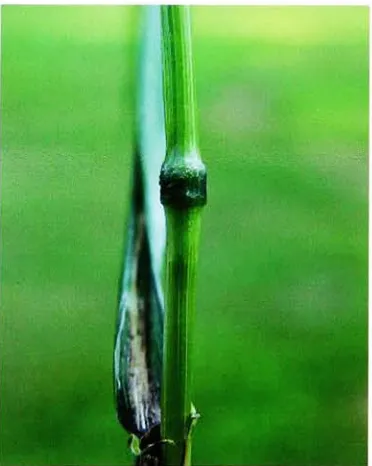
this year,Ibecame intriguedwiththecharacteristicallyuniquegrowingnodes of
long
stem prairie grass. Thisarea,whichisresponsibleforthegrowthof
leaves,
is locatedattheattachment oftheleafto the stem(Fig.2). This evolutionarytraitallowsthegrowthofgrassestobeundisturbed
by
grazinganimalsthat tend todamageothertypesof plantscontainingbudsofgrowth cellslocatedatthe tipsofthe
branches. Iwantedtogivetheformofthegrowingnode avitalroleinthepresentationof
mythesis,asit isresponsibleforself-preservationandsuccessfulproliferationofthe
species.
Inadditionto thelocationofthegrowingnode, anotherdistinctivetraitof
long
stem prairie grassesisthecloseproximity inwhich
they
coexist. Thestructuralintimacy
of afieldof
long
stem grasses allows eventhetallest,
thinnest,and mostfragileplantstosurvive. Throughadaptation andevolution,
they
have foundstrengthinnumbers. Eventhoughanaturalfield ismadeupof countless grassstalks,I envisionthefieldas
individualsstandingtogetherforsupport. Like
humans,
grassesaretoofragiletostandagainsttheelements
by
themselves. Iaimedtoexplorethischaracteristic ofdependenceinmythesis
by
creatingafieldofhundredsofgrasses,juxtaposedtoafield consistingofa singlebentandbrokengrass. Acompositionofthismanner would allowtheviewerto
confronttheconsequencesof a world constructed ofindividualismwithout
harmonization. Theoverallintentionofmythesiswasto demonstratethe
importance
ofInordertocreate a piecethatwoulddemonstratethesignificanceofsupport
within acommunity, I wantedto
keep
theoverall exhibit uncomplicatedandfocusedby
creatingan
installation
of numeroussimilarforms. Ifeltthat thispresentationwouldestablish a stronger messagethancreatinga moretraditionalmulti-piecethesis.
After Ibecameaware oftherelevanceofthe grasses,Iresearchedthestructure
andtype thatwas commontowhere Igrewupas well aswheremyancestorsfarmed. I
believedthataccurate representationofthe trueformswasimportant inorderto
bring
truthand strengthto thepresentation ofmythesis work. Thespecificgrass Ichoseto
representiscalledFoxtail Bristle
Grass,
orSetaria Italica(Fig. 3). Thisspeciesoriginated around4500 BCEinChina.1
Itisa
highly
adaptableplantthatcanliveinvaryingclimates. After populating Eurasiathroughnaturalmeans and
trade,
thegrassfound its waytoNorth Americainthepockets andtrousercuffs ofthesettlers and
immigrants.2
Currently,
therearethirty-twospeciesinthegeneraSetaria,
inhabiting
everycontinentexcluding Antarctica. Itcanbeharvestedas acrop forhumanand
livestockconsumptionorleftinthefieldsas forageforanimals. Bristlegrasses, along
with all othergenerainthegrass
family
Poaceae,
evolved asgrazingplants. ThePoaceaegrass
family
consistsof grassesranginginsizefromground coverto giantbamboos.
By
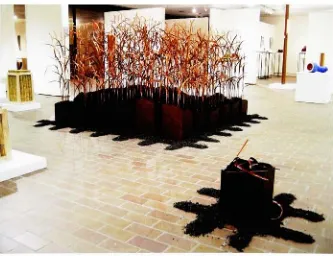
capitalizingontheessentialform ofFoxtail BristleGrass,
Iwas abletoemployanexteriorforminaninteriorspace(Fig. 4). Thisorganic grassformalso
allowedmetoinvestanorganic qualityintothestatic metalthatmakesupthestructure of
1
Foxtailoriginatedin Chinain4500 BCE. 2
MigrationofFoxtail to USinimmigrantspants cuffs. 3
theplant.
Individually,
Idecidedtoconstruct each grass's stalk out offourgraduatedsizes of copper
tubing
and wirerangingfromsixmillimetersin diameteratthebottomsectionto three millimeters atthe
top
section. Theoverallheightofeachgrass stalkvariesfromthirty-sixinchestoforty-twoinches. Theentire stalkhasalineartexture
runningparallelwiththestalk. I castthe threegrowingnodes ofeachplantinanickel
silveralloytofocusattentionontheirplacement, structure,and significantroleingrowth. Thesenodes alsohavethesamelineartextureand are solderedinline inthemiddle
regionsofthelowerthreesections. Aslender sixteeninch
long
spear-likeleafunfoldsina v-likefashion fromaroundthe
top
of eachofthelowerthree sections, thusdelineating
theconnection ofthelarger lowersectiontotheonemillimeter smallerin diameteradjacentupper section(Fig. 5). Theheadofthegrassisconstructedof copper meshto
createa
light,
tubularorganicstructure. Thissemi-transparentheadsitsatopthefinalcopper stalk sectionmeasuringteninches
by
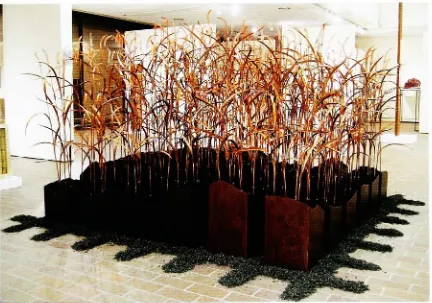
threemillimeters. Theentire processyielded216completestalksof grassthatweresituatedwithin37 steelbases.
Aviewerthatspenthours scrutinizingtheoverallconstruction ofmythesiswould
probablynotbeabletorecognizethatevery step intheconstruction processhadadistinct purposein my attempttocreatethe
familiar,
comfortingfeelingsofsupport. One ofthemost obviouswaysinwhichI decidedtoconveythis
feeling
wastobuildanentirefieldofFoxtail Bristle Grass. Eachgrass symbolizes
individuality
andsurvival; theentirefield,
ontheotherhand,
signifiesindividuals standingtogetherforsupport. Thecountlessstalksofgrassformacommunitywhere strengthand supportflourish. Themassive
Iemphasizedthe
feebleness
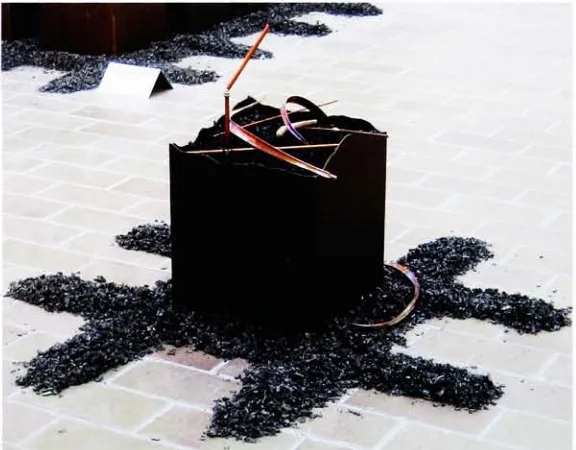
of a singlestalk,existingonitsown,by displaying
asingle,bentand unassembled stalk of grassthatstoodinabaselocatedsixfeetfromthe
edge ofthefieldofgrasses (Fig. 6). The factthatthegrasswasbrokenandunassembled
showedthatone
individual,
existinginsolitude cannotsurvive withoutacommunityof
support.
Viewing
thepieceinalarge areaallowsittoengagetheviewerfrom adistanceanddrawthemin. The exhibit compelstheviewerstoscrutinizetheformsforseveral
reasons. Theexterior naturalformofthegrass employs astatic materialtointriguethose
intheinteriorspace ofthegallery. Itried tofurthercreate anorganic,outdoor
feeling by
placinga oneinchthicklayerofblackwoodshavingsinthefour inchspace separating
thebases fromeach otheraswellasthegalleryfloor(Fig. 7). Ihopedthat thislayout
wouldenableviewerstobecome lost intheorganic nature ofthepiecewithout
being
influenced
by
thecommonalitiesofenclosed spaces.Another
intriguing
formthatdrawsviewersinisthealertnessoftheuprightandfocusedheads. Ifeelthat thisstructure givesthegrasses ahumanisticquality; the
extensionoftheheadsprojectstheslender stalks upward andvisuallypullsthestalks
vertically awayfromthefloorasif
they
are aware oftheirsurroundings.Lastly,
the thickanddensemass ofthe angular,yetsoftlycurvedleavesconnectstheindividualgrassesandencouragestheeyetocontinuallymove and scrutinizethe
entirepiece. Ibelievethat thesequalities aresuccessfulinmakingtheexhibit
interactive
withtheviewer
by
causingtheviewertomoveand respondto theintriguing
formsthatWhen Iwasintheprocess of
designing
thebasestoholdthe grasses,mymainobjectivewastoallowfortheexpression of arolling landscape. Thiswould provide
underlyingmovementbelowthegrasses(Fig. 8). Each baseprojectsthegrassesaway
fromthegalleryfloorand ontothesame plane astheviewerinordertopresentthe
grasses at anengaginglevel. Thisdesignlent itselfto thecompletion ofmyobjective,
however,
afterconsideringthenumber ofbasesthatIwouldneed,Idecidedtolinkthebasesto thehistoricalLand
Survey
System. I feltthat thiswouldfurtherconnectthebasestoahistoricaltruth thatwould continueto
develop
theconceptofcommunityinmypiece.
Beforetheadvent oftherailroad andlaterthegraveland pavedroad,prairie
grassesknew onlynaturalboundaries. Intimelandwasclaimed andfencedinforgrazing
or
farmland,
thussectioninga natural ecosystemintogrids of ownership. The UnitedStates begantobesectionedinto squaretownshipsin 1785 whentheBureauofLand
ManagementimplementedtherectangularPublic Land
Survey
System.4
Townships
generallyrepresentedsixmiles
by
sixmiles,or36square miles. Theborders ofthesetownshipseitherfollow linesoflongitudeandlatitudeor naturaltopography.
My
thesisincorporatedthis ecological configurationofboundaries
by
allowingafieldofgrasstobesubdividedintosquareplots. Thegrassesthemselves
defy
theunnatural confines oftheirbasesastheirleaves interminglethroughideologicalfence lines. The
interacting
grassesalsorepresentthecreation of communitiesdueto theconsequence ofindividuals'need
forsurvivaldespitesectioningoflandareas.
Efficiency
andaccuracywerevery importantthroughouttheentirecreationprocessof216grasses containedin 37 bases. Thefirsttime thepiecewas placedinthe
six
by
sixlayoutwasduring
theinstallation;
therefore,thefinal success ofthepiecedidnottakeplace untiltheconclusion ofthecreation.
Only
uponinstallation,
wasthe truemessage of acommunityapparentinmythesis.
Composition,
as well aslayoutandforms,
canbeapowerfultoolusedto create amessagefromtheartistto theviewer.
Therefore,
I chosetouse copperandnickel silverforspecific reasons.
Initially,
Iselectedcopperforthisprojectduetomyunderstandingofthematerial'sreadilyavailable nature andlowcost.
Also,
copper wirecomesingraduatedsizesthatsuitthe
descending
stalkdiameterofFoxtailBristle Grass. Thecolorpallet of copperiswarm,
inviting
and susceptibletoheatpatina, whilethecoolersilvercolor ofthenickel silvergrowingnodesprovidescontrastandemphasizespotentiality
overtheother architectureofthegrasses. Copperandnickel silverpossessaninherent
permanencedueto theirchemicalmakeupandresistancetocorrosion. This ideaof
permanenceallowsmetoutilizetheformoftheFoxtail BristleGrassinamanner
uninhibited
by
time. Althoughtheformofthemetalgrasseswillnot change overtime,
thesurface ofthemetalwillcontinuallyrespondto thedifferentmoisturelevelsofthe
environment. This abilityofthegrasses'
colortoreactovertimecombineswiththe
organicformtoinstill lifeina staticmaterial.
Multitudes ofcommunities surroundindividualsglobally. Themessage ofmy
thesis istoinsistthatindividualscannot exist ontheir own;
they
aredependentonthesupportfromotherindividuals. Forexample, a singlebladeofFoxtailgrass will notbe
abletowithstandharshenvironments suchas wind and rain. Inconditions such as
these,
a singlebladeofgrass would simply break.Survivalwouldbe impossiblewithoutthe
support of other organisms ofits kind. Inthesameway,humansrequire other
individuals
forsupport and proliferation. We formnumerous communitiesbasedon ourbeliefs,
activities,andinterests.
Throughouthistory,
communitieshaveencouragedsurvival of
individuals
congregating ingroups.Subsisting
in largegroupsallows peopletospecializeinareasinwhich
they
have abilitiesandinterests.5
This
interdependency
allowsthecommunitytobecomeefficient anddevelop. Strengthexistswithinthese
communities, andthegroupisabletoaccomplish morethanoneindividual could achieve
alone.
In lightofthepostmodernistview,I creditseveralartists whohavebeen
inspirationalandthoughtprovoking
during
thecreation ofmythesis. Robert Smithsondealswithexteriorforms inaninterior spacein his 1968 installationcalledA Nonsite
(Fig. 9). In Smithson'spiece, the exterior rockformsare engagedinaninteriorspace
by
enclosingtheminsideoftrapezoidalboxes. Inthepresentationofmythesis
body
ofwork,I endeavoredtocreate
traditionally
exteriorformsofFoxtail Bristle Grass whichthriveintheconfinementsoftheencasementofthegallerywalls. Thegrassformsofmy
thesisworkandthenatural rockformsofSmithson's A Nonsitebothshareanallegorical
referenceto theiroriginal exteriorlocation. Thisallegorical referenceto theexterior
originofeachpiece acts asthelink betweenthepresent piece andtheoriginal natural
formsand
ideas,
whichformedthepiece'sinspiration.6
5
Sykes,Brian. The Seven DaughtersofEve (New York: W. W. Norton&Company, Inc., 2001),p.13
1-135.
6
Owens,Craig. "The Allegorical Impulse: TowardaTheoryofPostmodernism."Art After Modernism: Rethinking Representation. Eds. Brian Wallis. New York: The New Museumof
Contemporary
Art, 1991. p.203-235.Thenext arthistoricalassociationIdetectedwasapieceproduced
by
AgnesDenes,
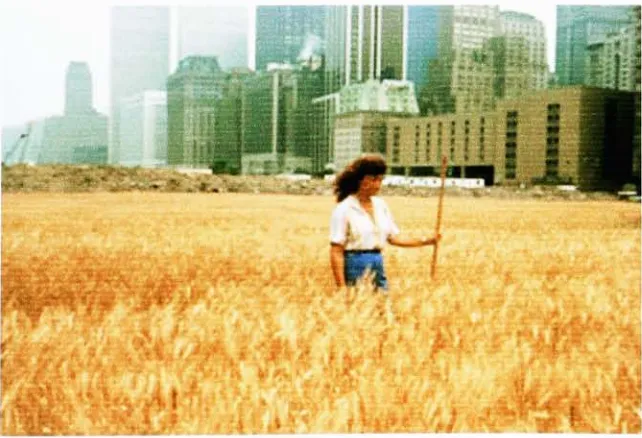
anearlypioneerofboththeenvironmentalartmovement and conceptual art. InWheatfield-A
Confrontation,
Battery
ParkLandfill,
NY1982,
Denesplantedandharvestedtwo acres of wheatfromthesite ofalandfill in Manhattan'sfinancial district
(Fig. 10). Itmarkedareclaimingoflandonlytoone
day
havethe sitebe builtuponagain. Agneschosetouseorganic, naturalformstoconstruct monumentalartwork
aroundthe
globe.8
Although mythesisinstallation isnon-organic incomposition,Iused
theinnateandnatural formsofthegrasstocreate a macrobiotic environment.
During
2004,
1 studied workby
HansHaacke,
aGermanartist concerned withsystemsandprocesses.
During
1963to1965,
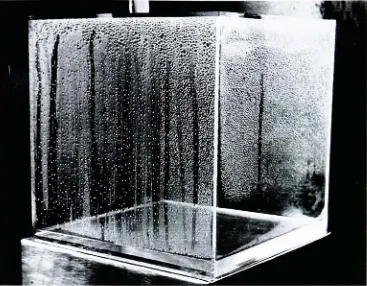
Haackedisplayed CondensationCube,
aplexiglasscube containingafewgallons ofdistilledwater(Fig. 11). The
humidity
insideof aplexiglassboxreacted withthechangesinambienttemperaturedueto thenumber of
viewersthatwerepresentintheroom. Haacke 'scondensationcubeisadidactic device
still pertinenttounderstanding contemporarylife andconceptualart. I see analogous
aspectsinmythesiswork wherethe systemof changehasbeenreversed.
My
installationcompelsthe viewers,ratherthanthe artwork, toreactinresponseto themassive
assemblageofgrassesthathave beenplacedbeforethem.
Perhapstheartistwhohasbeenmostinspirationalinthecreationofmythesis
workisFred Wilson. Fred WilsonisanAfrican-American installationartist who explores
forgotten ideasand artifactsinmuseum archives.Anexample,
Cabinetmaking
1820-1960,
arrangesacollection of ornate woodenchairsbeforeawhippingpost,which was7
McEvilley,Thomas."PhilosophyoftheLand."Artin America (November 2004):p. 158-164.
8
McEvilley,p. 158-164.
9
www.artnet.com/Magazine/features/cone/cone8-6-9.asp.
reportedlyused until 1958 (Fig. 12).The arrangementtellsviewers ofthecountlessblack
victims who experiencedthecruciformwhippingpost and of white peoplewhoviewed
slaveryas
customary.10
This shocking
display
evoked enormous feelingsofhorrorandremembrancetoa
devastating
periodinhistory. TwoaspectsofWilson'sworkhavebeenextremely
influential
inmyown artisticdevelopment. Firstofall, thevigilantmannerinwhichWilsonuses arrangement andlayoutofobjectstoevokeintense
reactionsfromtheviewers. In my
thesis,
Istrivedtocreateapowerful, thoughtprovokingenvironmentfortheviewers
by
thestrategicplacementoftheFoxtail BristleGrassand each ofthe37bases.
Secondly,
Wilson'spiecescommonlyarecomposedofforgottenorfamiliarobjects. Thepiece as awhole,
however,
isanything butordinary. Inmythesis work,I used afamiliarformof grassesthatiscommontomanyareas ofthe
world, nevertheless,Iundertooktheendeavortocreatean originaland contemplative
experiencefortheviewers.
Ibelievethatcurrentevents and experiences can gain rolesin developmentof
manyartist'swork aswellasobservationsof current andhistoricalartwork. One such
eventthatinfluenced mythesiswork wasalocal Midwesternevent of reclamationofthe
Pig's Eye Landfill site inSaint
Paul,
Minnesota. Overseveraldecades,
thelandareahadbecome
highly
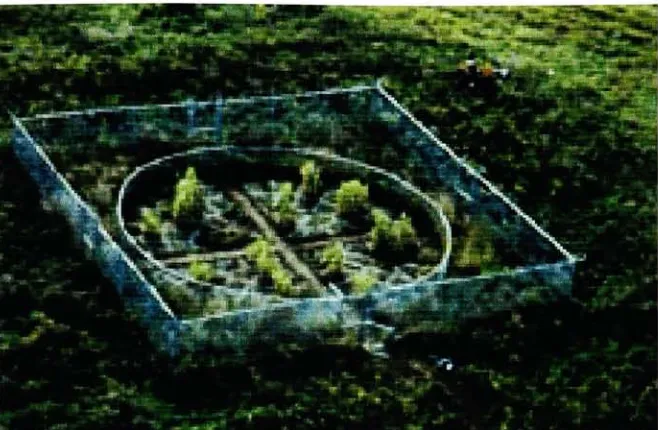
pollutedandconcentrated withtoxicmetals. In1990,
Mel Chin alongwithDr. Rufus
Chaney
beganafour-yearexperimentcalledRevival Field(1990-1993)
inwhich
they
attemptedtodetoxify
a600 squarefootsectionofthelandfill (Fig. 13).Revival Fieldwasthefirstphytoremediationproject wherenaturalplants wouldbeused
10
Buskirk,Martha.TheContingentObjectofContemporary Art (Cambridge: TheMITPress, 2003),p. 163-165.
toleachouttoxinsfromthepolluted soil.1 1 Chin'sproject calledforarectilinearfence
tobeconstructedaroundtheareatobeinvolved intheexperiment. This fenceline
delineatedtheregeneration area muchlikethemostcommonfence linefoundthroughout
the
farmlands
oftheMidwest. Thiseventhas significancetome asI viewedtheinstallationofmythesis
body
ofwork; theformofthesquareplantingofmygrasseshadthepurposeof
invoking
specificfeelingsof supportfoundwithintheassemblyofacommunity. As IthoughtbacktothereclamationofthePig's Eye Landfillsitein
Minnesota,
Irealizedthat thissamerectilinearfencing
ofthelandcould notonly sectionland butconnect and
help
torevitalizeitaswell.Inadditionto thenumerousartists whoinfluencethe
body
ofworkinmythesis, Iemployideasandforms fromartworkthatIhave createdintheyears previoustomy
thesis.Forexample, thesuccessfulformofthegrowingnodethatIhadfashionedin my
artwork
during
myfirstyear ofgraduateschoolfacilitatedthecreation ofSupport Withina
Community,
2005. In manypiecesthatI create,Ibelievethat thereare concealedformsandideasthatcanbe liberated ina successive
body
ofwork. Intheprocess ofcreating Support Withina
Community,
2005,
1identifiedseveral aspects ofthebody
ofworkthatIwouldliketo exploreinadditional pieces.
ThegridsystemIutilizedinmythesis thatpertainedto the Land
Survey
SystemintheUnited Stateswas an
intriguing
geometricalmeanstodisplay
abody
of work.Forme, thisconfigurationcreated a
feeling
ofintrigue,
therefore,
I wouldliketousethisgeometricformationin futurepieces.
Furthermore,
Iaspiretodrawmore attentionto this11
www.satorimedia.com/finraWeb/chin.htm
historicalmethodofsectioningourland
by
usingtherectilinearformationas amainfocuspointinmypost graduate work.
Iplanto continuetoutilizetheformoftheFoxtail Bristle Grass in my future
work as well.
Changing
thescale andproportionsofthegrassformwillallow metoadornthe
body,
thusexploringtheideaof support inatactileconnectionbetweenthebody
andtheformofthegrass.Displaying
alargenumberoftheseformsaroundtheperimeteroftheoriginal installationof216 grassesis anothermeans inwhichIcanlink
theformofthegrassto thehumanneedofsupport.
Intheinitialstepsintheprocess ofcreating mythesis
body
ofwork,Iwasdrivenby
thedesiretoincorporatetheconceptofbalancing
mypresentlifewithmyancestralheritage. Ichosetorepresentthisidea in mythesis
by
focusing
ontheagrarianlifestyleofmyancestors andrecreatingtheformofexpansive grass prairies
they
encounteredwhilemigratingto theplainsoftheMidwestern United States. Itisthrough theformof
theexpansivegrassprairies, thatIwas abletoexplorethe temporaldimensionsof
community.
AsphilosopherJosiah Royceexplains, "A communityconstituted
by
thefactthateachofitsmembersaccepts as a partofhisownindividuallifeand selfthesame past
eventsthateachofhis fellow-membersaccepts,maybecalledacommunityof
memory."
12
Royce goes ontoexplainthat similarly,"a communityconstituted
by
thefactthateachofitsmembersaccepts, aspartofhisownindividuallife andself, the same expected
futureevents ofexpectationor...acommunityof hope."
Thesecommon past andfuture
events,which allmembersholdas identicalparts oftheirown
lives,
arethebasisoftheir12
Robinson,D.S.,p.248
13
Robinson, D.S.,p.249
loyalty
to thecommunity.Therefore,
theincorporationoftheformoftheexpansiveprairie grasses servestosymbolizeRoyce 's definitionofcommunities ofmemoryand
hope.
Inadditionto thecreationofacommunityinmythesis, Iconstantlystroveto
incorporatea
feeling
of supportthroughoutmybody
of work. Structural support ofindividualgrassesdisplayedthepermanentneedfor communitynecessaryforsurvival.
Thisfeatureofmygrasses representstheideathat thequestforsupportwillperseverefor
all ofmankind. Asthe seventeenth-century EnglishwriterJohn Donneoncewrote,
"NomanisanIsland,entire ofitself;
everymanisa piece oftheContinent,
a part ofthemain...".
Thisphilosophicalstatement
by
Donneisaninsightfulassessmentthatindividualsexistnotin isolationof eachother; rather, aninvisibleconnectionencompassesall of
humanity. Donnecontinues
by
writing,"...anyman'sdeath diminishesme,because
Iaminvolved inMankind;Andtherefore
neversenttoknowforwhomthebell tolls;
Ittollsfor
thee."15
Atthe timewhenDonnemadethis statement,itwas atraditionintheCatholic
Churchtotollits bellwhenone ofitsparishioners died. Donne is suggesting herethatno
14
Donne,John.(1572-1631),Devotions Upon EmergentOccasions,MeditationXVII
13
Donne,John.(1572-1631),Devotions Upon EmergentOccasions,Meditation XVII
mancan existsolely
by
himself. Hestatesthatwe areallinterconnected,
sothatwhenone member ofsocietyis
lost,
it is feltby
allhumankind.Furthermore,
anotherperson'sloss isalossofour own. Ourneedforsupportisshaped
by
theintricate weavingofthelives of allhumankind.
Althoughitcouldbeassumedthatanycollectionofindividualscouldbe
considered acommunity,Idesiredtostressin mythesisworkthatacommunitycanexist
onlywhereindividualmembers areincommunication withoneanothersothatinsome
measure, thereisa correspondenceof
feeling,
philosophyand emotion. Thefactthattheleaves ofthegrasseswereallowedto
intermingle,
move andreacttoone anotherbetweenindividualgrasses showed acommunicationthatexisted withinthecommunityof
grasses.
However,
thesharingofindividualfeelings,
thoughtsand willsthat existinacommunityshould not
imply
thatalossofidentity
andindividuality
isprevalentamongitsmembers.r Individualsremain
individuals,
justasyoucan remove a single stalkfrommyfieldof grass. Alossof a singlestalk willthereforecreate an absencethatis felt
by
theremaining communityofgrasses. Individuallifewill alwaysexist,but
forming
acommunityofindividuals createsahigher-orderlifethatextendsbeyondanyindividual
life.
As AmericanphilosopherRoyceacknowledges,
"My
lifemeansnothing, eithertheoretically
orpractically, unlessI am a memberofacommunity."17
Thenotions of
personal
identity
andpurposeare alsoindecipherableunless we surmise acommunityofindividualsthatdefinecauses and establishsocialrolesformembers ofthatsocietyto
embrace.
16
Royce,J. 1881,Primer ofLogical Analysisforthe Use ofComposition Students.
17
Robinson,D.S.,p.249.
Figure 1. Lance
Neirby,
Balanceon Our Ancestors,2004,
Copper,
Heat Patina. Photo: [image:20.559.176.391.51.337.2]Lance Neirby.
Figure 2. ImageofGrass
Growing
Node. Adaptedfromwww.missouriplants.com. [image:20.559.190.376.391.624.2]Figure 3. Seteria ItalicaorFoxtail Millet
Grass,
Adapted fromphotographby Kitty
Kohoutforthe
University
ofWisconsinat Stevens Pointandfromscientificdrawing by
Agnes Chase from Norman C. Fassett's Grasses of Wisconsin.
Figure 4. Lance
Neirby,
Support WithinaCommunity,
2005,
Copper, Steel, Wood,
Paint,
Nickel
Silver, Brass,
MainPlotequals8'
x
8'
x52". Photo: Lance Neirby.
[image:21.559.112.445.363.619.2]Figure 5. Lance
Neirby,
Support WithinaCommunity, 2005, Copper, Steel, Wood, Paint,
Nickel
Silver, Brass,
Main Plotequals 8'x
8'
x
52",
DetailofLeafto Stalk Connection. Photo: Lance Neirby.Figure 6. Lance
Neirby,
Support WithinaCommunity, 2005, Copper,
Steel,
Wood, Paint,
Nickel
Silver, Brass,
27"x27"
x
20",
DetailofUnassembledGrass. Photo: LanceNeirby.
[image:22.559.194.372.48.301.2] [image:22.559.138.426.373.598.2]Figure 7. Lance
Neirby,
Support Within aCommunity, 2005, Copper, Steel, Wood,
Paint,
Nickel
Silver, Brass,
Main Plotequals 8'x
8'
x
52",
DetailofBlack WoodshavingsSeperating
Bases fromOne Another andGallery
Floor. Photo: Lance Neirby.Figure 8. Lance
Neirby,
Support WithinaCommunity, 2005, Copper, Steel, Wood, Paint,
Nickel
Silver,
Brass,
Main Plotequals8'
x
8'
x
52",
DetailofRolling Topography
ofBases. Photo: Lance Neirby.
[image:23.559.70.491.49.184.2] [image:23.559.66.498.274.577.2]ROBERT SMITHSON/ JAVESCOHAN GALLERY
X>. . "'r^Ml
j^
Vxv\
X*A*I [image:24.559.148.381.40.335.2]^^ jPtt* i
Figure 9. Robert
Smithson,
^4Nonsite, 1968, Wood, Limestone,
AerialPhotographs,
16 1/2"
x82"x
110",
Collection: MuseumofContemporary
Art,
Chicago. Adaptedfromwww.robertsmithson.com
Figure 10. Agnes
Denes,
WheatfteldA Confrontation:Battery
ParkLandfill,
DowntownManhattan, 1982,
TwoAcre PlotofWheat inLowerManhattan.Adapted fromwww. marquette.edu.
[image:24.559.108.429.413.632.2]Figure 11. Hans
Haacke,
CondensationCube,
1963, Plexiglass,
DistilledWater,
CollectionWulf
Herzogenrafh,
Bremen. Adaptedfrom www.artnet.com.Figure 12. Fred
Wilson, Cabinetmaking,
1992,
InstallationattheMarylandHistoricalSociety,
Baltimore. Adapted fromwww.artistsnetwork.org. [image:25.559.66.496.414.598.2]Figure 13. Mel Chin (with Dr. Rufus
Chaney),
RevivalField,
1990-1993,
Chinusedplantstoabsorb toxicmetals frompollutedsoil, Pig's Eye
Landfill,
SaintPaul,
Minnesota.Adapted fromwww.greenmuseum.org.
[image:26.559.113.442.85.300.2]Bibliography
Buskirk,
Martha. TheContingent ObjectofContemporary Art. Cambridge: The MITPress,
2003.Donne,
John.(1572-1631),
Devotions Upon Emergent Occasions. Meditation XVIIHaacke,
Hans. "Statement."Artin Theory: 1900-2000. An AnthologyofChanging Ideas.
Eds. Charles HarrisonandPaul Wood.
Maiden,
MA: BlackwellPublishing,
2003.p.930-931.
Hopkins,
David. After Modern Art. New York: OxfordUniversity
Press,
2000.Doss,
Erika. Twentieth-CenturyAmerican Art. New York: OxfordUniversity
Press,
2002.
Joselit,
David. American Art Since 1945. New York: Thames & Hudson WorldofArt,
2003.p. 131.
Leopold,
Aldo. ASandCounty
Almanac.New York: BallantineBooks,
1953.McEvilley,
Thomas."Philosophy
oftheLand."Artin America (November 2004):p.158-164.
Owens,
Craig. "The Allegorical Impulse: TowardaTheory
ofPostmodernism." Art AfterModernism:RethinkingRepresentation.Eds. Brian Wallis. New York: The New Museumof
Contemporary Art,
1991.p.203-235.Robinson,
D.S.,
ed.,1951,
Royce's Logical Essays: Collected Logical EssaysofJosiahRoyce.
Dubuque,
Iowa: W.C. Brown Co.Royce,
J.1881,
PrimerofLogicalAnalysisfortheUseofCompositionStudents.
SanFrancisco:A.L. Bancroft andCo.
Sykes,
Brian. The Seven DaughtersofEve. New York: W.W. Norton &Company,
Inc.,
2001.
www. satorimedia.com/finraWeb/chin.htm,Mel
Chin,
Revival Field1990-1993.