White Rose Research Online URL for this paper:
http://eprints.whiterose.ac.uk/79694/
Version: Submitted Version
Article:
Gawthrop, P.J., Wallace, M.I. and Wagg, D.J. (2005) Bond-graph based substructuring of
dynamical systems. Earthquake Engineering and Structural Dynamics., 34 (6). 687 - 703.
ISSN 0098-8847
https://doi.org/10.1002/eqe.450
Reuse
Unless indicated otherwise, fulltext items are protected by copyright with all rights reserved. The copyright exception in section 29 of the Copyright, Designs and Patents Act 1988 allows the making of a single copy solely for the purpose of non-commercial research or private study within the limits of fair dealing. The publisher or other rights-holder may allow further reproduction and re-use of this version - refer to the White Rose Research Online record for this item. Where records identify the publisher as the copyright holder, users can verify any specific terms of use on the publisher’s website.
Takedown
If you consider content in White Rose Research Online to be in breach of UK law, please notify us by
P. J. Gawthrop
1,∗, M. I. Wallace
2and D. J. Wagg
21Centre for Systems and Control and Department of Mechanical Engineering, University of Glasgow, GLASGOW. G12 8QQ
UK
2Department of Mechanical Engineering, Queens Building, University of Bristol, Bristol BS8 1TR, UK.
SUMMARY
A bond graph approach to hybrid simulation of dynamical systems using numerical-experimental real-time
substructuring is presented. The bond graph concepts of avirtual junctionand avirtual actuator, hitherto used
in the context of physical-model based control, are used to perform the substructuring in an intuitively appealing
way. The approach is illustrated by the reworking of a previously-published example.
The approach is verified experimentally using a bench-top multiple mass-spring system for the physical
substructure and automatically generated real-time code is used to implement the numerical substructure.
Copyright © 2004 John Wiley & Sons, Ltd.
KEY WORDS: Numerical-experimental substructuring; bond graphs; real-time control.
∗Correspondence to: P. .J .Gawthrop, Centre for Systems and Control and Department of Mechanical Engineering, University of
1. Introduction
This paper brings together two hitherto disparate research areas: real-time numerical-experimental
substructure-based testing of structures under dynamic loading as discussed by Wagg and Stoten [1]
and Darby et al. [2]; and bond graph based physical-model-based control as introduced by Sharon et al.
[3] and extended by Gawthrop [4], Costello and Gawthrop [5] and, in particular thevirtual actuator
approach of Gawthropet.al.[6,7].
Real-time dynamic substructuring is a novel experimental testing technique which can be used to
test individual components of engineering systems. This type of testing has been developed from
experimental testing of large scale structures using multiple time scales [8,9]. The basic concept is
that a complete model of the system is made by combining an experimental part with a numerical part.
Originally this was done for situations where numerical models of the experimental part were unreliable
— such as failure of concrete columns under earthquake loading [10]. However, the technique has now
been developed for a broader range of applications and in fact can now also be viewed as an advanced
form of component testing. In the fields of mechanical and aerospace engineering, physical components
are often tested to either characterise or improve the design performance. Substructure testing offers
a way of accurately testing nonlinear components which can be useful in many applications in these
fields. Some examples are described in [11] in connection with aerospace engineering. To carry out a
substructuring test the component of interest is isolated and fixed into an experimental test system. To
link the experimental substructure to the numerical substructure, a set oftransfer systemsare controlled
to follow the appropriate output from the numerical model. At the same time the forces between
the transfer systems and experimental substructure are fed back into the numerical model to give a
form bi-directional coupling. The key challenge is to carry out this operation effectively in real time
issue [14].
The bond graph approach to modelling of dynamic systems, introduced by Henry Paynter of MIT
[15], is well established [16,17, 18,19,20,21]. The authors believe that the approach provides a
natural conceptual framework for reasoning about substructuring.
As noted by Wagg and Stoten [1], the key issue of substructuring to be resolved is thesynchronisation
of the motion of the physical substructure and the computer-based numerical substructure. There
are two distinct problems here: the fact that the numerical integration implicit in the numerical
substructure introduces errors and the fact that there is usually a dynamical system (thetransfer system)
interposed between the computer and the physical systems. In this paper, the former is referred to as
the numerical synchronisation problem and the latter as thephysical synchronisationproblem. The
numerical synchronisationproblem is essentially an issue of numerical analysis. It has been discussed
by, for example, Darby et al. [2] and Algaard et al. [22]. Although important, it is not the subject of
this paper.
The physical synchronisation is essentially a control problem, with the response delay of the actuator
being the critical issue for the substructuring algorithm. Delay compensation is a well known issue for
real-time substructuring, with a number of single step forward prediction approaches having already
been presented by Horiuchi et al. [23], Darby et al. [13] along with other compensation techniques
such as Horiuchi and Konno [24] which have shown to improve accuracy. A more generic approach is
presented by Wallace et al. [14] which allows multiple and fractions of one time step to be predicted
without interpolation. Given the insight afforded by the bond graph approach, this paper shows that
an alternative solution to the physical synchronisation problem is provided by the virtual actuator
approach of Gawthropet.al.[6,7]. This method has the advantage that the virtual junction will provide
in principle, be used in the case when the substructure is nonlinear. However, within the context of this
paper, the virtual junction approach is applied to linear substructured systems.
The paper is organised as follows. Section 2 gives a bond graph based interpretation of
substructuring. Section3introduces virtual junctions and actuators and section4illustrates the method
using a previously used example [1]. Section5discusses an experimental verification of the approach,
and Section6concludes the paper and discusses some possible extensions.
2. Bond Graph Substructuring
F
N
v
N
F
P
v
P
Phy
Num
(a) Model
aPhy
aNum
u
F
P
[image:5.595.190.405.391.583.2](b) Augmented Model
Figure 1. Substructuring
Following Wagg and Stoten [1] and Darby et al. [2], this paper considers real-time dynamic
substructuring whereby a dynamic system issubstructuredinto two parts:
Num SS:[in] [1,2] SS:[out] [1,2] VJ [N] [T] [P] (a) Numerical FP v P F P 0 v T FT u Physical subsystem Transfer system 0 SS:[out] [1,2] [1,2] Phy Tra SS:[in] [1,2] (b) Physical
Figure 2. Augmented substructures
physical substructure to be implemented physically.
Substructuring can be readily described in bond graph terms as follows. Given the bond graph of a
dynamic system, choose the set of components forming the physical substructure and mark all bonds
external to this substructure, in general there will beN≥1 such bonds and the remaining components
will form the numerical substructure. Thus each of the two substructures hasNports connected by the
Nmarked bonds. In the case of mechanical systems, each port will correspond to a force-velocity pair;
in general this can be any effort-flow pair.
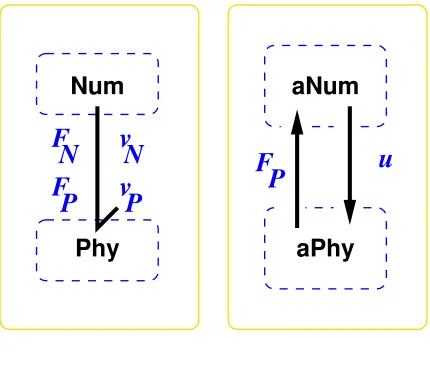
This decomposition is depicted in Figure1(a) whereNumandPhyare the numerical and physical
substructures respectively. FN and vN are the force/velocity pair associated with the numerical
substructure andFPandvPare the force/velocity pair associated with the physical substructure. The
connecting bond implements the twointerface equations:
FP =FN
vP =vN
(1)
and thus both the numerical and physical substructures may themselves contain many subsystems. In
this case, the quantities in (1) can be regarded as vectors containingN components. The simulation
example of Section4hasN=1; the experimental example of Section5hasN=2.
As pointed out previously, [1, 2] it is often not possible to connect the two substructures of
Figure1(a) because it is not physically possible to directly apply the signal implied by the numerical
substructure to the physical system. In bond graph terms, the two systems of Figure 1(a)cannot
be connected via an energy bond; as indicated in Figure 1(b),augmented versions of the numerical
(aNum) and physical (aPhy) substructure are connected using a pair of active bonds. For the purposes
of this paper it is assumed that:
Assumption 1. The causality is such that thephysicalsubstructure in Figure1(a) imposes aforce(in
general effort) on thenumericalsubstructure.
Assumption 2. The quantity imposed by the physical substructure in Figure 1(a) can be directly
measured.
Assumption 3. The quantity imposed by thenumericalsubstructure of Figure1(a) cannot be directly
imposed on thephysicalsubstructure but rather via an N-input utransfer system. In particular, the
input u can only be imposed via atransfer systemlabelledTrain Figure2(b).
Assumption1is not essential but simplifies the development; assumption2is essential for this paper
but could be removed as discussed in Section6; assumption3is the main issue addressed here.
The fact that the substructured system of Figure1(a) cannot be directly implemented but rather must
be approximated by Figure1(b) means that (1) no longer holds and must be replaced by:
FP−FN =F˜
vP−vN =v˜
where ˜F is the force synchronisation error and ˜v is the velocity synchronisation error. The
synchronisation problem is to reduce the two synchronisation errors to acceptable values; exact
synchronisation†corresponds to
˜
F =0
˜
v =0
(3)
A similar problem has been noted in the context of bond graph based physical-model based
control [6, 7]. This paper applies the (suitably modified) solution of this control problem to the
substructuring problem. In particular, it is shown constructively in Section 3 that if the augmented
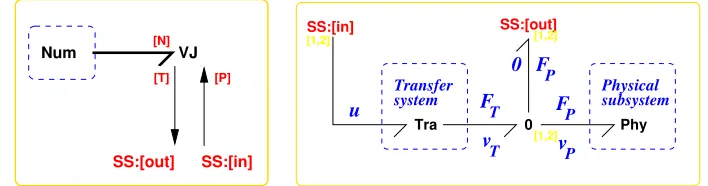
physical substructure aPhy of Figure 1(b) is given by Figure 2(a), then the three-port (each port
corresponding to N bonds) virtual junction VJcomponent can, in certain circumstances, provide a
solution to theexact synchronisationproblem.
3. Virtual junctions and Actuators
The virtual actuatorapproach to control system design was introduced by Gawthrop et al. [6] and
experimentally verified by [7] in the context of control system design. The same concepts are used in
this paper in the context of substructuring; this section gives a brief overview of the approach.
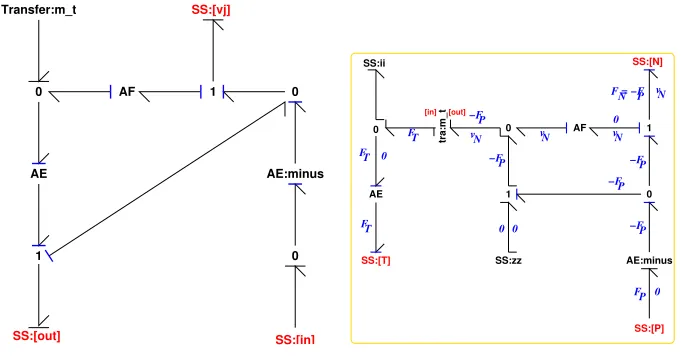
The virtual junction component appearing in Figure1(b) has three ports labelled:
[P ], carrying the measured signalyfrom thephysicalsystem but imposing 0 signal onto the physical
system;
[T ], carrying the control signaluto the input of thetransfersystem but not carrying any measurement
SS:[in] SS:[out] SS:[vj] AE:minus Transfer:m_t 0 0 1 AF AE 1 0 (a) Collocated
−F P
F P −F P −F P F = −FN P vN
vN vN
v N −F P −F P
[image:9.595.128.469.184.362.2]FT FT FT 0 0 0 0 0 SS:[N] [out] [in] SS:[T] SS:[P] AE:minus tra:m_t SS:zz SS:ii 1 AF 0 1 0 AE 0 (b) Non-collocated
Figure 3. Virtual Junction: bond graph
and
[N ] the port to which the numerical system is attached.
The purpose of the virtual junction is to make the input-output properties of the systems of Figure1(a)
and1(b) identical. For example, this can be done if the virtual junction implements the equations:
FN FT =
−1 0
1 T−1
FP vN (4)
wherevT =T FT.
The design of the virtual junction component is considered in detail elsewhere [7,6]. The design for
a particular example is discussed in Section4. Given the structure of Figure1, there are two restrictions
on the class of systems for which a virtual junction can be successfully implemented:
Assumption 5. DefiningσN as the length of the shortest causal path (SCP) between FN and vN and
σT as the length of the SCP between FT and vT, then:
σN≥σT (5)
Assumption 4 ensures internal stability and assumption 5 ensures that the combined numerical
substructure and virtual junction is proper and thus has a state-space realisation.
It is clear from this that an accurate model of thetransfersystem is required. Section5 has more
discussion on this point.
4. Simulation Example
FN
vN FP
vP
Physical substructure Numerical substructure
SS:[in] Mass:m_1 Mass:m_2 Mass:m_3 SS:[out]
(a) Three-mass system: bond graph
v
TF
T
F
Pv
Pu
F
P0
0 SysPhy:m_3
SS:[out]
Transfer:m_t
SS:[in]
[1,2] [1,2]
[1,2]
[image:10.595.122.470.351.677.2](b) Physical system: bond graph
Mass:m
Sf:zero
SS:[out]
Figure 5. Example: transfer system
F 2 v2 F 1
v1
m
k
c
(a) Schematic
F 1 v1
F 2 v2
SS:[in] 0 1 SS:[out]
C:k I:m
R:c
[image:11.595.126.468.111.642.2](b) Bond graph
Figure 6. Mass-spring-damper System
−1.5 −1 −0.5 0 0.5 1
0 20 40 60 80 100 120 140 160 MTT simulation on Tue Jan 27 16:25:52 GMT 2004
(a) Simulation: desired response yd and
substructured outputys
−2.5 −2 −1.5 −1 −0.5 0 0.5 1 1.5
0 20 40 60 80 100 120 140 160 MTT simulation on Tue Jan 27 16:26:20 GMT 2004
[image:11.595.130.468.470.565.2](b) Simulation: control signalu
Figure 7. Example: Simulation results.m1=m2=m3=mt=1,c1=c2=c3=0.1,ct=1,k1=k2=kt=1,
k3=−1+δ2whereδis the spring extension.r=−0.5 sin(t)
Wagg and Stoten [1] consider substructuring in the context of a three mass-spring-damper system
three instances of theMasscomponent depicted in Figure6. In the example of Wagg and Stoten [1] ,
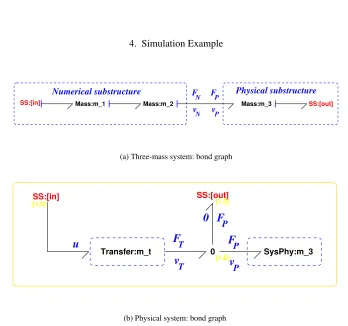
the third mass (m3in Figure4) is a physical system whereas the other two masses (m1&m2in Figure
4) are to be realised by numerical simulation. Causal strokes have been added to show that, in this case,
Assumption1holds.
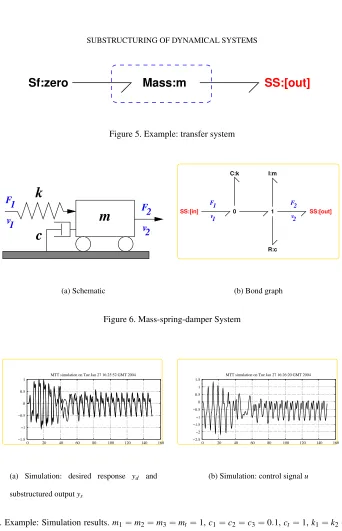
Further, with reference to Figure4(b) the physical massm3is controlled via thetransfer system mt.
As shown in Figure5, theTransfersystem is based on theMasssubstructure with the left-hand port
connected to a zero velocity source. This gives a simpler situation than that of Figure1as bothFT and
vT are associated with a single port.
Following the approach of Section2, the numerical system is obtained as in Figure2(a) by attaching
the masses m1 &m2 to the virtual junctionwhich is shown in expanded form in 3(a). The virtual
junction transfer function representation is:
FN FT =
−1 0
1 (cts+kt+mts
2) s FP VN (6)
The overall system then consists of thenumericalandphysicalsystems connected as in Figure1.
As discussed in Section 2, the numerical simulation corresponds to aproper transfer function. The
corresponding state-space matrices are:
A=
0 (−1)
m1 0 0 0
k1 (−
c1)
m1 −k2 0 0
0 m11 0
(−1)
m2 0
0 0 k2 (−
c2)
m2 0
0 0 0 m12 0
B= 0 1 0 0 0 0
−1 0
0 0 (8) C= µ
0 0 (k2mt) m2
(−c2mt+ctm2) m22 kt
¶
(9)
D=
µ
(m2−mt)
m2 0
¶
(10)
The desired system of Figure4(a) and the substructured system of Figure 1were both simulated
using the numerical parameters indicated in Figure7and the velocity of the third mass of the desired
system (yd), together with the corresponding velocity of the third mass of the substructured system (ys),
are plotted in Figure7(a). There is a transient error due to a non-zero initial condition being applied
to the transfer system (initial velocity = 0.01). With zero initial conditions,ys=yd. Figure7(b)shows
the control signal associated with the substructured system: the external force applied to the transfer
system. The simulation code was automatically generated from the bond graph diagrams using MTT
2 X k1
c1
k2
c2 v1
F1
v2 F2
X 1
k
n2n2
c
n2
m
m
3
k
n1c
n1
m
n1 [image:14.595.94.506.170.256.2]Numerical
Physical
Numerical
Figure 8. Physical/Numerical Substructured system.kn1=kn2=k1=k2=4750Nm−1;cn1=cn2=c1=c2=
6Nsm−1;m
n1=mn2=m3=6Nsm−1.
m
[image:14.595.152.438.347.504.2]t1
k1
c1
m3
k2
c2
m t2
Figure 9. Augmented Physical substructure: Photo
5. Experimental Example
The model to be simulated appears in Figure 8; it has been divided into physical and numerical
substructures and the parameters are given in the caption. The physical substructure is modelled as
Figure10. Thus the substructured model corresponding to this example appears in Figure1(a) where
both the numerical and physical substructures have been vectorised withN=2.
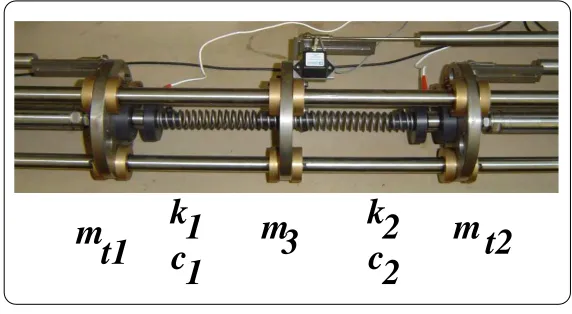
Figure9shows the substructured three mass system. The physical substructure is the central mass
F1 v1
k1
c1
k2
c2 F2 v2
m
(a) Schematic
v1
F1 F2
v2
SS:[L] 1
I:m
0 1
R:c_1
0 1
R:c_2 C:k_2
SS:[R] C:k_1
INTF De:y
(b) Bond graph
SS:[in_1] [L]Mass2:m_3[R] SS:[in_2]
[image:15.595.110.486.170.632.2](c) Vector bond graph
Figure 10. A two-port system
SS:[in] 1 SS:[out]
I:m
R:c 1
C:k
AE:ae
(a)tracomponent bond graph
SS:[in_1] tra:m_t1 SS:[out_1] SS:[in_2] tra:m_t2 SS:[out_2]
(b) Bond graph
Figure 11. Experimental example: Transfer system (Tra)
springk1and another between the massmt2and the springk2. The left-hand massmt1, together with
the actuator, forms the scalar transfer systemtraof Figure11(a); two instances oftraare combined in
To implement real-time substructuring we are using a dSpace DS1104 R&D Controller Board
running on hardware architecture of MPC8240 (PowerPC 603e core) at 250 MHz with 32 MB
synchronous DRAM (SDRAM). This DSP type board offers 4 A/D channels at 16 bit, 4 A/D
channels at 12 bit with 8 D/A channels at 16 bit, of which 5 and 4 are required respectively for
this substructuring example. This is fully integrated into the block diagram-based modelling tool
MATLAB™/Simulink™which is used to build the substructuring model. The dSpace companion
software ControlDesk is used for online analysis and control, providing soft real-time access to the
hard real-time application.
Simulink™s-functions were automatically generated from the bond graph representation of the
augmented numerical substructureaNumof Figures1(b)and2(a)using the MTT [25] package.
Two UBA (timing belt and ball screw configuration) linear Servomech actuators are used as the
transfer systems, with maximum force capacity of 500N and maximum linear speed of 640mms−1.
These are driven independently by two Panasonic Minas Series AC servo motors which are configured
as analogue amplifiers to remove any internal closed loop control functions. Three RDP Electronics
DCT captive guided DC LVDT displacement transducers are used to measure the displacement of
the two transfer systems and the substructure which have a ±0.11% linearity error on full scale
deflection of 50mm. Each unit has an internal bearing that guides the armature built-in DC to
DC signal conditioning to help remove noise. Two RDP Electronics model 31 precision miniature
tension/compression load cells are used for the force measurements either side of the substructure.
The unit is applicable both in tension and compression with linearity±0.15%, hysteresis±0.15% and
non-repeatability±0.1% of full scale deflection. Each mass is a constant 2.2kg and connected to the
rig via three parallel shafts constraining their motion to one degree of freedom with an axial alignment
plates to reduce friction. Through system identification the spring constants were found constant for
all and equal tok=4750Nm−1
and damping ratio ofc=6Nsm−1
.
There were two sets of experiments: identification of a dynamical model of the transfer system
(Section5.1) and validation of the bond graph approach to substructuring (Section5.2).
5.1. Transfer system identification
The left-hand transfer system has the following components:
1. the linear actuator, comprising an AC servo motor and associated power amplifier driving a
ball-screw mechanism;
2. the massmt1of Figure9, equal to 2.2 kg;
3. the LVDT sensor measuring the positionx1of the massmt1
The right-hand transfer system was similar.
As discussed in section 3, the virtual junction approach requires an accurate model of the transfer
system. Unfortunately, AC servos are non-linear [26] and difficult to characterise from first principles
as is the ball screw mechanism. Analysis of experimental measurements of step responses showed that
the dynamical response of the servo motor/ball-screw was indeed dependent on the form of the input
signal.
Most actuators used in this context are indeed non-linear and this must therefore be an important
consideration in transfer system design. In particular, it is well-known that the use of feedback reduces
uncertainly and nonlinearity. For this reason, a variable-gain proportional digital controller with gain
g1, sample interval∆=1ms, setpointxd1and described by
was implemented whereu1is the input to the linear actuator1. Theclosed-looptransfer system was
observed to have a more linear response than the open-loop transfer system.
−0.2 0 0.2 0.4 0.6 0.8 1 1.2 1.4
0 0.02 0.04 0.06 0.08 0.1 0.12 0.14 0.16 0.18 0.2
Displacement
Time Closed−loop displacement step response
(a)xt1forg1=0.6,0.8,1.0
−0.2 0 0.2 0.4 0.6 0.8 1 1.2 1.4
0 0.02 0.04 0.06 0.08 0.1 0.12 0.14 0.16 0.18 0.2
y
t Comparison of data
[image:18.595.120.466.229.312.2](b)xt1& ˆxt1forg1=1.0
Figure 12. Identified transfer system step responses
Name Value
ct1 150.8
kt1 13618.0
ct2 200.8
kt2 25902.0
Table I. Estimated Parameters
Sequences of input (xd1) and output (x1) data were measured when the mass was disconnected from
the springk1for three values ofg1. Using the “frequency-sampling filter” method of Wang and Cluett
[27], a step response (relatingxd1andx1) was identified for each of the three values of gain and plotted
in Figure 12(a). Although the bond graph of Figure 11does not correspond in detail to the actual
transfer system, it isphysically plausiblein the sense of Gawthrop [28] and so its parameters can be
estimated using the sensitivitybond graph approach [29]. The massmt1is known, and so the two
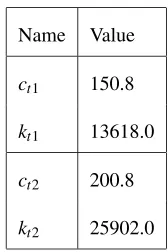
[image:18.595.255.339.406.532.2]must repeat this identification for the right hand transfer system as its frictional characteristics are not
necessarily the same regardless of its mechanical similarity. In fact it can be seen from TableIthat the
dynamics from Transfer System 2 are quite different.
The step responses of this physically plausible model are compared with the data-based step response
of12(a) forg1=1.0 in Figure12(b). The match is not perfect, but the identified model was used for
the experiments of Section5.2.
5.2. Experimental validation
Synchronisation subspaceplots are used to show the effectiveness of the control algorithm by plotting
the desired verses actual responses, [30]. A subspace plot shows the amplitude accuracy and the
magnitude of delay coupled together at any one time interval. Perfect synchronisation is represented
by a straight line at an angle of 45◦to the horizontal with maxima and minima of the reference signal.
Any reduction in synchronisation can be seen as a deviation from this idealised line. The result of
varying the amplitude accuracy is to change the angular orientation of the subspace plot compared to
the idealised line whereas a constant delay between the reference signal and the response results in
transforming the idealised straight line into an ellipse.
For constant wall excitation conditions these plots builds up into a repeating periodic pattern, which
can appear complex. However, the individual components of amplitude and delay produce their own
specific and identifiable patterns if evaluated separately. We use subspace plots as they allow the
controller effectiveness to be characterised in an online procedure, important for real-time testing,
and displays far more information than can be interpreted from simply observing the error between the
two signals.
−2 −1 0 1 2 −1.5 −1 −0.5 0 0.5 1 1.5
(b) TS 1 − NM and Virtual Junction
Amplitude (cm)
Amplitude (cm)
−2 −1 0 1 2
−1.5 −1 −0.5 0 0.5 1 1.5
(d) TS 2 − NM and Virtual Junction
Amplitude (cm)
Amplitude (cm)
−2 −1 0 1 2
−1.5 −1 −0.5 0 0.5 1 1.5
(a) TS 1 − NM only
Amplitude (cm)
Amplitude (cm)
−2 −1 0 1 2
−1.5 −1 −0.5 0 0.5 1 1.5
(c) TS 2 − NM only
Amplitude (cm)
Amplitude (cm)
z2 vs x2 Idealised Line z2 vs x2
Idealised Line
z1 vs x1 Idealised Line z1 vs x1
[image:20.595.136.458.176.502.2]Idealised Line
Figure 13. Wall excitation ofr1=5Hzandr2=5Hz.
synchronisation, theactualdisplacement of the transfer system,xi, must be equal to thedesiredoutput
from its respective numerical model (NM),zi, wherei=1,2 according to the transfer system being
observed. Figure13shows the results of both transfer systems for a sinusoidal excitation of 5Hzfrom
each wall,r1andr2. We compare the effectiveness of the control algorithm when the virtual junction
is included in the numerical model, (b)and(d), to when there is no plant model included, (a)and
(c). We can clearly see that the constant phase delay caused by the mechanical characteristics of each
−2 −1 0 1 2 −2 −1.5 −1 −0.5 0 0.5 1 1.5
2 (b) TS 1 − NM and Virtual Junction
Amplitude (cm)
Amplitude (cm)
−1 −0.5 0 0.5 1
−1 −0.5 0 0.5
1 (d) TS 2 − NM and Virtual Junction
Amplitude (cm)
Amplitude (cm)
−2 −1 0 1 2
−2 −1.5 −1 −0.5 0 0.5 1 1.5
2 (a) TS 1 − NM only
Amplitude (cm)
Amplitude (cm)
−1 −0.5 0 0.5 1
−1 −0.5 0 0.5
1 (c) TS 2 − NM only
Amplitude (cm)
Amplitude (cm)
z1 vs x1 Idealised Line
z1 vs x1 Idealised Line
z2 vs x2 Idealised Line
[image:21.595.138.455.176.502.2]z2 vs x2 Idealised Line
Figure 14. Wall excitation ofr1=3Hzandr2=5Hz.
systems. Comparing the shape of the subspace plots(a)and(c)we can see that although the transfer
systems are the same type of actuator they have slightly differing mechanical properties due to differing
frictional characteristics as predicted by the transfer system identification in Section5.1. This is why
we must use a separate model for each transfer system in its respective virtual junctions to account for
these mechanical variations.
The transfer system models are found though the system identification process as described in
of the control algorithm a feed-forward process, which means that the plant cannot not be subject to
frequency dependant behaviour. Figure14shows the results when the wall excitations are not equal and
opposite, thus the transfer systems must now be controlled to a compound sinusoid. We can see from
(b)and(d)that again the inclusion of the virtual junction has a beneficial effect on the synchronisation
compared to when just the simple numerical model is used,(a)and(c), but not to such a same extent
as in Figure13. This is due to the the transfer system models loosing coherence at the low frequencies.
We can also see this when we introduce a sinusoidal sweep as the wall inputs. Figure15shows the case
where we have a sweep from 1Hzto 5Hzfor the left hand wall excitation,r1, and a sweep from 3Hzto
4Hzfor the right hand wall excitation,r2. Although we again see a much higher level of synchronisation
when the virtual junction is included in the numerical model,(b)and(d), we cannot achieve the high
level of coherence as seen from Figure13, again due to the frequency dependent characteristics of the
transfer systems.
We can see from these results that the phase inversion achieved by the virtual junction has a
significant effect on increasing the synchronisation of the transfer systems. However, to increase its
effectiveness over the whole plant frequency range the transfer system models could be replaced by
an on-line system identification. This would close the control loop round the phase inversion stage of
the virtual junction and make the it possible to achieve high levels of synchronisation for compound
sinusoids caused by out of phase wall excitations.
6. Conclusions
A bond graph approach to real-time numerical-physical substructuring has been introduced which not
only gives new insight into substructuring but also provides a solution to the problem of synchronising
−1.5 −1 −0.5 0 0.5 1 1.5 −1.5 −1 −0.5 0 0.5 1
1.5 (b) TS 1 − NM and Virtual Junction
Amplitude (cm)
Amplitude (cm)
−2 −1 0 1 2
−2 −1.5 −1 −0.5 0 0.5 1 1.5
2 (d) TS 2 − NM and Virtual Junction
Amplitude (cm)
Amplitude (cm)
−1.5 −1 −0.5 0 0.5 1 1.5 −1.5 −1 −0.5 0 0.5 1
1.5 (a) TS 1 − NM only
Amplitude (cm)
Amplitude (cm)
−2 −1 0 1 2
−2 −1.5 −1 −0.5 0 0.5 1 1.5
2 (c) TS 2 − NM only
Amplitude (cm)
Amplitude (cm)
z2 vs x2 Idealised Line z2 vs x2
Idealised Line
z1 vs x1 Idealised Line z1 vs x1
[image:23.595.134.457.178.502.2]Idealised Line
Figure 15. Wall sine sweep excitation ofr1= 1 to 5Hz andr2= 3 to 4Hz in 60 seconds.
The experimental results highlighted the need for an accurate model of the transfer system. Three
techniques were used to achieve this: feedback control to reduce non-linearity and the effect of
poorly-known parameters; bond graph modelling to give physical insight and system identification to tune
physical parameters.
There are a number of topics that will be the subject of further investigation by the authors:
Transfer system design In the light of the experiments reported here, future work will pay close
non-linear modelling and control system design will be investigated. Once again, the bond graph approach
can be used not only for modelling and control design but also for actuator sizing [31,32,33].
Virtual sensors Sections2 and4assumes that the output of the physical system (in this caseFP)
is available for measurement. If this is not the case, or the measurement is badly corrupted by noise,
then thevirtual sensor approachmay be used. This has been previously used in the context of Physical
Model Based Control [4,34] and is based on the bond graph analogue to an observer or Kalman
filter[35].
Backstepping The relation between the bond graph approach and the backstepping approach of
Krstic et al. [36] was noted by [37,38]. The relationship with the virtual actuator approach is noted by
[6,7]. A non-bond graph approach based on backstepping is therefore a possibility.
On-line System Identification The Experimental validation section,5.2, highlights the need for the
models of the transfer systems to be calculated in an on-line system identification procedure. If this can
be achieved as part of the numerical model stage then frequency dependent behaviour and changing
plant conditions could be effectively controlled.
Non-Linear Substructure The ability to test to non-linear substructures would enable more realistic
structures to be investigated moving towards real industrial applications. Additionally, a non-linear
substructure will highlight the difficulties experienced due to cross-coupling between the transfer
systems in multi degree of freedom substructuring.
ACKNOWLEDGEMENTS
and David Wagg via an EPSRC Advanced Research Fellowship. Geraint Bevan (Glasgow University) wrote the
s-function generation code for MTT.
references
[1] D.J. Wagg and D.P. Stoten. Substructuring of dynamical systems via the adaptive minimal control approach.
Earthquake Engng Struc. Dyn., 30(6):865–877, June 2001.
[2] A. P. Darby, A. Blakeborough, and M. S. Williams. Improved control algorithm for real-time substructure
testing.Earthquake Engng Struc. Dyn., 30(3):431–448, March 2001.
[3] A. Sharon, N. Hogan, and D. E. Hardt. Controller design in the physical domain. Journal of the Franklin
Institute, 328(5):697–721, 1991.
[4] P. J. Gawthrop. Physical model-based control: A bond graph approach. Journal of the Franklin Institute,
332B(3):285–305, 1995.
[5] Des J. Costello and Peter J. Gawthrop. Physical-model based control: Experiments with a stirred-tank heater.
Trans. IChemE, Part A, 27:361–370, March 1997.
[6] Peter J Gawthrop, Donald J Ballance, and Dustin Vink. Bond graph based control with virtual actuators. In
Norbert Giambiasi and Cluadia Frydman, editors,Proceedings of the 13th European Simulation Symposium:
Simulation in Industry, pages 813–817, Marseille, France, October 2001. SCS. ISBN 90-77039-02-3.
[7] Peter J Gawthrop. Bond graph based control using virtual actuators. Proceedings of the Institution of
Mechanical Engineers Pt. I: Journal of Systems and Control Engineering, 218(4):251–268, September 2004.
URLhttp://dx.doi.org/10.1243/0959651041165864.
[8] M. Nakashima, H. Kato, and E. Takaoka. Development of real-time pseudo dynamic testing. Earthquake
Engineering and Structural Dynamics, 21:779–92, 1992.
[9] J. Donea, P. Magonette, P. Negro, P. Pegon, A. Pinto, and G. Verzeletti. Pseudodynamic capabilities of the
[10] Yu-Yuan Lin, Kuo-Chun Chang, and Yuan-Li Wang. Comparison of displacement coefficient method and
capacity spectrum method with experimental results of rc columns.Earthquake Engineering and Structural
Dynamics, 33(1):35–48, 2004.
[11] M. S. Williams and A. Blakeborough. Laboratory testing of structures under dynamic loads: an introductory
review.Philosophical Transactions of the Royal Society A, 359:1651 – 1669, 2001.
[12] A. Blakeborough, M. S. Williams, A. P. Darby, and D. M. Williams. The development of real-time
substructure testing.Philosopical Transactions of the Royal Society of London A, 359:1869–1891, 2001.
[13] A. P. Darby, A. Blakeborough, and M. S. Williams. Real-time substructure tests using hydraulic actuator.
Journal of Engineering Mechanics, 125(10):1133–1139, 2001.
[14] M. I. Wallace, D. J. Wagg, and S. A. Neild. A polynomial based forward prediction algorithm for improving
the accuracy of real-time dynamic substructuring.Submitted to Proceedings of the Royal Society A, 2004.
[15] H. M. Paynter. Analysis and design of engineering systems. MIT Press, Cambridge, Mass., 1961.
[16] Peter J Gawthrop and Serge Scavarda. Special issue on bond graphs: Editorial.Proceedings of the Institution
of Mechanical Engineers Pt. I: Journal of Systems and Control Engineering, 216(I1):i–v, March 2002. URL
http://dx.doi.org/10.1243/0959651021541363.
[17] Dean Karnopp, Donald L. Margolis, and Ronald C. Rosenberg.System Dynamics : Modeling and Simulation
of Mechatronic Systems. Horizon Publishers and Distributors Inc, 3rd edition, January 2000.
[18] Amalendu Mukherjee and Ranjit Karmakar. Modelling and Simulation of Engineering Systems through
Bondgraphs. Alpha Science, 2000.
[19] P. J. Gawthrop and L. P. S. Smith.Metamodelling: Bond Graphs and Dynamic Systems. Prentice Hall, Hemel
Hempstead, Herts, England., 1996. ISBN 0-13-489824-9.
[20] Lennart Ljung and Torkel Glad.Modeling of Dynamic Systems. Prentice Hall, 1994.
[22] W. Algaard, A. Agar, and N. Bicanic. Enhanced integral form of the Newmark time stepping scheme for
pseudodynamic testing.Engineering Computations, 18(3):676–689, 2001.
[23] T. Horiuchi, M. Inoue, T. Konno, and Y. Namita. Real-time hybrid experimental system with actuator delay
compensation and its application to a piping system with energy absorber. Earthquake Engineering and
Structural Dynamics, 28:1121–1141, 1999.
[24] Toshihiko Horiuchi and Takao Konno. A new method for compensating actuator delay in real-time hybrid
experiments.Philosophical Transactions of the Royal Society A, 359:1893 – 1909, 2001.
[25] MTT. MTT: Model transformation tools. Online WWW Home Page, 2002. URL: http://mtt.sourceforge.net.
[26] P.C. Sen. Principles of Electrical Machines and Power Electronics. John Wiley, 2nd edition, 1997.
[27] L Wang and W R Cluett. From Plant Data to Process Control. Taylor and Francis, London and New York,
2000.
[28] Peter J Gawthrop. Physically-plausible models for identification. InProceedings of the 2003 International
Conference On Bond Graph Modeling and Simulation (ICBGM’03), Simulation Series, Orlando, Florida,
U.S.A., January 2003. Society for Computer Simulation.
[29] Peter J Gawthrop. Sensitivity bond graphs. Journal of the Franklin Institute, 337(7):907–922, November
2000. URLhttp://dx.doi.org/10.1016/S0016-0032(00)00052-1.
[30] P. Ashwin. Non-linear dynamics, loss of synchronization and symmetry breaking. Proceedings of the
Institution of Mechanical Engineers, Part G: Journal of Aerospace Engineering, 212(3):183–187, 1998.
[31] Roger F Ngwompo and Peter J Gawthrop. Bond graph based simulation of nonlinear inverse systems using
physical performance specifications. Journal of the Franklin Institute, 336(8):1225–1247, November 1999.
URLhttp://dx.doi.org/10.1016/S0016-0032(99)00032-0.
[32] Ngwompo R F, Scavarda S, and Thomasset D. Physical model-based inversion in control systems design
using bond graph representation part 1: theory.Proceedings of the I MECH E Part I Journal of Systems and
[33] Ngwompo R F, Scavarda S, and Thomasset D. Physical model-based inversion in control systems design
using bond graph representation part 2: applications.Proceedings of the I MECH E Part I Journal of Systems
and Control Engineering, 215(2):105–112, April 2001.
[34] Peter J. Gawthrop and Donald J. Ballance. Symbolic algebra and physical-model-based control.Computing
and Control Journal, 8(2):70–76, April 1997. ISSN 0956-3385.
[35] D. C. Karnopp. Bond graphs in control: Physical state variables and observers.J. Franklin Institute, 308(3):
221–234, 1979.
[36] M. Krstic, I. Kanellakopoulos, and P. V. Kokotovic. Nonlinear and Adaptive Control design. New York:
Wiley, 1995.
[37] T-J Yeh. Backstepping design in the physical domain. InProceedings of the American Control Conference,
1999.