R E S E A R C H
Open Access
Leapfrog diagnostics: Demonstration of a broad
spectrum pathogen identification platform in a
resource-limited setting
Tomasz A Leski
1*†, Rashid Ansumana
2,3,4†, Anthony P Malanoski
1, David H Jimmy
2,5, Umaru Bangura
2,
Brian R Barrows
6, Morie Alpha
2, Bashiru M Koroma
2,4, Nina C Long
7, Abu J Sundufu
2,8, Alfred S Bockarie
2,4,
Baochuan Lin
1and David A Stenger
1Abstract
Background:Resource-limited tropical countries are home to numerous infectious pathogens of both human and zoonotic origin. A capability for early detection to allow rapid outbreak containment and prevent spread to non-endemic regions is severely impaired by inadequate diagnostic laboratory capacity, the absence of a“cold chain” and the lack of highly trained personnel. Building up detection capacity in these countries by direct replication of the systems existing in developed countries is not a feasible approach and instead requires“leapfrogging”to the deployment of the newest diagnostic systems that do not have the infrastructure requirements of systems used in developed countries.
Methods:A laboratory for molecular diagnostics of infectious agents was established in Bo, Sierra Leone with a hybrid solar/diesel/battery system to ensure stable power supply and a satellite modem to enable efficient
communication. An array of room temperature stabilization and refrigeration technologies for reliable transport and storage of reagents and biological samples were also tested to ensure sustainable laboratory supplies for diagnostic assays.
Results:The laboratory demonstrated its operational proficiency by conducting an investigation of a suspected avian influenza outbreak at a commercial poultry farm at Bo using broad range resequencing microarrays and real time RT-PCR. The results of the investigation excluded influenza viruses as a possible cause of the outbreak and indicated a link between the outbreak and the presence ofKlebsiella pneumoniae.
Conclusions:This study demonstrated that by application of a carefully selected set of technologies and sufficient personnel training, it is feasible to deploy and effectively use a broad-range infectious pathogen detection technology in a severely resource-limited setting.
Background
Developing countries in tropical regions of the world are the home for numerous important infectious pathogens [1-3]. Many of these infectious agents may have their reservoirs in domesticated or wild animals [4-8]. Since inhabitants of these countries live in relatively closer contact with animals, than populations of highly
developed countries, the chance of transmission of zoo-notic infections to humans is much greater [9]. Some of these pathogens not only have severe impact on public health in countries where they are endemic, but may also be rapidly disseminated to non-endemic regions through global transportation networks (air, freight con-tainers), migratory birds, and expanding wildlife trade [10-15]. While outbreaks caused by highly lethal patho-gens such as Ebola, Nipah or H5N1 influenza viruses are usually followed by high profile epidemiologic investiga-tions, the everyday infectious disease diagnostics and epidemiological surveillance systems in many of these
* Correspondence:[email protected] †Equal contributors
1
Center for Bio/Molecular Science and Engineering, Naval Research Laboratory, Washington DC 20375, USA
Full list of author information is available at the end of the article
regions are only rudimentary, sub-Saharan Africa being one of the prime examples [16,17]. This situation is compounded by serious shortages of resources and trained personnel capable of performing diagnostic pro-cedures. As a consequence, infectious disease outbreaks in these settings are detected relatively late in their course. A typical example of the problem was the recent yellow fever outbreak that began in October 2010 in Uganda. The outbreak, initially suspected to be caused by Ebola virus, started in early October and was subse-quently misdiagnosed as amoebic dysentery, alcohol poi-soning, and plague before being correctly identified as yellow fever at the end of December. By the time of con-firmation, there were approximately 200 confirmed cases and nearly 50 deaths were recorded [18,19].
Rapid and efficient infectious disease surveillance sys-tems are necessary to improve outbreak management and mitigate the consequences of outbreaks. However, direct replication the infectious outbreak surveillance systems in their current form that exist in developed countries is not practical due to many reasons including absence of detailed maps and lack of basic laboratory in-frastructure needed to support traditional diagnostic sys-tems. Our previous work on participatory mapping and surveying methods has indicated promising solutions to the first problem [20]. The issues related to inefficiency of current infectious disease diagnostics based on culture and simple molecular assays remain a serious challenge. Microbial culture, while still a“gold standard”technique for identification of bacteria, cannot be applied for de-tection of viral pathogens. In addition, microbial culture is labor intensive, time consuming and requires qualified and experienced technicians which are frequently in short supply in these locations. Molecular assays are rapid and sensitive but due to their low level of multi-plexing usually a number of different molecular assays needs to be performed sequentially to achieve definitive diagnosis. This is especially relevant in cases of infec-tious syndromes of diverse etiologies but manifested by similar symptoms [21]. Reliance on these technologies results in significant delays between specimen isolation and pathogen identification. An additional difficulty experienced by many regions of the developing world is the lack of a reliable cold chain capability necessary for transport and preservation of biological samples and diagnostic reagents in hot climate due to unreliable power and a lack of basic refrigeration equipment.
One of the ways to significantly improve the microbial diagnostic capacity in developing countries may be ‘leap-frogging’or skipping some stages of technological devel-opment that other countries have passed or are passing
through [22,23]. A good example of the “leapfrog”
phenomenon is the use of mobile phone technology, which has enabled the communication in villages in
developing countries that have never had land phones with their associated expensive infrastructure [24]. In case of microbial diagnostics, developing countries may need to jump directly to broad-range microbial diagnostic sys-tems, which are capable of one-step detection and identifi-cation of large number of diverse pathogens in a single, highly automated, assay. Advanced broad-range diagnostic technologies have the potential of making the pathogen identification process simpler and faster leading to more efficient detection and management of infectious disease outbreaks both in humans and animals.
The purpose of this study was to test the feasibility of application of a broad-spectrum diagnostics/surveillance platform for microbial detection in a resource-limited setting. This feasibility study was the result of a collab-orative effort between the US Naval Research Laboratory and Njala University, which led to the establishment of a molecular diagnostic laboratory at Mercy Hospital Re-search Laboratory, Bo, Sierra Leone.
Setting up this type of facility required solving a num-ber of issues typical for developing countries with a trop-ical climate including securing a reliable power supply, implementing cold chain and complementary methods of preserving biological samples and reagents, and enab-ling efficient communication by setting up an internet linked computer network. This paper describes how a broad spectrum diagnostics system was successfully deployed using a set of“leapfrog”technologies that were found to be critical in establishing an efficient labora-tory. The resequencing-microarray-based diagnostic sys-tem was subsequently applied for investigation of a suspected avian influenza outbreak at the commercial poultry farm.
Methods
Laboratory setup
The molecular diagnostic laboratory was set up in Mercy Hospital Research Laboratory (MHRL) located in the city of Bo, Sierra Leone. Bo is the second largest city in Sierra Leone and the capital of the Southern Prov-ince. The 1,200 square foot laboratory was located on the Mercy Hospital campus in Kulanda Town section of Bo. All equipment, which required temperature within certain limits for proper operation (including PCR instruments, Affymetrix fluidics stations, hybridization ovens and microarray scanner) was located in two
air-conditioned rooms. An additional air-conditioned
laboratory area detached from the main laboratory building was equipped with a PCR laminar flow hood and used for sample preparation for PCR, RT-PCR and sample processing for resequencing pathogen micro-array (RPM) assays.
freezers (AcuTemp, Dayton, OH), four Fridge-Freeze 60 liter portable vaccine refrigeration units (two freezers and two refrigerators) with ability to be powered with 12/ 24-volt DC or 110/240-volt AC (Fridge-Freeze Inc. San Diego, CA) and one upright Kenmore freezer model 2804 (Sears, Roebuck and Co., Hoffman Estates, IL). HemaCool freezers can be adjusted for freezing (−20°C) or refriger-ation (+4°C) and can be run for 16 hrs continuously in the absence of external power on internal batteries.
The power for the laboratory operation was supplied by two hybrid power subsystems, one operating at 230 V, 50 Hz (used for powering European and African made equipment) and another one operating at 120 V, 60 Hz (for powering US made scientific instruments). Both systems relied on combination of solar power with battery storage and diesel generator backup. The 230 V subsystem was additionally connected to municipal power grid and used municipal power when available. The detailed description of the power system and its performance was published previously [25,26].
Communication
A stand-alone solar powered C-band satellite communi-cation system was configured by Satcom Resources (Avon, CO) and deployed at MHRL. Bandwidth (512/ 128 (kb/s) up/down) was provided by Constellation Net-works Corp. (Traverse City, MI) and served up to 20 users simultaneously via intranet across the Mercy Hos-pital campus. The diagram of the network configuration is included in supplementary data (Additional file 1: Figure S4). Teleconferencing for training purposes and data exchange was conducted using Skype platform (Skype Technologies S.A., Rives de Clausen, Luxembourg).
Ambient temperature stable reagents
Ambient temperature stabilized reagents for PCR, real-time PCR or resequencing microarray protocols were ei-ther obtained commercially or developed in-house using lyophilization techniques (see Additional file 2: Tables S3 and S4 for listing of stabilized reagents tested and used for all molecular diagnostics protocols).
FTA paper - sample stabilization and recovery
Flinders Technology Associates filter paper (FTA paper, Whatman/GE Healthcare, Florham Park, NJ) [27] was used in this work to explore its suitability for dry storage of RNA preparations and for stabilization of field sam-ples collected from poultry. Either Indicating FTA Mini Cards (WB120356, Whatman) or Indicating FTA Classic Cards (WB120206, Whatman) were used depending on the application. An aliquot of RNA samples was spotted on the card or swabs containing field samples were pressed against an FTA card in order to transfer the maximum amount of fluid from swab to the FTA paper.
Subsequently the FTA cards were air dried at ambient temperatures for 40 minutes. Dry FTA cards were stored at ambient temperatures unless otherwise indicated.
To recover the nucleic acids for use in diagnostic cedures, the FTA paper embedded samples were pro-cessed using the following procedure modified from a protocol developed by Rogers and Burgoyne [28]. Circu-lar punches (1 mm or 3 mm in diameter) of the FTA paper from the areas of sample deposition were taken using Harris Uni-Core punch (Ted Pella Inc., Redding, CA). The punches were placed into 0.5 mL microcentri-fuge tubes and incubated for 5 min. with gentle shaking in 200 μl of solution A (4 M LiCl solution in 50% etha-nol). The incubation was repeated once with fresh solu-tion A. After incubasolu-tion, the disks were washed with gentle shaking for 5 min. in 200μl of solution B (50 mM Tris–HCl solution in isopropanol), then washed twice
for 5 min. with 200 μl of 70% ethanol. After the final
wash, the samples were air dried at 42°C for at least 30 minutes to remove the traces of ethanol completely.
RNA purification
The RNA was purified from influenza B/Lee/40 prepara-tions (Advanced Biotechnologies, Inc., Columbia, MD) using MasterPure DNA and RNA purification kit (Epi-centre Biotechnologies, Madison, WI) using manufac-turer recommended protocol.
Testing viral RNA stabilization efficiency on FTA paper
Influenza B RNA samples (5 μl each of 106, 104 or 102 genome copies/μl dilutions) were spotted on Indicating FTA Mini Cards (Whatman). The cards were incubated under one of three conditions: at room temperature 20-25°C (on a laboratory bench), 30°C (incubator) and 30-45°C (outdoors, protected from light) for up to 10 days. Three 1 mm punches were removed from the FTA cards at 24 hours, 3 days, and 10 days). The punches were
processed as described above (see “FTA paper - sample
stabilization and recovery”section).
Collection of poultry pharyngeal samples
Pharyngeal swabs were collected on March 30th, 2009,
FTA embedded specimens were placed in−20°C freezer for long term storage.
Resequencing microarrays
The resequencing microarray analysis was conducted using RPM-Flu v. 3.1 (RPM-Flu) and RPM-TEI v. 1.0 microarrays (RPM-TEI) in March 2010. Poultry samples for analysis were selected using a two-stage process. First the samples for which the amount of deposited samples was small (judged by the size of spot with change of color on indicating FTA card) were rejected. The remaining FTA samples were blindly drawn to select 15 samples from Bo farm and 3 samples each from 5 other farms. RPM-Flu v. 3.1 was designed to detect all known subtypes of influenza A viruses and 84 other viral and bacterial respiratory pathogens [29], while the RPM-TEI microarray was designed for detection of a broad range of biothreat agents [30] some of them (such as Lassa virus) endemic to West Africa. Sample processing was conducted as previously described [30-32] with the
following modifications related to the use of FTA paper embedded samples. Briefly, reverse transcription using random primers was used to obtain cDNA from RNA templates potentially present in a processed FTA paper disk for each analyzed sample. The resulting mixture was separated from the FTA paper disk and split into four aliquots of equal volume for multiplex PCR reac-tions using either RPM-Flu or RPM-TEI microarray spe-cific primer cocktails. Modified version of this protocol for testing the lyophilized/ambient temperature stabi-lized reagents is included as Supplementary Data.
Pathogen identification was performed using previously developed Computer-Implemented Biological Sequence Identifier (CIBSI) 2.0 software [33]. Although the microar-rays are designed with tiles for specific pathogen targets [29,30,32], they are capable of detection and correct se-quence determination of targets differing by up to 15% from the sequence present on the microarray. This allows for detection of target variants and near-neighbor discrimination.
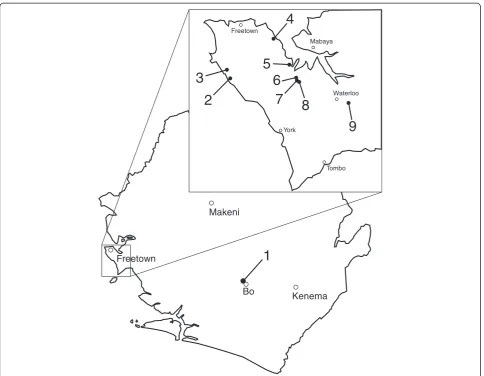
Freetown
Bo
1
Kenema Makeni
2
5
6
4
3
Freetown
York
Waterloo
Tombo Mabaya
7
[image:4.595.57.542.87.463.2]9
8
Reverse transcription and real time PCR (RT-PCR)
In order to detect influenza B RNA in testing RNA stabilization on FTA 1 mm processed disks were placed in a 0.5 mL PCR tube, and subjected to one step reverse transcription and PCR (RT-PCR) using Qiagen OneStep RT-PCR Kit (Qiagen, Valencia, CA) according to the man-ufacturer’s instructions. Positive controls were prepared using liquid preparations of influenza B RNA stored at
−20°C. The RT-PCR reaction was run in 25 μl total vol-ume using previously published BMA-F1 and BMA-R1 primers for detection of influenza B [31] and the following thermal cycling protocol: 50°C for 30 min; 95°C for 15 min.; 40 cycles of 94°C for 30 sec., 54°C 30 sec., 72°C 30 sec.; 72°C 10 min. The expected amplicon was a 162 bp segment of the influenza B matrix gene. The amplification results were analyzed using 2% TAE agarose gels contain-ing ethidium bromide. The bands were visualized in UV light and images captured using UVP BioDoc-It System, model M-20 (UVP, Upland, CA).
Real-time RT-PCR for universal detection of influenza A (based on detection of fragment of the Matrix gene) was performed using previously published PCR primers: MatrixF1 and MatrixR1 [34]. A preparation of influenza A H3N2 control strain was used as a positive control, water and blank processed FTA paper discs were used as negative controls. Reverse transcription (RT) was per-formed using AccuPower Cyclescript RT premix (Bio-neer, Alameda, CA). The total volume of the RT
reaction was 20 μl containing 500 nM each of forward
and reverse primers. The reaction mixture was subjected to 12 cycles of incubation at 25°C for 1 min. and 50°C for 4 min. and single final incubation at 95°C for 5 min. The real-time PCR amplification reactions were con-ducted using SsoFast EvaGreen reaction mix (Bio-Rad Laboratories, Hercules, CA) according to the manufac-turer’s instructions. The reaction was carried out in
20 μl total volume containing 500 nM of each primer
with 2 μl of the RT reaction mixture as a template. The
thermal cycling and fluorescent signal detection was per-formed in a CFX96 real-time PCR detection system (Bio-Rad Laboratories) with the following thermal cyc-ling conditions: initial incubation at 98°C for 2 min. fol-lowed by 40 cycles of 98°C for 2 sec. and 60°C for 5 sec. The amplification cycle was followed by melting curve analysis. The results were analyzed with CFX Manager software ver. 1.5.534.0511 (Bio-Rad Laboratories).
The protocols for RT-PCR and real-time RT-PCR for detection of influenza A using ambient temperature sta-bilized reagents are described in Supplementary Data (Additional file 2), and the reagents used with these pro-tocols are listed in (Additional file 2): Tables S3 and S4.
Results and discussion
Laboratory operation
This study was intended to identify the suite of technolo-gies necessary to deploy and successfully apply an
advanced, “leapfrogging”, technology for broad range
[image:5.595.57.541.101.257.2]pathogen identification in a severely resource-limited
Table 1 Farm and chicken sample information
No. Farm location No.
of sheds
No. of samples collected
Sample designations
Condition of chickens
Town Coordinates
1 Bo 7°57.911'N 11°44.767'W 1 40 B1-B40 Outbreak affecting 15% of chickens
2 Hamilton 8°23.275'N 13°15.453'W 4 20 H1-H20 All healthy
3 Oogu 8°24.256'N 13°15.612'W 1 16 O1-O16 All healthy
4 Wellington 8°27.222'N 13°10.242'W 3 12 W1-12 Some chickens sick
5 Allen Town 8°24.266'N 13°8.742'W 11 16 A1-16 All healthy
6 Hastings 8°22.776'N 13°8.094'W 1 8 HA1-HA8 All healthy
7 Hastings 8°22.622'N 13°7.997'W 1 4 HB1-HB4 All healthy
8 Hastings 8°22.403'N 13°7.925'W 2 8 HC1-HC8 All healthy
9 Joe Town 8°19.549'N 13°2.535'W 3 12 J1-12 Some chickens sick
Table 2 Technologies applied to deploy broad-range infectious pathogen diagnostics
Problem Solution/s applied
Unreliable power Efficient hybrid solar/diesel power system
Lack of“cold chain” On-site refrigeration
FTA paper for sample collection, transport and storage
Ambient temperature stabilized reagent sets
Delivery of regular reagents on dry-ice
Lack of efficient communication
Wired/wireless, hi-speed campus network connected
with Internet via satellite
Inadequate personnel expertise
Hands-on training in reference laboratory (NRL) and on-site.
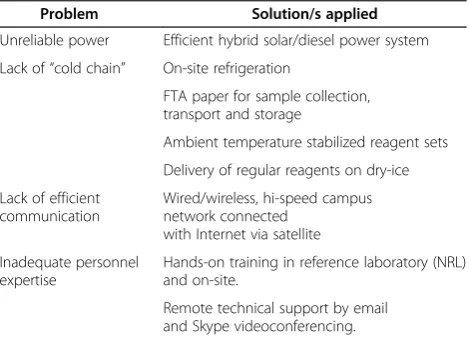
[image:5.595.305.540.562.732.2]setting. The typical major challenges in setting up a la-boratory in a developing country are listed in Table 2. They needed to be addressed in order to make the labora-tory operational and capable of reliably running high qual-ity molecular diagnostic protocols. While the general class of solutions was easy to recognize, the actual solution implemented depended intimately on the local conditions.
Stable power
One of the most significant difficulties in establishing stable operation of the molecular diagnostics laboratory in Bo was inadequate power necessary to run laboratory equipment. Due to the reliance on hydroelectric power generation in Sierra Leone, the availability of municipal
electricity (supplied by Bo/Kenema Power Service –
BKPS) varies throughout the year and power is mostly un-available during the dry season spanning from November to April. Even when available, the electricity is of poor quality due to inadequate design of electrical grid and is not suitable for powering sensitive scientific equipment [26]. To overcome this problem an innovative hybrid power system composed two self-contained local grids with two hybrid power subsystems (230 V, 50 Hz and 120 V, 60 Hz) was designed and deployed [25,26]. The sys-tem combined solar power generation with battery storage and diesel generator backup to provide reliable power for both basic laboratory infrastructure (e.g. lights, air condi-tioners) as well as sensitive scientific instruments (e.g. PCR cyclers, GenChip scanner).
Personnel training
Training is another key component of a successful la-boratory set up. The lala-boratory personnel have under-gone 10-week training in basic molecular biology diagnostic techniques including various PCR, and rese-quencing microarray technologies at Naval Research La-boratory (NRL) located in Washington, DC. A follow up training was conducted in Bo by NRL personnel. Personnel from MHRL also obtained scanner mainten-ance and calibration training from Affymetrix to ensure proper functioning of the scanner since this was the most delicate instrument of the system and needed to be periodically recalibrated. The proficiency of trained personnel was successfully demonstrated by conducting the investigation of an outbreak at the poultry farm that is described below. In addition to initial training, the NRL personnel were remotely supporting MHRL scien-tists taking advantage of the Internet connected com-puter network and Skype based videoconferencing.
Stabilization of field samples and molecular biology reagents
While the stable power and use of freezers and refrigera-tors with battery backup solved the problem of storing
perishable reagents and samples in the laboratory, it did not address the issues related to preservation samples collected in the field. Transport of temperature sensitive reagents needed for diagnostic procedures was also a significant problem due to unavailability of commercial “dry-ice” refrigerated transport service in Sierra Leone. To overcome these difficulties we explored applicability of two technologies: FTA paper for field sample collec-tion and transport as well as stabilizacollec-tion of molecular biology reagents by freeze drying or related techniques.
FTA paper
FTA paper is a well-established technology for ambient temperature preservation of nucleic acids and was designed to protect nucleic acids of the stored sample from degradation caused by nucleases, oxidation, UV light and other processes [35,36]. FTA paper also rapidly inactivates pathogens making the infectious samples safer to handle by untrained personnel [35-37]. While it was shown that FTA cards are able to adequately store DNA samples at room temperature for at least 17 years without significant degradation [38,39], only limited data is available on the stability of RNA on FTA paper, espe-cially when stored at elevated temperatures [28,35,40]. A series of experiments was conducted to find out if FTA technology might be suitable for short-term preservation of samples containing RNA viruses at high ambient tem-peratures characteristic for a tropical country such as Si-erra Leone. Influenza B was used as a model organism for testing. Three different concentrations of influenza B RNA were spotted on FTA Minicards and stored at vari-ous temperature conditions for 1–10 days. The higher concentration of RNA (106and 104copies/μl) was con-sistently detectable after 10 days even when incubated at the highest tested temperatures (Table 3 and Additional file 1: Figures S1-S3). Although the lower concentration of RNA (102copies/μl) was not detectable in more than half of the analyzed samples, the lack of detection did not seem to correlate with storage conditions. These results indicated that in addition to the established cap-ability to maintain stable DNA, the FTA cards could also be used to collect and store RNA samples for a time frame sufficient to transport and test samples. Inconsist-ent results of recovery of low concInconsist-entrations of influenza B from FTA paper most likely reflected the phenomenon of dilution of samples deposited on FTA or inefficient recovery rather than degradation of the RNA.
Reagent stabilization
used for reverse transcription, PCR, and real-time PCR together with modified protocols optimized for use with these regents. However in case of RPM platform, the sta-bilized reagents were developed in-house since there were no commercially stabilized reagents available. These reagents were developed by adaptation of previ-ously published methods [41-43]. Details of the proto-cols, commercial reagents tested and custom reagent composition and stabilization procedures are described in supplementary data (Additional file 2).
While these ambient-temperature-stabilized reagent sets were very stable in high ambient temperatures, the testing results showed that diagnostic assays using these reagents were significantly less sensitive than traditional reagents (data not shown). Due to financial and time constraints, optimization of the stabilized reagents was not pursued. While the stabilized reagents were not used for the subsequent epidemiological investigation, the re-agent stabilization technology has a great potential to make the molecular diagnostics more accessible in developing countries by eliminating the cold chain, greatly lowering power requirements that are dominated by refrigeration equipment and making the diagnostic protocols significantly less complex and error prone [41-43] and should be further explored in future.
As an alternative, reagents were transported as carry-on“dry ice” package in accordance with all airline regu-lations. The packages were prepared with sufficient amount of dry ice for 48 hours and passed through x-ray examination. Testing conducted with these reagents showed no noticeable difference in performance. Since US based personnel overseeing Mercy Hospital travel
regularly (every 1–2 months) to the site, it was possible to ship reagents to maintain operation of the molecular diagnostics laboratory for sustained periods of time.
Poultry outbreak investigation
To test the operational capabilities of MHRL molecular diagnostics laboratory broad-range microbial detection assays were used to investigate an outbreak that oc-curred at one of the few commercial poultry farms located in Bo. The concern was that the outbreak might have been caused by a highly pathogenic influenza virus which might be potentially transmitted to farm workers or poultry kept by individual owners. This is a significant risk especially in developing countries where it is a com-mon practice to keep chickens in close proximity to the household and potentially expose the whole families to the poultry pathogens.
[image:7.595.59.538.99.304.2]Two different assays, RPM-Flu and RPM-TEI, were used to analyze the outbreak samples. The analysis strat-egy relied on using microarray based broad-range detec-tion assay to analyze just a small percentage of collected samples and follow up using single specific PCR based assays for larger numbers of samples based on the results of microarray analysis. Therefore only 15 ran-domly selected samples (see methods for selection process details) out of a total of 40 pharyngeal swab samples collected in the farm located in Bo and pre-served on FTA paper were tested using resequencing assays. For comparison, 15 additional samples were selected from 5 other farms located in the Freetown area which housed mostly healthy chickens were also ana-lyzed using the same microarrays. The results of RPM
Table 3 Efficiency of detection of Influenza B RNA stored on FTA paper incubated at elevated temperatures1
Influenza B RNA concentration
(copies/ microliter)
Duration of incubation (hours) Incubation
temperatures (°C)
24 72 240
1 2 3 1 2 3 1 2 3
106 + + + + + + + + + 20-25 (RT)
+ + + + + + + + + 30
+ + + + + + + + + 30-45 (outdoors)
104 + + + + + + + + + 20-25 (RT)
+ + + F + + + + + 30
+ + + + + + + + + 30-45 (outdoors)
102 − − − + + F − F F 20-25 (RT)
− − − F F − − − − 30
F F F − F F − − − 30-45 (outdoors)
106(control RNA) + + + −20 (freezer)
102(control RNA) + + + −20 (freezer)
1
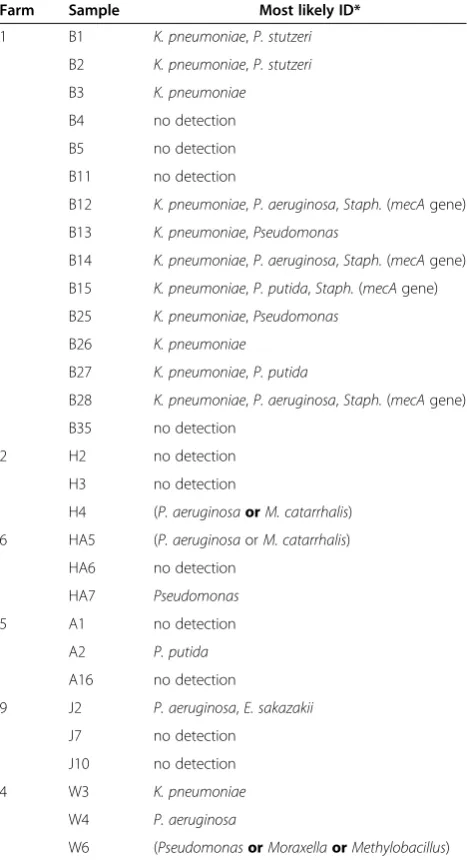
microarray analysis of selected samples are summarized in Table 4 and described below.
Bacterial pathogens
While no viral pathogens were detected using RPM assays,
a number of bacterial pathogens including Klebsiella
pneumoniaeand severalPseudomonasspecies were found
in analyzed samples.
An assortment of closely related Pseudomonasspecies
(P. stutzeri, P. aeruginosa, P. putida) or undefined
Pseudomonas was detected in 16 of the 30 analyzed
samples. The ubiquitous presence of Pseudomonas spp.,
a known opportunist organisms colonizing the avian re-spiratory tract [44], indicated that it played no significant
role in the outbreak. K. pneumoniaeon the other hand
was found mostly in the samples from farm in Bo (73%, 12 out of the 15 analyzed samples),while only one sam-ple from farms outside of Bo was positive for this organ-ism (7%, Table 4). This result suggested a link between
the outbreak and the presence of K. pneumoniae.
Al-thoughK. pneumoniaeis usually considered an
environ-mental contaminant, it may sporadically cause embryo mortality, yolk sac infections and mortality in young chickens, turkeys and ostriches. In addition, the
concur-rent infection of young turkeys with K. pneumoniae is
known to increase the severity of respiratory disease
caused by other pathogens [44]. The presence of K.
pneumoniae in the majority of outbreak samples
sug-gested that it is an opportunist pathogen colonizing/ coinfecting sick chickens and increasing the severity of infection caused by another (unidentified) pathogen. This notion was also supported by the fact that higher percentages of outbreak samples were testing positive for more than one pathogen simultaneously (60% vs. 6% of healthy samples).
In addition to previously mentioned bacteria, the
RPM-Flu microarray also detected mecA(methicillin
re-sistance) gene in four samples collected from the farm in
Bo. The mecAgene is responsible for staphylococcal
re-sistance to a broad range of β-lactam antibiotics [45].
WhilemecAcarrying bacteria in chickens were reported
before [46], it is unknown if the staphylococci carrying this gene were acquired by poultry from humans or the spread of this resistance mechanism was purely zoo-notic. Nonetheless, the prevalence ofmecAgene (at least 10% of analyzed samples collected in Bo) in the staphylococci colonizing/infecting the analyzed popula-tion of chickens is a cause of concern due to a potential of spread to humans and warrants further study.
Influenza virus
[image:8.595.57.291.113.544.2]Lack of positive detection of influenza in all samples tested with RPM-Flu assay indicated that it is unlikely that the outbreak was caused by any known strain of in-fluenza virus as it was initially suspected. To independ-ently confirm the RPM-Flu assay and expand the results of influenza A detection, all 136 collected samples were analyzed using a published real-time RT-PCR assay [34]. This assay, amplifying a conserved segment of influenza matrix gene to detect influenza A regardless of serotype,
Table 4 Results of pathogen detection using RPM-Flu 3.1 microarray
Farm Sample Most likely ID*
1 B1 K. pneumoniae,P. stutzeri
B2 K. pneumoniae,P. stutzeri
B3 K. pneumoniae
B4 no detection
B5 no detection
B11 no detection
B12 K. pneumoniae,P. aeruginosa,Staph.(mecAgene)
B13 K. pneumoniae,Pseudomonas
B14 K. pneumoniae,P. aeruginosa,Staph.(mecAgene)
B15 K. pneumoniae,P. putida,Staph.(mecAgene)
B25 K. pneumoniae,Pseudomonas
B26 K. pneumoniae
B27 K. pneumoniae,P. putida
B28 K. pneumoniae,P. aeruginosa,Staph.(mecAgene)
B35 no detection
2 H2 no detection
H3 no detection
H4 (P. aeruginosaorM. catarrhalis) 6 HA5 (P. aeruginosaorM. catarrhalis)
HA6 no detection
HA7 Pseudomonas
5 A1 no detection
A2 P. putida
A16 no detection
9 J2 P. aeruginosa,E. sakazakii
J7 no detection
J10 no detection
4 W3 K. pneumoniae
W4 P. aeruginosa
also did not detect the presence of this virus in any of the analyzed samples (data not shown).
Based on the obtained results, it was impossible to exclude the possibility that the outbreak was caused by one of the major poultry respiratory pathogens (such as avian paramyxovirus type 2 [47] or avian metapneumovirus [48]) that are not represented on the RPM-Flu microarray, since this assay was targeted for detection of human pathogens.
Although, the conclusive determination of the cause of the outbreak and the roles of particular identified patho-gens was not possible based on the available data, the out-break investigation demonstrated potential usefulness of the broad-range microbial detection technology in future investigations. The recent emergence and spread of highly pathogenic avian influenza strains has raised concern about outbreaks in poultry farms. As a result, the local health authorities usually treat poultry farm outbreaks as a potential deadly threat to humans, and order all the birds in the affected farms to be culled as a precaution. This practice results in a very significant economic burden to farm owners in developing countries and it may be avoid-able. In this study, the delay of completion of the molecu-lar analysis (approx. 11 months) caused by problems associated with logistics of reagent delivery did not enable us to prevent the slaughtering of the flock, however, the study indicated that application of broad–spectrum mi-crobial diagnostics might make it possible in future out-breaks. While cost of conducting a single RPM assay (approx. $100-200) is too high for routine diagnostics in resource-limited settings, the technology may be a cost ef-fective way for national surveillance of avian influenza and other important human pathogens. The power of a single set of RPM assays allows detection of a panel of pathogens that would otherwise require a full national reference la-boratory infrastructure, which would costs millions of USD. In the case of this project the total cost of setting up the laboratory to run RPM based assays was approxi-mately $250 thousand, including the building for labora-tory set up, power equipment, scientific instruments, telecommunication infrastructure and training.
Conclusions
The project has shown that successful deployment and application of an advanced diagnostic technology in the conditions of low-resource tropical country is feasible. One of the most important outcomes of this effort was identification of a set of technologies that are needed to achieve this goal in an extremely challenging environ-ment. Laying this groundwork will help us and others to build infectious pathogen diagnostic capacity in develop-ing world in an efficient way by takdevelop-ing advantage of technological“leapfrogging”.
Additional files
Additional file 1:Supplementary Data Figures.
Additional file 2:Supplementary Data [30,31,34,49].
Competing interests
APM, BL and DAS are inventors of four US patents, and one pending patent application that are related to RPM technologies. These authors also receive royalty payment from Tessarae LLC (Potomac Fall, VA, USA), which licenses the RPM technologies for commercial purposes.
Acknowledgements
We would like to acknowledge the help of Maurice Jefferson for designing and constructing protective shipping encasements for laboratory hardware and loading ramp for offloading shipped containers and Ted Clarke for drawing the Campus network diagram.
The funding for this project was provided by the Office of Naval Research (SwampWorks), the Office of the Under Secretary of Defense for Acquisition, Technology, and Logistics (Coalition Warfare Program) and the Defense Threat Reduction Agency (DTRA). The opinions and assertions contained herein are those of the authors and none are to be construed as those of the U.S. Department of Defense, U.S. Department of the Navy, any other military service, or government agency at large.
Author details
1Center for Bio/Molecular Science and Engineering, Naval Research
Laboratory, Washington DC 20375, USA.2Mercy Hospital Research Laboratory, Kulanda Town, Bo, Sierra Leone.3Liverpool School of Tropical
Medicine, University of Liverpool, Liverpool, UK.4Institute of Environmental Management and Quality Control, Njala University, Njala, Sierra Leone.
5
Chemistry Department, Njala University, Njala, Sierra Leone.6National Research Council (NRC) Associate, Naval Research Laboratory, Washington DC 20375, USA.7Nova Research Incorporated, Alexandria, VA 22308, USA.
8Biology Department of School of Environmental Sciences, Njala University,
Njala, Sierra Leone.
Authors’contributions
RA and TAL were involved in study conception, data collection, and drafting of the manuscript. APM was involved in the study conception, data analysis, and critical manuscript revision. ASB and AJS were involved in GIS data collection and manuscript revision. DHJ and UB were involved in poultry sample collection, molecular analyses and manuscript revision. BRB was involved in FTA card testing, and drafting part of the manuscript. MA was involved in poultry sample collection, and manuscript revision. BMK was involved in study conception and manuscript revision. NCL, BL and TAL were involved in MHRL personnel training. BL was involved study conception, data analysis and critical manuscript revision. DAS was involved in study conception and manuscript revision. All authors have read and approved of the final manuscript.
Received: 26 October 2011 Accepted: 4 July 2012 Published: 4 July 2012
References
1. Kebede S, Duales S, Yokouide A, Alemu W:Trends of major disease outbreaks in the African region, 2003–2007.East Afr J Public Health2010, 7(1):20–29.
2. Bausch DG, Demby AH, Coulibaly M, Kanu J, Goba A, Bah A, Conde N, Wurtzel HL, Cavallaro KF, Lloyd E,et al:Lassa fever in Guinea:I. Epidemiology of human disease and clinical observations.Vector Borne Zoonotic Dis2001,1(4):269–281.
3. Williams BG, Gouws E, Boschi-Pinto C, Bryce J, Dye C:Estimates of world-wide distribution of child deaths from acute respiratory infections.
Lancet Infect Dis2002,2(1):25–32.
4. Merianos A:Surveillance and Response to Disease Emergence. InWildlife and Emerging Zoonotic Diseases: The Biology, Circumstances and Consequences of Cross-Species Transmission. Volume 315, edn. Edited by Childs JE, Mackenzie JS, Richt JA. Berlin Heidelberg: Springer; 2007:477–509. 5. Ozer N:Emerging vector-borne diseases in a changing environment.Turk
6. Meng XJ:Hepatitis E virus: animal reservoirs and zoonotic risk.Vet Microbiol2010,140(3–4):256–265.
7. Fichet-Calvet E, Lecompte E, Koivogui L, Soropogui B, Dore A, Kourouma F, Sylla O, Daffis S, Koulemou K, Ter Meulen J:Fluctuation of abundance and Lassa virus prevalence in Mastomys natalensis in Guinea, West Africa.
Vector Borne Zoonotic Dis2007,7(2):119–128.
8. Chomel BB, Sun B:Zoonoses in the bedroom. Emerg Infect Dis2011, 17(2):167–172.
9. Maudlin I, Eisler MC, Welburn SC:Neglected and endemic zoonoses.Philos Trans R Soc Lond B Biol Sci2009,364(1530):2777–2787.
10. Tatem AJ, Rogers DJ, Hay SI:Global Transport Networks and Infectious Disease Spread. InGlobal Mapping of Infectious Diseases Methods, Examples and Emerging Applications. Edited by Simon I, Hay AG, David JR. New York: Academic; 2006:293–343. Rollinson D, Hay SI(Series Editors)::Advances in Parasitology, vol 62.
11. Reiter P:The standardised freight container: vector of vectors and vector-borne diseases.Rev Sci Tech2010,29(1):57–64.
12. Webster CH:Airline operating realities and the global spread of infectious diseases.Asia-Pacific journal of public health/Asia-Pacific Academic Consortium for Public Health2010,22(3 Suppl):137S–143S.
13. Lines J:Chikungunya in Italy.BMJ2007,335(7620):576.
14. Tatem AJ, Rogers DJ, Hay SI:Estimating the malaria risk of African mosquito movement by air travel.Malar J2006,5:57.
15. Karesh WB, Cook RA, Bennett EL, Newcomb J:Wildlife trade and global disease emergence.Emerg Infect Dis2005,11(7):1000–1002.
16. Bates I, Maitland K:Are laboratory services coming of age in sub-Saharan Africa?Clin Infect Dis2006,42(3):383–384.
17. Nkengasong JN, Nsubuga P, Nwanyanwu O, Gershy-Damet GM, Roscigno G, Bulterys M, Schoub B, DeCock KM, Birx D:Laboratory systems and services are critical in global health: time to end the neglect?Am J Clin Pathol
2010,134(3):368–373.
18. FluTrackers.com:Uganda: Hemorrhagic fever outbreak- Yellow Fever., . http://www.flutrackers.com/forum/showthread.php?t=155125. 19. World Health Organization:Yellow fever in Uganda.: ; http://www.who.int/
csr/don/2011_01_19/en/index.html.
20. Ansumana R, Malanoski AP, Bockarie AS, Sundufu AJ, Jimmy DH, Bangura U, Jacobsen KH, Lin B, Stenger DA:Enabling methods for community health mapping in developing countries.Int J Health Geogr2010,9:56. 21. Anthony RM, Brown TJ, French GL:Rapid diagnosis of bacteremia by
universal amplification of 23 S ribosomal DNA followed by hybridization to an oligonucleotide array.J Clin Microbiol2000,38(2):781–788. 22. Goldemberg J: Leapfrog energy technologies. Energy Policy 1998,
26(10):729–741.
23. Watson J, Sauter R:Sustainable innovation through leapfrogging: a review of the evidence.International Journal of Technology and Globalisation2011,5(3–4):170–189.
24. Kwankam SY, Ningo NN:Information Technology in Africa: A Proactive Approach and the Prospects of Leapfrogging Decades in the Development Process. InInet97. Kuala Lumpur, Malaysia: Internet Society; 1997.
25. Jacobus HS, Lin B, Jimmy DH, Ansumana R, Malanoski AP, Stenger DA: Evaluating the impact of adding energy storage on the performance of a hybrid power system.Energy Conversion and Management 2011, 52(7):2604–2610.
26. Jacobus HS:Solar-Diesel Hybrid Power System Optimization and Experimental Validation. InMS thesis.: University of Maryland; 2010. 27. Burgoyne LA:Solid medium and method for DNA storage. InEdited by
USPTO, vol. 5496562. USA: Flinders Technologies Pty Ltd; 1996. 28. Rogers CD, Burgoyne LA:Reverse transcription of an RNA genome
from databasing paper (FTA(R)).Biotechnology and Applied Biochemistry
2000,31(Pt 3):219–224.
29. Lin B, Malanoski AP, Wang Z, Blaney KM, Long NC, Meador CE, Metzgar D, MC A, YS L, MM R,et al:Universal detection and Identification of avian Influenza using resequencing microarrays.J Clin Microbiol2009, 47(4):988–993.
30. Leski TA, Lin B, Malanoski AP, Wang Z, Long NC, Meador CE, Barrows B, Ibrahim S, Hardick JP, Aitichou M,et al:Testing and validation of high density resequencing microarray for broad range biothreat agents detection.PLoS ONE2009,4(8):e6569.
31. Lin B, Blaney KM, Malanoski AP, Ligler AG, Schnur JM, Metzgar D, Russell KL, Stenger DA:Using a resequencing microarray as a multiple respiratory pathogen detection assay.J Clin Microbiol2007,45(2):443–452. 32. Wang Z, Malanoski AP, Lin B, Kidd C, Long NC, Blaney KM, Thach DC,
Tibbetts C, Stenger DA:Resequencing microarray probe design for typing genetically diverse viruses: human rhinoviruses and enteroviruses.BMC genomics2008,9(1):577.
33. Malanoski AP, Lin B, Wang Z, Schnur JM, Stenger DA:Automated identification of multiple micro-organisms from resequencing DNA microarrays.Nucleic Acids Res2006,34(18):5300–5311.
34. Carr MJ, Gunson R, Maclean A, Coughlan S, Fitzgerald M, Scully M, O'Herlihy B, Ryan J, O'Flanagan D, Connell J,et al:Development of a real-time RT-PCR for the detection of swine-lineage influenza A (H1N1) virus infections.J Clin Virol2009,45(3):196–199.
35. Whatman:Whatman FTA for Total RNA.Whatman2004,51643:1–2. 36. Whatman:Whatman FTA DNA protection.Whatman2006,51677:1–2. 37. Abdelwhab EM, Luschow D, Harder TC, Hafez HM:The use of FTA((R))
filter papers for diagnosis of avian influenza virus.J Virol Methods
2011,174(1–2):120–122.
38. Smith LM, Burgoyne LA:Collecting, archiving and processing DNA from wildlife samples using FTA databasing paper.BMC ecology2004,4:4. 39. Whatman:FTA Nucleic Acid Collection, Storage and Purification.: ; http://www.
whatman.com/FTANucleicAcidCollectionStorageandPurification.aspx. 40. Natarajan P, Trinh T, Mertz L, Goldsborough M, Fox DK:Paper-based
archiving of mammalian and plant samples for RNA analysis.
Biotechniques2000,29(6):1328–1333.
41. Chua AL, Elina HT, Lim BH, Yean CY, Ravichandran M, Lalitha P: Development of a dry reagent-based triplex PCR for the detection of toxigenic and non-toxigenic Vibrio cholerae.J Med Microbiol2011, 60(Pt 4):481–485.
42. Klatser PR, Kuijper S, van Ingen CW, Kolk AH:Stabilized, freeze-dried PCR mix for detection of mycobacteria.J Clin Microbiol1998,36(6):1798–1800. 43. Aziah I, Ravichandran M, Ismail A:Amplification of ST50 gene using
dry-reagent-based polymerase chain reaction for the detection of Salmonella typhi.Diagn Microbiol Infect Dis2007,59(4):373–377. 44. Barnes HJ:Miscellaneous and sporadic bacterial infections. InDiseases of
poultry. 11th edition. Edited by Saif YM. Ames: Blackwell Publishing Company; 2003:845–862.
45. Berger-Bachi B:Genetic basis of methicillin resistance in Staphylococcus aureus.Cellular and Molecular Life Sciences1999,56(9–10):764–770. 46. Kawano J, Shimizu A, Saitoh Y, Yagi M, Saito T, Okamoto R:Isolation of
methicillin-resistant coagulase-negative staphylococci from chickens.J Clin Microbiol1996,34(9):2072–2077.
47. Alexander DJ:Avian Paramyxoviruses 2–9. InDiseases of poultry. 11th edition. Edited by Saif YM. Ames: Blackwell Publishing Company; 2003:88–92.
48. Gough RE:Avian Pneumoviruses. InDiseases of poultry. 11th edition. Edited by Saif YM. Ames: Blackwell Publishing Company; 2003:92–100.
49. Colaco C,et al:Extraordinary stability of enzymes dried in trehalose: simplified molecular biology.Biotechnology (N Y)1992,10(9):1007–1011.
doi:10.1186/1478-4505-10-22
Cite this article as:Leskiet al.:Leapfrog diagnostics: Demonstration of a broad spectrum pathogen identification platform in a resource-limited setting.Health Research Policy and Systems201210:22.
Submit your next manuscript to BioMed Central and take full advantage of:
• Convenient online submission
• Thorough peer review
• No space constraints or color figure charges
• Immediate publication on acceptance
• Inclusion in PubMed, CAS, Scopus and Google Scholar
• Research which is freely available for redistribution