____________
Corresponding author’s email: [email protected] ISSN: 1457-9863
Publisher: Centre for Applied Language Studies, University of Jyväskylä © 2014: The authors
http://apples.jyu.fi
What makes a successful spoken request?
Using corpus tools to analyse learner language
in a UK EAP context.
Christian Jones & Nicola Halenko,
University of Central Lancashire
This study analyses the language of successful spoken requests used by Chinese intermediate level English for Academic Purposes (EAP) students in Discourse Completion Tasks (DCTs) at a UK higher education institution. Using corpus tools, the authors examined the frequent words, chunks and moves in request data and compared this to general reference corpora. Findings suggest that successful spoken requests often made use of high frequency modals and chunks. The data also demonstrated that the use of appropriate request moves were often associated with success, even if the language used contained linguistic errors. The findings have important implications for how spoken requests are taught in an academic context. The study also shows how learner data can be analysed with open-access corpus analysis tools used to provide a model of successful learner language; something which may be a more achievable model to aspire to than native speaker language.
Keywords: university students, ESL, corpus tools
1 Introduction
Analysing request behaviour has dominated Interlanguage Pragmatics (ILP) research over the past three decades (e.g., Alcon, 2005; House and Kasper, 1987; Safont, 2008; Trosborg, 1995). According to Schauer (2009), in conjunction with the face-threatening nature of this directive, its frequent occurrence in everyday interactions remains one of the main reasons for an abundance of research interest in this particular speech act. Halenko and Jones’ (2011) recent participant interviews during their investigation into the efficacy of explicit instruction of spoken requests revealed that formulating requests was an integral part of daily life in the EAP study abroad context.
Non-native speaker (NNS) requests are predominantly analysed according to a construct devised by Blum-Kulka and Olshtain (1984) for their large scale investigative study on speech acts, namely the Cross-Cultural Speech Act Realisation Project (CCSARP). Generally, the central component to a request is seen as the ‘head act’, conveying the underlying message. The head act is generally categorised as being direct (for example, Give me an extension for my assignment) conventionally indirect (for example, Would you mind giving me an extension...), or indirect (for example, I’m having trouble finding the book I need for the assignment...). Each of these three strategies for realising the request moves from most to least in terms of directness, as illustrated in the above examples.
Each head act can function independently but, in addition to the politeness marker, please, which is commonly found in a request, the head act is typically accompanied by a series of moves. These are modification devices (internal and/or external) which are used in order to mitigate the inherently face threatening nature of the act (Brown and Levinson, 1987) which each request represents. Internal modifiers are those which form part of the head act itself and these can consist of Openers (for example, Could you...), Softeners (for example, Could you possibly...), Fillers (for example, hesitators such as Could you, erm, possibly... or attention-getters such as Excuse me, could you possibly...). In contrast, external modifiers surround the head act, serving to further absorb the impact of the impending imposition. These include Preparators (for example, Mr Jones, I’ve got a question about my assignment...), and Grounders (for example, Could I have an extension? I’ve had computer problems.). A number of observations about the context and social environment need to be made before deciding on the appropriate construction of the request itself. In a study abroad, EAP setting, NNS-NS exchanges will frequently entail the convergence of interpersonal and transactional goals, whereby establishing and maintaining relationships is as important as getting things done. This convergence therefore suggests learners need to be made explicitly aware of the choices available to them to ensure communicative success.
1.1
Research gaps
large reference corpora and corpus analysis tools are not available to many teachers and researchers (Krishnamurthy and Kosem, 2007), meaning that the potential benefits of using corpus data in ELT are not always realised. It is therefore important to demonstrate how we can investigate pragmalinguistic and discourse patterns of successful spoken requests by students, using open-access resources. Finally, with a focus on the following research questions, this study seeks to address the disparity in the number of investigations which have been predominantly situated in an EFL rather than in an ESL (study abroad) context:
RQ1. What linguistic and discourse features form pragmatically acceptable spoken requests in an EAP context?
RQ2. To what extent are the most frequent forms in the learner request data different to the most frequent forms in a general spoken corpus?
2 Literature review
In spite of the number of studies investigating requests, there is a distinct shortfall in those situated in the ESL context. Of the study abroad investigations available, the primary focus is often on the influence of the L2 environment on the acquisition of pragmatic competence, as the following examples illustrate.
Studies exploring a wide range of first language request strategies tend to report that both the English NS and NNS subjects demonstrate a universal preference for Conventionally Indirect (CID) head act realisations (e.g., Barron, 2003; Billmyer and Varghese, 2000; Blum-Kulka, House and Kasper, 1989; Schauer, 2006; Trosborg, 1995; Woodfield, 2008). While it may be encouraging that learners can positively transfer sociopragmatic choices when engaged in the L2, the same studies have also highlighted deviations from NSs, such as learners’ pragmalinguistic choices within the modification devices employed. For instance, empirical data shows learners use a limited range of internal modifiers in comparison to their NS counterparts (e.g., Octu and Zeyrek, 2008; Trosborg, 1995; Sasaki, 1998; Schauer, 2006). In addition, Woodfield (2008) is one of most recent to highlight not just a limited range but also their limited frequency in NNS utterances, reporting that both her German and Japanese participant groups struggled to employ more than one internal modification device within any request performed. This study suggests a more advanced level of linguistic competence is needed in this case; an idea supported by several other investigations to date. These studies have also suggested that language proficiency is an important factor in the development of request strategies (Faerch and Kasper, 1989; Hill, 1997; Octu and Zeyrek, 2008). Secondly, despite evidence suggesting more advanced learners using a greater repertoire of mitigators in requests, these are still not as frequent as those used by NSs (Faerch and Kasper, 1989; Hill, 1997; Rose, 2000; Sasaki, 1998; Trosborg, 1995).
and Chinese learners of English and examined their use of the Conventionally Indirect mitigating strategy: the Query Preparatory (for example, Can I/could I..., I was wondering if...). A number of insightful patterns emerging from the findings hint that L1 patterns influence L2 behaviour and negative transfer, in particular, may be a cause of divergence from L2 norms.
Firstly, whilst the data corroborates universal preferences for Conventionally Indirect strategies when making requests, Lin’s Chinese learners typically opted for the permission modal may over the NS English preference for ability modals can/could when formulating these. This was subsequently reflected in the overuse of may amongst the EFL group’s data. Secondly, her Chinese EFL learners demonstrated a tendency towards the speaker-oriented constructions can/could you, which is perhaps indicative of their L1 choices of more direct strategies for realising requests. In fact, in an earlier study of the same nature, Yu (1999) reported that her Chinese speaker group opted for direct request strategies twice as many times as her Chinese EFL group when formulating requests. Thirdly, Lin’s EFL learner group demonstrated a higher frequency in the use of can, perhaps indicative of the fact that there is no distinction in Chinese between this present modal and its past tense form could, a further point noted by Yu (1999). Finally, external modifiers such as, Do you think I (you) can (could), I would appreciate it if... and Would you mind... rarely appeared in the EFL learner outputs. The apparent non-existence of these expressions in Chinese may explain these findings but equally, as in studies mentioned previously, the complex structures within them highlights the need for a certain level of linguistic proficiency.
Observing findings from an instructional perspective, historical attempts at enhancing ESL learners’ pragmalinguistic use of mitigators, for instance, have yielded mixed results. Whilst Fukuya’s (1998) study demonstrated that downtoners, disarmers and a combination of past tense, aspect and conditional such as I was wondering if... were more learnable for NNSs, a follow-up study (Fukuya and Clark, 2001) attempting to teach specific examples of these failed to reveal any significant instructional effects. This latter study operationalised two instructional techniques with separate learner groups, comparing the effects of input which included highlighting form (Focus on FormS) with input which mainly focussed on meaning (Focus on Form). A third group acted as a control for the study. A combination of internal and external mitigators were assessed in the form of six specific phrases (perhaps, possibly, I’d be grateful if…, I’d appreciate it if..., I was wondering if..., I know...but...). Two versions of a 48-minute video provided the input, differentiated by the instructional 6-minute segment at the beginning of the video which either contained explicit instruction on mitigating language (Focus on FormS group) or instruction on listening strategies (Focus on Form group). The control group watched an unrelated documentary. Disappointingly, the Pragmatic Mulitple Choice Test (PMCT) used to assess the learners post-instruction, yielded no significant differences between the 3 groups. The brevity of the treatment, low sample size (n=32) and post-test only design were offered as potential limitations for the resultant findings.
Clennell (1999), arguing for the need to focus on the pragmatic awareness of spoken language in EAP contexts, reported on a study which encouraged his learners to develop language awareness through interaction with native speakers. Farr (2003) used a corpus of MA students’ speech to demonstrate the importance of engaged listenership in spoken academic discourse, with a focus on student-tutor interaction. Her results indicated that use of minimal and non-minimal response tokens (such as hmm and right) was an important part of good listenership and that EAP learners would benefit from some instruction in this regard. Lynch (2007) shows how EAP learners can benefit from transcribing their own spoken data in class role-plays, analysing their data and then repeating and improving performance in subsequent role-plays.
3 Methodology
The data used to answer the research questions in this study is based upon a 3, 919 word sample of successful spoken requests, produced by learners at CEFR B2 level. The data obtained comes from a series of discourse completion tasks (DCTs) used to test the effectiveness of explicitly teaching pragmalinguistic and sociopragmatic spoken requests in a variety of EAP contexts, as reported in a previous study by Halenko & Jones (2011). In this study, 26 Chinese learners of English at Common European Framework (CEFR) level B2, taking part in an in-sessional EAP course provided the data for this study. These students were equally divided into a group receiving explicit instruction and a control group. The global descriptor for the Common European Framework (CEFR) suggests that at the B2 level a learner can ‘interact with a degree of fluency and spontaneity that makes regular interaction with native speakers quite possible without strain for either party’ (CEFR 2010: 24). This is the standard level required for international students on entry to an undergraduate degree at a Higher Education (HE) institution in the UK.
Three experienced EAP teachers, not involved in the study, were then asked to rate each response on the DCTs using a five point Likert scale ranging from 1 (inappropriate response which would lead the interlocutor to react negatively) to 5 (wholly appropriate response which would satisfy the interlocutor). An instruction sheet and introduction to the study were provided to each of the raters for standardisation purposes. These scores were subsequently compared using a series of independent and paired t-test analyses in SPSS and no significant differences were found amongst the raters’ scores.
For the purposes of the current study, all requests were chosen from the data set which achieved a mean score of 3 and above at the pre-, post- or delayed-test stages. While the DCT data cannot be considered to be the same as naturally occurring data, it does allow for a focused look at the language production what we might term of successful users of English (Prodromou; 2003, 2008) in this context and when compared with a larger general reference corpus, useful comparisons can be made.
The data was analysed in the following ways. Firstly, all the requests were examined to find the most frequent words and two- to four-word chunks. This enabled us analyse how the spoken requests were constructed to then be able to assess their pragmatic appropriateness. The tool used for this analysis was the freely available Lextutor (2013).The software is not able to distinguish between those chunks which are syntactically whole (e.g., Sorry to bother you) and those which are not (e.g., You help) and simply searches for combinations of two, three and four words which frequently cluster together. This has led some researchers to label them ‘lexical bundles’ (Biber et al., 1999) or ‘clusters’ (Handford, 2011) but we have opted for the more frequently used term chunks following the definitions used by O’Keeffe et al. (2007). Frequency lists were obtained for the data as a whole and for two individual scenarios where there was a distinct difference in social distance and power between the speaker and interlocutor. Secondly, the data was examined qualitatively, in order to examine how the successful requests seemed to be structured as successful speech acts. Lastly, the data was compared to the spoken section of the British National Corpus (2013) as a reference point, in order to highlight the different frequency of language and keywords in our data when compared with a reference corpus. Although it could be argued that the British National Corpus is much more general in nature, we felt that the comparison was still useful in the absence of a larger corpus of requests.
4 Results and discussion
RQ1. What linguistic and discourse features form pragmatically acceptable spoken requests in an EAP context?
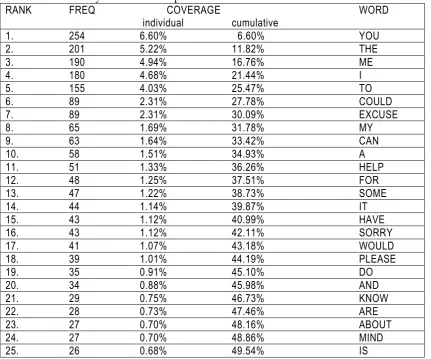
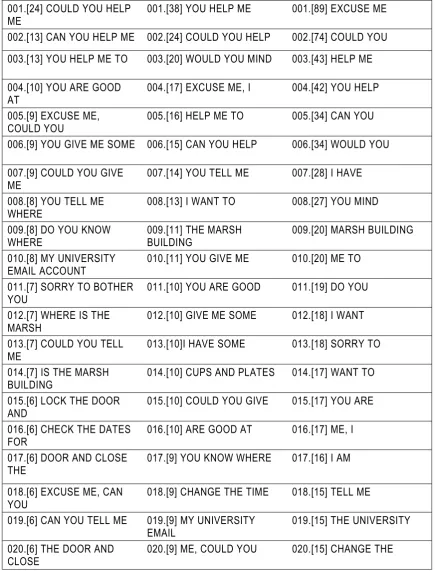
[image:7.595.85.517.180.539.2]Tables 1 and 2 below show the twenty most frequent words and two- to four-word chunks available from the whole data set (3, 919 words).
Table 1.The twenty five most frequent words whole data set
RANK FREQ COVERAGE
individual cumulative WORD
1. 254 6.60% 6.60% YOU
2. 201 5.22% 11.82% THE
3. 190 4.94% 16.76% ME
4. 180 4.68% 21.44% I
5. 155 4.03% 25.47% TO
6. 89 2.31% 27.78% COULD
7. 89 2.31% 30.09% EXCUSE
8. 65 1.69% 31.78% MY
9. 63 1.64% 33.42% CAN
10. 58 1.51% 34.93% A
11. 51 1.33% 36.26% HELP
12. 48 1.25% 37.51% FOR
13. 47 1.22% 38.73% SOME
14. 44 1.14% 39.87% IT
15. 43 1.12% 40.99% HAVE
16. 43 1.12% 42.11% SORRY
17. 41 1.07% 43.18% WOULD
18. 39 1.01% 44.19% PLEASE
19. 35 0.91% 45.10% DO
20. 34 0.88% 45.98% AND
21. 29 0.75% 46.73% KNOW
22. 28 0.73% 47.46% ARE
23. 27 0.70% 48.16% ABOUT
24. 27 0.70% 48.86% MIND
25. 26 0.68% 49.54% IS
and the treatment group is likely to have been influenced by the teaching they received.
Table 2. Most frequent four, three and two-word chunks (number of occurrences in square brackets)
001.[24] COULD YOU HELP
ME 001.[38] YOU HELP ME 001.[89] EXCUSE ME 002.[13] CAN YOU HELP ME 002.[24] COULD YOU HELP 002.[74] COULD YOU
003.[13] YOU HELP ME TO 003.[20] WOULD YOU MIND 003.[43] HELP ME
004.[10] YOU ARE GOOD
AT 004.[17] EXCUSE ME, I 004.[42] YOU HELP 005.[9] EXCUSE ME,
COULD YOU 005.[16] HELP ME TO 005.[34] CAN YOU 006.[9] YOU GIVE ME SOME 006.[15] CAN YOU HELP 006.[34] WOULD YOU
007.[9] COULD YOU GIVE
ME 007.[14] YOU TELL ME 007.[28] I HAVE
008.[8] YOU TELL ME
WHERE 008.[13] I WANT TO 008.[27] YOU MIND 009.[8] DO YOU KNOW
WHERE 009.[11] THE MARSH BUILDING 009.[20] MARSH BUILDING 010.[8] MY UNIVERSITY
EMAIL ACCOUNT 010.[11] YOU GIVE ME 010.[20] ME TO 011.[7] SORRY TO BOTHER
YOU 011.[10] YOU ARE GOOD 011.[19] DO YOU 012.[7] WHERE IS THE
MARSH 012.[10] GIVE ME SOME 012.[18] I WANT 013.[7] COULD YOU TELL
ME 013.[10]I HAVE SOME 013.[18] SORRY TO
014.[7] IS THE MARSH
BUILDING 014.[10] CUPS AND PLATES 014.[17] WANT TO 015.[6] LOCK THE DOOR
AND 015.[10] COULD YOU GIVE 015.[17] YOU ARE 016.[6] CHECK THE DATES
FOR 016.[10] ARE GOOD AT 016.[17] ME, I 017.[6] DOOR AND CLOSE
THE 017.[9] YOU KNOW WHERE 017.[16] I AM
018.[6] EXCUSE ME, CAN
YOU 018.[9] CHANGE THE TIME 018.[15] TELL ME 019.[6] CAN YOU TELL ME 019.[9] MY UNIVERSITY
EMAIL 019.[15] THE UNIVERSITY
020.[6] THE DOOR AND
Looking at the two contrasting scenarios where there was a greater social distance between the speakers in one scenario (student-tutor) and a smaller social distance (classmate-classmate) between the speakers in the other, the data also allows us to analyse how successful learners were in their linguistic sensitivity to these differences. Table 3 contrasts the two scenarios, showing the five most common four-word chunks in each scenario. We limited the number to five because of the size of the data sampled.
Table 3. The most frequent four-word chunks used in a higher and lower social distance scenarios
Asking a tutor for an essay extension
(higher social distance) Asking a classmate to help with a presentation (lower social distance)
1. COULD YOU GIVE ME 1. YOU ARE GOOD AT 2. EXTENSION OF ONE WEEK 2. KNOW YOU ARE GOOD 3. HAVE SOME PERSONAL REASONS 3. ARE GOOD AT COMPUTER 4.I HAVE SOME PERSONAL 4. I KNOW YOU ARE
5. AN EXTENSION OF ONE 5. TO DESIGN THE POWERPOINT
This data demonstrates that learners who produced successful requests were able to display some pragmalinguistic awareness appropriate for the social distance and imposition of each scenario. This is displayed in the usage of sorry to bother you in the greater distance scenario, a chunk which is absent from the second scenario. The high frequency of you are good at in the second scenario also suggests a sensitivity towards the needs to make the receiver of the request (in this case a peer) feel less imposed upon by offering a compliment before making a request, something which would not be appropriate in the tutor scenario. The use of the modals could you help me and could you give me in the data, however, does also suggest that many learners generally favoured these forms as a means of expressing requests with conventional indirectness.
Considering the frequency data as a whole, it would seem that successful requests in this data were realised with the modals can, could and would and chunks such as would you mind and could you help me to make requests, which are conventionally indirect. These were often accompanied by attention-getters such as excuse me and apologies to reduce the imposition on the listener such as sorry to bother you. Learners were also able to show some sensitivity to the social distance and the status of the interlocutor in the scenario by employing different chunks as appropriate to the situation but largely conventional indirectness was the favoured form of realising the requests.
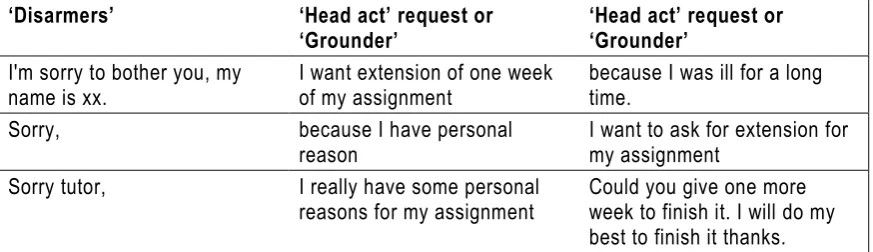
Having considered the data through the lens of quantitative analysis, it is also helpful to analyse it qualitatively in order to examine the moves which were deemed acceptable in each request scenario. Exploring the data in this way enables us to demonstrate that requests were often marked as pragmatically appropriate, even when there were linguistic errors contained within them, as can be seen in table 4.
indicate that Chinese L1 patterns convey politeness by firstly justifying the request prior to producing the request head act itself, termed the because-therefore pattern. Table 4 below displays some examples of this pattern.
Table 4. Sample request patterns for asking a tutor for an essay extension (higher social distance scenario)
‘Disarmers’ ‘Head act’ request or
‘Grounder’ ‘Head act’ request or ‘Grounder’
I'm sorry to bother you, my
name is xx. I want extension of one week of my assignment because I was ill for a long time. Sorry, because I have personal
reason I want to ask for extension for my assignment Sorry tutor, I really have some personal
reasons for my assignment Could you give one more week to finish it. I will do my best to finish it thanks.
These samples above demonstrate L1 patterns were also transferred into L2 speech behaviour in our data, as can be seen in examples such as sorry (disarmer), because I have personal reason (grounder) I want to ask for extension for my assignment (head act).
In contrast, NSs typically rely on the opposite therefore-because pattern, focusing on the head act which is subsequently supported by the relevant grounder (Yu, 1999; Zhang, 1995) so that the above example might become Sorry, can I have an extension because I have personal problems. These samples further show that the actual request did not always have to contain a polite modal form in order to be considered successful, providing the requisite moves were employed. In the scenario with a small amount of social distance the moves were markedly different to the above scenario and mainly consisted of a preparator (compliment) + request. Samples of this pattern can be seen in table 5 below.
Table 5. Sample request patterns for asking a classmate to help with a presentation (lower social distance scenario)
‘Preparators’ ‘Head act’
I am wondering you are good at computer
skills, can you design our group’s presentation? You know, a good group presentation need
cooperations. You are good at designing ppt, so would you please take responsibility for it? Hi Peter you are good at introduce aren't you? So can you do the introduce for the
presentation?
[image:10.595.87.515.543.647.2]Zhang, 1995) as this example illustrates: You know, a good group presentation need cooperations. You are good at designing ppt, (preparator used to mitigate impact of request) so would you please take responsibility for it? (head act).
NSs, by contrast, utilise internal modification strategies as the primary mitigator so exhibit fewer external modifiers in their utterances (Yu 1999; Zhang 1995). This naturally leads to Chinese learners’ requests being longer in comparison to NSS’ requests as illustrated in the examples above, whilst still being judged to be successful in this context.
RQ2:To what extent are the most frequent forms in the request data different to the most frequent forms in a general spoken and written corpus?
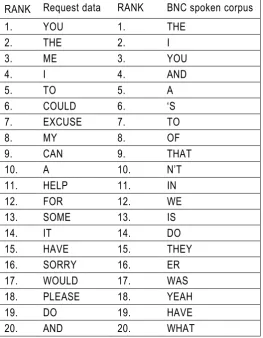
[image:11.595.86.350.389.728.2]In order to answer our second research question, three further forms of analysis were undertaken, using Lextutor (2013) software. Firstly, table 6 shows the most frequent twenty words in our data compared with the most frequent twenty words in the spoken section of the British National Corpus , as described by Leech et al., (2001). Raw frequency alone is of course only one form of comparison but it can provide an illuminating initial analysis of any data (O’Keeffe et al., 2007).
Table 6. Word ranking list in requests data in comparison to the spoken British National Corpus
RANK Request data RANK BNC spoken corpus
1. YOU 1. THE
2. THE 2. I
3. ME 3. YOU
4. I 4. AND
5. TO 5. A
6. COULD 6. ‘S
7. EXCUSE 7. TO
8. MY 8. OF
9. CAN 9. THAT
10. A 10. N’T
11. HELP 11. IN
12. FOR 12. WE
13. SOME 13. IS
14. IT 14. DO
15. HAVE 15. THEY
16. SORRY 16. ER
17. WOULD 17. WAS
18. PLEASE 18. YEAH
19. DO 19. HAVE
20. AND 20. WHAT
grammatical items such as the, to, a and for (Biber et al, 1999). The interactional nature of the requests is reflected in the higher frequency of you in the request data, though it is of similar ranking to the general spoken corpus. The higher frequency of modals such as would, could and can and sorry, excuse and please also reflect the fact that focussing the data upon requests results in a list with more content words reflecting the pre-request and request phases of the speech act.
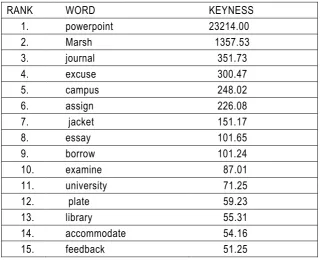
[image:12.595.84.408.444.704.2]Frequency lists alone are of course only one simple comparison and in order to understand the extent to which our request data differs from a general corpus, it was also necessary to undertake keyword analysis to investigate the extent to which forms occur more often in the data set compared to a general reference corpus. Lextutor (2013) provides the ten-million word spoken section of the British National Corpus as a means of achieving this. The software produces a list of all keywords which occur at least ten times more frequently in the input data than the reference corpus and makes a calculation of ‘keyness’ based upon the occurrences in the reference corpus and the input data. This is useful for practitioners as it highlights the important words to include in classroom materials in a particular context and for learners it helps them to focus on what to learn. Although this calculation produces a long list of keywords, for the purposes of this study a ‘keyness’ factor of fifty was decided upon as a minimum for inclusion in the data, based upon the research of Chung and Nation (2004: 259), who suggest that this is the most reliable and effective cut off point. Table 7 shows the keywords from the whole data set and table 8, the keywords in each scenario.
Table 7. List of keywords from all request scenarios
RANK WORD KEYNESS
1. powerpoint 23214.00
2. Marsh 1357.53
3. journal 351.73
4. excuse 300.47
5. campus 248.02
6. assign 226.08
7. jacket 151.17
8. essay 101.65
9. borrow 101.24
10. examine 87.01
11. university 71.25
12. plate 59.23
13. library 55.31
14. accommodate 54.16
15. feedback 51.25
presentation reflect the topic of the scenario where students were required to ask for help from a peer in making a presentation. However, it is also interesting to note the high keyness factor of attention getters such as excuse, from the chunk excuse me, which reflects the high frequency of the preparatory pre-request. It is also interesting to compare the keywords in the two DCTs scenario discussed in answer to research question one and see how they may differ when there is a high and low social distance and power. This comparison is shown in table 8.
Table 8. Keywords in high and low social distance scenarios
Although the data in table 8 demonstrates that some of the words with the highest keyness factor again reflect the nature of the DCT, such as appointment, feedback, extension and tutor, other keywords support the findings discussed in relation to research question one. This also demonstrates the ability of successful learners to recognise the social distance and imposition in this request and seek to minimise this preparatory apologies such as sorry and bother and the attention getter excuse from the chunk excuse me. The keyness of words such as reasons, personal and discuss indicate the higher frequency of grounders in this context. The lack of keywords which indicate conventional indirectness here, with the exception of the attention getting excuse, indicates that learners were sufficiently aware of the lesser social distance in this scenario and thus could focus upon making a successful request without such a need for conventional indirectness. This data again supports the findings for research question one.
High social
distance Low social distance
1. FEEDBACK 2331.00 1. POWERPOINT 18947.00
2. TUTOR 1748.25 2. INTRODUCE 2296.64
3. ESSAY 858.79 3. SLIDES 1684.20
4. EXCUSE 582.75 4. PRESENTATION 1658.70
5. SORRY 485.63 5. COMPUTERS 842.20
6. EXTENSION 388.50 6. COMPUTER 809.69
7. ASSIGNMENT 375.97 7. DESIGNING 467.89
8. DISCUSS 333.00 8. CONFIDENT 394.75
9. APPOINTMENT 333.00 9. INTRODUCTION 323.90
10. BOTHER 317.86 10. EXCUSE 300.75
11. FINISH 298.85 11. DESIGN 151.73
12. TOMORROW 143.45 12. SPEAKER 119.17
13. REASONS 92.32 13. HELP 74.94
14. PERSONAL 71.36
15. GIVE 59.62
5 Implications for teaching spoken request forms in an EAP context
The frequency lists demonstrate that, as we might expect, modal forms which express conventional indirect requests such as could, would and can and chunks such as would you mind, and can you help were of generally high frequency in this data. As a result, they are likely to be worth teaching as linguistic aspects of such requests to ESL or EAP learners. Similarly, chunks which can act as grounders and disarmers such as you are good at and sorry to bother you are also of use in appropriate contexts. However, the data also demonstrated that learners need to be taught requests at the level of discourse because an awareness of context shaped the linguistic choices and organisational patterns of the successful requests in our data, something which has long been suggested is an important feature of successful language learning by commentators (e.g., McCarthy and Carter, 1993; Thornbury, 2005).
It is important that learners become aware of the moves available when making requests in different scenarios as well as the impact of both positive and negative L1 transfers to L2 utterances. Furthermore, they should become aware that it was clearly not simply the correct choice of linguistic forms which dictated whether the requests were considered to be successful in these samples. The implication for classroom materials is that there is a need to focus learners on the language needed for requests but to supplement this with a focus on the contexts of use and the typical request moves which are most likely to match these contexts. In many cases, several commentators have noted that request forms receive only scant coverage in EAP material (e.g., Boxer and Pickering, 1995; Crandall and Basturkmen, 2004) and the focus has tended to be on written discourse and common spoken genres such as presentations. This seems something of an omission because spoken requests are a very common speech act in an EAP context and something which learners need to perform successfully on a daily basis. For this reason, materials for teaching spoken requests may need to come from general English textbooks. Such materials offer good coverage of common modals used to make requests but there is tendency to teach them either in isolated lists (Crandall and Basturkmen, 2004) or in question and answer sequences. The task below, taken from Soars and Soars (1996:44), illustrates this point. Students are required to match request forms and offers in a variety of contexts, such as in the examples in figure one below.
A B
Could you fill it up please? Sure. Shall I check the oil as well? Could I have the bill please? Certainly sir, I’ll bring it straight away. Two lagers, please. Halves or pints
[image:14.595.88.514.571.647.2]Can you tell me the code for Paris? One moment. I’ll just look it up. Would you mind opening the window? Not at all. It’s very stuffy in here.
Figure 1. Example of published materials teaching spoken requests
seem to encourage them to make decisions about when to use can, could or would or indeed when they do not require a modal, as shown in the example in a British pub. Learners may also get the impression that a successful request consists of simply the request itself. This could give learners the misleading impression that requests are simply question and answer sequences and mean that they are unaware of the common need for pre- and post-request moves. In the final scenario above, for example, it would seem more likely that the speaker would use some kind of device to get the listeners attention such as Excuse me and that they may add a reason for the request such as It’s really stuffy in here to mitigate against the imposition upon the listener. Adapting such material to include a focus on context and to allow learners a chance to discuss why different request forms have been chosen in each context and the moves they consist of would seem to have value in this regard. Successful requests produced by students can be used to inform the input material. An example of this can be found in the three-step sample materials (A, B, C) in the appendix.
6 Conclusion
Analysing samples of successful learner data as we have done, can, we believe, be of use to classroom teachers who may not have access to large corpora or the time to consult them. This study demonstrates that using samples of learner data and analysing the most frequent words, chunks, keywords and moves in speech acts such as requests can provide a helpful model in this particular EAP context. Whilst it is not surprising that much EAP research has focussed upon written forms of language, it is in the everyday functions of spoken language such as requesting that learners can interact with their peers and tutors, receive immediate feedback and learn how to interact in transactional and interpersonal ways.
We would agree with Cornbleet’s (2000) suggestion that EAP teaching should pay attention to interpersonal aspects of spoken language because it is in these areas that many learners can feel an immediate sense of success. As we have shown, making successful spoken requests in this context does not always necessitate using error-free language but rather language which is sensitive to the linguistic and organisational patterns required by that context.
References
Alcon Soler, E. 2005. Does instruction work for learning pragmatics in the EFL context? System, 33 (3), 417–435.
Bardovi-Harlig, K. 1999. Exploring the interlanguage of interlanguage pragmatic: A research agenda for acquisitional pragmatics. Language Learning, 49, 677–13.
Barron, A. 2003. Acquisition in interlanguage pragmatics: Learning how to do things with words in a study abroad context. Amsterdam: John Benjamins.
Beebe, L. M., & Cummings, M. C. 1996. Natural speech act data versus written questionnaire data: How data collection method affects speech act performance. In S. M. Gass & J. Neu (eds.), Speech acts across cultures: Challenges to communication in a second language. New York: Mouton de Gruyter, 65–86.
Biber, D. 2006. Stance in spoken and written university registers. Journal of English for Academic Purposes, 5 (2), 97–116.
Biber, D., Johansson, S., Leech, G., Conrad, S., & Finegan, E. 1999. Longman Grammar of Spoken and Written English. London: Longman.
Billmyer, K., & Varghese, M. 2000. Investigating instrument-based pragmatic variability: Effects of enhancing discourse completion tests. Applied Linguistics, 21 (4), 517–552.
Blum-Kulka, S., House, J., & Kasper, G. 1989. Cross Cultural Pragmatics: Requests and Apologies. Norwood, NJ: Ablex.
Blum-Kulka, S. & Olshtain, E. 1984. Requests and apologies: A cross-cultural study speech-act realisation patterns (CCSARP). Applied Linguistics, 5 (3), 196–213.
Boxer, D., & Pickering, L. 1995. Problems in the presentation of speech acts in ELT materials: The case of complaints. ELT Journal, 49 (1), 44–58.
British National Corpus (2013). [Retrieved 18 March 2013] Available at: http://www.natcorp.ox.ac.uk/.
Brown, P., & Levinson, S. C. 1987. Politeness: Some Universals in Language Usage. Cambridge: Cambridge University Press.
CEFR 2010. The Common European Framework of References for Languages. 2010.
[Retrieved 18 March 2013] Available at:
http://www.coe.int/T/DG4/Linguistic/Source/Framework_EN.pdf.
Chung, T. M., & Nation, P. 2004. Identifying technical vocabulary. System, 32 (2), 251– 263.
Clennell, C. 1999. Promoting pragmatic awareness and spoken discourse skills with EAP classes. ELT Journal, 53 (2), 83–91.
Cornbleet, S. 2000. Illocutionary Force and the EAP Context. In J. Cutting (ed.), The Grammar of Spoken English and EAP Teaching. Sunderland: University of Sunderland Press, 21–38.
Crandall, E., & Basturkmen, H. 2004. Evaluating pragmatics-focused materials. ELT Journal, 58 (1), 38–49.
Faerch, C., & Kasper, G. 1989. Internal and external modification in interlanguage request realisation. In S. Blum-Kulka, J. House, & G. Kasper (Eds.), Cross Cultural Pragmatics: Requests and Apologies .Norwood, NJ: Ablex. 221–247
Farr, F. 2003. Engaged listenership in spoken academic discourse: the case of student – tutor meetings. Journal of English for Academic Purposes, 2 (1), 67–85.
Fukuya, Y.J. 1998. Consciousness-raising of downgraders in requests. Paper Presented at Second Language Research Forum ’98, University of Hawai‘i at Manoa (ERIC Document Reproduction Service No. ED466100).
Fukuya, Y.J., & Clark, M. K. 2001. A comparison of input enhancement and explicit instruction of mitigators. In L. Bouton (Ed.), Pragmatics and Language Learning, vol. 10. Division of English as an International Language Intensive English Institute. Urbana: University of Illinois at Urbana-Champaign.
Grant, L.E. 2011. The frequency and functions of just in British academic spoken English. Journal of English for Academic Purposes, 10 (3), 183-197.
Halenko, N., & Jones, C. (2011). Teaching pragmatic awareness of spoken requests to Chinese EAP learners in the UK. Is explicit instruction effective? System, 39 (1), 240-250.
Handford, M . 2011. The language of business meetings. Cambridge: Cambridge University Press.
Hartford, B. S., Bardovi-Harlig, K. 1992. Experimental and observational data in the study of interlanguage pragmatics. In L. Bouton & Y. Kachru, Y. (eds.), Pragmatics and Language Learning vol. 3 . Urbana: University of Illinois at Urbana-Champaign, 33–52.
Hill, T. 1997. The development of pragmatic competence in an EFL context. Ph.D. dissertation, Temple University, Japan.
House, J., & Kasper, G. 1987. Interlanguage pragmatics: requesting in a for eign language. In W. Lorscher & R. Schulze (eds.), Perspectives on Language in Performance, Vol.2Tübingen: Narr, 1250–1288
Kasper, G., & Dahl, M. 1991. Research methods in interlanguage pragmatics. Studies in Second Language Acquisition, 13 (2), 215–247.
Krishnamurthy, R., & Kosem, I. 2007. Issues in creating a corpus for EAP pedagogy and research. Journal of English for Academic Purposes, 6 (4), 356 –373.
Leech, G., Rayson, P., & Wilson, A. 2001. Word frequencies in written and spoken English: Based on the British National Corpus. London: Longman.
Lextutor 2013. Compleat Lexical Tutor 2013. [Retrieved 15 March 2013].Available at
http://www.lextutor.ca/ .
Lin, Y. 2009. Query preparatory modals: Cross-linguistic and cross-situational variations in request modification. Journal of Pragmatics, 41 (8), 1636–1656.
Lynch, T. 2007. Learning from the transcripts of an oral communication task. ELT Journal, 61 (4), 311–320.
McCarthy, M., & Carter, M. 1993. Language as discourse: Perspectives for language teaching. London: Longman.
Octu, B., & Zeyrek, D. 2008. Development of requests: A study on Turkish learners of English. In M. Puetz & J. Neff van Aertselaer (eds.), Developing Contrastive Pragmatics: Interlanguage and Cross-cultural Perspectives Berlin: Mouton de Gruyter, 265–300 O’Keeffe, A., McCarthy, M., & Carter, R. 2007. From Corpus To Classroom. Cambridge:
Cambridge University Press.
Prodromou, L. 2003. In Search of the Successful User of English. Modern English Teacher, 12 (2), 5–14.
Prodromou, L. 2008. English as a Lingua Franca: A Corpus-Based Analysis. London: Continuum.
Rose, K. 2000. An exploratory cross-sectional study of interlanguage pragmatic development. Studies in Second Language Acquisition, 22 (1), 27–67.
Safont, M. P. 2008. The speech act of requesting. In E. Alcon (ed.), Learning how to request in an Instructed Languages Learning Context . Bern: Peter Lang, 41 –90.
Sasaki, M 1998. Investigating EFL students’ production of speech acts: A comparison of production questionnaires and role plays. Journal of pragmatics, 30 (4), 457–484. Schauer, G. A. 2006. Pragmatic awareness in ESL and EFL contexts: Contrast and
development. Language Learning, 56 (2), 269–318.
Schauer, G. A. 2009. Interlanguage pragmatic development: The study abroad context. London: Continuum.
Skyrme, G. 2010. Is this a stupid question? International undergraduate students seeking help from teachers during office hours. Journal of English for Academic Purposes, 9 (3), 211 –221.
Soars, J., & Soars, L. 1996. Headway Intermediate Student’s Book. Oxford: Oxford University Press
Trosborg, A. 1995. Interlanguage pragmatics: Requests, Complaints and Apologies. New York: Mouton.
Wang, V. X. 2011. Making requests by Chinese EFL learners. Amsterdam: John Benjamins Woodfield, H. 2008. Interlanguage requests: A contrastive study. In M. Puetz & J. Neff
van Aertselaer (eds.), Developing Contrastive Pragmatics: Interlanguage and Cross-cultural Perspectives. Berlin: Mouton de Gruyter, 231–264
Yu, M. C. 1999. Universalistic and Culture-Specific Perspectives on Variation in the Acquisition of Pragmatic Competence in a Second Language. Pragmatics, 9 (2), 281– 312.
Zhang, Y. 1995. Indirectness in Chinese Requesting. In: G. Kasper (ed.), Pragmatics of Chinese as native and target language. Hawai’i: University of Hawai’i Press, 69 –100.
Appendix 1
Sample request materials
A) Awareness raising and discussion (sociopragmatic)
Discuss each situation below. How appropriate do you think each request is in the situation given? If the request were made in this way in your first language, would it be appropriate?
Requests
1. A student comes to my office and asks to speak to my colleague, whose name is ‘Andrea’. The student opens the conversation by saying ‘Andrea?’
2. A student goes to the ‘I’ (student information office) and asks for information about supermarkets in the area. The student opens the conversations by saying ‘I need information about supermarkets in Preston’.
3. A student goes to see their course leader, who they have never met before and requests a copy of their timetable. The student opens the conversation by saying ‘Hello, my name is____, I want a copy of my timetable’.
4. 4. A student is preparing a presentation for a course. You want some help with your power point slides. You ask your friend to help and open the conversation by saying ‘Can you help me with this?’
B1) Focussed practice (pragmalinguistic)
How would you grade the following types of request in terms of their politeness? Mark each as ‘neutral’, ‘very polite’ or ‘quite polite’
You couldn’t______________, could you? Would you...?
Would you mind _______ ‘ing? I wonder if you could...? Could you...? Can you...? Do you mind...?
I was wondering if you could...?
Which requests forms might you choose for each scenario (1-5) given above. Why?
B2) Focussed practice (pragmalinguistic)
The organisation of each request is likely to be different, depending on how well you know the person and what you are requesting of them. Look at situation four. Which pattern below is more likely and why?
Pattern 1
Greeting (Hi John)
Request (Can you help me with the PowerPoint slides?) Thanks (Thank you)
Pattern 2
Greeting (Hi John)
Pre-request (You know we have to do this presentation? And you’re pretty good with powerpoint so..)
Request (Could you put the slides together? ) Reason (It would just make it a lot quicker) Thanks(Ta)
Look at the samples given (they are successful student requests) and decide what the context is in each case. How are these requests organised?
C) Consolidation (Sociopragmatic)
Students role-play the various scenarios, in pairs and then in front of the class