This is a repository copy of
Acceptor binding energy in delta-doped GaAs/AlAs
multiple-quantum wells
.
White Rose Research Online URL for this paper:
http://eprints.whiterose.ac.uk/1688/
Article:
Zheng, W.M., Halsall, M.P., Harmer, P. et al. (2 more authors) (2002) Acceptor binding
energy in delta-doped GaAs/AlAs multiple-quantum wells. Journal of Applied Physics, 92
(10). pp. 6039-6042. ISSN 1089-7550
https://doi.org/10.1063/1.1516872
[email protected] http s ://eprints.whiterose.ac.uk/
Reuse
See Attached
Takedown
If you consider content in White Rose Research Online to be in breach of UK law, please notify us by
Acceptor binding energy in
d
-doped GaAs
Õ
AlAs multiple-quantum wells
W. M. Zheng,a)M. P. Halsall, and P. Harmer
Department of Physics, UMIST, Manchester M60 1QD, United Kingdom
P. Harrison
IMP, School of Electronic and Electrical Engineering, University of Leeds, Leeds LS2 9JT, United Kingdom
M. J. Steer
EPSRC III–V Semiconductor Central Facility, Department of Electronic and Electrical Engineering, University of Sheffield, Sheffield S1 3JJD, United Kingdom
~Received 7 June 2002; accepted 30 August 2002!
A series of Bed-doped GaAs/AlAs multiple-quantum wells with the doping at the well center were grown by molecular beam epitaxy. The photoluminescence spectra were measured at 4, 20, 40, 80, 120, and 200 K, respectively. The two-hole transitions of the acceptor-bound exciton from the ground state, 1S3/2(G6), to the first-excited state, 2S3/2(G6), have been clearly observed and the
acceptor binding energy measured. A variational calculation is presented to obtain the acceptor binding energy as a function of well width. It is found that the experimental results are in good agreement with the theory. © 2002 American Institute of Physics. @DOI: 10.1063/1.1516872#
I. INTRODUCTION
Recently, studies of the internal transition of shallow im-purities fresh impetus due to the potential applications in far-infrared detectors and a solid state terahertz laser.1–5 Con-finement of such impurities in quasi-two-dimensional GaAs/AlxGa12xAs quantum wells~QWs!allows the tuning of these levels in a controlled way. For device applications the greater range the binding energy of the impurity can be tuned over the better. In particular it is desirable that the dipole-allowed 1s–2p transition can be tuned to be outside of the main longitudinal optical phonon bands of the semicon-ductor.
In the GaAs beryllium is an acceptor species commonly used in devices, it is relatively stable with respect to diffu-sion and has a binding energy of 28 meV in the bulk.6It has been shown previously that when incorporated into GaAs/AlxGa12xAs QWs this binding energy can be
in-creased substantially. Furthermore, the use of d doping avoids the extension of the impurity energy levels resulted from the distribution of the dopant atoms along the growth direct of the quantum wells. The electronic states and prop-erties of the shallow acceptors in the GaAs/AlxGa12xAs QWs are not understood as well as those
of shallow donors as the valence band of bulk GaAs is four-fold degenerate and contains a cubic term that must be taken into account to describe the acceptor states. Theoretically, the calculation of the effect of confinement on the ideal acceptor state in GaAs/AlxGa12xAs QWs was reported by Masselink
et al.7 Experimentally, Gammon et al. have observed the confinement-induced splittings of acceptor levels in the GaAs/AlxGa12xAs QWs with the resonant Raman scattering experiments.8 Subsequently, the transitions between split-tings of the acceptor levels have also been investigated in detail with far-infrared transmission,9 photoluminescence
~PL!, and photoluminescence excitation experiments.10–14 However, for the Be d-doped GaAs/AlAs multiple-quantum wells ~MQWs! with doping at the well center, there have been few reports of either experimental or theoretical work. However, this system is of especial interest as it represents the maximum possible confinement for the acceptor states in the valence band and thus the maximum possible tuning range for the 1s–2p transition of the acceptor. In this article we measure PL spectra at various temperatures for a series of GaAs/AlAs MQWs with Be d-doped at the well center and the well width range from 30 to 200 Å. The acceptor binding energy has been measured experimentally. The acceptor binding energy is calculated using a variational calculation as a function of the quantum-well width and compared with the experimental results.
II. EXPERIMENT AND RESULTS
A series of Bed-doped GaAs/AlAs MQWs were grown by molecular beam epitaxy with doping at the quantum-well center, on a semi-insulating ~100! GaAs substrate in a VG V80 H reactor equipped with all solid sources. The growth of the layers was performed under exact stoichiometric condi-tion using the technique of stoichiometric low-temperature growth,5which ensures high quality optical materials even at relatively low growth temperatures. Under these conditions, the quantum-well structures were grown at 550 or 540 °C and without interruptions at the quantum well interfaces, which ensured negligible diffusion of the Bed layers. Prior to the growth of the MQWs a 3000 Å GaAs buffer layer was grown. Each of multiple-quantum well structures investi-gated contained a same 50 Å wide AlAs barrier, while every GaAs well layer was d doped at the well center with Be acceptor atoms. The doping level and the main characteris-tics of each sample are summarized in Table I.
a!Electronic mail: [email protected]
6039
Photoluminescence experiments were performed from liquid helium to room temperatures using Renishaw Raman imaging microscope. The samples were mounted on a cold finger of a continuous flow helium cryostat. The optical ex-citation for the PL experiments was provided by an argon-ion laser (5145 Å). The laser beam was focused onto a sample, and the light returning back from the sample was collected and passed into a spectrograph for analysis. The excitation was typically 5 mW.
[image:3.612.332.539.49.301.2]The PL spectra with above-band gap excitation have been measured at the various temperatures for the samples in Table I. Figure 1 shows the PL spectra at 4, 20, 40, 80, 120, and 200 K for the sample RM1794. Three peaks are clearly resolved at 4 K, with positions located at 794, 795.88, and 806.26 nm, respectively. The first at 794 nm is the strongest peak and attributed to the transition of a heavy free exciton (XCB12HH1). The second at 795.88 nm originates from the
exciton recombination bound to the neutral beryllium accep-tor (Be0X). The energy separation between the XCB12HH1
and the Be0X is 3.7 meV, which is the energy required
re-moving the exciton from the Be0X complex. The intensity
ratio of the Be0X with the XCB12HH1 is 0.76 at 4 K and
decreases as the measuring temperature increases. As the
temperature arrives at 80 K, the Be0X peak is no longer
detectable, and the light free exciton peak (XCB12LH1) can
be observed. In addition the third peak at 806.26 nm is weaker than the XCB12HH1 and Be0X, which is attributed to
the free-to-bound recombination (eBe0) between an electron of the n51 quantized confinement level and a hole bound to a Be acceptor at the center of the GaAs well. As the measur-ing temperature rises to 40 K, the eBe0 line becomes very weak.
Figure 2 indicates the PL spectra of the sample R1392 at different measuring temperatures. In contrast to Fig. 1, the strongest peak at 4 K is attributed to the bound exciton, Be0X, with a doublet structure labeled A and B. The energy
splitting between A and B is 1.3 meV, which is 1.7 meV for a 100 Å wide GaAs/Al0.3Ga0.7As QWs.
11
The B peak is due to an excited state of the Be acceptor bound exciton. For the sample R1303 with the same density of dopant atoms as the sample R1392 and instead of a 150 Å wide quantum well, the doublet structure is not observed clearly, but the bound exciton peak, Be0X, has a weak shoulder. In Fig. 2 at the
high energy side of the Be0X is the heavy free exciton peak, XCB12HH1, and the intensity ratio, IBe0X/ICB12HH1, is 6.8 at
4 K, greater than that of other three samples, respectively. This fact is mainly due to the reduction of the free exciton lifetime with decreasing quantum well width, since the prob-ability for the electron-hole pairs to recombine as a free ex-citon instead of getting captured by impurities increases with decreasing quantum-well width.15 In addition at the lower energy side of the eBe0, a peak labeled THT is clearly ob-served and interpreted as the two-hole transitions ~THT!of the acceptor bound exciton. As the exciton attached to the neutral acceptor atom recombines, there is a small probabil-ity that some of energy emitted is absorbed by the hole
TABLE I. Characteristics of the samples: the repeated period, the quantum-well width (Lw) , thed-doping Be concentration~P!, and the growth tem-perature of the epitaxial layers~T!
Samples Periods Lw(Å) P (cm22) T (°C)
RM1795 400 30 231010 550
RM1794 200 100 531010 550
R1303 50 150 2.531012 540
[image:3.612.52.298.85.152.2]R1392 40 200 2.531012 540
FIG. 1. Series of PL spectra for sample RM1794 (Lw5100 Å) at different measuring temperatures showing the XCB12LH1, XCB12HH1, Be0X, and eBe0
[image:3.612.68.279.467.723.2]peaks.
FIG. 2. Series of PL spectra for sample R1392 (Lw5200 Å) at different measuring temperatures showing the XCB12LH1, XCB12HH1, Be0X, eBe0,
and THT peaks.
bound to the acceptor, which then undergoes a transition to an excited state leaving the acceptor, which binds the exci-ton, in an excited state instead of the ground state. The en-ergy of this transition is equal to that of the separation be-tween the Be0X and THT, 29.5 meV. The THT is also
observed in RM1795 and R1303 sample, but the THT signal intensity of the RM1795 is even weaker than that of R1303 and R1392 sample, respectively. This reason is attributed to the smaller concentration of dopant atoms and the smaller probability for the capture by an impurity, of an electron-hole pair in QWs instead of recombination as a free exciton. For the Be-doped GaAs/AlxGa12xAs QWs structures, the
degen-eracy of the valence band is lifted at theG point due to the quantum well potential which reduces the point group sym-metry from Td to D2d. Therefore, the ground state of the
neutral acceptor Be at the center of a quantum well splits into two doublet levels, namely 1S3/2(G6) and 1S3/2(G7).
9
The THT peak in Fig. 2 is associated with the transition of 1S3/2(G6)→2S3/2(G6).
III. CALCULATION AND DISCUSSION
A. Theory
Under the single-band effective mass and envelop func-tion approximafunc-tions, the Hamiltonian of a hole bound to the hydrogenic acceptor at position (0,0,z0) in the GaAs/AlAs
MQWs can be written as
H52 \ 2
2m*¹ 2
1V~z!2 e 2
4p«0«rr
8
, ~1!
where m* is the effective mass of a hole,«r is the relative
dielectric permittivity, and V(z) is the one-dimensional po-tential. The hole-acceptor separation r
8
is written as follows:r
8
5A
x21y21~z2z0!2. ~2!The success of variational approaches centers around the general choice of the trial wave function. We choose the produce of two terms as the trial wave function of a hole, i.e.,
C5x~z!e2r8/l, ~3!
where x(z) is the wave function of the hole in the GaAs/ AlAs MQWs without the acceptor impurity present and
e2r8/lis the simple hydrogenic wave function of the ground state, and wherelis known as the Bohr radius, but now it is employed as a variational parameter in order to minimize the total energy of the system. The SchrWdinger equation corre-sponding to the Hamiltonian of Eq. ~1!becomes
2 \
2
2m*$@¹z 2x
~z!#e2r8/l
12¹zx~z!¹ze2r8/l
1x~z!¹2e2r8/l%
2 e
2
4p«0«rr
8
x~z!e2r8/l
1V~z!x~z!e2r8/l
5Ex~z!e2r8/l, ~4!
where E is the total energy of the system. The energy E can be solved for any choice oflby expanding the derivatives in
finite differences and forming an iterative shooting algorithm.16 The variational parameter, l, is varied system-atically with the aim of minimizing the total energy. The acceptor binding energy, EB, is equal to the difference
be-tween E and the ground-state energy, E1, for the hole in the
QWs without the acceptor impurity present, and hence,
EB5E2E1. ~5!
B. Results and discussion
In this subsection the numerical results of the binding energies of the Be acceptor at the center of the GaAs/AlAs MQWs as a function of the well width will be given. We use the formula V(z)50.33DEg(x),16whereDEg(x) is the
dif-ference in band gaps at k50 between GaAs and AlxGa12xAs. DEg(x) is taken to 1247x meV and x is the
mole fraction of the AlxGa12xAs barriers. Although the
single-well potential V (z) makes it more appropriate for completely decoupled quantum wells, it will also be appro-priate for MQWs with thick barriers that no hole wave func-tion can penetrate. The effective mass m* is used as the heavy-hole mass of 0.62m0, the typical value in bulk GaAs,
where m0 is the mass of an electron in the free space. The
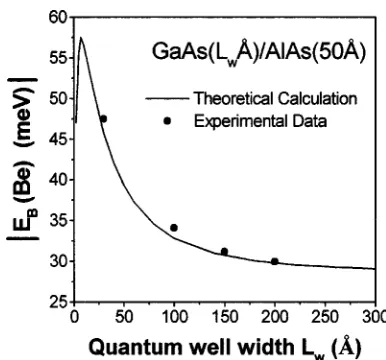
relative dielectric permittivity,«r, is set to 17.2. In previous theoretical calculations, a great deal of attention has been paid to the roles of the effective mass and the dielectric con-stant mismatches at interfaces in semiconductor hererostruc-tures, and their effects on the shallow impurity energy levels in the QWs.17–19With m* and«r parameters given earlier, we deduce the acceptor binding energy of 28.0 meV for very large well widths, which is in good agreement with the ex-perimental result in bulk GaAs.6 Figure 3 illustrates the ac-ceptor binding energy for the on-center Bed-doped in GaAs/ AlAs MQWs with a well width range from 5 to 300 Å. The solid circle dots show the acceptor binding energies gotten from the PL experimental measurements. According to the eBe0position of the PL spectra, the acceptor binding energy
[image:4.612.339.532.48.228.2]EB(Be) can be determined using the relation20
EB~Be!5E~XCB12HH1!1EBX2E~eBe0!, ~6!
where E(XCB12HH1) and E(eBe0) are the energies of the
XCB12HH1 and eBe0lines, respectively, and where EBXis the
binding energy of the heavy exciton and can be deduced from the accurate calculation of Andreani and Pasquarello.21 In Fig. 3 it can be find that the theoretical calculation is in good agreement with the experimental results. The acceptor binding energy increases as the quantum-well width de-creases, and has a peak with a maximum at Lw57 Å. This is
due to the finite barrier and is similarly seen in quantized donor and exciton calculations.22,23 For very narrow wells, the increasing confinement energy pushes the hole closer to the top of well, eventually forcing it to ‘‘spill over the top,’’ thus leading to decreases in the binding energy. As the well width increases, the acceptor binding energy tends towards its bulk value of 28 meV.6 The acceptor binding energy in this article is consistent with that of the G6 ground state in the literature.7
IV. CONCLUSIONS
We have investigated experimentally and theoretically the acceptor binding energy of a series of GaAs/AlAs MQWsd-doped with Be at the center of wells. The PL spec-tra are measured at the various temperatures and the two-hole transitions of the acceptor-bound exciton from 1S3/2(G6)→2S3/2(G6) have been clearly observed. The bind-ing energy of the shallow Be acceptor at the center of the MQWs has been measured experimentally. Using a varia-tional calculation the acceptor binding energy has been cal-culated as a function of the quantum-well width. It is found that the experiment results are in good agreement with the theory.
ACKNOWLEDGMENT
This work is supported by the EPSRC~UK!.
1M. Rochat, J. Faist, M. Beck, U. Oesterle, and M. Ilegems, Appl. Phys.
Lett. 73, 3724~1998!.
2W. D. Goodhue, E. R. Mueller, D. M. Larsen, J. Waldman, Y. H. Chai, S.
C. Lai, and G. D. Johnson, J. Vac. Sci. Technol. B 11, 941~1993!.
3N. C. Jarosik, B. D. McCombe, B. V. Shanabrook, J. Comas, J. Ralston,
and G. Wicks, Phys. Rev. Lett. 54, 1283~1985!.
4P. Harrison and R. W. Kelsall, J. Appl. Phys. 81, 7135~1997!. 5
M. P. Halsall, P. Harrison, J.-P. R. Wells, I. V. Bradley, and H. Pellemans, Phys. Rev. B 63, 155314~2001!.
6S. M. Sze, Physics of Semiconductor Devices, 2nd ed.~Wiley, New York,
1981!, pp. 20–22.
7W. T. Masselink, Y.-Ch. Chang, and H. Morkoc, Phys. Rev. B 32, 5190
~1985!.
8D. Gammon, R. Marlin, W. T. Masselink, and H. Morkoc, Phys. Rev. B
33, 2918~1986!.
9A. A. Reeder, B. D. McCombe, F. A. Chambers and G. P. Devane, Phys.
Rev. B 38, 4318~1988!.
10
P. O. Holtz, M. Sundaram, J. L. Merz, and A. C. Gossard, Phys. Rev. B 40, 12338~1989!.
11P. O. Holtz, Q. X. Zhao, B. Monemar, M. Sundaram, J. L. Merz, and A. C.
Gossard, Phys. Rev. B 47, 15675~1993!.
12
P. O. Holtz, M. Sundaram, R. Simes, J. L. Merz, A. C. Gossard, and J. H. English, Phys. Rev. B 39, 13293~1989!.
13P. O. Holtz, Q. X. Zhao, A. C. Ferreira, B. Monemar, M. Sundaram, J. L.
Merz, and A. C. Gossard, Phys. Rev. B 48, 8872~1993!.
14P. O. Holtz, M. Sundaram, J. L. Merz, and A. C. Gossard, Phys. Rev. B 40,
10021~1989!.
15J. Feldmann, G. Peter, E. O. GWbel, P. Dawson, K. Moore, C. Foxon, and
R. J. Elliott, Phys. Rev. Lett. 59, 2337~1987!.
16P. Harrison, Quantum Wells, Wires and Dots: Theoretical and
Computa-tional Physics~Wiley, Chichester, 2000!, pp. 71– 83.
17C. Mailhiot, Y.-C. Chang, and T. C. McGill, Phys. Rev. B 26, 4449~1982!. 18S. Fraizzoli, F. Bassani, and R. Buczko, Phys. Rev. B 41, 5096~1990!. 19L. Oliveira, Phys. Rev. B 38, 10641~1988!.
20R. C. Miller, A. C. Gossard, W. T. Tsang, and O. Munteanu, Phys. Rev. B
25, 3871~1982!.
21L. C. Andreani and A. Pasquarello, Phys. Rev. B 42, 8928~1990!. 22C. Mailhiot, Y.-C. Chang, and T. C. McGill, Phys. Rev. B 26, 4449~1982!. 23R. L. Greene and K. K. Bajaj, Solid State Commun. 45, 831~1983!.