Rochester Institute of Technology
RIT Scholar Works
Theses Thesis/Dissertation Collections
1992
Solving the solid waste problem: Pressure from the
public sector for point source reduction
Richard Leonard Pryll
Follow this and additional works at:http://scholarworks.rit.edu/theses
This Thesis is brought to you for free and open access by the Thesis/Dissertation Collections at RIT Scholar Works. It has been accepted for inclusion in Theses by an authorized administrator of RIT Scholar Works. For more information, please [email protected].
Recommended Citation
SOLVING THE SOLID WASTE PROBLEM:
PRESSURE FROM THE PUBLIC SECTOR FOR POINT SOURCE REDUCTION
by
RICHARD LEONARD PRYLL
A project submitted to the
Faculty of the School of Food, Hotel and Travel Management
at
Rochester Institute of Technology
in partial fulfillment of the requirements for the degree
of
Master of Science
FOAAf I ROCHESTER INSTITUTE OF TECHNOLOGY
School of Food, Hotel and Travel Management Department of Graduate Studies
M.S. Hospitality-Tourism Management Presentation of ThesislProject Findin2s
Name: Richard Leonard Pryll Date: 8/5/92 SS#:
-.,...-Title of Research: Solving The Solid Waste Problem: Pressure From The Public
Sector For Point Source Reduction
Specific Recommendations: (Use other side ifnecessary.)
Thesis Committee: (1) Dr. Richard F. Marecki (Chairperson)
(2) _
OR (3) _
Faculty Advisor:
Number of Credits Approved: 3_c_r_e_d_i_ts _
Date
F!\ffJ..
DateRichard F. Marecki
Committee Chairperson's Signature
Richard F. Marecki
Department Chairperson's Signature
Note: This form will not be signed by the Department Chairperson until all corrections, as suggested in the specific recommendations (above) are completed.
FORMK ROCHESTER INSTITUTE OF TECHNOLOGY
School of Food, Hotel and Travel Management Department of Graduate Studies
M.S. Hospitality-Tourism Management
Statement Grantinl: or Denyinl: Permission to Reproduce Thesis/Project
The author of a thesis or project should complete one of the following statements and include this statement as the page following the title page.
Title of thesis/project: Solving The Solid Waste Problem: Pressure From The
Public Sector For Point Source Reduction
I, Richard L. Pryll , hereby (grant,~) permission to the
Wallace Memorial Library of R.I.T., to reproduce the document titled above in
whole or part. Any reproduction will not be for commercial use or profit.
OR
I, , prefer to be contacted each time a
request for reproduction is made. I can be reached at the following address:
gls/9a-ACKNOWLEDGEMENTS
I wish to thank Dr. Richard Marecki who has been a
sterling example for being real in the educational world.
Along with Kelly Outerman, who always has been so upbeat.
These two people together seem to have the ability, as in the
story of Jesus and the miracle of the loaves and fishes, to
take a little bit and make something truly satisfying and
worthwhile.
I want to thank Dr. Ed Stockham, Professor Warren
Sackler, and the rest of the RIT faculty and staff for not
only showing patience with me, but other virtues as well.
Fran Domoy! I didn't know that you needed a PhD. to raise
broccoli. Thank you, for sharing the niche which you have
been carving. You were right, there is a world out there!
Ultimately, to Rick and Stan, my sons, who always see the
waterglass as half full, and most importantly to Jackie, my
wife, who nearly always tolerates my endeavors I dedicate this
TABLE OF CONTENTS
ACKNOWLEDGEMENTS i
TABLE OF CONTENTS ii
LIST OF TABLES iii
LIST OF FIGURES iv
CHAPTER ONE 1
Introduction 1
Fast-food, the junk-yard, and a landfill 1
Recycle, Reuse, Refuse, Why? 5
Purpose of Study 10
Problem Statement 10
Significance of Recycling 10
Hypothesis 12
Definition of Terms 12
CHAPTER TWO 15
Review of the Literature 15
Can We Afford Smaller, Less, or Recycled Packages? 15 Who Will Show Us The Way To Recycle? 37
CHAPTER THREE 42
Methodology and Research Design 42
Instrumentation 43
CHAPTER FOUR 46
Data Analysis and Findings 46
Descriptive Statistics of the Sample 46
Statistical Response Analysis 46
Comments Welcome Here 53
Summation of Written Comments 57
CHAPTER FIVE 58
Summary 58
Conclusions 58
Recommendations for Further Study 60
REFERENCES AND BIBLIOGRAPHY 61
APPENDICES 65
A. Reduce and Recycle (A Message From PIRG) 66 A Model Survey Tool by Harris Rusitsky
LIST OF TABLES
Table
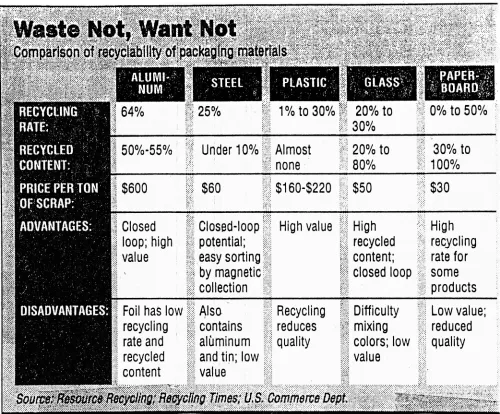
1.1 Waste Not, Want Not: Comparison of recyclability of packaging
materials 7
1.2 Rio Baedeker: A Layman's Guide To Key
Environmental Issues 8
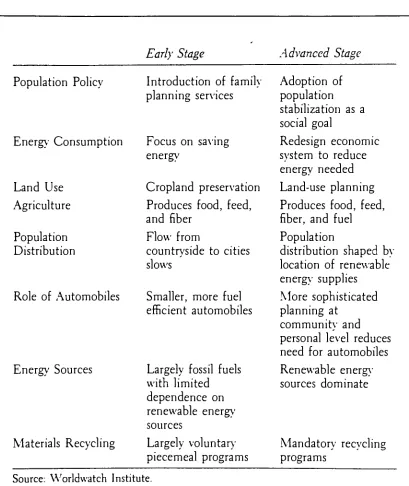
1.3 Early and Advanced Stages of the Transition
to a Sustainable Society 9
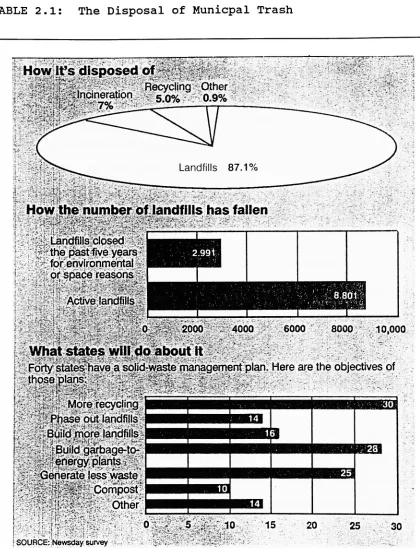
2. 1 The Disposal of Municipal Trash 16
2. 2 Trash Over The Long Haul 19
2. 3 The Pace of Recycling 24
2. 4 What s In Our Garbage 26
2. 5 Sales At Fast-Food Restaurants 27
2.6 Total Number of Restaurants in the U.S 34
2. 7 Growth of Nine Largest Chains 35
2.8 'Make Mine to Go'
LIST OF FIGURES
Figure
1 A Proposal by State Legislature Could Force Manufacturers to Make Packaging
More Reusable or Recyclable 47
2 Packaging Delivered to this Facility Can Be
Reused 5 or More Times 49
3 Packages Delivered to this Facility Are
Composed of 50% Recucled Materials 50
4 Packages Carried Out of this Facility by
Can Be Used 5 or More Times 51
5 Packages Carried Out of this Facility by Consumers Are Composed of 50% Recycled
Materials 52
6 If Manufacturers Are Forced To Comply
To New Packaging Regulations The Costs
Will Be Passed To Consumers 54
7 New Packaging Proposals Are Designed To
Reduce The Waste Stream. Supporters Have
Done Enough Research To Make Accurate
CHAPTER I
Introduction
Fast-food, the Junk-yard, and a Landfill
During the early 70's the researcher taught an
environmental course as part of the science electives. In the
curriculum were four units: Ecology, Energy, Natural
Resources, and Pollution. Pollution was a subject in and of
itself after the first Earth-Day. The objective of the unit
was to give the students a taste of what is happening in the
world of pollution, so teacher and students made arrangements
for a field trip.
The trip encompassed three main destinations, and the
entire school day. The first leg of the outing was to the now
defunct Genesee County Landfill in Batavia, N.Y. At the site,
not only was there a landfill, with trash to crunch and bury,
but also a recycling center. The recycling center is still in
operation and is maintained by the Association for Retarded
Citizens. The workers at the center always obliged by allowing
the students, most of whom were seniors in high school, to
take their places. For an hour or so the students crushed
paper and cardboard in a huge compactor, sorted clear from
highly revered and "dangerous" job as operator of the
tow-motor. After a brief but boring stint at the various jobs, the
director of operations answered questions and related the
destinations of the materials and the market value.
When the class was finished with the ARC it was directed
outdoors where Bill, the landfill manager, anxiously waited.
He first described how large an area this site served, the
types of materials that were held here and the landfills
life-expectancy. He made it very clear that when the landfill died
so would his employment with the county. NO MORE LANDFILL IN
GENESEE COUNTY. He dramatically told a story that would be
common in many communities across the northeast. The county is
lucky to have the services of a recycling center and landfill
in operation. He then found space for the class (most standing
room only in the bucket) on his 20 cubic yard loader. The huge
loader with steel crusher tires was perfect for rolling over
mounds of trash and touring the complex. Bill hasn't been
sited since the landfill closed in 1987.
The second part of the field trip was a stop at
McDonald's. This may sound normal when you consider that it
was a group of hungry teenagers, but eating was the secondary
purpose of the stop. The students marched into the restaurant,
Triple-beam Balances in hand to perform a task. As the
that they received including their tray. After they finished
their meals, they were expected to weigh the remains. "LOOK AT
ALL THAT GARBAGE !"
many of the students would comment. The
activity was entitled "What Precent Garbage", and the purpose
was to call their attention to the "extras" of their meal.
Just a reminder, styrofoam sandwich containers were part of
the deal at the time. This experiment was also conducted at
the school during the students'
normal lunch periods, but most
of them were "brown-bagging it", because of an austerity
budget. This method of taking lunch did not emphatically
illustrate the waste problem as did the fast-food outlet, but
was still done for the sake of comparison.
The third part of the field trip was a stop at Ed
Arnold's Scrap Metal Reprocessing, Inc. Ed greeted the class
with a great smile on his face and stogie in hand, and proceed
to detail his success story. Most of the story described, in
light-hearted fashion, his method of using friends and family
to promote a personal interest that evolved into a very
lucrative family business. He then started the tour of
operations by taking the class through the auto-parts
warehouse, past car doors, fenders, bumpers, transmissions,
carburetors, generators, and every other part imaginable, into
the radiator repair shop, to the truck scales, which gave him
it seemed, was his favorite. He had a late model car ready for
compaction and derived great delight watching the class as the
car metamorphosed into so much metal in a few scrunchy
screechy moments. At each phase of the business, Ed apprised
the class of the expense of the equipment or cost to set up
the operation.
During the day the class recognized the incentives which
eased the collection of metals for reuse. The private
businessman, it appears, can make a fortune if he runs his
business properly, especially if he has a supply of material
which is in demand. WHO DECIDES WHAT IS IN DEMAND? If the
materials are not in demand there is no incentive to sort or
recycle. Thus the materials become a waste, a burden, a
disincentive which is passed on to the public. The cost for
disposal of the waste becomes the local municipalities
problem. The cost for taking care of the problem is handed to
the taxpayer.
The students asked many questions about the trip on the
next day of class.
?Who owns and operates the landfill?
?Why aren't the glass bottles, cardboard boxes, and tin-cans being sorted and separated instead of
being crushed and buried?
?How do they determine the life of its operation? ?What will the town do with trash that is generated after the landfill is closed?
?How does a restaurant such as McDonald's figure into this picture?
Recycle. Reuse. Refuse, Why?
The researcher believes that, in the natural world, all
of the elements over time are in synergy. Energy to power the biosphere and all of the natural earth cycles comes from the
sun. The natural cycles include; the carbon dioxide cycle, the water cycle, the nitrogen cycle, the rock cycle, and the life-death-decay cycle starting with photosynthesis. In nature there is no waste, efforts toward survival should be to this
end. This means that in every natural reaction there are products that are the result of two or more substances
combining or reacting. The products are not always in immediate need but, because there are a limited amount of
materials on Earth, sooner or later they will be, and they
will be easily accessible!
The researcher believes that since the industrial
revolution, man has had an indeterminable affect on the workings of nature. Man as part of nature has a need for materials including; aluminum, steel, plastic, glass, and
in Table 1.1. If he is to be a more successful than the
dinosaur as a species on this earth consideration of material
use must be placed highest on his list of priorities. The
priorities as considered by world leaders including President
Bush at the recent Environmental Summit Conference are listed in Table 1.2. Notice that humans and human activity are at the
top of the priorities. Man must change from his current
direction and consider a sustainable harmony in nature.
According to Brown (1981), " The transition to a sustainable society will challenge the capacity of countries
everywhere to change and adapt. Some adjustments will occur in
response to economic forces, some in response to public policy
changes and still others as a result of voluntary changes in lifestyles. Market forces will also play a central role in the
adjustment process, but in many situations they will be more
effective if augmented by public policy. To exploit fully the
market's role in the transition, political leaders will have
to learn its strength and limitations (Brown, 1981) .
A graphic illustration of the variables that must be
considered when making a harmonic change in human ecology is found in Table 1.3. With this in mind the researcher will
focus on landfills, restaurants, and economic influences from
TABLE 1.1: Waste Not, Want Not
Waa#<*
Not,"" *'* ' . . ... STEEL 25% PLASTIC1% to 30% ^ 20% to
If
30%:::.'
::>/:5v;,:^jv':Vi?::-:,;
^)||:|;|;l|:#^;: ;:
GLASS'S }'
PAPER-
1
0% to 50%
11 i i RECYCLED ^ CONTENT: PRJCEPERTON
OESCRAP: ,
ADVANTAGES:
||
50%-55%1
Under 10%| j
Almost| none
1
20% to80%
|
30% to 100%
1
$600|
$60jj
;$160-$220 :|
$50|
$30I
|
Closed||
loop; highI
value Closed-loop potential; easy sorting by magnetic; collectionHigh value
|
High|
recycled|
content;|
closed loopHigh recycling ratefor some products T ' i
DISADVANTAGES: Foil has low
|| recycling rate and recycled content Also contains aluminum and tin; low value Recycling reduces quality Difficulty mixing colors; low value Low value; reduced quality
$oiji^^^P$Recycling;Bering Times;US; CommerceDept
'
^
[image:15.548.24.524.158.572.2]-TABLE 1.2: Rio Baedeker: Environmental Issues
A Layman's Guide to Key
Rio Baedeker: A
Lay
man's Guide toKey
Environmental IssuesOVER
POPULATION
DESCRIPTION
Nowat5.4billion,theworld's popula tionis growingbyabout95milliona year.Itcurrenttrends continue,world populationcouldnearly triple to 14 billionbythe latter haltotthe nextcentury.
PESSIMISTSVIEW
Overpopulationworsenspoverty, accelerates pollution,jeopardizes food supplies,spreadsdisease.Failureto curbpopulation growth undermines economic progress and magnifies environmentaldecline.
OPTIMISTS VIEW
Populationgrowthisanatural partner ofeconomicprogress.Theworld's carrying capacity isvast, andnatural resourcesareabundant.Technology andhumaningenuitycansolveany seriousshortages, ittheyarise.
LIKEiy OUTCOME
At the summit, manygroupswilladvo catemorecontraceptiveresearchand greaterspendingonvoluntaryfamily planningprograms.Butresistance fromreligiousconservativeswillprob ablyprecludesubstantiveaction.
BIODIVERSITY
<1V-DEFORESTATION
Humanactivities continuetoreduce biological diversity. Extinctionrates are accelerating.Amongthecauses: poverty, pollution,excessiveexploita
tion,habitat destructionandtheintro ductionolalien species.
Forestsarereeling frompressuresol economicdevelopment.Clear-cutting destroys habitatandwatersheds,in creases erosion andreducestheworld's ability tocopewithgreenhouse gases.
Aseconomicdevelopment spreads, ecosystems are choppedinto
ever-smallerfragments,abletosupport fewerspecies.Geneticmaterials for example,specimensofindividual species
needtobeprotected and managed as sovereignresources.
Deforestation threatens theentire planet.Morethan90%ottheworld's land-dwellingplants and animals inhabit torests. Tropical deforestation isaccelerating.
Extinctionol speciesfrom time totime Negotiators from 98countriesfavor ispartofnature'sway.Biotechnology new policiesto promotebiodiversity.
andbusinessneed unfetteredaccess to theworld's natural resourcesto support scientificprogressand economicgrowth.
Treesare a renewable resource and the supply isabundant.Selectivecut tingoftheforests bringsneededjobs andincome,spurring further economicdevelopment.
but the U.S.andsome otherwealthy nationsoppose promises ofaidto poorcountrieswithoutmakingthem takeconservationactionsontheirown.
Bindingagreementsonforestprotec tionappear remote.Developing countries opposerestrictions ontheir forestrypractices unlesstheyare compensatedfortheirstewardship.
OCEAN
POLLUTION
Thesingle greatest threatto the world'soceansispollutionfrom land-based sources,whichaccountfor about70%ofallthe toxic chemicals, sediment,garbage and otherpol lutantsatsea.
As toxicalgaeblooms spread,they depleteoxygen andblock sunlight, killingfishandotherlifeforms. Alarmingthreatsare also posedby alien speciesintroducedas cargo shipsroutinely discharge ballast waterin toreign harbors.
The capacityoftheoceansto "cleanse"
themselvesisenormous.
Besides,mostocean pollutionfrom land-basedsources canbemanaged effectivelybyindividualnations andthrough bilateralandregional arrangements.
Proponentsof ocean protection will pressfor legalcurbsonland-based pollution.Sofar.45nationshave ratifiedthe LawoftheSea agreement, createdin1982,butcommitments from 15more are neededtoputit in force. The U.S.willprobablyremain aninfluential holdout.
A---'
-ii-TABLE 1.3: Early and Advanced Stages of the Transition to a Sustainable Society
Early Stage Advanced Stage
Population Policy Energy Consumption Land Use Agriculture Population Distribution
Role of Automobiles
Energy' Sources
Materials Recycling
Introduction of family
planning services
Focus on saving
energy
Cropland preservation
Produces food, feed,
and fiber
Flow from
countryside to cities
slows
Smaller, more fuel efficient automobiles
Largely fossil fuels
with limited dependence on renewable energy sources Largely voluntary piecemeal programs Adoption of population
stabilization as a
social goal
Redesign economic
system to reduce
energy needed
Land-use planning
Produces food, feed,
fiber, and fuel
Population
distribution shaped by location of renewable
energy supplies
More sophisticated
planning at community and personal level reduces
need for automobiles
Renewable energy
sources dominate
Mandatory recycling programs
[image:17.547.68.477.112.598.2]Purpose of Study
The purpose of this study was to: (1) show that
conservation/recycling efforts are made by the fast-food
industry to maximize their image of quality, service,
environmental concern, and public relations as a profit
motive, (2) determine the perception of a restaurant
manager/owner's efforts to solve the solid waste problem, (3)
review and discuss the alternatives to landfills as a method
of waste disposal, (4) identify the need for public pressure
as impetus toward societal sustainability on Planet Earth.
Problem Statement
Can the fast-food industry meet the public's demand for
environmentally sound packaging?
Significance of Recycling
In Alvin Toffler's best-seller Future Shock (1970),
Americans were identified as the throw-away society. Americans
were expected to use more raw materials and energy than any
other country by 4 to 1 Stobaugh and Yergin (1979) .
Manufacturers, especially in the auto industry, designed
products under the auspices of planned obsolescence. The
clothing industry depends on Americans to be fashion conscious
and aware of new seasonal designs (Brown 1981) . There has been
a major change of philosophy since then because of many
are running out of EPA compliant landfill space, but we aren't
running out of space. Consequently, waste management
entrepreneurs are taking advantage of the situation. Because
they have done their homework, it has been a very lucrative
situation for them.
There are many ways to reduce the waste stream. Included
are methods of conservation, development of products of more
lasting quality, or designs to reduce waste at the production
location so that the materials never see the trash heap. The
last method is called point source reduction, and is the part
of the solution to the solid waste problem that was examined
in more detail; and the focus of the research was to explore
restaurants efforts to reduce waste.
Restaurants, especially the "fast-foods"
variety,
practice moneysaving and waste-trimming tactics to extend
their worth. Their main method of making money is duplication.
Once they find a method that works in a cost effective
fashion, they duplicate that method throughout their
franchises. They search for ways to save time, energy, and
resources. If having less waste means having lower trash disposal costs, they'll try it. Fine you say, but what about
everybody else? Let's look at what energized the interest and
Hypothesis
The fast-food industry is profit motivated and because of
duplication and organization will lead the way in efforts to
reduce the waste stream.
Definition of terms
Biosphere:
Community:
Compost:
Disposable:
Ecology:
Ecosystem:
Energy:
Environment:
Fly ash:
Fuel:
The world of living (biotic) things and their inanimate environment.
A group of animal and plant populations living
and interacting in a given place.
Decayed organic material used as a soil
fertilizer and conditioner.
In the restaurant business, a cup, or plate
that will be used once and thrown away.
The study of how living things relate to their
natural environment. The interrelated natural world.
A self-supporting and self-regulating
community of organisms interacting with each other and their environment
-e.g., oceans, lakes, ponds, tundra, forests, grasslands, deserts, metropolitan districts,
transportation corridors, small towns, industries, and agroecosystems.
The ability to do work, measured as potential
or stored energy, or as kinetic energy, the
energy of motion.
The sum of the external conditions influencing
the life of an organism or population(group of
the same kind of organisms) .
The fine particles of ash
produced by burning garbage.
in flue gases
A substance that can be burned, be split in a
chain reaction, or undergo nuclear fusion to
Habitat:
Human Ecology:
Incinerator:
Leachate:
Legislate:
Mass burn
facility:
Micro
organisms:
Municipal
solid waste
(MSW) :
The place where an organism or group of organisms lives.
The study of the relations between a human
community and its environment.
A furnace, boiler, or other container for
burning waste.
Liquid that leaks out of a landfill.
To pass a law or laws.
An incinerator which burns unsorted trash.
Bacteria, yeast, fungi, and any other living
things of microscopic size.
Wastes from households, street litter,
commercial refuse, ash, and abondoned
automobiles.
Nonrenewable
resource:
NYPIR6:
Pollution:
Private
sector:
Proposal:
Public sector:
Recycle:
Material that is limited or depleted to such a
degree that its recovery is cost prohibitive.
New York Public Interest Research Group.
A manmade change in the physical, biological,
or chemical characteristics of air, land, or water that can harm the health, activities, or
survival of living organisms.
Business activity that is unregulated by state
ownership or control.
A plan or scheme.
A governmental organization that acts for the
perceived benefit of the general population.
The process of conserving energy and
Renewable
resource:
Reusables:
Reuse:
Source
separation:
Sustainable:
Symbiosis:
Synergy:
Tipping fee:
Unsustainable:
Waste:
Waste stream:
Material that is essentially unlimited, such as energy from the sun.
In the restaurant business, a cup, or plate
that will be cleaned and used again.
The process of conserving energy and
preserving natural resources by using materials more than once.
Sorting trash (usually at the point of generation) and putting specific materials
-newspapers, glass, metal cans - into separate
containers for collection.
The ability to supply or provide with necessities or nourishment for existence and/or maintenance.
Two different species living together beneficially.
Interaction in which the combined effect is greater than the sum of the separate effects.
The charge to unload waste materials at an
incinerator or landfill.
Not able to supply or provide with necessities or nourishment for existence and/or
maintenance.
Resource.
-CHAPTER II
Review of the Literature
Can We Afford Smaller, Less, Or Recycled Packages?
The following describes alternatives to landfills and the
perceived solid waste disposal problem. In addition, for focus
and perspective, a quick look at fast-food retail outlets and
their efforts to profit in the restaurant business. Lastly, a
characterization of the role and effects of the activities of
a motivated public interest group.
The researcher believes economics to be the driving force
behind nearly all operations, and that even non-profit
organizations make money. This was the premise considered when
wrestling with the solid waste problem. According to Jon Naar,
author of Design For A Livable Planet (1990) , about 80% of
U.S. trash is dumped in landfills. There are higher estimates,
some as high as 87% (Newsday, 1989). See Table 2.1. The
researcher, in 1978 had been teaching that within five years all the landfills would be filled to capacity. The five years
have been up at least twice now, and more and more companies
are going into the trash disposal business. Where are these
disposal companies disposing of the trash? Is this a local
TABLE 2.1: The Disposal of Municpal Trash
''''ij"'-z:~:-<
L%i t- ' *
<
HowjIt's disposed of
RecyclingliOther
I 5.0% 6 0.9%
Howthenumber of landfills has fallen
'* Landfillsclosed
v!'%|fti^pj^^fj^^ans
r;
|
^fODehvirprwenital .;;.or spacereasonsActive landfills
0/ -
-l\ 2000; 4000 6000 8000 .10,000
L Fortystat^ objectivesof
those'plans:
-r|p^#:;t:hfere;^re(^ling^ I; '
',':Phaseoutlandfills Build.morelandfills^
'
Build'gabagHo-*
energy plants
Generatelesswaste
I^IS^arnposf
'
Other
[image:24.548.67.487.89.645.2]York and New Jersey is there a shortage of landfill space
(Bailey 1992) .
When the landfill in Batavia closed, many residents, no
longer able to haul their own trash to the dump, scrambled to
find an alternative for unloading their household waste. Even
though residential taxes weren't decreased, private haulers
had to be hired, and it wasn't long before their prices began
to escalate. At the same time the City of Batavia toyed with
a curbside recycling and collection program. Not only was
there an initial rise in living costs because of the loss of
the landfill, but everyone was at the mercy of the hauler.
Only one was servicing the area. Many residents were elated
this spring when notice was received from other trash haulers
who offered the same service at a much lower cost.
According to Bailey (1992) , Robert Mehegan, a Boston
public works'
official was quite surprised by recent contract
proposals from area waste haulers. To dump next year's
garbage, prices were reduced from $70, to $50 per ton.
Competition for hauling rights would save city taxpayers $7
million next year. Philadelphia and Cleveland will benefit
also from increased competition and reduced hauling rates
Is it fair for San Jose, California to pay $10/ton, and
$131/ton in Morris County, New Jersey? (Bailey, 1992) .
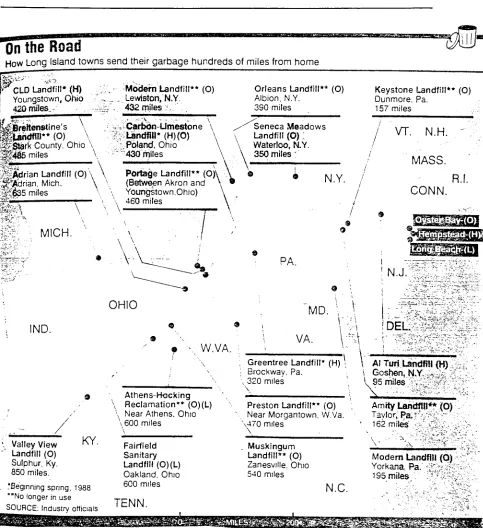
Logistics also play a big role in a country that generates 180
million tons of trash per year. Forced to close their own
dumps, East Coast cities and towns are sending their garbage
west at tremendous cost to local taxpayers and at the risk of
spreading pollution. See Table 2.2. In some cases, the garbage
is being hauled in refrigerated trucks or other trailers that
are then being used to ship food products back to New York,
Long Island, and the rest of the Northeast
-a practice health
officials say could be dangerous. By 1989, three towns with
roughly half of Long Island's population
-Hempstead, Oyster
Bay, and Huntington
-are expected to be trucking all their
garbage away. This trash odyssey of more than 1.3 million tons
a year will amount to roughly 220 truckloads a day. That
means, on average, one tractor-trailer loaded with 40,000
pounds of garbage would enter the Long Island Expressway every
six and a half minutes. (Bunch, 1989)
Do you remember the good barge Mobro 4000? In 1987 it
became a symbol of the nation's garbage problem. Originally
envisioned as the beginning of a $200,000 profit per day
enterprise, it spent instead, two months and 6,000 miles at
sea only to return home with its cargo (Perlman, 1989) .
Justices recently have rejected states efforts to bar waste
TABLE 2.2: Trash Over the Long Haul
On the Road
HowLongIslandtownssendtheirgarbage hundredsofmilesfrom home r CLDLandfill*
(H) Youngstown, Ohio 420miles
<&-.-. ;
r*
j^BreJtenstmes \
landfill**
(O) \
If/StarkCounty, Ohio x-|f$485miles
H/Wrian Landfill (0)\ pfgdrian,Mich.
S?^35miles
ModernLandfill**
(O) Lewisfon,N.Y.
432miles :,:':,
-'V -, \ Carbon-Limestone \ Landfill* (H)(0) .Poland,Ohio 430miles Sfev.t OrleansLandfill** (O) Albion, N.Y. 390miles Seneca Meadows Landfill(O) ; Waterloo,N.Y. 350miles:
KeystoneLandfill**
(O)
Dunmore, Pa. 157miles
/ VT. N.H. "i
\ PortageLandfill**
(0)V V \ (Between Akron and V
\ Youngstown,Ohio) \
v 460miles \
\ \ r- \
MASS. N.Y. R.I MICH. 9 CONN. 0s*ei|Bayi(0) DA. OHIO IND. 9 \ \ W.VA. I MD. VA. N.J. iDELi \ \ Athens-Hocking \ Reclamation** (0)(L)
\ NearAthens. Ohio
',,600 miles ValleyView Landfill (O) Sulphur, Ky. 850 miles. KY.
.'Beginningspring, 1988 "No longerinuse SOURCE:Industryofficials
Fairfield Sanitary Landfill (0)(L) Oakland, Ohio 600miles Greentree Landfill* (H)
j Brockway, Pa. \320miles
Preston Landfill**
(O) NearMorgantown,W.Va. \470miles \ . Muskingum Landfill** (O) Zanesville,Ohio 540miles N.C.
\ AlTuriLandfill(H)
\ Goshen,N.Y. V> .
V"
95miles fSfel 1
AmityLandfill** |Oj Taylor, Pa.;>/?
c"-~
''.
162mites r>hx;;-:>.>.:
ModemLandfill(O)
Yorkana,Pa. ?;*/& 195mites
"."''.""-'
--:.
[image:27.547.35.518.123.651.2]transporting garbage from up north to down south may still
come to fruition, especially if the disposal industry can tie
up those loose ends.
How much will the market bear if it knows that waste
haulers are paying from $1 to $7, and charging from $40 to
$131 to dump the trash (Bailey, 1992)? It is a problem that
individually we are faced with daily in our personal habitats,
and communally in our cities and towns. And it is a problem
perplexed by economics.
Bailey recognizes that a "landfill space shortage"
concept was not invented by the trash haulers, but it has
worked to their advantage. In June of 1992, The National Solid
Waste Management Association issued a report that "landfill
capacity in North America continues to decline". In an
accompanying press release, the trade group warned that
"escalating disposal costs will continue"
unless siting new
dumps becomes easier. Hugh Dillingham, a Browning-Ferris vice
president comments, "This perceived capacity crunch
-I don't
know where it is." Browning-Ferris has more than 485 million
tons of capacity at its 100 dumps. Waste Management won't
disclose the capacity of its 130 dumps, but probably has
between 650 million tons and 1 billion tons of space. Other
analyst Douglas R. Augenthaler of Oppenheimer & Co. (Bailey,
1992) .
The researcher has noticed that Genesee Disposal has been
winning the largest share of hauling contracts in the Town of
Batavia by having the most competitive rates. Competition
among the local haulers for contracts is bringing prices down.
Competition is certain to affect those companies that have
been doing business nationally like Browning-Ferris
Industries, Waste Management, Inc., Chambers Development Co.,
Laidlaw Inc., and Western Waste Industries. Yes, there is a
profit motive, it is a $25 billion per year industry (Bailey,
1992) . Local municipalities are paying these companies because
they no longer can dispose of it on their own property, or it
hasn't been cost effective to develop their own dumps.
Delaware used high dump fees to finance its own dumps in
the early 80*s. A municipality has many advantages over a
private company. Municipalities can borrow money at lower
costs, don't pay taxes, and don't look for profits. In
addition they can legislate flow control to steer all the
trash within their borders to their own dump. H. Lanier
Hickman, head of the Solid Waste Association of North
America, a group of mostly municipal waste officials says,
like a monopoly and is certain to be noticed and exercised as
competition against the private sector.
The researcher's accepted concept had been that landfill
space is declining and that the cost of trash removal is
escalating. The review of literature indicates the trend in
reality, right now, is the opposite. Everyone accepted the
status quo until they noticed that costs for such services
were getting out of hand. Necessity is the mother of
invention, ways to cut trash costs were needed.
Research has shown four accepted ways to extend the life
of the landfill and to drive disposal costs down further.
Incineration, recycling, composting, and point source
reduction can all help in this quest for living in comfortable
harmony. Municipalities have invested heavily in trash
incineration which burned about 16% of the nation's volume
last year, and that volume could grow to 25% by the year 2000
(Bailey, 1992) . There are many problems with the technology at
this point; it is expensive, it does not employ many workers,
they do not meet air pollution standards, ash residue is
sometimes toxic, and burning is rough on the plant (in Rome,
NY they had to replace the grates and stack linings after only
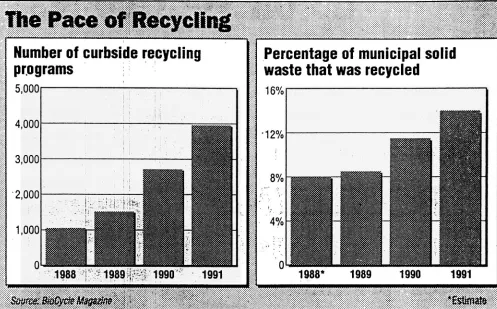
The recycling movement is underway (about 14% of
municipal waste) See Table 2.3 (Biocycle,1991) , but it does
not have the impetus that was evident in World War II. When
the war effort was on, it was everyone's Patriotic Duty to
recycle (Naar, 1990) . Today it is not important to recycle
unless there is a market for it. Jerry Taylor, director of
natural resources studies at the Cato Institute in Washington,
says, "The best way to tell if something should be recycled,
is whether it's already being recycled because of market
forces. If you need government intervention to achieve
recycling, then it probably will distort the markets"
(Allen,
1992) However, the National Solid Wastes Management
Association estimates the number of curbside collection
programs has grown to 3,500 from 600 three years ago, 40% are
mandatory (Allen, 1992). See also Table 2.3. Florida's Gov.
Lawton Chiles is urging companies to set up joint ventures to
purchase throwaways from state agencies. "It's a no-brainer
for [the] companies,"
claims Gov. Chiles. "Not too many
businesses have got a captive customer. We think we'll create
much more demand for products, and that's what's been
missing."
This idea is called a model for for jump-starting
stalled recycling efforts across the nation. (Grossman, 1992)
Another way to reduce the waste stream is the age-old
TABLE 2.3: The Pace of Recycling
i
--0f
Recycling
*id1 1 1 1 i*ii i n i^j^i i.n.m
Number of curbside recycling
programs
5,000r
1988 ^1989W, 1990 1991 mmmmmmm
KwKSSKw''"'
mimmmim
Percentage of municipal solid
waste that was recycled
16%
12%
1988*
1989 1990 1991
[image:32.548.29.526.144.453.2]waste and the other 7% is food waste (Naar, 1990). Table 2.4
illustrates the composition of municipal solid waste (Naar,
1990) . Table 2.5 also illustrates the composition of municipal
waste and makes projections for the future (Virag, 1989) . The
researcher feels that a great and easily accessible source of
energy is lost if organic materials are buried in the
landfill. If it is separated out, neatly piled, air and water
added, and allowed to decay, humus
-a most necessary
ingredient in soil is the finished product. The process of
doing all of these things is called composting, and the
product compost. Compost can be used as a fertilizer or soil
conditioner. Not only will it enhance soil, but separating the
organics reduces the waste stream (Virag, 1989) .
Stipp (1991) describes the composting accomplishments of
a blossoming waste entrepreneur. William Britton of Woods End
Research Laboratory (his own nine-man firm) is providing an
important service by specialty composting. He is called in to
employ his custom recipes to turn a big stink into a savory
plant food. His expertise allows him to handle tons of fish
scraps, a thousand tons of asphixiated chickens, 16,000 tons
of infected potatos, dead animals, and paper plant sludge.
Some of his goals for the future includes a farming revolution
in which compost is used instead of water-polluting chemical
TABLE 2.4: What's in Our Garbage
my&H
|Thenation's11 984;mun1ciparwastestriearn
^Millionspfjton's'^^^s^s pra'^Pi^i:^and.papertiMrd'
'Jl
2^Glass:^!i^->ffS:^"
if^jPJaitrcs^^^^^-S i^^RuBb^aVia.'leatfig^^'
*'2.8'-iTexliles'^Sfe-SSS
;-10.'8^ooa_waste^i^^j
:<-M2.i5^'Mis^'.*/otheri3ssirasss*'
SsssH! ... ,
productsdiscardedihii984BeloreiecycTIng
il^MIHIohsoftons?i^iS%pg5^^^^
~=712.r3Newspapers..>,g^; ??f4.6
^Books'
andtnaga2inessss&ffiEmagazine
5^^;9%Offic"pal&rssss^
'
^6.5sCommercialprinters'? ii^^^jSSUeJpVMUTO^r^^r^TT ":'^S'^:0^npn^^^S^^^SuB6
^;i^~7.^Cjprr^gOTSd)^ojr^^n^ra-[^g9:S^^^er.pape^p^^^hg
Winnersarid losers?e^Vi
'.-^^^
:.;i^fplastic^discards^ejexpectoito
^jncrease '
SS^S^!
///while"
the
-.
percent5;--vT?
offoodand> *
yardwastesdecline
[image:34.547.52.497.94.674.2]TABLE 2.5: Sales At Fast-Food Restaurants
SalesatFast-FoodRestaurants
Year Sales($million) %Change 7oofTotal
1970 6,190 17.8
1971 7,011 13.3 18.6
1972 8,037 14.6 19.6
1973 9,684 20.5 20.8
1974 11,365 17.4 21.9
1975 13,597 19.6 23.3
1976 16,346 20.2 24.9
1977 19,358 18.4 26.5
1978 22,285 15.1 27.0
1979 25,902 16.2 27.8
1980 28,699 10.8 28.3
1981 32,202 12.2 28.7
1982 35,357 9.8 29.5
1983 39,494 11.7 30.1
1984 43,719 10.7 30.5
1985 47,191 7.9 30.9
1986 52,509 11.3 31.6
1987 57,234 9.0 31.9
1988 60,425 5.6 31.9
Compound Annual Growth Rate(%)
1970-88 13.5
1970-80 16.6
1980-88 9.8
1983-88 8.9
[image:35.547.122.394.162.529.2]recalcitrant and toxic waste. His firm recently concocted a
way to compost toxic sludge contaminated with TNT (Stipp,
1991) General Electric and Celgene recently demonstrated that
a naturally occurring microbe can break down toxic methylene
chloride waste, generated by GE's engineered plastics
operations, into water, carbon dioxide, and salt (Naj , 1991).
According to John Crawford, Social Studies Teacher and
participant in a National Fuel Gas Summer Institute,
composting looks to be a viable method to turn waste into
resource. In a recent field trip the group saw what a giant
chipper/ shredder can do to construction and demolition
debris. They saw old lathe, plaster, and 2 x 4's ground to
tiny chips and shreds. Nails were removed by huge magnets and
the slurry was mixed with yard wastes and deposited in neat
windrows under a roofed polebarn type of warehouse. Albert
Gilewicz is the designer of this facility and claims that the
finished compost is in demand by local greenhouses as a soil
conditioner. He says that it takes about fourteen months from
grinder to greenhouse and that he can't meet the demand. He is
the founder of Parker Bay Consultants and they specialize in
municipal solid waste composting. The whole operation can be
found on Squaw Island outside of Buffalo, N.Y., which in its
previous life was a landfill. The DEC shut down the landfill
The fourth method for reducing the waste stream is called
point source reduction. To plan ahead of time, and decide to
make reusable,
easily recyclable containers for products.
There are many people who believe that many of the
manufacturers in our nation are wasteful and needlessly
overpack. They do not like the idea of single use food
servings and laundry packets, or juice-box containers that
sandwich plastic, aluminum, and paper together. Ellen
Harrison, associate director of Cornell University's Waste
Management Institute says "... there's, significant room for
reduction, and we're seeing some of that in the changes
manufacturers are making."
For example, the music industry
announced that it plans to phase out the compact disc boxes
which are ten times the volume of the discs that they hold
(Lowe, 1992) . Proctor and Gamble has redesigned containers
for Secret and Sure deodorants and antiperspirants so they'll
survive shipping without individual cartons. P&G says the
change will eliminate 80 million cartons and 3.4 million
pounds of waste a year. Warner-Lambert is test marketing a
plastic bottle for its Listerine mouthwash which currently
comes in glass. Besides reducing waste, Warner-Lambert hopes
to cut shipping costs, reduce breakage in the home and "appeal
to a younger market, " says Linda Haner, the company'
s manager
of market design. Haworth of Holland, Michigan aided by the
experimenting with plastic spacer blocks to keep wall panels
from rubbing against each other (Pierson, 1991) .
Just when there appears to be progress by the packaging
industry in the right direction, taking larger strides toward
recyclables, statistics indicate otherwise. Scott Chaplin, a
researcher at the Rocky Mountain Institute, a think tank in
Snow-mass, Colorado says that we shouldn't count on a big
comeback of refillable bottles. It seems to work best for
small, local bottlers with limited distribution areas, but the
bottling industry is dominated by larger regional companies.
In 1990. about 8.7% of U.S. soft drinks came in refillables,
down from 56% in 1975 (Stipp, 1991) . Have you noticed lately
that Very-Fine has been competing in the soft-drink arena with
Coca-Cola and Pepsi? You do not have to pay a deposit on
bottles that contain non-carbonated beverages.
As recently as July 19, 1992 there are groups coming
forward against the 1983 Bottle Bill. This bill was instituted
to rid the highways of litter and to encourage recycling. Now
even proponents of recycling say that the bottle bill is in
direct competition with recycling efforts. There seems to be
duplication of efforts by supermarket collection sites and
state mandated curbside collections. Supermarket officials
want to rid themselves of the cost and hassle of handling the
the coffers of the recycling companies. Aluminum is currently
the material worth the most (Lively, 1992) .
Hunger is another driving force, which makes food a very
powerful economic variable, and the last premise considered
when this problem was formulated: How are the prices of food
affected by trash removal costs? Would the cost of food go
down if recycling, incinerating, composting, and point source
reduction efforts were increased?
The researcher recalled that McDonald's had a tree give
away promotion about three years ago, and had recently
switched from the styrofoam sandwich containers to more
Earth-loving paper wrappers. These campaigns were undertaken to
combat the attacks of environmental activists that claimed;
rainforests are being cleared to provide more grazing land for
beef-cattle, and the hole in the ozone layer is growing
because of the CFC's that escape into the atmosphere when
styrofoam is manufactured (Naar, 1990) . There always seem to
be promotions on television implanting the idea that the
fast-food industry is environmentally concerned. It only took one
minute on the phone, and in within three days the researcher
received a whole packet of teaching propaganda (Petersohn &
Resni, 1989) promoting McDonald's environmental efforts. Could
quality, service, and concern for the public and the
environment is most important.
According to skeptics McDonald's is in muddled waters
because of overextension in the international market, but
shareholder profits are up and a goal to open 100 new
franchises is still in sight. Sharon Vuinovich, McDonald's
vice president of investor relations, says that we shouldn't
jump to conclusions on what the numbers show because
"McDonald's stores are a private market"
(Linden, 1991).
Profits undoubtedly are the number one motive in this
organization but where do growth and image in the environment
fit on their priority list? These variables are all related,
but are they concerned with trash hauling costs?
According to the video, "Should I Feel Guilty?", that was
produced by the Food Packaging Institute Inc., the total
amount of trash generated by all of the fast-food outlets
amounts to less than 2% of all of the country's trash (Steele,
1991) . Two percent doesn't sound like very much, but when the
total is 180 million tons, that means that 3.6 million tons of
garbage is generated by the fast-food outlets. That figure is
not insignificant.
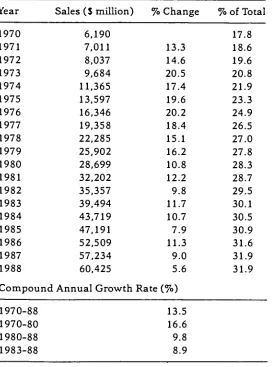
According to Emerson (1990) , fast-food sales are still in
restaurants made gains of more than 10% every year since 1970
except 1987 and 1988, see Table 2.6. Consider that in 1982
there were 381,700 eating and drinking places in the U.S. Also
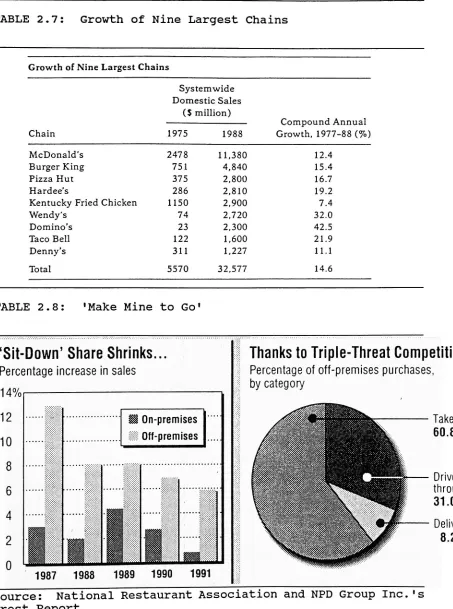
consider that the nine largest chains are 32,577 strong, with
McDonald's signs on 11,380, see Table 2.7.
The researcher made the following inquiry about trash
generated at the fast-food outlet; Is the trash-hauling cost
incurred by the fast-food eateries? The impression at first is
of course! All fast-food restaurants have conveniently located
trash disposal bins inside the establishment, and outside near
the drive-thru window is a huge dumpster. Those services are
not free. But, Helliker (1992) points out, that more and more
people are not eating on site, see Table 2.8. This means that
the cost of trash removal shrinks at the eatery. For five or
more years, dollars spent on off-premises dining (takeout,
drive-through, and home delivery) have been rising at a much
greater rate than on-premises sales; in 1991, while
on-premises sales were flat, off-premise dining rose by 5.9%.
Off-premises business accounted for 35% of the restaurant
industry's $130 billion in sales last year, according to the
NDP Group Inc.'s Crest Report, a survey of restaurant
TABLE 2.6: Total Number of Restaurants in the U.S.
Total Number of Restaurants in the United States
Eating
&Eating
Drinking
Drinking
Year Places Places Places
1958 229,815 114,925 344,740
1963 223,876 110,605 334,481
1967 '236,563 111,327 347,890
1972 253,136 106,388 359,524
1977 275,200 93,729 368,929
1982 301,700 80,000 381,700
Compound Annual Growth Rate
(%)
1977-82 1.9 -3.1 0.7
1958-82 1.1 -1.5 0.4
1958-67 0.3 -0.4 0.1
1967-77 1.5 -1.7 0.6
Source: U.S. Bureau of the
Census,
1982 Census of [image:42.547.72.477.198.592.2]TABLE 2.7: Growth of Nine Largest Chains
GrowthofNineLargestChains
Systemwide
Domestic Sales
($million)
Chain 1975 1988 Growth, 1977-88 (%)
McDonald's 2478 11,380 12.4
BurgerKing 751 4,840 15.4
PizzaHut 375 2,800 16.7
Hardee's 286 2,810 19.2
KentuckyFried Chicken 1150 2,900 7.4
Wendy's 74 2,720 32.0
Domino's 23 2,300 42.5
Taco Bell 122 1,600 21.9
Denny's 311 1,227 11.1
Total 5570 32,577 14.6
TABLE 2.8: 'Make Mine to Go'
'Sit-Down'
Share Shrinks.
Percentage increase in sales
14%r
12
10
8
6
4
2
0
On-premises
Off-premises
1987 1988 1989 1990
HKiM
1991
Thanks to Triple-Threat Competition
Percentage ofoff-premises purchases,
bycategory
Takeout
60.8%
Drive-through
31.0%
[image:43.548.44.497.85.694.2]The researcher made the following observations and
queries. Restaurants could not stay in business if it cost too
much, and developing new landfill facilities could be quite
expensive, and if prices in both areas continue to rise, will
there be any relief? Can time and technology rescue the
ecosystem from what appears to be a very foreboding
possibility.
Technology for incineration is rapidly improving
but people are afraid that even with all the benefits, damage
to the atmosphere is still at risk. Technology for composting
seems to be the rage with advances such as microbes that
digest plastic, but the answers are not all in yet. Technology
for recycling continues to improve but no markets exist for
the recyclables after separation. Technology in packaging
science is constantly improving the action of point source
reduction, but their improvements happen too slowly for some.
Notice that the answers to the solid waste problem are
expected from the private sector. Of course there are
government grants and subsidies to develop these technologies
but the point is that a governmental regulating agency is at
the bottom of the solid waste problem. Who else would be
concerned for the protection of the environment by the simple
benefit of ecology. The EPA has made recommendations as to
where and what we can dump and specifically to this study,
recommendations for constructing, monitoring and managing
number of regulations and compliances to protect our
air,
water, soil, and general health. But the quest for profit and
lifestyle is considered before leachate, fly ash, acid rain,
and ecological harmony in the private sector. The problem to
be addressed is this: Can the fast-food industry meet the
demands of the EPA by the year 1996? This becomes a small
facet in regard to a much greater problem: Should the solid
waste problem be left in the hands of the public or private
sector?
Who Will Show Us The Way To Recycle?
On September 18, 1991, the following headline appeared in
The Wall Street Journal: Massachusetts Business Groups Back
Broad Recycling and Packaging Law. At first, this seems to be
quite extraordinary. Why would the business people support
something that is bound to cost them more money? But Stipp
(1991) reported that there was pressure from environmental
activists, the Governor (a republican who is considered
green) , and William K. Reilly the head of the EPA. Reilly
suggested that trash is not a national problem and should be
handled at the state or local level. The group of business
associates that formulated the Bill included; the Grocery
Manufacturers of America, the Council for Solid Waste
Solutions, the American Paper Institute, and the Massachusetts
activists. Here is what the bill proposed. Packages in
Massachusetts by 1996 must be; reusable 5 times, contain 25%
recycled materials, be made of materials recycled at a 25%
rate in the state or contain at least 10% less material by
weight than 5 years earlier.
There were many problems suggested with such a Bill. For
instance some said that it would be an onerous and costly
monitoring project and that 80% of the packaging comes from
out of state. However a cost evaluation on an even more
stringent proposal by the Massachusetts Public Interest
Research Group that was performed at MIT was found to be
feasible and cost effective (Stipp, 1991) .
There are many more details suggested in the article, but
most important was that Massachusetts was setting a standard
for other states to follow. This indicated that there is
concern for gaining control of the waste problem in a
proactive fashion. It also sparked a question for the
researcher. Are users of these packages aware of these
proposals, and if so, will it cause some concern?
With this question still smoldering a search for more
information was initiated. A call to the office of New York's
Public Interest Research Group was received with bubbling
environmentally sound packaging. Weeks went by and nothing
appeared in the mail. Ensuing calls to the NYPIRG office were
still received with enthusiasm and more promises were made but
no information ever came.
In the February, 1992 Southwestern New York Environmental
Compliance Network Newsletter was a description of a bill that
concerned packaging. It mentioned that state Public Interest
Research Groups (PIRGs) have actively promoted packaging ban
proposals containing provisions commonly known as "rates and
dates"
or "environmental acceptability"
standards. These
proposals prohibit the use of various packaging materials that
do not meet one of the following three standards:
1. Are reusable (being reused at least five times) ;
2. Are recyclable (meeting statewide recycling rates,
which usually start at 25% and increase
incrementally) ; or
3. Are made of recycled material (containing a
specified amount of recycled material.)
Last year, state PIRGs introduced these bills in twelve
states, including Florida, Hawaii, Illinois, Massachusetts,
Maine New Hampshire, New Mexico, New Jersey, New York, North
Carolina, Oregon, and Vermont. Although most of the proposals
were soundly defeated, "rates and
dates" requirements for
rigid plastic packaging were enacted in Oregon and California,
On March 5, 1992 in the Rochester Times-Union this
article "Bill Would Require Recyclable Packaging" appeared.
The article describes a proposal before the state legislature
that would force manufacturers to make packaging with
recyclable or reusable materials. It appeared to be modeled
very closely to the Massachusetts proposal. Lowe (1992)
reported that this proposal was put together by the
environmentalists represented by NYPIRG. New York's proposed
Environmentally Sound Packaging Act would require one of three
options for packaging within 5 years. Be reusable 5 times. Be
made with at least 50% recycled materials, or Be readily
recyclable (meaning that the package can be recycled in
community programs by 75% percent of the state's population,
or that the package is made of materials already being
recycled at a 50% rate) . An important side note
-supporters
do not know how much the proposal would reduce trash (Lowe,
1992) .
The researcher noted that this article presented the
packaging industries' views in a clearer fashion than the
article about Massachusetts' plan. Lowe (1992) continued in
the report that packaging is a $70 billion a year industry,
that protects products from damage, tampering, theft,
deterioration, and also helps to sell the product. Most of
all, they feel that they are already doing their fair share to
mandated regulatons will force them to abandon effective
packaging for impractical alternatives, and that there are
problems because of limited recycling markets especially with
plastics. The environmentalists cite many examples of wasteful
practices employed by the packagers and point out that
CHAPTER THREE
Methodology and Research Design
The previous chapter provided a description of the
efforts of environmental groups to reduce the waste stream.
Their intent is to legislate guidelines to be followed by
product packaging manufacturers, who stand accused of wasteful
and harmful practices. An environmentally sound packaging act
would help limit those wasteful practices by requiring that
packaging be reusable, be made of recycled materials, or be
easily recyclable. The restaurant business was targeted in
this study to determine their perception and/or awareness of
the activities of the environmentalists. The benefits derived
by these proposals include extending the life of a landfill,
lowering costs for products, and providing a cleaner
environment.
The focus of the study was to determine if a restaurant
owner/manager thought that the government could motivate
manufacturers to do something about point source reduction.
The second point that was addressed is a determination of
their perception of current efforts to recycle. A third point
was the determination of costs. If more costs were incurred to
change packaging practices, who would pay for them. Last and
very important, determination of their understanding of the
A brief seven-item questionnaire (Appendix A) was
developed. It was modeled after a survey instrument (Appendix
B) designed by Harris Rusitsky (1991). There were 5 choices
ranging from strongly agree to strongly disagree with a not
sure in the middle. Next, a survey of the Buffalo, Rochester,
and Batavia phonebooks was conducted to identify the addresses
of all the Arby's, Burger King, McDonald's, Wendy's, and KFC
res