Severity of specific language impairment predicts delayed
development in number skills
Kevin Durkin1
*, Pearl L. H. Mok2
and Gina Conti-Ramsden2
1
School of Psychological Sciences and Health, University of Strathclyde, Glasgow, UK
2School of Psychological Sciences, Communication and Deafness, The University of Manchester, Manchester, UK
Edited by:
Klaus F. Willmes, RWTH Aachen University, Germany
Reviewed by:
Peter J. Anderson, Murdoch Childrens Research Institute, Australia
Catherine M. Sandhofer, University of California, Los Angeles, USA *Correspondence:
Kevin Durkin, School of
Psychological Sciences and Health, University of Strathclyde, 40 George Street, Glasgow G1 1QE, UK e-mail: [email protected]
The extent to which mathematical development is dependent upon language is controversial. This longitudinal study investigates the role of language ability in children’s development of number skills. Participants were 229 children with specific language impairment (SLI) who were assessed initially at age 7 and again 1 year later. All participants completed measures of psycholinguistic development (expressive and receptive), performance IQ, and the Basic Number Skills subtest of the British Ability Scales. Number skills data for this sample were compared with normative population data. Consistent with predictions that language impairment would impact on numerical development, average standard scores were more than 1 SD below the population mean at both ages. Although the children showed improvements in raw scores at the second wave of the study, the discrepancy between their scores and the population data nonetheless increased over time. Regression analyses showed that, after controlling for the effect of PIQ, language skills explained an additional 19 and 17% of the variance in number skills for ages 7 and 8, respectively. Furthermore, logistic regression analyses revealed that less improvement in the child’s language ability over the course of the year was associated with a greater odds of a drop in performance in basic number skills from 7 to 8 years. The results are discussed in relation to the interaction of linguistic and cognitive factors in numerical development and the implications for mathematical education.
Keywords: number skills, number development, specific language impairment (SLI), cognitive factors, linguistic abilities
INTRODUCTION
Developing competence with number is fundamental to everyday life and to education. One of the best predictors of subsequent academic attainment is children’s level of rudimentary number skills at school entry (Duncan et al., 2007). Understanding how children deal with this domain and what factors are associated with their learning are topics of theoretical and practical signifi-cance. Although most scientists in this area agree that developing number skills depends on complex neural, cognitive, linguistic and interpersonal abilities, the relative contributions of differ-ent capacities, and their interrelationships, are controversial and difficult to disentangle. Many researchers have argued that lin-guistic or linlin-guistically-supported processes, such as labeling, articulating and scaffolding, are critical to mastering basic num-ber, and that conceptual knowledge of the domain is organized, memorized, shared and built upon via language (Durkin, 1993; Wiese, 2003; Carey, 2004; Musolino, 2004; Ginsburg, 2009; Mix, 2009; Negen and Sarnecka, 2012). In contrast, others argue that numerical cognition has phylogenetic and ontogenetic origins independent of the language capacity (Gelman and Butterworth, 2005; Nieder and Dehaene, 2009).
Children with specific language impairment (SLI) are of par-ticular interest in this context (Fazio, 1996, 1999; Arvedson, 2002; Cowan et al., 2005; Donlan et al., 2007; Kleemans et al., 2011, 2012; Nys et al., 2013). Individuals with SLI fall within the
normal range of cognitive abilities, show no evidence of neuro-logical damage or hearing impairment yet, relative to peer norms, have deficits in either or both of expression and comprehension of language (Bishop, 1997; Conti-Ramsden and Durkin, 2011). SLI is a common condition affecting some 7% of 5-year-old children (Tomblin et al., 1997). Children with this condition pro-vide a naturally-occurring test of to what extent number skills development is possible when language abilities are compro-mised but cognitive abilities are within the typical range. In this report, we examine the longitudinal relationship between lan-guage ability and number skills development in children with SLI. To explain the background to the study, first we summa-rize evidence on the relationship between language and number development in the preschool and early school years, and then we describe previous research on number development in children with SLI.
development (Spelke and Tsivkin, 2001). Number words are com-mon in everyday parental input to infants and toddlers (Durkin et al., 1986; Fuson, 1988; Bloom and Wynn, 1997; Tare et al., 2008). Furthermore, variation in the extent and quality of number talk in parental speech has been found to predict developments among pre-schoolers in conceptual number knowledge, such as cardinal meanings (Linnell and Fluck, 2001; Levine et al., 2010; Mix et al., 2012).
Developments in language skills are clearly associated with developments in numerical and mathematical abilities. Negen and Sarnecka (2012)showed that the size of a child’s general nom-inal vocabulary (both expressive and receptive) is positively asso-ciated with number-concept acquisition, suggesting that noun learning could assist children in discovering the meanings of number words. For example, to understand the number word in a caregiver’s utterance such as “Look! There’s a mommy duck with three baby ducks!” (Negen and Sarnecka, 2012, p. 2020), it helps if the child already knows what the nounduckmeans and how one creates plural forms.O’Neill et al. (2004)found that mea-sures of narrative competence at 3- to 4- years were predictive of mathematics ability assessed 2 years later.
As children begin to use number words with increasing accu-racy in everyday settings, advances follow in their abilities to apply number concepts in contexts where they are trained or tested on number understanding (Mix et al., 2005; Palmer and Baroody, 2011; Reikerås et al., 2012). When children participate in educational contexts, number and early mathematical concepts receive more, and increasingly deliberate, attention (Ginsburg, 2009). Much of this is mediated through language: the ver-bal instructions of the teacher, the vocabulary and syntax of texts and other school materials (Durkin and Shire, 1987, 1991; Ellerton and Clarkson, 1996; Ginsburg, 2009). Cross-linguistic investigations of number skills development show that children’s performances can be helped or hindered by particular features of the way a given language encodes number (Seron and Fayol, 1994; Roberts and Gathercole, 2006; Salehuddin and Winskel, 2009; Zuber et al., 2009; Helmreich et al., 2011; Pixner et al., 2011).
With development, it is increasingly difficult to determine which variables affect progress in number and mathematical abil-ities, and in practice most children using their number skills will require both computational and linguistic application. How, then, do children whose linguistic abilities are impaired handle this domain?
Children who have difficulties in using language may face particular challenges in advancing their numerical understand-ing. Indeed, children with SLI face challenges in many areas of development and education (Bishop and Adams, 1990; Conti-Ramsden et al., 2009; Durkin et al., 2009; St. Clair et al., 2010). Difficulties in decoding others’ language, in formulating and producing utterances, and in processing textual materials pose considerable burdens when dealing with novel concepts and problem-solving procedures. AsGelman and Butterworth (2005)
comment, it would be surprising if there were no effects of language on numerical cognition, and even proponents of inde-pendent origins of numerical ability acknowledge that language facilitates the use of numerical concepts.
Previous research with children with SLI confirms that they do lag behind typical peers in progress in number and mathematical abilities, though this depends to some extent on which abilities are tested.Fazio (1994, 1996, 1999)followed a small group of children with SLI from preschool to age 9 years. She found that the chil-dren were late in acquiring counting skills and, although they did gradually develop these, they continued to experience difficulties with related rote memory tasks (such as multiplication tables), which she interpreted as indicating that storage or retrieval prob-lems underlie the children’s difficulties in this domain.Nelson et al. (2011)found that 4-year-olds with severe language delay scored 1SD below norms on a maths test measuring counting skills and simple addition and subtraction.Kleemans et al. (2011, 2012)showed that naming speed (the ability to retrieve linguis-tic information from long-term memory) was associated with early verbal numeracy skills in children with SLI (but not in TD children). On the other hand, naming speed did not predict per-formance on numerical estimation tasks (identifying the location of a number on a number line), which are less verbal.Arvedson (2002)found that on some number tasks designed to minimize verbal processing, 3- to 5-year-old children with SLI performed as well as age matched TD peers, and better than language-matched younger children. However, on tasks that required more verbal processing, and particularly when children were encouraged to count, the participants with SLI performed less well than their TD peers.Donlan et al. (2007), working with 8-year-olds with SLI, reported further evidence of severe deficits in both counting tasks and calculation tasks, compared to TD children. Participants with SLI did not differ from age-matched TD children, though, on a task of arithmetical principles in which judgments were required of the correctness or otherwise of abstract symbolic expressions, the most complex but arguably least linguistic of the tasks that they administered.
In one of the largest studies of number skills in primary school aged children with SLI (aged 8 years),Cowan et al. (2005)
found that these participants performed worse than age-matched TD comparison children on a range of tasks, including count-ing, knowledge of addition combinations, basic calculation, story problems, transcoding (reading and writing multi-digit num-bers), and relative magnitude judgments. That is, the disadvan-tage appeared to be pervasive across number tasks. Zero order correlations revealed consistently stronger associations between number task performances and language comprehension than those found for number task performance and either of working memory and non-verbal reasoning. In standard multiple regres-sions, language comprehension was the best predictor of variation on most of the number tasks. However, Cowan et al. included all participants, including those with typical development, in their regression analyses. While this provides a good test of the impor-tance of language ability across a range of children, it does not examine directly the impact of severity of impairment among those diagnosed as having SLI.
language ability bears in some way on number development in the preschool to early school years. However, most of the avail-able evidence is based on comparisons between children with SLI and TD peers at a particular age point. We lack information on the extent to which language impairment predicts progress in number tasks over time.Kleemans et al. (2012)provide valuable longitudinal data to show that grammatical ability at age 6 does contribute toward the prediction of number skills at age 7, but their study did not measure number skills at both age points, leav-ing the question of what underpins progress in need of further attention.
In this study, we examined a large sample of children with SLI, collecting their raw and standard scores on a standardized num-ber skills test at two age points (7 and 8 years). We measured their psycholinguistic profiles and non-verbal performance IQ (PIQ) at the outset. We investigated changes in number skills over the period tested. Children receive instruction in number at school, and various outcomes are possible. One, which we will describe as the “separate origins” hypothesis, is that, as operating on numbers involves cognitive processes that are independent of language, continuing progress in number performance should be indepen-dent of the severity of impairment; this is not to say that children with language impairments will necessarily display exceptionally strong number skills if they have not done so before, but some improvements in raw scores, and some variations in standard scores, should follow from maturational and educational effects and these should not be predictable on the basis of language abil-ities. An alternative possibility, which we will call the “language contingent” hypothesis, is that the development of number skills in childhood is influenced by the child’s linguistic abilities. Thus, on this account, children with SLI should remain at a disadvan-tage, reflecting a general lagging behind associated with language delay (cf.Conti-Ramsden et al., 2012). Modest improvements in raw scores could be expected, as the children do improve their language skills albeit at a slow pace, and they are exposed to num-ber education; but, as they find it increasingly difficult to keep up with the language demands associated with number work, stan-dard scores should fall relative to peer norms. The present study was designed to test these competing predictions.
MATERIALS AND METHODS
PARTICIPANTS
The participants in this study were originally part of a wider study: the Manchester Language Study (Conti-Ramsden et al., 1997; Conti-Ramsden and Botting, 1999). The original cohort of 242 children, which consisted of 186 boys (76.9%) and 56 girls (23.1%), was recruited from 118 language units in England in 1995, and represented a random sample of 50% of all Year 2 chil-dren (approximately 7 years of age) attending language units for at least half of the school week. Language units are specialized classes for children who have been identified with primary speech and language difficulties; the units are usually attached to main-stream schools. Children were excluded from the study if they were reported by their teachers as having frank neurological dif-ficulties, a diagnosis of autism, hearing impairment or a general learning disability. No additional criteria of SLI were used in the selection. Assessment of the children at age 7 after recruitment
into the study indicated that the majority met the traditional cri-teria of SLI, i.e., the standard scores for at least one test of language was less than 1SDbelow the mean whilst PIQ was within 1SDof the mean, or there was a discrepancy of 40 percentiles or more between the language test scores and PIQ (Conti-Ramsden and Botting, 1999).
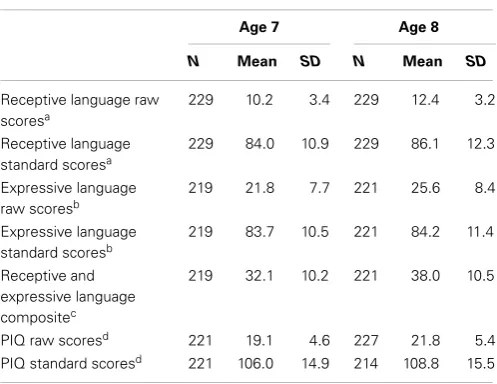
A total of 232 of these children were followed up a year later at age 8. For the purpose of this study, only those for whom there were data on their basic number skills measured at both ages have been included in the analyses. This resulted in a total of 229 children, 176 (76.9%) of whom were boys. The mean age of the participants was 7:1 years (6:6–7:9) at wave 1 and 8:1 years (7:5–8:9) at wave 2. The psycholinguistic profiles of the partici-pants at ages 7 and 8 are shown inTable 1. The average standard scores for receptive and expressive languages at both ages were all around 1SDbelow the population mean, whilst average PIQ was above the population mean at both ages. All children had English as a first language. A small number of children, 27 (11.8%), had exposure to languages other than English at home. Household income data were available for 144 of the participants, with 9.7% coming from households with an annual income of less than £5500 (low income), 24.3% from households earning between £5600 and £10,500 (low-medium income), 19.4% from house-holds earning between £10,600 and £15,500 (medium income), 22.9% from households with an annual income of between £15,600 and £21,000 (medium–high income), and 23.6% from families with an income of over £21,000 (high income).
MEASURES
Basic number skills
[image:3.595.303.552.478.670.2]Number abilities were assessed by Test B of the Basic Number Skills subtest of the British Ability Scales (BAS) (Elliot, 1983). The test covers both pre-numerical (matching, classifying) and
Table 1 | Psycholinguistics profiles at ages 7 and 8.
Age 7 Age 8
N Mean SD N Mean SD
Receptive language raw scoresa
229 10.2 3.4 229 12.4 3.2
Receptive language standard scoresa
229 84.0 10.9 229 86.1 12.3
Expressive language raw scoresb
219 21.8 7.7 221 25.6 8.4
Expressive language standard scoresb
219 83.7 10.5 221 84.2 11.4
Receptive and expressive language compositec
219 32.1 10.2 221 38.0 10.5
PIQ raw scoresd 221 19.1 4.6 227 21.8 5.4
PIQ standard scoresd 221 106.0 14.9 214 108.8 15.5
aTROG. bBus Story Test.
numerical aspects of number skills. Questions are asked covering the following areas: (1) matching and classifying, using qualita-tive attributes (e.g., matching spades to buckets based on their sizes); (2) matching and classifying by number (e.g., matching 2 ladybirds which have the same number of spots); (3) one to one correspondence (e.g., matching number of boxes in the pic-ture to numerals); (4) comparison of sets (e.g., comparing picpic-ture of carts with more, less and same number of boxes); (5) ordi-nal aspects of number; (6) knowledge of number names and numerals; (7) counting a set of objects; (8) awareness of num-ber patterns; (9) place value, including the ability to count in tens and knowledge of place value notation; (10) basic understanding of the four arithmetical operations.
For all tasks, children are presented with color picture cues and the instructions of the test are given verbally by the assessor, fol-lowing the wordings given in the manual. Gestures are also used, e.g., by pointing and circling objects in the booklet. For exam-ple, for the question on matching and classifying using qualitative attributes, two pictures cues are used, one with two spades (one big and one small) and one with eight buckets (four big and four small). The child is asked to match spades to buckets based on their sizes. Indicating appropriately, the tester says “Here is a big spade and here is a little spade.” Indicating with a circular motion, s/he then says “Here are the buckets that go with them. Can you show me all the buckets that go with the big spade?” For match-ing and classifymatch-ing by number, again usmatch-ing two pictures as cues, one with four yellow ladybirds and one with 12 red ladybirds, the child is asked to match a red and a yellow ladybird which have the same number of spots. The instructions of the test include, “Here are 4 yellow ladybirds,” then indicating to the appropriate ladybirds, the tester says “They may have a lot of spots or (indi-cating appropriately) very few spots or something in between.” Pointing to the yellow ladybird with nine spots, the tester then asks the child to “Find me the red ladybirds that go with this one.” Similarly, to assess basic understanding of the four arithmetical operations, one of the questions involved showing the child a pic-ture of a box with seven buttons. The tester then says to the child “There used to be 12 buttons in this box. How many have been taken out?”
Testing discontinued after six successive items have been failed. The number of correct answers is summed to give a basic number skills raw score, which can then be converted into a standard score and be assigned an age-relevant percentile.
Receptive and expressive language
Receptive language at ages 7 and 8 was assessed using the Test for Reception of Grammar (TROG;Bishop, 1982). This is a test of oral comprehension of syntax in which children are shown four pictures while the examiner reads a sentence. The child is asked to pick the picture that illustrates the sentence. These items begin very simply and progress to more complex grammatical sentences (e.g., “the cat the cow chases is black”). Items are organized into blocks of four grammatically related sentences. The number of blocks passed is noted to give the TROG raw score, which can then be transformed into a standard score. Expressive language at both ages was assessed using the Bus Story Test (Renfrew, 1991), which is part of the Renfrew Language Scales. In this
assessment, the examiner tells the child a short story about a bus while the child looks through a book of pictures illustrat-ing the story. The child must then retell the story as accurately as possible using the pictures as cues. Stories are audiotaped, tran-scribed and scored for the amount of correct information given. Two points are given for information central to the story, and one point for peripheral details, and these are summed to give the “total information score,” which can subsequently be converted into a standard score. The receptive and expressive language raw scores were found to be highly correlated, r=0.62,p<0.001
at age 7, andr=0.61, p<0.001 at age 8. For the purpose of
this study, therefore, a composite score representing both recep-tive and expressive language ability was derived by summing the TROG raw score and the Bus Story “total information score” measured at the corresponding age.
Performance IQ
Raven’s Coloured Progressive Matrices (Raven, 1986) was used to assess participants’ PIQ at both ages. The test is designed for edu-cational and clinical assessment. It can be used satisfactorily with children who have language impairment and is commonly used to assess the PIQ of children with SLI. This test presents the child with a series of patterns from which a “piece” is missing, and the child is asked to choose from six alternative pieces the one which completes the pattern. The test is split into three sets of 12 pat-terns each and the number of correct answers is summed. This total score is then compared with age-relevant population norms.
PROCEDURE
Following informed written consent from families, children were visited at school and assessed individually in a quiet room or area with only the participant and a trained researcher present. The battery of psychometric tests was completed as part of the wider study which also included assessments for vocabulary, reading, articulation, and grammatical knowledge. The assessments were conducted in the same order for every child: (1) TROG, (2) BAS Number Skills, (3) BAS Naming Vocabulary (Elliot, 1983), (4) BAS Word Reading (Elliot, 1983), (5) Goldman-Fristoe Test of Articulation (Goldman and Fristoe, 1986), (6) Raven’s Coloured Progressive Matrices, (7) Illinois Test of Psycholinguistic Ability: grammatic closure (Kirk et al., 1968), and (8) Renfrew Bus Story Test. In nearly all cases, testing was completed in 1 day at the child’s pace and with normal school breaks. Because of the large number of measures used, the numbers of data points available may vary from measure to measure. Both raw scores and stan-dard scores were examined in relation to children’s basic number skills. All subsequent analyses used raw scores. All statistical anal-yses were conducted using Stata/SE 12.0 (StataCorp, 2011). All figures were also plotted using Stata.
RESULTS
BASIC NUMBER SKILLS
Table 2 | Basic number skills at ages 7 and 8.
Age 7 Age 8
Mean SD Min Max Mean SD Min Max
BAS number skills raw scores 21.0 6.3 2 34 25.8 6.2 0 34
BAS number skills standard scores 82.3 13.0 64 121 80.1 13.4 64 112
BAS number skills percentilea 18.6 21.4 <1 92 16.7 19.4 <1 78
N=229.
[image:5.595.301.551.237.512.2]a25 (10.9%) and 48 (21.0%) of the 229 children at ages 7 and 8, respectively scored less than 1 percentile. These cases were coded as having a percentile of 0.5 when the mean percentiles were calculated.
Table 3 | Distribution of basic number skills standard scores at ages 7 and 8.
Range of standard scores Age 7 (%) Age 8 (%)
≤70 (2SDbelow mean) 16.6 30.1
>70 and≤77.5 (1.5–2SDbelow mean) 27.5 18.8 >77.5 and≤85 (1–1.5SDbelow mean) 23.1 17.5 >85 and≤100 (Between 1SDbelow mean
and mean)
23.1 25.3
>100 and<115 (Above mean but below 1SD above mean)
8.3 8.3
≥115 (1SDabove mean) 1.3 0
Total 100 100
The raw scores rose by an average of 4.8 points between ages 7 and 8,t(228)=14.9, p<0.001, Cohen’sd=0.99. The mean
standard scores were more than 1SDbelow the population mean at both ages. The standard scores declined on average 2.2 points, a significant drop,t(228)= −3.2,p=0.001, Cohen’sd=0.2. Thus,
although there had been an improvement in the participants’ basic number skills during the year, compared to normative data for TD peers they were on average performing more poorly at age 8 than at age 7. This drop in performance relative to the general population can also be seen inTable 3, which shows the distribu-tion of the standard scores for the two ages. For example, while 16.6% of the children scored 2SDbelow the population mean at age 7, this rose to 30.1% by age 8.
CONCURRENT PREDICTORS OF BASIC NUMBER SKILLS
Concurrent predictors of performance (using raw scores) at each age were examined first. Using linear regression analysis, covari-ates were added into the models in two steps: PIQ in the first step, followed by language skills. Given that the distribution of the basic number skills raw scores at age 8 was negatively skewed (skewness= −0.70, kurtosis=3.31), reflect square root transfor-mations were carried out and the transformed variables were used as the outcome in the linear regression at age 8.
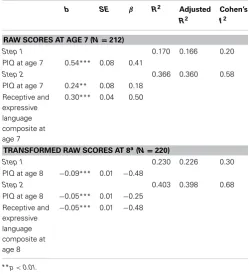
The regression results, shown inTable 4, indicated that PIQ and language scores were significant predictors of concurrent basic number skills at both ages, with better abilities in these areas being associated with better basic number skills. The adjustedR2
values showed that together they accounted for 36 and 40% of the variance in basic number skills performance at ages 7 and 8,
Table 4 | Linear regression analysis predicting basic number skills performance using concurrent variables at ages 7 and 8.
b SE β R2 Adjusted Cohen’s
R2 f2
RAW SCORES AT AGE 7 (N=212)
Step 1 0.170 0.166 0.20
PIQ at age 7 0.54*** 0.08 0.41
Step 2 0.366 0.360 0.58
PIQ at age 7 0.24** 0.08 0.18
Receptive and expressive language composite at age 7
0.30*** 0.04 0.50
TRANSFORMED RAW SCORES AT 8a(N=220)
Step 1 0.230 0.226 0.30
PIQ at age 8 −0.09*** 0.01 −0.48
Step 2 0.403 0.398 0.68
PIQ at age 8 −0.05*** 0.01 −0.25
Receptive and expressive language composite at age 8
−0.05*** 0.01 −0.48
**p<0.01. ***p<0.001.
aReflect square root transformation of raw scores at age 8.
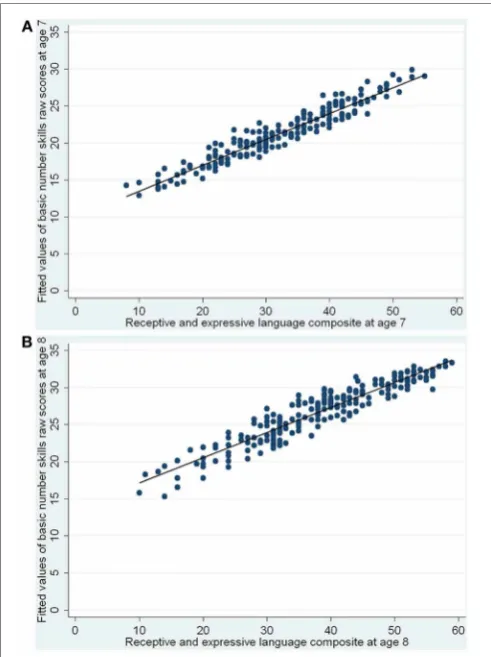
[image:5.595.46.292.237.364.2]FIGURE 1 | (A,B)Fitted values of basic number skills raw scores vs. receptive and expressive language composite—concurrent predictors of basic number skills at ages 7 and 8.
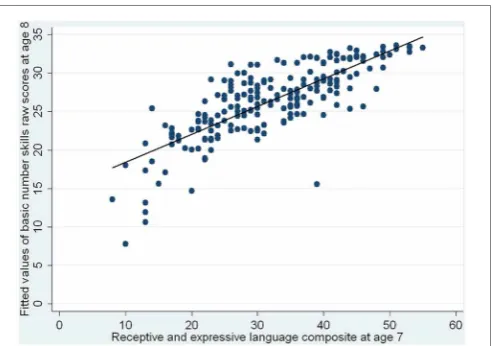
PREDICTING NUMBER SKILLS AT AGE 8 USING VARIABLES AT AGE 7 Using linear regression analyses and the approach of a conditional change model, we next investigated which variables at age 7 could predict basic number skills at 8. With the reflect square root trans-formed numbers skills raw scores at 8 as the outcome variable, PIQ raw scores were entered first, followed by basic number skills raw scores at 7, and lastly, the language composite. The results are shown inTable 5. Basic number skills at 7 and language skills at 7 are both significant predictors of number skills at 8, with better abilities in these areas at 7 associating with better basic number skills at 8. The standardized regression coefficients showed that the effect of earlier number skills was greater than that of earlier language skills. Having controlled for PIQ at 7, number skills at 7 accounted for 36% of the variance in basic number skills per-formance at 8, while language skills explained a further 4.6% of the remaining variance. The results are also illustrated inFigure 2
[image:6.595.45.291.60.389.2]which shows the fitted values of basic number skills raw scores at age 8 vs. basic number skills raw scores at age 7, and inFigure 3, which shows the fitted values of basic number skills raw scores at age 8 vs. language composite at age 7. As withFigure 1B, we have re-transformed the predicted values back to the original scale of the raw scores for easier interpretation. The figures again reveal that the higher the basic number skills raw scores at age 7 and the
Table 5 | Linear regression analysis predicting basic number skills performance at 8 using variables at age 7.
b SE β R2 Adjusted Cohen’s
R2 f2
TRANSFORMED RAW SCORES AT 8a
Step 1 0.161 0.157 0.19
PIQ at 7 −0.09*** 0.01 −0.40
Step 2 0.522 0.517 1.09
PIQ at 7 −0.03* 0.01 −0.13
Basic number skills raw scores at 7
−0.11*** 0.01 −0.66
Step 3 0.570 0.564 1.32
PIQ at 7 −0.01 0.01 −0.06
Basic number skills raw scores at 7
−0.09*** 0.01 −0.53
Receptive and expressive language composite at 7
−0.03*** 0.01 −0.28
N=212.
aReflect square root transformation of raw scores at age 8. *p<0.05.
[image:6.595.301.553.84.314.2]***p<0.001.
FIGURE 2 | Fitted values of basic number skills raw scores at age 8 vs. basic number skills raw scores at age 7.
better the language abilities at age 7, the better the basic number skills at age 8.
PREDICTING THE DROP IN PERFORMANCE IN BASIC NUMBER SKILLS BETWEEN AGES 7 AND 8
[image:6.595.301.551.363.548.2]FIGURE 3 | Fitted values of basic number skills raw scores at age 8 vs. receptive and expressive language composite at age 7.
Table 6 | Participants showing a change or no change in the basic number skills raw and standard scores between ages 7 and 8.
N % Mean change SD
RAW SCORES
No change in raw scores 12 5.2 0 —
Decrease in raw scores at 8 24 10.5 −3.5 2.4
Increase in raw scores at 8 193 84.3 6.1 4.0
All 229 100 4.8 4.9
STANDARD SCORES
No change 31 13.5 0 —
Decrease in standard scores at 8 122 53.3 −9.8 6.5
Increase in standard scores at 8 76 33.2 9.0 6.6
All 229 100 −2.2 10.5
[image:7.595.47.292.314.456.2]in a particular skills area contributes importantly to our under-standing of which factors impede development. Hence, we exam-ined the proportions of children who, from 7 to 8 years, showed no change, or who showed a decrease in scores, or who showed an increase in scores. These proportions were examined with respect to raw scores and standard scores. The results are presented in
Table 6. Although 84% had seen an increase in their raw scores, only a third (33%) had seen a rise in their standard scores. In fact, the standard scores of over half of the children (53%) had fallen between the two ages. This again suggested that although the basic number skills for the vast majority of participants had progressed between ages 7 and 8, the rate of progress, on average, was not as great as that of their population peers.
Binary logistic regression analyses were carried out to examine which variables could predict a drop in the maths scores between ages 7 and 8. We focus on children who remain static or show a decline on the grounds that these are most likely to yield infor-mation on which factors impede development. These are also the children most in need of educational support. The outcome of the regression was coded as “0” (the reference category), repre-senting no change or an increase in raw scores, or “1,” a decrease
Table 7 | Binary logistic regression analysis predicting a drop in performance in basic number skills between ages 7 and 8.
Odds ratio SE 95% CI
STEP 1
Difference in PIQ raw scores 0.88* 0.05 0.78–0.99
STEP 2
Difference in PIQ raw scores 0.90 0.06 0.80–1.02
Difference in language composites 0.90** 0.03 0.84–0.97
N=208; *p<0.05; **p<0.01.
in raw scores. A variable representing the difference in PIQ raw scores between ages 7 and 8 was first entered into the model, fol-lowed by the language composite raw score differences between 7 and 8 years. The results for predicting a drop in performance in basic number abilities are presented inTable 7. The difference in language skills between 7 and 8 years was the only significant predictor in the final model. With an odds ratio of less than 1, results of the final model suggested that the larger the change in language skills between ages 7 and 8, the smaller the odds of a drop in basic number abilities. That is, the greater the improve-ment in language ability, the lesser the likelihood of a drop in performance in basic number skills from 7 to 8 years: less lan-guage improvement, more likelihood of a drop in lanlan-guage skills. With an odds ratio of 0.90, one unit decrease in the difference in language composites was associated with a 11% increase in the odds of having a drop in number skills at age 8. The analo-gous analysis was performed on standard scores and the pattern of results was essentially unchanged.
DISCUSSION
The purpose of this longitudinal study was to examine the extent to which, in a sample of children with SLI, the severity of their condition predicts progress in number skills development dur-ing the early primary school years. Adddur-ing to earlier evidence of a disadvantage to children with SLI in this domain (Fazio, 1999; Arvedson, 2002; Cowan et al., 2005; Donlan et al., 2007; Kleemans et al., 2011, 2012), we obtained clear findings that this large sam-ple obtained mean standard scores more than 1SDbelow the population mean at age 7 and again at age 8. The standard scores of over half of the children (53%) had fallen between the two ages. Overall, then, children with SLI fell well below TD norms at age 7, and the gap worsened by age 8.
The next question of interest was whether language ability at age 7 contributed to the prediction of number scores at age 8. We regressed number scores at age 8 on PIQ at age 7, maths score at age 7, and language ability at age 7. This analysis revealed that, after taking account of the other predictors, i.e., PIQ and maths scores, language abilities explained an additional 4.6% of vari-ance in the later number scores. This indicates that, as well as impacting at age 7, severity of language impairment also influ-ences continuing progress in number skills over the following year.
We examined next whether the likelihood of decline in num-ber scores could be predicted from changes in language ability, controlling for changes in PIQ. The change in language skills between 7 and 8 years emerged as the only significant predictor in this analysis. The results were robust and indicated that less improvement in language ability was associated with a greater odds of a drop in performance in basic number skills from 7 to 8 years.
With respect to the contrasting theoretical positions we out-lined above, the evidence does not support a strong version of the “separate origins” hypothesis, holding that number and lan-guage abilities develop independently. This would predict that progress in number performance should not be affected by the severity of language impairment and the present results support the opposite conclusion. However, the present study, focusing on middle childhood, is moot on the question of early origins and, because all of the number tasks we administered required at least some degree of verbal processing, we do not have data to allow us to compare performance on non-verbal number tasks. Previous research has addressed this issue and found mixed results, with some indicating that children with SLI can per-form at around the level of typical peers on non-verbal number tests (Arvedson, 2002; Donlan et al., 2007; Kleemans et al., 2011, 2012), and others suggesting more pervasive deficits (Cowan et al., 2005).
Our results are more readily compatible with theoretical stances holding that the development of number skills is influ-enced by the child’s linguistic abilities. Consistent with this position, our findings that children with SLI are at a disad-vantage and show an increased gap from peer norms over the course of a year suggest that language is an impediment to their early engagement with number and a continuing liabil-ity as children with SLI face increasingly complex number work in primary education. Further research is clearly warranted to determine if non-verbal number skills progress at a different pace to verbally-mediated number skills in children with SLI, but it is important to bear in mind that, in practice, school work in number and mathematics tends to be immersed in lan-guage, both domain-specific and general (Durkin and Shire, 1991; Ginsburg, 2009).
Evidence from children with SLI provides valuable informa-tion to help our understanding of both atypical and typical development. The present findings confirm that the child’s abil-ity to handle the medium of communication bears on his or her progress in a crucial area of learning, number skills devel-opment. The more severe the language impairment, the more difficult the task of mastering number skills. Conversely, we
can infer that unimpaired language development in the typi-cal child supports number and mathematitypi-cal development. This is less readily apparent in typical development because the lan-guage ability is assumed and transparent, but recall thatCowan et al. (2005)found that language comprehension was the best predictor of variation on number tasks in a combined sample of TD and SLI participants. Of course, many other endoge-nous and environmental factors also bear on the complex pro-cesses of learning about number, but language is a fundamental component.
It should be acknowledged that the origins of language impair-ment itself have not been addressed here. It could be argued that both language and number skills development are depen-dent on similar underlying neural and cognitive processes, such as working memory. This in turn raises questions about the nature of working memory resources (e.g., verbal vs. non-verbal) that might be drawn upon in number tasks (see Nys et al., 2013, for an interesting discussion). While these are broader issues than our present concerns, we reiterate that evidence from chil-dren with SLI, who show language difficulties in the context of cognition within the normal range, makes an important contri-bution to the larger inquiry into the underpinnings of number development.
The present study did not include an age-matched TD sam-ple. Several previous studies have done so and the findings are clear. An advantage of such designs is that the participants are tested contemporaneously, by the same investigators under sim-ilar conditions; a possible disadvantage is that the experimenters are not usually blind to participant diagnostic status, raising the possibility of demand characteristics contributing to results. By using a standardized test of number abilities we were able to draw instead on normative data collected from a large representative sample, independently of the present investigators. The fact that similar results are obtained via each comparison strategy supports confidence in the overall pattern of results.
There are obvious but important practical implications that follow from our findings. We found that not only did chil-dren with SLI tend to underperform in number skills, rel-ative to standard performance, some remained static over a full school year and a substantial proportion declined. There is the risk that the problems children with SLI face in early mathematics education are compounded over time. The tasks themselves become more advanced and, as others have pointed out (Arvedson, 2002; Cowan et al., 2005), children’s difficul-ties with the verbal demands may be less apparent to educators and therapeutic intervention is likely to be concentrated on lin-guistic skills. Future research is needed to investigate whether the worsening gap that we have demonstrated here continues to grow over the remainder of primary schooling and beyond, and to assess the efficacy of interventions designed to meet these children’s language needs in the particular context of mathematics.
but that the gap worsens from age 7 to 8, that language ability contributes substantially to the concurrent prediction of number scores, that language ability at age 7 contributes to the prediction of number scores a year later, and that changes in language abil-ity over the year are associated with whether or not children with SLI manifest a drop in performance in basic number skills at age 8. Language ability underpins progress in number understanding and education.
ACKNOWLEDGMENTS
The authors acknowledge the support of the Economic and Social Research Council (grant RES-062-23-2745). We also acknowledge the support of the Nuffield Foundation for grants AT251[OD], DIR/28, EDU 8366, and EDU 32083 and the Wellcome Trust for grant 060774 which supported the data collection. The authors thank all the families that have participated in the study and the research assistants who helped with data gathering.
REFERENCES
Ansari, D., and Karmiloff-Smith, A. (2002). Atypical trajecto-ries of number development: a neuroconstructivist perspective.
Trends Cogn. Sci.6, 511–516. doi: 10.1016/S1364-6613(02)02040-5 Arvedson, P. J. (2002). Young
chil-dren with specific language impair-ment and their numerical cogni-tion. J. Speech Lang. Hear. Res.
45, 970–982. doi: 10.1044/1092-4388(2002/079)
Bishop, D. V. M. (1982). Test for Reception of Grammar. Manchester: Author.
Bishop, D. V. M. (1997).Uncommon Understanding: Development and Disorders of Language Comprehension in Children. Hove: Psychology Press.
Bishop, D. V. M., and Adams, C. (1990). A prospective study of the relationship between specific language impairment, phonologi-cal disorders and reading retarda-tion. J. Child Psychol. Psychiatry
31, 1027–1050. doi: 10.1111/j.1469-7610.1990.tb00844.x
Bloom, P., and Wynn, K. (1997). Linguistic cues in the acqui-sition of number words.
J. Child Lang. 24, 511–533. doi: 10.1017/S0305000997003188 Carey, S. (2004). Bootstrapping
and the origin of concepts.
Daedalus133, 59–68. doi: 10.1162/ 001152604772746701
Conti-Ramsden, G., and Botting, N. (1999). Characteristics of children attending language units in England: a national study of 7-year-olds. Int. J. Lang. Commun. Disord.34, 359–366. doi: 10.1080/136828299247333 Conti-Ramsden, G., Crutchley, A., and
Botting, N. (1997). The extent to which psychometric tests differenti-ate subgroups of children with spe-cific language impairment.J. Speech Lang. Hear. Res.40, 765–777. Conti-Ramsden, G., and Durkin, K.
(2011). “Specific language impair-ment,” in Child Psychology and Psychiatry: Frameworks for Practice, eds D. Skuse, H. Bruce, L. Dowdney, and D. Mrazek (Chichester: John
Wiley and Sons), 180–186. doi: 10.1002/9781119993971.ch29 Conti-Ramsden, G., Durkin, K.,
Simkin, Z., and Knox, E. (2009). Specific language impairment and school outcomes I: identifying and explaining variability at the end of compulsory education.Int. J. Lang. Commun. Disord. 44, 15–35. doi: 10.1080/13682820801921601 Conti-Ramsden, G., St. Clair, M. C.,
Pickles, A., and Durkin, K. (2012). Developmental trajectories of ver-bal and nonverver-bal skills in indi-viduals with a history of spe-cific language impairment: from childhood to adolescence.J. Speech Lang. Hear. Res.55, 1716–1735. doi: 10.1044/1092-4388(2012/10-0182) Cordes, S., and Brannon, E. M. (2009).
Crossing the divide: infants discrim-inate small from large numerosities.
Dev. Psychol. 45, 1583–1594. doi: 10.1037/a0015666
Cowan, R., Donlan, C., Newton, E. J., and Lloyd, D. (2005). Number skills and knowledge in children with specific language impairment.
J. Educ. Psychol.97, 732–744. doi: 10.1037/0022-0663.97.4.732 Donlan, C., Cowan, R., Newton, E.
J., and Lloyd, D. (2007). The role of language in mathematical devel-opment: evidence from children with specific language impairments.
Cognition103, 23–33. doi: 10.1016/ j.cognition.2006.02.007
Duncan, G. J., Dowsett, C. J., Claessens, A., Magnuson, K., Huston, A. C., Klebanov, P., et al. (2007). School readiness and later achievement.
Dev. Psychol. 43, 1428–1446. doi: 10.1037/0012-1649.43.6.1428 Durkin, K. (1993). “The
represen-tation of number,” in Systems of Representation in Children. Development and Use, eds C. Pratt and A. Garton (Chichester: Wiley), 133–166.
Durkin, K., and Shire, B. (1987). Primary school children’s interpre-tations of lexical ambiguity in math-ematical descriptions.J. Res. Read.
32, 43–50.
Durkin, K., and Shire, B. (eds.). (1991). Language in Mathematical Education: Research and Practice.
Milton Keynes: Open University Press.
Durkin, K., Shire, B., Riem, R., Crowther, R. D., and Rutter, D. R. (1986). The social and lin-guistic context of early number word use. Br. J. Dev. Psychol. 4, 269–288. doi: 10.1111/j.2044-835X.1986.tb01018.x
Durkin, K., Simkin, Z., Knox, E., and Conti-Ramsden, G. (2009). Specific language impairment and school outcomes II: educational context, student satisfaction, and post-compulsory progress. Int. J. Lang. Commun. Disord.15, 36–55. doi: 10.1080/13682820801921510 Ellerton, N. F., and Clarkson, P.
C. (1996). “Language factors in mathematics teaching and learn-ing,” inInternational Handbook of Mathematics Education (Part 2), eds A. J. Bishop, M. A. Clements, C. Keitel, J. Kilpatrick, and C. Laborde (Dordrecht: Kluwer Academic Publishers), 987–1033.
Elliot, C. D. (1983). British Ability Scales. Windsor: NFER-Nelson. Fazio, B. B. (1994). The counting
abil-ities of children with specific lan-guage impairment: a comparison of oral and gestural tasks. J. Speech Lang. Hear. Res.37, 358–368. Fazio, B. B. (1996). Mathematical
abil-ities of children with specific lan-guage impairment: a 2-year follow-up. J. Speech Lang. Hear. Res.39, 1–10.
Fazio, B. B. (1999). Arithmetic calcula-tion, short-term memory, and lan-guage performance in children with specific language impairment: a 5-year follow-up.J. Speech Lang. Hear. Res.42, 420–431.
Fuson, K. C. (1988). Children’s Counting and Concepts of Number. New York, NY: Springer Verlag. doi: 10.1007/978-1-4612-3754-9 Gelman, R., and Butterworth,
B. (2005). Number and lan-guage: how are they related?
Trends Cogn. Sci. 9, 6–10. doi: 10.1016/j.tics.2004.11.004 Ginsburg, H. P. (2009). “Early
mathe-matics education and how to do it,” inHandbook of Child Development and Early Education: Research to
Practice, eds O. A. Barbarin and B. H. Wasik. (New York: Guilford Press), 423–428.
Goldman, R., and Fristoe, M. (1986).
Goldman-Fristoe Test of Articulation. Circle Pines, MN: American Guidance Association.
Helmreich, I., Zuber, J., Pixner, S., Kaufmann, L., Nuerk, H.-C., and Moeller, K. (2011). Language effects on children’s non-verbal number line estimations. J. Cross Cult. Psychol. 42, 598–613. doi: 10.1177/0022022111406026 Izard, V., Sann, C., Spelke, E. S.,
and Streri, A. (2009). Newborn infants perceive abstract num-bers. Proc. Natl. Acad. Sci. U.S.A. 106, 10382–10385. doi: 10.1073/pnas.0812142106 Kirk, S. A., McCarthy, J. J., and
Kirk, W. D. (1968).Illinois Test of Psycholinguistic Abilities, Urbana, IL: University of Illinois.
Kleemans, T., Segers, E., and Verhoeven, L. (2011). Precursors to numeracy in kindergartners with specific language impairment.Res. Dev. Disabil. 32, 2901–2908. doi: 10.1016/j.ridd.2011.05.013 Kleemans, T., Segers, E., and
Verhoeven, L. (2012). Naming speed as a clinical marker in predicting basic calculation skills in children with specific language impairment.
Res. Dev. Disabil.33, 882–889. doi: 10.1016/j.ridd.2011.12.007 Levine, S. C., Suriyakham, L. W.,
Rowe, M. L., Huttenlocher, J., and Gunderson, E. A. (2010). What counts in the development of young children’s number knowledge?
Dev. Psychol. 46, 1309–1319. doi: 10.1037/a0019671
Linnell, M., and Fluck, M. (2001). The effect of maternal support for counting and cardinal understand-ing in pre-school children.Soc. Dev.
10, 202–220. doi: 10.1111/1467-9507.00159
Mix, K. S. (2009). How Spencer made number: first uses of the number words. J. Exp. Child Psychol. 102, 427–444. doi: 10.1016/j.jecp.2008.11.003 Mix, K. S., Sandhofer, C. M., and
words and number concepts: the interplay of verbal and nonver-bal processes in early quantitative development,” inAdvances in Child Development and Behavior,Vol. 33, ed R. Kail (New York, NY: Academic Press).
Mix, K. S., Sandhofer, C. M., Moore, J. A., and Russell, C. (2012). Acquisition of the cardinal word principle: the role of input.Early Child. Res. Q. 27, 274–283. doi: 10.1016/j.ecresq.2011.10.003 Musolino, J. (2004). The
seman-tics and acquisition of number words: integrating linguistic and developmental perspec-tives. Cognition 93, 1–41. doi: 10.1016/j.cognition.2003.10.002 Negen, J., and Sarnecka, B. W. (2012).
Number-concept acquisition and general vocabulary development.
Child Dev. 83, 2019–2027. doi: 10.1111/j.1467-8624.2012.01815.x Nelson, K. E., Welsh, J. A., Vance Trup,
E. M., and Greenberg, M. T. (2011). Language delays of impoverished preschool children in relation to early academic and emotion recog-nition skills.First Lang.31, 164–194. doi: 10.1177/0142723710391887 Nieder, A., and Dehaene, S. (2009).
Representation of number in the brain. Annu. Rev. Neurosci. 32, 185–208. doi: 10.1146/annurev. neuro.051508.135550
Núñez, R. (2011). No innate number line in the human brain. J. Cross Cult. Psychol. 45, 651–668.
Nys, J., Content, A., and Leybaert, J. (2013). Impact of language abil-ities on exact and approximate number skills development: evi-dence from children with specific language impairment. J. Speech Lang. Hear. Res. 56, 956–970. doi: 10.1044/1092-4388(2012/ 10-0229)
O’Neill, D. K., Pearce, M. J., and Pick, J. L. (2004). Preschool chil-dren’s narratives and performance on the Peabody Individualized Achievement Test—Revised: evi-dence of a relation between early narrative and later mathematical ability.First Lang.24, 149–183. doi: 10.1177/0142723704043529 Palmer, A., and Baroody, A. J. (2011).
Blake’s development of the number words “one,” “two,” and “three.”
Cogn. Instr. 29, 265–296. doi: 10.1080/07370008.2011.583370 Pixner, S., Moeller, K., Hermanova,
V., Nuerk, H. C., and Kaufmann, L. (2011). Whorf reloaded: lan-guage effects on non-verbal number processing in 1st grade— a trilingual study. J. Exp. Child Psychol. 108, 371–382. doi: 10.1016/j.jecp.2010.09.002 Raven, J. C. (1986).Coloured Progressive
Matrices. London: H. K. Lewis. Reikerås, E., Løge, I. K., and Knivsberg,
A.-M. (2012). The mathematical competencies of toddlers expressed in their play and daily life activ-ities in Norwegian kindergartens.
Int. J. Early Child.44, 91–114. doi: 10.1007/s13158-011-0050-x Renfrew, C. (1991).The Bus Story: A
Test of Continuous Speech. Oxford: author.
Roberts, S. H., and Gathercole, V. C. M. (2006). Categorizing col-lections of objects: linguistic and cognitive factors influencing Welsh and English speakers’ judgments.
First Lang. 26, 161–185. doi: 10.1177/0142723706060745 Salehuddin, K., and Winskel, H.
(2009). An investigation into Malay numeral classifier acquisition through an elicited production task.First Lang.29, 291–313. doi: 10.1177/0142723709103187 Seron, X., and Fayol, M. (1994).
Number transcoding in
children: a functional anal-ysis. Br. J. Dev. Psychol. 12, 281–300. doi: 10.1111/j.2044-835X.1994.tb00635.x
Sophian, C. (2007). The Origins of Mathematical Knowledge in Childhood. New York, NY: Lawrence Erlbaum Associates.
Spelke, E., and Tsivkin, S. (2001). “Initial knowledge and con-ceptual change: space and number,” in Language Acquisition and Conceptual Development, eds M. Bowerman and S. C. Levinson (Cambridge: Cambridge University Press), 70–100. doi: 10.1017/CBO9780511620669.005 StataCorp (2011). Stata Statistical
Software: Release 12.0 [Computer Software] College Station, TX: Stata Corp LP.
St. Clair, M. C., Durkin, K., Conti-Ramsden, G., and Pickles, A. (2010). Growth of reading skills in chil-dren with a history of specific language impairment (SLI): the role of autistic symptomatology and language related abilities.Br. J. Dev. Psychol. 28, 109–131. doi: 10.1348/026151009X480158 Strauss, M. S., and Curtis, L. E. (1981).
Infant perception of numerosity.
Child Dev. 52, 1146–1152. doi: 10.2307/1129500
Tare, M., Shatz, M., and Gilbertson, L. (2008). Maternal uses of non-object terms in child-directed speech: color, number, and time. First Lang. 28, 87–100. doi: 10.1177/0142723707085316 Tomblin, J. B., Records, N. L.,
Buckwalter, P. R., Zhang, X., Smith, E., and O’Brien, M. (1997). Prevalence of specific language impairment in kindergarten chil-dren.J. Speech Lang. Hear. Res.40, 1245–1260.
Wiese, H. (2003).Numbers, Language, and the Human Mind. Cambridge:
Cambridge University Press. doi: 10.1017/CBO9780511486562 Wynn, K. (1992). Children’s
acqui-sition of number words and the counting system.Cogn. Psychol.24, 220–251. doi: 10.1016/0010-0285 (92)90008-P
Zuber, J., Pixner, S., Moeller, K., and Nuerk, H.-C. (2009). On the language-specificity of basic number processing: transcoding in a language with inversion and its relation to working memory capacity.J. Exp. Child Psychol.102, 60–77. doi: 10.1016/j.jecp.2008. 04.003
Conflict of Interest Statement: The
authors declare that the research was conducted in the absence of any commercial or financial relationships that could be construed as a potential conflict of interest.
Received: 26 April 2013; accepted: 12 August 2013; published online: 03 September 2013.
Citation: Durkin K, Mok PLH and Conti-Ramsden G (2013) Severity of specific language impairment predicts delayed development in number skills. Front. Psychol.4:581. doi: 10.3389/fpsyg. 2013.00581