The role of practical work in the
developing practice of beginning physics
teachers
Dr Morag Findlay, School of Education, University of Strathclyde, Glasgow, UK.
Strand: 13. In-service science teacher education
Abstract
The role and rationale of practical work in teaching school science are receiving renewed scrutiny (Abrahams and Saglam, 2010). This paper is a case study which reports part of a larger longitudinal study which used semi-structured interviews to explore the approaches of beginning teachers of physics to teaching electricity during Initial Teacher Education (ITE) and beyond. The interview transcripts were analysed using thematic analysis. One of the emergent themes was the use of practical work in secondary school science. All of the beginning teachers had embedded the use of practical work in their teaching. This paper discusses their reasons for doing so and compares their responses with the rationales suggested by Hodson (1993), Lunetta, Hofstein, Clough, Abell, & Leerman (2007) and Abrahams (2011). The implications for ITE and continuing professional development (CPD) are discussed.
Background, Framework, and Purpose
The work discussed in this paper was part of a larger study focusing on the development of beginning physics teachers during their initial Professional Graduate Diploma in Education (PGDE) year and beyond. The original study explored the development of beginning physics teachers in the context of teaching electricity. Repeated semi-structured interviews over four-and-half years were based around the teachers’ changing approaches to teaching
electricity. The analytical framework used to study these teachers’ early development was Shulman’s (1987) pedagogical content knowledge (PCK), drawing on the approach adopted by Bishop and Denley (2007). The purpose of this paper is to develop a case study of the teachers’ developing approaches to using practical work and their rationale for doing so. The data from the case study were compared with the aims identified by Hobson (1990 and 1993).
Rationale
classroom develops the teachers’ general pedagogical knowledge. The interplay between their knowledge about practical work and their knowledge about classes and pupils plays a part in the development of their PCK.
The development of teachers’ PCK is set in the wider context of changes in science education. (Hodson, 1993, pp. 90-91) identified two of teachers’ purposes in using practical work as related to the Nature of Science (NoS):
To give insight into scientific method and develop expertise in using it. To develop 'scientific attitudes', such as open-mindedness, objectivity and a
willingness to suspend judgement.
Teaching about NoS is an explicit part of the English National Curriculum (QCDA, 2009). Reference to the nature of science has been implicit in some Scottish curricular documents, SQA (2002) and (2004), and is still implicit in the new Curriculum for Excellence (CfE) Science Outcomes (Learning and Teaching Scotland, 2010). However, the document presents the content to be taught, and suggests some possible approaches, but the phrase “nature of science” is not explicitly used.
Practical work in school science has been of interest to the science education and science education research communities for some time, for example Woolnough and Allsop (1985), (Hodson, 1993), Donnelly (1998), Abrahams & Saglam (2010) and Abrahams (2011). There are a number of different definitions of practical work including those given by and Lunetta et al. (2007) and SCORE (2008). The aims of practical work have also been defined in different ways by various authors, including Hodson (1990 and 1993), Bennett (2003) and Lunetta et al. (2007). This paper extracted information about beginning physics teachers’ views of the aims of practical work from a wider study into their development viewed
through the lens of teaching electricity. The aim was to explore whether practical work was simply “part of being a science teacher” Millar (2010, p. 112) or whether the beginning teachers had specific aims for using practical work.
Methods
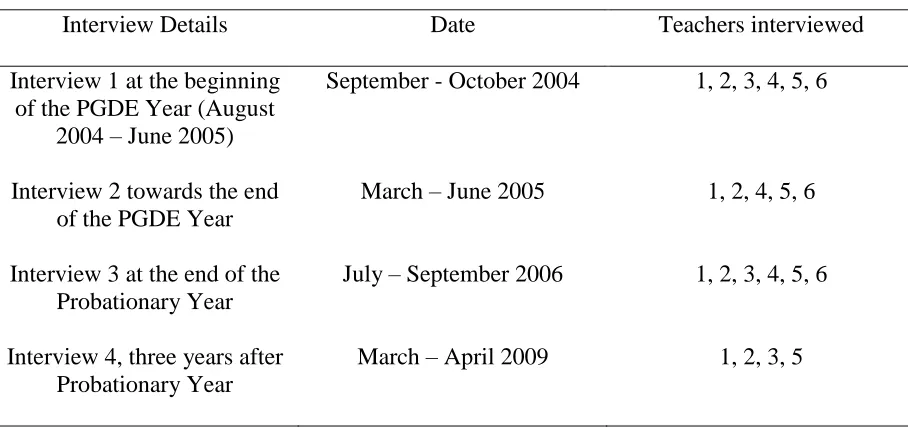
Table 1 Dates when the six teachers were interviewed about teaching electricity.
Interview Details Date Teachers interviewed
Interview 1 at the beginning of the PGDE Year (August
2004 – June 2005)
September - October 2004 1, 2, 3, 4, 5, 6
Interview 2 towards the end of the PGDE Year
March – June 2005 1, 2, 4, 5, 6
Interview 3 at the end of the Probationary Year
July – September 2006 1, 2, 3, 4, 5, 6
Interview 4, three years after Probationary Year
March – April 2009 1, 2, 3, 5
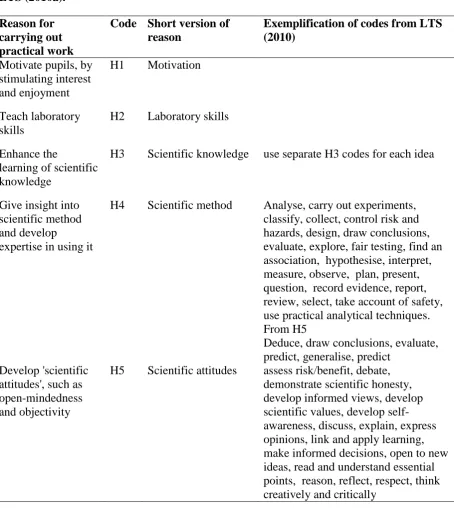
[image:3.595.70.524.94.309.2]For this paper, the material related to the role of practical work in teaching physics and science was re-analysed using Hodson’s (1993, pp. 90-91) aims of science education which have been widely quoted since, for example by Abrahams (2011, p. 11). The categories identified by Hodson are shown in the first column of Table 2. When the interviews were analysed a number of categories which were important to the teachers were identified. These categories are shown in the second column of Table 2.
Table 2 Categories from Hodson (1993) and categories which emerged from the analysis of Teacher 1’s interviews.
Categories identified by Hodson (1990, 1993)
Emergent categories identified in Teacher 1’s comments
H1 Motivate pupils by stimulating interest and enjoyment
N1 Changing a written problem to physical circuit
H2 Teach laboratory skills N2 Pupil attitudes H3 Enhance the learning of scientific
knowledge
N3 Pedagogical reasoning H4 Give insight into scientific method and
develop expertise in using it
N4 Linking practical work to real life H5 Develop 'scientific attitudes', such as
open-mindedness and objectivity
Hodson’s list of reasons for using practical work was exemplified using some of the
Table 3 Exemplification of some of the reasons for carrying practical work from LTS (2010a).
Reason for carrying out practical work
Code Short version of reason
Exemplification of codes from LTS (2010)
Motivate pupils, by stimulating interest and enjoyment
H1 Motivation
Teach laboratory skills
H2 Laboratory skills
Enhance the
learning of scientific knowledge
H3 Scientific knowledge use separate H3 codes for each idea
Give insight into scientific method and develop
expertise in using it
H4 Scientific method Analyse, carry out experiments, classify, collect, control risk and hazards, design, draw conclusions, evaluate, explore, fair testing, find an association, hypothesise, interpret, measure, observe, plan, present, question, record evidence, report, review, select, take account of safety, use practical analytical techniques. From H5
Deduce, draw conclusions, evaluate, predict, generalise, predict
Develop 'scientific attitudes', such as open-mindedness and objectivity
H5 Scientific attitudes assess risk/benefit, debate, demonstrate scientific honesty, develop informed views, develop scientific values, develop self-awareness, discuss, explain, express opinions, link and apply learning, make informed decisions, open to new ideas, read and understand essential points, reason, reflect, respect, think creatively and critically
Quotation 1
1. The key thing for me is knowing that ammeters are always connected in series as standard.
2. Voltmeters are always in parallel.
3. Have the ammeters in maybe three positions. Forget about the voltmeters just now. Find me the current reading there, find me the current reading in the centre and there.
4. What do you find? They should all be the same.
5. We've got the cell in here and we’ve got the circuit connected up, so connect up my voltmeter and find out what I’m actually measuring. … Right, that's what my total is, in this case 12 volts. And then you, well obviously you've got R1 and R2 … so V total is … equal to V1 plus V2.
6. I think it's important that they need to do it more than once with different (resistors) because they might think it’s just a fluke.
[Edited version of discussion in T1.3.4a]
The discussion was categorised as shown in Table 4.
Table 4 Categorisation of edited version of discussion in T1.3.4a about finding the rules for current and voltage in a series circuit.
Statement number
Abbreviated description Categorisation
1 How to use an ammeter Teach laboratory skills 2 How to use a voltmeter Teach laboratory skills
3 Measuring current Enhance learning of scientific knowledge
4 Observe that the current is the same everywhere around the circuit
Enhance learning of scientific knowledge
5 Measure voltage around a series circuit
Enhance learning of scientific knowledge
6 Change values of components to see applies to all circuits
Pedagogical reasoning
Question 4a was designed to elicit subject matter knowledge about the circuit laws and how they were taught. However, Teacher 1 changed a written problem to a physical circuit so that the pupils could observe what happened around the circuit and reinforce their prior
knowledge.
Results and discussion
When the teachers were re-interviewed later in the PGDE year, their initial focus on teaching physics to children had changed with experience to a focus on how to teach children physics. One of the factors in this change of focus was the role of practical work. One of the teachers in particular had a clear rationale for carrying out practical work with classes. Table 5 shows Teacher 1’s rationale for using practical work in school.
Table 5 Teacher 1’s rationale for using practical work in school.
Aim of practical work in
Hodson (1990, 1993) Teacher 1, Interview 3
motivate pupils, by stimulating interest and enjoyment
let them do it for themselves: the whole Curriculum for Excellence thing
teach laboratory skills You know how to look after the equipment and set it up
enhance the learning of scientific knowledge But if you've got the worksheets that they can work from and the support, certain ideas that they've got to [find].
give insight into scientific method and develop expertise in using it
it’s trying to ask what they think is going to happen this time
develop 'scientific attitudes', such as open-mindedness and objectivity
it's the same brightness, but obviously that energy thing doesn't really work there
The extent to which Hodson’s aims for practical work are visible in the teachers’ discussions of practical work was very variable. The first three aims were more visible in the transcripts than the fifth and particularly the fourth aim.
The other teachers also discussed their rationale for doing practical work with pupils. Surprisingly, one of the reasons given was to allow pupils to visualise written problems so that they could solve them practically and then mathematically:
Quotation 2
I would get them to build the circuit to see what happens.
Teacher 4, Interview 4, three years after the Probationary Year.
This section discusses the extent to which there is evidence in the interviews of the reasons why the teachers used practical work in their teaching.
Using Hodson’s Categories
carrying out practical work. The most common categorisation of practical work was to “enhance the learning of scientific knowledge”, (66 instances, 68%). The next most common categorisation was to “teach laboratory skills”, (16 instances, 16%). Motivation (5 instances, 5%), developing understanding of “the scientific method” (4 instances) and “scientific
attitudes” (2 instances) were much less commonly mentioned. The interview schedule is shown in Appendix 1. The full results of the number of times Hodson’s categories were mentioned are given in Appendix 2.
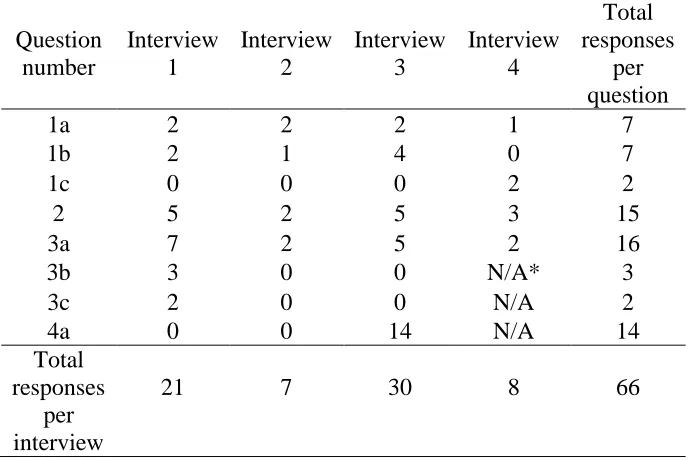
Most of the discussion about using practical work to develop scientific knowledge occurred in the discussion of series and parallel circuits. Questions 1, 2 and 3 dealt with introducing series and parallel circuits to First and Second Year pupils1. Question 4 dealt with series and parallel circuits with examination classes in Third and Fourth Year2. The number of times using practical work to develop scientific knowledge was mentioned in questions 1 – 4a in each interview is shown in Table 2. Table 6 looks more specifically at the 66 instances out of 97 total instances where Teacher 1 used practical work to enhance the pupils’ scientific
[image:7.595.126.471.337.567.2]knowledge.
Table 6 Instances of Teacher 1’s use of practical work to enhance scientific knowledge in Interviews 1 – 4.
Question number
Interview 1
Interview 2
Interview 3
Interview 4
Total responses
per question
1a 2 2 2 1 7
1b 2 1 4 0 7
1c 0 0 0 2 2
2 5 2 5 3 15
3a 7 2 5 2 16
3b 3 0 0 N/A* 3
3c 2 0 0 N/A 2
4a 0 0 14 N/A 14
Total responses
per interview
21 7 30 8 66
* N/A means that the question was not asked.
Questions 1c, 3b and c and 4a were all designed to probe how student teachers would encourage pupils to think about series and parallel circuits after they had done the practical work. This explains why some of the entries for these questions are blank. The exceptions occurred when Teacher 1 approached these written questions by telling pupils to set up the circuits, make observations and then base their thinking on these observations rather than answering the written questions. Interview 4 was cut short and stopped at question 3a which is why the N/A codes appear in Table 2.
1 In Scotland, pupils move into the first two years of secondary school when they are 12 years old, after seven years of primary school.
At the time of the first interview, Teacher 1 had only spent two weeks in a school during an Induction Block. During the Interview, he was focused on changing his own subject matter knowledge into a format which pupils could understand.
Quotation 3
This is where you get me confused [laughs] now because I know how things work myself, but then obviously how do you explain? How do you pass that information on [to pupils]?
[T1.1.3a means Teacher 1, Interview 1, Question 3a]
He had very little experience teaching pupils, and as a result, the discussion of introducing series and parallel circuits in questions 1 – 4 in the first interview was largely theoretical. Teacher 1’s approach of using physical circuits to help to focus pupils’ attention on what they observed led to the emergent category “written problem to physical circuit”. This
categorisation is discussed in the later section about emergent themes. Changing the focus of the original written question to the physical circuit is also reflected in the emergent category “pedagogical reasoning” as Teacher 1 explained why he had made this change in terms of the pupils’ different levels of ability and understanding. This categorisation is also discussed in the later section about emergent themes.
Interview 2 occurred after Teacher 1 had spent two, six-week placements in a school. During this time, he had not taught any classes electricity. This probably explains the change from 21 instances of using practical work to enhance scientific knowledge in Interview 1 to seven in Interview 2. The questions were designed to explore how the teachers would explain electrical concepts assuming that practical work had already been carried out. A possible explanation for the dip in referring to practical work was that Teacher 1 was applying knowledge gained in other subjects to teaching electricity and did not have practical work in electricity at the forefront of his mind.
Interview 3 took place just over a year later at the end of the Induction Year. In Interview 3, Teacher 1 was remembering and reflecting on how he had taught electricity over the previous year and was therefore had more recent experience of teaching electricity than at the time of Interview 2.
During Interview 3, when Teacher 1 was discussing Question 4a about how to solve a written problem about a series circuit, Teacher 1 started from a practical perspective and then linked this to solving the written problem. This long discussion resulted in 14 instances of using practical work to enhance the learning of scientific knowledge.
Interview 4 was cut short, so no comments will be made about that column in Table 2.
Discussion
This suggests that Teacher 1 may have had a tacit model to explain the prominence of practical work in his practice, similar to that of Tiberghien (2000). According to Millar (2009, p. 4), Tiberghien (2000) argued that practical work can be used to connect the domain of objects and observables (in this case electric circuits) with the domain of ideas (in this case the concepts, circuit rules (Kirchhoff’s laws) and electrical equations). This is shown diagrammatically in Figure 1.
Figure 1 Diagrammatic representation of practical work as the link between the physical domain and the domain of ideas. Based on Millar (2009, p.4).
Teacher 1 argued for the use of practical work to help pupils to make observations which were then used to develop their understanding of the underlying electrical concepts and connections. This is consistent with the suggestion that Teacher 1 used a tacit model of the link between experiment and theory consistent with Figure 1 above.
The role of practical work as the link between the domain of objects (lamps in circuits) and the domain ideas (current or voltage) is discussed in this extract from the third Interview: Quotation 4
You say to them: There's the equipment. You know how to look after the equipment and set it up and let them do it for themselves: the whole
Curriculum for Excellence thing. It’s dead easy to say, Right this is what's happening, and occasionally you feel yourself wanting to say, this is how it is instead of letting them find it. But if you've got the worksheets that they can work from and the support, certain ideas that they've got to [find]. Say right what happens there, what happens to the lamp? Using their own words, does it get dimmer or get duller? However they want to describe [it], I think it is a
good way for them. T1.3.3a
Teacher 1 had set practical work at the heart of his practice and had related it to the introduction of the Curriculum for Excellence (CfE), initially discussed published by the Curriculum Review Group (2004) and updated by the introduction of the Science Experiences and Outcomes (Learning and Teaching Scotland, 2010b). Teacher 1 had adopted a pupil-centred approach to learning which encouraged pupils to take responsibility for their own learning with the guidance and support of the teacher. He contrasted this with a teacher-centred approach which simply told pupils the expected answer and could move on more quickly.
However, a pupil-centred approach did not mean expecting the pupils to teach themselves from the worksheets. It is unclear whether Teacher 1 was prompting pupils towards the
Domain of objects and observables
Domain of ideas Practical
answer (“what happens here?”) or using his prompts to encourage the pupils to internalise the prompts so that they could move forward themselves “using their own words”.
Later in the same question, Teacher 1 described asking more able pupils to make predictions about what would happen to the brightness of two bulbs connected in parallel:
Quotation 5
The good ones, it’s trying to ask what they think is going to happen this time. And a lot of them will think the same thing’s going to happen. I don't want to demonstrate it. Say this is how it is built, go away and have a look and see what happens, and again they say, oh right it's the same brightness, but obviously that energy thing doesn't really work there. So they say, how come
now? T1.3.3a.
Teacher 1 designed the pupils’ learning so that they had to consider the gap between what they predicted would happen and what happened in practice. This provided opportunities for the pupils to demonstrate scientific attitudes of openness and respect for evidence by
reconsidering and changing their ideas about what would happen. (This was presumably the next step in teaching which was not discussed in the Interview.)
It has been argued that Teacher 1’s emergent pedagogical rationale for using practical work to link experimental work in the domain of objects with the domain of ideas links to
Tiberghien’s model linking the two domains. It could be further argued that Tiberghien’s model of practical work as the link between experiment and theory could also be applied to a second emergent category, “written problem to physical circuit”. Teacher 1 argued that when a class was presented with a difficult electrical problem, some pupils were able to solve it directly, but for “less able” pupils it was helpful to build the circuit, observe what was happening and use the observation as the starting point for their explanation.
Teacher 1 told less able pupils to build the physical circuit rather than to struggle with visualising what would happen in a complicated circuit diagram. A possible approach to the pedagogical reasoning involved would be:
Able pupils have already internalised their understanding of electric circuits in a number of rules.
These pupils are then able to apply these rules to the circuit diagram to predict what the effect on the physical circuit would be
Figure 2 Teacher 1’s possible pedagogical reasoning about how able pupils solve written problems.
However, the less able pupils had not internalised the rules, so they were unable to apply them to predict what would happen in the physical circuit. However, by encouraging the less able pupils to build the circuit, they could observe what had happened in the physical domain and could then try to explain what they saw rather than having to predict what would happen in the domain of ideas and then to explain why they thought that. Teacher 1’s possible pedagogical reasoning is summarised in Table 7.
Table 7 Teacher 1’s possible pedagogical reasoning about how to teach pupils who have and have not internalised the circuit rules.
Has pupil internalised the circuit rules?
Yes No
Apply the rules to the circuit diagram
Build physical circuit Predict outcome Observe what happens Explain reasoning Teacher reminds pupil of
the rules / pupil remembers the rules Apply the rules Explain observation
Question 4a was designed to explore how the teachers approached solving written problems about electrical circuits. In Interviews 1 and 2 during the PGDE Teacher 1 had not had any experience teaching electricity to Third or Fourth Year classes and consequently based his answers on his own experiences learning about electricity as a pupil and his growing pedagogical content knowledge.
Interview 3 was carried out after the Probationary Year when Teacher 1 had more experience teaching electricity. During Interview 3 when Teacher 1 was discussing teaching younger pupils, his answers to Questions 1, 2 and 3 were similar to those given in Interviews 1 and 2. However, when he discussed the written Question 4a which deals with current and voltage in a series circuit, he discussed how he did this in practice with a Third Year class.3 By talking about solving written problems practically, Teacher 1 automatically introduced more links between observation and theory to “enhance the learning of scientific knowledge.” However, Questions 4b, c and d were also theoretical questions, but in this case Teacher 1 discussed
3 This may relate to the discussion above about the model
Internalise
rules
Apply
rules
them theoretically rather than practically. Questions 4b and c dealt with adding resistors in series and the discussion was about the problems which pupils have adding resistors in parallel because generally the pupils are not good at adding fractions. Question 4d was at Fifth Year / Higher4 level about qualitative changes in voltage for a circuit with resistors in parallel and was again discussed theoretically.
4
Another approach – Predict, observe, explain
In his initial approach to teaching about parallel circuits in Interview 1 before he had any experience in schools, Teacher 5 adopted a didactic approach to teaching about parallel circuits:
Quotation 6
Reiterating with the first bulb the fact that there’s only one path for the
electricity to flow round. Going on to the second one, I would say well in this case you’ve got two ways that the current can flow. What are they? And I would get the pupils basically say, what are the two loops if you like that the current can flow round. [T5.1.3a]
The pupils were reminded what happened in a series circuit and the questioned about what they thought would happen when two lamps were added in series.
At the time of the second interview, Teacher 5 had completed a six-week placement in a state school and in a private school. In the second interview, he described adopting a different approach to using practical work in school which was based on a Predict – Observe – Explain (POE) routine (White & Gunstone, 1992).
Quotation 7
I would let them observe it first and I would play on a misconception a wee bit – I would probably show the first and second one up on the board and say – here’s one in series – … - we switch it on – what will happen – it will light Ok – take a second one in parallel – switch it on – what do you think will happen? - maybe go round and poll them a wee bit… [T5.2.3a edited]
During Interview 3, at the end of the Induction Year, Teacher 5 had developed this type of approach and continued to use it in his teaching.
Quotation 8
First of all I would put up the three circuits there and ask them first of all – what's the difference this time as to how we connected them before? … if the current is flowing down here and assuming the switch is shut, it's going to come down here, what's going to happen to it here? … so what do you think the bulbs are going to do in terms of brightness this time? – what's going to
happen? To be honest it's probably counter-intuitive and the kids are going to say they're going to get dimmer – and what's going to happen here? – oh they're going to get really dim – OK – let's go and give it a try – let them get all set up – let them go and do the experiment and low and behold they are all equal in brightness – what's going on – this is weird – why is this happening? - so maybe let them go away and think about that for a while – come back..
[T5.3.3a edited]
Over the course of the interviews, Teacher 5 had moved towards engaging the pupils more in their own learning in a way that suited each of the schools where he was teaching. Although he did not explicitly discuss using a POE routine, the analysis of the interview transcripts showed that he was moving in that direction.
Conclusions and Implications
Returning to the purposes of science education identified by Hodson (1990), the beginning teachers addressed the first three of Hodson’s aims for using practical work. There is some evidence that they also addressed Hodson’s fifth aim of developing scientific attitudes, and some evidence that they used practical work when teaching electricity to “give insight into the scientific method”. This may have happened because teaching electricity in the lower secondary school was about using practical work to confirm results rather than
experimentation to find the results.
One of the implications of this finding for Initial Teacher Education courses for science teachers in Scotland may be that more use should be made of the hints in the CfE documents to explicitly teaching PGDE student teaches about the Nature of Science and investigative approaches to science. Despite the current financial constraints, there may also be
opportunities to offer innovative approaches to CPD to develop understanding about NoS and the investigative science pedagogies to science teachers in primary and secondary schools. The aim of this paper was to explore whether practical work was simply “part of being a science teacher” Millar (2010, p. 112) or whether the beginning teachers had specific aims for using practical work. From the preliminary analysis reported here, to some extent beginning science teachers initially use practical work as “part of being a science teacher.” However, as they gained more experience as they worked with pupils, Teachers 1 and 5 developed a
rationale for using practical work which integrated it with their developing pedagogical content knowledge.
There are implications from this work for ITE and continuing professional development (CPD). Changes in the Scottish science curriculum as a result of the introduction of the Curriculum for Excellence (CfE), Learning and Teaching Scotland (2010b), have emphasised the role of curricular learning. This has provided an opportunity to carry out cross-curricular practical work in science which is less-closely linked to specific cross-curricular outcomes. This may provide an opportunity to focus on the role of practical work in
Bibliography
Abrahams, I. (2011). Practical Work in Secondary Science: A Minds-on Approach London: Continuum.
Abrahams, I., & Saglam, M. (2010). A Study of Teachers’ Views on Practical Work in
Secondary Schools in England and Wales. International Journal of Science Education, 32(6), 753 - 768.
Bennett, J. (2003). Teaching and Learning Science: a guide to recent research and its applications. London: Continuum.
Bishop, K., & Denley, P. (2007). Learning Science Teaching: Developing a Professional Knowledge Base. Maidenhead: Open University Press.
Boyatzis. (1998). Transforming qualitative information: thematic analysis and code development. Thousand Oaks, CA Sage Publications.
Curriculum Review Group. (2004). A Curriculum for Excellence: The Curriculum Review Group Report. Edinburgh: Scottish Executive.
Donnelly, J. F. (1998). The place of the laboratory in secondary science teaching.
International Journal of Science Education, 20(5), 585 - 596.
Findlay, M. J. (2010). From Teaching Physics to Teaching Children: The Role of Craft Pedagogy. Doctorate of Education, University of Strathclyde, Glasgow.
Hodson, D. (1990). A critical look at practical work in school science. School Science Review, 70(256), 33-40.
Hodson, D. (1993). Re-thinking Old Ways: Towards A More Critical Approach To Practical Work In School Science. Studies in Science Education, 22(1), 85 – 142.
Kind, V. (2009). Pedagogical content knowledge in science education: perspectives and potential for progress Studies in Science Education, 45(2), 169 – 204.
Learning and Teaching Scotland. (2010a). Principles and practice: sciences, from
http://www.ltscotland.org.uk/learningteachingandassessment/curriculumareas/sciences /principlesandpractice/index.asp
Learning and Teaching Scotland. (2010b). Sciences: Experiences and outcomes, from
http://www.ltscotland.org.uk/learningteachingandassessment/curriculumareas/sciences /eandos/index.asp
Lunetta, V. N., Hofstein, A., & Clough, M. P. (2007). Learning and teaching in the school science laboratory: An analysis of research, theory, and practice. In S. K. Abell & N. G. Lederman (Eds.), Handbook of research on science education (pp. 393-441). London: Routledge.
Lunetta, V. N., Hofstein, A., Clough, M. P., Abell, S. K., & Lederman, N. G. (2007). Learning and teaching in the school science laboratory: An analysis of research, theory, and practice. In S. K. Abell & N. G. Lederman (Eds.), Handbook of research on science education (pp. 393-441). London: Routledge.
Millar, R. (2009). Analysing practical activities to assess and improve effectiveness: The Practical Activity Analysis Inventory (PAAI). York: Centre for Innovation and Research in Science Education, University of York.
Millar, R. (2010). Practical Work. In J. Osborne & J. Dillon (Eds.), Good Practice in Science Teaching: What research has to say (2nd ed., pp. 108-134). Maidenhead: Open University Press.
QCDA. (2009). National Curriculum Retrieved 15th February 2010, from
SCORE. (2008). Practical Work in Science: A report and proposal for a strategic framework. London: SCORE.
Shulman, L. S. (1987). Knowledge and Teaching: Foundations of the New Reform. Harvard Educational Review, 57(1), 1-22.
SQA. (2002). Intermediate 2 Physics (4th ed.). Glasgow: Scottish Qualifications Authority. SQA. (2004). Standard Grade Revised Arrangements in Physics: General and Credit Levels in
and after 2006 Glasgow: Scottish Qualifications Authority.
Tiberghien, A. (2000). Designing teaching situations in the secondary school. In R. Millar, J. Leach & J. Osborne (Eds.), Improving Science Education: The contribution of
research. London: Routledge.
White, R., & Gunstone, R. (1992). Probing Understanding. London: Falmer Press.
Appendix 1
Interview Schedule about Teaching Electricity
Questions asked in Interviews 1, 2, 3 and 4
Question 1a Quite often a sequence of experiments in first year is start off two cells and then to add one bulb, two bulbs and three bulbs in series. The pupils are going to observer that the bulbs get duller. How would you use these observations to help the pupils?
Question 1b Quite often what pupils will say to you is, “We notice that these two light bulbs are the same brightness and that they are dimmer than the first one.” How would your explanation deal with that observation?
Question 1c Why did you decide to use this explanation?
Question 2 The second set of diagrams is a similar experiment, where this time the pupils start off with one bulb and then they add one cell, two cells and three cells in series. The pupils will observe that the bulb gets brighter. How would you start to explain that?
Question 3a After considering series circuits, now we are going to look at parallel circuits. In an ideal world when pupils do this experiment, they find that the bulbs in these circuits are equally bright. How would you explain this observation?
Question 3b Quite often what happens in schools after introducing series and parallel circuits practically, pupils are asked to look at circuit diagrams and to compare the brightness of the bulbs in the diagrams. How would you like pupils to think through this example?
Question 3c How would you like pupils to think through an even more complicated example?
Question 4 What I’d like to do now is to talk about a bit about teaching electricity in third
and fourth year. The pupils study series and parallel circuits but more mathematically. How would you expect pupils to calculate the missing values in the following circuits?
4a Two resistors in series;
4b Two resistors in parallel;
4c Two resistors in parallel in series with a resistor;
4d A more difficult example from the Higher Physics syllabus with the question 4c in series with a fourth resistor.
Question 5 deals with the introduction of potential divider circuits.
5a How would you introduce students to a simple potential divider circuit?
5b How would you like pupils to think through a potential divider circuit with a resistor and a variable resistor?
5c How would you like pupils to think through a potential divider circuit with a resistor and an LDR (light dependent resistor?
5d A more difficult example from the Higher Physics syllabus has two resistors in series with an LDR. The pupils were told that when light shines on the LDR its resistance goes down. Qualitatively, what happens to the voltages across the three resistors when the circuit is in the dark?
Question 6 The last set of questions are more general.
6a What do you think are the important ideas to get across when teaching electricity?
6b In your experience up to now, what problems do you think pupils have with electricity?
6c The last question is: do you have any other points you would like to make?
Preliminary questions for Interview 2
Question 7a What experience did you have teaching electricity on placement?
Question 7c Do you think that your ideas about teaching electricity have changed as a result of being in school?
Preliminary question for Interviews 3 and 4
Question 8a What do you think are the important things to get across when teaching electricity?
Appendix 2
Results for mention of Hodson’s reasons for using
practical work for Teacher 1 in Interviews 1 – 4.
Ques tion H 1. 1 H 1. 2 H 1. 3 H 1. 4 H 2. 1 H 2. 2 H 2. 3 H 2. 4 H 3. 1 H 3. 2 H 3. 3 H 3. 4 H 4. 1 H 4. 2 H 4. 3 H 4. 4 H 5. 1 H 5. 2 H 5. 3 H 5. 4 To tal
1a 0 0 0 0 0 0 1 0 2 2 2 1 0 0 0 0 0 0 0 0 8
1b 0 0 0 0 0 0 0 0 2 1 4 0 0 0 0 0 0 0 0 0 7
1c 0 0 0 0 0 0 0 2 0 0 0 2 0 0 0 0 0 0 0 0 4
2 0 0 0 0 0 0 0 0 5 2 5 3 0 0 0 0 0 0 0 0 15
3a 0 0 2 0 0 0 1 0 7 2 5 2 0 0 1 0 0 0 2 0 22
3b 0 0 0 0 0 1 0 3 0 0 0 0 0 0 0 0 4
3c 1 0 0 0 0 0 0 2 0 0 1 0 0 0 0 0 4
4a 1 0 0 0 0 5 0 0 0 14 0 0 0 0 0 0 20
4b 0 0 0 0 0 0 0 0 0 0 0 0 0 0 0 0 0
4c 0 0 0 0 0 0 0 0 0 0 0 0 0 0 0 0 0
4d 0 0 0 0 0 0 0 0 0 0 0 0 0 0 0 0 0
5a 0 0 0 0 0 0 0 0 2 0 0 0 0 2
5b 1 0 0 0 0 0 0 0 0 0 0 0 0 1
5c 0 0 0 0 0 0 0 3 0 0 0 0 0 3
5d 0 0 0 0 0 0 0 0 0 0 0 0 0 0
6a 0 0 0 0 0 0 0 0 0 0 0 0 0 0
6b 0 0 0 3 0 0 0 0 0 0 0 0 0 3
6c 0 0 0 0 0 0 0 0 0 0 0 0 0 0
Other 0 0 0 0 0 3 0 0 0 0 1 0 0 0 0 0 0 0 0 0 4
Total 3 0 2 0 0 6 8 2 21 10 31 8 3 0 1 0 0 0 2 0 97
The key to the questions is in Appendix 1.
A darkened cell means that the question was not asked.
Appendix 3
Results for emergent reasons for using practical work
for Teacher 1 in Interviews 1 – 4.
Questi on N1. 1 N1. 2 N1. 3 N1. 4 N2. 1 N2. 2 N2. 3 N2. 4 N3. 1 N3. 2 N3. 3 N3. 4 N4. 1 N4. 2 N4. 3 N4. 4 Tot al
1a 0 0 0 0 0 0 0 0 2 2 0 1 2 0 0 0 7
1b 0 0 0 0 0 0 0 0 0 1 4 2 0 0 0 0 7
1c 0 0 0 0 0 0 0 0 1 4 1 2 0 0 0 0 8
2 0 0 0 0 0 0 0 0 1 3 0 3 0 0 0 0 7
3a 0 0 0 0 0 0 1 0 1 9 17 2 0 0 1 0 31
3b 0 0 0 0 0 0 4 0 5 0 0 1 10
3c 1 1 0 0 0 0 4 0 0 0 0 0 6
4a 0 0 6 0 0 0 0 0 10 0 0 0 16
4b 0 0 0 0 0 0 0 0 0 0 0 0 0
4c 0 0 0 0 0 0 0 0 0 0 0 0 0
4d 0 0 0 0 0 0 0 0 0 0 0 0 0
5a 1 0 0 0 1 0 0 0 2
5b 1 1 2 0 2 0 0 1 7
5c 0 3 0 0 0 10 0 0 13
5d 0 0 0 0 0 0 0 0 0
6a 0 0 0 0 0 0 0 1 1
6b 0 0 4 9 4 9 2 1 29
6c 0 0 2 0 4 0 0 0 6
Other 0 0 0 0 0 0 0 0 8 0 0 0 2 0 10
Total 0 5 6 0 8 9 1 0 24 46 37 10 4 5 2 0 160
The key to the questions is in Appendix 1.
A darkened cell means that the question was not asked.