Theses Thesis/Dissertation Collections
2007
Enterprise network convergence: path to cost
optimization
Vidhumana Sridharan
Follow this and additional works at:http://scholarworks.rit.edu/theses
This Thesis is brought to you for free and open access by the Thesis/Dissertation Collections at RIT Scholar Works. It has been accepted for inclusion in Theses by an authorized administrator of RIT Scholar Works. For more information, please [email protected].
Recommended Citation
Enterprise Network Convergence: Path to Cost Optimization
By
Vidhumana Sridharan
Thesis submitted in partial fulfillment of the requirements for the degree of Master of
Science in Telecommunications Engineering Technology.
Vidhumana Sridharan Thesis approved by:
Professor Ronald G. Fulle (Chairman of the Thesis Committee)
Dr. Warren L. G. Koontz (TET Program Chair)
Dr. Anthony Trippe
I would like to thank my parents, Mr. Sridharan and Mrs. Anuradha, for their love
and support. Without their help this degree would not have been possible.
I am deeply indebted to my thesis advisor Professor Ronald Fulle. His wide
knowledge in the field of telecommunications has been of great value for me. His
detailed constructive comments, stimulating suggestions, diligent support, encouragement
and guidance have helped me in all the time of research for and writing of this thesis.
I would like to extend my sincere gratitude to Dr. Warren Koontz, Chair of
Telecommunications Engineering Technology program, who made the BS/MS degree a
dream that came true. I am deeply appreciative of all the support and assistance that he
has provided ever since I started my degree at R.I.T.
I would like to express my warm and sincere thanks to Dr. Chance Glenn and
Professor Mark Indelicato who have been a constant source of encouragement. Working
with them gave me an opportunity to learn from their experience and gain a better
understanding of various fields in the telecommunications industry.
Lastly, I am grateful to all the faculty and staff of the ECT ET department for
providing me with resources and support to complete my thesis. I would like to express
my appreciation to the staff at Wallace library for their assistance during my thesis
During the past two decades, telecommunications has evolved a great deal. In the
eighties, people were using television, radio and telephone as their communication
systems. Eventually, the introduction of the Internet and the WWW immensely
transformed the telecommunications industry. This internet revolution brought about a
huge change in the way businesses communicated and operated. Enterprise networks now
had an increasing demand for more bandwidth as they started to embrace newer
technologies. The requirements of the enterprise networks grew as the applications and
services that were used in the network expanded. This stipulation for fast and high
performance communication systems has now led to the emergence of converged
network solutions.
Enterprises across the globe are investigating new ways to implement voice,
video, and data over a single network for various reasons – to optimize network costs, to
restructure their communication system, to extend next generation networking abilities,
or to bridge the gap between their corporate network and the existing technological
progress. To date, organizations had multiple network services to support a range of
communication needs. Investing in this type of multiple communication infrastructures
limits the networks ability to provide resourceful bandwidth optimization services
throughout the system. Thus, as the requirements for the corporate networks to handle
dynamic traffic grow day by day, the need for a more effective and efficient network
arises. A converged network is the solution for enterprises aspiring to employ advanced
applications and innovative services.
This thesis will emphasize the importance of converging network infrastructure
and prove that it leads to cost savings. It discusses the characteristics, architecture, and
relevant protocols of the voice, data and video traffic over both traditional infrastructure
and converged architecture. While IP-based networks present excellent quality for non
real-time data networking, the network by itself is not capable of providing reliable,
quality and secure services for real-time traffic. In order for IP networks to perform
reliable and timely transmission of real-time data, additional mechanisms to reduce delay,
data), and present an in depth cost analysis of a typical network vs. a converged network
Acknowledgements... iii
Purpose... iv
Table of Contents... vi
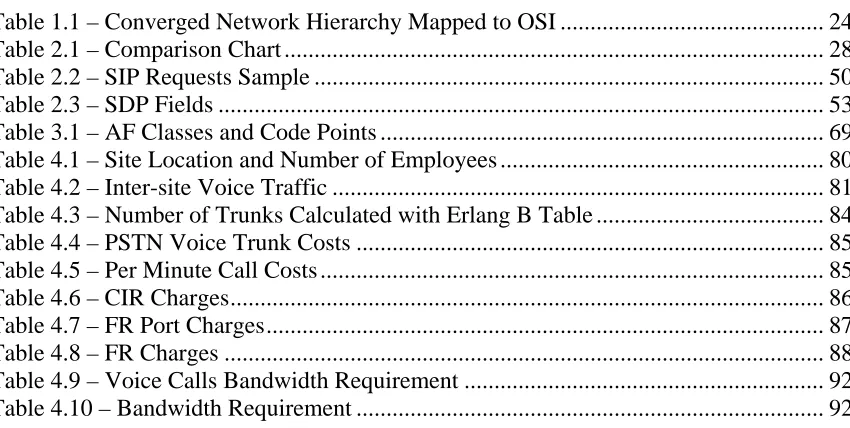
List of Tables ... ix
List of Figures ... x
1 IP Convergence... 1
1.1 Introduction... 1
1.2 Definition ... 2
1.3 Significance... 3
1.4 Incentives and Disincentives... 7
1.4.1 Incentives ... 8
1.4.2 Disincentives... 9
1.5 Advantages... 10
1.5.1 Reduced Costs... 11
1.5.2 Productivity Enhancements ... 13
1.5.3 Simplicity... 13
1.5.4 Reliability... 14
1.5.5 Scalability ... 14
1.5.6 Security ... 15
1.5.7 Potential ... 16
1.6 Challenges... 16
1.6.1 Security ... 18
1.6.2 Performance ... 18
1.6.3 Reliability... 19
1.6.4 Inexperienced Staff ... 20
1.7 Network Analysis... 20
1.8 Network Design ... 22
1.9 Conclusion ... 25
2 Network Technologies ... 26
2.1 Introduction... 26
2.2 Switching Characteristics... 26
2.2.1 Packet Switching... 26
2.2.2 Circuit Switching ... 27
2.2.3 Circuit Switching vs. Packet Switching... 27
2.3 Network Models... 28
2.3.1 Open System Interconnection ... 28
2.4.1 Voice Communications... 35
2.4.1.1 Frequency Division Multiplexing (FDM)... 35
2.4.1.2 Time Division Multiplexing (TDM)... 36
2.4.2 Video Communications ... 38
2.4.3 Data Communications... 40
2.5 Converged Networks ... 42
2.5.1 Gigabit Ethernet ... 42
2.6 Protocols ... 45
2.6.1 Multi Protocol Label Switching (MPLS)... 46
2.6.2 Session Initiation Protocol (SIP)... 48
2.6.3 Session Description Protocol (SDP) ... 52
2.6.4 Real-time Transport Protocol (RTP) and RTP Control Protocol (RTCP) 54 2.7 Conclusion ... 55
3 QoS and VPN Solutions... 57
3.1 Introduction... 57
3.2 Voice over TDM vs. Voice over IP ... 57
3.3 Video over ISDN vs. Video over IP ... 60
3.4 Quality of Service ... 63
3.4.1 Classification Mechanisms ... 64
3.4.1.1 Packet Classification... 65
3.4.1.2 Queuing... 65
3.4.1.3 Admission Control ... 66
3.4.1.4 Policing ... 67
3.4.2 QoS Architectures... 67
3.4.2.1 Differentiated Services... 67
3.4.2.2 Integrated Services... 70
3.4.2.3 IntServ + DiffServ ... 72
3.5 IP VPN ... 72
3.5.1 MPLS based IP VPN ... 73
3.5.2 IPSec Based IP VPN... 75
3.6 Conclusion ... 77
4 Cost Optimization ... 79
4.1 Introduction... 79
4.2 Overview... 80
4.2.1 Network Infrastructure... 80
4.2.2 Voice Traffic Volume ... 81
4.2.3 Data Traffic Volume ... 81
4.2.4 Video Traffic Volume... 81
4.2.5 Assumptions... 81
4.3 Traditional Network Solution ... 82
4.3.1 Voice Network ... 84
4.3.2 Data Network ... 85
4.4.1 Voice Network ... 91
4.4.2 Data Network ... 92
4.4.3 Video Network... 92
4.4.4 Total Bandwidth Calculation ... 92
4.4.5 Total Cost Calculations... 93
4.5 Comparison ... 93
4.6 Conclusion ... 94
Thesis Conclusion... 95
References... 97
Appendix A – List of Abbreviations... 103
Table 1.1 – Converged Network Hierarchy Mapped to OSI ... 24
Table 2.1 – Comparison Chart ... 28
Table 2.2 – SIP Requests Sample ... 50
Table 2.3 – SDP Fields ... 53
Table 3.1 – AF Classes and Code Points ... 69
Table 4.1 – Site Location and Number of Employees ... 80
Table 4.2 – Inter-site Voice Traffic ... 81
Table 4.3 – Number of Trunks Calculated with Erlang B Table ... 84
Table 4.4 – PSTN Voice Trunk Costs ... 85
Table 4.5 – Per Minute Call Costs ... 85
Table 4.6 – CIR Charges... 86
Table 4.7 – FR Port Charges... 87
Table 4.8 – FR Charges ... 88
Table 4.9 – Voice Calls Bandwidth Requirement ... 92
Figure 1.1 – Separate Voice and Data Network Infrastructure... 1
Figure 1.2 – Converged Network Layout ... 2
Figure 1.3 – Enterprise Telephony Market: Revenue Forecast ... 4
Figure 1.4 – IP Telephony vs. TDM Telephony... 5
Figure 1.5 – IP Converged Network Today... 6
Figure 1.6 – IP Converged Network in 3years ... 6
Figure 1.7 – Importance of Converging Networks ... 7
Figure 1.8 – Business Drivers for Deploying Converged Solution ... 8
Figure 1.9 – Barriers to Implementing Converged Network ... 10
Figure 1.10 – Benefits of Network Convergence ... 11
Figure 1.11 – Converged Network Performance Attributes ... 17
Figure 1.12 – Converged Network Hierarchy... 24
Figure 2.1 – OSI Reference Model ... 29
Figure 2.2 – OSI and TCP/IP Mapping ... 33
Figure 2.3 – FDM System... 36
Figure 2.4 – TDM system for N users... 37
Figure 2.5 – H.320 vs. H.323... 39
Figure 2.6 – Ethernet Bus Topology... 41
Figure 2.7 – Ethernet Star Topology... 41
Figure 2.8 – OSI and IEEE 802.3 Layers Mapping... 42
Figure 2.9 – Gigabit Ethernet Physical Layer... 43
Figure 2.10 – Architectural Model of 802.3z Standard ... 44
Figure 2.11 – SIP User Agents ... 49
Figure 3.1 – Cost Savings (IP Telephony vs. TDM) ... 59
Figure 3.2 – Increased Productivity with IP Telephony ... 59
Figure 3.3 – VoIP State of Deployment... 60
Figure 3.4 – ISDN to IP Shift in Videoconferencing... 61
Figure 3.5 – ISDN vs. IP Videoconferencing Cost Comparison ... 62
Figure 3.6 – MPLS based IP VPN ... 74
Figure 3.7 – AH Authentication Process ... 76
Figure 3.8 – ESP Encryption Process ... 77
Figure 4.1 – Barriers to Implementing Converged Solution... 79
Figure 4.2 – Traditional Network Infrastructure... 83
1 IP Convergence
1.1 Introduction
Enterprises across the globe are investigating the implementation of voice, video,
and data over a single network for various reasons – to optimize network costs, to
restructure their communication system to extend next generation networking abilities, or
to bridge the gap between their corporate network and the current technological progress.
To date, organizations had multiple network services to support a range of
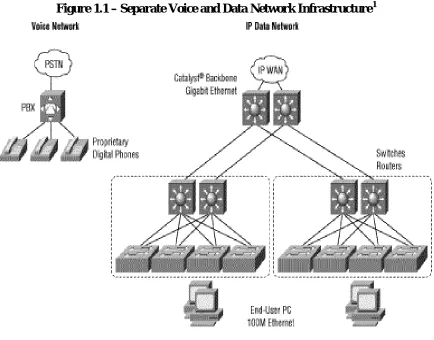
communication needs. Figure 1.1 illustrates the network infrastructure that has separate
[image:12.612.90.524.282.622.2]voice and data communications systems.
Figure 1.1 – Separate Voice and Data Network Infrastructure1
1
Cisco – Technical Considerations for Voice, Data and Video Networks. Cisco Systems.
As the requirements for the network to handle dynamic traffic grows day by day,
the need for a more effective and efficient network arises. A converged network is a
feasible solution for enterprises aspiring to employ advanced applications and innovative
services, while minimizing costs. This will be discussed in detail in sections to come.
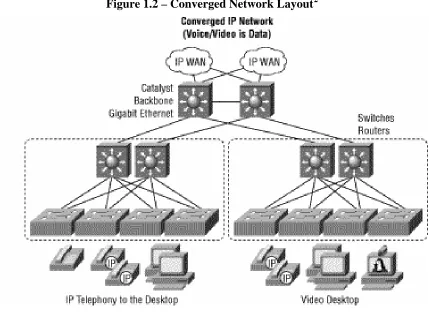
[image:13.612.94.523.179.491.2]Figure 1.2 displays the layout of a typical converged network.
Figure 1.2 – Converged Network Layout2
1.2 Definition
Network convergence is defined as the integration of all traffic types – voice, data
and video solutions – onto a single IP network3. Multiple data and traffic types are
integrated to coexist seamlessly. A converged network must sufficiently handle different
2
Cisco – Technical Considerations for Voice, Data and Video Networks. Cisco Systems.
http://www.itworld.com/WhitePapers/Cisco_AVVID_TechCon/
3
The Coming of True Convergence: Why Service Providers Can Finally Turn Out the Lights on the Old Public Switched Telephone Network (PSTN). International Engineering
traffic types and deliver consistent quality and reliability for the end-user. That is, both
voice and data packets that are routed through the network should have comparable
performance schemes. The voice packets must have less delay, and enhanced QoS, while
the data packets must have high reliability and performance ratings throughout the
network.
Convergence deployments have generated distinguished results in areas such as
quality of service, bandwidth management, stability of vendor solutions, and return on
investment (ROI)4. All of these factors put together make a converged network the
appropriate base model during the network design process. Therefore, while designing a
network decision makers should avoid getting fixed into a one dimensional solution that
might not be able to provide and accommodate all application traffic simultaneously.
1.3 Significance
With adaptive network architecture, enterprises can successfully create a powerful
converged network solution that efficiently handles several traffic types. With the
introduction of advanced telecommunications technologies has come the great potential
of having instantaneous access to business information from any part of the world in a
synchronous fashion, and the urge to optimize cost and network resources. Enterprise
networks are all about secure data communication, quality voice services and reliable
video streaming capabilities. These three technologies, so distinct from one another, add
their own value and have their own significance in the performance of any given
telecommunications network. Independent infrastructure has forced them to remain as
discrete methods of information-sharing. All information flowing through a corporate
network can be categorized in one of the three forms: voice, data or video. Unifying these
three important modes of communication media from separate network infrastructures
onto a single IP-based network has the power to change how corporations operate, both
internally and externally. IP convergence is moving into the corporate mainstream. By
2010, according to the Gartner Group, voice and data convergence based on IP telephony
4
Convergence: Preparing the Enterprise Network. ProCurve Networking by HP.
and VoIP will be under way in more than 95 percent of major companies5. Figure 1.3
shows how IP PBXs are being implemented in North America and how swift the revenue
growth is for the enterprise telephony market. According to Frost & Sullivan, revenues
[image:15.612.108.504.226.442.2]are expected to grow from $2.87 billion in 2005, to $3.8 billion in 2008.
Figure 1.3 – Enterprise Telephony Market: Revenue Forecast6
Based on a telecom market research by InfoTech, purchases of IPT platforms now
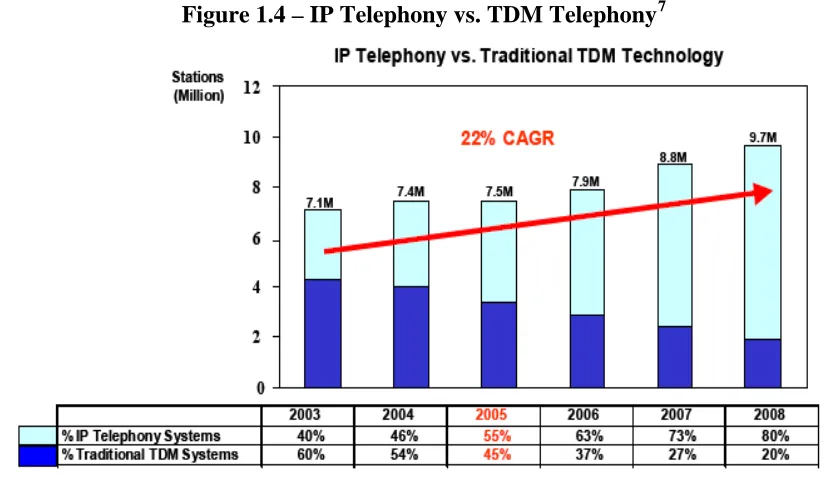
exceed those of traditional TDM PBXs. By 2008, IPT solutions are expected to make up
80% of new enterprise system deployments. Figure 1.4 shows the statistics on how IPT is
projected to take over the TDM world.
5
Gartner’s Positions on the Five Hottest IT Topics and Trends in 2005. Gartner Survey.
May 12, 2005 http://www.gartner.com/resources/125800/125868/gartners_positi.pdf
6
Manoj Menon. IP Convergence in the Enterprise. Cisco Systems.
Figure 1.4 – IP Telephony vs. TDM Telephony7
The Economist Intelligence Unit for AT&T conducted a global survey, which
polled 395 senior executives across 51 countries and over 20 industries, with 63% hailing
from large firms with annual revenue of more than US $500 million. Figure 1.5 and
Figure 1.6 illustrate the results from that survey.
7
Strategies for IP Telephony Evaluation and Migration: Best Practice Considerations for Deploying IPT in the Enterprise. InfoTech. April 2005.
Figure 1.5 – IP Converged Network Today8
Figure 1.6 – IP Converged Network in 3years8
As evident from Figures 1.5 and 1.6, about 48% of the survey respondents say
that IP convergence has been implemented in all or most of their business. Fully 77% of
the same business owners say this will be the case in 3 years’ time.
In the same survey, many executives also agreed that IP Convergence was
important to achieving their organizations goals. Figure 1.7 illustrates that almost 63% of
8
Convergence Takes Hold in the Enterprise. AT&T Corporation.
all the business owners that were surveyed agreed that network convergence played a big
part in achieving their enterprise objectives.
Figure 1.7 – Importance of Converging Networks9
1.4 Incentives and Disincentives
IP Convergence is the union of data and voice communication protocols, using
packet-based networks as the conventional infrastructure, to enhance the way enterprises
implement communication networks. With data and voice IP protocols it is possible to
improve the end-user information-sharing experience by combining voice, video, and
data content seamlessly. Although interest in convergence was immediate, it took more
than a half-decade for the overall market to reach a consensus that IP-based
communications was fully enterprise-ready10.
This section discusses the apparent incentives to convergence and analyses the
various disincentives to the implementation process.
9
Convergence Takes Hold in the Enterprise. AT&T Corporation.
http://www.corp.att.com/emea/docs/s4_convergence_eng.pdf
10
Strategies for IP Telephony Evaluation and Migration: Best Practice Considerations for Deploying IPT in the Enterprise. InfoTech. April 2005.
1.4.1 Incentives
There are many reasons why enterprises want to switch to converged network
solutions. The two key driving forces behind corporate network convergence are cost and
resource optimization. Convergence gives the enterprise workforce the ability to make
effectual decisions and act in real time using whatever tools are available from any
location. InfoTech found that while many companies vary in why they choose VoIP,
most enterprises have found the most common anticipated benefits as lowering total
operating costs, enhancing end-user productivity, improving IT organization efficiency,
reinforcing market differentiation and brand image11. Figure 1.8 is the graphical
representation of what companies say the initial interest is in deploying converged
network infrastructure.
Figure 1.8 – Business Drivers for Deploying Converged Solution12
As it is made clear by Figure 1.8, cost cutting is one of the primary motivator and
driving factors in the shift towards enterprise network convergence. But improving
business efficacy and competence by revitalizing already available infrastructure, thus
leading to resource optimization and enabling a user centric network design will be its
11
Strategies for IP Telephony Evaluation and Migration: Best Practice Considerations for Deploying IPT in the Enterprise. InfoTech. April 2005.
http://www.voicepro.com/_files/user/InfoTech%20Building%20Client%20Value1.pdf
12
Strategies for IP Telephony Evaluation and Migration: Best Practice Considerations for Deploying IPT in the Enterprise. InfoTech. April 2005.
accurate motive. Cost optimization and will be discussed in detail in the following
chapters.
1.4.2 Disincentives
There are reasons why there are critics of enterprise network convergence.
Although enterprise wide network convergence promises cost savings in the long run,
there is a huge amount of money that has to be invested for buying new equipment and
implementing a single IP-based network. Cost of implementation and cost of purchasing
equipments to support convergence is a main reason enterprises do not consider
convergence solutions. Although long-run cost saving might be appealing to migrate
conventional networks to converged solutions, enterprises might not have enough capital
to spend on immediate implementation and equipment costs.
Another major reason why enterprises are not influenced by convergence options
is that converged network is not easy to design and implement. Converged network
planning and design involves learning multiple technological architectures. Implementing
such complex technologies might not be an easy option without expert knowledge on the
subject. This will be discussed further in the Network Design section that is to follow
later in this chapter.
Also, network security becomes an issue when implementing converged solution.
Although security can be seen as an advantage to converged network, it does have some
drawbacks. This is discussed in detail in the Advantages and Challenges sections later in
this chapter.
Finally, convergence does not occur overnight. It has to be carefully planned and
implemented over a period of time. Some enterprises do not consider the option of
convergence because they might not be able to afford the network downtime during the
migration period. Today’s businesses need connectivity to the network all the time. So
the disruption to their network during migration poses as a negative outcome while they
consider convergence.
The Economist Intelligence Unit for AT&T conducted a global survey polled 395
firms with annual revenue of more than US $500 million. Figure 1.9 shows the results
from the survey.
Figure 1.9 – Barriers to Implementing Converged Network13
As observed in Figure 1.9, North American companies consider the cost of new
equipment to support convergence as their number one reason to not migrate their
network, closely followed by the cost of implementation.
1.5 Advantages
IP convergence is crucial to network modernization. Enterprise networks must be
designed to constantly embrace change, be quick enough to adapt new technologies and
be flexible to technological transformation. Over time, it will become apparent that
enterprises that adapted network convergence have had an advantage over corporations
that had been careless in the process.
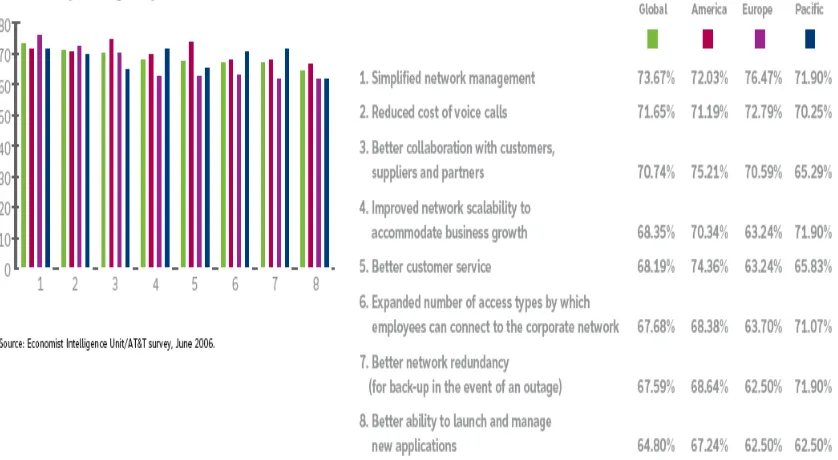
The Economist Intelligence Unit for AT&T conducted a global survey that polled
395 senior executives across 51 countries and over 20 industries, with 63% hailing from
large firms with annual revenue of more than US $500 million. With the results from that
13
Convergence Takes Hold in the Enterprise. AT&T Corporation.
survey, it is apparent that enterprises in North America are moving towards converged
solution, so the businesses can enhance their collaboration with customers, suppliers and
[image:22.612.95.514.182.412.2]partners among other important reasons. Figure 1.10 shows the results from the survey.
Figure 1.10 – Benefits of Network Convergence14
Some key advantages, as also mentioned in the survey above, in implementing a
converged network are competence, user productivity, ease of network management, and
scalability. Also, when implemented well, convergence can increase customer service.
Some apparent advantages of convergence are discussed below: 14, 15
1.5.1 Reduced Costs
A converged network solution moderates overall bandwidth costs by combining
all kinds of telecommunications traffic over one single network. It also decreases
management, maintenance and provisioning costs. It reduces the cost of integrating
14
Convergence Takes Hold in the Enterprise. AT&T Corporation.
http://www.corp.att.com/emea/docs/s4_convergence_eng.pdf
15
various applications. With such a simplification in network management, companies need
fewer support staff and reduce capital and operational expenses to build, implement,
maintain and manage the converged network.
A converged network brings down the number of vendors that a business
enterprise deals with, thus reducing various costs that differ from vendor to vendor. This
also increases the ability to associate invoices and services because enterprises trade with
fewer dealers. Unlike traditional networks, converged solution reduces personnel costs to
maintain different communication networks for voice, video, and data traffics. Overall, it
reduces costs, optimizes network performance, and improves the elasticity of the
network.
For an enterprise with 10,000 employees, saving just a ½ - 1 hour per employee
during a week will save the corporation $8 – $25 million each year, according to Sage
Research and Cisco Analysis16. Convergence brings about such time savings, which in
turn can be equated to absolute dollar value. For example16, innovative phone features
and advanced voicemail17 save up to 9 hours a week per employee. Also, extending
system features to remote employees saves more than 4 hours per week per employee –
this is an additional savings of 28 days per year. Extending system features to
telecommuters leads to cost and time savings as well – on average, 5 hours per week.
Besides, IT staffers would also save when end-users can use telephony features without
additional assistance. Moreover, a Nemertes survey of 100 companies with average IT
budgets of $10 million or more shows that employees move an average of .87 times per
year (or almost once every year) at a cost of $100 per move18. For a company with 1,500
16
The ROI of Convergence. Network World. June 14, 2004.
http://www.networkworld.com/supp/2004/0621convergenceperspectives.html?page=1
17
Advanced Voicemail: VoIP voicemail supports basic Class 5 voicemail features found
in traditional phone systems. This includes the ability to: set-up mailboxes; record greetings and inbound messages; and play back, store, and delete inbound messages. VoIP voicemail also enables some advanced features such as voicemail forwarding to email as an audio attachment. Users may also choose to receive voicemail notification
alerts via email. (http://www.voip-news.com/faq/voip-feature-faq/)
18
The ROI of Convergence. Network World. June 14, 2004.
employees, that amounts to $130,500 in annual costs that goes away with converged
network implementation because users have the flexibility to move their own phones.
1.5.2 Productivity Enhancements
A converged network enhances the opportunities for intra- and
inter-organizational cooperation. It enables distribution of a coherent and reliable user interface
to the network regardless of location, application or business function. It enables a new
level of integrated service. It provides a holistic rather than a disconnected view of
business communications.
Employee productivity within the organization increases when they have better
access to information regardless of their geographic location. By increasing information
processing capabilities with a converged environment, employees will now have higher
productivity through enhanced communication channels, as well as improvements for
remote and telecommuters. IT staff productivity increases with support processes that
improve service quality and reduce the time needed to perform day-to-day functions.
1.5.3 Simplicity
A converged network removes the complexity of managing multiple network
infrastructures. It enables an understanding of the true cost of the network. As mentioned
before, it improves invoice management. Another added advantage is that IP-based
networks are able to translate any form of information they receive regardless of physical
medium or service they may run on. This capability is built into the TCP/IP protocol suite
– TCP/IP bridges the gap between dissimilar network environments, operating systems or
applications19.
19
1.5.4 Reliability
Network reliability is another added advantage to converged IP-based
infrastructure. If designed appropriately, a converged network will have the capabilities
of providing both reliable voice and data services. Real-time applications such as video
and audio have their own set of parameters that measure the network’s reliability
standards. This set of parameters, such as latency, jitter, throughput, etc, are addressed by
resource management protocols such as RSVP. The IETF standards provided QoS
standards for every network by making enough bandwidth available on a priority basis to
support end-to-end quality control20. Furthermore, IP-based networks are able to offer
higher quality voice services than the traditional TDM networks21. However, if not
designed and implemented properly, the voice service might degrade compared to a
traditional TDM service. Thus, while reliability is an advantage if the network is
designed and implemented properly, it can turn around and pose as a challenge with a
poor network analysis and design.
1.5.5 Scalability
A network that easily scales has become one of the fundamental requirements
during the network design process. It enables the ability to expand the network as
business needs change without having to invest money or time on different applications.
A converged network makes the network absolutely adaptable and fully scalable. It
supports evolving business applications and services like unified messaging and
video/audio conferencing. In terms of scalability in converged networks, end-user
scalability is achieved by the implementation of VPN services. The closed end-user
grouping capability provided with the VPN like services lets enterprises limit incoming
20
Voice over IP Reliability: Architecture Matters. ShoreTel. October 2004.
http://www.infinitycomp.com/sbs/detail/shoretel_downloads/white_papers/Reliability_W hitepaper.pdf
21
Carolyn R. Johnson, Yokov Kogan, Yonathan Levy, Farhad Saheban, Percy Parapore.
Voice over IP and Quality of Service. January 2005.
or outgoing calls to only members of the specified group. Also, VPN services have
built-in security features, which allow for dedicated access without the need for deploybuilt-ing
firewalls. For example, when a packet reaches a VPN access router, it is checked against
a table for authorized source address. If there is no match found, then that particular
packet is discarded. Furthermore, same filtering techniques can be implemented to enable
enterprise to extend the access to their information to external users. This improves the
network to go from being an intranet to an extranet while using the already existing
infrastructure.
A converged infrastructure also makes it much easier to perform moves, adds or
changes as organizational needs grow or reduce. Adding, dropping or moving phone
numbers is all easily done on an IP-based network than on traditional TDM networks.
DHCP, a standard protocol in data environment, can be used for managing IP phones on
network. DHCP enables an IP phone to be moved to any part of the network without
having to manually change the database configuration on a PBX or physical
cabling/wiring alterations.
1.5.6 Security
All networks are vulnerable to attacks of one kind or another. For example, the
voice communications industry has been faced with toll fraud for decades. In the data
communications arena, security breaches have been prevalent for a longtime, especially
with financial networks. A converged network reduces the number of access points, and
hence the number of probable security threats. It facilitates real-time security policy
management and enforcement. It enables a focused approach to dealing with security
threats when they happen. Firms can implement and enforce a single set of standards
across converged network to provide the optimal level of security while reducing safety
breaches. Tunneling protocols such as IPSec, provide for authentication encryption and
integrity in a packet switched network. Voice can be run over VPN’s, just like data
traffic, with guaranteed improvement in performance by the QoS parameters that can be
transmission in a converged network that has VPN deployed because it inherits the
properties from IPSec. The IPSec protocol will be discussed in detail in a later chapter.
Converged networks can offer a more stable, higher-performing alternative that
helps increase your adaptability and reliability. With one network infrastructure, you can
have greater visibility of the resources and monitor and address security threats in a
straightforward fashion. A converged network environment also makes possible for
quicker enterprise wide communications to coordinate the response to security issues.
Similar to reliability standards, although security is an advantage if the network is
designed and implemented properly, it can turn around and pose as a challenge with a
poor network risk assessment and design. The latter part will be discussed later in this
chapter.
1.5.7 Potential
IP enterprise networks lead to boundless access to information. Every country in
the world is tied to the public Internet. The magnitude of the Internet gives businesses
worldwide reach. IP roaming capabilities enhance this overall reach by enabling end-user
mobility. Roaming services give telecommuters, remote workers, and travelers access to
the enterprise intranet from just about anywhere in the world. The Internet also offers
unique opportunities for organizations to economically extend communication
capabilities, applications and information to employees, remote offices, mobile workers,
telecommuters, suppliers, partners, vendors, etc.
A VPN solution is the means by which global enterprises communicate securely
via IP networks. VPNs allow corporations worldwide to carve out their own IP WAN
within the service providers IP backbone. Thus, VPNs have the endless potential of being
local, national or even global in geographical scope.
1.6 Challenges
Success with converged networks is not assured – rather it requires the
geographic scope – they connect corporate headquarters and branch offices to employees,
customers, vendors, partners, etc. Such networks, when converged on a single IP-based
backbone, clearly create challenges during the design and implementation process.
Requirement for converged network performance raises questions such as quality of
service, traffic analysis, and monitoring, performance management, etc. As
communication needs increase, corporations need a more flexible architecture that
promises hardware and applications interoperability and enables reliable delivery of
voice, data and other multimedia applications. Although converged IP network
[image:28.612.102.523.354.574.2]implementation is the answer, the implementation itself can pose a challenge22.
Figure 1.11 shows the results from the Economist Intelligence Unit for AT&T
survey emphasizing the various important network performance attributes as seen by the
company executives.
Figure 1.11 – Converged Network Performance Attributes23
Indicated in this chapter are few of those fundamental challenges to be considered
during the planning and design process of a converged network.
22
Implementing VoIP Network. Network General.
http://i.i.com.com/cnwk.1d/html/itp/Network_General_Implement_VOIP.pdf
23
Convergence Takes Hold in the Enterprise. AT&T Corporation.
1.6.1 Security
Figure 1.11 makes it evident that network security is the major concern while
enterprises consider a converged network solution. About 65% of the executives that
were surveyed clearly indicated that network security was their most important factor to
be considered in view of their networks convergence. To date voice and data networks
were implemented in different architectures, so the security needs were also kept
separate. However, as enterprises are emerging towards implementing converged
network solutions, designers are exposed to new voice and data susceptibilities. Security
measures are required to be considered not only after being attacked but also while
designing the network. All measures must be taken to protect the network from any kind
of malicious attack and minimize the impact on data transfer. All three hierarchies that
were discussed in the network design section must have individual security measures
implemented. Only authorized users must be able to connect to the network. All the
network users and devices that are connected to the network must have some limitation
posed that might be stated in the enterprise security enforcement policies. Therefore,
access control has become an essential security concern throughout the corporate world.
As security measures have taken priority while designing networks, so have the
issues that complicate the measures. Thus, today’s converged network solutions must
have security policies that includes prevention measures while planning and designing
the network and detection measures at each and every access point to the network.
Converged network security issues must be in conjunction with providing QoS for all
current and next generation applications.
1.6.2 Performance
Figure 1.11 makes it apparent that network performance – availability/downtime
– is the second major concern while enterprises consider a converged network solution. A
converged network carries both real-time and non real-time traffic. The real-time
applications place operational limitation on the network that may not be present with
the delay exceeds conventional standards – this is a constraint that typically would not
affect email applications. Thus, there is a need for some technique to monitor and
measure these real-time network statistics. Quality and performance measurements can
be done in a network if real-time end-user experience data is readily available. So
performance monitoring becomes an easier task on already functioning networks but
complicated on newly designed networks.
Unlike data and voice traffic, video streaming and other multicast traffic can be
harder to predict. Managing such real-time video traffic requires insight into the
availability, bandwidth utilization and errors for all interfaces. Moreover, in any given
enterprise network, the subscribers for multicast traffic can be dynamic. Thus, all
interfaces must be aware of all user groups at any given time to be able to forward the
traffic appropriately. Consequently, managing this user list itself adds more erratic
overhead and degrades the performance of the network. And since these are so
unpredictable, given ever changing user groups, predicting this type of traffic becomes a
complex task.
Thus, while planning and designing a converged network, the network
administrator has no other means but to gather data from other similar networks or
simulate and obtain performance results with simulation software with projected traffic
matrix.
1.6.3 Reliability
As evident from Figure 1.11, network reliability is the third major concern of
enterprises while considering network convergence. With a converged solution, users
now run all voice, data and multimedia applications on the same platform. Therefore, the
expectations network performance is typically high. For example, users that have been
using the PSTN network for a long time would have realized that it has 99.999%
reliability24. Now, they expect the newly implemented VoIP network to be as reliable as
24
Implementing VoIP Network. Network General.
that. If not properly designed to certain constrains, the network might not meet the users’
need. Therefore, this is a challenge for the network designer to consider.
As enterprise networks go from different voice, video and data networks to a
converged infrastructure, the QoS approach must undergo an immense transformation. As
mentioned earlier, unlike most non real-time traffic such as asynchronous data packets
over a network, audio and video traffic cannot afford to experience network delay,
congestion or jitter. The quality is degraded if audio/video packets arrive late, or
sometimes the packets are discarded. Therefore, converged networks require a QoS
technique implemented that can distinguish and prioritize among the various types of
traffic across the network. To accurately plan for desired QoS methodology, the network
designer should understand the different traffic types as they relate to the enterprise’s
needs and necessities, analyze the traffic for service level requirements, and then
implement an appropriate QoS policy. This way the approach will help prevent network
congestion and delays and optimize network performance. A QoS strategy should be
chosen that would ensure timely and reliable delivery of real-time traffic and reliable
delivery of non real-time traffic across the network. The different types of QoS strategies
and various methods of implementing QoS will be discussed in detail in later chapters.
1.6.4 Inexperienced Staff
A typical network uses different technologies for voice and data platforms the
converged network encompasses elements from both voice and data communication.
Consequently, IT and telecom professionals have to be knowledgeable about both of the
technologies in order to integrate and incorporate them in the network design. Thus, to
successfully manage a converged environment, a knowledgeable staff, with familiarity
with both telephony and data networking expertise, is essential.
1.7 Network Analysis
Network convergence does not happen overnight. It requires careful analysis of
proposed infrastructure, thorough budgeting strategies, and knowledgeable staff to carry
out tasks. Thus, enterprises have to put in immense effort in making sure the company is
ready for convergence and can afford the initial costs integrated with the implementation
process. This section will provide an insight on the facts that are to be considered when
an enterprise plans to integrate its voice, data and video services into a single IP-based
network.
The steps in transitioning a traditional network to a converged network might
sound extremely simple – just analyze the current technology and business needs and
plan and design a network that would meet the business needs and deploy next generation
technologies. It is not, however, as easy as it might seem. Migrating to an effective
functioning converged network solution is a complex task. Even after the network
analysis and the business needs are identified, there is much work to be done. Below are
some points that need to be carefully considered before making the big decision of
migrating to a converged infrastructure.
o Globalization is a buzz word among big business owners. Enterprises are
constantly looking to expand their empire globally to be able to reach a wider
customer base. In such case, it is no longer good enough to have their
communication systems just provide service in a specific area. Large enterprises
worldwide are moving to service providers that can provide end-to-end
connectivity and management services as a part of their service. If the corporation
considering migration to converged network solution has a global presence, then
it is time to move towards implementing network plans. This opens opportunities
to enormous cost savings in the long run.
o Another eminent reason in the move towards converged network solution is that
most of the equipment and software solutions running on today’s separate voice
and data networks will likely become obsolete with more and more next
generation technologies being introduced. Given that new technologies are being
developed and next generation technologies might not make full use of
depreciated equipment, telecommunications equipment will need to be refreshed
on a regular basis. Thus, as the need to replace any obsolete technological
network solution to reduce cost, improve QoS, and simplify the network
infrastructure.
Once an enterprise determines that there is a pushing need towards convergence,
then the scheduling of the project plan must be done accordingly. Most of the time global
corporations cannot afford to have their networks down for a long period of time, no
matter how vital the reason for the downtime is. Convergence does not happen overnight.
Therefore the migration process must be wisely scheduled.
1.8 Network Design
Whether it is designing a brand new converged network, or migrating from the
traditional network to a converged infrastructure, the planning and design of a converged
network has to take many points into consideration. Converged network planning and
design involves learning multiple technological architectures. The vendors have to work
with their clients and network architects to know and understand the business needs,
application features, traffic requirements, and other services. Generally, a converged
network just like a traditional network, has various design components such as the
communication media, the signaling architecture, the hardware requirements, the service
management facilities, etc25.
It is a common misconception that designing a converged network is easy
compared to designing traditional networks. But this is not always true26. For example,
while designing traditional networks the designers look at voice and data as separate
entities. Thus, the data network is designed to have good performance and reliability to
keep the network running, while the voice network has to take GoS and traffic analysis at
a certain level to have the voice system functional. Unlike that, for a converged network
designers have to put both of these factors together to obtain a mutual agreement of
25
The ROI of Convergence. Network World. June 14, 2004.
http://www.networkworld.com/supp/2004/0621convergenceperspectives.html?page=1
26
The Coming of True Convergence: Why Service Providers Can Finally Turn Out the Lights on the Old Public Switched Telephone Network (PSTN). International Engineering
network performance that is capable of handling all kinds of network traffic such as
voice, video and data. Therefore, the way a converged network is designed and all the
considerations that were taken into account while designing the network have a direct
impact on the network performance and reliability.
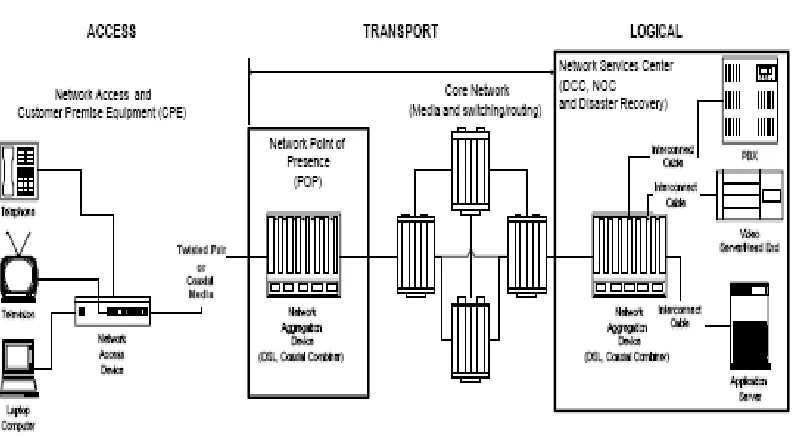
Network designers usually take a hierarchical approach to designing a converged
network27, 28. The hierarchy is divided into three layers. The first layer is the logical
layer, where all the enterprise’s applications and the hardware and software needed to
access the network inhabit. The second layer is the transport layer, where the network’s
routing and switching takes place. This layer is where corporate networks all around the
world are connected to each other for easy network access. This layer is also responsible
for having the enterprise network connected to the outside world network, also known as
the Internet and the PSTN. Lastly, there is the access layer where the network users
reside. Figure 1.12 shows a layout of the three layers in the converged network design.
27
Implementing VoIP Network. Network General.
http://i.i.com.com/cnwk.1d/html/itp/Network_General_Implement_VOIP.pdf
28
Designing Converged Networks. Networks and Services. December 2003.
Figure 1.12 – Converged Network Hierarchy29
Table 1.1 illustrates the relationship between the OSI reference model and the
converged network hierarchical model.
Table 1.1 – Converged Network Hierarchy Mapped to OSI30
OSI Model Converged Network Hierarchy
Physical Access
Data Link Access and Transport
Network Transport
Transport Transport
Session Logical
Presentation Logical
Application Logical
29
Rick Allison. Converged Networks Design Features. Lucent Technologies.
http://www.lucent.com/livelink/176405_Whitepaper.pdf
30
Rick Allison. Converged Networks Design Features. Lucent Technologies.
Similar to traditional network design, it is important to have network traffic
analysis data for converged network design. A network designer should be able to
determine the traffic flow across the network. This is an important factor so that a
designer can determine where traffic is going to be most, at what time the traffic is going
to be heavy, etc. Given that today’s enterprises run various high bandwidth applications
on a regular basis, having a real-time traffic data allows network architects to better
design networks with redundancy and back ups incase a link goes down. QoS
consideration is also another important factor in converged network design approach.
Therefore, the design of converged network is a complex process that takes many
design principles and technologies into consideration. These features may not be clear to
a traditional network designer31. Using the hierarchical approach to design the network
will increase network efficiency and performance.
1.9 Conclusion
This chapter introduced the concept of convergence – a single IP-based
infrastructure that runs voice, video and data traffic of enterprise networks. The
advantages, incentives, disincentives, and challenges in implementing a converged
network were also discussed. It is important to understand these various factors while
analyzing a network to determine whether or not convergence might be the right solution.
The following chapter will focus on the various technologies and protocols involved in a
traditional network implementation.
31
Designing Converged Networks. Networks and Services. December 2003.
2 Network Technologies
2.1 Introduction
The concept of voice and data networks have been around since the theory of
networking was developed. Enterprises across the globe have been implementing these
technologies to improve their business communication process, develop their business
opportunities and optimize costs. The legacy network model delivers voice, video and
data on separate single purpose network infrastructure, while the converged model has a
single network. This chapter will discuss the characteristics, architecture, and some
relevant protocols of the voice, data and video traffic over a converged architecture.
2.2 Switching Characteristics
There are two types of predominant networks – circuit switched and packet
switched. To understand the characteristics and behavior of converged networks, it is
important to understand the fundamentals behind the voice and data traffics; mainly the
difference between packet switched and circuit switched network technologies. This
section provides an overview of packet switching and circuit switching.
2.2.1 Packet Switching
Packet switching is a type of technology in which data is broken into small
“packets” that are routed through the network based on the destination address on the
packet. Different packets might take different routes from the source, but they are
reassembled in order at the destination. This method of data transmission gets hold of and
frees bandwidth as and when it is needed. This mode of communication between the
source and destination is viewed as connectionless service. Advantages of having a
packet switched network include having the network ability to connect to simultaneous
connectionless services, which in turn increases efficiency of the network. Packet
switching might be a disadvantage when network congestion occurs; that is many users
2.2.2 Circuit Switching
Circuit switching is a technique where a system establishes a physical connection
between the source and the destination (callING party and the callED party) before the
traffic transmission begins. Voice transmission via copper wires is a good example of
circuit switched network. This method of transmission statically reserves the required
bandwidth well in advance.
2.2.3 Circuit Switching vs. Packet Switching
Circuit switched networks are based on Time Division Multiplexing (TDM), in
which various signals are combined for transmission on a single communication channel.
Once a connection is established, it remains throughout the transmission session,
whereas, in a packet switched environment, the packets are routed based on destination
addresses contained in the header of each packet. Breaking down data into smaller
packets allows the communication channel to be shared among users in the network.
Circuit switching, as explained above, is completely transparent. The source and
the destination can use any bit rate, format, or framing methodologies they desire. In
contrast, for packet switched networks, the carrier needs to determine the basic
parameters before the transmission occurs. Compared to circuit switching, that statically
reserves the required bandwidth, packet switched networks allocate bandwidth
dynamically. Packets on a packet switched network can be routed through different
routes, and still be organized back at the destination end. On a circuit switched network,
all the data transmitted follow the same dedicated route.
The advantages of using a packet switched environment for voice and video
communications will be discussed in the next chapter. Although packet switching for
real-time applications seems easy to implement and has clear advantages, there is the
QoS issue that needs to be taken care of. This will be discussed in the following chapter.
Table 2.1 shows a comparison between circuit switched and packet switched
Table 2.1 – Comparison Chart
Circuit Switched Network Packet Switched Network
Bandwidth Allocation Static Dynamic
Dedicated Path Yes No
Bandwidth Optimization No Yes
Call Setup Required Not Required
Congestion Probability Only at setup On every packet transmission
2.3 Network Models
This section will discuss the two different reference models, Open Systems
Interconnection (OSI) and the Transmission Control Protocol / Internet Protocol (TCP/IP)
used for implementing data communication between interoperable systems.
2.3.1 Open System Interconnection
The first one, called the Open Systems Interconnection, proposed by the
International Standards Organization (ISO) is a seven-layer architectural model. Each
layer is responsible for specific, well-defined data communication function. Thus, the
model attempts to decompose the complexity of information flow between
communicating nodes into a set of functions that are independent of each other32. This is
achieved by building the model so that the upper layer protocols depend on the services
provided by the lower layers. Figure 2.1 represents the OSI reference model.
32
Oliver C. Ibe. Converged Network Architectures: Delivering Voice over IP, ATM, and
Figure 2.1 – OSI Reference Model33
The seven layers that are used in this model are: Application Layer, Presentation
Layer, Session Layer, Transport Layer, Network layer, Data Link Layer, and the Physical
Layer33.
1. Physical layer is the lowest layer of the OSI model that is responsible to define
the electrical and mechanical standards. It is concerned with transmitting raw bits
over the given communication medium. That is, it is responsible for establishing,
maintaining and terminating the required signaling. It deals with the physical
medium of information exchange.
2. Data link layer is responsible for organizing the data in a specific format (called a
frame) for transfer over the physical medium, and for detecting and correcting
errors in a frame. This layer transforms raw transmission facility into a line that
appears free of undetected transmission errors to the network layer.
33
Oliver C. Ibe. Converged Network Architectures: Delivering Voice over IP, ATM, and
3. Network layer is responsible for routing the data to its destination and for network
addressing. It controls the operation of the subnet. This layer is also accountable
for examining the packet to determine its destination and the required routing
information.
4. Transport layer is responsible for the reliable transfer of data between the source
and the destination, regardless of the performance and number of networks
involved in the connection between the communicating networks. This layer
accepts data and splits it up into smaller units, passes it on to the network layer,
and ensures that the packets transmitted arrive at the destination node. Thus, it is
responsible for end-to-end data integrity of data transmission34.
5. Session layer is responsible for the establishment, maintenance, and termination
of connections between applications. It controls data transfer by structuring data
exchange into a series of dialog units. This facilitates restarting the exchange if
service is interrupted. It is responsible for security during a connection and
maintains the connection until data transmission is complete33.
6. Presentation layer is responsible for translating the information to be exchanged,
into formats that are understood by the destination. This layer is concerned with
the syntax and semantics of the information transmitted. It ensures that
information sent by the application layer of source is interpretable by the user of
the application layer of the destination. It also performs data conversion, data
encryption, and data formatting for display or printing.
7. Application layer is responsible for providing services to end-user applications
that lie outside the scope of the OSI model. It defines the procedures by which
end-user applications access network services.
The application layer, presentation layer, and session layer are concerned with
application functions, while the lower four layers are concerned with data transport
functions. Thus, the boundary between the transport layer and the session layer is the
point of demarcation between application protocols and transport protocols.
34
Oliver C. Ibe. Converged Network Architectures: Delivering Voice over IP, ATM, and
2.3.2 TCP / IP
The second network model is the TCP/IP, which was developed for the Internet.
Like the OSI model, the TCP/IP is also a layered architecture. The layers of the TCP/IP
model includes the Network Access Layer, Internet Layer, Transport Layer and the
Application Layer35.
1. The Network Access layer is implementation specific. There are no specific
protocols are defined for the network access layer. The TCP/IP model indicates
that a host has to connect to the network using some protocol so it can send IP
packets to it. This protocol is not defined clearly, and caries from one host to
another, and from one network to another. It is expected that the network will rely
on the upper layer protocols for appropriate proceedings.
2. The Internet layer is the key player in the TCP/IP reference model. The
responsibilities at this layer include permitting hosts to bring in packets into any
network and have those packets travel independently to its destination – a packet
switched network based on a connectionless Internet layer. The Internet Protocol
(IP) defined for this layer is a simple connectionless datagram protocol. It
provides no error recovery, but performs error checking on each IP packet and
discards any packet found to be in error without notifying the sender. Thus, there
is no guarantee that the packet will be delivered.
3. The Transport layer provides a reliable data transfer between two communicating
end systems. It provides mechanisms that establish, maintain, and carry out
orderly termination of virtual circuits. The layer also provides mechanisms for
error recovery and flow control. Two protocols are defined for the transport layer:
Transmission Control Protocol (TCP), and User Datagram Protocol (UDP)36.
o TCP, detailed in RFC 793, defines a reliable mode for data transfer
with error control mechanism37. TCP is a byte-oriented reliable
35
TCP / IP. Cisco Systems. http://www.cisco.com/warp/public/535/4.html
36
Understanding TCP / IP. Cisco Systems.
http://www.cisco.com/univercd/cc/td/doc/product/iaabu/centri4/user/scf4ap1.htm
37
protocol. It uses sequence numbers and acknowledgments to enable
communication between two end users. The sequence numbers are
used to determine the ordering of transmitted packets and to determine
when a packet does not arrive at its destination. It is a
connection-oriented protocol that first establishes a connection between source
and destination, transfers the data, and then closes the connection.
o UDP is a connectionless protocol that offers minimum reliability
during data transfer, described in RFC 768, also provides minimal
protocol overhead38. Therefore, it is usually considered an unreliable
protocol. A connectionless path is one in which the communication
channel is not established prior to the transmission of data. Unlike
TCP, it does not require the connection between the source and
destination to be established prior to data transfer. And it is an
unreliable protocol because it does not issue an acknowledgment after
the data has been received. UDP is designed to be simpler than TCP
and is to be used by those applications that do not need the reliability
and overhead of TCP. Instead, the network transmits the data in a
package called a datagram. The datagram contains all of the
addressing information necessary for that message to reach its
intended destination.
4. The Application layer in the TCP/IP model is comparable to the abridgement of
the Session, Presentation and the Application layers of the OSI standard based
model. This layer contains all the higher level protocols such as TELNET, FTP,
SMTP, DNS, etc.
Figure 2.2 illustrates the layer mapping of OSI to TCP/IP architectures.
38
Figure 2.2 – OSI and TCP/IP Mapping39
2.3.3 OSI vs. TCP / IP
As discussed above, in both the models, each layer has a distinct set of functions
that it carries out; each layer also performs services for the layer above it. In both the
above mentioned network models, the upper layer protocols provide end to end transport
service to communicating applications. Also, the upper layers are used for application
oriented protocols.
Although there are many similarities between the reference models, there are
fundamental differences that make these architectural models apt for specific
applications. The OSI model was developed before devising the corresponding protocols.
39
Oliver C. Ibe. Converged Network Architectures: Delivering Voice over IP, ATM, and
Therefore, this model is not biased toward any set of protocols40. Given this feature, the
protocol developers did not have much exposure to the subject and did not have an idea
of which functionality to put in which layer. On the contrary, the TCP/IP reference model
was devised with the existing protocol stack. Therefore, there was no problem with the
protocols fitting the different layers in the model. The drawback was that this model does
not fit any other protocol stack. Hence, it is not useful for describing non-TCP/IP
networks40.
In addition, the OSI model supports both connection-oriented and connectionless
protocols at the network layer level, but only connection-oriented services at the transport
layer level. On the contrary, the TCP/IP model supports only connectionless services in
the network layer level, but both connection-oriented and connectionless services in the
transport level, giving the user a choice. Another major difference is that the TCP/IP
model does not clearly distinguish between the physical and the data link layers. The
differentiation between the transmission characteristics of the transmitting media and the
framing characteristics is done only in the OSI reference model.
With all the major differences discussed above, it is clear that the OSI and the
TCP/IP models have their own applications, advantages and disadvantages.
Consequently, the OSI reference model has proven to be useful for discussing networks
in the educational arena for beginners to comprehend computer networks40. In the
contrary, the TCP/IP model has protocols that are widely used in the industry40. TCP/IP
reference model is the one that is widely implemented in enterprise networks.
2.4 Legacy Networks
The goal of this section is to review data, voice and video communication systems
and technologies that have been used in enterprise environments over the years. A clear
understanding of these technologies and the demands that video and voice signals places
over a network is vital for the study of network convergence and the expectations of
legacy network users from a converged network solution.
40Andrew S. Tanenbaum. Introduction: Reference Models. Computer Networks.
2.4.1 Voice Communications
Traditionally, voice networks have been deployed with two major multiplexing
schemes – Frequency Division Multiplexing (FDM) and Time Division Multiplexing
(TDM).
2.4.1.1 Frequency Division Multiplexing (FDM)
Early telephone systems multiplexed multiple calls into a single physical circuit
using a technology called Frequency Division Multiplexing. In frequency division
multiplexing, the available spectrum of frequencies for voice transmission is divided into
independent channels. A user can transmit in one channel without affecting another user
in another channel. Thus, all the channels generated in the link can be used
simultaneously. FDM is used to partition the radio frequency spectrum, thereby making it
possible to receive transmissions from different radio and television stations