Recommended citation
Stagg, A. (2014). OER adoption: a continuum for practice. RUSC. Universities and Knowledge Society Journal, 11(3). doi http://doi.dx.org/10.7238/ rusc.v11i3.2102
Abstract
Whilst Open Educational Resources (OER) offer opportunities for broadening participation in Higher Education, reducing course development and study costs, and building open collaborative partnerships to improve teaching and learning practices, they have yet to gain significant mainstream traction. Research surrounding open education has focused on adoption at the institutional level, identifying key enablers and barriers to practice, but the practicalities of engagement with open resources are not often addressed.
By reviewing existing literature, and studying prior models used to explain OER (re)use, this paper proposes a continuum of use model. The proposed model seeks to acknowledge the complexity of applied knowledge required to fulsomely engage with open education by examining practitioner behaviours and the necessary supporting mechanisms. This conceptual model aims to be of use to both practitioners and also those responsible for designing professional development in an educational setting. Whilst the proposed model is designed for teaching staff use, some discussion is given as to how it could be applied to student learning using open resources as well.
Keywords
open educational practice; open educational resources; mediating artefacts; academic staff development; learning design
OER adoption: a continuum for practice
Adrian Stagg
University of Southern Queensland, Australia | [email protected]
Submitted in: January 2014 Accepted in: March 2014 Published in: July 2014
La adopción de los recursos educativos abiertos: un continuo de práctica abierta
Resumen
Si bien los recursos educativos abiertos (REA) presentan nuevas opciones para facilitar el acceso a la educación superior, reducir el coste de los estudios y del desarrollo de los programas docentes y establecer relaciones de colaboración abierta con el fin de mejorar la práctica de la docencia y del aprendizaje, aún les queda mucho camino por recorrer para ganar mayor difusión y aceptación. Las líneas de investigación en torno a la educación abierta se han centrado en su adopción en la esfera institucional, y han identificado los elementos clave que facilitan y los que obstaculizan la práctica educativa; pero a menudo no se tratan las posibilidades de aplicación práctica que supone aprovechar los recursos abiertos.
Tras revisar la literatura disponible sobre la materia y estudiar los modelos existentes que se han usado para explicar la (re)utilización de los REA, el presente artículo propone un continuo como modelo de uso. El modelo propuesto quiere dar a conocer la complejidad de los conocimientos aplicados que se requieren para alcanzar una implicación completa en la educación abierta mediante el análisis de las conductas de los profesionales de la docencia y los mecanismos de apoyo que precisan. Este modelo conceptual pretende ser de utilidad tanto para los profesionales de la docencia, así como para aquellos que se encargan de diseñar el desarrollo profesional en cualquier entorno educativo. Aunque el modelo propuesto se ha concebido para ser utilizado por el personal docente, también plantea cómo podría aplicarse en aquellos procesos de aprendizaje de los estudiantes basados en el uso de los recursos abiertos.
Palabras clave
Introduction
The notion of adopting Open Educational Practice (OEP) is relatively new in terms of the learning design literature. As such, it currently lacks a foundational research-led evidence base at the practitioner level (Masterman & Wild, 2013; van Wyk, 2012). This may hamper the Open Educational Resources (OER) community as there are practical issues (such as staff development, organisational policy, and business models) that need to be concurrently addressed. Many existing course resources are commercially published, with many course leaders unaware of the availability of OER. Furthermore, awareness of OER, and issues surrounding locating, evaluating, repurposing and attributing still require attention. One critique (Glennie, Harley, Butcher, & van Wyk, 2012) points to a lack of “critical perspective” (p. 7), offering the explanation that it is “perhaps unsurprising when the concept of OER presents itself as such a self-evident social ‘good’” (p. 7). Commentary abounds suggesting the use of OER can allow previously disadvantaged students to engage with degree programs by lowering educational costs (Conole, 2013; Wiley & Gurrell, 2009), reducing costs for course development (Conrad, Mackintosh, McGreal, Murphy, & Witthaus, 2013; Downes, 2007), improving global-level collaboration in teaching and learning (D’Antoni, 2008), making teaching resources readily available in a range of languages (Keller & Mossink, 2008), raising educational resource quality (Armellini & Nie, 2013), and acting as a further catalyst for learner-centred pedagogy (Bossu, Bull, & Brown, 2012).
These goals seem admirable, but the weakness in open rhetoric is practicality (or a lack thereof ). There is evidence to also suggest that OEP is, after ten years, neither widespread, nor well-known (Conole, 2013; Conrad et al., 2013).
A review of academic OER-focused publications in Africa (Papachristou & Samoff, 2012) identified OER research challenges; most notably that:
• of the case studies investigating OER at the single institutional level, most give no coverage to practical im-plementation challenges (p. 6), and
• the difficulties for practitioners attempting to (re)use open resources is under-acknowledged (p. 6).
This article seeks to address one such practical consideration; the issue of ‘OEP adoption’. The term is widely used, yet insufficiently articulated for practitioners beyond the open community, and is coupled with a cited lack of research about the practicalities of OER reuse (Beaven, 2013; Davis et al., 2010; Masterman & Wild, 2011).
‘Adoption’ is usually conflated with ‘use’, but as this article will demonstrate, it is a far more complex undertaking, and responds by suggesting a continuum of adoption that accounts for practitioner aims, environmental barriers, and identifies appropriate mediating artefacts for each stage.
Mainstreaming Open Educational Practice
OER have been defined as “digitised materials offered freely and openly for educators, students, and self-learners to use and reuse for teaching, learning and research” (OECD, 2007, p. 10). Traditionally, OER have been organised (usually via external funding) into repositories (such as MERLOT and Jorum), with an emphasis on unified storage and metadata as the enabling factors for adoption.
artefacts’ to assist and guide practitioners in OER (re)use, and an understanding of contextual OER use (Ehlers & Conole, 2010). Whilst these factors require further exploration in practical terms, the field of OEP is still maturing and there are gaps in our understanding of the motivational and attitudinal aspects of OER adoption. By understanding practitioner motivations and their experience of contextually reusing, revising, remixing, and redistributing OER to support learning outcomes, we can better design and implement strategy and professional development (Harley, 2008).
OEP aims to create sustainable environments wherein OER can be used (and created) to support high-quality educational outcomes (Ehlers & Conole, 2010). This requires a deep understanding of practitioner experience and the manner in which it interacts with (and is enabled or impeded by) the institutional environment. By extrapolating this approach, one can begin to see open resources as simply one aspect of online learning design, as opposed to the sole driver (Conole, 2013).
OEP initiatives are truly international. India has shared over 260 open courses that include both text and video assets as well as open learning materials to support non-formal learning in areas such as agriculture (Harishankar, Balaji, & Ganapuram, 2013), whilst the Virtual University of Pakistan has contributed over 6,000 hours of openly-licenced courseware to YouTube (Malik, 2013). Both Japan and South Korea have implemented open courseware (OCW) consortia (Yamada, 2013), whilst Vietnam has leveraged MIT OpenCourseWare in its course offerings (Do, 2013). In many ways, open education is viewed throughout Asia as one tactic to address the unequal access to high-quality learning resources, and the continually rising demand for tertiary education (Dhanarajan & Abeywardena, 2013). Whilst there is evidence of reuse of materials from Western institutions (such as in Vietnam), reuse of materials in the opposite direction would be of particular interest.
Despite a decade of work in this area, professional development for interested staff, institutional business models and research offering critical perspectives on OER are still challenges (Glennie et al., 2012). Educators in particular still have a number of very practical concerns about OER use, and recent research has identified a number of barriers and knowledge gaps. In a study of 375 educators from both K-12 and Higher Education (Boston Consulting Group, 2013), only 50% of K-12 educators were “somewhat aware” of OER (p. 10), and 34% of those cited a lack of understanding on how to reuse resources being their major challenge. Only 10% of respondents indicated that OER are primary resources in their course (p. 12).
Similar results have been found by other recent studies. A report by the Joint Research Centre of the European Commission that surveyed 36 OER initiative leaders from 12 countries (Falconer, McGill, Littlejohn, & Boursinou, 2013) acknowledged awareness as a continuing major challenge (p. 23). The related challenges included a lack of investment in openness (jeopardising sustainability), lack of staff time to explore OER, insufficient clarity regarding intellectual property and OER, the digital literacy levels of key stakeholders, and the need to find a ‘fit’ between existing teaching practices and open practices. The last three concerns all point to a need for systematic staff development within institutions, which could address these very practical needs.
Lastly, Murphy (2012), surveyed 110 Higher Education representatives, including those partnered with the Open Education Resources University (OERu). The results were very similar, reporting barriers such as a lack of senior leadership support at the institutional level (67%), and misalignment between current institutional practice and open practice (67%). However, 24% of those surveyed were already using OER created by other institutions, so there is evidence of traction within this community.
opportunities, underpinned by an understanding of the complexity of OER (re)use. The model which is the focus of this paper could be used to begin such a process.
Foundations of the continuum
An appreciation of institutional and personal barriers is important for operationalizing OEP strategy and these are addressed later in this paper. It is also important to address the lack of clarity around the meaning of the word ‘adoption’ in this setting. ‘Adoption’ proves to be a nebulous and ill-defined term in OEP, with a clear need to make explicit the implicit complexities of this practice.
The proposed continuum is founded on three previous models, namely the Capability Maturity Model or CMM (Paulk, Curtis, Chrissis, & Weber, 1993), Armellini and Nie’s OER Use Quadrants (2013) and the OER Engagement Ladder
(Masterman & Wild, 2013). The greatest influence in terms of structure and ethos was the CMM, but the other models contributed in terms of practitioner activities.
The CMM was a software engineering model designed to categorise behaviours of organisational processes as they mature from ad-hoc approaches to an environment in which software in particular is optimised for the organisation (thus adding value). It reported that when projects do succeed in unfavourable environments “it is generally through the heroic efforts of a dedicated team, rather than repeating proven methods of an organization with a mature software process” (Paulk et al., 1993, p. 18). It could be reasonably argued that OEP initiatives could be described similarly, wherein a small number of practitioners work within the existing institutional infrastructure to achieve their goals.
An effective organisation seeks to understand repeatable conditions and processes which support projects, and then extend an understanding of the processes to optimise them within an organisational context. There is a realisation that a systematic, defined approach is required, especially when diffusing a new organisation-wide idea. The maturity of process is “the extent to which a specific process is explicitly defined, managed, measured, controlled and effective” (Paulk et al., 1993, p. 21).
A similar evidence-based model could be developed that would provide guidance to open practitioners in a systematic manner, repeatable across contexts. However, in developing a model for OEP, the definition is altered to “the extent to which an organisation’s commitment to OEP is explicitly defined, managed, measured, supported, and effective”. Support is substituted for the less appropriate control in this definition.
Conceptual synergies are apparent between the CMM and the institutional maturity required to engage with OEP. An unaltered CMM may not be the ‘best fit’ in the open environment. Firstly, CMM is purely quantitative in its evaluation; a mixture of approaches is required to understand OEP. Additionally, CMM provides guidance on the types of activities that need improvement, but no advice to support organisational change (Herbsleb & Goldenson, 1996). CMM lacked the ‘mediating artefacts’ to actualise change between the models’ levels. The proposed continuum addresses the support issue by identifying a range of mediating artefacts that can be used to successfully interact at the various levels.
a progression then to strategic is enabled by a clear learning and teaching need, and finally embedded openness is supported by reflection (and transformation) of existing practice (Masterman & Wild, 2013, p. 3). The OER Engagement Ladder addresses CMM’s shortcomings in terms of considering the enablers to move between levels.
A four-quadrant OER use model arising from the EVOL-OER project (Armellini & Nie, 2013) links OER use to curriculum redesign, particularly emphasising the Carpe Diem design process (Armellini & Jones, 2008). The quad-rants describe the OER use as (1) used ‘as-is’ during the course design, (2) strategically repurposed during course redesign, (3) used ‘as is’ to enhance the course during delivery, and (4) repurposing resources to enhance the course during delivery, also termed ‘reflective enhancement’ (Armellini & Nie, 2013, pp. 15-16). Discussion of the model identifies some of the potential barriers – such as the time-consuming nature of searching for OER, the lack of open resources in specific disciplines, and the need for changes to teaching and learning practice – but it does not discuss in any detail the practicalities of supporting staff to overcome these barriers, or engage fulsomely with open resources.
Describing the continuum
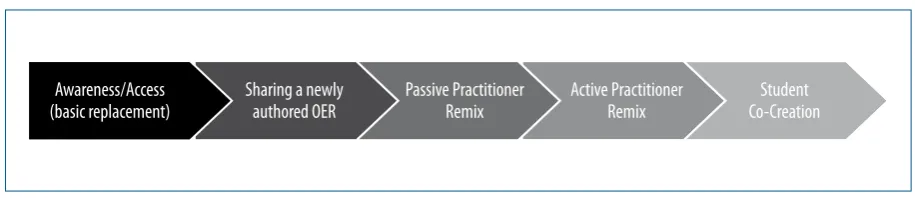
[image:6.595.69.527.519.618.2]It is proposed that there are five stages of adoption for OER in a Higher Education context (Figure 1) in which both the complexity of use and maturity of OEP are expressed. This model approaches OER adoption from the practitioner perspective only, but acknowledges the impact and constraints of the institutional environment as previously discussed. A parallel secondary model could be developed to describe the institutional environment, but for now, the focus is on practitioner attributes. It should also be noted that this model does not presuppose a linear journey, and each stage is not co- or pre-dependant on the previous one. For example, a practitioner may begin their interaction with openness at the ‘Active Remix’ stage without first progressing through the other three stages.
Figure 1:Continuum of open practice
Awareness/Access
(basic replacement) Sharing a newly authored OER Passive Practitioner Remix Active Practitioner Remix Co-CreationStudent
It is for this lack of inter-dependent activities that practice is graphically represented as a continuum and not a hierarchy. By presenting practice as a series of stages, the model does not infer that any activity is necessarily of greater worth – the alignment between the practitioner activity and their teaching (and institutional) context would instead act as the yardstick. It does, however, suggest that practitioner activities further to the right of the continuum are generally more complex undertakings.
1. Description, which provides an overview of the types of activities and objectives sought at that stage. 2. Practitioner Behaviours, which act as ‘evidence’ that a practitioner is engaging with OEP at this stage.
The stages can be described thusly:
(Stage 1) Awareness/Access:
• Description
The practitioner is aware of OER and seeks to include open material in their courses. However, OER may be seen as merely replacing proprietary content, essentially a ‘swap in/swap out’ proposition for the creation of a course.
Many institutions face a challenge to even reach this stage (Bossu et al., 2012; Dimitriadis, McAndrew, Conole, & Makriyannis, 2009; Harishankar et al., 2013). There may be little institutional policy, clarity or support at this stage and it is possible that OEP is poorly understood and fragmented.
• Practitioner Behaviours
Examples would include; adopting an open textbook to replace an existing text, replacing student readings with material from the Directory of Open Access Journals (DOAJ), or replacing images in a lecture with openly-licenced counterparts. In most cases, the teaching practice remains the same; only the content changes.
The practitioner will either have a working knowledge of Creative Commons Licencing, or direct access to a supporting role (such as a copyright officer, learning designer or librarian). At this stage, the primary mediating artefacts are (often generic) centrally delivered professional development, and the support mechanism (a human or online/automated resource). Professional development may include self-discovered externally offered opportunities (such as open webinars or micro-courses) that may supplement – or substitute – deliberately designed institutional professional development.
(Stage 2) Original Sharing
• Description
activities linked to “use of OER” as higher than “development of OER” (against a five point scale). Those reporting that they Often or Very Often used OER unaltered represented 22%, compared to 12% answering the same categories for developing OER. When the Sometimes frequency is added to those figures, they become 57% and 28% respectively. It is acknowledged, though, that this is representative of the Australian experience. Other countries, notably the examples from Asia referenced earlier, may show very different practitioner trends.
• Practitioner Behaviours
The motives for original sharing will vary between open practitioners, but the intent remains constant – to provide open access to their work. Sharing may be via an institutional repository (if one exists), an external repository (institutional intellectual property policies allowing), or may even be an ad-hoc solution such as a personal blog or similar web space. Sometimes this behaviour may be in response to remixing an OER with a Share-Alike licence component – thus sharing the resulting work is an obligation of (re)use.
The practitioner realises that there are other stakeholders in this process (such as heads of discipline, school, or faculty, librarians, learning designers, repository staff, institutional policy makers, and students), a concept that underpins OEP (Ehlers, 2011).
Institutional support becomes a critical enabler or barrier to engagement – from licencing advice, to the intellectual property policies, to the guidelines (if any) for where and how the OER can be stored.
(Stage 3) Passive Remix
• Description
A passive remix occurs when a practitioner locates a single artefact which aligns well (but not completely) to their learning and teaching needs, and the decision is made to localise the content. The practitioner changes the content (either superficially or substantively) to suit the local context, and then releases the work. At this stage, the focus may be on context-driven reuse, rather than sharing.
• Practitioner Behaviours
The open practitioner understands how to locate, reuse, attribute, and release a repurposed OER within the boundaries of their organisational environment. The practitioner will consider the remix in terms of appropriateness for local discipline context, and this consideration will be driven by learning and teaching needs. The reuse of the resource is not divorced from context, and as such, the practitioner is engaging with OEP (Ehlers & Conole, 2010) rather than simply with OER. However, the practitioner is repurposing a resource that is ‘almost fit for purpose’ and the reuse is reliant on substitution of contextually-appropriate information within the resource.
(Stage 4) Active Remix
• Description
This stage is differentiated by the scope of change considered by the practitioner. Rather than changes based on substitution, multiple open resources are blended into a new resource. Examples of this practice in action would be that a lecturer changing the resource to support a different pedagogical approach (such as taking a single reading and recasting it as resource catalyst for an introduction to problem-based learning in a course), or even be purely aesthetic (taking a resource and adding openly-licenced photographs, diagrams, or even multimedia to enhance the perceived production values).
• Practitioner Behaviours
The complexity at this stage is applied knowledge of licence compatibility. Whereas previous stages required knowledge of individual types of open licencing, the ‘Active Remix’ blends resources which may have different licencing requirements. These need to be internally compatible (able to be remixed), but the practitioner needs to be mindful of institutional requirements. The additional element is that of compatibility with the learning design. The practitioner is required to blend the resources with local context, discipline knowledge, and preferred pedagogies to create a meaningful learning asset. They may need to call upon other areas of expertise within the institution to achieve their goal. These areas may include academic developers, learning designers, copyright officers, librarians, and discipline peers, with each providing a discrete amount of support which is incorporated into the whole.
The other driver will be scope of resource. The support required to repurpose a single learning activity will be different from that required of the lecturer who is designing an entire open credit-bearing course.
(Stage 5) Developing (Student Co-Creation)
• Description
Engagement with OEP potentially creates learning environments that “empower learners as co-producers on their lifelong learning path” (Ehlers & Conole, 2010, p. 3). At this stage, students become involved in the discovery, use, and reuse of OER to support active learning.
• Practitioner Behaviours
This stage allows for open collaboration and community engagement. For example, an open repository or community-based open source software site may post a list of work that needs to be completed, and ask for volunteers. A university computer programming course could set these tasks as formal assessment. The students authentically contribute to the open community, whilst receiving formal credit (in terms of their course completion) at the same time.
In this type of environment, students are actively applying their discipline knowledge to create appropriate resources as part of a co-constructed learning experience. Resources created within the course can be curated by the lecturer and made available to subsequent cohorts (who may further remix the work).
Support mechanisms for the continuum
The activities described by the continuum are usually made possible by either some measure of support or intrinsically-motivated self-directed investigation by the new open practitioner. These are the practical considerations that need to be addressed by any institution seeking to engage with OEP.
All stages of the continuum inherently feature OER use. When the process is unpacked, it becomes apparent that this can be a complex undertaking, supported by some or all of the following:
• an understanding of how to search for, evaluate, and select openly-licenced content for a specific learning context;
• a working knowledge of Creative Commons and Free Cultural Licences, as well as Public Domain, including knowledge of licence compatibility, and the inherent obligations that each type of licence carries;
• a working knowledge of the local institutional policies and priorities; • the ability to integrate the newly-created OER into the curriculum; and
• a supporting mechanism (such as a repository) to store the newly created OER, and allow for global discover-ability.
At each step, the absence of mediating artefacts or a supportive institutional environment can inhibit a practitioner’s ability to engage fulsomely with OEP. Whilst ‘mediating artefact’, refers to items that “can be used to create and support the use of OER”, including “tools and resources” as well as “technologies to support the hosting and management [of OER]” (Ehlers & Conole, 2010, p. 2). Later work, however, acknowledges the role of professional development workshops and the pedagogical approach of a course as mediating artefacts (Dimitriadis et al., 2009). At the practitioner level, it can be reasonably argued that these human resources (such as librarians, copyright officers, learning designers, repositories and learning systems managers) are critical enabling factors.
Whilst the focus of this article is a model to describe OEP adoption at the practitioner level, it can be inauthentic to examine the practitioner without an understanding of their local institutional environment and the factors that can enable or inhibit them.
• intellectual property policies that allow for the use of OER, but prohibit the sharing of material created as part of an employee’s regular duties (Atkins, Brown, & Hammond, 2007; Masson & Udas, 2009);
• lack of institutional support for OEP (Geser, 2012);
• the lack of a high-level champion (Hylen, 2006) willing to embed, sustain and provide practical resourcing for OEP;
• the lack of professional development opportunities for staff (Downes, 2007);
• the perception that OEP is separate from ‘core’ learning and teaching priorities (Atkins et al., 2007); and • a lack of appropriate business models that support OEP (Butcher & Hoosen, 2012).
Personal perceptual factors about open resources also play a role in a practitioners’ desire to engage with OEP, especially in terms to how they view course design and supporting resources. Traditionally, lecture recordings and notes have been highly reliant on third-party-copyright material. In order to share resources with an open licence, this material must be removed (and ideally substituted with open material). Some academic staff have reported a reluctance to share ‘pared down’ resources for fear of reputational damage (Boulos, Maramba, & Wheeler, 2006). Likewise, fear that a remixed version of a staff member’s work will reflect poorly on the original author (Boulos et al., 2006) has also been reported.
Future research directions: students – the missing voice in OEP?
This model was developed for application to staff, but it is contended that it could not be adapted to describe student use of OER. The role of the pedagogical approach as a mediating artefact for students was previously mentioned (Dimitriadis et al., 2009), and this model could be repurposed to identify the scaffolding needs for students to complete learning activities based on an engagement with open resources.
This conceptual model is part of the author’s PhD work and as such will require further testing for validity as this study progresses. At this stage, it represents a synthesis of existing models, but adds to them behaviours to evidence each stage of practice, and focuses on the enablers to successfully support practitioners at each stage. Further research will refine this model.
Conclusions
References
Armellini, A., & Jones, S. (2008). Carpe diem: seizing each day to foster change in e-learning design. Reflecting education 4(1), 17-29.
Armellini, A., & Nie, M. (2013). Open educational practices for curriculum enhancement. Open Learning: The Journal of Open, Distance and e-Learning, 28(1), 7-20. doi http://dx.doi.org/10.1080/02680513.2013.796286
Atkins, D., Brown, J., & Hammond, A. (2007). A review of the Open Educational Resources (OER) movement: achievements, challenges, and new opportunities (Research report). California: William and Flora Hewlett Foundation.
Beaven, T. (2013). Qualitative methods for researching teachers’ (re)use of OER. Paper presented at OER13: creating a virtuous circle, Nottingham, UK.
Bossu, C., Bull, D., & Brown, M. (2012). Opening up Down Under: the role of open educational resources in promoting social inclusion in Australia. Distance Education, 33(2), 151-164. doi 10.1080/01587919.2012.692050
Bossu, C., Brown, M., & Bull, D. (2013). Adoption, use and management of open educational resources to enhance teaching and learning in Australia: final report to the Office for Learning & Teaching (Research report). Australia: Office of Learning and Teaching.
Boston Consulting Group (2013). The Open Education Resources ecosystem: an evaluation of the OER movement’s current state and its progress toward mainstream adoption (Research report). California: William and Flora Hewlett Foundation.
Boulos, M. N., Maramba, I., & Wheeler, S. (2006). Wikis, blogs and podcasts: a new generation of Web-based tools for virtual collaborative clinical practice and education. BMC Medical Education, 6(41). doi http://dx.doi. org/10.1186/1472-6920-6-41
Butcher, N., & Hoosen, S. (2012). Exploring the business case for Open Educational Resources. Vancouver: Commonwealth of Learning.
Conole, G. (2013). Designing for learning in an open world (Vol. 4). New York, NY: Springer. doi http://dx.doi. org/10.1007/978-1-4419-8517-0
Conrad, D., Mackintosh, W., McGreal, R., Murphy, A., & Witthaus, G. (2013). Report on the assessment and accreditation of learners using OER (Research report). Vancouver: Commonwealth of Learning.
D’Antoni, S. (2008). Open Educational Resources: the way forward, deliberations of an international community of interest
(Research report). Vancouver: Commonwealth of Learning.
Davis, H., Carr, L., Hey, J., Howard, Y., Millard, D., Morris, D., & White, S. (2010). Bootstrapping a culture of sharing to facilitate Open Educational Resources. IEEE transactions on learning technologies, 3(2), 96-109. doi http://dx.doi. org/10.1109/TLT.2009.34
Dhanarajan, G., & Abeywardena, S. (2013). Higher education and open educational resources in Asia: an overview In G. Dhanarajan & D. Porter (Eds.), Open educational resources: an Asian perspective (pp. 3-20). Vancouver: Commonwealth of Learning and OER Asia.
Dimitriadis, Y., McAndrew, P., Conole, G., & Makriyannis, E. (2009). New design approaches to repurposing open educational resources for collaborative learning using mediating artefacts. Paper presented at Same places, different spaces. Proceedings ascilite, Auckland
Downes, S. (2007). Models for sustainable Open Educational Resources Interdisciplinary journal of knowledge and learning objects 3, 29-44.
Ehlers, U., & Conole, G. (2010). Open Educational Practice: unleashing the power of OER. Paper presented at the UNESCO workshop on OER, Windhoek, Namibia.
Ehlers, U-D. (2011). From Open Educational Resources to Open Educational Practices. eLearning Papers, 23, 8-8. Falconer, I., McGill, L., Littlejohn, A., & Boursinou, E. (2013). Overview and analysis of practices with Open Educational
Resources in adult education in Europe. In C. Redecker, J. Munoz, & Y. Punie (Eds.), JRC scientific and policy reports. Luxembourg.
Geith, C., & Vignare, K. (2008). Access to education with online learning and Open Educational Resources: can they close the gap? Journal of asynchronous learning networks, 12(1), 1-22.
Geser, G. (2012). Open educational practices and resources - OLCOS roadmap 2012. Retrieved from http://www.olcos. org/cms/upload/docs/olcos_roadmap.pdf
Glennie, J., Harley, K., Butcher, N., & van Wyk, T. (Eds.). (2012). Open Educational Resources and change in Higher Education: reflections from practice: perspectives on open and distance learning. Vancouver: commonwealth of Learning.
Harishankar, V., Balaji, V., & Ganapuram, S. (2013). An assessment of individual and institutional readiness to embrace open educational resources in India. In G. Dhanarajan & D. Porter (Eds.), Open educational resources: an Asian perspective (pp. 53-72). Vancouver: Commonwealth of Learning and OER Asia.
Harley, D. (2008). Why understanding the use and users of open education matters. In T. Iiyoshi & M. Kumar (Eds.),
Opening up education: the collective advancement of education through open technology, open content, and open knowledge (pp. 197-211). Cambridge, MA: The MIT Press.
Herbsleb, J., & Goldenson, D. (1996). A systematic survey of CMM experience and results. Paper presented at the Proceedings of the 18th international conference on software engineering, Berlin. Retrieved from http:// herbsleb.org/web-pubs/pdfs/herbsleb-systematic-1996.pdf
Hylen, J. (2006, August). Open educational resources: opportunities and challenges. Paper presented at the 2006 Open Education Conference, Paris, France. Retrieved from http://www.oecd.org/edu/ceri/37351085.pdf
Keller, P., & Mossink, W. (2008). Reuse of material in the context of education and research. Netherlands: Creative Commons Nederland.
Malik, N. (2013). The genesis of OER at the Virtual University of Pakistan. In G. Dhanarajan & D. Porter (Eds.), Open educational resources: an Asian perspective (pp. 133-140). Vancouver: Commonwealth of Learning and OER Asia. Masson, P., & Udas, K. (2009). An agile approach to managing open educational resources. On the horizon 17(3),
256-266. doi http://dx.doi.org/10.1108/10748120910993286
Masterman, L., & Wild, J. (2011). JISC Open Educational Resources programme: Phase 2 OER impact study (Research Report). United Kingdom: JISC.
Masterman, L., & Wild, J. (2013). Reflections on the evolving landscape of OER use. Paper presented at OER13: creating a virtuous circle, Nottingham, UK.
Mawayo, M., & Butcher, N. (2012). Sharing existing teaching materials as OER: key considerations from practice. In J. Glennie, K. Harley, N. Butcher, & T. van Wyk (Eds.), Open educational resources and change in higher education: reflections from practice. Vancouver: Commonwealth of Learning.
OECD (2007). Giving knowledge for free: the emergence of Open Educational Resources. France: OECD.
Papachristou, N., & Samoff, J. (2012). Open educational resources: a survey of academic publications. In J. Glennie, K. Harley, N. Butcher, & T. van Wyk (Eds.), Open educational resources and change in higher education: reflections from practice. Vancouver: Commonwealth of Learning.
Paulk, M., Curtis, B., Chrissis, M., & Weber, C. (1993). Capability Maturity Model for software, version 1.1 (Vol. Technical report CMU/SEI-93-TR-024 ESC-TR-93-177). Pittsburgh, PA: Carnegie Mellon University.
Smith, M, & Casserly, C. (2006). The promise of Open Educational Resources. Change magazine, Fall, 1-14.
van Wyk, T. (2012). Taking OER beyond the OER community: policy issues and priorities. In J. Glennie, K. Harley, N. Butcher, & T. van Wyk (Eds.), Open Educational Resources and change in Higher Education: reflections from practice. Vancouver: Commonwealth of Learning
Wiley, D., & Gurrell, S.. (2009). A decade of development. Open Learning: The Journal of Open, Distance and e-Learning, 24(1), 11-21. doi http://dx.doi.org/10.1080/02680510802627746
Yamada, T. (2013). Open educational resources in Japan. In G. Dhanarajan & D. Porter (Eds.), Open educational resources: an Asian perspective (pp. 85-106). Vancouver: Commonwealth of Learning and OER Asia.
About the author
Adrian StaggeLearning Designer, University of Southern Queensland, Australia
Adrian Stagg is currently the eLearning Designer for the University of Southern Queensland. He has spent over 14 years in both public and academic libraries, and holds a Master of Applied Science (Library and Information Management). His interests in Open Educational Practice (OEP) have prompted the commencement of a PhD at the University of Tasmania focusing on the practitioner experience in the reuse of Open Educational Resources (OER). Adrian has authored research publications covering information literacy in Higher Education, the First Year Experience (FYE), and the use of technology in education (such as screen-casting and student response devices).
University of Southern Queensland West Street
Toowoomba Q4350 Australia