Method
Article
Validation
of
an
optimised
protocol
for
quanti
fi
cation
of
microplastics
in
heterogenous
samples:
A
case
study
using
green
turtle
chyme
Alexandra
G.M.
Caron
a,b,c,
Colette
R.
Thomas
b,d,
Kathryn
L.E.
Berry
a,c,
Cherie
A.
Motti
a,*
,
Ellen
Ariel
e,
Jon
E.
Brodie
fa
AustralianInstituteofMarineSciencePM3,TownsvilleMC,QLD4810,Australia
b
CentreforTropicalWaterandAquaticEcosystemResearch(TropWATER),JamesCookUniversity,Townsville 4811,Australia
c
AIMS@JCU,AustralianInstituteofMarineScienceandJamesCookUniversity,Townsville,Australia
d
SEEDScience,Australia
eCollegeofPublicHealth,MedicalandVeterinarySciences,JamesCookUniversity,Townsville4811,Australia fARCCentreofExcellenceforCoralReefStudies,JamesCookUniversity,Townsville4811,Australia
ABSTRACT
Quantifyingtheextentofmicroplastic(<5mm)contaminationinthemarineenvironmentisanemergingfieldof
study.Reliableextractionofmicroplasticsfromthegastro-intestinalcontentofmarineorganismsiscrucialto
evaluatemicroplasticcontaminationinmarinefauna.Extractionprotocolsandvariationsthereofhavebeen
reported,however,thesehavemostlyfocussedonrelativelyhomogenoussamples(i.e.water,sediment,etc.).
Here,wepresentamicroplasticextractionprotocolforexamininggreenturtle(Cheloniamydas)chyme(i.e.
ingestedmaterialanddigestivetractfluid),whichisaheterogeneouscompositeofvariousorganicdietaryitems
(e.g.seagrass,jellyfish)andincidentally-ingestedinorganicmaterials(sediment).Establishedextractionmethods
weremodifiedandcombined.Thisprotocolconsistsofaciddigestionoforganicmatter,emulsificationofresidual
fat,densityseparationfromsediment,andchemicalidentificationbyFouriertransform-infraredspectroscopy.
Thisprotocolenablestheextractionofthemostcommonmicroplasticcontaminants>100mm:polyethylene,
high-density polyethylene, (aminoethyl) polystyrene, polypropylene, and polyvinyl chloride, with 100%
efficiency.Thisvalidatedprotocolwillenableresearchersworldwidetoquantifymicroplasticcontamination
inturtlesinareliableandcomparableway.
Abbreviations:SLS,sodiumlaurylsulphate;PE,polyethylene;HDPE,highdensitypolyethylene;PVC,polyvinylchloride;PP, polypropylene;PET,poly(ethyleneterephthalate);AM-PS,(aminoethyl)polystyrene;RO,reverseosmosis;ATR-FTIR,attenuated totalreflectanceFouriertransform-infraredspectroscopy.
*Correspondingauthorat:AustralianInstituteofMarineSciencePM3,TownsvilleMC,QLD4810,Australia.
E-mailaddresses:[email protected](A.G.M. Caron),[email protected](C.R. Thomas),
[email protected](K.L.E.Berry),[email protected](C.A. Motti),[email protected](E.Ariel),
[email protected](J.E. Brodie).
https://doi.org/10.1016/j.mex.2018.07.009
2215-0161/©2018TheAuthors.PublishedbyElsevierB.V.ThisisanopenaccessarticleundertheCCBYlicense(http:// creativecommons.org/licenses/by/4.0/).
ContentslistsavailableatScienceDirect
MethodsX
Optimization ofmicroplasticextraction from multifarioustissues byapplyingestablished methodsin a
sequentialmanner.
Effectiveforheterogenoussamplescomprisingorganicandinorganicmaterial.
©2018TheAuthors.PublishedbyElsevierB.V.ThisisanopenaccessarticleundertheCCBYlicense(http://
creativecommons.org/licenses/by/4.0/).
ARTICLE INFO
Methodname:Sequentialprotocolforextractingmicroplasticsfromheterogenoussamplematrices
Keywords:Plasticingestion,Marinedebris,Plasticcontamination,Extractiontechnique,Chemicaldigestion,Densityseparation, Fouriertransform-infraredspectroscopy
Articlehistory:Received28March2018;Accepted11July2018;Availableonlinexxx
SpecificationsTable
Subjectarea EnvironmentalScience
Morespecificsubjectarea Marinepollution
Methodname Sequentialprotocolforextractingmicroplasticsfromheterogenoussamplematrices
Nameandreferenceof originalmethod
Nitricaciddigestion:Claessens,M.,VanCauwenberghe,L.,Vandegehuchte,M.B.,Janssen,C. R.,2013.Newtechniquesforthedetectionofmicroplasticsinsedimentsandfieldcollected organisms.Mar.Pollut.Bull.70,227–233.doi:https://doi.org/10.1016/j.
marpolbul.2013.03.009
Densityseparation:Hidalgo-Ruz,V.,Gutow,L.,Thompson,R.C.,Thiel,M.,2012.Microplastics inthemarineenvironment:Areviewofthemethodsusedforidentificationand quantification.Environ.Sci.Technol.46,3060–3075.doi:https://doi.org/10.1021/es2031505
FTIRspectroscopy:Hidalgo-Ruz,V.,Gutow,L.,Thompson,R.C.,Thiel,M.,2012.Microplastics inthemarineenvironment:Areviewofthemethodsusedforidentificationand quantification.Environ.Sci.Technol.46,3060–3075.doi:https://doi.org/10.1021/es2031505
Kroon,F.,Motti,C.,Talbot,S.,Sobral,P.,Puotinen,M.,2018.Aworkflowforimproving estimatesofmicroplasticcontaminationinmarinewaters:Acasestudyfrom North-WesternAustralia.EnvironmentalPollution,238,26–38.
Thompson,R.C.,Olsen,Y.,Mitchell,R.P.,Davis,A.,Rowland,S.J.,John,A.W.G.,McGonigle,D., Russell,A.E.,2004.Lostatsea:Whereisalltheplastic?Science304,838.doi:https://doi. org/10.1126/science.1094559
Jung,M.R.,Horgen,F.D.,Orski,S.V,C,V.R.,Beers,K.L.,Balazs,G.H.,Jones,T.T.,Work,T.M., Brignac,K.C.,Royer,S.,Hyrenbach,K.D.,Jensen,B.A.,Lynch,J.M.,2018.ValidationofATR FT-IRtoidentifypolymersofplasticmarinedebris,includingthoseingestedbymarine organisms.Mar.Pollut.Bull.127,704–716.doi:https://doi.org/10.1016/j.
marpolbul.2017.12.061
Resourceavailability Hardware: Extraction:
Aluminiumtraysandfoil
Blockheater(80C,modelAIM500,SEALAnalytical)
Branson12200UltrasonicClearer
Coveredglassdishes(shallow,flatbottomed,5cmdiameter) Freezer( 20C)
Fridge(4C)
Glassbeakers(200mL) GlassPasteurpipette Glassstirringrod Glasstesttubes(50mL)
GlassVacuum-filterapparatus(glassfritBuchnerfunnelwithmetalclampandvacuum Erlenmeyerflask;Millipore)
Hotplate(50C,StuartCB160)
Lintfreetissue
Maggylamp(2magnification) Metalbucket
Metalneedles Metaltweezers Metalteaspoon
Oven(60C) Paperclip
Pliablesteelfabricwithameshsizeof100mm Steelmeshsieve(100mm,20cmdiameter) Analysis:
PerkinElmerSpectrum100InfraredSpectrometerwithAttenuatedTotalReflectance Software:
PerkinElmerSpectrum(V.10.5.4);NICODOMIRlibraries(PolymersandAdditives, Coatings,Fibres,DyesandPigments,PetrochemicalsFullVersion;NICODOMLtd.,Czech Republic)
Reagents:
Chemicaldigestion:Nitricacid(HNO3,69.5%,Scharlau)
Densityseparation:NaClsolution,1.2g/cm3
,SigmaAldrich
Emulsification:sodiumlaurylsulphatepellets(SLS,AcrosOrganics,CASnumber 151-21-3)
Fouriertransform-infraredspectroscopy:methanol Reverseosmosiswater
Methoddetails
Protocolbackground
Plasticsareubiquitousandwidespreadinthemarineenvironment;pollutingtheoceansurface, watercolumn, and benthos [1–3]. Theyare broadly divided intotwo categories; macroplastics (>5mm)andmicroplastics(<5mm,[4,5]),andmainlyimpactmarinelifethroughtheprocessesof entanglementandingestion[6].Allseventurtlespeciesareknowntobeaffectedbyplasticdebris globally[7–10].Unlikeothermarineorganisms,theherbivorousfeedingstrategiesofgreenturtles make them highly susceptible to ingestion of marine debris [11,12]. Plastic debris can become entangled among green turtle food sources such as seagrass leaves and macroalgae [13]. The backward-facing oesophageal papillae of turtles inhibits regurgitation and facilitates particle accumulationinthegut[14–16].Chyme(i.e.ingestedmaterialanddigestivetractfluid)from non-pelagicgreenturtlesisexpectedtoberelativelycomplex,comprisingarangeoforganic(plantand animalmaterial)andinorganic(mineralandsediment)matrices,astheirbroaddietincludesjellyfish, sponges,seagrass,algaeandassociatedsedimentsandepibionts[37].Therefore,aprotocolcapableof efficientlyextractingmicroplasticsfromallmatricesisrequiredtoaccuratelyestablishcontamination levels.
Methodsforextractingmicroplasticshavebeendevelopedforarangeofrelativelyhomogeneous samplematricesandinclude:visualassessmentusingmicroscopy[17],densityseparationusing hypersaline solutions [18–21] and chemical digestion [18,22–24]. Many of these methods are suitableandefficientforeitherhomogenouslyorganicorhomogenouslyinorganicsamplematrices; however,eachofthemalonearenotsuitableformicroplasticextractionfromgreenturtlechyme. Herewetestseveralmicroplasticextractionmethodsandreagentvariationsincombinationusinga processofeliminationtoidentifytheoptimalstepsnecessarytoestablisharobustandreliableway toextractandquantifymicroplasticcontaminationinavarietyofheterogeneousmarineorganism tissues.
Materialandmethods
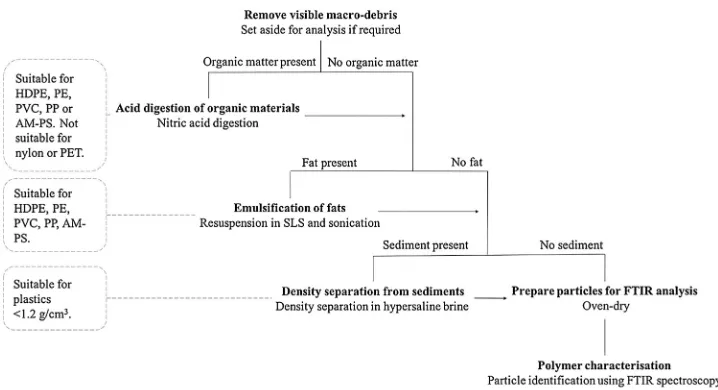
AsummaryofthemicroplasticsequentialextractionprotocolispresentedinFig.1.
Samplepreparation
Materials.
Aluminiumtraysandfoil
Freezer( 20C)
Fridge(4C)
Largeglassbeakerormetalbucket,tofitchyme
Largemetalspoonorladle
ROwater
Steelmeshsieve(100
m
m,20cmdiameter)Procedure.
Greenturtlesthathadbeeneitherfounddeadorrequiredeuthanizingwerekindlymadeavailable byQueenslandParks and WildlifeService (QPWS).Necropsies wereundertaken bya qualified veterinary pathologist. Foreguts (including oesophagus, stomach, and small intestine) were necropsied,therestofthedigestivetractbeingrequiredforadifferentstudy.Anteriorandposterior extremitiesofthetractswereclosedwithnon-plasticstringspriortoremoval.Tractswereextracted fromturtlecavitiesandstoredinaluminiumtraysandfoil,andfrozenat 20Cwithinafewhours. Tractswerethawedinafridgeat4Cfor48hpriortoanalysis.
Collectchymefromgreenturtledigestivetractandtransferitintoaglassormetalcontainer.Mostof thechymecanbecollectedusingametalspoonorladle.Tocollectchymeadheredtothe gastro-intestinaltract,rinsetractwithROwaterovera100
m
msteelmeshsieveandaddretainedresidueto thechyme.Thefiltrate,being<100m
misdiscarded.Visuallyinspectthechymeandremoveanyvisiblemacro-debris(i.e.rope,fishingline,bags,bottle lids,etc.).RinsethemwithROwaterover100
m
msteelmeshsieveandaddretainedresiduetothe chymetoassureminimallossofpotentialmicroplastics.Thefiltrate,being<100m
misdiscarded.Homogenisethechymebymanualstirringforoneminutewithametalspoon(excessivemechanical stirringorsonicationshouldbeavoidedtoreducethelikelihoodoflargerbrittleplasticitemsfurther fragmenting).Thoroughhomogenisationofthechymeismandatoryespeciallyifanalysingonlya
[image:4.468.56.415.63.258.2]subsampleofthewholechyme,asplasticdebristendtoaccumulateinsomepartsofgreenturtle digestivetract[7,25].
WeighthechymesampletodeterminethenumberoftesttubesandvolumeofHNO3required(see
Aciddigestionoforganicmaterials).
Aciddigestionoforganicmaterials
Materials.
Aluminiumfoil
Blockheater(80C,modelAIM500,SEALAnalytical)
Glassbeaker(500mL,ortofitvolumeofsamplesandHNO3)
Glassstirringrod
Glasstesttubes(50mL)
Metalteaspoon
Nitricacid(HNO3,69.5%,Scharlau)
Paperclip
Pliablesteelfabricwithameshsizeof100
m
mROwater
Procedure.
Put6gwetweight(w/w)ofhomogenisedchymeper50mLtesttubeusingametalteaspoon. Wherechymefromanindividualis>6g,thesampleshouldbesplitandmultipletesttubesused.
Add18mLofHNO3toeachsample(ratio3:1,HNO3mL:chymegw/w).
Placethetesttubesintotheblockheater.Coverthetesttubeswithaluminiumfoilandletthemsit overnightatroomtemperature(20C).
Uncoverthetesttubesandheatsamplesfortwohoursat80Cintheblockheater.Testtubesshould beclosely monitored.Theycanbecautiouslystirredwitha glassstirringrodtomake sureall materialsremainimmersedandtominimisefoaming.
Filtersampleswhilestillwarmoverthe100
m
msteelmeshsieve.Tofilter,foldthe100m
mmesh intoaconicalshapeandsecurewithapapercliptoasuitably-sizedglassbeaker.Allowretained materialtogatheratthebottomoftheconeforeaseofrinsingandcollection.Discardtheacidsolutiondownthesinkwithtentimesitsvolumeoftapwatertoneutralizeit.
RinsecollectedmaterialswithROwateroverthesinkanddiscardfiltrate.Whilestillinthesieve, visuallyinspectthedigestedsampleforundigestedfatresidueand sediment.Iffatresiduesare observedproceedwiththeemulsificationmethod(Fig.1;seeEmulsificationoffats).Ifnofatresidues areobservedbutsediment ispresent,proceedwiththedensityseparationmethod(seeDensity separationfromsediments).Ifnofatresiduesorsedimentarepresent,proceedwithfiltration(see Filtration).
Note. Chyme fromdifferentturtlescan have differentreactivity toHNO3,especially during the
heatingstep.Veryreactivesamplescanproduceanunmanageableamountofhazardousfoaming. Runningatestpriortoapplyingthismethodtoalargenumberofsamplesisrecommended.Reduce thequantityofsampleinthetesttubeifthechymereactstoostronglytoHNO3.
Depending on the composition and complexity of the samples, multiple samples from one individualcanbecombinedatthefiltrationstep.Actaccordingtotheamountofresidueretained. Combiningtheresidue reducesthenumberof samplestobeprocessed insubsequentstepsand streamlinestheoverallprocess.
Emulsificationoffats
Materials.
Glassbeaker(200mL)
GlassPasteurpipette
Glassstirringrod
Hotplate(50C,StuartCB160)
Metalteaspoon
Paperclip
Pliablesteelfabricwithameshsizeof100
m
mROwater
Sodiumlaurylsulphatepellets(SLS,100%,AcrosOrganics,CASnumber151-21-3)
Ultrasonicbath(47kHz6%,Branson12200UltrasonicClearer)
Procedure.
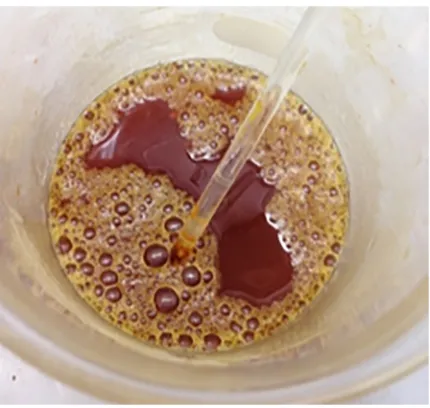
Prepareawarm1g/LSLSsolutionbyaddingSLSpelletstoROwaterona50Chotplate.Usethe glassstirringrodtostiruntilwelldissolvedandkeepat50Conthehotplate.
Re-suspendallretainedresidue(i.e.collectedonthe100
m
msieve,seeAciddigestionoforganic materials)remainingfromtheaciddigestioninthewarmSLSsolution.Todoso,placethesievemesh upside-downovera200mLglassbeakerandrinseitusingaglasspipetteandthewarmSLSsolution (50mLorenoughtoremoveallresidue).Onceallmaterialsaretransferredintotheglassbeaker, addextraSLSsolutiontogiveafinalvolumeof200mLifrequired.Sonicatefor 30sin an ultrasonic bath(47kHz6%). Avoidextended sonication toreducethe likelihoodoflargerbrittleplasticitemsfurtherfragmenting.
Filter samples while still warm over the100
m
msieve(as doneinAciddigestionof organic materials;fold the100m
mmeshintoaconicalshapeandsecurewithapapercliptoasuitably-sizedglassbeaker).DiscardSLSsolutiondownthesinkwithtentimesitsvolumeoftapwatertoneutralizeit.
Repeattheoperationuntilnofatresidueisobservedonthesieve.
RinseretainedmaterialswithROwateroverthesinkanddiscardfiltrate.Whilestillinthesieve, visuallyinspectretainedmaterialsforsediment.Ifsedimentisobserved,proceedwiththedensity separationmethod(Fig. 1,seeDensityseparationfromsediments).Ifnosedimentisobserved,proceed withfiltration(seeFiltration).
[image:6.468.130.345.64.268.2]Note. Thisemulsificationmethodwassuccessfulindissolvingdropletsoffats.Iftheamountoffat presentinthesamplesislarge,suchaschunks,orformsathicklayer,furtherhomogenizationmaybe necessary,ordifferentdigestionscouldbetested.ThiscouldincludesampledigestionusingKOH (needingfromafewdaystoafewweeksprocessing)whichhasbeensuccessfullyappliedtostomach contentoffish[22,26].Ifcombiningsamples(fromthesameindividual)afteraciddigestion,make suretovisuallyinspecttheretainedmaterialsonthesieve;itisimportanttomaintainamanageable amountoffatfortheemulsificationmethod.
Densityseparationfromsediments
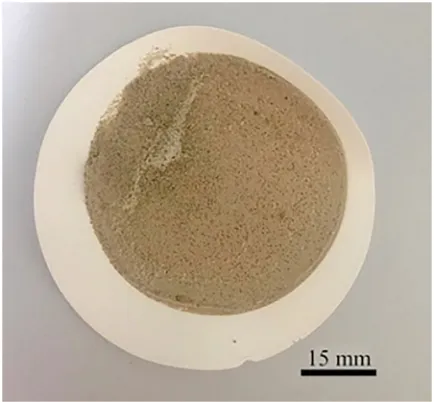
Proceedwithdensityseparationifsedimentispresentafterfiltration(i.e.eitherafteraciddigestion orafteremulsification;Fig.3).
Materials.
Aluminiumfoil
Glassbeakers(200mL)
GlassPasteurpipette
Glassstirringrod
NaCl(SigmaAldrich)
ROwater
Procedure.
Prepareahypersalinebrine(NaCl,1.2g/cm3)bysaturatingROwaterwithNaCl(watersolubilityat
20C=357g/L).NaClmustbeaddedwhilecontinuouslystirringuntilitnolongerdissolves. Re-suspendallretainedmaterialsfromthepreviousmethodused(eitheremulsificationoracid
digestion)in200mLofthehypersalinebrine.Todoso,placethesievemeshupside-downovera 200mLglassbeakerandrinseitusingaglasspipetteandthehypersalinebrine(50mLorenough toremoveall retainedmaterials).Once transferred,addextra hypersalinebrinetogivea final volumeof200mL.
Stirthesolutionwiththeglassstirringrodfor30s.Rinsethestirringrodwiththebrineintothe beakercontainingthesample.
[image:7.468.123.340.405.606.2]Coverthebeakerwithaluminiumfoilandallowtosettlefor1h.
Collectthetop20mLofthesolutionusingaglassPasteurpipetteandtransferittoaclean200mL glassbeaker.
RinsethepipettethreetimeswithROwaterintotheclean 200mLglassbeakertoremoveany particles that may have adhered tothe internal or external walls of the pipette. Discard the remaining180mLofbrineandsediment.
Note. MakesureNaClis freeofplasticcontamination;wherepossibleusescientificgradeNaCl. NaClinsoftplasticbagsorinplasticmeshbagscanbecomecontaminatedwithmicroplasticsasbags age and degrade.In addition, ensure the salt is stored in a covered, clean container, to avoid microfibercontaminationwhilethesaltisexposedtothelabair.Regardless,preparedNaClsolutions should bechecked for contamination priorto undertakingdensityseparation. If necessary, the solution should be filtered through cellulose nitrate/acetate 0.45
m
m pore membrane filters (MilliporeHA).Filtration
Materials.
Coveredglassdishes(shallow,flatbottomed,5cmdiameter).Adaptedsizetomatchthefilters.
GlassPasteurpipette
GlassVacuum-filterapparatus(glassfritBuchnerfunnelwithmetalclampandvacuumErlenmeyer
flask;Millipore)
Metaltweezers
MilliporeHAcellulosenitrate/acetate0.45
m
mporemembranefilters,larger(>100m
m)poresizes canbeusedtoselectivelyrecovermicroplasticsindifferentsizerangesOven(60C)
ROwater
Procedure.
Filterthecollected(lowdensity)supernatantfromthedensityseparationmethodundervacuum onto0.45
m
mporemembranefilters.WithROwater,rinsethewallofthe200mLglassbeakerinto thevacuum-filterapparatus a minimum of threetimes (oras much asneeded) torecoverall particles.If thedensity separation methodwas not used(i.e.no sediment was presentin the samples),materialscollectedonthe100m
msieveafterHNO3 digestionorafteremulsificationshouldbevacuum-filteredasabove.
Rinsethewallofthevacuum-filterfunnelthreetimeswithROwaterusingapipettetoensureall particlesareonthefilter.
Carefullyplaceeachfilterinacoveredglassdishusingmetaltweezers.
Oven-dryat60Cfor4h.
Visuallyinspectfiltersformicroplastics[17].CharacteriseparticlesusingFTIRspectroscopy(see Polymercharacterisation).
Polymercharacterisation
Polymer composition of recovered microplastics can be determined using FTIR spectroscopy [21,22,27–30].
Instrumentandsoftware.
PerkinElmerSpectrum 100 infraredspectrometer with attenuated total reflectance (ATR-FTIR) operatedwithPerkinElmerSpectrum(V.10.5.4)software
Materials.
Lintfreetissue(forcleaning)
Maggylamp(2magnification)
Metaltweezersandneedles
Methanol(forcleaning)
Procedure.
Noadditionaltreatmentofthemicro-particlesisnecessaryprior toFTIRanalysis.Macroplastics recovered duringthevisualinspectionofthechyme(see Samplepreparation)shouldberinsed thoroughlywithROwaterandoven-driedat60Cfor4hbeforeanalysisbyATR-FTIR.
PlaceindividualitemsontheATR diamondusingtweezersorneedles.Useapressureclampto ensuregoodcontactwiththesample.
AcquireFTIRspectraintransmissionmodeonaPerkinElmerSpectrum100FTIRSpectrometerusing anattenuated totalreflectance(ATR)accessoryas perKroonetal. [29]. UsetheData Tune-up commandtosmoothandperformabaselinecorrectionforallspectrausingdefaultPerkinElmer parameters.Inthisstudyspectraldatawereaccumulatedfor64scansat4cm 1resolutionwitha
wavenumber range of 4000–400cm 1 [22,27] using Euclidian distance against commercially
availableNICODOMIRlibrariesandapercentmatchbetweenthereferencespectraandthesample obtained.
AsperKroonetal.[29]sampleswithapercentmatchof<60%wereconsideredalowmatch,60–
<70%anintermediatematchand70–100%ahighmatch.Allspectramustbefurtherinspectedand anyunexplainedbandsinvestigatedbyreviewingthelowerpercentmatchesandtheliteratureto confirmpolymeridentification.
Protocolvalidationandsuitability
Protocolvalidation
The extractionefficiency of the sequential protocol was assessed by spiking three 6g (w/w) homogenisedchymesamples(seeSamplepreparation)withfivemicro-beads(high-density polyethyl-ene(HDPE);19248
m
m).Spikedsampleswerethenprocessedwiththesequentialprotocol.Since bothfatandsedimentswerepresentinthesesamples,allthreeextractionmethods:aciddigestion, emulsification of fats, and density separation, wereused. Every micro-bead was recovered; the extractionefficiencyoftheextractionprotocolwas100%forthe>100m
mHDPEmicro-beads.Toassessproceduralcontamination,threeblankscomprising6mLROwaterwereprocessedin accordancewiththesequentialextractionprotocol.Afteroven-drying,filterswerevisuallyinspected underadissectingmicroscopeandanyparticleorfibrepresentonthefilterswastreatedasprocedural contamination.Proceduralcontaminationblanksrevealedthepresenceofhair-likefibresandvery
finedarkparticles<100
m
moneachfilteraspreviouslyreportedbyFoekemaetal.[22].Becausethese particlesweresmallerthan100m
m,theydidn’tinterferewiththeextractionofmicroplasticssized >100m
mconductedwiththisprotocol.Ifthisprotocolisbeingadaptedtoinvestigatemicroplastics <100m
m, greater care must be taken to prevent procedural contamination. This could include wearingsynthetic-freenaturalfibreclothing[31]orworkinginasealeddamp-wipedroom[32].Protocolsuitability
Seventargetpolymerswereusedtotestthesuitabilityofthesequentialextractionprotocol:HDPE, polyethylene(PE), poly(ethyleneterephthalate) (PET),nylon (polyamide, PA),vinyl chloride/vinyl acetate/vinylterpolymer(PVC),(aminoethyl)polystyrene(AM-PS)andpolypropylene(PP).Tenpieces (1cmlong,cutusingascalpel)and20particles(<1mm2,grated)werepreparedfromeachpolymer
1Theareaofeachofthetenpieces(1cmlong)perpolymertypewasmeasuredusingthesoftware ImageJ1beforeandafteraciddigestionfollowedbyemulsification.AStudent'st-test(two-tailed, pairedsamples)wasrunwithanullhypothesisofnochangeintheareaofthepiecesbeforeand afterthedigestionandemulsificationmethods.
2Twentyparticles(<1mm2)perpolymertypewerealsosubjectedtoaciddigestionfollowedby
emulsification.Particleswerethenmanuallysortedandvisuallycounted.
3Ten pieces (1cm long) of the target polymers that were recovered after acid digestion and emulsification(i.e.notcompletelydegraded)weresubjectedtodensityseparation(NaCl, 1.2g/cm3).
Thecapacityofeachtreatedpolymertofloatorsinkwasrecorded.
4ATR-FTIRspectroscopywasusedtodeterminewhetherthesequentialextractionprotocolaffected polymer identification.The polymer composition of each plastic piece was measured prior to treatmentusingFTIRspectroscopy.Pieceswerethentreatedwiththeaciddigestionfollowedby emulsification.PiecesthatwererecoveredafterthesetwomethodswererinsedwithROwaterand oven-driedat60Cfor4hbeforerepeatingthechemicalanalysisusingFTIRspectroscopy.Apercent similarity,calculatedbycomparingtheFTIRspectraofthetreatedpolymersagainstthoseofthe untreatedpolymers(PerkinElmerCOMPAREalgorithm),wasusedtoassesschemicaldegradation.
HNO3digestioncompletelydissolvedallpiecesandallparticlesofPETandPA.Theprotocoldidnot
affectPE,HDPE,PVC,AM-PSandPP;100%recoverywasachievedandnochangeinsizeorchangein polymeridentificationwasobservedafterexposureofthesefivepolymertypestoaciddigestionand emulsification.
Thedensityseparationmethodissuitableforpolymerswithadensitylowerthanthehypersaline brine,i.e.
r
<1.2g/cm3.OfallpolymersinerttoHNO3digestion(i.e.PE,HDPE,PVC,AM-PSandPP),
onlyPVCwasnotrecoveredbydensityseparation,whichwasexpectedasitsdensityishigherthanthe hypersalinebrine(PVC
r
=1.16–1.58g/cm3,hypersalineNaClr
=1.2g/cm3).Torecoverawiderrangeofhigh-density polymers including PVC, solutions with a density >1.2g/cm3, such as sodium
polytungstate(1.4g/cm3[33]),orsodiumiodide(1.6g/m3[31])couldbeused.
AlimitationofusingHNO3digestionasaseparationmethodisanotablediscolourationofthe
target polymers tested. Thismakes comparison withother studies difficult, as moststudies on microplasticingestionbymarinebiotarelyonvisualinspectionusingmicroscopyastheprimary identification technique [1]. For this reason, werecommend using FTIRspectroscopy [19,30,34], whichallowscomparableresultsonpolymeridentificationandisgainingtractionasitbecomesless expensiveandmoresensitive.
Results
Thissequentialextractionprotocolallowstheextractionofmicroplasticsfromgreenturtlechyme with100%efficiencyfor>100
m
mmicroplasticsoffivecommonplasticpollutants:PE,HDPE,AM-PS, PPandPVC(PVCisonlyextractableifdensityseparationisnotused,i.e.ifsamplesdon’tcomprise sediment).Fourofthepolymertypesdeemedsuitableforthisextractionprotocolrepresent70%ofthe plasticsproducedgloballyin2007:HDPE=21%,PP=24%,PS=6%,PVC=19%[35].Usingthissequentialextractionprotocol,twomacroplasticsandsevenmicroplastics;twopaint chipsandfivemixed-yarnsyntheticplasticparticles,werefoundintheforegutoftwogreenturtles fromAustralia’sGreatBarrierReef[36].Theseresultshighlighttheneedforanalysisofanincreased samplesizeinordertoimproveourknowledgeofthemicroplasticloadofseaturtlesfromtheGreat BarrierReefWorldHeritageAreaandaroundtheworld.Thesequentialextractionprotocolvalidatedin thisstudywillenableresearchersworldwidetoquantifygreenturtlesmicroplasticcontaminationina reliableandcomparableway.
Acknowledgements
AppendixA.Supplementarydata
Supplementarymaterialrelatedtothisarticlecanbefound,intheonlineversion,atdoi:https://doi. org/10.1016/j.mex.2018.07.009.
References
[1]M.Cole,P.Lindeque,C.Halsband,T.S.Galloway,Microplasticsascontaminantsinthemarineenvironment:areview,Mar. Pollut.Bull.62(2011)2588–2597,doi:http://dx.doi.org/10.1016/j.marpolbul.2011.09.025.
[2]F.Galgani,G.Hanke,T.Maes,Globaldistribution,compositionandabundanceofmarinelitter,in:M.Bergmann,L.Gutow, M.Klages(Eds.),MarineAnthropogenicLitter,SpringerInternationalPublishing,2015,pp.29–56,doi:http://dx.doi.org/ 10.1007/978-3-319-16510-3.
[3]L.C. Woodall, A. Sanchez-Vidal, M. Canals, G.L.J. Paterson, R. Coppock, V. Sleight, A. Calafat, A.D. Rogers, B.E. Narayanaswamy,R.C.Thompson,Thedeepseaisamajorsinkformicroplasticdebris,R.Soc.OpenSci.1(2014) 140317,doi:http://dx.doi.org/10.1098/rsos.140317.
[4]D.K.A. Barnes, F. Galgani,R.C. Thompson,M. Barlaz, Accumulationand fragmentationof plastic debris inglobal environments,Philos.Trans.R.Soc.BBiol.Sci.364(2009)1985–1998,doi:http://dx.doi.org/10.1098/rstb.2008.0205. [5]C.J.Moore,Syntheticpolymersinthemarineenvironment:arapidlyincreasing,long-termthreat,Environ.Res.108(2008)
131–139,doi:http://dx.doi.org/10.1016/j.envres.2008.07.025.
[6]J.G.B.Derraik,Thepollutionofthemarineenvironmentbyplasticdebris:areview,Mar.Pollut.Bull.44(2002)842–852, doi:http://dx.doi.org/10.1016/s0025-326x(02)00220-5.
[7]K.E.Clukey,C.A.Lepczyk,G.H.Balazs,T.M.Work,J.M.Lynch,Investigationofplasticdebrisingestionbyfourspeciesofsea turtlescollectedasbycatchinpelagicPacificlonglinefisheries,Mar.Pollut.Bull.120(1-2)(2017)117–125,doi:http://dx. doi.org/10.1016/j.marpolbul.2017.04.064.
[8]S.C.Gall,R.C.Thompson,Theimpactofdebrisonmarinelife,Mar.Pollut.Bull.92(2015)170–179,doi:http://dx.doi.org/ 10.1016/j.marpolbul.2014.12.041.
[9]S.E.Nelms,E.M.Duncan,A.C.Broderick,T.S.Galloway,M.H.Godfrey,M.Hamann,P.K.Lindeque,B.J.Godley,Plasticand marineturtles:areviewandcallforresearch,ICESJ.Mar.Sci.73(2016)165–181,doi:http://dx.doi.org/10.1093/icesjms/ fsv165.
[10]C.K.Pham,Y.Rodríguez,A.Dauphin,R.Carriço,J.P.G.L.Frias,F.Vandeperre,V.Otero,M.R.Santos,H.R.Martins,A.B.Bolten, K.A.Bjorndal,Plasticingestioninoceanic-stageloggerheadseaturtles(Carettacaretta)offtheNorthAtlanticsubtropical gyre,Mar.Pollut.Bull.121(1-2)(2017)222–229,doi:http://dx.doi.org/10.1016/j.marpolbul.2017.06.008.
[11]A.P.M.DiBeneditto,D.R.Awabdi,Howmarinedebrisingestiondiffersamongmegafaunaspeciesinatropicalcoastalarea, Mar.Pollut.Bull.88(2014)86–90.
[12]Q.Schuyler,B.D.Hardesty,C.Wilcox,K.Townsend,Globalanalysisofanthropogenicdebrisingestionbyseaturtles, Conserv.Biol.28(2013)129–139,doi:http://dx.doi.org/10.1111/cobi.12126.
[13]D.R.Awabdi,S.Siciliano,A.P.M.DiBeneditto,Firstinformationaboutthestomachcontentsofjuvenilegreenturtles, Cheloniamydas,inRiodeJaneiro,south-easternBrazil,Mar.Biodivers.Rec.6(2013)1–6,doi:http://dx.doi.org/10.1017/ S1755267212001029.
[14]Q.A.Schuyler,C.Wilcox,K.Townsend,B.Hardesty,N.Marshall,Mistakenidentity?Visualsimilaritiesofmarinedebristo naturalpreyitemsofseaturtles,BMCEcol.14(2014)14,doi:http://dx.doi.org/10.1186/1472-6785-14-14.
[15]A.C.Vegter,M.Barletta,C.Beck,J.Borrero,H.Burton,M.L.Campbell,M.F.Costa,M.Eriksen,C.Eriksson,A.Estrades,K.V.K. Gilardi,B.D.Hardesty,J.A.IvardoSul,J.L.Lavers,B.Lazar,L.Lebreton,W.J.Nichols,C.A.Ribic,P.G.Ryan,Q.A.Schuyler,S.D.A. Smith,H.Takada,K.A.Townsend,C.C.C.Wabnitz,C.Wilcox,L.C.Young,M.Hamann,Globalresearchprioritiestomitigate plasticpollutionimpactsonmarinewildlife,Endanger.SpeciesRes.25(2014)225–247,doi:http://dx.doi.org/10.3354/ esr00623.
[16]J.Wyneken,TheAnatomyofSeaTurtles,U.S.Dep.Commer.,2001NOAATech.Memo.NMFS-SEFSC. [17]F.Norén,SmallPlasticParticlesinCoastalSwedishWaters,KIMO,Sweden,2007.
[18]M.Claessens,L.VanCauwenberghe,M.B.Vandegehuchte,C.R.Janssen,Newtechniquesforthedetectionofmicroplastics insedimentsandfieldcollectedorganisms,Mar.Pollut.Bull.70(2013)227–233,doi:http://dx.doi.org/10.1016/j. marpolbul.2013.03.009.
[19]V.Hidalgo-Ruz,L.Gutow,R.C.Thompson,M.Thiel,Microplasticsinthemarineenvironment:areviewofthemethodsused foridentificationandquantification,Environ.Sci.Technol.46(2012)3060–3075,doi:http://dx.doi.org/10.1021/es2031505. [20]J.Reisser,J.Shaw,C.Wilcox,B.D.Hardesty,M.Proietti,M.Thums,C.Pattiaratchi,Marineplasticpollutioninwatersaround Australia:characteristics,concentrations,andpathways,PLoSOne8(2013)e80466,doi:http://dx.doi.org/10.1371/journal. pone.0080466.
[21]R.C.Thompson,Y.Olsen,R.P.Mitchell,A.Davis,S.J.Rowland,A.W.G.John,D.McGonigle,A.E.Russell,Lostatsea:whereisall theplastic?Science304(2004)838,doi:http://dx.doi.org/10.1126/science.1094559.
[22]E.M.Foekema,C.DeGruijter,M.T.Mergia,J.A.vanFraneker,A.J.Murk,A.A.Koelmans,PlasticinNorthSeafish,Environ.Sci. Technol.47(2013)8818–8824,doi:http://dx.doi.org/10.1021/es400931b.
[23]T.M.Karlsson,A.D.Vethaak,B.Carney,F.Ariese,M.VanVelzen,M.Hassellöv,H.A.Leslie,Screeningformicroplasticsin sediment,water,marineinvertebratesandfish:methoddevelopmentandmicroplasticaccumulation,Mar.Pollut.Bull. (2017)0–1,doi:http://dx.doi.org/10.1016/j.marpolbul.2017.06.081.
[24]A.L.Lusher,G.Hernandez-milian,J.O’Brien,S.Berrow,I.O’Connor,R.Officer,Microplasticandmacroplasticingestionbya deepdiving,oceaniccetacean:thetrue’sbeakedwhalemesoplodonmirus,Environ.Pollut.199(2015)185–191. [25]A.S.Colferai,R.P.Silva-filho,A.Moreira,L. Bugoni,Distributionpatternofanthropogenic marinedebrisalongthe
[26]S.Kühn,B.VanWerven,A.VanOyen,A.Meijboom,E.L.Bravo,J.A.VanFraneker,Theuseofpotassiumhydroxide(KOH) solutionasasuitableapproachtoisolateplasticsingestedbymarineorganisms,Mar.Pollut.Bull.115(2017)86–90,doi: http://dx.doi.org/10.1016/j.marpolbul.2016.11.034.
[27]N.M.Hall,K.L.E.Berry,L.Rintoul,M.O.Hoogenboom,Microplasticingestionbyscleractiniancorals,Mar.Biol.162(2015) 725–732,doi:http://dx.doi.org/10.1007/s00227-015-2619-7.
[28]M.R.Jung,F.D.Horgen,S.V.Orski,C.VivianaRodriguez,K.L.Beers,G.H.Balazs,T.T.Jones,T.M.Work,K.C.Brignac,S.J.Royer, K.D.Hyrenbach,B.A.Jensen,J.M.Lynch,ValidationofATRFT-IRtoidentifypolymersofplasticmarinedebris,including thoseingestedbymarineorganisms,Mar.Pollut.Bull.127(2018)704–716,doi:http://dx.doi.org/10.1016/j.
marpolbul.2017.12.061.
[29]F.Kroon,C.Motti,S.Talbot,P.Sobral,M.Puotinen,Aworkflowforimprovingestimatesofmicroplasticcontaminationin marinewaters:AcasestudyfromNorth-WesternAustralia,Environ.Pollut.238(2018)26–38.
[30]A.L.Lusher,M.McHugh,R.C.Thompson,Occurrenceofmicroplasticsinthegastrointestinaltractofpelagicanddemersal fishfromtheEnglishChannel,Mar.Pollut.Bull.67(2013)94–99,doi:http://dx.doi.org/10.1016/j.marpolbul.2012.11.028. [31]S.Roch,A.Brinker,Rapidandefficientmethodforthedetectionofmicroplasticinthegastrointestinaltractoffishes,
Environ.Sci.Technol.51(2017)4522–4530,doi:http://dx.doi.org/10.1021/acs.est.7b00364.
[32]M.L.Taylor,C.Gwinnett,L.F.Robinson,L.C.Woodall,Plasticmicrofibreingestionbydeep-seaorganisms,Sci.Rep.6(2016) 33997,doi:http://dx.doi.org/10.1038/srep33997.
[33]P.L.Corcoran,M.C.Biesinger,M.Grifi,Plasticsandbeaches:adegradingrelationship,Mar.Pollut.Bull.58(2009)80–84,doi: http://dx.doi.org/10.1016/j.marpolbul.2008.08.022.
[34]O.Güven,K.Gökdag,B.Jovanovic,A.E.Kıdeyş,MicroplasticlittercompositionoftheTurkishterritorialwatersofthe MediterraneanSea,anditsoccurrenceinthegastrointestinaltractoffish,Environ.Pollut.223(2017)286–294,doi:http:// dx.doi.org/10.1016/j.envpol.2017.01.025.
[35]A.L.Andrady,Microplasticsinthemarineenvironment,Mar.Pollut.Bull.62(2011)1596–1605,doi:http://dx.doi.org/ 10.1016/j.marpolbul.2011.05.030.
[36]A.G.M.Caron,C.R.Thomas,K.L.E.Berry,C.A.Motti,E.Ariel,J.E.Brodie,Ingestionofmicroplasticdebrisbygreenseaturtles (Cheloniamydas)intheGreatBarrierReef:validationofasequentialextractionprotocol,Mar.Pollut.Bull.127(2018)743– 751,doi:http://dx.doi.org/10.1016/j.marpolbul.2017.12.062.