promoting access to White Rose research papers
White Rose Research Online [email protected]
Universities of Leeds, Sheffield and York
http://eprints.whiterose.ac.uk/
This is an author produced version of a paper published in Pattern Recognition
Letters
White Rose Research Online URL for this paper:
http://eprints.whiterose.ac.uk/75462/
Published paper:
Ferryman, J, Hogg, D, Sochman, J, Behera, A, Rodriguez-Serrano, JA, Worgan, S, Li, L, Leung, V, Evans, M, Cornic, P, Herbin, S, Schlenger, S and Dose, M
(2013) Robust abandoned object detection integrating wide area visual
surveillance and social context. Pattern Recognition Letters, 34 (7). 789 - 798 .
Robust abandoned object detection integrating
1
wide area visual surveillance and social context
2
James Ferrymana,∗, David Hoggb, Jan Sochmanb, Ardhendu Beherab, Jos´e
3
A. Rodriguez-Serranoc, Simon Worgand, Longzhen Lia, Valerie Leungf,
4
Murray Evansa, Philippe Cornice, Stephane Herbine, Stefan Schlengerg,
5
Michael Doseg,
6
aComputational Vision Group, School of Systems Engineering, University of Reading,
7
RG6 6AY, UK
8
bSchool of Computing, University of Leeds, UK
9
cXerox Research Centre Europe, 6 Chemin de Maupertuis, 38240 Meylan, France
10
dformerly University of Leeds
11
eDepartment of Information Processing and Modelling, ONERA, BP 80100, 91123
12
Palaiseau Cedex, France
13
fMathWorks, Les Montalets, 2 rue de Paris, 92190 Meudon, France
14
gL-1 Identity Solutions, Universitaetsstr.160, 44801 Bochum, Germany
15
Abstract
16
This paper presents a video surveillance framework that robustly and
effi-17
ciently detects abandoned objects in surveillance scenes. The framework is
18
based on a novel threat assessment algorithm which combines the concept
19
of ownership with automatic understanding of social relations in order to
20
infer abandonment of objects. Implementation is achieved through
develop-21
ment of a logic-based inference engine based on Prolog. Threat detection
22
performance is conducted by testing against a range of datasets describing
23
realistic situations. The proposed system represents the approach employed
24
in the EU SUBITO project (Surveillance of Unattended Baggage and the
25
Identification and Tracking of the Owner).
26
Keywords:
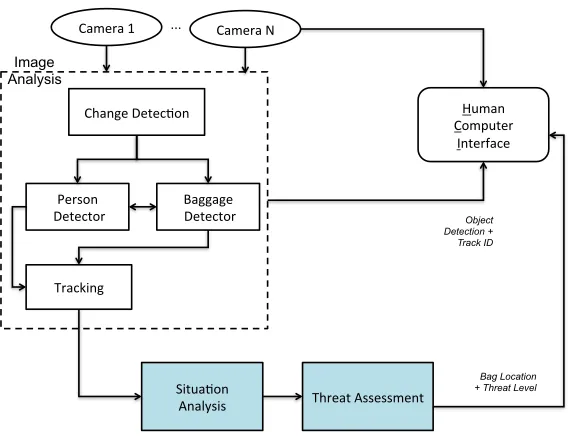
Camera 1 ... Camera N
Change Detec0on
Tracking
Situa0on
Analysis Threat Assessment
Object Detection + Track ID
Bag Location + Threat Level Baggage
Detector Person
Detector
Human Computer
Interface
[image:3.612.164.448.135.355.2]Image Analysis
Figure 1: General framework of the automated threat detection system
wide area video surveillance, behaviour analysis, abandoned objects
28
1. Introduction
29
In recent years there have been a number of incidents where terror
organ-30
isations have planted explosive devices in ordinary baggage to cause immense
31
disruption in mass transportation networks and other areas of critical
infras-32
tructure. Due to the potentially devastating consequences of such terrorist
33
activity, the monitoring and surveillance of unattended baggage has become
34
a priority for the security operators of mass transportation networks and
35
other critical infrastructure. The overriding goal is to minimise the number
36
of false alarms. Towards this goal, the main contribution of this work is
37
the development and evaluation of behaviour analysis methodology
ting robust identification of a baggage-owner while minimising false positives.
39
The approach taken advances the state of the art in abandoned bag
detec-40
tion by introducing the concept of ownership and combines it with automatic
41
understanding of social groups to infer abandonment. To achieve the goal, a
42
framework (see Figure 1) has been developed consisting of a complete
four-43
fold process, detection - tracking - situation analysis - threat assessment.
44
This paper is divided as follows. Firstly, in Section 2 related research is
de-45
tailed, followed in Sections 3-5 by descriptions of the system components. In
46
Section 6 the datasets used and results of experiments are presented before
47
concluding in Section 7 with conclusions and recommendations for future
48
research.
49
2. Related Work
50
There exists a significant body of academic research addressing the task
51
of robustly identifying abandoned baggage in public spaces. Most authors
52
treat detection of abandoned (or left) objects, especially luggage, as the task
53
of static object detection, with (Birch et al., 2011; Tian et al., 2010) or
with-54
out (e.g. (Evangelio and Sikora, 2011; Porikli et al., 2008)) the application
55
of tracking. Tian et al. (2010) present a framework to detect abandoned
56
and removed scene objects based on background subtraction and foreground
57
analysis, combined with tracking output to reduce false positives. Birch et al.
58
(2011) employ motion segmentation based on a GMM with fast learning and
59
a Motion History Image (MHI). For tracking of stationary objects, the edge
60
map (3x3 Sobel filter) for each pixel is computed and matched) by
correla-61
tion of edge directions. A comparative evaluation of stationary foreground
detection algorithms based on background subtraction is given in Bayona et
63
al. (2009).
64
There has been some attempt at human activity recognition and
associ-65
ation to scene objects. In Lu et al. (2007) moving objects are tracked using
66
shape and colour features and Kalman-based filtering, and classified using
67
eigen features and Support Vector Machine. A package is defined as a
non-68
human object and package ownership analysis performed using HMM-based
69
human activity recognition.
70
2.1. Dataset Based Challenges
71
The most widely used datasets with which to evaluate approaches to
72
abandoned bag detection have been from (PETS2007; PETS2006) and from
73
the UK Home Office i-LIDS (2007). The dataset provided for the PETS2006
74
challenge consists of 7 multi-camera scenarios involving an increasing
num-75
ber of people and passers-by. Most of the submissions to PETS2006 were
76
based on background subtraction combined with a blob tracker (Auvinet et
77
al., 2006; Guler and Farrow, 2006; Krahnstoever et al., 2006; Li et al., 2006;
78
Mart´ınez-del-Rinc´ın et al., 2006; Smith et al., 2006), with the exception of
79
Lv et al. (2006) who rely on a more realistic human model by incorporating
80
a human detector. Most often, when an object is not moving and its size
81
is beneath a given threshold, it is assumed to be a standing bag. Smith
82
et al. (2006) propose a probabilistic approach in which people and bags are
83
classified based on the immediate history of their size and velocity. Another
84
approach from PETS2006 is to use a slow-decay background model to
de-85
tect stationary objects (Guler and Farrow, 2006). To be able to apply the
86
PETS2006 rules for abandoned baggage (the owner is further than ametres
for more than bseconds), the owner is usually defined as the nearest tracked
88
object when the standing bag appears (Krahnstoever et al., 2006; Lv et al.,
89
2006) or by examining blob splits during tracking (Auvinet et al., 2006; Guler
90
and Farrow, 2006; Smith et al., 2006). When a standing bag and its owner
91
are identified, it is straightforward to apply the PETS2006 abandoned-bag
92
rules. The simplicity of the scenarios allows very limited situation
aware-93
ness and was designed mainly to test if the low level processing stages are
94
sufficient to cope with real-world scenarios.
95
The PETS2007 challenge focusses on two additional scenarios: theft and
96
loitering. The videos are much more challenging from the tracking point of
97
view as the scenes are more crowded. There are 8 scenarios, each viewed from
98
4 cameras. Two submissions to the challenge go beyond classical approaches
99
to blob tracking and split-track analysis (such as (Arsic et al., 2007; Dalley et
100
al., 2007)) and slowly/quickly adapting background models (such as Porikli
101
and Yin (2007)). Firstly, Ribeiro et al. (2007) use a Temporal-JointBoost
102
algorithm for each blob being tracked to classify it into a person-walking, not
103
moving, a person picking-up/leaving a bag, or an abandoned bag. The basic
104
idea is to incorporate temporal features (optical flow, motion energy) into the
105
classification process over some temporal window. Secondly, Ardo and
As-106
trom (2007) use an HMM to improve the temporal consistency of the tracking
107
and show how to use an HMM efficiently in this setting. These approaches
108
demonstrate the potential advantages of considering a longer temporal
win-109
dow for activity analysis. Nevertheless, the situation awareness in the PETS
110
2007 challenge is again very simple - reduced to comparing the distance of a
111
bag to its owner (abandoned bag, theft) or measuring the time for which a
person stays in the scene (loitering).
113
The UK Home Office have developed an image library (i-LIDS, 2007) to
114
help researchers and designers to evaluate video based detection systems to
115
meet Government requirements. The i-LIDS library includes an abandoned
116
luggage dataset including several challenges of single instances of left
lug-117
gage on a metro platform in the presence of passing passengers and trains.
118
While the dataset is useful for evaluating detection algorithms it remains
lim-119
ited because it is monocular and also does not contain examples of specific
120
behavioural interactions.
121
2.2. Limitations of Existing Approaches
122
It is clear that a global analysis of the situation rather than just
ex-123
amining each agent’s behaviour independently, would be beneficial in many
124
situations. The motivation for this is illustrated by a scenario similar to
125
that of (PETS2007) where a family or a group of friends comes together and
126
one of them leaves his/her bag with the others. Any threat detection system
127
treating the individuals independently would inevitably report an abandoned
128
bag, as the criteria specified in (PETS2006) that the bag is abandoned if the
129
owner is further thanametres for more thanbseconds, is fulfilled. For
treat-130
ing these more complex scenarios, the approaches described above may be
131
insufficient and it may be necessary to derive a more complete activity
anal-132
ysis. A significant corpus of the computer vision and artificial intelligence
133
literature attacks the problem of understanding activities from visual input.
134
While logic and grammar-based representations, with or without
combinina-135
tion with stastistical approaches, (Hongeng et al., 2004; Ivanov and Bobick,
136
2000; Joo and Chellappa, 2006; Shet et al., 2005) organise knowledge in a
flexible, powerful and clean way, one drawback of these approaches is that
138
they are unable to propagate the uncertainty in the primitive detections.
139
Hidden Markov Models (Brand et al. (1997)) and other flavours of dynamic
140
Bayesian network provide a powerful generalisation of stochastic finite state
141
automata to deal with such uncertainty. Another related approach is the
142
so-called propagation network (Shi et al., 2004). In recent work, Damen and
143
Hogg (Damen, 2012) first specify activities using a multiset attribute
gram-144
mar and then convert it to an equivalent Bayesian network. A more general
145
tool which converts first-order logic predicates into an equivalent Bayesian
146
network is the framework of Markov logic networks (Richardson and
Domin-147
gos, 2006), which have also been applied to activity analysis (Tran, 2008).
148
An entirely different approach is to detect events from image pixels directly
149
rather than by reasoning about the interactions between specific agents, for
150
instance (Li, 2008; Wang, 2009). Whilst these approaches are easily
con-151
figured to output whether an activity is normal or abnormal, they lack the
152
explanatory power of grammar and logic-based methods (i.e. why it is
ab-153
normal).
154
None of the approaches described in the literature, however, have
com-155
bined the concept of ownership with recognition of social groups, to reduce
156
the number of false positives in detection of abandoned objects.
157
3. Object Detection and Tracking
158
The framework, shown in Figure 1, supports application of a range of
159
object detectors and trackers including the POM person detection method
160
of Berclaz et al. (2009) and tracking-by-detection of Breitenstein et al. (2011),
both of which operate at low frame rates (2-4fps) or offline. While detection
162
and tracking is not the main contribution of this paper, brief descriptions are
163
given to methods which have been developed to permit the overall framework
164
to operate online and with multiple cameras.
165
3.1. Baggage Detection
166
Baggage hypothesis generation is based on static change detection using
167
the dual background approach of Porikli et al. (2008) adapted to use the
168
efficient implementation of the Gaussian Mixture Model in Zivkovic (2004).
169
Bag verification consists of application of a combination of filters including
170
both 2D and 3D geometric filters and foreground/background similarity filter,
171
and temporal filtering to check for peristence of the static regions.
172
3.2. Person Detection
173
Person detection is based on the homography based multi-camera
ap-174
proach of Yildiz and Akgul (2010), extended with a novel approach for ghost
175
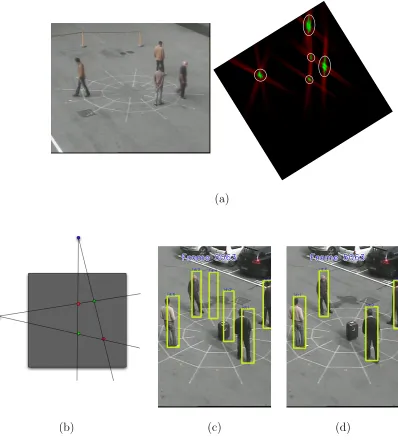
suppression. First, a synergy map, the result of projecting detected
fore-176
ground from each camera view to a single plane, is created, as shown in
177
Figure 2. In practice, the reverse process is used with sampled cells on the
178
synergy map, each corresponding to a vertical cuboid in space of fixed person
179
height, back-projected to the bounded rectangles in the original images. The
180
process is applied for an image resolution-limited ”infinite” number of planes
181
in a very efficient and fully real-time manner without hardware acceleration.
182
For a given location (x, y) in the Synergy map (which corresponds to a
183
small rectangular region on the ground plane), the valueS(x, y) accumulating
184
the evidence of a person’s presence can be calculated as:
(a)
[image:10.612.122.520.134.580.2](b) (c) (d)
Figure 2: Synergy map: (a). Detection of all pedestrians requires a threshold on synergy
map to be set to value that permits ghost detection to pass thorough. (b). Ghost positions
(red) can be predicted if correct positions (green) are known or can be estimated. (c-d).
Bounding boxes resulting from detections without (c) and with (d) ghost prediction and
S(x, y) = 1
|I|
X
i∈I
Pu1
u=u0
Pv1
v=v0p(u, v, i)
A(Z(x, y, i)) (1)
whereIis the set of images into which the cuboid can be visibly projected,
186
Z(x, y, i) = {(u0, v0),(u1, v1)} is the bounding box projection of the cuboid
187
corresponding to a specific synergy map pixel (x, y) into image i as defined
188
by two extreme corner points. A(s) is a function to calculate the area of any
189
shape s, and
190
p(u, v) =
1,if I(u, v) is foreground
0,otherwise
(2)
Candidate objects are represented by peaks in the synergy map, obtained
191
via thresholding. Ghost detections can occur where lines from different
cam-192
eras to different objects intersect. To prevent ghosts becoming new tracking
193
targets, a suppression map is generated in the regions of high ghost
probabil-194
ity and subtracted from the synergy map. Frame-to-frame tracking of peaks
195
further reinforces probable objects’ location.
196
3.3. Tracking
197
A multi hypothesis tracker is used Blackman (2004) modified for
appli-198
cation to tracking of extended objects. First, to handle short-term occlusions
199
and the merging of measurements from different persons in the detection
pro-200
cess, measurement-sharing between track hypotheses is allowed. This concept
201
is illustrated in Figure 3 (Top). Secondly, the measurement-to-track
associa-202
tion cost is modified to allow image features, specifically two hue-saturation
203
histograms corresponding to the top and bottom halves of a person, to be
204
used in addition to a simple Brownian motion model. Each model is updated
using the Exponentially Weighted Moving Average (EWMA). The
associa-206
tion score between a predicted state and a measurement is a product of the
207
normalised histogram intersection distance between their histograms and the
208
normalised Euclidean distance between their positions in 3D.
209
To overcome track fragmentations caused by long-term or complex
pat-210
terns of interaction between people, long term tracking based on tracklet
211
association is used. The approach is based on a Markov Logic Network
212
(MLN) (Leung and Herbin (2011)) where the notion of a group to account
213
for generic interaction between people is introduced. The scores for possible
214
associations are calculated using both spatial-temporal constraints and
ap-215
pearance information. Associations are not only considered for tracklets that
216
can be directly joined together; but are extended to tracklets separated by
217
a group in space and time. It therefore handles the formation and splitting
218
of groups, reducing track fragmentations and allowing longer tracks to be
219
formed. Examples of the tracklet association rules are shown in Figure 3
220
(Middle) and example final tracking output in Figure 3 (Bottom).
221
4. Situation Analysis
222
Situation analysis is an intermediate step towards threat assessment and
223
is defined as the description of the relationships between people and bags
224
that can be inferred from the behaviour of the participating agents. This
225
contribution focusses on two kinds of relationship: who owns each bag, and
226
who knows who. The analysis takes object tracks and class information as
227
input and describes the state of the world (i.e. the scene) in terms of the
228
observed agents and their behaviour. The following stage (threat assessment)
Spatial temporal Spatial-temporal
constraint Group
constraint Group
Join tracklets Join tracklets
[image:13.612.163.449.155.547.2]Appearance pp
Figure 3: Tracking processes. Top: Illustrating how measurement-sharing in video-MHT
overcomes short-term occlusions. Middle: Examples of tracklet association rules used in
the MLN formalism. Spatial-temporal coherence and appearance information are used
as inputs. The inference of groups and the joining of tracklets are two of the outputs.
determines whether the state of the world constitutes a possible threat (i.e.
230
there is a truly abandoned bag.) The main contribution is the combination
231
of the automatic understanding of social relationships with the concept of
232
ownership to reduce the number of false alarms.
233
4.1. Bag Ownership
234
For the reported experiments in this paper, a bag is detected when it
235
appears stationary in the scene, having been placed there by a person. At
236
this stage, detection of a bag as it is carried into or out of the scene has
237
not been incorporated. The ownership of each bag is inferred by simply
238
looking for a person in the proximity of the bag over a fixed time interval
239
prior to its appearance. The person is also required to be stationary at the
240
time the bag-drop is hypothesised to occur. Specifically, in the experiments
241
reported here, any person is assumed to be an owner if they are temporarily
242
stationary within one metre of the bag at any point within one second prior to
243
its appearance. Note that multiple possible owners are allowed, not because
244
this is expected to be the case in reality but in order to reduce false alarms
245
through taking both hypotheses through into the threat assessment.
246
4.2. Inference of Social Relations
247
Social groups are a very common phenomena in human crowds, with
em-248
pirical studies suggesting that about 74% of people come in a group to a social
249
event (Aveni (1977)) and about 50-70% (depending on the environment) are
250
in a group during casual walking (Rudloff et al. (2011)). Despite this high
251
percentage, the prevailing crowd behaviour models in todays simulation tools
252
(Challenger et al. (2009)), computer graphics applications (Reynolds (1987))
and in particular in activity recognition and computer vision (PETS2006)
254
are based on modelling each individual independently. An online algorithm
255
has been developed for automatic detection of social groups within crowds,
256
based on the analysis of the way the social relations influence the walking
257
behaviour of the group members.
258
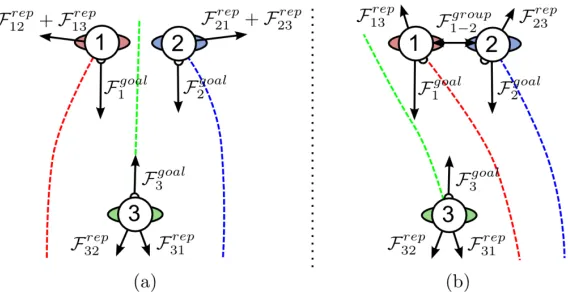
The method is based on the Social Force Model (SFM) (Helbing and
259
Molnar, 1995; Moussaid et al., 2010) widely used in the crowd simulation
260
community. In this, each individuals’ movement is influenced by notional
261
forces operating between individuals. Depending on whether two
individ-262
uals (a) know each other or (b) do not know each other, the Social Force
263
Model produces different sets of trajectories for these individuals. Until
re-264
cently, these attempts were based on human designed forces without proper
265
evaluation. Only recently, the model has been calibrated on real-world video
266
sequences resulting in a model that realistically predicts avoidance behaviour
267
of a walking group (Moussaid et al., 2009; Singh et al., 2009) and later in
268
a model with all its parameters, including group behaviour, estimated from
269
real data (Moussaid et al. (2010)).
270
The method employed in this work solves the inverse problem: knowing
271
the trajectories, what are the social forces, and thus the relations, that caused
272
that behaviour. The method is used in the framework to infer the social
273
relations between the individuals in a scene and thereby to inform threat
274
assessment as explained in Section 5.
275
The authors are aware of only two approaches aiming explicitly at social
276
group inference (Ge et al., 2009; Jacques et al., 2007) and one paper using
277
social groups to improve tracking (Pellegrini et al. (2010)). In Jacques et al.
Figure 4: Depending on whether the individuals 1 and 2 (a) do not know each other or (b)
know each other, the Social Force Model produces different sets of trajectories combining
together repulsive (Frep), goal directed (Fgoal), and group (Fgroup) forces influencing the
individuals.
(2007) the groups are detected when two individuals keep close enough for
279
a significant fraction of time over a given period. Experiments undertaken
280
by the authors have shown that such simple measures are not sufficient for
281
reliable group inference in complex scenes. In the proposed approach the
282
calibrated SFM instead is relied upon. Similar measurements were used in
283
Pellegrini et al. (2010) to improve tracking by jointly tracking and inferring
284
the social groups.
285
Also based on distance, but including the difference in velocity as well
286
as position, the method proposed in Ge et al. (2009) applies clustering to
287
the (complete) person trajectories. The merging criterion takes into account
288
the fraction of time in which the individuals are seen close to each other and
289
allows the addition of a person to the group only if they have been close to
290
at least half of its members. Figure 4 illustrates the Social Force Model. Full
details of the approach are given in Sochman and Hogg (2011).
292
5. Threat Assessment
293
The threat assessment stage determines whether the inferred situation
294
constitutes a threat, utilising the inferred knowledge of ownership and social
295
relations described in Section 4. The mechanism adopted is sufficiently
gen-296
eral to accommodate external information (e.g. the state of alert, time of
297
day) alongside information on the observed scene in determining whether or
298
not to raise an alarm.
299
Three increasingly sophisticated definitions are considered for what
con-300
stitutes an abandoned bag. The first adopts the simple baseline definition
301
that defined the PETS2006 challenge. In this, a threat (i.e. abandonment)
302
is defined as follows:
303
• Bag unattended if no person within 2 metres
304
• Bag abandoned if unattended for 30 seconds
305
Here, the notions of ownership and social relationships are not used.
306
The second definition (owner) includes the notion of ownership
(Sec-307
tion 4.1) and is defined as follows:
308
• Bag unattended if owner is not within 2 metres
309
• Bag unattended if there is no assigned owner and if no person within 2
310
metres
311
• Bag abandoned if unattended for 30 seconds
When there is no assigned owner, this is equivalent to the baseline
def-313
nition, but where one or more possible owners have have been assigned, the
314
condition for an alarm to be raised is less stringent since the behaviours of
315
non-owners within the scene is ignored (unless there is no assigned owner).
316
The third definition (owner+group) includes both the notions of
owner-317
ship (Section 4.1) and social relationships (Section 4.2). In this, a threat is
318
defined as follows:
319
• Bag unattended if owner or someone in the same social group as owner
320
is not within 2 metres
321
• Bag unattended if there is no assigned owner and if no person within 2
322
metres
323
• Bag abandoned if unattended for 30 seconds
324
This relaxes theownerdefinition in the direction of thebaselinedefinition,
325
since now the circle of people attending to a bag is widened to include people
326
in the same group as the possible owner(s). The likelihood of raising an
327
alarm is therefore reduced.
328
5.1. Implementation
329
The aim in threat assessment is to make it straightforward to encode
330
the evolving state of the world and explore different behavioural patterns
331
that constitute a potential threat. To achieve this, a simple logic-based
332
inference system (Prolog) is adopted in which the current state of the world
333
is represented by a set of facts and the behavioural patterns that constitute
334
potential threats are encoded as rules.
The elements of this logic-based approach are:
336
• Facts (logical atoms), which are employed to describe situations. A fact
337
is of the form R(A,B,...), where R indicates a type of relation between
338
the elements inside the brackets.
339
• Rules, which are employed to infer new facts from existing ones.
340
Given these elements, the threat assessment proceeds in two steps:
341
1. Tracking and detection data are converted into a set of facts;
342
2. A set of pre-defined rules is invoked to infer additional facts.
343
The position of an object in each frame is represented by a unique ID for
344
the object, it’s class (person or bag), it’s x,y position on the ground-plane
345
and the frame number:
346
track(id,class,x,y,frame).
347
The social relationships between individuals are represented by a single
348
predicate that records a unique group ID for each person. This partitions the
349
set of people into social groups. Any person not assigned to a social group
350
is assumed to be outside any group. This is represented simply by facts of
351
the form:
352
group(id,group id).
353
For convenience, a ‘class’ predicate is used (as in class(id, person).) to
354
record the class of each object independently of the ‘track’ facts.
355
The ownership of bags is inferred next by a set of Prolog rules that embody
356
the criteria described in Section 4.1. The result is a new set of facts, each
357
representing the ownership of a bag (b) by a person (p):
owner(p, b).
359
Finally, the alarm condition for the chosen threat definition is posed as a
360
Prolog query. As part of this, for the baseline definition, the condition that
361
a bag is attended translates into the rule:
362
attended(B, T) :- class(P, person), nearby(P,T,B,T,2).
363
Here the rule states that a bag is attended at time T (shown on the left
364
of the ‘:-’) if it is owned by someone (call them P), and the position of P at
365
time T is within 2 metres (i.e. nearby) of the position of B at time T (shown
366
on the right of the ‘:-’). Upper case arguments are used to signify that these
367
are variables.
368
The equivalent set of rules for the owner+groupdefinition, incorporating
369
the notions of ownership and social relationships, is as follows:
370
attended(B,T) :- owner(P,B), nearby(P,T,B,T,2), !.
371
attended(B,T)
:-372
\+owner( ,B), track(P,person, , ,T), nearby(P,T,B,T,2).
373
attended(B,T) :- owner(P,B), knows(P,Q), nearby(Q,T,B,T,2), !.
374
knows(P,Q) :- group(P,G),group(Q,G).
375
The first rule states that a bag B is attended at time T if there is an
376
owner P for the bag and this person is nearby. The second rule invokes the
377
baseline notion of being attended when there is no owner - the meaning of
378
‘\+’ before the owner predicate means that this isn’t present in the database.
379
The third rule states that a bag is attended (at time T) if there is a second
380
person Q who is nearby the bag and P and Q know one another. The fourth
381
rule implements the notion of two people knowing one another in terms of
382
their group membership - i.e. they know one another if they are from the
same social group. The owner definition, incorporating only the notion of
384
ownership, is defined by the first two of the rules above.
385
Finally the condition for an alarm to be raised is the same for all three
386
definitions - a bag must be unattended for a fixed period of time. The
387
definition of ‘unattended’ is expressed in terms of the different definitions of
388
attended, as follows:
389
unattended(B,T) :- class(B,bag), track(B,bag, , ,T),
390
\+attended(B,T).
391
This states that an object is unattended at time T if it is a bag, it is in
392
existence at time T, and there is no ‘attended’ fact in the database for that
393
bag at time T.
394
Thus, only the definition of ‘attended’ varies between the three definitions
395
of what constitutes an alarm.
396
Generally, Prolog was found to be a convenient way to represent
defini-397
tions in a readily understood fashion, facilitating extension and
experimen-398
tation. On the other hand, there are aspects of the inference mechanism in
399
Prolog that require care - for example the use of the cut (‘!’) in two of the
400
rules above is necessary to avoid the same alarm being raised multiple times.
401
6. Results
402
6.1. Datasets
403
Two different datasets are used to test the performance of the proposed
al-404
gorithms, the publicly available PETS2006 (PETS2006) and the second
pro-405
duced during the SUBITO project specifically for this study. The PETS2006
406
dataset consists of ten sequences with increasing complexity of a staged
Figure 5: Datasets used. Top row: Four views from PETS2006 which contains scenarios
with abandoned luggage. Bottom row: Three views from the SUBITO dataset describes
scenarios where luggage owner enters the scene, sometimes interacts with other individuals
and leaves the scene with/without the luggage.
doned bag scenario at a train station. All four camera views in the dataset
408
were used in turn for the first four sequences used (S1-1,
PETS-409
S1-2, PETS-S1-3 and PETS-S1-4), and camera view 3 used only for the
410
other sequences (S2-3, S3-3, S4-3, S5-3,
PETS-411
S6-3 and PETS-S7-3). The SUBITO dataset was recorded specifically for
412
the SUBITO project. It contains thirteen sequences (19-22, 24-29, 31, 36,
413
37) each recorded from four synchronised cameras placed around the scene.
414
In sequences 19-22 a single person brings a bag to a marked position and
loi-415
ters around the bag (sequence 19), abandons the bag (sequence 20), or leaves
416
the bag unattended for a while and then comes back (sequences 21, 22).
Se-417
quences 24-29, 31, 36 and 37 contain more challenging variants in terms of
418
number of people and the group relationships. Each action is recorded 12
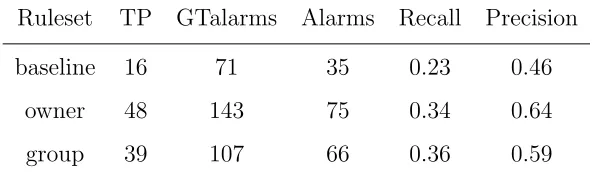
Table 1: Aggregate results across all SUBITO sequences comparing predicted alarms with
corresponding baseline/owner/group ground truth.
Ruleset TP GTalarms Alarms Recall Precision
baseline 16 71 35 0.23 0.46
owner 48 143 75 0.34 0.64
group 39 107 66 0.36 0.59
times for different entrance/exit directions. Depending on different threat
420
definitions, the same action may or may not raise an alarm. Each sequence
421
therefore should either correspond to 12 alarms (except for sequence 36 which
422
only corresponds to 11 alarms), or none. The ground-truth alarms were
ob-423
tained manually for all three threat definitions. The alarm time is determined
424
by first visually deciding the very frame when the owner is just outside the
425
prescribed distance from the bag, then adding a fixed time interval before the
426
alarm is raised. Within the SUBITO dataset, the critical distance around
427
a bag is assumed to be 2.5 metres (as opposed to 2 metres used in the
428
PETS2006 challenge)- this assumption is therefore used in the three threat
429
definitions. The time a bag must remain unattended to raise an alarm is
430
reduced to 4 seconds.
431
6.2. Preliminary experiments on PETS2006 data
432
In the first experiments, the baseline functionality of (PETS2006) was
433
implemented and evaluated. These experiments were carried out using an
434
earlier version of the threat assessment logic implemented in C++. This was
435
subsequently re-implemented in Prolog as part of the real-time system. To
436
achieve this, the Prolog is queried for an alarm on every frame, based on
Table 2: Aggregate results across all SUBITO sequences comparing the use of all three
threat definitions with the ground truth for the owner+groupdefinition.
Ruleset TP GTalarms Alarms Recall Precision
baseline 16 107 35 0.15 0.46
owner 42 107 75 0.39 0.56
group 39 107 66 0.36 0.59
Table 3: Aggregate results across all SUBITO sequences comparing the use of all three
threat definitions with the ground truth for the owner+group definition with
stiched-together tracks.
Ruleset TP GTalarms Alarms Recall Precision
baseline 15 107 36 0.14 0.42
owner 43 107 94 0.40 0.46
group 41 107 88 0.38 0.47
the current state of the world and pertinent facts from the recent past. This
438
world model is continually refreshed with the current location of each tracked
439
object.
440
For the threat assessment to be correct, the system is required to raise
441
an alarm following a potential threat, and to correctly identify the ID of
442
the abandoned bag. Specifically, an alarm must be raised within 50 frames
443
of a ground-truth alarm for it to be successful detected. The results on
444
the PETS2006 dataset employ automatic tracking using an implementation
445
of Breitenstein et al. (2011) and bag detection using Porikli et al. (2008).
446
Alarms were raised correctly on all tested sequences except PETS-S4-3 and
[image:24.612.150.453.333.427.2]PETS-S7-3. The failures on these two sequences were caused by
individu-448
als, having nothing to do with the abandoned bag, nevertheless being close
449
enough to prevent the bag being classified as unattended. This result
moti-450
vates the concept of ownership considered in the main set of experiments.
451
6.3. Experiments on SUBITO data
452
The main set of experiments were carried out on the challenging SUBITO
453
dataset. The inverse SFM system is run in batch mode so that it has access
454
to an entire sequence in predicting social groups rather than only the history
455
up until the current time. The entire sequence is therefore used in inferring
456
the set of alarms. This enabled evaluation of the interaction of the detection
457
and tracking sub-system and the threat assessment sub-system, giving the
458
inverted SFM the best chance of assigning correct social groups within
rela-459
tively short scenarios. A single threshold in the inverse SFM system controls
460
the propensity of pairs of individuals to be combined into the same group;
461
a lower threshold results in larger social groups. For the SUBITO data, we
462
found that both precision and recall reach their highest values within a small
463
range of this threshold and the results we present are for a choice of threshold
464
in this range.
465
The aggregate results across all SUBITO sequences are shown in Table 1,
466
comparing predicted alarms with the corresponding ground-truth - that is
467
baseline results are compared with the baseline ground-truth, etc. The
ag-468
gregate results comparing the use of all three threat definitions with the
469
ground-truth for the owner+group definition are shown in Table 2. As
ex-470
pected, the precision and recall for the baseline definition are lower in this
471
case since the ground-truth reflects a more sophisticated notion of threat,
incorporating concepts that are not present in the baseline definition. The
473
evaluation reported here attended only to the time an alarm is raised and
474
ignored the ID for the person and bag involved. Where there is more than
475
one true positive alarm for a ground-truth alarm, this is counted once in
com-476
puting recall and does not contribute to loss of precision. In other words,
477
multiple predicted alarms for the same ground-truth alarm are counted only
478
once. In general, there were few instances of this occurring in the experiment.
479
Within Table 2, there is a clear improvement in precision and recall
be-480
tween baseline and owner definitions. However, the comparison of
perfor-481
mance between ownerand owner+groupdefinitions is less decisive. Here the
482
recall has reduced slightly with the introduction of the social relationships,
483
but there is a comparable improvement in precision. Looking in more detail
484
at the results on individual sequences and alarms, several alarms have been
485
surpressed by correct assignment of an owner and partner to the same social
486
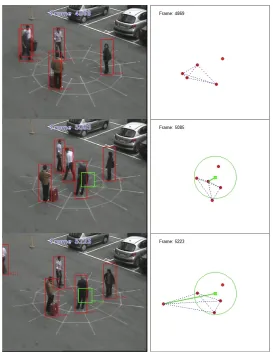
group. This is illustrated in Figure 6 showing a set of frames from SUBITO
487
sequence 36. Two individuals (d:211, d:212) entering the scene (Figure 6
488
(top)) are assigned to the same social group (indicated by blue line between
489
them), and one is detected as the owner of a bag (d:212) that appears within
490
the scene (Figure 6 (middle). The owner subsequently goes away from the
491
bag and outside the prescribed distance (shown as a green circle around the
492
bag), leaving their partner attending to the bag (Figure 6 (bottom)). No
493
alarm is raised.
494
In general the recall and precision are below acceptable performance for
495
a deployed threat assessment system. The principal source of error arises
496
from the highly challenging video sequences containing multiple overlapping
Figure 6: Social group analysis applied to SUBITO sequence 37 resulting in correct
sup-pression of false alarm.
actors at any time. The consequential limitations in detection and tracking
498
performance are translated directly into the threat assessments that can be
499
achieved using the logic described above. Some improvement in performance
500
was achieved by automatically stitching together tracks for which there is
501
sufficient evidence that they belong to the same objects at different periods
502
of time - specifically, one track (of more than 10 frames duration) ends within
4 seconds and 1 metre of another track (of more than 10 frames duration)
504
beginning. The precision and recall for the equivalent evaluation to that in
505
Table 2 is shown in Table 3. Finally, a real-time system that incorporates
506
all stages of the pipeline, including on-line estimation of social groups up to
507
the current frame, has also been implemented to demonstrate the practical
508
viability of the method.
509
7. Conclusions and Future Work
510
This paper has described a video surveillance framework that detects
511
abandoned objects in surveillance scenes containing multiple interacting
in-512
dividuals, extending the state of the art. Future work will address methods
513
to further improve the underpinning object (person and bag) detection and
514
tracking accuracy, as well as introduction of goal-directed and intentionality
515
modelling strategies in the behavioural analysis.
516
There is scope to perform a more rigorous analysis of ownership through
517
detecting bags being carried into the scene and hence identifying the owner
518
more reliably. Similarly, confidence that a bag has been removed from the
519
scene would be raised if it could be detected as it was carried out. There
520
is prior work on this problem that should in principle be directly applicable
521
to sequences such as those in the SUBITO dataset (e.g. Damen and Hogg
522
(2008)).
523
Finally, expressing the the conditions of a threat in terms of logic,
sug-524
gests that it may be possible to induce such conditions automatically from
525
examples, thereby providing a way to incorporate different kinds of
informa-526
tion about the scene without having to provide the logical rules by hand.
Earlier work on the use of inductive logic programming in video analysis
528
indicates how this might be achieved in principle (Dubba (2010)).
529
Acknowledgements
530
This work was supported by EC projects SUBITO Grant Agreement No.
531
218004 and FP7-ICT-247022 MASH. Any opinions expressed in this paper do
532
not necessarily reflect the views of the European Community. The
Commu-533
nity is not liable for any use that may be made of the information contained
534
herein.
535
H. Ard¨o and K. Astr¨om., 2007. Multi Sensor Loitering Detection Using
On-536
line Viterbi. In Proc. IEEE Int. Workshop on Performance Evaluation of
537
Tracking and Surveillance (PETS), ISBN 0-7049-1423-9.
538
D. Arsi´c, M. Hofmann, B. Schuller and G. Rigoll., 2007. Multi-Camera Person
539
Tracking And Left Luggage Detection Applying Homographic
Transforma-540
tion. In Proc. IEEE Int. Workshop on Performance Evaluation of Tracking
541
and Surveillance (PETS), ISBN 0-7049-1423-9.
542
E. Auvinet, E. Grossmann C. Rougier, M. Dahmane and J. Meunier., 2006.
543
Left-Luggage Detection Using Homographies and Simple Heuristics. In
544
Proc. IEEE Int. Workshop on Performance Evaluation of Tracking and
545
Surveillance (PETS), ISBN 0-7049-1422-0.
546
A. F. Aveni., 1977. The Not-So-Lonely Crowd: Friendship Groups in
Collec-547
tive Behavior. Sociometry, 40(1):9699.
A. Bayona, J. C. SanMiguel, and J. M. Mart´ınez., 2009. Comparative
Eval-549
uation of Stationary Foreground Object Detection Algorithms based on
550
Background Subtraction Techniques. In Proc. of the 6th IEEE Int.
Con-551
ference on Advanced Video and Signal Based Surveillance (AVSS 09),
552
DOI:10.1109/AVSS.2009.35, pp. 2530.
553
J. Berclaz, A. Shahrokni, F. Fleuret, J. Ferryman and P. Fua., 2009.
Eval-554
uation of Probabilistic Occupancy Map People Detection for Surveillance
555
Systems. In Proc. of the IEEE Int. Workshop on Performance Evaluation
556
of Tracking and Surveillance (PETS), pp 55-62, ISBN 978-07049-1501-4.
557
P. Birch, W. Hassan, N. Bangalore, R. Young and C. Chatwin., 2011.
Sta-558
tionary Traffic Monitor. In Proc. 4th Int. Conf. on Imaging for Crime
559
Detection and Prevention (ICDP-11), DOI:10.1049/ic.2011.0128 , pp. 1-6.
560
S. S. Blackman., 2004. Multiple Hypothesis Tracking for Multiple Target
561
Tracking. In IEEE Aerospace and Electronic Systems Magazine, 19(1),
562
pp. 5-18.
563
M. Brand, N. Oliver and A. Pentland., 1997. Coupled Hidden Markov Models
564
for Complex Action Recognition. In Proc. Computer Vision and Pattern
565
Recognition, pp. 994-999.
566
M. D. Breitenstein, F. Reichlin, B. Leibe, E. Koller-Meier and L. Van Gool.,
567
2011. Online Multiperson Tracking-by-Detection from a Single,
Uncali-568
brated Camera. In IEEE Trans. on Pattern Analysis and Machine
Intelli-569
gence, 33(9), pp. 1820-1833.
R. Challenger, C. W. Clegg, M. A. Robinson, and M. Leigh., 2009.
Under-571
standing Crowd Behaviours: Simulation Tools. Technical Report,
Univer-572
sity of Leeds.
573
G. Dalley, X. Wang, and W.E.L. Grimson., 2007. Event Detection Using an
574
Attention-Based Tracker. In Proc. IEEE Int. Workshop on Performance
575
Evaluation of Tracking and Surveillance (PETS), ISBN 0-7049-1423-9.
576
D. Damen and D. Hogg., 2008. Detecting Carried Bags in Short Video
Se-577
quences. In Proc. 10th European Conf. on Computer Vision, 5304:154-167.
578
D. Damen and D. Hogg., 2012. Explaining Activities as Consistent Groups
579
of Events: A Bayesian Framework Using Attribute Multiset Grammars. In
580
Int. Journal of Computer Vision, 98(1), pp. 83-102,
DOI:10.1007/s11263-581
011-0497-0.
582
K. S. R. Dubba, A. G. Cohn, and D. C. Hogg., 2010. Even Model Learning
583
From Complex Videos using ILP. In Proceedings ECAI, 215, pp. 93-98.
584
R. Evangelio and T. Sikora., 2011. Static Object Detection Based on a Dual
585
Background Model and a Finite-State Machine. EURASIP Journal on
Im-586
age and Video Processing, Article ID 858502, DOI:10.1155/2011/858502.
587
W. Ge, R. Collins, and B. Ruback., 2009. Automatically Detecting the Small
588
Group Structure of a Crowd. In Workshop on Applications of Computer
589
Vision, pp. 18.
590
S. Guler and M. K. Farrow., 2006. Abandoned Object Detection in Crowded
591
Places. In Proc. IEEE Int. Workshop on Performance Evaluation of
Track-592
ing and Surveillance (PETS), ISBN 0-7049-1422-0.
D. Helbing and P. Molnar., 1995. Social Force Model for Pedestrian
Dynam-594
ics. Physical Review E, 51:4282.
595
S. Hongeng, R. Nevatia and F. Br´emond., 2004. Video-Based Event
Recog-596
nition: Activity Representation and Probabilistic Recognition Methods.
597
Computer Vision and Image Understanding, 96:129-162.
598
Imagery Library for Intelligent Detection Systems, http://www.ilids.co.uk.
599
Last accessed: 29 January 2012.
600
Y. Ivanov and A. Bobick., 2000. Recognition of Visual Activities and
Inter-601
actions by Stochastic Parsing. In IEEE Trans. on Pattern Analysis and
602
Machine Intelligence, 22(8), pp. 852-872.
603
J. Jacques, A. Braun, J. Soldera, S. Musse, and C. Jung., 2007.
Understand-604
ing People Motion in Video Sequences using Voronoi Diagrams. Pattern
605
Analysis and Applications, 10:321332.
606
S-W. Joo and R. Chellappa., 2006. Attribute Grammar-Based Event
Recog-607
nition and Anomaly Detection. Proceedings Int. Workshop on Semantic
608
Learning Applications in Multimedia, New York , NY June.
609
N. Krahnstoever, P. Tu, T. Sebastian, A. Perera and R. Collins., 2006.
Multi-610
View Detection and Tracking of Travelers and Luggage in Mass Transit
611
Environments. In Proc. IEEE Int. Workshop on Performance Evaluation
612
of Tracking and Surveillance (PETS), ISBN 0-7049-1422-0.
613
V. Leung and S. Herbin., 2011. Flexible Tracklet Association for Complex
614
Scenarios using a Markov Logic Network. In Proc. 11th Int. Workshop on
615
Visual Surveillance, pp. 1870-1875.
L. Li, R. Luo, R. Ma, W. Huang and K. Leman., 2006. Evaluation of an
617
IVS System for Abandoned Object Detection on PETS 2006 Datasets. In
618
Proc. IEEE Int. Workshop on Performance Evaluation of Tracking and
619
Surveillance (PETS), ISBN 0-7049-1422-0.
620
J. Li, S. Gong and T. Xiang., 2008. Global Behaviour Inference using
Prob-621
abilistic Latent Semantic Analysis. In Proc. British Machine Vision Conf.,
622
DOI:10.5244/C.22.20.
623
S. Lu, J. Zhang and D. Feng., 2007. Detecting Unattended Packages through
624
Human Activity Recognition and Object Association. Pattern Recognition,
625
8:2173-2184.
626
F. Lv, X. Song, B. Wu, V. K. Singh and R. Nevatia., 2006. Left-Luggage
627
Detection using Bayesian Inference. In Proc. IEEE Int. Workshop on
Per-628
formance Evaluation of Tracking and Surveillance (PETS), ISBN
0-7049-629
1422-0.
630
J. Mart´ınez-del-Rinc´on, J. Herrero-Jaraba, J. Ral G´omez and C.
Orrite-631
Uru˝nuela., 2006. Automatic Left Luggage Detection and Tracking Using
632
Multi-Camera UKF. Proceedings IEEE Int. Workshop on Performance
633
Evaluation of Tracking and Surveillance (PETS), ISBN 0-7049-1422-0.
634
M. Moussaid, D. Helbing, S. Garnier, A. Johansson, M. Combe, and G.
635
Theraulaz., 2009. Experimental Study of The Behavioural Mechanisms
636
Underlying Self-Organization in Human Crowds. In Proc. of the Royal
637
Society B: Biological Sciences, 276(1668), pp. 27552762.
M. Moussaid, N. Perozo, S. Garnier, D. Helbing, and G. Theraulaz., 2010.
639
The Walking Behaviour of Pedestrian Social Groups and Its Impact on
640
Crowd Dynamics. PLoS ONE, 5(4):e10047, 04.
641
S. Pellegrini, A. Ess, and L. Van Gool., 2010. Improving Data Association
642
by Joint Modeling of Pedestrian Trajectories and Groupings. In Proc.
Eu-643
ropean Conference on Computer Vision. 6311:452465, Springer Berlin /
644
Heidelberg.
645
PETS2006. 2006. Ninth IEEE Int. Workshop on Performance Evaluation of
646
Tracking and Surveillance (PETS), New York, USA, June 18, ISBN
0-647
7049-1422-0, ISBN 0-7049-1422-0.
648
PETS2007. 2007. Tenth IEEE Int. Workshop on Performance Evaluation of
649
Tracking and Surveillance (PETS), Rio De Janeiro, October 14, ISBN
0-650
7049-1423-9.
651
F. Porikli and Z. Yin., 2006. Temporally Static Region Detection in
Multi-652
Camera Systems. In Proc. IEEE Int. Workshop on Performance Evaluation
653
of Tracking and Surveillance (PETS), ISBN 1422-0, ISBN
0-7049-654
1422-0.
655
F. Porikli, Y. Ivanov and T. Haga., 2008. Robust Abandoned Object
De-656
tection using Dual Foregrounds, EURASIP Journal on Advances in Signal
657
Processing, Article ID 197875.
658
C. W. Reynolds. 1987. Flocks, Herds and Schools: A Distributed Behavioral
659
Model. In Proc. of the 14th Annual Conference on Computer Graphics and
660
Interactive Techniques, pp. 2534, DOI:10.1145/37401.37406.
P. C. Ribeiro, P. Moreno and J. Santos-Victor., 2007. Detecting Luggage
662
Related Behaviors Using a New Temporal Boost Algorithm. In Proc. IEEE
663
Int. Workshop on Performance Evaluation of Tracking and Surveillance
664
(PETS), ISBN 0-7049-1423-9.
665
M. Richardson and P. Domingos., 2006. Markov Logic Networks, Machine
666
Learning, 62:107136.
667
C. Rudloff, T.Matyus, and S. See and D. Bauer., 2011. Can Walking
Be-668
haviour Be Predicted? An Analysis of the Calibration and Fit of
Pedes-669
trian Models. 90th Annual Meeting of the Transportation Research Board,
670
January.
671
V. D. Shet, D. Harwood and L. S. David., 2005. Vidmap: Video Monitoring
672
of Activity with Prolog. In Proc. IEEE Conference on Advance Video and
673
Signal Based Surveillance, pp. 224-229.
674
Y. Shi, Y. Huang, D. Minnen, A. Bobick and I. Essa., 2004. Propagation
675
Networks for Recognition of Partially Ordered Sequential Action. In Proc.
676
IEEE Computer Society Conference on Computer Vision and Pattern
677
Recognition, 2:862-869, DOI:10.1109/CVPR.2004.1315255.
678
H. Singh, R. Arter, L. Dodd, P. Langston, E. Lester and J. Drury., 2009.
679
Modelling Subgroup Behaviour in Crowd Dynamics Dem Simulation.
Ap-680
plied Mathematical Modelling, 33(12):44084423.
681
K. Smith, P. Quelhas and D. Gatica-Perez., 2006. Detecting Abandoned
Lug-682
gage Items in a Public Space. In Proc. IEEE Int. Workshop on Performance
683
Evaluation of Tracking and Surveillance (PETS), ISBN 0-7049-1422-0.
J. Sochman and D. C. Hogg., 2011. Who Knows Who - Inverting the Social
685
Force Model for Finding Groups. In Proc. IEEE Intelligent Workshop on
686
Socially Intelligent Surveillance and Monitoring.
687
Y. Tian, R. Feris, H. Liu, A. Humpapur, and M-T. Sun., 2010. Robust
688
Detection of Abandoned and Removed Objects in Complex Surveillance
689
Videos, In Proc. IEEE Trans. on Systems, Man, and Cybernetics, Part C:
690
Applications and Reviews, pp. 112.
691
S. Tran and L. Davis., 2008. Visual Event Modelling and Recognition Using
692
Markov Logic Networks. In Proc. European Conf. on Computer Vision,
693
pp. 610-623.
694
X. Wang, X. Ma and E. Grimson., 2009. Unsupervised Activity Perception
695
in Crowded and Complicated Scenes Using Hierarchical Bayesian Models.
696
IEEE Trans. on Pattern Analysis and Machine Intelligence, 31(3):539-555.
697
A. Yildiz and Y. S. Akgul., 2010. A Fast Method for Tracking People with
698
Multiple Cameras, Technical Report, Vision Lab, Gebze Institute of
Tech-699
nology.
700
Z. Zivkovic. 2004. Improved Adaptive Gaussian Mixture Model for
Back-701
ground Subtraction, In Proc. Int. Conf. on Pattern Recognition, 2, pp.
702
28-31.