This is a repository copy of New Horizons.
White Rose Research Online URL for this paper: http://eprints.whiterose.ac.uk/128205/
Book Section:
Boxall, Alistair Bruce Alleyne orcid.org/0000-0003-3823-7516 and Dalton, Andrew R H (2018) New Horizons. In: Annual Report of the Chief Medical Officer 2017, Health Impacts of All Pollution - what do we know? , pp. 107-138.
[email protected] https://eprints.whiterose.ac.uk/ Reuse
Items deposited in White Rose Research Online are protected by copyright, with all rights reserved unless indicated otherwise. They may be downloaded and/or printed for private study, or other acts as permitted by national copyright laws. The publisher or other rights holders may allow further reproduction and re-use of the full text version. This is indicated by the licence information on the White Rose Research Online record for the item.
Takedown
If you consider content in White Rose Research Online to be in breach of UK law, please notify us by
Page 1 of 341
Page 2 of 341
Foreword
Pollution, most particularly air pollution, is receiving a great deal of attention in the United Kingdom at the moment. However, tackling pollution (in all its forms) has not been foremost in the minds of health policy makers in recent years. It has been the role of public health professionals of all disciplines, and the wider public health workforce, to guard the public from the health impacts of pollution.
I chose to address pollution in this, my ninth, annual report because I believe it is time for policy makers to take seriously the threat to health posed by pollution, and therefore to understand that addressing pollution is disease prevention. Everyone understands that acute exposure to a toxic substance will cause ill-health. Lesser known, and understood, is the relationship between longer-term, lower level
exposure to pollutants. We already know there is a link in some instances: think of the opportunities to improve health that may be at our fingertips if we can better integrate socio-demographic, health and environmental data – using this to better understand these threats.
And who will benefit from this? Clearly we will all benefit but those dedicated to reducing health and environmental inequalities may take particular interest in Chapter 6 of this report, ‘Pollution and inequality’.
Page 3 of 341
This report could not have been produced without the generous input of the editors, Chapter Leads, Chapter Authors and contributors. The Chief Medical Officer,
Professor Dame Sally Davies expresses her thanks to all those who contributed to this report.
Editor-in-Chief
Andrew Dalton, Public Health Specialty Registrar, West Midlands Deanery
Project Manager and Editor
Orla Murphy, Department of Health and Social Care
Page 4 of 341
Contents
Chapter 1 Chief Medical Officer’s summary
Prof Dame Sally C. Davies, Chief Medical Officer, Department of Health and Social Care
Chapter 2 Pollution from the health and care System
Prof David Pencheon, Honorary Professor, Health and Sustainable Development, Medical School, University of Exeter Medical School
Dr Andrew R. H. Dalton, Public Health Specialty Registrar, West Midlands Deanery
Chapter 3 21st century chemicals
Prof Timothy W. Gant, Helen E. Smith, Dr Emma L. Marczylo, Dr Miriam N. Jacobs, Dr Timothy H. Marczylo, Dr Ovnair Sepai, Mr Andrew Tristem of Centre for
Radiation, Chemical and Environmental Hazards, Public Health England
Chapter 4 New horizons
Prof Alistair Boxall, Professor in Environmental Science, University of York
Dr Andrew R. H. Dalton, Public Health Specialty Registrar, West Midlands Deanery
Chapter 5 Economics of pollution interventions
Dr Laure de Preux, Assistant Professor in Economics, Imperial College Business School
Prof Franco Sassi, Professor of International Health Policy and Economics, Imperial College Business School
Chapter 6 Pollution and inequality
Prof Gordon Walker, Lancaster Environment Centre, Lancaster University Dr Gordon Mitchell, School of Geography, University of Leeds
Page 5 of 341
Chapter 7 Environmental health - response to pollution
Dr Naima Bradley, Head of Environmental Hazards and Emergencies Department, Public Health England
Dr Patrick Saunders, Visiting Professor of Public Health, University of Staffordshire Dr Benjamin Fenech, Principal Noise and Health Scientist, Public Health England Ms Vicki Rhodes, Senior Specialist (Special Topics), Environment Agency
Chapter 8 Pollution - data, surveillance and health impacts
Prof Paul Elliott, Dr Frédéric B. Piel, Dr Daniela Fecht and Dr Anna L. Hansell of UK Small Area Health Statistics Unit (SAHSU), MRC-PHE Centre for Environment and Health, Department of Epidemiology and Biostatistics, School of Public Health, Imperial College London
Chapter 9 Measurement and communication of health risks from pollution
Prof Kevin McConway, Emeritus Professor of Applied Statistics, Open University Prof Helene Joffe, Professor of Psychology, University College London
Prof Marian Scott, Professor of Environmental Statistics, University of Glasgow Sir David Spiegelhalter, Winton Professor of the Public Understanding of Risk, University of Cambridge
Page 6 of 341
Chapter 1
Chief Medical
Officer’s summary
Chapter author
Sally C. Davies
1Page 7 of 341
Introduction
As Chief Medical Officer for England I have a statutory duty to produce an annual report on the state of the public’s health. These reports – like me – are independent of Government, and call on stakeholders across the policy spectrum to make
changes that will improve our health. They draw on the expertise of the Chapter Leads – preeminent academics and practitioners in their fields – who come together to give their views and inform my independent recommendations. I am grateful to them all for their help.
This year I have chosen to focus my report on the impact of pollution on human health.
Page 8 of 341
Use of ‘Risk’ and ‘Hazard’ in this report
‘Hazard’ refers to the inherent properties of a substance that make it capable of causing harm to a person or the environment.
‘Risk’ is the possibility of a harm arising from a particular exposure to a substance, under specific conditions.i
On researching this report I expected to find many concrete actions official bodies could take to reduce the impact of pollution on the public’s health. I have been surprised by how little we know about many of the common pollutants that surround us each day. There are some areas where we do know enough to act, and here we should do so with urgency. The chapters that follow contain numerous suggestions from experts for policy makers and officials. I make my recommendations in this chapter.
Overall, I have been struck by the lack of evidence we have in this field. This is not for want of trying on behalf of academics and practitioners. At the moment we do not have the systems in place to effectively monitor, understand, and act on data about the health impacts of pollution. The clarion call from this report is therefore to create these systems so that we can determine effective actions. As I will set out, this will require a conceptual shift: we must start to address pollution as disease prevention. And we must consider the impact on human health of all of the different singular pollutants alone AND in combination with others, over short AND over long-term periods.
First – some context. I became Chief Medical Officer in 2011, and pollution has featured in most of my reports. For example, in my first surveillance report, published in 2012, I highlighted the World Health Organization’s inclusion of urban air pollution among the top ten risk factors for mortality in the UK. This should come as no
surprise to the public health profession as we have our roots in environmental health. The early public health professionals in the nineteenth century set out to uncover the environmental causes of diseases and find solutions to improve our ancestors’ health.
This era saw great change to the way our society and built-environment was structured, in order to improve health. The sweeping sanitary reforms and public works of the mid-nineteenth century are the basis of modern sanitation and drinking water systems, for example. This progress continued into the mid-twentieth century, with significant pieces of legislation such as the 1956 Clean Air Act which finally
i
Page 9 of 341
banished the infamous smog of UK cities. These achievements remain some of the biggest successes that we have had in improving the public’s health.
Page 10 of 341
Purpose and remit of this report
Purpose
I intend my report to bring political, policy and health system attention to pollution as a threat to the public’s health, both at acute exposure but also at lower-level, longer-term exposure. I want to emphasise the role pollution plays in non-communicable diseases (NCDs) and recommend means to better understand and tackle this threat; we can structure our research and public sector organisations to look at the whole spectrum of pollution holistically.
Remit
My reports cannot cover every aspect of a topic, to do so they would be
unmanageably large. I have therefore placed a number of parameters around the report remit in order to make the scope of this report manageable and to ensure the recommendations I make are achievable.
This report focuses on the direct impact of pollution on human health. This reflects my role as Chief Medical Officer. I do take a ‘one health approach’, which recognises that human illness, and the flora and fauna that surround us, can be closely linked. Whilst this report covers some pollutants of concern to environmental policy
colleagues, other pollutants that concern them are not addressed.
Pollution is at once intensely personal, rooted in the experience we all have of our own lived environments, but also global in scale, with pollutants moving across international borders. This is why pollution is becoming established as a priority for the international community. The United Nations’ Sustainable Development Goals – the SDGs, (also known as the Global Goals), contain specific targets for member states to substantially reduce the number of deaths and illnesses from hazardous chemicals as well as air, water, and soil pollution and contamination by 2030. My report is cognisant of this interconnected world, but focused on the people and pollutants in England.
Page 11 of 341
Changing how we think about pollution
Pollution
Any undesirable modifications of our human environment including air, water, soil, and food by substances that are toxic or may have adverse effects on health - or that are offensive even if not necessarily harmful to health.ii
Since the mid-twentieth century, pollution has slipped down the agenda as a public health issue. This was driven, in part, by the eradication of many of the contaminants with the most visible health impacts, with the remaining ones harder to elucidate. We also now face competing threats to our health, such as the obesity epidemic and declining physical activity levels. These threats are real and must be addressed. However, this has all resulted in a position where the impacts on human health of most pollutants are not fully understood, particularly where they act in concert. Instead of being seen as a health issue, pollution is often seen primarily as an environmental problem. This needs to change. As a society we need to regain a focus on pollution as a threat to human health.
By-and-large, pollution is currently thought of as an acute health threat: something which elicits a negative health response following a ‘dose’ of exposure. We think of pollutants as rapid poisons, rather than long-term risk factors for a variety of
diseases. However this is not the case; evidence shows that many pollutants are risk factors for a range of NCDs such as cardiovascular disease, cancer, asthma, and chronic obstructive pulmonary disease.iii We need to investigate the longer-term impacts of lower-level pollution exposure; this exposure is likely to have a
significantly deleterious impact at a population level due to the extent of the
exposure. Pollution should be recognised for what it is: a significant cause of NCDs. Addressing pollution is therefore disease prevention.
Recommendation 1
I recommend that Public Health England convenes a Programme Board to co-ordinate government action to reduce the contribution of pollution to
non-communicable diseases. This Board should include representation from Environment Agency and should be supported by the Government Expert Scientific Advisory Committees.
ii
Adapted from ‘A Dictionary of Epidemiology’, edited by Miquel Porta, Oxford University Press, 2014.
iii
I also note the growing evidence that pollution, notably air pollution, increases risk of
Page 12 of 341
We must consider the health impacts of all pollutants, addressing them
proportionately to our best understanding of the risk. A step beyond focusing on the full suite of pollutants that we are exposed to, is considering how we are exposed to them. Pollution mixtures are the norm – be it chemical mixtures or cross-media mixtures.
The UK Government's publication, ‘A Green Future: Our 25 Year Plan to Improve the Environment’ sets a vision - from 'the environment's perspective'.
Recommendation 2
I recommend that the UK Government fulfils its promise to publish a chemicals strategy, and that this strategy takes full account of the human health impacts of chemicals, including chemical mixtures.
As well as contributing to and causing NCDs, pollution contributes to inequalities. Health inequality remains one of the great social injustices in England today. There is both growing evidence and consensus that deprived groups in England are exposed more to pollution (notably air pollution), whilst certain groups – those with existing underlying medical conditions, the young and old, and others – likely face a greater health impact from pollution exposure. We must account for pollution within the health inequalities agenda and address and plan to prevent/ reduce pollution in the context of equality and fairness.
Vulnerable groups, such as young children, the elderly, those with underlying medical conditions and others, are at a disproportionately high risk from poor air quality. These groups can suffer large health burdens, and children, for example, can have lifelong poor health outcomes attributable in part to pollution exposure. I
commend work to protect these groups, such as the work underway in London to improve air quality around schools currently exposed to the highest levels of air pollution in the city.
Recommendation 3
Page 13 of 341
Acting where we can
There are pollutants where the evidence of their health impact is reasonably strong, often (but not always) where it has been easiest to measure. Where the evidence is strong that there are negative health consequences and evidence of effective
interventions to address it, this action should be continued and accelerated. In other areas, where there is evidence of health impacts but not of the effectiveness of interventions to reduce this, then we must act to develop the latter.
Recommendation 4
Local government holds authority over local planning and infrastructure, and has expertise such as environmental health and public health colleagues. It can take powerful action to address and avoid negative health impacts from pollution. Local government and public health professionals in particular must seize this opportunity to improve the health of their local population by implementing concrete, evidence based actions to address pollution.
Recommendation 5
I recommend that in order to prevent ill health, local authorities need to broaden current environment strategies (e.g. those which may or may not cover NOx or noise); these strategies should be cognisant of all forms of pollution, and consider risk at both consistent low-level exposure and intermittent high level exposure.
Recommendation 6
I recommend that Public Health England supports local authorities' response to the health impacts of all pollutants by making available:
a) up to date evidence on the health impacts of pollution and
b) toolkits to assist with Local Authority actions to avoid or ameliorate pollution.
Recommendation 7
Page 14 of 341
Outdoor air pollution has recently attracted a great deal of attention from media, scientists and policy professionals. Although there are great uncertainties over the exact extent, the evidence indicates a significant negative impact on human health (see Annex 1). This is, therefore, an example of where we must act, and where we know much of what will work. We need to roll out and embed into routine use actions that we know will improve health; evaluate and explore new ways to act (Box 1) – not missing out on the opportunities for natural experiments as action is taken; and fill evidence gaps.
I welcome the government's national standards for air pollution. Currently these standards are being breached. The Government's NOx plan is a good overall document but as it is aimed at local authority level, it may
a) be implemented inconsistently, b) contribute to inequality, and
c) contribute to complexity of local regulation for drivers.
Recommendation 8
I recommend that future UK government national standards for air pollutants, developed within the next five years, should be increasingly stringent and driven by an ambition to protect human health.
Recommendation 9
I recommend that Department for Transport should agree with local authorities standardised mechanisms and protocols for surveillance and road charging (if introduced), such that
a) health data and local authority data may be better integrated; and
b) vehicle drivers experience a simple system with consistency across England.
We must further expand this focus to indoor air. Work to gather evidence of health impacts, raise awareness of any harm and highlight actions to address this is needed, just as the Royal College of Paediatrics and Child Health /Royal College of Physician Working Group on indoor air quality and child health proposed.
Recommendation 10
I recommend that Department for Environment, Food and Rural Affairs investigate the availability and quality of (low cost) indoor air pollution monitors, publishing their results, in order to support the public's use of home air quality monitoring
Page 15 of 341
Box 1 Solar-Assisted Large-Scale Cleaning System (SALSCS) for Urban
PM2.5 Mitigation
Professor David Y. H. Pui, University of Minnesota
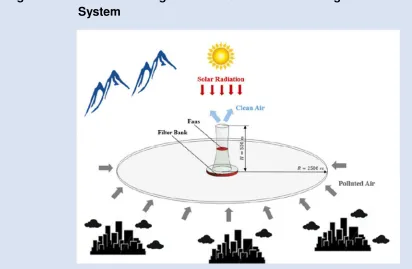
A Solar-Assisted Large-Scale Cleaning System (SALSCS) is an emerging method used for air quality abatement – or to clean polluted air. In these towers, solar heating warms the polluted ambient air, drawn in at the base, which rises. A filter bank, placed around the tower entrance, removes PM2.5 pollutants so that clean air exits from the top of the tower (figure 1). By placing the SALSCS near a large city, it pulls polluted air in and returns clean air to the city, reducing the PM2.5
[image:16.595.66.478.290.559.2]concentration.
Figure A Schematic diagram of the Solar-Assisted Large-Scale Cleaning
System
The first pilot scale SALSCS in Xi’an, funded by the Shaanxi government, aimed to demonstrate the concept (figure 2). As well as PM2.5 filters, catalyst-coated glass panels were added to reduce gaseous pollutants (for example, NOx). Short-term measurements showed PM2.5 concentrations in the district where the SALSCS was located approximately 12% below the surrounding districts. This matched the
Page 16 of 341
Figure B A night-view of the 1st generation SALSCS built in Xi’an, Shaanxi Province (completed July 2016)
Page 17 of 341 Figure C The 2nd generation SALSCS built in Yancheng Science Park, Jiangsu
[image:18.595.57.348.83.418.2]Province (completed September 2017)
Page 18 of 341
The SALSCS technology represents an effective and low-cost way to mitigate both PM2.5 and CO2, for the health and well-being of mankind.
There is sufficient evidence to say that a number of industries and sectors could be asked to take responsibility for the pollution they produce and its consequences for human health. In my report I have focused on the sector which I know best – the health service – and make recommendations relevant to both local hospitals and wider policy makers.
Recommendation 11
I recommend that industry leaders should work to:
a) be more transparent about the polluting effect of their activities, b) strive to reduce this effect, using innovative interventions, and c) bring success and best practice to attention within their industry.
My reasons for focusing here are twofold. Firstly, if we are to get industries to act on the health impacts of the pollution they produce, much of which will be as a result of products and processes which we value, then it seems reasonable that health professionals and policy makers should lead the way and demonstrate all the great progress some have made. Secondly, it is the case that the health service in this country is a significant polluter simply due to its size. There is positive action being taken, some led by NHS Sustainable Development Unit and some led locally by trail-blazing trusts. Some of this is presented as case studies here (box 2), particularly in Chapter 2 of this report ‘Pollution from the Health and Care System’. The health service causes a lot of pollution – it makes sense to strive to reduce this.
Page 19 of 341
Recommendation 12 I recommend that
a) NHS Trusts report progress against their Sustainable Development Management Plans in their annual reports, supported by publication of all relevant underlying data;
b) Public Health England should aggregate and analyse progress annually for a national public report to NHS Improvement; and
c) NHS Improvement should review Trusts' performance and recommend remedial action to Trusts, as appropriate.
Recommendation 13 I recommend that
a) Clinical Commissioning Groups should analyse local air quality monitoring data for breaches of air pollution standards, and publish these alongside the local hospital data for impacts on admissions for respiratory and cardiovascular disease and
b) Public Health England should aggregate and analyse progress annually for a national public report to NHS England.
I commend the efforts of Ambulance Trusts to phase out diesel vehicles and reduce idling. South Central Ambulance Service NHS Foundation Trust is experimenting with photovoltaic cells to keep electrical equipment in ambulances powered, whilst avoiding idling. Innovation and exploration like this should be championed locally and nationally.
Recommendation 14 I recommend that
a) Ambulance Trusts should publish annually on their progress towards phasing out diesel ambulances, including explaining how their routine procurement decisions pay heed to National Institute for Health and Care Excellence guidance on low vehicle emissionsiv (nitrogen oxides and particles) and b) Public Health England should aggregate and analyse progress annually for a
national public report to NHS England.
iv
http://indepth.nice.org.uk/no-idle-zones-can-help-protect-vulnerable-people-from-air-pollution-
Page 20 of 341
Recommendation 15
I recommend Health Education England convene and lead a working group, to include the Royal Colleges and Faculties of Health, to ensure that the health impacts of pollution are included in curricula for all clinicians in training. The group should also ensure the health impacts of pollution are included in continuous professional development programmes for existing staff.
Box 2 Nottinghamshire Healthcare NHS Foundation Trust
Lynn Richards, Energy and Environmental Manager and Sustainability Advisor, NHFT
Nottinghamshire Healthcare NHS Foundation Trust is committed to reducing the environmental impact associated with its service delivery and seeks to provide healthcare which is truly sustainable. Each year performance in key areas such as waste, energy, procurement and travel is monitored and progress is reported in the Trust’s Annual Report.
Our environmental objectives and targets are contained within the Trust’s
Sustainable Development Management Plan (SDMP). In response to organisational change, making significant progress against the existing plan, and updated guidance from the NHS Sustainable Development Unit, incorporating the United Nations
Sustainable Development Goals, the SDMP is currently being reviewed to make sure it accurately reflects the ambitions of the Trust.
Within the Estates and Facilities Directorate, the Trust holds accreditation to
ISO14001:2004 the internationally recognised environmental standard. This ensures that we set environmental objectives, meet compliance obligations, and make a commitment to the protection of the environment, and to the prevention of pollution.
The Trust has a network of staff Green Champions, and with their support we actively undertake projects and engage with local and national campaigns, such as National Clean Air Day and Fairtrade Fortnight. These help to promote behaviour change both within and outside of the work environment, maximising the positive effects.
Page 21 of 341
Box 3 City of York Council – a holistic approach to reducing pollution Mike Southcombe, Public Protection Manager, City of York Council
City of York Council takes a holistic approach to reducing pollution from all sources; examples of this are its’ One Planet York initiative and being the first council to adopt a holistic Low Emission Strategy (LES) with policies to reduce both carbon and other pollution.
Planning applications are reviewed for contaminated land, air quality, noise and other pollution to mitigate the impact of new developments on people’s health and environment. Our contaminated land and low emission planning policies have been adopted by others to help developers to reduce pollution. York regulates pollution from industry and has written guidance to control noise from licensed premises and events, with an out of hours service to deal with complaints.
York is at the forefront of developing policies to achieve the health-based air quality objectives, hence being awarded Ultra Low Emission City status. An extensive Pay As You Go electric vehicle charging network, funded by grants and a green charity, meant York was an early adopter of electric vehicles. A taxi incentive scheme coupled with an emission based taxi licensing policy has resulted in 15% of York’s taxis being low emission (petrol hybrids). York’s citywide monitoring network (and several feasibility studies) enables an evidence based approach to air quality strategy and planning and led to the use of electric buses and the concept of a bus based Clean Air Zone (CAZ) in the city centre; the CAZ is currently out for
consultation. Anti-idling policies were approved recently and follow on from public awareness-raising of the health impacts of air pollution, working with local
Page 22 of 341
Gathering data where we cannot act with
certainty
Unfortunately we do not currently understand enough about many pollutants to be certain whether they impact negatively on human health, especially at low to
moderate levels with long-term exposure. We understand less still about what action we could take to ameliorate any harmful effects on health.
Some of these pollutants have been in our environment for centuries but have never had data collected about their health impacts. Additionally, new techniques can reveal previously unknown negative health impacts. I argue that we have not thought enough about the impact of multiple pollutants at low exposure across a long period or in relation to long-term health impacts (namely NCDs). Some pollutants are only just emerging; for example newly synthesised chemicals, new technologies such as nanoparticles and the potential harms from chemicals in products.v Chapter 4 of this report, ‘New horizons’, addresses some of the newer substances we need to
consider as potential pollutants.
Recommendation 16
I recommend Public Health England investigate the creation and funding of a mechanism to synthesise evidence concerning the health impacts of all pollutants, and publish evidence-based statements on the health impacts of these pollutants in England.
Throughout this report, data, information and evidence are apparent as vital resources to address the health impacts of pollution, and priority areas for
improvement. Data has emerged as a central theme in my previous annual reports – obviously in genomics but also in the metrics that we use to monitor issues such as mental health. The data and information revolution is happening across biomedicine and has the potential to improve the health of the public. Pollution and human health is no different: we have a real opportunity to capitalise on the use of data to better understand these health impacts.
Facilitated by new, especially mobile, technologies, there has been a recent growth in citizen science. This has a role in data collection and knowledge generation around the impacts of pollution on human health. Quality and standards of data collection must, however, be maintained to give reliable and useful data.
v
Page 23 of 341
Recommendation 17
I recommend that UK Research and Innovation consider a health-related pollution topic for one of its first, national Citizen Science endeavours.
There are two distinct, albeit inter-related, types of data of the health impacts of pollution (Figure 1.1) that can be improved through integration of different pieces of data;
a) Static research data – helps us to gain knowledge about health harms from pollution and;
b) Surveillance data – allows the monitoring of known threats and for signals of new threats.
[image:24.595.92.500.421.722.2]Achieving this data integration will not be easy, but they would greatly help our understanding of, and ability to tackle, the health impacts of pollution.
Figure 1.1 The relationship between research and surveillance dataset covering the health impact of pollution
Page 24 of 341
It is easy, of course, to agree that we should have high-quality data used in a joined-up way – but what does this actually mean? Firstly, we need to integrate existing data and ensure wherever possible this is available open source. We need to use health data with a wider range of health outcome. In other words, not just focusing on mortality, but using data that capture the full health consequence of pollution on morbidity, mental health impacts, and impacts on quality of life. We need to collect new types of data, such as biomarkers and those relating to genetic susceptibilities. We need to develop bespoke statistical and research methods to mine these data. And we need to have access to surveillance data in real time, allowing us to act to improve health, identify vulnerable groups, and give insight into emerging issues.
It is clear: the evidence base around the health harms caused by many individual pollutants is not strong. Many of the professionals I spoke to when researching this report, however, raised real concerns about pollutants; and we must remember that the absence of evidence is not evidence of absence. To me this highlights the need for better systems of monitoring and surveillance across a range of different
pollutants.
These data systems will build resilience to the new, currently unknown pollution threats, and impacts on human health. They will help to fill knowledge gaps highlighted in my report, such as the impacts of light pollution on human health. I note there is increasing public and policy concern about the impact of
computer/smartphone screen use, and ‘blue light’, upon human health. Research is on-going and this is an important area of investigation, particularly given children’s use of social media via smartphones, increasing their exposure to potential risk.
Recommendation 18
I recommend that Public Health England works to bring together all of the routinely produced data on the health impacts of pollution and the surveillance of pollution (including data held by local authorities, the Environment Agency and others), to ensure availability for the public, public sector and researchers.
Recommendation 19
I recommend Public Health England develop and embed a formal, structured programme of surveillance on the health impacts of pollution and regularly publish findings.
Recommendation 20
Page 25 of 341
Changing the ways we work and do research
Trans-disciplinary working and research
Across the response to the health impacts of pollution and in all areas where action can be taken, I encourage consideration of the framework I suggest for pollution above. Action to reduce pollution is action to prevent ill health. Whilst it is always good for policy makers to think and then work in a joined-up way and
multidisciplinary way, pollution is so complex that here it is an imperative
(exemplified by the multi-faceted, successful response to lead pollution – see Box 4).
As well as changing how we think about pollution, and the data we gather, we also need to think about the way in which health professionals and researchers work. Aligned to the data issues explored above, we need more linked-up,
trans-disciplinary research. Until now researchers into the health impact of pollution found they do not fit into funding structures. Too often these structures follow an old
framework, with pollution being considered as an environmental hazard rather than as a broader health issue. As an example, if pollution is a driver of NCDs (as
demonstrated for air pollution) then researchers in this field should be able to easily apply for biomedical research funding.
Page 26 of 341
Recommendation 21
I recommend that UKRI convene a working group on the integration of health and pollution data. The Group should
a) include Health Data Research UK, other relevant bodies, and government Chief Scientific Advisers;
b) review existing data coverage; review methodologies for linkage of data sets; and explore new opportunities for joined up data; and
c) ensure data reviewed includes, as a minimum, data concerning the health impacts of pollution, socio-demographic data and pollution data.
Recommendation 22
I recommend research funding and structures should be put in place which
encourage research on the long-term impacts of low-levels of pollutant exposure on human health. These research structures should facilitate focused multi-disciplinary research into health and pollution.
Communication
Through all of this, there needs to be better communication with the public about the extent to which we understand health risks, what these risks are (including risk factors for NCDs), and what can be done. There are many skilled people working hard on this agenda already. Further, communication around pollution and health does not need to reinvent the wheel; we can draw on many other fields to
understand what works. Relative risks can be challenging for some people to
understand, and many of us remain under-equipped to make fully informed decisions about pollution with regards to their and their families’ health. Public health
professionals play a key role in describing risk levels to local pollutions in layman’s terms, whether to allay fears or warn of unsuspected harms.
Page 27 of 341
Box 4 Lead pollution – a pollution success story
Prof Roy Harrison, University of Birmingham
Lead was long recognised as a substantial hazard for workers in the lead industry - with limits enforced. In the 1960s epidemiological studies revealed that exposure to lead at environmental concentrations, far below those experienced in industry, were leading to impaired IQ development in children.
Lead is a multi-media pollutant with significant pathways for exposure through:
• The atmosphere. By far the greatest respiratory exposure for the majority of
the population arose from emissions from road traffic.
• Drinking water. Although most sources of drinking water were low in lead,
lead could be picked up in the distribution system, especially from household lead pipes.
• Soil and dust. Urban and roadside soils were heavily contaminated with lead,
largely due to emissions from road traffic. Indoor dusts could also be heavily contaminated by outdoor dusts and from leaded paintwork. Old paints
frequently contained a very high lead content, leading in some cases to clinical symptoms of poisoning in exposed children.
• Food. Foodstuffs contained lead from a range of sources, most notably
atmospheric deposits to food crops and the use of leaded solders in cans.
Faced with many exposures, the response had to be multifaceted. In 1985, the maximum lead content of petrol was reduced and the subsequent introduction of unleaded petrol led to a huge decline in airborne lead concentrations. Drinking water from sources most liable to dissolve lead was treated prior to distribution to suppress lead solubility, which together with widespread replacement of leaded pipework, led to a substantial reduction in drinking water lead concentrations. Limits were
introduced on the lead content of paints. The use of lead in food cans was phased out, and this together with a reduced input of lead into unprocessed foodstuffs led to a dramatic fall in dietary exposures.
Page 28 of 341
Summation and chapter summaries
Page 29 of 341
Summary of Section 1 ‘21
stcentury threats’
Chapter 2 Pollution from the health and care system Chapter 3 21st century chemicals
Chapter 4 New horizons
Page 30 of 341
Chapter 2 Pollution from the health and care system
As presented throughout Chapter 2, our healthcare system, the NHS, is a source of pollution. Our duty of care to our patients has, to date, not extended to how we run our NHS in terms of the health impact of its pollution footprint. This concept of
environmentally sustainable health systems has recently gained greater international focus.vi,vii WHO guidance echoes key themes presented in Chapter 2: minimising waste, using efficient procurement, prioritising prevention, and others. These are all required to switch the health system from having a negative to a neutral or positive environmental impact.
Five percent of all road traffic at any one time is estimated to be on NHS business, be it patients going to and from care or the NHS’s fleet of vehicles. This will be reduced if the right care is provided in the right place – using models of care with least amount of travel. Taking care to the patient will be part of this, so there is a role for us fulfilling the potential that technology has.
There is limited direct evidence of the health impacts of other forms of waste in the NHS, although the continued use of landfill and incineration must have some. There are ways to stop this – which will also improve NHS finances. It will not be sufficient to recycle; we need to reduce waste produced: reduce unnecessary healthcare, and ensure more efficient procurement.
Healthcare should be responsible for the pollution footprint of it’s supply chain. Gaps in knowledge and environmental monitoring remain. Reducing pharmaceutical
pollution – notably through waste and overprescribing reduction – has co-benefits (for finances, patients and others). Healthcare, and more significantly agriculture and aquaculture, contribute to the overall quantity of pharmaceuticals in the environment. Environmental antimicrobial pollution is a cause of antibacterial resistant bacteria, although the exact degree remains unknown
vi
WHO 2017 Environmentally sustainable health systems: a strategic document
Page 31 of 341
Chapter 3 21st century chemicals
Chemical mixtures are the norm in the environment, and these mixtures are growing increasingly complex. Constituent chemicals within these mixtures are mostly at a low concentration, with any one chemical unlikely to harm health on its own, but with less known about the health impact of the mixture.
Large datasets, new epidemiological techniques, geospatial methods, ‘omics’, genetic approaches, and others will help us to better understand the threat posed. We cannot rely solely on observational sciences, be it to study mixtures or individual chemicals. Experimental studies will be critical, notably toxicological studies. These must focus on the substances of concern to human health, providing evidence to be collated with observational data to give the most accurate picture of health impacts. They also need a real world focus, focusing on levels of exposure faced by humans.
In addition to new chemical threats, another change will be reassessing ‘legacy’ chemicals using 21st Century techniques. Metals are an example, one of the oldest legacy exposures, but whose risk can be revisited. This could include using genetic data to better understand and highlight individual susceptibility.
Some chemicals have been the subject of persistent discussion in terms of their health impact. These include dioxins, endocrine-disrupting chemicals, Bisphenol A, phthalates and others. Some of these have well defined hazard profiles, but
exposures are believed insufficient to cause risk. Others have associations with diseases, but this has not been proven to be causal. These chemicals require vigilance. The chapter author suggests specific research examining causal links between concentrations of chemical and health outcomes, rather than associations.
Page 32 of 341
Chapter 4 New horizons
This chapter explores pollutants that are newer, or are less well established in terms of the evidence of health impact. It discusses some of the newer techniques to study and respond to the health impact of pollution.
Noise stands second to poor air quality in terms of the burden of ill health caused by a single pollutant, and is increasingly high on the international agenda. Over 80 percent of people report being exposed to noise pollution in their homes. Links to ill health include, proximally, sleep disturbance and stress, with more distal
associations with hypertension, cardiovascular disease and children’s learning development. Research may identify causal relations with the latter measureable health outcomes. Addressing noise level retrospectively can be costly – it is better to consider noise pollution in planning decisions.
Other proposed threats are either far less well established or appear to have more limited impact. Light has some known effects on the body – but whether this extends to light pollution having health impacts is not known.Nanomaterials are a new and exciting technology, with many applications. These will pollute and will penetrate the human body due to their size. These need to be examined as emerging chemicals. With very limited information on any adverse health impacts, we must maintain a targeted watching brief – one that is interdisciplinary, with particular focus on exposure assessment. This summary of nanoparticles could well be repeated for micro plastics – with no current evidence of adverse human health impacts, there is a need for coordinated multi-disciplinary assessment.
Page 33 of 341
Summary of Section 02, ‘Socioeconomic world’
Chapter 5 Economics of pollution interventions Chapter 6 Pollution and inequality
Page 34 of 341
Chapter 5 Economics of pollution interventions
Economics and economies play a pivotal role in all of health. Chapter 5 presents evidence of the health economic evaluations of interventions to address pollution in England (or that are of relevance to England). In addition to this, there are many other questions that arise from considering together human health, pollution and economics. These include assessing the cost of the health impacts of pollution; the relationship between economic growth, pollution production and associated ill health, as well as the insight economics gives around changing polluting behaviours, and others.
Our best estimates of the overall cost of the health impact of pollution are likely to be underestimates. There are a number of reasons behind this, presented in the
chapter. For one, we have far less evidence about the impact pollution has on morbidity and quality of life – compared with mortality – which are major drivers of cost. More work is required to get a fuller and more accurate measure of cost of ill health from pollution; this will help to stimulate an appropriate policy response.
This chapter is informed by a systematic review of the health economic evaluations of interventions to reduce pollution. Although some actions have been shown to be beneficial from a health economic perspective, the review highlighted the gaps in evidence. This evidence base needs to be expanded, with results presented in a way that makes it easy for decision makers at a local and national level to implement the evidence based options.
Page 35 of 341
Chapter 6 Pollution and inequality
This chapter collates the evidence around pollution and health inequalities, and considers the implications.
If we use the simple ‘source-pathway-receptor’ model that describes how a pollutant can get from ‘the environment’ to cause health harms, there are plausible
inequalities across the whole pathway. In terms of evidence in England, much is focused on air quality and the differential exposure by socio-economic position. Here, there is growing consensus of a U-shaped exposure to raised mean
concentrations (lowest exposure in rural areas which tend to be in the middle of the socioeconomic gradient); and of a linear relationship between exposure to short term exceedances of air quality targets and deprivation (more exceedances in the most deprived). There is much more limited evidence of other types of inequality, such as by ethnicity, gender or others, and of inequalities in exposure to other pollutants.
The chapter discusses ‘triple jeopardy’: a concept that states that:
“disadvantaged groups face: first, increased risks from social and behavioural determinants of health; second, higher risks from high ambient pollution exposure; and, third, an effect modification that makes exposure to ambient pollutants exert disproportionately large health effects on them compared with advantaged groups”.viii
This implies an interaction between the pollution and socioeconomic position – through an underlying susceptibility, therefore more severe health outcomes for a given ‘portion’ of pollution exposure. This is intuitive, but the evidence is not yet clear (although there are some suggestions), and is certainly not showing a consistent, large impact on clinically meaningful outcomes at present.
The evidence base of health inequalities associated with pollution in England is also restricted by a number of limitations. A major weakness is the use of area level data rather than individual-level (while area-level data remains helpful and hypothesis generating) Combining data, including pollution exposures, health outcomes and rich socio-demographic data will allow better understanding of this relationship. This matters because addressing health inequalities is a priority in England. There is one question of particular importance: do our wider efforts to address the health impacts of pollution have positive, neutral or negative impacts on health inequalities?
Page 36 of 341
Summary of Section 3, ‘Our human response’
Chapter 7 Environmental and health service pollution
Chapter 8 Environmental pollution - data, surveillance and health impacts Chapter 9 Measurement and communication of health risks from pollution
Page 37 of 341
Chapter 7 Environmental and health service pollution
Chapter 7 explores how those working across environmental health are faced with the health consequences of pollution on a daily basis. Specialists in environmental health, and all allied practitioners working to curb pollution, are a vital resource to improve the public’s health and prevent chronic disease.
The environmental health workload can often be at the acute end of the response to the health impacts of major pollutants. As well as working to control the immediate acute health impact of pollution, the chapter describes how environmental health professionals engage in proactive and preventive work. They can use their
considerable expertise in the planning processes, for housing, transport and more, to create an environment where it is easy for the public not to pollute nor be affected by pollution. Practically, the skills and responsibilities to do this locally now lie in one place – local authorities.
Polluters often do the minimum to reduce their health impact, often just meeting legal requirements. The chapter explores the need to forge an environment where
individuals, institutions and public bodies find it easy not to pollute – where making the no/low pollution choice is the norm, and where pollution levels are reduced as far as possible to improve health. It describes how this will require the provision of information to aid decisions, real leadership and structural changes to make the ‘right’ choice easier.
Page 38 of 341
Chapter 8 Environmental pollution - data, surveillance and health impacts
This chapter discusses the difficulty of studying and monitoring the health impact of pollution.
There is a proliferation of data, across pollution exposures and health outcomes, ‘Joined-up data’ increases size and richness of datasets, and can add a longitudinal component – all of which increases the ‘power’ of these data to answer question about the health impacts of pollution. Achieving this needs close collaboration and partnership between many institutions, the health sector, national and local
government, academic and others. Data not only need integrating but also needs to be published, whilst ensuring that appropriate governance procedures remain. Access, particularly to routine monitoring data, must be fast enough to respond to emerging health threats from pollutants.
The UK is well placed to remain a world leader in understanding pollution;
methodological advances could allow us to capitalise on existing datasets to improve our knowledge.
Biomonitoring has great potential to transform how we gather knowledge on the health impacts of pollutants. Using biomarkers means we can overcome difficulties in relating environmental pollutant concentrations to the exposure faced by individuals: they can give us an exact, person specific measure. When combined with health outcomes we can improve estimates of risk from pollutants and strengthen causal inferences to ill health. Internationally, biomonitoring data sets have provided valuable insights, and the chapter describes how an annual biomonitoring dataset would help us examine current and future pollutant threats, protecting the public’s health and monitor our actions.
Page 39 of 341
Chapter 9 Measurement and communication of health risks from pollution
This chapter expands on the difficulties in measuring the health risks from pollution, and the challenge of communicating risk levels.
It is important to remember the context in which pollution sits when considering its health impact. Most pollution arises out of an activity that someone chooses to do: therefore there is always some inertia to maintain the status quo. Practically, this means we must be confident (not necessarily precise) about the health impact of a pollutant. We must then communicate this in an impactful way in order to elicit changes (a necessary – not sufficient requirement).
One question, across pollutants, is understudied; what is the balance in harm
between short term exposure to high level and long term exposure to lower levels of pollutants? This has an obvious implication for measuring the total burden of
pollutants, but also has implications for the policy response. The fastest way to address one type of exposure may not address the other. This chapter discusses the advantages collaboration across disciplines provides when trying to establish
causation, and trying to synthesise results.
There is an existing body of evidence – often not from the world of pollution itself – to draw on upon when communicating risk. Valuable insights can be provided. For example, risk perception theory shows us the value of the emotive communication, and behaviour change theory highlights the importance of self-efficacyix in making changes.
The chapter describes other facets of successful risk presentation and
communication. It explores openly stating both confidence in, and precision of, best risk estimates as a way to overcome the uncertainty we have around risks of
pollutants, without compromising action. This openness and using emotive messages are two lessons for pollution risk communication.
ix
Page 40 of 341
Chapter 02
Pollution from the
Health and Care
System
Chapter lead
David Pencheon
1Chapter authors
David Pencheon
1,Andrew R H Dalton
21 Honorary Professor, Health and Sustainable Development, Medical School, University of Exeter Medical School
Page 41 of 341
Introduction
Healthcare can do much to improve health. The financial cost of healthcare should be seen mostly as an investment; the environmental cost should mostly be seen as avoidable.
Not only can healthcare systems be disproportionately polluting, but they have special responsibilities and opportunities to be exemplary in not causing avoidable harm. There are many reasons why the health service pollutes:
the size of the sector – small relative increases in efficiency or decreases in waste have high absolute consequences;
the toxicity of many products used – many diagnostic reagents and the interventions (for example pharmaceuticals) are novel agents and therefore can have unexpected and polluting consequences on the environment unless rigorously and systematically tested.
Every healthcare practitioner has a duty to do no harm: “primum non nocere”. The same principle should be applied to healthcare systems such as the NHS. The financial cost of waste and human cost of pollution caused by the NHS means we need to factor this into how we design and deliver models of prevention and care. It is counter-productive to provide healthcare in ways that pollute the conditions that create and protect health.
For instance, the NHS is now responsible for almost one in 20 of all vehicles on the road.1 Reducing the fossil fuel transport within the NHS creates multiple health benefits: reducing air pollution (PM/NOx); promoting physical activity; and the reduction of climate change inducing greenhouse gases – all of which have
Page 42 of 341
Healthcare’s role in pollution: part of the answer
The NHS (both practically and symbolically) has a special role in not only curing disease but also in prevention. This translates into a responsibility to measure and address the preventable pollution for which the NHS is responsible: from toxic waste, to air pollution to greenhouse gas emissions. Examples of how the NHS contributes to pollution include;
• business mileage and the movement of ambulances in 2016 by NHS providers
alone equates to around 680m miles per year, creating 517 tonnes of NOx and 27.3 tonnes of PM 2.5, this equals a health impact cost of over £15m per annum.;3
• annually NHS providers spend over £540m on energy which equates to the
release of 3.7 million tonnes of CO2. There are still NHS providers burning coal and oil at health sites; both are very carbon and pollutant intensive fuels, with 176 gigawatt hours of energy from these in 2016.
The NHS in England spends approximately £16bn per year on prescribing drugs, much of which is disposed of in uncertain ways, either before or after being administered. Not only does this result in great financial, but it is unclear exactly what the long term polluting effects of pharmaceutical might be on the environment.
Some level of pollution is inevitable in most health care activity. Much harm, waste and pollution can therefore be eliminated by reducing avoidable and unneeded health care by addressing over-diagnosis and over-prescription (supporting efforts to, for example, reduce over use of antibiotics). This is in addition to traditional waste reduction such as throwing away excess packaging, unused open packets etc. Waste extends to over diagnosis and over treatment.4 An estimated 20% of clinical practice has no benefit to the patient – whilst there is significant overuse of tests and interventions.5 Addressing waste produces higher value healthcare, providing more care for a given ecological footprint. Efforts to reduce waste – and pollution – also extend to having a much more strategic and ambitious approach to prevention: as the Prince of Wales said in 1891, “If preventable, then why not prevented”.6
Preventing ill health has the added co-benefit of reducing the need for future treatment – with its associated environmental impacts.
As responsible stewards, doctors can provide a more effective use of constrained economic and environmental resources.7
Page 43 of 341
There is increasing evidence to suggest that, with sufficient will, the polluting
Page 44 of 341
Pollution and finances: “a convenient truth”
The link between financial sustainability and environmental sustainability is a highly convenient truth, and an opportunity the system should seize. Much pollution caused by the health system is due to wasteful practices that generate harm to the
environment (and in turn to the public and patients), waste money (and other finite resources), and jeopardise safety. Understanding the scale of the problem and the opportunity for improvement brings significant, multiple benefits for the health of both current and future generations, as well as preserving those resources now.
An example at the most critical part of the system – hospital admissions – shows that some enlightened hospitals systems assess every unplanned admission to quantify the degree of preventability, and thus the unnecessary activity, cost, harm, waste and pollution caused. This can be repeated across all other aspects of the health system. A population or public health approach to care9 (as practiced by systems such as Kaiser Permanente in the USA) can significantly reduce unnecessary and wasteful care, thus reducing harm and pollution.10
Given the multiple benefits of actions to reduce waste in the health system –
Page 45 of 341
Pollution in the health and care system
Three specific examples are considered here as they fulfil the important criteria of being widely understood and measurable, and areas where action is possible and effective.
Travel and air quality
The health system in this country, like in nearly all countries, is large (employing over 1.2 million people in England – the fifth largest employer in the world), reaches every town and community in the land, and involves the movement of many goods,
services and people. The movement of staff, patients, visitors, and the coordination of logistical support for the health service means that approximately 3.5-5% of all road traffic at any one time in England is estimated to be on some sort of NHS business.11
Much of this is avoidable if we are to bring the right care to the right people at the right time. We need to understand that there is a price to pay for this scale of transport and travel, not just in terms of time or money but in terms of air pollution (NOx, PM10 and PM2.5) and greenhouse gas generation. Because no-one pays today for the true, full social cost of fossil fuel use and pollution (much of the cost is deferred to the future) and because large hospitals are fixed and immovable assets, we focus much of our specialised care there. These contain a critical mass of
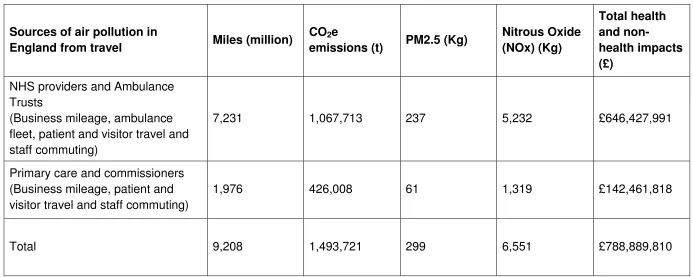
Page 46 of 341 Table 2.1 Air quality and the NHS fleet, 2016
Sources of air pollution in
England from travel Miles (million)
CO2e
emissions (t) PM2.5 (Kg)
Nitrous Oxide (NOx) (Kg)
Total health and
non-health impacts (£)
NHS providers and Ambulance Trusts
(Business mileage, ambulance fleet, patient and visitor travel and staff commuting)
7,231 1,067,713 237 5,232 £646,427,991
Primary care and commissioners (Business mileage, patient and visitor travel and staff commuting)
1,976 426,008 61 1,319 £142,461,818
Total 9,208 1,493,721 299 6,551 £788,889,810
Source created using information from Health Outcomes of Travel Tool; a modelling tool for the harm; air pollution, noise, GHGs and accidents from all travel in the NHS including all business mileage and ambulance fleet, available at
Page 47 of 341 Box 1 Personalised Care for Lung Fibrosis Patients: Reducing
unnecessary travel
Idiopathic Pulmonary Fibrosis (IPF) is a condition that causes progressive scarring of the lungs resulting in shortness of breath, leading to the need for extra oxygen. Treatment is given to relieve symptoms and to try to slow progression. University Hospitals North Midlands (UHNM) University Hospital is a specialised centre for the management of patients with IPF
The issue?
It is only in the past few years that drugs have become available to treat IPF. These can only be prescribed by specialised centres. These drugs have side effects for which patients require close monitoring and regular clinic visits and assessments. As a specialist centre for IPF, UHNM sees patients referred from a large area across the Midlands and Wales. For some patients this means a lot of traveling.
Patients with IPF can also require prompt support, especially as the disease
progresses. This is usually provided in close collaboration with the patients’ carers, local community and hospital-based respiratory services. Thus communication between all parties has to be effective.
Action taken
To address the issues of frequent clinic attendances in person and prompt
intervention to support patients, the team in Stoke have developed a bespoke ‘app’ – accessible by phone, tablet or computer - on a secure hospital website. This allows patients to track and report their symptoms from home instead of attending the hospital in person.
The patient-generated reports are reviewed by the clinical team daily, who can then guide the patient/carer. The app includes the patient’s history and co-morbidities. Functionality is especially useful to enable patients to recognise symptoms and drug side effects. It also supports patient/carer participation in the management of their disease with real–time communication between them and the clinical team avoiding the need to make unnecessary visits to the hospital clinic.
The impact?
There are currently over 250 IPF patients at the trust. Although the app was only recently launched over 50 patients are using it. This can mean a reduction in appointments of up to 50% meaning a saving in carbon costs as well as better outcomes for patients. The trust is hoping the project will enable a reduction to two visits a year for the mild to moderate disease and four visits for severe.
Page 48 of 341
Lessons learned
• Internal testing was required to ensure patient safety and the suitability of the
application
• A simple user guide was produced;
• Security of the system, data entry and confidentiality were addressed by entry
protection on the Trust website;
• The application can be used on a variety of devices for example smart phone,
tablet, laptop or desk computer according to patient preference;
Scaling up
Page 49 of 341
Despite the extraordinary growth of person-held ICT, the miniaturisation of near patient testing, and the potential savings from such developments, there is little evidence that care is being taken to the patient. Consequently, our ability to invest in modern ICT systems, prevention, care in the community, powering public, patients, and primary care is all hindered by the centralisation of healthcare facilities. This results in such a high proportion of road traffic being on NHS business which contributes to air pollution, wasted time, higher risks of road injury and community severance†††, all of which adversely affect health. Figure 2.1 describes how
investment in sustainable transport can affect improved health.
The health service has an important opportunity to be a part of the solution to the pollution challenges we face, not part of the problem. Moreover, health services and health professionals have an important responsibility to visibly show that they take their contribution to air quality (and other issues such as climate change seriously). Some hospital Trusts, Bart’s NHS Trust in East London, and Great Ormond Street Hospital, for example, have specific programmes to reduce the damaging effect their activities have on air quality through reducing their energy use, stopping ambulance idling, other fuel efficient driver training and increasing zero carbon forms of transport in patients.
†††
‘Community severance’ (also known as ‘the barrier effect’) is a term to
Page 50 of 341
Figure 2.1 Virtuous cycle of investing in sustainable health and sustainable transport
Page 51 of 341
Author’s suggestions for improvements
• All hospitals could have travel plans as part of their Sustainable Development
Management Plans (SDMPs) including:
o Plentiful active and low carbon travel opportunities to and from health
facilities (walking, cycling, public transport etc.);
• Energy strategies in the NHS could consider non-combustible renewable heat
and co-generation (for example fuel cell combined heat and power), the use of renewable source electricity (either by generation on site or through energy contracts) and District/Community Heating Schemes:
o This should include restricting use of energy resilience equipment. It
should be used for energy resilience, where necessary, but not for short term financial gain through incentivised combustion of heavy polluting fuels to support the national grid.
• The NHS could adopt innovative models of prevention and care that allow
patients and staff to travel much less whilst receiving high quality care (telecare, long term condition monitoring, virtual clinics, specialists in primary care settings);
• All action to reduce pollution in the NHS could be elevated from “expectations” to