Int. J. Electrochem. Sci., 8 (2013) 10487 - 10497
International Journal of
ELECTROCHEMICAL
SCIENCE
www.electrochemsci.orgPotentiometric Determination of Cyclizine by a PVC membrane
Sensor
Mohammad Reza Ganjali1,2,*, Bagher Larijani,3,* Farnoush Faridbod,1,2 Parviz Norouzi1,2
1
Center of Excellence in Electrochemistry, University of Tehran, Tehran, Iran
2
Biosensor Research Center,Endocrinology and Metabolism Research Institute, Tehran University of Medical Sciences, Tehran, Iran
3
Endocrinologyand Metabolism Research Center,Endocrinology & Metabolism Research Institute, Tehran University of Medical Sciences, Tehran, Iran
*
E-mail: [email protected]; [email protected]
Received: 13 April 2013 / Accepted: 17 June 2013 / Published: 1 August 2013
Potentiometric determination of Cyclizine was performed by a potentiometric PVC membrane sensor. Sodium tetraphenyl borate was used for the preparation of the sensing element used in the membrane. Dibutyl phthalate was the solvent mediator of the PVC membrane. A room temperature ionic liquid was also used in the composition of the membrane to helps the drug to exchange from aqueous solution to the organic phase. Also, it can diminish the Ohmic resistance of the membrane due to its ionic property. The best PVC membrane sensor response was obtained by a membrane composition of 30% PVC, 60% DBP, 7% ion-pair and 3% ionic liquid. The constructed sensor can measure the concentration of Cyclizine in the range of 5.0×10⁻⁶
-1.0×10⁻² mol L-1 with a detection limit of 4.5×10⁻⁶ mol L-1. The potentiometric measurements can be done in the pH range of 4.0 to 6.0. The proposed electrode displays a fast response time (about 15 s) and can be used for a period of seven weeks without any considerable change in its performance.
Keywords: Cyclizine, Ion-Pair complex, Potentiometry, PVC membrane, Ion selective electrode
1. INTRODUCTION
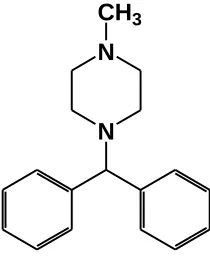
Cyclizine (CYC), 1-(diphenylmethyl)-4-methylpiperazine or 1-benzhydryl-4-methylpiperazine (Fig. 1.), is a piperazine derivative that has been effectively used for the prevention and treatment of nausea and vomiting associated with motion sickness [1-3]. Cyclizine is a histamine H1-receptor
[image:2.596.245.350.72.200.2]
N N CH3
Figure 1. Chemical structure of Cyclizine
The analysis of drugs in biological fluids and pharmaceutical formulations requires an accurate, selective, sensitive and precise analytical technique to make sure a credible representation of the drug's absorption and disposition in the body.
Several methods for determination of Cyclizine have used including colorimetry [4], derivatization with tritiated acetic anhydride [5], gas–liquid chromatography [6], GC–MS [7], second derivative UV spectrophotometry [8], cyclic Voltammetry [9] and HPLC [10].
Different electrochemical measurement techniques were used for drug analysis during recent year but potentiometric using indicator electrodes have advantages of rapid and ease of preparation and procedures, portability, fast response time, wide linear dynamic range, simple operatory and low cost. These characteristics have certainly led to the construction of numerous sensors for several ionic species, and the number of reported sensors has grown over the past years [11-21]. Also, potentiometric sensors can be easily applied for quality control of the drugs in the factories.
PVC membrane electrodes are one of the subdivisions of potentiometric sensors which are widely used for different applications [22-32].
In this work, a potentiometric sensor based on PVC membrane was constructed. The membrane responded based on ion-exchange mechanism of ion-pair complex of Cyclizine and sodium tetraphenyl borate. Room temperature ionic liquid (RTIL), 1-n-butyl-3-methylimidazolium tetrafluoroborate ([bmim]BF4) was also used in the composition of the PVC membrane sensor to improve the
performance of the device.
2. EXPERIMENTAL SECTION
2.1. Materials and Reagents
All of the solutions were prepared in double-distilled deionized water, using analytical grade reagents. High-molecular weight polyvinylchloride (PVC) (Fluka Co., USA), sodium tetraphenyl borate (NaTPB), dibutyl phthalate (DBP), nitrobenzene (NB), benzyl acetate (BA), nitrophenyloctylether (NPOE), tetrahydrofuran (THF), and room temperature ionic liquid (1-n-butyl-3-methylimidazolium tetrafluoroborate ([bmim]BF4) (Merck Co., Germany). All materials were of the
formulations were obtained from a local pharmaceutical manufacturer (Tehran, Iran) as gift samples. 2.2. Preparation of the ion-pair complex
Sensing element used in the sensors was an ion-pair complex made from the interaction of Cyclizine and sodium tetraphenyl borate. It was prepared by mixing about 20 mL of 0.01 (mol L-1) solution of Cyclizine hydrochloride with 20 mL tetraphenyl borate solution (0.01 mol L-1). The resulting precipitate was then filtered, washed with distilled water and dried in the room temperature.
2.3. Preparation of the PVC membrane sensor
To prepare PVC membrane sensors, different amounts of ion-pair complex along with appropriate amounts of PVC, plasticizer and ionic liquid were dissolved in tetrahydrofuran (THF), and the solution was mixed well into a glass dish of 2 cm diameter. Then, THF was evaporated slowly until an oily concentrated mixture was obtained. A plastic tube (about 3 mm o.d.) was dipped into the mixture for about 10 s so a transparent membrane of about 0.3 mm in thickness was formed. The tube was then pulled out from the mixture and kept at room temperature for about 5 h. Afterwards, the tube was filled with an internal filling solution (1.0×10⁻³ mol L-1 of Cyclizine hydrochloride solution). The sensor was finally conditioned for 15 h by soaking in the same solution [18-23].
2.4. Standard Cyclizine solutions
Stock solution of Cyclizine hydrochloride (0.02 mol L-1) was prepared. The working standard solutions (1×10⁻⁷ to 1×10⁻² mol L-1) were prepared by appropriately dilution of the stock solution with distilled water.
2.5. Potentiometric Measurements
The glass cell where Cyclizine sensor was placed into consisted of two Ag/AgCl double junction reference electrodes (Azar-Elelectrode Co., Iran) as internal and external reference electrodes. Both electrodes were connected to a Corning ion analyzer with a 250 pH/mV meter with ±0.1 mV precision. The cell assembly used for the potentiometric measurements was as follow:
Ag-AgCl || internal solution, 1×10⁻³ mol L-1 Cyclizine hydrochloride solution | PVC membrane | sample solution || Ag-AgCl, KC1 (satd.)
2.6. Assay sample preparation
Twenty tablets of Cyclizine finely powdered. Portions equivalent to the weight of one tablet (50 mg Cyclizine) were weighed and transferred into 100-mL volumetric flask. 50 mL of distilled deionized water was added. The contents were shaken thoroughly to dissolve the compound, made up to volume and adjust the pH to 4. Suitable aliquots of this solution were filtered through a Millipore filter (0.45 mm).
3. RESULTS AND DISCUSSION
The most important part in the construction of a PVC membrane sensor is preparation of a sensitive membrane. Next, characterizations of the constructed sensor are optimized.
[image:4.596.43.558.356.650.2]3.1. Membrane composition optimization
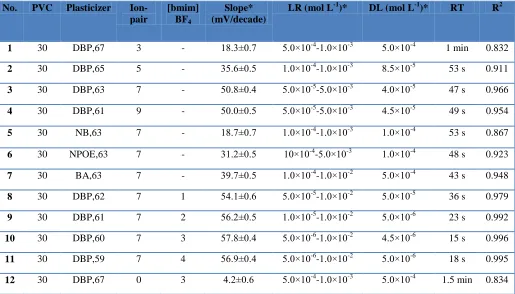
Table 1. Optimization of the PVC membrane ingredients No. PVC Plasticizer
Ion-pair
[bmim] BF4
Slope* (mV/decade)
LR (mol L-1)* DL (mol L-1)* RT R2
1 30 DBP,67 3 - 18.3±0.7 5.0×10⁻⁴-1.0×10⁻³ 5.0×10⁻⁴ 1 min 0.832
2 30 DBP,65 5 - 35.6±0.5 1.0×10⁻⁴-1.0×10⁻³ 8.5×10⁻⁵ 53 s 0.911
3 30 DBP,63 7 - 50.8±0.4 5.0×10⁻⁵-5.0×10⁻³ 4.0×10⁻⁵ 47 s 0.966
4 30 DBP,61 9 - 50.0±0.5 5.0×10⁻⁵-5.0×10⁻³ 4.5×10⁻⁵ 49 s 0.954
5 30 NB,63 7 - 18.7±0.7 1.0×10⁻⁴-1.0×10⁻³ 1.0×10⁻⁴ 53 s 0.867
6 30 NPOE,63 7 - 31.2±0.5 10×10-4-5.0×10⁻³ 1.0×10⁻⁴ 48 s 0.923
7 30 BA,63 7 - 39.7±0.5 1.0×10⁻⁴-1.0×10⁻² 5.0×10⁻⁴ 43 s 0.948
8 30 DBP,62 7 1 54.1±0.6 5.0×10⁻⁵-1.0×10⁻² 5.0×10⁻⁵ 36 s 0.979
9 30 DBP,61 7 2 56.2±0.5 1.0×10⁻⁵-1.0×10⁻² 5.0×10⁻⁶ 23 s 0.992
10 30 DBP,60 7 3 57.8±0.4 5.0×10⁻⁶-1.0×10⁻² 4.5×10⁻⁶ 15 s 0.996
11 30 DBP,59 7 4 56.9±0.4 5.0×10⁻⁶-1.0×10⁻² 5.0×10⁻⁶ 18 s 0.995
12 30 DBP,67 0 3 4.2±0.6 5.0×10⁻⁴-1.0×10⁻³ 5.0×10⁻⁴ 1.5 min 0.834
*The results are base on five replicate measurements.
be seen, the optimum amount of PVC was selected 30 mg and the best amount of plasticizer was 60 mg. Plasticizer should be a water-immiscible organic liquid which provide a homogeneous dissolution and diffusional mobility of the ion-pair complex inside the membrane [47-52]. The plasticizer should be a organic liquid with low vapor-pressure, compatible with PVC, no functional groups which can undergo protonation reactions [45-55]. The type of the used plasticizer can affect the analytical responses e.g. slope, linear domain and selectivity of PVC membrane electrodes. Four general plasticizers with different polarity (dielectric constant) were tested dibutyl phthalate (DBP with DC of 6.4), nitrophenyloctyl ether (NPOE with DC of 24), nitrobenzene (NB with DC of 35.7) and benzylacetate (BA with DC of about 5.7). The responses showed that the membrane had DBP better responds. DBP among the used plasticizers provided an effective linear range and a lower detection limit due to the better extraction of Cyclizine hydrochloride ions in the organic layer of the membrane.
As shown in Table 1, a room temperature ionic liquid ([bmim]BF4) was also used in the
composition of the membrane no. 8 to no. 11. Using [bmim]BF4 helps the Cyclizine ions better extract
and exchange from aqueous solution to the organic phase of the membrane. RTILs can be act as an ionic additive and beside the mentioned effect; they can also decrease the membrane Ohmic resistance. As it can be seen from Table 1, absence of the ion-pair complex in the membrane causes a very poor response (membrane no. 12), which confirm significance of the ion-pair. The best Nernstian slope was obtained 57.8±0.4 mV per decade with the membrane no. 10. This membrane composition was selected for the next experiments.
3.2. Characterization of the measurement parameters of the sensor
Linear range, detection limits, Nerstian slope and its standard deviation, response time, applicable pH range, lifetime and selectivity of the proposed sensor were studied [48-55].
The measuring range of a potentiometric sensor whi ch is the linear part of the calibration graph as shown in Figure 2, was obtained 5.0×10⁻⁶-1.0×10⁻² mol L-1 with a detection limit of 4.5×10⁻⁶ mol L-1. Using ionic liquids in the composition of the membrane causes the improvement in the measurement parameters of the sensor. Calibration graph slope for PVC membrane electrode was 57.78 mV per decade of the Cyclizine concentration and a standard deviation of ±0.40 mV after five replicate measurements.
Dynamic response time of the sensor [46-51] was obtained by the variation and the recording of the Cyclizine concentration in a series of solutions from 5.0×10⁻⁶ to 5.0×10⁻³ mol L-1. Sensor was able to quickly reach its equilibrium response in the whole concentration range. This time for PVC membrane sensor was about 15 s in the whole concentration range.
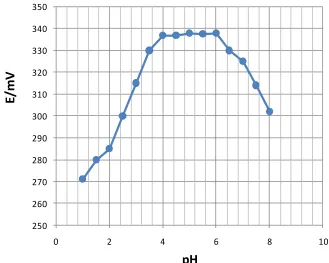
To examine the effect of pH on the sensor responses, the potential was measured at specific concentration of the Cyclizine solution (1.0×10⁻⁴
y = -57.78x + 562.3 R² = 0.996
150 200 250 300 350 400 450
1 2
3 4
5 6
7
E
/
m
V
-log [Cyclizine. HCl]
Figure 2. Calibration curve of PVC membrane electrode, the results are based on 5 replicate measurements.
250 260 270 280 290 300 310 320 330 340 350
0 2 4 6 8 10
E/
m
V
[image:6.596.120.484.77.397.2]pH
[image:6.596.145.474.467.730.2]
Relatively noteworthy fluctuations in the potential vs. pH behavior took place below and above the formerly stated pH limits. In detail, the fluctuations above the pH value of 6.0 might be justified by removing the positive charge on the drug molecule. Fluctuations below the pH value of 4.0 were caused by removal of the membrane ingredients or analyte in the solution. In both electrodes the same trend were observed.
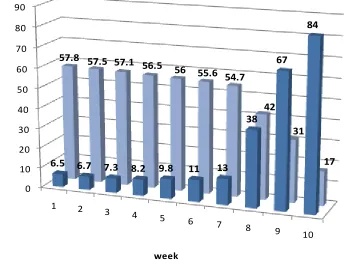
The sensor lifetime was estimated by the calibration curve, periodical test of a standard solution and calculation of its response slope. For this estimation, a sensor was employed extensively (1 hour per day) for 10 weeks. After 7 weeks utilization of PVC membrane sensor, as seen in Figure 4, two changes were observed: a slight gradual decrease in the slope and an increase in the detection limit.
In PVC membrane electrodes after several time of usage, the membrane ingredients leak from the organic layer and affect the membrane response.
0 10 20 30 40 50 60 70 80 90
1 2
3 4
5 6
7 8
9 10
6.5 6.7 7.3 8.2 9.8 11 13 38
67 84
57.8 57.5 57.1 56.5
56 55.6 54.7
42
31
17
week
[image:7.596.143.488.307.583.2]DL x 10(6) M Slope mV/decade
Figure 4. Lifetime study of PVC membrane sensor
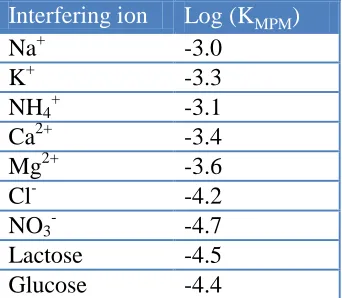
Table 2. Selectivity coefficients of various interfering compounds for the Cyclizine sensor
Interfering ion Log (KMPM)
Na+ -3.0
K+ -3.3
NH4+ -3.1
Ca2+ -3.4
Mg2+ -3.6
Cl- -4.2
NO3- -4.7
Lactose -4.5
Glucose -4.4
The resulting values of the selectivity coefficients are shown in Table 2. Note that all selectivity coefficients show that interferences are negligible in the performance of the electrode assembly.
3.3. Analytical Applications
The proposed sensor was evaluated by measuring the drug concentration in some pharmaceutical formulations (50 mg Cyclizine per tab.) (Table 3). The drug concentration was determined using calibration method. The results are in satisfactory agreement with the labeled amounts.
Table 3. Potentiometric determination of Cyclizine in pharmaceutical preparations
Sample Stated content Found by the electrode*
Sample 1 50 mg/tab 53.2± 0.7 mg/tab Sample 2 50 mg/tab 48.4± 0.7 mg/tab Sample 3 50 mg/tab 51.5±1.3 mg/tab * The results are based on five replicate measurements.
[image:8.596.111.482.507.626.2]
the solution and the laboratory temperature) changed slightly. Cyclizine recovery percentages were good under most conditions, and not showing any significant change when the critical parameters were modified.
4. CONCLUSIONS
A Cyclizine potentiometric PVC membrane sensor was constructed for analysis of Cyclizine hydrochloride in pharmaceutical formulations. The sensor demonstrated advanced performance with a fast response time, low detection limit of 4.5×10⁻⁶ mol L-1 and potential responses across the range of 5.0×10⁻⁶
-1.0×10⁻² mol L-1. The sensor enabled the Cyclizine hydrochloride determination in pharmaceutical formulations with acceptable accuracy. The proposed sensor respond based on ion-exchange mechanism. The best PVC membrane electrode performance was achieved by a membrane composition of 30% PVC, 60% DBP, 3% RTIL and 7% ion-pair complex.
ACKNOWLEDGEMENT
The authors are grateful to the Research Council of University of Tehran for the financial support of this work.
References
1. S. A. Benezra, and K. Florey (Ed.), Analytical Profiles of Drug Substances, vol. 6 Academic Press, New York (1977) pp. 84–97.
2. H. I. Chinn, W. R. Gammon, and M. E. Frantz, J. Appl. Physiol., 5 (1953) 599. 3. J. J. Brand, and W. L. M. Perry, Pharmacol. Rev., 18 (1966) 895.
4. R. T. Sane, and U. M. Vaidya, Ind. J. Pharm. Sci., 41 (1979) 73.
5. R. Kuntzman, I. Tsai, and J. J. Burns, J. Pharmacol. Exp. Ther., 158 (1967) 332. 6. D. S. Griffin, and R. S. Baselt, J. Anal. Toxicol., 8 (1984) 97.
7. M. C. Dumasia, L. Grainger, and E. Houghton, Xenobiotica, 32 (2002) 795. 8. A. G. Davidson, and S. M. Hassan, J. Pharm. Sci., 73 (1984) 413.
9. P. Norouzi, R. Dinarvand, M. R. Ganjali, A. Moosavi-Movahedi, A. Saboury and A. Tamaddon, Anal Sci 25 (2009) 505.
10. A. Jonczyk, Acta Pol. Pharm. Drug. Res., 56 (1999) 183.
11. H. A. Zamani, M. R. Ganjali, and M. Adib, Sensor Lett., 4 (2006) 345.
12. M. R. Ganjali, Z. Memari, F. Faridbod, and P. Norouzi, Int. J. Electrochem. Sci. 3 (2008) 1169. 13. M. R. Ganjali, T. Poursaberi, F. Basiripour, M. Salavati-Niasari, M. Yousefi, and M. Shamsipur,
Fresenius J. Anal. Chem., 370 (2001) 1091.
14. H. A. Zamani, A. Zanganeh-Asadabadi, M. Rohani, M. S. Zabihi, J. Fadaee, M. R. Ganjali, F. Faridbod and S. Meghdadi, Mater. Sci. Eng. C, 33 (2013) 984.
15. M. R. Ganjali, L. Naji, T. Poursaberi, M. Shamsipur, S. Haghgoo, Anal. Chim. Acta, 475 (2003) 59.
16. M. R. Ganjali, A. Rouhollahi, A. R. Mardan, M. Hamzeloo, A. Moghimi, and M. Shamsipur, Michrochim. J., 60 (1998) 122.
17. M. R. Ganjali, T. Razavi, F. Faridbod, S. Riahi, and P. Norouzi, Curr. Pharm. Anal. 5 (2009) 28. 18. H. A. Zamani, M. R. Ganjali, H. Behmadi, and M. A. Behnajady, Mater. Sci. Eng. C, 29 (2009)
19. M. R. Abedi, H. A. Zamani, M. R. Ganjali, and P. Norouzi, Sensor Lett. 5 (2007) 516. 20. H. A. Zamani, M. R. Ganjali, P. Norouzi and S. Meghdadi, Anal. Lett. 41 (2008) 902. 21. H. A. Zamani, F. Faridbod and M. R. Ganjali, Mater. Sci. Eng. C, 33 (2013), 608.
22. M. Hosseini, S. D. Abkenar, M. R. Ganjali and F. Faridbod, Mater. Sci. Eng. C, 31 (2011) 428. 23. M. Javanbakht, M. R. Ganjali, P. Norouzi, A. Badiei, A. Hasheminasab and M. Abdouss,
Electroanalysis, 19 (2007) 1307.
24. V. K. Gupta, R. Ludwig and S. Agarwal, Anal. Chim. Acta, 538 (2005) 213.
25. H. A. Zamani, M. R. Ganjali, P. Norouzi, A. Tadjarodi, and E. Shahsavani, Mater. Sci. Eng. C 28 (2008) 1489.
26. V.K. Gupta, A.K. Singh, L.K. Kumawat, Electrochim. Acta, 95 (2013) 132.
27. H. A. Zamani, M. Masrournia, H. Mohamadzadeh, M. R. Ganjali, M. Rahimizadeh, and P. Ziaei, Mater. Sci. Eng. C, 29 (2009) 976.
28. H. A. Zamani, M. R. Ganjali, P. Norouzi, and M. Adib, Mater. Sci. Eng. C, 28 (2008) 157. 29. S. K. Srivastava, V. K. Gupta, S. Jain, Electroanalysis, 8 (1996) 938.
30. H. A. Zamani, M. T. Hamed-Mosavian, E. Hamidfar, M. R. Ganjali and P. Norouzi, Mater. Sci. Eng. C, 28 (2008) 1551.
31. A. K. Singh, V. K. Gupta and B. Gupta, Anal. Chim. Acta, 1 (2007) 171.
32. M. R. Ganjali, A. Daftari, P. Nourozi and M. Salavati-Niasari, Anal. Lett., 36 (2003) 1511. 33. M. Javanbakht, S. E. Fard, A. Mohammadi, M. Abdouss, M. R. Ganjali, P. Norouzi, and L.
Safaraliee, Anal. Chim. Acta, 612 (2008) 65.
34. H.A. Zamani, M. Nekoei, M. Mohammadhosseini, and M.R. Ganjali, Mater. Sci. Eng. C, 30 (2010) 480.
35. H. A. Zamani, B. Feizyzadeh, F. Faridbod, and M. R. Ganjali, Mater. Sci. Eng. C 31 (2011) 1379. 36. H. A. Zamani, A. Arvinfar, F. Rahimi, A. Imani, M. R. Ganjali and S. Meghdadi, Mater. Sci. Eng.
C, 31 (2011) 307.
37. M. Masrournia, H. A. Zamani, H. A. Mirrashid, M. R. Ganjali, F. Faridbod, Mater. Sci. Eng. C, 31 (2011) 574.
38. M. R. Ganjali, P. Norouzi, F. Faridbod, N. Hajiabdollah, B. Larijani and Y. Hanifehpour, Anal. Lett. 40 (2007) 2544.
39. H. A. Zamani, F. Naghavi-Reyabbi, F. Faridbod, M. Mohammadhosseini, M. R. Ganjali, A. Tadjarodi and M. Rad, Mater. Sci. Eng. C, 33 (2013) 870.
40. H. A. Zamani, M. R. Ganjali, P. Norouzi, and S. Meghdadi, J. Appl. Electrochem., 37 (2007) 853. 41. H. A. Zamani, R. Kamjoo, M. Mohammadhosseini, M. Zaferoni, Z. Rafati, M. R. Ganjali, F.
Faridbod and S. Meghdadi, Mater. Sci. Eng. C, 32 (2012) 447.
42. V. K. Gupta, A. K. Singh and B. Gupta, Anal. Chim. Acta, 575 (2006) 198.
43. H. Behmadi, H.A. Zamani, M.R. Ganjali, and P. Norouzi, Electrochim. Acta, 53 (2007) 1870. 44. H. A. Zamani, M. Mohammadhosseini, S. Haji-Mohammadrezazadeh, F. Faridbod, M. R. Ganjali,
S. Meghdadi and A. Davoodnia, Mater. Sci. Eng. C, 32 (2012) 712.
45. S. Chandra, P. K. Tomar, A. Kumar, A. Malik, A. Singh, A, Monatshefte fur Chemie, 144 (2013) 573.
46. M. R. Ganjali, P. Norouzi, A. Atrian, F. Faridbod, S. Meghdadi, M. Giahi, Mater. Sci. Eng. C 29 (2009) 205.
47. V. K. Gupta, R. Mangla and S. Agarwal, Electroanalysis, 14 (2002) 1127.
48. M. R. Ganjali, H. Shams, F. Faridbod, L. Hajiaghababaei, P. Norouzi, Mater. Sci. Eng. C, 29 (2009) 1380.
49. A. K. Jain, V. K. Gupta, L. P. Singh, P. Srivastava and J. R. Raisoni, Talanta, 65 (2005) 716. 50. H. A. Zamani, G. Rajabzadeh, M. R. Ganjali, Talanta, 72 (2007) 1093.
51. H. A. Zamani, M. R. Ganjali, F. Faridbod, and M. Salavati-Niasari, Mater. Sci. Eng. C, 32 (2012) 564.
Mater. Sci. Eng. C, 31 (2011) 588.
53. M. R. Ganjali, P. Norouzi, M. Adib, and A. Ahmadalinezhad, Anal. Lett., 39 (2006) 1075. 54. E. Y. Z. Frag, A. M.K. Mohamed, G. G. Mohamed, and E. E. Alrahmony, Int. J. Electrochem.
Sci., 6 (2011) 350.
55. H. A. Zamani, F. Malekzadegan, and M. R. Ganjali, Anal. Chim. Acta, 555 (2006) 336. 56. S. Riahi, M. R. Ganjali, P. Norouzi, and F. Jafari, Sens. Actuators B, 132 (2008) 13. 57. M. Shamsipur, M. Yousefi, M. Hosseini, and M. R. Ganjali, Anal. Lett., 34 (2001) 2249.
58. F. Faridbod, M. R. Ganjali, B. Larijani, M. Hosseini and P. Norouzi, Mater. Sci. Eng. C, 30 (2010) 555.