Copyright 0 1975 AmericanSocietyforMicrobiology Printed inU.S.A.
Base
Sequence Differences Between the RNA
Components
of
Harvey
Sarcoma
Virus
JAN MAISEL, EDWARD M. SCOLNICK, AND PETERDUESBERG*
DepartmentofMolecularBiologyand VirusLaboratory,University ofCalifornia, Berkeley,Califomia 94720,*
and the National CancerInstitute,Bethesda, Maryland20014
Received forpublication25March 1975
The 50 to 70S RNA ofthe Harveysarcoma-Moloney leukemia virus (MLV)
complex consists of30 to 40S RNA subunits oftwo different size classes and
contains sequences homologous to Moloney mouse leukemia virus and to
information contained inaC-typeratvirus, termed NRK virus. Wehaveisolated
by preparative gel electrophoresis the large (component 1) and the small
(component 2) 30 to40S RNA species from theHarvey sarcoma-MLV complex.
HarveyRNAcomponent 1 was completely complementary toDNA transcribed
fromMLV RNA andshowednohomologytoDNAtranscribed from NRK virus
when annealed under conditions of DNAexcess.Harvey RNA component2was
about65%complementaryto MLV DNA andabout33% complementarytoNRK
virus DNA. Approximately 60 to 80% ofthe MLV-specific sequences in RNA
component 2iseitheradistinct molecular speciesorispart of ahydrid molecule
including NRK virus- and MLV-specific sequences. The rest of the MLV
sequences in component 2 could be accounted for by degraded component 1
co-purifying withcomponent 2.Thepossible roleofthesesequences intheability
ofthe virustotransform cells isdiscussed.
TheHarvey murine sarcomavirus (H-MSV)
was first isolated from rats inoculated with
Moloney mouse leukemia virus (M-MLV) (6).
Like other murine sarcoma viruses, H-MSV is
replication defective, replicating only in the
presence of helper leukemia virus (5, 7, 12).
Sarcomavirus preparations thereforeconsist of
amixture ofleukemiavirusparticles and
defec-tivesarcomavirus in theenvelope ofleukemia
virus, termedpseudotypes(12) andabbreviated
H-MSV(MLV).
The 30 to 40S RNA species ofH-MSV
con-sists oftwoelectrophoretically distinct
compo-nents. The largerone, termed here component 1, hasthesameelectrophoreticmobilityasthat ofthehelperM-MLV. The smallerone, termed
here component2, is thoughttobe specific for
the defective sarcoma virus (8). Further, the
virus contains two distinguishable sets of
nu-cleic acid sequences: one is homologous tothe RNA of M-MLV; the other is homologous to
RNA foundinaC-typevirusreleased
spontane-ously by a rat kidney cell line (NRK line)
(9-11). The RNAs of M-MLV and of the rat
virus,termed NRKvirus, areunrelated(2,4, 10,
11, 14). M-MLV contains only one 30 to 40S
RNA component. By contrast, the NRK virus
was found to contain two electrophoretically
distinct30 to40S RNAcomponentswhich have
about the same size as those found in Harvey
virus(8, 13).
It is the purpose ofthis paper to determine
how the M-MLV-specific and NRK
virus-specific sequences are distributed between the
two RNA components of Harvey virus. The
most complex possibility assumes that each
RNA species of Harvey virus includes NRK
virus-specific and MLV-specific components.
The simplest possibility assumes that Harvey
RNA component 1 consists of MLV RNA and that component 2 consists of the small RNA
componentofNRKvirus.
We have used hybridization of MLV and
NRK virus DNA with electrophoretically
puri-fiedRNAcomponents ofHarvey virusto
distin-guish between such alternatives. It was found
thatHarvey RNA component 1consistsonlyof
MLV-specific sequences. Harvey RNA
compo-nent 2 contains 65% MLV- and 35% NRK
virus-specific sequences. It appears that 60 to
80% of the MLV-specific sequences in RNA
component 2 is either a distinct molecular
speciesoris part of ahybrid molecule including
NRK virus- and MLV-specific sequences. The
rest of the MLV-specific sequences in RNA
component2 canbe accountedforby degraded
component 1 co-purifyingwithcomponent2.
The following methodology was used.
H-749
on November 10, 2019 by guest
http://jvi.asm.org/
MSV(MLV) was propagated in a chronically
infected line of NIH-3T3 mouse cells as
de-scribed (10, 11). The NRK cell line
spontane-ously producing NRK virus and the NIH-3T3
mouse cell line chronically infected with MLV
have beendescribed (9, 10).
Preparation of viral ['H]RNA components
followed procedures described earlier (8). In
short, infectedcells werelabeledwith200,Ci of
[3H
luridine
(30 to 40 Ci/mmol, New EnglandNuclear Corp.) per 6 ml of medium in a 10-cm
petri dish. Virus was harvested at 4- to 6-h
intervals and purified as described (8). The 50
to 70SRNA was prepared by sucrose gradient
sedimentation. After ethanol precipitation, the
50 to 70S RNA was heated (100 C, 45 s at low ionicstrength) andsubjectedto electrophoresis in 2%polyacrylamidegels (8).After electropho-resisthegel was sliced into 1-mm sections, and
the RNA of each section waseluted by mildly
shaking each slicefor 24 h at room temperature
in1.5mlofbuffer containing0.4 M LiCl, 0.01 M
Tris (pH 7.4), 1 mMEDTA, and 0.2% sodium
dodecylsulfate(SDS). Inlaterexperiments the gel slices were crushed by squeezing them
through a 26-gauge syringe needle prior to
elution. Radioactivity in each slice was
deter-mined from an aliquot of the eluatein
toluene-based scintillation fluid containing 10%
Nu-clear-Chicago solvent. The eluate of
appropri-ate fractions of each RNA component was
pooled, centrifuged for 5 min at 30,000 x g to
pellet contaminating polyacrylamide
particles,
and
precipitated by
addition of2volumes of 95%ethanol. The precipitate containing RNA and
water-soluble polyacrylamide was then
re-dis-solvedin 0.4mlofstandardbuffer(0.1MNaCl,
0.01 M Tris, pH 7.4, 1 mM EDTA, 0.1% SDS)
and sedimentedin a 15 to 30%glycerol gradient
in the same buffer to separate the viral
['H
]RNA from the soluble polyacrylamide.Gradient fractions containing viral ['H]RNA
were then ethanol precipitated inthe presence
of 12ug of carriertobaccomosaic virusRNA.
DNAs complementary to about 90% of the
viral RNAs (cDNA) were made during 1-h endogenous reactions using detergent-disrupted
purified viruses. The procedure is a
modifica-tion of onedescribed earlier(1).Reactionsof 30 to60ml wereincubated at37 Candcontained:
100
Mg
ofactinomycin D per ml, 0.02 MTris-hydrochloride (pH 7.8), 0.06 M KCl, 2 mM
dithiothreitol, 0.02% TritonX-100, 6mM
mag-nesium acetate, and 5 x
10-i
M eachofTTP,dATP, dGTP, and dCTP. Parallel reactions
with [3H]dCTPof known specific radioactivity
wereused to estimate theyield of DNA made. ToprepareDNA, SDSwas added to 1%tothe
reaction mixture, and the solution was
ex-tracted with an equal volume of a mixture
consisting of 48% phenol, 48% CHCl,, and 4%
isoamyl alcohol. The aqueous phase was then
dialyzed for 36h against H,O(3 x 21, changed
at 12-hintervals), adjusted to 0.2 NNaOH and
incubated for 60 min at 37C. The solutionwas
thenre-dialyzedandlyophilized.DNA made in
this fashion was about 80 to 90%
complemen-tary to 60 to 70S viral RNA and < 10% was
double stranded (1, 9-11).
RNA-DNA hybridization was amodification
ofaprocedure describedearlier (1, 10).
Hybridi-zations were at 66C for 30 h in 0.1 ml
contain-ing 0.02 M Tris-hydrochloride (pH 7.2), 0.4 M
NaCl, 0.5 mM EDTA, 0.1% SDS, 2 ,g ofcalf
thymus DNA, 50
Mg
ofyeast RNA, 100 ng ofviral DNA, and 1 to 10 ng of viral [3H]RNA
(approximate specific activity, 10' to 5 x 10'
counts/min per ug). RNA DNA hybrids were
assayed with S1 nuclease (1).Background of 40
counts/minwassubtractedfromeach sample.
Preparation of the two 30 to 40S RNA
com-ponentsof50to70SH-MSV(MLV)RNAwasas
follows. The 50 to 70S RNA species of the
Kirsten and Moloney sarcoma-leukemia virus
complexes were shown to form a broader and moreslowlysedimentingpeak in sucrose
gradi-entsthan the60to70SRNA
species
ofM-MLV,
suggesting greater RNA size
heterogeneity
inthesarcomaviruspreparation (3, 8,
14).
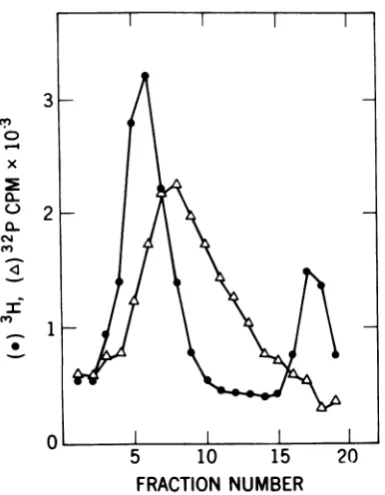
Asimi-lar observation was made when the 50 to 70S
RNA complex of Harvey sarcoma-leukemia virus was compared to that of M-MLV
(Fig.
1). The basis for the
heterogeneity
of thesarcoma-leukemia virus RNAs has been shown
to be the presence of two 30 to 40S subunit
classes ofdifferent size in the 50 to 70S RNA
species of these sarcoma-leukemia virus
com-plexes (8). Given that thetwodifferentsubunit
species of the Harvey sarcoma-leukemia virus
complex arepresent at roughly equimolar
con-centrations(reference8and
Fig.
2)
and that theviruscomplexalso containsabout
equal
concen-trations of helper leukemia virus
(assayed
by
the XC test [7a]; sarcoma virus
assayed
by
focus formation [EdwardScolnick, unpublished
data]), the viral RNAcomplexmayhave either
one of the following two structures. The 50 to 70S RNA complex could consist of two
sub-classes each containing identical large orsmall
subunits,or itcould consist of one class
contain-ing different subunits associated within the
samecomplex.ThebroadpatternshowninFig.
1 iscompatible with theview that the 50 to70S
RNAs of H-MSV includes complexes of only
large and only small subunits, though the
existence ofsome complexesoflarge and small
on November 10, 2019 by guest
http://jvi.asm.org/
2A). More than one-half of the radioactivity
below this line in RNA component2is
consid-ered tobe degraded component 1RNA.
Given the presence of M-MLV- and NRK
3 virus-specific sequences in the RNA ofHarvey
virus, the question was asked how these
sequences are distributed between the two RNA
components of H-MSV(MLV). To answer this
question RNA components 1 and 2 were
hybri-2 t \ dized in separate experiments to saturating
2-
B /\ R _ amounts of DNA (4a) complementary toM-MLV RNA and to DNA
complementary
toNRK virus RNA. All hybridizations were
car-ried out at a 10- to 100-fold excess of the
respective DNA over each viral RNA
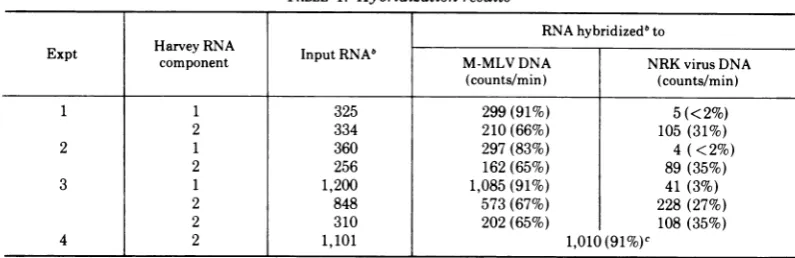
compo-1 nent (Table 1). Itcan be seen in Table 1 that
HarveyRNA component 1 is83 to90%
homolo-gous toM-MLV DNAbutonly2 to3%
homolo-gous to NRK virus DNA if compared by this
method. However, Harvey RNA component 2 is 65 to 67% homologous to MLV DNA and 31 to
0 5 10 15 20 35% homologous to NRK virus DNA.
Hybridization withsaturatingconcentrations
FRACTION NUMBER of DNAs complementary to M-MLV and NRK
1. Sedimentation analyses of the 50 to 70S virus RNAs rendered 91% ofRNAcomponent 2
of H-MSV(MLV) and of M-MLV. Purification resistant to nucleaseSi(Table 1). Thus, at least
e viruses and extraction of their RNAs are 91% of the component 2 sequences can be ac-ibed in the text. Centrifugation of the RNAs counted for by sequences present in M-MLV
n a sucrose gradient containing 0.1 M NaCI,
M Tris
(pH
7.4), 1 mM EDTA, and 0.1% DNAandbNRKNviumspDNA.The
extentofhomol-for45minat 65,000 rpm in a Spinco SW65 rotor
ogy
between RNAcomponent 2 and themixtureC. Radioactivity of each fraction was deter- of MLV and NRK virus DNA may be even
din
a Tri-Carb liquid scintillation counter from higher than 91%, because some (10%)[3I]-Lquot
of each fractiondissolvedin toluene-based RNA is rendered soluble during the hybridiza-Ilation fluid containing 10% Nuclear-Chicago tion reaction. The exact extent of thermala.t. degradation cannot be determined because a
single-stranded RNA control is degraded faster
nits cannot be excluded. than RNA -DNAhybridsformedin thepresence
ie
two 30 to 40S RNA subunit species of ofcomplementaryDNA.rey virus were isolated by preparative elec- These results indicate that only Harvey
com-a.oresis of heat-dissociated 50 to 70S RNA ponent 2 RNAcontains RNA sequences
homol-2). After elution from the gel, each RNA ogous to two different RNA tumor viruses,
)onent was freed of buffer-soluble poly- M-MLV and NRK virus. HarveyRNA
compo-Lamide
by glycerol gradient sedimentation nent 1 appears to represent entirelyM-MLV-2B, C). RNA component 1, which is specific sequences. Component 2, which is
ght to be at least in part the RNA of the thought to bespecific for the defective sarcoma
ar MLV, is probably completely free of virus (8), appears to contain 66%
M-MLV-?onent 2 if prepared by this method. RNA related and 33% NRK virus-related sequences.
?onent
2 is expected to include 20 to 40% About60 to80% of the MLV-specific sequencesLally
degraded component 1 RNA, which in RNA component 2 are either a distinctates with component 2 RNA. The extent of molecular species of component 2 or part of a
amination of RNA component 2 by de- hybrid molecule including NRK virus- and
ed component 1 RNA can be roughly esti- MLV-specific sequences. Although our
experi-,d.
An upper limit of the amount of ran- ments cannot distinguish directly betweenIy
degraded component 1 contaminating these alternatives, the second alternativeac-3onent
2 can be obtained by connecting the counts more readily for the presence of twoy between the two RNA components with different sets of viral sequences in an
electro-background of degraded RNA migrating phoretically homogenous component. The rest
rd the cathode of the gel (dashed line, Fig. of the MLV-specific sequences inRNA
compo-
T-x
0s
2
CLJ
(V)
I
0
FIG RNAs of tho
descri
was ii
0.01
SDS
I
at 20
minec anali
scintii
solver subu: Th
Harv
tropk
(Fig.
comr
acryl (Fig.
thoul
helpe
com;
comj
parti
migri
conta
grad
mate
doml
comi
valle; the
i
towai
on November 10, 2019 by guest
http://jvi.asm.org/
[image:3.499.47.240.61.309.2]ELECTROPHORESIS
C
C-)
I-SEDIMENTATION
c
Component 2
00
20 40 150 2 4 6 8 2 4 6 8 [image:4.499.123.409.65.256.2]DISTANCE MOVED(mm) FRACTION NUMBER
FIG. 2. Preparation of the 30 to 40S RNA components1and 2 ofH-MSV(MLV). (A) The 50 to 70S[3H]RNA ofH-MSV(MLV) was prepared as described for Fig. 1. After ethanol precipitation the['H]RNAwasheated at 100 C for 45 s in 30 to 50ulof4 mM Tris, 2 mM sodium acetate (pH 7.2), 0.2% SDS, 10% glycerol and subjected to electrophoresis in 2%polyacrylamide (8). Elution of the RNA from gel sections and determination of its radioactivity are described in the text. The horizontal bars indicate the electrophoretic fractions pooled to prepare RNA components 1 and 2. After ethanol precipitation RNA components 1 (B) and 2 (C) were freed ofsoluble polyacrylamide byglycerolgradient (15 to30%, vol/vol)sedimentationfor90 minandotherwiseas described in Fig. 1.
TABLE 1. Hybridization results"
Harvey RNAhybridized"to
Expt HarveyRNA Input RNA" M-MLV DNA NRKvirus DNA (counts/min) (counts/min)
1 1 325 299 (91%) 5(<2%)
2 334 210(66%) 105 (31%)
2 1 360 297 (83%) 4(<2%)
2 256 162(65%) 89 (35%)
3 1 1,200 1,085 (91%) 41 (3%)
2 848 573(67%) 228 (27%)
2 310 202(65%) 108(35%)
4 2 1,101 1,010(91%)c
aEachhybridizationwascarriedout at66C for 30 h and containedin 0.1ml:0.02MTris-hydrochloride (pH 7.2), 0.4 MNaCl, 5 x 10- MEDTA, 0.1%SDS,2 tgofcalf thymusDNA,50ugofyeastRNA, and 100 ng of cDNAprobe(saturation).
'Numbers represent [3H]radioactivity ofRNA, precipitated by 5%trichloroacetic acid and determined on
driedmembrane filters(MilliporeCorp.) intoluene-based scintillation fluid in aTri-Carb spectrometer. RNA componentsofHarveysarcomavirus hadspecificactivities ofapproximately10'to 5x 10'counts/min pergg.
About 1 to 10 ngof RNA was used per experiment. The reactions were assayed for hybridization with Si
nuclease. Backgroundof 40counts/min has been subtracted from eachvalue. LevelsofS1 nuclease-resistant
counts per minute inthe absence ofcDNAwere less than 10counts/min above thebackground. The input radioactivities of [3H]RNAswerecheckedforeach experimentatzerotimebeforeincubatingat66C.
cM-MLV plus NRKvirus DNA.
nent2probablyrepresentsdegradedcomponent
1 comigrating with component 2. In addition, the presence of some sequences other than those from MLV and NRK virus in component 2
cannot be excluded because about 9% of the RNA didnothybridizeto amixtureofMLV and NRK virus DNAs.
Ourfindingof MLV- and NRKvirus-specific
sequences in the sarcoma-specific component2
of Harvey virus is consistent with the notion
thatsequences homologous to both viruses are
present in Harvey virus-transformed nonpro-ducer cells(11),thoughthe size of theMLV-like and NRKvirus-like RNA components in these
J.
on November 10, 2019 by guest
http://jvi.asm.org/
[image:4.499.62.460.350.479.2]cellswas notdetermined. Analogousstudieson the two RNA components of Kirsten sarcoma
virusagreewithourresultsinthat KirstenRNA
component 1 wassaid tobe helperMLVRNA;
however, Kirsten RNA component 2 was
sug-gested to contain only NRK virus-specific
se-quences, whichisat variance with ourfindings
(13, 14).
Two hypotheses which are similar to those
discussed earlier(8-11) could explain the origin
ofboth NRK virussequencesand M-MLV RNA
sequences in RNA component 2 of Harvey sarcomavirus.(i)RNAcomponent 2could have
been generated by recombination ofM-MLV,
when it was first injected into rats, with a rat
virus, suchastheNRKvirus.Since neither the
NRK virus nor theM-MLVseems totransform rat or mouse cells, transforming abilityof
Har-vey virus could be the result of a particular
combination ofNRK virus-specific and
MLV-specific sequences, perhapsincludingsome
ad-ditional (<10%)sequencesof unknownoriginin
thesameRNAcomponent 2ofHarvey virus. (ii) Alternatively, M-MLV could have rescued from
ratcellsadefectivesarcomaviruswhich shares
sequences both with NRK virus and with M-MLV.
Adefinitiveanswer tothequestion ofwhether
the MLV- and NRKvirus-specific sequencesof
Harvey RNAcomponent 2 are part ofthesame
molecular speciesisexpectedfromfurther
stud-ies usingeither Harvey virus pseudotypedby a
helper virus unrelated to M-MLVor by
study-ing the RNAs of Harveyvirus containing
com-ponent 2 at great excess over component 1, to
minimize contamination of component 2 by
degradedcomponent 1.
Weare grateful toSun Yung Kim and Jean Maryakfor technical assistance.
This work was supported by the Cancer Programofthe National Cancer Institute, under Public Health Service contractNO1 CP43212.
LITERATURECITED
1. Benveniste, R. E., and E. M. Scolnick. 1973. RNA in mammalian sarcoma virustransformed non-producer
cells homologous to murine leukemia virus RNA. Virology 51:370-387.
2. Beneveniste, R. E., and G. Todaro. 1973. Homology between type-C viruses of various species as deter-mined by molecular hybridization. Proc. Natl. Acad. Sci.U.S.A. 70:3316-3320.
3. Bondurant, M. C., A. J. Hackett, and F. L. Schaffer. 1973. Infectivity and RNA patterns as functions of high- and low-dilution passage of murine sarcoma-leukemia virus: evidence for autointerference within an oncornaviruspopulation. J. Virol. 11:642-647. 4. Callahan, R., R. E. Benveniste, M. M. Lieber, and G.
Todaro. 1974. Nucleic acid homology of murinetype-C viralgenes. J. Virol. 14:1394-1403.
4a. Duesberg, P. H., and E. Canaani. 1970. Complemen-taritybetween Rous sarcoma virus (RSV) RNA and the in vitro-synthesized DNA of the virus-associated DNA polymerase.Virology 42:783-788.
5. Hartley, J. W., and W. P. Rowe. 1966. Production of altered cell foci in tissue cultureby defective Moloney sarcoma virus particles. Proc. Natl. Acad. Sci. U.S.A. 55:700-786.
6. Harvey, J.J. 1964. An unidentified virus which causes the rapid production of tumors in mice. Nature (London) 204:1104-1105.
7. Harvey, J. J., and J. East. 1971. The murine sarcoma virus(MSV). Int. Rev. Exp. Pathol. 10:265-360. 7a. Klement, V., W. P. Rowe, J. Hartley, and W. E.
Pugh. 1969. Mixed culture cytopathogenicity: a new test for growth of murine leukemia viruses in tissue culture. Proc. Natl. Acad. Sci.U.S.A. 63:753-758. 8. Maisel, J., V. Klement, M. M.-C. Lai, W. Ostertag, and
P. Duesberg. 1973. Ribonucleic acid components of murine sarcoma and leukemia viruses. Proc. Natl. Acad. Sci.U.S.A.70:3536-3540.
9. Scolnick,E.M., J. M. Maryak, and W. P. Parks. 1974. Levelsofrat cellularRNA homologous to either Kirsten sarcoma virus orrattype-C virus in cell lines derived fromOsborne-Mandel rats. J. Virol. 14:1435-1444. 10. Scolnick,E. M., and W.P.Pa.ks.1974.Harvey sarcoma
virus: a secondmurine type-C sarcoma virus with rat genetic information. J. Virol.13:1211-1219.
11. Scolnick, E. M., E. Rands, D. Williams, and W. Parks. 1973.Studies on the nucleic acid sequences of Kirsten sarcomavirus: a model for formation of a mammalian RNA-containingsarcoma virus. J. Virol. 12:458-463. 12. Tooze, J. 1973. The molecular biology of tumor viruses.
ColdSpringHarborLaboratory, Cold SpringHarbor, N.Y.
13. Tsuchida, N., R. V. Gilden, and M. Hatanaka. 1974. Sarcoma virus related RNA sequences in normal rat cells. Proc.Natl. Acad. Sci. U.S.A. 71:4503-4507. 14. Tsuchida,N., M. S.Shih, R. V. Gilden, and M. Hatanaka.
1974. Sarcoma and helper-specific RNA tumor virus subunits in transformed nonproducer mouse cells activated to producevirus by treatment with bromode-oxyuridine. J. Virol. 14:1262-1267.
16,
on November 10, 2019 by guest
http://jvi.asm.org/