Copyright© 1975 American SocietyforMicrobiology Printed inU.S.A.
DNA
Synthesis
and DNA
Polymerase Activity of Herpes
Simplex
Virus
Type
1
Temperature-Sensitive
Mutants
GARY M. ARON,' DOROTHY J. M. PURIFOY, AND PRISCILLA A. SCHAFFER* Department ofVirology and Epidemiology, Baylor College of Medicine, Houston, Texas 77025
Received forpublication 7April 1975
Fifteen temperature-sensitive mutants of herpes simplex virus type 1 were
studied with regard to therelationship between their ability to synthesize viral
DNAandtoinduce viral DNApolymerase (DP)activityatpermissive (34C) and
nonpermissive (39C) temperatures. At 34 C, all mutants synthesized viral DNA,
while at39 C four mutants demonstratedaDNA'phenotype,three were DNA',
and eight were DNA-. DNA' mutants induced levels of DP activity similarto
those ofthe wild-type virus atboth temperatures, and DNA' mutants induced
reducedlevels of DP activity at 39 C but not at 34 C. Among the DNA- mutants,
three were DP', two were DP', and three showed reduced DP activity at 34 C
with no DP activity at 39 C. DNA-, DP- mutants induced the synthesis of a
temperature-sensitive DP asdetermined by invivo studies.
In theherpessimplexvirus(HSV)replicative
cycle, little is known concerning the number
and function of genes involved in viral DNA
synthesis. After infection with HSV, however,
the levels of activity of several enzymes
in-volved in nucleic acid metabolism have been shownto increase. These enzymes include thy-midine kinase (12), DNA polymerase (6, 8, 9, 13), DNase (9), dTMP kinase (18), dCMP
deaminase (8), and deoxycytidine kinase (6, 19).
It hasbeenreported that the increase in DNA
polymeraseactivity which occurs after infection
with HSV is due to the appearance of a new
DNA polymerase, the synthesis of which is
controlled or specified by the viral genome
(9-11, 16, 17, 27). Through theuse of
tempera-ture-sensitive(ts) mutantsexhibiting defectsin
DNA polymerase activity
and/or
viral DNA synthesis at the nonpermissive temperature,additionalinformation maybe obtained
regard-ingboth theprocess ofviral DNAsynthesisand
the origin and role of DNApolymerase in HSV
replication.
The present paper describes the relationship
between the synthesis of viral DNA and the
inductionof DNApolymerase by 15 ts mutants
ofHSV-1. The results of these studies indicate
that at least six cistrons control the synthesis
and/orfunction of viral DNA and DNA
polym-erase. The finding that DNA- mutants
repre-senting twodistinct cistrons produce DNA
po-lymerase molecules which aretemperature sen-'Presentaddress:SouthwestTexasStateUniversity, Biol-ogyDepartment, San Marcos,Tex. 78666.
sitive in vivo lends further support to the
conceptthat HSV codes fora newDNA
polym-erase(s) essential for the replication of viral DNA.
MATERIALS AND METHODS
Cellcultures and media. Humanembryonic lung (HEL) cells in 16-ounce prescription bottles and tubes were propagated in Eagle medium supple-mented with 10% fetal bovine serum and 0.075%
NaHCO,
as previously described (23). Culturesweremaintained in Eagle medium containing 5% fetal bovine serum and 0.15%
NaHCO,.
Cells in petri dishes were propagated and maintained in Eagle medium supplemented with 10 and 5% fetal bovine serum, respectively, containing0.225% NaHCOsina5%CO2atmosphere.
Viruses and virus assays. TheKOSstrain oftype
1HSV(HSV-1)wasusedasthewild-type(WT) virus, andpermissive and nonpermissive temperatureswere 34and 39C,respectively. Theisolation, preliminary
characterization, and nomenclature of ts mutants
induced by 5-bromodeoxyuridine, nitrosoguanidine, and UVlight have been described previously (21, 24).
Virus stocks were prepared in HEL cell cultures at 34C (21), and virus assays were performed by a
plaquemethodutilizinga 2%methylcelluloseoverlay (3). Constant-temperature waterbaths(+0.1 C) were used for incubationof closedvessels and water-jack-eted CO2 (5%) incubators (±+0.2 C) were used for
petri dishes.
Infection and labeling of cells for DNA determi-nation. HEL cells in 8-ounce prescription bottles containing 3 x 101 to 5 x 10⁶ cells were infected
at a multiplicity of 5 to 10PFU/cell with each
mu-tant and the WT virus in duplicate experiments,
each includingall virusestobetested. Multiplicities
ofinfection were verified by simultaneous assays of 498
on November 10, 2019 by guest
http://jvi.asm.org/
DNA SYNTHESIS AND DP ACTIVITY OF HSV-1 MUTANTS 499
inocula.After incubation in maintenance medium at either 34 or 39C for 6 h (to permit inhibition of
host-cell DNA synthesis), medium was decanted,
monolayers were washed twice with Tris-phosphate
bufferat pH 7.4, and10ml of maintenance medium containing 10 uCi of ['H]thymidine per ml (13
Ci/mM, Schwarz BioResearch Inc., Orangeburg,
N.Y.) wasadded to each culture. Infected cells were harvested 24 h after infection byscraping into me-dium. One milliliter of uniform cell suspension was
removed and frozenat -90C. This samplewaslater thawed, sonicated at 10 kc for 40 s, and centrifugedat
10'rpm for 15 minat 5C. The supernatantfluid was assayedimmediately for infectivityat34and 39C in HEL cellmonolayers.
Separation of viral and cellular DNA. Cells in
the remaining 9 ml of suspension were pelleted, washed once in10ml ofTNE (0.01 M Tris-hydrochlo-ride, 0.1 M NaCl, and 0.001 M EDTA, pH 7.4) and repelleted. TNE was decanted, tubes were drained, and pellets were frozen at -90C. Cellpellets were
later thawed, resuspended in 3.5 ml of TNE, and lysedbythe addition of 0.18 ml of 10% sodiumlauryl sarcosinate and0.07mlof 10%sodiumdodecylsulfate atfinal concentrations of 0.5 and 0.2%, respectively.
Suspensionswereincubatedat roomtemperature for
10 min, Pronase (Calbiochem, La Jolla, Calif.) was
added to a final concentration of 50
Ag/ml,
and suspensions were incubatedat 37 C for 30 min. One milliliter ofeach lysateand 9 ml of TNEweremixed and the refractive index of the solutionwasadjustedto 1.4010 inCsCl.SampleswerecentrifugedinCsClat
143,000 x g for 68 h using a Beckman 75 Ti-rotor (Beckman Instruments, Palo Alto, Calif.) and a
Beckman L2-75Bultracentrifuge at 25C. After
cen-trifugation, 40 0.3-ml fractions were collected (Isco
density gradient fractionator, model640;
Instrumen-tation Specialties Co., Lincoln, Neb.) and 50Mil of each fraction was placed on Whatman GF/A filter disks. Disksweredried, washedoncein 5% trichloro-acetic acid (4C), once in water (4C), redried, and placed in scintillation vialscontaining7ml of
count-ing solution containing toluene and BioSolv (Beck-man).Samples were counted usingaBeckmanLS250 liquid scintillation counter.
Counts per fractionwere plotted and the percent-age ofboth cellular and viral DNA in mutant-infected cellextracts was determined usinga DuPont model
310curveresolver.
Induction of DNA polymerase (DP) activity in infected cells: (i) infection of monolayers. HEL cells were seeded in 100-mm petri plates, 3 x 10⁶
cells/plate. Twenty-four toforty-eight h later, when
monolayers were confluent, duplicate cultures were
infected at a multiplicity of infection of 5 to 10
PFU/cell.Afteradsorptionofvirus for1hat 37C,the
inoculum was decanted, monolayers were washed
twice with Tris, and 10mlof maintenance medium
was added to each culture. Cultures were further incubatedfor3 to 13 h at 34 or39C and infected cells wereharvestedby trypsinization. Cellswerepelleted bylow-speed centrifugation (approximately 10x 10'
to 16 x 10' cells/pellet), washed with Tris, and repelleted. Mock-infected control cultures were
treated similarly. Fordetermination of infectivity to parallelkinetic studies of DP activity, 2 x 10' HEL
cellsintubeswereinfected asdescribedfor induction
of enzymes.Cultures were harvested at the indicated timesby one cycle of freezing and thawing followed by 45 s of sonication at 4 C with a Raytheon sonic oscillator. Suspensions were clarified by low-speed centrifugation and supernatant fluids were assayed at
34C in HELcell monolayers.
(ii)Preparation of enzyme extracts. Infected and control cell pellets were resuspended in 5 to 10 volumes of hypotonic enzyme extraction solution consisting of0.003M 2-mercaptoethanol and 0.01 M Tris buffer, pH 7.5. Clarified whole-cell enzyme extracts wereobtained by sonication at 4 C, 10 kc for 3minfollowedbycentrifugation for1h at 30,000 x g at 4C. The protein content of the enzyme extracts wasdeterminedby the method of Lowry et al. (15).
(iii) Enzyme assays. DP activity was assayed by themethod of Kitetal. (14),modified to include 100
mM(NH4),SO4for infectedcell enzyme extracts (11).
Briefly, incubation mixtures contained 20 mM so-dium phosphate, pH 7.5, 8 mM MgCl,, 6.6 mM Tris-hydrochloride, pH 7.5, 2 mM 2-mercaptoethanol, 100Mg ofheat-denatured salmon sperm DNA, 0.266
mM thymidine-5'-[methyl-3H]triphosphate
([3H]-TTP; 48 Ci/mM; New England Nuclear Corp.,
Boston, Mass.), and 0.266 mM each of dATP, dCTP, and dGTP (P. L. Biochemicals, Inc., Milwaukee, Wis.), in atotal volume of 200Ml.The standard assay timewas 30minat39C.Under the conditions of the assay there was a linear dose response between the amount of ['HJTI'P incorporated with time (for 60 minormore), and with the amount of enzyme added per tube (80to 300Mgofprotein). The reaction was stoppedby the addition of cold 5% trichloroacetic acid and the incorporated nucleotides(trichloroacetic
acid-insoluble fractions) were processed by washing three
times in 5% trichloroacetic acid followedby solubili-zationwith1ml ofNCS(Amersham/Searle,Arlington Heights, Ill.). Radioactivity was determined in a
Beckman LS-250liquidscintillation counter. Heat inactivation of polymerase. In vitro heat inactivation of enzyme samples was performed as follows: 100 Ml ofenzyme containing approximately 200Mgofproteininstopperedtubes was placed in a
constanttemperature water bath(+0.1C) at 39 C. At the indicatedtimes, duplicate tubes were withdrawn
and placedinanicebath. DNA polymeraseactivity
was then determined using 50-Ml aliquots of the heated enzyme preparation. In vivo heat inactivation of DP activity was determined by temperature
shift-upexperiments. Cultures infectedasdescribed
above were maintained at34C for 11 h followed by
shift-up to 39C. Cultures were harvested at the
indicated times after shift-up and assayed for DP activityasdescribed above.
RESULTS
Synthesis of viral and cellularDNAbyWT
virus and ts mutants. Fifteen ts mutants of
HSV-1,
belonging
to 10 complementationgroups(21),wereused in thisstudy.Inaneffort
IVOL. 16,1975
on November 10, 2019 by guest
http://jvi.asm.org/
to determine whether the tsfunction exhibited
by each of the 15mutantshadaneffectonviral
and cellular DNA synthesis, the incorporation
of[3H
]thymidine
intoDNA inmutant-and WTvirus-infected cells at 34 and 39 C was
exam-ined. Although the viral DNA phenotypes of the
mutants at 39 C had been determined previ-ously by analytical ultracentrifugation of
in-fected cellextracts (21), preparative
centrifuga-tion ofisotopically labeledextracts wascarried
out since this technique offers amore sensitive
method for the quantification of viral and
cellular DNAsynthesis.
Characteristic patterns of incorporation of
[3H ]thymidine into viral and cellular DNA by
the WTvirus and five representativemutantsin
asingle, simultaneous experiment areshown in
Fig. 1. Mock-infected cellsgave asingle peak of
cellular DNA with a buoyant density of 1.6900
to 1.700 g/cm3 (Fig. 1). WT virus-infected cells
atboth 34 and 39 C, all mutant-infected cellsat
34 C and some at 39 C (e.g., tsF18 and tsG8),
gave two peaks, one corresponding to cellular
DNA and one, witha buoyant density of 1.725
g/cm3, corresponding to viral DNA. No
differ-ence in buoyant density wasobserved between
the viral DNAsof the mutants and that of the
WT virus.
Theaveragevalues for viral and cellular DNA
synthesis in two or three tests with all 15
mutants and the WT virus are shown in
Table 1. Although all mutants produced viral
DNAat 34C, only three of them (tsN20, tsG8,
andts022) did so asefficientlyasthe WT virus.
Other mutants synthesized from 12 (tsC4) to
75%(tsB2)asmuchviral DNAasthe WTvirus.
Reduced amounts of [3H ]thymidine-labeled
viral DNA were synthesized by WT
virus-infected cells at 39 C as compared with 34 C
(Fig. 1). Compared withthe WT virus at 39C,
fourmutants (tsE6, tsF18, tsIll, andtsN20) in
four complementation groups synthesized 50%
or more as much viral DNA(DNA' mutants),
and threemutants (tsG3 [16%], tsG8
[3%],
andts022 [4%]) in two complementation groups
synthesized only minimal amounts of viral
DNA at39 C (DNA' mutants). Eight mutants
belonging to four complementation groups
failed tosynthesize detectableamountsofviral
DNA at this temperature (DNA- mutants). The quantities of viral DNA synthesized by mutants belonging to the same
complementa-tion group at 34 C were roughly similar.
Like-wise, at 39 C the viral DNA phenotypes of
mutantsingroupswith multiple members (i.e., groupsA, B, C, and G)weresimilar.
With regard to cellular DNA synthesis, the
WT virus inhibited cellular DNA synthesis to
36% ofmock-infected cell levels at34C (Fig. 1,
Table 1). Fourteen of the fifteenmutants
exhib-ited even greater inhibition of cellular DNA
synthesisat34 C than the WT virus. Inextracts
of cells infected with these mutants, residual
cellular DNA synthesis ranged from 10 (tsIll)
to 30% (tsB2) of mock-infected cell levels. One
mutant, tsG3, however, was about halfas
effi-cient as the WT virus in inhibiting cellular
DNAsynthesis in that 60% of the DNA
synthe-sized in mock-infected cells was synthesized
during the 6- to 24-h labeling period. At 39 C
the WT virus and all 15 mutants inhibited
cellular DNA synthesis as efficiently or more
efficiently thanat34 C (Table 1). At 39 C,22%
ofthe mock-infected level ofcellular DNA was
synthesized in WT virus-infected cells,
repre-senting 78% inhibition. Six mutants (tsE6,
tsF18, tsN20, tsA15, tsB2, and tsB21) inhibited
cellularDNAsynthesisasefficientlyasthe WT
virus at this temperature while the remaining
nine mutants were more efficient inhibitors in
that residual levels ofcellular DNAranged from
4 (tsAl and tsG8) to 14% (tsG3 and tsC4) of
FIG. 1. Separation of viral and cellular DNAs by CsCI equilibrium centrifugation. Mock-infectedWT virus andmutant-infectedHEL cells incubatedat34 and 39 Cwereexposedto10,Ciof [3H]thymidinepermlfrom6 to24hpi.Lysates ofthesecelIswerethensubjectedtoequilibrium centrifugationinneutralCsCIgradients.
fA
/
K
FOACTION HUMS*
on November 10, 2019 by guest
http://jvi.asm.org/
[image:3.499.71.462.507.633.2]SYNTHESIS AND DP ACTIVITY OF HSV-1 MUTANTS 501
TABLE 1. Viral and cellular DNAsynthesisofWT
virus andts mutantsof HSV-1at34and 39C
ViralDNA'C CellularDNA0c
Virus
34C 39 C 34 C 39C
WT 100 100 36 22
Mock-infected 100 100
cells
tsE6 72 68 21 23
tsF18 63 50 28 17
tsI11 59 64 10 8
tsN20 94 82 24 21
tsG3 57 16 60 14
tsG8 96 3 18 4
ts022 99 2 21 6
tsAl 44 0 11 4
tsA15 19 0 24 20
tsA16 33 0 21 16
tsB2 75 0 30 29
tsB21 56 0 24 21
tsC7 27 0 18 11
tsC4 12 0 15 14
tsD9 57 0 23 7
aResults areexpressed as the percentage of viral DNA inWTvirus-infected cultures.
'Resultsareexpressedasthe percentage of cellular
DNA inmock-infectedcultures.
cValues given represent the average of two or three
separateexperiments.
levelsin mock-infected control cells (Table 1). At 39
C
no significant correlation was ob-served between the viral DNA synthetic capa-bilities of the mutants and their ability toinhibit cellular DNA synthesis. Mutants which
inhibited cellular
DNAsynthesis
as efficientlyasthe WT virusat39
C
synthesized
eitherlarge amounts (e.g., tsN20), intermediate amounts (e.g.,tsF18),
or no (e.g., tsA15, tsB2, andtsB21)
viral DNAat39Cascompared
withtheWT virus at this temperature (Table 1). Induction of DP activity by
WT
virus andts mutants. In order to establish optimum conditions for assay ofHSV-1 DP activity, the effects of
(NHJ2SO4
concentration, tempera-ture of assay, and time of assay were firstexamined.
As previously shown by Keir et al. (11), infected cell extracts were optimally active at
100 mM
(NH4)2SO4,
whereas uninfected cellextractswereoptimally active in the absence of
(NH4)2SO4
and significantly less active at 100mM (Fig. 2). Therefore, insubsequent assays of WT virus and ts mutant-induced polymerase activity, optimal conditions of
NH,'
ioncon-centration (i.e., 100 mM) were employed.
In order to
determine
the effect ofpermissive
and
nonpermissive growth temperature on DP activity, enzyme extracts from both WT virus-infected and unvirus-infected controlcells, grownfor10 h at 34C, were assayedat34and39C. The results demonstrate that DPactivityfromboth infected and uninfected cells was
approxi-mately
twofold
greater whenassayed
at39 Cascompared
to 34C(Fig.
3).
Initialscreening
ofmutant-infected cell extracts for DP
activity,
therefore, wascarriedout at39 C for 30min.In
addition, failuretodetect DPactivity ininitial screening tests
performed
at 39C would suggest that the enzyme itselfmight
be temperature-sensitive.Todetermine the time of maximal DP activ-ity during the
HSV replicative
cycle
at both permissive andnonpermissive
temperatures, the kinetics of DP activitywerestudied in WTvirus-infected
HEL cells and in mock-infectedcells
sampled
at intervalsduring
the HSVreplicative
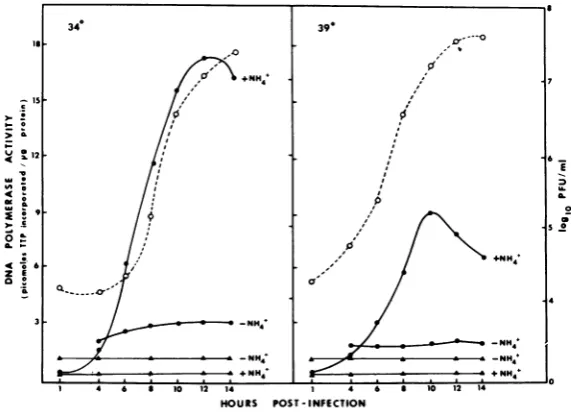
cycle(Fig. 4). When DP assayswereperformed
in the absence ofNH.'
ion,
withextracts ofinfected cells grown at either34 or
39
C,
a 1.5- to 2-fold increase in activityabove5
.11
zIz
.2
I-2
4
3
2
(NI))2SO4CONCENTRATION (mM) FIG. 2. Effect ofNH4+concentrationon DP activ-ity. Mock-infected and infected cells were harvested after 10 h of incubation at 34 C. DP activity was assayed in the presence of the indicated concentra-tionsof(NH4)
,SO,
for30minat39C. DPactivityisexpressedas the ratioof picomoles ofTTP
incorpo-rated per microgram of protein in the presence of
(NH4),SO,
to the incorporation in the absence of(NH4),SO,.
Symbols: (0) infected cultures and (A) mock-infected cultures.VOL.16,1975
on November 10, 2019 by guest
http://jvi.asm.org/
[image:4.499.44.236.68.382.2] [image:4.499.254.444.342.572.2]502 ARON, PURIFOY,
that of uninfected control cell activity was
observed from 4 to 14 h postinfection (pi).
Assays performed with 34C-infected cell
ex-tracts in the presence of
NH4,
ion, however, demonstratedamarked increase inDPactivity beginning at 4 h pi and reaching maximum levelsat10to 12 h pi.This increaserepresentedan approximate 12-fold increase in polymerase activity when compared with the activity ob-served in uninfected cells. Under these condi-tions an increase in infectious virus was first apparent at 6 h pi and had not reached
max-imum levels by 14 h. DPactivity assayed with
NH4+ ion fromextracts ofinfected cells grown
at 39C also began to increase by 4 h pi and reached a maximum at 9 to 10 h pi. This increase represented asixfold increasein
activ-ity above uninfected control cell levels. Under these conditions an increase in infectious virus
was apparent after 4 h and maximum titers
were reached from 12 to 14 h pi. Ten hours pi
was therefore selected as the time of assay for
DP activityof tsmutant-infected cells grown at
34and39C.
DP activity of HSV-1 ts mutants. The DP activity inducedby the WTvirusand15HSV-1
ts mutants after 10 h ofincubation at 34 and
39C is shown in Table 2. At 34C polymerase activity in mock-infected cultures wasonly 1% ofthat inWT virus-infected cultures, while all
but
three mutants (tsC4,tsC7,
and tsD9)syn-thesized from 72 to 116% ofWT levels ofDP activity. At 39C mutants
belonging
tocom-plementation groups
E, F, I, and N, which34e
''
, +NH4
VU12
-0 1
Oz
/.'synthesized
50% or greater of the amount ofviralDNA
synthesized
by
the WT virus(Table
1),
induced WT levels ofDP activity(DNA',
I 10
I
I 8
6.
0
A.
I.-:6
I.-2
4
TIME OF ASSAY (min.)
FIG. 3. Effect oftemperatureof assayonDP
activ-ity. Mock-infected andinfected cellswereharvested
after 10 h of incubation at 34C. DP activity was
assayedateither34 or39Cfor30minattheindicated
timepi in the presence of (NH4)2S04 (100 mM)for
infected cells (0). Mock-infected cells (A) were
as-sayed in the absence of
(NHJSO4.
o
- - I . .' . .l
1 4 6 * 10 12 14 1 4 6 a 10 12 14
[image:5.499.266.456.118.357.2]HOURS POST-INFECTION
FIG. 4. Kinetics of induction of DP activity. Mock-infected (A) andinfected (0) cells were incubated at either34or 39C and harvested at the indicated times pi. ExtractswereassayedforDPactivityat 39Cfor30
minin the presence and absence of(NH4) S04 (100 mM).Infectivityassayswereperformedtoparallelkinetics ofenzymeinduction (0).
J. VIROL.
on November 10, 2019 by guest
http://jvi.asm.org/
[image:5.499.114.400.431.638.2]SYNTHESIS AND DP HSV-1 MUTANTS 503
TABLE 2. Induction of DNA polymeraseactivity by WTvirus and ts mutants of HSV-1 at 34 and 39 C
DNApolymerase Phenotype at 39 C aCtiVitya
Virus DNA ViA
34C5 39C polym-
DNral
erase
WT 100o lOOb
Mock infected 1 3
tsE6 73 141 + +
tsF18 108 80 + +
tsI11 112 82 + +
tsN20 116 152 + +
tsG3 86 20 4 4
tsG8 109 14 4 4
ts022 81 5 4 4
tsAl 103 95 +
-tsA15 72 114 +
-tsA16 80 102 + _
tsB2 95 24 4 _
tsB21 74 38 4 _
tsC4 35 1 - _
tsC7 41 3 _ _
tsD9 34 1
aCultures were infected at a multiplicity of 5
PFU/cell andincubatedateither34 or39 C for 10 h.
Mock-infected and infected cell extracts were
pre-paredand DPactivitywasdeterminedinthe presence
of 100 mM (NH,)2S04. Results are expressed as
picomoles of TTP incorporated per microgram of protein in 30 min at 39C relative to WT virus-infectedcultures as 100%.Values given represent the averageoftwo tofour separatedeterminations.
'DNA polymerase activity: 100%equals 17.5 and
8.9picomolesof TTPincorporated permicrogram of
protein/hat 34C and39C,respectively.
DP+ mutants). Mutants belonging to
com-plementationgroups G and 0induced reduced
amounts ofboth viral DNA (Table 1) and DP
activity(DNA',DP'mutants). Theremaining
mutants studied, all of which were DNA- at
39 C
(Table
1), fell into three categories withrespect totheir abilitytoinduce DP activityat
39 C
(Table 2):
(i) mutants belonging tocom-plementation group A, which induced activity
at levels comparable to that of the WT virus
(DNA-, DP' mutants), (ii) mutants in
com-plementation group B, which induced only about one-third of the WT virus level of DP
activity (DNA-, DP' mutants), and (iii)
mu-tants in complementation groups C and D,
which induced DPactivity equal to or less than
that produced in mock-infected cells (DNA-, DP- mutants). Mutants in this group also
induced less than 50% of the level of WT DP
activityat34 C. These results suggested that at
39
C
mutants which were phenotypically DP'or DP- either (i) contained an inhibitor of DP
activity, (ii) produced a temperature-sensitive
DNA polymerase molecule, or (iii) were
defec-tive in the inductionofDP. When assays were
conducted at 34 C, no increase in DP activity wasdetected withany ofthemutants,
indicat-ing that none ofthe mutants produced DP at
39 C whichwasinactivated in the 39 C assay.
Inhibitor studies. The possibility that
mu-tants in complementation group B grown at
39C andmutants incomplementationgroupsC
and D grown at 34 and 39 C produced a freely
diffusable inhibitorof DP resulting in reduced
levels of enzyme activity was examined.
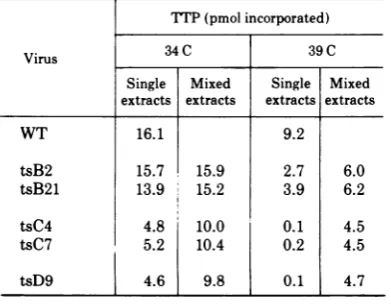
Ex-tracts of cells infected at 34 or 39 C with
mutants in groups B, C, and D were mixed in
equal amounts with extracts of cells infected with the WT virus and incubated at the same
temperature (Table 3). In all cases the DP
activity in mixed extracts was approximately equal to one-half the sum of the activities of each single extract in the mixture. The reduc-tion in DP activity in mixed extracts
corre-sponded
tothedilution oftheactivity
in the WTextract
by
the mutant extract and indicatedthatnofreely
diffusable
inhibitor of DPactivity
was present in either group
B,
C,
or Dmu-tant-infected cells.
Heatinactivation of DP activity.Heat
[image:6.499.44.235.97.372.2]inac-tivation studies were performed with group B,
TABLE 3. DNA polymerase activity in mixed extracts ofWT virus and ts mutant-infectedcellsa
TTP(pmol incorporated)
Virus 34C 39 C
Single Mixed Single Mixed extracts extracts extracts extracts
WT 16.1 9.2
tsB2 15.7 15.9 2.7 6.0
tsB21 13.9 15.2 3.9 6.2
tsC4 4.8 10.0 0.1 4.5
tsC7 5.2 10.4 0.2 4.5
tsD9 [ 4.6 9.8 0.1 4.7
a Cultures were infected at a multiplicity of 5
PFU/cell and incubated at either 34 or 39 C for 10 h. Equal volumes of single enzyme extracts were mixed with extracts of WT virus-infected cells grown at either34or39 C. DPactivity was assayed with 50
Il
ofsingle or mixed extracts, and results are expressed
aspicomoles ofTTPincorporated per microgram of protein in 30 min at 39 C.
VOL.16,1975
on November 10, 2019 by guest
http://jvi.asm.org/
[image:6.499.249.445.446.598.2]504 ARON, PURIFOY, AND SCHAFFER
C, andDmutants in order todeterminewhether
they induced DP which wastemperature
sensi-tive in vitroand/orin vivo.
Forinvitrostudies infected cellextracts were
preheated for 10, 20, and 30 min at 39 C, and
residual activity was compared with enzyme
extracts of cells infected with WT virus and
group A (DP' mutants) treated in the same
manner. None of the mutants tested induced
DP which was more heat labile than the WT
enzyme (Fig. 5). Residual polymerase activity
ofbothWTand mutantextractsranged from 50
to 60%ofinitial activity after 30 min at 39 C.
For in vivostudies infected cells maintained
at 34C for 11 h were shifted to 39 C and
residual DP activity was determined after 1, 2,
and 3 h and compared with that of WT virus-infected cells treated in the same manner. One
setofinfected cultures was maintained at 34C
to determine normal enzyme levels at the
per-*missive
temperature. The results of in vivoheat inactivation ofDPareshown in Fig. 6. DP
activity inallculturesmaintainedat 34C from
0 to 14hpi remained constant (tsB2, WT, and
tsC4) or increased (tsD9 and tsC7). While DP
activity in WT and tsB2-infected cultures
de-clined to about80% oftheoriginal activity 3 h
after shift-up to 39 C, activity in cultures
in-fected with tsC4, tsC7,and tsD9declinedto less
than 25% ofthe activity present at the time of
shift. Thus, in vivo DP activity of mutants in
groups C and D was significantly more
heat-labile than thatoftheWTviruswhereasthat of
thegroup B mutant was not.
DISCUSSION
In an effort to determine the biochemical
nature ofthe temperature-sensitive defects
ex-hibitedby HSV-1 ts mutants, therelationship between their ability to synthesize viral DNA andtoinduce DP activitywasexaminedatboth permissive and
nonpermissive
temperatures.The abilities of mutants to synthesize viral DNA and to inhibit cellular DNA synthesis
were measured by preparative
ultracentrifuga-tion. Determination of viral DNA phenotypes
by both analytical (21) and preparative
ul-tracentrifugation yielded identical results. Un-likeanalyticalultracentrifugation,however, the
preparative technique enables one to measure
the synthesis of viral DNA as well as the inhibitionofcellular DNA synthesis.
Oftheeightmutantswhichwerefoundto be
viral DNA-, all have been demonstrated to
inducethesynthesis ofvirus-specific proteinsas
detectedbyimmunofluorescence and
polyacryl-amide gel electrophoresis (R.J. Courtney,
per-0
460-z z
o 10 20 30
TIME (min.)
FIG. 5. In vitroheatinactivation of WT virus and
ts mutant-infected cell extracts. Infected cells were
harvested after 10 h ofincubation at 34 C. Enzyme
extracts were heated at 39C for the indicated times and assayed for DPactivityinthe presence of 100mM (NH4)2S04- Symbols: (e) mock-infected, (@) WT, (0) tsB2, (x) tsD9,
(U)
tsAl, (0) tsA16, (A) tsC4, and (A) tsC7-infected cell extracts. Results are pre-sentedrelative to unheated extracts as 100%.sonal communication), implyingthattheir
tem-perature-sensitive defects do not involve early
functions such as adsorption, penetration, and
uncoating. Therefore, the failure to detect
[3H ]thymidine
incorporation intoviralDNAat39C by these mutants (representing four of 15
complementation groups so far identified
[211)
suggestseither that insufficient viral DNA was
synthesized to allow detection by the methods employed or that no viral DNA was
synthe-sized.
It is
possible
that the lateness of the 24-hharvest time may have underestimated the
extent ofviralDNAsynthesissince virus
parti-cles released into the medium of infected
cul-tureswere notcollectedand added to thepoolof
cell-associated DNA. It should be noted,
how-ever, that the encapsidation ofviral DNA into
virions in herpesvirus infection is relatively
inefficient(1). Thus, the majority of viral DNA
synthesized would remain within the nucleus.
Furthermore, not all mutants are able to
syn-thesize physical particles at 39C, and those
which do synthesize primarily "empty"
on November 10, 2019 by guest
http://jvi.asm.org/
[image:7.499.269.461.70.309.2]DNASYNTHESIS AND DPACTIVITY OFHSV-1 MUTANTS 505
4 100
<4"
0
_SO u11
wr
12 13 140
ftG2
. I , I L L I 1 13 140 n 1n
HOURSAFTER ICTON
lsc7
. ..
I a a 14
#s09
[image:8.499.98.392.68.235.2]I12 13 14
FIG. 6. In vivo heat inactivation of WT virus and ts mutant-induced DP activity. Infected cells were incubated in duplicate at 34C for 11 h when half the cultures wereshiftedto 39C. Cultureswereharvested at
the indicated timespi and assayed for DPactivity in the presence of100 mM (NH4),SO4; (0) cultures
maintainedat34C (O to 14 hpi);(0)culturesshiftedto 39Cat 11hpi.Results are presented relative to DP
activitydetected in cultures at 11 h, thetime of shift,as 100%.
cles (22)which wouldnot
deplete
the viral DNA pool.Although
no conclusiverelationship
betweenthe inhibition of host-cell DNA
synthesis
andthe
synthesis of viral DNAwasdemonstrated inthe
presentstudy,
the data ofPringle
etal.(20),
with ts mutants of
pseudorabies virus,
sug-gested
atemporal
relationship between
thesetwo
virus-induced
functions. Little ispresently
known about the mechanism involved in the
inhibition
ofcellular
DNAsynthesis;
however,
the
availability
of ts mutants with alteredcapacitiestoinhibit cellular DNA
synthesis
willpermit
the examination of thisproblem
ingreater detail.
The results of these and other
(G.
M.Aron,
P.A.
Schaffer,
and M.Benyesh-Melnick,
Abstr.Annu. Meet. Am.Soc. Microbiol. 1973,
V42,
p.201)
studies indicate that a minimum of sixHSV-1
cistrons(A, B,
C, D, G,
and0)
areinvolved in either the production or
regulation
ofviral DP and DNA
synthesis. (i)
Mutants in groups G and 0 (DNA',DP')
inducereduced
levels of DP and may
be
defective either in the production of DP or in theability
tosynthesize
a
factor(s)
regulating
theactivity
ofthe enzyme.(ii) Mutants in groups A
(DNA-, DP+)
and B (DNA-,DP') appeartobedefective in regulat-ing theability
of DP to functionproperly
invivo,since noviral DNAwassynthesizedinthe
presence of
functional,
thermostable DP. (iii) Mutants in complementation groups C and D (DNA-,DP-)
appear toinduce atemperature-sensitive DP as determined by in vivo studies,
suggesting that the ts defects of these mutants
aredue to theproduction ofa temperature-sen-sitivepolymerase molecule per se.
Thepresent
study
oftherelationship
betweenthe
ability
ofthets mutants toinduce DP andsynthesize viral DNA indicate that HSV-DNA replication is not an essential requirement for
the
induction of DP.Thus,
mutantsbelonging
to
complementation
groups A and B induce DPandyetareunableto
synthesize
viral DNA. The data also suggest that viral DP is essential forDNA
replication
since (i) none of the mutantstestedsynthesized viralDNA inthe absence of DP, and(ii) acorrelation wasobserved between
the amount ofviral DNA
synthesized
and thelevel of DP activity found in theDNA+, DP+ and DNA', DP' mutant groups. Although DP maybe essential for DNA synthesis, it is not the sole requirement since
complementation
group A and B mutants induced DP yet werepheno-typically
DNA-.Additional evidence for the apparent involve-ment of a large number of cistrons (of an approximate total of 100
HSV
genes) in thesynthesis
and/or
regulation
of viral DP andDNA comes from studies withotherherpesvirus
ts mutants. Three of
eight
cistrons ofHSV-1
werefoundby
Timbury
andSubak-Sharpe (26)to affect viral DNA synthesis. Studies by
Esparza et al. (4) also indicate that at least threeof atotalofseven cistrons sofaridentified
are involvedintheexpression oftheHSV-2DP
andDNAphenotypes. Mutants defectiveintwo ofthesecistronsinduce DP that is temperature-sensitive in vivo but not in vitro (Purifoy and Benyesh-Melnick, submitted for publication).
VOL.16,1975
10 a
II
on November 10, 2019 by guest
http://jvi.asm.org/
506
In studies of another series of HSV-2 ts
mu-tants, Halliburton and Timbury (5)
demon-strated that seven of the 10 cistrons affected the
synthesisof viral DNA; two of the seven cistrons apparently affect DP induction and mutants
defective in one of the two cistrons exhibit
temperature-sensitive DP activity in vivo but
not in vitro (J. Hay, personal communication). Pringle et al. (20) reported that members of four
ofthe nine complementation groups of ts
mu-tants of pseudorabies virus were unable to
synthesize more than 1% of WT virus levels of viral DNA.
Immunological and biochemical studies (5)
indicate that the HSV-induced polymerase is
distinctfrom the host-cell enzyme and hence is
virus coded. The finding thatcomplementation
group C and D ts mutants induce polymerase
activity which is temperature sensitive in vivo
represents further suggestive evidence that
HSV codes for a new DP. Furthermore, since
mutantsbelongingto twodifferent
complemen-tation groups induced a temperature sensitive
DP, there may betwo subunitsinvolved in the
formationof a functional HSV-induced polym-erase.
Confirmation of the hypothesis that HSV codes for a new polymerase must await the demonstration that the temperature-sensitive lesions reside intheinduced molecule(s) as has
been shown for bacteriophage T4 and T5 DP
(2). The conversion of an inactive form of T4
DP upon temperature shift-down to a
func-tional enzyme has been shown for a T4 bac-teriophage mutant bearing a
temperature-sensitive defect in the structural gene for DP
(7, 25).
Experiments are in progress to determine whether the temperature-sensitive polymerase defect of group C and D HSV-1 ts mutants is
involved in the initiation
and/or
elongation ofviral DNA synthesis in vivo. More detailed studies of these and other mutants of HSV-1 should prove to be useful in elucidating the biochemicaleventsinvolvedinHSV DNA
repli-cation.
ACKNOWLEDGMENTS
This investigation was supported by Cancer Research Center grant CA 10,893 from the National Cancer Institute andby training grant5Ti Al74fromthe National Institute ofAllergyandInfectiousDiseases.
TheauthorswouldliketoexpresstheirappreciationtoM. Benyesh-Melnick forhelpfulcommentsanddiscussions and to acknowledgethe excellent technical assistance ofSharen Moore.
LITERATURECITED
1. Ben-Porat, T.,and A.S.Kaplan.1963.Thesynthesisand fate ofpseudorabiesvirus DNA ininfectedmammalian
cells in the stationary phase of growth. Virology 20:310-317.
2. DeWaard, A.,A. V.Paul, andI.R. Lehman. 1965. The structural gene fordeoxyribonucleic acid polymerase in bacteriophages T4 and T5. Proc. Natl. Acad. Sci. U.S.A.54:1241-1248.
3. Dreesman, G.R., and M. Benyesh-Melnick. 1967. Spec-trum of human cytomegalovirus complement-fixing antigens. J. Immunol. 99:1106-1114.
4. Esparza, J., D. J. M. Purifoy, P. A. Schaffer, and M. Benyesh-Melnick. 1974. Isolation, complementation andpreliminary phenotypic characterization of tem-perature-sensitive mutants of herpes simplex virus type2.Virology57:554-565.
5. Halliburton,I.W., and M. C.Timbury.1973. Character-ization of temperature-sensitive mutants of herpes simplex virus type 2. Growth and DNA synthesis. Virology 54:60-68.
6. Hay, J., P. A. J.Perera, J. M. Morrison, G. A.Gentry, and J. H.Subak-Sharpe. 1971. Herpesvirus-specified proteins, p. 355-376. In G. E. W. Wolstenholme and M. O'Connor (ed.), Strategy of the viral genome. The Williams & Wilkins Co., Baltimore.
7. Karam, J.D., and J.F.Speyer. 1970. Reversible inactiva-tion of T4 ts DNA polymerase mutants in vivo. Virology 42:196-203.
8. Keir, H.M. 1968. Virus-inducedenzymesinmammalian cells infected with DNA-viruses, p. 67-99. In L. V. Crawford and M. G. P. Stoker (ed.), The molecular biology ofviruses. Cambridge University Press, Lon-don.
9. Keir, H. M., andE. Gold. 1963. Deoxyribonucleicacid nucleotidyltransferase anddeoxyribonucleasefrom cul-turedcells infected withherpessimplex virus. Biochim. Biophys. Acta72:263-276.
10. Keir, H. M., J. Hay, J. M. Morrison, and H. Subak-Sharpe. 1966. Altered properties ofdeoxyribonucleic
acidnucleotidyl-transferaseafterinfectionof mamma-liancells withherpes simplexvirus.Nature(London) 210:369-371.
11. Keir,H. M., H.Subak-Sharpe, W. I. H. Shedden,D. H. Watson, and P. Wildy. 1966. Immunological evidence for aspecificDNApolymerase producedafterinfection by herpes simplexvirus.Virology30:154-157. 12. Kit,S.,andD.R.Dubbs.1963.Acquisitionofthymidine
kinase activity by herpes simplex infected mouse fibroblast cells. Biochem. Biophys. Res. Commun. 11:55-59.
13. Kit, S., and D. R. Dubbs. 1969. Enzyme induction by viruses. Monogr. Virol.2.Karger, Basel.
14. Kit, S., L. J. Piekarski, andD. R. Dubbs. 1967. DNA polymerase inducedbysimianvirus40.J.Gen. Virol. 1:163-173.
15. Lowry, 0. H., N. J. Rosebrough, A. L. Farr, and R. J. Randall. 1951. Protein measurement with the Folin phenol reagent. J. Biol. Chem. 193:265-275. 16. Muller,W. E.G.,D.Falke,B.Heicke, and R. K. Zahn.
1973. Biological activity of 2-phenylethanol and its derivatives. VIII. Influence on herpesvirus DNA-syn-thesis in rabbit kidney cells. Arch. Gesamte Virus-forsch. 40:205-214.
17. Muller, W. E. G., D. Falke, and R. K. Zahn. 1973. DNA-dependent DNA polymerase pattern in nonin-fected and herpesvirus infected rabbit kidney cells. Arch. GesamteVirusforsch. 42:278-284.
18. Newton, A. A. 1964. In A. Baselli (ed.), Acid nucleici e lora funzione biologica, p. 109-128. Tipografia SuccessoriFusi,Pavia.
19. Perera,P. A. J.,andJ. M.Morrison. 1970.Evidencefor the induction of a new deoxycytidine kinase incells infected withherpesvirus.Biochem. J. 117:21-22.
J. VIROL.
on November 10, 2019 by guest
http://jvi.asm.org/
507
20. Pringle, C. R., D. K. Howard, and J. Hay. 1973. Temper-ature-sensitive mutants of pseudorabies virus with differential effectson viral and host DNA synthesis.
Virology55:495-505.
21. Schaffer, P. A., G. M. Aron, N. Biswal, and M. Benyesh-Melnick. 1973.Temperature-sensitive mutantsof
her-pes simplex virus type 1: isolation, complementa-tion andpartial characterization. Virology52:57-71. 22. Schaffer,P. A., J. P. Brunschwig, R. M. McCombs, and
M.Benyesh-Melnick. 1974. Electronmicroscopic stud-ies oftemperature-sensitivemutantsofherpes simplex virustype1.Virology 62:444-457.
23. Schaffer, P. A., R.J.Courtney,R. M.McCombs,andM. Benyesh-Melnick. 1971.A temperature-sensitive
mu-tantofherpes simplex virus defectiveinglycoprotein synthesis. Virology 46:356-368.
24. Schaffer, P., V. Vonka, R. Lewis, and M. Benyesh-Mel-nick. 1970. Temperature-sensitive mutants of herpes simplex virus.Virology 42:1144-1146.
25. Swartz, M. N., H. Nakamura, andI.R. Lehman. 1972.
Activation ofadefective DNApolymerase ina temper-ature-sensitive mutantofbacteriophage T4. Virology 47:338-353.
26. Timbury, M. C., and J. H. Subak-Sharpe. 1973. Genetic interactionsbetween temperature-sensitivemutantsof types 1and 2 herpes simplex viruses. J. Gen. Virol. 18:347-357.
27. Weissbach, A.,S.-C. L. Hong, J. Aucker, and R. Muller. 1973.Characterization of herpes simplex virus-induced deoxyribonucleic acid polymerase. J. Biol. Chem. 248:6270-6277.