Assessing the Performance of Horizontal Axis
Marine Current Turbines: The Impact of
Evaluation Methods and Inflow Parameters
by
Masoud Rahimian, B.E., M.E
National Centre for Maritime Engineering and Hydrodynamics
Australian Maritime College
Submitted in fulfilment of the requirements for the degree of Doctor of Philosophy
ii
Declarations
I declare that ‘This thesis contains no material which has been accepted for a degree or
diploma by the University or any other institution, except by way of background information
and duly acknowledged in the thesis, and to the best of my knowledge and belief no material
previously published or written by another person except where due acknowledgement is made in the text of the thesis, nor does the thesis contain any material that infringes copyright.’
This thesis may be made available for loan and limited copying in accordance with the Copyright Act 1968
Signed:
Masoud Rahimian
iii
Statement of Published Work Contained in Thesis
The publishers of the papers comprising Chapters 2 to 4 hold the copyright for that content,
and access to the material should be sought from the respective journals. The remaining
non-published content of the thesis, Chapter 5, are submitted and under review, and may be made
available for loan and limited copying and communication in accordance with the Copyright
Act 1968.
Statement of Co-Authorship
The following people and institutions contributed to the publication of work undertaken as part
of this thesis:
Masoud Rahimian, University of Tasmania (Candidate)
Doctor Jessica Walker, Primary Supervisor, University of Tasmania (Author 1)
Associate Professor Irene Penesis, Co-Supervisor, University of Tasmania (Author 2)
Michael Sos, University of Tasmania (Author 3)
Luke Johnston, University of Tasmania (Author 4)
Author details and their roles:
Paper 1: Rahimian M, Walker J, Penesis I. Numerical assessment of a horizontal axis marine current turbine performance. International Journal of Marine Energy. 2017;20: 151-64.
Chapter 2 was based on this paper. The Candidate was the primary author. Author 1 and Author
2 assisted with research direction, advice, and presentation. [Candidate: 80%, Author 1: 10%,
iv
Paper 2: Rahimian M, Walker J, Penesis I. Performance of a horizontal axis marine
current turbine– A comprehensive evaluation using experimental, numerical, and
theoretical approaches. Energy. 2018; 148:965-76.
Chapter 3 and parts of Chapter 4 were based on this paper. The Candidate was the primary
author. Author 1 and Author 2 assisted with research direction, advice, and presentation.
[Candidate: 80%, Author 1: 10%, Author 2: 10%].
Paper 3: Rahimian M, Walker J, Penesis I. The influence of shear flow and waves on the performance characteristics of a horizontal axis marine current turbine. Journal of Applied Energy. 2018. (submitted for review)
Chapter 5 is based on this paper. The Candidate was the primary author. Author 1 and Author
2 assisted with research direction, advice, and presentation. [Candidate: 80%, Author 1: 10%,
Author 2: 10%].
Paper 4: Sos M, Johnston L, Walker J, Rahimian M. The impact of waves and immersion depth on horizontal axis tidal turbine performance. 12th European Wave and Tidal Energy Conference (EWTEC2017). Cork, Ireland. p. 1-8.
This conference paper is included in the appendix. Author 3 and Author 4 completed the
experimental work presented in the paper and contributed to the drafting of the paper. Author
1 contributed to the conception and design of the project, the analysis and interpretation of the
research data, and prepared the paper. The Candidate contributed to the conception and design
of the project and the analysis and interpretation of the research data. [Author 3: 35%, Author
v
We the undersigned agree with the above stated proportion of work undertaken for each of the
published (or submitted) peer-reviewed manuscripts contributing to this thesis.
Signed:
Dr Jessica Walker Primary Supervisor
National Centre for Maritime Engineering and Hydrodynamics Australian Maritime College
University of Tasmania
Date: 02 May 2018
Assoc/Prof Irene Penesis Co-Supervisor
National Centre for Maritime Engineering and Hydrodynamics Australian Maritime College
University of Tasmania
Date: 02 May 2018
Assoc/Prof Michael Woodward Director
National Centre for Maritime Engineering and Hydrodynamics Australian Maritime College
University of Tasmania
vi
Acknowledgements
Finally, this wonderful chapter of my life has come to an end. It has been filled with joy and
tribulations, and I certainly was not able to make it through on my own.
Firstly, I would like to express my sincere gratitude to my supervisory team, Dr Jessica Walker
and Assoc/Prof Irene Penesis for their continuous support, patience, encouragement, and
immense knowledge. They have been great supervisors as well as tremendous mentors for me.
It has been a pleasure to work with them and I hope I can pass on what I have learnt from them.
My genuine thanks also goes to Dr. Zhi Leong, and Dr. Philip Marsh for sharing their CFD
knowledge, which helped me make through CFD difficulties. Special thanks must also go to
Rowan Frost, Jock Ferguson, and Tim Lilienthal for their technical support in the setup and
execution of experimental works.
I would like to express my appreciation to the turbine research team led by Prof Karen Flack
at the United States Naval Academy for sharing their rotor design, which was used as the basis
for the AMC turbine.
Last but not the least, thanks to Zhinous, my love, who brought colours into my life. This work
vii
Abstract
The oceans offer a considerable sustainable energy resource in the form of wave, marine currents and thermal energy and provide a potential alternative to fossil fuels. Marine current,
or tidal, energy can be harnessed using horizontal axis marine current turbines (HAMCTs). In
this work, the performance of a 2-bladed HAMCT was extensively investigated using
experimental, theoretical and numerical models under different flow conditions. The
motivation behind the study was to assess the influence of various parameters, associated with
an evaluation method and those involved in the environment of a deployment site, on turbine
performance. The employed evaluation methods were compared to find the best practice for
performance assessment in various operational conditions.
For this purpose, two physical scale models with diameters of 500 mm and 800 mm were
tested in the Australian Maritime College Towing Tank and Circulating Water Channel
(CWC). Towing tank results from the United States Naval Academy were also employed for
facility comparison as well as CFD model verification. The experimental results provide the
hydrodynamic characteristics of the turbine under the different inflow conditions in each
facility. The difference between the performances of the two scale models was found to be
mainly due to the effect of Reynolds number and possibly attributed to the blockage effect. To
predict the performance of a full-scale turbine, experiments on a scale model in conditions with
Reynolds number independency, in this study Re > 2×10⁵, in a facility with little blockage is
suggested. Unlike the towing tanks, the CWC did not have a uniform inflow. Using the
equivalent flow velocity, obtained from kinetic energy flux over the rotor swept area, in
dimensional analysis of the CWC data resulted in a better correlation with the towing tank
results. It shows that although the shear flow profile practically has little effect on the mean
power output per se, selecting the flow velocity by which the performance is analysed is
essential in scale model tests. The impact of facility bias on the performance assessment
appeared to be induced mainly from blockage and partially from the flow velocity profile.
An experimentally validated Blade Element Momentum (BEM) model was modified to
consider shear flow profile and Reynolds number in the performance calculations. In addition,
QBlade software was employed as a tool to investigate the effect of using local Reynolds
number over the blade span. No significant changes were seen in the BEM model results by
viii
showed that using local sectional Reynolds numbers in the prediction may be not worth the
effort to achieve results that were slightly more accurate than the model with a single reference
Reynolds number. BEM theory provides reasonable performance predictions for turbines in
steady flow conditions.
To establish detailed hydrodynamic characteristics of the turbine in ideal flow conditions,
an experimentally validated numerical model using Computational Fluid Dynamics (CFD) was
developed. Different CFD approaches were applied to the model to find the best numerical
practice for the performance evaluation of HAMCTs. The CFD model was modified to account
for sheared inflow and surface waves using volume of fluid (VOF) and single-phase methods.
A steady moving reference frame (MRF) simulation of the whole turbine model using the k-ω
SST turbulence model with the wall-function model was found to be the best approach for the
performance prediction of HAMCTs under steady inflow conditions in a balance between
simulation time and result accuracy. Conversely, a transient solution with the sliding mesh
method provided a better fit to the experimental results for turbine under waves and sheared
inflow velocity profiles. The CFD simulations showed that a sheared inflow velocity profile
had a cyclic effect on the blade loadings and almost no significant effect on the mean power
production of the turbine. The effect of turbine depth and waves on the mean power yield was
also negligible when the tip immersion depth of the turbine was more than half the turbine
radius. Since both wave and sheared flow velocity affect the quality of power output even in
deeper positions, they should be considered during the turbine design stage. Regardless the
angular position of the blades, the maximum values of CPand CToccurred at the passing wave peaks and the minimum values at the troughs.
This study comprehensively evaluated the methods available to predict the performance of
HAMCTs and provided a detailed discussion of the different parameters that affect both turbine
and model performance. Overall, the BEM model provided accurate performance results in the
steady flow condition, though it was unable to capture the effect of shear velocity on the turbine
hydrodynamics. The QBlade model yielded similar results to the BEM model with the possibility of investigating Reynolds number effect; a user-friendly tool for quick performance
prediction of a full-scale turbine. The CFD approach provided detailed information about the
turbine hydrodynamics in both steady and unsteady conditions; however, an extensive
verification and validation of the model is essential to achieve trustworthy results. The scale
ix
However, it is important to know how to account for blockage, inflow velocity profile and
x
Table of Contents
List of Tables ... xvi
1. Chapter 1: Thesis Introduction ... 1
1.1 . Introduction ... 2
1.2. Problem Definition ... 2
1.3. Research Objectives ... 4
1.4. Description of Model Geometry ... 5
1.5. Novel Aspects ... 7
1.6. Thesis Outline ... 8
2. Chapter 2: Numerical Assessment of a Horizontal Axis Marine Current Turbine under Steady Flow Conditions ... 11
2.1 . Introduction ... 12
2.2. Problem Description ... 13
2.3. Governing Equations ... 14
2.4. CFD Model ... 15
2.4.1. Geometry and Flow Domain ... 15
2.4.2. Grid Generation... 15
2.4.3. Solver Setup ... 17
2.4.4. Solution ... 19
2.4.5. Grid Sensitivity ... 20
2.4.6. Y+ Study ... 21
2.5. Results and Discussion ... 23
2.5.1. Validation of Numerical Models with Experimental Results ... 23
2.5.2. Reynolds Number and Scale Effects ... 29
2.5.3. Effect of Chosen Turbulence Model ... 32
2.5.4. Effect of Chosen Boundary Layer Model ... 33
2.5.1. Evaluation of Transient vs Steady State Solutions ... 34
2.6. Conclusion ... 36
3. Chapter 3: Experimental Evaluation of a Horizontal Axis Marine Current Turbine ... 38
3.1 . Introduction ... 39
3.2. Experimental Approach ... 40
3.2.1. Test Facilities ... 40
3.2.2. Test Rig ... 43
3.2.3. Physical Models ... 43
xi
3.2.5. Test Procedure... 47
3.2.6. Blockage Correction ... 48
3.2.7. Uncertainty Analysis ... 49
3.2.8. Equivalent Inflow Velocity ... 51
3.3. Results and Discussion ... 52
3.3.1. Towing Tank Results ... 52
3.3.2. Circulating Water Channel Results ... 54
3.3.3. Blockage, Facility Type and Model Scale ... 57
3.4. Conclusion ... 59
4. Chapter 4: The impact of evaluation method on the performance of the horizontal axis marine current turbine ... 61
4.1 . Introduction ... 62
4.2. Theoretical Approach ... 63
4.2.1. Blade Element Momentum Theory ... 63
4.3. Results and Discussion ... 67
4.3.1. Modified BEM Model for shear ... 67
4.3.2. Effect of Scaling and Reynolds Number ... 67
4.4. Comparison of Turbine Performance Evaluation Methodologies... 69
4.5. Conclusion ... 72
5. Chapter 5: The influence of shear flow and wave on the performance characteristics of a horizontal axis marine current turbine ... 74
5.1 . Introduction ... 75
5.2. Numerical Models ... 77
5.2.1. The Single-Phase Model ... 77
5.2.2. The Volume of Fluid Model ... 78
5.2.3. Wave and Shear Modelling ... 79
5.2.4. Validation ... 79
5.3. Case Studies ... 80
5.4. Results and Discussion ... 81
5.4.1. CFD Model Validation ... 81
5.4.2. Effect of Shear Flow Velocity Profile ... 87
5.4.3. Effect of Surface Waves ... 89
5.4.4. Interaction of Wave and Velocity Profile ... 91
5.5. Conclusion ... 91
6. Chapter 6: Summary, Conclusion and Future Work ... 94
6.1 . Summary ... 95
6.2. Findings and Limitations ... 96
xii
6.2.2. Model Scale Testing... 97
6.2.3. Theoretical Modelling ... 98
6.2.4. CFD Modelling in Unsteady Conditions... 99
6.2.5. Comparing Assessment Methods ... 100
6.3. Implications of the Research ... 102
6.4. Future Work ... 104
7. References ... 106
xiii
List of Figures
Fig. 1.1. Deployment of AR-1000 at a tidal site [7] ... 3
Fig. 1.2. Turbine models used in the experiments (top – 800 mm rotor, bottom – 500 mm rotor) ... 5
Fig. 1.3. Turbine CAD model ... 6
Fig. 2.1. Hybrid grid generated over the turbine and flow domains for the numerical model ... 16
Fig. 2.2. Boundary conditions of the domains around the half turbine model ... 18
Fig. 2.3. Grid independency for the half turbine in the steady state solution ... 22
Fig. 2.4. Effect of different Y+s on the torque outputs of the CFD models ... 23
Fig. 2.5. Velocity distribution over the turbine planes for transient MRF simulation at TSR = 6 and inflow velocity of 2 m/s using SST turbulence model and wall function ... 24
Fig. 2.6. Distribution of turbulence kinetic energy over the turbine planes for transient MRF simulation at TSR = 6 and inflow velocity of 2 m/s using SST turbulence model and wall function ... 25
Fig. 2.7. Eddy viscosity distribution over the turbine planes for transient MRF simulation at TSR = 6 and inflow velocity of 2 m/s using SST turbulence model and wall function ... 26
Fig. 2.8. Pressure distribution over the turbine planes for transient MRF simulation at TSR = 6 and inflow velocity of 2 m/s using SST turbulence model and wall function ... 27
Fig. 2.9. Comparison of power coefficient curves between CFD models and USNA experimental results ... 28
Fig. 2.10. Comparison of thrust coefficient curves between CFD models and USNA experimental results ... 28
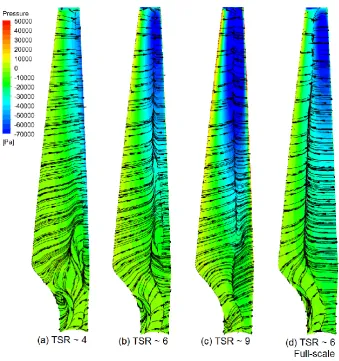
Fig. 2.11. Pressure distribution and limiting streamlines over the suction side of the blade ... 29
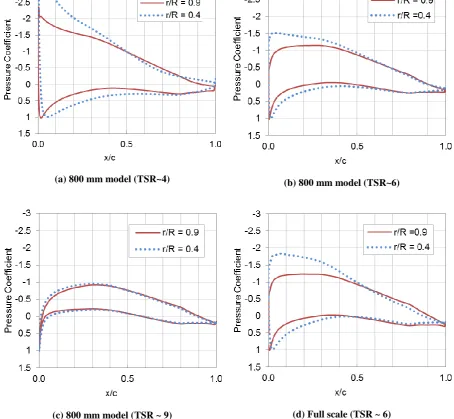
Fig. 2.12. Unsteady flow around the blade using Q-criterion of 0.004 for transient MRF simulation . 30 Fig. 2.13. Pressure coefficient over the blade surface at two radial cross sections for an inflow speed of 2 m/s at different TSRs ... 31
Fig. 2.14. Pressure coefficient at r/R = 0.7 for different TSRs of the scale model and full-scale turbine ... 32
Fig. 2.15. Comparison of CPcurves from CFD simulations with different boundary layer models ... 34
Fig. 2.16. Comparison between the CP curves of the steady and transient simulations with MRF and sliding mesh method ... 35
Fig. 2.17. Comparing the flow velocity profile around the turbine between the sliding mesh and MRF methods. ... 36
Fig. 3.1. Test setup configuration in CWC ... 41
Fig. 3.2. Schematic configuration of CWC ... 41
Fig. 3.3. Test setup configuration in Towing Tank ... 42
xiv
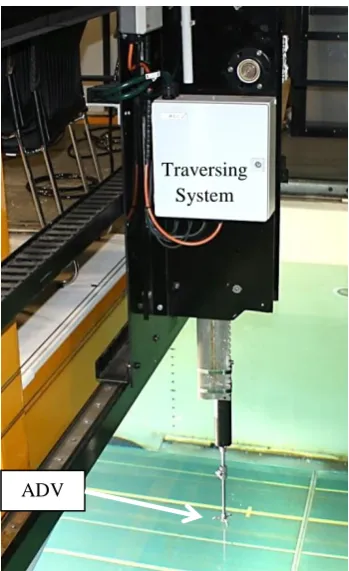
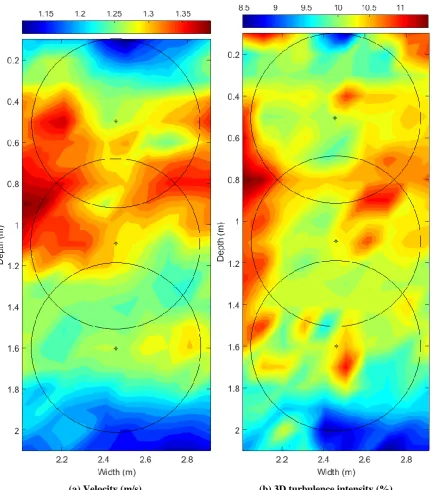
Fig. 3.5. Internal equipment of the test rig ... 43 Fig. 3.6. ADV velocity measurement ... 45 Fig. 3.7. Results from ADV measurement for a streamwise flow velocity of 1.3 m/s ... 46 Fig. 3.8. Dividing the rotor swept area to small elements for calculating equivalent inflow velocity
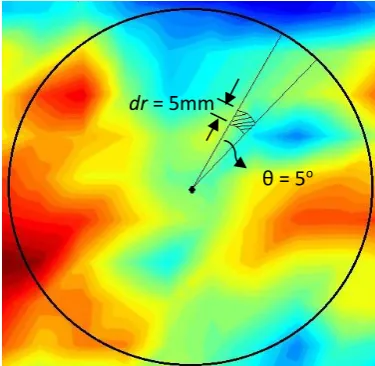
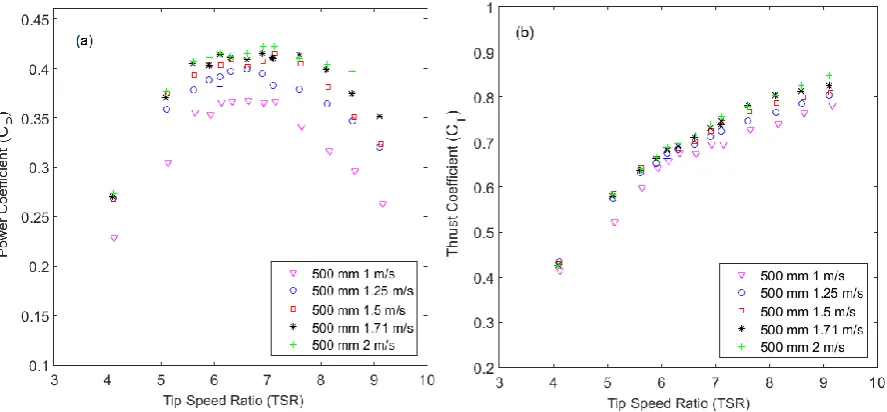
based on kinetic energy flux through the rotor swept area... 52 Fig. 3.9. Towing tank performance curves of the 500 mm diameter turbine after blockage correction53 Fig. 3.10. Towing tank performance curves of the 800 mm diameter turbine after blockage correction
... 53 Fig. 3.11. Circulating water channel (CWC) performance curves of 800mm turbine using velocity at
the hub (a) Power coefficient (b) Thrust coefficient ... 55 Fig. 3.12. Circulating water channel (CWC) performance curves of 800mm turbine using equivalent
velocity (a) Power coefficient (b) Thrust coefficient ... 55 Fig. 3.13. Circulating water channel (CWC) performance curves of 500mm turbine using velocity at
the hub (a) Power coefficient (b) Thrust coefficient ... 56 Fig. 3.14. Circulating water channel (CWC) performance curves of 500mm turbine using equivalent
velocity (a) Power coefficient (b) Thrust coefficient ... 56 Fig. 3.15. Blockage effect on turbine performance evaluation (towing tank results) ... 57 Fig. 3.16. The effect of scaling/Reynolds number and facility bias on the turbine performance ... 58 Fig. 4.1. Comparing Lift coefficient of NACA63-618 estimated by the QBlade with the 2D wind
tunnel [21] ... 66 Fig. 4.2. Accounting for Reynolds number and shear inflow in of the turbine performance evaluation
using BEM predictions and QBlade ... 68 Fig. 4.3. Accounting for scale effect in the turbine performance assessment using CFD simulations . 69 Fig. 4.4. Comparing the methods employed for performance evaluation of 800 mm turbine ... 70 Fig. 5.1. The domains of the CFD model and the boundary conditions ... 78 Fig. 5.2. Validation of the single-phase and the VOF model for shear using fitted experimental curve
at 1.1 m depth ( case s from Table 5.1) ... 82 Fig. 5.3. The VOF model validation for depth case using AMC towing tank results ... 83 Fig. 5.4. Pressure coefficient over the turbine blade (a) at two immersion depths and (b) under case
w1 at depth of 0.76 m ... 83 Fig. 5.5. Free surface deformation due to the turbine rotation ... 84 Fig. 5.6. The VOF simulations results of torque over each blade and the total torque of turbine in two
submergence depths ... 84 Fig. 5.7. Phase averaged results from the simulation of the validation wave case at U = 1.25 m/s and
TSR= 6.5. Solid line relates to the phase-average parameter; dashed line represents the averaged values. Blue dotted line is phase-averaged and blue dash-dotted line is
xv
Fig. 5.10. The VOF simulation results of torque over each blade and the resultant torque of the turbine in condition with and without shear velocity profile at TSR ~ 6.5 and hub immersion depth of 0.76 m... 88 Fig. 5.11. Comparing the velocity distribution over the vertical plane in the VOF simulation with and
without velocity profile ... 89 Fig. 5.12. The VOF results of torque over each blade and the resultant torque of the turbine model
under wave case 1 condition at TSR ~ 6.5 and two hub immersion depths ... 90 Fig. 5.13. Phase averaged results from the simulation of the wave cases at U = 1.25 m/s and TSR=
6.5. Thick dashed line represents the time-averaged values ... 91 Fig. 6.1. Performance of the 800 mm turbine at TSR~6.5 obtained from different assessment methods
... 103 Fig. 6.2. Performance of the 500 mm turbine at TSR~6.5 obtained from different assessment methods
xvi
List of Tables
Table 1.1. Blade Geometry ... 6
Table 2.1: CFD setup ... 18
Table 2.2: Simulation time and momentum residual in steady state solutions at TSR ~ 6 ... 20
Table 2.3: Simulation time and momentum residual in transient solutions at TSR ~ 6 ... 20
Table 2.4: Sample Calculation of Grid Convergence Index for Numerical Models ... 22
Table 3.1. Details of the experimental testing facilities ... 42
Table 3.2. Uncertainty of experimental results in each facility at TSR ~ 6 (data given is +/- amount in the relevant units) ... 51
Table 5.1. Characteristics of case studies applied to the turbine in CFD simulations ... 80
Table 5.2. Cyclic fluctuations of torque over a single blade and rotor for simulation cases ... 85
Table 5.3. The turbine performance results from simulations and the AMC experiments under the wave condition ... 86
TABLE IV Blade Geometry ... 116
xvii
Nomenclature
Greek Symbols
α Local angle of attack rad
β Seabed friction -
γ Power law of velocity profile -
δ Local blade twist rad
ε Change in key variable -
P
Precision error -
B
Bias error -
cal
Calibration error -
θ differential angle of the element rad
λr Local tip speed ratio rad
μ Viscosity kg / m.s
υ Kinematic viscosity m2 / s
ρ Density kg / m3
σi Root mean square of velocity fluctuations m / s
σs Standard deviation -
τ Shear stress N / m2
ϕ Key variable of simulation (Torque/Thrust) -
φ Relative flow angle rad
ψ Local solidity ratio rad
ωw Wave angular frequency rad / s
ω Rotational velocity rad / s
Ɐ Volume m3
Roman Symbols
a Axial induction factor -
a՛ Angular induction factor -
xviii
Aw Wave amplitude m
B Number of blades -
C Cross-sectional area of facility m2
CB Blockage correction factor -
CL Lift coefficient -
CD Drag coefficient -
CT Thrust coefficient -
CP Power coefficient -
dr Differential radius m
dt Time step s
dT Differential thrust N
dQ Differential torque N m
c Local blade chord m
e Relative error of key variable -
F Tip loss factor -
g Gravity m / s2
h number of mesh -
H Total water depth m
I 3D turbulence intensity -
Ix streamwise turbulence intensity -
k Wave number 1 / m
N Number of grids -
NS Number of measured samples -
pe Apparent order of mesh -
P Pressure Pa
Q Torque N m
r Local blade radius m
rf Mesh refinement factor -
R Rotor radius m
Rec Chord based Reynolds number -
S Surface m2
xix
SEE Standard error of estimate -
SSR Summed square of residuals -
SE Standard error -
t Time s
th Local blade thickness m
tn−2 t-random variable with n − 2 degrees of freedom
-T Thrust N
u Velocity vector m / s
U Freestream velocity m / s
uτ Friction velocity m/s
u՛ Velocity fluctuations m / s
u Mean velocity m / s
uw x Wave velocity in x-direction m / s
uw z Wave velocity in z-direction m / s
U1 Velocity at turbine location m / s
U2 Velocity in wake m / s
U3 Bypass velocity m / s
U Depth averaged velocity m / s
Uz Velocity at depth z m / s
Ueq Equivalent velocity m / s
Urel Relative velocity m / s
v Analogue voltage recorded by sensor Volt
Y+ Dimensionless distance from wall -
yw Distance from wall m
xx
Abbreviations
AMC Australian Maritime College
ADV Acoustic Doppler Velocimeter
ADCP Acoustic Doppler Current Profiler
AoA Angle of Attack
BEM Blade Element Momentum
BSL EARSM Baseline Explicit Algebraic Reynolds Stress Model
CAD Computer-Aided Design
CFD Computational Fluid Dynamics
CWC Circulating Water Channel
FSI Fluid-Structure Interaction
GCI Grid Convergence Index
HAMCT Horizontal Axis Marine Current Turbine
ITTC International Towing Tank Committee
KE Kinetic Energy
MRF Moving Reference Frame
MSWT MARIN Stock Wind Turbine
NACA National Advisory Committee for Aeronautics
NREL National Renewable Energy Laboratory
RANS Reynolds Averaged Navier Stokes
SPh Single-Phase
SST Shear Stress Transport
TKE Turbulence Kinetic Energy
TSR Tip Speed Ratio
TT Towing Tank
USNA United States Naval Academy
1. Chapter 1: Thesis Introduction
Chapter 1
2
1.1. Introduction
Fossils fuels are currently the main resource providing global energy requirements. Huge
dependence on this conventional source of energy is raising significant concerns. In addition
to their negative environmental impacts, given the current rate of exploitation these resources
are expected to be depleted within the next few decades. Thus, many studies are being
performed to develop various renewable energy resources as sustainable alternatives. Oceans
cover more than 70% of the earth, which store a vast renewable energy resource. The forms of
ocean energy can be categorised into tidal, wave, current, thermal gradient and salinity gradient
[1]. Tides and waves can provide predictable and consistent power generation, compared to
solar and wind energy, which are highly dependent on weather condition [2]. Global tidal and
marine current energy capacity is estimated to be in the order of 570 TWh/yr [3] well over
twice electricity consumption of Australia in 2014 [4].
Horizontal-axis marine current turbines (HAMCTs) are devices that can convert the kinetic
energy of the oceans to electricity [5]. Full scale HAMCTs are in the range of 1 MW and have
2 or 3-bladed rotors. The turbine blades rotate about a horizontal axis, parallel to the direction
of the water flow. Ocean current velocities in a range of 2 to 3 m/s are optimal for the operation
of these turbines. In those currents, a tidal turbine generates the same amount of energy as a
wind turbine four times the size. Despite the performance of a horizontal-axis turbine
depending on the current direction, they have slightly higher efficiency than vertical turbines
[6]. Some examples of HAMCTs are the AR-1000, shown in Fig. 1.1, presented by Atlantis
Resource Corporation [7], the HS1000 designed by Andritz Hydro Hammerfest [8] and the 1.2
MW SeaGen in Northern Ireland [9].
1.2. Problem Definition
In spite of recent advancements in tidal energy technology, it has not yet become technologically competitive with other renewable energy sources [10, 11]. One of the main
concerns is the reliability and performance of these devices in the harsh marine environment
[12]. Although many researchers have been striving to enhance the technology of these devices
for many years, there are not yet many commercialised HAMCTs around the world [13, 14].
To date, operational records of only a few tidal energy devices have been demonstrated [15].
Turbine performance is influenced by various parameters, such as the flow condition of
3
to ensure that the performance of a turbine is optimum for a particular site in the primary design
stages [16]. Various flow conditions that a turbine may experience, for example, are shear
velocity profile due to seabed friction, change in flow direction, turbulence and fluctuations in
the flow, depth variation and surface waves. Despite recent studies trying to assess the effect
of these conditions on the turbine performance, more investigation is required to address the
[image:23.595.161.434.205.423.2]influence of each flow condition on the hydrodynamic characteristics of HAMCTs.
Fig. 1.1. Deployment of AR-1000 at a tidal site [7]
There are several approaches available to study the performance of a full-scale turbine,
among which selecting an appropriate and accurate method that characterises the turbine
hydrodynamics in various operational conditions is crucial. Among all of the theoretical
approaches for analysing turbine performance, Blade Element Momentum (BEM) Theory
represents the state-of-the-art. This theory is based on the assumption that each stream flow
passing through the screw disc can be analysed independently from the rest of the flow.
Therefore, the variations in the fluid dynamic quantities occur in the plane along the axial and
radial directions from strip to strip, without considering expressly the radial equilibrium among
the strips [17]. The Blade Element Momentum (BEM) theory is a useful tool to attain a quick
power prediction of a marine current turbine [18]. A comprehensive description of BEM theory
is given by Manwell, et al. [19]. Studies that have applied BEM theory to HAMCTs include
[18, 20-24].
Experimental approaches are common practice to predict the hydrodynamic characteristics
of marine systems. However, experimental tests are expensive to perform on full-scale turbines.
4
drawback of model tests is the unwanted effects of scaling that influence the viscous flow over
the turbine blades. Nevertheless, they offer a realistic condition for performance evaluation and
parametric study. Developing successful testing procedures and scaling methods has always
been a key issue to predict valid full-scale performance. Having the ability to extrapolate results
from model test data reduces some of the costs and challenges in turbine development. Besides
the scale effects, there are parameters, such as facility bias, blockage and flow conditions, that
should be taken into account when analysing the results. In this regard, different methods and
facilities are proposed to see the effects of various factors, such as facility bias, on the
performance of HAMCTs. Most facilities employed to test marine current turbines, such as
towing tanks, have no turbulence and present a uniform flow. Thus, the performance curves
developed from testing in such facilities represents the ideal case. Turbine performance in a
real environment will be different due to the flow unsteadiness, which is demanding to be
accounted for in a model test procedure. Key experimental studies on HAMCT include
[25-32].
In addition to results from the above-mentioned approaches, an accurate and detailed
performance prediction can be achieved if the assessment method considers the viscous effect
over the turbine blades. Computational fluid dynamics (CFD) is an approach that inherently
captures viscous flow. Although CFD may come with a great computation cost, the advantages
of providing a better understanding of the flow field around the blade should not be neglected
[33]. CFD is mainly being utilised as a tool for complex flow studies [34]. In addition, CFD
can be employed to improve the design of a turbine in order to optimise the performance [35].
However, due to the vast variety of methods that can be employed for performance assessment,
selecting a proper CFD approach is challenging. Some key CFD studies on HAMCT are [18,
36-42].
1.3. Research Objectives
The core aim of this work was to evaluate the performance of a horizontal axis marine
current turbine in both steady and unsteady flow conditions. To find the best practice for
performance evaluation, an in-depth investigation on the various methods and their limitations
and benefits was completed. This allows quantification of the parameters of importance relative
to the environmental conditions at a deployment site. The two overarching research questions
5
“How do flow conditions, such as shear inflow velocity, waves and submergence depth, and
evaluation parameters, such as blockage and model scale, influence the performance of HAMCTs?”
“What are the best approaches to characterise the hydrodynamic performance of
HAMCTs in steady and unsteady flow conditions?”
To address these questions, three methodologies including theory, scale model tests and
CFD modelling were employed to assess the performance of the turbine. Based on the
outcomes of this study, guiding principles are presented on how best to assess turbine
performance. Conclusions about the hydrodynamic behaviour of the turbine in different flow
conditions are also presented.
1.4. Description of Model Geometry
The experiments for this study consisted of tests on scale models in both the Towing Tank
(TT) and Circulating Water Channel (CWC) of the Australian Maritime College (AMC), University of Tasmania. The physical turbine models were two-bladed rotors, which are 1/20th
and 1/32th scale of the commercial-scale design of a HAMCT developed at the U.S. National
Renewable Energy Laboratory (NREL). The rotors and hubs , made from 6061 T6 Aluminium
alloy, were based on those designed at the United States Naval Academy [21], which have a
NACA 63-618 model blade profile. Lift and drag coefficient data for this blade is available
from Miley et al. [43] and X-Foil predictions [44]. The diameters of the two models were 500
mm and 800 mm. The lift and drag coefficients of the blades in the operating range should be
Reynolds number independent to allow scaling of the model-scale results to full-scale. The
Reynolds number independency of the lift and drag coefficient data at the operating Reynolds
number was investigated by Walker et al [21]. The blade details are provided in Table 1.1;
where r is local radius, c and th are local chord and local thickness of the blade, respectively and R is the overall blade radius. The rotors are shown in Fig. 1.2.
6
Table 1.1. Blade Geometry
Section r/R c/R th/c (%)
Twist
(deg) Shape
1 2 3 4 5 6 7 8 9 10 11 12 13 14 15 16 17 18 19 20 21 22 23 24 25 0 0.115 0.175 0.205 0.243 0.261 0.299 0.336 0.355 0.385 0.445 0.475 0.505 0.565 0.595 0.625 0.685 0.715 0.745 0.805 0.835 0.895 0.925 0.985 1 0 0.08 0.117 0.136 0.161 0.17 0.165 0.16 0.158 0.153 0.145 0.141 0.137 0.128 0.124 0.119 0.11 0.106 0.101 0.092 0.087 0.078 0.073 0.063 0.06 100 100 62.9 46 29.8 25.4 21 18.5 18 18 18 18 18 18 18 18 18 18 18 18 18 18 18 18 18 12.9 12.9 12.9 12.9 12.9 12.9 11.5 10.2 9.5 8.7 7.4 6.9 6.5 5.7 5.4 5.1 4.5 4.3 4.0 3.6 3.4 2.9 2.7 2.2 2.1 circle circle ellipse ellipse ellipse thick foil thick foil thick foil foil foil foil foil foil foil foil foil foil foil foil foil foil foil foil foil foil
The experimental results provide a solid dataset, describing the hydrodynamic behaviour of
the HAMCT. In addition, a key objective of this work was to validate the theoretical and
numerical models. The experimental dataset together with data available in the literature were
utilised for validation in this thesis. The CAD design of the turbine generated in Rhino modeller
is shown in Fig. 1.3. The CAD model was identical to the physical scale turbine, which allows
for validation of the CFD models.
7
1.5. Novel Aspects
The contributions of this study are through the application of different methodologies in
assessing the turbine hydrodynamic characteristics in conditions rarely studied. The novel
aspects of this study are as follows:
Experimental investigation of scale effect by conducting tests on two physical model sizes of the turbine. Some previous works have studied the effect of scaling on wind turbines using numerical methods. Make and Vaz [45], Giahi and Dehkordi [46], in similar efforts, conducted
some CFD simulations on the performance of wind turbines at model and full-scale Reynolds
numbers conditions. There is a lack for experimental study of scale effect in the literature. This
thesis is pioneering in evaluating the scale effect on marine turbines performance using
experimental methods.
Evaluation of the facility bias effects on the turbine performance assessment by comparing towing tank and circulating water channel results. Despite recent research by Gaurier, et al. [30] which performed experiments on a tidal turbine model in two towing tanks and two
circulating water tanks, a detailed study was needed on the parameters associated with facility
bias, such as flow condition and blockage ratio.
Quantifying the effect of shear flow velocity on the turbine performance using experiments in the CWC and CFD simulations. Although there are some previous studies on the effect of shear velocity on wind turbines, such as Bardal, et al. [47] and Wagner, et al. [48], few studies
have been performed on marine turbines, such as a numerical study by Tatum, et al. [41]. In a
recent experimental effort, Forbush, et al. [49] developed a method to account for spatial and
temporal velocity variations in performance assessment of a full-scale cross-flow hydrokinetic
turbine in an intended river. However, providing a general approach to consider shear in the
performance assessment of marine turbines was required.
A theoretical approach was employed to check the effect of Reynolds number and shear on the turbine by developing a BEM code and modelling the turbine in QBlade. Previous BEM studies on marine turbines were performed in steady condition of flow, such as [20]. In an
effort by Koh and Ng [20], the effect of Reynolds number in BEM theory accuracy was
investigated using lift and drag coefficients obtained from XFoil. This was performed using
various blade pitch angles in one uniform flow velocity. In a work performed by Masters, et al.
8
turbine using BEM. However, this thesis has employed various inflow velocities to see the
effect of Reynolds number on BEM results in addition to the influence of sheared flow in BEM
calculations.
The interaction of shear and waves on the hydrodynamic characteristics of the turbine was simulated using numerical modelling. There are some studies on wave effects on marine current turbines ([42, 51-53]) and recently an investigation was conducted by Tatum, et al. [41]
on the turbine performance under the interaction of shear and waves using CFD modelling. A
point of difference in this thesis is that two CFD models were evaluated to find the best
approach to account for shear, surface proximity and wave. The model was validated against
experimental results and then the impact of various waveforms and shear flow profiles were
studied using the validated model. Finally, the interactive effect of submergence depth, shear
and wave was investigated on the HAMCT performance.
A comparison presented, in this work, among the theoretical, numerical and experimental methods employed for the performance assessment of the HAMCT. The impacts of different parameters associated with an assessment approach or those involved in environmental
condition were examined and recommendations were provided on how to deal with them.
Although these methods are common practice among researchers, comparing all the methods
for a turbine is rare.
1.6. Thesis Outline
This work, completed in a chapter structure, consists of introduction, scientific chapters and
conclusion. The chapters follow the development of the methods employed for the performance
evaluation of the turbine, including numerical, experimental and theoretical approaches, to
study the effects of various operational parameters. The structure of the thesis is as follows:
Chapter 1: The introductory chapter defines the research problem, the research objectives
and explains the geometric models employed in this research. The novel aspects of the work
were presented with respect to other studies in this field.
Chapter 2: In this chapter, CFD approaches were compared and discussed to find an
optimum numerical method for marine current turbine modelling. The influences of using these
approaches on the numerical results were assessed against experimental results from the
9
using incompressible Navier Stokes equations, continuity and momentum conservation. Then
the CFD model setup, including geometry modelling, grid generation and solver setting in the
ANSYS CFX were presented. Two turbulence models of k- SST and BSL EARSM were applied on the model. Steady state and transient solutions using moving reference frame (MRF)
and sliding mesh method were compared. The effect of modelling a single blade instead of the
whole turbine was evaluated. Three approaches of boundary layer modelling over the blade,
including wall function, near wall method, and transitional gamma-theta model were studied.
A grid sensitivity and a Y+ study were implemented on the numerical models. Finally, the
proposed CFD approach should be able to predict the hydrodynamic characteristics of different
scales of the turbine.
Chapter 3: The third chapter presented the experimental approaches for the performance
assessment of the turbine. The performance was characterised by testing two physical scale
models. The experiments were implemented in the towing tank and the CWC of the AMC,
enabling an investigation on the effect of facility bias. Blockage and flow velocity profile are
the main differences between the two facilities. Moreover, the scale effect was studied by
comparing the results from the two scale models. The independency of the results from
Reynolds number was checked in order to predict the full-scale turbine performance.
Chapter 4: This chapter provides a comparison among the performance evaluation
methods. To see the effect of Reynolds number in BEM prediction, the larger turbine was
modelled in the QBlade, a BEM based software. To find the best BEM approach, the turbine
performance results from the QBlade using lift and drag coefficients from local sectional
Reynolds numbers were compared with the BEM model with a single reference Reynolds
number. The BEM model was developed to model the turbine in the shear velocity profile of
the CWC. The results from the theoretical models introduced in this chapter were compared
with the experimental and the numerical models in the previous chapters, which would signify
the advantages and limitations of each analysis method for HAMCT characterisations.
Chapter 5: In this chapter, the experiments on the 800 mm diameter scale model of the turbine in the CWC were presented for different depths and shear flow profiles. The CWC flow
characteristics were measured using an acoustic Doppler velocimeter. Then an experimentally
validated CFD model was developed to account for shear and surface waves. Results from the
towing tank [54] and the CWC were utilised to validate CFD model for wave and shear
10
practice for performance evaluation of the turbine in presence of wave and shear flow profile.
Finally, the hydrodynamic characteristics of the turbine under the influence of wave and shear
were assessed using the validated CFD model.
Chapter 6: The concluding chapter of this work provides a summary of the project by
presenting the key findings together with recommendations for future researchers in this field.
It also discusses the implication of findings and limitations of the approaches employed to
2.
Chapter 2: Numerical Assessment of a Horizontal Axis Marine
Current Turbine under Steady Flow Conditions
Chapter 2
Numerical Assessment of a Horizontal
Axis Marine Current Turbine under
Steady Flow Conditions
A refereed journal paper was published based on this Chapter in the International Journal of Marine Energy. The citation for this journal paper is:
12
2.1. Introduction
Marine current turbines work on a similar basis to wind turbines. Therefore, a lot can be
learnt from wind turbine studies to develop performance prediction methods for HAMCTs.
Blade element momentum theory and the vortex element approach are two conventional
methods for the performance evaluation of wind turbines, shown to be applicable to marine
current turbines by many studies, such as Wu, et al. [55], and Baltazar and De Campos [56].
Despite helpful results from these two methods, an accurate performance prediction needs to
consider the viscous effect on the turbine blades. Computational fluid dynamics (CFD) is an
approach that can capture viscous flow. Although CFD may come with a great computation
cost, the advantages of providing a better understanding of the flow field around the blade
should not be neglected [33]. Thus, CFD is being utilised as a tool for complex flow studies
[34]. In addition, CFD can also be employed to improve the design of a turbine in order to
optimise the performance [35]. A detailed study was performed by Make and Vaz [45] to
analyse the scaling effect on the performance of two well-known National Renewable Energy
Laboratory (NREL) 5MW and MARIN Stock Wind Turbine (MSWT) wind turbines using
Reynolds Averaged Navier-Stokes (RANS) simulation. Giahi and Dehkordi [46] also did a
similar study on developing a RANS model to assess the effect of scaling on aerodynamic
behaviour of an NREL 2MW wind turbine.
In recent decades, by increasing the power of computers, CFD has been used extensively as
a viable tool to predict the hydrodynamics of marine current turbines. However, due to the vast
variety of methods that can be employed for performance assessment, selecting an appropriate
CFD approach is challenging. Xu [57] applied three methods of vortex lattice, boundary
element method and a RANS solver to predict the performance of a HAMCT. Based on the
developed RANS method, he proposed a design procedure and assessed the effect of
non-uniform flow on the performance. Bai, et al. [36] employed an immersed boundary method to
couple the simulation of a turbulent flow and the solid body of a three-bladed turbine using a
3D finite volume solver. Shi, et al. [58] used the viscous flow solver ANSYS CFX to predict
the hydrodynamic characteristics of a HAMCT focusing on the impact of flow separation on
turbine performance. A RANS model of a three-bladed HAMCT in unsteady flow was
developed in STAR-CCM by Gunawan, et al. [59] using the rotating reference method with a
13
In this chapter, CFD approaches for marine turbine modelling from the literature were
compared and discussed to find an optimum numerical model, compromising between
accuracy and computational time. The impact of using these various approaches was assessed
by comparing the numerical output with experimental results from the United States Naval
Academy (USNA) [21]. Pointwise mesh software was employed for grid generation. The
well-known solver ANSYS CFX was used to set up the simulations. Two turbulence models, k-
SST and BSL EARSM, were applied to the model. Steady state and transient solutions using a
moving reference frame (MRF) and a sliding mesh method were compared. The effect of
modelling a single blade instead of the whole turbine was evaluated. Three approaches of
boundary layer modelling over the blade, including wall function, near wall method, and
transitional gamma-theta model were studied.
2.2. Problem Description
The main objective of this study was to propose a CFD model that can predict the
performance of a two-bladed HAMCT in the fully submerged condition. It assumes that the
effects of the free surface and the seabed are negligible. Some common approaches in CFD
were utilised to generate the numerical models. The models were compared in terms of their assessment of the hydrodynamic performance of the turbine and their pros and cons were
discussed. The proposed CFD approach should be able to predict the hydrodynamic
characteristics of different scales of the turbine.
The turbine model was a 1/20th scale of a two-bladed HAMCT based on a design developed
at the US NREL. The blade profile was a NACA 63-618, with the lift and drag coefficients
data available from 2D wind tunnel tests [21] and X-Foil predictions [44]. The lift and drag
coefficients were Reynolds number independent for Rec > 5×10⁵. Rec is based on the chord
length at 70% of the span. The diameter of the model was 800 mm. The blade geometry was
detailed in Table 1.1 of Chapter 1. The hub had a diameter of 41 mm and a total length of 123
mm. The CAD design of the turbine was generated in Rhino modeller and is shown in Fig. 1.3
of Chapter 1. The CAD model was identical to the physical scale turbine from the literature,
which allows for validation of the CFD results.
14 R TSR U (2-1) 2 2 0.5 T T C R U (2-2) 2 3 0.5 P Q C R U (2-3)
where Q and T are torque (N.m) and thrust (N), respectively and ρ is the water density (kg/m3). 2.3. Governing Equations
To model the hydrodynamics of the turbine, the Reynolds-averaged Navier-Stokes (RANS)
method was applied to solve the incompressible Navier-Stokes equations, continuity and
momentum conservation, written in finite volume format as follows:
0
i i V S
d
dV u dn dt
(2-4)
( )
i i j j j ij i j j M
V S S S
d
u d u u dn Pdn u u dn S d
dt
(2-5)where Ɐ and S indicate integration regions of volume and surface respectively; and dn is the outward normal surface vector. u is velocity vector and indices i or j = 1, 2, 3 define the direction. p is pressure and SM is a source term. If µ is dynamic viscosity, shear stress (
ij), is defined by: j i ij j i u u x x (2-6)The Reynolds stress term isu ui j , determined by turbulence models. k- SST (shear stress
transport) and BSL EARSM were the two models utilised in this study to predict the turbulent
flow around the turbine blades.
The k- SST model is based on the k- model in the near wall region but utilised k-
formulation in the far field. It considers the transport of the turbulence shear stress in
15
pressure gradient [60]. Because of these improvements it is commonly used in modelling of
wind and marine turbines [33].
Baseline k- or BSL is another two equation model proposed by Menter [61] to resolve the
k- model sensitivity to free stream condition. Explicit Algebraic Reynolds Stress Model (EARSM) is an extension to the BSL, which enables the turbulence model to capture the
secondary flows as well as flows with streamline curvature and system rotation [62] [63].
Therefore, BSL EARSM is expected to predict the turbulent flow around a rotating turbine
properly.
2.4. CFD Model
2.4.1. Geometry and Flow Domain
The first step in the CFD modelling was to produce an accurate geometry of the turbine and
fluid domains. The 3D CAD model, by which the physical scale turbine was fabricated, was
used for CFD simulation. Two cylindrical fluid domains were generated around the turbine to
have one stationary and one rotating domain. In addition, given the periodic condition of the
turbine geometry, the turbine together with the two domains was halved, which reduces the
number of grids and consequently the computational time of the simulations. This model is
referred to as the half turbine in this Chapter. The influence of using one blade instead of the
whole turbine in simulations was evaluated in this study. For transient solutions with the sliding
mesh method the whole turbine must be modelled. Thus, the steady state solution was used for
comparison between the half and the whole turbine.
2.4.2. Grid Generation
A hybrid mesh was generated by Pointwise software, discretising the fluid domains and the
turbine surfaces. The grids over the blade surface were structured. Higher grid resolution close to the leading and trailing edges, the kink and the tip of the blade was considered to properly
discretise the curves of the blade. For the other regions including the fluid domains, the blade
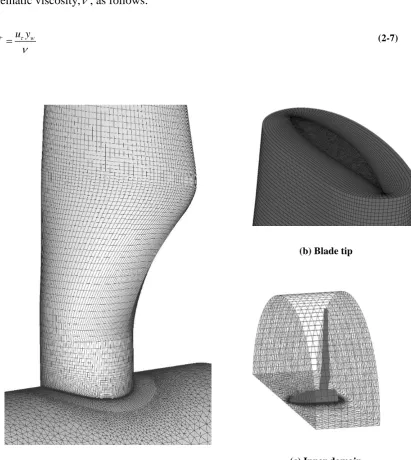
tip and hub surfaces, an unstructured mesh was produced, see Fig. 2.1. The total number of
grids, including hexahedral, tetrahedral and prismatic elements, was approximately 8 million
for the whole turbine model. The number of prismatic inflation layers and the growth rate over
the blade covering the boundary layers varied depending on the required Y+. The average Y+
16
for presenting Y+ in this Chapter. Y+ is the non-dimensional wall distance which determines
the level of grid refinement. It is defined by the wall friction velocity,u , and fluid kinematic viscosity, , as follows:
w
u y
Y
(2-7)
(a) Blade root and hub
(b) Blade tip
[image:36.595.87.499.129.590.2](c) Inner domain
Fig. 2.1. Hybrid grid generated over the turbine and flow domains for the numerical model
A Y+ in the order of 1 should be considered for the model to accurately capture the turbulent flow over the blade surfaces for the numerical models using a “viscous sub-layer modelling”
approach [33]. This method is also known as “near-wall modelling”. On the other hand, a Y+
less than 300 is recommended when a wall function applies in the turbulence model [64].
17
blades are mostly operating in the transitional flow condition. Hence, the effect of the transition
model was also checked by adding the Gamma-Theta formulation to the k- SST turbulence model. Overall, the influence of turbulence model and boundary layer model were evaluated
by using four different models as follows:
- Fully turbulent k- SST with near wall method, provided by Y+ ~ 1 - Fully turbulent k- SST with wall function, provided by Y+ ~ 30
- Transitional k- SST with near wall method, using Y+ ~ 1 and the Gamma-Theta transition model
- BSL EARSM turbulence model with wall function, provided by Y+ ~ 30
All of the above simulations were performed on a same mesh, where only the grid resolution
close to the wall has changed according to the required Y+, which had insignificant effect on
the total number of grids.
2.4.3. Solver Setup
Ansys CFX R15.0 was utilised to set up the solver. It uses a conservative element-based
finite volume method to solve the RANS model [65]. Fig. 2.2 shows the domains together with
the boundaries of the half turbine model. The condition of the boundaries, domains and
interfaces were detailed in Table 2.1. A normal velocity of 2 m/s with a turbulence intensity of
1% was set at the inlet. A zero relative pressure was considered for both the outlet and the
opening. The surfaces of the blade and the hub were specified as no slip walls. The inner
domain has a general grid interface with the outer domain. A rotational periodicity condition
was applied on the bottom faces of the two domains for half turbine model.
A moving reference frame (MRF) was described using a “frozen rotor” in ANSYS CFX to
simulate the rotation of the turbine in the steady state solution. In the MRF method, the fluid
around the blade in the inner domain was set as a MRF, while the blade and hub were stationary
relative to the inner fluid. Thus, a solution was achieved without moving the grids during the
numerical solution. The induced acceleration of the fluid was added to the momentum equation
as an extra source term. The MRF approach was performed for the transient solution as well to
18
Table 2.1: CFD setup
Boundary Condition
Inlet Outlet Opening
Blade Hub
Uniform flow of 2 m/s normal to inlet Relative Pressure = 0 Pa Relative Pressure = 0 Pa
No Slip Wall No Slip Wall
Domain Condition
Inner Domain Outer Domain
Fluid (Rotating) Fluid (Stationary)
Interface Condition
Bottom Interfaces Domains Interfaces
Rotational Periodicity General Grid Interface (GGI)
Fig. 2.2. Boundary conditions of the domains around the half turbine model
A sliding mesh method was performed to model the rotation of the rotor for the transient
solution of the whole turbine model. The transient rotor stator condition was set for the interface
between the two domains in the ANSYS CFX. The inner domain rotated at each time step for
a certain amount based on the rotational speed set for the rotor. Thus, the boundary cells of the
19
real situation when modelling the flow in rotating cases; but unlike MRF, it is computationally
demanding [66]. The result from the steady solution was set as an initial condition for the
transient rotor stator solution to help with convergence achievement in less computational time.
ANSYS CFX uses a pressure-velocity coupled method proposed by Rhie [67] to discretise
the governing equations. The high resolution scheme was chosen for discretising the advection
term as well as for the turbulent viscosity. In the transient rotor stator solutions, the second
order backward Euler scheme was used for the transient scheme.
In addition to the model scale, the CFD model of the full-scale turbine was generated to
provide a better understanding of the scale effect as well as an estimate of the full-scale
performance.
2.4.4. Solution
Torque and thrust together with power and thrust coefficients were monitored during the
solution iterations and used as criteria for solution convergence. The judgement of solution
convergence was achievement of less than 2% deviation of torque and thrust values over at
least 200 iterations. Given the higher unsteadiness for higher TSRs, for convergence
achievement in the steady condition, a number of iterations from 1500 for TSR ~ 4 to 5000 for
TSR ~ 9 were required.
The efficiency of the CFD models used for performance evaluation of the HAMCTs was
presented in Table 2.2 and Table 2.3, for the steady and transient solutions, respectively. The
tables outline the wall clock time required to achieve simulation convergence at TSR ~ 6. All
of the simulations were done on 32 cores of a high performance computing cluster with 16 GB
RAM. Total time of 3 rotations was enough to achieve convergence for the transient
rotor-stator solution using a time step corresponding to 1 of rotation. The transient time step was
defined as:
2 360
dt
(2-8)
The solution time for the transient sliding mesh, in Table 2.3, was high because of the need
to have a steady MRF result as the initial condition, which leads to a longer computational
time. The transient MRF simulation was run by setting the total time to 20 s and time step to
20
All the simulations were performed in double precision in order to have infinitesimal
round-off error due to the computers precision. The number of cells for the whole turbine model was
6.1 million, which was approximately halved for the half turbine model. The effect of changing
Y+ on the number mesh was insignificant. The residual of the momentum equation in the
streamwise direction for the steady and transient solutions was presented in Table 2.2 and
Table 2.3, respectively. The lower residual represents a lower truncation error, which means
higher accuracy of the converged results.
Table 2.2: Simulation time and momentum residual in steady state solutions at TSR ~ 6
CFD model
Whole turbine Half turbine
SST-wall function (Y+ ~ 30)
SST-near wall (Y+ ~ 1)
SST-transition (Y+ ~ 1)
BSL EARSM (Y+ ~ 30)
SST (Y+ ~ 30)
BSL EARSM (Y+ ~ 30)
Time
(minutes) 724 1052 883 620 380 350
Residual 8.0e-05 2.2e-04 3.0e-04 8.8e-05 8.9e-05 1.0e-04
Table 2.3: Simulation time and momentum residual in transient solutions at TSR ~ 6
CFD model
Sliding Mesh - Whole turbine MRF - SST
SST BSL-EARSM Half turbine Whole turbine
Time
(minutes) 2500 2420 1477 1500
Residual 2.0e-07 1.7e-05 8.9e-08 7.0e-07
2.4.5. Grid Sensitivity
Grid sensitivity was estimated by the grid convergence index (GCI), which is actually a
measure of the discretisation error. For this purpose, three different meshes were generated
over the half turbine model by changing the grid resolution over the blade surfaces and in the
regions closer to the turbine. A factor of grid refinement greater than 1.3 was considered for
generating the meshes. The cell numbers for these three meshes were 2.15 million (coarse),
3.01 million (medium) and 4.36 million (fine). The GCI calculation in this Chapter was
performed based on the method proposed by Slater [68]. The first step to find the GCI was to
define a representative cell size:
21
where N is the total number of cells and ΔⱯi is the volume of the ith cell. Then the grid refinement factor rf = hcoarse/hfine was calculated; e.g. rf21 = h2/h1. A key variable ϕ important to the study objectives, torque in this study, was selected for error calculation. In turn, the
apparent order pe was computed using:
32 21 21
1
ln / ( )
ln( )
e e
p q p
r
(2-10)
21
32
( ) ln
e e p e p rf s q p rf s (2-11)
where 21 21 , 32 3 2 and s is the sign of 32/21. If the relative error of the torque is
1 2
21 1
e
, (2-12)
Finally, GCI is obtained for the fine mesh by
21 21 21 1.25 1 e p e GCI rf (2-13)
Table 2.4 summarises a sample of the GCI calculation performed for the three selected
meshes. It can be seen that the fine-grid convergence index is about 2%. In addition to the GCI
calculation, the grid independency of the CFD solutions was conducted on the MRF steady
technique over the different mesh resolutions. Fig. 2.3 illustrates the grid independency of the
steady solution for torque at TSR ~ 6 by showing the torque difference relative to the torque
value of the USNA results, which means |Q-QUSNA|/QUSNA. It signifies that the results are grid
independent for a cell number higher than 4 million.
2.4.6. Y+ Study
Fig. 2.4 shows the effect of Y+ on the torque values relative to the experimental value.
Changing the Y+ was important in terms of accounting for the viscous effect near the walls.
Both the turbulence models used in this study were embedded with an automatic wall function
in ANSYS CFX R15.0. In the case of using Y+ ~ 1, the near wall method was applied to the
turbulence model. Having a Y+ 20 activated the wall function method in the turbulence model. Although the higher Y+ results in less mesh density and consequently less
22
mesh independency condition was met, comparing the simulations with different Y+ resulted
in an optimal Y+ ~ 30. Later in this Chapter, this conclusion based on the correlation with the
experiments will be discussed further.
Table 2.4: Sample Calculation of Grid Convergence Index for Numerical Models
Parameter Value
N1, N2, N3
h1, h2, h3
ϕ1, ϕ2, ϕ3
rf21, rf32
pe
e21, e32
GCI21, GCI32
4.36, 3.05, 2.15 million
3.2, 4.6, 6.5 x 10⁻⁵
29.1, 28.7, 28.5 Nm
1.43, 1.41
1.74
1.37%, 0.69%
1.98%, 1.04%
![Fig. 1.1. Deployment of AR-1000 at a tidal site [7]](https://thumb-us.123doks.com/thumbv2/123dok_us/8401878.325784/23.595.161.434.205.423/fig-deployment-ar-tidal-site.webp)