Building bridges between dynamic and temporal doxastic logics
Extended Abstract
Johan van Benthem ILLC Amsterdam Stanford University
C´edric D´egremont∗ ILLC Amsterdam
March 20, 2008
Analyzing the behavior of agents in a dynamic environment requires describing the evolution of their knowledge as they receive new information. Moreover agents entertain beliefs that need to be revised after learning new facts. I might be confident that I will find the shop open, but once I found it closed, I should not crash but rather make a decision on the basis of new consistent beliefs. Such beliefs and information may concern ground-level facts, but also beliefs about other agents. I might be a priori confident that the price of my shares will rise, but if I learn that the market is rather pessimistic (say because the shares fell by 10%), this information should change my higher-order beliefs about what other agents believe.
Tools from modal logic have been successfully applied to analyze knowledge dynamics in multi-agent contexts. Among these, Temporal Epistemic Logic [16], [12]’s Interpreted Systems, and Dynamic Epistemic Logic [2] have been particularly fruitful. A recent line of research [8, 7] compares these alternative frameworks, and [7] presents a representation theorem that shows under which conditions a temporal model can be represented as a dynamic one. Thanks to this link, the two languages also become comparable, and one can merge ideas: for example, a new line of research explores the introduction of protocols into PAL (see [7]).
To the best of our knowledge, there are no similar results yet for multi-agent belief revision. One reason is that dynamic logics of belief revision have only been well-understood recently. But right now, there is work on both dynamic doxastic logics [5, 3] and on temporal frameworks for belief revision with [10] as a recent example. The exact connection between these two frameworks is not quite like the case of epistemic update. In this paper we make things clear, by viewing belief revision as priority update over plausibility pre-orders. This correspondence allows for similar language links as in the knowledge case, with similar benefits.
We start in section 1 with some relevant background, while section 2 gives the main new definitions needed in the paper. Section 3 presents the key temporal doxastic properties that we will work with. In section 4 we state and prove our main result linking the temporal and the dynamic frameworks, first for the special case oftotal pre-orders and then in general. We also discuss some variations and extensions. In section 5 we introduce formal languages, providing an axiomatization for our crucial properties, and discussing some related definability issues. We state our conclusions and mention some open problems in the last section. Our key proofs are in the appendix.
∗The second author was supported by a GLoRiClass fellowship of the European Commission (Research Training
1
Introduction: epistemic background results
Epistemic temporal trees and dynamic logics with product update are complementary ways of looking at multi-agent information flow. Representation theorems linking both approaches were proposed for the first time in [4]. A nice presentation of these early results can be found in [14, ch5]. We start with one recent version from [7], referring the reader to [7] for a proof, as well as generalizations and variations.
Definition 1.1 (Epistemic and Event Models, Product Update).
• An epistemic modelM is of the form hW,(∼i)i∈N, Vi where W 6=∅, for eachi∈N, ∼i is a relation onW, and V :P rop→℘(H).
• An event model ǫ = hE,(∼i)i∈N,prei has E 6= ∅, and for each i ∈ N, ∼i is a relation on W. Finally, there is a precondition map pre:E → LEL, where LEL is the usual language of epistemic logic.
• The product updateM ⊗ǫof an epistemic modelM=hW,(∼′
i)i∈N, Vi with an event model ǫis the model hE,(∼i)i∈N,prei, whose worlds are pairs (w, e) with the world wsatisfying the precondition of the event e, and accessibilities defined as:
(w, e)∼′i (w ′, e′
) iff e∼ie′, w∼i w′
Intuitively epistemic models describe what agents currently know while the product update describe the new multi-agent epistemic situation after some epistemic event has taken place. Nice intuitive examples are in [1]. Next we turn to the epistemic temporal models introduced by [16]. In what follows, Σ∗ is the set of finite sequences on any set Σ.
Definition 1.2 (Epistemic Temporal Models). An epistemic temporal model (ET L model for
short) His of the form hΣ, H,(∼i)i∈N, Vi whereΣis a finite set of events,H⊆Σ∗ andHis closed under non-empty prefixes. For each i∈N, ∼i is a relation on H, andV :P rop→℘H.
The crucial epistemic temporal properties driving [7]’s main theorem are:
Definition 1.3. Let H=hΣ, H,(∼i)i∈N, Vi be an ET L model. H satisfies: Let ∼∗ be the reflexive transitive closure of the relation S
i∈N ∼i:
• Local Bisimulation Invarianceif, wheneverh∼∗ h′ andh andh′ are epistemically
bisim-ilar1, we haveh′e∈H iff he∈H.
• Perfect Recall if, whenever ha∼ih′b, we also have h∼ih′ .
• Local No Miracles if, wheneverga ∼g′b and g∼∗ h ∼h′, then for every h′a, hb∈H, we
also have h′a∼hb.
These properties describe the idealized epistemic agents needed in: 1
Theorem 1.4(van Benthem et al. [7]). Let Hbe an ET L model,M an epistemic model, and the ‘protocol’ P a set of finite sequences of pointed events models closed under prefixes. We write ⊗
for productupdate. LetF orest(M, P) =S~ǫ∈P M⊗~ǫbe the ‘epistemic forest generated by’Mand sequential application of the events in P. 2
The following are equivalent: 1. H is isomorphic to F orest(M, P).
2. Hsatisfies propositional stability, synchronicity, local bisimulation invariance, Perfect Recall, and Local No Miracles.
Thus, epistemic temporal conditions characterize just those trees that arise from performing iterated product update governed by some protocol. [7] and [14, ch5] have details. Our paper extends this analysis to the richer case of belief revision, where plausibility orders of agents evolve as they observe possibly surprising events. We prove two main results:
Theorem. Let H be a doxastic temporal model, M a plausibility model, ~ǫ a sequence of event
models, and ⊗ priorityupdate. The following are equivalent (details will follow later): 1. H is isomorphic to the forest generated by M ⊗~ǫ
2. Hsatisfies propositional stability, synchronicity, invariance for bisimulation, as well as prin-ciples of Preference Propagation, Preference Revelation and Accommodation.
Theorem. Preference Propagation, Preference Revelation and Accommodation are definable in an
extended doxastic modal language.
2
Definitions
We now turn to the definitions needed for the simplest version of our main representation theorem, postponing matching formal languages to Section 5. Let N ={1, . . . , n} be a finite set of agents.
2.1 Plausibility models, event models and priority update
We first introduce static models that encode the current prior (conditional) beliefs of agents. These carry a pre-order≤between worlds encoding a plausibility relation. Often this relation is taken to be total, but when we think of elicited beliefs as multi-criteria decisions, a pre-order allowing for incomparable situations may be all we get [11]. We will therefore assume reflexivity and transitivity, but not totality. We writea≃b(‘indifference’) if a≤b and b≤a, and a < b ifa≤b and b6≤a.
Definition 2.1(Doxastic Plausibility Models). Adoxastic plausibility modelM=hW,(i)i∈N, Vi
has W 6=∅, for each i∈N, i is a pre-order on W, andV :P rop→℘H. We now consider how such models evolve as agents observe events.
Definition 2.2 (Plausibility Event Model). A plausibility event model (event model, for short)ǫ
is a tuple hE,(i)i∈N,prei with E6=∅, eachi a pre-order on E, and pre:E → L, where L is a doxastic language. 3
2
For a more precise definition of this notion, see Section 2 below. 3
Definition 2.3 (Priority Update; [3]). The priority updateof plausibility model M=hW, (i)i∈N, Vi and event model ǫ=hE,(i)i∈N,prei is the plausibility model M ⊗ǫ:
• W′={(w, e)∈W ×E | M, w
pre(e)} • (w, e)′
i (w
′, e′) iff eithere≺
ie′, or e≃ie′ and wiw′
• V′((s, e)) =V(s)
The idea behind priority update is that beliefs about the last event override prior beliefs. If the agent is indifferent, the old plausibility order applies. More motivation can be found in [3, 6].
2.2 Doxastic Temporal Models
Definition 2.4 (Doxastic Temporal Models). A doxastic temporal model (DoT L model for short)
H is of the form hΣ, H,(≤i)i∈N, Vi, where Σ is a finite set of events, H ⊆ Σ∗ is closed under non-empty prefixes, for each i∈N, ≤i is a pre-order on H, and V :P rop→℘H.
Our task is to identify just when a doxastic temporal model is isomorphic to the ‘forest’ gener-ated by a sequence of priority updates:
2.3 Dynamic Models Generate Doxastic Temporal Models
Definition 2.5 (DoT Lmodel generated by a sequence of updates). Each initial plausibility model
M = hW,(i)i∈N, Vi and sequence of event models ǫj = hEj,(ji)i∈N,preji yields a generated DoT Lplausibility model hΣ, H,(≤i)i∈N,Vi as follows:
• Let Σ :=Smi=1ei.
• Let H1:=W and for any1< n≤m let Hn+1 :={(we1. . . en)|(we1. . . en−1)∈Hn andM ⊗ ǫ1⊗. . .⊗ǫn−1 pren(en)}. Finally let H=
S
1≤k≤mHk.
• If h, h′ ∈H1, then h≤
i h′ iff hMi h′.
• For1< k≤m, he≤ih′e′ iff 1. he, h′e′ ∈Hk, and 2. either e≺kie′, or e≃ike′ and h≤i h′.
• Let wh∈V(p) iff w∈V(p).
Now come the key doxastic temporal properties of our idealized agents.
3
Crucial Frame Properties for Priority Updaters
3.1 Bisimulation Invariance
Definition 3.1(≤-Bisimulation). LetHandH′be twoDoT Lplausibility modelshH,(≤
1, . . . ,≤n), ViandhH′,(≤′
1, . . . ,≤ ′
n), V′i. A relationZ ⊆H×H′is a≤-Bisimulation if, for allh∈H,h′∈H′, and all ≤i in (≤1, . . . ,≤n),
(prop) h and h′ satisfy the same proposition letters, (zig) If hZh′ and h≤
ij, then there exists j′∈H′ such that jZj′ and h′ ≤′i j′, (zag) If hZh′ and h′ ≤′
i j′, then there exists j∈H such that jZj′ and h≤ij. If Z is a ≤n-bisimulation and hZh′, we call h and h′ are ≤-bisimilar.
Definition 3.2(≤-Bisimulation Invariance). ADoT LmodelHsatisfies ≤-bisimulation invariance
if, for all≤-bisimilar histories h, h′ ∈H, and all events e, h′e∈H iff he∈H.
3.2 Agent-Oriented Frame Properties
In the following we drop agent labels and the “for each i∈N” for the sake of clarity. Also, when we writehawe will always assume that ha∈H. We will make heavy use of the following notion:
Definition 3.3 (Accommodating Events). Two events a, b ∈ Σ are accommodating if, for all
ga, g′b, (g≤g′ ↔ga≤g′b) and similarly for ≥, i.e., a, bpreserve and anti-preserve plausibility.
Definition 3.4. Let H=hΣ, H,(≤i)i∈N, Vi be a DoT L model. H satisfies:
• Propositional stabilityif, wheneverh is a finite prefix ofh′, thenhandh′ satisfy the same
proposition letters.
• Synchronicity if, whenever h ≤h′, we have len(h) =len(h′).
The following three properties trace the belief revising behavior of agents in doxastic trees.
• Preference Propagation if, whenever ja≤j′b, then h≤h′ implies ha≤h′b.
• Preference Revelation if, whenever jb≤j′a, then ha≤h′b impliesh ≤h′.
• Accommodation if, a and bare accommodating whenever both ja≤j′b andha6≤h′b.
These properties are somewhat trickier than in the epistemic case, reflecting the peculiarities of priority update in settings where incomparability is allowed. But we do have:
Fact 3.5. If ≤is a total pre-order andH satisfies Preference Propagation and Preference
Revela-tion, then H satisfies Accommodation.
We can also prove a partial converse without assuming totality:
Fact 3.6. If H satisfies Accommodation, it satisfies Preference Propagation.
4
The Main Representation Theorem
We start with a warm-up case, with plausibility a total pre-order.
4.1 Total pre-orders
Theorem 4.1. Let Hbe a total doxastic-temporal model,Ma total plausibility model,~ǫa sequence
of total event models, and let ⊗ stand for priorityupdate. The following are equivalent:
• H is isomorphic to the forest generated by M ⊗~ǫ.
• H satisfies propositional stability, synchronicity, bisimulation invariance, Preference Propa-gation, and Preference Revelation.
4.2 The general case: pre-orders allowing incomparability
While the argument went smoothly for total pre-orders, it gets somewhat more interesting when incomparability enters the stage. In the case of pre-orders we need the additional axiom of Accom-modation as stated below:
Theorem 4.2. Let H be a doxastic-temporal model, M a plausibility model, ~ǫ be a sequence of
event models while ⊗ is priorityupdate. The following assertions are equivalent:
• H is isomorphic to the forest generated by M ⊗~ǫ,
• H satisfies bisimulation invariance, propositional stability, synchronicity, Preference Revela-tion and AccommodaRevela-tion.
By Fact 3.6, Accommodation also gives us Preference Propagation.
Given a doxastic temporal model describing the evolution of the beliefs of a group of agents, we have determined whether it could have been generated by successive ‘local’ priority updates of a plausibility model. Of course, further scenarios are possible, e.g., bringing in knowledge as well.
4.3 Extensions and variations of the theorem
4.3.1 Unified plausibility models
Theorem 4.3. Let H be a unified doxastic-temporal model, M a unified plausibility model,~ǫ be a sequence of unified event models, while⊗is priorityupdate. The following assertions are equivalent:
• H is isomorphic to the forest generated by M ⊗~ǫ,
• H satisfies bisimulation invariance, propositional stability, synchronicity, -Perfect Recall,
-Preference Propagation, -Preference Revelation and-Accommodation.
4.3.2 Variations: languages and protocols
One issue left open so far may have bothered some readers. Our definition of event models pre-supposed a language for the preconditions, and correspondingly, the right notion of bisimulation in our representation results should match the precondition language used. This issue is discussed in the extended version of the paper. Also, so far, the same sequences of events were executable uniformly anywhere in the initial doxastic model, provided the worlds fulfilled the preconditions. This strong assumption might be lifted (cf. [7]) and leads to interesting variations.
5
Dynamic and Temporal Doxastic Languages
To conclude, we turn from structural properties of models to logical logical languages that can express these, and thus the type of doxastic reasoning our agents can be involved with.
5.1 Dynamic doxastic language
We first look at a core language that matches dynamic belief update.
Definition 5.1 (Dynamic Doxastic-Epistemic language). The language of dynamic doxastic
lan-guage DDEL is defined as follows:
φ:=p | ¬φ| φ ∨ φ | h≤iiφ| hiiφ |Eφ| hǫ,eiφ
where i ranges over over N, p over a countable set of proposition letters P rop, and (ǫ,e) ranges over a suitable set of symbols for event models.
Definition 5.2 (Epistemic Plausibility Models). Epistemic Plausibility Models are the obvious
combination of epistemic models (of section 1) and plausibility models (of section 2), while the priority update of an epistemic plausibility model is as expected, i.e. the crucial clauses are:
Definition 5.3 (Priority update).
• (w, e)′ i (w
′, e′) iff e≺
ie′, or e≃ie′ and wi w′
• (w, e)∼′
i (w′, e′) iff e∼i e′ andw∼iw′
Definition 5.4 (Truth definition). Let Ki[w] ={v |w∼i v}. Booleans cases are expected.
M, wh≤iiφ iff ∃v such that wi v and M, vφ
M, whiiφ iff ∃v such that v∈Ki[w] andM, vφ
M, wEφ iff ∃v ∈W such thatM, vφ
M, whǫ, eiφ iff M, wpre(e) and M ×ǫ,(w, e)φ Knowledge Ki and the universal modality Aare defined as usual.
Reduction axioms. The methodology of dynamic epistemic and dynamic doxastic logics revolves
around reduction axioms. On top of some complete static base logic, these fully describe the dynamic component. Here is well-known Action−Knowledge reduction axiom of [2]:
[ǫ,e]Kiφ↔(pre(e) →
^
{Ki[ǫ,f]φ : e∼i f}) (1) Similarly here are the key reduction axioms forhǫ,eih≤ii with priority update:
Proposition 5.5. The following dynamic-doxastic principle is sound for plausibility change:
hǫ,eih≤iiφ↔(pre(e) ∧ (h≤ii
_
{hfiφ : e≃if} ∨ E
_
{hgiφ : e <ig})) (2)
The crucial feature of such a dynamic ‘recursion step’ is that the order betweenactionandbelief is reversed. This works because, conceptually, the current beliefs alreadypre-encodethe beliefs after some specified event. In the epistemic setting, principles like this reflect agent properties of Perfect Recall and No Miracles [8]. Here, they rather encode radically ‘event-oriented’ revision policies, and the same point applies to the principles we will find later in a doxastic temporal setting.
Proposition 5.6. The following axiom is valid for the existential modality:
hǫ,eiEφ↔(pre(e) ∧ (E_{hfiφ : f ∈Dom(ǫ)})) (3) We do not pursue completeness, since we are just after the model theory.
5.2 Doxastic epistemic temporal language
Our epistemic-doxastic temporal models are simply our old doxastic temporal modelsH extended with epistemic accessibility relations ∼i. Our main language is as follows:
Definition 5.7 (Doxastic Epistemic Temporal Language). Here is theDETL syntax:
φ:=p | ¬φ| φ ∨ φ | heiφ | he−1iφ| h≤iiφ | hiiφ | Eφ where i ranges over N, eover Σ, and p over proposition letters P rop.
The language DETL is interpreted over nodes hin our trees (cf. [8]):
Definition 5.8 (Truth definition). Let Ki[h] ={h′ |h∼i h′}. Booleans cases are expected.
H, hheiφ iff ∃h ′∈H such thath′=he and H, h′φ
H, hhe−1iφ iff ∃h ′∈H such thath′e=h and H, h′φ
H, hh≤iiφ iff ∃h ′ such thath≤i h′ and H, h′ φ
H, hhiiφ iff ∃h ′ such thath′ ∈Ki[h] and H, h′ φ
5.3 Defining the frame conditions
We will prove semantic correspondence results (cf. [9]) for our crucial properties, using somewhat technical axioms that simplify the argument. Afterwards, we discuss their intuitive meaning.
5.3.1 The key correspondence result
Theorem 5.9(Definability). Preference Propagation, Preference Revelation and Accommodation
are definable in the doxastic-epistemic temporal language DETL.
• H satisfies Preference Propagation iff the following axiom is valid:
Ehaih≤iihb−1i⊤ → ((h≤iihbip ∧ haiq) → hai(q ∧ h≤iip) (P P)
• H satisfies Preference Revelation iff the following axiom is valid:
Ehbih≤iiha−1i⊤ → (haih≤ii(p ∧ hb−1i⊤) → h≤iihbip) (P R)
• H satisfies Accommodation iff the following axiom is valid:
Ehaih≤iihb−1i⊤
∧ E[hai (p1 ∧ E (p2 ∧ hb−1i⊤) ) ∧ [a] (p1 → [≤i]¬p2)]
→ ( (h≤iihbiq → [a]h≤iiq)
∧ (haih≤ii(r ∧ hb−1i⊤) → h≤iihbir)
(AC)
The preceding correspondence arguments are Sahlqvist substitution cases (cf. [9]). We do not prove completeness, but here is a nice syntactic counterpart (Fact 5.11) to our earlier Fact 3.5:
Fact 5.10. On total doxastic temporal models the following axiom is valid:
hai(ψ ∧ E(φ ∧ hb−1i⊤)) → ( hai(ψ ∧ h≤iiφ) ∨ Ehbi(φ ∧ h≤ii(ψ ∧ ha−1i⊤)) (T ot)
Fact 5.11.
⊢((P P) ∧ (P R) ∧ (T ot)) → (AC) (4)
5.3.2 Two intuitive explanations
Reformulation with safe belief. An intermediate notion of knowledge first considered by [17]
has been argued for doxastically as safe belief by [3] as describing those beliefs we do not give up under true new information. The safe belief modality 2≥ is just the universal dual ofh≥i. Here is an example of how we can rephrase our earlier axioms:
• H satisfies Preference Propagation iff the following axiom is valid on H:
Ehaih≥ihb−1i⊤ → (hai2≥ip → 2≥i[b]p) (P P’)
Analogies with reduction axioms Another way to understand the above axioms with existen-tial modalities is their clear analogy with the reduction axiom for priority update.
hǫ,eih≤iip↔(pre(e) ∧ (h≤ii
_
{hfip : e≃if} ∨ E
_
{hgip : e <ig})) (2)
Ehaih≤iihb−1i⊤ → (h≤iihbip → [a]h≤iip) (P P)
Ehbih≤iiha−1i⊤ → (haih≤ii(p ∧ hb−1i⊤) → h≤iihbip) (P R)
The family resemblance is obvious, and indeed, P P andP Rmay be viewed as the two halves of the reduction axiom, transposed to the more general setting of arbitrary doxastic-temporal models.
5.4 Variations and extensions of the language
The above doxastic-temporal language is by no means the only reasonable one. Weaker forward-looking modal fragments also make sense, dropping both converse and the existential modality. But they do not suffice for the purpose of our correspondence.
Proposition 5.12(Undefinability). Preference propagation, Preference Revelation andAccommodation
are notdefinable in the forward looking fragment of DETL
Richer doxastic temporal languages are studied in the extended version of the paper: including common belief, mixtures of knowledge and beliefs, and unrestricted past and future operators.
6
Conclusion
Agents that update their knowledge and revise their beliefs can behave very differently over time. We have determined the special constraints that capture agents operating with the ‘local updates’ of dynamic doxastic logic. This took the form of some representation theorems that state just when a general doxastic temporal model is equivalent to the forest model generated by successive priority updates of an initial doxastic model by a protocol sequence of event models. We have also shown how these conditions can be defined in an appropriate extended modal language, making it possible to reason formally about agents engaged in such updates and revisions. Our methods are like those of existing epistemic work, but the doxastic case came with some interesting new notions.
But from where we are standing now, we see several larger directions to pursue:
• A systematic analysis of axiomatic completeness for constrained revision processes, analogous to the purely epistemic theory of observation and conversation protocols initiated in [7],
• A comparison of our ‘constructive’ DDL-inspired approach toDT L universes with the more abstract AGM-style postulational approach of [10],
• A theory of variation for agents with different abilities and tendencies (cf. [14]),
References
[1] A. Baltag and L.S. Moss. Logics for Epistemic Programs. Synthese, 139(2):165–224, 2004. [2] A. Baltag, L.S. Moss, and S. Solecki. The logic of public announcements, common knowledge,
and private suspicions. InTARK ’98: Theoretical aspects of rationality and knowledge, pages 43–56. Morgan Kaufmann Publishers Inc., 1998.
[3] A. Baltag and S. Smets. Dynamic belief revision over multi-agent plausibility models. In G. Bonanno, W. van der Hoek, and M. Wooldridge, editors, Logic and the Foundations of Game and Decision Theory: Proceedings of LOFT’06, Texts in Logic and Games, pages 11– 24. Amsterdam University Press, 2006.
[4] J. van Benthem. Games in Dynamic Epistemic Logic. Bul. Econ. Res., 53(4):219–248, 2001. [5] J. van Benthem. Dynamic logics for belief change. JANCL, 17(2):129–155, 2007.
[6] J. van Benthem. Priority product update as social choice. ILLC PP Series, PP-2008-09, 2008. [7] J. van Benthem, J. Gerbrandy, and E. Pacuit. Merging frameworks for interaction: DEL and ETL. In Dov Samet, editor,Theoretical Aspects of Rationality and Knowledge (TARK 2007), 2007.
[8] J. van Benthem and E. Pacuit. The Tree of Knowledge in Action: Towards a Common Perspective. In I. Hodkinson G. Governatori and Y. Venema, editors, Advances in Modal Logic, volume 6. College Publications, 2006.
[9] P. Blackburn, M. de Rijke, and Y. Venema. Modal Logic. CUP, 2001.
[10] G. Bonanno. Belief revision in a temporal framework. In G. Bonanno, W. van der Hoek, and M. Wooldridge, editors,Logic and the Foundations of Game and Decision Theory: Proceedings of LOFT’06, Texts in Logic and Games, pages 43–50. Amsterdam University Press, 2006. [11] K. Eliaz and E.A. Ok. Indifference or indecisiveness? Choice-theoretic foundations of
incom-plete preferences. Games and Economic Behavior, 56(1):61–86, July 2006.
[12] R. Fagin, J.Y. Halpern, Y. Moses, and M.Y. Vardi. Reasoning About Knowledge. MIT Press, Cambridge, 1995.
[13] K. Kelly. Ockham’s razor, truth, and information. In J. van Behthem and P. Adriaans, editors, Handbook of the Philosophy of Information. 2008.
[14] F. Liu. Changing for the Better. Phd dissertation, ILLC Amsterdam, 2008.
[15] S. Morris. The common prior assumption in economic theory.Econ. & Phil., 11:227–253, 1995. [16] R. Parikh and R. Ramanujam. A knowledge based semantics of messages. JoLLI, 12(4):453–
467, 2003.
7
Appendix
Theorem. Let H be a total doxastic-temporal model, Ma total plausibility model,~ǫa sequence of
total event models, and let ⊗ stand for priority update. The following are equivalent:
• H is isomorphic to the forest generated by M ⊗~ǫ.
• H satisfies propositional stability, synchronicity, bisimulation invariance, Preference Propa-gation, and Preference Revelation.
Proof. Necessity. We first show that the given conditions are indeed satisfied by anyDoT Lmodel generated through successive priority updates along some given protocol sequence. Here, Proposi-tional stability and Synchronicity are straightforward from the definition of generated forests.
Preference Propagation Assume thatja≤j′b (1). It follows from (1) plus the definition of
priority update that a≤b (2). Now assume thath ≤h′ (3). It follows from (2), (3) and priority update that ha≤h′b.
Preference Revelation Assume that jb≤ j′a (1). It follows from (1) and the definition of
priority update that b ≤ a (2). Now assume ha ≤ h′b (3). By the definition of priority update, (3) can happen in two ways. Case 1: a < b (4). It follows from (4) by the definition of < that b6≤a(5). But (5) contradicts (2). We are therefore in Case 2: a≃b (6) andh≤h′ (7). But (7) is precisely what we wanted to show.
Note that we did not make use of totality here.
Sufficiency Given a DoT L model M, we first show how to construct a DDL model, i.e., a
plausibility model and a sequence of event models.
Construction Here is the initial plausibility modelM=hW,(i)i∈N,Vˆi:
• W :={h∈H |len(h) = 1}.
• Sethih′ iff≤i.
• For every p∈P rop, ˆV(p) =V(p)∩W.
Now we construct the j-th event model ǫj=hEj,(ji)i∈N,preji:
• Ej :={e∈Σ|there is a historyhe∈H withlen(h) =j}
• For eachi∈N, setajibiff there areha, h′b∈Hsuch thatlen(h) =len(h) =jandha≤i h′b.
• For eache∈Ej, letprej(e) be the formula that characterizes the set{h|he∈H and len(h) = j}. By general modal logic,bisimulation invariance guarantees that there is such a formula, though it may be an infinitary one in general.
Now we show that the construction is correct in the following sense:
Claim 7.1 (Correctness). Let ≤ be the plausibility relation in the given doxastic temporal model.
Let4FDDL be the plausibility relation in the forest induced by priority update over the just constructed plausibility model and matching sequence of event models. We have:
Proof of the claim The proof is by induction on the length of histories. The base case is obvious from the construction of our intitial model M. Now for the induction step. To simplify notation we will write a ≤ b tfor an
ib with n the length for which the claim has been proved, and i an agent.
From DoT L to F orest(DDL) Assume that h1a ≤ h2b (1). It follows that in the constructed event model a≤b (2). Case 1: a < b. By priority update we have h1a4FDDL h2b. Case 2: b≤a (3). This means that there are h3b, h4a such that h3b≤ h4a. But then by Preference Revelation and (1) we have h1 ≤h2 (in the doxastic temporal model). It follows by the inductive hypothesis that h1 4FDDL h2. But then by priority update, since by (2) and (3) a and b are indifferent, we have h1a4FDDL h2b.
FromF orest(DDL)toDoT L Next leth1a4FDDL h2b. The definition of priority update has two clauses. Case 1: a < b. By definition, this implies that b6≤a. But then by the above construction, for all histories h3, h4 ∈ H we have h3b 6≤ h4a. In particular we have h2b 6≤ h1a. But then by totality4,h
1a≤h2b. Case 2: a≃b (4) and h1 4FDDL h2. For a start, by the inductive hypothesis, h1 ≤ h2 (5). By (4) and our construction, there are h3a, h4b with h3a ≤ h4b (6). But then by Preference Propagation, (5) and (6) imply that we haveh1a≤h2b.
Theorem. Let H be a doxastic-temporal model, M a plausibility model, ~ǫ be a sequence of event
models while ⊗ is priorityupdate. The following assertions are equivalent:
• H is isomorphic to the forest generated by M ⊗~ǫ,
• H satisfies bisimulation invariance, propositional stability, synchronicity, Preference Revela-tion and AccommodaRevela-tion.
By Fact 3.6, Accommodation also gives us Preference Propagation.
Proof. Necessity of the conditions
The verification of the conditions in the preceding subsection did not use totality. So we concentrate on the new condition:
Accommodation Assume thatja ≤j′b (1). It follows by the definition of priority update that
a ≤b (2). Now let ha 6≤ h′b (3). This implies by priority update that a 6< b (4). By definition, (2) and (4) means thata≃b(5). Now assume that g≤g′ (6). It follows from (5), (6) and priority update that ga≤g′b. For the other direction of the consequent assume instead that g6≤g′ (7). It follows from (5), (7) and priority update thatga6≤g′b.
Sufficiency of the conditions Given a DoT L model, we again construct a DDL plausibility
model plus sequence of event models: 4
Construction The plausibility model M=hW,(i)i∈N,Vˆiis as follows:
• W :={h∈H |len(h) = 1},
• Sethih′ whenever≤i,
• For every p∈P rop, ˆV(p) =V(p)∩W.
We construct the j-th event model ǫj =hEj,(ji)i∈N,prejias follows:
• Ej :={e∈Σ|there is a history of the form he∈H withlen(h) =j}
• For each i∈N,ajib iff either (a) there are ha, h′b∈H such that len(h) = len(h) =j and ha≤i h′b, or (b) [a new case] aand b are accommodating, and we put a≃b (i.e. a≤b and b≤a).
• For eache∈Ej, letprej(e) be the formula that characterizes the set{h|he∈H and len(h) = j}. Bisimulation invariance guarantees that there is always such a formula (maybe involving an infinitary syntax).
Again we show that the construction is correct in the following sense:
Claim 7.2 (Correctness). Let ≤ be the plausibility relation in the doxastic temporal model. Let
4FDDL be the plausibility relation in the forest induced by successive priority updates of the plausi-bility model by the sequence of event models we constructed. We have:
h≤h′ iff h4FDDLh′.
Proof of the claim We proceed by induction on the length of histories. The base case is clear
from our construction of the initial modelM.
Now for the induction step, with the same simplified notation as earlier.
From DoT L to F orest(DEL) We distinguish two cases.
Case 1. ha≤h′b, h≤h′. By the inductive hypothesis, h≤h′ implies h4FDDL h′ (1). Since
ha ≤ h′b, it follows by construction that a ≤ b (2). It follows from (1) and (2) that by priority updateha4FDDL h′b.
Case 2. ha ≤ h′b, h 6≤ h′. Clearly, then, a and b are not accommodating and thus the
special clause has not been used to build the event model, though we do have a ≤b (1). By the contrapositive of Preference Revelation, we also conclude that for allja, j′b∈H, we have j′b6≤ja (2). Therefore, our construction gives b 6≤ a (3), and we conclude that a < b (4). But then by priority update, we get ha4FDDLh′b.
Case 1. ha4FDDLh′b, h4FDDLh′. By definition of priority update,ha4FDDL h′bimplies that a ≤ b (1). There are two possibilities. Case 1: The special clause of the construction has been used, anda,bare accommodating (2). By the inductive hypothesis,h4DDLF h′ impliesh≤h′ (3). But (2) and (3) imply thatha≤h′b. Case 2: Clause (1) holds because for someja, j′b∈H, in the DoT L model, ja ≤ j′b (4). By the inductive hypothesis, h 4FDDL h′ implies h ≤ h′ (5). Now, it follows from (4), (5) and Preference Propagation that ha≤h′b.
Case 2. ha 4FDDL h′b, h 64FDDL h′. Here is where we put our new accommodation clause
to work. Let us label our assertions: h 64FDDL h′ (1) and ha 4FDDL h′b (2). It follows from (1) and (2) by the definition of priority update that a < b (3), and hence, by definition b 6≤ a (4). Clearly, a and b are not accommodating (5): for otherwise, we would have had a≃b, and hence b≤a, contradicting (4). Therefore, (3) implies that there areja, j′b∈H withja ≤j′b(6). Now assume for contradictio that (in the DoT L model) ha 6≤ h′b (7). It follows from (6) and (7) by Accommodation thataand b are accommodating, contradicting (5). Thus we have ha≤h′b.
Theorem(Definability). Preference Propagation, Preference Revelation and Accommodation are
definable in the doxastic-epistemic temporal language DETL.
Proof. We only prove the case of Preference Propagation, the other two are in the extended version of the paper. We drop agent labels for convenience.
(P P) characterizes Preference Propagation We first show that (P P) is valid on all models
H based on preference-propagating frames. Assume that H, h Ehaih≤iihb−1i⊤ (1). Then there are ja, j′b ∈ H such that ja ≤ j′b (2). Now let H, h (h≤ihbip ∧ haiq) (3). Then there is h′ ∈H such that h ≤ h′ (4) and H, h′ hbip (5), while also H, ha q (6). We must show that
H, hhai(q ∧ h≤iip) (7). But, from (2),(4),(6) and Preference Propagation, we getha≤h′b, and the conclusion follows by the truth definition.
Next, we assume that axiom (P P) is valid on a doxastic temporal frame, that is, true under any interpretation of its proposition letters. So, assume that ja ≤ j′b (1), and also h ≤ h′ (2). Moreover, let ha, h′b ∈ H (3). First note that (1) automatically verifies the antecedent of (P P) in any node of the tree. Next, we make the antecedent of the second implication in (P P) true at h by interpreting the proposition letter p as just the singleton set of nodes h′b, andq as just ha (4). Since (P P) is valid, its consequent will also hold under this particular valuation V. Explicitly we have H, V, h hai(q ∧ h≤iip. But spelling out what p, q mean there, we get just the desired conclusion that ha≤h′b.
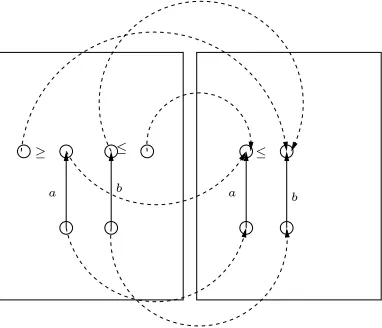
Proposition(Undefinability). Preference Propagation, Preference Revelation and Accommodation
are notdefinable in the forward looking fragment of DETL
b
≥ ≤ ≤
[image:16.595.211.402.282.446.2]a a b