Effector
Domains of Human
Immunodeficiency
Virus Type 1 Rev
and
Human T-Cell
Leukemia
Virus Type I Rex Are
Functionally
Interchangeable and
Share an
Essential Peptide
Motif
THOMAS J. HOPE, BARBARA
L.BOND,
DAVID McDONALD, NICOLA P. KLEIN, ANDTRISTRAM G. PARSLOW*
Departments
of Pathology and of Microbiology and Immunology, University of California,
San
Francisco,California 94143-0506
Received 31 May 1991/Accepted 25 July 1991
The
human
immunodeficiency virus type 1 Rev and human T-cell leukemia virus type I Rex transactivators
areposttranscriptional regulatory proteins that promote retroviral gene expression by interacting with specific
viral
mRNAs. Rev and Rex have markedly
dissimilar amino acid sequences and RNA target specificities but are
thought to act through the same cellular pathway. In this report, we demonstrate
that short peptidedomains
which are required for
effector activity in Rev and Rex are functionally interchangeable. Activity of these
effector domains depends upon a
previously
unrecognized tetrapeptide motif that is present in
both Revand
Rex and also in
analogous proteins from other complex
retroviruses. The conserved effector motif may mediate
essential
interactions of Rev, Rex, and other
transactivators of this type with a common cellular cofactor.
The human
immunodeficiency viruses (HIV) and human
T-cell leukemia viruses (HTLV) are evolutionarily distinct
retroviral
families that differ in genomic organization,
pri-mary
sequence, and
pathogenic effects (29). Like other
complex
retroviruses (3), each encodes a posttranscriptional
regulatory
protein (designated Rev in HIV and Rex in
HTLV) that transactivates viral replication by inducing the
export
of incompletely spliced
viral mRNAs from the
nu-cleus to the
cytoplasm (reviewed
in references 2 through 4
and
8). Rev and Rex are comparable in many respects: both
arenuclear
proteins
that
associate preferentially
with
nucle-oli,
and each acts
by
binding directly
to
its target transcripts
ataspecific, highly structured
cis-acting element known
asthe Rev response
element (RRE) or Rex response element
(XRE),
respectively
(2, 4,
5, 7, 8,
15, 20, 27, 30). Indeed,
Rex canfunctionally replace
Rev
under
certain conditions
(1,
9,
19, 24),
suggesting
that
both proteins may act through a
commonpathway.
Yet
there is little apparent sequence
similarity
between these
twoproteins
that
could
accountfor
their similar effects.
To
search
for
peptide domains within
Rev
and Rex that
serverelated
functions,
wehave
con-structed
and
characterized
aseries of
fusion
proteins
con-taining
sequences
from
both
transactivators.
In
this report,
wedemonstrate that
short effector
domains
which
mediate
the
regulatory activities
of Rev and Rex
arefunctionally
interchangeable
and
weidentify
atetrapeptide
present
in
both
domains
that may be
a coreeffector motif
for
transac-tivators of this type.
MATERIALS
ANDMETHODS
Plasmid
constructions.
All
transactivator
expression
vec-tors(Fig.
1A)
werederivatives of
pRSV-Rev (10);
fusions
and
oligonucleotide-directed
mutations
wereverified
by
DNA sequence
analysis.
To
construct Rexand Rev/Rex
vectors,
revcodon 116 in
pRSV-Rev
wasmutated
to aBglII
site
(Asp
replaces Glu),
and
aRexcDNA with
appropriate
flanking
restriction sites
waseither
inserted in
place
of the
*
Corresponding
author.rev
sequence
(SacI-BglII)
or
fused to the 3' end of rev in
frame
(BglII-Bglll).
In
all
fusions, Leu replaces Met at rex
codon
1.The
RRE-containing reporter plasmid pDM128 has
been
described (10);
toprepare
the XRE reporter,
a1.2-kb
StuI-BsmI fragment
(HIV-1
nucleotides 6852
to8066)
con-taining
the RRE
wasexcised from pDM128 and
replaced
by
a
ClaI linker,
and
a271-bp
ClaI
fragment bearing the XRE
was
inserted
at
this site
(Fig. 1B). This XRE fragment had
been
prepared from cloned
HTLV-I
by polymerase chain
reaction with primers
5'-CGCGGATCCATCGATATAAAC
TAGCAGGAGTCTAT-3' and
5'-CGCGGATCCATCGATC
TCGAGAGTTGAGCAAGCAGGGTC-3',
which
wasfol-lowed by
ClaI
digestion.
Transfection
andexpression assays.
Transfections,
chlor-amphenicol acetyltransferase (CAT)
assays,
and
immuno-blots
wereperformed
aspreviously
described
(10,
11). Each
CAT assay
wasnormalized
tothe
expression
of
acotrans-fected
internal control
plasmid (10,
11), and all results shown
were
confirmed
in three or more separate tests
of each
construct.Rev
sequences
weredetected in
immunoblots
aspreviously
described
(11)
by
using
acombination of
twoantipeptide
sera(kindly
provided by
B.
R.Cullen,
Duke
University)
specific
for the
N-terminal half of
Rev.Unfused
Rex
proteins
weredetected with
anantipeptide
serum(kind-ly
provided by
W.C.
Greene,
Duke
University)
against
the
RexC
terminus;
because
this
Rexantiserum reacted with
abackground
of cellular
proteins
in the 30-
to46-kDa range,
the
anti-Rev
serum wasused
todetect fusion
proteins.
RESULTS
Previous studies have delineated
atleast
twoessential
functional domains in the
116-amino-acid
HIV-1 Revpro-tein.
Sequences
in the
N-terminal half
of
Revprovide
signals
for nuclear and nucleolar
localization
and also mediate
high-affinity binding
of the
RRE,
whereas adiscrete
C-ter-minal
region
known
asthe
Reveffector
domain
(approxi-mately
residues
78
to88)
is
believed
tointeract
with
uniden-tified
cellular
factors
required
for
transactivation
(10,
11,
13,
6001
on November 10, 2019 by guest
http://jvi.asm.org/
A
RSV
Sac
Bam
BgI
I ,
~~polyA
IWI LI
Cla
Rev
B
SV40
SD
CAT
Rex
}-
Rev/Rex
*--
RRE
0
XRE
Rev
Rex
- - --I
2
EniEJ
D,
3
WLLJLL
J H4
1271
5
711KhZ§
-1
6 L..LLlW-:...LW I
t--7
EIE4l-1IZ--IIZ
8
EIcr
X---1-:--
WIZl
-
I1
ZI
CC
85,89
RK
FIG. 1. A RevA/Rex fusion protein transactivates through eitherthe RRE or the XRE.(A) Transactivator
plasmids.
Theexpression
vectorpRSV-Rev (10)
transcribes
aRev cDNAby usingthe Rous sarcoma virus(RSV)promoter and HIV-1polyadenylation signals.
Openrectangles
in the rev sequencedenote the essential N-terminalregion,arginine-rich
tract, andC-terminal effector domain (11, 13, 16).Sac, Sacl; Bam,BamHI;
Bgl,BglII;
Cla,ClaI.
(B) Reporterplasmids. RRE-containingreporterpDM128,derivedfromHIV-1, encodesnofunctional viralproteins
(10); locations oftheCATcodingsequence andof unique splicedonor(SD) and acceptor(SA) sitesareshown. SV40, simian virus40; LTR,long terminal repeat. (C) Functional characterization of wild-type, mutant, andchimeric
transactivators in acotransfection assay. CV1 cellsweretransfected withindicatedconstructsandassayed forCAT activity36 to 40h later. Adenotes in-framedeletion of indicatedrevcodons; missense mutations inconstructs 7and 8 arenamedasdescribedin thelegendtoFig.2. Mutant
A78-114
hasbeen described (11);A89-116
containedastop codonatposition 89; LE78,79DListhemutation designatedM10by Malimetal.(13).Sham,pUC118 only; None,reporteronly.Rev
Rex
1I None
2
4 LI3E
5
---{II----=
6 ZI
9 112I'''1
11 gE .--f
12
|N
]
1 4 lt ;Z
14
--lc2
II15
ErErs
tzs-6
5n--Rev
Rex C
Rev / Rex
RevA/Rex A
KAV 14-16 EED *
LIK18-20 EDL 0
R38,39 G *
R41-43G *
W45 R 0
W45G
9
R48,50 G A4-26
0
0*0
Bam
I
Bgl
-n1
-ICla
SA
I
TA
.1 11 "I 11
CIa
3LTR
:1hZ
C
1
Sham None Rev A89-1 16 A78- 114 Rex Rev/
Rex
RevA/
Rex LE78,79DLRRE
0
0
0
.5
0 I .
S.0
XRE
S
0
aRRE
XRE
0
* a
0*
'*
0
*
*0
SO.0
S..0
on November 10, 2019 by guest
http://jvi.asm.org/
[image:2.612.93.546.70.398.2]Rev
Rex
Sham
1l ~ ~~ | None
I 1E-]~EJf~I1 t
]-RevA
..-4
r
_z
Rex
6 L - RevA Rex
17
R5-7 G18
I-
V
54,55
DL
19
YI
59,60
DL
20
n=
YW
64,65
DL
~~~~~ ~~ ~ ~~ ~ ~ ~~ ~
F-e..lL~L 2L5
~~rr~T
IL
Ir
FLTJLL-77L7I
Lr
[-,-.. 7
....;;| ff3 LL.77
IE
J
TFH 119-121 DL LGS 143-145 DL1-144
1-120 1-77
1-59
16-189
56-189 66-189
16-118
56-118
66-118
0
* S .
* S.*
* *0*
* *0*
* S.@
* I.@
*
,.*
6* *
@0@0
* *@*
* *@*
* *@*
0*
B
46
kD-30
kD-14
kD-14, 16, 17, 31).
Thefunctional
organization
of the 189-amino-acid Rexprotein
of HTLV-I is less wellcharacterized,
butprotein localization signals
have been identifiedatthe N and Ctermini(18, 23),
and mutationsatseveral other siteswithin theprotein
have been foundtoabolish function(1, 9, 18).
Wepreviously
described variants of the mammalianexpression
vectorpRSV-Rev
that encodewild-type
ormutantforms of HIV-1 Rev(13,
17);
for the presentstudy,
weprepared
additional derivatives
coding
forHTLV-I Rexorfor various Rev/Rexchimeras
(Fig.
1A).
Thebiological
activities ofFIG. 3. Mutationalanalysis of the Rex moietyin RevA/Rex.(A) Functional analysis. CATenzymeactivitywasassayedin CV1 cells
that had been transfected withindicated transactivator constructs
together with CATreporterplasmids containing either theXREor
the RRE. Mutations were prepared by oligonucleotide-directed
mutagenesis ofacloned Rex cDNA andwerethen subcloned into
expression vectors. Missense mutations in the Rex moiety are
namedasdescribed in thelegendtoFig. 2;each introducesaunique
BglII site. The mutationsinconstructs17and 19to22aresimilaror
identical tothose designated Ml, M6, M7, M13,andM15,
respec-tively, inaprevious study(18). Truncatedmutants(constructs23to
32)wereprepared bycleavingrexattheBglII site introducedbya
missense mutationoratanendogenous ClaI site(codons78 and79) and are named according to the rex amino acids present. (B) Immunoblot analysis ofmutant proteins. Extracts (60 ,ugoftotal
proteinperlane)of transfectedCOS7cells werefractionated on a
denaturing sodium dodecyl sulfate-14% polyacrylamide gel and
probedwithantipeptideantiseraspecificfor the N-terminal half of
Rev. Sham, pUC118 only;None,reporteronly.
these
proteins
were thenassayed by
transient transfection into CV1 cellsalong
witheach oftworeporterplasmids (Fig.
1B).
One reportergenerated
transcripts
containing
boththeCAT
coding
sequenceand the RRE of HIV-1 withinasingle
intron;
wehave shown thatRev transactivates CATexpres-FIG. 2. Fusion with N-terminal RevsequencesconfersRREspecificityonto Rex. CATreporter plasmids containingthe RREortheXRE werecotransfected withvectorsencoding Rev,Rex, Rev/Rex,orvarious derivatives of RevA/Rex.Namingofmissense mutationsin the Rev
moiety ofRevA/Rex indicates native andmutantaminoacids(in single-letter code)at the affectedpositions;thus,W 45 G denotesreplacement oftryptophan by glycineatposition45.A4-26 denotes in-frame deletion ofrevcodons4 to 26. Mutant vectorswerepreparedby replacing
the5'SacI-BamHIfragmentofconstruct5(Fig.1C)withcorrespondingfragmentsfrompRSV-Revmutants describedpreviously(11).None,
reporteronly.
A
9 . 0
* .
* 9
* *
* ,
* S
* ..
22
23
24
25
26
27
28
29
30
31
32
.
0 0
0
0
-AWRob,
It
,9
If
--I
IIW -W -,. -.11
dm
- #NW 4w Nit.--
WI
- I*'19W. -1-1.
on November 10, 2019 by guest
http://jvi.asm.org/
[image:3.612.74.495.76.502.2]69-
EPVPLQLPPLERILTLD]CNEDCG
-9066-
PPVQSIRSPGTPSMDALSAQLYSSLSLDSPPSPPREPLRPSRSLPRQSLIQPP
-11867- PPVQSTNSPGTPSMDALSALLSNTiLSLA,SPPSPPREPQGPSRSLPLPPLLSPP -119 100- PNMESNMVGMENLTLEETQOLEDNALYN -125
67- SPLD
QTIQiHLQGiLTIQ'ELPDPPTHLP
-92 67- TPLD,LAIQQLQNLA E SI PDPPTNTP -9260-
YAVDR:LADE:AQHILAIQLPDPPHSA
-84B
4
33
34
6
35
36
Rev
Rex
RRE
Ii
zI.- l t . l . 1.I
.
r7Tr7LZiIIt.ZiIIIi
Il
*
....ZZt...IZZ
<J <o(
None Rex LSLD 90-93 G
L 90 RevA/ Rex
0
RevA/ LSLD90-93G Rev/LSLD 90-93 G
C
ll
(
f?,
t /46
kD-30
kD-... _.
.-
a
Anti-Rex
(O
t
.At-e
Anti-Rev
sion from this reporter more than 100-fold
by
inducing
cytoplasmic expression
of theunspliced transcripts
(10).
The second reporter,which
was identical except that the RRE had beenreplaced by
the XREfrom HTLV-I
(8), yielded
30-to60-fold CAT
induction in
response toRex.
Under the
conditions
ofourassay,each wild-type
trans-activator functioned efficiently
only through its
cognateresponseelement
(Fig. 1C,
constructs1and 4); in particular,
Rexyielded
little or no CATinduction
through
the RRE.This
relatively strict specificity of
Rex contrastswith
find-ings
in someother transfection
systems(19, 24) but is in
accord with theobservations of
atleast
oneother
group(22).
Although
thetechnical features of
an assaythat maintain
such
specificity have
notbeen
identified,
wespeculate that
ouruseof
nonreplicating expression
vectorsmaybe
contrib-utory. As
expected,
wefound that
deletion of residues
89to116
from
Revhad
nofunctional
effect
(construct 2),but
that aslightly larger deletion (residues 78
to114)which removed
theeffector domain abolished activity
completely (construct3).
By fusing
thefull-length
Rex sequencetothe C terminus
ofRev,
wethen createdachimeric protein (construct 5)
thatcouldtransactivate
efficiently through either the RRE
orthe XRE.Remarkably,
the dualactivity
of this fusionprotein
XRE
0
0
0
0
0
FIG. 4. A conserved and essential effector motif in posttran-scriptional transactivator proteins. (A) Conserved tetrapeptide in HIV-1 Rev, HTLV-I Rex, and equivalent proteins from other
complex retroviruses. Sequences of effector domains from the HIV-1(BRU strain) andHTLV-Iproteins arealignedwithrespect
totheproposedconservation(solid rectangle). Partialsequencesof
HTLV-IIRex,Visna OrfL/Rev-V(6, 25) protein,and Revproteins from representative strains ofHIV-2 (strain ROD), SIVsm (strain 251), and SIVagm (strain TYO) are also shown; the functional significance ofthetetrapeptidesin most of these proteinshas not
been tested. Inproteinsin which thetetrapeptideismostdivergent from the consensus sequence, a second copy may be present (dashed rectangle). Mutations at the nine underlined sites in
HTLV-I Rex havenofunctional effect(1, 18);anadditional
muta-tionatresidues 100 and 101 has beenreportedtoinactivateRex,but
themutantproteinappearedgrosslyanomalousongel electropho-resis (18). (B) Mutation of the tetrapeptide in Rex eliminates function and iscomplemented bythe effector domainof Rev. CAT
assayswithCV1cellstransfected with the indicatedtransactivator
andreporterplasmidswereperformed.(C)Immunoblotanalysisof
transfectedCOS7cellsexpressingthe indicatedconstructs.Extracts
(100 ,ugoftotal protein perlane) were fractionatedondenaturing
sodiumdodecylsulfate-14%polyacrylamide gelsand detectedwith
theindicated antisera. Sham, pUC118 only; None,reporteronly.
was not affected
by
deletion of the Rev effector domain(construct 6, designated RevA/Rex),
norby point
mutations thatareknown(11,
13)
toinactivate thisdomain(constructs
7 and8).
Thesefindings
indicated that fusion with the N-terminalportion
of Rev couldconfer
RREspecificity
onto Rex inourassayandalso
implied that fusion with
Rexcould
complement
loss ofthe effector domain from Rev.Tomapthesequences
required
toconfer RREspecificity,
we
introduced
selected missense mutations into
the Revmoiety
of RevA/Rex(Fig. 2,
constructs 9 to15).
Each mutation hadpreviously
been foundtoinhibitbinding
of Rev tothe RRE invitro(14, 17, 31)
andtoinactivate
Rev in vivo(11,
13).
In the contextof thefusion
protein,
five of theseA
HIV-1
HTLV-I
HTLV-Il
Visna
H IV-2
SlVsm
SlVagm
on November 10, 2019 by guest
http://jvi.asm.org/
[image:4.612.96.529.71.491.2]RRE ortheXRE
Induction (fold) of CATactivityb
Constructa RRE XRE
Expt1 Expt 2 Expt 1 Expt2
3 2.8 1.8
4 2.1 4.1 38.0 40.4
6 44.2 89.6 10.9 4.7
17 52.9 102 5.1 2.6
18 52.3 131 9.5 7.7
19 57.7 137 17.6 8.9
20 59.1 97.3 17.5 10.4
21 36.9 53.5 8.1 6.0
22 34.7 58.4 5.8 4.8
23 29.4 58.3 8.8 2.7
24 43.7 83.3 12.4 7.3
25 1.4 1.9 0.8 0.6
26 1.7 2.2 1.3 1.0
27 58.7 97.2 6.3 2.9
28 54.1 110 7.0 4.9
29 59.0 116 9.6 3.7
30 54.0 120 11.2 9.8
31 53.3 118 5.4 4.1
32 50.8 84.0 1.3 1.7
a Constructsarenumberedasin Fig.3A.
bDataarefrom two independent experiments, derived and expressed as described in Table 2,footnote b.
mutations selectively eliminated
transactivation through
the
RRE; the latter
mutations
each involved sequences within
an
arginine-rich
tract
in
Rev
(amino acids
35 to 50) that has
been
shown
to
be critical for
RRE
binding
(14, 17, 31).
By
contrast, two
other
mutations (involving
Rev
amino acids
14
to
20) had no
detectable
effect, suggesting
that the
function
of
these sequences was
complemented by
Rex.
Indeed,
we
found
that
large simultaneous deletions could
be
introduced
at
both Rev
termini
(amino acids
4
to 26
and
78 to
114)
without
diminishing RRE-specific transactivation
(construct
16).
Parallel
testing confirmed
that all seven mutants
could
transactivate
through
the
XRE,
implying
that
the
proteins
were stably expressed and that
signals in the intact Rex
moiety could
ensure
appropriate localization within
the
[image:5.612.56.296.99.320.2]nucleus.
Fusion with
a
51-amino-acid
region
that
includes
TABLE 2. Effects of mutationsin theconserved
tetrapeptide
motifontheability
ofRexand ofRev/Rex chimerastotransactivate throughthe XRE
Induction(fold) of CATactivityb
Constructa
Expt1 Expt2 Expt3 Expt4 Mean + SEM
4 50.6 30.6 29.5 36.9 ±9.7
33 1.1 1.6 1.1 0.6 1.1 ± 0.4
34 1.2 1.7 2.0 1.4 1.6 ±0.3
6 9.7 9.4 10.1 6.8 9.0± 1.3
35 0.4 0.4 0.4
36 3.9 6.2 5.1 ± 1.2
a ConstructsarenumberedasinFig.4B.
bRatio of CATexpressionfromthe reporterplasmidinCV1 cells
trans-fectedwith andwithout each indicated construct. Acetylation of
chloram-phenicolwasassayedbythin-layerchromatographyandquantified by
scin-tillationcounting. Alldatawerecorrected forthetraceacetylationproduced
by extracts from untransfected cells and were normalized within each
experiment relative to the expression ofan internal control plasmid, as
previously described(10, 11).
sufficient
toconfer
RRE
specificity
onto
Rex
in this
assay.
We
nextperformed mutational analysis of
the Rex
moiety
in
RevA/Rex
tomap
the sequences that
could complement
deletion
of the Rev
effector domain.
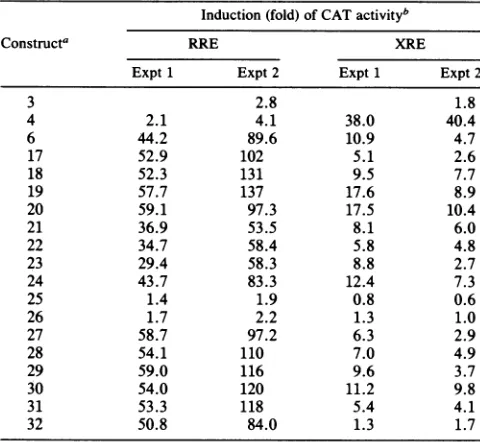
Representative
func-tional
data
areshown in
Fig.
3A
and Table 1; the size and
stability
of selected mutantproteins
wereconfirmed by
immunoblot
analysis
of the
transfected cells
(Fig.
3B). We
found that missense mutations
involving
known
protein
localization
signals
(18, 23)
atthe N
and
C termini
of
Rex
(constructs
17
and
22) did
notinactivate
RevA/Rex,
presum-ably
because
equivalent signals
are
present
in
the Rev
moiety
(10, 13).
Three
other
missense mutations
that have
been
reported
(1, 18) to
abolish
effector function
in Rex
failed
toinactivate
the
fusion protein
(constructs 19 to 21).
Progressive truncations of
the Rex
moiety (constructs 23 to
29)
revealed that up
to79
C-terminal
or65
N-terminal
amino
acids
could be deleted
without
eliminating function,
although
simultaneous deletion of both these
regions profoundly
inhibited
XRE-specific transactivation
(construct 32). Most
importantly,
twochimeras that lacked the central
portion
of
Rex failed
totransactivate
through
either response element
(constructs 25 and
26),
whereas
afusion
protein comprising
only amino acids
66
to118
of
Rex
(construct 32)
transacti-vated
through the RRE
asefficiently
as
wild-type
Rev.
These
findings indicated
that
a52-amino-acid
internal
segment
from
Rex
could
functionally replace
the
effector
domain of Rev.
Upon comparing
the sequences of these
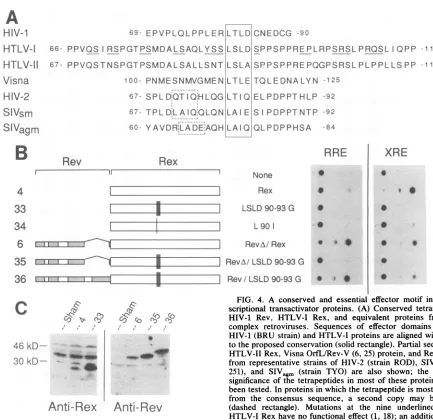
tworegions (Fig. 4A),
wenoticed
that
each includes
asingle
copy
of the
tetrapeptide
Leul¶rLeuAsp.
Moreover,
wefound related
(though
notidentical) tetrapeptides
atcompa-rable
locations
in all other
known
retroviral transactivators
of this type,
including
HTLV-IT
Rex,
Rev
proteins
from
tworelated families of
primate
immunodeficiency lentiviruses
(simian immunodeficiency
virus type
sm[SIVsm]/HIV-2
and
SIVagm),
and the
functionally equivalent
OrfL/Rev-V
protein
of
Visna,
anungulate
lentivirus
(6,
25).
In the HTLV-I
and
Visna
proteins,
this
motif
encompasses
the
site
of
mutations
that have
been
reported (18, 26)
toinhibit transactivation.
We
therefore
asked whether this
tetrapeptide
wasrequired
for Rex effector
activity.
As
shown in
Fig.
4B
and Table
2,
we
found that Rex
wascompletely inactivated
when
all four
residues
in
the
tetrapeptide
werereplaced by
glycines
(con-struct
33)
and that
even ahighly
conservative
mutation
(isoleucine replacing
leucine)
atthe
first
position
of
the
tetrapeptide strongly
inhibited
function
(construct
34).
In
contrast,
data from
previous
studies
(1, 18)
indicate
that
mutations
atnine
nearby sites
(Fig.
4A,
underlined)
have
noeffect
onRex
activity,
suggesting
that the
tetrapeptide
is the
only
essential sequence in the
Rexeffector
domain.
Wealso
found
(Fig.
4B
and
Table
2)
that
fusion with
full-length
Rev
partially
restored the
ability
of
aRex
tetrapeptide
mutanttotransactivate
through
the XRE
(construct
36)
but that
dele-tion
of the Rev effector
domain
prevented
this
complemen-tation
(construct
35).
Immunoblot
analysis
confirmed
that
these
effects
were notdue
todifferences
in
protein stability
(Fig.
4C).
Thus,
the
tetrapeptide
in
Rexis
essential for
transactivation and is
interchangeable
with
aregion
from
Rev
that
contains
this
samepeptide
motif.
DISCUSSION
The
studies
reported
here
extend
earlier
mutational
anal-yses
and
provide
newinsights
into the functional
architec-tureof
Revand
Rex.Under the
conditions
of
ourin vivo
assay,
in
which each of these
proteins
cantransactivate
only
on November 10, 2019 by guest
http://jvi.asm.org/
through
its cognate responseelement,
wefind that
se-quences
in and around the
arginine-rich
tractof
Rev
aresufficient
toconfer RRE
specificity
ontoRex.
This
observa-tion is
compatible with earlierevidence
(14,17, 31)
that
mutations
throughout thisregionin
Revinhibit RRE
binding
in
vitro
and that similararginine-rich
tractstogether
with
their flanking
sequencesdictate the
targetspecificities of
several
otherRNA-binding
proteins (12, 21, 28). Our data
suggest,
however, thatthe
structural
determinants
of
XRE
specificity
may be verydifferent:
although
anarginine-rich
tract
is
present atamino acids
1
to15 in
Rex, several
RevA/Rex
mutantswhich
lacked this
region (constructs 27
to31)
remained
fully competentfor
transactivation through the
XRE. A
similarinterpretation has
recently
been suggested
by Hofer
et al. (9), who found thatthe
arginine-rich
sequencein Rex
could be replaced by thatof
Revwithout
affecting
recognition
of the XRE. Sequencescritical
for
targetdis-crimination
musttherefore be
located
in the remainder
of
Rex, which
includes relatively few arginines orother
basic
residues but can
nevertheless confer XRE specificity ontoRev in vivo
(e.g., construct 27). Furthermutational
analysis
will be
needed
to map these sequences precisely.Our studies
also reveal that amino acids 66 to 118of
Rexcomprise
an autonomouseffector domain that
is
functionally
interchangeable
with the effector domain of Rev. Thesharedfunction
of these two domains appears todepend
upon apreviously unrecognized
tetrapeptide motif found in bothRev and Rex,
as well as in all other known retroviraltransactivators
of this type (Fig. 4A).Identification of this
conserved
effector motif provides a structuralbasis for the
view (3, 8) that,
while the posttranscriptional transactivatorsof various
complex retroviruses have markedly differentsequences and target
specificities, they may nevertheless actthrough a common
effector pathway. Although the details ofthis pathway
are presently unknown, transactivation isbe-lieved to
result from
specific interactions of the viral proteinnot only with
the target mRNA but also with one or morecellular components
of the RNA splicing or transportappa-ratus (2-4, 13,
18). The existence of a conserved andessential effector
motif suggests that posttranscriptionaltransactivators
from
diverse retroviruses may exert theireffects through contact
with a common cellular factor.ACKNOWLEDGMENTS
WethankD. R. Littman andH. E. Varmus for comments on the manuscriptand D. Serrano fortechnical help.
This work was supported by the NIH. T.J.H. and T.G.P. are a SpecialFellow and a Scholar, respectively, of the Leukemia Society ofAmerica.
REFERENCES
1. Bohnlein, S., F. P. Pirker, L. Hofer, K. Zimmermann, H. Bachmayer, E. Bohnlein, and J. Hauber. 1991. Transdominant repressors for human T-cell leukemia virus type I Rex and human immunodeficiency virus type 1 Rev function. J. Virol. 65:81-88.
2. Chang,D.D., and P. A. Sharp. 1990. Messenger RNA transport and HIV rev. Science 249:614-615.
3. Cullen,B. R. 1991. Human immunodeficiency virus as a proto-typic complexretrovirus. J. Virol. 65:1053-1056.
4. Cullen, B. R., and W. C. Greene. 1989. Regulatory pathways governing HIV-1 replication. Cell 58:423-426.
5. Daly, T. J., K. S. Cook, G. S. Gray, T. E. Maione, and J. R.
llusche.
1989. Specific binding of HIV-1 recombinant Rev proteinto theRev-responsiveelement in vitro. Nature (London) 342:816-819.6. Davis, J. L., and J. E. Clements. 1989. Characterization of a
cDNA clone encoding the visna virus transactivating
protein.
Proc.Natl.
Acad. Sci. USA 86:414-418.7. Grassmann, R., S. Berchtold, C. Aepinus, C. Ballaun, E. Boehnlein, and B.Fleckenstein. 1991. Invitro
binding
ofhuman T-cellleukemia virus rexproteinstotherex-responseelement of viral transcripts. J. Virol. 65:3721-3727.8. Hanly, S. M., L. T. Rimsky, M. H. Malim, J.H.Kim, J.
Hauber,
M. Duc Dudon,S.-Y. Le,J. V.Maizel, B. R.Culien,
and W. C. Greene. 1989. Comparative analysis of theHTLV-I
Rex and HIV-1 Rev trans-regulatory proteins and their RNA response elements. Genes Dev.3:1534-1544.
9. Hofer, L., I. Weichselbraun, S. Quick, G. K. Farrington, E.
Bohnlein,
and J. Hauber. 1991. Mutational analysis of the humanT-cell leukemiavirustype I trans-actingrexgene prod-uct. J. Virol. 65:3379-3383.10. Hope, T. J., X. Huang, D. McDonald, andT. G. Parslow. 1990. Steroid-receptorfusion of the HIV-1 Rev transactivator: map-ping cryptic functions of the arginine-rich motif. Proc.
Natl.
Acad. Sci. USA87:7787-7791.11. Hope, T.
J.,
D. McDonald, X. Huang, J. Low, and T. G.Parslow.
1990. Mutational analysis of the humanimmunodeficiency virus type 1 Rev transactivator: essential residues near the amino terminus. J. Virol. 64:5360-5366.12. Lazinski, D., E. Grzadzielska, and A. Das. 1989. Sequence-specific recognition ofRNA hairpins bybacteriophage antiter-minators requires a conservedarginine-rich motif. Cell 59:207-218.
13. Malim, M. H., S.
Bohnlein,
J. Hauber, and B. R. Cullen. 1989. Functional dissection of the HIV-1 Rev trans-activator--deri-vation of a trans-dominant repressor of Rev function. Cell 58:205-214.14. Malim, M. H., and B. R. Cullen. 1991. HIV-1 structural gene expression requires the binding of multiple Rev monomers to the viral RRE: implications of HIV-1 latency. Cell65:241-248. 15. Malim, M. H., J. Hauber, S.-Y. Le, J. V. Maizel, and B. R. Cullen. 1989. The HIV-1 rev trans-activator acts through a structured target sequence to activate nuclear export of un-spliced viral mRNA. Nature (London)338:254-257.
16. Malim, M. H., D. F. McCarn, L. S. Tiley, and
B.
R. Cullen. 1991. Mutational definition of the human immunodeficiency virus type 1 rev activation domain. J. Virol. 65:4248-4254. 17. Olsen, H. S., A. W. Cochrane, P. J. Dillon, C. M. Nalin, andC. A. Rosen. 1990. Interaction of the humanimmunodeficiency virus type 1 Rev protein with a structured region in env mRNA is dependent on multimer formation mediated through a basic stretch of amino acids. Genes Dev. 4:1357-1364.
18. Rimsky, L., M. Duc Dudon, E. P. Dixon, and W. C. Greene. 1989. trans-dominant inactivation of HTLV-I and HIV-1 gene expression by mutation of the
HTLV-I
Rex transactivator. Nature (London) 341:453-456.19. Rimsky, L., J. Hauber, M. Dukovich, M. H. Malim, A. Langlois, B. R. Cullen, and W. C. Greene. 1988. Functional replacement of the HIV-1 rev protein by the
HTLV-I
rex protein. Nature (London) 335:738-740.20. Rosen, C. A., E. Terwilliger, A., Dayton, J. G. Sodroski, and W. A. Haseltine. 1988. Intragenic cis-acting art gene-responsive sequences of the human immunodeficiency virus. Proc.
Natl.
Acad. Sci. USA 85:2071-2075.21. Roy, S., U. Delling, C.-H. Chen, C. A. Rosen, and N. Sonenberg. 1990. A bulge structure in HIV-1 TAR RNA is requiredfor Tat binding and Tat-mediated trans-activation. Genes Dev. 4:1365-1372.
22. Sakai,H., H. Siomi, H. Shida, R. Shibata, T. Kiyomasu, and A. Adachi. 1990. Functional comparison of transactivation by human retrovirus rev and rex genes. J. Virol. 64:5833-5839. 23. Siomi, H., H. Shida, S. H. Nam, T. Nosaka, M. Maki, and M.
Hatanaka. 1988. Sequence requirements for nucleolar localiza-tion of human T cell leukemia virus type I pX protein, which regulates viral RNA processing. Cell 55:197-209.
24. Solomin, L., B. K. Felber, and G. N.
Pavlakis.
1990. Different sites of interaction for Rev, Tev, and Rex proteins within the Rev-responsive element of human immunodeficiency virus type 1. J. Virol. 64:6010-6017.on November 10, 2019 by guest
http://jvi.asm.org/
and B. R. Cullen. 1990. Visna virus encodes a
post-transcrip-tional regulator ofviralstructuralgeneexpression. Proc.Natl. Acad. Sci. USA 87:7497-7501.
26. Tiley,L. S.,M. H. Malim, and B. R. Cullen. 1991. Conserved functional organization of the human immunodeficiency virus
type1 andvisna virus Revproteins. J. Virol. 65:3877-3881. 27. Toyoshima, H., M. Itoh, J.-I. Inoue, M.Seiki,F. Takadu, and
M. Yoshida. 1990. Secondary structure of the human T-cell leukemia virustypeIrex-responsiveelement is essential forrex
regulation of RNA processing andtransportofunspliced RNAs. J. Virol.64:2825-2832.
RNA. Science 249:1281-1284.
29. Wong-Staal,F., andR. C. GaHo. 1985. HumanT-lymphotropic retroviruses. Nature (London) 317:395-403.
30. Zapp, M. L., and M. R. Green. 1989. Sequence-specificRNA
binding by the HIV-1 Rev protein. Nature (London) 342:714-716.
31. Zapp, M. L., T.J. Hope,T.G. Parslow, andM.R.Green. 1991. Oligomerization and RNA binding domains of the HIV-1 Rev
protein:adualfunction foranarginine-rich binding motif.Proc.
Natl.Acad. Sci. USA88:7734-7738.