0022-538X/93/010019-10$02.00/0
Copyright © 1993, American Society for Microbiology
Proteolytic Processing of Ty3 Proteins
Is
Required
for
Transposition
JACQUELINE KIRCHNERANDSUZANNESANDMEYER*
Departmentof Microbiology andMolecularGenetics, Universityof California, Irvine,
Irvine,
California
92717-4025Received 6July1992/Accepted 22 September 1992
Ty3 is a retroviruslike element found in Saccharomyces cerevisiae. It encodes GAG3 and GAG3-POL3
polyproteins which areprocessed intomature proteins foundinthe Ty3viruslike particle. Inthisstudy, the region encodingaproteasethat ishomologous toretroviralaspartylproteaseswasidentifiedandshowntobe required for production ofmature Ty3 proteins and transposition. The Ty3 protease has theAsp-Ser-Gly
consensussequencefound incopia, Tyl, andRoussarcomavirus proteases,rather than theAsp-Thr-Glyfound inmostretroviralproteases.TheAsp-Ser-Glyconsensusisflankedbyresidues similartothose whichflankthe active sites ofcellularaspartylproteases.Mutationsweremade in theTy3 active-sitesequencetoexamine the roleof the protease in Ty3 particle maturation and to test the functional significance ofthe Ser active-site variant in theconsensussequence. Mutationof theactive-site AspblockedprocessingofGag3andGag3-Pol3
and allowed identification of a GAG3-POL3 polyprotein. This protein was turned over
rapidly
in cellsexpressingthe mutantTy3. Changing the active-site SertoThrcausedonlyamodestreductioninthelevels of certainTy3proteins.Fiveputative cleavagesitesofthis protease inTy3 GAG3andGAG3-POL3polyproteins
were defined by amino-terminal sequence analysis. The existence of an additional protein(s) ofunknown function,encoded downstream of theprotease-coding region,wasdeducedfromthepositionsof these amino terminiandthesizes of knownTy3proteins. Although Ty3 proteasecleavage sitesdonotcorrespond exactly
to known retroviral protease cleavage sites, thereare similarities. Residues P3 through P2' in the regions
encompassingeach ofthefive sites are uncharged, and noPI position isoccupied by an aminoacid with a
branched beta carbon.
Theretroviralcorecontains an aspartylprotease (PR) of 12to15 kDainmass(forareview,seereferences 42 and 53).
Alignment of theproteasesequencesofretroviral and
cellu-lar aspartyl proteases shows two regions ofconserved
se-quence: Asp-Thr/Ser-Gly in the amino-terminal portion of each protease domain and H-H-Gly (where H is Ile, Leu, Trp,orVal)in thecarboxyl-terminal portionofeach domain
(45, 57). In avian sarcoma/leukosis virus, PRisencodedat the downstream end of gag, while in some mammalian retroviruses, it is contained in a separate reading frame between gag and pol, and in others, the coding region overlaps with gag but is primarily contained within the
upstreamend ofpol. Pulse-labeling studies have shown that both structural and catalytic proteins are synthesized as
polyproteinprecursorswhicharefound in immaturevirions.
Maturation of the virusparticles coincidestemporallywith theappearanceofprocessed proteins. Mutagenesis ofthePR codingdomaincanblockparticlematuration andprocessing,
implicatingPR in thematurationprocess (9, 10, 20, 23, 46, 47, 55, 56). More recently, retroviral proteases have been showntobeactiveonpeptidesubstratessimulating
polypro-teincleavagesites(24-26) and inheterologoussystemssuch
as Saccharomyces cerevisiae (27) orEscherichia coli (11,
26), whenproduced aspartofpol, thereby confirming that PR istheprocessing enzyme.
Solution of theX-raycrystal structure forboth the Rous
sarcomavirus(40) andhumanimmunodeficiency virus (41, 59) PR, information frommutagenesis of several retroviral PR species (20, 23, 33-35, 55), and studies with variant substrates havegreatly expandedourunderstandingofboth
*Correspondingauthor.
thestructureand the function of thisenzyme.Thesimilarity of PRtocellularaspartylproteasestwice itsmassprompted
Pearl andTaylorto propose that PR forms a dimer resem-bling the cellular aspartyl proteases within which a PR domain is repeated (45), and this has been confirmed by structural studies (19, 24, 38, 40, 41). More recently, syn-theticdimers have been showntohaveintracellularactivity inthe absence ofparticle formation, as predicted if dimer-izationistherate-limitingstepofretroviralprotease activa-tion(5, 28). Comparisonofsyntheticandnaturalsubstrates forretroviral proteaseshasshown that there is not a strict
cleavage site consensus(24, 25, 51). Natural cleavage sites
arewithin hydrophobic regions, especially from P2 to P2', anddonotcontain beta-branched amino acidsatpositionP1. Some cleavage sites are only recognized in the native context, arguingthathigher-orderstructuresalsoplayarole
in cleavage site recognition (34, 58). Thehydrophobic
con-text, together with synthetic peptide substrates and the X-raycrystalstructures, arguesthatsevenaminoacids,four amino terminal and three carboxyl terminal to the scissile bond, arethe local determinants ofcleavage sites.
Proteases ofretrotransposonsarelessextensively
charac-terized than those of retroviruses. The protease predicted from thegypsy-like element 17.6proteinsequencecontains Asp-Thr-Glyatthepositionofthepredicted PRactive site, butotherretrotransposons,includingtheintracistemal type A particle, copia, and the copia-like Tyl and Ty2 and
gypsy-like Ty3elements of S. cerevisiae (3),have Asp-Ser-Glyattheprotease active site.Thecopia element encodesa
proteasewhichisexpressed togetherwithstructuralproteins fromasplicedmRNA. A missensemutation in the active site of this protease prevents accumulationof viruslike particle (VLP) protein, presumably because of instability of the
19
on November 9, 2019 by guest
http://jvi.asm.org/
mutant precursors in vivo
(60).
The yeastTyl
element encodes anaspartyl
protease of23 kDaatthebeginning
of the second openreading
frame(ORF).
It isexpressed
aspart of apolyprotein
generated by
translationalread-through
from the first ORF(14, 61).
Alinker insertion mutationnearthe
putative
active site inTyl
proteaseblocksprocessing
of the precursorpolyprotein
to matureTyl
proteins
and results in accumulation of immatureparticles, although
a novelprotein
isproduced
from the precursor via either residualTyl
proteaseactivity
orthe action ofacellular protease(14,
61).
Becauseprocessing
sites have not been characterized for any retrotransposon protease, thesimilarity
ofcleavage
specificity
between retrotransposon and retroviral proteases isnotknown.Ty3
occursinonetofivecopies
intypical haploid
labora-tory strains and iscomposed
of a 4.7-kb internal domain flankedby 340-bp long
terminal repeats.Ty3
is transcribed into a 5.2-kbgenomic
RNA(8).
The RNA contains twoORFs,
GAG3of 307codons, predicted
toencodeaprotein
of 290residues,
and POL3 of1,270
codons(17).
In cellsexpressing high
levels of the 5.2-kbRNA, Ty3 proteins
aresynthesized
and intracellularparticles
of156S areobserved(15).
Theseparticles
areprimarily
composed
of structuralproteins,
encodedby GAG3,
of39, 38, 31, 26,
and 9 kDa. The 26- and 9-kDaproteins
have beendesignated capsid
(CA)
andnucleocapsid
(NC), respectively.
Ty3
particles
also containcatalytic proteins
encodedby POL3, including PR,
reverse
transcriptase (RT),
andintegrase
(IN),
which arehomologous
to their retroviral counterparts. RT has anapparentmassof 55
kDa,
and the INspecies
have apparentmassesof 61 and 58 kDa.GAG3
proteins
aresynthesized
in relativeabundance,
while POL3proteins, produced
fromaGAG3-POL3 fusion
polyprotein,
arepresent in theparticle
at about
1/13
the level of the structuralproteins.
Theseparticles copurify
withTy3 RNA,
aswellasRTactivity
andfull-length
Ty3
DNA. Theseparticles
areanalogous
to the retroviralcore and arereferredto asVLPs.This
study
was undertaken to(i)
determine the effectonparticle morphogenesis
ofinactivating
theTy3 PR, (ii)
de-termine thefunctionalsignificance
ofheterology
atthe active sites of retroviral and retrotransposon PRspecies,
and(iii)
identify Ty3
PRcleavage
sites in the GAG3 and POL3polyprotein
domains.MATERIALS ANDMETHODS
Yeast and bacterial strains and cultureconditions.
Cultur-ing
and transformation of E. coli and S. cerevisiae strainswas
according
to standardmethodology (1).
S. cerevisiaeTMy16
(AL4Ta
trpl-H3
ura3-52 his3-A200 ade2-101lys2-1
leul-12
canl-100ATy3
GAL3+) (39),
aderivativeofyVB110
whichcontains noendogenous
Ty3
elements(16),
wasused forexperiments
inwhichTy3 transposition
wasmonitored. Immunoblotanalysis
wasperformed
on strain AGY-9(MA
Ta ura3-52 his4-539lys2-801
trpl-A63 leu2-AJ
spt3) (a
gift
from A. Gabriel and J.Boeke,
The Johns HopkinsUniversity).
AGY-9 transformed withplasmids expressing
Ty3
wasusedforVLPprotein
analysisbecause the mutation in SPT3 reducesTyl expression.
AGY-9 also produceshigher
relative levels ofTy3 proteins
than theTy3nullstrainyVB11O,
from whichTMy16
wasderived.Processing
ofTy3proteins
isindistinguishable
in the two strains. E. coliRZ1032
(lysA[61-62]
thi-1
relAl
spoTl
dut-1ung-1
[Teti]
supE44)
wasused forproduction
ofsingle-stranded
DNAfor site-directedmutagenesis by
the method of Kunkel (29). Plasmids wereamplified
inHB101
(F-
hsd-20[rB-
mB-j
recA13leuB6 ara-14 proA2 lacY] galK2rpsL20
[Smr]
xyl-5
mtl-lsupE44 A).VLP preparation. In order to study Ty3 proteins, yeast strain AGY-9 was transformed with pEGTy3-1, a plasmid carrying wild-type Ty3 fused to the GALI-10 upstream activating sequence(16). This plasmid also carried the yeast URA3gene, sequences from the yeast 2,umplasmid which confer high copy number, and the bacterial Ampr gene and on.Transformed cellswerepregrownin mediumcontaining raffinose(anonrepressingcarbonsource) and lacking uracil. Cells were transferred to synthetic medium containing ga-lactose as the carbon source and lacking uracil to induce transposition. VLPs were partially purified by using a method developed from that used by Eichinger and Boeke (13) and previously described (15). Briefly, cells were grown to anoptical density at 600 nm of 0.9 to 1.1, washed inbuffer, digested with zymolyase, lysed with glass beads, and frac-tionated over a 26-ml 70%-30%-20% sucrose stepgradient of5, 5, and 16 ml, respectively, by centrifugation in a SW28 rotor at83,000 xgfor 3 h at4°C. Four milliliters from the 70%-30% interface of each gradient was pooled, concen-tratedby centrifugation in aTiSO rotor at 100,000 x g for 1 hat 4°C, and resuspended in 100
pl
of buffer B (containingMg2+) (13)with 10% glycerol. Protein concentrations were determined by the Bradford assay (4), and purity was assessedby fractionation of 10 ,ug of each VLP preparation
by electrophoresis on asodium dodecyl sulfate (SDS)-10% polyacrylamide gel and staining with Coomassie blue.
Immunoblot analysis. Proteins fractionated on polyacryl-amide gels were transferred electrophoretically to Nitro-Screen West membranes (DuPont, New England Nuclear
Corp.)andanalyzedasdescribedpreviously (15, 17).GAG3
proteinswerevisualizedwithan antibody againstapeptide
representingresidues 30to44of thepredicted GAG3 protein andlyingwithin CA.POL3proteinswerevisualized with an
antibody againstapeptideencodedbyPOL3 codons 1086to 1099 and lyingwithin IN. The use of these antibodies has been describedpreviously (15, 17).
Amino-terminal sequence analysis of Ty3 proteins. Condi-tions andtechniquesused forpreparingprotein for
sequenc-ing were as recommended by P. Matsudaira (36). VLP
protein isolated from approximately 30 liters of galactose-induced cells, as described above, was concentrated by
centrifugationinaTi50rotor at100,000xgfor 2 hat4°C and
resuspended in 250 ,ul of buffer B with 10% glycerol. A one-third volume of 4x Laemmli sample buffer (31) was added. The sample was heated at 37°C for 10 min and
centrifuged at 12,000 x g for 20 min at 4°C to remove insoluble material. An SDS-10% polyacrylamide gel (1 mm
by15cmby10cm)withfour 1-cm wellswasmade byusing deionized acrylamideandallowedtopolymerizeovernight. Fourequal aliquotsof33 ,ul(about330,ug)each were loaded. The running buffer was supplemented to 0.01% thioglyco-late. TheTy3 proteinswerefractionated byelectrophoresis
at 200 V for approximately 4.5 h and transferred to a
polyvinylidene difluoride (PVDF) membrane (Bio-Rad) for 2.5 h at 400mAin 10 mM CAPS
[(3-(cyclohexylamino)-1-propanesulfonic acid;pH11.0]-0.1% EDTA-10%methanol. Themembrane was then rinsed twice withdouble-distilled water, stained for 1 min in 0.1% Coomassie blue and 40%
methanol,destained in threechanges of 50% methanol, and rinsed with water. The bands on the PVDF membrane
containing the 61 (IN)-, 58 (IN)-, 55 (RT)-, 38
(Pr38GAG3)-,
and 31(p31GAG3)-kDa
Ty3 proteins were excised, and theproteins were subjected to five or seven cycles of Edman
degradation performed on the Applied Biosystems model
on November 9, 2019 by guest
http://jvi.asm.org/
470-A pulsed-liquid protein sequencer by G. Hathaway at theBiotechnologyInstrumentationFacilityattheUniversity
of California, Riverside. A similarprocedure employing an
SDS-15% polyacrylamide gel was used to fractionate the lower-molecular-mass
Ty3
proteins, the 26 (CA)-, 9(NC)-,
and 16(PR)-kDa species, from a second large-scale prepa-ration ofpooled Ty3 VLP protein representing 6 liters ofgalactose-induced cells. Electrophoresiswas for 5 h at 200 V. Electrophoretic transfer was for 2 h at 100 V, but was otherwiseperformed as described above. The PVDF mem-brane to which these proteins were transferred was also stained anddestained,and the bandscontaining Ty3proteins
were excised. The proteinsweresubjectedtofive cyclesof Edmandegradation sequencing asdescribed above.
Recombinant DNA manipulations. ApIBI20 plasmid con-taining the 5' half of Ty3on a3.2-kbpHindIII-SalIfragment (2)wasused formutagenesis. Two 19-meroligonucleotides
were used to separately mutagenize the sequences that encode the conserved Asp and Ser of the PR active site.
Oligonucleotide 212 (5'GATCCACTGAIAAACAGGG3')
wasused to changetwonucleotides(underlined), converting
the encoded Asp residue to an Ile residue (Asp-59 -) Ile).
Oligonucleotide 211 (5'GGGTGATCCAGTGTCAAAC3')
was used to change a single nucleotide, converting the encoded Ser residue to a Thr residue (Ser-60 -* Thr).
Plasmid DNAwasisolated from transformants andscreened by sequence analysis. The 2.0-kbpBglII-SalI fragment of Ty3 containing the mutated sequencewas then substituted intopEGTy3-1for thewild-type fragmentin the5'portionof Ty3. These plasmids are referred to as pEGTy3-lmut2l2
(Asp-59
-3Ile)
andpEGTy3-lmut2ll
(Ser-60
-+Thr)
andwere used for protein analysis in AGY-9. The 2.0-kbp BglII-SalI fragmentwasalsocloned intopJK312AC, replac-ingthewild-type fragmentin the5'portionof theTy3carried on thisplasmid. These plasmids, carrying mutantTy3 ele-ments, are referred to as pJK312ACmut211 and
pJK312ACmut212. The plasmid pJK312AC is identical to pJK311AC(22)inhavingthe yeastTRP1 gene
andARSJ
and CEN4 sequences forselection and maintenance atlow copy number and the E. coli Amprgeneandon. TheTy3element onpJK312AC,however,hasadeletion of theprimerbinding site,which preventsreplication.ThisTy3is also fusedtotheGALl-10 upstream activating sequence, expresses all Ty3 proteins, and (like pJK311AC) can complement
transposi-tion ofamarkeddonorTy3(see Results).
RT assays. RT activity was measured under conditions
optimizedforTy3RT(15).VLPswerepreparedasdescribed above from galactose-induced AGY-9 cells containing pEGTy3-1, pEGTy3-lmut211, or pEGTy3-lmut212 or no
plasmid.RTactivitywascalculated asthe percent
incorpo-ration of
[a-32P]dGTP
at 26°C in 2.0 hby using a poly(C) templateandanoligo(dG) primer. Incorporationofradioac-tivitywaslinearduringthis time forproteinsin the range of 1 to4 ,gina30-,ulreaction volume (7, 15).
Transposition assays. Transposition assays were per-formedby using ahelper Ty3
(pJK312AC,
or aderivative,
pJK312ACmut211orpJK312ACmut212), incapableof
trans-positionbut able to provide proteins in trans and a donor
Ty3(pJK314orpJK422) (22), marked with the yeast HIS3 geneandincapableofautonomoustranspositionbut
contain-ingthecis-actingsequencesrequiredfortransposition. The
plasmid pJK314carried adonorTy3inwhichNC, PR, RT,
and IN coding sequences were replaced with HIS3, and
pJK422 carried a donor Ty3 in which only IN coding
sequences were replaced withHIS3. Each donor plasmid
containeda2,umsequencewhich confers
high
copy numberPROTEASE ACTIVE SITE
NH Asp Ser Gly COOH
1
1
lie Thr mut212 mut211
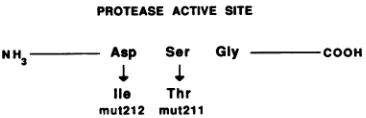
FIG. 1. Mutagenesisof conservedpositionsintheTy3PRactive site. The Asp-to-Ile mutation in Ty3-lmut212 and the Ser-to-Thr mutation inTy3-lmut211 areshown.
inS. cerevisiae, the yeastURA3 gene for
selection,
and thepIBI20vectorfor
replication
and selection in E.coli.
Yeast strainTMy16
was transformedseparately
with eachof thethree
helper
plasmids.
These transformantswerethentrans-formed with one of the donor
plasmids.
TMy16
was also transformed with each donorplasmid
alone. Two individual transformants for each donor ordonor-helper
combinationweregrown for 5
days
onsynthetic
medialacking
uracilorboth uracil and
tryptophan,
respectively,
to select for the retention of theseplasmids.
The media also contained anappropriate carbon source to induce
Ty3
transcription
(ga-lactose)
or to repressTy3
transcription
(glucose).
Fivepurified
coloniesrepresenting
anoriginal
transformantwerethen
patched
ontocomplete
medium(YPD)
and grown for 1day
toallow loss of the marked donorplasmid.
Patcheswerethen
replica plated
ontosynthetic
mediumlacking
histidine andcontaining
5-fluoro-oroticacid(5FOA)
toselect forcells which had losttheURA3-markeddonorplasmid
butretained theHIS3-markedTy3.
RESULTS
AnAsp-to-Ilemutation in theactive siteof
Ty3
PRblocksTy3 processing. The
similarity
among thecopia,
Tyl,
andTy3 retrotransposons and retroviruses and their
respective
proteasesargued
thatTy3
PRwould be foundtoberequired
for maturation of theTy3
VLP. If immatureTy3
particles
accumulated in cellsexpressing
aTy3
withamutation in the active site ofPR,
it would notonly implicate
PR in thematurationprocessbutwould facilitate studies of precursor
proteins.
Site-directedoligonucleotide
mutagenesis
wasused to
change
theAsp
within the active site consensusAsp-Ser-Gly
to Ile(Fig.
1), creating Ty3-lmut212.
To obtain
high-level expression
of theTy3
PR mutant,Ty3-lmut212,
itwas clonedon ahigh-copy-number
plasmid
under
regulation
of theGALl-10
upstreamactivating
se-quence, as described for
pEGTy3-1.
Strain AGY-9 wastransformed with
pEGTy3-1 and, separately,
withpEGTy3-lmut212. Transformants were grown in medium
lacking
uracil andcontaining galactose,
toselect forgrowth
of cellsretaining
theplasmid
and to induceexpression
of theTy3
elements. Extracts of cellsexpressing wild-type
andmutantTy3 elements were then fractionated over 70%-30%-20%
sucrose step
gradients,
and theparticulate
material in the70%-30%interfacefractionwascollected
by
centrifugation.
ProteinswerefractionatedonSDS-10%polyacrylamide gels
and identifiedby
Coomassie bluestaining (Fig.
2A)
andby
immunoblotanalysis
with antibodiesagainst
determinants within the CA and IN domains(Fig.
2B andC).
The antibodies raisedagainst
the CA determinant reacted withaminor
p39GAGSP
component and withPr38GG3,
p31GG3,
and CA encodedby
wild-type Ty3-1.
These pro-teinswerepreviously
identifiedasGAG3proteins
produced
by Ty3-1
(15).
TheTy3-lmut212
showedPr38GA3
at low levels and an even lower amount of aprotein
with anon November 9, 2019 by guest
http://jvi.asm.org/
[image:3.612.352.535.77.136.2]B. anti-CA
WT 211 212 0 kDa
-21 2 -1 7 0
-11 6
anti-IN WT 211 212 0
'C,POI.,^
Pr173pl t-_,
pi115 fi
-76
IN(61kDDs
IN(58kDa) _
p39 ,
Pr38- _
p31-CA- _
FIG. 2. Analysis of VLP proteins isolatedfrom cellsexpressing Ty3PRmutants. (A)Coomassie blue-stainedSDS-10% polyacrylamide gelinwhicha40-,ugaliquot of the particulatefractionwasloadedperlane.AGY-9cells transformed withpEGTy3-1 (WT),pEGTy3-lmut211 (211), and pEGTy3-lmut2l2 (212)orwithAGY-9cellsalone(0)were sourcesof theparticulatefractions.Molecularmassstandards used
todeterminethe size of theGAG3-POL3polyproteinareshown inflanking lanes (M),and the molecularmasses areindicatedonboth sides of thegel. Ty3 proteinsPrl73GAG3POL3 and RTarelabeled. (B) Immunoblot analysisof the70%-30%interface fraction. Extractsarefrom
cells defined above for panel A. Tenmicrograms of proteinwasfractionatedon anSDS-10% polyacrylamide gel (duplicate sampleswere
loadedintwolanes),transferredtonitrocellulose, probed witheitheranti-CAoranti-INantibodies,reacted with125I-proteinA,washed,and
exposedtoX-rayfilm for 6days.TheTy3 proteinsarelabeled.(C) Four-weekexposureof the immunoblots used forexposuresshown inpanel B.
apparentmass of 173kDa (Fig. 2),similar to thepredicted size of a GAG3-POL3 fusion protein (175 kDa). The
p39GAG3-POL3, p31GAG3, and CAproteins were absent. CA and the 61- and 58-kDa IN species were detected in
Ty3-lmut212 only after overexposure of the immunoblot (Fig.
2C)andarepresent atthesamelevelasinthe controlsample (nontransformedcells). Strain AGY-9 hasfour endogenous copiesofTy3 (39),andexpressionof theseelements islikely
to accountforthisbackground.
Antisera raised againstthe INdeterminant reacted witha
115-kDa species and 61- and 58-kDa IN species in the extracts from the cellscontaining the wild-type Ty3-1 (17) (Fig. 2BandC). Inextracts of cellsexpressing the Ile-Ser-Glyactive-site mutant, themostprominentreactiveprotein hadanapparentmassof 173 kDa(Fig.2B and C).Wewere
also abletodetectaspeciesofapproximately115 kDa which mayhave beengeneratedbyresidual PRactivity,theaction of a cellular protease, or the action of a contaminating protease(s) introducedduringVLPpreparation.Therewere
much lower overalllevels ofproteinswhich reacted withthe antibody against IN in extracts of cells expressing the mutantcomparedwith those in extracts of cellsexpressing thewild-type Ty3. Thus, inactivation ofTy3 PR does not result in accumulation of immature Ty3 particles to the levels observed for mature particles in cells expressing wild-type Ty3 elements. This could be due either to less efficient formation of the mutant particles or more rapid
turnoveroftheparticles that form.
PRis required for wild-type levels of RT activity andfor transposition.Theparticulatefractions fromcellsexpressing wild-type and mutant Ty3 elements were assayed for RT
activity (Fig. 3). The level of [a-32P]dGTP incorporation mediated by extracts of cells expressing pEGTy3-lmut2l2
wasslightly abovebackground and approximately 10% that
ofextractsexpressing wild-type Ty3inthe linearrangeof 1
to 4 ,ug ofprotein. BecausenomatureRTwas detected by
Coomassie bluestaininginextracts of this PRmutant (Fig. 2A), we speculate that the source of the activity over
background levels observed in nontransformed cells is the
115-kDaproteinwhichreactswith the anti-IN antisera. The size of thisproteinis consistent withthat ofanRT-INfusion.
Alternatively, it is possible that RT activity is reduced severalfold, rather than beingcompletely absent, in imma-tureparticles composedofunprocessed polyproteins, simi-lartowhat has been shownforahumanimmunodeficiency
virus PR active-site mutant (47) and forTyl PR active-site mutants(61).
The absence ofmatureproteinsin the PRmutantparticles and the reduced level ofTy3 proteins in general suggested that the mutation would block Ty3 transposition, despite
c
0 la 0 C
30
20
10
* pEGTy3-1 pEGTy3-1mut2ll
pEGTy3-1 mut212
AGY-9
0 2 4 6 8
g protein
FIG. 3. RT assays ofextracts from cells expressingwild-type
and PRmutantTy3 elements.AGY-9 cells transformed with high-copy-number Ty3 plasmids or not transformed were grown in
galactose-containing, uracil-lacking media, and extracts of these cultureswerefractionatedoversucrosestepgradients. Oneto6,ug
of total VLP proteinwasused in each assayfor eachsample, as
described in Materials and Methods. RTactivityisexpressedasthe percent incorporation of [a-32P]dGTP. These values are the
aver-agesofduplicateassaysandarerepresentativeofassaysperformed
withmultiple samples.
A.
kDa 200_ Pr173
97.4-_
68-RI
RT-1
43-
29.5-C.
-Pr173
,.-p 11
, _IN(61kDa)
" IN(S8kDa)
p39r38
p31-
on November 9, 2019 by guest
http://jvi.asm.org/
[image:4.612.56.547.78.237.2] [image:4.612.313.552.481.629.2]A.
DONOR:
pJK314HELPER: none pJrXK312AC miu:211
CHO:- GLU GAL GLU GAL GLU GAL
C.
B
DONOR: pJK314HELPER: nocrne pJK312AC mut212
CHO: GLU GAL GLU GAL GLU GAL
DONOR: pJK29?
D.
DONOR: pJK422HELPER: none pJK31,2A'C m-:_21' HELPER: none pJK312AC mut2l2
CHO: GLU GAL GLU GAL GLU GAL CHO: GLU GAL GLU GAL GLLJ GAL
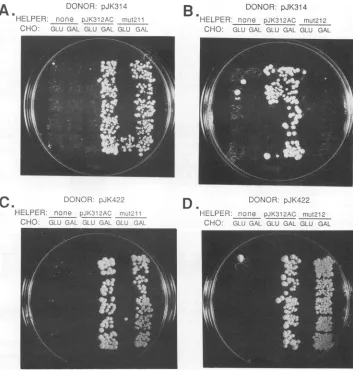
FIG. 4. Transposition assaysof Ty3PR mutants. TMyl6cells weretransformed withpJK312AC, pJK312ACmut211, andpJK312AC mut212(helper Ty3plasmids) and then with pJK314 (donorTy3plasmidnotencodingPR)orwith pJK422(donor Ty3 plasmid encodingPR). TMy16cellswerealso transformed with eachdonorplasmid alone. Transformantswerestreakedontoselectivesynthetic mediacontaining eitherglucose(GLU) (torepresstransposition)orgalactose (GAL) (to inducetransposition). Five isolated colonies ofeachwerethenpatched
ontoYPDnonselective mediatoallow lossofthe donorplasmidandreplica platedontomediacontaining5FOA andlacking histidinetoselect for the acquisition ofa genomic marked donorTy3. Growthon mediumlacking histidine andcontaining5FOA is shown. The plasmids contained inthe transformantandthe carbonsource onwhich cellsweregrown areindicated aboveeachcolumn ofpatchesontheplates.
detectable RTactivity. This predictionwastestedby
trans-forming the Ty3 null strain TMy16 with a
galactose-induc-ible,wild-type, or mutant helper Ty3element, carriedon a
low-copy-number plasmid, pJK312ACorpJK312ACmut212, respectively, and with agalactose-inducible donorTy3 ele-ment carrying a HIS3 insertion on a high-copy-number plasmid, pJK314orpJK422.Awild-typehelper Ty3 supplies proteinsrequiredfortransposition ofadonorTy3 element, thereby
complementing
itstransposition(6, 22) (see Materi-als and Methods). Inthis assay, cellscarrying theplasmidsare induced for transposition on galactose-containing me-dium lacking uracil and tryptophan and are patched onto YPDtoallowplasmid loss. Patches of cellsaretransferred onto medium containing 5FOAto select against cells
con-taining the URA3-marked donor plasmid and lacking histi-dinetoselect for cells which haveacquiredagenomiccopy of the HIS3-marked donor Ty3. Testing of the Ile-Ser-Gly PRmutanthelperTy3 in this assay withadonorlackingthe PR coding region(pJK314) showed that the PR mutant did
not complement transposition ofthis donor Ty3 (Fig. 4B).
The level ofgrowth on medium lackinghistidine and
con-taining5FOAwasthe same, whether pregrowthwas on an
inducingornoninducingcarbonsource.Itwaspossiblethat
transpositionwasblocked because the mutation caused the Ty3polyproteintoadopt anaberrantstructurewhichwas a poorsubstrate forprocessing.Toassessthispossibility, the donor Ty3element in plasmid pJK422, which encoded PR but lackedmostof the INcodingsequence,wasusedto test whether Ty3-lmut212 could be rescued by wild-type PR.
Transposition of this donor did occur(Fig. 4D). Thus, the GAG3-POL3polyprotein containingthemutantPRcould be
processed to produce at least the IN species required for
transposition. Thissuggested that theabsenceof
transposi-tion observed for pJK314 together with
pJK312ACmut212
was due tolack ofPR activity, rather thaninability
ofthepolyprotein to be
incorporated
intoparticles
or to be asubstrate forprocessing.
Ty3 polyprotein cleavage sites arewithin hydrophobic
on November 9, 2019 by guest
http://jvi.asm.org/
[image:5.612.140.493.77.447.2]gions. Comparisons of retroviral protease cleavage sites in retroviral polyproteins and heterologous proteins have shown apreference in P2, P1, and P2' positions for
hydro-phobic residues (44, 49, 51). While retrotransposon PR
speciessharetwoconservedregionswith those of retroviral PR species, cleavage sites have not been defined for any retrotransposon protease. AGY-9 cells transformed with
pEGTy3-1 were grownin medium containing galactose and
lackinguracil to obtain large amounts ofTy3 VLP protein. The cell extracts were fractionated by velocity sedimenta-tionover asucrose stepgradient,concentrated by
sedimen-tation, andfractionated by SDS-polyacrylamide gel
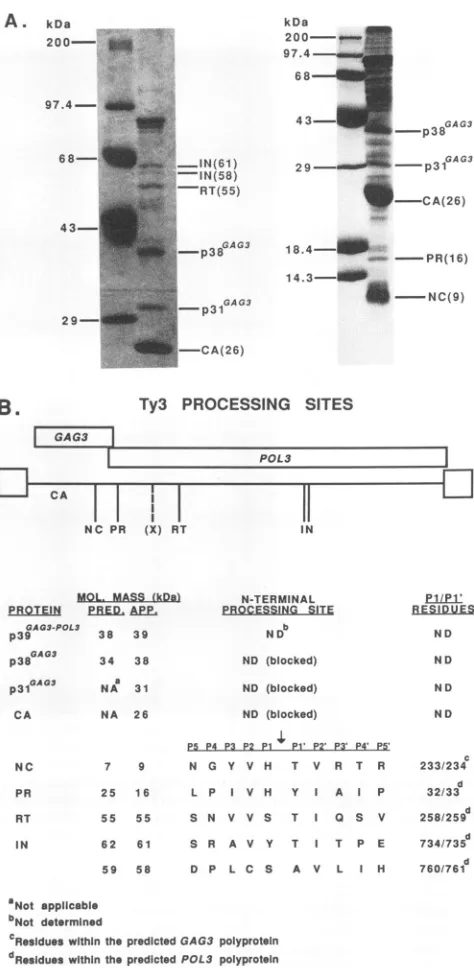
electro-phoresis (PAGE) (Fig. 5A). The proteins were transferred frompolyacrylamide gelsto aPVDF membraneasdescribed inMaterials and Methods and stained withCoomassieblue. Bandswere excised, and the amino-terminal sequence was determinedbyautomated Edman degradationfor the 9-kDa GAG3 protein and the 16-, 55-, 61-, and 58-kDa POL3
proteins. The 38-, 31-, and 26-kDa GAG3 species were blocked at their amino termini; the 39-kDa GAG3 protein was not subjected to amino-terminal sequencing. A mini-mum of five cycles per amino-terminal region was per-formed. The cleavage siteswere inferred from positions of amino-terminal sequence in thepredicted Ty3 polyprotein;
each amino-terminal sequence occurredonlyoncewithinthe
predicted Ty3 protein sequence. Theseresultsareshown in
Fig. 5B. Although each putative processing site is unique,
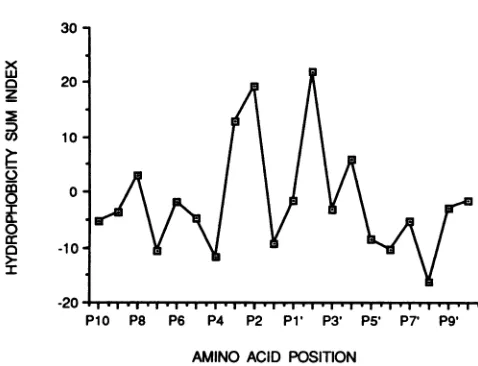
twosites have His residues attheP1positionand two have Serresidues. Thr is the P1' residue in three of the five sites. The P2 and P2' positions are occupied by hydrophobic residues: Valatfour of thefiveP2sites,and Val or Ile at the five P2' sites. The hydrophobicity index of each of the 20 amino acids surrounding each of the five cleavage sites, determined bythe method ofKyte and Doolittle (30), was summed andplotted(Fig. 6).Itis apparent thatalthoughthe P1 and P1' positions are not, P3, P2, and P2' are quite hydrophobic.
Changing thePR active-site SertoThr does not result in
significant changes inthe levelsorsizes ofTy3 proteinsorin theability ofTy3 totranspose.The conserved active site of mostretroviral PRproteins isAsp-Thr-Gly. Althoughavian
sarcoma/leukosisvirus which hasAsp-Ser-Glyattheactive
site,
has been showntobecapableofcleaving heterologoussubstrateproteinsandpeptides(12, 21, 25, 48),whetherSer and Thr are fully interchangeable against the homologous substrate in vivo hasnotbeentested. The Ser in theTy3PR active-site Asp-Ser-Gly sequence was changed to Thr to
producethemutantelementTy3-lmut211 (Fig. 1).Extracts of cells expressing this mutant were fractionated on
70%-30%-20% sucrose step gradients and further separated on
SDS-10%
polyacrylamide
gels, and then stained with Coomassie blue(Fig.
2A)ortransferredtoNitroScreen West for immunoblot analysis with antisera against CA and IN domains(Fig.
2B and C). GAG3 proteins were present at similar levelscompared with their counterparts in the wild-type Ty3. However, Western blot (immunoblot) analysis showed that p115 and the 61- and 58-kDa INspecies wereslightly underrepresentedinparticles from mutant compared withwild-typeTy3 elements. RT assays showed activity in theextracts of cells expressingTy3-lmut211 to be
approxi-mately 61%that ofwild-typeTy3 within the linear range of 1 to 4 ,ug of protein (Fig. 3). The Coomassie blue-stained
proteins included a species ofthe correct size for RT (55
kDa) present at reduced levels in the mutant Ty3 sample
(Fig. 2A).Thesimplestinterpretation of the results of the RT assay
is, therefore,
that the decrease inactivityis duetotheA. kDa
200-97.4
-
68-
43-
29-B.
I ZGAG3
CA I
NC PR (X) RT
MOL. MASS {kDa)
PROTEIN PRED.AME
GAG3-POLS
p39 38 39
GAGC3
p38 34 38
GAG3
p31 N A 31
CA NA 26
kDa 200-97.4
-68-_
4 38GAG3
4W10
IN(61 29 .pr31G 3
1-N(58) RT(55)
GAGS
-PR(l6)
14.3- _
30AG3 -NC(9)
-p31GAG3
--CA(26)
Ty3 PROCESSING SITES
POL 3 j
£1l
ININ-TERMINAL
EBROESSING SITE
ND
ND (blocked)
ND (blocked)
ND (blocked)
B ES IDUVE
N D
N D
N D
N D
c
233/234
d
32/33
258/259
734/735
760/761 Not applicable
bNot determined
CResidueswlthinthe predicted GAG3polyprotein
dResidueswithin thepredicted POL3 polyprotein
FIG. 5. Ty3 proteolytic processing sites. (A) SDS-PAGE analy-sis of aliquots of Ty3 VLP protein used for Edman degradation sequencing. Ten to 15 ,ug ofTy3 VLP protein produced in cells transformed with pEGTy3-1, induced by growth in galactose-con-taining medium,wasloadedperlaneoneithera10%polyacrylamide
(left)-or a15% polyacrylamide (right)-SDS gel.Mr standardsare
indicatedonthe left, and Ty3 proteinsarelabeledonthe right. (B) Schematic of Ty3 with putative N-terminal processing sites shown forNC,PR, RT, and IN (61- and 58-kDaspecies),acomparison of predicted (PRED.) and apparent (APP.) molecular masses for all
Ty3proteins, and the five putative cleavage sites (P5toP5') deduced from the amino-terminal sequence. Predicted value is the mass
calculated assuming no additional processing sites in the
GAG3-POL3 polyprotein; (x) indicates the putativeN-terminalprocessing site ofprotein X (seeDiscussion). Apparent molecularmasses were
derivedby comparisontothemobility ofstandards.
P5 P4 P3 P2 P1 P1' P2' P3' P4' P5'
NC 7 9 N G Y V H T V R T R
PR 25 16 L P I V H Y I A P
RT 55 55 S N V V S T I 0 S V
IN 62 61 S R A V Y T T P E
59 58 D P L C S A V L I H
on November 9, 2019 by guest
http://jvi.asm.org/
[image:6.612.319.556.88.572.2]-20
z
CP)10 P
co0
0
-10--20.
P10 P8 P6 P4 P2 P1' P3' P5' P7' Pg'
AMINO ACID POSITION
FIG. 6. Plot of hydrophobicityindices ofT`y3PRcleavage
con-texts. Thehydrophobicitywas determined by the method of Kyte
andDoolittle (30) withaDNAsequenceanalysisprogramwrittenby
A. Goldin and G. Gutman (UniversityofCalifornia, Irvine) from
position P10 toposition P10' for the fiveTy3 PRputative sites of
cleavage and summed at each position. A similar analysis was
previously presented for retroviral PRcleavage sites (49).
reduced level ofRTin this fraction, rather than to reduced
specific activityof the mature RT.
Theability ofahelper Ty3 with the Ser-to-Thr mutationto
complement transposition was also assayed. By this
quali-tative assay, the level of transposition of a marked donor
Ty3, either encodingPR or not,was the same when
com-plementedbyeitherthewild-type helper Ty3 elementorthe
Asp-Thr-Gly PRmutanthelperTy3(Fig. 4A and C). Thus,in contrast to results with the Ile-Ser-Gly active-site mutant, functionof theAsp-Thr-Gly mutantPRwas not limiting for transposition.
DISCUSSION
The Ty3 PRactive sitewasidentified by comparisonof the
sequenceof thepredicted Ty3 POL3proteintosequencesof
cellularaspartylproteasesandproteasesofretroviruses and retrotransposons (16). The mutation changing Asp to Ile in the active site of PR eliminated or reduced the levels of
mature Ty3 proteins, implicating PR in processing of Ty3
GAG3 and GAG3-POL3 polyproteins. This phenotype is inferred to result directly from disruption of PR function, rather than indirectly from conversion of the GAG3-POL3 polyprotein toaformwhichassumesan aberrant
conforma-tion. Whenthe Ty3 having theAsp-to-Ile mutation in PRwas
expressed as a helper in trans with a donor Ty3 which
encoded the wild-type PR, processing and transposition occurred. Thus, the conformation of the mutant Gag3-Pol3
was compatible with sufficient processing for transposition to occur. Thevariety of mutations in retrotransposon (60,
61) and retroviral PR active sites which confer similar phenotypes also argues that the block in maturation ob-servedisunlikelytoresult from specific structuraleffects (9,
10, 20,23, 46, 47, 55, 56). Inourstudy, levels ofRTactivity inthemutantwere slightlyabove the background observed
innontransformed cells. Whether this resulted from a low
levelofactivity of theGag3-Pol3precursor orgenerationof
some active species by background levels of processing, either by uninduced, endogenous Ty3-encoded PR or by
cellular proteases, cannot be determined from these data. The 115-kDa species which reacts with the anti-IN antibody ispresent in the PR mutant and almost certainly contains the RT domain. Differing amounts of RT activity have been observed for PR mutants in other systems. It seems likely that these differences reflect both the particular mutations used to inactivate PR and the system. In the case of Tyl, three mutations which eliminated detectable processing and RT activity measured by an endogenous in vitro assay did not interfere with activity measured by an exogenous in vitro assay (61). One of the mutants which contained a large deletion of the PR and IN coding sequences actually en-hanced this activity about 15-fold. In avian retroviruses, mutagenesis of the PR active site virtually eliminated RT activity (9, 55, 56). In murine leukemia virus (10, 20) and human immunodeficiency virus (46, 47), significant in vitro activity has been reported for some, but not all, PR mutants. Althoughexistence of a Ty3 Gag3-Pol3 fusion protein was previously inferred from experiments in which POL3 was fused in frame to lacZ (22), the experiments reported here allowed direct visualization and identification of the pre-dicted GAG3-POL3 polyprotein for the first time. The Ty3 Gag3-Pol3 appears to be a labile species. In cells expressing either a GAG3-POL3 fusion mutant (22) or a PR active-site mutantTy3under control of a strong promoter, the GAG3-POL3 polyprotein did not accumulate in immature particles. Analysis of extracts from cells expressing the GAG3-POL3 fusionmutant Ty3 in linear sucrose gradients failed to show precursor species in any fraction, indicating that these proteins are also not accumulating as nonparticulate species. These resultscontrast with the results of experiments which showed accumulation of polyprotein precursors and forma-tion of immature particles when proteolytic activity was disrupted by a variety of mutations in the PR active site in retroviruses or Tyl retrotransposons (10, 20, 33, 47, 55,61). This result was similar, however, to that seen with copia structural-catalytic protein fusion and PR active-site mutants which did not accumulate unprocessed polyproteins (60). There may be differences in the accessibility of different polyproteins to cellular proteases. It does not seem likely that the failure of precursor proteins and immature particles toaccumulate is due to disruption of the normal structure in the case of either the Ty3 PR mutant or the GAG3-POL3 fusion mutant, because both can be complemented by do-nors which are not themselves transpositionally competent (22; this study). A model consistent with these findings is that the GAG3-POL3 polyprotein is an unstable, transient species, possibly even under conditions in which is incorpo-rated intoparticles, because of either specific processing or nonspecific degradation.
Ingeneral, themasses predicted for proteins generated by cleavage of GAG3 and GAG3-POL3 polyproteins at the positions identified here are consistent with the apparent masses of theseproteins (Fig. SB). The protein predicted for translation of GAG3 from the putative initiation Met through the end of the ORF is 290 residues in length. A major
Pr38GAG3
anda minorp39GAG3-POL3
species
arecandidates
for the
full-length
GAG3protein.
Mutation of theproteaseresulted in loss of the 39-kDa species, as well as the 26-, 31-, and 9-kDaspecies, but not the 38-kDa species. This suggests that thep39GAG3-POL3species is processed from the GAG3-POL3 fusionprotein-possibly at the amino terminus of PR. Theobservation that the synthetic Ty3 GAG3-POL3 fusion mutant produced noPr38GAGS but did produce
p39GAG3-POL3
protein (22) is consistent with thisinterpretation.The amino termini of the 38-, 31-, and 26-kDa proteins
on November 9, 2019 by guest
http://jvi.asm.org/
[image:7.612.59.298.69.252.2]were blocked. These proteins all reacted with the anti-CA antibody against a peptide representing residues 30 to 44 of the predicted GAG3 protein and failed to react with an antibody raised against a peptide representing GAG3 codons 235 to 252(15). The amino-terminal location and the sizes of
these three proteins are consistent with common amino
termini. The 31-kDa protein could be generated by the cleavage between residues 232 and 233, which defines the amino terminus of NC, and the 26-kDa species could be produced by additional processing. Alternatively, the car-boxyl terminus of the 26-kDaproteincould bedeterminedby the NC amino-terminal cleavage and the 31-kDa produced by modification of the 26-kDa species. Inspection of the protein sequence in the region which might be cleaved to generate thecarboxyl terminus ofa26-kDa species from a 31-kDa species terminatingatNC has allowedustoidentify the sequence Thr-Thr-Ala-Leu-Thr-Glu-Arg (GAG3 codons 185 to191) (whereLeuand Thr could occupy the P1 and P1'
positions, respectively)which would becompatiblewith the features common to known retroviral and Ty3 processing sites. Assuming all three GAG3 proteins have a common
amino terminus, the most likely explanation of a blocked amino terminus isacetylation.The amino-terminal sequence of thepredicted GAG3 protein is Met-Ser,asequencewhich is subject to processing and N-acetylation inS. cerevisiae
(18, 32).This modification ofastructural polyproteinisnot unprecedented, as the amino terminus ofPr769ag of avian sarcoma/leukosis viruswas showntobeacetylated (43).
The NCprotein would haveamaximum of 57residues if the carboxyl terminus is defined by the end of GAG3. Although this is fewer than would beexpectedon thebasis of the apparent mass, retroviral NC proteins, which are closeto60amino acids inlengthand similar incomposition
toTy3 NC,migrate anomalously slowly, perhapsbecauseof
theirhighlybasicnature.
Theamino-terminal sequence of the 16-kDaprotein begins
26 residues from the Asp of the PR active site,similartothe
spacing of 24 to 36 residues found among three retroviral PRs (23, 45, 49). A 16-kDa protein reacts weakly with antibodies raised against a peptide from the proposed PR
codingregion(7). Ifnoothercleavageoccurred between the amino terminus of the PR and that ofRT, aprotein of228 residues would begenerated. Therefore,anadditional cleav-age site is inferred. Analysisof theprotein sequence inthe implicated region by using the ANALSEP program(50, 54), operatingon adata baseconsistingof knownTy3 processing sites, identified the sequence
Glu-Thr-Val-Asn-Asn-Val-Arg-Thr-Tyr-Ser(POL3 codons 162to 171) in which cleav-agecouldoccurbetween either Asn-AsnorArg-Thr. Cleav-age at oneofthese two positions in thepolyprotein would generate a Ty3 PR of 132 or 135 residues whose predicted
mass is closetothe apparent massof 16 kDa.
The postulated cleavage that createsthe carboxyl termi-nusof PR wouldalso generateaproteinof about 90 residues encoded between theregions which encode PR and RT. This region containsanin-frame direct repeat of 18 bp flanking a 60-bp sequence and encodes a protein sequence with no known similarity to retroviral proteins. In Ty3-2 (16), this 60-bp sequence is repeated, flanked by a total of three copies of the 18-bp sequence. It is known that chimeras ofTy3-1
andTy3-2 which contain the duplication are
transposition-allyactive(17). Therefore, ifthisregionhasafunction, it is not disrupted by an additional copy of the insertion. A protein of approximately 10.5
kDa
could begeneratedfrom this cleavage. We have observed proteins which migrateclose to PR in SDS-PAGE analysis ofTy3 VLP
prepara-tions, includingoneof 11kDa, butwe couldnot
unequivo-cally distinguish one such
protein
from thebackground
of cellularproteinspresentin cellsnotoverexpressing Ty3andmigratinginthesameregion.
Retroviral proteases are homodimeric
proteins,
the sub-units of whicharefoundasrepeateddomains in the relatedmonomericcellular
aspartyl
proteases.Ithas beenproposed
that cellular and retroviral proteases evolved from a com-mondimericprotein, witheventualgeneration
ofacellular gene encoding the monomeric cellular protease(45).
It istempting to speculate that a
protein
ofapproximately
90 amino acids(protein
X),
encoded downstream of theTy3
PR,could representavestigialversion of thecellular
aspar-tyl protease and that, eventually, insertions into this
se-quenceandacquisitionofaPR
cleavage
sitecompleted
the transitionto adimericTy3PR. Supportfor thistheory
wassought
byinspection
of theTy3
PRactive-site sequence and thepredictedsequenceofthepostulated protein.
The imme-diate context of theTy3
PR activesite,
Phe-Asp-Ser-Gly-Ser, does in fact have closer resemblance to the cellular proteases
(Phe/Val-Asp-Thr-Gly-Ser)
than to the retroviral proteases(Leu/Val-Asp-Thr-Gly-Ala) (45).
Within the down-streamcoding region,
asequenceencoding Asp-Ser
occurs34 or 37 codons from the
predicted cleavage site,
and the sequenceIle-Leu isencoded 11codons from the RT aminoterminus. This has a weak resemblance to the protease
hydrophobic
motif. Acorollary
of thehypothesis
thatTy3
PRactuallyevolved fromamonomericcellular-type aspartyl
protease is that there may have been positive selection for viruses which lostonedomainof themonomeric PR.Dimer-izationcould then
develop
as a means ofregulating
activa-tion.Inspection
of both the intercisternal type Aparticle
H18 and simian AIDS retroviruspredicted protein
se-quenceshas also revealed an in-frame PR-like
region
adja-cent tothe PR
coding region (protein X)
which is flankedby
imperfectdirectnucleotide repeats
(37, 52).
Whether these sequences areprocessed
from thepolyprotein
and have afunction is also not known. A modified PR domain could have
specific functions, including
processing
in the absence ofahigh
concentration of retrotransposonproteins,
facili-tating foldingofan activehalf-domain,
orinhibiting
prema-ture
activity.
Whether any of these functionsmight
persist
in the currentversion ofTy3
canbe testedby
determining
the effects of directed mutations within thisregion
on thekineticsofTy3PR
activity.
The amino terminus of RT is consistent with a 55-kDa
protein,
thecarboxyl
terminus of which is definedby
theamino terminus of the 61-kDa IN
species.
Thepredicted
massesfor INproteins
with aminoterminiobserved in thisstudy
anda commoncarboxyl
terminusdefinedby
the endof POL3are 62 and 59 kDa. These are close tothe observed values of 61 and 58 kDa. Amutant(Ty3-2)
whichterminates prematurelyinthe INcoding region produces
species
which differ in apparent massby
about the same amount as themature
species
(17).
Thisfinding, together
with theapparentmasses of the mature
proteins,
suggests that thecarboxyl
termini of the 61- and 58-kDaINspecies
donotdiffer from each other andareencoded atthe end of POL3.Alignment
of retroviralcleavage
sites andexperiments
producing
in vitro cleavage ofsynthetic
peptides
haveim-plicated
residues P4 to P3' inspecifying
PR substrates. A role for a larger context can be inferred fromexperiments
showing
that the samecleavage
sequenceisnot an equiva-lent substrate at differentpositions
in thegag-pol polypro-tein(34, 58). Comparison
of thefiveTy3
polyprotein
cleav-age sites identified here showed noposition
which wason November 9, 2019 by guest
http://jvi.asm.org/
absolutely conserved. Nevertheless, a hydrophobic residue wasconsistentlypresent atP3 (Ile, Val, andLeuin three of the five sites), P2 (Valat four outof five sites), and P2' (Ile at three sites and Val at the other two sites). P1 and
P1'
positions were not found to be occupied by especially hydrophobicresidues. Thiswasdifferent from the results of summing the hydrophobicity indices of 46 retroviral sites, whichshowed that the P3 residue is not particularly hydro-phobic but that the P1 and P1' residues are (49). The Ty3 cleavagesitesdidnot encompass all the features from either the type Ior type II pattern defined by Pettit et al. (49) in comparing46 retroviral cleavage sites, nor did any of them precisely match known processing sites of retroviral poly-proteins (44, 49). Inspection of the Ty3 GAG3 and POL3 predicted proteinsequence by using the ANALSEP program and a weight matrix derived from 46 retroviral processing sites, however, did identify Ty3 processing sites for IN 61-and 58-kDa species (50).In summary, we have identified the Ty3 PR and demon-strated its critical role in VLP maturation and transposition. Wehave also identified and characterized five of its putative cleavage sites in the Ty3 GAG3-POL3 polyprotein. From these cleavage sites, we deduced the existence of an addi-tional Ty3 protein(s) encoded between PR and RT coding regions. The cleavage context is, as is the case for retrovi-ruses, relatively hydrophobic. The decreased hydrophobic-ity that we observed at P1 in Ty3 compared with that observed in retroviruses suggested modest differences be-tween the specificities of Ty3 and retroviral PR. Interest-ingly, changing the Ser in the Asp-Ser-Gly active-site se-quence found incopia, Tyl, Ty3, and Rous sarcoma virus to Thr in Ty3 to mimic the Asp-Thr-Gly sequence found in most retroviruses allowed production of all mature Ty3 proteins. Althoughthe mutant PR appeared to process POL3
proteins somewhat less efficiently than the wild type, Ser and Thr are both functionalin this position in the active site.
ACKNOWLEDGMENTS
Wethank G.Hathaway,BiotechnologyInstrumentation Facility, for the amino-terminal sequence analysis. We thank D. Loeb for helpful discussions andcommunicating results prior to publication and R. Swanstrom and S. Pettit forinspection of the GAG3-POL3 polyproteinsequence for sitespredicted to be cleaved by retroviral and Ty3proteases.
This work was supported by P.H.S. grant GM33281 to S.B.S. J.K. wassupportedon P.H.S.predoctoral traininggrantGM07311.
REFERENCES
1. Ausubel, F. M., R. Brent,R. E. Kingston, D. D. Moore, J. G. Seidman,J. A.Smith, and K.Struhl.1992. Current protocols in molecular biology. Greene Publishing Associates and Wiley-Interscience, Boston.
2. Bilanchone,V. B.Unpublisheddata.
3. Boeke, J. D., and S. B. Sandmeyer. 1991. Yeast transposable elements, p. 193-261. In J.Pringle,E.Jones, and J. Haber (ed.), Themolecularandcellular biology oftheyeastSaccharomyces:
genome dynamics, protein synthesis, and energetics. Cold Spring HarborLaboratory, Cold SpringHarbor, N.Y. 4. Bradford, M. M. 1976. A rapid and sensitive method for the
quantitation of microgram quantities of protein utilizing the principle ofprotein-dyebinding. Anal. Biochem. 72:248-254. 5. Burstein, H., D. Bizub, and A.M.Skalka. 1991. Assembly and
processing of avian retroviral gag polyproteins containing linkedprotease dimers. J. Virol.65:6165-6172.
6. Chalker, D. L., and S. B.Sandmeyer.1990.Transfer RNA genes are genomic targets for de novo transposition of the yeast retrotransposonTy3. Genetics126:837-850.
7. Chalker, D. L., and S. B. Sandmeyer.Unpublished data.
8. Clark, D.J.,V. W. Bilanchone, L. J. Haywood, S. L. Dildine, and S.B. Sandmeyer. 1988. Ayeast sigma composite element, Ty3, has properties of a retrotransposon. J. Biol. Chem. 263: 1413-1423.
9. Craven, R. C.,R. P. Bennet, and J. W. Wills. 1991. Role of the avian retroviral protease in the activation of reverse tran-scriptase during virion assembly. J. Virol. 65:6205-6217. 10. Crawford, S., and S. P. Goff. 1985. A deletion mutation in the 5'
part of the pol gene of Moloney murine leukemia virus blocks proteolytic processing of the gag andpol polyproteins. J. Virol. 53:899-907.
11. Debouck, C., J. G. Gorniak, J. E.
Strickler,
T. D. Meek, B. W. Metcalf, and M. Rosenberg. 1987. Human immunodeficiency virus protease expressed inEschenchia
coli exhibits autopro-cessing and specific maturation of the gag precursor. Proc. Natl. Acad. Sci. USA 84:8903-8906.12. Demsey, A., F. Collins, and D. Kawka. 1980. Structure of and alterations to defective murine sarcoma virus particles lacking envelope proteins and core polyprotein cleavage. J. Virol. 36:872-877.
13. Eichinger, D. J., and J. D. Boeke. 1988. The DNA intermediate in yeast Tyl element transposition copurifies with virus-like particles: cell-free Tyl transposition. Cell 54:955-966. 14. Garfinkel, D. J., A. M. Hedge, S. D. Youngren, and T. D.
Copeland. 1991. Proteolytic processing of pol-TYB proteins from the yeast retrotransposon Tyl. J. Virol. 65:4573-4581. 15. Hansen, L. J., D. L. Chalker, K. J. Orlinsky, and S. B.
Sandmeyer. 1992. Ty3 GAG3 and POL3 genes encode the components of intracellular particles. J. Virol. 66:1414-1424. 16. Hansen, L. J., D. L. Chalker, and S. B. Sandmeyer. 1988. Ty3,
a yeast retrotransposon associated with tRNA genes, has ho-mology to animal retroviruses. Mol. Cell. Biol. 8:5245-5256. 17. Hansen, L. J., and S. B. Sandmeyer. 1990. Characterization of a
transpositionally active Ty3 element and identification of the Ty3 integrase protein. J. Virol. 64:2599-2607.
18. Huang, S., R. C. Elliott, P.-S.
Liu,
R. K. Koduri, J. L. Weickmann, J.-H. Lee, L. C. Blair, P. Ghosh-Dastidar, R. A. Bradshaw, K. M. Bryan, B. Einarson, R. L. Kendall, K. H. Kolacz, and K. Saito. 1987. Specificity of cotranslational amino-terminal processing of proteins in yeast. Biochemistry 26:8242-8246.19. Katoh, I., Y. Ikawa, and Y. Yoshinaka. 1989. Retrovirus pro-tease characterized as a dimeric aspartic proteinase. J. Virol. 63:2226-2232.
20. Katoh,I.,Y.Yoshinaka,A. Rein, M. Shibuya, T. Odaka, and S. Oroszlan. 1985. Murine leukemia virus maturation: protease region required for conversion from "immature" to "mature" core form and for virus infectivity. Virology 145:280-292. 21. Khan, A. S., and J. R. Stephenson. 1979. Feline sarcoma
coded polyprotein: enzymatic cleavage by a type C virus-coded structural protein. J. Virol. 29:649-656.
22. Kirchner, J., S. B. Sandmeyer, and D. F.Forrest. 1992. Trans-position of a Ty3 GAG3-POL3 fusion mutant is limited by availability of capsid protein. J. Virol. 66:6081-6092.
23. Kohl, N. E., E. A. Emini, W. A. Schleif, L. J. Davis, J. C. Heimbach, R.A. F. Dixon, E. M.
Scolnick,
and I. S. Sigal. 1988. Active human immunodeficiency virus protease is required for viral infectivity. Proc. Natl. Acad. Sci. USA 85:4686-4690. 24. Kotler, M., W. Danho, R. A. Katz, J. Leis, and A. M. Skalka.1989. Avian retroviral protease and cellular aspartic proteases are distinguished by activities on peptide substrates. J. Biol. Chem. 264:3428-3435.
25. Kotler, M., R. A. Katz, W. Danho, J. Leis, and A. M. Skalka. 1988. Synthetic peptides as substrates and inhibitors of a retroviral protease. Proc. Natl. Acad. Sci. USA 85:4185-4189. 26. Kotler, M., R. A. Katz, and A. M. Skalka. 1988. Activity of
avian retroviral protease expressed in
Eschenichia
coli. J. Virol. 62:2696-2700.27. Kramer, R. A., M. D. Schaber, A. M. Skalka, K. Ganguly, F. Wong-Staal, and E. P. Reddy. 1986. HTLV-III gag protein is processed in yeast cells by the virus pol-protease. Science 231:1580-1584.
28. Krausslich, H. G. 1991. Human immunodeficiency virus
on November 9, 2019 by guest
http://jvi.asm.org/
ase dimer as a component of the viral polyprotein prevents particle assembly and viral infectivity. Proc. Natl. Acad. Sci. USA88:3213-3217.
29. Kunkel, T. A. 1985. Rapid and efficient site-specific mutagenesis without phenotypic selection. Proc. Natl. Acad. Sci. USA 82:488-492.
30. Kyte, J., and R. F. Doolittle. 1982. A simple method for displayingthe hydropathic character of a protein. J. Mol. Biol. 157:105-132.
31. Laemmli,U. K. 1970.Cleavage of structural proteins during the assembly of the head of bacteriophage T4. Nature (London) 227:680-685.
32. Lee, F.-J.,L.-W. Lin, and J. A. Smith. 1990. Model peptides reveal specificity of N-acetyltransferase from Saccharomyces cerevisiae.J. Biol. Chem.265:11576-11580.
33. Le Grice, S. F., J. Mills, and J. Mous. 1988. Active site mutagenesis of the AIDS virus protease and its alleviation by transcomplementation. EMBOJ.7:2547-2553.
34. Loeb, D. D., C. A. HutchisonHI,M. H.Edgell, W. G. Farmerie, and R.Swanstrom. 1989. Mutational analysisofhuman immu-nodeficiencyvirus type 1 protease suggestsfunctionalhomology with asparticproteinases. J. Virol. 63:111-121.
35. Loeb, D. D., R.Swanstrom, L. Everitt, M. Manchester, S. E. Stamper,andC. A. HutchisonIII. 1989. Complete mutagenesis of theHIV-1 protease. Nature(London)340:397-400. 36. Matsudaira, P. T.1989.Apracticalguidetoproteinand peptide
purification for microsequencing. Academic Press, San Diego. 37. McClure, M. A., M. S. Johnson, and R. F. Doolittle. 1987.
Relocation ofaprotease-likegene segmentbetweentwo retro-viruses.Proc. Natl.Acad. Sci. USA84:2693-2697.
38. Meek,T.D., B. D. Dayton, B. W.Metcalf, G.B.Dreyer,J. E. Strickler,J. G. Gorniak, M.Rosenberg, M. L. Moore, V. W. Magaard, and C. DeboucL 1989. Human immunodeficiency virus 1 protease expressed in Eschenchia coli behaves as a dimericasparticprotease.Proc.Natl. Acad. Sci.USA 86:1841-1845.
39. Menees, T., and S. B. Sandmeyer.Unpublisheddata.
40. Miller, M., M.Jaskolski, J. K. Rao, J.Leis,and A.Wlodawer.
1989. Crystalstructureofaretroviralprotease proves relation-shiptoasparticproteasefamily.Nature(London) 337:576-579. 41. Navia,M.A., P. M. D. Fitzgerald, B. M. McKeever, C.-T.Leu, J. C. Heimbach, W. K. Herber,I.S.Sigal,P. L.Darke,andJ. P. Springer. 1989. Three-dimensional structure of aspartyl
pro-teasefrom humanimmunodeficiencyvirus HIV-1.Nature (Lon-don) 337:615-620.
42. Oroszlan, S., and R. B. Luftig. 1990. Retroviral proteinases. Curr. Top. Microbiol.Immunol. 157:153-185.
43. Palmiter, R. D., J. Gagnon,V. M.Vogt, S. Ripley,and R. N. Eisenman. 1978.The NH2-terminal sequence of the avian
on-covirusgagprecursorpolyprotein (Pr760as). Virology 91:423-433.
44. Pearl, L.H., and W. R. Taylor. 1987. Sequence specificity of retroviralproteases. Nature(London) 328:482.
45. Pearl, L. H., and W. R. Taylor. 1987. Astructural model forthe retroviral proteases. Nature(London)329:351-354.
46. Peng,C.,N. T. Chang, and T. W.Chang. 1991. Identification andcharacterization of human immunodeficiency virustype I
gag-pol fusion protein in transfected mammalian cells.J.Virol. 65:2751-2756.
47. Peng,C., B. K. Ho, T. W. Chang, and N. T. Chang. 1989.Role of human immunodeficiency virus type 1-specific protease in coreprotein maturationandviralinfectivity. J.Virol. 63:2550-2556.
48. Pepinsky,R. B.1983. Localizationof lipid-protein and protein-proteininteractionswithin the murine retrovirusgagprecursor by a novel peptide-mapping technique. J. Biol. Chem. 258: 11229-11235.
49. Pettit, S. C., J. Simsic, D. D. Loeb, L. Everitt, C. A. Hutchison III, and R. Swanstrom. 1991. Analysis of retroviral protease cleavage sites reveals two types of cleavage sites and the structural requirements of the P1 amino acid. J. Biol. Chem. 266:14539-14547.
50. Pettit,S.J., and R. Swanstrom.Personalcommunication. 51. Poorman, R. A., A. G. Tomasselli, R. L. Heinrikson, and F. J.
Kezdy. 1991. Acumulativespecificity model forproteasesfrom human immunodeficiency virus types 1 and 2, inferred from statisticalanalysis ofanextendedsubstratedatabase. J. Biol. Chem. 266:14554-14561.
52. Power, M. D., P. A. Marx, M. L.Bryant,M. B.Gardner, P.J. Barr, and P. A. Luciw.1986.Nucleotidesequenceof SRV-1,a type Dsimianacquiredimmunedeficiency syndrome retrovirus. Science 231:1567-1572.
53. Skalka,A. M. 1989. Retroviral proteases: firstglimpses atthe anatomyofaprocessing machine. Cell 56:911-913.
54. Staden,R.1988. Methodstodefine and locatepatternsof motifs insequences.Comput.Appl. Biosci.4:53-60.
55. Stewart, L., G. Schatz, and V. M. Vogt. 1990. Properties of avian retrovirus particlesdefective in viral protease.J. Virol. 64:5076-5092.
56. Stewart, L., and V. M. Vogt. 1991.trans-acting viralproteaseis necessary and sufficient for activation of avian leukosis virus reversetranscriptase. J. Virol. 65:6218-6231.
57. Toh,H., RKikuno,H.Hayashida, T. Miyata, W. Kugimiya, S. Inouye, S. Yuki, and K. Saigo. 1985. Close structural resem-blancebetweenputative polymerase ofaDrosophila transpos-able genetic element 17.6 andpolgene product of Moloney murine leukemiavirus. EMBO J.4:1267-1272.
58. Tritch, R. J., Y.-S. E. Cheng, F. H. Yin, and S. Erickson-Viitanen. 1991. Mutagenesis of proteasecleavage sites inthe humanimmunodeficiencyvirustype I gagpolyprotein.J.Virol. 65:922-930.
59. WVlodawer,A., M.Miller,M.Jaskolski,B. K.Sathyanarayana, E.Baldwin,I. T.Weber, L. M.Selk,L.Clawson,J.Schneider, and S. B. Kent.1989.Conservedfoldinginretroviralproteases: crystal structure ofa synthetic HIV-1 protease. Science 245: 616-621.
60. Yoshioka, K., H. Honma, M.Zushi, S. Kondo, S.Togashi,T. Miyake, and T. Shiba. 1990. Virus-like particle formation of Drosophila copia through autocatalytic processing. EMBO J. 9:535-541.
61. Youngren, S.D.,J. D.Boeke,N.J. Sanders,and D.J. Garfinkel. 1988. Functionalorganization ofthe retrotransposonTyfrom Saccharomycescerevisiae:Typroteaseisrequiredfor transpo-sition.Mol.Cell. Biol. 8:1421-1431.