
The discursive construction of literacy in a disadvantaged school
53
0
0
Full text
(2) Chapter 9 The production of the literate subject: What counts as literacy in a disadvantaged school?. It is the institutional structure of the school with its increased managerial and bureaucratic control over teaching and its demands on teachers to transfann children and to solve all their social and personal problems by attaining certain tests results that crcates a difficult work situation for teachers. (Weiler 1988, p. (23) The significance of modern pedagogy is its tie \0 problems of social regulation; pedagogy links the adminiSlfalive concerns of the state with the self-governance of the subject. The fonus of knowledge in schooling frame and classify the world and the nature of work, which, in turn, have the potential 10 organ ize and shape individual identity. (Popkewitz,. 1991, p.14) No less than the Koranic school of Islam, our school is a purpose-budt literate milieu in which ethical and literate competencies form a continuum. (Hunter 1994b, p. 117). 9,1 Introduction In the preceding chapters I have foregrounded the complexity of teachers' work - how teachers struggle to make the space and time for positive and productive academic and social education. That schools are expected to 'transform children' produces many contradictions for teachers (Weiler 1988). The kinds of transformations made possible and desirable in schools involve political and cultural decisions, where different groups struggle to make their know ledges count. Literacy pedagogy is moral and ethical work because it has as its goals the formation of competencies for the future citizenry (Hunter 1994b). In text saturated societies, literate practices increasingly organise the mundane routines of life, work and consumerism, le isure and cultural pursuits. Thus the need for the production of a literate population has become, in Foucault's terms, a 'truth' of postindustrial fast capitalist societies. Governments have made literacy a political and economic imperative, devoting considerable sums of money towards literacy education for all citizens (see for example Commonwealth of Ausu'alia 199 1). The need to account for this spending requires that such competencies are monitored and assessed, both nationally and locaUy. In this managerial context schools must monitor, record and gauge the literate performance of their students. In disciplinary societies the examination takes many forms and happens as a part of everyday practice.. Page 362.
(3) Chapter 9 The Production of the Literate Subject. In this chapter I di scuss written assessments of children's literate performance in order to consider what counts officially as literate competence for Banfield students at this time. Three sources of data infonn this chapter: the entire corpus of teacher written school repons for the 1992 school year, the archival collection of reports for the grade five/six/seven class, plus a collection of children's written self-assessments made during classroom observations of the four classes. Reading across this corpus of data and. through detailed analysis of contrastive examples. I consider how assessments shape the ideal literate student at Banfield at this time. I discuss how literacy assessments draw on a multiplicity of discourses in 'transforming' the child to be educated. The chapter proceeds in four main sections. First I discuss the context of production of report cards. Second I summarise the major discourses deployed across the 1992 corpus of reports, illustrating what counts as the ideal literate student through a discussion of five contrastive reports. Third 1 provide an analysis of one student's reports taken from across his primary school career. Here I am interested in con tinuities and d isconti nuities in the formation of the literate subject. Finally 1 move to an analysis of the selfassessments written by the grade five/six/seven class.. 9.2 Producing report cards for multiple audiences and functions Assessment involves a set of discursive practices where the gaze of the teacher and institutional disciplinary practices combi ne to produce a visible and semi-pennanent record of the educable individuaL In many modern schoo ls, assessment involves continual monitoring and writing regular written statements about each student. This surveillance culminates in 'report cards' and 'parent-teacher interviews' - teachers' official accounts of children's work in schools. Here the teacher evaluates the perfonnance of individuals across grids of specification which change from time to time. Areas specified may include literacy, maths, environmental studies, behaviour, religioLls education, physical education and so on. The literacy field can be variously named and divided. For example students may be assessed on reading, writing and spelling, or language arts, or English. The report card marks out the things which count. At the same time as the students are assessed by the teacher they are also being trained in forms of self-surveillance - technologies of the self - and learning to record judgements of their performance across specific criteria. My time at Banfield coincided with a period of discu rsive change within the school (Fairclough 1993). During (his period 'new' educational, social and political discourses competed for prominence and were newly combined and blended: managerial (with. Page 363.
(4) Chapter 9 The Production of the Literate Subject. vocabularies of productivity, quality. excellence, standards), political (with vocabularies of equity, j ustice, opportunity, equal outcomes), social (with vocabularies of community, group, member, contributor, rules) psychological (with vocabularies of behaviour management, self-control, rules, rights of others). The same words, such as 'excellence', 'justice', 'rights', and 'outcomes', are deployed to different ends. To illustrate, at this time 'excellence' became a key word in evaluations of social j ustice programs with the. demand for demonstrable gains in outcomes. These hybrid discourses were 'new' in the sense that they re-defined the student subject that teachers should produce and thereby altered teachers' work. For example, the emphasis on literacy standards was new for the teachers who had been at the school for some time. For teachers who had been literacy advisers elsewhere, this emphasis was not new but fo und inflated urgency in this context. Literacy thus became a problem. My arrival at the school increased its status as an object of study. Additionally, national moves to make Australia a 'clever country', including award restructuring and competency frameworks, the push towards national statements and profiles, and the National Policy on Languages and Literacy (Commonwealth of Australia 1991), International Literacy Year, and a global trend towards infonnation industries, resulted in a proliferation of texts concerning education and the workforce. Quality and standards became key words across the educational sectors and a concomitant industry of 'audits' and 'reviews' emerged to document the assessed outcomes of public spending. Yet schools simultaneously became major targets for cost-cutting state governments suffering the effects of economic recession. Increasi ng pressure on schools to deliver a quality student product and threats of closures put schools in the position of competing for students. In these circumstances students are constituted in different ways. They become clients who might take their business elsewhere. Schools with small enrolmen ts, such as Banfield, were under threat of closure. Given these conditions, the discursive construction of the literate student in the official school report at this time is likely to signal the contested and Changi ng nature of the school ethos and its student product. The report card can be considered the primary student record - the written communication where the teacher evaluates the child. Here the student subject is produced publicly. If subjectivity is discursively constructed, what kinds of literate subjects are constructed in teachers' written assessments of students? Foucault (1979) has pointed out how institutions of modern societies are sites for transformations of the individual. Referri ng to prison reform he explains how transformative goals are linked with record keeping - building the dossier of the individual.. Page 364.
(5) Chapter 9 The Production of the Literate Subject. But no doubt the most important thing was that this control and transformation of behaviour were accompanied · both as a condition and as a consequence· by the development of a knowledge of the individuals. When the new prisoner arrived, the Walnut Street administration received a report concerning his crime, the circumstances in which it was committed, a summary of the examinations of the defendant, notes on his behaviour before and after the sentences: indispensable elements if one wished to 'decide what steps wi ll have to be taken to destroy his old habits'. (Foucault 1979, pp. 12S·126). Schools are not the same as prisons, but they employ similar techniques of power over indi viduals, which Foucault describes as 'the disciplines' - meticulous control in order to produce doc ile and usefu l citizens (Foucault 1979, p.1 37). For example sc hools, like prisons, are places of legal detention· if only temporary. Within the school there are specific places for specific individuals to be (and noUo be). Timetables govern movement and make it possible to locate teachers and their students throughout the day. One adult is in charge of, watches and cares for large groups of children. Regular records are maintained of indi vidual students' behaviour, attitudes, abi lities, work habits, perfonnance on tests and attendance at school. In Western SOCieties, 'dividing practices'· such as entry criteria, testi ng, profili ng, examining, stre::mung and ability grouping· have a pivotal role in organising education (Ball 1990). In the process of schooling the slUdent is compiled and constructed both in the passive processes of objectification, and in the active, self-fonning subjectification, the latter involving processes of self-understanding mediated by an external authority figure - for our purposes, most common ly the teacher. (Ball 1990, p.4). The report card can be seen as a key site in the process of 'compil ing the student'. Here the teac her assessor documents officially how the student measures up along a continuum of ethical and literate competencies (Hunter 1994b). Having examined the child in the school context across grids of specification they construct a semi-pennanent official record of the insti tutionalised individual (Collins 1991; Luke 1989). Yet few studies have investigated how assessment as an ensemble of discursive practices works in the fonnation of the student. As a starting point it is necessary to consider teacher written repoI1 cards as a specific kind of textual practice constrained and produced in particular institutional and commun ity contexts. Texts are multi functional, simultaneously produci ng a number of social effects and consequences, both intended and unintended (Halliday 1985; Fairclough 1993). Written assessments in educational institutions have multiple purposes and audiences. The report card is the document sent home, often couriered by the child, for parents to read. Teachers and principals put their Signatures on the report to attest to its authenticity and to thei r belief in its 'truth'. As such, the official school report represents a unique document linking, in a web of writing, child, parents or guardians, teachers, principals and future. Page 365.
(6) Chapter 9 The Production of the Literate Subject. unknown others who may have cause to read it. Sometimes its 'life' continues in the extended family and community; grandparents, aunties, uncles, siblings and friends check out how the focal child is perfonning in the public institution. At other times the report card may have little impact and receive little or no attention. Reports document the student in ways which can be used by next year's teachers, future. teachers, would-be employers, Thus it can be used in and out of the institution in order to predict the performance ofthe studenlfperson in a new context. Verdicts about students' futures may be contingent on these records. For example, entry to a private or specialised high school may require presentation of these documents. Legal, medical and psychological professionals may refer to school reports in decisions about child placement, access to specialist assistance and appropriate response to child law breaking. These extreme uses of the report as evidence of the 'truth' about the child suggest how and why it becomes a complex and contradictory document. The institutional and societal context of the production and interpretation of report cards is therefore important to dwell on before proceeding to an analysis of specific documents. What kinds of texts are report cards? They can be likened to case notes, references, examination records, letters, narratives and recounts. Yet they can also be contrasted with each of these. Grammatically, they mainly take the form of declaratives, where the subject position of the writer is that of giver (of information) and the addressee's position is that of receiver (Fairclough 1989, pp.125-126). At times reports also include imperatives. In this corpus, the principal's handwritten note to the student reader sometimes takes that form: 'Keep practising those management skills Julia', Writer authority can be of two kinds: 'relational modality', where one participant has authority over another, such as the principal or teacher over a student, and 'expressive modality' where the writer claims truth in their representation of reality (Fairclough 1989, pp. 126-127). Both relational and expressive modalities are therefore relevant to reports . The teacher writer is concerned with an evaluation of truth about the student subject and brings to bear her professional knowledge in constructing that evaluation. However the teacher writer is ambiguously positioned relationally. While she has relational authority over the object of her text - the student - she has no such authority over the parent reader. Thus the writer must move between expressions of authority with respect to the tl1lth of their topic - the student - but avoid expressing relational authority. Modality, or writer's authority, is evident in verbs such as 'may', 'might', 'must', 'should', 'can', 'can't', 'ought'. Teacher report writers both claim the authority of their professional knowledge of the student, and simultaneOUSly deny any relational authority in respect of. Page 366.
(7) Chapter 9 The Production of the Literate Subject. the parent readers. Rep0l1s as a genre are specific to the functions of schooling as an institution. There is considerable variation within the genre of reports as schoo ls determine their own categories, layout and text requirements. The rep0l1 card is a complex and not insignificant documenl. It has potential status in a number of contexts. Teachers as report writers exercise power. Reporting can be seen as one of a network of disciplinary pract ices which govern the student population. Aware of the potential power of this document in a child's life, teachers invest considerable time in making it 'fair' and 'useful'. They are aware that their own success as a teacher may also be at stake when they assess students. Student failure can be anributed to teacher failure. Preparing reports then is stressful work as teachers struggle to find and put together words which account for the student - the student entrusted to their care and instruction. During the period of my study written reports at Banfield increased in length and complexity to the point where the principal became concerned that teachers were doing too much. There was no consistent format for report cards with the staff deciding as they did on numerous policy issues to do things as they put it, 'in their own unique ways'. Thus the layout and design were not prescribed, there were no boxes to tick and in the first two reports of the school year there were no subject headings or divisions. On the surface, then, the Banfield report appeared an open-ended document - a blank canvas to be filled by each teacher as she saw fit. However across the corpus the impact of progressive developmental discourses was evident in the trend towards holistic, naturalistic assessment, based on 'kid-watching'. For instance the teachers wrote in terms of 'observed behaviours' and 'signs of development'. Mostly teachers produced one full page of text. Several teachers used the newly leased Mac computers to produce their reports and incorporated border designs. Others wrote by hand and the school assistant word processed their texts. The school assistant, who had heen at the school longer than any other staff member, was quite vocal about her knowledge of individual children and her opinion was respected by the teachers. Thus in some cases an extra reader - the school assistant - was already inserted. Teachers also knew that the principal would check every rep0l1 and sometimes add a hand written comment directly addressing the student. While teachers might anticipate as collegial readers the school assistant and principal, their target audiences are parents (or guardians) and the student. RepOlt writing is not straight forward. Teachers' professional knowledge must be evident, yet the language cannot be so jargon-laden that it will be 'over the heads' of its primarily lay readersparents. Thus we might predict reports will include a mix of professional educational discourse and everyday commonsense observations. These texts must therefore be. Page 367.
(8) Chapter 9 The Production of the Literate Subject. polysemous in order to be read by di ffere nt readers. In this school many of the parent audience had themselves not finished high school education, others were studying at university and others had completed various levels of education outside of Australia. There is then a diversity of parent readers. The rep011 must display teac hers' authoritative expeltise and a demonstration of knowledge of the individual student in a document that is accessible and believable to the parent. The written repon is a site for examination of the student but it is also a mechanism for mon itoring of teachers and the school. Here the teacher displays her professional knowledge of the student for all to see. Reports are checked by the pri ncipal in tenns of content, appropriateness, language and correctness. At this pa lm teachers may be asked to reconsider wording, to proofread, to add or delete. The pri ncipal's task is to anticipate how the text might be read:. •. in the home, (by parents or guardians, the student, sibli ngs, extended fami lies, overseas relatives);. • •. in the commu nity, (by friends and visitors, paren ts' employers, church groups);. •. in differem educalional sites, (by other teachers and admi nistrators, Catholi c education officials, state authorities. in other institutions, (by doctors, lawyers, psychologists or police officers).. Thus the con tent, the syntax, the spelling, the wording, the jargon, the pOitrayal of the student, the corollary portrayal of the teacher and the school must all be considered before the document is safe to go out. A school's reporting system may be checked by state education authorities in order to check school performance. While the most common scenario is that the report has a short life span and few readers, the possibility that this official school document may have an unpredictable and varied readership cannot be forgotte n and impinges on its production. The report simultaneous ly works as bOlh an individualised discip lin ary practice and as a record of that examination through the ongoing gaze of teachers and pri ncipal. In addition the teacher is writi ng for the student. The report card, in defi ni ng and classifyi ng studentsrup, is a vehicle for rewarding the good student and admonishing (he bad student, however that 'goodness' or 'badness' might be constructed. Thus teachers must make the report do its work on the student by using language which together the student and parent readers can decipher and weigh up, in answeri ng questions such as: 'How did I pe rform? How do I measure up?' The student reader, already schooled in educational discourses, may inform or translate for the parent reader. Whilst schools may not see the report as a judgement and may work hard to avoid this, their social function ensures reports are read as judgements. Reports cards are part of a wider social practice. Page 368.
(9) Chapter 9 The Production of the Literate Subject. of accountabili ty measures in education. Through the detailed written evaluation of each student, a cumulative record of achievement of the educable individual is maintained. In subjecting each student to normative grids, the school simultaneously re-writes its own identity as an institution. The results of day-by-day teacher surveillance and examinat ion of the collective student body contribute to the constl1lction of a school ethos and desired student subject in the school's archival records. In the process the teacher writers and collegial readers produce official ways of talking about the student population and their perfonnance in school life. In this chapter I consider how and why certain discourses become dominant in this disadvantaged school at this time. I turn now to a summary of the key trends across the 1992 corpus of reports. My interest here is in the lexical choices made by the teachers in assessing the literate student.. 9.3 Report writing as normalising practice: formations of studentship In Australia recent defini tions of literacy include writing. read ing. listening, speaking and in some cases, viewing (see for example the National English Profiles, Curriculum Corporation 1994a). In the midst of academic debates, policy decisions and media hype, teachers continue to teach and assess local for ms of school literacies. However sc hool reports tend to be an internal matter with school communities deciding their frequency, content, philosophy, subjects and design. Thus the report card as a locally produced text can be seen as an official statement of what counts for that community at a particular time. Hence reading the report cards is illuminating in the sense that these texts make visible how school literacies are defined and how stude nts are subjected to the performance categories that come to matter in a specific site. The construction of studentship is a cultural practice; thus what it means to be a school student varies across time and place. The subjects for study. the physical conditions of the school environment, the tools of the trade and the relationships between teachers and students are situation specific. In the report card there are written traces of what is considered imp0l1ant in a school community. The school report transforms children into students and evaluates them across agreed grids of behaviours, attitudes. apt itudes and so on. The report card records these officiai judgements. in this section I explore how the literate student is evaluated and described by teachers. In particular, I am interested in the ways in which success is constructed at this time in this school. In the first instance I discuss the key discourses emerging from a lexical analysis across the entire corpus of 1992 reports. I then move to a more detailed analysis of five contrastive reports of students fro m the grade fi ve/six/seven class.. Page 369.
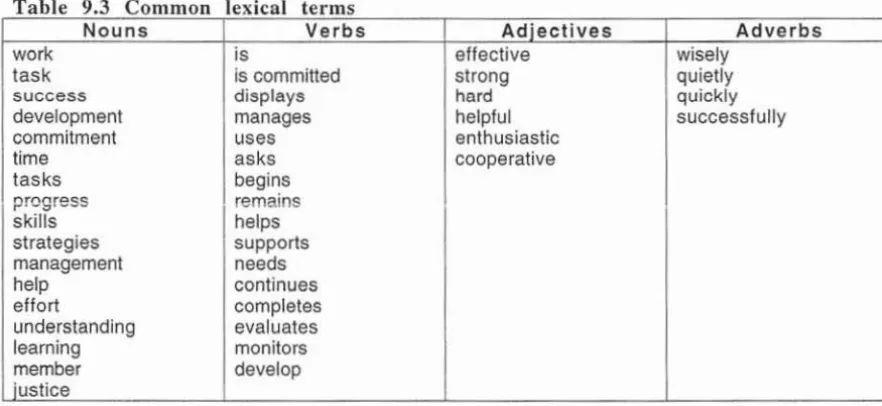
(10) Chapter 9 The Production of the Literate Subject. I collected all available reports for the 1992 school year - three reports for each child written by each of the four class teachers. I read this set of texts noting repeated words. Identifying lexical chai ns or content words helps build an analysis of the world and its participants as represented in texts (Halliday 1985; Kamler 1994a). Content words include nouns, adjectives, verbs and adverbs, and exclude functional words such as articles, prepositions, conjunctions and pronouns. The idea is to build up lexical classifications schemes in order to 'chart how d iscourses are made up of various wordings' (Kamler 1994a, p.132). Using lhis approach [ identified common lexical items. (Table 9.3 represents a sample of commonly occurring vocabulary.). .. Ta bl e 9 3 Common lexical terms No un s. wo'" lask success developmenl commitment time tasks progress skills strategies management help effort understanding learning member I iustice. Ve rbs. ;s is commilted di~play~. manages uses asks begins remains helps supports needs continues completes evaluates monitors develop. Ad ·eeti ve s effective slrong hard helpful enthusiastic cooperative. Ad ve r bs wisely quietly quickly successfully. My aim in conducting a broad analysis across the corpus was to get a sense of what words were used by the teacher writers in reporting on the enti re Banfield student population. Lexical choices are not insignificant. Networks of words indicate the discourses employed by teachers as they evaluate students and record that evaluation in writi ng for the student, parents and colleagues to read. Words construct specified grids, norms against which the student can be j udged . In this site at this time key lexical items include work, develop, task, time, success. For example the word 'work' (or worked, works, working , worker) appeared 594 times on a computer search of 148 student reports. My aim is not to provide a quantitat ive analysis here, but it is interesting to note that on the same scan the word 'learn' (or learnt/learned, learns, learning, learners) appeared 187 times. In this scan no other key words were used anywhere near as frequently as work, as counts on other common words indicate: task (179), develop (170) , help (166), lime (161), success (122), progress (59), COnunil (53), strategies (4), manage (33). In the same scan, writi ng appeared 185 times, spelli ng 109 ti mes, language 44 times, reading 35 times, grammar 6 times, and speaking on one occasion.. Page 370.
(11) Chapter 9 The Production of the Literate Subject. This broad analysis and comparative cou nts of key vocabulary hi ghlight the significance of the managerial discourse in the fonna tion of the student at Banfield that year. However teachers did not draw exclusively on the managerial discourse but blended it with other discourses: educational (ski lls, strategies, progress. learning), psychological (displays, development, attitude) political Gustice) and moral (helpful, cooperative, commitment). For instance, teacher references to students having a sense of justice in dealing with others in the community is informed by progress ive Catholicism. Thus it cannot si mply be said that the ideal Banfield student was constituted entirely through managerial discourse.. 9.3.1 The ideal Banfield student: Transformations and reformations To give a clearer picture of this heterogiossia of discourses at work in the formation of the literate student I turn now to an analysis of the report cards of fi ve students whose classroom performance I observed first hand. Here I consider the documents in their entirety, considering any statements about literacy within the context of the whole report.. My aim is to consider how and what kinds of students' school behaviours are observed and recorded in order to establish what kinds of knowledge teachers bring to bear in constituting the student. There are several reasons for close consideration of the reports of these particular students. The grade five/six Iseven class were the senior students and expected to playa leadership and pastoral role with younger peers. They were in their final years of primary school ing, soon to be graduates of Banfield. I have focussed upon the reports of contrasti ve students, based on my observations in the classroom, interviews with the teachers and my reading of their reports. For example, I have included students new to the school and those who have a long history of schooling at Banfield. I have analysed the reports of students whom the teacher constructs as ideal and those who are portrayed as problematic or as deviating from the school ethos and norms. I have included students from different cultural and language communities. I have included two gi rls and three boys. Several of the students received government assistance because their families are classified as economically disadvantaged. In addition, I have se lected reports of students who readers will have already briefly encountered in previous chapters. notably, Juli a in Chapters Six and Seven, Tatiana in Chapter Seven, Carlo in Chapter Eight, Mark in Chapters Seven and Eight and Joel in Chapter Eight. Below I incl ude the April reports for Joel, Tatiana, Mark, Juli a, and Carlo. Each of these reports is written by the same teacher. Fi rst the reports are presented fully with no discussion, in order that readers can read them one against the other. noticing similarities, patterns and contrasts. I follow with a discussion of successful and problematic students.. Page 371.
(12) Chapter 9 The Production of the Literate Subject. Fi ure 9.3.l n J oel's r e ort BANFIELD SCHOOL REPORT April 1992 Year 5/617 Since school began Joel has displayed the behaviours of a student committed to learning and success. During classtime Joel begins work quietly. He remains on task despite distractions. He ensures that he has all the things he needs to begin work. He asks many questions, clarifies tasks and expectations, accepts his mistakes and is resourceful about getting help when he needs it. During ou r recent Language work, Joel demonstrated his effective use of time management strategies and organisational skills. He used his time wisely, monitored his own progress and evaluated his efforts. To his credit, Joel is currently feeling the satisfaction and success thai comes with consistent effort and hard work. Joel is a valuable contributor during class meeting time. His strong sense of justice and his compassion towards others is evident in his thoughts, ideas and opinions. Joel willingly helps and supports others. Signed Teacher. .......................................... Principal. .......................... .. [A hand written note on the right hand side, added by the principal, reads:] Joel I am absolutely deli hted with our a roach and commitment this term.. Figure 9.3.1b Ta tian a's report BANFIELD SCHOOL REPORT Tatiana. Year 5/617 April 1992 Tatiana approaches school work with enthusiasm and a strong sense of commitment. This is shown by Tatiana's work habits. Tatiana will clarify a task before she begins work, making sure that she has understood. She works quickly and remains on task. Tatiana completes wo rk in the given time. Tatiana understands the need to plan her time wisely. She has successfully used some effective time management strategies. She has shown an ability to monitor her progress, evaluate her efforts and set future learning goals. With consistent practice in this area Tatiana will continue to refine these important skills. Tatiana is an effective group member. She expresses her thoughts clearly. She builds on the opinions of others or disagrees without aggression. Tatiana is supportive and encouraging of other group members. She is a fair and just organiser, showing sensitivity to the needs and feelings of others. Tatiana endeavours to keep our negotiated class rules. She is cooperative and helpful in class. Signed teacher ................................ Principal ................................... . (A handwritten note on the bottom, added by the principal, reads:] It is great to developing very sound learning strategies.. see you. Page 372.
(13) Chapter 9 The Production of the Literate Subject F i ure 9.3. 1c Ma rk's r e o rt BANFIELD SCHOOL REPORT Year S/6n Aodl 1992 In the early weeks of this term Mark demonstrated difficulty relating to other class members and adults in the school. He found that many of his attitudes and actions towards others conflicted with the general expectations of the school. This realisation presented a challenge for Mark. He had to make some hard decisions and take some responsibility for changing his behaviour. To his credit, he has begun to take on responsibility and lately, he is showing some very positive and observable signs of development. On many occasions he is; - helping and encouraging others. - allowing others the right to learn by minimising disruptive behaviour. - allowing others the right to speak without interruption. - responding app ropriately to requests. - making useful and valuable contributions to class discussions. This has been evident in his role as 'chairperson' for class meetings and 'computer expert' for other classes. Mark's excessive knowledge has also enabled him to contribute valuable thoughts and ideas in class discussions. Initially Mark wasted much class time . He took a long time to settle, to begin the task and to stay on task. However, our recent language work has shown Mark the importance of time management and effective organisational skills. Mark has begun to direct his energies towards the development of these skills. Mark is iorming positive relationships with his peers. He has a sensitive nature that he is beginning to share with others. Mark can be co-operative, helpful and responsible when he chooses. Signed teacher ................... ............. Principal ................................... . [A handwritten note on the right hand side, added by the principal, reads:] It is wonderful to see these asitive as ects to our learnin and behaviour bein mentioned here. Kee this u !. F i ure 9.3. 1d Julia's re ort BANFIELD SCHOOL REPORT Year S/6n April 1992 Julia began this year with a healthy attitude to learning. She was keen to meet the set work expectations. She endeavoured to complete her work on time. She worked consistently during classtime. Julia's attitude and commitment to work has been through observable changes these past few weeks. She is slow to get organised and slow to begin work. She is not managing her time. Consequently, she is not experiencing the satisfaction that comes with personal effort and success. I am helping Julia to overcome this by: - stating the expectations that she is required to meet ego time limits. - expecting her 10 accept the consequences of her chosen course of action ego work not finished is to be done in her own time. - helping her to set goals and to use strategies for time management and organisation. Julia is beginning to respond to these ideas. Julia expresses herself articulately. Her thoughts, ideas and opinions are valued in our class meetings and discussions. When given leadership roles during class meetings, she demonstrates an ability to summarise discussions and make insightful observations. Julia has a warm and sensitive nature. Her delightful sense of humour is appreciated by us all. Signed teacher ................................ Principal. ..... ............................ .. [A handwritten note on the right hand side, added by the principal, reads:] Keep practising those mana ement skills Julia. The are essential for success.. Page 373.
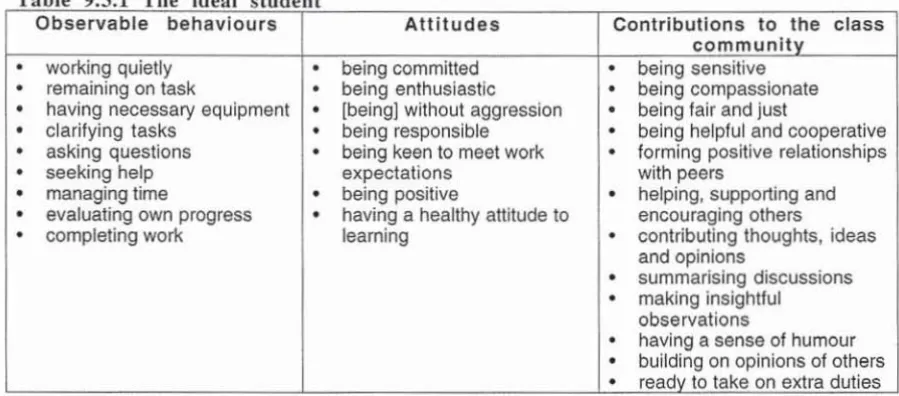
(14) Chapter 9 The Production of the Literate Subject. F i urc 9. 3. Je Ca rlo's re ort BAN FIELD SCHOOL REPORT. .crum. Year 5/617 April 1992 Carlo began this year with a positive attitude. His actions showed that he was determined to succeed. He was prepared each day with the things that he needed, he began work quickly and he remained on task. Carlo has maintained this attitude most of the term. Consequently, he is experiencing a successful term. Our recent language work rep resented a major challenge for Carlo and he worked hard to meet it. During this work Carta began to realise the importance of managing his time wisely. He is currently developing the skill of breaking the large task into smaller bits and then working through them, step by step. He is beginning to realise the need to clarify the task when he is unsure and to seek the help that he needs. He is gradually becoming aware of his own responsibility in his learning. With continued practice and encouragement Carlo will further develop in this area. Carlo's main area of need at this stage is reading. He needs support and daily practice. I am encouraging Carlo to regularly change his book, to read at home and to read to me. He is showing positive signs of growth. Carlo is helpful and co-operative in class. He is always willing to take on extra duties. Si ned teacher ....... ......................... Princi al ................................... .. Across the five report cards, representations of the ideal Banfield student are constructed across specified behaviours, abilities, attitudes and knowledges. Readers may have noted the consis tency of the teacher's criteria across the students. Whilst there are no headings, as such, each child is clearly assessed using a similar formula. The teacher writer makes reports on: •. observable behaviours. •. attitudes. •. contribution to class conununi ty. •. areas in need of change. •. teacher action. •. academic performance in specified subject areas.. The first three areas, observable behaviours, attitudes and contribution to class community, are positive descriptions of what a student should be like. Below in tabular form I summarise this grid of required behaviours, attitudes and contributions in order to build a composite identity-kit of the ideal student.. Page 374.
(15) Chapter 9 The Production of the Literate Subject Table 93 I The ideal s tudent Observ able. be ha vi ours. • working quietly • remaining on task. • • • • • • •. having necessary equipment clarifying tasks asking questions seeking help managing time evaluating own progress completing work. Attitudes. • being committed • being enthusiastic. • • • • •. [being] without aggression being responsible being keen to meet work expectations being positive having a healthy attitude to learning. Contribution s 10 Ihe clas s c o mmun it v being sensitive • being compassionate • being fair and just • being helpful and cooperative • forming positive relationships with peers • helping, supporting and encouraging others • contributing thoughts, ideas and opinions • summarising discussions • making insightful observations • having a sense of humour • building on opinions of others • ready to take on extra duties. ·. The specified observable behaviours explain how the student should relate to their work and to the teacher as student. In sum, the ideal student actively relates to the teacher by seeking help, asking questions and clarifying tasks. Further, the student is prepared for work, works quietly and cons istently. evaluates their ow n progress and completes tasks on time. A teacher-student-work relationship is constituted here. The ideal student is one who initiates contact with the teacher in order to get the job done. Such a student is selfregulated. The picture of the student subject constructed here is of the individual worker and learner. When students display such behaviours, the teacher is able to make diagnostic assessmen ts about student attitudes - conunitment. enthusiasm, responsibility, a healthy atti tude to learning and so on. Students are congramlated on these assumed internal attitudes, which al low them to become successful students. The grids of behaviours and attitudes indicate how the students should relate to themselves and to the teacher. However as members of a classroom communi ty, students are not only responsible to themselves but also to their peers. In the third column the teacher lays out how students fu lfil such responsib il ities. The student subject required here is a social bei ng who demonstrates care for thei r commu ni ty by being sens itive, helpfu l, cooperative, compassionate and by using their talents (sense of humour) and abi lities (making insightful observations) for the good of the whole conununity. Thus the ideal student at Banfield at this time is not the isolated competitive worker or even an active learner. but a soc ially responsible community member. Being fair and just, compassionate and hav ing a sense of humour are placed alongside completi ng work and meeting deadlines. The student, as the citizen-to-be, is assessed on more than academic aptitudes or work rates. Thus the managerial discourse is recontex tualised in the ethos of this Catholic parochi al school.. Page 375.
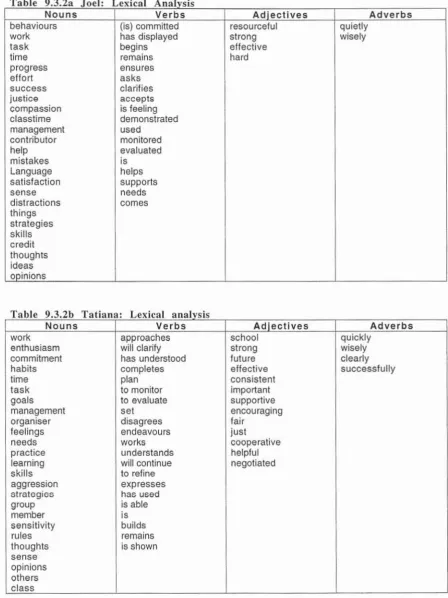
(16) Chapter 9 The Production of the Literate Subject. This teacher writer usuaHy made positive rather than negative statements about students. She reframed problems as areas for teacher action including, for instance, stating expectations, setting consequences, helping s[Udents set goals and showing students time management strategies. Nevertheless, three major transgressions were explicitly reported as areas requiring students to take responsibility for change - wasting time, interrupting others and not complying with teacher authority. Thus the students' responSibilities to. self, peers and teachers are laid out. The teacher writer presents an individualised blueprinr for action for each student, their parents. the principal and herself. The report card represents the formation of the ideal student subject and simultaneously delineates transformations required of students who deviate from the specified nOlms. It outlines how students should act, what they should say, how they should be. A generic identity is constructed for the would be successful student. 9.3.2 Successful students: Joel and Tatiana Reports are sites of textual reward and punishment. In these accounts teachers publjcly praise the sllccessful and chastise the deviant. Thus report cards can have direct effects on the lives of students and upon their identity formation. They are one of the major fOlms of public identification of the child as an official subject. (Others include birth certificates, passports, medical records.) In the case of school reports they are written in part for the child reader. Thus potentially the report may have substantial effects upon the student. At this point then my interest is in how different students are reported. I begin with a lexical analysis of the reports of two successful students, Joel and Tatiana. in order to see how success is discursively produced in individual cases. (See Figs 9.3.2a and 9.3.2b.) A lexical classification scheme makes the discourses easier to discem (Kamler 1994a).. Page 376.
(17) Chapter 9 The Production of the Literate Subject. Table 93 .. 2a Joel .' Lexica l Ana 'V s's I Nouns behaviours work task time progress effort success justice compassion classtime management contributor help mistakes Language satisfaction sense distractions things strategies skills credit thoughts ideas opinions. Ve rbs (is) committed has displayed begins remains ensures asks clarifies accepts is feeling demonstrated used monitored evaluated. Ad ' ectives resourceful strong effective hard. Adverbs quietly wisely. ;s helps supports needs comes. Ta bl e 9.3.2b Tatiana: Lexical analysis Nouns work enthusiasm commitment habits time task goals management organiser feelings needs practice learning skills aggression strotcgict; group member sensitivity rules thoughts sense opinions others class. Ver bs approaches will clarify has understood completes plan to monitor to evaluate set disagrees endeavours works understands will continue to refine expresses hilS used is able ;s builds remains is shown. Ad ectives school strong future effective consistent important supportive encouraging fair just cooperative helpful negotiated. Adverbs quickly wisely clearly successfully. By April 1992 Joel and Tatiana had attended Banfield for some years and were seen as successful students, They were well-liked by teachers and their peers. Their class teacher's reports indicate what cou nts as success at this time. The lexical analysis is il luminating. Key discourses and associated lexical items include: •. managerial (work, habits, time, tasks, goa ls, organiser, manage ment, effort, st ralegies, progress, resourceful, effective, quickly);. Page 377.
(18) Chapter 9 The Production of the Literate Subject. •. soc ial (community, group, member, class, rules, feelings, needs, others, helpful , contributor);. •. educati onal (skills, learning, practice, clarifies, understands, behaviours, has displayed);. • • •. political Uustice, just, fai r); indi vidualism (thoughts, ideas, opinions, sense); psychological (sens itivity, enthusiasm, commitment, compassion, wise ly, [without] aggression; [despite] distractions; cooperative).. These categories overlap but this preliminary analysis begins to show what coums as the sllccessful student: workers who man age their time, cooperate with others, have a soc ial conscience, control their own behaviour and are committed to school goals. In these first reports ofthe school year little is said about students' performance on school subjects as such. Only one reference is made to 'Language work' in Joel's report and no references to a school design ated subject are made at all in Tatiana's. In Joel's case Language is placed with a managerial discourse. Tatiana and Joel represent the kinds of student outcomes teachers at Banfield aimed for. Successful students exhibit a repertoire of work habits, personal attributes, social dispositions, moral commitments and academic abilities. Within this contested ethical terrai n, as I discuss below, literate competencies are enmeshed. Literate practices do not happen in a vacuum and the school ethos, hislOry and contemporary discursive practices impact on what teachers come to see as their work. Literacy pedagogies and associated strategies are always in a process of reformulation and redesign in local si tes. At Banfield, for instance it becomes more important for Joel's teacher to report that he is 'a valuable contributor to class meeting time' and that he has a 'strong sense of justice' than it is for her to describe his competence in the 'oral report' genre. Similarl y the 'important skills' that Tatiana is reported as practising are 'an ability to monitor her progress, evaluate her efforts and set future learnin g goals'. Thus at this time students' generic skills and dispositions as workers, class members and learners are made central. Literate competencies, by whatever definition of literacy, are backgrounded. If teachers are required to 'transform children' (Weiler 1988) and literacy is seen as a major component of that transformation, it is important to analyse the discursive events in whic h Iiteracies are located. In this first report for the year the blueprint for proper studentship is laid out. These repons announce to each student and their fantilies what kind of student is required. In the case of Joel and Tatiana we hear the stori es of successful students: committed,. Page 378.
(19) Chapter 9 The Production of the Literate Subject. enthusiastic self-regulated workers, leamers and community members who manage their own time, support their peers and demonstrate a sense of justice. Thus the student as ethical subject is registered. These sets of obl igatory uaits will have different impact on different students. Becoming an ideal student requires fundame ntal transformations for students whose out-of-school identities conflict with the student self demanded at school. I tum now to a discussion of April reports of three students who were each in different ways constructed as problematic: Mark, Julia and Carlo.. 9.3.3 Problematic students: Mark, Julia and Carlo Mark had recently transferred to Banfield. somewhat unw illingly, from a local state elemental), school where his previous teacher noted (in a report filed at Banfield) that he was making 'serious attempts' to 'eradicate his behaviour problems'. Mark's parents had recently separated and he and one younger sibling lived mostly with the ir father. Mark is Anglo Australian and spoke English as a first language. Mark's full report is reproduced in Figure 9.3.1c. Table 9.3.3a is the lexical analysis made of this report.. Page 379.
(20) .,,. T a bl e 9 33M . a Noun s weeks difficulty class members adults school altitudes actions expectations realisa tion actions expectations realisation challenge decisions responsibility behaviour development signs occasions credit right interruption requesls contributions discussions role chairperson class meetings knowledge thoughts ideas time task skills management nature eneroies. k. Chapter 9 The Production of the Literate Subject. L eX .lca I. a naI lVS'IS. Ver bs demonstrated found conflicted presented has begun is showing is helping is allowing is responding has enabled wasted took has begun is forming is beginning chooses. Ad ectlv e s early general hard observable positive many disruptive useful excessive valuable class long eflective organisational language co-operative helpful sensitive responsible. Ad ve rb s appropriately. As the table shows, Mark is assessed on the same grid as his successful classmates: management, ski lls, contributions to the community and so on. However, Mark is seen as hav ing some difficulties and challenges. His actions are also described in terms of conflict and wasting time. Mark's difficulties are constructed in terms of how he re lates to other people; however his actual misbehaviours are not spelt out directly. Rather his teacher reports that he has made some 'hard decisions' and 'has begun to take responsibility' and that she can now see 'posi tive and observable signs of develop ment'. In reportin g these positive signs she implies what was wrong with his previous ways of relating: On many occasions he is: - helping and encouraging others . • allowi ng others the right to learn by minimising disruptive behaviour. - allowing others the right to speak without interruption. - responding appropriately to requests. - making useful and valuable contributions to class discussions.. Page 380.
(21) Chapter 9 The Production of the Literate Subject. Thus the report tells of a student in the process of transformation. At the same time as it tells of Mark's conflicts with Banfield expectations, it explains how this is being changed, indeed how Mark is being transformed by working on himself and taking on the responsibi lity for his own reconstnlction, The report provides a positive model or 'identity kit' which Mark appears to be on the brink of embracing. Mark is becoming a self-regulating individual who can modify his behaviour according to the norms of his school community. This is described as a sign of development. In this first segment of the report the teacher writer employs a number of discourses to assess the student. She uses her expert teacher knowledge of the developing child to psyc hologise his behaviours, attitudes and internal cognitive states in the context of this school. Thus she employs psychological, moral and educational discourses to know Mark as student. The danger here is that, as 'behavioural clinician' (Foucault, 1977), the teacher will be ascribing to the student a cognitive state which is indeed the accomplishment of institutional discourse (Luke 91, pp.17·18).. The teacher then goes on to preseot evidence of Mark's development and to refer to what count as his positive contiibutions to the class: - being 'chairperson' - being 'computer expert' . contributing to class discussions from his 'excessive knowledge'.. Both Mark's problematic and positive behaviours can be read as fanning part of a gendered ensemble often associated with male communication styles. His leadership and knowledge are placed against his interrupting and disrupting. his discounting of the needs of others. What is required of Mark then is an analysis of what counts as appropriate for a knowledgable, energetic, male student in this classroom. His energies must be subjected (0 self control and redirected to more useful ends Thus discipline produces subjected and practised bodies, 'docile' bodies. Discipline increases the forces of the body (in economic tenus of utility) and diminishes these same forces (in political tenus of obedience). In shan, it dissociates power from the body; on the one hand, it turns it into an 'apti tude" a 'capacity', which it seeks to increase; on the other hand, it reverses the course of the energy, the power that might result from it, and turns it into a relation of strict subjection (Foucault 1979, p.138).. As his teacher puts it: Mark has begun to direct his energies towards the development of these skills.. Mark is then named as potentially someone who might be a good student if he chooses. School success for Mark simply requires that he make the right choices at the right time and those right choices are very much about his self-control in relation to others. What Mark has to demonstrate is that he knows when it is appropriate for him to be a computer expe11. a chairperson, and to contribute from his 'excessive knowledge' and when these. Page 381.
(22) Chapter 9 The Production of the Literate Subject. behaviours will be considered as interruptions or disruptive. Thus for Mark there is no question of him having academic credentials, but he must learn when and how to display these in the community as well as what cannot be displayed. Mark's parents have been given an instrument wh ich explicates how Mark should be in school. Implied in reporting as an institutional discursive practice is the ever-present, but unspoken assumption that parents and teachers will form alliances in re-shaping the wayward student. For disciplinary practices to work they must peneLrate all insti tutions of the social body. Thus the report must go home to do its work in the family. I move now to discuss a female student, Julia, who was also considered by her teacher as problematic. Julia had attended Banfield for several years and was well known by staff members and students. Julia lived with her mother, who was unemployed at that time and physically unwell. Like Mark she was considered a potentially able student academically but without the right studen t habits, attitudes and behaviours. Unlike Mark, Julia made a good beginning to the year but her teacher reported that her performance had since deteriorated. Her full report is reproduced in Figure 9.3.1d. The table below represents the lexical analysis of this report. Ta b le 9.3.3 b Jul ia: Lexical analysis No un s Ve rb s attitude began was hearing work individual expectations walked time has been class time is managing is commitment am helping changes satisfaction is beginning limits expresses are valued effort success demonstrates consequences is appreciated course action management ideas thoughts opinions meetings discussions roles waiting observations nature sense humour. A djec t ives healthy sel observable time personal slow chosen finished class leadership inSightful warm sensitive delightful. Ad ve rb s consistently articulates. Julia does not have a problem with anti-social behaviour but for different reasons she does not meet deadlines and does not produce the work required. What is problematic here is that Julia's 'healthy attitude to learning' has not been sustained. A healthy attitude. Page 382.
(23) Chapter 9 The Production of the Literate Subject. is defined within the text as being 'keen to meet the set work expec tations', completi ng 'work on time' and working 'consistently during classtime'. The iss ue here is Julia's commitment to work. No explanation is offered for Julia's change of attitude. It is simply reported as fact - supported by the 'observable changes' noted by the vigilant expert teacher. Thus the parent reader is presented with evidence of this change and the teacher's action on thi s prob lem. I am helping Ju lia to overcome this by: - stat ing the expectations that she is requ ired to meet ego time limits. - expecting her to accept the consequences of her chosen course of action ego work nOl fi nished is to be done in her own time. - helping her to set goals and to use slrategies ror time management and organisat ion. Julia is beginning to respond to these ideas.. Thus the new reg ime is spelt out for the absent parent who in some way may be implicated in Ju lia's deterioration in her student duties. Once agai n the teacher employs a managerial discourse as her organising framework. In other words the teacher rewrites Julia as a student in terms of 'time limits', 'seuing goals', 'time management and organi sation' and so on. I did not speak to parents and certainly not to Ju lia's mother (w ith whom Julia lived at that time). However it is interesting to speculate on the ways in whic h such a discourse might be read by families who have not had the opportunity to participate in regular paid work in consistent set hours of the day. The ideal student is constructed as a keen selfregulating worker who can produce on time and work consistently. The promise of satisfacti on and success is dependent on Julia making the 'personal effo rt'. Agai n success is just there - awaiting the student's correct choice for hard work, effort, speed and organisation. Thus the teacher presents her diagnosis of the student and her treatment of the problem. In effect, in layi ng out her pedagogical solutions the teac her writer prescribes an appropriate pedagogy for the fa mi ly. Next Juli a's teacher moves to the part of the report text where Ju lia's strengths are defined. AU the reports end on a positive note. Here we fi nd a different Ju lia who is not slow and who does not lack commitment. The 'oral' Julia as opposed to the 'nonproducing literate' Julia is highly successful within the classroom community. She 'expresses herself articu lately', 'summarises discussions', makes 'insightfu l observations' and 'has a del ightful sense of hu mour'. While these things obviously count as part of the ideal student repertoire, they are presented last almost as antidote to the critiq ue of the student whi ch takes up most of the text. Even though Julia's oral accomplishments are not ignored, they are separated fro m her other 'work'. Her articulateness is constructed as a gift, a talent, something other than learning and work. It Page 383.
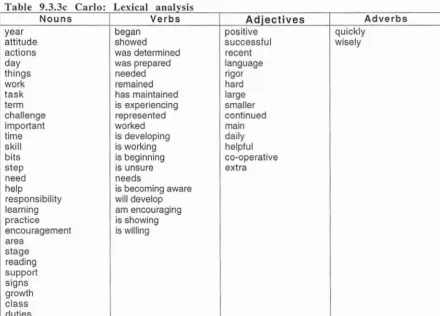
(24) Chapter 9 The Production of the Literate Subject. clearly does not count in the same way as producing the desired product by the set deadline - Julia's literate work. Even though literacy is not mentioned (nor is reading or writing), implied in all of these reports is that the work is students' written products that, after all, is one of the major fomls of work which students produce in school. It must be remembered that these reports contribute to the dossier to which the principaJ refers when the time comes for students to go on to selective high schools. Julia's attitude problem may result in the principal withholding a reference for her preferred high school.. If she is asked to submit her reports for her last year of primary school this will be one of them. Unlike Mark, Julia is not asked to change her behaviours towards others but her own ways of operating in the classroom. She is asked to manage her time better to improve her productivity. This will happen if she is more carrunitted and if she takes on her teacher's advice and strategies for time management. Again the object is to train Ju lia in self-regulating practices which will allow her (0 govern herself. Another problematic student is Carlo. Carlo had been at Banfield for upwards of five years by the time the present repolt was written. Carlo lived with both parents and several brothers and sisters. He spoke Italian as his first and family language and had learnt English as a second language. When this report was written he was in grade six in a grade five/six/seven composite class. Table 9.3.3c Carlo: Lexical analysis Noun s year altitude actions day things work task term challenge important time skill bits step need help responsibility learning practice encouragement area stage reading support signs growth class duties. Verbs began showed was determined was prepared needed remained has maintained is experiencing represented worked is developing is working is beginning is unsure needs is becoming aware will develop am encouraging is showing is willing. Adjectives positive successful recent language rigor hard large smaller continued main daily helpful co-operative extra. Ad ve rbs quickly wisely. Page 384.
(25) Chapter 9 The Production of the Literate Subject. Carlo is also evaluated across a similar grid of performance drawing on managerial, psychological and educational discourses. He has a 'positive attitude', 'his actions showed that he was determined to succeed', he has 'the things he that he needed', he 'began work quickly' and 'remained on task', 'he is experie ncing a successful term'. The use of success in relation to a 'successful term' is qualified. In the second paragraph there are some signals that Carlo, despite his following the norms of hard work and effort, may not be experiencing the satisfaction and success Joel and Tatiana are reported to enjoy. In Carlo's case positive attitude may not be enough. We are told that the recent language work 'represented a major challenge for Carlo'. Then we are told that Carlo 'worked hard to meet it'. However the teacher goes on to portray Carlo as needing to 'break the task into smaller bits' in order to work through them 'step by step'. While it is never made clear, the educational discourse employed by the teacher can be read as euphemistically suggesting that Carlo finds school work difficult. A euphemism is a word which is substituted for a more conventional or familiar one as a way of avoiding negative values. (Fairclough 1989. p. 117). In Carlo's report, words such as 'major challenge', 'unsure', ' smaller', trigger warning bells for teacher readers, but may well go unnoticed by parent readers. Given their mUltiple audiences and functions, it is not surprising that teachers are cautious in what they write in reports. In anticipating student, parent, teacher, principal and other allied 'child professionals' as wou ld be readers, teachers need to be careful. The report is a document intended to produce positive effects unObtrusively and to avoid producing negative effects. Euphemisms provide one technique for teachers to softe n negative evaluations of the student (McKenzie 1992). As McKenzie notes, it is not only through the use of euphemisms, but also through the use of double negatives such as 'not unsatisfactory' and moderating phrases such 'a little' that the text is given its cautious quality. While Carlo has presented himself as the ideal student in terms of work habits and attitudes, the language work continues to present him with a major challenge. After signall ing that perhaps all is not completely well with Carlo but never specifying what exactly is wrong, the teacher moves to reassure by promising that with 'practice and encouragement' he 'will further develop in this area'. Exactly what 'this area' is remains unclear. Unlike the other students' reports, for Carlo literacy is marked out as an area of concern. Following the remark above about the recent language work being a major challenge for Carlo, the teacher returns to her theme of 'area of need', The report states his 'main area. Page 385.
(26) Chapter 9 The Production of the Literate Subject. of need at this stage is read ing'. Exaclly what is needed is not specified, but if we deduce from what follows, it wou ld appear that Carlo needs reading practice. He needs to change his book regularly, to read to his teacher and to read at home. The report indicates that the teacher is watching Carlo closely and that he needs to be checked regularly. Havi ng been identified as a novice reader, Carlo is reported as requiring step by step practice and conti nual professional monitoring. Why Carlo needs this practice is not explained. This paragraph reassures parent readers that he is showing positive signs of growth, presumably in reading, though what these signs consist of is not explai ned. The teacher is faced with multiple dilenunas in writing Carlo's report. Hav ing set her criteri a around work habits and attitudes, it is then difficult to write about a student who presents these, but still struggles to succeed by academic criteria. Thus the report is written to acknowledge Carlo's efforts but to signal to a professional reader thaL all is not completely well. Carlo spoke Italian at home. His teac her was unsure whether Carlo's parents could read in English but he had an older sibling who could read and translate. The chances are that this report could be heard by Carlo. hi s parents and siblings as 'successful', whilst the princi pal. future teachers and the principal of the selective high school to which he might apply, will recognise the euphemisms for a student experiencing learning and literacy difficulties - the child who needs the task broken into smaller bits, who experiences major challenge with his language work and who at eleven and a hal f years of age needs to read to his teacher. Locked into a network of wri ting, Carlo (even with the ri ght attitude, commitment, responsibility and work habits) is recogn isable as a student with literacy difficulties, if unspecified. Because literacy is a stumbling block for Carlo's school success, I decided to investigate his archival records more closely and I return to this analysis in Section 9.4. Before looking closely at Carlo's reports I conclude this section with a discussion of the apparent absence of literacy in the. 1992 corpus.. 9.3.4 An absence of literacy? Desp ite the proclaimed importance of literacy, it is at first sight largely absent from the repol1s studied above. Except for the case of Carlo, there are very few specific references to literacy in the April reports for the grade five/six/seven class. However, it may be that literacy is not absent but present in a reconstructed vocabulary. For example, in the excerpts which follow it could be argued that literacy is present but in a renamed form. During our recent Language work, Joel demonstrated his effective use of time management strategies and organisational skills. He used his time wisely. monitored his own progress and evaluated his efforts.. Page 386.
(27) Chapter 9 The Production of the Literate Subject. However, our recent language work has shown Mark the importance of time management and effective organisational ski lls. Mark has begun to direct his energies towards the development of these ski lls. Tatiana will clarify a task before she begins work , making sure she has understood. She works quickly and remains on task. Tatiana completes work in the given time. Julia began this year with a healthy attitude to learning. She was keen to meet the set work expectations. She endeavoured to complete her work on lime. She worked consistently during classti me.. In Joel's and M ark's reports literacy is reframed as 'language work' and embedded in a managerial discourse. In Tatiana's and Julia's reports language is an absent category altogether. However if we replace 'work' with 'wri te' in the excerpts from Tatiana's and Julia's reports the results are interesting. 'Tatiana will clarify a task before she begins writing, making sure she has understood. She writes quickly and remains on task. Tatiana completes writing in the given time.' 'Julia began this year with a healthy attitude to leaming. She was keen to meet the set writing expectations. She endeavoured to complete her writing on time. She wrole consistently during classlime.·. In these texts 'work' and 'effort' come to stand for 'writing' and 'products'. In other words, the managerial discourse surrounding work becomes so dominant that it equates with or stand s for writing. Wri ting is after all students' work. Written products are the results of students' efforts to be on task. In this school context then, writing is constructed as students' work, as a product to be fin ished by a deadline. The discursive constmclion of the literate student in this sc hool at this period is enmeshed with accountabil ity and economic agendas. When progressive discourses were dominant, a split between children's activities at school and paid employment was marked by avoidance of tenns associated with labour and work for what children did in school (Close 1992). In this school at this time there seems to have been a blurring of these boundaries as the manageri al discourse of employment and traini ng increasingly merges with the di scourses of education. In these circumstances students' literacy can be equated with productive work. This was evide nt in the teacher's everyday classroom talk and reiterated here in the reports to paren ts. I would argue that this discursive change indicates a shift from the emphasis on reading and literacy for personal enjoyment and fulfilment to wri tten productive li teracy for work and personal management. The repOli cards foreground students' self-management, use of time and productivity. Foucault (1979) has argued that disciplinary practices inserted into modem institutions, such as armies, schools, hospitals and workplaces govern the population unObtrusively through detailed control of individuals in time and space.. Page 387.
(28) Chapter 9 The Production of the Literate Subject. [Al n attempt is also made to assure the quality of time used: constant supervision, the pressure of supervisors, the elimination of anytbing that might disturb or di stract; it is a question of constituting a totally useful time. (Foucault 1979, p. 1S0). WhiJe Foucault described the modem fac tory. he could just as easily be talking about the school. The emphasis in the reports is on productive use of time and the avoidance of anything which may intetfere with that. The pressure on teachers to produce wellbehaved, productive, literate students trans lates into the vocabulary of report cards and classrooms. This is a period of discursive change where the literate studen t in a disadvantaged school is constituted in particular and non-accidental ways. The discourses employed in reporting on school srudents shape certain possibilities for identities. While the developing child of the eighties is still visible here, there is a new urgency about. productivity, behavioural self-control and working within time limits. The formation of the 'new worker' required by fast capitalist industrial information societies is in process here. How and why the literate student in a disadvantaged school such as Banfield is disc ursively constructed as 'worker' and what the social and material effects are or might be in students' life trajectories are important and complex ethical questions. Predicting or evaluating the outcomes of such an education are beyond the scope of this project but are clearly important questions for later research. I move now to the repon card arc hive of Carlo, in order to look more closely at the shaping of literacy and the related construction of school success and failure.. 9.4 The construction of the literate subject across a school career As [ have discussed in Chapters Four and Five, the late eighties and early nineties were a period of discursive turmoil and contestation in school education. The romance and opt imism of progressivism were under attack from both the right and the left in terms of alleged student outcomes. The right made claims about literacy crises and the left argued that disadvantaged students were failed by schooling and school literacies. Through an analysis of the report archive of one child across his primary school career, r examine how a multiplicity of discourses collide and compete in producing the literate student subject. It is evident in Carlo's report archi ve that progress ive discourses {' taking children from where they are at') coexist with and are reshaped by managerial discourses ('productivity', 'time management' and 'standards'). Carlo's corpus of reports can be read as the dossier of a literate subject. In analysing Carlo's report file my focus is upon what counts as literacy and how Carl o performs accordi ng to changing and non-changing criteria. I read the reports historically making. Page 388.
(29) Chapter 9 The Production of the Literate Subject. reference to dominant educational discourses especially those which relate to literacy education. My aim was to consider the discursive construction of the literate subject. with reference to one student. What do Carlo's reports say about Who Carlo can/should be? What must be transformed? What must Carlo do and be {O be a success in the literacy classroom? What changes and what remains the same over his primary schoo l career? Focussing in particular on the literacy related entries, I followed Carlo's sc hool career at Banfield through an analysis of his reports from 1989 (the earliest on file) to 1993 making comparisons across the five year period. Through this longitudinal corpus, I worked towards historicising and contextualising the discursive construction of the contemporary literate subj ect at Banfield and I considered conti nuities and discontinuities as they related to one child's schoo l experience. I deci ded to analyse Carlo's reports for a number of reasons. Along with his siblings he had attended the school for most of hi s school career. Carlo had grown up in the local vicinity and, like many other families in this community, his parents had experienced longterm unemployment. As is noted in Section 9.3.3 Carlo, had been identified as having needs in literacy and spoke English as a second language. Carlo then was not an unusual student in the context of a disadvantaged school community. When Tvisited the sc hool, I worked closely with Carlo's class. His teacher regularly described he r concerns about the standard of his written work. I worked with his younger sister in another class where the teacher's story about Adrianna was similar. An older sibling of Carlo's attended the same high school as my son so I regularly encountered Carlo and his family at local events such as weekend soccer matches. The family supported their children by regular attendance at schoolMrelated events. When I came to Carlo's dossier I was informed by my regular contact with him and his family both in and out of school. Carlo's report archive began at grade three and concluded with grade seven. Readi ng the corpus of Carlo's school reports retrospectively was akin to reading a narrative of a child's li fe at school - a series of regular updates on Carlo as student. It also illustrated how the reponing of literacy was done over this period by a number of teachers. We can see how different aspects of literacy are made to count differently at di ffere nt times. In Figures 9.4a to 9.41, I include literacy-related excerpts from each report starti ng with his early school career and concluding with a repol1 made in the middle of Carlo's final year al Banfield.. Page 389.
Figure
+2

Related documents
inadequacy of Dalit women‟s participation and representation in the national, regional, and local level institutions and decision making structures proves that the claim of
Further, if mental does not depend on physical events then also, there is need of explanation as to.. where to locate
various national level agencies often carry out their activities within local authority areas. without consultation or collaboration with the relevant
Neutrons produced in nuclear research reactors are widely used in science and engineering. Since neutrons are highly penetrating they can be used to probe deep within the materials
We aim to recruit 1000 low back pain patients aged 18 years and over consulting 7 GP practices within one Pri- mary Care Trust in England, UK. The study includes GPs in
For the concluding validation, concurrent validity criter- ion needs to be determined. Our questionnaire was developed for population-based cross-sectional studies of sleep
The multivariate methods which were applied for the regression of spectral data include: • SMLR: stepwise multiple linear regression til SPCR: stepwise principal component regression
5.4.6 Conclusion The results of the present study clearly demonstrate that dietary protein and energy regulate the growth, proximate composition and level of circulating IGF-I
