JOURNAL OF VIROLOGY, Sept. 1990, p. 4321-4328 0022-538X/90/094321-08$02.00/0
Copyright ©D 1990, American Society for Microbiology
Template Switching
by
Reverse
Transcriptase
during
DNA
Synthesis
GUANGXIANG LUO ANDJOHN TAYLOR*
Fox Chase CancerCenter, 7701 BurholmeAvenue, Philadelphia, Pennsylvania19111 Received 6April 1990/Accepted 11 June 1990
Theability ofreversetranscriptasetomaketemplateswitchesduring DNA synthesis is implicit inmodelsof retrovirusgenomereplication,aswellasinrecombination andoncogenetransduction. In ordertounderstand
such switching,weused in vitro reactionswithpurifiednucleic acids andenzymes. Theassaysysteminvolved
theuseofanend-labeled DNA primerso astoallow thequantitationof elongationon adonor templaterelative tothe amountofelongation achieved by template switching (bymeansofsequencehomology) whenanacceptor
templateRNA was added. We examined several variables that affected the efficiency ofthereaction: (i) the reaction time, (ii) the relative amounts ofacceptor and donor template, (iii) theextent ofsequenceoverlap
between the donor andacceptortemplates, and(iv) thepresenceorabsence of RNase H activity associated with thereversetranscriptase. The basic reaction, with RNA templates and normalreversetranscriptase, yielded
asmuchas83% template switching.Inthe absenceofRNase H, switching still occurred but the efficiencywas
lowered. Also, when the donor template was changed from RNA to DNA, there was still switching; not
surprisingly, this was largely unaffected by thepresence orabsence of RNase H. Finally, we examinedthe
action of the RNaseHonRNA templates afterprimary transcriptionbut priortotemplate switching. Wefound that inmostcases,both ends of theoriginalRNAtemplatewereabletomaintainanassociation with the DNA product. This result was consistent with the work of others who have shown that RNase H acts as an
endonuclease.
In the life cycle of a retrovirus, the RNA genome is reversetranscribedinitially intoaminus-strand DNA, which inturn acts as atemplate for the synthesis ofa plus-strand
DNA(18). The syntheses of each of these DNA strandsare similar in thatthey areinitiated fromaunique locationon a specific RNA primer molecule. Also, both syntheses soon reach the endof their templates andcome to what is called astrong stop. According tothemodel, there then occurs a base-pairing interaction between the 3' end ofthe
strong-stop DNA and a complementary RNA sequence. Such an interaction effectively allows template switching and, thus, extension of the strong-stopspecies byDNAsynthesis ata secondlocation. The RNaseHactivity that isnormallypart of thereversetranscriptasemolecule doesplayapartinthis template switching; it is thought to degrade the relevant
RNA in the original hybrid with the strong-stop species, thereby freeingthat DNAsothat itmaymakethenecessary base-pairingreaction with the secondtemplatesite.
Thereare additional situations in whicharelated formof
template switchingisconsidered relevantto retrovirus rep-lication.
The second is in thecopy choice model ofrecombination
proposed by Coffin (1; J. M. Coffin, Appl. Virol. Res., in
press). Thecopychoice model is an extrapolation from the above-mentioned template switches that occur for minus-and plus-strand DNA synthesis. It proposes that
single-stranded nicks in the retrovirus genome would create new strong-stop species of minus-strand DNA during reverse transcription; these species could then participate in
tem-plate switchingtothehomologous site on asecond copyof
viral RNA, especiallysince the viralparticlesarethoughtto
containapairofviralRNAsheld inaso-called dimerlinkage
structure. By such template switching during reverse
tran-scription, a single full-length minus-strand DNA per virion
*Correspondingauthor.
could beproducedevenif bothofthe RNAscontainedmany single-strand nicks. Also, ifthe two RNAs were different,
then efficient recombination would be observed. Hu and
Temin (6) have recently established this requirement for
such a heterodimeric RNA, so as to allow high-frequency
retrovirus recombination. Also, studies by Goodrich and Duesberg (4) supportthe model of Coffin. The data donot addressaquite different model of recombination, referredto as displacement-assimilation, proposed by Junghans et al. (7).
There is a third proposal invoking template switching during reverse transcription. Swanstrom et al. (17) have
proposed a model to explain the ability ofretroviruses to transduce cellular proto-oncogene sequences. This model
invokestemplate switching between cellularand viral RNA
sequences duringreverse transcription.
Inordertogetabetterunderstandingoftemplate
switch-ingand how itworks,wesetupamodel in vitro system with purified templates and enzymes, in which the switching
could be quantitated and characterized. Our findings have
significantlyimprovedourunderstandingof thephenomenon alongwith themechanism of action of the RNaseH.
MATERIALS AND METHODS
Enzymes. Two different forms of cloned reverse
tran-scriptasewere purchased fromBethesdaResearch Labora-tories. The first was the intactenzyme ofMoloney murine
leukemia virus (MLV) (3), while the second contained a
C-terminaldeletion, so as toremovethe RNase H activity (8). The RNase H ofEscherichia coli was also purchased
from Bethesda Research Laboratories.
RNA and DNA sequences. The sequenceschosenas tem-plates for reverse transcription were from the genome of
Roussarcomavirus. (Inretrospect,therewasno significant reason for using these sequences over any others.) The
sequences werederived fromaRous sarcomavirus (Prague
4321
Vol. 64, No. 9
on November 10, 2019 by guest
http://jvi.asm.org/
B strain) provirus subclone. It spanned the region from nucleotide -299 to + 4, by the convention that +1 corre-sponds to the first nucleotide of the R sequence; that is, +1 is equivalent to the 5' nucleotide of the RNA genome. To make adonor RNA template, this region was subclonedinto the RNA transcription vector pGem3B (Promega Biotec). This clone was cut withHindlIl prior to transcription with phage T7 RNA polymerase. The resultant RNAcontained28 bases (b) of 5' vector sequences. It was gel purified and then cleaved as follows. A 13-b oligonucleotide complementary to -245 to -233 was hybridized, the RNA was digested with theRNase H of E. coli, according to the instructions of the supplier, and then the resultant 315-b 5' fragment was extracted and gel purified. To make the standard RNA acceptor template, a second pGem3B subclone was made, spanning -299 to -140. This vector was cut with
SphI
prior to transcription with T7 polymerase, and then the RNA product was gel purified. For the overlap experiment shown in Fig. 2C, we had to further modify the donor RNA to reduce the overlap with respect to the acceptor template. This was done, as above, with specific oligonucleotides and RNase H digestion.Togenerate plus-strand DNA templates, the
above-men-tioned plasmid clones were digested with either
HindIll
or SphI. Then, together with a single oligonucleotide, the DNA was used as template for asymmetric polymerase chain reactions (5) to generate single-stranded DNA. The resultant donortemplate spanned -245 to +44 (plus 30 b of 3' vectorsequence). The acceptor DNA spanned -299 to -140 (plus 17 b of 5' vector sequence). Again, the products were gel purified prior to use.
Reverse transcription. Synthesis reactions were carried out in the presence of 4 deoxynucleotide triphosphates
(1 mM each), 10 mM MgCl2, 100 mM KCI, 10 mM dithio-threitol, 50 mM Tris hydrochloride (pH 7.8), 1,000 U of RNasin (Promega Biotec) per ml, and 50 U of reverse
transcriptase in a 10-,ul reaction volume. The reaction mix-tures also contained 200,000 cpm of DNA primer that had been 5' end labeled with phage T4 kinase (Bethesda Re-search Laboratories) and [y-32P]ATP (6,000 Ci/mM; Du Pont, NEN Research Products). This primer was 14 b long, spanning the region -119 to -106, and complementary to the donor templates. The RNA templates were added at
approximately 30 ng per reaction (unless otherwise indicat-ed), so that the molar ratio of template to primer was
approximately 15. The amounts of the DNA template used per reaction were significantly lower. For reactions using only RNA templates, we also added 50
,ug
of dactinomycin (Sigma Chemical Co.), to inhibit DNA-directed DNA syn-thesis. The reaction volumes were 10,ul,
with incubation at 37°C for 1 to 3 h, unless otherwise indicated. In some cases, the DNA products were treated with alkali (0.3 N NaOH, 10min, 95°C) to remove RNA templates prior to gel analysis. For the experiment shown in Fig. 6B, samples were treated prior to electrophoresis with calf intestinal phos-phatase (Boehringer Mannheim Biochemicals). The treat-ment was 0.1 U in 10 ,ul for 1 h at 37°C, with the buffer
recommended by the supplier.
Gel analysis. Denaturing and nondenaturing gels of 6%
polyacrylamide were run as described by Sambrook et al. (14). After electrophoresis, gels were dried onto DEAE paper(DE-81; Whatman, Inc.) and then subjected to auto-radiography in the presence of one intensifying screen.
Alternatively, inorder to get precise quantitation, the dried gel was analyzed in two dimensions with an AMBIS radio-analytic imaging system.
RESULTS
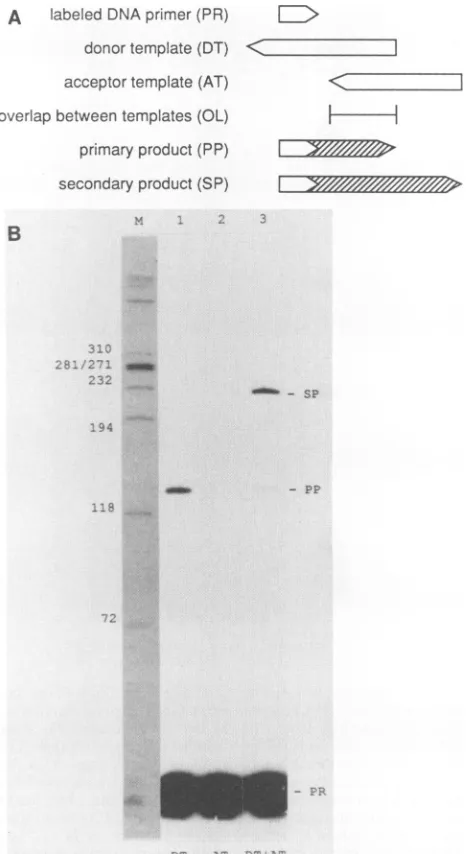
In order to study templateswitching,we setupthein vitro assay system, assummarized in Fig.
1A.
DNAsynthesis
wasinitiated on a14-b DNAprimer(PR) 5' end labeled with
32P.
The primer couldbasepair with the donortemplate (DT)but not to the acceptor template (AT).The twotemplates shareda region of sequence identity, referred to as the
overlap.
During reverse transcription, the primer was first extended
to the end of the donortemplate molecule to create what is called the primary DNA product (PP). And in the presence of the acceptor template, the reverse transcription ofsome
of these primary productsswitched to the acceptortemplate,
extended to the end of that template, and thereby created
what is called the secondary product (SP). Fig.
1B
gives an example of how the PP was resolved from SP and PR byusing electrophoresis into an acrylamide gel. This gel was
dried and subjected to autoradiography, as shown, or sub-jected to direct quantitation in two dimensions by using an
AMBIS radioanalytic imaging system. For Fig. 1, lane 3, we thus deduced that 83% of the DNA products made use of
template switching. The reverse transcriptase used in this example was synthesized in bacteria from amolecularclone
of the reverse transcriptase of MLV (3).
Figure 2 summarizes some of our resultsconcerningthree variables that affect the efficiency of template switching. In these studies, the donor and acceptor templates were com-posed of RNA. Figure 2A shows the time course. The bulk of the achievable switching occurred within 1.5 h at
37°C,
under the chosen reaction conditions. The extent of switch-ing was dependent on the molar excess of acceptortemplaterelative to donor template (Fig. 2B). The reaction was 57%
efficient even when the amount of acceptor RNA was approximately equimolar with the amount of donor tem-plate. In these two series of experiments, the amount of template switching was controlled by either thereactiontime or the amount of acceptor template. One interpretation is that the rate-limiting factor for switching was theprobability of the elongated primary product to make an essential interaction with the acceptor template.
Figure 2C summarizes the results of examining a third variable, the extent of overlap between the donor and acceptor templates. With 100 b of overlap, there was a significant amount of template switching. And as the amount of overlap was decreased to 40 and 20 b, there was a decrease in the amount of switching. With no more than 10 b of overlap, there was no detectable switching. These data are also consistent with the above-mentioned interpretation of the rate-limiting step and indicate that the probability of the essential interaction between primary product and ac-ceptor template is in turn dependent on the length of complementary sequence, that is, the amount of overlap between the two templates.
In the above studies, we made use of a bacterially ex-pressed MLV reverse transcriptase, which also contains RNase H activity. In order to test the role of this RNase H activity, we made use of another recombinant enzyme. This protein lacked the carboxy terminus of the protein that contains the RNase H domain (8). As summarized in Table 1, we tested whether this enzyme could allow template switching compared with the normal reverse transcriptase. When the templates were both RNA, we observed 3% switching, indicating that the RNase H-deficient enzyme was also inefficient in switching. The measure of relative effi-ciency (3%) was probably an upper limit, because the
on November 10, 2019 by guest
http://jvi.asm.org/
REVERSE TRANSCRIPTION 4323
A labeled DNAprimer
(PR)
Eli
donortemplate (DT) acceptortemplate(AT)
overlapbetweentemplates (OL) primary product (PP) secondary product (SP)
KZZIIIIIIIZ
REACTION TIME (hours)
100
50[
0
B
D.2 1 5 l
EXCESS OFACCEPTOR (AT/DT)
50
C
25
0 10 20 40
OVERLAP(nucleotides)
FIG. 1. Basic assay system. (A) Representation of the DNA primer,twotemplates, andtwoDNAproducts. The templateswere composed of either RNAorDNA. Theproductswereobtained by usingreversetranscriptase. Theprimary productrepresented
elon-gation of the labeled primer by using the donor template. The secondary product could only be generated by DNA synthesis initiated on the donor template makinga switch to the acceptor
template. (B) Example of analysis of the labeled DNA reaction products. PR, end labeled with32P,wasincubated with donor RNA
template (DT) (lane 1), AT (lane 2), and both (lane 3). DNA synthesis was carried out for 3 h at 37°C by using cloned MLV
reversetranscriptase, after which theproductswereextractedand
separatedon adenaturing gelof6% polyacrylamide. The gelwas
driedandanalyzed by autoradiography,asshown. The free PRwas
separatedfromtheprimaryproduct (PP)and thesecondaryproduct (SP).Thelengthswerededucedrelativetothesizemarkers in lane
M, namely, end-labeled HaeIII fragments ofphage 4XX174DNA. For quantitation of 32p in the dried gel, we used an AMBIS
radioanalytic imagingsystem. Forexample, in lane 3 this showed
that the amount of SP relative to SP plus PP was 83%. This is referredtoasthepercentage oftemplate switching.
FIG. 2. Parameters affecting the extent of template switching. (A) Summary of theeffect of reaction time. The reaction mixture includedlabeled primer, anRNAas donortemplate, andafivefold
excessofanother RNAasacceptortemplate, witha100-boverlap. ThemixtureincludedMLVreversetranscriptaseand theincubation times were as indicated. Gel analysis and subsequent AMBIS
scanning were used to determine the percentage of secondary product relativetothetotal of primary and secondary products,as
describedinthe legendtoFig. 1. (B) Summary of reactions, as in
panel A,exceptthat thereaction times werekeptconstant at 3h, while theratio ofacceptor todonortemplatewasvaried from 0to
10.(C) Summary of reactions,asinpanel B,exceptthat theratio of templateacceptor todonorwaskeptconstantat5, whilethe lengths
of thetemplate donorswere varied sothat theamount ofoverlap withthe templateacceptorranged from 0 toapproximately 100 b.
Moreprecise estimates of the overlaps usedare101, 35to38, 20to
23, and 3to8b.These valueswereobtainedby primer extensionon thetemplates relativetoadideoxysequencing ladder (15) (datanot
shown).
switching activityof thenormalenzymewasprobably satu-rated(Fig. 2B).
Although thedeficientenzyme didnotcontain thecoding regionfor RNaseH,itwaspossiblethatasaconsequenceof the expression in bacteria, some bacterial RNase H might
havebeencopurifiedwith thereversetranscriptase activity. To test for this, we carried out the experiment as
summa-rized in Fig. 3. We created an RNase H-sensitive substrate
by hybridizing a DNA oligonucleotide to an end-labeled RNA (10). This substrate was incubated with either the normalorthe RNase H-deficientenzymeand then testedon
B
_ - sp
z
I-C')
w -J
w 0
100 VOL.64, 1990
3 //7
///~
on November 10, 2019 by guest
http://jvi.asm.org/
[image:3.612.344.533.76.427.2] [image:3.612.65.298.90.517.2]4324 LUO AND TAYLOR
TABLE 1. Requirement ofRNase H domain
fortemplate switching"
% Template
Donor Acceptor switching with Ratio of
template template RNase H: switching (absent/present) Present Absent
RNA RNA 83 3 0.03
DNA RNA 39 ND
DNA DNA 11 4 0.36
aTemplate-switching experiments were carried out as described in the legendstoFig. 1B and 4;quantitationwaswith theAMBIS machine.
an acrylamide gel for any cleavage. The normal enzyme caused cleavage (Fig. 3, lane 2), while no detectable
cleav-age wasobserved with the deficient enzyme (lane 3). In order to test further whether template switching was dependentonRNase Hactivityornot,wemodified the basic
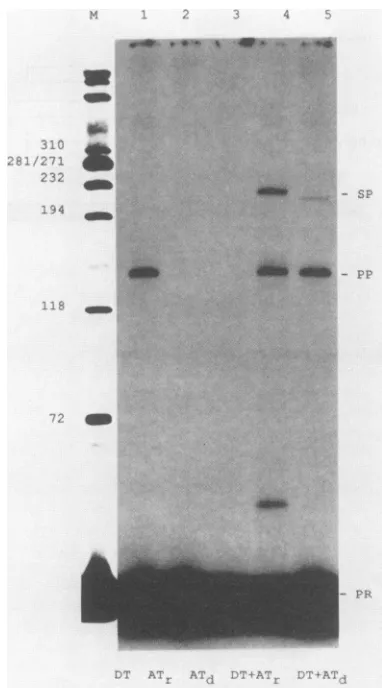
assay so that the donor RNA template was replaced by DNA. Examples shown inFig. 4 demonstratethat we were abletoobtaintemplate switchingfromDNA toeitherRNA (lane 4)or to DNA(lane 5). Table 1 givesaquantitation of
suchtransfers, including the observation thatthe RNase H
domain of thereverse transcriptase was not a major
deter-minant ofswitchingbetween DNA templates. (That is, the
RNase H-deficientenzyme gave 36% asmuch switchingas
the normal enzyme.)
Fromtheseexperiments, weconcluded thatreverse
tran-scriptase could carry out significant amounts oftemplate
switching from eitherRNAorDNAtemplates and thateven
moreefficient switching occurred when the donortemplate
wasRNAand the reversetranscriptasecontained RNase H
function.
Wealso carriedoutexperimentstodetermine whether the labeledprimaryDNAproductwasactuallyreleased from the
_mw -m--_ 4C1. V:W
f
I;... .. b::
I4
.41%
... ...
'
'~~~~~~~~~~~~~~~~~~~~~~~~~~~~~~~~~~~~~~~~~~1
...- . - ...
*:
*3
,, ...
-i
-
F_-lSi)PP
AT, 7-"* AT,
FIG. 4. Analysis of template switching from DNA donor
tem-platetoRNA and DNA acceptortemplates. The basic reactionwas
carried out asinFig. 1 butwiththefollowing changes. The donor RNAtemplatewasreplaced bya similarDNA species (lane DT), and the AT was either RNA (lane ATr) orDNA (lane ATd). The amountof ATdwaslower than thatofATr. The gelanalysis of the labeled DNA products was as before, includingthe DNA marker indicated at theleft(laneM).TheDNAproduct SP is14b shorter in lane 5 than in lane 4, because ATd is 14b shorter atits5' end relativetoATr.Inlane 4, the bandwith amobilitycorrespondingto
about 30 b was proven to be an artifact and was solved for subsequentexperiments.
-so
FIG. 3. Assay for RNase H activity.An RNA species, labeledat its 5'end with [y-32P]ATP,washybridizedtoa50-b complementary
DNA oligonucleotide and then used as a substrate for RNase H
activity. Lane 1, Noenzyme; lane 2, MLV reverse transcriptase;
lane3, MLVreverse transcriptase engineeredtohave noneofthe domainneeded for RNaseHfunction. Afterincubation, the samples wereextracted andseparatedon agelof6%polyacrylamide, dried, andautoradiographed, asshown.Thesizemarkers in laneMareas
inFig. 1.
donortemplate, even in the absence ofthe acceptor
tem-plate. This was doneby analysis of the products by using
electrophoresis into nondenaturing polyacrylamide gels. As
a positive control, an aliquot of each product was heat denatured prior to electrophoresis. Figure 5 shows the resultsobtained when the products were synthesized with the end-labeled primer (PR) and an RNA as the donor template. Figure 5, lane 1, shows the product directed by the normal reverse transcriptase. Using direct quantitation of
Fig. 5, lane 1, we found that about7% of the product was
alreadyreleasedfromitsRNAtemplate, compared with the controlin lane 2.Figure5, lane 3, shows the primary product
as synthesized with the enzyme lacking RNase H function. Here, wewere unable to detect any released product. Note that thecomplex migrated differently from that created by thecompleteenzyme. Ourinterpretationis that the complete enzyme allowed RNase H digestion of some of the RNA template that had been reverse transcribed. However, it
J. VIROL.
IAwl
on November 10, 2019 by guest
http://jvi.asm.org/
[image:4.612.115.250.444.641.2]REVERSE TRANSCRIPTION 4325
FIG. 5. Analysis oftemplate-product associations by
electropho-resis intoa nondenaturing polyacrylamide gel. End-labeled primer
waselongatedonanRNA template by using either normalreverse
transcriptase (lanes 1 and 2) orthe form lacking RNase H activity
(lanes 3 and 4). This template was 86 b longer than the acceptor
template used in thetemplate-switching experiments. The reaction products were directly loaded onto a nondenaturing gel of 6%
polyacrylamide either without(lanes 1and3)orwith (lanes 2 and 4) aprior heat denaturation. After electrophoresis, the gel was dried
and examined by autoradiography.
must be noted that this digestion was onlypartial, in that it did not lead torelease of the primary product.
Theabove experiments, with and without RNase H activ-ity, show that after DNA synthesis, most of the product molecules are still in association with their RNA template.
Similarresultswereobtained withaDNAtemplate (datanot
shown). Our interpretation is that under the conditions of
DNA synthesis used in these experiments, each template
was apparently used only once. (If a template were used
morethanonce, thesynthesis ofasecondproduct, bywhat
can be called displacement synthesis, would displace and
ultimately free the first product. A theoretical argument
against this occurring in our experiments with RNA
tem-plates was that in most reactions, we used a 15-fold molar excessof templaterelativetoprimer. We alsocarried outan
experiment in which synthesis was initiated with relatively
low amounts of labeled primer and then chased by the addition ofanexcessof unlabeled primerandmoreenzyme. We found that this did not lead to an increase of released labeled product [datanot shown], consistentwith the inter-pretation thatdisplacementsynthesiswasnotrelevanttoour experiments.)
From ourstudies with RNA donor templates (Fig. 5), we could not deduce which part(s) ofthetranscribed RNAwas removed by the RNase H. Figure 6A diagrams five
theoret-ical possibilities. The results shown in Fig. 5 had already eliminated the first possibility (no RNase H action) and the fifth possibility (complete RNase H action and release of free product). (The amount of free product was actually7%,and we are attempting here to explain the remaining 93%.)
There is a dogma, arising from early studies of retroviral minus-strand strong-stop DNA (18), that RNA digestion proceeds from the 3' end of the template in a 3'-to-5' direction. This is diagrammed in Fig. 6A as the third possi-bility. In contrast, more recent studies (13) indicate that the RNase H domain may act endonucleolytically and at a distance of 7 to 14 b behind the polymerization site. This could lead to the second or fourth possibility. In order to distinguish further between the various possibilities, we carried out the following experiments.
In the first experiments, we asked whether the labeled 5' endof the nondenatured DNA product was base paired with a residual fragment of template RNA, as inpossibilities three and four. To test this, we examined accessibility of the labeled 5'-terminal phosphate in the product to digestion with calf intestinal phosphatase (CIP). Our rationale, based ontheexperience of others (14), was that base pairing of this region with residual RNA template would confer resistance to CIP. The products were in fact much more resistant (48%) than free DNA (6%) (Fig. 6B). However, the resistance of the product was nevertheless not as much as that of the productsynthesized in the absence of RNase H(93%). (Note that all the CIP treatments [Fig. 6, lanes 2, 3, 5, and 6] successfully removed the 5' label from theprimer, PR.) Two models could be advanced to explain the intermediate level of resistance. One model is that the products are heteroge-neous, with some DNAs being free, and thus CIP-sensitive, and with others still in association with the RNAtemplate. The other model is that the products are homogeneous, but that during the CIP digestion, some of products were di-gested. This latter model is supported by the largely homo-geneous electrophoretic migration of thenondenatured prod-uct (Fig. 5, lane 1).
A second series of experiments was then carried out to distinguish between possibilities three and four. For these, the label was notin the DNA primer but at the 5' end of the RNA template. As in the nondenaturing gel shown in Fig. 6C, we observed the production of a labeled product
com-plex (lane 1). This result appeared to exclude possibility
three and favor possibility four. (Alimitation of this exper-iment was that it did not exclude the possibility that some
other complexes existed that were nolonger associated with labeled RNA). Ifthis interpretation were to be correct, we
reasoned that it should be possible to locate the residual end-labeled RNAfragments on a denaturing gel. As shown in Fig. 6D, lane 1, this was confirmed. Thefragments were
predominantly of asingle size. This specieswas10-fold more
abundant than any other. It was shown tobe 17 nucleotides by usingadjacent ladders of the untreated RNAafterpartial
hydrolysis with alkali (Fig. 6D, lane OH), and partial
diges-tion with the ribonuclease of Phyllobacterium
myrsi-nacearum that is specific for the 3' side of uridines and adenosines (Fig. 6D, lane PhyM). Actually, minoramounts
of digestion occurred on some moleculesatsites 1 and 2 bon
either side of this site, as well as between nucleotides 9 and 10. As expected, none of these species were detected for products generated with the reverse
transcriptase
that lacked RNase H activity (Fig. 6D, lanes 2).Our interpretation of these results was that some of the labeled RNA that was used as template for reverse
tran-scriptase was cut by the associated RNase H between
VOL.64, 1990
on November 10, 2019 by guest
http://jvi.asm.org/
[image:5.612.125.233.74.364.2]J. VIROL. 4326 LUO AND TAYLOR
Iz/r
IIIIiI I2.2~ ~~~~
i7m
3.1
±
B
hi.
..
:.-4. /////
5.
IlYll/
diF0
'p
D
~~
so
templateproduc< t.
e
a.tX
:S * t
FIG. 6. Determinationofstructure oftemplate-product associations. Reactions were carriedout as in Fig. 5, with an oligonucleotide primer,anRNAdonortemplate, andreversetranscriptase. (A) Five theoreticalstructuresforthe resultant template-product association,with therepresentationsasshown in Fig. 1A and with base pairing indicated by vertical lines. (B) Denaturing gel analysis ofthesensitivity ofthe end-labeledproductstodigestion with CIP. Productsweregenerated (i) with normalreversetranscriptase (lanes1through 3)or(ii)withthe
RNase H-deficientenzyme(lanes 3 through 6).Identical portionswereexamined directly (lanes 1 and 4), after CIPtreatment(lanes2and5),
orafterheat denaturationand CIPtreatment(lanes 3 and 6). (C) Nondenaturing gel analysis oftemplate-product associations,asinFig.1B,
exceptthatthelabelwasnotonthe DNA primer butatthe5'end of the donor RNAtemplate. Reactions werecarriedoutwith the normal reverse transcriptase. Portions were examined on a nondenaturing gel either directly (lane 1) or after heat denaturation (lane 2). (D) Sequencing gel of 10% polyacrylamideas usedtoexamine end-labeledproducts from panel C. Also shown, assize andsequencemarkers,
are apartialalkalidigestion andaPhyM (BethesdaResearchLaboratories) digestion of end-labeled RNA (11). A
1
C
on November 10, 2019 by guest
http://jvi.asm.org/
[image:6.612.150.470.78.631.2]REVERSE TRANSCRIPTION 4327 nucleotides 17 and 18, as measured from the 5' end. This
action of RNase H at a site lagging the site of DNA
polymerization was exactly consistent with what has been deduced by Oyama et al. (13).
DISCUSSION
The template switching during reverse transcription, as observed in these studies, was consistent with the three basic typesofswitchingreviewed in theintroduction. Others have predicted that the various strand switches would be
largely dependent on the RNase H domain of the reverse
transcriptase. Our results confirm this and provide some
understanding of the factors affecting template switching, especially the role of RNase H digestion. While our data supportthe modelofrecombination proposedbyCoffin(1; in press), in the absence of data to the contrary, we would cautionagainst referringtotheswitchingascopychoice and agree with Coffin in describing the model as forced copy
choice (in press). We have interpreted ourdataas evidence
for forcedswitches,thatis, switches forced by transcription coming to the end of a template. Actually, we have not
excluded the additional possibility that some switching oc-curs from withintheregion ofoverlapbut priortothe actual endofthe donortemplate. Weexpect such switchingtobe
relatively minor,butitcould be enhancedbythe presenceof modified bases in the template or secondary structures in
eithertemplate or nascentDNAproduct.
Interms ofthe RNase Hdigestion, wewereable toshow thatafterextensionbyreverse
transcription
totheendofthe RNAtemplate, the consequences ofRNase H action onthetranscribed
RNAwere as in Fig. 6A, panel4. Thatis,
there were residual fragments ofthe RNA template sufficient to make interactionswith both the 5' and 3' ends of the DNAproduct. More specifically, we found that the 3' end ofthe
productwas boundto a17-bfragmentfrom the 5' endofthe RNAtemplate.Thesefindings areconsistent with therecent studies ofOyamaetal.
(13)
and KrugandBerger
(9),
which show that the retroviral RNase H acts as an endonuclease. Also,thediscrete size of the5'fragment
ofthetemplate
is in agreement with the concept ofthe reversetranscriptase
asdescribed by Oyama et al.
(13); they
explain
the RNase Hdomain as acting behind the
polymerase
domain. Thatis,
acting at a site between the RNA
template
and thenewly
synthesized
DNAproduct
createdby
one or two turnsofthedouble helix. This residualRNA
fragment
created when thepolymerase
comes totheendof the RNAtemplate
mayalso be relevant to the reversetranscription
ofhepadnavirus
genomes
(12).
It hasbeen foundby
Lien etal.(10)
thatfor duckhepatitis
Bvirus,
19- and 20-b 5'fragments
of theplus-strand
RNAare notonly
generated
but goontobecomeprimers
forthe reversetranscription
of minus-strand DNA intoplus-strand
DNA. Sincethe 5' end ofthehepadnavirus
RNA is acap structure,reverse
transcription
must stop 2bbefore the end ofthe
template;
thatis,
the RNase H acts either 17 or 18 b behind the site oftermination ofreversetranscription.
Almostidenticalresults have beenreported
by
Seegeretal. (16) fortwoother
hepadnaviruses,
woodchuckhepatitis
virus andground
squirrel
hepatitis
virus. Thesimilarity of these results to the retrovirus data
presented
here isstriking.
It istempting
tospeculate
further and tosuggest that as a
general phenomenon,
after reversetran-scription to the end ofan RNA
template,
such a residualoligonucleotide
might
be ableto act asprimer
forsynthesis
of an
almost-full-length
second strand. This could have relevancenotonly
tothetechnology
ofin vitrosynthesis
ofdouble-stranded cDNAs but also tothe in vivo creation of reverse
transcripts
ofcellular RNAs as precursorsforinte-gration.
It is
important
to note that we have also obtained twoindependent
lines ofevidence foramechanism oftemplate
switching
that isindependent
of RNase H action. This second mechanism occurs at a lower but notinsignificant
level. Its existence has beendemonstratedboth
by using
anenzyme that lacks RNase H
activity
andby
replacing
the RNAtemplate
with a DNAtemplate.
The data support theinterpretation
thatthis additionalform oftemplate
switching
isnotduetostrand
displacement,
asmight
beexpected
if thetemplate
were used more thanonce. We do notyetunder-stand the
mechanism,
but the apparentrequirement
for atleastsome
unwinding
ofthe3' endoftheprimary
product
is relevant notonly
here but for theswitching
mediatedby
RNase H
actions,
sincewehaveshown thataresidualRNAoligonucleotide
doesbindtothe3'end,
and it also hastoberemoved.Itmay berelevant that inan
early
report of Collett et al.(2),
it was claimed that reversetranscriptase
has anunwinding
function. Furtherexperiments
are neededto testthis
hypothesis.
ACKNOWLEDGMENTS
J.T. was
supported by
grantMV-7M fromtheAmerican Cancer Society,by
Public Health Servicegrants CA-06927 and RR-05539 fromtheNationalInstitutes ofHealth,andby
anappropriation
from theCommonwealth ofPennsylvania.
Wethank BillMasonfor
pointing
outthe relevanceofourfindings
tothe
replication
ofhepadnaviruses.
Both BillMasonand RichKatz gavehelpful
discussions and criticalreading
ofthemanuscript.
Tony Yeungperformed
the chemicalsynthesis
of theoligonucleotides
used inthestudy.
LITERATURE CITED
1. Coffin,J.M.1979. Structure,
replication,
andrecombination of retrovirus genomes: someunifying
hypotheses.
J. Gen. Virol.42:1-26.
2. Collett,M. S., J. P. Leis, M. S. Smith,and A. J. Faras. 1978.
Unwinding-like activity
associated with avian retrovirus RNA-directedDNApolymerase.
J.Virol. 26:498-509.3. Gerard,G.F.,J.M.D'Alessio,M. L.Kotewicz,and M. C.Noon.
1986. Influenceon
stability
in E. coli ofthecarboxy-terminal
structure of cloned
Moloney
murine leukemia virus reversetranscriptase.
DNA5:271-279.4. Goodrich,D. W., and P. H.Duesberg. 1990. Retroviral
recom-bination
during
reversetranscription.
Proc. Natl. Acad. Sci.USA 87:2052-2056.
5.
Gyllensten,
U. 1989. Directsequencing
of in vitroamplified
DNA, p.45-60. In H. A. Erlich(ed.),PCRtechnology.
Stock-tonPress, New York.
6. Hu, W.-S., and H. M. Temin. 1990. Genetic consequencesof
packaging
twoRNA genomes inoneretroviralparticle:
pseudo-diploidy
andhigh
rate ofgenetic
recombination. Proc. Natl. Acad. Sci. USA87:1556-1560.7.
Junghans,
R. P., L. R.Boone, and A. M.Skalka. 1982. Retro-viral DNA H structures:displacement-assimilation
model of recombination. Cell30:53-62.8. Kotewicz, M. L., C. M.
Sampson,
J. M. D'Alessio,and G. F. Gerard. 1988. Isolation of cloned Moloney murine leukemia virus reversetranscriptase lacking
ribonuclease H activity. NucleicAcidsRes. 16:265-277.9. Krug,M.S.,and S. L.Berger. 1989. RibonucleaseHactivities associated withviral reverse
transcriptases
areendonucleases.Proc. Nati. Acad. Sci. USA 86:3539-3543.
10. Lien,J.-M., C. E. Aldrich, andW. S. Mason. 1986. Evidence thata
capped
oligoribonucleotide
is theprimer
forduckhepa-titisB virus
plus-strand
DNAsynthesis.
J. Virol. 57:229-236. VOL.64, 1990on November 10, 2019 by guest
http://jvi.asm.org/
11. Luo, G., L. Sharmeen, and J. Taylor. 1990. Specificities in-volvedin the initiation of retroviral plus-strand DNA.J. Virol. 64:592-597.
12. Mason, W.S.,J. M. Taylor, and R. Hull. 1987. Retroid virus
genomereplication. Adv. Virus Res. 32:35-96.
13. Oyama, F., R. Kikuchi, R. J. Crouch, and T. Uchida. 1989. Intrinsic properties ofreversetranscriptase inreverse
transcrip-tion.J. Biol. Chem.264:18808-18817.
14. Sambrook, J.,E. F. Fritsch, and T. Maniatis. 1989.Molecular cloning: a laboratory manual, 2nd ed. Cold Spring Harbor
Laboratory, Cold Spring Harbor, N.Y.
15. Sanger, F., S. Nicklen,and R. A. Coulson.1977. DNA
sequenc-ing with chain-terminating inhibitors. Proc. Natl. Acad. Sci. USA 74:5463-5467.
16. Seeger, C., D. Ganem, and H. E.Varmus. 1986. Biochemical andgeneticevidence for thehepatitisB virusreplication strat-egy. Science 232:477-484.
17. Swanstrom, R.,R.C.Parker,H. E.Varmus,andJ.M.Bishop.
1983. Transduction ofacellularoncogene-thegenesisof Rous sarcomavirus. Proc. Natl. Acad. Sci. USA80:2519-2523. 18. Varmus, H., and R. Swanstrom. 1982. Replication of
retrovi-ruses, p. 369-512. In R. Weiss, N. Teich, H. Varmus, and J. Coffin (ed.), RNAtumorviruses, 2nd ed. ColdSpring Harbor
Laboratory, Cold Spring Harbor, N.Y.