White Rose Research Online URL for this paper:
http://eprints.whiterose.ac.uk/93756/
Version: Accepted Version
Article:
Jiang, M.D., Liu, W. and Li, Y. (Accepted: 2015) Adaptive Beamforming for Vector-Sensor
Arrays Based on Reweighted Zero-Attracting Quaternion-Valued LMS Algorithm. IEEE
Transactions on Circuits and Systems II: Express Briefs. ISSN 1558-3791
https://doi.org/10.1109/TCSII.2015.2482464
[email protected] https://eprints.whiterose.ac.uk/ Reuse
Unless indicated otherwise, fulltext items are protected by copyright with all rights reserved. The copyright exception in section 29 of the Copyright, Designs and Patents Act 1988 allows the making of a single copy solely for the purpose of non-commercial research or private study within the limits of fair dealing. The publisher or other rights-holder may allow further reproduction and re-use of this version - refer to the White Rose Research Online record for this item. Where records identify the publisher as the copyright holder, users can verify any specific terms of use on the publisher’s website.
Takedown
If you consider content in White Rose Research Online to be in breach of UK law, please notify us by
Adaptive Beamforming for Vector-Sensor Arrays
Based on Reweighted Zero-Attracting
Quaternion-Valued LMS Algorithm
Mengdi Jiang, Wei Liu and Yi Li
Abstract—In this work, reference signal based adaptive
beam-forming for vector sensor arrays consisting of crossed dipoles is studied. In particular, we focus on how to reduce the number of sensors involved in the adaptation so that reduced system complexity and energy consumption can be achieved while an acceptable performance can still be maintained, which is espe-cially useful for large array systems. As a solution, a reweighted zero attracting quaternion-valued least mean square algorithm is proposed. Simulation results show that the algorithm can work effectively for beamforming while enforcing a sparse solution for the weight vector where the corresponding sensors with zero-valued coefficients can be removed from the system.
Index Terms—vector sensor array, quaternion, adaptive beam-forming, LMS, zero attracting.
I. INTRODUCTION
Adaptive beamforming has a range of applications and has been studied extensively in the past for traditional array systems [1], [2], [3], [4]. With the introduction of vector sensor arrays, such as those consisting of crossed-dipoles and tripoles [5], [6], [7], adaptive beamforming for such an array system has attracted more and more attention recently [6], [8], [9], [10].
In this work, we consider the crossed-dipole array and study the problem of how to reduce the number of sensors involved in the beamforming process so that reduced system complexity and energy consumption can be achieved while an acceptable performance can still be maintained, which is especially useful for large array systems. In particular, we will use the quaternion-valued steering vector model for crossed-dipole arrays [8], [9], [10], [11], [12], [13], [14], [15], [16], and propose a novel quaternion-valued adaptive algorithm for reference signal based beamforming.
In the past, several quaternion-valued adaptive filtering algo-rithms have been derived in [9], [16], [17], [18]. Notwithstand-ing the advantages of the quaternionic algorithms, extra cares have to be taken in their developments, in particular when the derivatives of quaternion-valued functions are involved, since
This work is partially funded by National Grid UK.
M. Jiang and W. Liu are with the Department of Electronic and Elec-trical Engineering, University of Sheffield, Sheffield, S1 3JD, UK (email:
{mjiang3,w.liu}@sheffield.ac.uk).
Y. Li is with the School of Mathematics and Statistics, University of Sheffield, Sheffield, S3 7RH, UK (email:[email protected]).
Copyright (c) 2015 IEEE. Personal use of this material is permitted. However, permission to use this material for any other purposes must be obtained from the IEEE by sending an email to [email protected].
quaternion algebra is non-commutative. Very recently, prop-erties and applications of a restricted HR1 gradient operator
for quaternion-valued signal processing were provided in [19]. Based on these recent advances in quaternion-valued signal processing, we here derive a reweighted zero attracting (RZA) quaternion-valued least mean square (QLMS) algorithm by introducing a RZA term to the cost function of the QLMS algorithm. Similar to the idea of the RZA least mean square (RZA-LMS) algorithm proposed in [20], the RZA term aims to have a closer approximation to thel0norm so that the number of non-zero valued coefficients can be reduced more effec-tively in the adaptive beamforming process. This algorithm can be considered as an extension of our recently proposed zero-attracting QLMS (ZA-QLMS) algorithm [21], where the
l1 norm penalty term was used in the update equation of the weight vector. We will show in our simulations that the RZA-LMS algorithm has a much better performance in terms of both steady state error and the number of sensors employed after convergence.
A review of adaptive beamforming based on vector sensor arrays is provided in Sec. II, and the proposed RZA-QLMS algorithm is derived in Sec. III. Simulations are presented in Sec. IV, and conclusions drawn in Sec. V.
II. ADAPTIVEBEAMFORMINGBASED ONVECTOR SENSORARRAYS
A. Quaternionic Array Signal Model
d
...
θ
φ y
z
[image:2.612.311.518.505.633.2]x
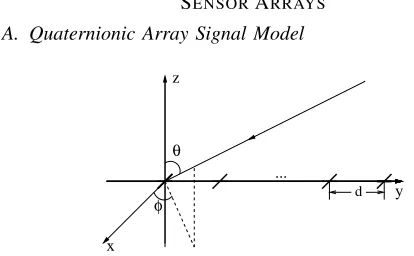
Fig. 1. A ULA with crossed-dipoles.
A general structure for a uniform linear array (ULA) with
M crossed-dipole pairs is shown in Fig. 1, where these pairs are located along the y-axis with an adjacent distanced, and at each location the two crossed components are parallel to the x-axis and y-axis, respectively. For a far-field incident signal
with a direction of arrival (DOA) defined by the anglesθand
φ, its spatial steering vector is given by Sc(θ, φ) = [1, e−j2πdsinθsinφ/λ,
· · ·, e−j2π(M−1)dsinθsinφ/λ]T (1) where λ is the wavelength of the incident signal and {·}T
denotes the transpose operation. For a crossed dipole the spatial-polarization coherent vector is given by [22], [23]
Sp(θ, φ, γ, η) = {
[−cosγ,cosθsinγejη] for φ= π
2
[cosγ,−cosθsinγejη] for φ= −π
2 (2)
whereγ is the auxiliary polarization angle with γ∈[0, π/2], andη∈[−π, π]is the polarization phase difference.
The array structure can be divided into two sub-arrays: one parallel to the x-axis and one to the y-axis. The complex-valued steering vector of the x-axis sub-array is given by
Sx(θ, φ, γ, η) = {
−cosγSc(θ, φ) forφ= π2 cosγSc(θ, φ) forφ= −2π
(3)
and for the y-axis it is expressed as
Sy(θ, φ, γ, η) = {
cosθsinγejηSc(θ, φ) φ=π2
−cosθsinγejηS
c(θ, φ) φ=−2π
(4)
Before we present the quaternion-valued steering vector model, we first very briefly review some basics about quater-nion. A quaternion q can be described as
q=q1+ (q2i+q3j+q4k), (5) where q1, q2, q3, and q4 are real-valued [24], [25]. In this paper, we consider the conjugate operator of q as q∗ =q
1−
q2i−q3j−q4k. The three imaginary unitsi,j, and ksatisfy
ij=k, jk=i, ki=j,
ijk=i2=j2=k2=−1; (6) where the exchange of any two elements in their order gives a different result. For example, we haveji=−ij rather than
ji = ij. For a general quaternion-valued function f(q), the derivative df(q)
dq with respect to q can be expressed as [19],
[21], [26]
df(q)
dq =
1 4(
∂f(q)
∂q1 −
∂f(q)
∂q2
i−∂f(q)
∂q3
j−∂f(q)
∂q4
k), (7) while the derivative of f(q)with respect toq∗ is given by
df(q)
dq∗ = 1 4(
∂f(q)
∂q1
+∂f(q)
∂q2
i+∂f(q)
∂q3
j+∂f(q)
∂q4
k). (8) Combining the two complex-valued subarray steering vec-tors together, an overall quaternion-valued steering vector with one real part and three imaginary parts can be constructed as
Sq(θ, φ, γ, η) = ℜ{Sx(θ, φ, γ, η)}+iℜ{Sy(θ, φ, γ, η)}+
jℑ{Sx(θ, φ, γ, η)}+kℑ{Sy(θ, φ, γ, η)}, (9)
where ℜ{·} and ℑ{·} are the real and imaginary parts of a complex number/vector, respectively. Given a set of coeffi-cients, the response of the array is given by
r(θ, φ, γ, η) =wHSq(θ, φ, γ, η) (10)
wherewis the quaternion-valued weight vector.
[ . . . − . . . ] ] ] ] ]
d[
n
n
xM[
n
wM[n
n
[
y w1
x1[
]
[image:3.612.327.565.495.639.2]n
Fig. 2. Reference signal based adaptive beamforming.
B. Reference Signal Based Adaptive Beamforming
The aim of beamforming is to receive the desired signal while suppressing interferences at the beamformer output. When a reference signal d[n] is available, adaptive beam-forming can be implemented by the standard adaptive filtering structure, as shown in Fig. 2, where xm[n], m = 1,· · · , M
are the received quaternion-valued input signals through theM
pairs of crossed-dipoles, andwm[n] =am+bmi+cmj+dmk,
m = 1,· · ·, M are the corresponding quaternion-valued weight coefficients witha,b, c anddbeing real-valued.y[n]
is the beamformer output ande[n] is the error signal
y[n] =wT[n]x[n], e[n] =d[n]−wT[n]x[n], (11) where
w[n] = [w1[n], w2[n],· · ·, wM[n]]T
x[n] = [x1[n], x2[n],· · · , xM[n]]T . (12)
The conjugate form of the error signal is e∗[n], given by
e∗[n] =d∗[n]−xH[n]w∗[n], (13) where{·}H is the combination of both{·}T and{·}∗ opera-tions for a quaternion. Thenwcan be updated by minimizing the instantaneous square error J0[n] =e[n]e∗[n].
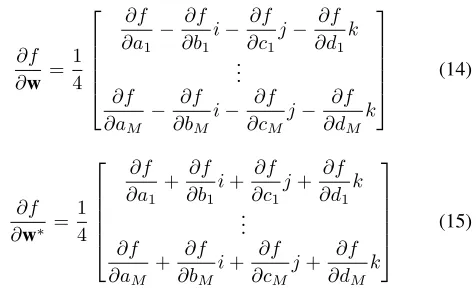
For a general quaternion-valued function f(w), the differ-entiation with respect to the vector wandw∗ is
∂f ∂w =
1 4 ∂f ∂a1 −
∂f ∂b1
i−∂c∂f
1
j−∂d∂f
1
k
.. .
∂f ∂aM −
∂f ∂bMi−
∂f ∂cMj−
∂f ∂dMk
(14) ∂f ∂w∗ =
1 4 ∂f ∂a1 + ∂f ∂b1
i+ ∂f
∂c1
j+ ∂f
∂d1 k .. . ∂f ∂aM + ∂f ∂bM
i+ ∂f
∂cM
j+ ∂f
∂dM k (15)
As discussed in [19], [27], the gradient ofJ0[n]with respect to w∗ would give the steepest direction for the optimization surface. It can be obtained as follows
∇w∗J0[n] =−
1 2e[n]x
∗[n], (16)
and the update equation for the weight vector with step size
µis given by
leading to the following QLMS algorithm [16], [17], [26]
w[n+ 1] =w[n] + 1 2µ(e[n]x
∗[n]). (18)
III. THERZA-QLMS ALGORITHM
Using the QLMS algorithm, we can find the optimal coef-ficient vector in terms of minimum mean square error (MSE) and obtain a satisfactory beamforming result. However, to reduce the complexity and also power consumption of the system, in particular for a large array, we can reduce the number of sensors involved, at the cost of the final beam-forming performance. To achieve this, we here derive a novel quaternion-valued adaptive algorithm by introducing an RZA term to the original cost function of the QLMS algorithm. In this way, we can simultaneously minimise the number of sensors involved while suppressing the interferences during the beamforming process.
First, to minimise the number of sensors, we could add the
l0 norm of the weight vector wto the cost function J0[n]to form a new cost function
ˆ
J0[n] = (1−δ1)e[n]e∗[n] +δ1∥w[n]∥0, (19) whereδ1is a weighting term between the original cost function and the newly introduced term. In this way, the number of non-zero valued coefficients inwwill be minimised too, where the similar idea has been applied in [28].
In practice, we could replace the l0 norm by the l1 norm. However, l1 norm would uniformly penalise all non-zero valued coefficients, while l0 norm penalises smaller non-zero values more heavily. To have a closer approximation to l0 norm, we can introduce a larger weighting term to those coefficients with smaller values and a smaller weighting term to those with larger values. This weighting term will change according to the resultant coefficients at each update of the algorithm. This general idea has been implemented as a reweighted l1 minimization [29], [30] and employed in the sparse array design problem [31], [32], [33].
The modified cost function for the proposed RZA-QLMS algorithm with the reweighting term is given by
J1[n] = (1−δ1)e[n]e∗[n] +δ1
M ∑
m=1
(εm|wm[n]|), (20)
where εm is the reweighting term for wm. Then using the
chain rule in [19], we can obtain the gradient of J1[n] with respect tow∗[n]. In particular, the differentiation of the second part of J1[n]with regards to wm∗[n]is given by
∂(εm|wm[n]|)
∂w∗
m
= 1 4εm(
∂(|wm[n]|)
∂am
+∂(|wm[n]|)
∂bm
i
+∂(|wm[n]|)
∂cm
j+∂(|wm[n]|)
∂dm
k) = 1
4εm(
am
|wm[n]|
+ bm |wm[n]|
i+ cm |wm[n]|
j+ dm |wm[n]|
k) = 1
4εm
wm[n]
|wm[n]| = 1
4εm(sign(wm[n])), (21)
TABLE I
COMPARISON OF COMPUTATIONAL COMPLEXITY.
QLMS ZA-QLMS RZA-QLMS Real-valued addition 28M+4 35M+4 38M+4 Real-valued multiplication 32M+4 44M+4 52M+4 (Including square root operation) (0) (M) (2M)
wheresign(·)is a component-wise sign function
sign(wm[n]) = {
wm[n]/|wm[n]| wm[n]̸= 0 0 wm[n] = 0
The overall gradient result is given by
∇w∗
mJ1[n] =−
1
2(1−δ1)e[n]x ∗
m[n] + 1
4δ1εm(sign(wm[n])).
(22) We choose the reweighting termεmas
εm= 1/(σ+|wm[n]|), (23)
with σ being roughly the threshold value below which the corresponding sensor will not be included in the update. Then, with the step size µ1, we finally obtain the following update equation for the RZA-QLMS algorithm in vector form
w[n+ 1] = w[n] +1
2(µ1−4ρ1)(e[n]x ∗[n]) −ρ1(sign(w[n]))./(σ+|w[n]|), (24) where ρ1 = 14µ1δ1, |w[n]| is a vector formed by taking the absolute value of the coefficients inw[n], ‘./’ is a component-wise division between two vectors, andsign(w[n])is defined as
sign(w[n]) = {
w[n]./|w[n]| w[n]̸= 0 0 w[n] = 0
Whenσ+|w[n]| is removed from the above equation, it will be reduced to the ZA-QLMS algorithm in [21], with its cost function given by
J2[n] = (1−δ2)e[n]e∗[n] +δ2∥w[n]∥1, (25) where δ2 is a trade-off factor. The update equation for the ZA-QLMS algorithm is
w[n+ 1] =w[n] +1
2(µ2−4ρ2)(e[n]x
∗[n])−ρ
2·sign(w[n]), (26) whereρ2= 14µ2δ2, andµ2 is the step size.
We now discuss the computational complexity of the al-gorithms. The results are shown in Tab. I, where M is the number of vector sensors of the array. Obviously, the RZA-QLMS algorithm has the highest complexity. However, as we will see in simulations, this additional cost is paid back by a resultant much smaller number of sensors, and especially at a later stage of the adaptation, when the number of sensors involved becomes smaller, the overall complexity of the RZA-QLMS algorithm could be lower than the other two algorithms. After removing the sensors with a smaller magnitude for their coefficients compared toσ, the beam response difference
∆r between the original array and the new one is given by
∆r = |wHSq−(w−∆w)HSq|
= |∆wHSq| ≤ |∆wH| · |Sq| ≤σ·∆M·
√
0 1000 2000 3000 4000 5000 6000 7000 8000 −30
−25 −20 −15 −10 −5
Iterations
Ensemble Normalised Mean Square Error [dB]
[image:5.612.62.286.56.200.2]ZA−QLMS RZA−QLMS
Fig. 3. Learning curves of the three algorithms.
where ∆M is the number of removed sensors, and ∆w is the change of w after some of its sensors are removed (the corresponding coefficients on the positions of removed sensors have a magnitude smaller thanσand are then set to zero). As a result, the maximum possible change in array response, due to removal of some sensors, is given by σ·∆M·√M.
IV. SIMULATIONRESULTS
Simulations are performed based on an array with 16
crossed-dipoles and half-wavelength spacing for the three al-gorithms: QLMS, ZA-QLMS and RZA-QLMS. The stepsizes
µ,µ1 andµ2 are set to be2×10−4,4×10⁻⁴and2×10−4, respectively, which are chosen empirically to make sure these algorithms have a similar convergence speed. A desired signal with 20 dB signal to noise ratio (SNR) impinges from the broadside of the array (θ = 0◦) and two interfering signals with a signal to interference ratio (SIR) of -10 dB arrive from the directions (20◦,90◦), and (30◦,−90◦), respectively. All the signals have the same polarisation of(γ, η) = (30◦,0). For the RZA-QLMS and ZA-QLMS algorithms, the coefficients of the zero attractorρ1 andρ2 are 7×10⁻⁷and2.8×10−5, respectively and σ = 0.001. Their learning curves obtained by averaging results from 200 simulation runs are shown in Fig. 3 and the resultant beam patterns are shown in Fig. 4, where for convenience positive values ofθ indicate the value range θ ∈ [0◦, 90◦] for φ = 90◦, while negative values of
θ∈[−90◦, 0◦]indicate an equivalent range of θ∈[0◦, 90◦] withφ=−90◦.
First, the two nulls at the directions of the interfering signals can be observed in all three beam patterns, clearly indicating a satisfactory beamforming result for all algorithms. However, from Fig. 3, we see that although these three algorithms have a similar convergence speed, the original QLMS algorithm has the smallest steady state error, which is not surprising since it has the most degrees of freedom among them. On the other hand, the proposed RZA-QLMS algorithm has achieved a lower steady state error than the ZA-QLMS algorithm. In terms of output signal to interference plus noise ratio (SINR), it is 23.48 dB for the QLMS algorithm, 18.32 dB for the RZA-QLMS algorithm, and 7.36 dB for the ZA-RZA-QLMS algorithm.
−80 −60 −40 −20 0 20 40 60 80
−60 −50 −40 −30 −20 −10 0
theta(degrees)
The beam pattern of array(dB)
[image:5.612.324.550.56.201.2]QLMS ZA−QLMS RZA−QLMS
Fig. 4. Beam patterns of the three algorithms.
2 4 6 8 10 12 14 16
0 0.05 0.1 0.15
Number of sensors
Magnitude of Weight Coefficient
[image:5.612.325.549.248.388.2]QLMS ZA−QLMS RZA−QLMS
Fig. 5. Amplitudes of the steady state weight coefficients.
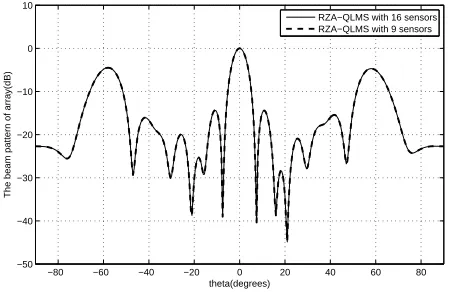
The amplitudes of steady state weight coefficients for the three algorithms are shown in Fig. 5, where for the QLMS algorithm, the amplitudes of the coefficients are spread over the sixteen sensors with some small variations, while for the ZA-QLMS algorithm, some degree of sparsity has also been achieved with four of the coefficients are close to zero. However, with 0.001 as the threshold value, they can not be discarded. For the RZA-QLMS algorithm, the variation is significantly larger and seven of them are almost zero-valued, which means the corresponding sensors can be removed and only 9 sensors are needed to give a satisfactory beamforming result, rather than 16 sensors. Moreover, the difference re-sponse between the original array and the one with 7 sensors removed is extremely small, and no difference can really be observed by a naked eye, as shown in Fig. 6. Based on the steady-state sensor number, the computational complexity of the three algorithms is listed in Tab. II, where we can see that the RZA-QLMS algorithm has the lowest complexity.
TABLE II
COMPARISON OF COMPUTATIONAL COMPLEXITY IN SIMULATIONS
QLMS ZA-QLMS RZA-QLMS
Real-valued addition 452 564 346
−80 −60 −40 −20 0 20 40 60 80 −50
−40 −30 −20 −10 0 10
theta(degrees)
The beam pattern of array(dB)
[image:6.612.62.287.56.202.2]RZA−QLMS with 16 sensors RZA−QLMS with 9 sensors
Fig. 6. Beam pattern of the two arrays.
V. CONCLUSION
An RZA-QLMS algorithm has been proposed for adaptive beamforming based on vector sensor arrays consisting of crossed dipoles. It can reduce the number of sensors involved in the beamforming process so that reduced system complexity and energy consumption can be achieved while an acceptable performance can still be maintained, which is especially useful for large array systems. Simulation results have shown that the proposed algorithm can work effectively for beamforming while enforcing a sparse solution for the weight vector where the corresponding crossed-dipole sensors with almost zero-valued coefficients can be removed from the system.
REFERENCES
[1] H. L. Van Trees, Optimum Array Processing, Part IV of Detection, Estimation, and Modulation Theory. New York: Wiley, 2002. [2] W. Liu and S. Weiss,Wideband Beamforming: Concepts and Techniques.
Chichester, UK: John Wiley & Sons, 2010.
[3] C. G. Li, F. Sun, J. M. Cioffi, and L. X. Yang, “Energy Efficient MIMO Relay Transmissions via Joint Power Allocations ,”IEEE Transactions on Circuits & Systems II: Express Briefs, vol. 61, no. 7, pp. 531–535, July 2014.
[4] X. C. Chen, W. Zhang, W. Rhee, and Z. H. Wang, “A ∆Σ TDC-based beamforming method for vital sign detection radar systems,”IEEE Transactions on Circuits & Systems II: Express Briefs, vol. 61, no. 12, pp. 932–936, December 2014.
[5] R. T. Compton, “The tripole antenna: An adaptive array with full po-larization flexibility,”IEEE Transactions on Antennas and Propagation, vol. 29, no. 6, pp. 944–952, November 1981.
[6] A. Nehorai, K. C. Ho, and B. T. G. Tan, “Minimum-noise-variance beamformer with an electromagnetic vector sensor,”IEEE Transactions on Signal Processing, vol. 47, no. 3, pp. 601–618, March 1999. [7] M. D. Zoltowski and K. T. Wong, “ESPRIT-based 2D direction finding
with a sparse uniform array of electromagnetic vector-sensors,”IEEE Transactions on Signal Processing, vol. 48, no. 8, pp. 2195–2204, August 2000.
[8] X. M. Gou, Y. G. Xu, Z. W. Liu, and X. F. Gong, “Quaternion-Capon beamformer using crossed-dipole arrays,” inProc. IEEE International Symposium on Microwave, Antenna, Propagation, and EMC Technolo-gies for Wireless Communications (MAPE), November 2011, pp. 34–37. [9] X. R. Zhang, W. Liu, Y. G. Xu, and Z. W. Liu, “Quaternion-valued robust adaptive beamformer for electromagnetic vector-sensor arrays with worst-case constraint,”Signal Processing, vol. 104, pp. 274–283, November 2014.
[10] M. B. Hawes, and W. Liu, “Design of fixed beamformers based on vector-sensor arrays,”International Journal of Antennas and Propaga-tion, vol. 2015, 2015.
[11] N. Le Bihan and J. Mars, “Singular value decomposition of quaternion matrices: a new tool for vector-sensor signal processing,”Signal Pro-cessing, vol. 84, no. 7, pp. 1177–1199, 2004.
[12] S. Miron, N. Le Bihan, and J. I. Mars, “Quaternion-MUSIC for vector-sensor array processing,” IEEE Transactions on Signal Processing, vol. 54, no. 4, pp. 1218–1229, April 2006.
[13] N. Le Bihan, S. Miron, and J. I. Mars, “MUSIC algorithm for vector-sensors array using biquaternions,”IEEE Transactions on Signal Pro-cessing, vol. 55, no. 9, pp. 4523–4533, 2007.
[14] J. W. Tao and W. X. Chang, “A novel combined beamformer based on hypercomplex processes,” IEEE Transactions on Aerospace and Electronic Systems, vol. 49, no. 2, pp. 1276–1289, 2013.
[15] J. W. Tao, “Performance analysis for interference and noise canceller based on hypercomplex and spatio-temporal-polarisation processes,”IET Radar, Sonar Navigation, vol. 7, no. 3, pp. 277–286, 2013.
[16] J. W. Tao and W. X. Chang, “Adaptive beamforming based on complex quaternion processes,” Mathematical Problems in Engineering, vol. 2014, 2014.
[17] Q. Barth´elemy, A. Larue, and J. I. Mars, “About QLMS derivations,” IEEE Signal Processing Letters, vol. 21, no. 2, pp. 240–243, 2014. [18] W. Liu, “Channel equalization and beamforming for quaternion-valued
wireless communication systems,” Journal of the Franklin Institute (arXiv:1506.00231 [cs.IT]), November 2015.
[19] M. D. Jiang, Y. Li, and W. Liu, “Properties and applications of a restricted HR gradient operator,” arXiv:1407.5178 [math.OC], July 2014.
[20] Y. Chen, Y. Gu, and A. O. Hero, “Sparse LMS for system identification,” in Proc. IEEE International Conference on Acoustics, Speech, and Signal Processing, Taipei, April 2009, pp. 3125–3128.
[21] M. D. Jiang, W. Liu, and Y. Li, “A zero-attracting quaternion-valued least mean square algorithm for sparse system identification,” inProc. of IEEE/IET International Symposium on Communication Systems, Net-works and Digital Signal Processing, Manchester, UK, July 2014. [22] R. Compton, “On the performance of a polarization sensitive adaptive
array,”IEEE Transactions on Antennas and Propagation, vol. 29, no. 5, pp. 718–725, 1981.
[23] J. Li and R. Compton Jr, “Angle and polarization estimation using esprit with a polarization sensitive array,”IEEE Transactions on Antennas and Propagation, vol. 39, pp. 1376–1383, 1991.
[24] W. R. Hamilton,Elements of quaternions. Longmans, Green, & co., 1866.
[25] I. Kantor, A. Solodovnikov, and A. Shenitzer,Hypercomplex numbers: an elementary introduction to algebras. New York: Springer Verlag, 1989.
[26] M. D. Jiang, W. Liu, and Y. Li, “A general quaternion-valued gradient operator and its applications to computational fluid dynamics and adaptive beamforming,” in Proc. of the International Conference on Digital Signal Processing, Hong Kong, August 2014.
[27] D. H. Brandwood, “A complex gradient operator and its application in adaptive array theory,”IEE Proceedings H (Microwaves, Optics and Antennas), vol. 130, no. 1, pp. 11–16, 1983.
[28] J. Yoo, J. Shin, and P. Park, “An improved NLMS algorithm in sparse systems against noisy input signals,”IEEE Transactions on Circuits & Systems II: Express Briefs, vol. 62, no. 3, pp. 271–275, March 2015. [29] E. J. Cand`es, M. B. Wakin, and S. P. Boyd, “Enhancing sparsity by
reweightedl1 minimization,”Journal of Fourier Analysis and
Applica-tions, vol. 14, pp. 877–905, 2008.
[30] W. Xu, J. X. Zhao, and C. Gu, “Design of linear-phase FIR multiple-notch filters via an iterative reweighted OMP scheme,” IEEE Trans-actions on Circuits & Systems II: Express Briefs, vol. 61, no. 10, pp. 813–817, October 2014.
[31] B. Fuchs, “Synthesis of sparse arrays with focused or shaped beam-pattern via sequential convex optimizations,” IEEE Transactions on Antennas and Propagation, vol. 60, no. 7, pp. 3499–3503, 2012. [32] G. Prisco and M. D’Urso, “Maximally sparse arrays via sequential
con-vex optimizations,”IEEE Antennas and Wireless Propagation Letters, vol. 11, pp. 192–195, 2012.