This is a repository copy of The contribution of early language development to children's emotional and behavioural functioning at 6 years: An analysis of data from the Children in Focus sample from the ALSPAC birth cohort.
White Rose Research Online URL for this paper: http://eprints.whiterose.ac.uk/95282/
Version: Accepted Version
Article:
Clegg, J., Law, J., Rush, R. et al. (2 more authors) (2015) The contribution of early
language development to children's emotional and behavioural functioning at 6 years: An analysis of data from the Children in Focus sample from the ALSPAC birth cohort. Journal of Child Psychology and Psychiatry and Allied Disciplines, 56 (1). pp. 67-75. ISSN
0021-9630
https://doi.org/10.1111/jcpp.12281
This is the peer reviewed version of the following article: Clegg, Judy, et al. "The contribution of early language development to children's emotional and behavioural functioning at 6 years: an analysis of data from the Children in Focus sample from the ALSPAC birth cohort." Journal of Child Psychology and Psychiatry 56.1 (2015): 67-75., which has been published in final form at https://dx.doi.org/10.1111/jcpp.12281. This article may be used for non-commercial purposes in accordance with Wiley Terms and
Conditions for Self-Archiving (http://olabout.wiley.com/WileyCDA/Section/id-820227.html).
[email protected] https://eprints.whiterose.ac.uk/
Reuse
Unless indicated otherwise, fulltext items are protected by copyright with all rights reserved. The copyright exception in section 29 of the Copyright, Designs and Patents Act 1988 allows the making of a single copy solely for the purpose of non-commercial research or private study within the limits of fair dealing. The publisher or other rights-holder may allow further reproduction and re-use of this version - refer to the White Rose Research Online record for this item. Where records identify the publisher as the copyright holder, users can verify any specific terms of use on the publisher’s website.
Takedown
If you consider content in White Rose Research Online to be in breach of UK law, please notify us by
1
The contribution of early language development to children’s emotional and behavioural functioning at 6 years: an analysis of data from the Children in
Focus sample from the ALSPAC birth cohort
Short title: Children’s early language development and later emotional and behavioural functioning at 6 years
J.Clegg PhD 1 J. Law PhD2 R. Rush MSc 3J. T.J. Peters PhD 4 and S. Roulstone PhD 5
1 University of Sheffield, UK. 2Newcastle University, UK.
3 Queen Margaret University, Edinburgh, UK. 4 University of Bristol, UK.
5 University of the West of England, UK.
Short title: Children’s early language development and later emotional and behavioural functioning at 6 years
Key words: children, language development, ALSPAC, emotional and behavioural functioning
Length: 6515 including all references and appendices
Address for correspondence: Dr Judy Clegg
Human Communication Sciences University of Sheffield
Sheffield S10 2TA
2
Title: The contribution of early language development to children’s emotional and behavioural functioning at 6 years: an analysis of data from the Children in Focus sample from the ALSPAC birth cohort
Abstract
Background
An association between children’s early language development and their emotional and behavioural functioning is reported in the literature. The nature of the association remains unclear and it has not been established if such an association is found in a population-based cohort in addition to clinical populations.
Method
This study examines the reported association between language development and emotional and behavioural functioning in a population-based cohort. Data from 1314 children in the Children in Focus (CiF) sample from the Avon Longitudinal Study of Parents and Children (ALSPAC) were analysed. Regression models identified the extent to which early language ability at two years of age and later language ability at four years of age is associated with emotional and behavioral functioning at six years while accounting for biological and social risk and adjusting for age and performance intelligence (PIQ).
Results
3
behavioural functioning. Interestingly, social risk dropped out of the multivariate analyses when age and PIQ were controlled for. Early expressive vocabulary at 2 years and receptive language at 4 years made a strong contribution to emotional and behavioural functioning at 6 years in addition to biological risk. The final model accounted for 11.6% of the variance in emotional and behavioural functioning at 6 years.
Conclusions
The study identified that early language ability at 2 years, specifically expressive vocabulary and later receptive language at 4 years both made a moderate, but important contribution to emotional and behavioural functioning at 6 years of age. Although children’s language development is important in understanding children’s emotional and behavioural functioning, the study shows that it is one of many developmental factors involved.
4
Introduction
There has been a long standing interest in the association between language and behaviour but recently the nature of this relationship has come under renewed scrutiny (Hartas 2011; Lindsay, Dockrell and Strand 2007; Lindsay and Dockrell 2013; Van Daal, Verhoeven and van Balkom 2007). One key source has been clinical samples of children with developmental language impairment where an overlap is commonly reported with communication impairment often perceived as leading to subsequent difficulties in emotional and behavioural functioning. (Botting & Conti-Ramsden 2000; Brownlie et al., 2004; Johnson, Beitchman and Brownlie 2010; Van Daal et al., 2007). Another has been clinical samples of children with social, emotional and behavioural difficulties and again the overlap is noted with an assumption that poor communication skills contribute to the development or maintenance of the psychopathology (Cohen, et al., 1998; Clegg, Stackhouse, Finch, Murphy and Nicholls 2009; Giddan, Milling and Campbell 1996). Patterns of language impairment have also been correlated with behavioural profiles in children with social, emotional and behavioural difficulties (SEBD) (Clegg et al., 2009 Ripley and Yuill 2005; van Daal et al., 2007).
5
and the age at which the assessments are carried out. Indeed, a recent meta-analysis confirmed that the evidence for specific language impairment as a specific risk factor for mental disorders was inconclusive (Goh Kok Yeh and O’Kearney 2013). Investigating the complex association between language and behaviour in a general population cohort may further our understanding of how this association operates over time in the general population as well as in clinical samples. Such a study will be able to account for the biological, social and developmental factors that are known to impact on emotional and behavioural functioning such as social risk (Davis, Sawyer, Lo and Wake 2010; Spratt et al., 2012), biological risk (Schoon, Sacker and Bartley 2003) and the interaction between these factors and the subsequent impact on development (Lindsay et al., 2007; Spratt et al., 2012).
6
Similarly Whitehouse, Robinson and Zubrick (2012) found no association between parent report of early vocabulary development and later emotional and behaviour functioning in the Western Australian Pregnancy cohort (n = 1623 in total). At 2 years of age, caregivers completed the Language Development Survey (LDS) (Rescorla 1989), a parent report measure of expressive vocabulary and the Child Behaviour Checklist (CBCL) (Achenbach 1991), a parent report measure of child behaviour. Children with a score on the Language Development Survey (LDS) at or below the 15th percentile for their age and gender were identified as having an expressive language (namely vocabulary) delay and formed the late talkers subgroup. The CBCL was then repeated at ages 5, 8, 10, 14, and 17 years. At 2 years of age, the late talkers were more likely to have clinically significant internalising and externalising behaviour difficulties than the typical language group. However, at all the subsequent time points including the 5 year follow up, there was no difference between the late talkers and the typical language group on the CBCL suggesting that any behavioural difficulties ameliorated over time. In conclusion, the study stated that early childhood expressive vocabulary delay is not a specific risk factor for later emotional and behavioural difficulties in childhood and through adolescence.
7 primary outcome in the early school years as a primary indicator of “school
readiness”.
Aims and research questions
The aim of this study was to explore the role played by expressive and receptive language (at two and four years) in predicting behaviour at six years of age using the Avon Longitudinal Study of Parents and Children (ALSPAC). The study asks the following research questions:
1. What is the contribution of childhood receptive and expressive language development to children’s emotional and behavioural functioning at 6 years of age relative to biological and social risk?
2. To what extent is the contribution sensitive to age within the preschool period?
Methods
ALSPAC and the Children in Focus sample Participants
8
the period from 1991-1992 were invited to participate. The eligible sample consisted of 20, 248 pregnancies and the mothers of 14, 541 (71.8% pregnancies were recruited antenatally). Of these 14, 541 pregnancies, 14,062 resulted in live births of whom 13, 988 were alive at one year of age (see Boyd et al., 2013 for a detailed description). The sample was found to have some under-representation of less affluent families and fewer families from black and ethnic minority groups than is the case nationally, although the overall developmental trajectories of the children were similar to national norms for the period (Roulstone, Law, Rush, Clegg and Peters 2010). Ethical approval for the study was obtained from the ALSPAC Ethics and Law Committee and the Local Research Ethics Committee.
9
All assessments (direct and parent report) were carried out by fully qualified and trained staff. The speech and language measures were conducted by qualified and experienced speech and language therapists (Roulstone et al., 2002).
Variables
Biological risk
The five biological risk variables were selected, as they were known to have an association with childhood development. Five biological variables were included: 1)
gender defined as male or female; 2) smoking defined as mothers who smoked in the first three months of pregnancy; 3) birthweight defined as the weight of the infant at birth and used as a proxy measure of developmental health; 4) parity
defined as the number of times the mother had given birth and; 5) gestation defined as the number of weeks at which the infant was born. These variables were all obtained from parental questionnaire data collected at birth and in the first year of life.
Social risk
10 Early Language variables (at 25 months)
The early language variables consist of a combination of parental questionnaire data and direct child assessment data collected at 25 months (2;01 years).
All Mothers in the ALSPAC cohort were asked a series of questions about their child’s understanding and use of language, focusing on their vocabulary, their
grammar and their ability to join words together within an utterance. The questionnaire was based on and modified from the Macarthur Communicative Development Inventory (CDI) (Fenson et al., 1993). The following variables comprised this early language questionnaire (see appendix 2 for further information).
Expressive vocabulary:number of words the child can say
Receptive vocabulary:number of words the child can understand
Expressive grammar:child’s ability to join words together
RDLS Comprehension Scale:The Reynell Developmental Language Scales (RDLS)
(Reynell 1977) is a standardised assessment used to assess receptive and expressive language. The RDLS comprehension scale measures a child’s verbal comprehension by administering a series of activities where the child is asked to respond to and carry out a series of spoken tasks. The assessment was administered and scored according to the assessment manual.
Later Language variables (aged 49 months)
The later language variables relate to data collected from the CiF sample at 49 months (age 4 years, 1 month).
11
Expressive Language - The Bus Story Test (Renfrew 1997): is a standardised
measure of expressive language. The assessment involves a child listening to a spoken narrative about a bus and is accompanied by pictures depicting the events that occur in the story. The child then re-tells the story, and the child’s narrative is scored for sentence length (mean sentence length of the five longest sentences),
information content (number of relevant pieces of information given) and
grammatical complexity (number of subordinate clauses). The first two but not the
third were included in the analysis due to lack of complete available data. Further
information about the language assessments can be found in Roulstone et al., (2002).
Behaviour variable (aged 61 months)
The parent report version of the Strengths and Difficulties Questionnaire (SDQ) (Goodman 1997) was used at 61 months (5 years, 8 months). The SDQ provides a total score which is the sum of the scores for Emotional, Conduct, Hyperactivity and Peer problems subscales together with a score for the perceived impact of the difficulties experienced. There is also a score for the children’s strengths – the
12 Age and Intelligence as Co-Variates
Two variables, age and performance intelligence (PIQ) were used in the analyses to adjust for the effects of age and intelligence. Age was taken when the children completed a school entry assessment administered by the Local Education Authority. The age of the children was 5 years, 3 months. The PIQ score was obtained for the CiF sample using the Wechsler Pre-School Scale of Intelligence Scale for Children - Revised (WPPSI-R) (Wechsler 1989). The CiF sample completed the WPPSI at age 4 years, 1 month (49 months).
Analyses
Descriptive analyses of the variables
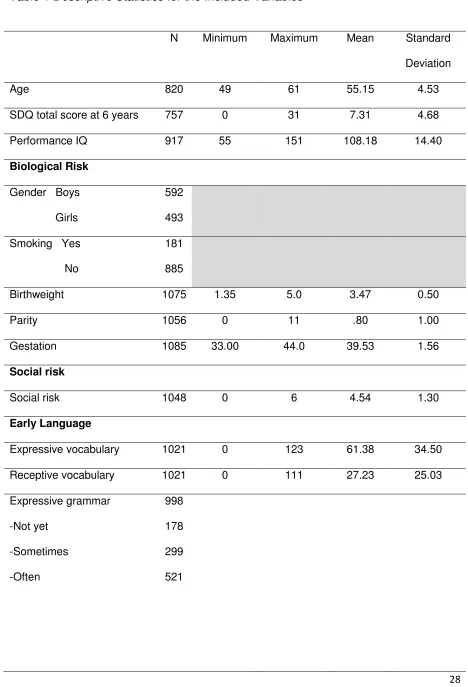
Descriptive analyses of all the variables included in the univariable and multivariable regression modelling for the whole CIF cohort (Peters 2008) are shown in table 1.
Insert table 1 about here
Step 1
13
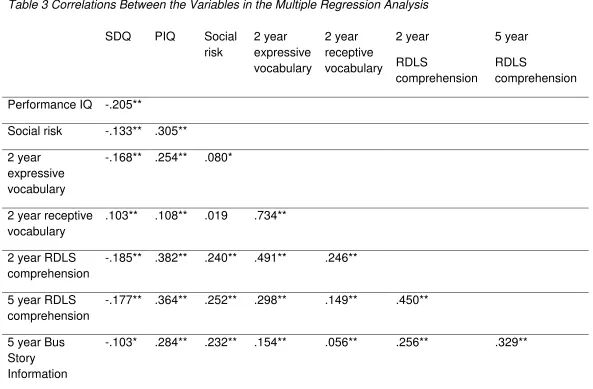
score, PIQ, social risk and the 2 year and 5 year language variables were completed using Spearman’s rank order.
Step 2
Variables were then grouped into: 1) biological risk; 2) social risk; 3) early language ability (25months) and 4) later language ability (49 months). A series of multivariable analyses was then conducted with the SDQ total score as the single outcome variable. This step further identified those variables which remained independently associated with the SDQ total score (p<0.05), within each grouping following identification in step 1, adjusting for other variables within the same group as well as for age and PIQ. Tests for collinearity were undertaken and all variables were within accepted limits (Tolerance <0.2, Variance Inflation Factor <1 (Menard 1995)). Variables remaining significant at the p<0.05 level within these multivariable analyses were carried forward to the final across-group multivariable analyses.
Step 3
This combined the earlier analysis using multivariable regression modelling across the four groups of variables and a significance threshold of 5% at each stage while adjusting for age and PIQ.
14
five analyses, with their standard errors calculated according to Rubin’s rule (Rubin 1987).
Results
Step1: Univariable analysis
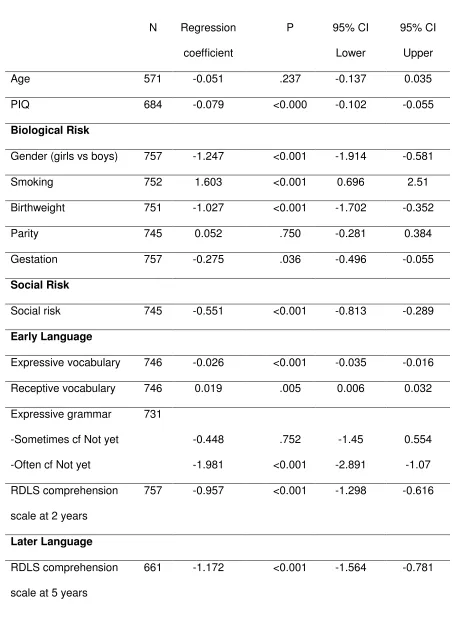
Table 2 shows that twelve variables were associated with the behaviour outcome variable at six years. These were: PIQ, four of the biological risk variables (gender, smoking in the first three months of pregnancy, birth weight and gestation); social risk; all four early language variables at 2 years (expressive vocabulary, receptive vocabulary, expressive grammar, and the RDLS comprehension scale) and two later language variable at 4 years (the RDLS comprehension scale and the Bus Story Information measure). Three variables were not significantly associated with the behaviour variable at six years. These were: age; one biological risk variable - parity; and the information expressive language measure at 4 years from the Bus Story Test. Significant correlations (shown in table 3) between the SDQ total score, PIQ, social risk and the 2 year and 5 year language variables (as found significant in step 1) were identified.
Insert table 2 about here
Step 2: Multivariable analysis
15
variable. These three variables went forward for consideration as biological risk variables in the final modelling stage.
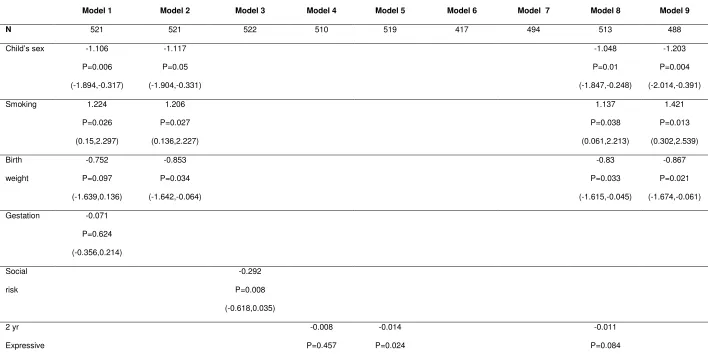
Model 2 Social risk: The social risk variable did not go forward, once age and PIQ were controlled for, since following the univariable analysis it was not significantly associated with behaviour at 6 years (p=0.08 (model 3 in table 4).
Model 3 Early language at 4 years: From the four early language variables, receptive vocabulary, expressive grammar and RDLS comprehension were not independently associated whereas expressive vocabulary accounted for 6.3% of the outcome variance (models 4 and 5 in table 4). The latter variable therefore went forward for consideration in the final modelling stage.
Model 4 Later language at 5 years: The RDLS comprehension scale was the only later language variable that was significantly associated with behaviour at 6 years, accounting for 8.5% of the outcome variance (models 6 and 7 in table 4), and it therefore went forward for the final (across group) modelling.
Insert table 4 about here
Step 3: Combining biological risk, early language and later language variables
16
The final model (model 9 in table 4) includes biological risk, and the RDLS comprehension scale at 4 years as the later language variable. The final model accounts for 11.6% of the variance in the behaviour outcome variable. The influence of biological risk is moderate (Gender p=0.004; Smoking p = 0.013; Birthweight p=0.021). Later language in the form of RDLS comprehension scale at 4 years makes a stronger contribution to behaviour in addition to biological risk (p=0.002).
The results from the method of imputation did not differ from the multiple regression modelling.
Discussion
Returning to the two research questions it is clear that parent report of expressive language at two years and receptive (but not expressive) language at four years of age predict 6 year behaviour when taken alone. Biological risk factors (gender, smoking and birthweight) and social risk (at a univariable level) also have an important role to play. The findings suggest that this relationship is sensitive to age with expressive vocabulary at two years and receptive language at four years remaining in the final models once all the other factors are taken into consideration.
17 social risk in children’s emotional and behavioural functioning is a potential area for
further research.
Age differences in the contribution of receptive and expressive language development to emotional and behavioural functioning were identified. At age 2 years, only expressive vocabulary made a significant contribution but at 4 years expressive language no longer made a significant contribution and was replaced by receptive language. Here, later receptive language may be accounting for the variability in early vocabulary and also has a stronger role than early vocabulary as it is nearer the 6 year age when emotional and behavioural functioning was measured. Changes in language measures between ages 2 and 4 years may also account for the age differences. The same standardised receptive language measure (the Reynell Developmental Language Scales (Reynell 1977)) was used at both 2 years and 4 years. However, at 4 years, expressive language was measured using the Bus Story Test (Renfrew 1997) which is a narrative based standardised assessment as opposed to the parent report measure of vocabulary and expressive grammar used at 2 years.
18
ALSPAC is a highly respected population-based cohort study (Sonuga-Barke 2012). In our analysis the consistency of the use of the standardised receptive language measure at 2 years and 4 years in addition to the direct language assessments in conjunction with the parent report measures at both 2 and 4 years add to the robustness of the study. Yet, the switch in measures between expressive vocabulary and expressive narrative while reflecting the increasing sophistication in the child’s language may restrict the interpretation of the findings.
19
expressive and receptive language to not only the total SDQ score but also the subscale scores. However, the rationale for such an analysis in this general population cohort was difficult to justify given that language only made a modest albeit important contribution to emotional and behavioural functioning.
This study investigated the contribution of early and later expressive and receptive language development to children’s emotional and behaviour functioning at 6 years
in a general population cohort. The study identified that early expressive language and later receptive language make a moderate but important contribution to emotional and behavioural functioning at 6 years of age with later receptive language making the stronger contribution. This population-based study shows that children’s early language development is important in understanding children’s
emotional and behavioural functioning but is one of many developmental factors to consider in the association between language development and emotional and behavioural functioning.
20
categories defining typical language and language impairment (Law et al., 2012; Ukoumunne et al., 2012). Therefore, future research may need to develop more robust procedures for defining and categorising such impairments in general population data.
In conclusion, early vocabulary development is clearly an important marker in children’s pre-school development and this study shows that it may be predictive of
later emotional and behavioural ability. Identifying poor vocabulary development is warranted particularly when the risk for subsequent emotional and behavioural difficulties increases when later receptive language is implicated.
References
Achenbach, T.M. (1991). Manual for the Child Behaviour Checklist/4-18 and 1991
Profile. Burlington, VT: Department of Psychiatry, University of Vermont USA.
Botting, N., & Conti-Ramsden, G. (2000). Social and behavioural difficulties in children with language impairment. Child Language Teaching & Therapy, 16, 105-120.
Boyd, A., Golding, J., Macleod, J., Lawlor, D.A., Fraser, A., Henderson, J., Molloy, L., Ness, A., Ring, S., & Davey Smith, G. (2013). Cohort profile: the ‘children of the
90s’ – the index offspring of the Avon Longitudinal Study of Parents and Children.
21
Brownlie, E.B., Beitchman, J.H., Escobar, M., Young, A., Atkinson, L., Johnson, C., Wilson, B., & Douglas, L. (2004). Early language impairment and young adult delinquent and aggressive behaviour. Journal of Abnormal Child Psychology, 32, 4, 453-467.
Clegg, J., Stackhouse, J., Finch, K., Murphy, C., & Nicholls, S. (2009). Language abilities of secondary age pupils at risk of school exclusion: a preliminary report.
Child Language Teaching & Therapy, 25,123-140.
Cohen, N.J., Menna, R., Vallance, D.D., Barwick, M.A., Im, N., & Horodezky, N.B. (1998) Language, social cognitive processing and behavioural characteristics of psychiatrically disturbed children with previously identified and unsuspected language impairments. Journal of Child Psychology and Psychiatry, 39, 853-864.
Conti-Ramsden, G., & Botting, N. (2008). Emotional health in adolescents with and without a history of Specific Language Impairment (SLI). Journal of Child Psychology & Psychiatry, 49, 516-525.
22
Fenson, L., Dale, P.S., Reznick, J.S., Thal, D., Bates, E., Hartung, J.P., Pethick, S., & Reilly, J.S. (1993). The MacArthur Communicative Development Inventories: User’s guide and technical manual. San Diego, CA; Singular Publishing Group, USA.
Giddan, J.J., Milling, L., & Campbell, M.D. (1996). Unrecognised language and speech deficits in preadolescent psychiatric inpatients. American Journal of Orthopsychiatry, 66, 85-92.
Goh Kok Yew, S., & O’Kearney, R. (2013). Emotional and behavioural outcomes
later in childhood and adolescence for children with specific language impairments: meta-analyses of controlled prospective studies. Journal of Child Psychology & Psychiatry, 54, 516-524.
Goodman R. (1997) The Strengths and Difficulties Questionnaire: A Research Note.
Journal of Child Psychology and Psychiatry, 38, 581-586.
Hartas, D. (2011). Children’s language and behavioural, social and emotional
difficulties and prosocial behaviour during the toddler years and at school entry.
British Journal of Special Education, 38, 83-91.
23
Law, J., Rush, R., Anandan, C., Cox, M., & Wood, R. (2012). Predicting language change between 3 and 5 years and its implications for early identification.
Paediatrics, 130, 1, 132-137.
Lindsay, G., & Dockrell, J. (2013). The relationship between speech, language and communication needs (SLCN) and behavioural, emotional and social difficulties (BESD). Research Report DFE-RR247-BCRP6
Lindsay, G., & Dockrell, J. (2012). Longitudinal patterns of behavioural, emotional and social difficulties and self concept in adolescents with a history of specific language impairment. Language, Speech and Hearing Services in Schools, early online publication DOI 10.1044/0161-1461 (2012/11-0069).
Lindsay, G., Dockrell, J., & Strand, S. (2007). Longitudinal patterns of behaviour problems in children with specific speech and language difficulties: child and contextual factors. British Journal of Educational Psychology, 77, 811-828.
Menard, A. (1995). Applied logistic regression analysis. Sage University paper series on quantitative applications in the social sciences, 07-106. Thousand Oaks, CA: Sage, USA.
24
Peters, T.J. (2008) Multifarious terminology: multivariable or multivariate? Univariable or univariate? Paediatric and Perinatal Epidemiology, 22, 506.
Renfrew, C. (1997). Bus Story Test.
Rescorla, L., Ross, G.S., & McClure, S. (2007). Language delay and behavioural/emotional problems in toddlers: findings from two developmental clinics.
Journal of Speech, Language and Hearing Research, 50, 1063-1078.
Rescorla, L. (1989). The Language Development Survey: a screening tool for delayed language in toddlers. Journal of Speech & Hearing Disorders, 54, 4, 587-599.
Reynell, J. (1977). Reynell Developmental Language Scales (Revised). Windsor: NFER Publishing Company, UK.
Ripley, K., & Yuill, N. (2005). Patterns of language impairment and behaviour in boys excluded from school. British Journal of Educational Psychology, 75, 37-50.
Roulstone, S., Law, J., Rush, R., Clegg, J., & Peters, T. (2010). The role of language in children’s social and educational outcomes. Department for Education (DfE), UK.
25
the Avon Longitudinal Study of Parents and Children. Early Child Development and
Care, 172, 259-268.
Royston, P. (2005). Multiple imputation of missing values: update of ICE. Stata Journal, 5, 4, 527-536.
Rubin, D.B. (1987). Multiple imputation for nonresponse in surveys. Wiley, New York, USA.
Schoon, I., Parsons, S., & Sacker, A. (2004). Socioeconomic adversity, educational resilience and subsequent levels of adult adaptation. Journal of Adolescent
Research, 19, 383-404.
Schoon,I., Sacker, A., & Bartley, M (2003) Socio-economic adversity and psychosocial adjustment:a developmental-contextual perspective Social Science & Medicine, 57, 1001–1015.
Sonuga-Barke, E.J.S. (2012). Editorial: The developmental psychopathologist as scientist-sleuth – can large-scale longitudinal birth cohort studies provide the missing clues? Journal of Child Psychology & Psychiatry, 53, 619-621.
26
Ukoumunne, O.C., Wake, H., Carlin, J., Bavin, E.I., Lum, J., Skeat, J., Williams, J., Conway, L., Cini, E., & Reilly, S. (2012). Profiles of language development in pre-school children: longitudinal latent class analysis of data from the early language in Victoria study. Child: care, Health and Development, 38, 3, 341-349.
Van Daal, J., Verhoeven, L., & van Balkom, H. (2007). Behaviour problems in children with language impairment. Journal of Child Psychology & Psychiatry, 48, 1139-1147.
Wechsler, D. (1989). Wechsler Preschool and Primary Scale of Intelligence-Revised. San Antonio, TX: The Psychological Corporation.
Whitehouse, A.J., Robinson, M., & Zubrick, S.R. (2012). Late talking and the risk for psychosocial problems during childhood and adolescence. Paediatrics, 128
ACKNOWLEDGEMENTS
The UK Medical Research Council, the Wellcome Trust and the University of Bristol
provide core support for ALSPAC. The research presented here was initially support
through funding from the Department for Education in England DFE-134
All authors declare that they have no financial interest and no potential conflict of
27
We are grateful to all the families who have taken part in the ALSPAC study, the midwives for their help in recruiting them, and the whole ALSPAC team, which includes interviewers, computer and laboratory technicians, clerical workers, research scientists, volunteers, managers, receptionists and nurses. We would like to thank the ALSPAC speech team who collected the speech and language data and to Laura Miller who has acted as our “data-buddy” throughout this project, providing
28 Table 1 Descriptive Statistics for the Included Variables
N Minimum Maximum Mean Standard
Deviation
Age 820 49 61 55.15 4.53
SDQ total score at 6 years 757 0 31 7.31 4.68
Performance IQ 917 55 151 108.18 14.40
Biological Risk
Gender Boys
Girls
592
493
Smoking Yes
No
181
885
Birthweight 1075 1.35 5.0 3.47 0.50
Parity 1056 0 11 .80 1.00
Gestation 1085 33.00 44.0 39.53 1.56
Social risk
Social risk 1048 0 6 4.54 1.30
Early Language
Expressive vocabulary 1021 0 123 61.38 34.50
Receptive vocabulary 1021 0 111 27.23 25.03
Expressive grammar
-Not yet
-Sometimes
-Often
998
178
299
29
RDLS comprehension scale
at 2 years (z scores)
1085 -2.85 3.20 0.00 1.00
Later Language
RDLS comprehension scale
at 5 years (z scores)
875 -11.93 1.36 0.02 0.98
Bus Story Information 728 1 52 27.41 11.15
30 Table 2 Univariable Regression Analyses with Behaviour (SDQ total score) at 6
Years as the Outcome Variable
N Regression
coefficient
P 95% CI
Lower
95% CI
Upper
Age 571 -0.051 .237 -0.137 0.035
PIQ 684 -0.079 <0.000 -0.102 -0.055
Biological Risk
Gender (girls vs boys) 757 -1.247 <0.001 -1.914 -0.581
Smoking 752 1.603 <0.001 0.696 2.51
Birthweight 751 -1.027 <0.001 -1.702 -0.352
Parity 745 0.052 .750 -0.281 0.384
Gestation 757 -0.275 .036 -0.496 -0.055
Social Risk
Social risk 745 -0.551 <0.001 -0.813 -0.289
Early Language
Expressive vocabulary 746 -0.026 <0.001 -0.035 -0.016
Receptive vocabulary 746 0.019 .005 0.006 0.032
Expressive grammar
-Sometimes cf Not yet
-Often cf Not yet
731 -0.448 -1.981 .752 <0.001 -1.45 -2.891 0.554 -1.07 RDLS comprehension
scale at 2 years
757 -0.957 <0.001 -1.298 -0.616
Later Language
RDLS comprehension
scale at 5 years
31
Bus Story information 558 -0.031 .042 -0.065 0.002
Bus Story sentence
length
32 Table 3 Correlations Between the Variables in the Multiple Regression Analysis
SDQ PIQ Social risk 2 year expressive vocabulary 2 year receptive vocabulary 2 year RDLS comprehension 5 year RDLS comprehension Performance IQ -.205**
Social risk -.133** .305** 2 year
expressive vocabulary
-.168** .254** .080*
2 year receptive vocabulary
.103** .108** .019 .734**
2 year RDLS comprehension
-.185** .382** .240** .491** .246**
5 year RDLS comprehension
-.177** .364** .252** .298** .149** .450**
5 year Bus Story Information
-.103* .284** .232** .154** .056** .256** .329**
33 Table 4 Multivariable Regression Coefficients (95%) for Biological Risk, Social risk, Early Language and Later Language with
Behaviour as the Dependent Variable
Model 1 Model 2 Model 3 Model 4 Model 5 Model 6 Model 7 Model 8 Model 9
N 521 521 522 510 519 417 494 513 488
Child’s sex -1.106 P=0.006 (-1.894,-0.317) -1.117 P=0.05 (-1.904,-0.331) -1.048 P=0.01 (-1.847,-0.248) -1.203 P=0.004 (-2.014,-0.391)
Smoking 1.224
P=0.026 (0.15,2.297) 1.206 P=0.027 (0.136,2.227) 1.137 P=0.038 (0.061,2.213) 1.421 P=0.013 (0.302,2.539) Birth weight -0.752 P=0.097 (-1.639,0.136) -0.853 P=0.034 (-1.642,-0.064) -0.83 P=0.033 (-1.615,-0.045) -0.867 P=0.021 (-1.674,-0.061) Gestation -0.071
34
Vocabulary (-0.029,0.013) (-0.026,-0.002) (-0.023,0.01)
2 yr Receptive Vocabulary 0.002 P=0.859 (-0.022,0.027) 2 yr Expressive Grammar Sometimes cf Not yet
Often cf Not yet 1.015 P=0.175 (-0.298,2.328) 0.067 P=0.523 (-1.449,1.583) 2 yr RDLS
Comprehen sion
-0.232 P=0.378 (-0.748,0.284) 5 yr RDLS
Comprehen sion -0.761 P=0.034 (-1.462,-0.059) -1.06 P=0.001 (-1.627,-0.493) -0.902 P=0.002 (-1.467,-0.336) 5 yr Bus Story- Information -0.004 P=0.865 (-0.045,0.038)
R2 0.084 0.084 0.06 0.075 0.063 0.067 0.085 0.088 0.116
35
Appendix 1
Social Risk Variable (Schoon, Parsons & Sacker 2004)
Schoon’s category Variable Binary coding
Parental occupation ALSPAC has both father’s and mother’s
social class based on OPCS
employment codes. In this study we
have used paternal occupation.
Unskilled, partly
skilled or manual
occupation: 0
Skilled occupation: 1
Father education Within ALSPAC there is considerable
missing data for the partner’s
education; this variable was therefore
excluded from the composite.
Mother’s education Mother’s education ‘O’ level or below
(including vocational):
0
Better than ‘O’ level: 1
House tenure House tenure Rented or other
housing: 0
Owner occupied: 1
Overcrowding ALSPAC has a ‘crowding index’,
formed by the number of people in a
house, divided by the number of rooms.
More than one person
per room: 0
Less than one person
per room: 1
36
household amenities
Receipt of state
benefits
Financial difficulties
A set of questions are asked regarding
the mother’s ability to afford certain
basic items for the baby, specifically
food, clothing, heating, rent or
mortgage and things she will need for
the baby producing a continuous score.
Financial difficulties: 0
None or minimal
financial difficulties: 1
Car ownership Use of a car No: 0
37
Appendix 2
Expressive Vocabulary at 24 months item (expressive vocabulary variable) (taken from the
CDI)
From a list of 123 early vocabulary words, Mothers were asked to report if their child could
say the word. These words included the categories of body parts, actions, clothes, home,
animal, people, places, adjectives and prepositions.
Receptive vocabulary at 24 months item (receptive vocabulary variable) (taken from the CDI)
From the same list of words in the above item, Mothers were asked to report if their child
could understand the word.
Expressive grammar at 24 months (expressive grammar variable) (taken from the CDI)
Mothers were asked ‘Has your child begun to combine words yet, such as ‘another sweet’ or
38
Key Points
An association between children’s language development and their emotional and behavioural functioning is documented. However it remains unclear as to whether this association is found in the general population as well as clinical samples.
This study identifies the contribution early and later expressive and receptive language development makes to emotional and behavioural functioning at 6 years in a prospective population based cohort.
Early and later expressive and receptive language development makes a moderate contribution to children’s emotional and behavioural functioning in the early school years while accounting for other known developmental factors.
Children’s language development is important in understanding their emotional and behavioural functioning, specifically expressive vocabulary at the age of 2 years and receptive language at school entry age.