This is a repository copy of Outlier Detection in Big Data.
White Rose Research Online URL for this paper:
http://eprints.whiterose.ac.uk/122381/
Book Section:
Hodge, Victoria J. orcid.org/0000-0002-2469-0224 (2014) Outlier Detection in Big Data. In:
Wang, J. and Wang, J., (eds.) Encyclopedia of Business Analytics and Optimization.
Encyclopedia of Business Analytics and Optimization . Hershey, PA: IGI Global , pp.
1762-1771.
https://doi.org/10.4018/978-1-4666-5202-6
[email protected] https://eprints.whiterose.ac.uk/
Reuse
Items deposited in White Rose Research Online are protected by copyright, with all rights reserved unless indicated otherwise. They may be downloaded and/or printed for private study, or other acts as permitted by national copyright laws. The publisher or other rights holders may allow further reproduction and re-use of the full text version. This is indicated by the licence information on the White Rose Research Online record for the item.
Takedown
If you consider content in White Rose Research Online to be in breach of UK law, please notify us by
Encyclopedia of
Business Analytics and
Optimization
John Wang
Montclair State University, USA
Published in the United States of America by
Business Science Reference (an imprint of IGI Global) 701 E. Chocolate Avenue
Hershey PA 17033 Tel: 717-533-8845 Fax: 717-533-8661 E-mail: [email protected] Web site: http://www.igi-global.com
Copyright © 2014 by IGI Global. All rights reserved. No part of this publication may be reproduced, stored or distributed in any form or by any means, electronic or mechanical, including photocopying, without written permission from the publisher. Product or company names used in this set are for identification purposes only. Inclusion of the names of the products or companies does not indicate a claim of ownership by IGI Global of the trademark or registered trademark.
Library of Congress Cataloging-in-Publication Data
British Cataloguing in Publication Data
A Cataloguing in Publication record for this book is available from the British Library.
All work contributed to this book is new, previously-unpublished material. The views expressed in this book are those of the authors, but not necessarily of the publisher.
For electronic access to this publication, please contact: [email protected]. Encyclopedia of business analytics and optimization / John Wang, editor.
pages cm
Includes bibliographical references and index.
Summary: “This reference confronts the challenges of information retrieval in the age of Big Data by exploring recent ad-vances in the areas of knowledge management, data visualization, interdisciplinary communication, and others”-- Provided by publisher.
ISBN 978-1-4666-5202-6 (hardcover) -- ISBN 978-1-4666-5203-3 (ebook) -- ISBN 978-1-4666-5205-7 (print & perpetual access) 1. Management--Mathematical models. 2. Decision making--Mathematical models. 3. Business planning--Mathe-matical models. 4. Big data. I. Wang, John, 1955-
HD30.25.E53 2014 658.4’038--dc23
2013046204 Managing Director:
Production Editor: Development Editor: Acquisitions Editor: Typesetter:
Cover Design:
Lindsay Johnston Jennifer Yoder Austin DeMarco Kayla Wolfe
Category: Big Data Analysis
Copyright © 2014, IGI Global. Copying or distributing in print or electronic forms without written permission of IGI Global is prohibited.
1762
Outlier Detection in Big Data
INTRODUCTION
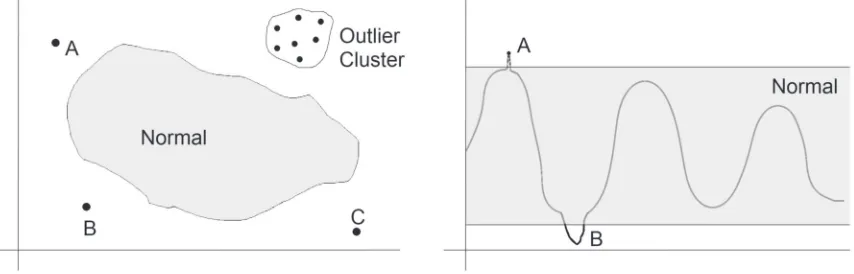
This chapter will examine the issues posed by Big Data for the task of outlier detection. An outlier (Hodge, 2011) (often called an anomaly (Chan-dola, Banerjee, & Kumar, 2009) in the literature) is a particular data point or, in some instances, a small set of data points that is inconsistent with the rest of the data population as shown in Figure 1.
“Big Data” refers to large, dynamic collec-tions of data. Data sources are generating more and more data while increasing numbers of decentralized data sources are added everyday as interconnection and data exchange become easier. Typical features of Big Data are: data comprising trillions of records where the data is loosely structured; delivered from heterogeneous data sources in heterogeneous data formats; often streamed in real-time and at high volume; and, often distributed either across local computer clusters or across separate geographically distinct sites driven by Big Data mechanisms such as cloud computing and on-line services. Such data may
be problematic for traditional outlier tools and techniques to process. This chapter studies when and where outlier detection is used and examines the problems posed and the solutions produced for outlier detection on Big Data. It then analyzes the future directions for outlier detection in Big Data.
BACKGROUND
Outlier detection or anomaly detection has been used for centuries to detect and remove anoma-lous data points from data. The original methods were arbitrary but today, principled and system-atic techniques are used. These include (Hodge, 2011): distance-based; density-based; statistical (including regression); machine learning (includ-ing decision trees, expert systems and cluster(includ-ing); information theory; spectral decomposition; neu-ral networks; support vector machines (SVMs); and, natural computation derived from artificial immune systems. Outlier detection distinguishes outlier data from normal data using either: abnor-Victoria J. Hodge
University of York, UK
[image:4.612.84.511.565.702.2]DOI: 10.4018/978-1-4666-5202-6.ch157
1763
mality detection which compares new data to a model of normality (or a model of abnormality); or, outlier classification which classifies new data as either normal or abnormal. Outlier detection can also use time-series or sequence analysis to detect changes in temporal patterns.
In the business domain, outlier detection can rapidly identify an intruder inside a business’s computer network with malicious intentions (Vieira, Schulter, Westphall, & Westphall, 2010). DARPA (http://www.darpa.mil) is investing $35 million in a program focusing on insider threat detection in massive datasets as anomaly detection produces important information for a wide variety of application domains. Much outlier detection research focuses on detecting fraud, particularly financial fraud (Phua, Lee, Smith-Miles, & Gayler, 2010). Fraud detection automates all or part of the application process and the usage or activ-ity monitoring. In general business databases, outliers may indicate fraudulent cases or they may just denote an error. Outlier detection can pinpoint these data so they can be corrected or removed and database consistency and integrity can be ensured. Equity or commodity traders can use outlier detection to monitor individual shares, commodities or markets to detect buying or sell-ing opportunities (Fang, Luo, Xu, & Fei, 2009). Businesses can identify new opportunities by using outlier detection to pinpoint unusual or distinctive patents using text-based outlier detection (Yoon & Kim, 2012). Outlier detection can even be used to provide an early warning to detect financial institutions that display abnormal behavior and may be more likely to fail (Kimmel, Booth, & Booth, 2010). Activity monitoring of time-series or sequence data can be used to constantly moni-tor processes for anomalies: detecting faults in machinery (Schlechtingen & Santos, 2011), de-tecting faults on factory production lines (Merdan, Vallee, Lepuschitz, & Zoitl, 2011) or analyzing telecommunication networks (Eiweck, Pattinson, Behringer, & Seewald, 2010). Such fault detection can help to minimize downtime, prevent failures and save businesses money and time. Businesses
rely on the transportation systems to transport their products or to receive raw materials. Employees rely on the transport network to get to and from work and to meetings. Hence, an efficient and reliable transportation system is vital for business productivity. Traffic incidents, vehicle defects or infrastructure defects can be detected by process-ing the sensor data and recognizprocess-ing outliers.
FINDING OUTLIERS IN BIG DATA
Issues, Controversies, Problems
As the complexity, variety, speed and volume of data increases then management and process-ing of these data becomes ever more complex. Additionally, many businesses require real-time outlier detection on such data. Hence, outlier detectors need to be carefully designed to cope with the complexity, variety, speed and volume required. The volume of outliers detected in Big Data may well overwhelm many system admin-istrators and software management tools used for diagnosis and analysis. Hence, outlier detectors need to be accurate and minimize false positives or false negatives due to the cost of analyzing each anomaly. The granularity of Big Data needs to be sufficiently high to allow the individual points to be differentiated for outlier analysis. However, Big Data are often very high dimensional. This high dimensionality causes the data points to be-come sparse so existing distance measures such as Euclidean distance and the standard concept of nearest neighbors become less applicable (Er-toz, Steinbach, & Kumar, 2003). Additional data dimensions can also introduce noise and make outliers more difficult to detect. Outlier detec-tion, therefore, needs to handle high dimensional and sparse data. If this data is distributed, there is also the issue of data synchronization when aggregating the data.
While Big Data poses many challenges for outlier detection applications, it also provides opportunities. Big Data will contain a broader
Outlier Detection in Big Data
1764
range of outlier examples and will allow systems to uncover new types of outlier through increased data richness. Outlier detection systems need to find rare patterns (outliers) and can improve their robustness by exploiting the richness of the data as models are only as good as the data learned. Many interesting data patterns and data relationships are not stored in a single data collection but are spread across heterogeneous data sources (Das, Srivastava, Matthews, & Oza, 2010). Businesses must develop new techniques for analysis and vi-sualization of these distributed data sources which will allow new patterns and relationships to be discovered that were not previously available. This will close the gap between what information the data holds and what we can extract. There is also potential to incorporate new data sources. Social network analysis is being introduced to uncover new outliers (Šubelj, Furlan, & Bajec, 2011) or to provide additional evidence (Phua, Smith-Miles, Lee, & Gayler, 2012) for outlier validation.
Solutions and Recommendations
Many businesses require real-time decision mak-ing includmak-ing real-time outlier detection. This requires systems that can process vast volumes of data, often heterogeneous streaming data and provide instantaneous decisions. There are vari-ous solutions for outlier detection to allow large volumes of data to be analyzed. One technique is to develop an algorithm specifically for large datasets. Koufakou and Georgiopoulos (2010) introduced a (distributed) two-step technique tailored to processing large and heterogeneous datasets. They use the categorical attributes to calculate an outlier score and partition the data and then use these partitions to analyze the continuous attributes and identify the outliers. Another approach is to keep the outlier detector simple. Eiweck et al. (2010) used simple statisti-cal outlier detectors based on inter-quartile range and standard deviations to allow near real-time analysis of telecoms networks through analyzing the data using different time frames. The
simplic-ity allows large data to be processed in near-real time. Bohm. Haegler, Müller, and Plant, (2009) aimed to be parameter free precluding the need to tune parameters and allowing fast training. They defined the data by a mixture model of distribu-tions and a point is an outlier if it does not fit in any of the distribution functions.
Processing can also be speeded by only storing the required granularity of information. Busi-nesses can store all of the raw data, samples of the data, summaries of the data or a combination, for example, storing a data summary locally for fast access and maintaining the raw data in large data warehouse to be accessed when necessary. Dash and Ng (2010) used sampling to analyze transactional data (supermarket sales) for outliers. The authors selected a representative sample from the entire dataset by ensuring that the distance between the sample and the dataset is below a threshold. This sample models normality so new transactions can be classified as outliers or normal by comparing them against the sample. However data sampling has to be performed carefully as spikes and outliers may be discarded during sam-pling as they occur infrequently and modelling normality requires clean data to ensure that no outliers are contaminating the training sample. Omniture (http://www.omniture.com/en/) and other commercial tools use data summarization. Storing a data summary allows a business to only save selected features of the data; vastly reducing the storage requirement and speeding processing. Also, some outliers can only be found in high dimensional data using feature subsets which represent smaller views of the data (Koufakou & Georgiopoulos, 2010). Again, summarization has to be performed carefully to ensure that outliers are not removed during feature selection.
Big Data warehouses store vast timelines of data for analysis. These data are often distributed across compute clusters or geographical sites. Data warehouse infrastructures have two main components: software to distribute and store the data for instance Hadoop Distributed File System (http://hadoop.apache.org/) and software to
re-Outlier Detection in Big Data
1765
trieve and perform computations on the data from these distributed machines for instance MapRe-duce. To process large data, authors have taken existing outlier detection algorithms such as the binary KD-Tree (He, Ma, Wang, Zhuang, & Shi, 2011) or graphs representing social networks or Web page links (Kang, Chau, & Faloutsos, 2011) and parallelized them for distributed processing using Hadoop. Distributed processing can be lo-cal or global.
Outliers can be identified locally and the
lo-cal outlier scores aggregated to produce a global outlier score at a coordinating node or the local data can be aggregated at a coordinating node and analyzed for outliers globally. The
communica-tion overhead is an important consideracommunica-tion for Big Data. Local outlier detection is likely to have the lowest overhead as only outlier scores need to be aggregated whereas a global approach needs to combine all data. However, a global approach can provide a system-wide view whereas local processing limits the overview. Anguilli, Basta, Lodi, and Sartori (in press) adapted a distance-based approach to detect outliers locally in very large datasets using a small subset of the dataset, computing distances on local nodes and iteratively
merging the results at a coordinating node. They developed a ”lazy” version, which only sends distances when they are needed and this showed the most promising performance. Gao (2011) pro-posed to detect outliers globally by aggregating all different data sources into a matrix representation which preserves the individual object relation-ships. Computing cosine distance between the components of the eigenvectors of the matrix using spectral techniques can identify the key features of the combined matrix and pinpoint outliers. Das, Bhaduri, and Votava (2011) performed both local and global analyses by using a one-class SVM to identify outliers locally and collecting these local outliers at one coordinating node. The coordinat-ing node also uses data samples from the local nodes to build a global model. All local outliers are tested against this global model.
When analyzing Big Data for outliers, the high number of outliers detected may overwhelm the system and some of these outliers detected may be false alarms. One option is to rank the outliers to assign a priority so the outliers can be analyzed in priority order as resources become available. Viswanathan et al. (2012) proposed a lightweight method for outlier ranking capable
Outlier Detection in Big Data
[image:7.612.94.272.132.319.2]O
1766
of operating in modern data centers by calculat-ing the outlier probability uscalculat-ing simple statistics. Another approach is to validate anomalies once they have been detected to remove false positives. Sithirasenan and Muthukkumarasamy (2011) analyzed network intrusion data from different viewpoints and calculated an outlier score by comparing each outlier found with the data of its nearest neighbors using entropy.
Many authors have examined hybrid sys-tems. As computer networks become ever more complex with grid or cloud systems, the task of network intrusion detection becomes ever more complicated. It needs to aggregate and analyze the data across multiple nodes and layers; process ever increasing volumes of data and detect ever more sophisticated attacks including coordinated and distributed attacks. Roschke, Cheng, and Meinel (2009) and Vieira et al. (2010) among others have developed hybrid modular intrusion detection systems to identify malicious behavior. Modules include a pattern-based anomaly detec-tor to learn normal behavior and recognize novel (outlier) behavior; a rule-based signature detec-tor which can be sophisticated but cannot detect novel attacks and frequency detectors to check for repeated behavior in a short space of time. Enter-prise software running on computer networks is also becoming more complex spanning multiple computers, operating systems, languages and sites yet businesses need to ensure the availability and performance of enterprise software on their networks. Cherkasova, Ozonat, Mi, Symons, and Smirni (2009) proposed a hybrid system compris-ing two techniques: a regression-based model that learns the application’s resource usage pattern and detects changes; and a performance signature that models the application’s runtime behavior and identifies the causes of changes. Schlechtingen and Santos (2011) recommended hybrid techniques for different aspects of wind turbine monitoring. For example, they used regression to monitor simple components and neural networks for more complex monitoring tasks. Merdan et al. (2011) designed a system for factory process monitoring using communicating multi-agent systems. The
agents analyze sensor data for anomalies locally and then communicate to generate a global view.
The financial sector has been proactive in using Big Data and business analytics for a wide range of tasks including fraud detection (Phua et al., 2010) and transaction processing (Dash & Ng, 2012). Recent research for financial fraud detec-tion has examined using multi-layered approaches and harvesting data from social networks. Phua et al. (2012) developed a multi-layered system to identify anomalous credit applications in real-time. Credit application fraud frequently involves identity theft where the applicant purports to be someone else so their technique used real social relationships to generate a suspicion score. It also identified duplicate credit applications and increases the suspicion score. Šubelj et al. (2011) also analyzed social networks to find networks of collaborating fraudsters. They used an expert sys-tem to analyze the network across multiple layers. Konijn and Kowalczyk (2011) have investigated a hierarchical approach for detecting health insur-ance fraud which uses standard distinsur-ance-based and density-based techniques to score outliers. It then aggregates these scores with a range of statistics calculated over different sections of the data to identify outliers in entities that are higher in the hierarchy. Other insurance fraud research has used survival analysis which analyses the time until a certain event and determines the probability that an individual will survive until a specified time. The individual could be an insurance policy owner and the policy survives while no fraudu-lent claims are made. Gepp, Kumar, Wilson, and Bhattacharya (2012) state that survival analysis is relatively new to business applications and will be assisted by Big Data which can provide historical timelines of data.
The transportation domain has been similarly proactive in incorporating Big Data and analyzing global views using distributed processing tech-niques. Accelerometer and GPS readings from mobile phones can act as probes to determine up-to-date road surface conditions and provide in-formation to travelers and maintenance companies (Pertunnen et al., 2011). Road surface problems
Outlier Detection in Big Data
1767
manifest as anomalous patterns in the data. Other authors monitor distributed sensor data. Etienne, Devogele, and Bouju (2010) detected maritime traffic anomalies through distributed sensor monitoring; finding unusual trajectories of vessels using spatio-temporal pattern analysis of the sensor data. Das et al. (2010) analyzed sensor data from aircraft fleets using an adapted one-class multi-kernel SVM where different feature subsets train the different kernels. These methods show prom-ise but there are still outstanding issues to allow real-time monitoring in these big transportation datasets including: distinguishing the individual objects in dense traffic; distinguishing the source of mobile phone signals, for example, pedestrians versus vehicles; and, having sufficiently accurate GPS locations to pinpoint which road the signal originates from where the road network is dense. Das et al. (2010) note that analyzing data across vehicle fleets is challenging as the data is large, complex, often heterogeneous and requires a system-level analysis.
FUTURE RESEARCH DIRECTIONS
While computational capability has increased massively in recent years, gaps still exist espe-cially in capacity and speed for processing Big Data. However, High Performance Computing should progress to fill many of the gaps. Murphy (2011) pinpoints cloud-based data analytics as a rich area of future research and development with anomaly detection and other performance monitoring tools available as “as-a-service” tools. Such systems can use the large volumes of data for data mining and identify new patterns and trends. Thus, Big Data will produce a shift in the analysis from hypothesis-driven discoveries to data-driven discovery of patterns or anomalies in the data (Sanfilippo, Wolf, O’Connell, Carey, & Longstaff, 2012).
As the volume and richness of data expands then more outliers will be found. It will not be sufficient to just detect outliers; systems will
need to provide precise and systematic explana-tions about the outliers to guide system analysts. Current explanations are often cumbersome and the relationships obtained are too complex to understand. As the number of anomalies de-tected increases then anomalies will also need to be prioritized and scheduled for investigation (Sanfilippo et al., 2012). Machine faults, hack attacks or traffic incident are critical anomalies that require immediate detection and investiga-tion. Other anomalies are more strategic and can be scheduled for less busy processing periods. Additionally, detected anomalies can be screened to remove false positives and reduce the number of anomaly investigations. Outlier detection will also need to consider the cost of misclassification. False negatives are usually more costly (such as missing instances of fraud or the precursors to an industrial process failure) than false positive errors which just waste the analyst’s time investigating false leads.
Existing outlier algorithms can be adapted for Big Data or new techniques considered. A potential new technique is Deep Learning (Bengio, 2009) which generates data models comprising multiple levels of non-linear operations and is well suited to the complexity challenges of Big Data. There is also a move to integrate different outlier algorithms to analyze Big Data. Hybrid techniques should give better performance than the individual algorithms by overcoming their individual limitations and exploiting their differ-ent strengths. The use of hybrid techniques will expand as the size and range of the data and the variety of outliers expands.
CONCLUSION
Massive and complex data sources appear at first glance to be part of the challenge for data min-ing tasks such as outlier detection but they also hold many opportunities. New outliers can be uncovered, vast timelines of data are available for analysis and the data models learned will be
Outlier Detection in Big Data
1768
increasingly rich as the data expands. This will allow businesses to learn more about market trends, economic factors, competitors and cus-tomers. Existing outlier detection methods need to be adapted or new methods devised to process the complexity, volume, speed and variety of Big Data. Also, how the data is represented needs to be carefully considered including using data samples and feature subsets. Big Data is often distributed and streamed so outlier detection needs to be able to process distributed and streaming data sources. Hybrid outlier detectors are often used for Big Data to exploit the power of the individual methods. The sheer volume of outliers detected in Big Data will necessitate screening and/or prioritizing so outliers can be investigated systematically and systematic explanations provided regarding why a data point is an outlier.
The future is likely to see outlier detection available on high performance computers as software-as-a-service applications.
Outlier detection on Big Data will uncover previously unseen outliers, fill in gaps in outlier knowledge, provide new insights and identify new data relationships.
REFERENCES
Angiulli, F., Basta, S., Lodi, S., & Sartori, C. (in press). Distributed strategies for mining outliers in large data sets. IEEE Transactions on Knowledge
and Data Engineering.
Bengio, Y. (2009). Learning deep architectures for
AI. Foundation and Trends in Machine Learning,
2(1), 1–127. doi:10.1561/2200000006
Böhm, C., Haegler, K., Müller, N., & Plant, C. (2009). CoCo: coding cost for parameter-free outlier detection. In, Proceedings of 15th ACM
SIGKDD International Conference on Knowledge
Discovery and Data Mining (pp. 149-158). New
York, USA: ACM.
Chandola, V., Banerjee, A., & Kumar, V. (2009). Anomaly detection: A survey. ACM Computing
Surveys, 41(3). doi:10.1145/1541880.1541882
Chaudhary, K., Yadav, J., & Mallick, B. (2012). A review of fraud detection techniques: Credit card. International Journal of Computers and
Applications, 45(1), 39–44.
Cherkasova, L., Ozonat, K., Mi, N., Symons, J., & Smirni, E. (2009). Automated anomaly detection and performance modeling of enterprise applica-tions. ACM Transactions on Computer Systems, 27(3). doi:10.1145/1629087.1629089
Das, K., Bhaduri, K., & Votava, P. (2011). Dis-tributed anomaly detection using 1-class SVM for vertically partitioned data. Statistical Analysis
and Data Mining, 4(4), 393–406. doi:10.1002/
sam.10125
Das, S., Srivastava, A., Matthews, B., & Oza, N. (2010). Multiple kernel learning for heterogeneous anomaly detection: Algorithm and aviation safety case study. In, Proceedings of 16th ACM SIGKDD
International Conference on Knowledge
Discov-ery and Data Mining (pp. 47-56). New York,
USA: ACM.
Dash, M., & Ng, W. (2010). Outlier detection in transactional data. Intelligent Data Analysis, 14(3), 283–298.
Eiweck, J., Pattinson, C., Behringer, R., & See-wald, A. (2010). A new approach for outlier detection in near real-time. In, Proceedings of 4th
UKSim European Symposium on Computer
Mod-eling and Simulation (pp. 477-483). Washington
DC, USA: IEEE Computer Society.
Ertöz, L., Steinbach, M., & Kumar, V. (2003). Finding clusters of different sizes, shapes, and densities in noisy, high dimensional data. In,
Proceedings of 3rd SIAM International Conference
on Data Mining (pp. 47-58). Philadelphia, USA:
Society for Industrial and Applied Mathematics.
Outlier Detection in Big Data
1769
Etienne, L., Devogele, T., & Bouju, A. (2010). Spatio-temporal trajectory analysis of mobile objects following the same itinerary. In, Proceed-ings of the International Symposium on Spatial
Data Handling (SDH), Hong Kong.
Fang, Z., Luo, G., Xu, S., & Fei, F. (2009). Stock fluctuations anomaly detection based on wavelet modulus maxima. In, Proceedings of 2nd
Interna-tional Conference on Business Intelligence and
Financial Engineering (pp. 360-363). Washington
DC, USA: IEEE Computer Society.
Gao, J. (2011). Exploring the power of
heteroge-neous information sources, Unpublished doctoral
dissertation, University of Illinois at Urbana-Champaign.
Gepp, A., Kumar, K., Wilson, J., & Bhattacharya, S. (2012). A comparative analysis of decision trees vis-à-vis other computational data mining techniques in automotive insurance fraud detec-tion. Journal of Data Science, 10(3), 537–561.
He, Q., Ma, Y., Wang, Q., Zhuang, F., & Shi, Z. (2011). Parallel outlier detection using kd-tree based on MapReduce. In, Proceedings of 3rd
International Conference on Cloud Computing
Technology and Science (pp. 75-80). Washington
DC, USA: IEEE Computer Society.
Hodge, V. (2011). Outlier and anomaly detection: A survey of outlier and anomaly detection meth-ods. Saarbrucken, Germany: Lambert Academic
Publishing.
Kang, U., Chau, D., & Faloutsos, C. (2011). Mining large graphs: Algorithms, inference, and discoveries. In, Proceedings of 27th International
Conference on Data Engineering (pp. 243-254).
Washington DC, USA: IEEE Computer Society. Kimmel, R., Booth, D., & Booth, S. (2010). The analysis of outlying data points by robust locally weighted scatter plot smooth: a model for the identification of problem banks. International
Journal of Operational Research, 7(1), 1–15.
doi:10.1504/IJOR.2010.029514
Konijn, R., & Kowalczyk, W. (2011). Finding fraud in health insurance data with two-layer outlier detection approach. In, Proceedings of 13th
International Conference on Data Warehousing
and Knowledge Discovery (pp. 394-405). Berlin,
Germany: Springer-Verlag.
Koufakou, A., & Georgiopoulos, M. (2010). A fast outlier detection strategy for distributed high-dimensional data sets with mixed attributes.
Data Mining and Knowledge Discovery, 20(2),
259–289. doi:10.1007/s10618-009-0148-z Merdan, M., Vallee, M., Lepuschitz, W., & Zoitl, A. (2011). Monitoring and diagnostics of indus-trial systems using automation agents.
Interna-tional Journal of Production Research, 49(5),
1497–1509. doi:10.1080/00207543.2010.526368
Murphy, J. (2011). Performance engineering for cloud computing. In, Proceedings of 8th European
conference on Computer Performance Engineer-ing (pp. 1-9), Berlin, Germany: Springer-Verlag.
Perttunen, M., Mazhelis, O., Cong, F., Kaup-pila, M., Leppänen, T., Kantola, J., et al. (2011). Distributed road surface condition monitoring using mobile phones. In, Proceedings of 8th
Inter-national Conference on Ubiquitous Intelligence
and Computing (pp. 64-78). Berlin, Germany:
Springer-Verlag.
Phua, C., Lee, V., Smith-Miles, K., & Gayler, R. (2010). A comprehensive survey of data mining-based fraud detection, Research Computing
Re-search Repository, abs/1009.6119.
Phua, C., Smith-Miles, K., Lee, V., & Gayler, R. (2012). Resilient identity crime detection. IEEE Transactions on Knowledge and Data Engineer-ing, 24(3), 533–546. doi:10.1109/TKDE.2010.262
Roschke, S., Cheng, F., & Meinel, C. (2009). Intrusion detection in the cloud. In, 8th IEEE
Inter-national Conference on Dependable, Autonomic
and Secure Computing (pp. 729-734). Washington
DC, USA: IEEE Computer Society.
Outlier Detection in Big Data
1770
Sanfilippo, A., Wolf, D., O’Connell, K., Carey, L., & Longstaff, T. (2012) C3E Workshop 2011
final report. Retrieved July 09, 2012 from http://
cps-vo.org/node/3456.
Schlechtingen, M., & Santos, I. (2011). Com-parative analysis of neural network and regres-sion based condition monitoring approaches for wind turbine fault detection. Mechanical
Sys-tems and Signal Processing, 25(5), 1849–1875.
doi:10.1016/j.ymssp.2010.12.007
Sithirasenan, E., & Muthukkumarasamy, V. (2011). Substantiating anomalies in wireless net-works using group outlier scores. Journal of Soft-ware, 6(4), 678–689. doi:10.4304/jsw.6.4.678-689
Šubelj, L., Furlan, Š., & Bajec, M. (2011). An expert system for detecting automobile insur-ance fraud using social network analysis. Expert
Systems with Applications, 38(1), 1039–1052.
doi:10.1016/j.eswa.2010.07.143
Vieira, K., Schulter, A., Westphall, C. B., & Westphall, C. M. (2010). Intrusion detection for grid and cloud computing. IT Professional, 12(4),
38–43. doi:10.1109/MITP.2009.89
Viswanathan, K., Choudur, L., Talwar, V., Wang, C., MacDonald, G., & Satterfield, W. (2012). Ranking anomalies in data centers. In, Proceed-ings of 13th IEEE/IFIP Network Operations and
Management Symposium (pp. 79-87). IEEE.
Yoon, J., & Kim, K. (2012). Detecting signals of new technological opportunities using SAO-based semantic patent analysis and outlier detection.
Scientometrics, 90(2), 445–461. doi:10.1007/
s11192-011-0543-2
ADDITIONAL READING
Aggarwal, C., Zhao, Y., & Yu, P. (2011). Outlier detection in graph streams. In, Proceedings IEEE 27th International Conference on Data Engineer-ing (pp. 399-409). Washington DC, USA: IEEE
Computer Society.
Barnett, V., & Lewis, T. (1994). Outliers in
statis-tical data (3rd ed.). Chichester, UK: John Wiley
& Sons Ltd.
Chandola, V., Banerjee, A., & Kumar, V. (2009). Anomaly detection: A survey. ACM Computing
Surveys, 41(3). doi:10.1145/1541880.1541882
Franks, B. (2012). Taming the big data tidal wave: Finding opportunities in huge data streams with
advanced analytics. Hoboken, NJ: John Wiley
& Sons.
Gogoi, P., Bhattacharyya, D., Borah, B., & Kalita, J. (2011). A survey of outlier detection methods in network anomaly identification. The Computer
Journal, 54(4), 570–588. doi:10.1093/comjnl/
bxr026
Hadi, A., Imon, A., & Werner, M. (2009). Detection of outliers. Wiley Interdisciplinary
Reviews: Computational Statistics, 1(1), 57–70.
doi:10.1002/wics.6
Han, J., Kamber, M., & Pei, J. (2011). Data
min-ing: Concepts and techniques (3rd ed.). Waltham,
MA: Morgan Kaufmann Publishers.
Hawkins, D. (1980). Identification of Outliers.
London, UK: Chapman and Hall. doi:10.1007/978-94-015-3994-4
Hodge, V. (2011). Outlier and anomaly detection: A survey of outlier and anomaly detection meth-ods. Saarbrucken, Germany: Lambert Academic
Publishing.
Hodge, V., & Austin, J. (2004). A survey of outlier detection methodologies. Artificial
In-telligence Review, 22(2), 85–126. doi:10.1023/
B:AIRE.0000045502.10941.a9
Patcha, A., & Park, J. (2007). An overview of anomaly detection techniques: Existing solu-tions and latest technological trends. Computer
Networks, 51(12), 3448–3470. doi:10.1016/j.
comnet.2007.02.001
Outlier Detection in Big Data
1771
Phua, C., Lee, V., Smith-Miles, K., & Gayler, R. (2010). A comprehensive survey of data mining-based fraud detection, Research Computing
Re-search Repository, abs/1009.6119.
Su, X., & Tsai, C.-L. (2011). Outlier detection.
Wiley Interdisciplinary Reviews: Data Mining and
Knowledge Discovery, 1(3), 261–268.
Wang, J. (2009). Encyclopedia of data
warehous-ing and minwarehous-ing (2nd ed.). Hershey, PA: IGI Global.
Yang, P., & Zhu, Q. (2011). Finding key attribute subset in dataset for outlier detection.
Knowledge-Based Systems, 24(2), 269–274. doi:10.1016/j.
knosys.2010.09.003
Zhang, Y., Meratnia, N., & Havinga, P. (2010). Outlier detection techniques for wireless sensor networks: A survey. IEEE Communications
Sur-veys & Tutorials, 12(2), 159–170. doi:10.1109/
SURV.2010.021510.00088
KEY TERMS AND DEFINITIONS
Anomaly Detection: The task of finding anomalies in a business’s data. Some authors use “anomaly detection” to specifically refer to network intrusion detection.
Anomaly: Datum that deviates from the norm (often used interchangeably with “outlier”).
Big Data: Large, dynamic and unstructured collections of data often distributed and streamed.
Business Analytics: The analysis of a busi-ness’s data to gain insight into the business.
Data Mining: The process of analyzing data from different perspectives to predict future be-havior and trends.
Distributed: Data storage and processing that is performed in different locations connected by transmission links.
Fault Detection: The task of finding failures in hardware or software.
Outlier Detection: The task of finding outliers in a business’s data. It is considered a fundamental task in data mining.
Outlier: Datum that deviates from the norm.
Outlier Detection in Big Data