This is a repository copy of Randomised controlled trial of a text messaging intervention for reducing processed meat consumption: The mediating roles of anticipated regret and intention.
White Rose Research Online URL for this paper: http://eprints.whiterose.ac.uk/118447/
Version: Accepted Version
Article:
Carfora, V, Caso, D and Conner, MT orcid.org/0000-0002-6229-8143 (2017) Randomised controlled trial of a text messaging intervention for reducing processed meat consumption: The mediating roles of anticipated regret and intention. Appetite, 117. pp. 152-160. ISSN 0195-6663
https://doi.org/10.1016/j.appet.2017.06.025
(c) 2017, Elsevier Ltd. This manuscript version is made available under the CC BY-NC-ND 4.0 license http://creativecommons.org/licenses/by-nc-nd/4.0/
[email protected] https://eprints.whiterose.ac.uk/
Reuse
Items deposited in White Rose Research Online are protected by copyright, with all rights reserved unless indicated otherwise. They may be downloaded and/or printed for private study, or other acts as permitted by national copyright laws. The publisher or other rights holders may allow further reproduction and re-use of the full text version. This is indicated by the licence information on the White Rose Research Online record for the item.
Takedown
If you consider content in White Rose Research Online to be in breach of UK law, please notify us by
Randomised Controlled Trial of a Text Messaging Intervention for Reducing Processed Meat 1
Consumption: The Mediating Roles of Anticipated Regret and Intention 2
Carfora V.1*, Caso D.1, Conner M.2
3
1Department of Humanities, University of Naples ''Federico II'', Italy. 4
2School of Psychology, University of Leeds, UK. 5
6
Abstract 7
The present study aimed to extend the literature on text messaging interventions involved in
8
promoting healthy eating behaviours. The theoretical framework was the Theory of Planned
9
Behaviour (TPB). A randomized controlled trial was used to test the impact of daily text messages
10
compared to no message (groups) for reducing processed meat consumption (PMC) over a 2 week
11
period, testing the sequential mediation role of anticipated regret and intention on the relationship
12
between groups and PMC reduction. PMC and TPB variables were assessed both at Time 1 and
13
Time 2. Participants were Italian undergraduates (at Time 1 N = 124) randomly allocated to control
14
and message condition groups. Undergraduates in the message condition group received a daily
15
SMS, which focused on anticipated regret and urged them to self-monitor PMC. Participants in the
16
control group did not receive any message. Those who completed all measures at both time points
17
were included in the analyses (N = 112). Findings showed that a daily messaging intervention,
18
controlling for participants’ past behaviour, reduced self-reported consumption of PMC. Mediation
19
analyses indicated partial serial mediation via anticipated regret and intentions. The current study
20
provided support for the efficacy of a daily messaging intervention targeting anticipated regret and
21
encouraging self-monitoring in decreasing PMC. Outcomes showed the important mediating role of
22
anticipated regret and intentions for reducing PMC.
23
24
Keywords: healthy eating; messages; theory of planned behaviour; meat consumption; self-25
monitoring; anticipated regret.
Introduction 28
In human evolutionary history, meat was one of the chief means of ensuring the nutritional
29
requirements of our species (Leroy & Praet, 2015). Moreover, meat holds a special status
30
(deFrance, 2009) and symbolic meaning (Fiddes, 1991) in many societies. The last century lead to
31
the large-scale production of meat (de Boer, Schösler, & Aiking, 2014; Edjabou, & Smed,
32
2013)along with negative environmental impacts(e.g., Tubiello et al., 2014). Consequentially, the
33
Western world witnessed an elevated rise in meat consumption (e.g., Delgado, 2003) that exceeds
34
the recommended amount (e.g., WCRF / AICR 2007) and increased the risks of contracting
35
different organic pathologies. In fact, different studies have found that red and processed meat
36
consumption are both correlated with risk of coronary heart disease, stroke and diabetes (e.g.,
37
Bouvard et al., 2015; Micha, Wallace, & Mozaffarian, 2010).
38
Based on this evidence, the International Agency for Research on Cancer (IARC), that is the
39
cancer agency of the World Health Organization (WHO, 2015), has classified the consumption of
40
red meat as probably carcinogenic to humans. Specifically, it has affirmed that processed meat is a
41
carcinogen, and that eating 50 grams of processed meat every day increases the risk of colorectal
42
cancer. Processed meat includes all meat products that have been treated with salting, curing,
43
fermenting and smoking processes to preserve or flavour it. Examples of processed red meat
44
include hot dogs, sausages and bacon.
45
Considering the importance of this health topic, dietary changes should try to promote a
46
reduction in the consumption of meat products (Bajželj et al., 2014; Tukker et al., 2008),
47
specifically the excessive intake of processed meat. Encouraging young adults to become more
48
aware about their nutrition and eating habits could be particularly valuable as this group could avoid
49
many of the negative health consequences of excessive red and processed meat consumption if they
50
change their behaviour early enough and then maintain this change.
51
In the last few years, different studies have addressed the reduction of meat consumption (de
Boer, Schösler, & Aiking, 2014),but no studies have specifically focused on reducing processed
53
meat consumption (PMC) in young adults. The present research aimed to fill this gap in the existing
54
literature by evaluating a daily text messaging intervention to promote the self-monitoring of PMC,
55
leveraging on the effects of anticipated regret.
56
Messaging interventions for promoting healthy eating behaviours and self-monitoring
57
In recent years, mobile communication is pervasively integrated into different aspects of
58
society (e.g., Hamill & Lasen, 2005; Caso 2015) and text messaging is widespread in the lives of
59
young adults (Lenhart et al., 2010; Martínez-Alemán& Wartman, 2009). Generally, messaging
60
interventions have shown efficacy in reaching quickly and with low-cost a wide number of
61
individuals (Kharbanda et al. 2010) and in promoting healthy behaviour (e.g., Woolford et al., 62
2010). A systematic review of reviews (Hall, Cole-Lewis, & Bernhardt, 2015) and a meta-analysis
63
of 38 studies (Orr & King, 2015) both showed that messaging interventions produced positive 64
changes in different health behaviours with a small but significant effect size (g = .29). 65
Furthermore, several researchers explored the efficacy of text messaging for promoting 66
different healthy eating behaviours in younger generations. For example, Svetkey, Batch, and Lin 67
(2015) showed the efficacy of mobile technology in promoting weight loss in young adults. 68
Napolitano et al. (2013) found that SMS reminders promoted healthy diet and weight loss. In 69
addition, Brookie et al. (2017) and Carfora, Caso, and Conner (2016b) provided evidence that 70
messaging interventions were effective in increasing fruit and vegetable intake in young adults and 71
adolescents, while Suffoletto et al. (2015) found that a message intervention can reduce alcohol 72
consumption in young adults.
73
Moreover, other researchers have focused on the specific use of messaging interventions for 74
promoting self-monitoring, which consists in reminding individuals to monitor, in the present case,
75
their health behaviour (e.g., Franklin et al., 2006; Hurling et al., 2007; Rodgers et al., 2005). Self
-76
monitoring is a method of systematic self-observation and when combined with recording of the
target behaviour can increase personal self-awareness (Kanfer, 1970). Indeed, self-monitoring
78
improves attention to health through awareness, measurements and observations, enhancing self
-79
management of health goals (Wilde & Garvin, 2007). 80
Self-monitoring appears to be a worthwhile strategy to change various eating behaviours. Its
81
application could promote the management of a specific food consumption, helping the 82
identification of discrepancies between current and recommended levels of consumption (Fishbach 83
et al., 2012; Myrseth & Fishbach, 2009). A systematic literature review by Zheng et al. (2015) 84
confirmed that the regular self-monitoring of weight was associated with more weight loss. Caso
85
and Carfora (2017) reported that SMS reminders about the self-monitoring of fruit and vegetable
86
intake were efficient in increasing consumption in young adults. Furthermore, self-monitoring
87
seemed to be more effective when it was combined with the use of food diary for recording food 88
consumption (Burke, Wang, & Sevick, 2011; Helsel, Jakicic, & Otto, 2007). Specifically, the 89
comprehensive review of Harkin et al. (2016) reported a large effect size of self-monitoring on
90
behaviour when information about its performance was recorded(d = 2.39), compared with not 91
recorded performance (d = .60). This effectiveness could be based on its capacity to simplify 92
memory and self-confrontation (Bailey & Sowder, 1970; Schoutrop et al., 2002).
93
In line with the above evidence, we hypothesized that a text messaging intervention for 94
promoting written self-monitoring of PMC could be a useful strategy for encourage young adults to
95
reduce the PMC. 96
Intervention for reducing processed meat consumption
97
In the extant literature, different strategies have been reported for implementing meat 98
reducing interventions, such as the promotion of one or more meatless days, the encouragement of 99
reducing the portions of meat in meals and replacement of meat with meat free substitutes (de 100
Bakker, & Dagevos, 2012; de Boer, Schösler,& Aiking, 2014; Laestadius et al., 2014,Sutton, &
101
Dibb, 2013). For example, Scrimgeour (2012) showed that a web-based intervention decreased
positive attitudes towards meat and enhanced intentions to eat less meat. Loy et al. (2016) provided 103
evidence that the self-regulation strategy of mental contrasting with implementation intentions were
104
efficient for promoting reduced meat consumption. More recently, Klöckner (2017) indicated the 105
efficacy of an intervention based on a stage model for reducing beef consumption in Norway. 106
Furthermore, two studies used messaging interventions for reducing meat consumption. 107
Bertolotti, Chirchiglia, and Catellani (2016) reported that persuasive messages about health/safety 108
had greater effects on elders’ involvement, attitudes and intentions to change their meat 109
consumption, when they were framed in factual terms. Moreover, they found that persuasive 110
messages about well-being/growth had higher effects when they were framed in prefactual terms.
111
Carfora, Caso, and Conner (2017; Study 2) showed that a messaging intervention, which promoted 112
self-monitoring of red meat consumption through a daily food dairy, was effective in increasing
113
intentions to reduce and reducing actual consumption. Furthermore, they reported that results of the 114
intervention were mediated through changes in healthy-eating and meat-eating identities.
115
In line with above studies, we hypothesised that a text messaging intervention, combined 116
with self-monitoring, could be a useful strategy for reducing PMC of young adults. In particular, we
117
predicted that anticipated regret and intentions about PMC could mediate the impact of SMS 118
reminders on self-monitored PMC.
119
Anticipated regret construct within the Theory of planned behaviour
120
A number of studies underlined that emotional experiences following a decision can
121
promote behaviour change, modifying the individuals’ evaluation about potential outcomes of a
122
certain behaviour (e.g., Bell, 1982). Particularly, regret is a feeling experienced when a person
123
perceived discrepancies between ‘what is’ and ‘what might have been’ (Loomes & Sugden, 1982).
124
Anticipated regret refers to the anticipated negative feeling when a person performs a target
125
behaviour that has been studied within the context of the Theory of Planned Behaviour (TPB;
Ajzen, 1991). The TPB has been widely used as model for understanding and changing dietary
127
behaviours, where its’ constructs were shown to be strong predictors of eating behaviours (e.g.,
128
Armitage & Conner, 2001; Carfora, Caso, & Conner, 2016a; Conner & Norman, 2005; Lombardi et
129
al., 2017; McEachan et al., 2011). TPB affirms that performance of a behaviour is driven by an
130
intention to act, which in turn is explained by other three factors: attitude, subjective norm and
131
perceived behavioural control (PBC) in relation to the considered behaviour. Different studies have
132
applied the TPB model for explaining behaviours such as meat consumption (Graça, Calheiros, &
133
Oliviera, 2015; Richetin, Conner, & Perugini, 2011; Sparks, Guthrie, & Shepherd, 1997; Zur, 2012;
134
Zur & Klöckner, 2014). Recently, Carfora et al. (2017; Study 1) found that the significant TPB
135
factors for predicting young adults’ intentions to reduce red meat consumption were affective and
136
instrumental attitudes, PBC and meat-eating identity.
137
Moreover, different TPB studies showed that anticipated regretalso predicts intention in
138
relation to healthy eating behaviours (e.g., Conner & Abraham, 2001; Sandberg & Conner, 2011;
139
Shaikh et al., 2008). For example, Richard, van der Pligt, and de Vries (1996) showed that
140
anticipated regret explained additional variance in expectations/intentions related to eating junk
141
food, using soft drugs and drinking alcohol. Kellar and Abraham (2005) and Caso, Carfora, and
142
Conner (2016) confirmed the predictive power of anticipated regret, controlling for past behaviour,
143
in determining intention to eat an adequate amount of fruit and vegetable. Importantly, a recent
144
meta-analysis (Brewer et al., 2016) showed that anticipated regret from not engaging in a specific
145
behaviour was strongly associated both with intentions and health behaviours.
146
In addition to its predictive effects, some studies demonstrated that high levels of anticipated
147
regret may drive people to act on their intentions (Sheeran & Orbell, 1999). Other studies
148
manipulated anticipated regret for increasing intention to act health behaviours. Parker, Stradling,
149
and Manstead (1996) showed that an anticipated-regret video was effective in changing beliefs
150
about exceeding the speed limit and increasing negative attitudes toward speeding. Richard, van der
151
Pligt and de Vries (1996) found that those who focused on their anticipated feelings after unsafe sex
expressed stronger expectations to use condoms in the future and they used more condoms in the
153
follow-up after five months. Sheeran and Orbell (1999) found that individuals who were induced to
154
anticipate regret about not playing the lottery intended to play more often than individuals in the
155
control group. O’Carroll et al. (2011) reported that an anticipated regret manipulation increased
156
participants’ intention to register as an organ donor in future, compared to a control condition. 157
Furthermore, Sandberg and Conner (2009, 2011) showed that the mere exposure to a measurement
158
of anticipated regret within a TPB questionnaire was sufficient for changing attendance rates in
159
woman invited for cervical screening and increasing physical activity in young adults.
160
Considering the moderating role of anticipated regret on the intention/behaviour
161
relationship, different studies found its significant effect (Abraham & Sheeran, 2004; Sheeran &
162
Orbell, 1999). For example, Conner, Sandberg, McMillan, and Higgins (2006) showed that
163
anticipated regret predicted intention about smoking initiation, over and above the other TPB
164
components, and that anticipated regret moderated the relationship within intention and behaviours.
165
In a meta-analysis conducted by Sandberg and Conner (2008), anticipated regret was shown to
166
directly impact both on intentions, controlling for the TPB variables, and on prospective behaviour,
167
having also a moderation role on intention-behaviour relationships.
168
A few studies have explored the mediating role of anticipated regret in promoting behaviour
169
changes. Among them, Smerecnik and Ruiter (2009), implementing a RCT on messages about HIV
170
with a 2 (threat: low versus high) × 2 (coping: low versus high) between-subjects design, found that
171
anticipated regret was a mediator of both the impact of the fear appeal messages on intention and
172
the coping-intention relationship. Particularly, regret was increased by high coping information,
173
which in turn increased intentions to use condoms.
174
The main criticism of the existent literature is that only a few studies have tested the role of
175
anticipated regret in changing health behaviours, particularly controlling for past behaviour and
176
allowing examination of effects on behaviour change. Indeed, it would be more prudent to test that
the effects of anticipated regret on intention and behaviour are not dependent on participants’ past
178
behaviour because anticipated regret may act as proxy measure of past behaviour (i.e. ‘I would 179
regret doing or not a specific behaviour because I usually do it’). Past behaviour has been found to
180
significantly increase the variance explained in intentions and behaviour after controlling for the
181
other TPB constructs (e.g., Caso et al., 2016; Bagozzi & Kimmel, 1995). For example, Abraham
182
and Sheeran (2004) found that anticipated regret about not exercising promoted the power of
183
exercise intentions to predict later behaviour. Their results controlled for the effect of past
184
behaviour. Importantly, there are currently no studies that manipulated anticipated regret and
185
controlled for past behaviour for promoting healthy eating behaviours. Therefore, we tested if an
186
intervention designed to highlight anticipated regret in relation to not reducing PMC could
187
strengthen intentions to reduce PMC and so increase the intention-behaviour relationship.
188
Fishbein and Ajzen (2010) note that the different predictors of intentions are inter-related
189
such that change in one construct can result in changes to other constructs. With this in mind we
190
verified if a manipulation targeting anticipated regret combined with self-monitoring produces
191
changes in anticipated regret plus other determinants of intentions. We further examined whether
192
the manipulation showed effects on behavior mediated through anticipated regret and intentions or
193
through other determinants of intentions.
194
The Present Research 195
The current study reports a randomised controlled trial (RCT) designed to test the effects of
196
a daily SMS compared with a no-message control condition on intentions and behaviours about
197
PMC reduction. In the present research, we used an SMS that focused on anticipated regret and
198
reminded participants to self-monitor PMC using daily food diary.
199
Thus, we hypothesized that:
H1: messages changed future behaviour (PMC at T2), also controlling for past behaviour (PMC at
201
T1);
202
H2: messages changed intentions at T2, also controlling for intentions at T1;
203
H3: messages changed anticipated regret at T2, also controlling for anticipated regret at T1;
204
H4: any effects of messages on future behaviour (PMC at T2) would be mediated by changes in
205
anticipated regret and then intention (versus other paths involving other determinants of intentions),
206
controlling for past behaviour (PMC at T1).
207
208
Material and Method 209
Participants and procedures
210
The present study was conducted following receipt of ethical approval by the **********
211
Department of the University **********.
212
In December 2016, a total of 132 e-mails were sent by the first author to a convenience
213
sample of Italian undergraduates, who agreed to participate in a university study on eating habits in 214
order to receive a training credit. In the e-mail participants were asked to provide written consent,
215
their mobile telephone numbers and a personal code (to allow researchers to match food diaries and 216
questionnaire responses). Moreover, in the e-mail it was specified thatonly those who did not follow
217
a specific diet (such as vegan, vegetarian, protein, slimming and/or fattening diets) could 218
participate. 219
After written consent were collected (N = 124) participants were randomized to condition 220
(based on a randomization sequence created in Microsoft Excel). Participants were allocated to 221
control (N = 62) and message group (N = 62) at the ratio of 1:1. All participants then completed a 222
TPB questionnaire followed by a daily food diary for one week (T1). At T1, 124 fully completed 223
a further daily food diary for one week (T2) with those in the intervention condition also receiving a 225
daily SMS message. At the end of the week participants completed a further TPB questionnaire 226
(T2). At the end of the study all participants were invited to a lesson, in which experimenters 227
presented the findings of the research and information about the benefits of monitoring PMC for 228
reducing its consumption. 229
The final sample at T2 was comprised of 112 participants (49 males; 63 females; mean age
230
= 19.37; standard deviation (SD) = 1.55; N = 55 in message group; N = 57 in control), whofully
231
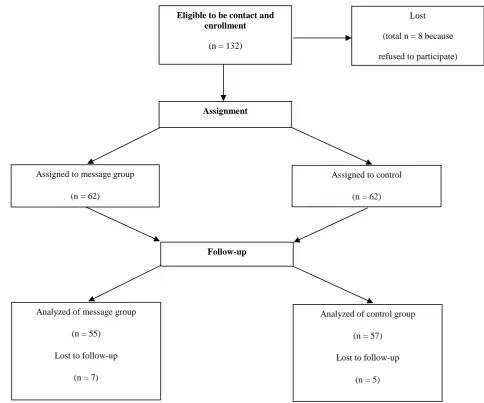
completed all measures. Figure 1 shows the flow of participants through the study.
232
[image:12.595.56.541.357.760.2]233
Figure 1. Flow of participants through each stage.
234
235
236
237
238
239
240
241
242
243
244
245
246
247
248
Assigned to control
(n = 62)
Follow-up
Analyzed of message group
(n = 55)
Lost to follow-up
(n = 7)
Analyzed of control group
(n = 57)
Lost to follow-up
(n = 5) Eligible to be contact and
enrollment
(n = 132)
Assignment
Assigned to message group
(n = 62)
Lost
(total n = 8 because
Intervention
249
The intervention consisted of a combination of encouragement of written self-monitoring of
250
behaviour and anticipated regret as behaviour change techniques (respective codes: 2.3 and 5.5; 251
Michie et al., 2013). At the beginning of the experimental phase, the message group were informed 252
they would receive an e-mail, in which was clarified that the recommended PMC is at most one
253
small portion per week (50 grams), and that they would daily receive for 1 week a SMS on 254
WhatsApp (a cross-platform mobile messaging application). The daily message was the same each
255
day and focused on anticipated regret and a reminder to monitor PMC in relation to the goal of not 256
exceeding the small portions of PMC a week (<<Think about regret that you could experience if 257
this week you exceed the recommended portion of processed meat (that is one small portions 258
corresponding to 50 grams). Today remember to monitor its consumption using the food diary to 259
help not exceed the recommended amounts>>). 260
Measures
261
An online food diary was used to monitor food consumption. Participants were invited to report 262
each food eaten during daily meals and between meals (breakfast, lunch, dinner and snacks), 263
selecting food items associated with photographs of three portion sizes of foods typical of the 264
Mediterranean diet (Turconi et al., 2005). For the analyses, we considered only the items of PMC 265
and coded small-, medium- and large-sized portions as .05, 1 and 1.5 portions. Then, we calculated
266
the behaviour weighting the total number of processed meat portions by the portion size and 267
summing them across the week. A measure of past behaviour was computed from the T1 food 268
diary; a measure of behavior was computed from the T2 food diary. 269
The TPB questionnaire included measures of gender and age (T1). Intention, attitude, 270
subjective norm and PBC measures (T1 and T2) were adapted from previous research (Carfora et 271
al., 2017) on red meat consumption. Intentions were assessed with three items on a 7-point Likert
272
grams)…(1) strongly disagree to (7) strongly agree”). Cronbach’s alpha was .98 at T1 and .99 at T2. 274
Instrumental attitudes were assessed with three items on a 7-point Likert scale (e.g., “In the next
275
week, not eating more than one portion of processed meat (50 grams) is … not worthwhile– 276
worthwhile; worthless–valuable; harmful–beneficial; all scored 1-7). Cronbach’s alpha was .98 at
277
T1 and .90 at T2. Affective attitudes were assessed with three items on a 7-point Likert scale (e.g.,
278
“In the next week, not eating more than one portion of processed meat (50 grams) is … 279
unenjoyable–enjoyable; unpleasant–pleasant; boring–exciting”; all scored 1-7). Cronbach’s alpha
280
was .99 at T1 and .88 at T2. Subjective norm was assessed with three items on a 7-point Likert scale
281
(e.g., “Most people who are important to me think that I should not eat more than one portion of 282
processed meat (50 grams) per week… extremely unlikely (1) to extremely likely (7)”). Cronbach’s 283
alpha was .89 at T1 and .94 T2.PBC was measured by seven items on a 7-point Likert scale (e.g.,
284
“Over the next week, I feel that whether I don’t eat more than one small portion of processed meat 285
(50 grams) is beyond my control... (1) strongly disagree to (7) strongly agree”). Cronbach’s alpha 286
was .91 both at T1 and T2. Anticipated regret was measured by three items on a 7-point Likert
287
scale adapted from Caso et al., 2016; e.g., “If during the next one week, I eat more than one portion 288
of processed meat (50 grams) this would bother me Cronbach’s alpha was .94 at T1 and .99 at T2. 289
Data analysis
290
Analyses were conducted in SPSS 23. We first checked for biases in drop-out or
291
randomization using Chi-square and ANOVA. We then used ANOVA to compare the two conditions
292
on behaviour (controlling for past behaviour) and on differences in anticipated regret, intentions, 293
attitudes, subjective norms and PBC. Finally, multiple mediation analyses, using bootstrapping in 294
SPSS, were conducted to test if any differences between groups were mediated by anticipated regret 295
and intentions, controlling for past behaviour. 296
Preliminary analysis
298
Univariate analyses did not show any significant differences between groups (ps> .17) in T1 299
variables (intention, affective and instrumental attitudes, subjective norm, PBC, PMC and age; 300
Table 1) before the text messaging intervention. Chi-square did not indicate any significant
301
differences in gender (p> .19). These results confirmed that randomisation was adequate and the 302
two groups were matched on baseline variables and the appropriateness of analyzing differences at 303
follow-up (time 2) on these variables without necessarily controlling for baseline difference.
304
Further analyses, comparing TPB values, age and gender between participants who 305
responded to all measurements (daily food dairy and questionnaire) at both T1 and T2 and those 306
who dropped out between the two time points, indicated that there were no significant differences 307
on any measured variable (ps > .52). These outcomes suggested that the initial sample was 308
representative of the final sample. 309
Main analyses
310
Since there were no differences at baseline between groups we first used ANOVA at time 2 311
to compare conditions. Univariate analyses (ANOVA) revealed a significant effect of group 312
(F(1,112) = 13.09; p< .001, p2 = .11) on PMC at T2. Table 1 shows that there were lower levels of 313
PMC in the intervention compared to the control condition. Moreover, ANOVAs found significant 314
effects of group on instrumental attitude (F(1,112) = 8.81; p< .004, p2 = .09), anticipated regret 315
(F(1,112) = 5.40; p< .02, p2 = .06) and intentions (F(1,112) = 7.32; p< .008, p2 = .06). As 316
indicated in Table 1 reactions to reducing PMC were more positive in the intervention compared to 317
the control conditions. Table 1 also shows differences across time points and group for each 318
variable and indicates few changes across time in the control condition but significant changes 319
We also confirmed that these effects were similar using ANCOVA controlling for baseline 321
scores. Results showed significant effects of group at T2 for PMC (F(1,112) = 17.59; p< .001, p2 = 322
.14), instrumental attitude (F(1,112) = 8.59; p< .004, p2 = .09), anticipated regret (F(1,112) = 4.63; 323
p< .03, p2 = .05) and intentions (F(1,112) = 12.82; p< .001, p2 = .11) controlling for baseline 324
score of each variable. 325
We replicated the main analyses using an intention-to-treat approach (ITT analyses) by
326
replacing any missing values at T2 with the values from T1. This analysis produced very similar 327
findings with significant effects of group at T2 for PMC (F(1,124) = 18.77; p< .001, p2 = .13), 328
instrumental attitude (F(1,124) = 10.51; p< .002, p2 = .08), anticipated regret (F(1,124) = 2.15; p < 329
.05, p2 = .01) and intention (F(1,124) = 10.56; p< .05, p2 = .08).This indicates that the main 330
analyses were not unduly biased by drop out from the sample. The findings from the ITT analyses 331
were substantively unchanged by using ANCOVA controlling for baseline scores. 332
[image:16.595.59.536.542.766.2]333
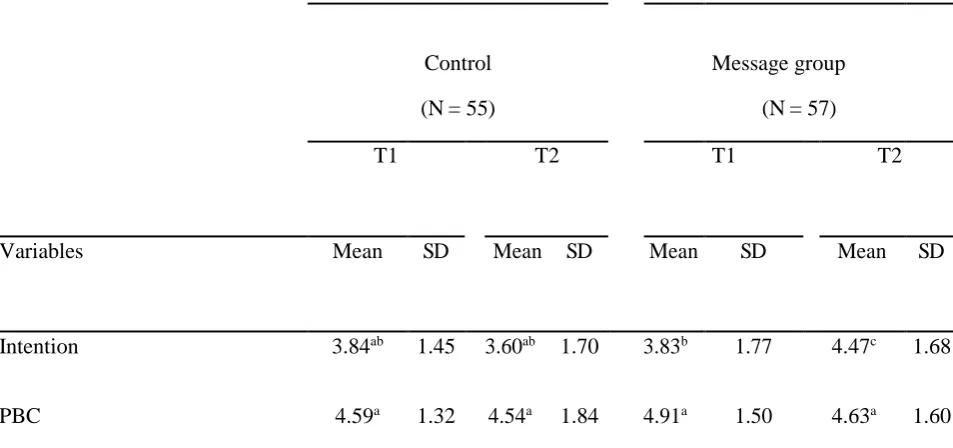
Table 1. Means and standard deviations of measured variables at Time 1 (T1) and Time 2 (T2) in 334
each condition.
335
336
337
Control
(N = 55)
Message group
(N = 57)
T1 T2 T1 T2
Variables Mean SD Mean SD Mean SD Mean SD
Intention 3.84ab 1.45 3.60ab 1.70 3.83b 1.77 4.47c 1.68
Subjective norm 4.10a 1.34 3.74a 1.21 4.18a 1.15 3.93a 1.43
Affective attitude 4.15a 1.26 4.28a 1.33 4.12a 1.50 4.23a 1.21
Instrumental attitude 5.19ab 1.48 5.22ab 1.35 5.23ab 1.60 6.03c 1.25
Anticipated regret 2.98ab 1.20 2.86ab 1.08 3.10ab 1.02 3.39c 1.08
PMC 3.32ab 2.18 3.29ab 2.61 3.13ab 3.63 1.74c 1.84
Note: PMC = Processed Meat Consumption; Means in a row that do not share the same letter suffix 338
are significantly different from one another. 339
340
Mediation analyses
341
Sequential mediation analysis were run to test whether the effect of the text messaging 342
intervention (intervention vs. control group) on weekly PMC at T2 was sequentially mediated via 343
each TPB variable and then intention (both at T2), controlling for past behaviour (PMC at T1).The 344
only significant result was for the mediated path of anticipated regret and intention. 345
The indirect effects were considered significant if bootstrapped 95% confidence intervals 346
(CI) did not include zero. The considered mediated paths were: simple mediation paths from 347
condition to PMC at T2 via anticipated regret or intention and the sequential mediation chain from 348
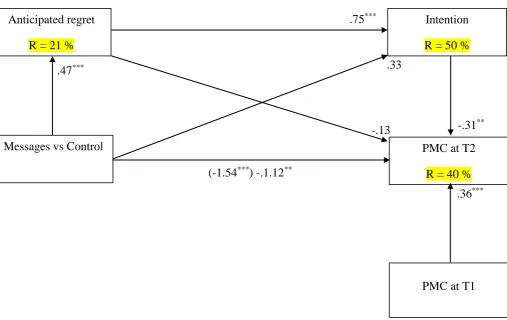
condition to PMC at T2 via anticipated regret and then intention. Figure 2 shows that for 349
comparisons of the message group against control only one of the three mediated pathways was 350
significant and the total indirect effect was significant (-.27; 95% CI, -.69; -.02). The path between
351
conditions and PMC at T2, controlling for past behaviour (PMC at T1), was reduced by controlling 352
for the mediators but remained significant(-1.12; 95% CI, - 2.33; -.49) indicating any mediation was
partial. Examination of the mediated paths indicated that the only significant mediated effect was 354
for the sequential mediation chain from groups to PMC at T2 via anticipated regret and then 355
intention (-.11; 95% CI, -.35; -.01). The simple mediation paths from condition to PMC at T2 via
356
anticipated regret (-.06; 95% CI, -.44; .13) or via intention (-.10; 95% CI, -.41; .07) were not
357
significant. 358
[image:18.595.57.565.255.575.2]359
Figure 2. Mediation effects showing paths between variables. 360
361
362
363
364
365
366
367
368
369
370
371
372
Note:PMC = Processed Meat Consumption. All values indicated unstandardized coefficients; * p< 0.05, 373
*** p< 0.001. 374
375
Discussion 376
The current study describes a test of the effects of a persuasive message, which targeted
377
anticipated regret and provided a reminder to engage in written self-monitoring and was designed to
378
reduce PMC in young adults, through prompting changes in TPB variables over a 7-day period
379
Anticipated regret
R = 21 %
Messages vs Control
(-1.54***) -.1.12** .47***
Intention
R = 50 %
PMC at T2
R = 40 % -.13
.75***
.33
-.31**
using a RCT. Participants at baseline reported a PMC higher than the recommended amount (i.e.,
380
one small portions corresponding to 50 grams a week). The intervention group (i.e., who received
381
daily reminders to self-monitor and reminder of potential anticipated regret) significantly reduced
382
their weekly PMC compared to the control group. This result confirmed H1 and was consistent with
383
studies showing the efficacy of persuasive SMS in changing healthy eating behaviours (e.g.,Siopis,
384
Chey,& Allman-Farinelli, 2015), such as an adequate meat consumption (Carfora et al., 2017;
385
Bertolotti, et al., 2016).Moreover, our findings support H2, which stated that intervention group
386
increased intention to reduce PMC. Thus, a simple messaging intervention could be an efficient
387
strategy to encourage young adults to change their processed meat eating habits, increasing
388
intentions and reducing the sequential consumption. Furthermore, H3 was confirmed, since
389
anticipated regret significantly increased after the intervention in the messaging group.
390
Although both groups were required to self-monitor their food intake a simple message
391
encouraging self-monitoring of PMC plus reminder of potential anticipated regret about eating
392
PMC was sufficient to increase anticipated regret and intention, and consequentially to reduce
self-393
reported PMC. Thus, these findings support the efficacy of a text messaging intervention that
394
combines the reminder to engage in self-monitoring, writing a daily food dairy, with the elicitation
395
of anticipated regret simultaneously. Specifically, the present results are consistent with previous
396
research both on engagement in self-monitoring (Fishbach et al., 2012; Myrseth & Fishbach, 2009)
397
-showing that this strategy helps young adults to control any discrepancies between their current
398
behaviours and intentions– and on targeting anticipated regret– confirming that it could drive
399
intention and behaviour change (e.g., Abraham &Sheeran, 2004)-, importantly extending for the
400
first time the evidence of their combined efficacy in the domain of the promotion of healthy eating.
401
Therefore, a very simple anticipated regret manipulation with a daily reminder to engage in self
-402
monitoring and only 1 week of written self-monitoring can lead to significantly lower PMC. To our
403
knowledge this is the first time that a simple SMS, eliciting anticipated regret and containing a 404
reminder to self-monitor, has been tested in healthy eating research; therefore, although the effect
size ( p2 = .24) is relatively small, it is a significant effect. However, our findings are consistent 406
with the effect sizes observed in other studies on anticipated regret (O’Carroll et al., 2011; Sandberg 407
& Conner, 2008) or self-monitoring combined with SMS (e.g., Caso & Carfora, 2017). Thus, even
408
if the effect size is medium, according to Prentice and Miller (1992), it could be considered an 409
important finding, since the intervention was minimal and the outcome is difficult to influence. 410
Our mediation analyses (Figure 1) indicates that for reducing PMC the effectiveness of 411
messages compared to no messages was partially mediated by sequential effects of messages on 412
anticipated regret and intention, partially supporting H4. Interestingly, in the present context, the 413
effects of the messages compared to no messages on PMC was not mediated via a simple path 414
through only anticipated regret or intention. These results could be interpreted as an evidence that 415
only changing anticipated regret, and in turn intentions, daily engagement in written self-monitoring
416
procedure could decrease PMC. This finding is in line with the TPB model, which considers 417
anticipated regret as an important determinant of intentions. In fact, this finding highlights that 418
anticipated regret not only predicts intentions in relation to healthy behaviours (e.g., Abraham & 419
Sheeran, 2004; Conner et al., 2006; Kellar & Abraham, 2005), but also determines intention
-420
behaviour changes. Therefore, the present study is prospectively a useful contribution to the 421
literature because it emphasizes that anticipated regret, combined with the engagement in written 422
self-monitoring, could be increased by SMS reminders in young adults, prompting a sequential
423
enhancement of intentions in relation to healthy eating behaviours. It could be hypothesised that 424
both daily eliciting anticipated regret and reminding the engagement in a written self-monitoring of
425
PMC can lead individuals to intend to control this consumption for not feeling negative emotions. 426
Particularly, the effects of SMS were observed after controlling for previous past behaviour, 427
indicating impacts on behaviour change. Importantly although the intervention did change other 428
components of the TPB there was only evidence of the effect on behaviour being mediated through 429
Limitations and future directions
431
The present study had several limitations that future research should address, including a 432
reliance on self-reported data and low generalizability due to the focus on a student sample. In fact,
433
the PMC was assessed with a daily food dairy, which can be considered as less valid than an
434
objective measure. Moreover, our findings may not be generalisable to all young adults because the
435
sample was not representative and was restricted to participants from South of Italy.
436
Importantly, the design of the current study does not allow us to separate the effects of
437
targeting anticipated regret versus encouraging the engagement in written self-monitoring. A future
438
direction for research would be to test the combined and individual effects of targeting anticipated
439
regret and encouraging self-monitoring in a full (2x2) factorial design.
440
Furthermore, the mediation analyses were based on measures of anticipated regret taken
441
after the measurement of behaviour. As such these analyses assume that intentions and anticipated
442
regret changed as a result of the intervention rather than as a result of experience of performing the
443
behaviour or not. Future research could usefully assess this potential alternative explanation of the
444
findings.
445
A further weakness of the current research was that self-reported behaviour was measured
446
contemporaneously with the messages. It is possible that messages might be lead to more biases in
447
responding in such a design than if behaviour had been measured objectively and or taken at
448
different time points. The extent to which changes in PMC remain or are extinguished once the
449
message cease also remains to be assessed, i.e., we did not ascertain whether the observed decrease
450
of PMC would be maintained in the longer period. Future research could usefully investigate if and
451
how long a brief text messaging intervention can promote a stable reduction of PMC. In particular,
452
studies are required to test whether a text message intervention could produce effects over the
453
considerably longer periods of time than examined here (one week) that would be required to
produce impacts on health outcomes. This is also important because the long term reduction in
455
processed meat consumption is likely more difficult than changing the behaviour for a single week.
456
Moreover, since this study was a first attempt to manipulate anticipated regret combined
457
with a self-monitoring reminder, we used the same message content for seven days. Future studies
458
could try to differentiate it, using different way for eliciting anticipated regret such as a diverse
459
message framework (for example, see Bertolotti et al., 2016). This may be particularly important in
460
longer term studies where participants may be expected to habituate to the same message.
461
A related issue is whether the observed effects could be attributable to the two conditions
462
differentially affecting biased responding. This could explain the observed findings if the nature of
463
the intervention compared to the control condition lead to a greater willingness to avoid reporting
464
PMC. Given the nature of the mediation findings we would also have to assume that such a bias
465
also affected the completion of the questionnaires. We would argue that this is implausible given
466
that participants in both groups would have been aware that the study focused on PMC.
467
Nevertheless, replicating the study with an objective measure of behaviour is likely necessary to
468
confirm that such an effect did not bias the current findings.
469
A replication of this study on a larger scale and for a longer period with a more objective 470
measure of behaviour could produce important public health implications. In fact, the stable 471
reduction of PMC in young adults is consequentially an opportunity to decrease risks of contrasting 472
different pathology, such as colorectal cancer and cardiovascular diseases (Bouvard et al., 2015; 473
Micha, Wallace, & Mozaffarian, 2010; WHO, 2015). 474
However, the mechanisms by which anticipated regret and self-monitoring produces changes in
475
eating behaviour need to be further studied. There could be other variables that mediate the impact
476
of SMS on eating behaviour and so targeted in messages in future studies. Moreover, new studies
477
could test other message content combined with self-monitoring. For example, effects of SMS
478
could also be elicited through basing their contents on moral norm (Clapp et al., 2003) or affective
479
attitude (Conner et al., 2011). These could be potential useful directions for future research.
Conclusion 481
In summary, our research contributed to a better understanding of how text messages can be used to
482
deliver an intervention (targeting anticipated regret and encouraging self-monitoring) for reducing
483
PMC. Our findings showed that an anticipated regret manipulation combined with prompted written
484
daily self-monitoring could promote this behaviour. Future studies exploring these effects on
485
healthy eating behaviours could be worthwhile.
486
References 487
Abraham, C., & Sheeran, P. (2004). Deciding to exercise: The role of anticipated
488
regret. British journal of health psychology, 9(2), 269-278. doi: 10.1348/135910704773891096.
489
Ajzen, I. (1991) The theory of planned behavior. Organizational Behavior and Human
490
Decision Processes, 50(2),179-211. doi: 10.1016/0749-5978(91)90020-t.
491
Apostolidis, C., & McLeay, F. (2016). Should we stop meating like this? Reducing meat
492
consumption through substitution. Food Policy, 65, 74-89. doi: 10.1016/j.foodpol.2016.11.002
493
Armitage, C. J., & Conner, M. (2001). Efficacy of the theory of planned behavior. A
meta-494
analytic review. British Journal of Social Psychology, 40, 471-499. doi:
495
10.1348/014466601164939.
496
Bajželj, B., Richards, K. S., Allwood, J. M., Smith, P., Dennis, J. S., Curmi, E., & Gilligan,
497
C. A. (2014). Importance of food-demand management for climate mitigation. Nature Climate
498
Change, 4(10), 924-929. doi: 10.1038/nclimate2353.
499
Bagozzi, R. P., & Kimmel, S. K. (1995). A comparison of leading theories for the prediction
500
of goal-directed behaviours. British Journal of Social Psychology, 34(4), 437-461. doi:
501
10.1111/j.2044-8309.1995.tb01076.x.
502
Bailey, K. G., & Sowder, W. T. (1970). Audiotape and videotape self-confrontation in
503
psychotherapy. Psychological Bulletin, 74(2), 127. doi: 10.1037/h0029633.
Bell, D. E. (1982). Regret in decision making under uncertainty. Operations research, 30(5),
505
961-981. doi: 10.1287/opre.30.5.961.
506
Bertolotti, M., Chirchiglia, G., & Catellani, P. (2016). Promoting change in meat
507
consumption among the elderly: Factual and prefactual framing of health and well-being.
508
Appetite,106, 37-47. doi: 10.1016/j.appet.2016.02.150.
509
Bouvard, V., Loomis, D., Guyton, K. Z., Grosse, Y., El Ghissassi, F., Benbrahim-Tallaa, L.,
510
... & Straif, K. (2015). Carcinogenicity of consumption of red and processed meat. Lancet
511
Oncology, 16(16), 1599. doi: 10.1016/s1470-2045(15)00444-1.
512
Brewer, N. T., DeFrank, J. T., & Gilkey, M. B. (2016). Anticipated regret and health
513
behavior: A meta-analysis. Health Psychology, 35(11), 1264-1275. doi:10.1037/hea0000294
514
Brookie, K. L., Mainvil, L. A., Carr, A. C., Vissers, M. C., & Conner, T. S. (2017). The
515
development and effectiveness of an ecological momentary intervention to increase daily fruit and
516
vegetable consumption in low-consuming young adults. Appetite, 108, 32-41. doi:
517
10.1016/j.appet.2016.09.015.
518
Burke, L. E., Wang, J., & Sevick, M. A. (2011). Self-monitoring in weight loss: A
519
systematic review of the literature. Journal of the American Dietetic Association, 111, 92-102. doi:
520
10.1016/j.jada.2010 .10.008.
521
Carfora, V., Caso, D., & Conner, M. (2016a). The role of self-identity in predicting fruit and
522
vegetable intake. Appetite, 106, 23-29. doi: 10.1016/j.appet.2015.12.020.
523
Carfora, V., Caso, D.,& Conner, M. (2016b). Randomized controlled trial of a messaging
524
intervention to increase fruit and vegetable intake in adolescents: Affective versus instrumental
525
messages. British Journal of Health Psychology, 21, 937-955. doi: 10.1111/bjhp.12208.
526
Carfora, V., Caso, D., & Conner, M. (2017). Correlational study and randomised controlled
527
trial for understanding and changing red meat consumption: The role of eating identities. Social
528
Science & Medicine, 175, 244-252. doi: 10.1016/j.socscimed.2017.01.005.
Caso, D. (2015). L’uso di Internet e il benessere psicosociale in adolescenza: Uno studio 530
correlazionale [Internet use and psychosocial well-being in adolescence: A correlational study].
531
Psicologia della Salute, 2, 141-155. doi:10.3280/PDS2015-002008.
532
Caso, D., Carfora, V., Conner, M. (2016). Predicting intentions and consumption of fruit
533
and vegetables in Italian adolescents. Effects of anticipated regret and self-identity,
534
Psicologia Sociale, 3, 319-326. doi: 10.1482/84668.
535
Caso, D., & Carfora, V. (2017). Un intervento di messaggistica istantanea per la promozione
536
del monitoraggio del consumo di frutta e verdura [Messaging intervention for promoting
self-537
monitoring of fruit and vegetable consumption] .Psicologia della Salute,1, 97–111.
538
doi:10.3280/pds2017-001005.
539
Clapp, J. D., Lange, J. E., Russel, C., Shillington, A., & Voas, R. (2003). A failed norms
540
social marketing campaign. Journal of Studies on Alcohol, 64, 409–414. doi:
541
10.1207/s15327027hc1701_4.
542
Conner, M., & Abraham, C. (2001). Conscientiousness and the theory of planned behavior:
543
Toward a more complete model of the antecedents of intentions and behavior. Personality and
544
Social Psychology Bulletin, 27, 1547–1561. doi: 10.1177/01461672012711014.
545
Conner, M., & Norman, P. (2005). Predicting health behavior. Open University Press.
546
Conner, M., Rhodes, R., Morris, B., McEachan, R., & Lawton, R. (2011). Changing exercise 547
through targeting affective or cognitive attitudes. Psychology & Health, 26(2), 133-149.
548
doi:10.1080/08870446.2011.531570. 549
Conner, M., Sandberg, T., McMillan, B., & Higgins, A. (2006). Role of anticipated regret,
550
intentions and intention stability in adolescent smoking initiation. British Journal of Health
551
Psychology, 11(1), 85-101. doi: 10.1348/135910705x40997.
552
de Bakker, E., & Dagevos, H. (2012). Reducing meat consumption in today’s consumer 553
society: questioning the citizen-consumer gap. Journal of Agricultural and Environmental Ethics,
554
25(6), 877-894. doi: 10.1007/s10806-011-9345-z.
de Boer, J., Schösler, H., & Aiking, H. (2014). “Meatless days” or “less but better”?
556
Exploring strategies to adapt Western meat consumption to health and sustainability challenges.
557
Appetite, 76, 120-128. doi: 10.1016/j.appet.2014.02.002.
558
DeFrance, S. D. (2009). Zooarchaeology in complex societies: political economy, status, and
559
ideology. Journal of archaeological research, 17, 105-168. doi: 10.1007/s10814-008-9027-1
560
Delgado, C. (2003). Rising consumption of meat and milk in developing countries has
561
created a new food revolution. The Journal of Nutrition, 3907-3910.
562
de Bakker, E., & Dagevos, H. (2012). Reducing meat consumption in today’s consumer 563
society: questioning the citizen-consumer gap. Journal of Agricultural and Environmental Ethics,
564
25(6), 877-894. doi: 10.1007/s10806-011-9345-z.
565
Hallström, E., Röös, E., & Börjesson, P. (2014). Sustainable meat consumption: A
566
quantitative analysis of nutritional intake, greenhouse gas emissions and land use from a Swedish
567
perspective. Food Policy, 47, 81-90. doi: 10.1016/j.foodpol.2014.04.002.
568
Edjabou, L. D., & Smed, S. (2013). The effect of using consumption taxes on foods to
569
promote climate friendly diets–The case of Denmark. Food Policy, 39, 84-96. doi:
570
10.1016/j.foodpol.2012.12.004.
571
Fiddes, N. (1991). Meat: A natural symbol. New York: Routledge. doi: 10.2307/2803944.
572
Fishbein, M., & Ajzen, I. (2010). Predicting and changing behavior: The reasoned action
573
approach, Routledge. doi:10.4324/9780203838020.
574
Fishbach, A., Touré-Tillery, M., Carter, T. J., & Sheldon, O. J. (2012). The problem with
575
self-control. Paper presented at the Society for Personality and Social Psychology Conference, San
576
Diego, CA.
577
Franklin, V. L., Waller, A., Pagliari, C., & Greene, S. A. (2006). A randomized controlled
578
trial of Sweet Talk, a text- messaging system to support young people with diabetes. Diabetic
579
Medicine, 23, 1332-38. doi: 10.1111/j.1464-5491.2006.01989.x.
Graça, J., Calheiros, M. M., & Oliveira, A. (2015). Attached to meat? (Un)Willingness and
581
intentions to adopt a more plant-based diet. Appetite, 95, 113-125. doi:
582
10.1016/j.appet.2015.06.024. 583
Hall, A., Cole-Lewis, H., & Bernhardt, J. M. (2015). Mobile text messaging for health: A
584
systematic review of reviews. Annual Review Public Health, 36(1), 393-415. doi: 10.1146/annurev
-585
publhealth-031914-122855.
586
Hamill, L., & Lasen, A. (2005). Mobile world: Past, present and future. Springer: USA. doi:
587
10.1007/1-84628-204-7.
588
Harkin, B., Webb, T. L., Chang, B. P., Prestwich, A., Conner, M., Kellar, I., ... & Sheeran,
589
P. (2016). Does monitoring goal progress promote goal attainment? A meta-analysis of the
590
experimental evidence. Psychological bulletin, 142(2), 198--229.doi: 10.1037/bul0000025.
591
Helsel, D. L., Jakicic, J. M., & Otto, A. D. (2007). Comparison of Techniques for
Self-592
Monitoring Eating and Exercise Behaviors on Weight Loss in a Correspondence-Based
593
Intervention. Journal of the American Dietetic Association, 107(10), 1807-1810. doi:
594
/10.1016/j.jada.2007.07.014.
595
Hurling R., Catt M, Boni M.D., Fairley B.W., Hurst T., et al. (2007). Using internet and
596
mobile phone technology to deliver an automated physical activity program: randomized controlled
597
trial. Journal of Medical Internet Research, 9(2):e7. doi: 10.2196/jmir.9.2.e7.
598
Kanfer, F. H. (1970). Self-monitoring: Methodological limitations and clinical applications.
599
Journal of Consulting and Clinical Psychology, 35(2), 148–152. doi:10.1037/h0029874.
600
Kellar, I., &Abraham, C. (2005). Randomized controlled trial of a brief research-based
601
intervention promoting fruit and vegetable consumption. British Journal of Health
602
Psychology, 10(4), 543-558. doi: 10.1348/135910705x42940.
603
Kharbanda, E. O., Stockwell, M. S., Fox, H. W., & Rickert, V. I. (2009). Text4Health: A
604
qualitative evaluation of parental readiness for text message immunization re- minders. American
605
Journal of Public Health,99(12), 2176–2177. doi: 10.2105/AJPH.2009.161364.
Klöckner (2017). A stage model as an analysis framework for studying voluntary change in
607
food choices–The case of beef consumption reduction in Norway. Appetite, 108, 434-449. doi:
608
10.1016/j.appet.2016.11.002.
609
Laestadius, L. I., Neff, R. A., Barry, C. L., & Frattaroli, S. (2014). “We don’t tell people
610
what to do”: An examination of the factors influencing NGO decisions to campaign for reduced 611
meat consumption in light of climate change. Global Environmental Change, 29, 32–40.
612
doi:10.1016/j.gloenvcha.2014.08.001.
613
Lenhart, A., Purcell, K., Smith, A., & Zickuhr, K. (2010). Social Media & Mobile Internet
614
Use among Teens and Young Adults. Millennials. Pew internet & American life project.
615
Leroy, F., & Praet, I. (2015). Meat traditions. The co-evolution of humans and meat.
616
Appetite, 90, 200-211. doi: 10.1016/j.appet.2015.03.014.
617
Lombardi, A., Carfora, V., Cicia, G., De Giudice, T., Lombardi, P., & Panico, T. (2017).
618
Exploring willingness to pay for QR code labeled extra-virgin olive oil: An application of the
619
theory of planned behaviour. International Journal on Food System Dynamics, 8(1), 14-31. doi:
620
10.18461/ijfsd.v8i1.812.
621
Loomes, G., & Sugden, R. (1982). Regret theory: An alternative theory of rational choice
622
under uncertainty. The Economic Journal, 92(368), 805-824. doi: 10.2307/2232669.
623
Loy, L. S., Wieber, F., Gollwitzer, P. M., & Oettingen, G. (2016). Supporting Sustainable
624
Food Consumption: Mental Contrasting with Implementation Intentions (MCII) Aligns Intentions
625
and Behavior. Frontiers in Psychology, 7, 607. doi: 10.3389/fpsyg.2016.00607. 626
Martínez-Alemán, A. M., & Wartman, K. L. (2008). Online social networking on campus:
627
Understanding what matters in student culture. Routledge. doi: 10.1353/csd.0.0086.
628
McEachan, R. R. C, Conner, M., Taylor, N. J., & Lawton, R. J. (2011). Prospective 629
prediction of health-related behaviors with the Theory of Planned Behavior: A meta-analysis.
630
Health Psychology Review, 5(2), 97-144. doi: 10.1080/17437199.2010.521684.
Micha, R., Wallace, S. K., & Mozaffarian, D. (2010). Red and Processed Meat Consumption 632
and Risk of Incident Coronary Heart Disease, Stroke, and Diabetes Mellitus: A Systematic Review 633
and Meta-Analysis. Circulation, 121(21), 2271–2283. doi:10.1161/circulationaha.109.924977.
634
Michie, S., Richardson, M., Johnston, M., Abraham, C., Francis, J., Hardeman, W., Eccles, 635
M. P., Cane, J., & Wood, C. E. (2013). The behavior change technique taxonomy (v1) of 93 636
hierarchically clustered techniques: Building an international consensus for the reporting of 637
behavior change interventions. Annals of Behavioral Medicine, 46, 81-95. doi: 10.1007/s12160
-638
013-9486-6.
639
Myrseth, K. O. R., & Fishbach, A. (2009). Self-control: A function of knowing when and
640
how to exercise restraint. Current Directions in Psychological Science, 18, 247–252. doi: 641
10.1111/j.1467- 8721.2009.01645.x.
642
Napolitano, M. A., Hayes, S., Bennett, G. G., Ives, A. K., & Foster, G. D. (2012). Using 643
Facebook and Text Messaging to Deliver a Weight Loss Program to College Students. Obesity, 644
21(1), 25-31. doi:10.1038/oby.2012.107.
645
O'Carroll, R. E., Foster, C., McGeechan, G., Sandford, K., & Ferguson, E. (2011). The “ick”
646
factor, anticipated regret, and willingness to become an organ donor. Health Psychology, 30(2),
647
236. doi: 10.1037/a0022379.
648
Orr, J. A. & King, R. J. (2015). Mobile phone SMS messages can enhance healthy 649
behaviour: A meta-analysis of randomised controlled trials. Health Psychology Review, 9(4), 397
-650
416. doi: 10.1080/17437199.2015.1022847. 651
Parker, D., Stradling, S. G., & Manstead, A. S. (1996). Modifying beliefs and attitudes to 652
exceeding the speed limit: An intervention study based on the theory of planned behavior1.Journal
653
of Applied Social Psychology,26(1), 1-19. doi: 10.1111/j.1559-1816.1996.tb01835.x.
654
Pew Research Center, (2014). February 13. Emerging nations embrace internet, mobile 655
technology. Pew Research Center. Retrived from:http://www.pewglobal.org/2014/02/13/emerging
-656
nations-embrace-internet-mobile-technology/
Richard, R., Van der Pligt, J., & De Vries, N. A. N. N. E. (1996). Anticipated regret and time
658
perspective: Changing sexual risk-taking behavior. Journal of Behavioral Decision Making, 9(3),
659
185-199.
660
Richetin, J. Conner, M., & Perugini, M. (2011). Not doing is not the opposite of doing:
661
Implications for attitudinal models of behavioral prediction. Personality and Social Psychology
662
Bulletin, 37(1), 40-54. doi: 10.1037/e527772014-348.
663
Rodgers, A., Corbett, T., Bramley, D., Riddell, T.,Wills, M., Lin, R.-B., et al. (2005). Do u
664
smoke after txt? Results of a randomised trial of smoking cessation using mobile phone text
665
messaging. Tobacco Control, 14, 255–261. doi: 10.1136/tc.2005.011577. doi:
666
10.1207/s15324834basp1802_1.
667
Sandberg, T., & Conner, M. (2011). Using self-generated validity to promote exercise
668
behaviour. British Journal of Social Psychology, 50, 769-783. doi:
10.1111/j.2044-669
8309.2010.02004.x.
670
Sandberg, T., & Conner, M. (2009). A mere measurement effect for anticipated regret:
671
Impacts on cervical screening attendance. British Journal of Social Psychology, 48, 221-236. doi:
672
10.1348/014466608X347001.
673
Sandberg, T., & Conner, M. (2008). Anticipated regret as an additional predictor
674
in the theory of planned behaviour: A meta-analysis. British Journal of Social Psychology,
675
47, 589-606. doi: 10.1348/ 014466607X258704.
676
Schoutrop, M. J. A., Lange, A., Hanewald, G., Davidovich, U., & Salomon, H. (2002).
677
Structured writing and processing major stressful events: A controlled trial. Psychotherapy and
678
Psychosomatics, 71, 151–157. doi: /10.1159/000056282.
679
Scrimgeour, L.R., (2012). Digital Persuasion: Effects of web-based information and beliefs
680
on meat consumption attitudes, and intentions. Thesis Dissertation, Psychology, University of
681
Canterbury.
Shaikh, A. R., Yaroch, A. L., Nebeling, L., Yeh, M. C., & Resnicow, K. (2008).
683
Psychosocial predictors of fruit and vegetable consumption in adults a review of the literature.
684
American Journal of Preventive Medicine, 34, 535–543. doi: 10.1016/j.amepre.2007.12.028.
685
Sheeran, P., & Orbell, S. (1999). Augmenting the theory of planned behavior: Roles for
686
anticipated regret and descriptive norms. Journal of Applied Social Psychology, 29, 2107–2142.
687
doi: 10.1111/j.1559-1816.1999.tb02298.x.
688
Siopis, G., Chey, T., & Allman-Farinelli, M. (2015). A systematic review and meta-analysis
689
of interventions for weight management using text messaging. Journal of Human Nutrition and
690
Dietetics, 28(s2), 1-15. doi: 10.1111/jhn.12207.
691
Smerecnik, C. M., & Ruiter, R. A. (2010). Fear appeals in HIV prevention: The role of
692
anticipated regret. Psychology, Health & Medicine, 15(5), 550-559. doi:
693
10.1080/13548506.2010.498888.
694
Sparks, P., & Guthrie, C. (1998). Self-identity and the theory of planned behavior. Journal of
695
Applied Social Psychology, 28, 1393-1410. doi:10.1111/j.1559-1816.1998.tb01683.x.
696
Suffoletto, B., Kristan, J., Chung, T., Jeong, K., Fabio, A., Monti, P., & Clark, D. B. (2015). 697
An interactive text message intervention to reduce binge drinking in young adults: A randomized 698
controlled trial with 9-month outcomes. PLOS ONE, 10(11), e0142877.
699
doi:10.1371/journal.pone.0142877. 700
Sutton, C., & Dibb, S. (2013). Prime Cuts: valuing the meat we eat. WWF-UK and Food
701
Ethics Council.
702
Svetkey, L. P., Batch, B. C., Lin, P.-H., Intille, S. S., Corsino, L., Tyson, C. C., … Bennett,
703
G. B. (2015). Cell phone intervention for you (CITY): A randomized, controlled trial of behavioral
704
weight loss intervention for young adults using mobile technology. Obesity, 23(11), 2133–2141.
705
doi:10.1002/oby.21226.
706
Tubiello, F.N., Salvatore, M., Cóndor Golec, R.D., Ferrara, A., Rossi, S., Biancalani, R.,
707
Flammin, A., et al. (2014). Agriculture, forestry and other land use emissions by sources and
removals by sinks1990–2011 analysis. FAO Statistics Division. Working Paper Series ESS/14-02.
709
Retrived from: http://www.fao.org/docrep/019/i3671e/i3671e.pdf> (accessed 24.10.14).
710
Tukker, A., Emmert, S., Charter, M., Vezzoli, C., Sto, E., Munch Andersen, M., … Lahlou, 711
S. (2008). Fostering change to sustainable consumption and production: an evidence based view.
712
Journal of Cleaner Production, 16(11), 1218–1225. doi:10.1016/j.jclepro.2007.08.015.
713
Wilde, M. H., & Garvin, S. (2007). A concept analysis of self-monitoring. Journal of
714
Advanced Nursing, 57(3), 339-350. doi: 10.1111/j.1365-2648.2006.04089.x.
715
Woolford, S. J., Clark, S., Strecher, V., & Resnicow, K. (2010). Tailored mobile phone text
716
messages as an adjunct to obesity treatment for adolescents. Journal of Telemedicine and
717
Telecare, 16(8), 458-461. doi.org/10.1258/jtt.2010.100207.
718
World Health Organization (2015). ARC Monographs evaluate consumption of red meat
719
and processed meat. Retrieved from: https://www.iarc.fr/en/media-entre/pr/2015/pdfs/pr240_E.pdf.
720
Zheng, Y., Klem, M. L., Sereika, S. M., Danford, C. A., Ewing, L. J., & Burke, L. E. (2015).
721
Self-weighing in weight management: A systematic literature review. Obesity, 23(2), 256-265. doi:
722
10.1002/oby.20946.
723
Zur, I. (2012). Reduction of Meat Consumption. The case of Norway. Master thesis. Norges
724
teknisk-naturvitenskapelige universitet, Fakultet for samfunnsvitenskap og teknologiledelse,
725
Psykologisk institutt.
726
Zur, I., & Klöckner, C. A. (2014). Individual motivations for limiting meat consumption.
727
British Food Journal, 116(4), 629-642. doi: 10.1108/BFJ-08-2012-0193.