Volume 2, Issue 10, October 2013
Page 298
ABSTRACT
Routing is an important functional aspect in wireless ad-hoc networks that handles discovering and maintaining the paths between nodes within a network. Ad-hoc On-Demand Distance Vector (AODV) routing protocol has been continues to be a very active and fruitful research protocol since its introduction in the wireless ad-hoc networks.
In this paper we have mainly emphasized on the Implementation of AODV routing protocol for the ZigBee network based on IEEE 802.15.4 standard in the SIMULINK-based MATLAB TRUETIME, which facilitates co-simulation of controller task execution in real-time kernels, network transmissions, and continuous plant dynamics.
This paper includes the analysis of performance metrics like packet delivery ratio and the packet loss ratio with the change in transmitting power. In addition to this, the paper also presents the comparison of AODV routing protocol performance with fuzzy logic (FL) based AODV for the maximum signal Transmission range.
Keywords: IEEE 802.15.4 standard, AODV, True time, Fuzzy Logic (FL), ZigBee Network
1. INTRODUCTION
A wireless Ad-Hoc network is one which organizes network without having any backbone architecture. The basic components in the Ad-hoc network are the palmtops, laptops, mobile devices etc. Networks viz. Wireless Personal Area Network, Wireless Sensor Network, Vehicular Network are the types of Wireless Ad-Hoc Network. Wireless Sensor Area Network and ZigBee [1] are under the standard of IEEE 802.5.4 [2] for wireless radio networks for the field of control which requires the necessity of Low cost, Ultra-low power consumption, Low data rate (less than 250 Kbps), Use of unlicensed radio bands, Cheap and easy installation, Flexible and easy installation, Integrated intelligence for network set-up and message routing to enhance the performance of the application. Routing protocols plays an important role to find and setup the path between source and destination nodes. All nodes in the ZigBee network are mobile and can be connected dynamically in an arbitrary manner. All nodes of these networks behave as routers and take part in discovery and maintenance of routes to other nodes in the network. This situation becomes more complicated if more nodes are added within the network. Routing protocol must be able to decide the best path between the nodes, minimize the bandwidth overhead to enable proper routing, minimize the time required to converge after the topology changes. ZigBee networks application includes Commercial Building, Security, Home Automation, Agriculture and Environmental Monitoring, Healthcare Medical Monitoring, Vehicle Monitoring. Smart computing techniques viz. Fuzzy Logic, Artificial Neural Network, Artificial Neuro Fuzzy System, Genetic Algorithm is basically introduced now days to optimize the performance of the system compared to hard computing. This paper includes the analysis of performance metrics like packet delivery ratio and the packet loss ratio with the change in transmitting power. In addition to this, the paper also presents the comparison of AODV routing protocol performance with fuzzy logic (FL) based AODV for the maximum Signal Transmission range.
2. TRUETIME
TRUETIME [3] [4] is Matlab/Simulink-based, which facilitates co-simulation of controller task execution in real-time kernels, network transmissions, and continuous plant dynamics. The TRUETIME blocks are connected with ordinary. The True Time block library [3] consists of the True Time Kernel block that simulates a real-time kernel executing user defined tasks and interrupt handlers, the Network block that allows nodes to communicate over simulated network, a couple of standalone interface blocks and of the Battery block that allows modeling of battery driven operation. Mainly two network protocols are supported by the True Time Network where the path-loss of the radio signals is taken into account. Presently IEEE 802.11b/g (WLAN) and IEEE802.15.4 (ZigBee) [1] [2] are supported.
3. AODV ROUTING PROTOCOL
The TRUETIME wireless network simulates communication in an ad-hoc network, i.e., no centralized access point or infrastructure exists to coordinate the traffic across the network. In such networks it is necessary to implement
Evaluation of Routing Protocol Performance
for ZigBee Network Using Fuzzy Logic in
MATLAB/TRUETIME
Prativa P.Saraswala1, Dr.Dharmistha D. Vishwakarma2 and Prof.Satish K.Shah3
1
Research Scholar, V.T Patel Dept. of Electronics and Communication, CHARUSAT, Changa
2Lecturer, Dept. of Elect. Engg. Polytechnic. The M.S. University of Baroda, Vadodara
3Ex-Head and Retired Professor, Faculty of Technology and Engineering. The M.S. University of Baroda, Vadodara 3
Volume 2, Issue 10, October 2013
Page 299
established route may be used to send data. Periodic hello messages are used to maintain local connectivity information between neighboring nodes. In order to propagate the information about the broken link, a RERR message is then sent to each node that constitutes a previous hop on any of these routes.
Figure 1 AODV True Time Simulink model Figure 2 True Time Function Block Parameters for ZigBee network
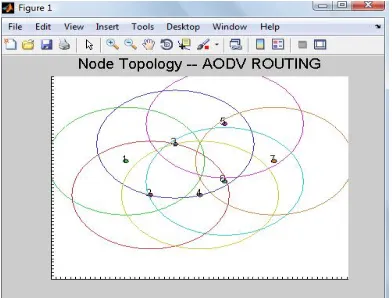
A Truetime Simulink model with seven nodes connected to a wireless network is shown in Figure 1.True Time Function Block diagram Parameters for ZigBee network is shown in Figure 2 which need to be set before the simulation run. There is also a block that animates the position of the nodes as the simulation progresses as shown in Figure 3
Figure 3 Topology created by Simulink model available in TRUETIME
4.
S
OFTC
OMPUTING:
F
UZZYL
OGICVolume 2, Issue 10, October 2013
Page 300
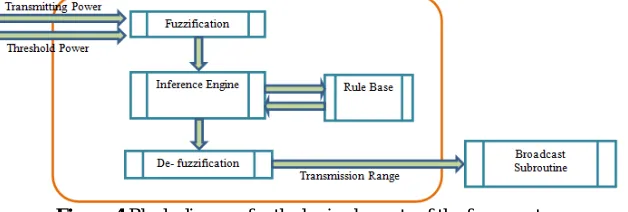
Figure 4 Block-diagram for the basic elements of the fuzzy system
Here the signal transmission range is optimized using the fuzzy logic where the transmission power and the threshold power are taken as inputs and the transmission range is taken as the output for the system. With increase in transmission power and threshold power the signal transmission range can be maximized. The rule base for the Transmission range fuzzy logic system is shown in the table below where the three variables (two inputs and one output) are classified into three membership functions Low, Medium and High. The membership function used here is of triangular type. Figure 5 shows the Membership function with the defined range of each variable where the Fuzzy variables are Transmitting power, Threshold power and the Transmission range.
Figure 5 Membership function with the range of each variables
Table 1 defines the Fuzzy rule base for the maximum transmission range. From the Rule defined it is clear that as we increase the transmitting and the threshold value, the transmission range also increases. At maximum transmitting and threshold power, transmission range is maximum.
Table 1: Fuzzy rule base
Signal Transmission
Range
Threshold
Transmission Power Low Medium High
Low Low Low Low
Medium Medium Medium Medium
High Medium High High
5. SIMULATION RESULTS & SETUP
There are many routing protocols are available for ZigBee network. So it is difficult to decide which routing protocol is better for the network. The performance metrics decides the performance of the routing protocol based on the parameters which required optimizing the performance. Here the AODV routing protocol has been simulated for the ZigBee Network based on IEEE 802.15.4 standard. The transmission range which plays a very important role in the AODV routing protocol has been evaluated. In order to analyze the AODV routing protocol in this paper following performance metrics are considered:
Packet Delivery Ratio (PDR): The ratio of the data packets Received to the destinations to those generated by the sources. Mathematically, it can be expressed as:
Volume 2, Issue 10, October 2013
Page 301
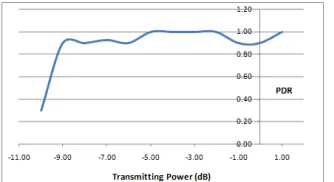
Figure 6 Packet Delivery Ratio V/S Transmitting Power
In Figure 6 observation made that as the transmitting power increases, number of packet delivered to the destination also increases. Similarly in Figure 7 we can see that the Packet loss ratio decrease with the increase in the transmitting power. At transmitting power 1dB, the PDR is maximum and the PLR is minimum.
-0.10 0.00 0.10 0.20 0.30 0.40 0.50 0.60 0.70 0.80
-11.00 -9.00 -7.00 -5.00 -3.00 -1.00 1.00 PLR
Transmitting Power
Figure 7 Packet Loss Ratio V/S Transmitting Power
Transmission range is the function of transmitting power and the threshold power. As the transmitting power and the threshold power increases, the signal transmission range also increases. Figure 8 shows the comparison between the Classical AODV and the Fuzzy AODV with transmitting power at various Threshold power of -48dB,-49 dB.
Figure 8 Transmission Range V/S Transmitting Power for -48 dB and -49 dB for classical AODV and Fuzzy based AODV
Volume 2, Issue 10, October 2013
Page 302
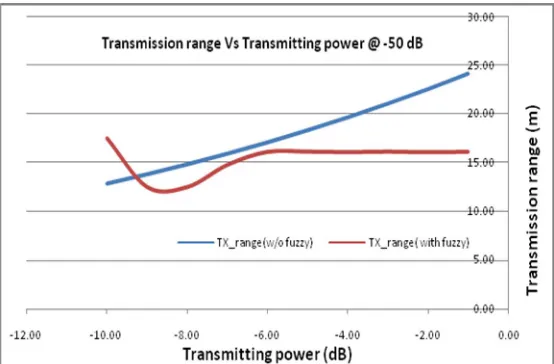
Figure 9 Transmission Range V/S Transmitting Power for -50 dB for classical AODV and Fuzzy based AODV
It can be observed that as the threshold value reduces, the Transmission Range of Classical AODV is better than the fuzzy based AODV. As the Threshold value is higher the Transmission Range of Fuzzy based AODV is better.
6. CONCLUSION
Performance metrics like Packet delivery ratio and the Packet loss ratio for the AODV routing protocol for the ZigBee network has been analyzed in the True time 2.0 in MATLAB. From the observations it can be concluded that the packet delivery ratio (PDR) increases with the Transmitting power and the Packet loss ratio (PLR) decrease with the increase in transmitting power. Further comparing the Classical AODV with the Fuzzy based AODV results, it can be concluded that the transmission range of classical AODV is better than the AODV with Fuzzy logic. Transmission range can be improved over the Fuzzy logic using other soft computing techniques like Artificial Neural network (ANN) and the Adaptive Neuro-Fuzzy Inference System (ANFIS).
References
[1] M. Ohlin, D. Henriksson, and A. Cervin, "TrueTime 2.0 Reference Manual," Department of Automatic Control, Lund University, Sweden, 2007. http://www.control.lth.se/truetime.
[2] Prativa P. Saraswala, “Survey on upcoming ZigBee technology in future communication system”, published in International Journal of Electronics and Computer Science Engineering, pp-1124-1127, ISSN 2277-1956/V1N3-1124-1128.
[3] Andersson, Martin, Dan Henriksson, Anton Cervin and Karl-Erik arzen (2005). “Simulation of wireless networked control systems” in Proceedings of the 44th IEEE Conference on Decision and Control and European Control Conference ECC 2005. Seville, Spain.
[4] Anton Cervin, Martin Ohlin, Dan Henriksson ‘Simulation of Networked Control systems using True time’, Department of Automatic Control LTH, Lund University.
[5] Prativa P. Saraswala, “Survey on upcoming ZigBee technology in future communication system”, published in International Journal of Engineering Science and Innovative Technology (IJESIT) Volume 2, Issue 1, January 2013, ISSN: 2319-5967.
[6] http://www.ietf.org/rfc/rfc3561.txt/[visited 12-6-2012].
[7] Charles E. Perkins, Ad Hoc On-Demand Distance Vector (AODV) Routing draft-ietf-manetaodv 03.txtSaiful. [8] Tony Larrson, NicklasHedman “Routing Protocols in Wireless Ad-hoc Networks- A Simulation Study”, Master
Thesis,March 1998.
[9] Using MATLAB7: User Guide, www.mathworks.com [10]Fuzzy Logic Toolbox User Guide:www.mathworks.com
Volume 2, Issue 10, October 2013
Page 303
Dr. Dharmistha D. Vishwakarma is currently working as a Lecturer in Department of Electrical Engineering, Polytechnic, The Maharaja Sayajirao University of Baroda, Vadodara, Gujarat, India. She has more than 7 years teaching experience. She has published and presented more than 27 papers in various national and international journals and conferences. Her research area is towards the wireless networking and soft computing techniques.