Structural Determinants of Murine Leukemia Virus Reverse
Transcriptase That Affect the Frequency of Template Switching
EVGUENIA S. SVAROVSKAIA,1,2KRISTA A. DELVIKS,2CAREY K. HWANG,2,3 ANDVINAY K. PATHAK2*
Department of Biochemistry1and Department of Microbiology and Immunology,3West Virginia University,
Morgantown, West Virginia 26506, and HIV Drug Resistance Program, National Cancer Institute,
Frederick Cancer Research and Development Center, Frederick, Maryland 217022
Received 24 February 2000/Accepted 8 May 2000
Retroviral reverse transcriptases (RTs) frequently switch templates within the same RNA or between copackaged viral RNAs to generate mutations and recombination. To identify structural elements of murine leukemia virus RT important for template switching, we developed an in vivo assay in which RT template switching within direct repeats functionally reconstituted the green fluorescent protein gene. We quantified the effect of mutations in the YXDD motif, the deoxynucleoside triphosphate binding site, the thumb domain, and the RNase H domain of RT and hydroxyurea treatment on the frequencies of template switching. Hydroxyurea treatment and some mutations in RT increased the frequency of RT template switching up to fivefold, while all of the mutations tested in the RNase H domain decreased the frequency of template switching by twofold. Based on these results, we propose a dynamic copy choice model in which both the rate of DNA polymerization and the rate of RNA degradation influence the frequency of RT template switching.
The process of retroviral reverse transcription requires the dissociation of nascent DNA from one location on the RNA template and reassociation of the DNA at another region of homology (11). The first of these template-switching events, strand DNA transfer, involves the transfer of the minus-strand strong-stop DNA from the 5⬘end of the viral genomic RNA to the 3⬘ end of the RNA using the two identical R regions at the ends of the viral RNAs. The second template-switching event, plus-strand transfer, involves the transfer of the plus-strand strong-stop DNA using the complementarity between the primer tRNA and the primer-binding site. It has been hypothesized that because these template-switching events are necessary for the completion of viral replication, retroviral reverse transcriptases (RTs) have evolved to possess low template affinity and low processivity (60). Since RTs pos-sess low processivity, they also frequently undergo other inter-nal template-switching events during reverse transcription. In-termolecular template-switching events between copackaged viral RNAs can result in homologous and nonhomologous recombination (24, 35, 61). On the other hand, intramolecular template-switching events (within the same template) generate mutations such as deletions, deletions with insertions, and du-plications (43, 45).
Retroviral vectors containing directly repeated sequences provide a powerful in vivo experimental model system for elucidating the mechanism of RT template switching (14, 32, 45, 66). Directly repeated sequences are deleted at a high frequency (8, 12, 13, 26, 35, 41, 45, 46, 63), which appears to be correlated with repeat size (13, 32, 47, 67). Deletion of direct repeats is a highly accurate process, because drug resistance genes and other selectable markers are functionally reconsti-tuted with high efficiency (13, 32). It was also recently shown that the linear distance between direct repeats increased the frequency of deletions and that within a 701-bp direct repeat,
the frequency of template switching was higher near the 5⬘end of the repeat than near the 3⬘end (14). These results suggested that the length of homology 3⬘to the site of polymerization is important for efficient template switching. These data also suggested that degradation of the template RNA with RNase H permits base pairing between the repeated sequence to facilitate RT template switching and deletion.
Structural features of RTs that may play an important role in their template-switching properties are unknown. Previous studies have indicated that RNase H activity is necessary for minus-strand transfer, as well as plus-strand transfer (17, 52, 57, 58). Mutations in several regions of RT have been shown to affect the processivity of DNA synthesis in vitro; these regions include the Tyr-X-Asp-Asp (YXDD) motif (9, 22, 51), the thumb region (2, 3, 5), the finger domain (50, 56), residue Q151 of the deoxynucleoside triphosphate (dNTP)-binding site (30), and the RNase H domain (1, 59). In addition, other viral proteins, specifically, the nucleocapsid protein (NC), might be important for template switching. Some in vitro studies have suggested that NC increases the processivity of RT (15, 29). However, other studies have indicated that NC has no effect on the processivity of RT (48, 49).
To identify the structural determinants of RT that are im-portant for template switching, we introduced amino acid sub-stitutions in the murine leukemia virus (MLV) RT dNTP-binding site, the YXDD motif, the␣-helix H of the thumb domain, and the RNase H domain. In addition, we developed an in vivo assay and determined the extent to which the mu-tations in RT affect the frequency of template switching.
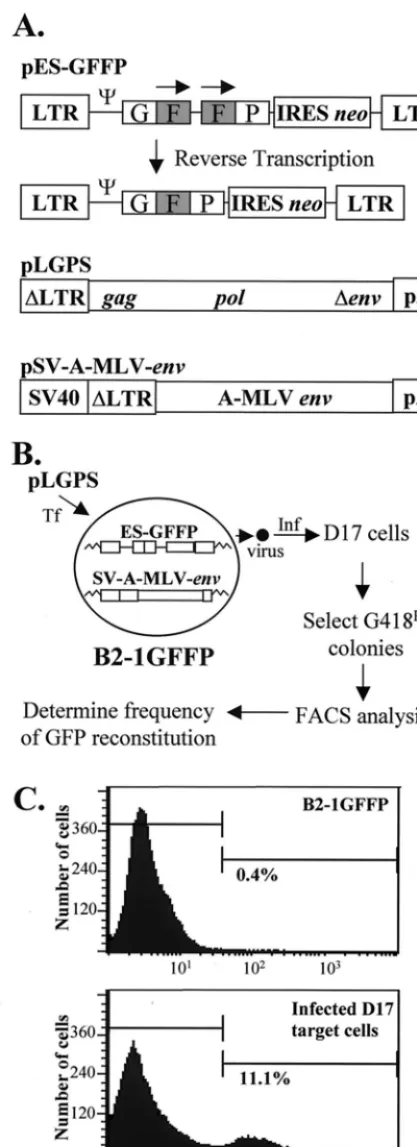
Direct repeat deletion assay.To develop an in vivo assay for RT template switching, we first constructed pES-GFFP, an MLV-based retroviral vector, using standard cloning proce-dures (details are available upon request; Fig. 1A). The vector pES-GFFP contained all of thecis-acting elements needed for viral replication and the overlapping GF and FP fragments of the gene for the green fluorescent protein (GFP) separated by 25 bp. The directly repeated sequence (the F portion) was 250 bp in length. During reverse transcription, the directly re-peated sequence was deleted at a high frequency, resulting in * Corresponding author. Mailing address: HIV Drug Resistance
Program, National Cancer Institute, FCRDC, Bldg. 535, Rm. 334, Frederick, MD 21702. Phone: (301) 846-1710. Fax: (301) 846-6013. E-mail: [email protected].
7171
on November 9, 2019 by guest
http://jvi.asm.org/
the reconstitution of a functional GFP-encoding gene (Fig. 1A). The vector pES-GFFP also contained the selectable markerneo, which was translated from an internal ribosomal entry site (IRES) of encephalomyocarditis virus (27, 28, 31). GFFP andneowere expressed from a single RNA transcript initiating in the 5⬘long terminal repeat (LTR).
Next, the pES-GFFP vector was used to construct a stable cell line that was named 1GFFP. To construct the B2-1GFFP cell line, the plasmid pSV-A-MLV-env, which ex-presses the amphotropic MLV envelope gene, was obtained from the AIDS Research and Reference Reagent Program (Fig. 1A). The plasmid pSV-A-MLV-env was cotransfected with pBSpac, a plasmid that encodes the puromycinN -acetyl-transferase gene and confers resistance to puromycin (58), into D17 dog osteosarcoma cells (obtained from the American Type Culture Collection). Transfection, infection, and drug selection were performed as previously described (31, 32). Pu-romycin-resistant cell clones were isolated, and their ability to express a functional amphotropic envelope protein was verified by generating infectious virus upon cotransfection with the construct pLGPS, which expresses the MLVgag-pol-encoded proteins, and the retroviral vector pGA-1, which encodesneo
(Fig. 1A). One cell clone, named B2, was selected because it exhibited the highest viral titer (105CFU/ml).
The pES-GFFP vector was introduced into B2 cells by gen-erating ES-GFFP virus from PG13 packaging cells (40), infect-ing B2 cells, and selectinfect-ing for G418-resistant cell clones (G418 is an analog of neomycin). To select a clone with undeleted directly repeated F portions of GFP, five cell clones were analyzed by fluorescence-activated cell sorter (FACS) (result of cell clone B2-1 shown in Fig. 1C, top). Less than 0.4% of the cells were fluorescent, which was similar to the proportion of fluorescent cells in uninfected D17 cells (0.1%), indicating that the GFP was not functionally reconstituted.
To verify that the ES-GFFP provirus was capable of com-pleting one cycle of retroviral replication and functionally re-constituting GFP, cell clones with undeleted direct repeats were cotransfected with pLGPS and pSV␣3.6, which conferred resistance to ouabain (36). Virus production from the ouabain-resistant B2-1 cell clones was verified by infection of D17 cells, which were selected for resistance to G418 and analyzed by FACS (example shown in Fig. 1C, bottom). The B2-1 cell clone that exhibited the highest titer (105CFU/ml) was named
B2-1GFFP and used in all subsequent experiments (data not shown). The presence of a high proportion of fluorescent cells indicated functional reconstitution of GFP.
[image:2.612.69.278.71.645.2]To ensure that the B2-1GFFP cells did not harbor a repli-cation-competent MLV, culture supernatant from a pool of D17 cells infected with virus from the B2-1GFFP cells was used to infect fresh D17 cells. The absence of G418-resistant colo-nies verified that a replication-competent MLV was not present (data not shown). Finally, Southern blotting was per-formed to ensure that the B2-1GFFP cells contained only one ES-GFFP provirus (data not shown).
FIG. 1. Structures of MLV-based constructs and direct repeat deletion assay to identify structural determinants of MLV RT important for template switching. (A) Structures of MLV-based vector pES-GFFP, pLGPS, and pSV-A-MLV-env. The pES-GFFP vector contains LTRs and all of thecis-acting elements of MLV. GFFP andneoare transcribed from the LTR promoter. The IRES of encepha-lomyocarditis virus is used to expressneo. The directly repeated F portion of GFP is shaded and indicated by overhead arrows. During reverse transcription, the repeated F portion may be deleted to reconstitute a functional GFP. The pLGPS construct expresses MLVgagandpolfrom a truncated viral LTR. The pSV-A-MLV-envconstruct expresses the amphotropic MLV envelope from a
truncated MLV LTR and the simian virus 40 (SV40) promoter enhancer.⌿, MLV packaging signal. (B) Experimental protocol. B2-1GFFP, a D17-based cell line expressing pES-GFFP and pSV-A-MLV-env, was constructed. The wild-type and mutated pLGPS constructs were separately cotransfected (Tf) with pSV␣3.6 into B2-1GFFP cells, and the virus produced was used to infect (Inf) D17 cells. The infected cell clones resistant to G418 were analyzed by FACS, and frequen-cies of direct repeat deletion were determined. (C) The top graph shows FACS analysis of B2-1GFFP cells. The bottom graph shows FACS analysis of D17 target cells infected with virus collected from B2-1GFFP cells transfected with wild-type pLGPS and selected for G418 resistance.
on November 9, 2019 by guest
http://jvi.asm.org/
Protocol.The protocol used to identify protein determinants important for RT template switching during reverse transcrip-tion is outlined in Fig. 1B. First, pLGPS-derived constructs containing mutations in the MLV RT were separately cotrans-fected with pSV␣3.6 into B2-1GFFP cells. The transfected cells were selected for resistance to ouabain, and the resistant colonies were pooled and expanded. The B2-1GFFP cells were maintained in the presence of 1M 3⬘-azido-3⬘ -deoxythymi-dine (AZT) to reduce the probability of reinfection of the virus-producing cells. This concentration of AZT was previ-ously shown to inhibit MLV replication 100-fold (33). Control experiments in which B2-1GFFP cells were maintained in the absence or presence of AZT indicated that the presence of AZT did not influence the frequency of direct repeat deletion and GFP reconstitution (data not shown). Before collecting virus, the culture medium containing AZT was removed and the cells were plated at a density of 5⫻106/100-mm-diameter
dish. The culture medium was replaced with fresh medium 24 h later. Another 24 h later, the culture medium containing ES-GFFP virus was harvested and used to infect D17 target cells. The infected D17 cells were selected for resistance to G418, and the resulting colonies were pooled and analyzed by FACS to determine the frequency of direct repeat deletion. In most experiments, approximately 100 to 1,000 colonies were pooled for each analysis. In general, the multiplicity of infection was
⬍0.0005 and the probability of double infection was very low (⬍1 in 2,000 colonies). The frequency of direct repeat deletion provided a measure of the template-switching events during one cycle of retroviral replication.
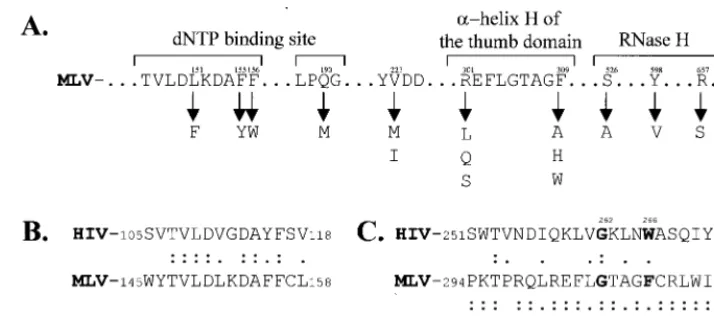
MLV RT mutants.All of the mutants that were tested in the direct repeat deletion assay are summarized in Fig. 2A. Con-struction of the YXDD motif and the RNase H mutant forms of MLV RT was described previously (21; E. K. Halvas, E. S. Svarovskaia, and V. K. Pathak, submitted for publication). A detailed description of the mutagenic oligonucleotides and the strategies used to introduce mutations into the dNTP-binding site (Halvas et al., submitted) and ␣-helix H of the thumb domain is available upon request.
Two criteria were used for selection of the RT mutants for analysis of their effects on template switching. First, mutations that were previously reported to be important for the proces-sivity or fidelity of reverse transcription were selected for the study. Second, only mutants that were previously shown to
generate detectable viral titers were selected because the in vivo direct repeat deletion assay required that the mutants complete one cycle of retroviral replication.
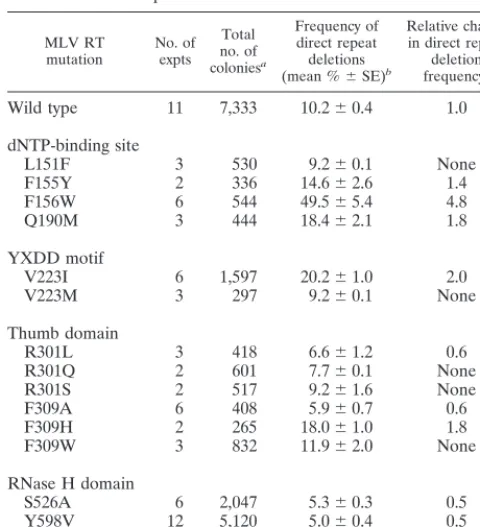
Effect of dNTP-binding site and YXDD motif mutants on template switching.The amino acid residues of MLV RT in-volved in binding to the dNTP substrate were previously iden-tified on the basis of sequence alignments and comparison of crystal structures of the MLV and human immunodeficiency virus type 1 (HIV-1) RTs (18, 23, 25; Halvas et al., submitted). Residues L151, F155, and F156 of the MLV RT are homolo-gous to residues V111, Y115, and F116 of the HIV-1 RT, respectively (Fig. 2B). The effects of the L151F, F155Y, F156W, and Q190M mutations on template switching were determined. The F155Y, F156W, and Q190M mutations in-creased the frequency of direct repeat deletions, which ranged from 14.6 to 49.5% (Table 1). However, the L151F mutation did not affect the ability of the RT to switch templates. The most significant change was caused by the F156W mutation, which increased the direct repeat deletion frequency 4.8-fold (P⬍0.00005; all statistical analysis was performed using the two-samplettest).
Position V223 of the highly conserved YXDD motif of the MLV RT was selected for mutagenesis because previous stud-ies indicated that this amino acid is important for the proces-sivity and fidelity of RT (9, 21, 22, 51). The results obtained from analysis of the V223I and V223M mutations are summa-rized in Table 1. The V223I mutant form of MLV RT exhibited a twofold increase in the frequency of GFP reconstitution (P⬍
0.00005). However, the V223M mutant form of MLV RT did not exhibit a statistically significant alteration in the frequency of GFP reconstitution (P⫽0.246). Therefore, replacement of V223 of MLV RT with the equivalent methionine residue in HIV-1 RT did not change the frequency of template switching by MLV RT (Table 1).
[image:3.612.123.480.72.230.2]Effect of thumb domain mutations on template switching. The thumb domain of MLV RT was chosen as a target for mutational analysis because the HIV-1 RT crystal structure and in vitro assays strongly suggested that it is important for processivity (2, 3, 5). Since the thumb domain of the MLV RT has not been crystallized and there is no significant primary sequence homology in this region between the MLV and HIV-1 RTs, the precise location of␣-helix H of the thumb domain of the MLV RT was unclear. The primary sequence of FIG. 2. Mutant forms of MLV RT. (A) Selected regions of the MLV RT primary sequence containing the dNTP-binding site, the YXDD motif, the␣-helix H of the thumb domain, and RNase H. The numbers above the primary sequence indicate the amino acid positions in the primary sequence. The substitution mutations analyzed at each amino acid position are indicated below the primary sequence with downward arrows. (B) Primary sequence alignment of the MLV and HIV-1 RT dNTP-binding sites. Double dots represent identical amino acids, whereas single dots represent conserved amino acids. The numbers indicate amino acid positions in the primary sequence. (C) Primary sequence alignment of the␣-helix H of the HIV-1 RT thumb domain and corresponding sequences in the MLV and SNV RTs.
on November 9, 2019 by guest
http://jvi.asm.org/
the MLV RT was compared to those of 15 other retroviral RTs (data not shown). Nearly all of the RT sequences analyzed contained a G-X-X-X-(W/F/Y) (aromatic amino acid) motif. All 16 RTs contained a glycine at the position equivalent to HIV-1 G262 (Fig. 2C). Fifteen of the 16 RTs contained an aromatic amino acid at the position equivalent to HIV-1 W266. Therefore, the analysis strongly indicated that MLV RT G305 and F309 are equivalent to HIV-1 RT G262 and W266 (Fig. 2C). This was further supported by the fact that the distance between the MLV primer grip region (YLGY) and the MLV G-X-X-X-F region is 33 amino acids, which is very similar to the 29-amino-acid distance between the HIV-1 primer grip and the G-X-X-X-W motif. This region of the MLV RT is very similar to the spleen necrosis virus (SNV) RT (Fig. 2C). Mo-lecular modeling of this region, using the HIV-1 RT crystal structure, also indicated that this region is likely to be equiv-alent to the HIV-1␣-helix H (data not shown). Finally, muta-tional analysis showed that all eight substitution mutations of MLV G305 resulted in at least 10,000-fold reductions in viral titers, indicating that this glycine is very important for viral replication (E.S.S. and V.K.P., unpublished data).
Based on this analysis, residues R301, G305, and F309 are predicted to face the same side of the ␣-helix H and are involved in making contacts with the template-primer complex. Previously, several mutations were introduced at all three of these residues and their effects on the fidelity of reverse tran-scription were determined (E.S.S. and V.K.P., unpublished).
For this study, the R301L, R301Q, R301S, F309A, F309H, and F309W mutations were selected for further analysis.
The effects of mutations at residues R301 and F309 on the frequency of direct repeat deletion are summarized in Table 1. The R301L and F309A mutations produced statistically signif-icant reductions in the frequency of GFP reconstitution to 6.6 and 5.9%, respectively (P ⬍ 0.003). Conversely, the F309H mutation produced a statistically significant increase in the frequency of direct repeat deletions to 18% (1.8-fold increase;
P⬍0.00005). Finally, the R301Q, R301S, and F309W muta-tions did not produce a statistically significant change in the frequency of direct repeat deletions. Therefore, mutation of residues R301 and F309 to the equivalent Q and W residues found in the HIV-1 RT, respectively, did not affect the fre-quency of RT template switching.
Effect of RNase H domain mutations on template switching. Mutations S526A, Y598V, and R657S were introduced into the MLV RNase H domain, and the effects of these mutations on template switching were determined. These mutations were selected because it was previously shown that the RNase H domain plays an important role in obligatory template-switch-ing events durtemplate-switch-ing reverse transcription (17, 52, 57, 58). Addi-tionally, it was previously shown that these RNase H mutations permitted viral replication to occur. These mutations produced much slower replication kinetics, suggesting a defect in RNase H activity (6, 7).
The effects of the S526A, Y598V, and R657S mutations on the frequency of direct repeat deletion are summarized in Table 1. All three RNase H mutations produced a statistically significant reduction in the frequency of direct repeat deletions (P ⬍ 0.00005). The frequency of deletions was reduced to approximately 50% of that observed for wild-type RT (0.5-fold).
Effect of HU treatment on the frequency of direct repeat deletion.Hydroxyurea (HU) treatment has been shown to de-plete all four cellular nucleotide pools and increase retroviral mutation rates (34). It has been recently shown that HU treat-ment of infected cells resulted in a significant reduction in the rate of polymerization with which reverse transcription pro-ceeds (47).
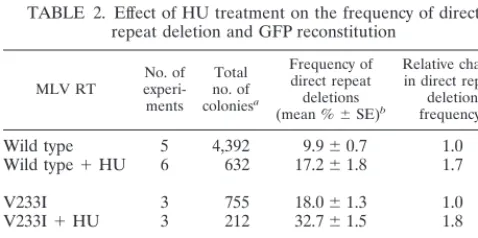
We hypothesize that mutations in the dNTP-binding site and the YXDD motif result in polymerases that catalyze DNA synthesis more slowly than wild-type RT and that this reduc-tion in the rate of DNA synthesis increases the frequency of RT template switching. A model to explain the rationale be-hind this hypothesis is outlined in Fig. 3 and discussed later. To test this hypothesis, D17 target cells were infected with virus generated with the wild-type RT, as well as V223I and Y598V mutant forms of RT, in the absence or presence of 1 mM HU. HU treatment was performed as previously described (34). Briefly, D17 cells were placed on culture medium containing 1 mM HU for 4 h prior to infection, 4 h during infection, and 24 h postinfection. The frequency of direct repeat deletion and GFP reconstitution was determined. The results are shown in Table 2. In the presence of HU, the frequency of GFP recon-stitution was increased by 1.7-fold for wild-type RT, which is in agreement with previously published results (P⬍0.0065) (47). Similarly, the frequency of GFP reconstitution increased 1.8-fold for the V223I mutant RT in the presence of HU (P⬍
0.0018), indicating that HU treatment could further increase the frequency of direct repeat deletion for mutant RTs that exhibited a higher deletion frequency in the absence of HU. However, HU treatment did not increase the frequency of direct repeat deletions for the Y598V RNase H mutant form of MLV RT (P⫽0.836).
[image:4.612.52.292.91.355.2]The experiments described here demonstrate that we have TABLE 1. Effects of mutations in MLV RT on the frequency of
direct repeat deletion and GFP reconstitution
MLV RT
mutation No. ofexpts Total no. of coloniesa
Frequency of direct repeat deletions (mean %⫾SE)b
Relative change in direct repeat
deletion frequencyc
Wild type 11 7,333 10.2⫾0.4 1.0
dNTP-binding site
L151F 3 530 9.2⫾0.1 None
F155Y 2 336 14.6⫾2.6 1.4
F156W 6 544 49.5⫾5.4 4.8
Q190M 3 444 18.4⫾2.1 1.8
YXDD motif
V223I 6 1,597 20.2⫾1.0 2.0
V223M 3 297 9.2⫾0.1 None
Thumb domain
R301L 3 418 6.6⫾1.2 0.6
R301Q 2 601 7.7⫾0.1 None
R301S 2 517 9.2⫾1.6 None
F309A 6 408 5.9⫾0.7 0.6
F309H 2 265 18.0⫾1.0 1.8
F309W 3 832 11.9⫾2.0 None
RNase H domain
S526A 6 2,047 5.3⫾0.3 0.5
Y598V 12 5,120 5.0⫾0.4 0.5
R657S 6 2,099 5.3⫾0.5 0.5
aTotal number of colonies analyzed by FACS in 2 to 12 independent
infec-tions.
bFrequency of direct repeat deletion was determined as a percentage of
infected D17 target cells that exhibited fluorescence after G418 selection com-pared to the negative control. The standard error of the mean was determined by using the Sigma Plot 5.0 program.
cCalculated as follows: frequency of direct repeat deletion observed with
mutant MLV RT⫼frequency of direct repeat deletion observed with wild-type RT. Statistically significant changes in the frequency of direct repeat deletions, relative to the wild-type RT (set to 1.0) are shown (two-samplettest,P⬍0.05).
on November 9, 2019 by guest
http://jvi.asm.org/
developed a powerful in vivo assay to identify structural deter-minants of MLV RT that are important for template switching. This assay is more rapid than previously described assays uti-lizing the herpes simplex virus thymidine kinase or -galacto-sidase gene because it is not necessary to compare viral titers after different drug selections or count numerous colonies (13, 47). Furthermore, the FACS analysis of infected cells allows accurate and rapid quantitation of the frequency of direct repeat deletion from large pools of infected cell colonies. In addition, the assay makes it possible to rapidly analyze a large number of RT mutations and to determine whether the struc-tural alterations affect the frequency of template switching during in vivo retroviral replication. Analysis of viable mutants in vivo is more likely to reveal how the mutations may affect the
viral population. For example, the F156W mutation may arise during viral replication, which could result in a fivefold in-crease in the rate of recombination.
Our results demonstrate that several different domains of MLV RT can affect the frequency of template switching. Mu-tations in the dNTP-binding site, the YXDD motif, the␣-helix H of the thumb domain, and the RNase H domain can affect the frequency of template switching. These results are not surprising, since previous studies have shown that mutations in these domains can affect RT processivity (1–3, 5, 9, 22, 30, 50, 51, 56, 59). It is interesting that most of the mutations in the YXDD motif and the dNTP-binding site increased the fre-quency of RT template switching. These mutations would be expected to interfere with the rate of DNA polymerization, although this effect has not been directly shown. This expecta-tion is supported by the observaexpecta-tion that most of these muta-tions produced lower RT activities (Halvas et al., submitted). The F156W mutation, which produced the largest increase in the frequency of RT template switching (4.8-fold), also caused the most severe defects in viral replication (2% of the wild-type titer) and RT activity (11% of the wild-type activity) (Halvas et al., submitted). However, the frequency of RT template switch-ing was not correlated to the reduction in viral titers for other mutations, perhaps because other steps in retroviral replica-tion, such as initiation of DNA synthesis, were also affected by these mutations.
Interestingly, an increase in the frequency of RT template switching was not correlated with a reduction in the overall fidelity of the RT. Previous results have shown that the YIDD mutation, which caused a twofold increase in RT template switching, did not cause a change in fidelity (21). The RNase H mutations caused twofold reductions in template switching but little or no decrease in fidelity (0 to 1.6-fold). These results suggest that an alteration in the processivity of RT does not affect its overall fidelity.
Previous studies have shown that alanine-scanning muta-tions in the ␣-helix H of the thumb domain of HIV-1 RT greatly decreased in vitro fidelity and increased the rate of frameshift mutations (4, 5). These results suggested that mu-tations in the␣-helix H would decrease processivity and in-crease the frequency of RT template switching. It was there-fore surprising that most of the mutations tested in the present study either had no effect or decreased the frequency of RT template switching. The only exception was the F309H muta-tion, which increased the frequency of template switching nearly twofold. It was especially surprising that the F309A mutant form of MLV RT did not increase the frequency of template switching in vivo. In vitro studies and biochemical analysis of the equivalent mutant form of HIV-1 RT (W266A) have shown that this mutant RT has a very low affinity for the template primer and the dissociation constant is nearly 430-fold higher than that observed for the wild-type HIV-1 RT (4). The F309A mutation in MLV RT might affect other properties of the enzyme that prevent template switching despite its low template affinity. Mutations in the primer grip have been pre-viously shown to reduce RNase H activity (19, 42). Therefore, it is possible that the F309A mutation in MLV RT also affects RNase H activity, which might suppress template switching.
[image:5.612.57.289.73.231.2]All of the RNase H mutations tested caused lower frequen-cies of RT template switching. These results are consistent with previous observations that RNase H is essential for template switching in vitro, as well as for obligatory strand transfer events during viral replication (17, 39, 52, 57, 58). Interestingly, the RNase H mutant forms of MLV RT reduced the frequency of template switching by approximately 50%. We have previ-ously observed that RT template-switching events occur at FIG. 3. Dynamic copy choice model for RT template switching. Shaded
boxes represent direct repeats in an RNA template. Horizontal arrows represent nascent DNA. The thickness of these arrows indicates the relative polymeriza-tion rate; the thicker the arrow, the higher the rate of polymerizapolymeriza-tion. Small open boxes represent RNA degraded by the RNase H domain. In the case of slow RNase H activity, the degraded RNA fragments are shown as larger open boxes. Hydrogen bonds between the RNA template and nascent DNA are designated by vertical marks. Vertical arrows of various thicknesses indicate the relative efficiency of template switching. WT, wild type.
TABLE 2. Effect of HU treatment on the frequency of direct repeat deletion and GFP reconstitution
MLV RT experi-No. of ments
Total no. of coloniesa
Frequency of direct repeat deletions (mean %⫾SE)b
Relative change in direct repeat
deletion frequencyc
Wild type 5 4,392 9.9⫾0.7 1.0
Wild type⫹HU 6 632 17.2⫾1.8 1.7
V233I 3 755 18.0⫾1.3 1.0
V233I⫹HU 3 212 32.7⫾1.5 1.8
Y598V 3 1,059 4.0⫾0.3 1.0
Y598V⫹HU 3 450 3.9⫾0.8 1.0
aTotal number of colonies that were analyzed by FACS in three to six
inde-pendent infections.
bDetermined as described in Table 1, footnoteb.
cCalculated as follows: frequency of direct repeat deletion observed with
mutant or wild-type MLV RT⫼frequency of direct repeat deletion observed with the same MLV RT in the presence of 1 mM HU. Statistical analysis using the two-samplettest showed that the wild type, as well as the V233I mutant form of MLV RT, displayed direct repeat deletion frequencies different from that observed in the presence of 1 mM HU (P⬍0.01). The direct repeat deletion frequencies obtained with the Y598V mutant form of MLV RT were not signif-icantly different in the presence or absence of HU (P⫽0.836).
on November 9, 2019 by guest
http://jvi.asm.org/
[image:5.612.54.293.520.639.2]very similar frequencies during RNA-dependent and DNA-dependent DNA synthesis (8). According to the previously proposed model (14), RNase H activity is necessary for tem-plate switching during RNA-dependent DNA synthesis. There-fore, the MLV RT RNase H mutations may severely impair template switching during RNA-dependent DNA synthesis but not affect the frequency of template switching during DNA-dependent DNA synthesis, as observed previously (16). If this interpretation is correct, then only a small fraction of the template-switching events observed with the RNase H mutant forms of MLV RT occurred during minus-strand DNA syn-thesis.
Dynamic copy choice model for RT template switching.We recently developed a model for RT template switching (14). The model proposed that base pairing between newly synthe-sized DNA sequences 3⬘ to the RT with complementary se-quences of the template increases the probability of RT tem-plate switching. As RT copies the 3⬘ direct repeat, RNase H degrades the RNA template 3⬘ to the RT. Next, hydrogen bonding occurs between the newly synthesized single-stranded DNA and complementary sequences in the 5⬘ copy of the direct repeat. The conformational rearrangements that permit this hydrogen bonding are depicted as a loop in the template RNA in Fig. 3. The hydrogen-bonding interactions 3⬘ to the RT serve to bring the homologous acceptor template in close proximity to the RT, subsequently leading to branch migration and a template switch.
We have modified the proposed model to incorporate ob-servations reported here (Fig. 3). The revised model, called the dynamic copy choice model, proposes that there is a steady state between the rate of DNA polymerization and the rate of template RNA degradation 3⬘ to the RT. The steady state determines the extent of nascent DNA that is available for base-pairing interactions with the acceptor template. We pro-pose that this steady state can be disturbed by affecting the rate of DNA polymerization, as well as the rate of RNA degrada-tion. Once the nascent DNA 3⬘ to the RT is available for base-pairing interactions with the acceptor template, the NC protein promotes hydrogen bonding and duplex formation (62). After the DNA duplex forms 3⬘to the RT, the primer end of the nascent DNA is released from the donor template, which might involve its dissociation from the RT. Finally, the primer end associates with the acceptor template, completing the template switch. Even though the RT template-switching events are portrayed as intramolecular events, the same mech-anistic events could also result in intermolecular template-switching events.
In this study, we observed that conditions likely to reduce the rate of DNA polymerization increased the frequency of RT template switching. These conditions included carrying out reverse transcription with HU treatment, as well as RTs con-taining mutations in the dNTP-binding site and the YXDD motif. The reduction in the rate of DNA polymerization may permit more efficient degradation of the template RNA and/or provide more time for hydrogen bond formation between the nascent DNA and the acceptor template. On the other hand, when RNase H mutant forms of RT were used, the rate of RNA degradation might have been reduced, resulting in im-pairment of base-pairing interactions between the nascent DNA and the acceptor template. As a result, the frequency of RT template switching was reduced.
The dynamic copy choice model helps to integrate some of the previously proposed models and experimental observations associated with RT template switching. First, the previously proposed forced copy choice model is consistent with the dy-namic copy choice model (10). The forced copy choice model
proposed that when RT encounters a break in the template RNA, the RT switches templates. In the dynamic copy choice model, a break in the RNA would represent one extreme situation in the spectrum in which the rate of DNA polymer-ization has been reduced to zero. The obligatory template switches during reverse transcription, namely, minus- and plus-strand DNA transfers, also represent the same situation in which the rate of DNA polymerization is zero. Second, the dynamic copy choice model is consistent with several previous observations that secondary structures in the template RNA create RT pause sites, increasing the frequency of template switching (37, 38, 44, 53–55, 65). Since RT pausing is likely to reduce the rate of DNA polymerization, its effect on RT tem-plate switching should be similar to that observed for HU treatment or RT mutations expected to reduce the rate of DNA polymerization.
Our observation that HU treatment did not increase the frequency of RT template switching for RNase H mutation Y598V suggests that decreasing the rate of DNA polymeriza-tion is unable to overcome this particular defect in RNase H activity. Although at first glance this observation appears sur-prising with respect to the dynamic copy choice model, the interpretation of the result is dependent on the extent to which the template-switching events observed with the Y598V mu-tant form of MLV RT occurred during minus-strand DNA synthesis. The observation that HU treatment did increase the frequency of template switching for wild-type RT suggests that the rates of DNA polymerization and RNase H degradation are similar. It is possible that the RNase H activity of the Y598V mutant form of RT is substantially lower than the wild-type RNase H activity. If so, the HU treatment might not be able to compensate for this substantial RNase H defect by reducing the rate of DNA polymerization. As discussed earlier, only a small fraction of the template-switching events observed with this mutation may have occurred during minus-strand DNA synthesis. For example, if we assume that 25% of the template-switching events observed with the Y598V mutant form of MLV RT occurred during minus-strand DNA synthe-sis, then only 1% of the proviruses underwent direct repeat deletion during minus-strand DNA synthesis (25% of an over-all deletion frequency of 4%). If the frequency of direct repeat deletion during minus-strand DNA synthesis is increased by approximately twofold with HU treatment, then the overall rate of direct repeat deletion would be expected to increase from 4 to 5%. The direct repeat deletion assay used in this study may not be sufficiently sensitive to detect such a small increase in the deletion frequency.
It is also important to note that direct repeat size might determine the sensitivity of the assay and whether a defect in RNase H activity can be overcome to a level that can be detected by reducing the rate of polymerization. It is possible that increasing the direct repeat size will increase the time frame in which a defective RNase H can degrade the template RNA. Consequently, the frequency of RT template switching events that occur during minus-strand DNA synthesis will be increased for all RTs. Since the overall frequencies of direct repeat deletions will be higher, the overall sensitivity of the assay should be increased.
It must be pointed out that the Y598V mutant form of RT was previously shown to have 100% polymerization-indepen-dent RNase H activity in an in vitro assay (7). However, it is unknown whether the polymerization-dependent and/or the polymerization-independent activities of RNase H are impor-tant for RT template switching. Furthermore, it is unclear whether the in vitro RNase H activity reflects the level of activity that is displayed in the context of in vivo viral
on November 9, 2019 by guest
http://jvi.asm.org/
tion. The Y598V mutant form of RT most likely has a defect in RNase H activity in vivo, since it exhibited slower kinetics of viral replication and a fivefold reduction in viral titer (6, 21). Therefore, it is possible that the Y598V RNase H defect can-not be overcome by decreasing the rate of DNA polymeriza-tion with HU treatment.
Finally, other structural determinants of RT, as well as other viral proteins not analyzed in this study, might have a strong influence on RT template switching. Specifically, the NC pro-tein has been shown to promote minus-strand and plus-strand DNA transfer events and might play an important role in stabilizing the hydrogen bonding between the nascent DNA and the acceptor template (20, 64). Experiments to analyze the role of other structural determinants of RT and NC in tem-plate switching are under way.
K.A.D. and C.K.H. contributed equally to this work.
We especially thank Wei-Shau Hu for valuable intellectual input and discussions throughout this project, Steve Hughes and John Coffin for valuable intellectual input and discussion of results, and Anne Arthur for editorial expertise and revisions.
This work was supported by Public Health Service grant CA58875 from the National Institutes of Health and by the HIV Drug Resis-tance Program, National Cancer Institute.
REFERENCES
1.Bavand, M. R., R. Wagner, and T. J. Richmond.1993. HIV-1 reverse tran-scriptase: polymerization properties of the p51 homodimer compared to the p66/p51 heterodimer. Biochemistry32:10543–10552.
2.Beard, W. A., K. Bebenek, T. A. Darden, L. Li, R. Prasad, T. A. Kunkel, and S. H. Wilson.1998. Vertical-scanning mutagenesis of a critical tryptophan in the minor groove binding track of HIV-1 reverse transcriptase. Molecular nature of polymerase-nucleic acid interactions. J. Biol. Chem.273:30435– 30442.
3.Beard, W. A., D. T. Minnick, C. L. Wade, R. Prasad, R. L. Won, A. Kumar, T. A. Kunkel, and S. H. Wilson.1996. Role of the “helix clamp” in HIV-1 reverse transcriptase catalytic cycling as revealed by alanine-scanning mu-tagenesis. J. Biol. Chem.271:12213–12220.
4.Beard, W. A., S. J. Stahl, H. R. Kim, K. Bebenek, A. Kumar, M. P. Strub, S. P. Becerra, T. A. Kunkel, and S. H. Wilson.1994. Structure/function studies of human immunodeficiency virus type 1 reverse transcriptase. Ala-nine scanning mutagenesis of an alpha-helix in the thumb subdomain. J. Biol. Chem.269:28091–28097.
5.Bebenek, K., W. A. Beard, J. R. Casas-Finet, H. R. Kim, T. A. Darden, S. H. Wilson, and T. A. Kunkel.1995. Reduced frameshift fidelity and processivity of HIV-1 reverse transcriptase mutants containing alanine substitutions in helix H of the thumb subdomain. J. Biol. Chem.270:19516–19523. 6.Blain, S. W., and S. P. Goff.1995. Effects on DNA synthesis and
transloca-tion caused by mutatransloca-tions in the RNase H domain of Moloney murine leukemia virus reverse transcriptase. J. Virol.69:4440–4452.
7.Blain, S. W., and S. P. Goff.1993. Nuclease activities of Moloney murine leukemia virus reverse transcriptase. Mutants with altered substrate speci-ficities. J. Biol. Chem.268:23585–23592.
8.Bowman, R. R., W. S. Hu, and V. K. Pathak.1998. Relative rates of retroviral reverse transcriptase template switching during RNA- and DNA-dependent DNA synthesis. J. Virol.72:5198–5206.
9.Boyer, P. L., and S. H. Hughes.1995. Analysis of mutations at position 184 in reverse transcriptase of human immunodeficiency virus type 1. Antimi-crob. Agents Chemother.39:1624–1628.
10. Coffin, J. M.1979. Structure, replication, and recombination of retrovirus genomes: some unifying hypotheses. J. Gen. Virol.42:1–26.
11. Coffin, J. M., S. H. Hughes, and H. E. Varmus.1997. Retroviruses. Cold Spring Harbor Laboratory Press, Cold Spring Harbor, N.Y.
12. Czernilofsky, A. P., A. D. Levinson, H. E. Varmus, J. M. Bishop, E. Tischer, and H. M. Goodman.1980. Nucleotide sequence of an avian sarcoma virus oncogene (src) and proposed amino acid sequence for gene product. Nature
287:198–203.
13. Delviks, K. A., W.-S. Hu, and V. K. Pathak.1997.⫺vectors: murine
leukemia virus-based self-inactivating and self-activating retroviral vectors. J. Virol.71:6218–6224.
14. Delviks, K. A., and V. K. Pathak.1999. Effect of distance between homolo-gous sequences and 3⬘homology on the frequency of retroviral reverse transcriptase template switching. J. Virol.73:7923–7932.
15. Druillennec, S., A. Caneparo, H. de Rocquigny, and B. P. Roques.1999. Evidence of interactions between the nucleocapsid protein NCp7 and the reverse transcriptase of HIV-1. J. Biol. Chem.274:11283–11288. 16. Fuentes, G. M., P. J. Fay, and R. A. Bambara.1996. Relationship between
plus strand DNA synthesis and removal of downstream segments of RNA by human immunodeficiency virus, murine leukemia virus and avian myeloblas-toma virus reverse transcriptases. Nucleic Acids Res.24:1719–1726. 17. Garces, J., and R. Wittek.1991. Reverse-transcriptase-associated RNase H
activity mediates template switching during reverse transcription in vitro. Proc. R. Soc. Lond. B Biol. Sci.243:235–239.
18. Georgiadis, M. M., S. M. Jessen, C. M. Ogata, A. Telesnitsky, S. P. Goff, and W. A. Hendrickson.1995. Mechanistic implications from the structure of a catalytic fragment of Moloney murine leukemia virus reverse transcriptase. Structure3:879–892.
19. Ghosh, M., J. Williams, M. D. Powell, J. G. Levin, and S. F. Le Grice.1997. Mutating a conserved motif of the HIV-1 reverse transcriptase palm subdo-main alters primer utilization. Biochemistry36:5758–5768.
20. Guo, J., L. E. Henderson, J. Bess, B. Kane, and J. G. Levin.1997. Human immunodeficiency virus type 1 nucleocapsid protein promotes efficient strand transfer and specific viral DNA synthesis by inhibiting TAR-depen-dent self-priming from minus-strand strong-stop DNA. J. Virol.71:5178– 5188.
21. Halvas, E. K., E. S. Svarovskaia, and V. K. Pathak.2000. Development of an in vivo assay to identify structural determinants in murine leukemia virus reverse transcriptase important for fidelity. J. Virol.74:312–319.
22. Harris, D., P. N. Yadav, and V. N. Pandey.1998. Loss of polymerase activity due to Tyr to Phe substitution in the YMDD motif of human immunodefi-ciency virus type-1 reverse transcriptase is compensated by Met to Val substitution within the same motif. Biochemistry37:9630–9640.
23. Hsiou, Y., J. Ding, K. Das, A. D. Clark, Jr., S. H. Hughes, and E. Arnold.
1996. Structure of unliganded HIV-1 reverse transcriptase at 2.7 A resolu-tion: implications of conformational changes for polymerization and inhibi-tion mechanisms. Structure4:853–860.
24. Hu, W. S., E. H. Bowman, K. A. Delviks, and V. K. Pathak.1997. Homolo-gous recombination occurs in a distinct retroviral subpopulation and exhibits high negative interference. J. Virol.71:6028–6036.
25. Huang, H., R. Chopra, G. L. Verdine, and S. C. Harrison.1998. Structure of a covalently trapped catalytic complex of HIV-1 reverse transcriptase: im-plications for drug resistance. Science282:1669–1675.
26. Hughes, S., and E. Kosik.1984. Mutagenesis of the region between env and src of the SR-A strain of Rous sarcoma virus for the purpose of constructing helper-independent vectors. Virology136:89–99.
27. Jang, S. K., M. V. Davies, R. J. Kaufman, and E. Wimmer.1989. Initiation of protein synthesis by internal entry of ribosomes into the 5⬘nontranslated region of encephalomyocarditis virus RNA in vivo. J. Virol.63:1651–1660. 28. Jang, S. K., H. G. Krausslich, M. J. Nicklin, G. M. Duke, A. C. Palmenberg,
and E. Wimmer.1988. A segment of the 5⬘nontranslated region of encepha-lomyocarditis virus RNA directs internal entry of ribosomes during in vitro translation. J. Virol.62:2636–2643.
29. Ji, X., G. J. Klarmann, and B. D. Preston.1996. Effect of human immuno-deficiency virus type 1 (HIV-1) nucleocapsid protein on HIV-1 reverse transcriptase activity in vitro. Biochemistry35:132–143.
30. Jin, J., N. Kaushik, K. Singh, and M. J. Modak.1999. Analysis of the role of glutamine 190 in the catalytic mechanism of murine leukemia virus reverse transcriptase. J. Biol. Chem.274:20861–20868.
31. Jorgensen, R. A., S. J. Rothstein, and W. S. Reznikoff.1979. A restriction enzyme cleavage map of Tn5 and location of a region encoding neomycin resistance. Mol. Gen. Genet.177:65–72.
32. Julias, J. G., D. Hash, and V. K. Pathak.1995. E⫺vectors: development of
novel self-inactivating and self-activating retroviral vectors for safer gene therapy. J. Virol.69:6839–6846.
33.Julias, J. G., T. Kim, G. Arnold, and V. K. Pathak.1997. The antiretrovirus drug 3⬘-azido-3⬘-deoxythymidine increases the retrovirus mutation rate. J. Virol.71:4254–4263.
34. Julias, J. G., and V. K. Pathak.1998. Deoxyribonucleoside triphosphate pool imbalances in vivo are associated with an increased retroviral mutation rate. J. Virol.72:7941–7949.
35. Katz, R. A., and A. M. Skalka.1990. Generation of diversity in retroviruses. Annu. Rev. Genet.24:409–445.
36. Kent, R. B., J. R. Emanuel, Y. Ben Neriah, R. Levenson, and D. E. Housman.
1987. Ouabain resistance conferred by expression of the cDNA for a murine Na⫹, K⫹-ATPase alpha subunit. Science237:901–903.
37.Kim, J. K., C. Palaniappan, W. Wu, P. J. Fay, and R. A. Bambara.1997. Evidence for a unique mechanism of strand transfer from the transactivation response region of HIV-1. J. Biol. Chem.272:16769–16777.
38. Klarmann, G. J., C. A. Schauber, and B. D. Preston.1993. Template-di-rected pausing of DNA synthesis by HIV-1 reverse transcriptase during polymerization of HIV-1 sequences in vitro. J. Biol. Chem.268:9793–9802. (Erratum,268:13764, 1993.)
39. Luo, G. X., and J. Taylor.1990. Template switching by reverse transcriptase during DNA synthesis. J. Virol.64:4321–4328.
40. Miller, A. D., J. V. Garcia, N. von Suhr, C. M. Lynch, C. Wilson, and M. V. Eiden.1991. Construction and properties of retrovirus packaging cells based on gibbon ape leukemia virus. J. Virol.65:2220–2224.
41. Omer, C. A., K. Pogue-Geile, R. Guntaka, K. A. Staskus, and A. J. Faras.
1983. Involvement of directly repeated sequences in the generation of
on November 9, 2019 by guest
http://jvi.asm.org/
tions of the avian sarcoma virussrcgene. J. Virol.47:380–382.
42.Palaniappan, C., M. Wisniewski, P. S. Jacques, S. F. Le Grice, P. J. Fay, and R. A. Bambara.1997. Mutations within the primer grip region of HIV-1 reverse transcriptase result in loss of RNase H function. J. Biol. Chem.
272:11157–11164.
43.Pathak, V. K., and W. S. Hu.1997. “Might as well jump!” Template switching by retroviral reverse transcriptase, defective genome formation, and recom-bination. Semin. Virol.8:141–150.
44. Pathak, V. K., and H. M. Temin.1992. 5-Azacytidine and RNA secondary structure increase the retrovirus mutation rate. J. Virol.66:3093–3100. 45. Pathak, V. K., and H. M. Temin.1990. Broad spectrum of in vivo forward
mutations, hypermutations, and mutational hotspots in a retroviral shuttle vector after a single replication cycle: deletions and deletions with insertions. Proc. Natl. Acad. Sci. USA87:6024–6028.
46. Pathak, V. K., and H. M. Temin.1990. Broad spectrum of in vivo forward mutations, hypermutations, and mutational hotspots in a retroviral shuttle vector after a single replication cycle: substitutions, frameshifts, and hyper-mutations. Proc. Natl. Acad. Sci. USA87:6019–6023.
47. Pfeiffer, J. K., R. S. Topping, N. H. Shin, and A. Telesnitsky.1999. Altering the intracellular environment increases the frequency of tandem repeat deletion during Moloney murine leukemia virus reverse transcription. J. Vi-rol.73:8441–8447.
48. Raja, A., and J. J. DeStefano.1999. Kinetic analysis of the effect of HIV nucleocapsid protein (NCp) on internal strand transfer reactions. Biochem-istry38:5178–5184.
49. Rodriguez-Rodriguez, L., Z. Tsuchihashi, G. M. Fuentes, R. A. Bambara, and P. J. Fay.1995. Influence of human immunodeficiency virus nucleocap-sid protein on synthesis and strand transfer by the reverse transcriptase in vitro. J. Biol. Chem.270:15005–15011.
50. Sarafianos, S. G., V. N. Pandey, N. Kaushik, and M. J. Modak.1995. Site-directed mutagenesis of arginine 72 of HIV-1 reverse transcriptase. Catalytic role and inhibitor sensitivity. J. Biol. Chem.270:19729–19735. 51. Sharma, P. L., and C. S. Crumpacker.1999. Decreased processivity of
human immunodeficiency virus type 1 reverse transcriptase (RT) containing didanosine-selected mutation Leu74Val: a comparative analysis of RT vari-ants Leu74Val and lamivudine-selected Met184Val. J. Virol.73:8448–8456. 52. Smith, C. M., J. S. Smith, and M. J. Roth.1999. RNase H requirements for the second strand transfer reaction of human immunodeficiency virus type 1 reverse transcription. J. Virol.73:6573–6581.
53. Suo, Z., and K. A. Johnson.1998. DNA secondary structure effects on DNA synthesis catalyzed by HIV-1 reverse transcriptase. J. Biol. Chem. 273:
27259–27267.
54. Suo, Z., and K. A. Johnson.1997. Effect of RNA secondary structure on the kinetics of DNA synthesis catalyzed by HIV-1 reverse transcriptase. Bio-chemistry36:12459–12467.
55. Suo, Z., and K. A. Johnson.1997. RNA secondary structure switching during DNA synthesis catalyzed by HIV-1 reverse transcriptase. Biochemistry36:
14778–14785.
56. Tamalet, C., J. Izopet, N. Koch, J. Fantini, and N. Yahi.1998. Stable rear-rangements of the beta3-beta4 hairpin loop of HIV-1 reverse transcriptase in plasma viruses from patients receiving combination therapy. AIDS12:F161– F166.
57. Tanese, N., A. Telesnitsky, and S. P. Goff.1991. Abortive reverse transcrip-tion by mutants of Moloney murine leukemia virus deficient in the reverse transcriptase-associated RNase H function. J. Virol.65:4387–4397. 58. Telesnitsky, A., S. W. Blain, and S. P. Goff.1992. Defects in Moloney murine
leukemia virus replication caused by a reverse transcriptase mutation mod-eled on the structure ofEscherichia coliRNase H. J. Virol.66:615–622. 59. Telesnitsky, A., and S. P. Goff.1993. RNase H domain mutations affect the
interaction between Moloney murine leukemia virus reverse transcriptase and its primer-template. Proc. Natl. Acad. Sci. USA90:1276–1280. 60. Temin, H. M.1993. Retrovirus variation and reverse transcription: abnormal
strand transfers result in retrovirus genetic variation. Proc. Natl. Acad. Sci. USA90:6900–6903.
61. Temin, H. M.1991. Sex and recombination in retroviruses. Trends Genet.
7:71–74.
62. Tsuchihashi, Z., and P. O. Brown.1994. DNA strand exchange and selective DNA annealing promoted by the human immunodeficiency virus type 1 nucleocapsid protein. J. Virol.68:5863–5870.
63. Varela-Echavarria, A., C. M. Prorock, Y. Ron, and J. P. Dougherty.1993. High rate of genetic rearrangement during replication of a Moloney murine leukemia virus-based vector. J. Virol.67:6357–6364.
64. Wu, T., J. Guo, J. Bess, L. E. Henderson, and J. G. Levin.1999. Molecular requirements for human immunodeficiency virus type 1 plus-strand transfer: analysis in reconstituted and endogenous reverse transcription systems. J. Vi-rol.73:4794–4805.
65. Wu, W., B. M. Blumberg, P. J. Fay, and R. A. Bambara.1995. Strand transfer mediated by human immunodeficiency virus reverse transcriptase in vitro is promoted by pausing and results in misincorporation. J. Biol. Chem.270:
325–332.
66. Zhang, J., and C. M. Sapp.1999. Recombination between two identical sequences within the same retroviral RNA molecule. J. Virol.73:5912–5917. 67. Zhang, J., and H. M. Temin.1994. Retrovirus recombination depends on the
length of sequence identity and is not error prone. J. Virol.68:2409–2414.