Abstract:In ambulatory ECG monitoring application energy efficient signal acquisition plays significant role in ensuring the lifetime of resource constrained WBAN node . Most of the Compressive Sensing (CS) algorithms employ fixed mother wavelet choice for decomposition phase, resulting in incorrect block-wise data representation thus yielding higher PRD, lower CR and subsequent faster energy consumption rate. To overcome this design issue a novel minimum PRD based adaptive best mother wavelet (ABMW) selection algorithm has been proposed individually for each block and tested for compression of ECG signals in emergent CS paradigm over three datasets. Performance metrics illustrate that the proposed algorithm supports true representation of the physiological events, is energy efficient and faster than its predecessors and has an average execution delay of 1.7 seconds for compression and recovery of 10 seconds ECG data. Simulation results show that proposed algorithm achieved average PRD of 1.141733, CR of 63.77417 and SNR of 40.63878. The proposed algorithm achieved average PRD of 3.59 , execution speed of 2.09 seconds ,CR of 62.32, SNR of 29.5dB and energy consumption is around 1.64E-04 which is very near to average energy consumption values for both MIT-BIH ,PTB datasets and 24-bit acquired ECG data.
Keywords : Adaptive mother wavelet selection, Energy efficiency , Compressive Sensing, Sparse representation, WBAN.
I. INTRODUCTION
H
eart problems are exponentially increasing world-wide due to sedentary life style. As per WHO Cardio Vascular Diseases (CVD) is the leading killer in india and amounts to around 30% [1] of mortality. With increasing population and universally skyrocketing medical expenditure, different ways of reducing cost of monitoring health like m-health, e-health applications have been designed and tested. In coming days affordable tele-cardiological solutions will be in demand to monitor vital signs from remote locations and assess the medical condition of the patient. A tiny network comprising of wireless enabled intelligent bio-sensor nodes mounted on, in and around the human body[2] capable of capturing biological signals and communicating to other sensor nodes for transmission to remote locations for medical diagnosis is known as Wireless Body Area Network (WBAN).Revised Manuscript Received on August 05, 2019.
Rajashekar KunabevaResearch Scholar ,Dept of ECE, JNNCE, shivamogga , Karanataka, VTU ,India.
Dr.Manjunatha.P, Professor & HOD, Dept of ECE, JNNCE shivamogga, Karanataka, VTU, India..
Dr.Narendra.V.G,Associate Professor, Dept of CSE, MIT, MAHE, Manipal, India.
Electro-Cardiogram (ECG) signal is a non-invasive tool for analysis of the heart diseases.ECG is an electrical activity of the heart and it analysis can indicate the possible problem in the classified form of cardiac arrhythmia. Any deviation or disturbance in the rhythmic beat of the heart is known as Arrhythmia[3]. In continuous monitoring ECG application the data generated for a day may be around 2-3 GB , which cannot be stored and transmitted taking battery and memory limitations into consideration. Every deployed WBAN bio-sensor node is resource constrained, with battery capacity as the major bottle-neck , making it ineviTable for the design of energy efficient sensing systems. The battery-driven sensor node should acquire the evolving ECG data with minimum samples to represent the original signal and to reconstruct it effectively in the true form.
ECG monitors worn on the body in a WBAN have limited processing, storage capacity and limited bandwidth. A typical WBAN node is tiny and wearable on the body which is driven by 3 V Li-ion battery whose life span is 3 to 5 days[4].Any compression method needs to conserve the battery of the nodes and prolong the life time of the ECG sensor node for monitoring 24x7.
Hence it is ineviTable to reduce the data during acquisition phase itself in the ECG sensor node. The emergent Compressive sensing (CS)[7] is a novel sampling strategy that uses fixed set of few linear measurements coupled with a non-linear recovery process. With CS algorithm [5] it is possible to acquire any data like ECG at sub-nyquist rate thereby reducing the samples required to represent the ECG signal as linear measurements and recover it using non-linear recovery algorithms to find the optimal solution. Application of energy efficient CS technique for ambulatory monitoring was highlighted in [9].
Many CS algorithms reported in the literature compress data by applying fixed mother wavelet [10][11][12] for the entire ECG signal in the decomposition phase, which may not be appropriate. Most suiTable mother wavelet has to be chosen at sparsification phase for each ECG block followed by CS sampling process. To the best of our knowledge none of the previous studies have applied adaptive best mother wavelet selection in the digital CS paradigm for ECG signal compression.
In this work a novel ECG compression technique called as Adaptive best mother wavelet selection based compressive
sensing (ABMWCS)
algorithm has been proposed to select best mother wavelet, linearly quantize
Rajashekar Kunabeva, Manjunatha P, NarendraVG
Adaptive Best Mother Wavelet Based
Compressive Sensing Algorithm for Energy
Efficient ECG Signal Compression in WBAN
and apply static Huffman based entropy encoding to the compressed data. Minimum PRD value criterion is chosen for mother wavelet selection for every block of ECG signal. Major contribution of this work is that best mother wavelet selection strategy has been adopted for the CS domain. Reduced energy consumption, lower PRD and increased speed of compression are the merits of the proposed method as illustrated in section VI.
The article comprises of different parts. Section II reports survey of related works, III formulation of the problem, IV explains ABMWCS algorithm for compression and decompression. Section V mentions experimental database and performance metrics. Section VI discusses results and performance of the proposed algorithm. Section VII contains concluding remarks.
II. LITERATURE SURVEY
In this section survey of existing CS techniques have been done. Large volumes of evolving ECG data needs to be reduced so that lesser number of bits need to be processing and thus resulting in lower energy consumption. Efficient ECG compression methods lead to reduction of data and thus support ultra low-power operations on WBAN sensor node Some of the trivial compression techniques found in the literature are classified into three types [6]:
1) Direct compression: ECG data is directly compressed. 2) Transform coding: ECG is compressed post
transformation to other domain.
3) Parameter extraction: Signal features are used for compression and reconstruction of ECG signal.
A. Some of the Recent Adaptive CS Algorithm.
The potential of CS for low-complexity energy-efficient ECG compression [23] was thoroughly quantified for on resource-constrained embedded WBAN node and achieved a 37.1% [10] extension in node lifetime relative to its DWT-based algorithm counterpart for “good” reconstruction quality. Since fixed mother wavelet were used for DWT decomposition the PRD values achieved for most of the records fall between 2 to 9% [10] .Hence adaptive signal representation may be explored for further reduction of PRD. Energy-efficient compressed sensing (CS)-based approach for on-node ECG compression in [11] addressed design of sampling matrix and illustrated that for MMC-SBM matrix the averaged output PRD of the WLM algorithm is less than 9%for the number of measurements for M = 128, and it can achieve 87.5% of “good” reconstruction quality with M = 160 [11],, but did not focus on adaptive signal decomposition.
Regarding e-health application like ECG monitoring proposed adaptive Fourier decomposition (AFD) [12] algorithm hybridized with a symbol substitution (SS) technique for ECG compression and achieved averaged (CR) of 17.6–44.5 and PRD of 0.8–2.0. AFD relieves the requirement of preprocessing and generates input-dependent basis adaptively [12] to achieve high efficiency, fidelity and achieved PRD is 1.05 on average with a standard deviation of 0.57, which reveals that the proposed method is suiTable for a variety of ECG signals but works effectively in frequency domain only.
An adaptive approach for optimal signal representation where best basis selection [13]followed parameter based mother wavelet optimization led to substantial improvement of performance in signal compression with respect to DWT
and random selection of the mother wavelet but method was tested for only two mother wavelets db3 and Coiflet. For a CR of 50% optimal PRD achieved was 0.6 [13] and increased with CR but other mother wavelets were not inspected.
Landmark work based on minimum PRD strategy based best mother wavelet selection [14] was proposed to compress the ECG signal in DWT domain and achieved average values of PRD ,CR and SNR of 0.23, 15.2 and 66.96 respectively tested over single channel ECG 48-records of MIT-BIH arrhythmia database. The proposed scheme in DWT domain resulted in low PRD and high compression ratio proving that it is excellent in terms of quality with average quality score of 67.68 [14] . Trade-off for lower CR is the major limitation of this work for obtaining lower PRD values and energy consumption analysis was not done .
Wavelet based hybrid ECG compression techniques based on different threshold for different modes obtained by applying EWT [15] has been tested on self-acquired ECG signals of 20 subjects, each of 12 minutes duration and 360,000 samples with sampling rate 500 Hz and average 31.2 CR and 3.28% PRD.EWT based technique also yielded an average 33.1 CR and 3.3% PRD [15] when tested over MIT-BIH arrhythmia database. Boost for CR and further reduction in average PRD needs to done in CS domain.
Potential for Energy efficient CS–based ECG segment [16] algorithm using machine learning techniques for arrhythmia detection has been studied .Best-basis compressed sensing algorithm [17] tackled the problem of improving the reconstruction from CS measurements for sounds and geometrical images over DCT domain. The tree structure of the dictionary was used in a fast iterative thresholding algorithm resulting in best cosine basis and yielded the PSNR metric to a maximum of 21.32dB relative to fixed DCT for sound signal and PSNR=26.50dB [17] for image , and no information of PRD values to their corresponding selected basis have been reported nor focused on choice of best mother wavelet .
Sparse signal representation is a mandatory pre-requisite for CS-based dimension reduction of the signal. CS theory suggests that if a signal is sparse or compressive, the original signal can be reconstructed by exploiting a few measured values [7] which are much less than the ones suggested by conventional Shannon’s theorem [24].
From the above literature survey it is evident that even though many works attempted to compress ECG signal adaptively, but none of the approaches have used Best mother wavelet selection in emergent digital CS domain even though recent landmark work by [14] did Best mother wavelet selection but it was done over DWT domain only.
III. PROBLEM FORMULATION
WBAN consists of tiny, intelligent sensor nodes mounted on the body. In most of the recent works ECG signal compression is done by using fixed mother wavelet and corresponding sparse matrix is generated for DWT decomposition for all the segments of ECG signal. The evolving cardiac signal segments or blocks are non-identical for ‘N’ number of samples. Each ECG block bear different characteristics of the heart functionality and hence require unique, true representation of the information prior to compression with an aim of obtaining high quality signal at medical expert end. This demands that instead of the same mother wavelet being used for entire signal, novel block-wise strategy is applied for accurate compression and sparse reconstruction method is used at the medical centre for further diagnostic purposes.
IV. PROPOSED SOLUTION
Generic Compressive Sensing (CS) process is illustrated in figure 1. The current work focuses on adaptive choice of the mother wavelet Ψ for obtaining the sparsest signal representation.
Figure1: Generic CS algorithm computational model [8]
A. Design of ABMWCS algorithm
The manipulations to the signal in standard CS algorithm can be seen as in figure 8. In general CS theory relies on three main requirements [11]: (i) Sparse representation
(ii) Mutual Incoherence Property (MIP) (iii) Non-linear reconstruction method.
The conventional approach in standard CS algorithms for the signal representation is to employ a fixed mother wavelet for decomposition of the entire signal and apply CS technique for compression which leads to lower CR and higher PRD. Recently [14] attempted to select best mother wavelet for decomposition in wavelet domain and achieved least Avgg PRD of 0.23 but no information was cited by the author regarding its energy efficiency
The present work focuses on the sparse representation of the ECG signal by adaptively selecting minimum PRD based mother wavelet for each ECG block and then applying Compressive Sensing (CS) algorithm.
To the best of our knowledge no previous work has applied Best mother wavelet (BMW) selection based on minimum PRD value for each block of ECG signal in CS algorithms. This is the novel idea to ensure that signal is decomposed and represented appropriately as per the characteristics of the block under consideration and later selection of sample is done by generated random sensing matrix This a approach is known as Adaptive Best Mother Wavelet based Compressive Sensing (AMWCS) algorithm.
In the digital CS domain, CS theory states that signal acquisition can be done at Sub-Nyquist rate to obtain a compressed version and can be recovered with lesser number of measurements relative to the conventional Shannon’s sampling rate.
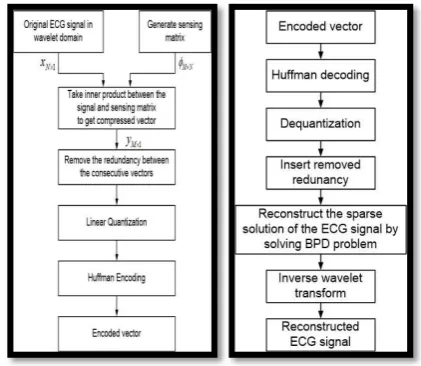
End-to-end compression and decompression process adopted for realization of proposed algorithm is as shown in figure 2. Working principle of ABMWCS algorithm is illustrated in algorithm 1 & 2 and explained below.
Compression:
Mathematical model applied for the proposed algorithm is as follows:
XECG = ΨABM x A
(1) where,
ΨABM : N x N,sparsification matrix in DWT domain. A : N x1 vector of RAW ECG signal coefficients. X ECG : N x1 , sparse ECG vector.
Mother wavelet matrix ,ΨABM is generated adaptively by varying DWT Daubechies dB(i) with index ‘i’ varying between 1 to 45 vanishing moments.
For each ECG block of 512 samples minimum PRD is computed and its corresponding dBi is used for generation of
ΨABM and this sparse matrix is then applied over ECG block
under consideration.
The condition to be satisfied for the CS theory to be applied for sampling of signal are:
(i) RIP condition.
(ii) Mutual Incoherence between ΨABM and
ϕ
MxNmatrices Realization of RIP for embedded compression is difficult. Hence, MIP property is preferred which states that least proximity should be observed between elements ofsparsification matrix ΨABM and sensing matrix
ϕ
MxN. The sensing matrixϕ
MxN chooses Mj samples Nj raw coefficients and compresses the signal. The target dimension ‘M’ for sensing matrix of each ECG block block(j) to be compressed is found as below:Mj ≤ Kj / C log10 (Nj /Kj) (2)
where constant, C > 0
The compressed ECG vector is obtained by taking inner product in (3)
YMx1 = <ϕMxN . XECG> (3) where,
ϕ
MxN : M x N ,Gaussian random sensing matrix. Y: M x 1, Compressed vector.Decompression:
The Signal reconstruction is done by optimal solution for signal recovery is found by following equation and applying BPDN algorithm for l1 norm.
(4)
where is the approximated error or noise level in the received data.
Equation (4) is an convex optimization problem and has been solved effectively by deploying spgl1 solver toolbox [19][10].
Algorithm1, ABMWCS calls PRDmin function for determining the best mother wavelet among 1 to 45 for daubechies wavelet using minimum PRD strategy for each ECG block before decomposition. Further decomposition is done using DBmin for corresponding PRDmin found in algorithm 2 followed by compressive sampling phase.
Algorithm 1: ABMWCS
Input : ECG record XECG. Procedure:
1. Read an ECG signal , XECG.
2. Filtration and normalization for removal of artefacts. 3. Divide the ECG signal into ‘B’ blocks each of length N samples.
4. For j ← ‘1 to B’ ECG blocks. 5. Select a ECGblock(j).
6. Call PRDmin() // find out minimum PRD.
7. Apply dbmin(j) and perform DWT based decomposition up to level-6.
8. Apply CS algorithm using dbmin(j) for each block(j). //Adaptive Compression equations (1) to (4)
9. Repeat through step 4 to step11 for all ‘B’ blocks. 10. Perform decompression.//Figure 2
10. Recover optimal length ECG signal by BPDN algorithm.
11. Apply Spline interpolation for each ECG block(j). 12. Reconstruct entire ECG signal XECG.
Output : Compressed vector Y , Reconstructed signal XECG , Avg PRD, Avg CR, Avg SNR and Avg QS, Avg ECs and Avg execution time.
Algorithm 1 represents the logic of proposed ABMWCS algorithm . For each ECG block ECGblock(j), algorithm 2 is called to find ut minimum PRD and associated DBmin .Use the minimum PRD value for DBmin for adaptive DWT decomposition up to level 6. Then compression of ECG signal block(j) is then implemented using equations (1) to (4) which represent CS algorithm computations.
Best mother wavelet is selected as below and logic has been adopted from [14].
Algorithm 2: PRDmin
Input : ECGblock (j)
Procedure:
1. For i ← 1 to 45 db ‘levels’
2.
[cai1,cdi1]←dwt(ECGblock(j),name);//1-level dwt
3.generate v(i)←rand.
4. roundof cail ←cail / v(j) and cdil ←cdil / v(j). 5. compute r(i)← idwt (cail,cdil)
6. r(i) ←r(i).v(i)
7. Update vectors DBN<-[DBN dbi], PRD=[PRD PRDi]. 8. Repeat through step 1 to 7 till i < 45.
9. 9. Compute minimum PRD , PRDmin and corresponding 10. dbmin(j) for block(j).
[image:4.595.318.529.50.233.2]Output : PRDmin and DBmin
Figure 2: ABMWCS algorithm (a) Compression (b) Decompression
Figure 2 shows different stages of ABMWCS algorithm implemented in this paper for both compression and decompression operations.
Adaptive decomposition is applied on ECG signal for best representation of data and sampling is performed using CS algorithm. Redundancy is eliminated between adjacent vectors, linear quantization is done and then encoded by huffman coding technique.
Reverse operations are done at receiver end to reconstruct the signal. Received ECG vector is huffman decoded, de-quantized and redundancy is removed. Sparse CS recovery problem is solved by deploying BPDN algorithm by taking l1-norm and using spgl1 solver toolbox [19]. Finally cubic spline interpolation is applied after inverse DWT operations to reduce error as much as possible between raw and recovered ECG samples.
EXPERIMENTAL DATABASE
Performance of the proposed ABMWCS algorithm was tested by conducting simulation experiments .The test data was chosen from MIT-BIH Arrhythmia database where each record has been acquired and stored using ADC with 11-bit resolution and sampled at 360 Hz .
The proposed algorithm was given ECG record each of 10 seconds and performance metrics were computed. simulations were carried out on MATLAB 2018a. Validation of the proposed ABMWCS algorithm was done using MIT-BIH [20], PTB database[21] and acquired 24-bit ECG data for normal subjects.
PERFORMANCE METRICS
Evaluation of proposed algorithm has been done using metrics defined below, namely Compression Ratio (CR), Percentage root mean square difference (PRD), Signal to Noise Ratio (SNR), Quality score(QS), and Energy consumption (ECS) by ABMWCS algorithm.
The definitions for the metrics are as below:
CR =
x
100
b
b
b
orig comp orig
(5)
where, - Number of bits of original vector.
-Number of bits of
PRD = Ecg Ecg Ecg
X
||X
X ||
100
||X ||
(6)
SNR = dB (7)
[image:5.595.49.280.385.480.2]QS = CR / PRD (8) Reconstruction quality class of “Very good” [10] is desirable post by any compression algorithm to be accepTable. Table.1 shows the different recovery classes.
Table 1 : PRD and Quality Class [10]
Sl.
NO PRD
Reconstructed Signal Quality
1 0 - 2% “Very good”
2 2 - 9% “Very good” or “good”
3 ≥ 9% Not possible to determine the quality group
Energy consumption by ABMWCS algorithm is given in computed by following expression:
=
2 c
M
M c
18. (9)where M, N are defined in (3) above.
Table 2: Simulation Energy parameters[18].
Parameter Value
Initial energy in WBAN node, E0 2 J
Traditional energy consumption , Ee 50nJ/bit
Amplifier energy consumption Eamp 0.01nJ/bit
CS energy consumption, Ec 0.005nJ/bit
V. RESULTS AND DISCUSSIONS
Simulation tests have been carried out using MATLAB software on intel core i3 processor for ECG data with different resolutions like 11-bit MIT-BIH, 16-bit PTB databases and acquired 24-bit ECG data. All the experiments have been carried for first 4096 samples segment of single channel ECG records. Performance of the proposed ABMWCS algorithm can been noted from Tables 3 ,4 and 5 respectively.
Table3:Compression Performance for MIT-BIH Arrhythmia
database ECG recor d Exec time(s )
CR PRD(%
) QS
SNR(dB )
ECS (J)
100 1.646858 63.352
3 0.6625 95.6207 43.5758 1.6137e
-04
101 1.530080 61.8786 0.3776 163.8718 48.4593 1.6544e-04
102 2.093119 71.7330 10.798 6.6429 19.3328 1.3720e-04
103 1.584411 64.524
1 0.7723 83.5520 42.2447 1.5809e
-04
104 1.643468 63.299
0 1.0420 60.7464 39.6425 1.6151e
-04
105 1.426324 64.3288 0.7351 87.5135 42.6734 1.5864e-04
106 1.579878 65.198
9 1.0619 61.3956 39.4779 1.5620e
-04
107 1.530235 62.8196 1.4519 43.2658 36.7610 1.6284e-04
108 1.372609 63.636
4 0.5954 106.873 44.5033 1.6058e
-04
109 1.358829 62.926
1 0.8352 75.3419 41.5641 1.6255e
-04
111 1.484361 64.595
2 0.7668 84.2373 42.3061 1.5790e
-04
112 1.706871 63.0149 0.7850 80.2744 42.1027 1.6230e-04
113 1.439479 64.311
1 0.8752 73.4851 41.1583 1.5869e
-04
114 1.657924 63.725
1 0.6816 93.4955 43.3296 1.6033e
-04
115 1.398198 63.1392 0.7861 80.3183 42.0903 1.6196e-04
116 1.460581 63.9737 1.6585 38.5724 35.6055 1.5964e-04
117 1.415733 64.222
3 0.7527 85.3181 42.4671 1.5894e
-04
118 1.437859 63.387
8 1.2276 51.6348 38.2187 1.6127e
-04
119 1.475720 62.8729 1.0889 57.7415 39.2605 1.6270e-04
121 1.370970 64.2933 0.5750 111.8088 44.8062 1.5874e-04
122 1.299082 62.890
6 0.9972 63.0655 40.0241 1.6265e
-04
123 1.757058 64.3999 0.8774 73.4016 41.1364 1.5844e-04
124 1.400465 64.257
8 0.7471 86.0085 42.5323 1.5884e
-04
201 1.660060 63.9560 0.6198 103.1839 44.1546 1.5968e-04
202 1.431978 62.8551 0.5610 112.0356 45.0203 1.6274e-04
203 1.978333 64.5597 2.4756 26.0779 32.1262 1.5800e-04
205 1.659002 63.9027 0.8389 76.1719 41.5255 1.5983e-04
207 1.864198 63.7607 0.7019 90.8348 43.0740 1.6023e-04
208 2.485718 65.3232 1.0485 62.3017 39.5887 1.5585e-04
209 1.793908 63.565
3 0.9870 64.4054 40.1140 1.6077e
-04
210 1.835365 62.7663 0.6679 93.9779 43.5060 1.6299e-04
212
1.990707 63.8849 1.1333 56.3724 38.9134 1.5988e-04
213 1.716608 64.1335 1.7714 36.2056 35.0338 1.5919e-04
214 1.657709 64.240
1 0.9044 71.0280 40.8725 1.5889e
-04
215 2.480802 63.796
2 1.0606 60.1499 39.4888 1.6013e
-04
217 1.771506 63.0859 1.1959 52.7500 38.4458 1.6211e-04
219 1.838637 64.062
5 1.1359 56.3965 38.8930 1.5939e
-04
220 2.352513 64.719
5 1.1144 58.0742 39.0590 1.5755e
-04
221 1.787511 64.0625 0.6362 100.6934 43.9279 1.5939e-04
222 2.412853 63.2102 0.6756 93.5552 43.4056 1.6176e-04
223 1.740348 64.009
2 0.9079 70.5017 40.8391 1.5954e
-04
228 1.562592 63.032
7 0.7887 79.9197 42.0618 1.6225e
-04
230
1.884032 64.9858 1.2252 53.0424 38.2361 1.5680e-04
231 1.777748 63.1214 0.7772 81.2174 42.1894 1.6201e-04
232 1.645234 63.441
1 0.7140 88.8571 42.9264 1.6112e
-04
234 1.787052 63.671
9 0.7549 84.3410 42.4418 1.6048e
-04
Avg 1.701143 63.7741 1.1417 74.69105 40.6387 1.60E-04
Min 1.299082 61.878
6 0.3776 6.1523 19.6006
1.56E-0 4
Max 2.485718 65.323
2 2.4756
163.871
8 48.4593
1.65E-0 4
Results for 48 ECG records of MIT-BIH arrhythmia database is shown in Table2. It is
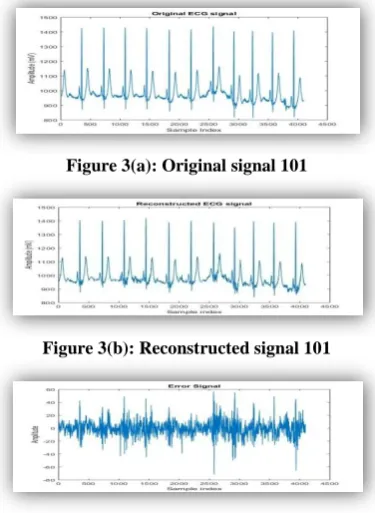
reconstructing ECG record 101 from fewer linear measurements using BPDN algorithm [10] with least PRD of 0.3776 % which fits in the desired range of 0-2% for “very good” quality class as seen from Table1.it can be seen only 1.6544e-4 joules of energy is consumed while retaining 99% of the battery capacity with highest SNR of 48.4593dB and lower execution speed of 1.530080 seconds.
Figure 3(a): Original signal 101
Figure 3(b): Reconstructed signal 101
Figure 3(c): Reconstruction error signal 101
A. Compression Performance for MIT-BIH database. Significant comparisons can be noted between proposed ABMWCS algorithm and landmark contributions [10][14].
Average execution time of 1.70 seconds is taken for compression and reconstruction of the 10 seconds ECG data by the ABMWCS algorithm which is much lower than 2.16secs [14].
The compression ratio (CR) ranges from 61.87 to 65.32 which indicates that much higher data reduction has been done relative to [14]. PRD for 102 record is 10.7984 which is outside the clinically accepTable range i.e.,2-9% but the mean of all the other records have yielded average PRD of 1.14, minimum of 0.3776 for 101 and maximum of 2.4756 for 203 which is very well within the clinically accepTable range. while the average PRD achieved in [14] is 0.23 which is near to zero and it shows that our proposed algorithm has to be modified to scale down average PRD further without compromising other metrics.
Average QS achieved by the proposed algorithm is 74.69105 relative to 67.68 by [14].
Limitation of proposed algorithm is that the Average value of SNR is 40.63878 compare to 66.96 of [14] indicating that signal quality needs to be improved retaining other metrics.
Minimum energy consumption by the ABMWCS, Algorithm 1 can be noted where average of 1.6e-4 J of battery energy is consumed during data acquisition in the digital CS domain. statistically 99.99 % of the energy is retained for capturing ECG record with 4096 samples. This confirms that
proposed ABMWCS algorithm is energy efficient and prolongs the life time of ECG WBAN node .
We can note from Table 3 that least PRD of 0.3776,highest QS of 163.8718 was achieved by ABMWCS algorithm but yielded lower SNR of 48dB for record 101 compared to 60.12 and even average SNR is lower than other works [10] [14]. Average execution delay for compression and decompression is 1.53 seconds compared to 2.16 seconds [14] but achieved CR of 61.8786 and energy consumption of 1.6544E-04 J is very close to mean energy consumption of 1.60E-04J for entire MIT-BIH arrhythmia database but no information about Energy consumption metrics has been mentioned in [14].
Remarks
The proposed ABMWCS algorithm is energy efficient, faster, can compress single channel ECG signal and reconstruct signal with relatively higher quality. Even though most of the ECG records PRD values are in the clinically accepTable range it further needs to be scaled down for reduction of error and increasing SNR.
B. Compression Performance for PTB database
PTB database[21] consists of ECG data collected from healthy volunteers and patients with different heart diseases. Each signal is digitized at 1000 samples per second, with 16 bit resolution over a range of ± 16.384 mV.
Response of the proposed algorithm for selected records of PTB-database used for cross validation can been seen in Table3 .
Table4: Compression Performance for PTB database
ECG record
Exec
time(s) CR PRD(%) QS SNR(dB) ECS (J)
s0010_
rem 1.82383 63.1747 7.2883 8.6680 22.7475 1.6186e-04 s0014
lrem 1.85069 63.0149 3.3222 18.9678 29.5715 1.6230e-04
s0015l
rem 1.71190 63.5476 1.9535 32.5296 34.1836 1.6082e-04 s0016
lrem 1.55645 64.0447 11.3210 5.6572 18.9223 1.5944e-04
s0017l
rem 1.37532 64.3999 3.1820 20.2389 29.9460 1.5844e-04 s0020a
rem 1.60103 63.8139 1.8351 34.7743 34.7269 1.6008e-04 s0021a
rem 1.75380 63.6186 3.2665 19.4763 29.7184 1.6063e-04
Avg 1.66758 63.6591 4.59551 20.0445 28.54517 1.61E-04
Min 1.37532 63.0149 1.8351 5.6572 18.9223 1.58E-04
Max 1.85069 64.3999 11.321 34.7743 34.7269 1.62E-04
Remarks
[image:6.595.75.263.139.396.2]C: Compression Performance for 24-bit ECG records
The two channel ECG signals of subjects of various age with normal medical profile were recorded with 24-bit ADC resolution, sampling rate of 102.4Ksps by using TI ADS1293 EVM [22] analog front end (AFE) acquisition module as shown in Fig 4 .The recorded signals were saved as text files in the laptop and for our experiments single channel ECG data from the pre-recorded files were extracted.
Figure 4 : 24-bit ECG acquisition (TI ADS 1293 EVM Board)
Table4: Compression Performance for acquired single channel 24-bit ECG data.
ECG record
Exec time(s )
CR PRD(%
) QS
SNR(dB
) ECS (J)
Eas (subject1
)
2.331510 59.9254 2.3182 25.8494 32.6968 1.7076e-04
Haracq (subject2
) 1.704337 59.5170 4.3162
13.789
2 27.2980
1.7187e-0 4
Praacq (subject3
) 2.446583 62.9616 2.2566
27.900
9 32.9308
1.6245e-0 4
Sh (subject4
)
1.888173 66.9034 5.4858 12.1957 25.2152 1.5135e-04
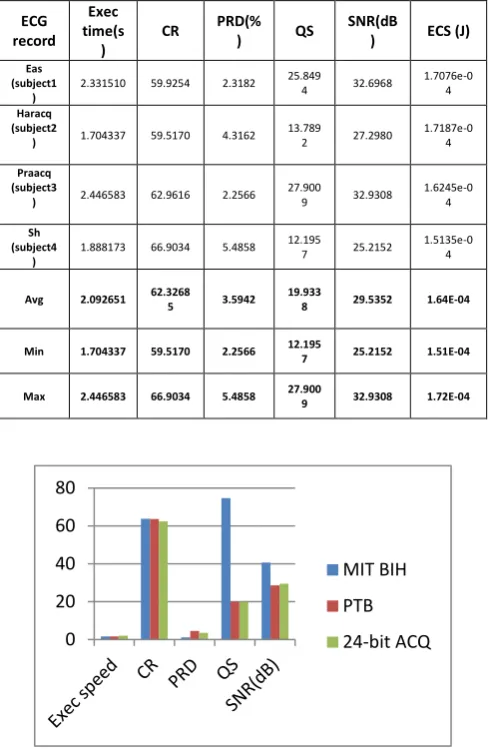
Avg 2.092651 62.32685 3.5942 19.9338 29.5352 1.64E-04
Min 1.704337 59.5170 2.2566 12.195
7 25.2152 1.51E-04
[image:7.595.95.245.155.277.2]Max 2.446583 66.9034 5.4858 27.9009 32.9308 1.72E-04
[image:7.595.47.292.344.719.2]Figure 5:Comparision of ABMWCS metrics for different Databases
Figure 6:Energy profile of ABMWCS algorithm
Remarks
It can be observed that even for the real-time ECG data acquired from normal subjects using TI ADS1293 board the performance of ABMWCS algorithm is considerable from clinical stand point of view with average PRD of 3.59 ,execution speed of 2.09 secs ,CR of 62.32,SNR of 29.5dB and energy consumption is around 1.64E-04 joules which is very near to average energy consumption metrics for MIT-BIH and PTB database.
Figure5 and 6 give comparision between average values of metrics for the proposed ABMWCS algorithm. Minimum energy consumption has been observed for the 11-bit MIT-BIH database and maximum for the 24-bit ECG data. As bit resolution increases the PRD also increases making it difficult for quality recovery. Overall it can be inferred that the proposed ABMWCS algorithm is energy efficient, faster and supports better reconstruction quality for signals tested from two universal databases and one real-time acquired 24-bit resolution data. Hence the performance of the proposed ABMWCS algorithm is validated particularly for energy consumption metric.
VI. CONCLUSION
In this article an energy efficient compression algorithm, ABMWCS has been proposed which selects best mother wavelet based on least PRD value for every ECG block and then compressive sensing is applied . Simulation experiments were carried out for 4096 samples of each ECG record with different bit-resolutions drawn from MIT-BIH, PTB databases and 24-bit resolution ECG data was acquired using ADS1293 board. Average execution delay of 1.7 seconds for compression and recovery of 10 seconds ECG data. Results reveal that energy consumption of 1.60E-04J or 0.01% only was utilized by ABMWCS algorithm for performing adaptive compressive sensing and is faster than its predecessors, but average PRD of 1.141733 for MIT -BIH, 4.595514 for PTB dataset and 3.5942 for 24-bit ECG are relatively higher. In all three tested datasets the PRD is within 2-9 % of the desired bracket for clinical acceptability. It can also be observed that the proposed ABMWCS algorithm extends the node life time by very less battery utilization for sensing ECG .Overall it can be inferred that the proposed ABMWCS algorithm is energy efficient, faster and supports better reconstruction quality for signals tested from two universal databases and one real-time acquired 24-bit resolution data. Hence the performance of the proposed ABMWCS algorithm is validated particularly for low energy consumption, lesser execution speed than [14]
which is much required in
WBAN node. Further
reduction of PRD and
0 20 40 60 80
MIT BIH
PTB
24-bit ACQ
1.55E-04 1.60E-04 1.65E-04
MIT BIH PTB 24-bit ACQ
ECS(J)
improvement in other metrics needs to be explored by applying suitable CS recovery algorithms.
ACKNOWLEDGMENT
We sincerely thank Ms. Komalakumari for extending help in debugging programs and volunteers whose normal ECG signals were recorded for research purpose. We also thank anonymous reviewers for their valuable feedback .
REFERENCES
1. Non-communicable Diseases (NCD) Country Profiles-[online] www.who.int- World Health Organization –accessed on 26.10.2018. 2. Movassaghi et al., “Wireless body are networks: A Survey”, IEEE
communications surveys and Tutorials, Vol. 16, No. 3, Third Quarter 2014.
3. “Arrhythmias”, Heart foundation, 2014.
4. “BioPatch Wireless Device” - Zephyr Technology Corporation [online] http://zephyranywhere.com/products/biopatch/ - accessed 07/08/2015.
5. D. L. Donoho, “Compressed sensing”, IEEE Trans. on Inform. Theory, vol. 52, no. 4, pp. 1289–1306, Apr. 2006.
6. 6. S. M. S. Jalaleddine, C. G. Hutchens, R. D. Stranttan, and W. A. Coberly,“ ECG data compression techniques : A unified approach”, IEEE Trans.Biomed. Eng., vol. 37, no. 4, pp. 329–343, Apr. 1990.
7. 7. mmanuel J. Candès, Michael B. Wakin , “An Introduction to Compressive Sampling”, IEEE signal processing magazine, March 2008, pp:21-30
8. 8. Andrianiaina Ravelomanantsoa, “Simple and fficient Compressed Sensing ncoder for Wireless Body Area etwork”,IEEE Transactions on Instrumentation and Measurement ,Vol.63, NO.12, December 2014, pp: 2973-2982
9. DarrenCraven et.al., “ nergy-efficient Compressed Sensing for ambulatory ECG monitoring”, Computers in Biology and Medicine”, Elsevier, 2016, pp:1–13.
10. Mamaghanian et al.,“Compressed Sensing For Real-Time Energy-Efficient ECG Compression On Wbsn”, IEEE transactions on biomedical engineering, vol. 58, no. 9, september 2011.
11. Jun Zhang, Liang Yuand Yuanqing Li, “ nergy-Efficient ECG Compression on Wireless Biosensors via Minimal Coherence Sensing and Weighted l1 Minimization Reconstruction”, IEEE Journal Of Biomedical And Health Informatics, vol. 19,issue 2,march 2015.
12. JiaLi Ma, TanTan Zhang, and MingChui Dong, “A ovel ECG Data Compression Method Using Adaptive Fourier Decomposition With Security Guarantee in e-Health Applications”, IEEE Journal Of Biomedical And Health Informatics, vol. 19, issue 3, may 2015. 13. Laurent Brechet, Marie-Françoise Lucas, Christian Doncarli, and
Dario Farina, “Compression of Biomedical Signals With Mother Wavelet Optimization and Best-Basis Wavelet Packet Selection”,
IEEE Transactions On Biomedical Engineering, vol. 54, issue 12, December 2007.
14. Veer Amol Motinath, Chandan Kumar Jha, Maheshkumar H. Kolekar, “A ovel ECG Data Compression Algorithm using Best Mother Wavelet Selection”, IEEE Intl. Conference on Advances in Computing, Communications and Informatics (ICACCI), Sept. 21-24, 2016, Jaipur, India.
15. Rakesh Kumar & Indu Saini, “Empirical Wavelet Transform Based ECG Signal Compression”, IETE Journal of Research, 60:6,423-431. 16. Jeevan K. Pant and Sridhar Krishnan, “ fficient Compressive Sensing of ECG Segments Based on Machine Learning for QRS-Based Arrhythmia Detection”, IEEE ,2016.
17. Gabriel Peyr_e., “Best Basis Compressed Sensing.”, IEEE
Transactions on Signal Processing, Institute of Electrical and Electronics Engineers, 2010, volume 58 issue 5, pp.2613 -2622. 18. Dapeng Wu,Boran Yang,Honggang Wang,Dalei Wu And Ruyan
Wang, “An nergy-Efficient Data Forwarding Strategy for Heterogeneous WBA s”,IEEE access, Volume 4, 2016.
19. .vanden Berg and M. P. Friedlander, “SPGL1: A solver for large-scale sparse reconstruction,” April 2015.
20. http://www.cs.ubc.ca/labs/scl/spgl1. 21. MIT-BIH arrhythmia database [online],
www.physionet.org/mitdb/- last accessed on 14/09/2017. 22. PTB database [online] ,www.physionet.org/ptb/ - last accessed on
14/09/2017.
23. Ads 1293 Evm Data Sheet,[online], www.ti.com, November 2012. Razzaque, Mohammad, and Simon Dobson, "Energy-Efficient Sensing in Wireless Sensor Networks Using Compressed Sensing", Sensors, 2014.
24. Zhang, Zheng, Yong Xu, Jian Yang, Xuelong Li, and David Zhang, "A Survey of Sparse Representation: Algorithms and Applications",IEEE Access, 2015.
AUTHORS PROFILE
Mr.Rajashekar Kunabeva has 4 Years of Industrial experience and 15 years in Academics .His area of interests are wireless sensor networks, biomedical signal processing and allied fields. He is pursuing research work towards obtaining Ph.D. He is a Life Member of Indian Society for Technical Education (ISTE).
Dr. Manjunatha P has completed his BE degree from kuvempu University in 1994, ME from Karnataka University in 1999, and Ph.D. from IIT Bombay, Mumbai in the area of wireless sensor networks in 2012. He is presently working as Professor in the department of ECE, JNNCE Shivamogga. He has an experience of around 18 years in Academics. His areas of interest are communication, signal processing, wireless sensor networks, Image Processing, , Pattern Recognition and Natural Language Processing. He has to his credits, 01- chapter Edited Text Book, 03- International Journals, and 12- Conferences papers. He is a Fellow of the Institution of Electronics and Telecommunication Engineers (IETE), a Life Member of Indian Society for Technical Education (ISTE. He is the reviewer of International Journal of Systems Assurance Engineering and Management (IJSA).
![Table 1 : PRD and Quality Class [10]](https://thumb-us.123doks.com/thumbv2/123dok_us/8183024.255494/5.595.49.280.385.480/table-prd-quality-class.webp)