Chemistry Publications
Chemistry
2002
STM study of the atomic structure of the
icosahedral Al-Cu-Fe fivefold surface
T. Cai
Iowa State University
V. Fournée
Iowa State UniversityThomas A. Lograsso
Iowa State University, [email protected]
A. R. Ross
Iowa State UniversityPatricia A. Thiel
Iowa State University, [email protected]
Follow this and additional works at:
http://lib.dr.iastate.edu/chem_pubs
Part of the
Materials Science and Engineering Commons
, and the
Physical Chemistry Commons
The complete bibliographic information for this item can be found at
http://lib.dr.iastate.edu/
chem_pubs/40
. For information on how to cite this item, please visit
http://lib.dr.iastate.edu/
howtocite.html
.
This Article is brought to you for free and open access by the Chemistry at Iowa State University Digital Repository. It has been accepted for inclusion in Chemistry Publications by an authorized administrator of Iowa State University Digital Repository. For more information, please contact
STM study of the atomic structure of the icosahedral Al-Cu-Fe fivefold
surface
Abstract
We use scanning tunneling microscopy (STM) to investigate the atomic structure of the icosahedral (i-)
Al-Cu-Fe fivefold surface in ultra high vacuum (UHV). Studies show that large, atomically flat terraces feature
many ten-petal “flowers” with internal structure. The observed flower patterns can be associated with features
on Al rich dense atomic planes generated from two-dimensional cuts of bulk models based on x-ray and
neutron diffraction experiments. The results confirm that the fivefold surface of i-Al-Cu-Fe corresponds to a
bulk-terminated plane.
Keywords
Ames Laboratory, Materials Science and Engineering
Disciplines
Materials Science and Engineering | Physical Chemistry
Comments
This article is from
Physical Review B
65, no. 14 (2002): 140202, doi:
10.1103/PhysRevB.65.140202
.
STM study of the atomic structure of the icosahedral Al-Cu-Fe fivefold surface
T. Cai,*V. Fourne´e,†T. Lograsso, A. Ross, and P. A. Thiel‡
Department of Chemistry, Department of Metallurgy and Ceramics, and Ames Laboratory, Iowa State University, Ames, Iowa 50011 共Received 1 November 2001; published 28 March 2002兲
We use scanning tunneling microscopy共STM兲 to investigate the atomic structure of the icosahedral 共i-兲 Al-Cu-Fe fivefold surface in ultra high vacuum共UHV兲. Studies show that large, atomically flat terraces feature many ten-petal ‘‘flowers’’ with internal structure. The observed flower patterns can be associated with features on Al rich dense atomic planes generated from two-dimensional cuts of bulk models based on x-ray and neutron diffraction experiments. The results confirm that the fivefold surface of i-Al-Cu-Fe corresponds to a bulk-terminated plane.
DOI: 10.1103/PhysRevB.65.140202 PACS number共s兲: 61.44.Br, 68.35.Bs, 68.37.Ef
The lack of periodicity within the class of intermetallics known as quasicrystals1 poses a challenge in determining their surface structure. The most common technique, dy-namical theory of electron diffraction, relies very much on the existence of model systems based on periodic structure. Therefore, an exact analysis is not achievable for quasicrys-tals. Approximations have been introduced successfully into dynamical low-energy electron diffraction 共LEED兲 calcula-tions to determine structures of i-Al-Pd-Mn共Refs. 2, 3兲and
i-Al-Cu-Fe 共Ref. 4兲 fivefold (5 f ) surfaces—and the result has been supported in the former case by data from x-ray scattering,5 low-energy ion scattering,6 and temperature-programmed desorption.7However, these techniques provide only averaged information on surface structure. Alterna-tively, scanning tunneling microscopy 共STM兲 probes the electronic surface structure at atomic scale in real space8and thus its application does not require periodicity in the mate-rial. In this work, we employ STM as our main technique to probe the surface structure of i-Al-Cu-Fe quasicrystal.
STM has been actively used to investigate the structure of the i-Al-Pd-Mn 5 f surface.9–17Annealing the sputtered sur-face at appropriate temperature routinely generates a step-terrace surface structure. In STM studies, an ultimate goal is to obtain high-resolution images displaying the fine structure
共at the best, the direct images of the atomic arrangements兲on these flat terraces, and to relate the surface structure to the atomic structure of a bulk model. Two facts challenge the achievement of this goal. First, the intrinsic structural and chemical complexity in the quasicrystals undoubtedly engen-ders a complex geometric and/or electronic surface structure. Second, both the tip specification 共the size and the shape兲 and the scanning conditions greatly influence the resolution and appearance of the STM images. In recent years, several research groups have recorded STM images, with different resolution and at different scales, on flat terraces of i-Al-Pd-Mn 5 f surfaces.11–15,17 These images are usually domi-nated by dark ‘‘holes,’’ which are sometimes shaped like pentagons and sometimes like fivefold stars, depending upon the resolution of the tip.
Among icosahedral quasicrystals, it is known that i-Al-Cu-Fe has a bulk structure very similar to that of i-Al-Pd-Mn. It is reasonable to expect that surfaces of these two materials with the same high-order symmetry will exhibit similar structure. In this paper, we test that hypothesis. There
has been only one previously published STM image of an
i-Al-Cu-Fe surface,18 and it was not possible at that time to attempt interpretation of the observed features, partly due to lack of information about the bulk structure and partly due to the lack of high-resolution in the imaging.
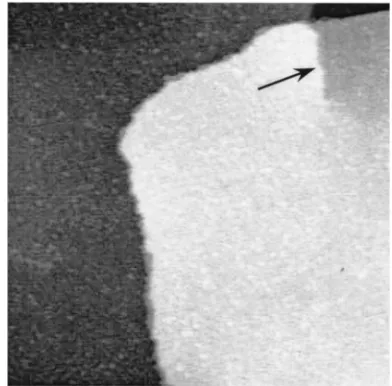
Figure 1 represents the step-terrace structure commonly obtained on a clean, well annealed i-Al-Cu-Fe 5 f surface in UHV, after preparation as described in other publications.4,19,20 We have discussed the step height mea-surement and the structural imperfection along the 5 f axis in detail in a previous paper.4 The step that separates the two major adjacent terraces in Fig. 1 is 0.40 nm high. The peak-to-peak corrugation across individual terraces is about 0.05 nm. Higher protrusions, about 0.1 nm high共which appear as the brighter bumps on the terrace兲, are often observed on the surface as well. These may be similar in origin to the larger protrusions that were reported previously in highly resolved STM images of the i-Al-Pd-Mn 5 f surface. There, analysis of their shapes led to the conclusion that they should be regarded as part of the icosahedral structure, and not impu-rities randomly distributed on the surface.16
[image:3.612.338.534.501.694.2]High-resolution STM关Fig. 2共a兲兴 shows the fine structure
FIG. 1. STM image (100⫻100 nm2) showing the typical step-terrace structure. The arrow indicates a screw dislocation; these are often observed on the 5 f i-Al-Cu-Fe surface.4
RAPID COMMUNICATIONS
PHYSICAL REVIEW B, VOLUME 65, 140202共R兲
on the flat terraces. The Fourier transform from such a image of 50⫻50 nm2 关see inset in Fig. 2共a兲兴exhibits tenfold sym-metry, consistent with the 5 f quasiperiodic order on the ter-race. The most notable features in the image are the ‘‘flow-ers’’ that are approximately 1.5 nm in diameter, measured from peak to peak of the outermost petals, as shown in Fig. 2共c兲. Several flowers are outlined in Fig. 2共a兲, and labeled A–C. In their pioneering STM work on i-Al-Cu-Fe 5 f
sur-face, Becker et al.18 also reported some ‘‘daisy’’-like struc-tures that appeared like central spots surrounded by a series of ring- or U-shaped features. However, features in their STM image were not sufficiently resolved. We have obtained STM images at higher resolution, which makes it possible to analyze the structural features of the flowers. The ‘‘com-plete’’ flowers关Fig. 2共a兲, A–C兴consist of ten petals. Despite the distortion of the STM scan, the ten petals appear to be uniformly distributed共as far as both intensities and positions are concerned, e.g., flower A兲in a circle, which gives local tenfold symmetry. However, some flowers are missing parts of petals 共e.g., flower B兲. The center of the flowers is either filled 共e.g., flowers A and B兲or empty 共e.g., flower C兲. Be-tween the center and the ring of ten petals in each flower, there is clearly another ring of bright contrast, which, how-ever, is not well resolved in the STM images. These features are clarified in the schematic sketches of Fig. 2共c兲.
It is clear that there is also a wealth of features between the intact flowers, which we call the ‘‘glue’’ area. In some cases, four close petals from two neighboring flowers 共two petals from each flower兲constitute four vertices of a penta-gon, with an additional atom that does not belong to any flowers fulfilling the fifth vertex. Such pentagons appear much more clearly in Fig. 2共b兲. Another type of glue object is a nearly petal-free inner ring, with a diameter of 1.05 nm, shown in Fig. 2共a兲. Such a ring can be resolved into ten separate spots, defining axes parallel to the axes of the petal-rich flowers, suggesting that the inner rings have this sym-metry in the full flowers as well. Overlapping is another possible configuration for adjacent flowers, as indicated by the white arrows in Fig. 2共a兲.
[image:4.612.341.533.57.253.2]Some groups of five flowers form large pentagons, as out-lined in Fig. 3. Noting that the lines linking the center and one of the ten petals of each flower define five directions, we connect the flowers by five sets of parallel lines in the five
FIG. 2. 共a兲 High resolution STM image (20⫻20 nm2) of an atomically flat terrace. Inset: Fourier transform of an image of 50⫻50 nm2on a terrace. A: complete flower with ten petals and filled center. B: flower with one missing petal and filled center. C: flower with empty center. D: nearly petal-free flower. Ar-rows: overlapping of neighboring flowers.共b兲High resolution STM image (10⫻20 nm2) showing small pentagons gluing two adjacent flowers. Large circles: flower patterns. Small circle: outlines of small gluing pentagons. 共c兲 Schematic of a flower, together with line scans of a flower with filled center共top curve in box兲, and an empty center共lower curve in box兲.
FIG. 3. Same high resolution STM image as in Fig. 2. Penta-gons are drawn to illustrate the local 5 f arrangements of flowers. Parallel lines separated by different spacings align the flowers. The arrow indicates where a displacement takes place. The splitting of a wider spacing into two smaller ones is shown in the upper-right-most spacing.
CAI, FOURNE´ E, LOGRASSO, ROSS, AND THIEL PHYSICAL REVIEW B 65 140202共R兲
directions defined above. Figure 3 shows only part of one set of parallel lines to illustrate the idea. Analysis shows that these lines are mainly separated by two different spacings:
L⫽1.88 nm for the wider spacings and S⫽1.17 nm for the narrower ones. The ratio L/S⫽1.61 is close to the ‘‘golden mean’’⫽(
冑
5⫹1)/2⬇1.618.The arrow in Fig. 3 indicates a location where one parallel line stops and shifts at right angles. Such discontinuity and displacement changes the sequence of the consecutive spac-ings, e.g., from a LLS sequence to a LSL one, which makes it impossible to identify the exact sequence of successive spac-ings. Another reason why it is difficult to identify exact se-quences is because one could also identify other, more closely spaced lines connecting flower centers, particularly when dealing with extended images of larger area. An ex-ample is shown by the upper-right-most spacing in Fig. 3. The wider spacing 共L兲 then would be reasonably split into two shorter spacings of S and S/ 共note L⫽S⫹S/兲.
Based on x-ray and neutron diffraction measurements, Boudard et al.21 derived a bulk model for i-Al-Pd-Mn. The bulk structure can be described as atomically dense planes, quasiperiodically stacked along the 5 f axis, and separated by less dense planes. The atomically dense planes can be sepa-rated into a small number of groups, each group encompass-ing only a small range of variations in composition and local order.
Similar experiments have been carried out on the i-Al-Cu-Fe alloy,22 and a similar structure model can be used to describe its bulk structure. Based on this model, dynamic LEED calculations4 concluded that the outermost layer per-pendicular to the 5 f axis is Al-rich with a fraction of Fe atoms. Figure 4 presents a 10⫻10 nm2 section of such a plane, generated from the bulk model. This atomically dense plane contains 85% Al atoms and 15% Fe atoms.
Many flowerlike patterns, with size similar to those that dominate the STM images, are easily identified in the plane
共Fig. 4兲. Each flower consists of two concentric rings with a
filled center. Each ring possesses ten atoms. However, the choice of atoms to form such flower patterns in the plane is not unique. We have chosen the flowers in Fig. 4 in such a way that their arrangement matches the pattern of flowers drawn in the STM image of Fig. 3, and vice versa. As ob-served in the STM images, local ‘‘glue’’ configurations that connect the neighboring flowers, such as the small penta-gons, overlapping flowers, and intermediate-sized rings, are also identified in the plane, as indicated by the constructions in Fig. 4. The size of the features identified in the model
共Fig. 4兲 compares very well with the size of the features measured with STM, as indicated in Table I.
Furthermore, we note that the center of the patterns iden-tified in Fig. 4 is either occupied by Al atom or Fe atom. In addition, some flower patterns have Fe atoms, instead of only Al atoms, occupying the atomic positions in the petals. Com-paring the obtained STM image 共Fig. 3兲 where the flowers are either filled or empty at the center and some flowers exhibit missing petals, we speculate that Fe and Al atoms contribute differently to the electronic structure at the surface and thus respond differently to the tunneling conditions used to acquire the presented STM images. Another possible
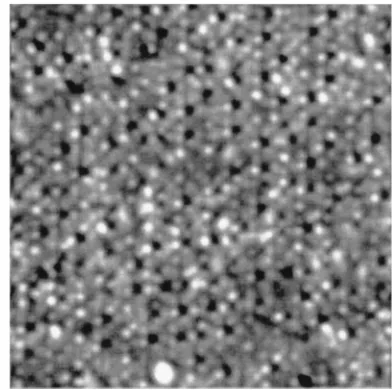
in-FIG. 5. High resolution STM image (20⫻20 nm2) of an i-Al-Pd-Mn 5 f surface, obtained under experimental conditions very similar to those of Figs. 2 and 3, and with the same experimental apparatus.
[image:5.612.78.270.58.255.2] [image:5.612.317.561.84.207.2]FIG. 4. Atomic positions in a plane (10⫻10 nm2) generated from experimental bulk structure model. Filled circles: Al atoms. Unfilled circles: Fe atoms. The sketched contour illustrates the matching part of the STM image outlined in Fig. 3.
TABLE I. Experimental and model-based sizes of characteristic features.
Feature
Size in STM data共nm兲
Size in model共nm兲
Full flowers共petal to petal兲 1.57⫾0.06 1.52 Inner ring 1.05⫾0.04 0.94 Small pentagon共edge length兲 0.46⫾0.02 0.47 Large pentagon共edge length兲 2.04⫾0.08 1.99
L共defined in Fig. 3兲 1.88⫾0.07 1.89
S共defined in Fig. 3兲 1.17⫾0.05 1.17
L/S 1.61⫾0.06 1.61
RAPID COMMUNICATIONS
STM STUDY OF THE ATOMIC STRUCTURE OF THE . . . PHYSICAL REVIEW B 65 140202共R兲
[image:5.612.337.533.490.685.2]terpretation for the missing parts共both the empty center and the missing petals兲is local defects on the surface.
Finally, we point out that the atomic-resolution STM im-ages of i-Al-Cu-Fe presented in this paper are quite different than those for the i-Al-Pd-Mn 5 f surface. On the latter sur-face, pentagonal or star-shaped holes are the predominant features reported to date.11–14,17 We have ruled out differ-ences in experimental conditions in various laboratories as being responsible for the differences, as follows: in the same chamber, we acquired a 30⫻30 nm2 high-resolution STM image on an i-Al-Pd-Mn 5 f surface 共Fig. 5兲 with the same tip under similar tunneling conditions. The most notable fea-tures in Fig. 5 are the pentagonal depressions aligned in par-allel directions. Nonetheless, images for both alloys can be interpreted in terms of features expected for the bulk-terminated surfaces.17 Hence, it is puzzling why the surface STM images are very different, when the bulk structures of the two quasicrystals are very similar. Perhaps subtle differ-ences in the electronic structure simply serve to emphasize the pentagonal holes in one alloy, and the flowers in the other.
In summary, we have obtained atomic resolution STM images on the atomically flat terraces of i-Al-Cu-Fe 5 f sur-face. The analysis of the images shows that the flat terraces exhibit local 5 f symmetry, consistent with the quasiperiod-icity on the surface. The acquired STM images display the atomic arrangements on the surface with sufficient resolution so that it is possible to compare the STM image directly with the atomically dense planes generated from the experimental bulk structure. The comparison shows a good match. We conclude that these images are consistent with the descrip-tion of the 5 f surface of i-Al-Cu-Fe as Al-rich, bulk-terminated planes.
This work was supported by the Director, Office of Sci-ence, Office of Basic Energy SciSci-ence, Materials Science Di-vision of the U.S. Department of Energy under Contract No. W-405-Eng-82. We would also like to acknowledge that STM studies of the atomic-scale structure of 5 f Al-Pd-Mn surfaces were underway in parallel with our own work, in the laboratories of R. McGrath共Univ. Liverpool兲and D. Gratias
共LEM-CNRS/ONERA兲. We thank them for sharing informa-tion openly and generously.
*Present address: Brookhaven National Laboratory, Chemistry Department, Upton, NY 11973-5000.
†Present address: Laboratoire de Science et Ge´nie des Mate´riaux
et de Me´tallurgie, Center d’Inge´nierie des Mate´riaux, Ecole des Mines de Nancy, F-54042 Nancy, France.
‡Corresponding author. Email address: [email protected]
1C. Janot, in Quasicrystals: A Primer, edited by C. J. Humphreys,
P. B. Hirsch, N. F. Mott, and R. J. Brook, Monographs on the Physics and Chemistry of Materials Vol. 48 共Clarendon Press, Oxford, 1992兲.
2
M. Gierer, M. A. Van Hove, A. I. Goldman, Z. Shen, S.-L. Chang, C. J. Jenks, C.-M. Zhang, and P. A. Thiel, Phys. Rev. Lett. 78, 467共1997兲.
3M. Gierer, M. A. Van Hove, A. I. Goldman, Z. Shen, S.-L. Chang,
P. J. Pinhero, C. J. Jenks, J. W. Anderegg, C.-M. Zhang, and P. A. Thiel, Phys. Rev. B 57, 7628共1998兲.
4T. Cai, F. Shi, Z. Shen, M. Gierer, A. I. Goldman, M. J. Kramer,
C. J. Jenks, T. A. Lograsso, D. W. Delaney, P. A. Thiel, and M. A. V. Hove, Surf. Sci. 495, 19共2001兲.
5M. J. Capitan, J. Alvarez, J. L. Joulaud, and Y. Calvayrac, Surf.
Sci. 423, L251共1999兲.
6R. Bastasz, C. J. Jenks, T. A. Lograsso, A. R. Ross, P. A. Thiel,
and J. A. Whaley, in Quasicrystals, edited by E. Belin-Ferre´, P. A. Thiel, K. Urban, and A.-P. Tsai, MRS Symposia Proceedings No. 643共Materials Research Society, Warrendale, NJ, 2001兲. 7C. J. Jenks, T. A. Lograsso, and P. A. Thiel, J. Am. Chem. Soc.
120, 12 668共1998兲.
8C. Bai, Scanning Tunnelling Microscopy and Its Applications,
Springer Series in Surface Sciences Vol. 32 共Springer, Berlin, 2000兲.
9P. Ebert, M. Feuerbacher, N. Tamura, M. Wollgarten, and K.
Ur-ban, Phys. Rev. Lett. 77, 3827共1996兲.
10P. Ebert, F. Kluge, B. Grushko, and K. Urban, Phys. Rev. B 60,
874共1999兲.
11T. M. Schaub, D. E. Bu¨rgler, H.-J. Gu¨ntherodt, and J. B. Suck,
Phys. Rev. Lett. 73, 1255共1994兲.
12T. M. Schaub, D. E. Bu¨rgler, H.-J. Gu¨ntherodt, and J.-B. Suck, Z.
Phys. B: Condens. Matter 96, 93共1994兲.
13T. M. Schaub, D. E. Bu¨rgler, H.-J. Gu¨ntherodt, J. B. Suck, and M.
Audier, Appl. Phys. A: Mater. Sci. Process. 61, 491共1995兲. 14T. M. Schaub, D. E. Bu¨rgler, C. M. Schmidt, and H.-J.
Gu¨ntherodt, J. Non-Cryst. Solids 205–207, 748共1996兲. 15
Z. Shen, C. Stoldt, C. Jenks, T. Lograsso, and P. A. Thiel, Phys. Rev. B 60, 14 688共1999兲.
16J. Ledieu, A. Munz, T. Parker, R. McGrath, R. D. Diehl, D. W.
Delaney, and T. A. Lograsso, Surf. Sci. 433–435, 666共1999兲. 17J. Ledieu, R. McGrath, R. D. Diehl, T. A. Lograsso, D. W.
Delaney, Z. Papadopolos, and G. Kasner, Surf. Sci. Lett. 492, L729共2001兲.
18R. S. Becker, A. R. Kortan, F. A. Thiel, and H. S. Chen, J. Vac.
Sci. Technol. B 9, 867共1991兲.
19C. J. Jenks, P. J. Pinhero, Z. Shen, T. A. Lograsso, D. W. Delaney,
T. E. Bloomer, S.-L. Chang, C.-M. Zhang, J. W. Anderegg, A. H. M. Z. Islam, A. I. Goldman, and P. A. Thiel, in Proceedings of the 6th International Conference on Quasicrystals (ICQ6), ed-ited by S. Takeuchi and T. Fujiwara 共World Scientific, Sin-gapore, 1998兲, pp. 741–748.
20Z. Shen, P. J. Pinhero, T. A. Lograsso, D. W. Delaney, C. J. Jenks,
and P. A. Thiel, Surf. Sci. 385, L923共1997兲.
21M. Boudard, M. de Boissieu, C. Janot, G. Heger, C. Beeli, H.-U.
Nissen, H. Vincent, R. Ibberson, M. Audier, and J. M. Dubois, J. Phys.: Condens. Matter 4, 10 149共1992兲.
22M. Cornier-Quiquandon, A. Quivy, S. Lefe`bvre, E. Elkaim, G.
Heger, A. Katz, and D. Gratias, Phys. Rev. B 44, 2071共1991兲.
CAI, FOURNE´ E, LOGRASSO, ROSS, AND THIEL PHYSICAL REVIEW B 65 140202共R兲